



Abstract
Artemisinin (ART) is a most promising antimalarial agent. However, its low aqueous solubility limits its oral absorption, resulting in low bioavailability. In this study, we have successfully discovered a novel cocrystal with 2-methyl resorcinol (ART-2MRE) providing improved solubility compared with a previously reported cocrystal with resorcinol (ART-RES). Single crystal X-ray structure analysis revealed that the ART-2MRE cocrystal was composed of ART and 2MRE in a molar ratio of 2 : 1. Though the ART-2MRE and ART-RES cocrystals were found to have similarities in their crystal structures, with one layer of a cocrystal former and two layers of ART arranged in alternating rows, the ART-2MRE cocrystal showed higher dissolution rate than ART-RES cocrystal. In situ real-time low-frequency (LF) Raman monitoring and powder X-ray diffraction (PXRD) measurements of the crystals during the dissolution test proved useful to investigate the dissolution behavior of the cocrystals. Low-frequency Raman monitoring revealed that as dissolution progressed, there was a continuous shift from the peak unique to the ART-2MRE cocrystal to the peak unique to the ART stable form. Similar observations were obtained in PXRD measurements as well. Furthermore, experiments were conducted by adding a polymer to the dissolution test solution to investigate the dissolution behavior under supersaturation, indicating the possibility of differences in the dissolution behavior between the ART-2MRE cocrystal and ART-RES cocrystal. Understanding the dissolution behavior from cocrystals is essential in developing cocrystals.
This is a visual representation of the abstract.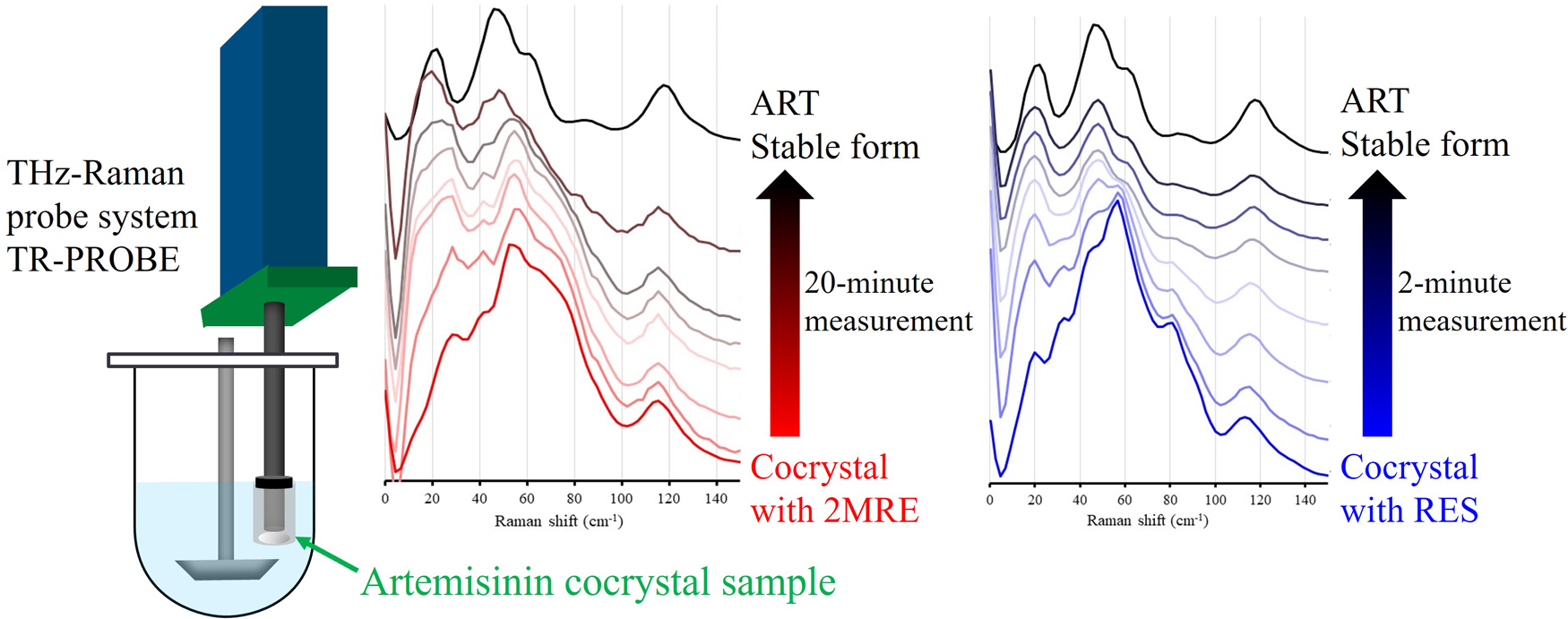
Get full access to this article
View all access options for this article.
References
Supplementary Material
Please find the following supplemental material available below.
For Open Access articles published under a Creative Commons License, all supplemental material carries the same license as the article it is associated with.
For non-Open Access articles published, all supplemental material carries a non-exclusive license, and permission requests for re-use of supplemental material or any part of supplemental material shall be sent directly to the copyright owner as specified in the copyright notice associated with the article.
