




Abstract
The development of non-contact in situ techniques for monitoring cure kinetics has the potential to greatly improve both resin formulation and processing. We have recently shown that low-frequency Raman spectroscopy is a viable method for assessing resin structural cure kinetics and complements the traditional chemical conversion determined from the fingerprint region of the spectrum. In this work, we further evaluate the relationship between structural and chemical conversion by investigating two chemically identical yet rheologically different interpenetrating polymer network resin formulations. Rheological analysis demonstrates a relationship between structural conversion and storage modulus, which is not observed in the chemical conversion data. We show that one can produce master cure kinetics curves with comparable kinetic constants using both the chemical and structural conversion methodologies. Parametric analysis of the structural conversion, chemical conversion, and photorheological conversion was combined with a semi-empirical model for the storage shear modulus as a function of the extent of cure.
This is a visual representation of the abstract.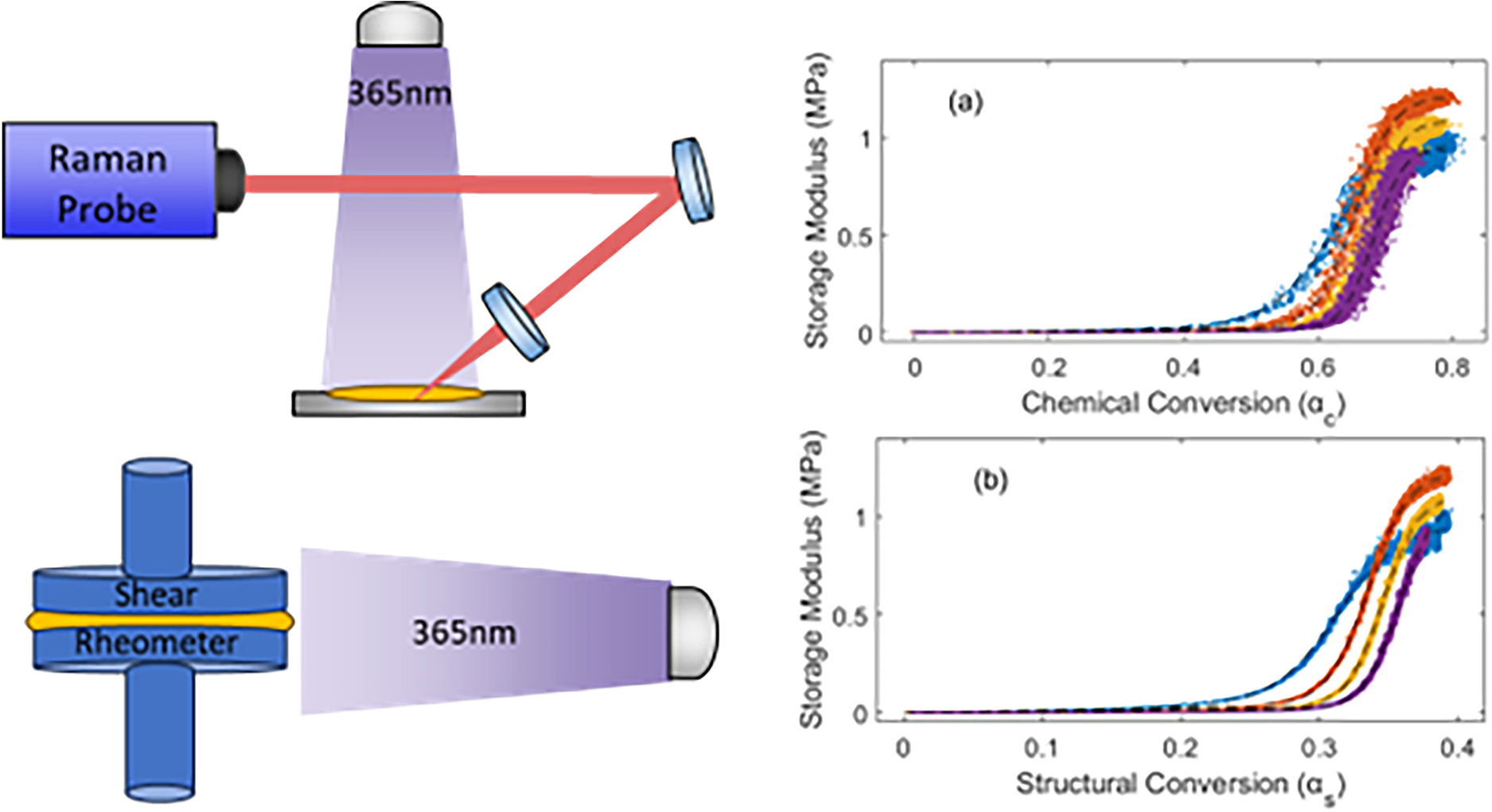
Get full access to this article
View all access options for this article.
References
Supplementary Material
Please find the following supplemental material available below.
For Open Access articles published under a Creative Commons License, all supplemental material carries the same license as the article it is associated with.
For non-Open Access articles published, all supplemental material carries a non-exclusive license, and permission requests for re-use of supplemental material or any part of supplemental material shall be sent directly to the copyright owner as specified in the copyright notice associated with the article.
