




Abstract
For the purpose of investigating the chemical enhancement of amorphous semiconductors as well as increasing the sensitivity of the surface-enhanced Raman spectroscopy (SERS) substrate, titanium dioxide (TiO2) precursors were calcined at different temperatures to generate crystallized TiO2 (c-TiO2) and amorphous TiO2 (a-TiO2) nanosheets, respectively. Afterward, a two-dimensional (2D) a-TiO2/Ag nanosheet SERS substrate was successfully fabricated using electrostatic interaction between a-TiO2 and Ag nanoparticles. In order to demonstrate a greater SERS sensitivity on a-TiO2/Ag compared to either c-TiO2 or Ag nanoparticles alone, the SERS probe molecules rhodamine 6G (R6G) and malachite green (MG) were utilized. Based on the results of SERS detections for probe molecules and contaminants, it demonstrates that a-TiO2/Ag nanosheets produce highly sensitive and repeatable Raman signals. The detectable concentration limits for R6G and MG were found to be 10−11 M and 10–10 M, respectively. And it has been determined that the system exhibits an enhancement factor (EF) of up to 1 × 10⁸. The limit of detection for 4-mercaptobenzoic acid and alizarin red can both reach 1 × 10⁻⁸. Furthermore, a finite-difference time-domain simulation is performed in order to evaluate the magnetic field strength generated by Ag nanoparticles. As a result of the simulation, it is evident that the actual EF is smaller than the calculated one, leading support to the view that a-TiO2 nanosheets have a beneficial effect on the chemical enhancement of SERS.
This is a visual representation of the abstract.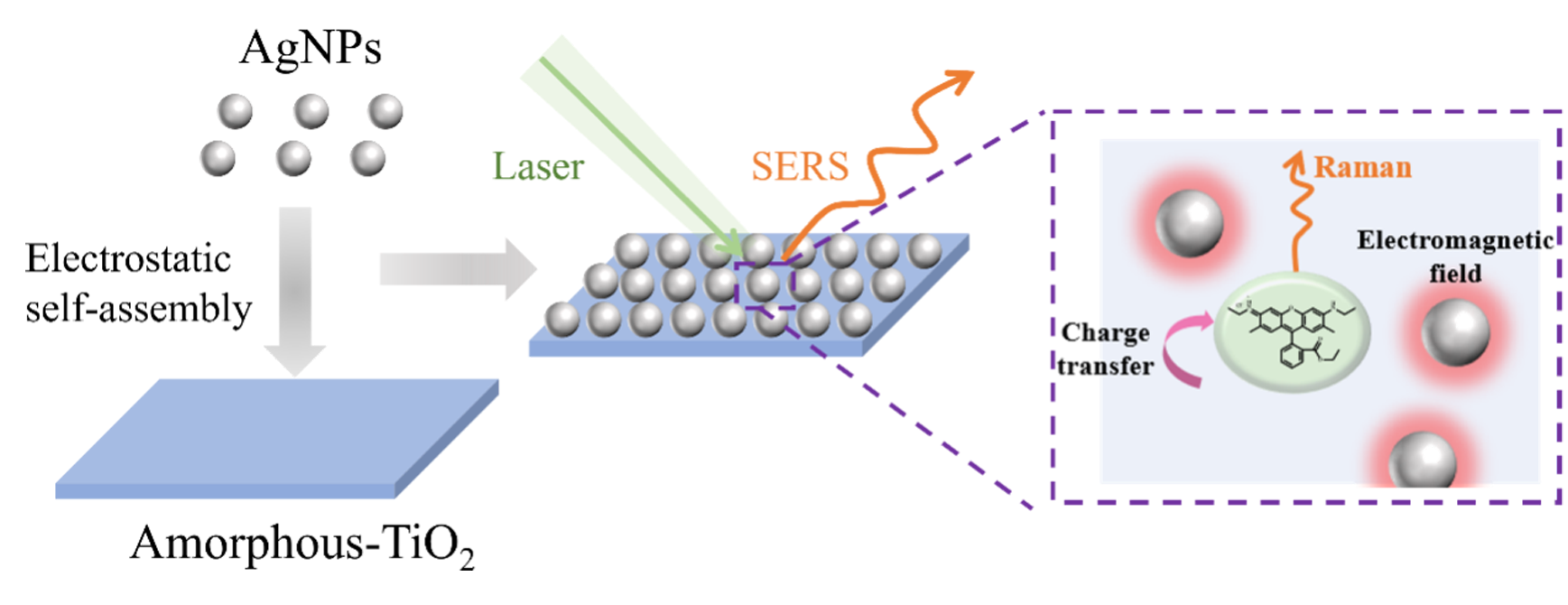
Keywords
Get full access to this article
View all access options for this article.
References
Supplementary Material
Please find the following supplemental material available below.
For Open Access articles published under a Creative Commons License, all supplemental material carries the same license as the article it is associated with.
For non-Open Access articles published, all supplemental material carries a non-exclusive license, and permission requests for re-use of supplemental material or any part of supplemental material shall be sent directly to the copyright owner as specified in the copyright notice associated with the article.
