



Abstract
Surface-enhanced Raman spectroscopy (SERS) is a highly sensitive technique that can assist in trace analysis for biomedical, diagnostic, and environmental applications. However, a major limitation of SERS is surface contamination of the substrates used, which can complicate the spectral reproducibility, limits of detection, and detection of unknown analytes. This is especially prevalent with commercially available substrates as shipping under a controlled and clean environment is difficult. Here we report a method using dilute bleach solutions to remove surface contamination from commercially available substrates consisting of gold-coated nanopillar arrays that maintains functionality. The results show that this method can be used to remove background signals associated with typical surface contamination in commercially available substrates as well as remove thiolated self-assembled monolayers (SAMs). Results indicate the bleach oxidizes the surface contaminants, which can then be easily washed away. Although the metallic surface also becomes oxidized in this process, the surface can be reduced without loss of SERS activity. The SERS intensity of SAMs improved following bleach treatment across all concentrations studied.
This is a visual representation of the abstract.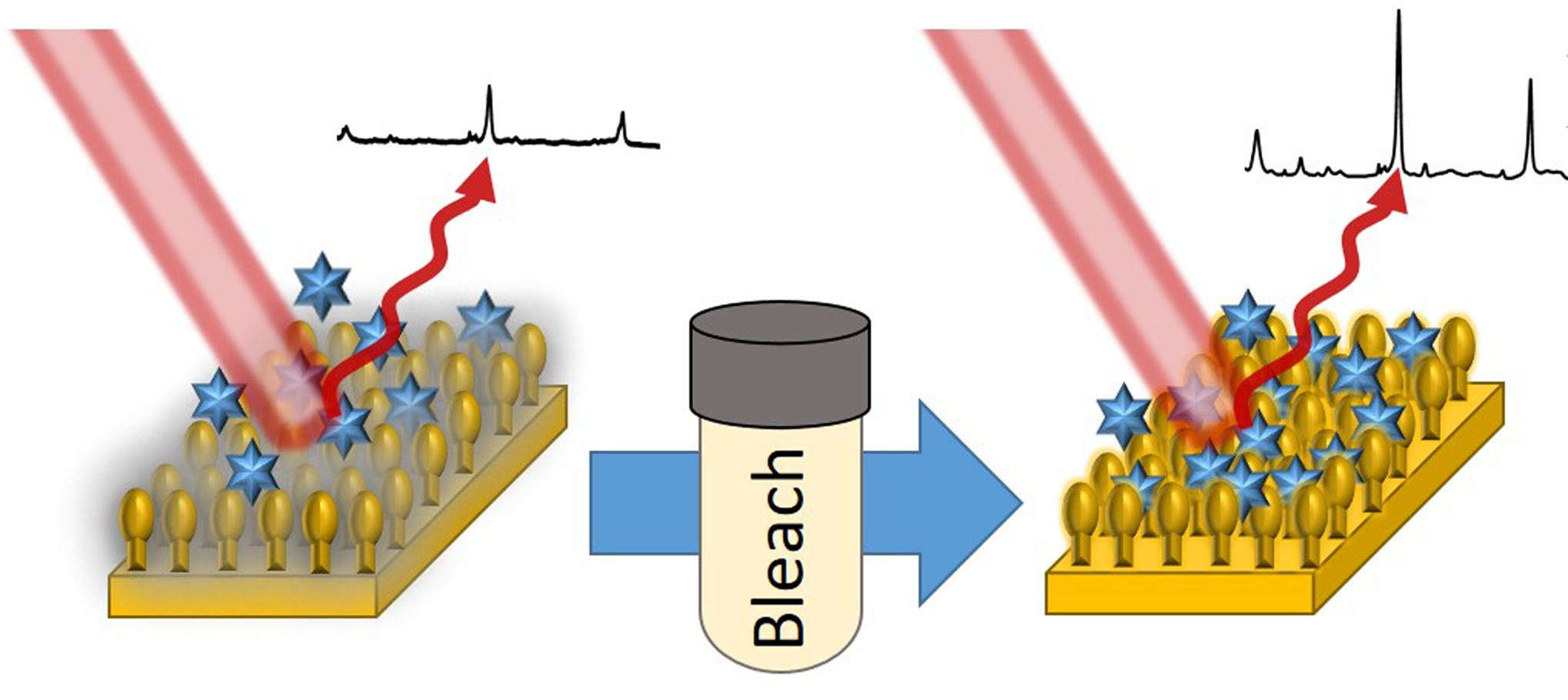
Get full access to this article
View all access options for this article.
References
Supplementary Material
Please find the following supplemental material available below.
For Open Access articles published under a Creative Commons License, all supplemental material carries the same license as the article it is associated with.
For non-Open Access articles published, all supplemental material carries a non-exclusive license, and permission requests for re-use of supplemental material or any part of supplemental material shall be sent directly to the copyright owner as specified in the copyright notice associated with the article.
