




Abstract
The molecular basis of bone structure and strength is mineralized collagen fibrils at the submicron scale (∼500 nm). Recent advances in optical photothermal infrared (O-PTIR) spectroscopy allow the investigation of bone composition with unprecedented submicron spatial resolution, which may provide new insights into factors contributing to underlying bone function. Here, we investigated (i) whether O-PTIR-derived spectral parameters correlated to standard attenuated total reflection (ATR) Fourier transform infrared spectroscopy spectral data and (ii) whether O-PTIR-derived spectral parameters, including heterogeneity of tissue, contribute to the prediction of proximal femoral bone stiffness. Analysis of serially demineralized bone powders showed a significant correlation (r = 0.96) between mineral content quantified using ATR and O-PTIR spectroscopy, indicating the validity of this technique in assessing bone mineralization. Using femoral neck sections, the principal component analysis showed that differences between O-PTIR and ATR spectra were primarily attributable to the phosphate ion (PO4) absorbance band, which was typically shifter toward higher wavenumbers in O-PTIR spectra. Additionally, significant correlations were found between hydrogen phosphate (HPO4) content (r = 0.75) and carbonate (CO3) content (r = 0.66) quantified using ATR and O-PTIR spectroscopy, strengthening the validity of this method to assess bone mineral composition. O-PTIR imaging of individual trabeculae at 500 nm pixel resolution illustrated differences in submicron composition in the femoral neck from bones with different stiffness. O-PTIR analysis showed a significant negative correlation (r = –0.71) between bone stiffness and mineral maturity, reflective of newly formed bone being an important contributor to bone function. Finally, partial least squares regression analysis showed that combining multiple O-PTIR parameters (HPO4 content and heterogeneity, collagen integrity, and CO3 content) could significantly predict proximal femoral stiffness (R2 = 0.74, error = 9.7%) more accurately than using ATR parameters. Additionally, we describe new findings in the effects of bone tissue orientation in the O-PTIR spectra. Overall, this study highlights a new application of O-PTIR spectroscopy that may provide new insights into molecular-level factors underlying bone mechanical competence.
This is a visual representation of the abstract.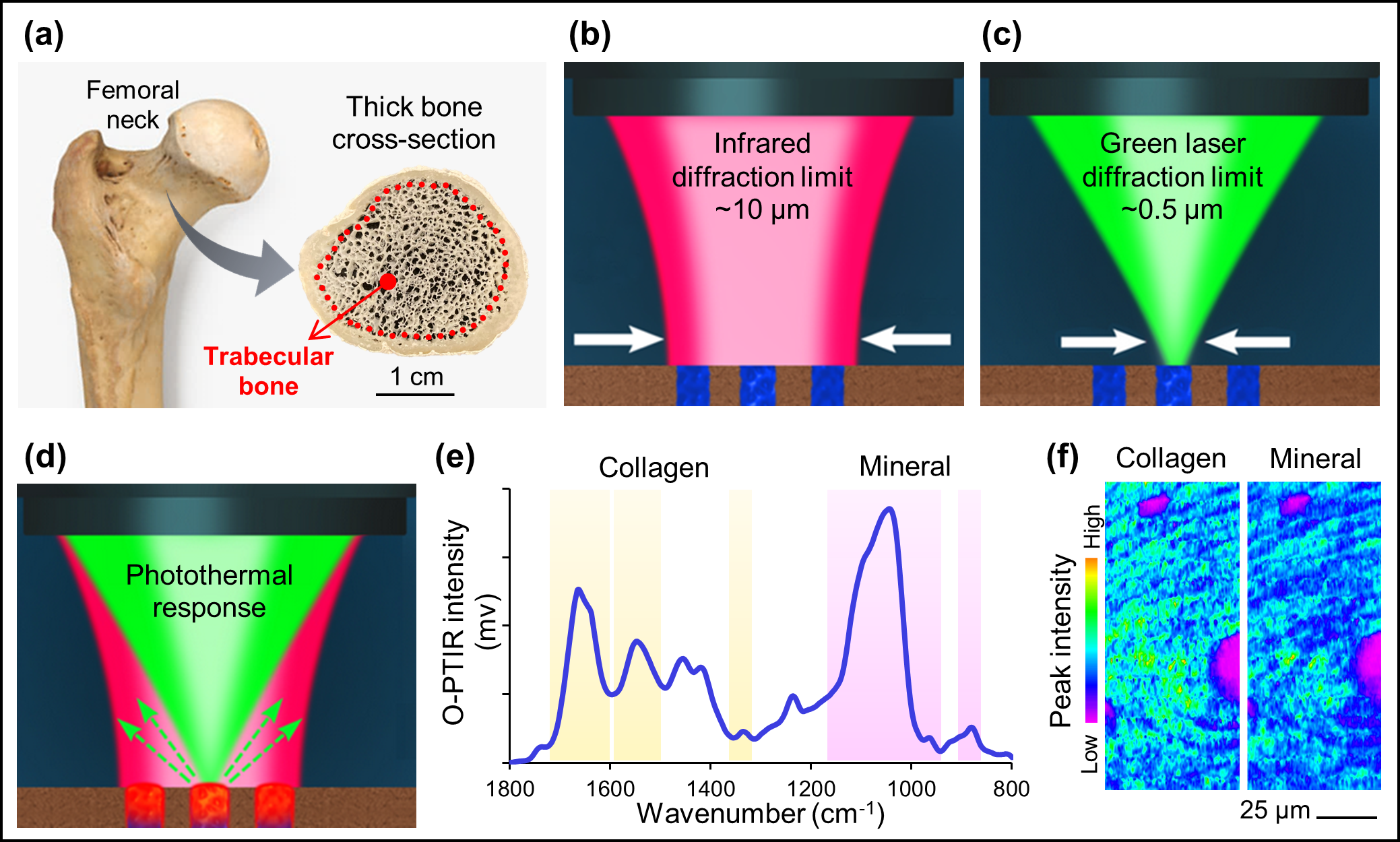
Keywords
Get full access to this article
View all access options for this article.
References
Supplementary Material
Please find the following supplemental material available below.
For Open Access articles published under a Creative Commons License, all supplemental material carries the same license as the article it is associated with.
For non-Open Access articles published, all supplemental material carries a non-exclusive license, and permission requests for re-use of supplemental material or any part of supplemental material shall be sent directly to the copyright owner as specified in the copyright notice associated with the article.
