



Abstract
We have demonstrated high-speed, super-resolution infrared (IR) spectroscopy and chemical imaging of autofluorescent biomaterials and organisms using camera-based widefield photothermal detection that takes advantage of temperature-dependent modulations of autofluorescent emission. A variety of biological materials and photosynthetic organisms exhibit strong autofluorescence emission under ultraviolet excitation and the autofluorescent emission has a very strong temperature dependence, of order 1%/K. Illuminating a sample with pulses of IR light from a wavelength-tunable laser source causes periodic localized sample temperature increases that result in a corresponding transient decrease in autofluorescent emission. A low-cost light-emitting diode-based fluorescence excitation source was used in combination with a conventional fluorescence microscopy camera to detect localized variations in autofluorescent emission over a wide area as an indicator of localized IR absorption. IR absorption image stacks were acquired over a range of IR wavelengths, including the fingerprint spectral range, enabling extraction of localized IR absorption spectra. We have applied widefield fluorescence detected photothermal IR (FL-PTIR) to an analysis of autofluorescent biological materials including collagen, leaf tissue, and photosynthetic organisms including diatoms and green microalgae cells. We have also demonstrated the FL-PTIR on live microalgae in water, demonstrating the potential for label-free dynamic chemical imaging of autofluorescent cells.
This is a visual representation of the abstract.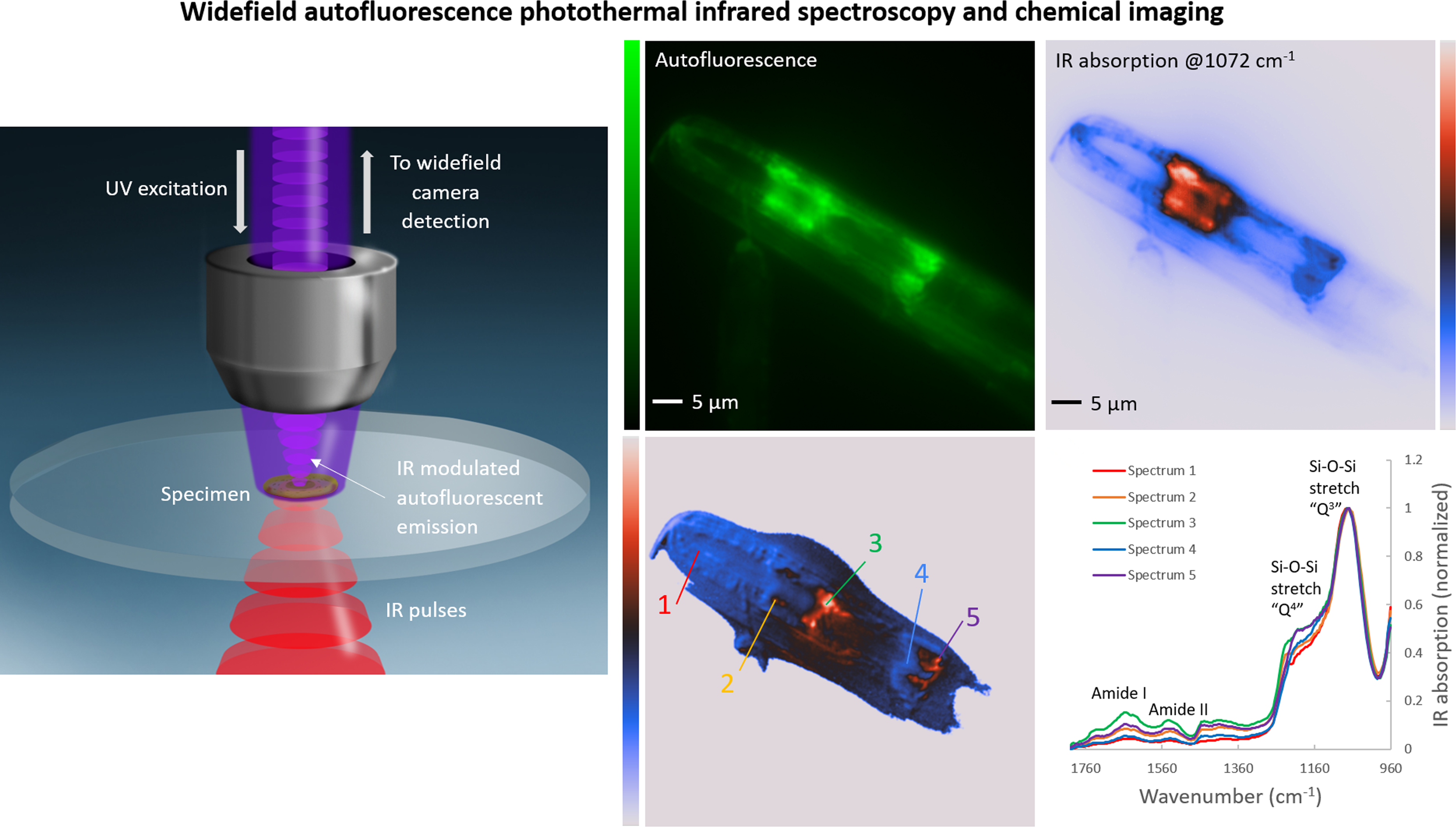
Keywords
Get full access to this article
View all access options for this article.
References
Supplementary Material
Please find the following supplemental material available below.
For Open Access articles published under a Creative Commons License, all supplemental material carries the same license as the article it is associated with.
For non-Open Access articles published, all supplemental material carries a non-exclusive license, and permission requests for re-use of supplemental material or any part of supplemental material shall be sent directly to the copyright owner as specified in the copyright notice associated with the article.
