




Abstract
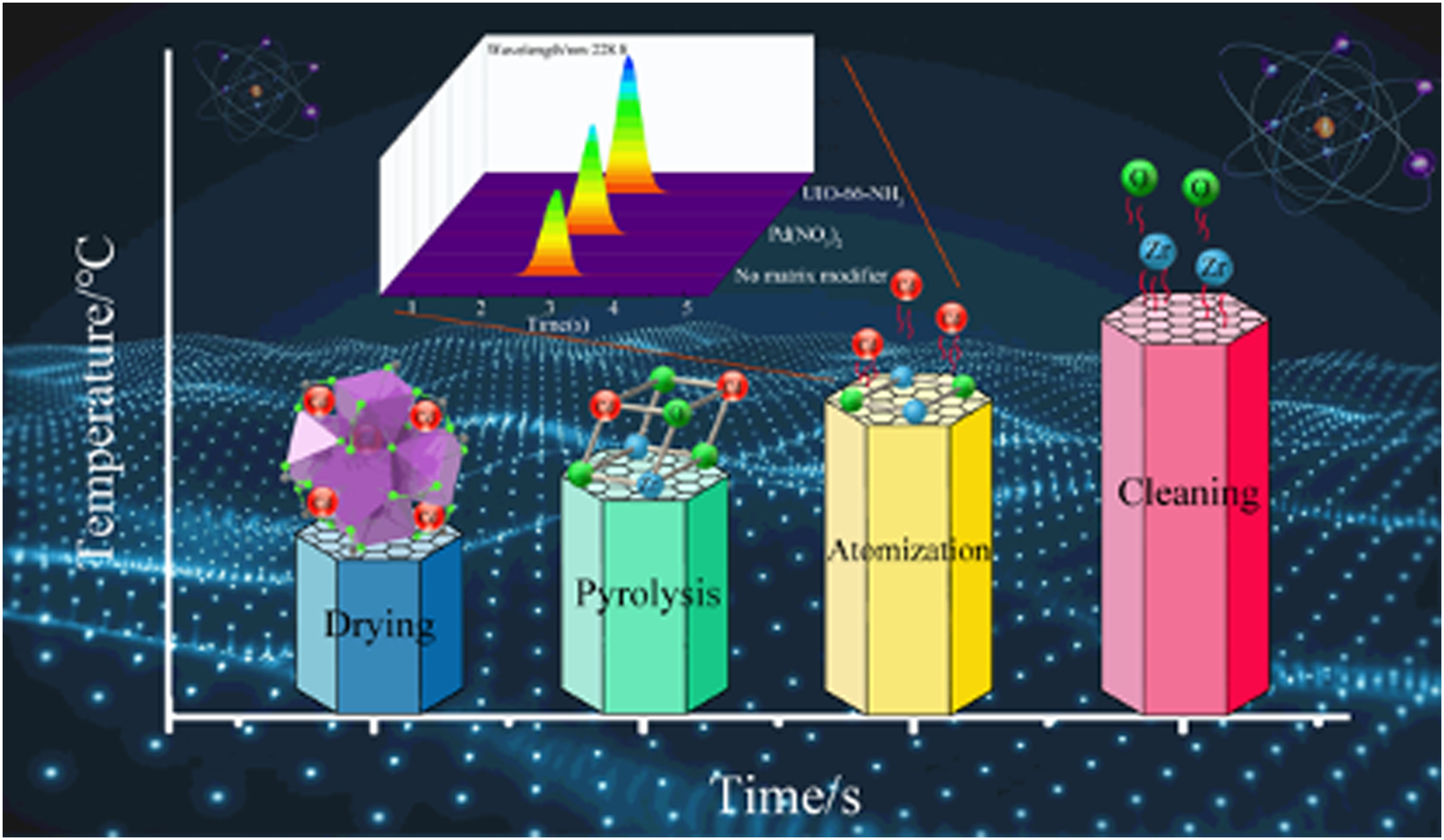
Cadmium (Cd) is a highly toxic heavy metal that is widely distributed in soils at low concentrations. Its volatilization loss occurs at an ashing temperature higher than 350 °C. Accordingly, the accurate determination of its concentration in soils often requires the addition of chemical modifiers by graphite furnace atomic absorption spectrometry (GFAAS) to improve the thermal stability of Cd. In this work, a metal–organic framework (MOF, UIO-66-NH2) was utilized as a matrix modifier to improve accuracy in determining Cd in soils using GFAAS. The Cd signal, as influenced by drying and pyrolysis temperature and special gas, was also investigated, and the measuring conditions were optimized (2 μg L−1 Cd concentrations, matrix modifier: UIO-66-NH2, pyrolysis temperature: 550 °C, atomization temperature: 1650 °C, and special gas: air). The limit of detection (LOD) and the characteristic mass for Cd in soil were 3.84 ng g−1 and 0.80 pg, respectively. Five soil standard reference materials (SRMs) were analyzed for Cd to verify the effectiveness of the optimized measuring conditions. The soil Cd concentrations obtained were in remarkable agreement with the reference values. Moreover, the mechanism of UIO-66-NH2 on the graphite platform was investigated in the drying and pyrolysis steps by scanning electron microscopy (SEM), Fourier transform infrared (FT-IR), X-ray diffraction (XRD), and X-ray photoelectron spectroscopy (XPS). During the drying steps, many functional groups of the matrix were activated, and Cd2+ could be captured on its surface. After the pyrolysis step, the structure matrix collapsed and was partially decomposed into ZrO2, and subsequently, an intermediate state of ZrO2-(CdO) appeared at high temperatures, which came from the active binding sites on the zirconium oxide octahedron nodes.
Get full access to this article
View all access options for this article.
References
Supplementary Material
Please find the following supplemental material available below.
For Open Access articles published under a Creative Commons License, all supplemental material carries the same license as the article it is associated with.
For non-Open Access articles published, all supplemental material carries a non-exclusive license, and permission requests for re-use of supplemental material or any part of supplemental material shall be sent directly to the copyright owner as specified in the copyright notice associated with the article.
