A new three-dimensional luminescent cobalt (II) metal–organic framework, [Co(Titpe)(bcpf)·(DMF)]·(H2O)2·(DMF) (compound 1, JUST-8) (Titpe = 1,1,2,2-tetrakis(4-(1H-imidazol-1-yl)phenyl)ethane, bcpf = 4,4′-sulfonyldibenzoic acid; DMF = N,N-dimethylformamide), has been solvothermally synthesized by using CoCl2·6H2O and a mixture of ligands: Titpe ligand and bcpf ligand. Single crystal X-ray analysis reveals that 1 crystallizes in the triclinic system and space group with a = 13.2097(14) Å, b = 13.9519(14) Å, c = 14.4413(15) Å, α = 89.949(7)°, β = 70.303(7)°, γ = 80.322(7)°, V = 2465.7(5) Å3, Z = 2, Mr =1032.97, Dc = 1.391 g/cm3, μ = 0.455 mm−1, F(000) = 1070, R = 0.0585, and wR = 0.1540 for 8674 observed reflections (I > 2σ(I)). Its overall structure is a double-fold interpenetrated framework, and it shows a porosity of 12.97% based on a calculation by PLATON and a 4-c type topological network with the point symbol of {6^5.8}. The Co atom bridges the Titpe ligands to form the one-dimensional chains into a two-dimensional layered structure and then connects the auxiliary ligands to get a three-dimensional structure. Compound 1 showed a blue fluorescence emission with the peak maximum at 431 nm (λex = 314 nm).
A new three-dimensional luminescent Cobalt (II) metal–organic framework, [Co(Titpe)(bcpf)·(DMF)]n (1), has been solvothermally synthesized by using CoCl2·6H2O and a mixture of ligands: Titpe ligand and bcpf ligand. Its overall structure is a double-fold interpenetrated framework, and it shows a porosity of 12.97% based on a calculation by PLATON and a 4-c type topological network with the point symbol of {6^5.8}. The Co atom bridges the Titpe ligands to form the one-dimensional chains into a two-dimensional layered structure and then connects the auxiliary ligands to get a three-dimensional structure. Compound 1 showed a blue fluorescence emission with the peak maximum at 431 nm (λex = 314 nm).
Introduction
Metal–organic frameworks (MOFs) are a class of porous hybrid organic–inorganic solids in which different metal ions are linked by polyfunctional organic ligands,1–4 These have become the center of attraction in various fields due to their inherent properties, such as large pore volume, high surface area, and active metal sites with ordered and coordinated pores,5–7 including catalysis, chemical sensors, gas storage, drug delivery, chemical separation, and so on.8–11
Among these, luminescent metal–organic frameworks (LMOFs) have been widely studied in biological and chemical detection because of their unique advantages, such as short response time, handy operability, and high distinguishability.12–14 Generally, the fluorescence emission of LMOFs is mainly produced from metal ions, organic ligands, or metal–ligand charge transfer processes.15,16 Compared with the relatively limited choices of lanthanide metal ions, the reasonable design and oriented synthesis of photo-responsive organic ligands is a facile route to acquire a powerful luminophore.17,18 In addition, the perturbation of adsorbed guest molecules can change the photoemission spectrum of LMOFs, making them excellent candidates for a chemical sensor.19 During those organic ligands, recently, the tetraphenylethene (TPE)-core ligands have been much focused on because of the aggregation-induced emission (AIE) effect reported by Tang’s group.20,21 According to this interesting phenomenon, a series of LMOFs based on some TPE-core ligands have been synthesized and showed good luminescence properties.22–25
In the early stage, we had also used some TPE-core ligands to synthesize MOFs, which showed good potential in lighting phosphors and chemical sensors.22,24,26,27 Based on our former research on LMOFs with AIE effect, herein, we present that a new three-dimensional (3D) luminescent Cadmium(II) MOF [Co(Titpe)(bcpf)·(DMF)]·(H2O)2·(DMF) (1 Titpe = 1,1,2,2-tetrakis(4-(1H-imidazol-1-yl)phenyl)ethene, bcpf = 4,4′-sulfonyldibenzoic acid; DMF = N,N-dimethyl-formamide) can be synthesized via a solvothermal method at 90°C that from a TPE-core ligand. In addition, the luminescent spectra of 1 show that it emits blue light caused by ligand-to-ligand charge transfer of the TPE chromophore. So, it also shows good AIE luminescence property. Its structure, X-ray powder diffraction (XRPD), and thermogravimetric analysis (TGA) were also investigated.
Results and discussion
Crystallographic data for Compound 1 were collected using a Bruker SMART APEX II CCD-based diffractometer at room temperature, with graphite-monochromatic Mo Kα radiation (λ = 0.71073 Å). The structures were solved by direct methods and refined by the full-matrix method based on F2 using the SHELXTL and Olex2 programs. Non-hydrogen atoms were refined anisotropically using all reflections with I > 2σ(I), while all H atoms were placed at calculated positions with isotropic displacement parameters set to 1.2 Ueq of the attached atom and refined using riding atoms, which were caused by the electron cloud density. Details of the crystallographic parameters, data collection, and refinements for 1 are given in Table 1. CCDC number: 1938009.
Crystallographic data and details of refinement for Compound 1.
Compounds
C55H43CoN9O7S
T (K)
296(2)
Formula weight
1032.97
Crystal system
Triclinic
Space group
a (Å)
13.2097(14)
b (Å)
13.9519(14)
c (Å)
14.4413(15)
α (°)
89.949(7)
β (°)
70.303(7)
γ (°)
80.322(7)
V (Å3)
2465.7(5)
Z
2
Dc (g/m−3)
1.391
μ (mm−1)
0.455
F(000)
1070.0
θ range (°)
2.50–18.20
Collected reflections
4576
Unique reflections
8674
R1, wR2 (I > 2σ(I))
0.0585, 0.1195
R1, wR2 (all data)
0.1381, 0.1540
GOF
1.001
Structure of [Co(Titpe)(bcpf)·(DMF)]·(H2O)2·(DMF)
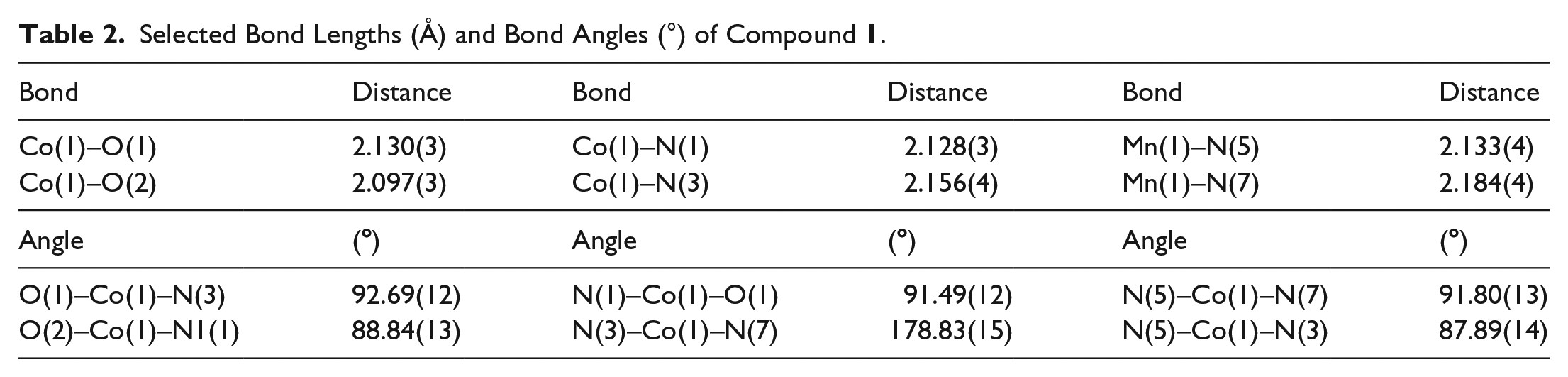
Single crystal X-ray diffraction studies reveal that 1 crystallizes in the triclinic system with space group . The asymmetric unit of 1 contains one Co atom, one Titpe ligand, one bcpf2− anion, and one free DMF molecule. As depicted in Figure 1(a), the Co atom is in a six-coordinate coordination environment and the octahedrally coordinated with CoN4O2 geometry by four N atoms (N(1), N(3), N(5), and N(7)) from four Titpe ligands with the Co–N bond distances varying from 2.1287(38) to 2.184(32) Å, and two oxygen atoms (O(1), O(2)) from two different bcpf2− ligands with the Co–O bond distances falling in the 2.0964(28)–2.1296(28) Å range (Table 2). These are similar to typical Co–N and Co–O bond lengths of other reported Cd-based MOFs.28 However, the distances of Co(1) and O(3) with Co(1) and O(4) are 3.6473(28) and 3.8126(27) Å, respectively, which were too long to be considered a bond and exceed the normal Co–O bond length. According to Figure 1(b), two adjacent Co(II) ions are linked together by N(1) and N(5) atoms of the Titpe ligands with the distances of 20.0889(21) Å to form a one-dimensional (1D) chain along the a-axis. Interestingly, a two-dimensional (2D) layered structure can also be formed by the attachment of Co atoms and N(3), N(7) atoms of the Titpe ligands along the a-axis (Figure 1(c)). Then, each such layered structure is connected by two oxygen atoms (O(1), O(2)) of bcpf2− ligands into a 3D network structure along the c-axis (Figure 1(d)).
(a) Coordination environment of the Co(II) in compound. (b) 1D chain of Compound 1 along the a-axis. (c) 2D layer of Compound 1 along the a-axis. (d) 3D network of 1 along the c-axis. (e) 1D frameworks along c-axis. (f) Two distinct frameworks that interpenetrate to form the complete structure.
Selected Bond Lengths (Å) and Bond Angles (°) of Compound 1.
Bond
Distance
Bond
Distance
Bond
Distance
Co(1)–O(1)
2.130(3)
Co(1)–N(1)
2.128(3)
Mn(1)–N(5)
2.133(4)
Co(1)–O(2)
2.097(3)
Co(1)–N(3)
2.156(4)
Mn(1)–N(7)
2.184(4)
Angle
(°)
Angle
(°)
Angle
(°)
O(1)–Co(1)–N(3)
92.69(12)
N(1)–Co(1)–O(1)
91.49(12)
N(5)–Co(1)–N(7)
91.80(13)
O(2)–Co(1)–N1(1)
88.84(13)
N(3)–Co(1)–N(7)
178.83(15)
N(5)–Co(1)–N(3)
87.89(14)
During analysis of the structure, it was discovered that there was a 1D pore in the c-axis direction of Compound 1 with a porosity of 12.97% and its aperture is 22.599 Å based on calculation by PLATON (Figure 1(e)). The structure consists of double-fold interpenetrated frameworks formed by two of these identical nets, with each framework consisting of octahedrally coordinated CoN4O2 linked to four Titpe ligands and two bcpf ligands. Each Titpe ligand links four Co(II) ions, and accordingly, the Titpe can be regarded as a 4-connected node. Each Co(II) atom links four Titpe ligands and two bcpf ligands, so the Co(II) atom can be regarded as a 6-connected node. Thus, topological analysis indicates that 1 can be described as a 2-nodal (4-c)(6-c) net with a topology symbol of {4^4.6^10.8}{4^4.6^2} (Figure 1(f)).
Powder X-ray diffraction and thermal analyses
The powder X-ray diffraction (PXRD) patterns show that the peak positions of the crystalline samples of 1 closely match those in the simulated from the single-crystal data, showing the phase purity of the as-made samples (Supplemental Figure S1). TGA was recorded on Compound 1 to test their thermal stability from 15°C to 800°C under nitrogen atmosphere (Supplemental Figure S2). The result of the TGA curve indicates that when the solvent molecules in the holes were moved from room temperature to 120°C, it is known that MOF-1 ([Co(Titpe)(bcpf)·(DMF)]·(H2O)2·(DMF)) loses 4% of two free water. In addition, Compound 1 underwent a weight loss (6%) between 120°C and 280°C due to the loss of DMF molecules. Comparing the infrared spectrum before and after heating shows that the peak 1673 cm−1(–C=O) of the DMF disappears and proves that the DMF is not present in Compound 1 by the peak of infrared spectrum (Supplemental Figure S3). The structure remains stable from 280°C to 350°C (Supplemental Figure S1), and then the structure of MOF-1 began to gradually decompose (>400°C).
Optical properties
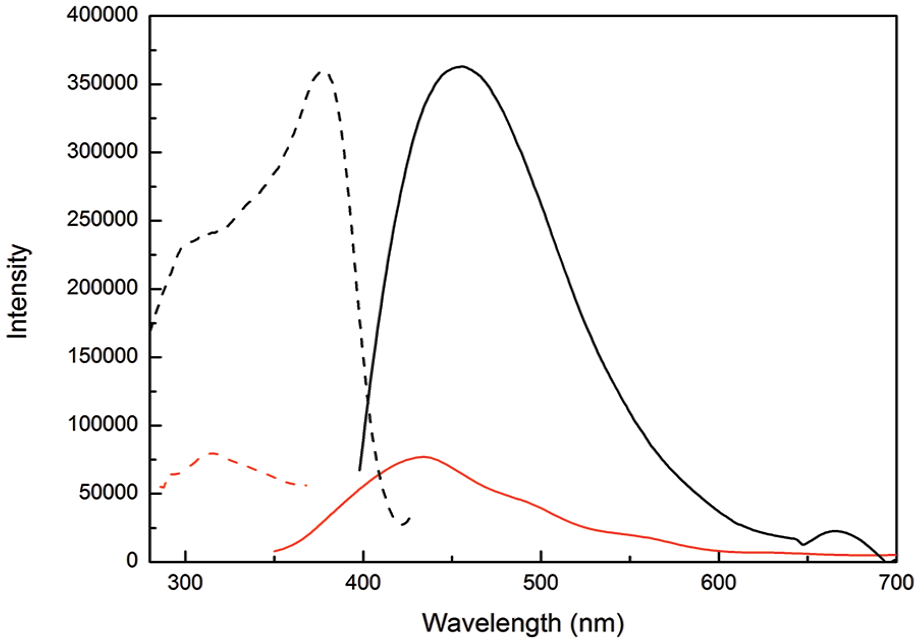
The luminescence emission spectra of 1 and Titpe were studied at room temperature in their solid forms (Figure 2). The free ligand Titpe displays a main fluorescent emission band at λmax = 455 nm under excitation at 378 nm. 1 exhibits a luminescence emission centered at 431 nm excitation at 314 nm, corresponding to blue shift of ~21 nm with respect to that of the Titpe, which may be tentatively assigned to the π–π* intraligand fluorescence due to its close resemblance to the emission band of the Titpe ligand.29 The fluorescence intensity of 1 is lower than that of the Titpe due to the metal-to-ligand charge transfer (MLCT) with electrons being transferred from the Co(II) centers to the unoccupied p* orbitals of the Titpe ligand.30 The Commission International de I’Eclairage (CIE) chromaticity coordinates of 1 and Titpe are (0.148, 0.040) and (0.175, 0.187) (Figure 3).
Photoluminescence (PL) spectra of Titpe (black); Compound 1 (red).
The CIE coordinates of Titpe (black); Compound 1 (red) (λex = 365 nm).
In summary, we have successfully synthesized a new luminescent Co-MOF ([Co(Titpe)(bcpf)·(DMF)]·(H2O)2·(DMF)) under solvothermal conditions, which is composed of a regular octahedron and features a 3D 2-nodal (4-c)(6-c) net topological structure. Furthermore, Compound 1 exhibits blue emission in the solid state that may be due their TPE-core chromophore Titpe. It means this complex may be useful to the development of fluorescent materials.
Experimental
Materials and methods
All the materials and solvents were obtained from commercial sources. The synthetic method of the Titpe ligand was reported in previous studies.31,32 TGA was performed on a Netszch TGA 209 F3 thermogravimeter that was carried out from 30°C to 800°C at a temperature increase rate of 10°C/min from under N2 flow (50 mL/min). Elemental analyses (C, H, and N) were done on a Perkin-Elmer 240C elemental analyzer. PXRD pattern on Ultima IV with CuKα radiation field emission (λ = 1.5406 Å). Infrared spectra were recorded on a SHIMADZU IR prestige-21 FTIR-8400S spectrometer by using potassium bromide particles in the range of 4000–400 cm−1. Luminescent spectra were recorded on an FS5 fluorescence spectrophotometer at room temperature.
Preparation of [Co(Titpe)(bcpf)·(DMF)]·(H2O)2·(DMF)
CoCl2·6H2O (0.04 mmol, 0.0097 g), Titpe (0.01 mmol, 0.0059 g), 4,4′-H2bcpf (0.02 mmol, 6.1 mg), DMF (2.0 mL), and H2O (1.0 mL) were mixed in a 20 mL Teflon-lined vessel and then heated to 90°C for 48 h. Colorless crystals of the compound were obtained at a yield of 51% based on Titpe. Elemental analyses calcd for C55H43CoN9O7 (Mr: 1032.97): C, 63.89; H, 4.16; N, 12.21; found: C, 63.71; H, 4.19; N, 12.11.
Supplemental Material
Supporting_information-R1 – Supplemental material for Synthesis, structures, and fluorescence properties of one novel Cobalt metal–organic framework based on a tetraphenylethene-core ligand
Supplemental material, Supporting_information-R1 for Synthesis, structures, and fluorescence properties of one novel Cobalt metal–organic framework based on a tetraphenylethene-core ligand by Xiudian Xu, Yu Liang, Junfeng Li, Lei Zhou, Li-Zhuang Chen and Fang-Ming Wang in Journal of Chemical Research
Footnotes
Declaration of conflicting interests
The author(s) declared no potential conflicts of interest with respect to the research, authorship, and/or publication of this article.
Funding
The author(s) received no financial support for the research, authorship, and/or publication of this article.
ORCID iD
Fang-Ming Wang
Supplemental material
Supplemental material for this article is available online.
References
1.
FurukawaHCordovaKEO’KeeffeM, et al. Science2013; 341: 123044.
2.
FéreyG.Chem Soc Rev2008; 37: 191.
3.
ZhangJWuHEmgeTJ, et al. Chem Commun2010; 46: 9152.
4.
StockNBiswasS.Chem Rev2012; 112: 933.
5.
ZhouHCLongJRYaghiOM.Chem Rev2012; 112: 673.
6.
XiaWMahmoodAZouR, et al. Energy Environ Sci2015; 8: 1837.
7.
EomSParkSSongJH, et al. Eur J Inorg Chem2019; 2: 330.
8.
YanB.Acc. Chem Res2017; 50: 2789.
9.
SuhMPParkHJPrasadTKLimDW.Chem Rev2012;112: 782.
10.
AnJYGeibSJRosiNL.J Am Chem Soc2009; 131: 8376.
11.
MaSSunDWangXS, et al. Angew Chem Int Ed2007; 46: 2458.
12.
HuZDeibertBJLiJ.Chem Soc Rev2014; 43: 5815.
13.
KanWQWenSZ.Polyhedron2017; 128: 169.
14.
MengXWeiMJWangHN, et al. Dalton Trans2018; 47: 1383.
15.
YangXLChenXHHouGH, et al. Adv Funct Mater2016; 26: 393.
16.
CuiYJZhangJHeHJ, et al. Chem Soc Rev2018; 47: 5740.
17.
MeiJLeungNLCKwokRTK, et al. Chem Rev2015; 115: 11718.
18.
MaLFengXWangS, et al. Mater Chem Front2017; 1: 2474.
19.
HuZDeibertBJLiJ.Chem Soc Rev2014; 43: 5815.
20.
HuZLustigWPZhangJ, et al. Am Chem Soc2015; 137: 16209.
21.
WeiZGuZYArvapallyRK, et al. J Am Chem Soc2014; 136: 8269.
22.
LustigWPWangFTeatSJ, et al. Inorg Chem2016; 55: 7250.
23.
HuZHuangGLustigWP, et al. Chem Commun2015; 51: 3045.
24.
WangFLiuWTeatSJ, et al. Chem Commun2016; 52: 10249.
25.
ShustovaNBMcCarthyBDDincaM.J Am Chem Soc2011; 133: 20126.
26.
WangFMLiJChenaLZ, et al. Dalton Trans2017; 46: 956.
27.
LiJFXuXDZhouL, et al. Chinese J Struct Chem2019; 38: 797.
28.
ZengMHWangBWangXY, et al. Inorg Chem2006; 45: 7069.
29.
LiDXChenMMLiFL, et al. Inorg Chem Commun2013; 35: 302.
30.
CuiJWHouSXHeckebKV, et al. Dalton Trans2017; 46: 2892.
31.
KimKYJungSHLeeJH, et al. Chem Commun2014; 50: 15243.
32.
WangYYuanBXuYY, et al. Chem Eur J2015; 21: 2107.
Supplementary Material
Please find the following supplemental material available below.
For Open Access articles published under a Creative Commons License, all supplemental material carries the same license as the article it is associated with.
For non-Open Access articles published, all supplemental material carries a non-exclusive license, and permission requests for re-use of supplemental material or any part of supplemental material shall be sent directly to the copyright owner as specified in the copyright notice associated with the article.