




Abstract
Objective:
TikTok has experienced exponential growth as a social media platform, with over 1 billion active users. Concurrently, retrograde cricopharyngeal dysfunction (RCPD) has seen a surge in awareness among patients and on social media. Our objective was to characterize the most popular RCPD-related content on TikTok.
Methods:
The top 50 videos associated with the following hashtags were analyzed: “RCPD,” “noburp,” “retrograde cricopharyngeal dysfunction,” and “noburpsyndrome.” Recorded metrics included views, likes, and comments, along with information regarding the creator’s identity, gender, geographical location, and the video’s purpose.
Results:
One hundred and three videos were included in the final analysis, with a cumulative total of 32 284 962 views, 3 185 271 likes, and 54 664 comments. Over 90% of these videos were created by patients or the general public, with less than 5% attributed to physicians. The primary purpose of these videos varied, with 46.60% aimed at educating viewers about RCPD, 23.30% serving as post-treatment testimonies, and 14.56% demonstrating symptoms.
Conclusion:
TikTok is a highly popular platform for RCPD-related content. Patient education, treatment testimonies, and symptom demonstration were the most common primary purposes of these videos. Considering the limited representation of physician-generated content, this social media landscape represents an opportunity for otolaryngologists to leverage TikTok for educational outreach and patient advocacy.
Introduction
Social media usage is at an all-time high, with approximately 72% of adults in the United States (U.S.) engaging on at least 1 platform. 1 Among these platforms, TikTok stands out as the fastest-growing globally, boasting a user base of over 1 billion worldwide, with 62% of Americans between 18 and 29 years old using the platform.2 -4 This exponential rise in social media and internet usage has revolutionized the way in which the general public consumes information, with 72% reportedly searching for health information on social media. 5 While this has improved access to health-related information and facilitated the creation of online support groups for patients, it has simultaneously resulted in the mass distribution of health misinformation and potentially dangerous medical advice.6,7
The formal recognition of retrograde cricopharyngeus dysfunction (RCPD) by Dr. Robert Bastian in 2019 has led to a notable surge in awareness and recognition of this condition. 8 In his landmark publication, Dr. Bastian described a series of patients with the inability to belch, excessive flatulence, gurgling noises from the chest and lower neck, difficulty vomiting, abdominal bloating, and social isolation. 8 Although patients with identical symptomatology had been documented as far back as 1987, no treatments had been formally proposed until Dr. Bastian presented his success using botulinum toxin (BT) injection into the cricopharyngeus muscle (CPM), effectively treating 51 patients.8,9 Since 2019, hundreds of individuals with RCPD have been identified and successfully treated with Dr. Bastian’s method.8,10 -14
Several publications have identified that patients with RCPD are predominately young adults, with a comprehensive literature review reporting the average age at presentation to be 26 years old. 15 Notably, this demographic aligns with the age group most active on TikTok in the U.S. 2 While previous studies have assessed the quantity and quality of videos on TikTok pertaining to general otolaryngology, plastic surgery, scoliosis, and dermatology, none have investigated content related to RCPD on the platform.4,6,16 -18
The purpose of this investigation was to (1) quantify the volume and popularity of RCPD-related content on TikTok, (2) analyze and describe the source of this content, and (3) identify what topics related to RCPD garnered the most attention and interaction.
Materials and Methods
This retrospective observational study was completed using publicly available information from TikTok between April 12, 2024, and April 14, 2024. The study was exempt from Institutional Review Board approval at the University of Texas Health Science Center at Houston given the public nature of this data.
TikTok Video Identification
On April 12, 2024, a search was conducted on TikTok’s internal search engine using the terms: “#RCPD,” “#noburp,” “#noburpsyndrome,” and “#retrogradecricopharyngealdysfunction.” The search results showed that “#RCPD” returned 1182 posts, “#noburp” returned 713 posts, “#noburpsyndrome” returned 35 posts, and “#retrogradecricopharyngealdysfunction” returned 99 posts. The top 50 posts from #RCPD, #noburp, and “#retrogradecricopharyngealdysfunction” were selected for further analysis, while all 35 posts from “#noburpsyndrome” were included. Following the removal of duplicate videos and exclusion of those unrelated to RCPD, a total of 103 videos remained for final investigation.
Characterization of TikTok Videos
For each TikTok video identified, data were collected on the number of views, likes, and comments, as well as the gender of the video creator and their country of origin. Additionally, using methodology from previous TikTok analyses, the source of each video was categorized as one of the following: board-certified otolaryngologist, other physician, other healthcare professional, patient/public, or news/company. 4 Similarly, the purpose of each video was classified into one of the following categories: demonstration of RCPD symptoms, educational, humor, patient testimony after treatment, or other.
Results
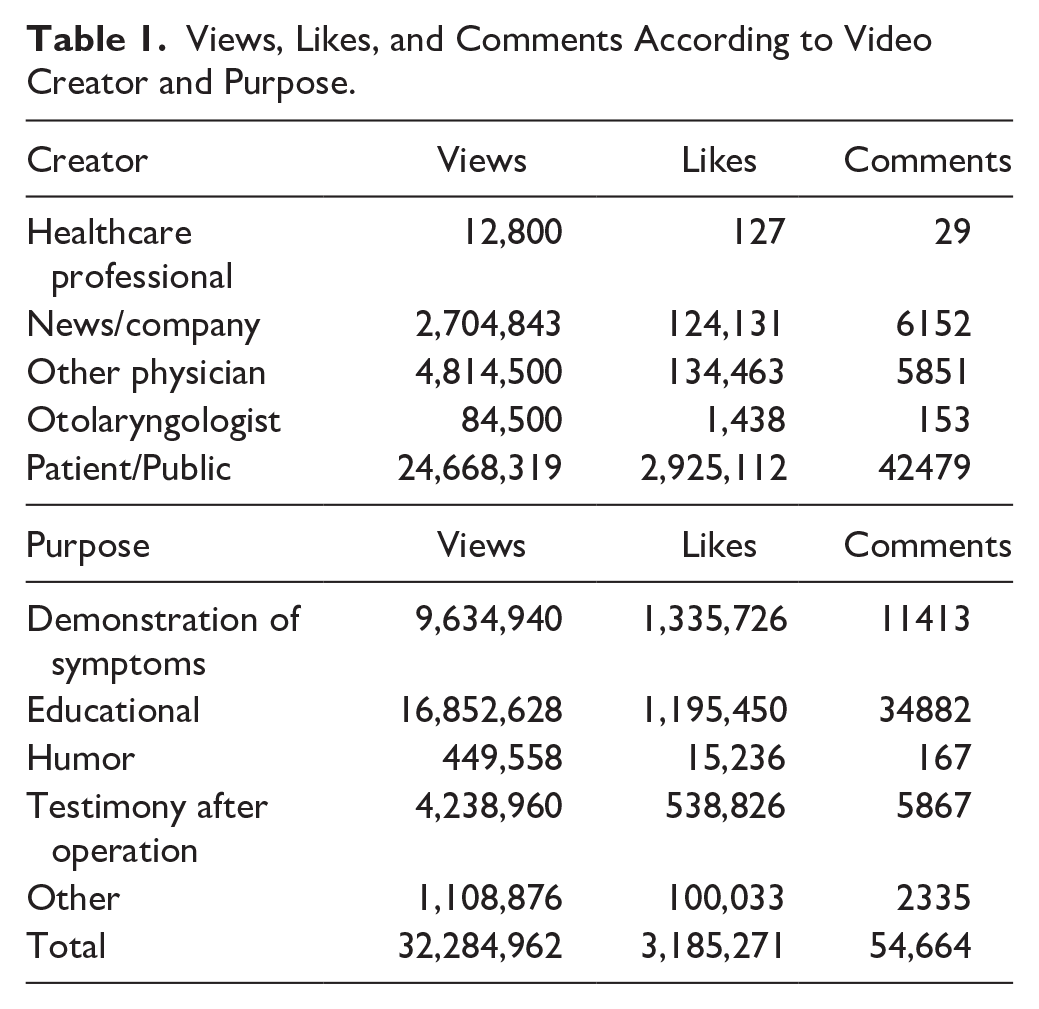
Analysis of the 103 included videos revealed a total of 32 284 962 views, 3 185 271 likes, and 54 664 comments (Table 1). The majority of videos were created by patients or the public (94, 91.26%), followed by other physicians (3, 2.91%), news or companies (3, 2.91%), otolaryngologists (2, 1.94%), and other healthcare professionals (1, 0.97%; Table 2). 88.35% of individuals featured in the videos were female, 7.77% were male, and 3.88% were unknown as they only displayed informational text (Table 2). Most of the content originated from the United States (U.S.; 73, 70.87%), followed by the United Kingdom (24, 23.30%), Jordan (1, 0.97%), China (1, 0.97%), and the Netherlands (1, 0.97%); 3 (2.91%) of the videos were unable to be categorized based on country of origin (Table 2).
Views, Likes, and Comments According to Video Creator and Purpose.
Categorization of TikTok Videos According to Creator, Gender, Country of Origin, and Purpose.
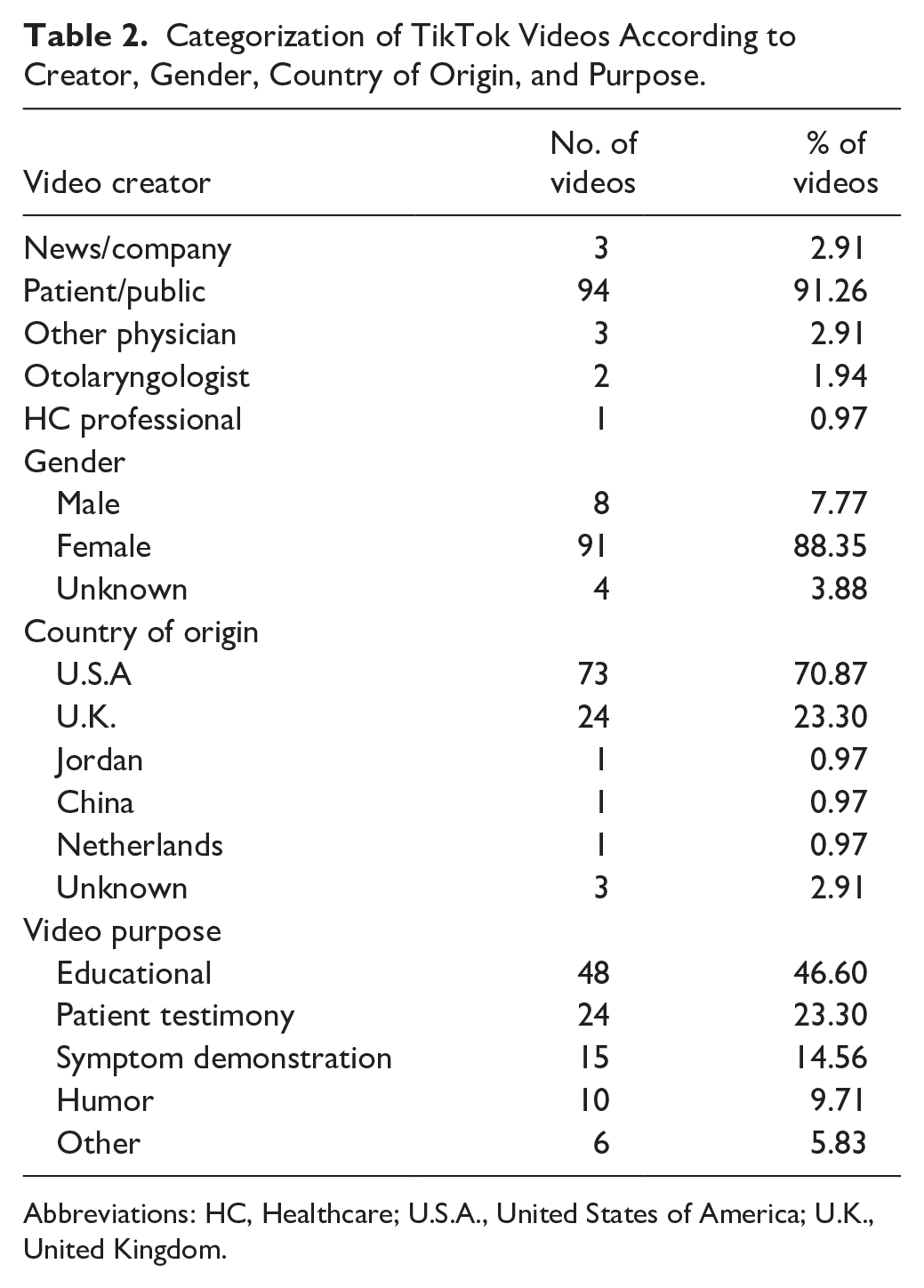
Abbreviations: HC, Healthcare; U.S.A., United States of America; U.K., United Kingdom.
Analysis of the purpose of each video revealed that most videos discussed educational content related to RCPD (48, 46.60%). This was followed by patient testimonies after treatment (24, 23.30%), demonstration of RCPD symptoms (15, 14.56%), humorous content (10, 9.71%), and other (6, 5.83%). Patient or public-generated content amassed 24 668 319 total views, while otolaryngologist-generated content had only 84 500 views (Table 1). Educational content related to RCPD accumulated 16 852 628 views, followed by a demonstration of RCPD symptoms with 9 634 940 views and patient testimonies after treatment with 4 238 960 views (Table 1).
Discussion
This study represents the first comprehensive analysis of content related to RCPD on the social media platform TikTok. While prior investigations have examined patient resources related to facial plastic surgery and general otolaryngology, none have addressed the relatively novel diagnosis of RCPD.4,16,19 -21 Considering the popularity of TikTok in the U.S. among individuals aged 18 to 29, a demographic that comprises the majority of RCPD patients according to currently available literature, it is critical to evaluate related content on the platform. We found that over 90% of RCPD-related videos on TikTok were created by patients or the general public, with fewer than 5% originating from a board-certified physician. Moreover, educational videos and patient testimonials emerged as the most common video type, with 48 and 24 videos, respectively (Table 2). Despite this, educational content and symptom demonstration had the highest viewership, with 16.8 million and 9.6 million views, respectively (Table 1).
Interestingly, in contrast to our findings, previous analyses of TikTok content related to dermatology or plastic surgery have found that healthcare professionals constitute a greater proportion of video creators, ranging from 39% to 56%.4,18 However, our examination of RCPD-related content on TikTok revealed limited representation from healthcare professionals, with only 5.42% of accounts featuring RCPD content belonging to a healthcare professional and 4.45% to a board-certified physician (Table 2). Given that RCPD is a relatively new diagnosis, it is crucial for healthcare professionals to create accurate and up-to-date information for patients on social media platforms.
Moreover, individuals with rare and under-researched conditions, like RCPD, have been demonstrated to develop a significant online presence as a source of community and support.10,11,22,23 However, the information found online can be inaccurate or potentially harmful to patients. 24 Therefore, it becomes essential for healthcare professionals, particularly otolaryngologists, to develop patient-centered social media content. This is especially important since 85% of internet users listen to health-related information online without assessing its quality or validity. 25
While post-treatment testimonies comprised 23.30% of videos and symptom demonstrations accounted for 14.56%, the latter amassed over twice as many views as the former (9.6 million versus 4.2 million; Table 1). These videos often showcased the gurgling sounds originating from the neck or chest, along with the abdominal bloating commonly experienced by RCPD patients. From this data, it can be inferred that patients are particularly interested in understanding the specific symptoms associated with RCPD, as evidenced by their increased engagement with this content. Additionally, the predominance of female video creators aligns with the demographic distribution on TikTok in the U.S. 2
While our study used a methodology similar to previous analyses of TikTok content, several limitations should be noted. Firstly, the classification of videos was determined by the authors and is thus susceptible to observer bias. Furthermore, social media platforms like TikTok are influenced by social norms, which may lead video creators to upload content that aligns with these factors, introducing a Hawthorne bias. Additionally, the content on TikTok is rapidly changing, and new content is released daily, making it difficult to analyze every piece of information. Lastly, individuals with a large following on TikTok may receive financial compensation based on increased interaction with their content. This could incentivize video creators to potentially falsify or exaggerate information in an attempt to increase exposure.
Conclusion
In conclusion, our study demonstrates that RCPD-related content on TikTok is incredibly popular, with 32.2 million views and 3.1 million likes across 103 videos. Given the overlap between the demographics of RCPD patients and active TikTok users, analyzing this platform provides valuable insights into patient discussions and highly sought-after information. We observed that content aimed at educating viewers on RCPD was the most popular, accounting for 46.60% of videos and amassing 16.8 million views. Additionally, post-treatment testimonies and symptom demonstrations accumulated 4.2 million and 9.6 million views, respectively. Despite the popularity of RCPD-related videos, less than 5% of videos originated from board-certified physicians. Considering these findings, physicians, particularly otolaryngologists, could use TikTok as a platform to educate the public and advocate for RCPD patients. By leveraging this platform, healthcare professionals have the opportunity to provide accurate information, dispel misconceptions, and enhance awareness and understanding of this condition.
Footnotes
Acknowledgements
None.
Author Contributions
All authors contributed equally to study conception, data collection, data analysis, and manuscript preparation
Declaration of Conflicting Interests
The author(s) declared no potential conflicts of interest with respect to the research, authorship, and/or publication of this article.
Funding
The author(s) received no financial support for the research, authorship, and/or publication of this article.
Ethical Approval
The study was exempt from Institutional Review Board approval at the University of Texas Health Science Center at Houston given the public nature of this data.
