




Abstract
Sts. Cosmas and Damian, the twin patron saints of medicine, were once among the most recognized saints in Christendom. In today’s secularized society their prominence is much less known. The saints were beheaded during the violent persecutions of Christians in the Roman Empire in the end of the 3rd century and the first years of the fourth. Their story, however, is more than miracles and martyrdom. The history of Sts. Cosmas and Damian show the connection between medicine of Classical Greece and the worship of doctor-saints in early Christendom, and the tradition of charity to the poor in medical care.
The Asclepian Cult
In the Homeric age certain aristocratic families maintained the healing arts, passing knowledge from father to son. They claimed lineage to the gods: Zeus taught healing to Apollo, who in turn passed it to his deified son Asclepios, the offspring of his union with the mortal Koronis. (Asclepios’ siblings included Hygeia and Panacea, evidence of the power of the healing force of the bloodline.) Asclepios in turn taught the healing arts to mortal physicians, the gods’ great gift to mankind. “By the fifth and fourth centuries
During the Hellenic age the sick and suffering sought divine intercession at Asclepieia, temples to Asclepios. Central to a pilgrim’s visit was the incubation, the visitation of Asclepios during sleep where the god worked his miracles. Upon arrival the supplicant made a sacrifice to Asclepios, then withdrew to a section of the temple to sleep. In most temples the visitor bedded somewhere on the floor of the sanctuary. While some scholars suggest that such Asclepieia were proto-hospitals, most of them made no accommodations for pilgrims, and physicians did not provide care in Asclepieia.
The incubation produced 3 basic outcomes. The first and best was that Asclepios simply effected a cure as the victim slept, who awoke in perfect health. Second, the dreamer might receive an instruction to perform a specific task, often of a bizarre nature, that bore no relationship to the malady. An anticlimactic result was the third, a recommendation to accept the standard medical remedy. 1
Greek Medicine
Under the influence of pre-Socratic philosophers, physicians in Kroton, Rhodes, Knidos, Kos, and other cities carefully studied disease on the basis of natural law rather than the actions of gods. They thus set themselves apart from the cult. Alexandria emerged as the leading center of Greek science, including medicine. A compendium from the various schools of medicine describing various maladies and their treatments became known as the Corpus Hippocraticum, named after Hippocrates of Kos (c. 460-c. 370
The nascent discipline of scientific medicine, however, retained its Asclepian roots long into the Roman imperial period. Some physicians served as Asclepian priests themselves. Galen of Pergamon (129-199?
Christian Doctors in the Third Century
Cosmas and Damian were Christians, probably of Arab descent. They were born in Aegea in the Roman province of Cicilia, where they studied medicine. The region today is on the southern coast of Turkey near its border with Syria. They were known for their miraculous cures of many ailments, including blindness, paralysis, and fever. Transplant and vascular surgeons with an interest in history know of their greatest miracle, the transplantation of a leg of a Black man (an “Aethiop”) to replace the gangrenous one of a deacon as he slept.
2
According to one scholar the miracle of the black leg appears in at least 40 extant works of art (Figure 1).
2
Meister des Stettner und Schalter Altaretabels. Beinwunder der Heiligen Cosmas und Damian. Landesmuseum Wurttemberg. Public domain.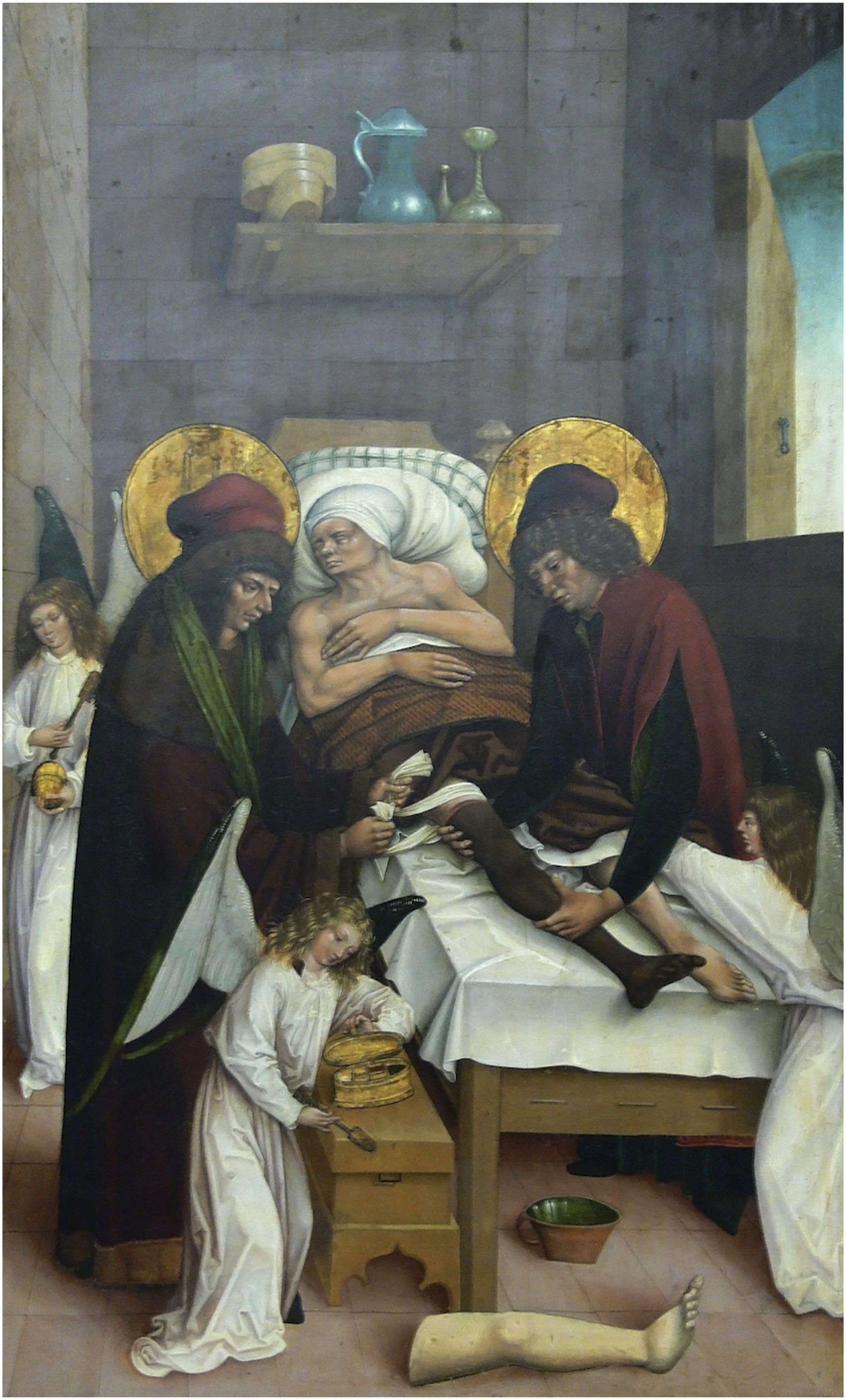
They refused payment, so were called “anargyroi,” a Greek word meaning “without silver.” The brothers had a falling out when Damian, not wanting to offend a grateful woman named Palladia, accepted her gift of 3 eggs. Cosmas was so angered by the transgression that he vowed not to be buried with his brother. According to legend, the twins resolved their differences by a talking camel that helped their reconciliation, 2 but the ethic of medical service to the poor without payment was established.
Their story of their martyrdom reflected the strength of their faith and virtue. Under the directives of Diocletian, the governor of Cilicia sentenced Cosmas, Damian, and their 3 brothers to death. Angels saved them from drowning, burning at the stake, and shooting by archers. Their persecutors turned to stoning and crucifixion, but still the brothers survived. “Finally, they were beheaded,” wrote Jacalyn Duffin, a Canadian medical historian and hematologist. “If this hyper-resistant vitality was connected to their healing occupation, we are not told.” 2
Scholars set the date of their death at CE 297, a few years before the height of the persecutions that began in 303. A basilica was built over their gravesite in Cyrrhus, a Christian city that today is an archeological site on the northern border of Syria.
Constantine (272-337, r. 306-337) ended the persecutions in 311 and changed the fortunes of the early Christians and the history of the world. When Constantine entered Rome as ruler, Miller wrote, “[He] began the transformation of the ancient world to a Christian society.” 1 In 324 Constantine became sole ruler of the entire breadth of the Roman Empire and proclaimed Christianity as the state religion.
He moved his capital from Rome to a Greek town on the Bosporus called Byzantium, which he renamed Constantinople. Rebuilding it on a grand scale befitting the Roman Empire at its zenith Constantine dedicated his new capital in 330. The new location and the Greeks that quickly populated its offices produced a Hellenized empire distinct from its progenitor in the west. To its 4th century occupants it was still Rome, but today it is the Byzantine Empire. Timothy Miller, professor of history at Salisbury (MD) University, described the hybrid realm as “still governed by Roman administration and legal institutions, but predominantly Greek in language and culture, and confessing Christianity as its official religion.” 1
Doctor-Saints
Christianity had to deal with the vestiges of paganism and the Asclepian cult. The death of the last pagan emperor Julian (r. 361-363) in 363 “unleashed a vigorous celebration of saints, especially of the recent martyrs who had suffered and died for their religion.” 1 “The Church fostered the cult of the anargyroi, doctor-saints who healed the sick as a manifestation of the power Christ had given them.” 1
Like Cosmas and Damian
Christianity embraced the spiritual aspect that was the tradition of the Asclepians and was retained in Greek medical practice. Christ was savior of souls and healer of bodies. The Church, in turn, sanctified doctor-saints as intercessors whose blessings could heal the sick.
Especially influential were those who had “died in Christ,” personified by Cosmas, Damian, and other physicians martyred during the Roman persecutions. 3 Unlike worldly doctors that demanded a fee, people believed that doctor-saints would heal them without payment—anargyroi, like the twin saints—as long as they observed the spiritual process of prayer, liturgy, and the confession of sins. 1
The process by which the healing miracle took place was much the same as that in the Asclepieia, pilgrims retreating instead to a shrine where holy relics were kept. The rites were complex, perhaps in part to cloak the similarity between those of the Asclepiads and the Christian doctor-saints. But the connection between the Asclepiads and the anargyroi, Miller wrote, “no doubt helped to redirect the habits of pious folk toward shrines and symbols within a Christian context.” 1
Shrines and Celebrations
Within a century of their deaths the saints had churches and basilicas devoted to them throughout the Roman Empire, including Jerusalem and the Forum. In the latter a hall in the Temple of Peace (also called the Forum of Vespasian) was converted into a basilica to honor the healing saints, where a mosaic in the domed ceiling of the apse portrays the twin doctor-saints. With closely clipped hair and beards and in the same brown tunic worn by the central image of Christ, their images as Semitic ascetics were established. 4
Their iconography corresponds with the occupations to which they are associated: Cosmas, with surgery and medicine, holds surgical instruments and books; Damian, with pharmacy, pots of medicines and plants. The Medici made certain that the great artists of the Renaissance rendered their likenesses: Fra Angelico, Sano di Pietro, Bicci di Lorenzo, Fra Filippo Lippi, Taddeo Gaddi, and Sandro Botticelli, many of them portraying the miracle of the black leg. 2
Italian immigrants brought the saints, their shrines, and celebrations to the New World. Each September the parish in Cambridge, MA, celebrates the saints’ feast day with a street carnival, a parade where the statues of the saints are carried through the East Cambridge and Somerset neighborhoods, and evening entertainment by top line pop stars. Apart from their identity as patron saints of medicine, it is a fair bet that the visitors to the festivals do not know of their most enduring legacies: the traditions of faith and charity in medicine.
Footnotes
Declaration of Conflicting Interests
The author(s) declared no potential conflicts of interest with respect to the research, authorship, and/or publication of this article.
Funding
The author(s) received no financial support for the research, authorship, and/or publication of this article.