




Abstract
In their 2022 ASR article, Horwitz, Matheny, Laryea, and Schnabel (HMLS 2022) argue that religious subculture significantly shapes educational stratification, emphasizing how Jewish subcultures, especially for young women, foster an education-enhancing “habitus and self-concept.” While commending their aim to identify “clear explanatory mechanisms” and avoid essentialist explanations, this Comment critiques HMLS’s methodology and conclusions, addressing the broader question: Can parental cultural socialization explain group-level differences in educational attainment? We identify four issues: mismeasurement of Jewish parentage, insufficient controls for social class, and two gaps in specifying and operationalizing cultural mechanisms. Re-analyzing the National Survey of Youth and Religion (NSYR), we show that HMLS’s findings remain stable after correcting Jewish parentage mismeasurement but shift substantially when better adjusting for social class. We argue that cultural explanations must meet two additional principles—portability and convertibility—to avoid lapsing into essentialism or reproducing “culture of poverty” narratives. These principles require that (a) social and cultural mechanisms function independently of group membership and be transferable across actors and fields, and (b) structural advantages and barriers are acknowledged and integrated. This Comment thus extends existing guidelines for analyzing the role of culture in stratification and offers a framework for identifying non-essentialist mechanisms driving group differences in attainment.
Horwitz, Matheny, Laryea, and Schnabel (HMLS 2022) argue in their ASR article, “From Bat Mitzvah to the Bar: Religious Habitus, Self-Concept, and Women’s Educational Outcomes,” that “religious subculture is a key factor in educational stratification” (p. 337). Drawing on their analysis of the National Survey of Youth and Religion (NSYR), they claim that U.S. teenagers immersed in Jewish religious subcultures achieve higher levels of postsecondary education, with a particularly strong effect for young women. They attribute this to how Jewish religious subcultures promote egalitarian values, fostering an education-enhancing “habitus and self-concept” in Jewish women compared to non-Jewish women and Jewish boys (pp. 336, 351).
This Comment challenges HMLS’s conclusion, urging sociologists to approach their article as an opportunity to refine guidelines for studying a broader question implied in their work: Can parental cultural socialization explain group-level differences in educational attainment? We see three key reasons for such a re-examination.
First, while it is intuitive that parental cultural socialization significantly influences children’s outcomes—and there is prominent related research, such as Lareau (2011)—we lack clarity on the theoretical and evidentiary standards required to substantiate this claim. Second, HMLS (p. 337, emphasis added) contribute meaningfully to this conversation by proposing a compelling standard: It is problematic to directly attribute academic success to an ascribed characteristic like one’s ethnoreligious heritage, just as it is problematic to attribute academic success to race without clear explanatory mechanisms.
By advocating for “clear explanatory mechanisms,” HMLS aim to avoid the essentialism often associated with “culture of poverty” arguments, which attribute poor outcomes to the “problematic” cultures of disadvantaged groups (Brady 2023; Streib et al. 2016). However, while this objective is commendable, we argue that a gap remains between the goal of identifying clear explanatory mechanisms and the approach HMLS adopt for meeting it. Thus, third, addressing this gap offers an opportunity to advance research on the impact of culture on stratification.
Four Issues And Corresponding Guidelines
We identify four issues in HMLS’s analysis and propose corresponding guidelines for future research. The first two issues emerge when we attempt to replicate and extend their work using their augmented NSYR dataset:
1. Mismeasurement of Jewish parentage: HMLS’s operationalization of Jewish identity lacks validity, leading to potential misclassification.
2. Insufficient control for social class: HMLS’s analysis does not adequately account for class, leaving their results vulnerable to unobserved confounding.
Our re-analyses show these flaws alter HMLS’s findings, and we argue that better measures of class would likely produce further changes. These issues reinforce two established guidelines in research on stratification: the need for valid and reliable measurements of group membership, and the importance of fully adjusting for social class.
The next two issues highlight gaps in HMLS’s approach to identifying clear explanatory mechanisms. These stem from their omission of two critical exercises: specifying the social and cultural mechanisms that imbue children with a distinct habitus, 1 and identifying the mechanisms that prevent children of certain groups from leveraging such a habitus to achieve educational outcomes. These omissions lead to two additional guidelines that have yet to be articulated in existing research:
3. Portability: Mechanisms of attainment must be transferable across social groups. If a characteristic can only emerge within a particular group, one risks essentialism—the very pitfall that identifying clear explanatory mechanisms seeks to avoid.
4. Convertibility: If other groups acquire the same characteristics, they must be able to translate them into greater attainment. Barriers such as societal discrimination could prevent this, undermining the existing causal theory.
In short, and in contrast to HMLS, we argue that analyses of the effect of culture on stratification must demonstrate that group membership is essentially irrelevant—neither a prerequisite for nor a barrier to attainment—when proposing non-essentialist mechanisms for differential outcomes. These guidelines are important for analyzing differential attainment in general, but they take on heightened significance when focusing on lower-attaining groups: if a habitus is framed as exclusive to a disadvantaged group, and if societal structures obstruct these groups from acquiring and utilizing the beliefs, desires, and skills valuable in a specific field, we risk mischaracterizing their disadvantage as intrinsic rather than cultural. Thus, beyond reaffirming existing guidelines for evaluating stratification, our Comment introduces two principles that serve as additional guidelines to help sociologists better identify the social and cultural mechanisms underlying attainment.
Replicating and Extending Hmls’s Results
We summarize the results of our replication and extension in Table 1. The online supplement provides further analysis, more extensive explanations, and detailed models. Throughout, we adopt HMLS’s measures of educational attainment (i.e., college completion and college selectivity). We also accept HMLS’s use of “social class” as a shorthand for other aspects of family and socioeconomic background—besides Jewish religious culture—that contribute to educational attainment. Our replication builds on HMLS’s code and data, which they graciously shared. Despite using their data and code, we cannot replicate their precise estimates and Ns (see the online supplement).
Average Marginal Effects and Coefficients for Jewish Parentage for College Completion (BA+) and College Selectivity (SAT)
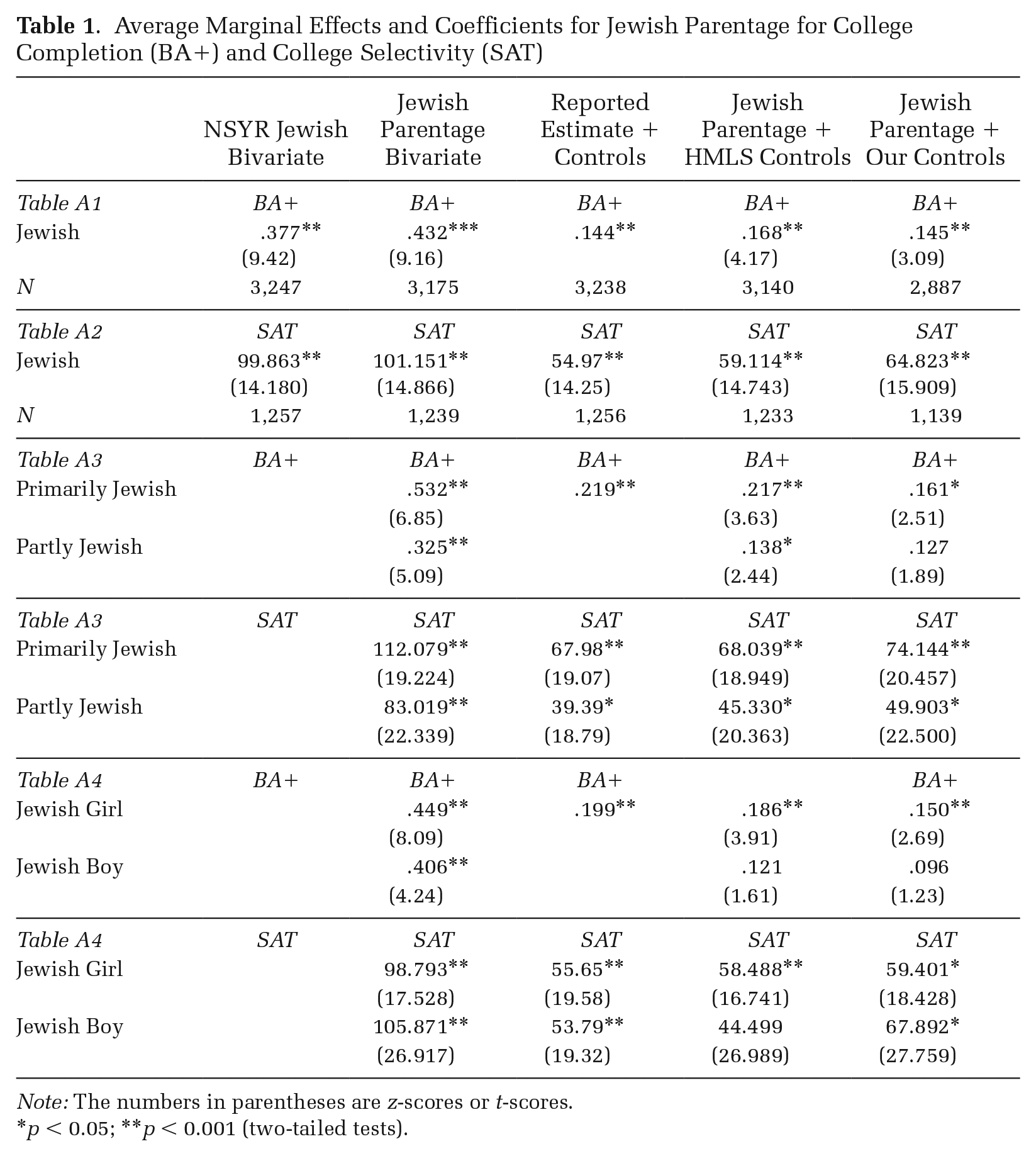
Note: The numbers in parentheses are z-scores or t-scores.
p < 0.05; **p < 0.001 (two-tailed tests).
To guide our discussion, we also use a series of directed acyclic graphs (DAGs) in Figure 1. 2 The model in Panel A represents HMLS’s strategy for estimating the effect of religious subculture and egalitarian habitus on educational attainment. Specifically, HMLS estimate the effect of Jewish parentage on attainment, net of parents’ social class.
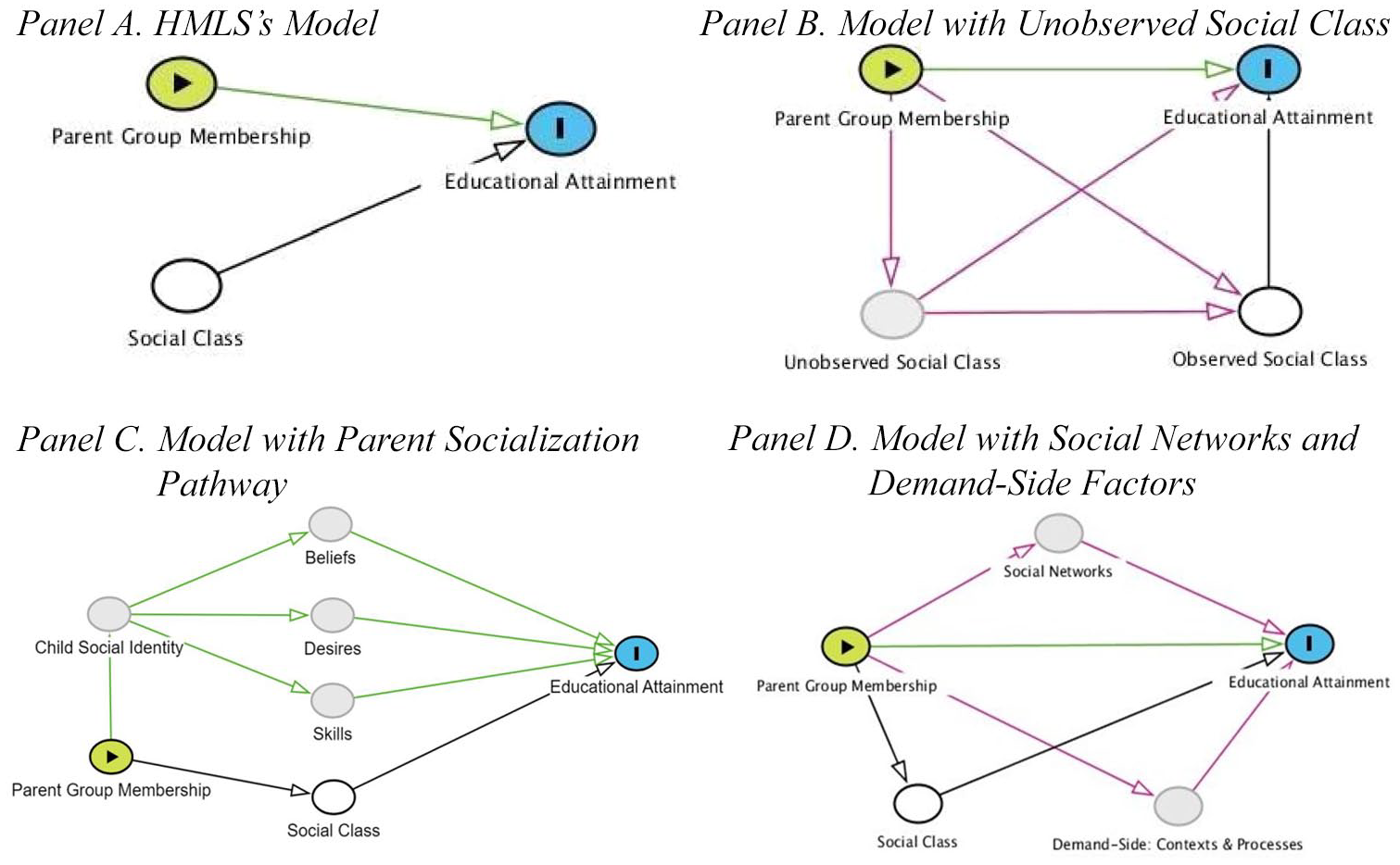
Directed Acyclic Graphs of the Relationship between Jewish Parentage and Educational Attainment
Our first issue regards the need to measure group membership properly. The NSYR principal investigators’ “Jewish” variable serves as the basis for HLMS’s measure of Jewish parentage. A problem, however, is that this variable classifies a teen as “Jewish” if they were targeted by the Jewish oversample or if they reported synagogue attendance or self-identify as Jewish, even if neither of their parents self-identified as Jewish or reported attending synagogue. This approach to measuring a teen’s Jewish identity might be reasonable, but it is inconsistent with HMLS’s stated strategy of “measure(ing) religious subcultural upbringing based on the religious affiliation of adolescents’ parents—not the children themselves” (p. 343). Therefore, we follow HMLS’s stated strategy by constructing a measure of partial Jewish parentage exclusively based on the survey instrument (as with the measure of full Jewish parentage). 3 Among teens classified as having Jewish parents, this revised coding results in a higher share with two (versus one) Jewish parents (62 versus 52 percent in HMLS) (see the online supplement).
Although our replication improves the validity and reliability of the measurement of Jewish parentage, Table 1 shows the revised coding does not appreciably alter HMLS’s findings. Rather, our improved measure of Jewish parentage initially shows slightly larger coefficients for college completion and college selectivity (see column 1 versus 2 or column 3 versus 4).
Bias From Unobserved Social Class
If Panel A in Figure 1 were the appropriate causal model for identifying clear explanatory mechanisms driving group differences in attainment, our replication would substantiate HMLS’s claims. However, Panel B in Figure 1 demonstrates our second issue. Any analysis based on Panel A will be hampered by unobserved confounding so long as social class is not accurately and comprehensively measured and incorporated into the analysis.
To be clear, Panel A acknowledges that some aspects of class may be correlated with both Jewish parentage and educational attainment. For example, some of the reason why Jewish parentage predicts higher attainment in the first two models of Table 1 has little to do with teens’ beliefs, desires, or skills. It is simply that Jewish parents possess greater economic resources and hence are of a higher social class. Insofar as these factors are unobserved, this will bias the coefficients for Jewish parents and allow for a cultural explanation that is actually due to class differences. It is therefore imperative to adjust for class as much as possible in order to identify the specific effect of internalized culture on attainment.
Adjusting for class is a challenge because Jewish parentage and social class are extremely confounded in the NSYR. 4 Jewish parents in the dataset are overwhelmingly drawn from the affluent, as measured by income, education, or any other variable. 5 In the NSYR, 57 of the 142 cases with Jewish parentage are in the top one of 11 income categories—more than in the bottom eight income categories combined. Given that Jewish parents are so disproportionately advantaged in the NSYR, it is necessary to measure social class as precisely as possible to prevent spurious associations.
Unfortunately, the NSYR was not designed to scrutinize social class. The NSYR lacks important social class variables, such as wealth, and has a weak measure of income (see the online supplement; Brady et al. 2020; Brady et al. 2018). In the absence of better measures of social class, caution is warranted about attributing attainment to culture. Moreover, every effort should be made to optimize the measurement of social class given what is available in the NSYR.
The online supplement demonstrates how we improve on HMLS’s measurement and specification of social class using the NSYR. First, we remove occupational prestige because stratification scholars have long demonstrated it is a gendered measure of cultural status rather than an effective measure of socioeconomic resources (Hauser and Warren 1997; Hout 2018). Second, we include salient “social class” measures available in the NSYR that HMLS omit: home ownership, parent nativity, and parent age. The online supplement shows each has significant coefficients and is confounded with Jewish parentage. Third, we specify nonlinear relationships between parents’ income and categorical education, and the outcomes. By contrast, HMLS collapse these variables into a continuous SES index, which effectively treats income and education as having linear effects. Distinguishing them is critical given that Jewish parentage is so highly confounded with the highest categories of income and education and so rare in the lowest categories. The online supplement further justifies each of these choices.
Again, Table 1 (see also the online supplement) summarizes our replication. The third column shows HMLS’s reported results. The fourth replicates their models with their controls, but with our measure of Jewish parentage. The fifth column shows our measure of Jewish parentage and our controls for social class.
Once we improve HMLS’s models by adjusting for better measures of social class, several results change. The coefficient for Jewish parentage on college completion, for example, is approximately 86 percent as large, but about 9 percent larger for college selectivity (i.e., mean SATs). For college completion, the separate coefficient for having one Jewish parent (what HMLS call “partially Jewish”) is no longer statistically significant, and the separate coefficient for having two Jewish parents (what HMLS call “primarily Jewish”) is only 74 percent as large. These separate coefficients are slightly larger for college selectivity.
Most importantly, HMLS’s findings for Jewish girls change considerably. Being a Jewish girl now has a coefficient approximately 81 percent as large on college completion (Jewish boy remains insignificant but is 79 percent as large). Furthermore, Jewish boys, not girls, now appear to attain higher college selectivity (i.e., attend colleges with the highest SATs). HMLS report no significant difference between Jewish girls and boys in college selectivity, but we find the coefficient for Jewish boys is 53 percent larger with our controls for social class, and the coefficient for Jewish girls is only about 2 percent larger.
The evidence for differences between Jewish girls and Jewish boys is even weaker than these changed coefficients. A better test of whether Jewish girls actually have higher college completion than Jewish boys (and the other groups) would change the reference category to Jewish girls (from HMLS’s reference of non-Jewish girls). 6 A better test of whether Jewish boys actually have higher college selectivity than Jewish girls would change the reference category to Jewish boys. HMLS show neither of these tests, but we show them in Table S6 in the online supplement. These models show no statistically significant differences between Jewish girls and Jewish boys for either outcome. Thus, with these more appropriate tests, there is no quantitative evidence supporting HMLS’s emphasis on girls’ distinctive benefit from Jewish subculture.
Our replication illustrates it is necessary to measure social class as well as possible; otherwise the effect of parental cultural socialization on attainment will be biased. Indeed, given the limitations of the NSYR regarding social class, it is plausible that even further improvements to the measurement of social class would further alter the results.
Portability: Avoiding Essentialism Via Mediation
To this point, we have supported HMLS’s goal of identifying clear explanatory mechanisms to assess whether and how culturally acquired religious habitus influences group differences in attainment, as well as their effort to operationalize these mechanisms. However, we questioned their success in meeting two well-established guidelines for such an analysis: ensuring valid and reliable measures of group membership and adequately adjusting for social class. Now, we advance a deeper critique by introducing two principles we argue are essential for cultural explanations of attainment to satisfy the standard of identifying clear explanatory mechanisms.
The first of these principles, portability, can be developed by questioning HMLS’s assumption that parental Jewishness can stand in for (culturally inculcated egalitarian) religious habitus. In Panel C of Figure 1, we present a simple delineation of the causal chain by which a particular habitus may be inculcated in children from a particular social group (depicted in green). This chain clarifies the distinct causal role of “parent social group” on “(child) social identity” and thus on the child’s habitus. Merely by laying out a “parental socialization pathway” (PSP) in this manner and pointing to elements of habitus that can be possessed by anyone (and are thus “portable”), a key question comes to the fore that was previously hidden: Does parental group membership have a direct effect on attainment even after the child’s habitus is directly incorporated in the analysis? HMLS imply that the appropriate strategy for validating the hypothesis that religious habitus shapes attainment is by testing whether Jewish children have higher educational attainment net of social class. But even were social class to be fully incorporated (and we argue it was not and cannot be fully with the NSYR dataset), it would still be unclear whether remaining group differences are explained by cultural socialization or by something else. The way to resolve this question is not by showing that children raised Jewish have different attainment levels, but by showing there is no effect of Jewishness once the mediating effects of parental cultural socialization are incorporated.
What might such an analysis look like? Our answer must remain tentative because, despite their call for “clear causal mechanisms,” HMLS neither conceptualize nor measure the second or third steps in the PSP chain. Panel C begins to address this issue by distinguishing roles for parental and child identity and by parsing habitus into beliefs, desires (i.e., a type of values), and skills. We use “beliefs, desires, and skills” as shorthand for some of the declarative, evaluative, and procedural domains of cultural knowledge that comprise how habitus is expressed (see Bourdieu 1977; Patterson 2014; Wacquant 2016). We note this is largely in keeping with HMLS’s definition of habitus (see note 1), and we use this shorthand to clarify how we can “know” habitus when we see it. To be sure, and as we will discuss, it is difficult to measure these elements of habitus. But the solution to such difficulty is not to evade it by treating group membership (in this case, Jewish parentage) as a surrogate for habitus. The solution also cannot be collapsing the first and second stages of the PSP causal chain by deriving a child’s social identity and habitus from their parent’s social group membership.
This conflation is problematic in the first instance because it prevents the mediation analysis that is essential for testing whether parental cultural socialization shapes attainment. Moreover, whereas HMLS imply that children are merely vehicles for parental influence, a reanalysis of the NSYR data shows that many teens in the NSYR do not accept their parents’ identity or even their parents’ religious practices as their own. 7 Although it is possible for parental group membership and subcultural socialization to affect children despite children’s indifference or resistance, it is hard to believe such influence is as strong for teenagers who neither identify with their parents’ social identity nor participate in their parents’ subculture. 8 After all, even HMLS note the importance of “self-concept” as the companion of habitus for shaping teens’ attainment. Moreover, although other research with the NSYR suggests parents’ identification influences their children’s future self-identification and action, even net of their behavior as teens (e.g., Pearce, Uecker, and Denton 2019), when parents are theorized to influence their children so directly, there must be evidence other than parents’ self-identification to show this is the case. We must know something about their children, how they identify, and what they do, ideally from the child’s perspective. So, once we acknowledge that we cannot simply assume a child has internalized their parents’ subculture and that it matters whether the child identifies with or participates in the same culture, the next question is: how? That is, we must open the black box of the parent socialization pathway.
The mechanisms by which culture is learned and internalized and the variations in its expression are complex. 9 For example, research emphasizes the importance of relationships (e.g., status, quality), interaction (brief, lasting, intermittent, repetitive), context (stable, chaotic, shifting), the extent to which culture is embedded in external artifacts (e.g., language, books), and the extent to which culture is embedded in actions and practices. How best to measure culture, including habitus as internalized and embodied culture, is similarly complex (Mohr et al. 2020). Thus, one cannot assume an individual’s habitus based exclusively on their selection of an identity category on a fixed-choice survey. Nor can we assume habitus has been neatly transmitted from parents to children based exclusively on parents’ selection of an identity category on a fixed-choice survey. At a minimum, we need evidence that selection is linked to portable expressions of culture and to show that these beliefs, desires, and skills have been culturally transmitted from parent to child, directly or indirectly, to avoid reifying the false notion that something inherent to groups explains attainment. 10 That is, any feature of a parent’s habitus—such as gender egalitarian values—must be portable in theory, even if in actuality, neat transmission from parent to child is likely impossible because children have agency (they can reject or modify these values) and other socializing agents, such as teachers and friends, influence kids, too. 11
Furthermore, we cannot know how parentage matters for attainment if we cannot identify how specific features of parents’ habitus influence their offspring’s aims and actions. HMLS attempt to address this issue with two types of qualitative evidence to substantiate their argument that American Jewish parents uniquely transmit egalitarian values to their children, which drives their pursuit, and especially Jewish girls’ pursuit, of higher education (pp. 340–42). Unfortunately, the first evidence they offer is a partial and imprecise historical overview that inconsistently mingles religious with ethnic and political features of Judaism. 12 These data also inaccurately describe the Jewish American experience, especially Jewish women’s experiences in the United States. 13 The second evidence contains qualitative interviews (also from the NSYR) with 33 exclusively white, “middle-upper class” girls (15 of whom have at least one Jewish parent). From this, HMLS contend that Jewish girls internalize their parents’ egalitarian values, as manifest in their quests for self-concept congruence, which explains their attainment in comparison to Jewish boys and non-Jewish girls (pp. 341–42).
HMLS’s approach here is promising, in the first instance, even though it can at best be suggestive of mechanisms responsible for quantitative results. What people say about their motivations matters—not only because it reveals their self-understanding, but also because this understanding can shape their future actions, a central claim of HMLS’s argument. Furthermore, different social groups often draw on distinct cultural repertoires to justify their actions, which can also shed light on how individuals perceive their values and actions within the world (Lamont and Swidler 2014:159). Interviews, when interpreted with sensitivity, can further illuminate how culture matters by attending to non-verbal cues such as body language, pauses, sighs, laughter, and even “meta-feelings” (Pugh 2013:50–51). Unfortunately, however, we do not see such interpretive richness in HMLS’s analysis, nor more generally do the interview data show what HMLS claim.
First, the qualitative interview data suffer from sample selection limitations. The Jewish girls are compared with Protestant girls from similar social class backgrounds, but not with Jewish boys. The “middle-upper class” white Jewish girls are also not compared with non-middle-upper class or non-white youths. 14 One has to scrutinize HMLS’s Appendix Table A3 to realize the non-Jewish girls are probably not representative of non-Jewish “middle-upper class” girls in the United States. Indeed, HMLS appear to disproportionately oversample groups that hold more conservative gender ideologies (e.g., one-sixth of HMLS’s sample are Mormon/LDS [i.e., ~17 percent of their sample versus ~2 percent of the entire U.S. population] and two-ninths are conservative protestants). Even without these sample selection limitations, the qualitative data from 33 girls is simply insufficient to substantiate the many quantitative generalizations HMLS make about non-Jewish girls (Abend, Petre, and Sauder 2013). 15 Most importantly, while HMLS differ from us in emphasizing Jewish parentage rather than child social identity, one has to scrutinize Appendix Table A3 to realize that fully one-third of their Jewish girl interviewees do not self-identify as Jewish (indeed, two identify as Catholic, and one each identifies as Mainline Protestant, Christian, and none). 16
Second, in their interview responses, Jewish girls described their aspirations to become prominent and hold high-impact, prestigious careers; their visions of marriage and motherhood as secondary; and the practical steps they were taking, or planned to take, in pursuit of these plans. Yet not one of them attributed these aspirations and actions to Judaism, being Jewish, or even their parents’ egalitarian values. The only evidence consistent with these arguments was HMLS’s finding that Jewish girls attribute their Jewish culture to promoting questioning and openness to new ideas (p. 355). But Jewish girl respondents did not link this openness to new ideas to educational attainment, instead attributing their educational goals to admiration for various people in their lives and their (not-specifically Jewish) traits (e.g., inspiring teachers and inquisitive people, p. 355). 17
To be clear, a large body of literature in cultural cognitive sociology suggests that people, especially teens, are often unable to articulate the internalized values that guide their actions and tend to draw on public culture when asked to justify why they behave the way they do. 18 Indeed, Vaisey (2009) relies on NSYR data to make this exact point, which has since become highly influential in research on the relationship between culture and action (for a review and extension, see Luft 2020). As such, had HMLS found evidence from the NSYR survey that justified the claim that Jewish teens were different in their habitus due to differences in religious socialization, it would not necessarily be problematic that the interview data do not support such a claim. But as we have seen, the NSYR survey data do not (and indeed, cannot) provide such evidence. As such, the fact that the interview data also lack such evidence is problematic.
Moreover, while it is not entirely surprising that the youth in HMLS’s study generally fail to connect their Jewish upbringing with their values and goals, they do attribute their traits, aims, and actions to something—in addition to the aforementioned, their parents’ insistence and their parents’ own ivy league backgrounds (p. 355)—and these attributions deserve closer consideration or, at the very least, an explanation from HMLS if the authors dismiss them as irrelevant. Without such an explanation (which could, for example, include an appeal to Vaisey’s dual-process model), the absence of explicitly articulated connections between these teens and their Jewish values raises critical questions about HMLS’s hypothesis. This absence does not, in itself, invalidate their argument within the framework of cultural-cognitive theories of action, but it certainly does not provide support for the argument they are making—specifically, that the transmission of egalitarian values from Jewish parents to their children is responsible for Jewish girls’ outcomes.
Given this absence in HMLS, we attempted to search for a mechanism in the NSYR that might mediate between Jewish parentage and teens’ outcomes (see the online supplement). Unfortunately, measures of gender egalitarian values are not available in the NSYR, and so nothing approaching the necessary mediation analysis is possible. However, as a first step in that direction, we tested nine other potential mechanisms between Jewish parentage and outcomes: ideal and realistic educational expectations, grades, ideal age at marriage, importance of doing well on schoolwork, planfulness, parents’ importance that someday teen graduates from college, subjective financial situation, and parents’ importance of spending time doing activities with teen. Only two of the nine show any evidence of mediating the relationship. Contrary to HMLS, however, (an older) ideal age at marriage is significantly and positively predicted by being a Jewish boy or having one Jewish parent, but not significantly predicted by being a Jewish girl or having two Jewish parents. Of the nine potential mechanisms tested, the only one consistent with HMLS’s hypothesis is the importance parents place on their teen someday graduating from college (and this is only for college completion, not college selectivity; we note additionally that at least one respondent mentioned this in their interview, p. 356). Nevertheless, as we explain in the online supplement, the vast majority of any effects of Jewish parentage cannot be explained by this mechanism.
Let us summarize the implications of the portability principle and our efforts at reckoning with the parental socialization pathway. In short, it may be intuitive to believe that parents with different social identities socialize their children differently and that this contributes to their children’s different habitus and attainment. Yet, we cannot simply collapse these three steps and assume, as HMLS do, that a child’s habitus can be operationalized by (their parents’) social group membership. Rather, to have confidence in any claim that cultural socialization and internalization matter for attainment, it is necessary to specify the beliefs, desires, and skills that are associated with the parents’ culture; to specify that their children share these habitus features in common with their parents; to demonstrate how (and indeed, that) parents have transmitted these aspects of their religious subculture to their children; and to show that parents have influenced their children’s outcomes accordingly. If social and cultural mechanisms of transmission cannot be specified, nothing can stop a researcher from filling in the blank and interpreting group differences in terms of any mechanism. One could even attribute the difference of Jewish girls’ high educational attainment to the essentialist and dubious possibility that Jewish girls are biologically or genetically superior. Conversely, by specifying features of habitus that are portable, meaning members of any group can possess these features or lack them, as well as showing how and that they have been transported, we can evaluate how these features and transmission mechanisms matter for different outcomes.
Convertibility: is it valuable for everyone?
A final, but equally important, challenge in identifying clear explanatory mechanisms for whether and how culture drives group differences in attainment is the need to address the principle of convertibility. To be convertible, a feature of habitus should offer comparable returns across different groups. Unfortunately, different groups routinely receive unequal rewards for the same beliefs, desires, and skills. Consequently, even if individuals possess a habitus that is useful for attainment, it is unlikely that everyone can equally translate such features into tangible achievements.
In Panel D of Figure 1, we highlight two reasons why rates of return may vary for different people possessing the same beliefs, desires, and skills: discrimination from societal gatekeepers and differential access to social networks. The first of these reasons is straightforward. Just as family class background can create different opportunities for individuals, regardless of cultural features of their upbringing, important “demand-side” factors can also help or hinder adolescents’ attainment, regardless of their habitus. For example, biases might penalize individuals if their beliefs, desires, and skills do not align with stereotypes associated with their (perceived) social identity. Various formal gatekeepers (e.g., teachers, college admissions officers, employers, police officers) decide to allocate resources and to discipline and penalize some adolescents and not others, often depending on how their implicit or explicit social category judgments interface with their judgments of adolescents’ habitus. These demand-side gatekeepers shape how supply-side resources translate into attainment (Kerckhoff 1995; Tomaskovic-Devey and Avent-Holt 2019).
Children with the same or similar habitus and (supply-side) resources may attain differentially because gatekeepers evaluate the same habitus and actions of adolescents differently based on their (perceived) social identities. We know this to be true for women, who face systematic discrimination even when their behavior is similar to—or their academic performance surpasses—that of men (Quadlin 2018); for American Jews, who were historically excluded from higher education (Karabel 2006) and the professions (Dinnerstein 1981), and who have faced a recent rise in antisemitism on college campuses and in broader contexts, including hiring (Kopstein, Schugurensky, and Shenhav-Goldberg 2024; Tomlin 2024); and for Jewish women on college campuses in particular (Ipsos – Jewish on Campus 2023). Such demand-side factors might elevate certain adolescents and block others. Consequently, it is possible to over- or even underestimate how habitus shapes attainment by failing to consider the contexts in which people operate. Even Bourdieu (1980:135–36, in Wacquant 2016:69) was clear on this point. Habitus cannot be regarded apart from the social fields in which it functions, and the same habitus can result in different attainment because of different opportunities and constraints (see also Patterson 2014:7). How people react to you matters. At a broader level, institutionalized discrimination against people with different social identities, regardless of their beliefs, desires, or skills, shapes experiences along paths to attainment and outcomes.
In addition to formal gatekeepers, various informal gatekeepers within social networks (e.g., friends and mentors) play important roles in channeling or obstructing attainment. HMLS do mention the role of “familial networks” (p. 342), even though they do not and cannot measure them. Moreover, HMLS discuss “put[ting] children in contact with adults who serve as role models” (p. 341), such as “career women” who culturally socialize girls to “develop self-concepts centered around elite careers” (p. 342). However, the vast literature on social networks and (labor market) attainment does not emphasize socializing role models and self-concept as the key mechanisms, but instead focuses on how networks provide channels for differential information, resources, and social support (for classic statements, see Granovetter 1983; Lin 2002; for a recent review, see Kim and Fernandez 2023). Moreover, abundant evidence shows that access to social networks may vary depending on one’s social identity, independent of social class (e.g., Kasinitz and Rosenberg 1996; Royster 2003). Indeed, these barriers may be strong independent of habitus. A habitus that opens doors for members of one social group may not do the same for members of another. Hence, social networks operate as demand-side informal gatekeeping that enables or constrains certain youths’ attainment. However, social networks also complicate supply-side resources that drive attainment, and, if unobserved, can confound any effects of cultural socialization, just like unobserved social class.
Thus, even if the NSYR included measures that afforded the type of mediation analysis depicted in Panel C in Figure 1, and this analysis showed that group differences in attainment were fully mediated by elements of habitus, we would still have reason to doubt we had a clear picture of how cultural socialization matters for attainment. In particular, insofar as institutional discrimination or social network-based gatekeeping occurred because of social identity, this would still leave open the possibility that various group-based barriers were limiting the full value that habitus offers for attainment. In short, not only is the effect of cultural socialization on attainment limited by the portability of beliefs, desires, and skills across social groups, it is also limited by the convertibility of such elements of habitus into attainment value. In fact, various elements of habitus may only work for members of some groups insofar as they are perceived as misaligned with stereotypes attached to other groups. 19
To address this issue, one would need to supplement the NSYR to incorporate discrimination by institutional gatekeepers and informal social networks into any analysis that claims clear explanatory mechanisms for how internalized culture affects attainment. Habitus does not occur without friction in a vacuum; “sorting machines” (Kerckhoff 1995) of institutions, networks, schools, and employers filter, facilitate, and constrain how a given habitus translates into attainment. One might, for example, incorporate school-, community-, or state-level variation in the presence of Jewish teachers or female principals to test whether certain institutional contexts better facilitate and reward, or impede and punish, features of the Jewish girl habitus. There are ample research exemplars of sociologists incorporating demand-side processes to fulfill the principle of convertibility in social stratification research generally (e.g., Tomaskovic-Devey and Avent-Holt 2019) and in research on educational attainment specifically (e.g., Roscigno, Tomaskovic-Devey, and Crowley 2006). Integrating these approaches more deeply with the sociology of culture would strengthen efforts to identify clear explanatory mechanisms in cultural explanations of attainment.
Conclusions
Given the foci and comparative advantages of sociology, sociologists should have an interest in guarding the rigor of answers to HMLS’s question of parental cultural socialization’s effects on attainment. So long as cultural explanations of attainment prominently recur in both scholarly and public debates, sociologists have a responsibility to scrutinize such arguments. Embracing HMLS’s foundational principle of specifying “clear explanatory mechanisms” will help sociologists avoid the pitfalls of simplistic answers to this question. Nevertheless, we must be mindful of the gap between this principle and its execution.
In this Comment, we explain why this gap is so important and offer guidance for how sociologists can more rigorously investigate the question of parental cultural socialization’s effects on attainment, and especially, how sociologists should test the hypothesis that group differences in attainment are explained by parental cultural socialization. Our guidance, in short, involves reaffirming two guidelines and clarifying two more, based on two principles.
First, group membership must be conceptualized and measured in ways that are both valid and reliable. Second, researchers must rigorously and comprehensively control for social class. Third, to argue that elements of habitus contribute to group-based differences in attainment, one must identify portable cultural mechanisms that help explain observed disparities. Fourth, these portable cultural mechanisms must also be demonstrably convertible despite the barriers posed by networks and various demand-side processes that channel, exclude, and discriminate.
To close, we remind the reader of HMLS’s implicit warning against “culture of poverty” arguments. Sociologists are often instinctively skeptical of such arguments because of serious logical and evidentiary problems (Brady 2023; Streib et al. 2016). Nevertheless, the pitfalls of culture of poverty arguments cannot be avoided simply by focusing on attainment rather than under-attainment. Scholars have long been skeptical of arguments that a problematic parental culture causes children’s under-attainment. 20 We should be equally skeptical of arguments that a productive parental culture causes attainment (a point HMLS also make; p. 337). The basis for such skepticism is reinforced insofar as the cultural mechanisms underlying parental socialization are not specified nor shown to be convertible and portable, but instead assumed to be an essential feature of parents’ social group and directly transmitted to their children. For such reasons, this Comment aims to raise the standard for research on the important question of how parental cultural socialization affects attainment.
Supplemental Material
sj-pdf-1-asr-10.1177_00031224251344634 – Supplemental material for How Does Culture Matter for Attainment, and How Would We Know If It Did?
Supplemental material, sj-pdf-1-asr-10.1177_00031224251344634 for How Does Culture Matter for Attainment, and How Would We Know If It Did? by David Brady, Aliza Luft and Ezra W. Zuckerman Sivan in American Sociological Review
Footnotes
Acknowledgements
We thank participants in the MIT Economic Sociology Working Group for their insightful comments on an early draft, and Jessica Collett, Natasha Quadlin, and Omar Lizardo for their valuable feedback at various stages of this project.
Authors’ Note
All authors contributed equally to this comment.

Notes
References
Supplementary Material
Please find the following supplemental material available below.
For Open Access articles published under a Creative Commons License, all supplemental material carries the same license as the article it is associated with.
For non-Open Access articles published, all supplemental material carries a non-exclusive license, and permission requests for re-use of supplemental material or any part of supplemental material shall be sent directly to the copyright owner as specified in the copyright notice associated with the article.
