



Abstract
This paper adds to the literature on cultural stratification by revisiting cultural voraciousness, nearly two decades after it was first introduced as a measure of cultural participation designed to capture inequalities in the pace and variety of cultural activities. Specifically, using the UK 2014–15 Time Use Survey, we compare measures of cultural voraciousness in the UK in 1998 and 2015, focussing in particular on the way cultural voraciousness is associated with both gender and class. We find continuity over time in the patterns of relationship between cultural voraciousness, gender and class, which are not explained by income or hours worked. While women at the bottom of the class scale are still the most disadvantaged in terms of unequal access to cultural participation, high level managerial women now equal equivalent men in their voracious cultural participation. We conclude that not only is cultural voraciousness still useful in depicting cultural inequalities delineated by gender and class, and not only do gender and class gaps in cultural voraciousness persist over time, but also that there is evidence for accentuated class inequality over time in cultural voraciousness among men and among women.
Introduction
More than ten years have passed since a new measure of cultural participation, ‘cultural voraciousness’, was introduced into the literature on cultural stratification (Katz-Gerro and Sullivan, 2010; Sullivan and Katz-Gerro, 2007). This measure was designed to complement the concept of cultural omnivorousness – which emphasised taste for both highbrow and lowbrow cultural products (Peterson, 1992) – by capturing an additional dimension of cultural participation, related to a temporal aspect. Cultural voraciousness was based both on the pace and extent of participation in a range of outdoor leisure activities that take both time and money to accomplish: going to the cinema or theatre, eating or drinking out, going to sporting events and sports participation/keeping fit. Motivating the concept of cultural voraciousness was the development of a ‘quantitative’ dimension of leisure consumption which could be interpreted theoretically in relation to notions of cultural repertoires, to the changing pace of work and leisure in late modernity and to the ‘insatiable’ quality of contemporary consumption. Voraciousness resonates with the idea of ‘multi-cultural capital’ through the knowledge and performance of a range of time- and money-intensive (out-of-home) leisure activities. The concept offers a possible reconciliation of the contradiction between the ‘increasingly overworked’ versus ‘increasing leisure consumption’ contention, with diminishing discretionary time devoted by those who can afford it to the rapid consumption of high-end leisure activities.
As cultural voraciousness measures leisure participation in terms of the actual patterning of activities, it is therefore sensitive to the social differences and constraints on those activities generated by gender (Katz-Gerro and Sullivan, 2010). The gendered patterning of voracious cultural participation is related to men and women’s access to society’s ‘legitimate’ cultural capital (Bourdieu, 1984), which subsequently is recognized by gatekeepers in the labour force, in the educational system and in other social arenas (DiMaggio, 2004). The main findings of the original articles were that men were more culturally voracious than women, and that voraciousness was also positively associated with occupational status (representing economic capital), educational level (human capital) and type of newspaper read (cultural capital). The gender and class dimensions of inequality intersected, such that, overall, the most disadvantaged groups in relation to cultural voraciousness were women from the lowest-status occupational classes, while the most advantaged were men from professional/managerial occupations (Katz-Gerro and Sullivan, 2010). The measures of cultural voraciousness used came from the nationally-representative UK Home OnLine survey, conducted in 1998, and were based both on survey questions about the frequency of participation in activities and time use diary data. In the current paper, we offer analyses of similar measures from the nationally-representative UK Time Use Survey collected in 2014–15, enabling a revisiting of cultural stratification by gender and class in the UK.
The concept of cultural voraciousness has become widely used in the literature on leisure participation and cultural consumption in general (e.g. recently, Cutts and Widdop, 2017; Gemar and Vanzella-Yang, 2022; Lefèvre et al., 2020; Michael, 2015; Quidu, 2022; Segre and Morelli, 2021; Weingartner and Rössel, 2019), and in relation to gender (Erel, 2012; Gemar and Pope, 2021; Molinillo and Japutra, 2017) and class (Weingartner and Rössel, 2019). Yet much had changed in the UK in respect of the occupational/gender distribution of employment between the time of the original data collection in 1998, and 2015, the date of the most recent UK Time Use Survey. Perhaps the most relevant of these occupational/gender changes over this period were the growth in female employment rate, and an increasing polarization between those in relatively secure full-time employment, and those in irregular, unstable and precarious positions in the labour market.
The increase in women’s employment rate over the period 1998–2015 (from 65% to 69%: Office for National Statistics, 2022) was entirely made up of women in full-time, rather than part-time, employment (Roantree and Vira, 2018; Tinson et al., 2016). This increase was associated with an increase in women’s educational qualifications and was reflected in a steady decrease in the overall gender pay gap in median gross hourly earnings (from 27% to 19%: Office of National Statistics, 2019). The growth of full-time career employment, and the concomitant decrease in the gender pay gap to reach near-equality for younger, more highly educated women (a 2% difference for women in full-time positions in 2014: Eurostat, 2022), meant that at the top end of the distribution of occupations (professional and managerial positions) women’s jobs became more like men’s. The effect was both to increase this particular group of women’s employment-related time constraints, but at the same time according them levels of pay that were closer to those of equivalent men than they were in 1998 (Office of National Statistics, 2019). The advancement in women’s employment position notwithstanding, penalties related to the intersection of gender and class were still in place, as has been shown, for example, in the case of class-based advantages in the labour market being offset by a concomitant ‘women’s penalty’ (Rivera and Tilcsik, 2016).
Over the same period, the recession of the mid years of the decade 2000–2010, including the economic crash of 2008 followed by a period of economic austerity, ushered in a phase of readjustment in employment conditions, characterised by increasing precariousness for those at the lower end of the class distribution in respect of the stability of working hours and the permanency of working contracts (Tinson et al., 2016). For many, the decreasing relative size and regularity of financial resources and less predictable working hours (involving a greater need to be constantly available for work when called upon, and consequently less ability to plan activities in advance with any security) might be expected to have had a significant impact in terms of opportunities for cultural participation.
Given these changes, we believe it is time to revisit the original analyses, in order to make two new contributions. First, to investigate the robustness over time of the concept of voraciousness as a characteristic of cultural stratification, using a more recent national-level survey. Second, to investigate whether the pattern of inequalities in cultural voraciousness by gender and class that were originally identified have persisted over time. The main theoretical impetus behind this re-visitation, therefore, is to extend the literature on inequalities in cultural participation by focussing on the intersecting issues of gender and class, paying particular attention to changes in cultural voraciousness associated with these variables. The 2014–15 UK Time Use Survey, containing the same combination of individual questionnaire (including questions on leisure activity participation) and time use diary as the original Home OnLine data, offers the possibility of updating the original analyses over the 15-year period spanning the impact of the economic recession and economic austerity, and the increasing movement of women into career employment. In addition, it offers a new opportunity to consider subjective affect related to the experience of time, including feeling rushed, feelings of stress and satisfaction with life and leisure time which might be expected to have a relationship with cultural voraciousness.
Cultural capital and the intersection of gender, class and time
The concept of cultural voraciousness and its particular emphasis on the degree of engagement in cultural practices has been shown in recent research to be useful for analysing various aspects of the association between culture and stratification. Cultural capital accrued through cultural participation is theorised to reproduce the privileged position of the middle and upper classes and to be transposable into economic and social advantages (Bennett et al., 2009; Bourdieu, 1984; Gunn, 2005; Tatum and Browne, 2019; Yuksek et al., 2019). However, the question of how gender affects cultural participation has generally taken the back seat in research on inequalities in cultural stratification (Christin, 2012). Even more rare have been studies that looked at the way class and gender interact to shape cultural consumption (Katz-Gerro, 2006). Given that the convertibility of cultural consumption into financial rewards and other life outcomes may partially overlap with gender (Jarness et al., 2019; Reeves and De Vries, 2019), the intersection of cultural capital, class and gender is central to discussions of the mechanisms through which inequality is reproduced.
Among the several studies that did provide more elaborated information on gender, there was evidence that women are generally more likely than man to participate in highbrow cultural activities (Bihagen and Katz-Gerro, 2000; Christin, 2012; Falk and Katz-Gerro, 2016; Miles and Sullivan, 2012), although the mechanisms behind this difference are relatively unexplored. This association between gender and cultural consumption (with highbrow as the ‘legitimate’ culture) is intriguing because women are typically disadvantaged compared to men in most life domains. In addition, several studies have looked at how the effect of gender on highbrow cultural taste is intertwined with the effect of social class and educational attainment (Atkinson, 2018; Bihagen and Katz-Gerro, 2000; Christin, 2012).
Adding time use considerations to the intersection of gender and class can provide insight on the complex ways that culture produces and reproduces inequalities. Time use patterns condition individuals’ propensity to act as insatiable consumers, switching between activities and accommodating themselves to the accelerated pace of life of late modernity (Rosa, 2003). This is particularly true for the well-educated and high earners, for whom time is scarce (Sullivan and Gershuny, 2004). As intensity of cultural engagement increases, time is more compressed, resulting in tension between limited time and a broad cultural palette, and in possible associated subjective feelings of being rushed and pressed for time (Southerton, 2003). Cultural voraciousness, as a depiction of status distinction, can reconcile the apparent contradiction between the increase in leisure time and the increase in time devoted to work by the emphasis on the pace of leisure participation. This, however, can often be accompanied by difficulties in managing time, in feeling stressed, which can affect overall life satisfaction.
Indeed, the focus on affect draws the discussion of gendered cultural stratification even further away from class-related dynamics to uncover identity-related and interactional mechanisms behind the gendering of cultural engagement (Lagaert et al., 2017; Ridgeway and Kricheli-Katz, 2013). These involve, for example, interpersonal and structural constraints on engagement (Mullens and Glorieux, 2019), various tensions in the workplace due to expectations that are grounded in a gendered ideal-worker narrative, fuelling inequality especially among professional women (Brumley, 2014), and the construction of specific emotion cultures in response to emotional opportunities and constraints created by the context of organisations (Guenther, 2009; Kelly et al., 2010).
From the above review, we see that the concept of voracious consumers appears to be useful in complementing cultural omnivorousness, sharing many of the same relationships to cultural stratification. In this paper, we present an opportunity to trace change in patterns of cultural voraciousness over time, using very similar data collection methods and measures in two time points. We ask what happens when looking at the UK 2015 Time Use survey, 16 years on, in terms both of the robustness over time of measures of cultural voraciousness, and their relationship to gender and class? What is the picture of cultural stratification that the comparison of these two surveys reveals, and are changes in the distribution of gender- and class-related variables in UK society reflected in the correlates of cultural voraciousness? Our main research hypotheses are: (1) in relation to the growth of economic precarity over the 16 years from 1998 to 2015 at the lower end of the class distribution, we hypothesise that the lowest socio-economic class groups are now more disadvantaged in relation to cultural voraciousness than previously; (2) in relation to the growth in female full-time employment in professional/managerial occupations we hypothesise a changing association between cultural voraciousness and gender, such that women in professional/managerial occupations have become more similar to men in relation to their patterns of cultural voraciousness; (3) in relation to the growth of economic insecurity at the lower end of the class distribution and in line with the same underlying intersection between gender and class, we hypothesise that the most disadvantaged groups in terms of cultural participation are still lower-class women.
Methods
Data and variables
The original analyses were based on the first wave of ‘Home OnLine’ (1998), a panel study of adults in UK households undertaken by the Institute for Social and Economic Research at the University of Essex (hereafter the HoL). It included individual/household questionnaires and a 7-day time use diary. The measures of cultural voraciousness used were based on questions from the individual questionnaire asking respondents with what frequency they had participated in certain leisure activities over the past week and month. The focus was on out-of-home leisure activities generally characterised by their time and/or money-intensive nature. These comprised: going to the cinema/concerts/the theatre; leisure group participation; eating/drinking out; watching sports; and doing sports/keeping fit. Respondent’s records of the same activities as recorded in their week-long time-use diaries were also compared to these questionnaire measures.
The most recent nationally-representative time use survey in the UK is the 2014-2015 Time Use Survey (hereafter the UKTUS), which formed the Office of National Statistic’s contribution to the second round of the Harmonised European Time Use Survey. Like the HoL, the UKTUS also included an individual questionnaire, and a time-use diary, in this case collected over 2 days (a weekday and a weekend day).
While these surveys were similar in many respects, in that they were both nationally-representative general-purpose time use diary surveys, and both collected questionnaire measures and a diary measure of cultural participation, they were not specifically designed to be directly comparable. There are, consequently, some differences both in the exact questions asked about activity participation, and in the length of the diary collection period.
Firstly, the format of the survey question asking about participation in different activities was slightly different. In relation to the set of out-of-home activities from the HoL listed above, interviewees were asked whether they did these activities on ‘most days; at least once a week; at least once a month; or several times a year’. In the UKTUS, interviewees were asked about similar activities 1 , but in a somewhat different format: How many times did you do [X activity] in the past week? and; how many times did you do [X] activity in the past month? Although the format is not identical, it is still possible to create measures from the UKTUS that are similar to those of the HoL measures 2 . We adopted the same strategy for examining the differences between these measures as in the original papers. This involved the creation of two different measures based on the questionnaire information (a ‘past 4 weeks’ measure, and a ‘past week’ measure), which we then compared (see section below: comparison of measures).
Comparison of measures – cultural voraciousness means and frequency distributions for ‘Past 4 weeks’, ‘Past week’ and ‘2 diary days’ measures: UKTUS (working age population).
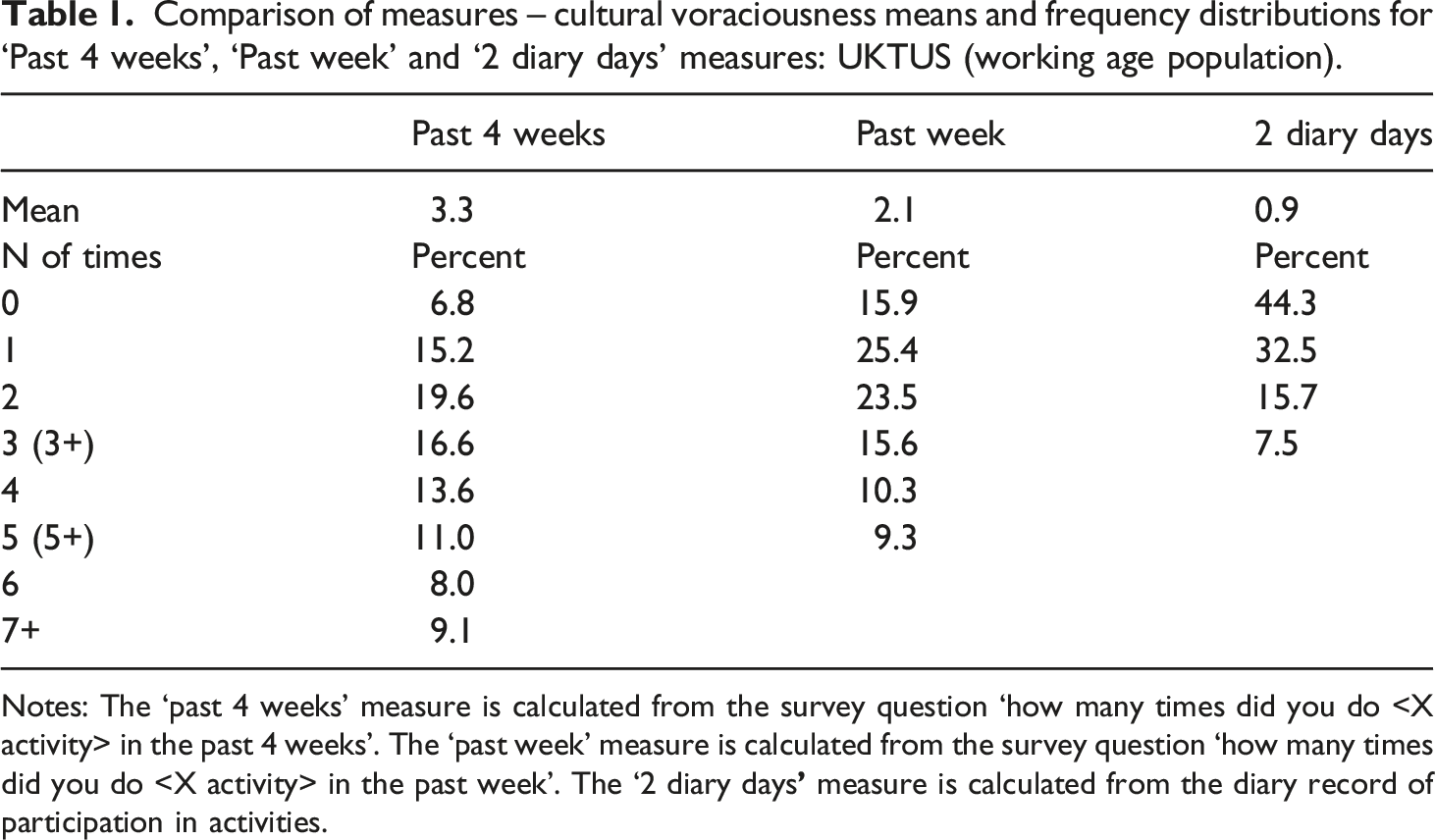
Notes: The ‘past 4 weeks’ measure is calculated from the survey question ‘how many times did you do <X activity> in the past 4 weeks’. The ‘past week’ measure is calculated from the survey question ‘how many times did you do <X activity> in the past week’. The ‘2 diary days
Mean cultural voraciousness by gender and occupational class for different measures (Past 4 weeks, Past week and 2 diary days measures): UKTUS (working age population).
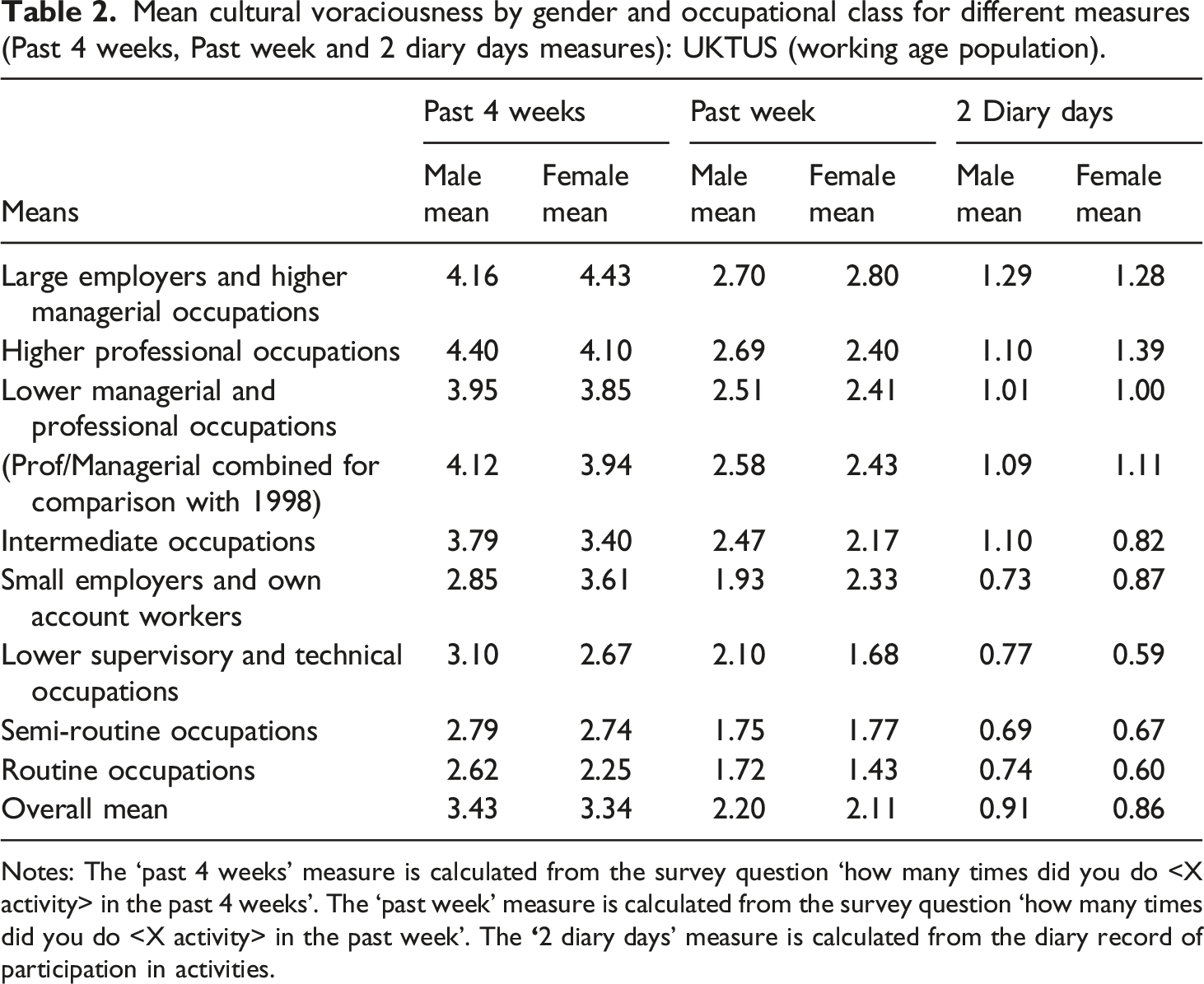
Notes: The ‘past 4 weeks’ measure is calculated from the survey question ‘how many times did you do <X activity> in the past 4 weeks’. The ‘past week’ measure is calculated from the survey question ‘how many times did you do <X activity> in the past week’. The
As was done in the original paper (Katz-Gerro and Sullivan, 2010), we selected only men and women of working age (18–65) for our analyses, as we were interested in the intersection between gender, class (based on occupation) and cultural voraciousness. In multivariate analyses of variance that test the differences in cultural voraciousness means by sex and occupational class, we focus on the ‘past week’ questionnaire-based measure of cultural voraciousness as the dependent variable (chosen because it covers a longer time-frame than the 2-diary day measure, but presents less of a problem in respect of recall bias than the ‘past 4 weeks’ questionnaire measure). The main independent variables that we use are sex (respondents were asked only to identify their biological sex), and occupational class based on the official UK National Statistics Socio-Economic Classification of occupations (NS-SEC). In recognition of women’s primary responsibility for child care, which might affect their time availability to engage in cultural activities, we include a control variable indicating how many children aged between 0 and 16 lived in the same household as the respondents. We also include certain other variables that might have the potential to affect cultural participation through their relationship to either time availability or income. These comprise questionnaire measures of actual hours spent in paid employment during the previous week, usual hours of employment and net weekly income. In order to further explore additional aspects of time related to availability, we then estimate relationships between the measure of voraciousness and questionnaire-based measures of time pressure, levels of reported stress and life and leisure satisfaction.
Comparison of measures
Table 1 shows frequency distributions and overall means for cultural voraciousness calculated from: (1) the question asking about participation over the past 4 weeks (first column); (2) the question asking about participation over the past week (middle column); and (3) participation across the 2 days of the diary (final column). As we would expect from the time frames involved in each case, the highest average number of activities (mean 3.3) is reported from the ‘past 4 weeks’ measure, and the lowest (mean 0.9) from the 2-day diary measure. We would expect the diary reports to be the more reliable of these measures, as time use diary data is regarded as the ‘gold standard’ for the reporting of daily activities (Cornwell et al. 2019). Nevertheless, the relationship between the three measures shows a consistent and expected pattern, lending confidence to our results based on the ‘past week’ measure.
Interestingly, the HoL means reported in the original papers were lower across both questionnaire measures, in particular for the 4-week measure (not shown). This may provide suggestive evidence that the frequency and/or range of participation in these activities has increased over the period 1998–2015 in the UK. We cannot discount, however, that these differences are due to slight variations in the way in which the questions were asked in the two surveys (see Methods section above). 3
Findings: Who are the culturally voracious now?
Table 2 presents raw mean cultural voraciousness by sex and occupational class (NS-SEC). This initial table shows results for all three measures of voraciousness, demonstrating the consistency of results across the measures. Firstly, we see the same trends by both sex and NS-SEC as were found in the original 2007 and 2010 papers based on the 1998 HoL data. In respect of sex, we see that men overall have higher voraciousness than women. In respect of occupational class, we see that, in general, the higher the position in the NS-SEC scale the more voracious is the respondent. However, in terms of the interaction between sex and NS-SEC, something new emerges from the more recent data.
While women in the lowest occupational category were unequivocally the least culturally voracious both in 1998 and 2015, the 1998 analyses showed that men from the managerial, professional and intermediate occupations were (more or less equally) the most culturally voracious. However, it appeared from the 2015 questionnaire measures that managerial and, particularly, professional men had moved ahead of their ‘intermediate occupations’ counterparts, hinting at an increasing class polarization among men (see the row of the table that combines lower managerial and professional occupational categories). Against this interpretation, the same distinction is not evident in the 2-day diary measure – pointing to the possibility that men in managerial and professional occupations may be exaggerating the extent of their cultural participation in their 2015 questionnaire responses (which are known to be more susceptible to these kinds of normative biases than diary data).
This 1998-2015 differences among men at the upper end of the class hierarchy led us to adopt a more finely-grained categorization of the NS-SEC scale than used in the original papers, which revealed something further of interest – in this case for women. Unlike in 1998, in the 2015 data the voraciousness raw means for women in some of the NS-SEC categories at the top of the scale equalled or even exceeded those of their male equivalents. In particular, for those women in the category ‘Large employers and higher managerial occupations’, the mean measure of cultural voraciousness exceeds that for equivalent men for both of the questionnaire measures, while that for women in ‘Higher professional occupations’ exceeds that for equivalent men on the diary measure. For each measure, the means for women in the ‘Large employers etc.’ occupations exceed those of men in the ‘Higher professional occupations’, and for the diary measure the mean for women in ‘Higher professional occupations’ also exceeds that of equivalent men.
Predicted mean cultural voraciousness (Past week measure) from analysis of variance: UKTUS (working age population).
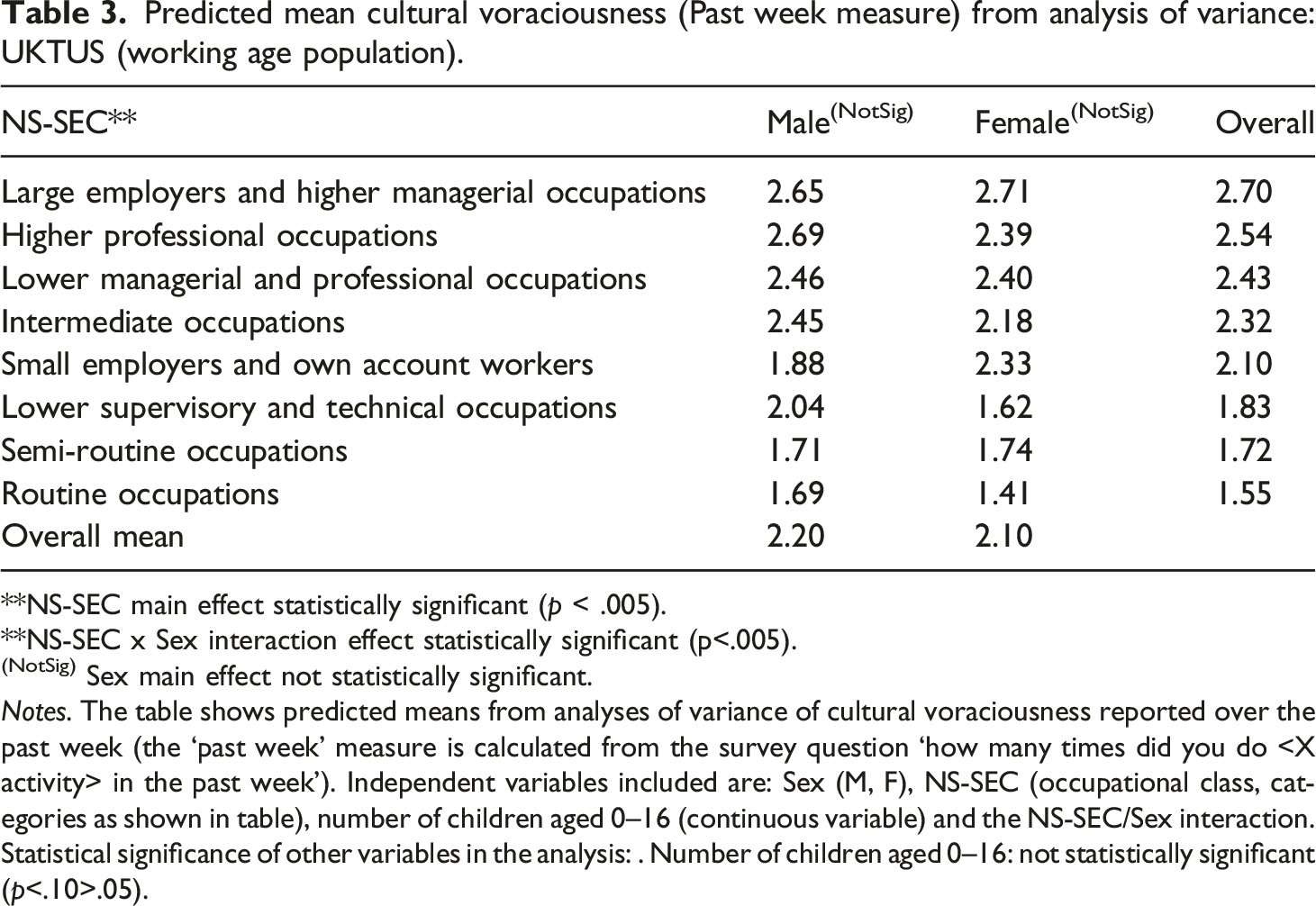
**NS-SEC main effect statistically significant (p < .005).**NS-SEC x Sex interaction effect statistically significant (p<.005).
(NotSig) Sex main effect not statistically significant.
Notes. The table shows predicted means from analyses of variance of cultural voraciousness reported over the past week (the ‘past week’ measure is calculated from the survey question ‘how many times did you do <X activity> in the past week’). Independent variables included are: Sex (M, F), NS-SEC (occupational class, categories as shown in table), number of children aged 0–16 (continuous variable) and the NS-SEC/Sex interaction.
Statistical significance of other variables in the analysis: . Number of children aged 0–16: not statistically significant (p<.10>.05).
Even while controlling for number of children aged 0–16 (border-line statistically significant, p < .10), the predicted means of Table 3 are very similar to the pattern of the raw means shown in Table 2; women in the lowest NS-SEC category (‘Routine occupations’) have by far the lowest predicted mean, while higher-level women managers share the highest mean voraciousness with male professionals. With sex, NS-SEC and their interaction included in the model, the relationship between voraciousness and NS-SEC is statistically significant (p < .005), while that with sex is not (overall means for men and women are not that different). The sex-class interaction effect, however, is strongly significant (p < .005), meaning that the pattern of the relationship with voraciousness by NS-SEC for women and men is different. This is indicated in the table by a steeper gradient in the means for women than for men (2.71–1.41 compared to 2.65 to 1.69).
Predicted mean cultural voraciousness (Past week measure) from analysis of variance: UKTUS (working age population).
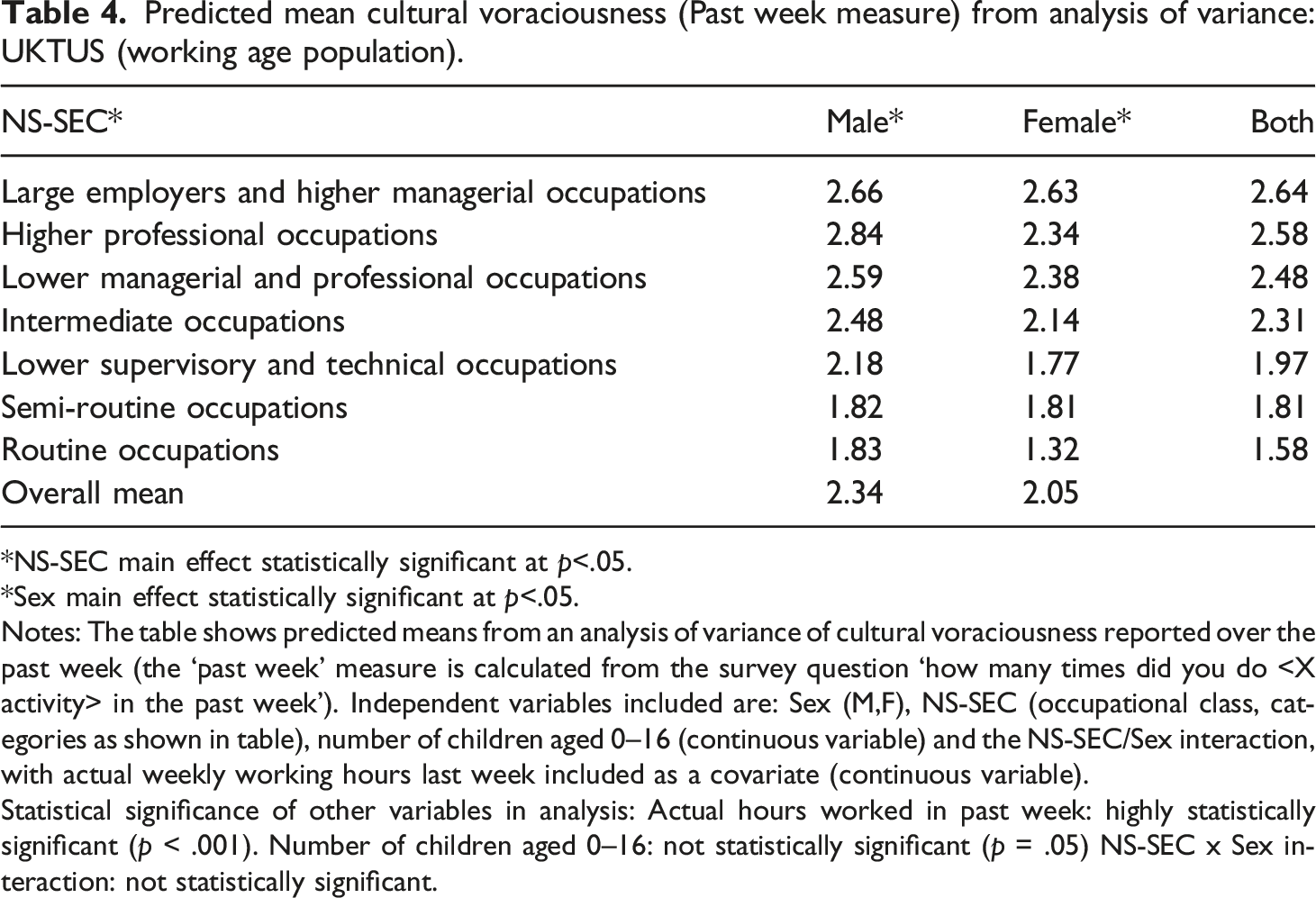
*NS-SEC main effect statistically significant at p<.05.
*Sex main effect statistically significant at p<.05.
Notes: The table shows predicted means from an analysis of variance of cultural voraciousness reported over the past week (the ‘past week’ measure is calculated from the survey question ‘how many times did you do <X activity> in the past week’). Independent variables included are: Sex (M,F), NS-SEC (occupational class, categories as shown in table), number of children aged 0–16 (continuous variable) and the NS-SEC/Sex interaction, with actual weekly working hours last week included as a covariate (continuous variable).
Statistical significance of other variables in analysis: Actual hours worked in past week: highly statistically significant (p < .001). Number of children aged 0–16: not statistically significant (p = .05) NS-SEC x Sex interaction: not statistically significant.
In relation to money, there was no statistically significant relationship evident between voraciousness and net weekly income using the same model (results not shown). 2-way Pearson correlation coefficients show no relationship for women, and only a weak positive relationship for men (r = .055, p < .05).
Overall, these results suggest a consistent, robust pattern of relationship between cultural voraciousness, sex and NS-SEC, which is not affected by weekly income, and which has persisted through the period 1998–2015. While there is no convincing relationship with income, there does, however, appears to be some relationship to time availability.
Cultural voraciousness has previously been theorised as a mechanism for displaying status where time is at a premium for those with money to spend but little leisure time (e.g. Sullivan, 2008). While we did find some relationship with aspects of time, this accorded more straightforwardly with the direct time availability hypothesis. We find that less time available outside working hours (i.e. longer working hours) over the past week is associated with lower mean voraciousness over the same period. We therefore decided to look directly at the relationship between voraciousness and subjective feelings of time pressure. Previous analyses of the UKTUS data have found strong associations between feelings of ‘rushedness’ and gender (women being more likely to feel ‘always’ rushed than men), a relationship that appears persistent over time (Sullivan and Gershuny, 2018). However, we found no clearly interpretable pattern evident between mean measures of voraciousness (past week or 2-day diary) and feelings of rushedness, for either women or men.
If voraciousness were linked to feelings of time pressure, we might also expect to see that reflected in an association with a similar question from the individual questionnaire about levels of stress. And indeed in this case we do find clear statistically significant relationships between reported levels of stress and measures of voraciousness for both genders (significant in one-way analysis of variance at p <.01 in all cases). These relationships are consistently negative in direction: those who report ‘never’ normally feeling stressed have statistically significantly higher mean voraciousness than those reporting ‘always’ feeling stressed.
Comparison of correlation (Pearson’s r) between different measures of cultural voraciousness and measures of satisfaction: UKTUS (working age population).
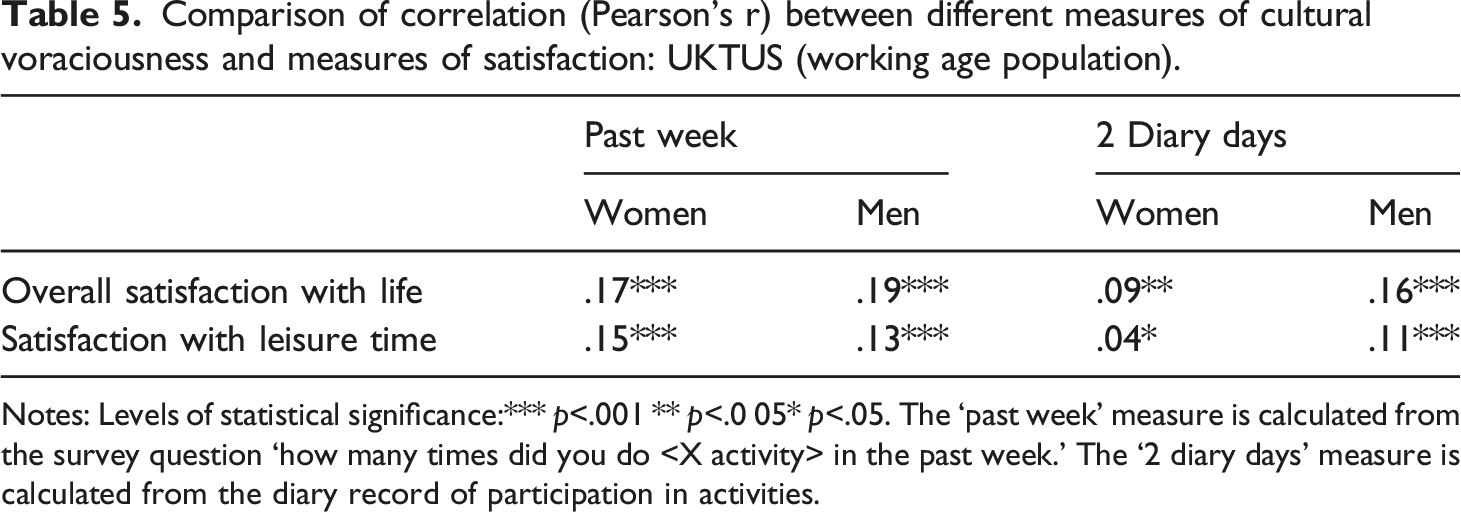
Notes: Levels of statistical significance:*** p<.001 ** p<.0 05* p<.05. The ‘past week’ measure is calculated from the survey question ‘how many times did you do <X activity> in the past week.’ The ‘2 diary days’ measure is calculated from the diary record of participation in activities.
Discussion
The concept of cultural voraciousness was introduced into the literature on cultural consumption in articles dating back to the 2000s (Katz-Gerro and Sullivan, 2010; Sullivan and Katz-Gerro, 2007). The focus on the pace or tempo of participation in high-end, out-of-door leisure activities complemented the idea of omnivorous cultural consumption, where the focus was on the diversity of cultural tastes on the high-brow/low-brow range (Peterson, 1992). The original articles focused on the intersectionality of gender and class stratification in relation to cultural voraciousness, but since that time, wide-ranging research in both consumer studies and consumer culture research have identified voracious cultural consumption as an important marker of status among different social groups. For example, studies have shown that a pattern of voracious cultural consumption is seen by consumers as a vehicle to shape a trajectory of upward mobility (Erel, 2012), to transfer legitimate cultural capital to immigrant children (Tatum and Browne, 2019), or to shape a distinctive urban identity (Cutts and Widdop, 2017; Hanquinet et al., 2012).
We revisit voracious cultural consumption as a key characteristic of cultural stratification, documenting change in the way it is distributed in UK society over the period between 1998 (the date of the time use diary survey that the original papers were based upon) and 2015, the date of the most recent nationally-representative time use diary survey in the UK. We re-evaluate the persistence of the intersectionality between cultural voraciousness, gender and class shown in the original articles in the light of the continuous increase in women’s employment and the polarization of employment conditions between 1998 and 2015. In addition, because voraciousness articulates the way individuals who have less disposable time nevertheless consume culture for the purpose of displaying status, we consider the subjective experience of time in relation to respondents’ reports of feeling rushed, feelings of stress and satisfaction with life and leisure time.
We find the same broad pattern of voracious leisure consumption according to gender and class in 2015 as was reported in 1998, in which men and those in higher occupational class locations are more voracious and women and those in lower-class locations are less voracious. Furthermore, the pattern of gender by class intersectionality remains persistent; men at the upper ends of the class scale were still the most voracious, while women at the bottom of the class scale were still the least voracious. In respect of the gender-class interaction, though, we may also see the beginnings of a change: in contrast to the 1998 data, women in higher managerial positions in 2015 exceeded equivalent men in their cultural voraciousness. We also observe an increasing class difference among men, whereby high-level managerial and (particularly) professional men had moved ahead of their lower level and ‘intermediate occupations’ counterparts. In other words, we may be seeing an increasing engagement in cultural consumption as a marker of status among men, differentiating between classes.
We conclude that not only is the concept of voraciousness still useful in depicting social inequalities in cultural consumption delineated by gender and class, and not only do the gender and class gaps in cultural voraciousness persist over time, but also there is evidence for accentuated class inequality over time in cultural voraciousness among men and among women. Overall, between 1998 and 2015 we find continuity in the pattern of relationships between cultural voraciousness, gender and class, which persists when controlling for the number of children, income and time availability. While women in general and, in particular, women at the bottom of the class scale, remain most disadvantaged in terms of access to cultural participation, high level managerial women appear to have caught up with equivalent men. This is an important finding in the context of recent research showing that consuming certain cultural activities increases the likelihood of workplace opportunities and plays a role in predicting future earnings, controlling for family background, education and other traits (Reeves and De Vries, 2019). The finding of both continuity and change in the relation of cultural voraciousness to class and gender could be seen as evidence for two major features of cultural stratification that have been discussed in the literature. First, that social change in the association between the social structure and cultural hierarchies is a slow process, inevitably only partially identified through a time window that spans between 1998 and 2015 (López-Sintas and Katz-Gerro, 2005). Second, that although the attributes of socially desired cultural capital may change over time (e.g. from highbrow to omnivorous to voracious), cultural participation always serves as a vehicle for social distinction and status (Bennett et al., 2009).
In respect of the two trends in UK employment, we identified at the start of the article: an increasing precariousness in respect of the stability of working hours and the permanency of working contracts for those at the lower end of the class distribution, and the continuous increase in women’s full-time employment rate, our results suggest a process of polarization in cultural consumption, whereby there have been some changes at the top end of the class distribution, but not at the bottom. We observe some changes in the position of women at the top end of the class scale, which may be related to the growth of full-time career employment among women, the decrease in the gender pay gap and the increase in highly educated women in full-time jobs.
Since the essence of cultural voraciousness as a mechanism of the reproduction of inequality is about the way one uses leisure time, it has been suggested that a voracious pattern of consumption will simply characterise those with money to spend but little leisure time. In fact, in the 2015 UKTUS net weekly income was not related to our weekly questionnaire measure of voraciousness when controlling for NS-SEC. In addition, the effect of weekly hours worked did not neutralise the relationships between cultural voraciousness, class and gender, lending support to a class-related cultural interpretation.
Our data, however, does give an indication that having less time available is associated with lower voraciousness, which led us to investigate respondents’ subjective relationship with time. The absence of a clear association between voraciousness and feeling ‘always rushed’ indicates that, in addition to the fact that voracious consumption is not simply about having more leisure time (since adding hours worked into the model does not affect the overall picture in respect of gender/class relationships), or more income (as net weekly income is not related to voraciousness in multivariate analysis), there are also no strong relationships with time-pressure related variables. There was, though, a negative relationship with feelings of stress (those reporting never feeling stressed were in fact more culturally voracious than those reporting always feeling stressed) and a clear positive association between cultural voraciousness and feelings of life and leisure satisfaction, further underlining the disadvantaged situation of lower-class women in relation to this dimension of the cultural stratification of consumption.
The findings presented here are based on unique data, allowing a comparison across time. However, it is a limitation that the 2015 diary data are not based on a full week’s diary record. In consequence, we observe fewer leisure activities from the diary measure than in the comparable measure in the original Katz-Gerro and Sullivan (2010) article. The questionnaire ‘past week’ estimate of cultural voraciousness that we used for the multivariate analyses of variance is based on respondents’ recollection and possibly normative considerations about presenting themselves in a certain way (particularly where voracious leisure consumption is associated with status). These features can be improved upon in future research to add more evidence to the gender and class patterns we report here. Qualitative research trying to understand what motivates voracious leisure consumption among those with little available time would also add additional insights to our understanding of the context of cultural stratification.
To conclude, if a voracious pattern of cultural engagement is not mainly a result of income, or objective or subjective pressure of time, we can rely on the literature summarised above to provide a cultural explanation: it gives high status consumers the opportunity to continue to emphasise and display status through their leisure participation (simultaneously feeding the imperative of late capitalism for increasing high-value service consumption – see Sullivan, 2008). Generally, the homology between cultural consumption (voraciousness) and social position (gender and class) indicates a variety of economic and social returns to cultural consumption and the likelihood of attaining advantageous social positions (Reeves and De Vries, 2019). This conjecture is supported by the process of polarization we observe: since 1998 professional men have relatively increased their voraciousness scores to ‘lead the pack’, with higher-level female managers equalling or even exceeding those of equivalent men. At the other end of the class spectrum, women in routine occupations remain the most disadvantaged. Levels of satisfaction both with life overall and leisure time were positively and significantly related to voraciousness for both women and men, pointing to a strong ‘lifestyle’ value attached to voracious cultural consumption, and underlining continuing existing inequalities by class and gender.
Footnotes
Declaration of conflicting interests
The author(s) declared no potential conflicts of interest with respect to the research, authorship, and/or publication of this article.
Funding
The author(s) disclosed receipt of the following financial support for the research, authorship, and/or publication of this article: The writing of this paper was funded by ESRC grant ES/S010149/1 (New Frontiers for Time Use Research).
Notes
Author Biographies
