



Abstract
This study considers the role of religious habitus and self-concept in educational stratification. We follow 3,238 adolescents for 13 years by linking the National Study of Youth and Religion to the National Student Clearinghouse. Survey data reveal that girls with a Jewish upbringing have two distinct postsecondary patterns compared to girls with a non-Jewish upbringing, even after controlling for social origins: (1) they are 23 percentage points more likely to graduate college, and (2) they graduate from much more selective colleges. We then analyze 107 interviews with 33 girls from comparable social origins interviewed repeatedly between adolescence and emerging adulthood. Girls raised by Jewish parents articulate a self-concept marked by ambitious career goals and an eagerness to have new experiences. For these girls, elite higher education and graduate school are central to attaining self-concept congruence. In contrast, girls raised by non-Jewish parents tend to prioritize motherhood and have humbler employment aims. For them, graduating from college, regardless of its prestige, is sufficient for self-concept congruence. We conclude that religious subculture is a key factor in educational stratification, and divergent paths to self-concept congruence can help explain why educational outcomes vary by religion in gendered ways.
Over the past three decades, U.S. women have doubled their college completion rates and reversed a long-standing gender gap so that they now outpace men (Buchmann and DiPrete 2006; U.S. Department of Commerce 2019). The overall pattern is certainly important, but some women are thriving more than others. Women’s college completion rates and college selectivity vary by structural factors such as race and socioeconomic status (Buchmann, DiPrete, and McDaniel 2008), but they may also vary substantially by cultural factors like religious subculture (Keysar and Kosmin 1995; Lehrer 1999; Sherkat and Darnell 1999; Uecker and Pearce 2017; Wilde, Tevington, and Shen 2018). In this article, we examine women’s educational pathways through the lens of cultural sociology. We demonstrate how habitus is shaped by religious subcultures, examine the mechanisms underlying the stratification of higher education by gender and religious subculture, and argue that stratification research should account for religious subculture when examining stratification in higher education.
Today, religious subculture is rarely discussed in the literature on the vertical (number of years or highest degree) and horizontal (institutional characteristics) dimensions of women’s postsecondary education (Gerber and Cheung 2008). 1 This is surprising given that religion was once considered a core factor in the stratification process (Bellah et al. 1985; Durkheim [1912] 1995; Glenn and Hyland 1967; Herberg 1955; Weber [1930] 2005). Religious upbringing has since fallen off the list of primary variables education stratification researchers use, and most of the existing literature on educational attainment and religious subcultures focuses on conservative Protestants (Darnell and Sherkat 1997; Fitzgerald and Glass 2012, 2014; Uecker and Pearce 2017). This narrow focus on one group has precluded sociologists from generating a broader theory of how religious subcultures operate as a mechanism of stratification, especially among women.
Generating a theory for why higher education is stratified by gender and religious subculture has been challenging because it is unclear how religious subculture is linked with educational processes. Much work simply considers a respondent’s own adult affiliation (which they self-select into) or, worse yet, attributes educational differences to something like ethnoreligious heritage, rather than considering upbringing and how people are socialized into religious subcultures. For example, several studies demonstrate that Jews have especially high rates of educational attainment, but attributing educational success to being Jewish without a clear social or cultural explanation can reify the myth that Jews are genetically predisposed to educational success (Cochran, Hardy, and Harpending 2006; Evans 2018). It is problematic to directly attribute academic success to an ascribed characteristic like one’s ethnoreligious heritage, just as it is problematic to attribute academic success to race without clear explanatory mechanisms. Consider the case of Asian Americans, who, like Jewish Americans, have been described as a “model minority” (Freedman 2005; Lee and Zhou 2015). Asserting statements like “being Asian is associated with an increase in achievement” without considering the mechanisms facilitating this pattern implies that race and ethnicity themselves are the “cause” of those differences (Zuberi 2000). This is precisely why Lee and Zhou (2015) move away from such claims and instead point to the structural, cultural, and social psychological processes that interact to shape 1.5- and second-generation Asian Americans’ educational opportunities.
In a similar vein, we investigate how girls raised by Jewish parents are subject to structural, cultural, and social psychological processes that facilitate their educational advancement. Girls raised by Jewish parents are an ideal case to investigate how one’s religious subculture facilitates educational advancement because Jews are among the most highly educated religious groups in the United States (Cooperman, Smith, and Ritchey 2015). Why Jews have an educational advantage is not yet clear, but it is not simply a function of high socioeconomic status (Beyerlein 2004; Burstein 2007; Glass and Jacobs 2005; Hartman and Hartman 2009; Keysar and Kosmin 1995; Pyle 2006), nor is it the case that Jews have an inherent cultural bias in favor of schooling (Burstein 2007; Goldscheider 2004).
Rather than rely on retrospective survey data as others have done, we follow adolescents into adulthood. We use data from a nationally representative 10-year study of adolescents and their parents, which had a unique oversample of adolescents with Jewish parents. Using longitudinal survey data (N = 3,238) and interview data (107 semi-structured interviews with 33 respondents), we compare girls raised by Jewish parents to boys raised by Jewish parents as well as to girls raised by non-Jewish parents. We also link the data to the National Student Clearinghouse (NSC) to track the educational outcomes of National Study of Youth and Religion (NSYR) respondents for three additional years (13 years total) (Horwitz 2022).
We argue that girls raised by at least one Jewish parent acquire a particular habitus shaped by social class and by religious subculture. Theology and other “religious” things certainly contribute to the contours of religious subcultures, but so do historical, social, and political processes. People from different religious subcultures have varying perspectives of, and histories with, gender, education, occupations, and what constitutes a successful life more generally. As parents from similar socioeconomic strata but different religious subcultures transmit different habitus to their daughters, they develop distinct self-concepts and distinct conceptions of how education can help them achieve their future goals. Girls raised by at least one Jewish parent develop a self-concept marked by openness to new experiences and visions of themselves as prominent careerwomen. They are highly attuned to what these careers require and organize their educational experiences to position themselves for selective colleges. Girls from comparable social origins but raised by non-Jewish parents have different visions of their future selves that do not hinge on selective college attendance.
Habitus, Religious Culture, Gender, And Self-Concept
We draw on the Bourdieusian concept of habitus, which includes habits of mind, dispositions to action, and evaluative orientations, operating largely outside consciousness, that both reflect one’s life experiences and incline one to reproduce the kinds of situations that generated those experiences (Bourdieu 1977). In Bourdieu’s (1977:86) conception, habitus is a “system of internalized structures, schemes of perception, conception, and action” common to members inhabiting one’s social world. Disparities in postsecondary outcomes result, in part, from the different habitus children develop within their family contexts. Habitus shapes aspirational differences that emerge early in life and lead adolescents to take different views on the purpose of education, plan for college in different ways, and make different college choices (Bourdieu and Passeron 1977; Jones and Schneider 2016; MacLeod 2009; Willis 1978).
We propose that religious subcultures also shape the habitus a child acquires. 2 By religious subculture, we are referring to shared ideas, values, experiences, behaviors, and symbols that are transmitted intergenerationally between members of different religious and ethnoreligious groups. Religious subcultures are not just shaped by theology, but also by factors such as historical events, demographic patterns, and political concerns. As subcultures evolve, they can take on a life of their own above-and-beyond the religious beliefs on which they are based, shaping and reshaping people’s values and behaviors in ways that go beyond theology (Mez 2020; Nie 2019; Perry and Schnabel 2017). For example, conservative Protestantism is a religious subculture shaped by both theological and social factors. The religious subculture of U.S. conservative Protestantism is characterized by active religious practice, but one need not be actively religious to be shaped by conservative Protestant subculture. Many people are a part of conservative Protestant subculture and share many of the same social and political views as conservative Protestants without engaging in regular religious practice (Whitehead and Perry 2020).
Schooling and education have played a central role in shaping contemporary Jewish subculture (Botticini and Eckstein 2012). For thousands of years, daily life for Jewish people—regardless of their social class, occupation, or age—was organized around reading and studying Torah. Jews became literate much earlier than did other people. As the occupational structure moved away from agriculture, Jews’ unusually high literacy rates helped them pursue non-agrarian jobs that involved writing and bookkeeping (Botticini and Eckstein 2012). Being literate proved especially helpful to Jews facing discrimination and constrained opportunities in early modern Europe. Confined to ghettos for much of the early modern era, Jews lived under strict regulations. One of the only ways Jews could find employment was by working with money, which was considered a dirty business and off-limits to literate Christians (Katz 1973). Literacy helped Jews become merchants, craftsmen, and “court Jews”—Jewish bankers handling the finances of European royalty, who were themselves prohibited from moneylending. Widespread religious literacy paved the way for Jews to become an urban population engaged in skilled occupations (Botticini and Eckstein 2012). After Jews were emancipated and left the ghettos, they continued to embrace education as the way to access enlightenment ideas and build a better life (Katz 1973).
For Eastern European Jews who immigrated to the United States in the early-twentieth century, education remained the key instrument to mobility and a better life. Jewish immigrants flocked to all levels of schooling (Feingold 1992). By the end of World War I, Jews composed over half of all students in New York City public high schools and about three-in-four of all students at the City College of New York. Although studying Jewish texts was limited to boys historically, Jewish immigrants were pragmatic, recognizing that educating their daughters was crucial for upward mobility (Klapper 2005). As formal schooling became increasingly important for occupational success in an increasingly formalized U.S. economy, education helped transform American Jewry from a proletarian immigrant group to, by the 1950s, the most firmly middle-class ethnic group in the nation (Feingold 1992). By 1970, one-third of the Jewish workforce held professional or technical positions.
Education played such a significant role in helping Jews survive in Europe and in the United States that, as we will argue, it now permeates Jewish religious subculture. Could it be—as a result of religious, social, and political histories making education central to Jewish life and helping Jews overcome obstacles—that as Jewish parents and grandparents transmit their heritage, children learn to see advanced degrees and professional careers as part and parcel of what it means to be Jewish? Rather than any genetic predisposition or inherent cultural bias, is it possible that education is simply woven into the very fabric of contemporary Jewish habitus?
Religious subcultures are especially powerful in socializing children into gender ideologies. Gender ideologies are sets of beliefs that guide various life choices, including one’s education, career, and family (Ammons and Edgell 2007; Corrigall and Konrad 2007; Davis 2006; Davis and Pearce 2007). Parents, who are key agents in socializing their children into religious subcultures (Bengtson, Putney, and Harris 2013), play a key role in transmitting the gender ideologies of their religious subculture. Conservative Protestants tend to be less supportive of gender egalitarianism (Bolzendahl and Myers 2004; Schnabel 2016), which leads many conservative Protestant girls to learn they should prioritize family over career. This manifests in early transitions into marriage and childbearing and out of educational institutions and the labor force (Glass and Jacobs 2005; Sherkat and Darnell 1999; Uecker and Pearce 2017). Recently, Uecker and Pearce (2017) found conservative Protestant women attend less-selective colleges because they tend to view college as a time for self-betterment, as opposed to other women who view college as a form of human capital investment.
We posit that as girls develop habitus shaped not only by their social class but also by their religious subculture, they develop fundamentally different self-concepts—different ideas of who they are. Self-concept develops through childhood and early adulthood, but most profoundly during adolescence. This is the stage in which individuals play with their sense of self, which includes experimenting with their identity, comparing themselves to others, and developing the basis of a self-concept that may stay with them the rest of their lives. We want to feel, experience, and behave in ways that are consistent with our self-image and that reflect what we hope to be, our ideal self. The closer our self-image and ideal self are to each other, the more congruent we are (Burke 1991).
Gross (2013:109) describes “self-concept congruence” as the process through which people develop a vision of their future self that comports with the norms of their social and cultural milieu: “people often make choices or follow certain paths without fully recognizing that by doing so they are making choices out of a social-psychological interest—reinforced by feedback from the people to whom they are closest—in remaining true to understandings they have of who they are and who they would like to become.” Thus, as Gross (2013:10) explains, “what one would like to maximize depends on the kind of person one understands oneself to be . . . these processes usually operate in the background, without much conscious thought being given to the gender appropriateness of ambitions.”
Figure 1 depicts our conceptual framework of the structural, cultural, social psychological, and familial processes that stratify higher education by gender and religious subculture in girls’ quest for self-concept congruence. We expect girls from comparable social class groups but raised by parents with different religious subcultures will develop different habitus—they will have different understandings of their place in the world and the possibilities that lay ahead, especially in regard to negotiating potential pathways to purpose in life, such as careers and family. Consequently, they will develop different self-concepts and see different ways to attain self-concept congruence. The divergence in self-concept will lead to different aspirations for higher education, and ultimately, different higher-education outcomes (Horwitz 2022).
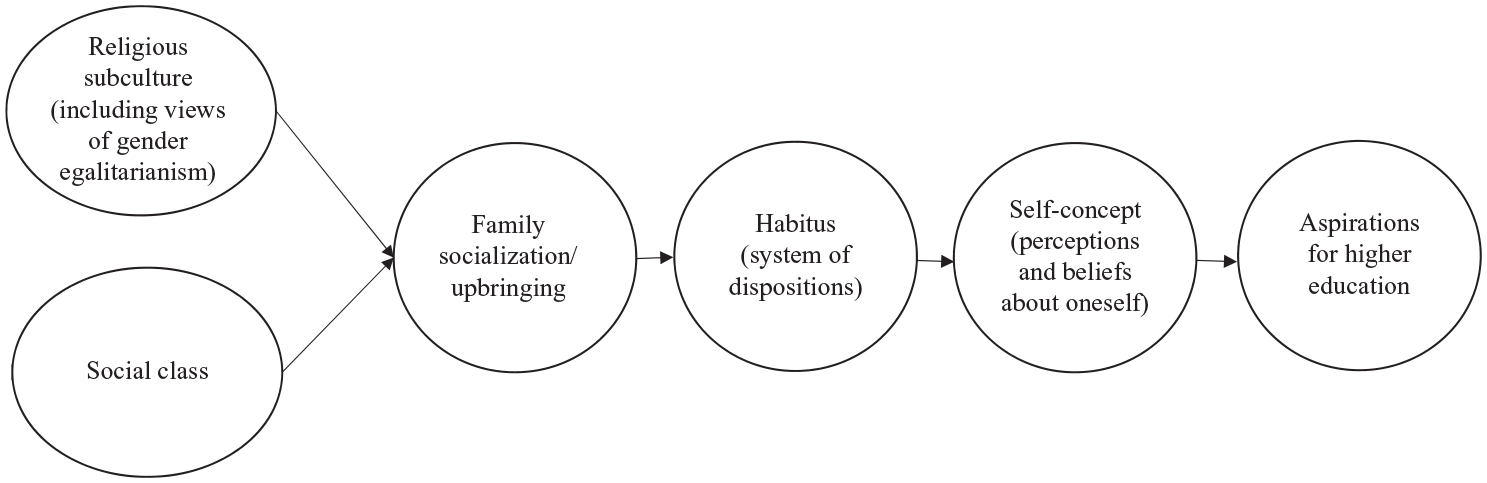
Conceptual Framework: The Quest for Self-Concept Congruence
The Case Of American Jews
American Jews provide a test case that could illustrate how one’s quest for self-concept congruence could stratify higher education by religious subculture and gender. 3 Jews are among the most highly educated religious groups in the United States (Cooperman, Smith, and Ritchey 2015), but their educational advantage is not simply a reflection of their higher economic position (Beyerlein 2004; Keysar and Kosmin 1995). Although well-documented through several nationally representative surveys, the mechanisms underlying this Jewish educational advantage remain largely unexplained (Burstein 2007).
Part of the challenge to advancing our understanding of why Jews have an educational advantage is the perpetual reliance on cross-sectional surveys, which identify some factors correlated with educational success (Hartman and Hartman 2009) but do not illustrate how these factors are enacted. Most attempts to explain the Jewish education advantage appeal to factors difficult to measure with surveys, such as inherent cultural bias in favor of schooling (Fejgin 1995). Unfortunately, this has perpetuated the stereotype that Jews (along with other “model minorities,” like Asian Americans; see Lee and Zhou 2015) are exceptional because of specific traits associated with “Jewishness” (Chua and Rubenfeld 2014). Framing Jews’ achievement as a cultural trait spreads the belief that educational success comes from adopting the “right” cultural values.
To understand how Jews, as a religious subculture, transmit their educational advantage, we need to consider the role of social networks (Fejgin 1995; Goldscheider 2004; Keister 2003). Social networks matter because they put children in contact with adults who serve as role models. Indeed, Hartman and Hartman (1996) found that social expressions of Jewishness—such as belonging to communal Jewish organizations, having Jewish friends, and living in a predominantly Jewish neighborhood—predict higher educational attainment. Because most American Jews are highly educated and work in high-status occupations, such as managerial/executive or business/finance positions (Hartman and Hartman 2009), adolescents raised by Jewish parents tend to be embedded in networks of adults who can provide young people with resources and advice that facilitate an academic advantage. Furthermore, adolescents raised by Jewish parents are likely to learn early on, by observing their parents and adults around them, that attending college and pursuing an elite career is a norm and an expectation (Burstein 2007). This intergenerational transmission process occurs even if the children themselves do not identify as Jewish. This perspective leads us to expect that adolescents raised by at least one Jewish parent (i.e., primarily or partially Jewish upbringing) will be more likely to earn at least a bachelor’s degree (Hypothesis 1a) and will attend more-selective colleges than will adolescents raised by non-Jewish parents (Hypothesis 1b).
We also predict a compounding effect of Jewish upbringing such that adolescents raised by two Jewish parents (i.e., primarily Jewish upbringing) will be more likely to earn a bachelor’s degree (Hypothesis 2a) and will attend more selective colleges (Hypothesis 2b) than will adolescents raised by one Jewish parent (i.e., partial Jewish upbringing). Given that Jewish adults are disproportionately likely to hold professional positions, we expect children with two Jewish parents are even more likely to see themselves in such roles early in life. Furthermore, when children have two Jewish parents, they are likely to have even more Jewish extended family members in professional occupations and passing on Jewish heritage, which means more adults serving as role models and sending messages about the value of having a professional career and the level and type of education it takes to obtain such a career. In contrast, when children have one Jewish parent and one non-Jewish parent, the non-Jewish parent is less likely to have a prestigious occupation. This is true despite Jewish and non-Jewish spouses having similar levels of education, which suggests that even people with similar education levels have different dispositions toward professional careers (Hartman and Hartman 2009). 4
Finally, we expect the relationship between Jewish upbringing and degree attainment (Hypothesis 3a) and between Jewish upbringing and college selectivity (Hypothesis 3b) will both be stronger among women than among men. We predict this is because girls raised by Jewish parents are likely to have distinctive gender self-concepts that stem from Jews’ strong levels of support for gender egalitarianism (Bolzendahl and Myers 2004; Fishman 2005; Hartman and Hartman 2009; Harville and Rienzi 2000). As Fishman (2005:239) argues, “The attitude of American Jews toward women has been sweepingly more liberal than that of other American ethnic groups. . . . [American Jews] are overwhelmingly committed to equal educational and occupational opportunity for women.” Egalitarianism is a key factor in increased maternal employment and education (Fan and Marini 2000; Shu and Marini 1998) and is linked to social psychological factors, such as higher self-confidence, self-esteem, and self-efficacy, that may yield distinctive self-concepts and aspirations (Ridgeway and Jacobsen 1979). Jewish parents, who are likely to espouse gender egalitarianism, are likely to teach their daughters that they can become career women just like their male counterparts. Looking around at their familial networks, girls raised by Jewish parents are likely to see many career women and develop self-concepts centered around elite careers. They are also likely to see elite college education as integral to attaining self-concept congruence. Just as the gender-traditionalism of conservative Protestant habitus can be particularly constraining for girls (Uecker and Pearce 2017), we suspect the gender-egalitarianism of Jewish habitus will give girls with a Jewish upbringing a comparative advantage over girls with a non-Jewish upbringing.
Data And Methods
Data
We analyze longitudinal survey and interview data from the National Study of Youth and Religion (NSYR). 5 The NSYR is a four-wave multi-method longitudinal study of adolescents first recruited in 2002 (ages 13 to 17) with a nationally representative sample of 3,290 adolescents and a unique Jewish oversample of 80 additional adolescents. 6 Wave 1 began with a nationally representative telephone survey (National Study of Youth and Religion 2008) with adolescents and one of their parents or caregivers (conducted separately) and then a follow-up in-person, semi-structured interview with a subset of the youth survey participants (N = 222 at Wave 1). 7 Wave 1 interview participants were selected using stratified quota sampling to ensure diversity in race, ethnicity, gender, social class, rural and urban residence, region of the country, and religious affiliation. Semi-structured interviews averaged about two hours in length. The NSYR followed the adolescents as they transitioned into adulthood with three additional survey waves and semi-structured interviews in 2005, 2008, and 2013. 8 Interview participants were asked a broad range of questions about the social, academic, and religious dimensions of their lives. We paid close attention to what their discourse revealed about their life goals, aspirations, and dispositions.
The NSYR has several unique features that make it possible to study how habitus and self-concepts vary by religious subcultural upbringing and explain divergence in higher-education outcomes. First, the NSYR includes both survey and interview components, which we leverage to explore broad patterns and unpack underlying mechanisms. Second, the NSYR follows adolescents into emerging adulthood, which allows us to track girls’ quest for self-concept congruence. Third, because the NSYR surveyed parents, we can identify the religion of adolescents’ parents. This allows us to consider the family-level process of parents transmitting habitus via religious subculture. Fourth, the NSYR oversampled adolescents with Jewish parents, which gives us a rare opportunity to examine this analytically relevant minority group.
We also link the NSYR to the National Student Clearinghouse (NSC) to obtain detailed records on college attendance and graduation to overcome a common limitation of longitudinal research: respondents who dropped out of the study after Wave 1, or who graduated from a postsecondary institution after the study ended (in 2013), lack complete educational outcome data. Because of the NSC match, we can identify all the higher-education institutions an individual ever attended or from which they graduated. The NSC match occurred in September 2016 when respondents were approximately 26 to 31 years old. By this age, most people who will complete a bachelor’s degree have done so. 9 Thus, we have college-going data even for respondents who dropped out after the first NSYR wave or completed college after the last wave of data collection in 2013. Matching the NSC to the NSYR allows us to follow the NSYR respondents three additional years (13 years total). To our knowledge, no other study has investigated the relationship between religious subculture and educational attainment by tracking adolescents for such a long time using parental and adolescent surveys, interview data, and NSC data. It is precisely this methodological innovation that allows us to investigate generalizable patterns as well as the mechanisms by which religious subcultures stratify higher education for women.
In summary, we use longitudinal survey data (N = 3,238) to compare girls raised by Jewish parents to boys raised by Jewish parents as well as to girls raised by non-Jewish parents. We then use longitudinal interview data (107 semi-structured interviews with 33 respondents) to examine how girls from similar social origins but raised by parents from different religious subcultures describe their life goals and the role of higher education in attaining those goals.
Quantitative Measures
Dependent variables
Our first outcome of interest is whether a respondent received a bachelor’s degree by 2016. Degree attainment comes from two sources: the NSYR survey data and NSC records from September 2016. Our second outcome of interest is the selectivity of the last undergraduate institution a respondent attended. We use SAT scores of enrolled students as a proxy for institutional selectivity (Black and Smith 2006). We obtained SAT score data from IPEDS, which reports 25th and 75th percentiles of a given cohort’s SAT scores. We use the average of these parameters to construct a measure of central tendency for colleges’ SAT scores, which Black and Smith (2006) suggest is “the single most reliable signal about college quality.” We will refer to this measure of central tendency as “mean SAT score” for simplicity’s sake.
Key independent variable
The key independent variable for this study is respondents’ religious subcultural upbringing. We measure religious subcultural upbringing based on the religious affiliation of adolescents’ parents—not the children themselves. In fact, 39 percent of adolescents who have at least one Jewish parent do not identify as exclusively Jewish or Jewish at all. 10 By looking at parents’ religious subculture, which does not always match their children’s, we can examine the role of family socialization. We use parents’ responses to a Wave 1 survey item about their own religious affiliation and whether their spouse shares that religious affiliation. 11 We consider adolescents with at least one Jewish parent to have “Jewish upbringing” (n = 163) and adolescents who have no Jewish parents to have “non-Jewish upbringing” (n = 3,075).
To test some of our hypotheses, we combine all adolescents with at least one Jewish parent into a single category called “Jewish upbringing” to maximize statistical power. To test other hypotheses, we differentiate between respondents with primarily Jewish upbringing (two Jewish parents, n = 76) and partially Jewish upbringing (one Jewish parent, n = 87). This disaggregation allows us to see if adolescents raised by two Jewish parents have different outcomes than adolescents raised by one Jewish parent.
Most adolescents with partial Jewish upbringing (68 percent, n = 59) have one Jewish parent and one non-Jewish parent. Some adolescents with partial Jewish upbringing have information on only one parent, frequently due to divorce (n = 16), and that parent is Jewish (“single parents”; 32 percent, n = 28). Because of how the data were collected, in these cases we do not know whether the child’s non-responding parent was Jewish. However, because our focus is on habitus and the survey questions center children’s and parents’ living arrangements, and because children in these cases only live with one Jewish parent, we treat all these cases as having one Jewish parent. Analyses handling these cases (with no information for a second parent) in different ways yielded equivalent results. 12
One can be Jewish by religion or ethnicity. This study on religious subcultures focuses on the role of upbringing by parents who are Jewish by religion. The data are well-suited to measuring Jewish upbringing in this way and do not have a separate Jewish ethnicity measure. Most of our Jewish respondents, like most Jews in the United States, are not ultra-Orthodox (or even Orthodox for that matter, who as a whole make up only about 10 percent of American Jews). 13 We highlight this point because religious subcultures vary within and across groups, and we might expect different patterns among separatist and dogmatic ultra-Orthodox Jews than among the Jewish groups (i.e., Reform and Conservative) that make up the vast majority of religious American Jews (and thus our sample). As mentioned earlier, theological elements and the extent to which people practice religion contribute to religious subcultures. We account for the role of religiosity by including an index of the adolescent’s religiosity (a composite constructed from the adolescent’s frequency of religious service attendance, how frequently the adolescent prays alone, how important religion is in the adolescent’s everyday life, and how close the adolescent feels to God) and the parent’s religiosity (a composite constructed from the parent’s frequency of religious service attendance and how important religion is in the parent’s everyday life).
Culture operates within structure and is ever shifting over time. Therefore, it is important to note the specific historical context of the cohort under study. NSYR respondents were born in the mid-to-late 1980s, a time when many of their mothers would have been in the workforce and key barriers previously impeding women’s educational and career opportunities (e.g., quotas limiting the number of women enrolling in certain universities and professional schools) had been dismantled. Therefore, culture, preferences, and aspirations had increasing potential to have an effect as new opportunities were available to women. Just as this cohort grew up in a particular societal context, they grew up in a particular religious subcultural context. Judaism became much more egalitarian during the twentieth century (Nadell 2019), and in many ways, non-Orthodox Jewish men and women are now more equal than are men and women from other religious groups (Schnabel 2016).
Our use of religious upbringing as measured by parents’ religious affiliation is a significant departure from prior studies. Past research has generally relied on national surveys (e.g., the GSS) in which adults were asked to retrospectively indicate their childhood religious affiliation. Researchers then compared the educational attainment of those who identified as Jewish to those who identified with other religious subcultures. This approach precludes researchers from understanding the mechanisms by which Jewish upbringing could influence educational outcomes regardless of whether children themselves identify as being Jewish (which brings in complications of, among other things, selection effects in who elects into, and maintains, the identity). In this study, we are interested in the religious affiliation of adolescents’ parents because we want to understand the religious context and culture in which a child grows up. By distinguishing the amount of exposure young people have to Jewish socialization, we can move away from associations between adult religious affiliation and educational attainment to a more sophisticated explanation for why these associations exist.
Other independent variables
We include the following measures from the Wave 1 survey to account for background characteristics: gender, SES (constructed based on each parent’s education level, each parent’s occupational prestige, and family income 14 —additional analyses demonstrated the patterns are robust to alternative specifications of SES 15 ), race and ethnicity (non-Hispanic White, non-Hispanic Asian, non-Hispanic Black, and Hispanic), home region (Northeast, West, Midwest, and South), age, living with married parents (1 = living with married parents; 0 = else), the urbanicity of the county in which the adolescent lived (12-point scale ranging from “rural-remote” to “city-large”), and secondary schooling type (1 = private, 0 = public). We considered additional controls, but they did not alter the results. 16 Table 1 presents descriptive statistics for each of these variables (which we label “demographic controls”).
Descriptive Statistics
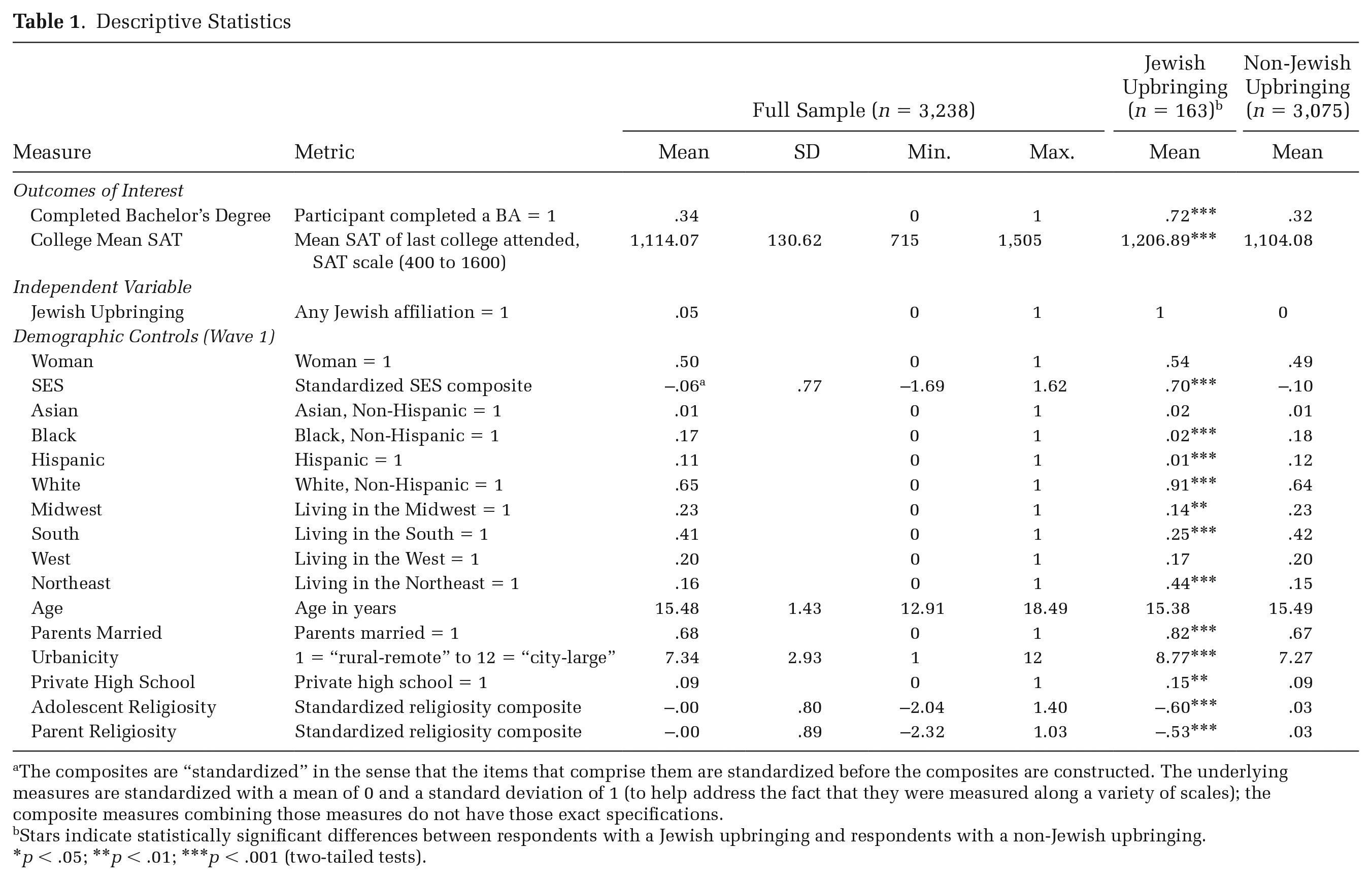
The composites are “standardized” in the sense that the items that comprise them are standardized before the composites are constructed. The underlying measures are standardized with a mean of 0 and a standard deviation of 1 (to help address the fact that they were measured along a variety of scales); the composite measures combining those measures do not have those exact specifications.
Stars indicate statistically significant differences between respondents with a Jewish upbringing and respondents with a non-Jewish upbringing.
p < .05; **p < .01; ***p < .001 (two-tailed tests).
Analytic Strategy
We first test whether Jewish upbringing predicts a greater likelihood of getting a bachelor’s degree. We then use measures of parental religious affiliation to compare primarily and partially Jewish upbringing to explore our theoretical argument. We follow by examining whether and how the patterns we observe are gendered, comparing the role of Jewish upbringing among women and men. We conduct parallel analyses of college selectivity.
We use logistic regression for the binary outcome (bachelor’s degree) and OLS for the continuous measure (college selectivity, represented by colleges’ mean SAT scores), presenting predicted estimates in the figures and full multivariate models in the Appendix. We use survey weights to adjust for probability of sample selection and potential sampling bias. We focus on the 3,238 cases with full information, excluding 132 of the 3,370 total cases. 17 When shifting from degree attainment to college selectivity, our analytic sample changes from 3,238 to 1,256 because college selectivity can only be examined for students attending institutions that report 25th and 75th percentile SAT scores (typically four-year colleges). Because Jewish adolescents are more likely than their non-Jewish counterparts to attend four-year colleges (p < .001 conditional on any college attendance), our analyses likely reflect a conservative estimate of the association between Jewish upbringing and college selectivity.
Quantitative Results
Vertical Stratification: Bachelor’s Degree Attainment
We first consider whether Jewish upbringing predicts a greater likelihood of bachelor’s degree attainment. Figure 2 shows that in our bivariate model, adolescents raised by at least one Jewish parent are much more likely to get a bachelor’s degree (73 percent predicted probability) than are children raised by non-Jewish parents (32 percent). The model accounting for background characteristics—including SES—shows that adolescents raised by at least one Jewish parent still have a substantially higher predicted probability of completing a bachelor’s degree (52 percent) than adolescents not raised by at least one Jewish parent (34 percent). Multivariate regression tables for the models underlying these predicted probabilities and the other predicted probabilities are in Appendix Table A1. The results support Hypothesis 1a: adolescents raised by at least one Jewish parent are more likely than adolescents raised by non-Jewish parents to earn at least a bachelor’s degree.
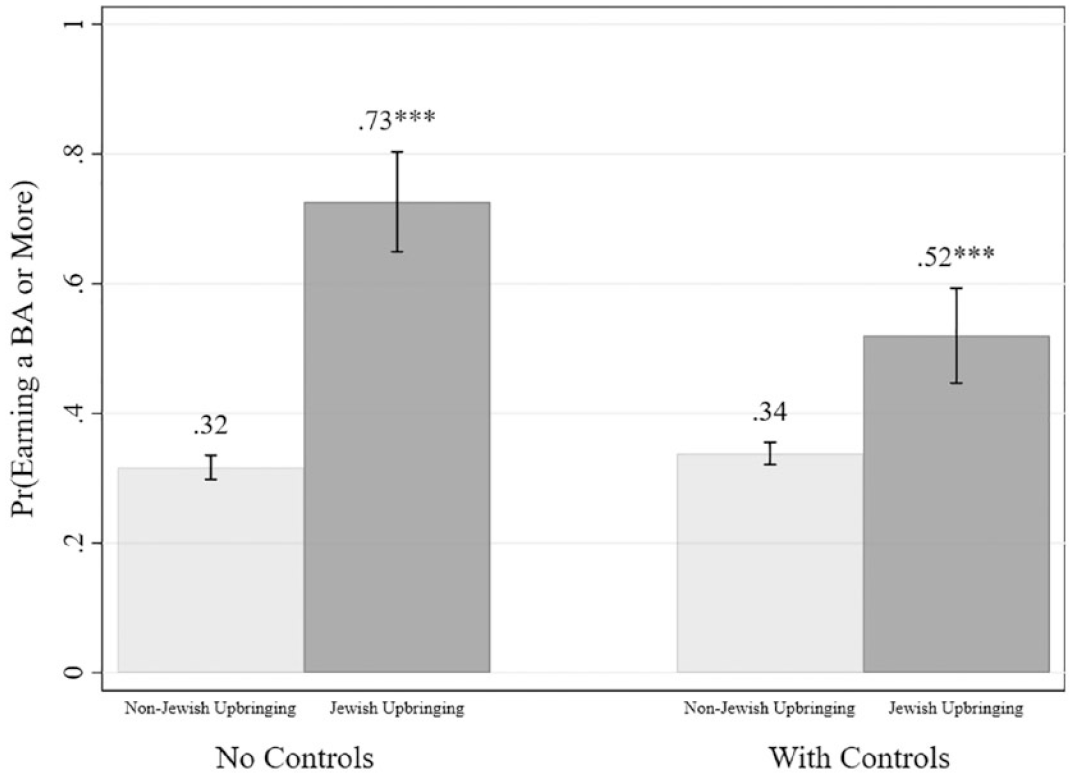
Bachelor’s Degree Attainment Rates by Upbringing (Jewish versus Non-Jewish)
Turning to a comparison of different exposure to Jewish upbringing, Figure 3 shows that respondents with a primarily Jewish upbringing are about 12 percentage-points more likely to complete a bachelor’s degree (58 percent predicted probability in the fully controlled model) than are those with a partially Jewish upbringing (46 percent). Of note, this 12-point gap is the same as that found between non-Jewish upbringing (34 percent) and partially Jewish upbringing (46 percent). Therefore, it appears that each additional Jewish parent is associated with approximately a 12-point greater likelihood of completing a bachelor’s degree, even when accounting for characteristics like SES and religiosity. This pattern supports Hypothesis 2a: being raised by two Jewish parents is more strongly related to degree attainment than being raised by one Jewish parent (who is usually married to a non-Jewish parent).
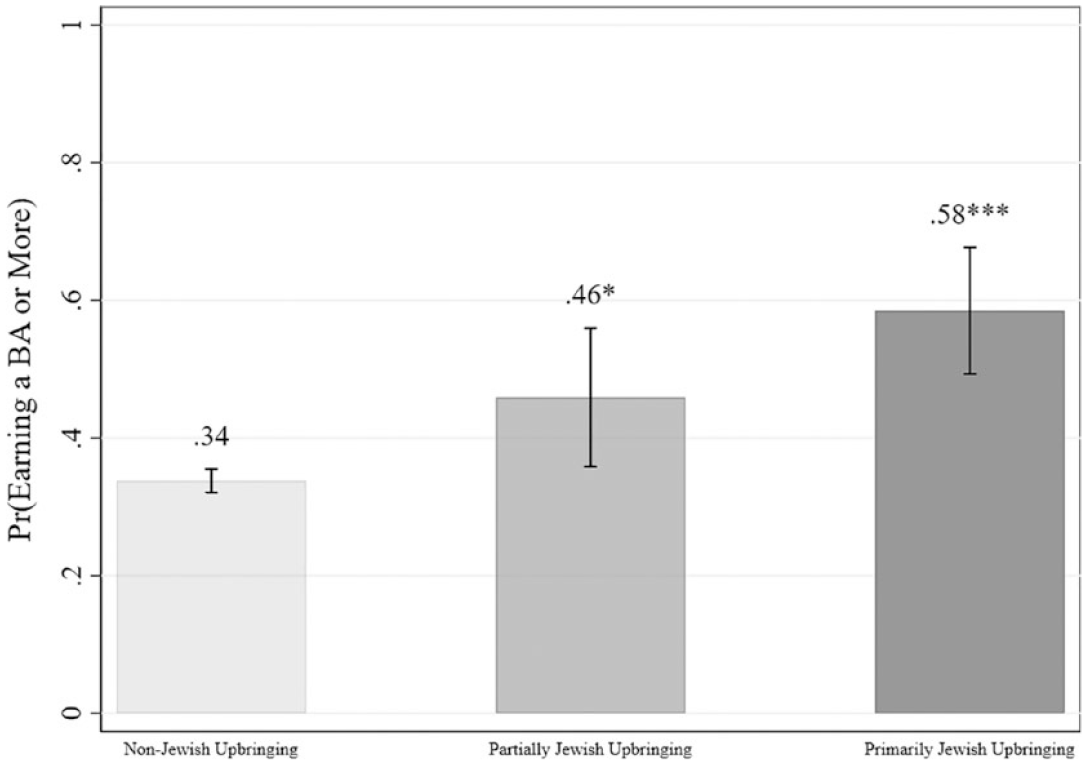
Bachelor’s Degree Attainment Rates by Upbringing (Primarily and Partially Jewish versus Non-Jewish)
We hypothesized that the association between Jewish upbringing and educational attainment would be stronger among women, given the gender egalitarianism and emphasis on women’s careers in Jewish families. Figure 4 presents the patterns by gender. Although both women and men raised by at least one Jewish parent are more likely to complete a college degree, the pattern is clearly gendered. There is a substantial 13-percentage-point gap between men raised in a Jewish (44 percent predicted probability of college completion) versus non-Jewish (31 percent) habitus, but the gap by Jewish upbringing among women is almost twice as large at 22 percentage points (59 versus 37 percent, respectively). In fact, because the Jewish education advantage is most pronounced among women, it appears that gender—and Jewish women’s educational attainment specifically—is a key component in why the Jewish education advantage is so large. These patterns are consistent with Hypothesis 3a: the relationship between Jewish upbringing and degree attainment is stronger among women than among men.
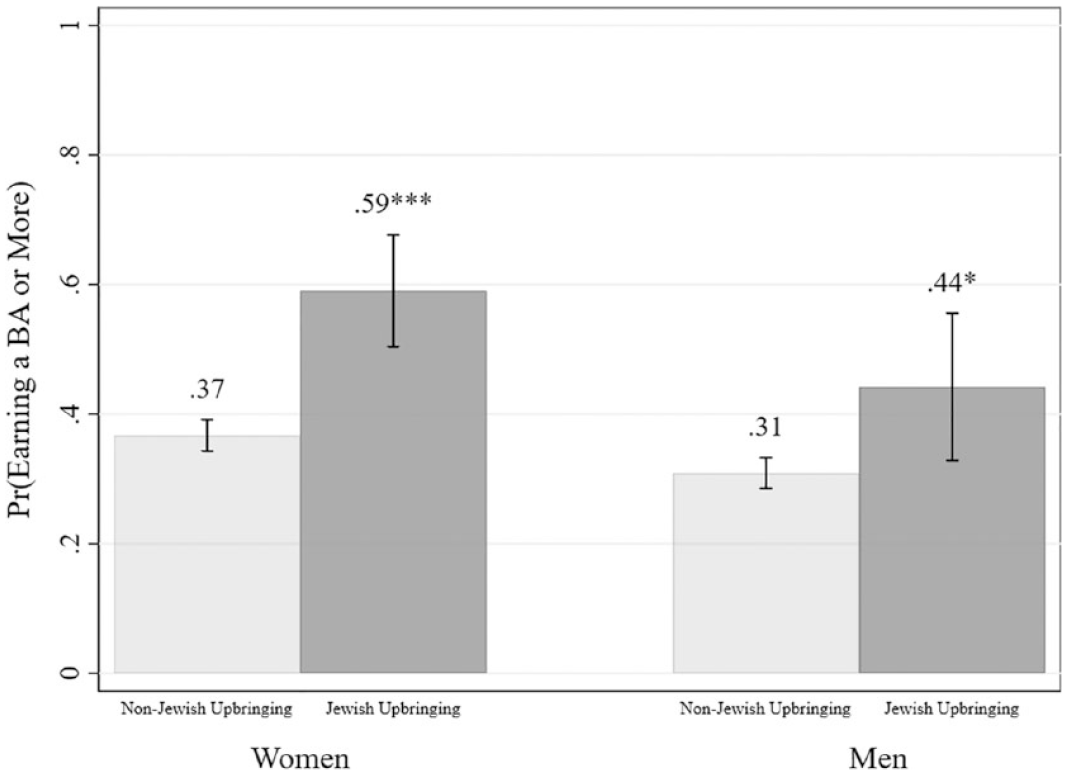
Bachelor’s Degree Attainment Rates by Gender and Upbringing (Jewish versus Non-Jewish)
Horizontal Stratification: Institutional Selectivity
We next examine the relationship between Jewish upbringing and college selectivity by considering bivariate and multivariate patterns for any Jewish upbringing and mean SAT scores. 18 Recall that these are not the SAT scores of individual respondents in the NSYR—they are the mean SAT scores of the colleges respondents graduated from. Figure 5 shows that participants raised by at least one Jewish parent attended colleges with a mean SAT score of 1201, whereas participants raised by non-Jewish parents attended colleges with a mean SAT score of 1102 (99 points lower). This large gap is roughly equivalent to the difference between Stanford University and the University of Virginia or between New York University and Miami University. In the fully controlled model—which includes SES—a substantial advantage for Jewish upbringing (1138) persists over non-Jewish upbringing (1083). These patterns are consistent with Hypothesis 1b: adolescents raised by at least one Jewish parent (compared to no Jewish parents) attend more selective colleges.
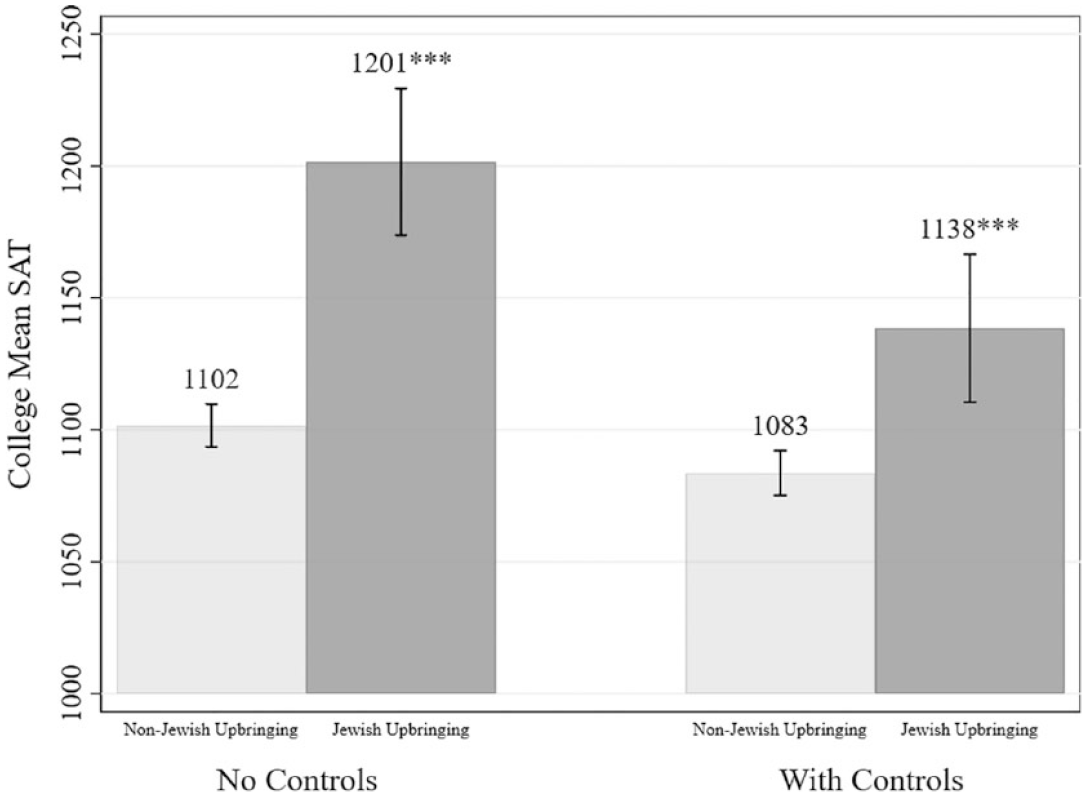
College Selectivity by Upbringing (Jewish versus Non-Jewish)
As shown in Figure 6, a primarily Jewish upbringing is more strongly linked to attending selective colleges than is a partial Jewish upbringing. Adolescents with a primarily Jewish upbringing graduate from colleges with a mean SAT of 1152, whereas adolescents with a partial Jewish upbringing graduate from colleges with a mean SAT of 1123. Adolescents with no Jewish upbringing graduate from colleges with a mean SAT of 1084. Therefore, the data are consistent with Hypothesis 2b:
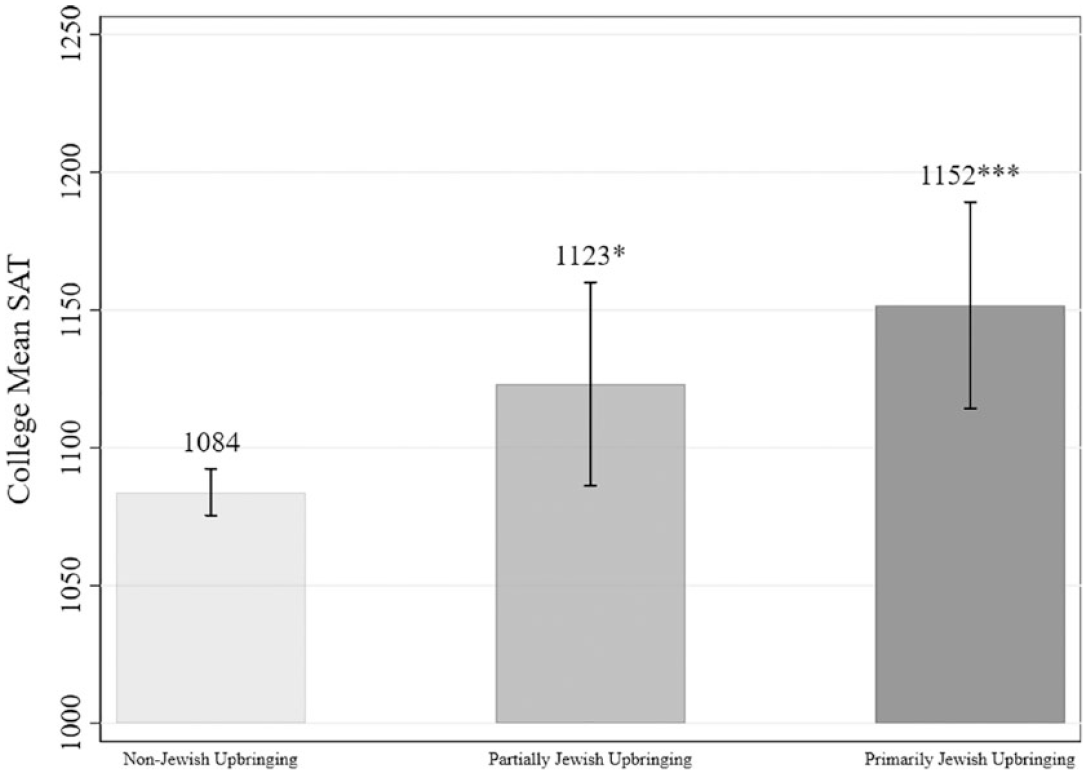
College Selectivity by Upbringing (Primarily and Partially Jewish versus Non-Jewish)
Figure 7 shows the relationship between Jewish upbringing and college selectivity by gender. There is a clearly gendered pattern for degree attainment, but the patterns for college selectivity among women and among men are statistically indistinguishable. Both women and men raised by at least one Jewish parent attend substantially more selective colleges than do those with a non-Jewish upbringing, and the differences by Jewish upbringing are essentially the same for women (55-point difference by Jewish upbringing) and men (54-point difference). This pattern is inconsistent with Hypothesis 3b: the relationship between Jewish upbringing and college selectivity is not stronger among women than among men. This is likely because college selectivity is conditional on graduating college. Girls raised in a Jewish habitus are more likely to graduate from college than are boys raised in a Jewish habitus. However, among girls and boys who do graduate, the colleges are equally selective.
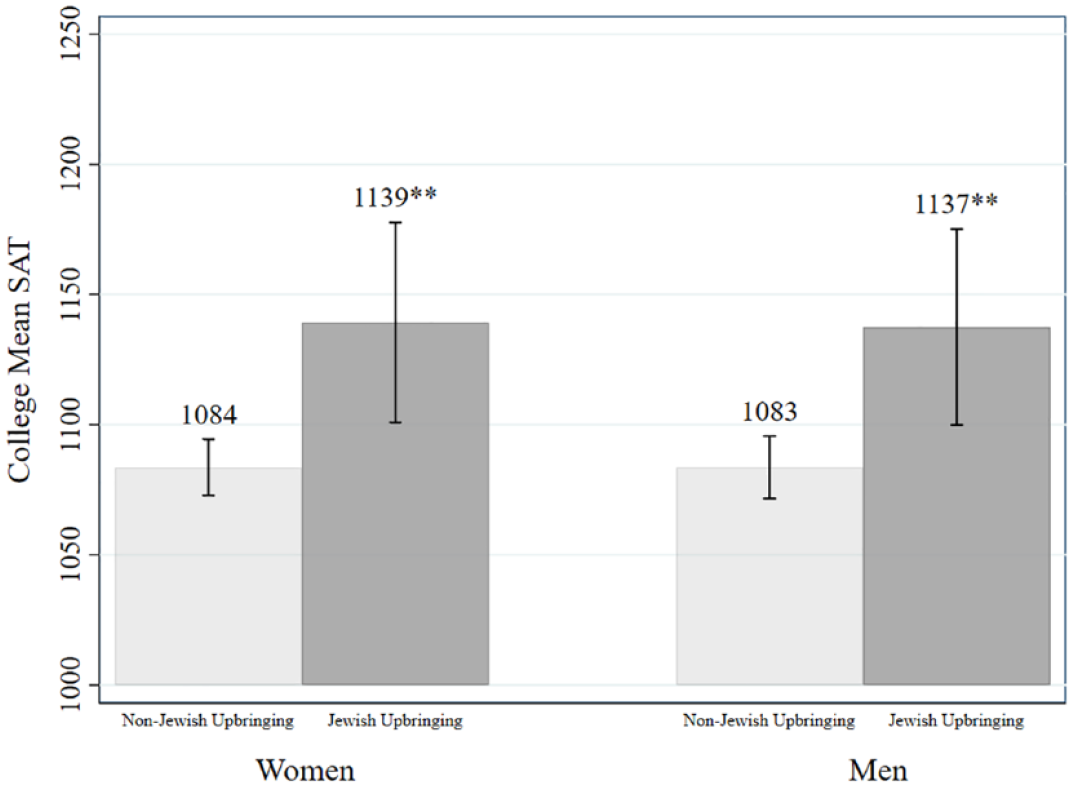
College Selectivity by Gender and Upbringing (Jewish versus Non-Jewish)
The quantitative analyses show that Jewish upbringing is implicated in both vertical and horizontal educational stratification: respondents with a Jewish upbringing are much more likely to attain a college degree and to do so from more selective schools. Adolescents with a primarily Jewish upbringing experience more of these benefits than do those with a partially Jewish upbringing, who in turn experience more benefits than do those with a non-Jewish upbringing. 19 Girls with a Jewish upbringing are much more likely than girls with a non-Jewish upbringing to graduate college, and girls raised by at least one Jewish parent attain degrees at substantially more selective colleges than do those not raised by at least one Jewish parent. In fact, the Jewish educational advantage of college-degree attainment is driven more by women than by men, with the gap in degree attainment by Jewish upbringing being twice as large among women than among men.
Supplementary Analysis
Disaggregating non-Jewish upbringing
Our primary focus is Jewish upbringing, but we recognize the importance of considering variation across religious traditions. To address this, we also conducted analyses on adolescents’ eventual bachelor’s degree attainment and college selectivity by the responding parent’s religious identity (i.e., the self-identified religious affiliation of the person filling out the “parent survey”) across all groups with at least 100 cases (those with fewer cases were combined into an “other” category) (results in the online supplement). Past research highlights conservative Protestant upbringing as a constraint on educational outcomes, especially among women. We find there is some evidence of conservative Protestants “underperforming” in comparison to mainline Protestants, but their outcomes are not statistically distinguishable from those for Catholics, except in terms of college degree attainment among boys, not girls. Although there is certainly some variation among non-Jews, the biggest distinction by far is that between adolescents with Jewish parents and those with non-Jewish parents.
Disaggregating by Jewish denomination
Our argument is fundamentally about the religious subculture of mainstream (i.e., non-ultra-Orthodox) American Jews, but we also considered how the impact of Jewish upbringing might vary by Jewish denomination. The most significant divergence in educational attainment is between ultra-Orthodox and non-ultra-Orthodox Jews, with educational attainment rates among modern Orthodox Jews resembling those of Conservative and Reform Jews more than those of ultra-Orthodox Jews (Cooperman, Smith, Alper, and Cornibert 2015). We think it is unlikely any ultra-Orthodox Jews were in the NSYR sample, and we expected patterns to look similar across Reform, Conservative, and Orthodox Jews. We conducted analyses on adolescents’ eventual bachelor’s degree attainment and college selectivity by the responding parent’s identification as Reform, Conservative, or Orthodox (there is also an “other” category) (results are in the online supplement). We found positive coefficients in comparison to non-Jewish parents across all four Jewish groups for both attainment and selectivity; despite large standard errors due to the small sizes of the subgroups, these premiums were statistically significant on both outcomes for the two larger groups (Reform and Conservative). 20
Qualitative Methods
We now turn to an examination of data from 107 semi-structured interviews with 33 respondents as they move from adolescence into early adulthood. We constructed this sample by first identifying the girls being raised by at least one Jewish parent, which yielded 15 girls out of the 97 who completed semi-structured interviews at Wave 1. 21 All 15 girls were middle-upper class and all but one identified as White. Because we are interested in how religious subculture shapes one’s habitus and self-concept, we constructed our comparison group to be similar in terms of social origins. Past research using these data to make comparisons by religious upbringing sought to make roughly comparable groups (Uecker and Pearce 2017), but we more explicitly matched on key factors to better account for background characteristics. For the comparison group, we included only girls raised by non-Jewish parents who were middle-upper class and identified as White. This yielded 18 non-Jewish female respondents of varying, but largely Christian, religious backgrounds. 22 The 33 respondents followed over time for this study were interviewed an average of 3 times over 10 years, which resulted in a total of 107 interviews. Table 2 presents demographic information for the interviewees. Appendix Table A3 provides more detailed data for the 33 interviewees, including where they attended college and whether they graduated. Readers may note that respondents with a Jewish upbringing already experienced an educational advantage by the time they were interviewed for this study, with girls with Jewish parents having higher grades than girls with non-Jewish parents. Our analysis shows that girls with Jewish parents become oriented toward college early in life, and their focus on academics helps explain this early academic advantage.
Interview Sample Demographics
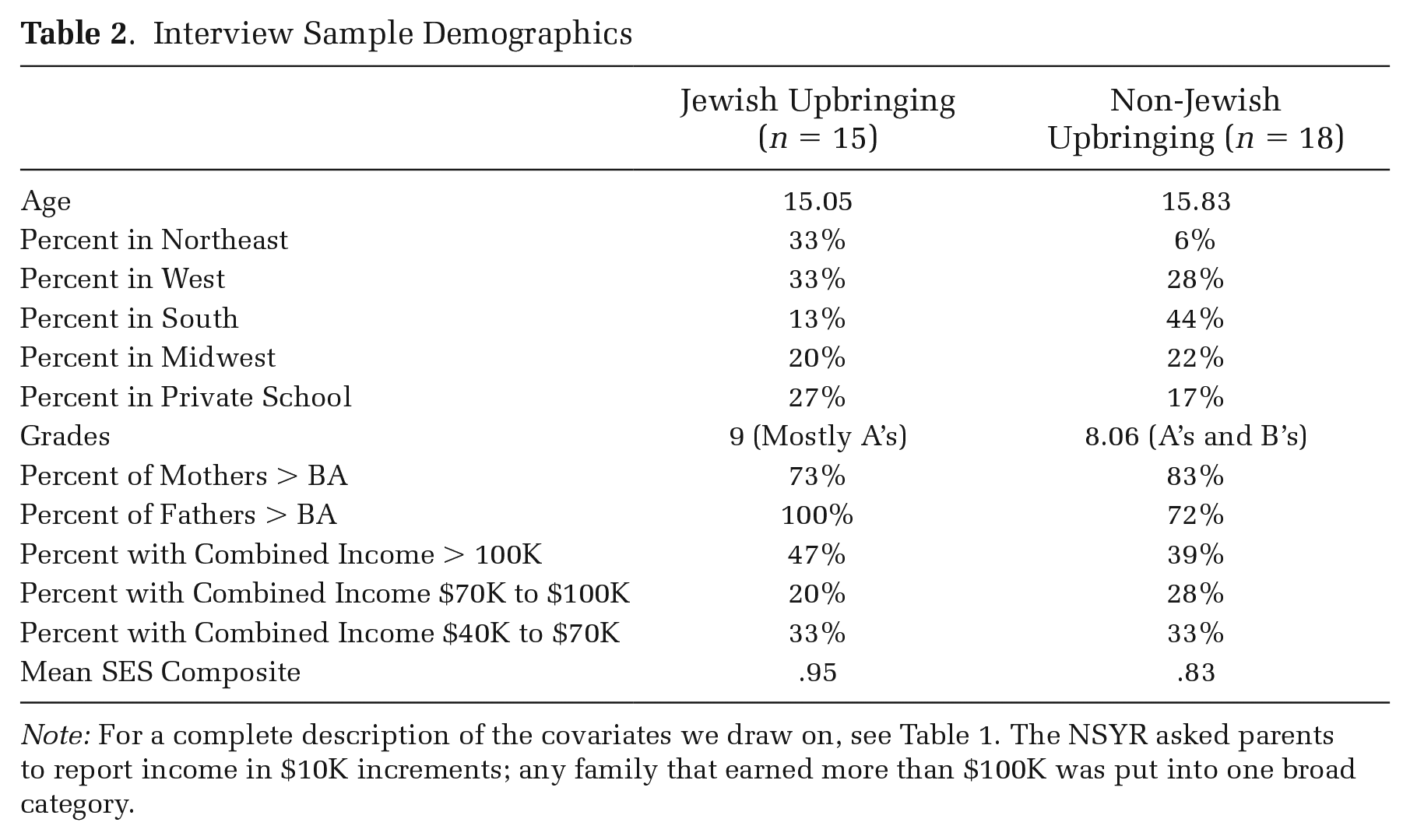
Note: For a complete description of the covariates we draw on, see Table 1. The NSYR asked parents to report income in $10K increments; any family that earned more than $100K was put into one broad category.
We coded the data using a team-based approach, which is optimal for assessing the reliability and validity of the codes (Namey et al. 2007). We used an iterative process to develop a codebook. The first three authors began by reading transcripts and writing memos based on differences they noticed in how respondents spoke about their social, academic, and religious lives; their relationships with their parents; their views on morality; their attitudes and usage of alcohol and drugs; their dating and sexual activity; and their life goals. We devised a set of inductive codes and coded four interviews to develop version 1 of the codebook. After adjudicating with one another, we noticed that attitudes around life goals, especially motherhood and career, had the greatest divergence in viewpoints. We revised the codebook to focus on these issues, which fell under the larger theoretical umbrella of self-concept. We then created a codebook of concepts that allowed for the systematic tagging of transcripts for a more objective assessment of evidence for the processes we perceived. The coding and analysis were conducted using Dedoose.com, which allowed us to assess inter-rater reliability (> .80). We conducted a thematic analysis on two levels, individual cases and across cases, comparing the themes and categories, and we used a number of cross-case analysis techniques (Ivankova, Creswell, and Stick 2006).
Qualitative Results
Overall, the qualitative data comport with our theory that girls’ quest for self-concept congruence varies by their religious subculture. Girls raised by at least one Jewish parent developed a self-concept marked by openness to new experiences and a vision of themselves as prominent careerwomen. They were highly attuned to what these careers take and organized their educational experiences to position themselves for elite colleges so they could realize their professional visions and attain self-concept congruence. Girls from similar social origins but raised by non-Jewish parents had very different visions of their future selves, in which elite higher education was not necessary for attaining self-concept congruence. For girls with non-Jewish parents, graduating from college, regardless of what type of college, seemed to be sufficient for attaining self-concept congruence. These girls did not have clearly articulated goals about higher education and did not organize their high school journeys with a singular goal of (elite) college admissions.
Career First, Motherhood Second
In every wave, interviewees were asked to describe their life’s purpose, the things they wanted to accomplish in life, and the kinds of plans they had for education, career, and family. We found a clear divergence between how girls raised by at least one Jewish parent imagined their futures compared to girls from similar social positions but with a non-Jewish upbringing.
Girls raised by at least one Jewish parent were oriented toward prestigious careers as early as middle school and through emerging adulthood. These girls saw themselves as making their mark in the world through high-impact, prestigious careers. From an early age, several girls aspired to become prominent figures. For example, at 13, Stacy (2JP) hoped to become a lawyer, noting she wanted to be “somebody that people remember in history” and “somebody important.”
23
Debbie (2JP, 17) also envisioned herself making an impact in her industry. When asked what she wanted to accomplish in life, Debbie said: I’d like to make a mark. I’m not the type of person who’s okay not being in the limelight. . . . I crave attention in that I really want to make a mark that’s noticeable . . . like being known in whatever industry I’m in. . . . Be a prominent figure.
For Stacy, the idea of becoming a lawyer came from her dad, who thought she would be a good lawyer because she likes to argue, is opinionated, and enjoys discussing politics. Vanessa (1JP, 17) also mentioned that her father (her Jewish parent) had long encouraged her to become a lawyer. 24 These girls’ fathers appear to embrace gender egalitarianism, encouraging their daughters to pursue careers that require long hours and are traditionally more common among men.
As girls raised by at least one Jewish parent prioritized prestigious careers, they saw motherhood as secondary. Only one-fifth of the Jewish-affiliated respondents mentioned family, childrearing, and marriage without being prompted when articulating their future goals. They did not disavow motherhood, but it was not at the forefront of their minds. They wanted to have a family, but during adolescence and emerging adulthood, they intentionally worked toward their careers and assumed they would have kids “down the road.” Emily (1JP, 19), for example, wanted to have kids eventually but did not imagine getting married until she was 30: “I have other things I want to do first. I want to get my career and my own thing set before I settle down.” Stacy (2JP, 19) provided a clear example of this “career-first, motherhood-second” mentality when asked to describe how she sees her purpose in life: I’m career-oriented. I have a lot more friends who are in a relationship—it’s very serious, they want to get married, start a family, that kind of thing. I think I’m gonna wanna do that eventually, but I’m 19 now, so I’m just not really focused on that. . . . It might be something I get to later.
In contrast, girls with non-Jewish parents were much less focused on having prestigious careers, and they were more likely to have a self-concept oriented around family and parenthood. Almost half of the non-Jewish-affiliated girls mentioned family, childrearing, and marriage without being prompted when articulating their future goals. For some, especially those who were deeply religious, motherhood was their highest aspiration. Mandy (0JP, 17) explained that being a stay-at-home mom was the most important thing she could do with her life: I think the biggest thing that a mother can do is to be with her kids. That’s the greatest thing over her career. That’s not saying she can’t use her intellect. I have some intelligence. I’ve done pretty well. I had scholarships and things like that, but I don’t mind just being their mother. I don’t view it as just being a mother. You can still use all of that stuff in an even greater calling in life.
Many of the girls raised in a non-Jewish upbringing mentioned working, but they saw their work as a discrete rather than integral part of their identity. Whereas Jewish upbringing promoted self-concepts centered on meaningful careers and public impact, non-Jewish upbringing promoted self-concepts centered on marriage and motherhood. We saw very few cases of girls raised by non-Jewish parents articulating a self-concept that foregrounded a high-impact career. For example, when Lisa (0JP, 15) described how she imagined her future, she said, “[I think about] what I’m going to be like in 10 years, what college I’m going to go to and what I’m going to do for my occupation, my kids, my husband, stuff like that.” As with many of the non-Jewish-affiliated girls, Lisa’s goals did include college and potentially a job, but only alongside marriage and motherhood.
In Wave 2, participants were asked: “What do you think about mothers working outside the home?” Girls raised by at least one Jewish parent were much more supportive of mothers working outside the home than were girls raised in a non-Jewish upbringing. For example, Amy (2JP, 16) said, I think it sets a great example that they could work and still have a family. Especially if I have daughters, I don’t want them to grow up thinking that they’re just going to stay at home and cook and clean all day. I would want them to know that they could have a good profession and still have a good family.
Whereas Amy’s support for mothers working outside the home was rooted in setting a good example for her children, Leah (2JP, 18) was focused on personal fulfillment. After saying she was “all for” mothers working outside the home, Leah elaborated: “I think they can be just as good of a parent and I think it’s essential for personal happiness. . . . I’m just not an idle person.” Girls raised with either one or two Jewish parents were generally supportive of working mothers, but those with two Jewish parents were especially enthusiastic about women’s careers.
In contrast, none of the girls from a non-Jewish upbringing were enthusiastic about mothers working outside the home, although many did express some levels of conflicted support. For example, Gina (0JP, 19), whose mother was a school superintendent, said, “My mom works a lot, and I think I turned out okay.” Others were more hesitant, outlining issues with mothers working. For example, Lorraine (0JP, 16) said it is not bad for children if mothers work “as long as their parents give them plenty of attention . . . for parents that work all the time, they’re always too busy to play with their child, or talk to them or things like that . . . that I don’t like.” These girls said it was easy for jobs to interfere with successful mothering, and they drew specific boundaries around what appropriate childrearing looks like. Caroline (0JP, 17) drew one of the most explicit boundaries, articulating a strict trade-off between motherhood and career: “I think [preschool is] good. But I also think that their moms should drop them off at eight and pick them up at three. And I think that women shouldn’t be so worried about careers if they’re going to have kids.”
About one-quarter of non-Jewish-affiliated girls expressed a clear and explicit preference for mothers staying at home. Although they did not necessarily think it was bad for mothers to work, they cited specific benefits of mothers staying home, especially in children’s earliest years. Some girls felt they had to make a choice between motherhood and career, as it would be impossible to do both to their fullest potential: I want to have a career, but I would never want to do something halfway. I’d feel like if I had kids and I had the career, it would be too hard to split between them because I’d want to be a really good mom, but I’d also want to really concentrate on my career and do that the best I could. So I think that if I had a major career and kids, I would just feel unhappy because I’d feel like I wasn’t doing either of them to my full potential. So that’s why I’d want to stay home with the kids and be able to be really involved in their lives and be a good supportive mom. (Molly, 0JP, 18)
Indeed, girls with a non-Jewish upbringing did not just place a rhetorical emphasis on marriage and motherhood. They were also much more likely to be married and already parenting by their mid-20s when the last round of data were collected. Among the women raised by non-Jewish parents, 13 (72 percent) were married/engaged and 5 (28 percent) already had children. In contrast, only 3 (20 percent) of the women with at least one Jewish parent were married/engaged and none had children (see Appendix Table A3 for details). This trend is consistent with the NSYR survey data. 25
Eagerness to Encounter New Ideas, People, and Experiences
Girls raised by at least one Jewish parent articulated a self-concept marked by openness, an eagerness to have new experiences, and a generally cosmopolitan orientation toward life. One’s willingness to embrace novel ideas and experiences is important for college because higher-education institutions intentionally aim to expose students to new ideas and new people. For many respondents, college was likely the first time they would live in a completely new environment. For girls raised by at least one Jewish parent, this prospect was exciting rather than fraught with anxiety.
Girls with a Jewish parent occasionally cited Judaism as a religion that encouraged them to develop their own beliefs and promoted questioning and openness to new ideas. As Jessica (2JP, 15) explained, “I appreciate Judaism for being the type of religion [that] allows for questioning all the time, for study, for constant analysis and thought.” Abigail (2JP, 18) also saw Judaism, and her parents’ approach to teaching her about Judaism, as being encouraging of questioning: “That’s the thing with Judaism, we always ask questions.” For girls raised by at least one Jewish parent, Judaism not only promoted questioning but also allowed them to maintain a belief in science and the value of higher education. As Abigail explained, “Reform [Judaism] takes science into account . . . like when they say the Earth was created in seven days, they’re like, ‘well, how long is a day?’ So there are always questions. That’s the one thing I love about Judaism—they always say you should question.”
Evidence of openness also came through in how the girls with a Jewish parent described the people they admired. For example, 14-year-old Leah (2JP) sought to surround herself with bold and inquisitive people: “I like people who are interested in learning and observing—not people who stay afraid on the surface and hang out there.” Another example came from Dara (2JP, 16), who most admired teachers who “don’t just stick to lessons they have to do and take time to solicit other people’s opinions,” or Debbie (2JP, 17), who respected her English teacher for “speaking his mind.” Stacy (2JP, 13) explained that she was politically and socially liberal but she wanted to “stay open-minded towards everyone” and “wants to live in a place that was diverse and had a lot of people . . . where you can be pretty open and be yourself and be accepted for that.” Hannah (2JP, 17) said she wanted to be like her father because she admired his open-mindedness.
In contrast, girls raised in a non-Jewish upbringing rarely cited boldness or open-mindedness as the characteristics they most admired. They were more likely to report resilience, determination, and encouragement as characteristics they hoped to emulate. Several of these girls, especially those with strong religious beliefs, expressed concerns about being around people who had different beliefs and values from them. Some expressed specific anxieties around encountering ideologically dissonant ideas in college. Their pursuit of ideological homogeneity, and thus homophily, in their community was a factor in how they navigated college, including where to attend.
For example, Mandy (0JP, 17), a member of The Church of Jesus Christ of Latter-day Saints, chose to attend Brigham Young University to be with others who held similar religious values: “I think largely because it’s a church-based school so a lot of people value and believe the same kind of things that I do.” Sally (0JP, 17), also a member of The Church of Jesus Christ of Latter-day Saints, was nervous about her choice to attend University of Utah: “The school is kind of liberal and the classes were kind of a fear of mine.”
Mandy and Sally were not alone in their desire to surround themselves with peers who shared their values. At age 15, Brittany (0JP) was also nervous about socializing with people who were different from her. She already felt high school had a negative influence on her religious faith because school was “the main place where you meet opposing values” and she saw people happily leading different lifestyles not centered around religion: “That kind of toys around with how I feel about [my ideas of religion].” At age 17, Brittany was nervous about maintaining her religious faith in college because people would likely challenge her ideas about religion: “That’s not going to be all that much fun. ’Cause I don’t like to debate with people. I can do it, but I don’t like it. Facing hostility is not fun.” At age 21, Brittany was still nervous to try new things, noting that her religious conservatism made her less adventurous. We saw significant concern about careers distracting from religious values in interviews with girls raised in the most conservative religious traditions, but, consistent with Edgell and Docka (2007), even those whose parents were in more “liberal” Christian traditions privileged religious familism. They too worried that career ambitions would take away from family in a way that diverged from the career focus of girls raised by Jewish parents.
Higher Education and Self-Concept Congruence
The 33 girls in our qualitative sample, all of whom were raised middle-upper class, recognized that college serves as the primary pathway to social mobility. Thus, even without being prompted, the majority of girls with Jewish and non-Jewish parents mentioned college as part of their future goals. However, the differences in girls’ self-concepts meant that how they talked about, planned for, and related to higher education looked different. We now describe the role that higher education played in allowing the girls to make their self-concepts a reality.
We have shown how girls raised by Jewish parents had a self-concept marked by elite career goals coupled with an eagerness to have new experiences. To achieve their career goals, these girls strove to enter selective colleges and planned for graduate school. In fact, even in Wave 1 when interviewees were in middle and high school, two-in-five girls raised by at least one Jewish parent cited graduate school as part of their future goals. As Debbie (2JP, 17) explained, when asked how far she would like to go in school, Definitely grad school. I’ve already decided. . . . My dad would tell me people in his class in high school didn’t go to college and I just don’t understand how that could happen. College isn’t a choice. It’s something that I do. It’s like high school, college, and then I choose graduate school, but it’s kind of built in.
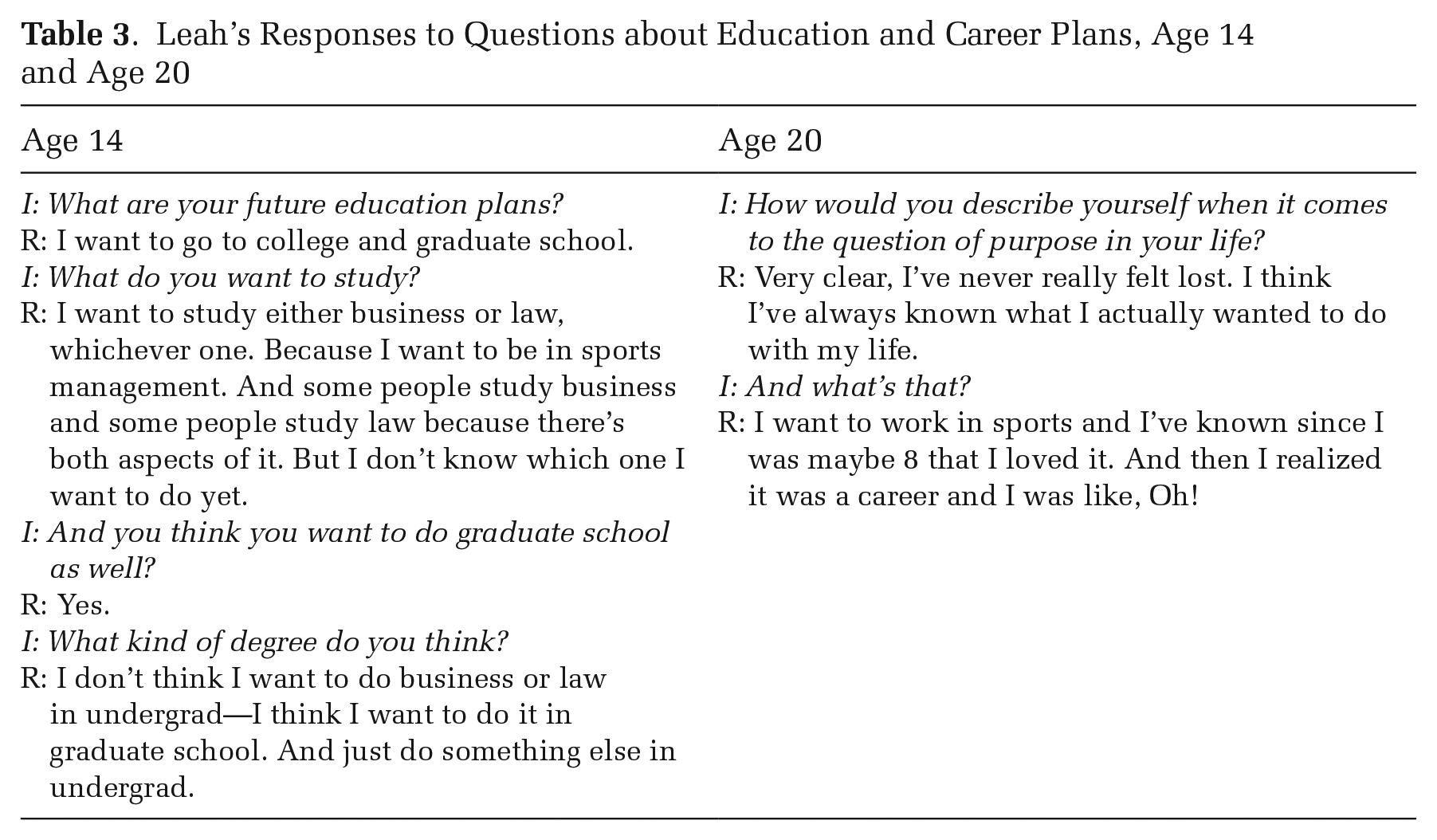
Not only were these girls already planning to attend graduate school, they also had clear reasons why it was important to do so. Even girls as young as 13 already had articulate visions of their career and educational plans. These visions generally changed very little, even as the girls got older. Table 3 shows Leah’s responses to questions about her career and educational plans at age 14 and then again at age 20 (when attending the University of Pennsylvania). At an early age, Leah had a sophisticated understanding of different educational paths, recognizing she could wait until graduate school to study business or law and choose a different major for her undergraduate degree. This type of detailed planning was common across narratives of girls raised by at least one Jewish parent.
Leah’s Responses to Questions about Education and Career Plans, Age 14 and Age 20
In addition to having earlier and more developed educational and career plans (often including graduate school), girls with at least one Jewish parent were more likely to focus on being admitted to highly selective colleges, such as Cornell, Carleton, Northwestern, and Stanford. These aspirations for elite colleges developed early in girls’ upbringing. Stacy (2JP, 13) said she planned to “get into a good college—like an ivy-league kind of college” followed by law school. Jessica (2JP, 15) also planned to go to a prestigious school: I’m thinking about Ivy Leagues. My parents both went to Cornell. I’ve been there a few times, I like it there a lot and it’s the kind of place I would want to go. So I’m definitely thinking of applying there. . . . I want to go to a pretty prestigious school.
At age 20, Jessica reflected on how her college planning started back in elementary school: “From 5th grade on, your goal is do well so that you can get into Honors classes and then do well in the Honors classes so you can get into AP classes, do well in those so you can get into college.” Similarly, Amy (2JP, 16) was fixated on attending an Ivy League college and making sure she was on track to get into a school like Stanford: “This is my junior year, I cannot do anything at all that will mess it up. . . . I’ve been working towards college since like the 5th grade, which sounds pathetic, but it’s true.”
Girls raised by at least one Jewish parent did not just have abstract plans to attend prestigious universities, they also took numerous practical steps during high school to position themselves for this goal. They had stellar grades, knew precisely what kinds of accomplishments colleges reward in the admissions process, actively prepared for college, and demonstrated sophisticated knowledge of what college entailed. For example, Stacy (2JP, 17) was well on her way to college, already taking college classes (while still in high school), preparing for the SATs, and attending college fairs. Her desire to attend a selective college was the primary motivator for her orientation around academics: “I know it’s going to be important to what college you get into and your future, so it’s pretty important the grades you get.”
Like Stacy (2JP), Debbie (2JP) prepared for college by being involved in a multitude of extracurriculars, in addition to being a stellar student, class president, and winning a prestigious state award for photography. In her interview, Dara (2JP,16) outlined an array of activities on her plate as she prepared for college, including doing a project for the Intel corporation. Hannah (2JP, 17) planned to spend three weeks of her summer at a camp at Carleton, where she aspired to go to college. She explained that a lot depended on those three weeks: This is going to be a huge three weeks of my life because it’s kind of going to determine if I’m going to go to Carleton or not. And if I do go to Carleton, what I’m going to major in. What’s that going to mean for the rest of my life? It’s going to be a huge three weeks.
As part of their self-concept, girls raised by at least one Jewish parent were intent on doing well academically—it was a central component of their identity. As Jessica (2JP, 20) said, “I’m most proud of my academic successes and that I’ve proven myself to be good in many different things and it makes me feel well rounded and worthy of something.” They saw a clear connection between academic success and their future. Similarly, Emily (1JP, 15), who had a 3.9 GPA and was involved in Model UN, said, “I care a lot about doing well in school just because it will help my future.” These girls were highly involved in demanding extracurricular activities and were more likely to highlight the relevance of these activities for their college applications.
In contrast, girls raised by non-Jewish parents, whose self-concept was marked by motherhood or simply getting a job, planned to go to college but provided very little detail about these plans and rarely mentioned graduate school. Earlier, we noted that children acquire a habitus that reflects both their social class and their religious subculture. Here we see how social class, not religious subculture alone, shapes educational aspirations. Middle-upper-class girls raised by non-Jewish parents do plan to attend college and usually complete their bachelor’s degree. This is largely a function of their middle-upper-class position. They know that college is par for the course in their social milieu and important for getting a job. However, because they generally do not aspire to professional positions, they rarely care about college selectivity. Thus, how they conceptualize the purpose of college, the kind of college they plan to attend, and the overall emphasis they place on higher education are profoundly different from the girls raised by Jewish parents.
For example, when asked how far they wanted to go in school, half of the girls raised by non-Jewish parents made short and simple statements, such as, “I want to go all the way through college,” or “I want to get four years of college.” Others provided additional details, such as where they might go (usually a college close to home), but their answers were rarely as comprehensive and intentional as those of the girls raised by Jewish parents. Even for excellent students like Brittany (0JP)—who had a 4.0 GPA from 7th grade onward, took AP Biology and AP English, and was involved in the National Honor Society—prestigious higher education was not central to her self-concept. When asked how far she would like to go in school, she said: “I want to go to college, but other than that I don’t know.” When asked if she may want to go further, she said, “I’m not really sure.” By age 18, Brittany was still uncertain about her educational plans and did not seem to have a strong grasp of how degrees work. She thought she might get a master’s degree, but she was confused about whether that was a four-year degree or if a master’s degree comes after a bachelor’s degree. Brittany did not appear to prioritize attending a selective college and only applied to Western, a public college close to home with an 82 percent acceptance rate. As Brittany explained, she did not really care where she went to college: “I didn’t have a dream school. I really didn’t care that much. I liked Western, it was the only school I applied to. I got in and I’m going there.” Girls with Brittany’s academic track record in high school but raised by a Jewish parent were much more ambitious in their college choices. Unlike girls raised by at least one Jewish parent who were intentionally positioning themselves for elite colleges, girls raised in a non-Jewish upbringing were more likely to cite other sources of motivation as their rationale for doing well in school and for doing extracurricular activities.
Certainly, the groups of girls experiencing Jewish and non-Jewish upbringings are not perfectly comparable. For example, although we matched on SES and race, respondents with a Jewish upbringing were more likely to be located in certain regions of the country and were already getting better grades by the time we started following them. But the striking differences in the aspirations, career plans, and general orientations to education, work, and life by religious subculture cannot be attributed to imperfect matching alone. Clearly, habitus resulting from religious subcultures profoundly shapes young people’s self-concept, life aspirations, and educational pathways. 26
Discussion
American Jews, and especially Jewish women, have exceptionally high rates of educational attainment and attend more selective colleges, even after controlling for SES. But their success is not simply a reflection of ascribed characteristics like being Jewish or being female. Structural, cultural, historical, and social psychological processes contribute to Jews’ academic success, and to ethnoreligious stratification in higher education more broadly. This study examined how religious subcultures differentially shape girls’ habitus and self-concept in ways that affect their educational pathways. Because families provide the contexts in which habitus is developed, we theorized that children raised by parents from different religious subcultures—even those from otherwise similar socioeconomic backgrounds—acquire different habits of mind, dispositions to action, and evaluative orientations. Religious subcultures espouse vastly different views on gender egalitarianism and thus have an especially influential role in shaping girls’ habitus. As girls acquire the habitus of their class position and of their religious subculture, they develop different self-concepts and different conceptions of how higher education can help them attain self-concept congruence.
Using over a decade of longitudinal survey, interview, and administrative data, we compared the educational trajectories of adolescents raised by Jewish parents (of whom the vast majority, like American Jews as a whole, were non-Orthodox) and adolescents raised by non-Jewish parents. We focused specifically on family-level processes by considering the habitus children acquire from parents from different religious subcultures. Our approach departs from earlier studies in two significant ways. First, rather than relying on retrospective survey data in which adults indicate their childhood religious affiliation and educational attainment, we followed adolescents into adulthood using both survey and interview data. We listened to teenage girls narrate their lives and their visions for their future, and then we observed what aspects of these visions came to fruition 13 years later. Second, rather than using respondents’ self-identified religious affiliation as the key explanatory variable, we used their parents’ religious affiliations. This shift allowed us to consider the role of religious upbringing as a part of adolescents’ habitus rather than seeing religious affiliation as an ascribed characteristic or self-selected identity.
We offer five key findings. First, holding all else equal, adolescents raised by at least one Jewish parent are more likely to graduate from a four-year college. Although prior studies show that American Jews have much higher rates of educational attainment than do non-Jews, this study provides a new angle by focusing on religious upbringing rather than retrospectively looking at the association between adult religious affiliation and educational outcomes. Second, adolescents raised by at least one Jewish parent graduate from more selective colleges. This is the first study to show that Jews are not only more likely to graduate from college than non-Jews, but also more likely to attend more-selective colleges.
Third, adolescents with a primarily Jewish upbringing (raised by two Jewish parents) have better educational outcomes than do those with a partially Jewish upbringing (raised by one Jewish parent and usually one non-Jewish parent). But adolescents with a partially Jewish upbringing fare better educationally than do those with no Jewish upbringing at all (i.e., raised with no Jewish parents). Our distinction between primarily and partially Jewish upbringing is especially useful because there are clear differences between the two groups. We theorized that adolescents raised with two Jewish parents would be more likely to develop self-concepts that center professional careers. In other words, girls raised by two Jewish parents (which often means, among other things, more Jewish grandparents and extended family) are more deeply embedded in Jewish habitus. This is the first study to show that the level of embeddedness in and exposure to a religious subculture through parents matters for educational outcomes.
Fourth, girls raised by at least one Jewish parent have higher educational attainment than do boys with the same upbringing. This was not the case in earlier cohorts of American Jews, when men outpaced women (Hartman 2015; Hartman and Hartman 2009). The exceptional rates of women’s attainment likely reflect a cohort trend; the people in our study were entering college around 2005, as opposed to earlier studies that considered people entering college between 1953 and 1993. To understand why women raised by at least one Jewish parent are now outpacing men raised by at least one Jewish parent, we also analyzed interview data with 18 boys, six of whom were raised by at least one Jewish parent and 12 of whom were raised in a non-Jewish upbringing. Although the sample size was small, it was clear that boys raised by Jewish or non-Jewish parents were similarly likely to aspire toward careers. Given the gender egalitarianism and existing examples of successful career women in Jewish households, we see more of a difference in the career aspirations among women than among men. Boys grow up believing a career is important, regardless of their religious subcultural upbringing. But there is more heterogeneity among girls, some of whom grow up envisioning themselves in high-impact careers, whereas others envision themselves primarily as exceptional mothers. Religious subcultural boundaries are demarcated by issues of gender and sexuality, and the habitus girls acquire through parents’ religious subcultures plays an important role in determining what kind of future girls imagine for themselves and whether they idealize careers or motherhood.
When it comes to selectivity, girls raised by at least one Jewish parent attend comparably selective colleges as boys who are raised by at least one Jewish parent (conditional on graduating from college). Notably, this breaks from the trend among conservative Protestants, where women (but not conservative Protestant men) end up at less selective schools. According to Uecker and Pearce (2017), conservative Protestant men and women have different views about the purpose of college: conservative Protestant men primarily see college as a human capital investment, whereas conservative Protestant women primarily see college as a path to self-improvement. This is not the case for people raised in a Jewish habitus. Men and women raised in a Jewish habitus appear to receive similar messages about the purpose of college: college, especially a selective college, is the gateway to graduate school and to a professional career.
Fifth, and perhaps most important, girls raised by at least one Jewish parent, and especially those with two Jewish parents, articulate self-concepts marked by elite career goals and an eagerness to have new experiences. Consequently, their quest for self-concept congruence entails elaborate plans for elite higher education and graduate school. They frame college as a broadening experience and human capital investment setting the stage for high-impact careers—career first, motherhood second. In contrast, girls raised by non-Jewish parents rarely frame college as a necessary precursor to a prestigious career. The quest for self-concept congruence among girls raised by non-Jewish parents revolves more around motherhood and altruism. Going to college is a norm for these middle-upper-class White girls, but a college’s selectivity is not of paramount importance. Of note, at the time of this longitudinal data collection effort, most children’s parents had a religious affiliation. With the rise of the “nones”—and a growing number of people with school-age children being non-religious—a subset of non-Jewish-affiliated girls may start to exhibit aspirations similar to girls with Jewish parents, as some secular parents may provide a similarly gender-egalitarian and education-focused upbringing.
Our results are driven by the patterns for non-Orthodox Jewish women as they make up most of our sample (as well as the vast majority of American Jews). Nevertheless, the patterns for Jewish upbringing might look very different if we had an oversample of adolescents with ultra-Orthodox upbringing, where we would expect different gendered orientations toward elite secular education, self-concept, and the negotiation of careers and motherhood.
Our primary argument is that stratification scholars should pay more attention to religious subcultures as a central factor in educational stratification. We hope to contribute to academic discourse by highlighting the fact that religious subculture is something that should be considered, but we also hope to intervene in popular discourses that consider it important but in problematic ways. We argue that structural, cultural, social psychological, historical, and familial processes stratify higher education by gender and religious subculture. Therefore, popular discourses about some religious groups being naturally more successful than others should move away from seeing religion as referring to “types” of people inherently predisposed to success. Jews’ educational success stems from social forces and historical patterns. Specifically, a Jewish upbringing facilitates young people’s sense of self and their beliefs about gender and the purpose of college. Just as conservative Protestant women—who, in a reversal of American Jews, have distinctly less educational attainment than otherwise expected—do not aspire to be exceptional stay-at-home mothers out of pure personal preference operating in a vacuum, women raised by Jewish parents do not aspire to elite education and prestigious careers out of pure personal preference. They develop these aspirations by observing the adults around them, whose own educational and occupation histories were shaped by the adults around them. Our preferences and, ultimately, choices about things like college are social decisions shaped by cultural processes (Vaisey 2010; Vaisey and Valentino 2020). Part of the narrative that Jewish adults convey to their children is that education helped Jews survive in Europe and eventually thrive in the United States. Jews value education because it has been needed and worked for them, not because they are genetically or culturally predisposed to it. Just as we should not attribute race as the “cause” of one’s academic performance, we should avoid attributing success to ethnicity or religion without considering the historical, social, and psychological mechanisms underlying group differences.
Religious subculture shapes girls’ habitus, but we want to be cautious about prescriptive judgments regarding which habitus is “better.” Following Lee and Zhou’s (2015) work on Asian Americans and the model minority myth, we do not want to perpetuate beliefs that Jews are educationally successful because they have adopted the “right” cultural values. Rather, as Lee and Zhou (2015) suggest, we see there are different cultural frames for a “good education,” “success,” and a meaningful life more generally. Religious groups may value education and investment in oneself equally, but they construct different visions of what a “good” education is and what success means depending on the cultural frames accessible to them. Social scientists often overlook this because we take for granted the middle-class normative frame for success. We might even be skeptical about a habitus, such as that of White evangelical Protestants, that seems to constrain women’s opportunity for educational advancement (Uecker and Pearce 2017). Thus, we support Lee and Zhou’s (2015:53) call to consider “the possibility that success may mean different things to different people—net of their values—and jettison the assumption that all middle-upper class children frame success through a singular normative lens.” We even find evidence of challenges and pressures that come when girls’ self-concepts center educational and career success as markers of their meaning and purpose in life.
Our focal case was the role of religious subcultural upbringing in shaping one’s habitus and self-concept, but the theory and data speak more broadly to educational stratification, and especially to how habitus can facilitate or constrain educational attainment and selectivity in gendered ways. Contemporary research on horizontal and vertical stratification of education emphasizes social divides like race, class, and gender (Buchmann et al. 2008; Gerber and Cheung 2008), but religion is underemphasized and understudied in the sociology of education and education research more generally. For example, religion does not appear in Perna’s (2006) frequently-cited model of educational attainment. Our study shows religious affiliation and its influence on habitus is another significant social divide that stratifies postsecondary education. By understanding why education is stratified by religion, we can gain more general insight on why education is stratified by social divides and subcultures. We have shown, for example, that habitus plays a particularly strong role in what education scholars refer to as “choice effects” (i.e., secondary effects), which reflect how young people’s social environments influence their decisions about educational transitions (Jackson 2013). We hope future research will further explore the role of religious subculture, and especially self-concept developed within specific religious subcultures, in the vertical and horizontal stratification of education.
Beyond educational stratification, our results also speak to a larger conversation about social stratification. One of the reasons why Jews tend to be economically successful is because both men and women work in prestigious occupations (Hartman and Hartman 2009). It may be more challenging for individuals raised with more conservative religious views and traditional gender norms to get ahead economically due to women’s constrained careers and lost economic potential. Thus, certain religious subcultures might facilitate or hinder social mobility by shaping women’s pathways through higher education and ultimately the labor market.
Women’s educational advancement over the past three decades has been remarkable. And yet, as our study shows, not all women are equally likely to complete college or to attend selective colleges. Religious subcultures, given their divergent views on gender egalitarianism and shaping people’s sense of what is a good life and how to pursue it, play a key role in stratifying women’s paths through higher education. Having shown how religious subcultural upbringing shapes girls’ habitus and puts them on profoundly different educational trajectories in their quest for self-concept congruence, we hope stratification scholars will bring religion back in as a key explanatory variable.
Supplemental Material
sj-pdf-1-asr-10.1177_00031224221076487 – Supplemental material for From Bat Mitzvah to the Bar: Religious Habitus, Self-Concept, and Women’s Educational Outcomes
Supplemental material, sj-pdf-1-asr-10.1177_00031224221076487 for From Bat Mitzvah to the Bar: Religious Habitus, Self-Concept, and Women’s Educational Outcomes by Ilana M. Horwitz, Kaylee T. Matheny, Krystal Laryea and Landon Schnabel in American Sociological Review
Footnotes
Appendix
Interview Sample Details
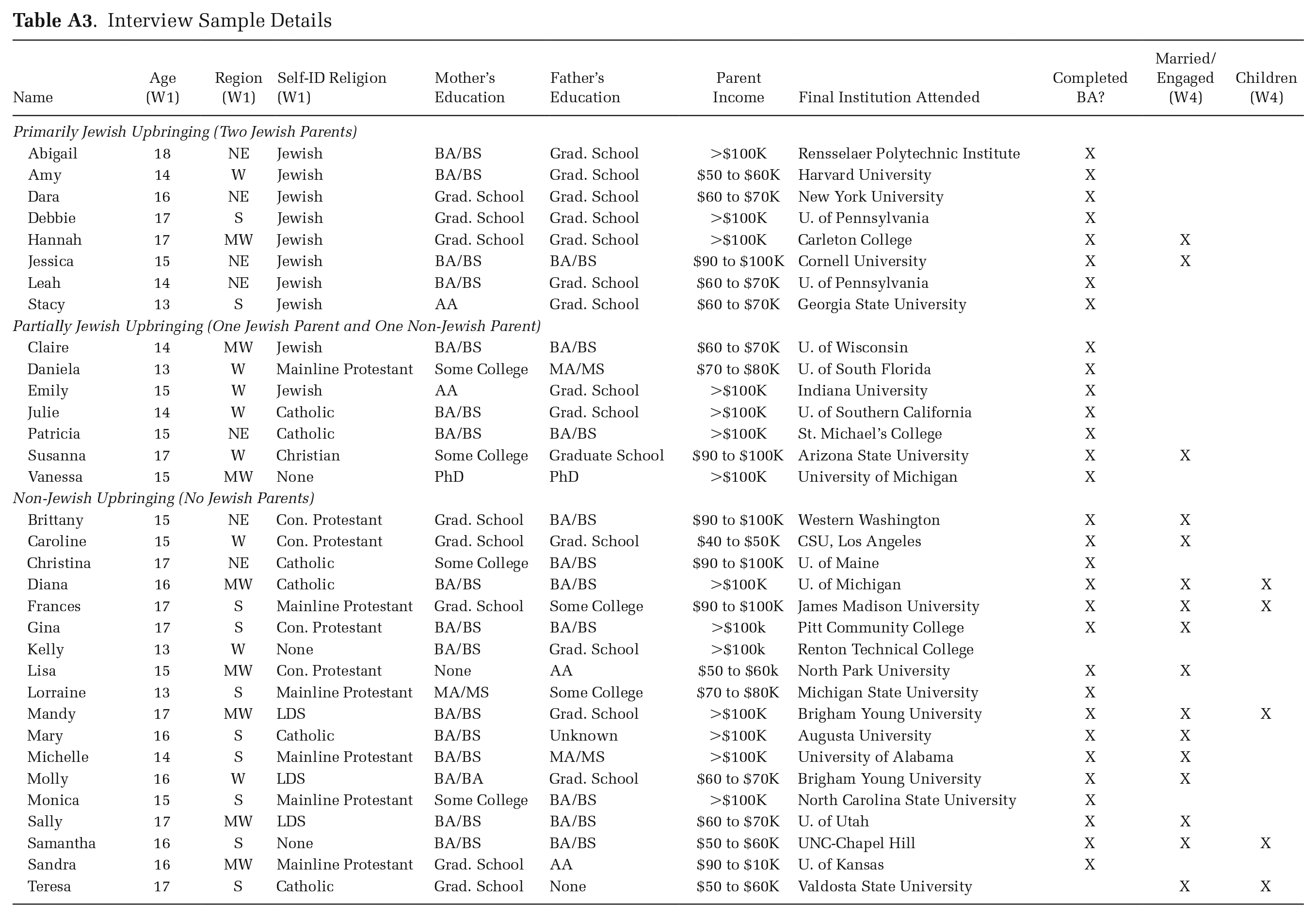
| Name | Age (W1) | Region (W1) | Self-ID Religion (W1) | Mother’s Education | Father’s Education | Parent Income | Final Institution Attended | Completed BA? | Married/Engaged (W4) | Children (W4) |
|---|---|---|---|---|---|---|---|---|---|---|
| Primarily Jewish Upbringing (Two Jewish Parents) | ||||||||||
| Abigail | 18 | NE | Jewish | BA/BS | Grad. School | >$100K | Rensselaer Polytechnic Institute | X | ||
| Amy | 14 | W | Jewish | BA/BS | Grad. School | $50 to $60K | Harvard University | X | ||
| Dara | 16 | NE | Jewish | Grad. School | Grad. School | $60 to $70K | New York University | X | ||
| Debbie | 17 | S | Jewish | Grad. School | Grad. School | >$100K | U. of Pennsylvania | X | ||
| Hannah | 17 | MW | Jewish | Grad. School | Grad. School | >$100K | Carleton College | X | X | |
| Jessica | 15 | NE | Jewish | BA/BS | BA/BS | $90 to $100K | Cornell University | X | X | |
| Leah | 14 | NE | Jewish | BA/BS | Grad. School | $60 to $70K | U. of Pennsylvania | X | ||
| Stacy | 13 | S | Jewish | AA | Grad. School | $60 to $70K | Georgia State University | X | ||
| Partially Jewish Upbringing (One Jewish Parent and One Non-Jewish Parent) | ||||||||||
| Claire | 14 | MW | Jewish | BA/BS | BA/BS | $60 to $70K | U. of Wisconsin | X | ||
| Daniela | 13 | W | Mainline Protestant | Some College | MA/MS | $70 to $80K | U. of South Florida | X | ||
| Emily | 15 | W | Jewish | AA | Grad. School | >$100K | Indiana University | X | ||
| Julie | 14 | W | Catholic | BA/BS | Grad. School | >$100K | U. of Southern California | X | ||
| Patricia | 15 | NE | Catholic | BA/BS | BA/BS | >$100K | St. Michael’s College | X | ||
| Susanna | 17 | W | Christian | Some College | Graduate School | $90 to $100K | Arizona State University | X | X | |
| Vanessa | 15 | MW | None | PhD | PhD | >$100K | University of Michigan | X | ||
| Non-Jewish Upbringing (No Jewish Parents) | ||||||||||
| Brittany | 15 | NE | Con. Protestant | Grad. School | BA/BS | $90 to $100K | Western Washington | X | X | |
| Caroline | 15 | W | Con. Protestant | Grad. School | Grad. School | $40 to $50K | CSU, Los Angeles | X | X | |
| Christina | 17 | NE | Catholic | Some College | BA/BS | $90 to $100K | U. of Maine | X | ||
| Diana | 16 | MW | Catholic | BA/BS | BA/BS | >$100K | U. of Michigan | X | X | X |
| Frances | 17 | S | Mainline Protestant | Grad. School | Some College | $90 to $100K | James Madison University | X | X | X |
| Gina | 17 | S | Con. Protestant | BA/BS | BA/BS | >$100k | Pitt Community College | X | X | |
| Kelly | 13 | W | None | BA/BS | Grad. School | >$100k | Renton Technical College | |||
| Lisa | 15 | MW | Con. Protestant | None | AA | $50 to $60k | North Park University | X | X | |
| Lorraine | 13 | S | Mainline Protestant | MA/MS | Some College | $70 to $80K | Michigan State University | X | ||
| Mandy | 17 | MW | LDS | BA/BS | Grad. School | >$100K | Brigham Young University | X | X | X |
| Mary | 16 | S | Catholic | BA/BS | Unknown | >$100K | Augusta University | X | X | |
| Michelle | 14 | S | Mainline Protestant | BA/BS | MA/MS | >$100K | University of Alabama | X | X | |
| Molly | 16 | W | LDS | BA/BA | Grad. School | $60 to $70K | Brigham Young University | X | X | |
| Monica | 15 | S | Mainline Protestant | Some College | BA/BS | >$100K | North Carolina State University | X | ||
| Sally | 17 | MW | LDS | BA/BS | BA/BS | $60 to $70K | U. of Utah | X | X | |
| Samantha | 16 | S | None | BA/BS | BA/BS | $50 to $60K | UNC-Chapel Hill | X | X | X |
| Sandra | 16 | MW | Mainline Protestant | Grad. School | AA | $90 to $10K | U. of Kansas | X | ||
| Teresa | 17 | S | Catholic | Grad. School | None | $50 to $60K | Valdosta State University | X | X | |
Acknowledgements
The authors are grateful to Harriet Hartman, Ari Y. Kelman, Omar McRoberts, Brian Powell, Mitchell Stevens, and Jeremy Uecker for helpful input. This paper was presented and benefited from comments at the Center for Educational Policy at Stanford University, the Center for Studies in Higher Education at UC-Berkeley, and the annual meetings of the Association for the Sociology of Religion (2018), Association for Jewish Studies (2018), the American Sociological Association (2019), the Society for the Scientific Study of Religion (2019), the Association for the Study of Higher Education (2019), and the Younger Scholars in the Sociology of Religion Conference (2019).
Funding
The project was supported by the Jim Joseph and Wexner Foundations, as well as the Institute of Education Sciences (Grant R305B140009). The National Study of Youth and Religion,  , whose data were used by permission here, was generously funded by Lilly Endowment Inc., under the direction of Christian Smith, of the Department of Sociology at the University of Notre Dame.
Notes
References
Supplementary Material
Please find the following supplemental material available below.
For Open Access articles published under a Creative Commons License, all supplemental material carries the same license as the article it is associated with.
For non-Open Access articles published, all supplemental material carries a non-exclusive license, and permission requests for re-use of supplemental material or any part of supplemental material shall be sent directly to the copyright owner as specified in the copyright notice associated with the article.
