




Abstract
Honor killings, which occur when women are perceived to have broken purity norms and bring “dishonor” to their family, pose profound moral and societal problems and underrecognized sociological puzzles. Given the immense cost, why do families murder their own daughter, niece, or cousin? Conversely, given the tragic consequences, why are norms broken in the first place? Drawing on accounts of honor killings, we characterize the key actors, actions, and incentives, and develop two interlinked theoretical models, one on norm-enforcement and another on norm-breaking. The former specifies the conditions under which honor norms should hold, the latter, counterintuitively, predicts that honor killings occur most frequently when honor norms are contested; not when they are strictest. Analyzing data from 24 countries and ~26,000 individuals and building a unique dataset of honor killings from Turkey, we find support for the hypotheses. Honor norms are stronger when laws offer leniency for honor killings, families’ loss of reputation is more consequential, and community cohesion is higher. Actual killings have an inverse-U-shaped link with the prevalence of honor norms. Our work advances the theoretical understanding of honor norms and killings and offers one of the most comprehensive empirical analyses of the factors influencing honor killings.
Basma was a married woman in Jordan who ran away with another man. Her husband had already divorced her and she married the man whom she ran away with, but her family’s honor was tarnished in the eyes of the community. After six years of ostracism and taunting, Basma’s 16-year-old brother killed her. “Now we can walk with our heads held high” said Basma’s 18-year-old sister (Jehl 1999).
Basma is one of thousands of women thought to be killed each year for “honor.” Perpetrators’ motivation for these murders is to restore what they see as the dignity and honor of their family. In a typical honor killing case, a female family member is perceived, by her family or the broader community, to have violated a social norm of “purity” (Thrasher and Handfield 2018), for instance, by flirting too much with a man who is not her husband, refusing an arranged marriage, divorcing and remarrying, or having an extramarital relationship (Human Rights Watch 2001). This perceived violation is then punished by the family, often by a young male family member and sometimes with murder.
Honor killings are distinct from “crimes of passion,” intimate partner violence, or domestic violence (Chesler 2009; Churchill 2018), which are usually committed in private and intentionally hidden from public view. Honor killings, in contrast, are public acts; the decision to execute the woman is typically made carefully, sometimes in a family council in which the costs and benefits are meticulously weighed (Churchill 2018; Kardam 2006; Kulczycki and Windle 2011; Smartt 2006). The murder, often publicly announced, is sought to cleanse the family’s honor in the eyes of the wider community. As a Syrian woman remembered, “I had just reached the police station . . . when I saw my classmate Aziz joyfully descending a hill . . . and chanting, ‘I’ve killed her and saved the family’s honor!’ He ran up to two policemen . . . handed them the dagger and said in a voice loud enough for everyone around to hear, ‘I have killed my sister and have come to hand myself over for justice.’ The three of them strolled slowly into the police station, chatting amicably” (reported in Churchill 2018:7–8).
Strikingly, no reliable estimate of honor killing prevalence exists, although there are hints about its tragically widespread extent (Kulczycki and Windle 2011). The United Nations Population Fund (UNFPA 2000:29) states that annually, up to 5,000 women and girls, worldwide, are believed to be killed for honor, and nongovernmental organizations estimate this number to be as high as 20,000 (reported in D’Lima, Solotaroff, and Pande 2020). The empirical bases for these estimates, however, are unclear. In Pakistan, between 2004 and 2007, 1,957 honor killing cases were reported by the media (Nasrullah, Haqqi, and Cummings 2009), a nongovernmental organization in Pakistan recorded 1,096 female and 88 male victims of honor crimes in 2015 (Human Rights Commission of Pakistan 2016), and in Iran, there were “a reported 8000 so-called honor killings between 2010 and 2014” (Pirnia, Pirnia, and Pirnia 2020). In a survey with a stratified convenience sample of adults from Jordan, 28 percent of respondents reported personally knowing an honor killing victim, and 4 percent reported an honor killing in their extended family (Sheeley 2007; reported in Kulczycki and Windle 2011).
These statistics may seem dated, but the issue is not a problem of the past. In the recent dataset we use from Turkey, 126 femicides appeared in local or national newspapers from 2010 to 2020 that explicitly declared an honor-based reason. Only a few years ago, across multiple Middle East and North African countries (MENA), honor-based violence had high levels of public support (Beller, Kröger, and Hosser 2021). Among a sample of 9th-grade students from Jordan, approximately 40 percent of boys and 20 percent of girls believed it was justified to kill a female family member who had brought dishonor to the family (Eisner and Ghuneim 2013), and among a nationally representative sample of Kuwaiti adults, 33 percent of males and 28 percent of females strongly agreed that physical violence was a justified punishment for adultery (Gengler, Alkazemi, and Alsharekh 2018).
In addition to fundamental public health and moral problems, honor killings pose two particularly thorny sociological puzzles that have been incompletely answered or missed in the literature. First, what is it about “honor” that motivates people to undertake such killings (the puzzle of honor norm-enforcement)? Killing one’s own natal family member is an extraordinarily gruesome and costly act that key theoretical approaches, like rational choice or evolutionary explanations, seemingly struggle to account for. Second, if we can explain what motivates families to kill one of their own for their “honor,” why would anyone violate these norms in the first place, given that the potential costs to the violator are so staggeringly high (the puzzle of honor norm-breaking)?
Past work relevant to our first puzzle mostly provides quasi-tautological or general, black-box type, explanations, arguing that honor killings are motivated by honor or attributing them to culture, morality, religion, gender inequality, patriarchy, low socioeconomic status, or rapid modernization (e.g., Dayan 2021; Faqir 2001; Fiske and Rai 2014; Gengler et al. 2018; Ne’eman-Haviv 2021a, 2021b). These explanations overlook the micro mechanisms that intervene in the causal chain, missing the decision-making processes behind the murders and the interactions between families that sustain honor norms (for a similar critique of some explanations in the political sociology of incarceration, see Muller and Schrage 2021). Hints of the mechanisms can be gathered from the literature, but a deep examination and empirical test are currently missing. Moreover, many of these studies are based on weak methodological foundations. In their systematic review, Kulczycki and Windle (2011) highlight that the literature suffers from a scarcity of primary data, problems of data validity and reliability, insufficient acknowledgment of limitations, and duplicated material. We have identified no prior work on our second puzzle, which requires a clear distinction between norms of honor and their breaking. Here, we tackle both puzzles and aim to understand why people take such seemingly irrational acts (Gambetta 2005).
Our study contributes to the literature both theoretically and empirically. First, we specify the typical characteristics of the phenomenon, drawing on existing qualitative research, and formalize this into theoretical models of honor norms and honor killings. Along with providing clear testable hypotheses, our models solidify a novel insight: it is essential to distinguish the prevalence of honor norms and actual murders. The former is necessary for killings to happen, but it is insufficient. Our models do not try to explain the cultural origins or the historical evolution of honor killing. Rather, one model identifies the conditions under which honor norms are likelier to be sustained in a community, and the other links norms to behavior. Second, by analyzing both attitudes toward honor killings and actual honor incidents with a combination of unique data, rigorous methods, and computational social science tools, we make a significant empirical contribution. Overall, we help advance the field with more primary research (Kulczycki and Windle 2011).
The issue of honor killing is highly sensitive, and gathering reliable data is difficult. Several of the shortcomings of the literature discussed above are ultimately due to these inherent difficulties, some of which also apply to our study. Nevertheless, by combining multiple resources (qualitative accounts, survey data, and actual killings) and applying multiple methods of inquiry (i.e., formal thinking and computational and statistical modeling) we aim to push the frontier and pave the way for further research.
Our study aims to help make sense of this tragic phenomenon by starting to disentangle the factors leading to honor killings. Doing so may help us understand what can be done to effectively reduce honor killings and yield interventions to save women like Basma. Our study may also have broader applicability. While our explananda are honor norms and killings, the behavioral mechanisms and processes we build as explanans are more general and could be applied to other phenomena. We will speculate about some of those potential applications in the conclusions. Indeed, our models of honor norms and killings implies that these phenomena are not emic or a property of certain “exotic” cultures or people, but rather a manifestation of general social mechanisms that apply broadly across cultures and social groups. Anyone could, in principle, find themselves in situations that resemble those that ultimately yield honor killings, although often with less dire consequences.
Literature on Honor Killings
We can specify honor killings as murders that are (1) taken with the aim of restoring honor after some perceived purity rule violation has taken place (e.g., holding hands or flirting with boys, refusing marriage and seeking independence, or filing for divorce), and (2) the victim is an in-group member, usually a female family member who is killed by a male relative (Churchill 2018; Human Rights Watch 2001). Male family members are sometimes killed too but such cases are thought to be rare, as nearly all recorded victims are female (but see Oberwittler and Kasselt 2011). Sometimes women participate in the murder, and the killer can be from outside the family, acting on their behalf, but a more typical case involves a close male relative (Celbis et al. 2013; Churchill 2018). Killings are often executed publicly or publicized, and these factors differentiate honor killings from the large majority of domestic violence cases (Chesler 2009).
Some studies focus on the role of “cultures of honor” and consider a cross-domain notion of honor that can be violated in multiple ways, including sexual impropriety, but also insults or disrespect that lead to acts of revenge against out-groups (Cross et al. 2013; Nisbett and Cohen 1996; Uskul et al. 2012). Other researchers argue that a “violence-prone personality,” developed through socialization, combined with a “warrior masculinity” can lead men to engage in honor killing (Churchill 2018). Fiske and Rai (2014) build a psychological theory for all types of violence. Their main argument is that all violence is morally motivated, and violence is thought to regulate four main elementary relations. Of these four, communal sharing is the most relevant: when an ingroup member violates a moral code, the whole group bears responsibility, and the way out is to terminate the responsible member. This observation is important, but it is a truism in the honor killing case. Moreover, Fiske and Rai’s (2014:15) theory of virtuous violence concerns only psychological motives, not violence’s “social structural, political, economic, or environmental contexts.” Conversely, Cooney (2019) focuses on a “social geometry” explanation of honor killings (i.e., the social status and social distances separating the people involved), which is insightful but avoids individuals’ decision-making. In contrast, our work integrates individual decision-making with the wider social setting and the context within which this violence occurs.
Instrumental explanations of honor killing focus on the value of violence as a costly signal toward the community that identifies the family of the victim as norm-abiding (Thrasher and Handfield 2018). Signaling can explain the origins of the practice and provides a sound micro-behavioral explanation, but it does not account for some key characteristics identified in qualitative accounts. Specifically, in the Thrasher and Handfield (2018) model, honor killing is presented as a costly signal that distinguishes “high-quality” families who can afford to kill for their honor from “low-quality” families who cannot. The receiver of this signal is another family, a member of whom is a potential marriage partner of the focal signaler family’s surviving daughters. This signaling model can explain why families are willing to kill for their honor, our first puzzle: they want to signal they are an honorable family so their members will find marriage partners in the community. But it cannot address our puzzle 2, that is, why norm-breaking that triggers a killing happens in the first place. Additionally, it cannot explain active punishment by the community of the “dishonored” family: signaling explains that high-quality families will kill so they will be able to marry out their surviving daughters; but why should an uninvolved third or fourth family actively harass or taunt the dishonored family? Likewise, signaling does not explain higher-order punishment: why do people who do not punish the disgraced family get punished, signatures of which we find in our review of qualitative evidence. Finally, in the signaling model there is no repeated interaction between families, hence community closure does not appear as a key factor.
Other research aims to identify the predictors of support for honor killings, with the implicit assumption that doing so can help explain the behavior. This literature consistently finds more support among people from lower-educated backgrounds (Beller et al. 2021; Eisner and Ghuneim 2013; Gengler et al. 2018) but mixed evidence for gender, with some work reporting more support among male respondents (Caffaro, Ferraris, and Schmidt 2014; Eisner and Ghuneim 2013; Yeşilçiçek Çalik 2018) and other studies finding no gender differences (Beller et al. 2021; Gengler et al. 2018). A similar mixed result holds for age (Beller et al. 2021), although counterintuitively, there is some evidence that younger respondents are the most supportive of honor violence (Gengler et al. 2018). Finally, the relationship between Islam and honor killings remains unclear, with some studies reporting no relationship (Eisner and Ghuneim 2013) and others finding that tribal identification, religiosity, and support for political Islam all predict support (Gengler et al. 2018), or that the relationship depends on different dimensions of religious practice, with no relationship between private prayer, but a relationship between the social aspects of religion (e.g., mosque attendance) (Beller et al. 2021).
A final strand seeks an “ultimate” explanation by drawing on the arguments originally proposed for explaining cultures of honor, based on historical means of subsistence and pastoralism (Becker 2024; Cohen and Nisbett 1994; Cross et al. 2013; Nisbett and Cohen 1996; Uskul and Cross 2020; Uskul et al. 2012). This literature focuses on the origins of honor cultures, which is not our aim here.
In summary, multiple explanations can be found in the literature for honor killings, ranging from the circular argument that honor motivates honor killing, to instrumental concerns and predictors of support for such violence. Yet, these explanations primarily avoid the micro motives and fail to give a convincing behavioral account of honor norms and killing. A theoretical framework that can incorporate the fragments of multiple mechanisms is needed.
Theoretical Model and Hypotheses
Characterizing Honor Killings
We first characterize the elements of a typical honor killing case drawing on the existing literature. Honor in collectivistic societies is perceived to be a shared resource in which actions by one group member affect members of their family or community (Churchill 2018; Thrasher and Handfield 2018; Uskul et al. 2012): “[b]oth men and women believe that an unchaste woman destroys not only her own reputation, but also the name and honour of all her family and tribe” (Faqir 2001:72). A wide range of actions can be deemed to create dishonor, including adultery, divorce, premarital relationships, being raped, being too westernized, and refusing an arranged marriage (Chesler 2009; Churchill 2018; Kardam 2006). Once honor is thought to have been tainted, there is a need to purify it. Sometimes, nonviolent resolutions are found through bargains that are mediated by “respectable religious men, community leaders, city or district governors, well-known people with power and status” (Kardam 2006:36); other times violence is used to “wash . . . honor with blood” (Churchill 2018:6, 76).
The decision to use violence is often made at the family-level, with members of the woman’s family convening and deciding how the violence will be conducted and who will carry it out (Kulczycki and Windle 2011). Churchill (2018:59) writes that “[h]onor killings are almost always premeditated and display evidence of advanced planning, often following a discussion among men about what should be done and who must act (the so-called family council).” The murder is often carried out by a natal family member (69.9 percent of cases Churchill reviews), typically the brother of the woman, but it could also be the father, mother, or uncle. Husbands and in-laws are less frequently involved, and the murderer is rarely someone outside the extended family (Celbis et al. 2013; Churchill 2018; Kulczycki and Windle 2011). But why would family members murder their own?
A key part of the answer is community punishment. As Mohammed Ajjarmeh, chief judge of the High Criminal Court in Jordan said: “Nobody can really want to kill his wife or daughter or sister but sometimes . . . it’s society that forces him to do this, because the people won’t forget” (Jehl 1999). Communities can compel families whose relative is perceived to violate honor by imposing severe social, instrumental, and economic damages on them. Uskul and Cross (2019:44) write, “an individual’s (or family’s) social and economic prospects depend on being viewed as reputable, trustworthy people. . . . If one’s reputation is sullied, the individual or family may lose social connections that afford jobs, housing, mates, trade or other resources.” Indeed, Basma’s mother said, “We were the most prominent family, with the best reputation. . . . Then we were disgraced. Even my brother and his family stopped talking to us. No one would even visit us. They would say only, ‘You have to kill’” (Jehl 1999). Her family too was “ostracized, with her eight sisters deemed unmarriageable by the neighbors, and her five brothers confronted with taunts in the street” (Jehl 1999). In another case in Pakistan, a “father (who remained unrepentant for the attempted murder of his daughter) noted that he had started receiving better marriage prospects for his younger daughters after his attempt to ‘punish’ his older daughter who had married without his consent” (D’Lima et al. 2020:31).
The motivation of social norms can also be identified in accounts of honor killings. Social norms can be defined as behavioral rules that specify the actions that should, or should not, be taken. People follow these behavioral rules because of social expectations and potentially social punishment, like ostracism, gossip, and verbal or physical confrontation (Bicchieri 2006; Cialdini, Reno, and Kallgren 1990; Elster 1989). In the case of honor-based violence, one family member breaking the rules of “honor” leads to the avoidance/ostracism, gossip, teasing, or physical confrontation of the entire family. This happened to one man in Turkey who refused to kill his wife in response to an honor violation: “nobody would say hello to this man. We walked together in the center of the village, the man greeted everybody, but no one responded to him. Why? Because there was such gossip about his wife and the man still walked with dignity. . . . Just because he did not kill his wife and did not clean his honor” (Kardam 2006:30). There are even reports of children being made to watch a killing and witness the possible consequences of defying an arranged marriage (D’Lima et al. 2020:31). In summary, the community is an essential part of the picture that can push the family to kill, “[t]he most important causal factors leading to a death are what others in the extended family and community believe, the pressure exerted by other family members, the peer and psychological pressures exerted on family members by the community” (Churchill 2018:60).
While the threat of ostracism and community pressure explains why a family may be willing to punish one of their own, this shifts the burden of explanation to the community side: why would other families put pressure on the “dishonored” family? We seek to address both questions by building a theoretical model that simultaneously accounts for the decision of the family that commits the killing and the pressure from the other families. The model makes use of the repeated nature of inter-family interactions in tight communities.
Before presenting our model, it is important to address some of its features. As discussed above, honor killings are often a decision made in family councils, with deliberate weighing of the costs and benefits of the act. Given the deliberative nature, and the extreme costs of this decision for both the family and the victim, we believe a game-theoretic approach, which assumes that actors try to maximize their outcomes given their beliefs about others’ actions, is suitable (see also Matsueda, Kreager, and Huizinga 2006). Our model is inevitably a simplification of reality, leaving out the intricate nuances and idiosyncratic details of many cases, but it is empirically grounded in that it closely draws on the characterization of the phenomenon we presented above. Moreover, abstracting is an essential part of clear theorizing (Healy 2017), which, in this case, helps clarify the decisions families and victims face, and, as we will see, will yield novel and testable hypotheses. By formalizing interactions, even deviations of actual behavior from our model’s predictions will help us understand the phenomenon better. Finally, we will sketch the key insights from our model in an informal way, leaving the formal technical analysis and details of the model to the online supplement.
Explaining the Puzzle of Norm-Enforcement: A Model of Inter-family Interactions
Our first puzzle, the puzzle of norm-enforcement, is about explaining how honor is so valued that a family decides to kill one of their own for it. Research shows that families may be prepared to harm their children by, for example, exposing them to female genital mutilation or foot binding (Mackie 1996; Mackie and LeJeune 2009). But in those cases, the aim is not to kill the child. Rather, the harmful practice is thought to be beneficial for the child. Moreover, killing is extremely costly, so it may be difficult for a family to make the threat credible enough to prevent female family members from breaking an honor norm (Schelling 1960). And we not only need to explain the decision of the family that commits the killing, but also the decisions of other families to put pressure on the focal family.
To address this puzzle of honor norm-enforcement, we draw on Hoffman and Yoeli’s (2022) norm-enforcement model and tailor it for honor killings. Our norm-enforcement model predicts that under certain conditions (which we will elaborate below and that will form the basis of our hypotheses), a community of families are locked in an “equilibrium.” An equilibrium is a collective steady state of potential actions, possibly conditional on the actions of other actors (“strategies” in the theoretical jargon). Once an equilibrium is reached, no individual actor whose potential actions are part of this equilibrium wants to or can deviate from it, as doing so would be costlier than sticking with the equilibrium action.
In an honor equilibrium, the “focal” family will kill their member if the member breaks an honor norm (within-family punishment). If the family do not kill, the family is punished perpetually by other families in the community (peer-to-peer punishment). The other families punish the focal family, because otherwise these families themselves will be perpetually punished by the remaining families in the community for their failure to punish (higher-order punishment). Expectations of being punished enforce this equilibrium and keep the honor norm alive.
Our formal analysis (for all details, see Part A of the online supplement) shows that some conditions need to be met for this honor equilibrium to be obtained: (1) the cost of honor killing (e.g., years spent in prison) should be low, relative to other key factors in the model; (2) the cost of being punished by other families (e.g., being ostracized or denied a marriage or jobs) when the focal family fails to punish their deviant member, or a family fails to punish the “dishonored” family, should be relatively high; and (3) the shadow of the future in the community (equivalently community closure) should be relatively high. The final factor, shadow of the future or community closure, is lower in more fluid communities (e.g., communities that easily dissolve or are subject to higher migration) where the probability of continued interactions between families is lower. This factor is higher in stable and dense communities that have higher probabilities of long-term interactions between families.
These conditions naturally lead to the following hypotheses through which our theory can be tested empirically:
Hypothesis 1: Honor norms are likelier to be observed the lower the cost of punishing a family member.
Hypothesis 2: Honor norms are likelier to be observed the higher the cost incurred from second-order punishment, that is, consequences of being ostracized.
Hypothesis 3: Honor norms are likelier to be observed the stronger the community closure and the higher the shadow of the future in the community.
A tragedy of this situation is that when such an equilibrium holds, no family has incentives to deviate unilaterally. Once families are locked in the cycle of expectations about actions and punishment, it is difficult to escape, as the initial cost of harming one’s own family member is outweighed by the long-run future costs of being punished if they do not harm that person (e.g., socially and economically ostracized by other families). Making it even harder to break the cycle is that families impose higher-order punishment such that they are prepared to punish other families who are unwilling to punish the “dishonored” family.
Hypotheses 1 and 2 are consistent with the characteristics of honor killings we presented above, giving us greater confidence in the model. Still, one may claim they are unsurprising. However, these hypotheses are fundamentally different from intuitive predictions because they are derived from a coherent and unified theoretical framework with clear behavioral mechanisms. As we will show, thinking formally yields multiple novel and important insights. Indeed, upon closer inspection, these hypotheses are not at all intuitive. Take Hypothesis 2: the costlier the second-order punishment for breaking the norm, the stronger the norm. Without a model, one could take the opposite view: if the consequences of being punished for breaking the norm are more dire (e.g., from having a larger family), individual families may oppose the norm more strongly, which would undermine the norm itself. The key insight of our model is that an honor equilibrium is a macro phenomenon beyond a single family, emerging from inter-familial interactions, and once it is attained, a single family would not want to deviate unilaterally.
Our model also identifies community closure, or shadow of the future, as a key factor. This is a novel prediction that has not been identified in prior research. With this in mind, we reexamined the existing qualitative evidence and found some signatures of this factor. A report on honor killings in Turkey (Kardam 2006:43), for instance, concludes that “[i]n communities where kinship ties are important and people’s relationships outside their narrow circle are quite limited, . . . then familial reactions can be quite brutal to the ‘offender(s)’ of honor.” Our model yields a further insight, that in sustaining an honor equilibrium, higher-order punishment and how people expect to be punished should they fail to punish others, known as metanorms, play key roles (Axelrod 1986; Eriksson et al. 2021). Again, past research has not identified the importance of higher-order punishment or only mentioned it in passing. Some signatures of it, however, can be found in interviews with people from honor cultures: “One has to have a good family above everything, good family, good relations. For example, if my friends are thieves, I will also become a thief . . . if a woman goes along with a whore, then she will also become a whore” (Kardam 2006:46).
Explaining the Puzzle of Honor Norm-Breaking: A Model of Intra-family Interactions
Our inter-family model offers a solution to the puzzle of honor norm-enforcement. However, the more we explain this puzzle, the more challenging a second puzzle becomes: given that families may be willing to kill their members for breaking norms of purity, and can make this threat credible, why would anyone break the norm of purity in the first place? Just because an honor norm exists, that does not imply that punishment will happen: norm-breaking needs to occur to trigger it.
To make this point clearer, we introduce another model (see Figure 1, Panel A) that captures a stylized interaction within a family assuming that a norm of honor exists. Here, a woman can decide whether to break a norm of purity. Afterward, the family decides whether to harm the woman. If the woman does not break any purity norms, the status quo prevails, which is captured by payoffs of zero for both the woman and the family (the absolute values of the payoffs do not matter, just the relative payoffs in the terminal nodes of the game tree). If the woman breaks the norm, and the family does not harm the woman, she obtains a higher payoff (i.e., 1), and the family may lose “honor,” represented by –L. When the family harms, the woman incurs a large cost of D (>1) and so does the family of K.
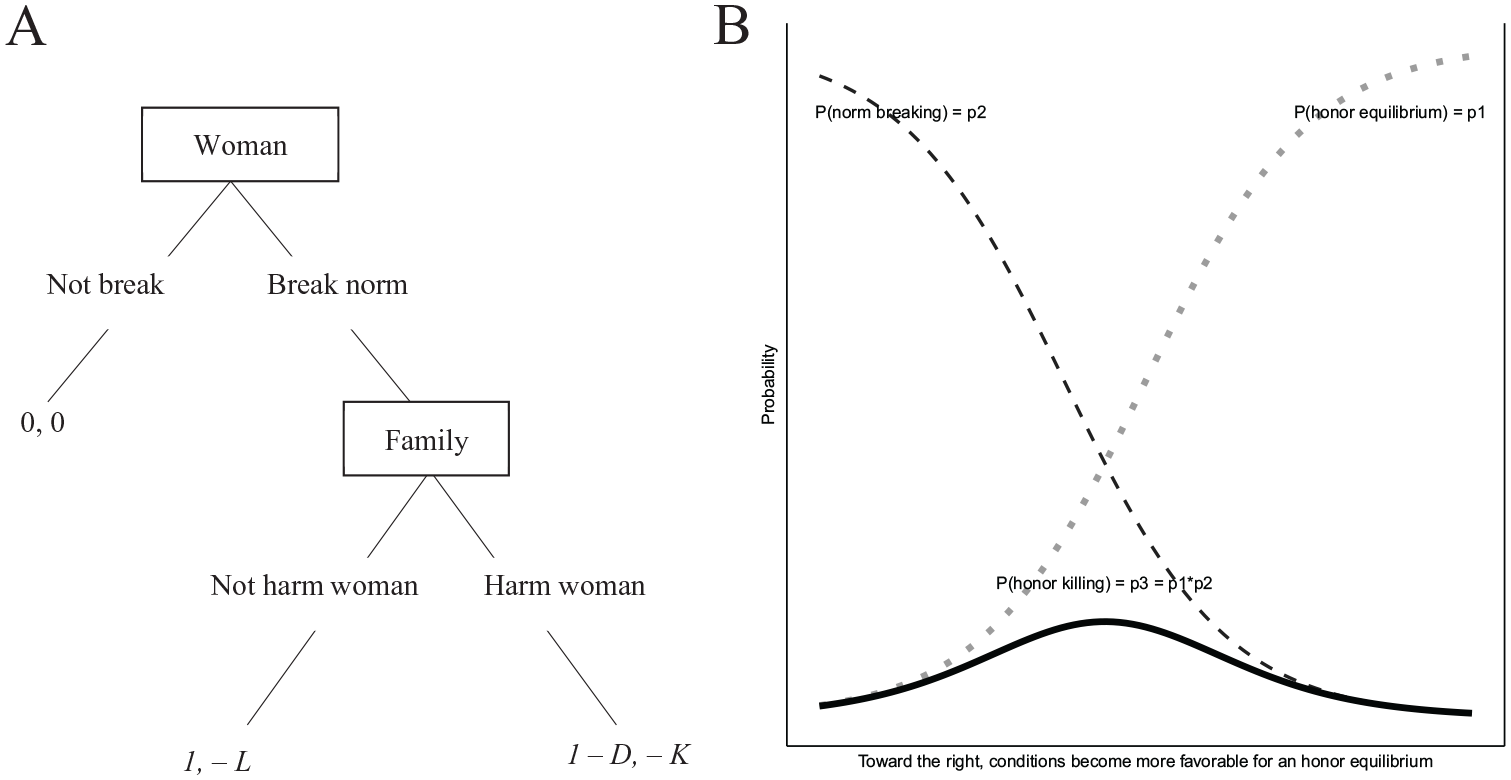
Within-Family Interaction and Probabilities of Interaction Outcomes
We should think of the two models (the intra-family model in Figure 1, Panel A, and the inter-family norm-enforcement model) together. When an honor equilibrium obtains, the family in Panel A is prepared to kill for it (i.e., in Panel A, K < L and the family harms), and the credible threat of killing deters women from breaking any norms of purity (because 1 – D < 0) (Schelling 1960). On the other hand, if in the inter-family model the honor equilibrium does not obtain (the three conditions that form Hypotheses 1, 2, and 3 are not met), there are no norms of honor to start with and the family in Panel A is not prepared to kill for honor (K > L, hence family does not harm). In this case, the woman breaks the norm but is not punished. In neither of these two cases should we observe an honor killing. So why does it nevertheless happen?
One potential answer is that on some occasions women do not actually break any norms of purity; the community or family incorrectly believe a violation had taken place. In 30.5 percent of the cases Churchill (2018) considers, the victim did not commit the alleged honor offense. Churchill (2018:59) argues that “[f]emales bear the burden of a presumption of guilt: if there is gossip or rumors, or a girl or woman has not conformed to expectations (e.g., been outside alone), there is the general presumption of illegitimate intent or offensive behavior” which dramatically increases the possibility of false allegations (see also Jehl 1999). Additionally, women may be harmed for violating honor even when they are sexually abused. These cases can also be understood through our model of norm-enforcement. So long as the community believes a violation has occurred, punishment takes place, indefinitely and repeatedly. This prospect of perpetual punishment by the community would urge family 1 to act, even when their member has not, or has involuntarily, broken a purity norm. A second answer is similar to Durkheimian (1897) fatalistic suicide or Weber’s (1978) value-rational orientation. For some women, complying with the strict norms of purity may be so unbearable they are willing to “sacrifice” themselves by defying the honor norms (1 > D).
Yet, these explanations are insufficient to explain most cases, and unfounded gossip, involuntary breaking, or “suicide” are not the primary explanations we provide here. For honor killing to happen, families must be prepared to kill, which happens in an honor equilibrium in our inter-family model. But a key insight from our formal analysis is that strong norms of honor are necessary but not sufficient for honor killings. For killings to occur, two things need to simultaneously happen: strong norms of honor should exist in the community (honor equilibrium obtains) and some sort of (actual or believed) norm-breaking needs to happen. A key argument we make is that this combination of two factors is likeliest to happen in places where honor norms are common but not universal.
This insight is displayed in Figure 1, Panel B. Assume the x-axis describes collectively the conditions that make an honor equilibrium in the inter-family norm-enforcement model more likely (i.e., the conditions set out in Hypotheses 1, 2, and 3; for a precise expression of what this axis represents, see Part B of the online supplement). The likelihood of an honor equilibrium (p1) increases as we go to the right of the x-axis. Furthest right, the probability of an honor equilibrium (p1) is highest, and the norms that enforce this equilibrium in the community are the strongest. Consequently, the probability of breaking a norm in Figure 1, Panel A, by the woman (call this probability p2) will be lowest, because it is nearly certain she will be harmed if she breaks any norms of purity. Furthest to the left on the x-axis in Panel B, p1 (probability of honor equilibrium) is the lowest. Consequently, p2 (probability of norm-breaking by the woman) is the highest, for the woman does not expect to be harmed. The probability of honor killing (p3) is the product of p1 and p2, which is highest in the middle of the x-axis (Panel B). In this moderate region, the probability of the honor equilibrium is low enough that the woman in Panel A is willing to break a norm and has a substantial chance of avoiding harm but there is still a reasonable chance she will face punishment. For a formal exposition of these insights, see Part B of the online supplement. This forms our next hypothesis, which addresses our puzzle of enforcement:
Hypothesis 4: The relationship between the incidence of honor killings and the prevalence of norms for honor-based violence will be inverse-U shaped.
Another line of reasoning also leads to the same prediction: “miscalculation” or insufficient information on a decision-maker’s side could result in inadvertent breaking of a norm and inadvertently trigger violent equilibrium strategies. Crucially, such missteps are likeliest to happen in intermediate zones of normative strength, where honor norms are not universal or universally enforced (otherwise missteps would be prevented), but also not very rare (otherwise they would not count as “missteps” to start with).
Some of these missteps could be on the side of the woman. For example, an act, such as flirting, may be seen as benign by a woman but as unacceptable by the community and trigger punishment. Likewise, a woman may mistakenly believe the community sanction on her family will be weaker than it ends up being, or that the cost of the harm is much higher than the cost of a “loss of honor” when in fact it is not, and this motivates her family to kill. The other kind of “miscalculation” concerns other members of the family. That is, some family member may underestimate the strength of honor norms in the community, which they communicate to their daughter, sister, or niece and socialize her in this way. But when the woman breaks the purity norm, the real community pressure, which is large and perpetual, is revealed. That norms of honor are typically imprecisely defined heightens the possibility for such mistakes (Cooney 2019). Basma’s story again may illustrate this: presumably, if the family had known the real and continuous pressure from the community, the initial divorce that triggered the process would have been avoided, or the family may have been able to find other ways of handling Basma’s divorce and subsequent marriage. Such miscalculations do not necessarily counter the assumptions of our theoretical model (i.e., the common rationality assumption). In our model, the decision-makers are families. Families consist of many individual members whose actions cannot be fully controlled. It is thus not inconceivable that some member of a family takes a “misstep.”
Our model implies there should be fewer honor killings when norms of honor are clearly established (also when norms are weak), but this does not imply that strong norms of honor are desirable. Indeed, such norms of purity subjugate women, placing normative and behavioral burdens on them and restricting their economic, political, and social involvement. This means that under the honor equilibrium, women forgo their freedom and incentives. Note too that in our model, the harmful strategy of the family can sometimes be triggered by the woman acting defiantly. This should not be interpreted as the model shifting the responsibility of an honor killing to the woman. On the contrary, it is the interaction between the families in the community that breeds violent norms, and it is the family that decides to kill. Moreover, when a woman “breaks” a norm of purity, there is often a male counterpart who is rarely punished. This shows the highly unequal nature of such honor norms.
Based on the discussion above, which makes a clear distinction between honor norms and honor killings, and assuming that Hypothesis 4 obtains, one can derive a further hypothesis about the effectiveness of any intervention that aims to prevent honor killings. Where there are weak honor norms, such interventions will be futile, for in these places there will be no potential for honor killings. In places where honor norms are strong and well established (honor equilibrium), Hypothesis 4 predicts that honor killings will also be rare, hence interventions will not appear effective either. 1 In the intermediate zones of honor norms, interventions should reduce killings as they reduce missteps, potentially by signaling that they are normatively inappropriate and thus clearly establishing expected behavior. Interventions in intermediate zones are also more likely to shift the model’s parameters, such as the cost of honor killings, away from the honor equilibrium. This brings us to our final hypothesis:
Hypothesis 5: The effect of an exogenous intervention on the incidence of honor killings will have a U-shaped association with the prevalence of norms for honor-based violence.
When we introduce our datasets, we will describe in detail a significant legislative shift that happened during the time our femicide data were collected. A new law that aimed to prevent violence against women, support victims, and end lenience toward perpetrators was introduced in Turkey in 2012. The legislation likely affected many factors, significantly increasing the cost of honor killings, signaling inappropriate action, and providing protection to victims and enacting wider regulations. We will test Hypothesis 5 by focusing on this legislative change and testing how much the new law reduced honor killings, conditional on the prevalence of norms for honor-based violence in a province.
Data and Operationalizations
We use two main data sources to study our hypotheses. First is the Pew World’s Muslims Survey (Pew Research Center 2013). The other is a unique dataset that combines an existing database on femicides in Turkey with further demographic and survey data. The Pew dataset includes measures of support for honor killing and allows us to test Hypotheses 1, 2, and 3, which are about the acceptance of honor-based violence. The Turkish dataset, which includes actual honor killings, allows us to test Hypotheses 4 and 5, which are about incidences of honor killings. As quantitative evidence on honor killings remains sparse, we also use the Turkish dataset to describe properties of honor killings including time trends, geographic distribution, and perpetrator characteristics. We also conduct a quantitative text analysis of the news articles reporting the murders.
The Pew World’s Muslims Survey
The Pew World’s Muslims Survey (Pew Research Center 2013) was conducted in 26 Muslim countries in Africa, Asia, the Middle East, and Europe from October 2011 to November 2012. Samples in most countries were nationally representative. Because education data are missing in Morocco due to an administrative error, and education is a strong predictor of honor norms, we excluded Morocco from some analyses. Additionally, the main outcome variable is not measured in Iran, presumably for sensitivity reasons.
The key outcome to test Hypotheses 1, 2, and 3, support for honor norms, is measured with the following two items, one asking about a man, another about a woman: “Some people think that if a man (woman) engages in premarital sex or adultery [in Afghanistan, Iraq, and Uzbekistan the wording is: brings dishonor to his (her) family] it is justified for family members to end his (her) life in order to protect the family’s honor. Others believe that this practice is not justified, no matter the circumstances. Do you personally feel that this practice is often, sometimes, rarely, or never justified?” The answer categories after reverse coding are 0 = never, 1 = rarely, 2 = sometimes, 3 = often.
Responses to these items most directly capture support for punishing honor norm-violations, or norm-enforcement, but they can also be used to indicate support for honor norms. Prior literature posits multiple ways to identify norms (Bicchieri and Xiao 2009; Krupka and Weber 2013), but stronger support for punishment of violation is a key indicator, as greater support for norm-enforcement is crucial for the long-term stability of a social norm. Moreover, stronger enforcement typically implies greater support for the underlying social norm (Gelfand et al. 2011; Szekely et al. 2021).
The most straightforward measure to operationalize cost of killing for honor is legislation. Eight countries in our dataset (Algeria, Egypt, Iraq, Jordan, Lebanon, Morocco, Niger, Palestinian Territories) have, or had at the time of the Pew poll, legislation in place providing leniency for honor-based femicides (e.g., Articles 340 and 98 in the Jordanian Penal Code; see Odeh 2010). 2 Two countries in our dataset, Pakistan and Afghanistan, have laws that not only allow leniency for honor killings but deem some of the acts that trigger honor killings (e.g., adultery or “fornication”) punishable by death. We use binary indicators for the existence of these types of laws in a country as a factor that reduces the costs of honor killing, and we expect that people in countries with such laws are likelier to support honor norms (Hypothesis 1). While the cost of honor killing is already high, legislation can change it: the difference between multiple decades of imprisonment compared to being released after a year or two is large and should substantially shift the costs of an honor-based murder. That the consequences of legislation matter is also shown by some families delegating the task of honor killing to their young members who can avoid full adult sentencing (see Kulczycki and Windle 2011).
To operationalize cost of being punished (ostracized) by other families, we use the number of children (information on the gender composition of children is missing in Pew), household size, and subjective economic status (very bad, somewhat bad, somewhat good, very good) as proxies for how costly it would be if the family is sanctioned by other families. We expect the more children there are, the larger the family, and the higher the subjective economic status, the costlier sanctions would be, as there is more to lose, hence the likelier these families are to endorse honor norms, per our model (Hypothesis 2).
We use two variables in the Pew survey as proxies to operationalize community closure / shadow of the future: frequency of mosque attendance (the more frequent attendance, the higher the frequency of interaction with the community) and urbanicity (community closure is typically much stronger in rural than in urban areas). More frequent mosque attendance and living in a rural area should both be associated with stronger support for honor norms (Hypothesis 3).
As control variables, we use marital status (married versus single), age in years, education (country normalized z-score), subjective importance of religion in one’s life (not at all, not too much, somewhat, very), and frequency of prayer outside a mosque (nine answer categories from “never” to “several times a day”). We include the latter religion variables because prior literature reports conflicting findings on the link between religiosity and honor norms (Beller et al. 2021; Eisner and Ghuneim 2013; Gengler et al. 2018). We also aim to isolate the social aspect of mosque attendance as a proxy for community closure / shadow of the future, hence our decision to control for personal religiosity (Aksoy and Gambetta 2021).
Due to data limitations, some operationalizations of our key variables are not ideal. For instance, the prevalence of cousin marriage, the actual frequency of interactions, or the number of strong ties would be good proxies for community closure / shadow of the future. Likewise, actual reliance on the community for subsistence, rather than subjective economic status or household size, would be a good measure for costs of being punished. But the Pew dataset does not have such measures, and in fact we did our best to find any proxy that would be relevant for our variables of interest.
Turkish Data on Femicides: Bianet
Bianet, an online news outlet in Turkey, compiles a tally of femicides and has created the most comprehensive database of femicides in Turkey. A team of reporters, with help from a professional media monitoring service, collect all cases of femicides that appear in local and national news. The team focuses on a wide range of keywords to capture gender-related murders, and their tally includes “crimes of passion,” domestic violence, intimate partner violence, and honor killings. The Bianet team checks every case manually and removes murders that are not gender related. In cases for which the motivation of the murder is unclear, the team searches for additional information (e.g., from court cases or police reports) and updates the database accordingly. They also clean the database of duplicate entries. Kavakli (2022) discusses the advantages and further details of this database. The website Kadincinayetleri (https://kadincinayetleri.org) presents the Bianet data in a structured format with clearly defined variables. We downloaded the data from this website.
This database includes femicides from 2009 to 2020. The district and date of the incident, the identified motive of the murder, the description of the case as it appeared in news reports, the age of the victim, and the perpetrator’s relationship to the victim are included. Using the identified motive, we distinguish and focus our analyses on murders tagged as honor killings. Other categories of femicide include theft, financially motivated, sexually motivated, accidents, crimes of passion, and others. We link this database with other variables from multiple sources to test Hypotheses 4 and 5 (which predict, respectively, an inverse-U and U-shaped link between the prevalence of honor norms; and killing incidences and the effect of interventions on killing incidents) and to study the characteristics of honor killings and other femicides.
As a proxy for prevalence of norms for honor-based violence, we use the Turkish Statistical Institute’s survey on domestic violence (TUIK 2014). This survey includes a question that asks if the respondent agrees whether a husband who learns his wife has been unfaithful is justified to physically harm her. We calculate the proportion of respondents who agree with this at the province level, using the survey weights provided by TUIK. This item is available in 78 out of 81 provinces. We link this variable with the Bianet femicide dataset at the province level. The TUIK samples only women for this survey, so our prevalence measure is based on women’s responses. This is unlikely to create bias because, as we show with the Pew sample, there are no systematic differences in support for honor norms between men and women across all Pew countries, including Turkey (see Figure D1 in the online supplement). Pew does not provide data at a sufficiently detailed geographic disaggregation that would allow us to create province-level estimates of honor norms within Turkey.
The time-range of the database (2009 to 2020) overlaps with a significant legislative change, allowing us to examine an exogenous intervention for preventing honor-based (and other) femicides. On March 8, 2012, Turkey passed a new law “to Protect Family and Prevent Violence against Woman” (Law code 6284; for the full text, in English, see http://www.lawsturkey.com/law/law-to-protect-family-and-prevent-violence-against-woman-6284). This law was implemented as an outcome of the 2011 Istanbul Convention, a human rights treaty of the Council of Europe signed by 45 countries, including Turkey. The main aim is to prevent violence against women and domestic violence, support victim protection, and end the impunity of perpetrators. Law code 6284 involves a series of statutes that provide potential victims with protection, such as shelter, and grants the police and prosecutors additional tools and opportunities to prevent violence against women and detain potential perpetrators. Special courts were established to expedite decisions in femicide cases. The Supreme Council of Judges and Prosecutors instructed special courts to accelerate the preventive and protective injunction to tackle violence against women and domestic violence. We use the cutoff date of March 8, 2012, as a shift in the cost of honor killings. The legislation operates at many levels, first making the honor equilibrium less likely to be obtained by significantly increasing the cost of honor killing; it can also be a signal of what is appropriate and what is not. The legislation also makes the actual act of killing more difficult to execute by, for example, providing protection to women, even when families decide to kill. Turkey withdrew from the Istanbul Convention on July 1, 2021, an issue we will come back to in the conclusions; however, this change is outside the timeframe of our database.
As further control variables, using official statistics from TurkStat, we obtained provincial in- and out-migration as percentages of province populations. We also have provincial data for the number of women, province population, provincial Gross Domestic Product (GDP) in U.S. Dollars, and percentage annual growth in GDP. Finally, as the proportion of Kurds may be linked with the number of femicides (Kavakli 2022), we include an estimate of the proportion of Kurds in a province. Because there is no official data on ethnic identity in Turkey, we use Turkey’s Demographic and Health Survey 2008 and 2013 waves to estimate proportion of Kurds in a province (Hacettepe University 2013; Koc, Hancioglu, and Cavlin 2008), as suggested in Aksoy and Yıldırım (2024), and applying the survey weights and taking the 2008 and 2013 averages.
The Pew data we use here, particularly the items on honor-based violence, have been used in prior literature (Beller et al. 2021), and Kavakli (2022) used the Bianet database. However, none of these studies has formalized the characteristics of the phenomenon into a model, nor tested the predictions we derived from our model. In addition, to our knowledge, no past research has merged legislative data (laws that provide leniency for honor-based crimes and blasphemy laws) with the Pew survey. Neither has past research examined Turkey’s Law code 6284 when analyzing the Bianet database or linked it with the Turkish Statistical Institute’s (TUIK 2014) survey on domestic violence. Also, no past research has focused on honor killings in the Bianet data—Kavakli (2022) does not distinguish different forms of femicides. Finally, no previous study has considered all these data sources together to form a unified evidence base.
Results: Pew Data
Descriptive Analyses
Figure 2 shows the averages of the extent to which people think killing a family member for honor is justified, and the proportion of people who think honor killings are at least sometimes justified. The figure breaks the averages down by country and victim gender. We see fairly widespread support for honor killings, but with substantial between-country variation, across the countries sampled by Pew irrespective of operationalization. Averaged across all countries, about 29 and 24 percent of respondents think that killing a family member for honor is at least sometimes justified when the member is female or male, respectively. Generally, enforcement support is stricter toward female family members than male members. This difference regarding victim gender is strongest in Jordan, Egypt, Lebanon, and Iraq. In Albania, Kosovo, Thailand, and Uzbekistan, the norm seems stronger toward male than female members, although these differences, except in Uzbekistan, are small. Support for honor-based violence is weakest in Azerbaijan and Kazakhstan and strongest in Iraq and Afghanistan. Turkey, which is the context of our second dataset on actual honor killings, is situated somewhere in the middle, with around 20 percent of respondents agreeing that honor killing is at least sometimes justified.
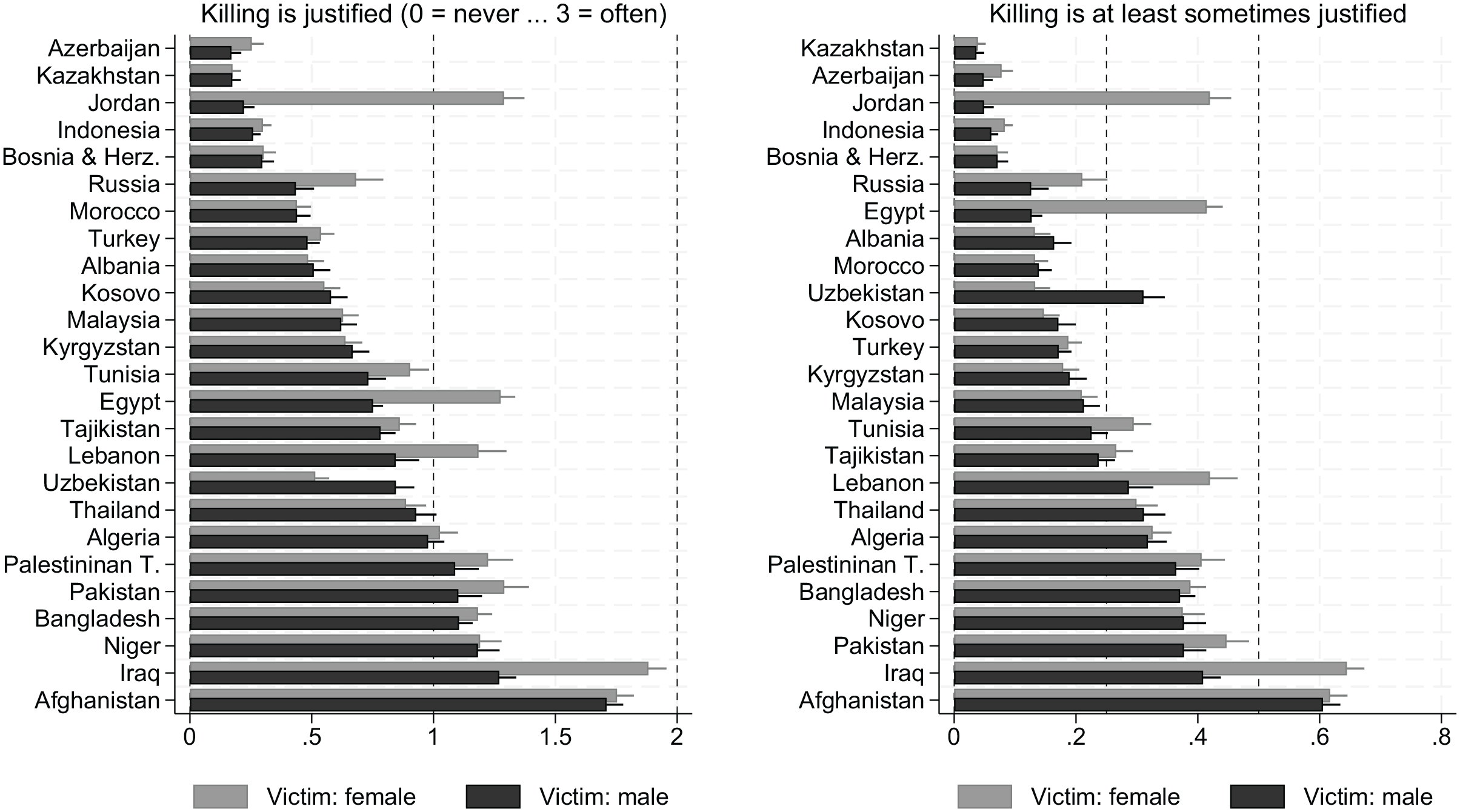
Support for Honor Killings by Country and Victim’s Gender
Tests of Hypotheses 1, 2, and 3
We test Hypotheses 1, 2, and 3 using multilevel regression models with random intercepts for countries predicting the extent to which people think killing a family member for honor is justified. Figure 3 shows the coefficients. The two bottom panels show the regression coefficients broken down by respondent gender (female and male) and by gender of the family member who is the target of honor-based violence (victim) in the scenario. These panels show that victim’s gender plays little role, as the coefficients are nearly identical for male and female victims. Likewise, respondent gender does not seem to matter much for the coefficients. Although there is a general tendency that honor norms are stricter toward female victims than male victims, as Figure 2 shows, the associations of the factors with honor norms are rather similar for male and female victims, and male and female respondents. Hence, in subsequent steps, we first pool male and female respondents when predicting the item for which the victim is a female family member (Figure 3 top-right panel), then average the two items (male and female victim) and use it as a single dependent variable to reduce measurement error, again pooling male and female respondents (Figure 3 top-left panel). The coefficients are, again, effectively the same.
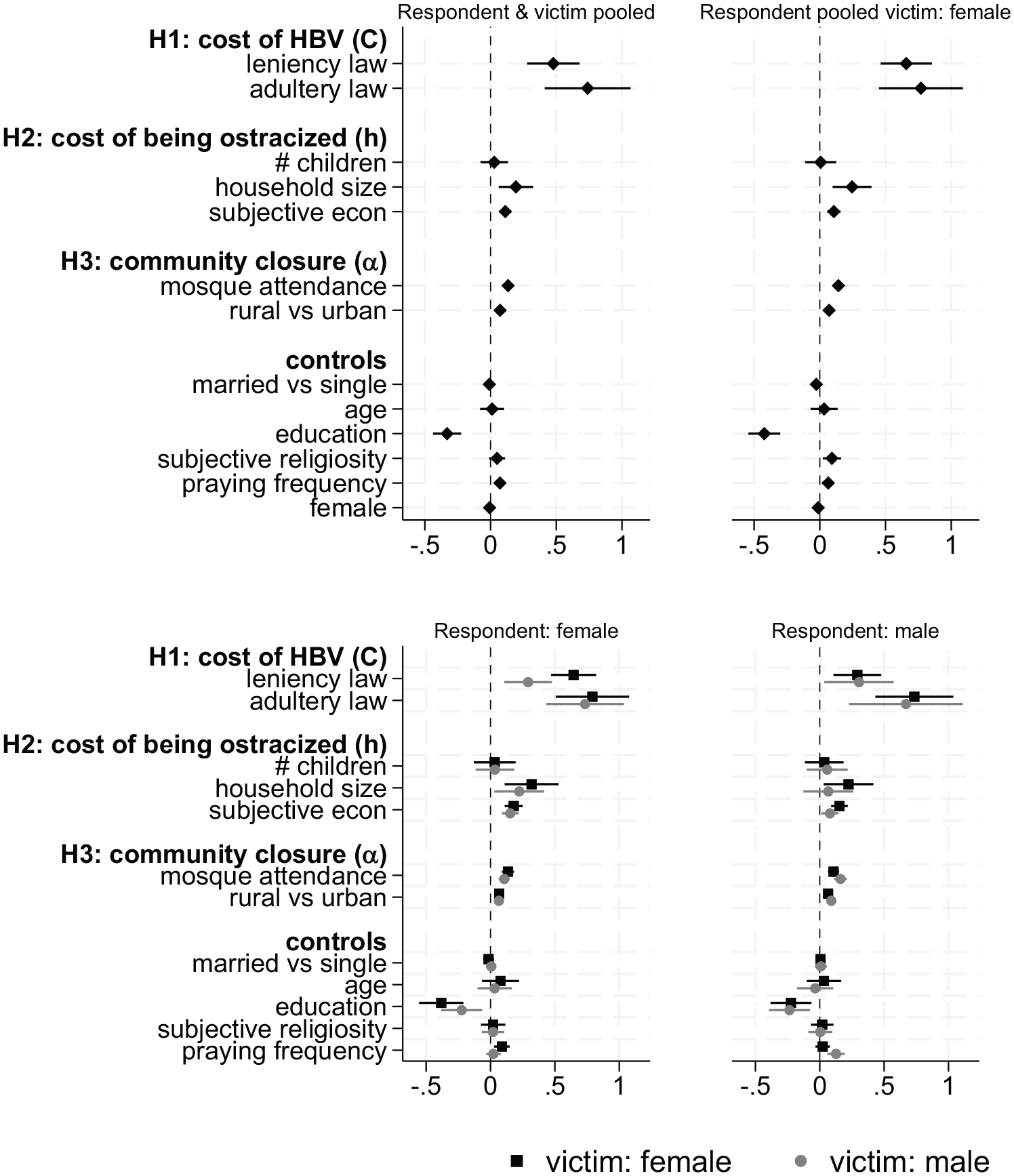
Support for Honor Killings; Coefficients from Multilevel Regressions with Random Intercepts for Countries
Hypothesis 1, the cost of honor killing, receives strong support. In countries that offer legal allowances for honor killings, either through leniency for honor-based femicides (in models in Figure 3 top-right / top-left panels, b = 0.66 / 0.48, se = 0.10 / 0.10, p (two-sided) < 0.001 / < 0.001) or through adultery laws (b = 0.77 / 0.74, se = 0.16 / 0.17, p (two-sided) < 0.001 / < 0.001), support for honor-based violence is stronger. Given that all independent variables are standardized to (0,1) (the dependent variable is kept at its original range 0 to 3), the largest coefficients belong to these legislations. In countries with legal leniency for honor-based violence, compared to countries where there is not, respondents report 0.5 to 0.8 points more, on average, in how much they think honor killing is justified on the 0 to 3 response range.
As to Hypothesis 2, regarding the cost of being ostracized, the coefficients of all three proxies have the expected direction and two are highly statistically significant. Household size (b = 0.25 / 0.19, se = 0.08 / 0.07, p (two-sided) = 0.001 / 0.004) and subjective economic standing (b = 0.11 / 0.11, se = 0.03 / 0.02, p (two-sided) < 0.001 / < 0.001) are significantly and positively associated with support for honor-based violence, and the number of children has a non-significant but positive coefficient (b = 0.01 / 0.03, se = 0.06 / 0.05, p (two-sided) = 0.912 / 0.559).
We also find support for Hypothesis 3, on community closure / shadow of the future. Honor-based violence norms receive more support in rural areas than in urban areas (b = 0.07 / 0.07, se = 0.01 / 0.01, p (two-sided) < 0.001 / < 0.001), and more frequent mosque attendance is associated with stronger support (b = 0.14 / 0.13, se = 0.02 / 0.02, p (two-sided) < 0.001 / < 0.001). The association with mosque attendance is net of subjective religiosity and prayer frequency.
As to the control variables, we find a small association with inner aspects of religion (praying [b = 0.06 / 0.07, se = 0.02 / 0.02, p (two-sided) = 0.007 / 0.001]; subjective importance of religiosity is non-significant in one specification and significant but small in the other [b = 0.09 / 0.05, se = 0.04 / 0.03, p (two-sided) = 0.010 / 0.112]). This suggests religiosity per se is not a strong driver of honor-based norms. Age, marital status, and gender, as noted earlier, have basically zero association with honor-based violence norms. Education, however, is a very strong and negative predictor of norms for honor-based violence (b = −0.42 / −0.33, se = 0.06 / 0.05, p (two-sided) < 0.001 / < 0.001).
Results: Turkish Data an Femicides
Descriptive Analyses
We first describe some characteristics of honor killings shown in Figure 4. Panel A shows the geographic distribution of honor killings in Turkey, normalized by population. Honor killings are most likely to happen in the south and east, but there are several places in the east where no killings happen, and areas in the center and the west where they do happen. Panel B shows the temporal distribution of honor killings, marking March 8, 2012, when law 6284 that aims to protect women passed. Honor killings show a sharp drop right after passage of the law. A McCrary (2008) density test around March 8, 2012 (null hypothesis of no discontinuity around the cutoff) also suggests the frequency of honor killings dropped strongly right after passage of law 6284 (discontinuity estimate = − 2.367, se = 1.328). Panel C shows that brothers are the most common perpetrators of honor killings. Husbands also commit honor killings, but fathers, other relatives, and sons are frequent perpetrators. Most of the victims of honor killings in our dataset are very young, between 16 and 30 years. Panel D shows the results of a text analysis of news descriptions of honor killings. These descriptions often involve terms such as honor, cleansed, sister, sibling, and brother, and there is often a statement that reveals the excuse. These descriptive analyses resonate with the known characteristics of honor killings, showing that the data are high quality.
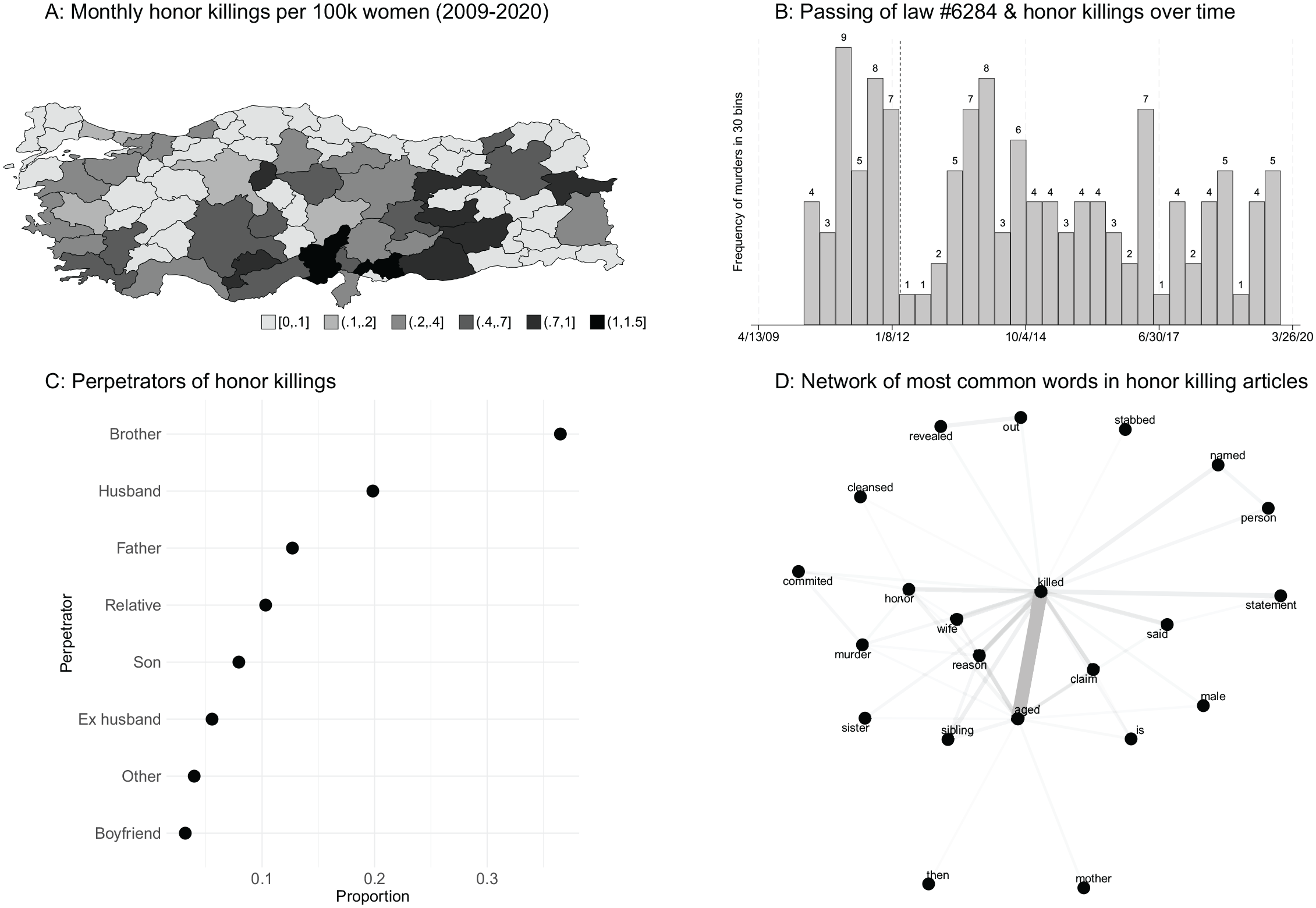
Honor Killings in Turkey (2009 to 2020), Their Characteristics, and Variation over Time
Tests of Hypotheses 4 and 5
Hypothesis 4 predicts an inverse-U-shaped relationship between the prevalence of norms for honor-based violence and honor killing incidences. Hypothesis 5 predicts the effect of law 6284 as an intervention to reduce honor killings will have a U-shaped association with the prevalence of honor-based violence. To test these hypotheses, we fit Poisson regressions that predict the monthly number of honor killings in a province (Table 1). The models adjust for year fixed effects and female adult population and use cluster robust standard errors at the province level. The models also adjust in a second step for GDP, GDP growth, proportion of Kurds, and in- and out-migration rates. Some of these control variables could be linked with the prevalence of honor norms (e.g., migration), and hence suppress the effect of our prevalence measures; other factors (e.g., GDP) could have their own independent effects. Thus, we study the effects with and without these controls, and the results are largely robust to including the controls. The models are nonlinear (Poisson) and involve quadratic effects and interaction terms, so the plain coefficients are not immediately informative. Figure 5 shows the marginal effects obtained from Models 1 and 3 in Table 1 (hence they are obtained without adjusting for the full set of controls; with controls the results are virtually the same). These marginal effects are obtained conditional on the proportion of women who agree with the statement that violence is justified if the wife is caught cheating, the available proxy for honor norm support, directly testing Hypotheses 4 and 5.
Coefficients of Poisson Models That Predict the Monthly Number of Honor Killings
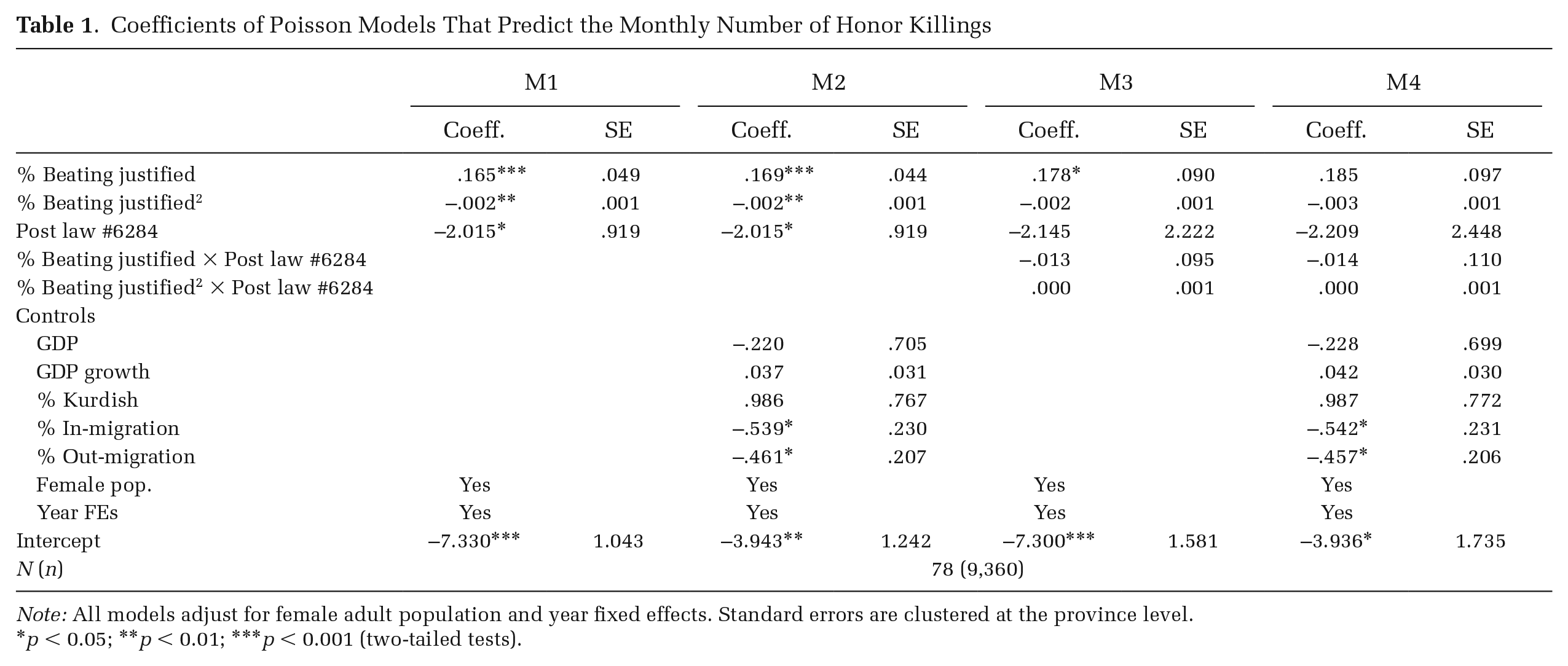
Note: All models adjust for female adult population and year fixed effects. Standard errors are clustered at the province level.
p < 0.05; **p < 0.01; ***p < 0.001 (two-tailed tests).
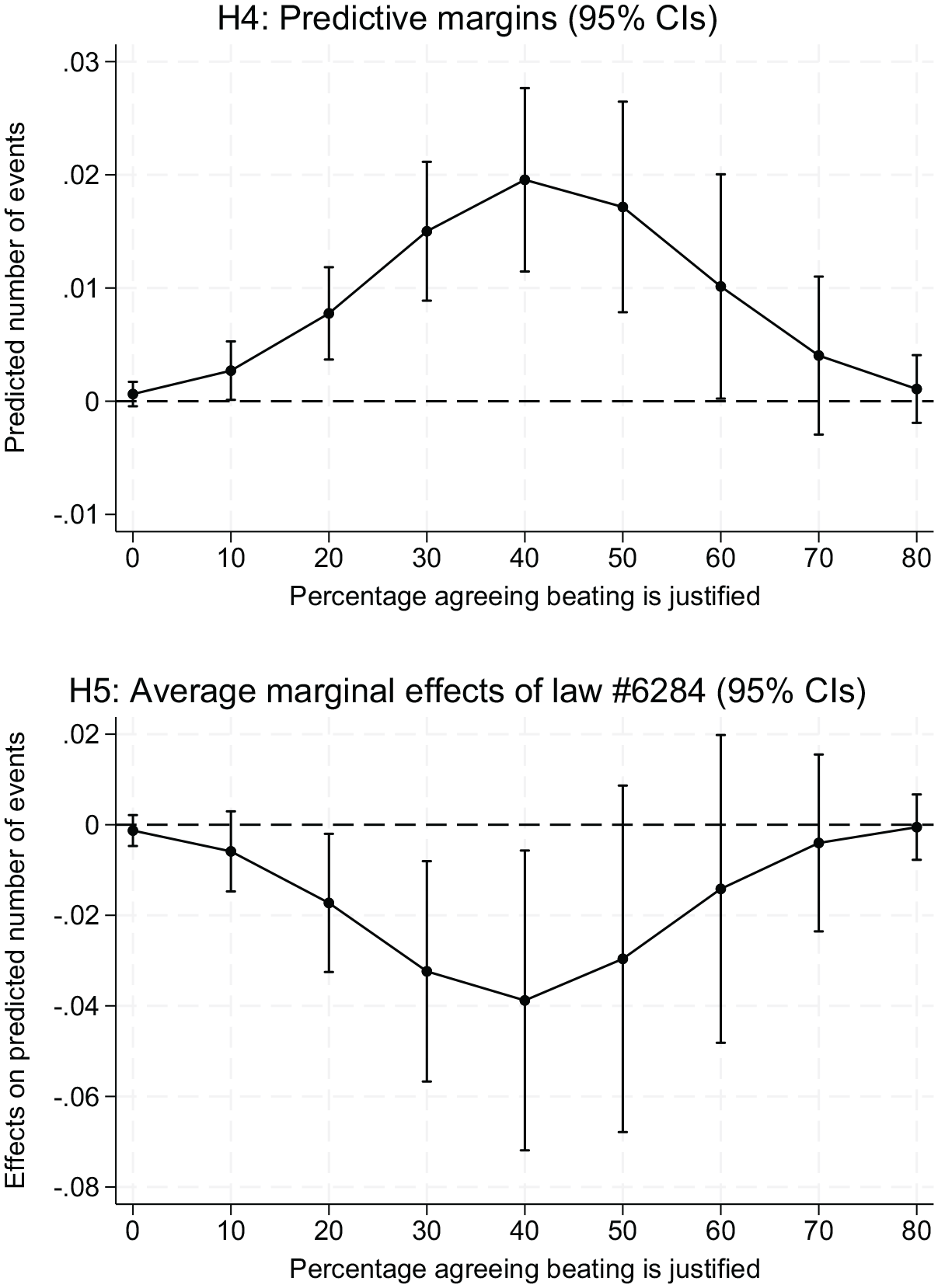
Results of Poisson Models Predicting the Monthly Number of Honor Killings
The results in Figure 5 broadly support Hypotheses 4 and 5. Honor killings are lowest in areas where honor-based violence norms are the least and the most prevalent; honor killings are highest in the middle zones where norms exist but are not universal, as predicted by Hypothesis 4. Using the model with controls, the marginal predicted monthly number of honor killings when 40 percent of people agree that honor-based violence is justified (0.019) is significantly higher than when, for example, 10 percent (0.003, difference = 0.016, p (two-sided) < 0.001) or 80 percent (0.001, difference = 0.019, p (two-sided) < 0.001) agree.
Hypothesis 5 is also supported. The negative effect of law 6284 on honor killing incidences is highest where honor-based violence norms are in the middle zones, and effectively zero where honor-based violence norms are the least and the most prevalent. The marginal effect of law 6284 on monthly number of honor killings when 40 percent of people agree that honor-based violence is justified (–0.04) is significantly larger than when virtually nobody agrees (–0.00, difference = 0.04, p (two-sided) = 0.032) or 80 percent agree (−0.00, difference = −0.04, p (two-sided) < 0.025). Turning to control variables, in- and out- migration have negative associations with honor killings, and the economy (GDP and its growth) and proportion of Kurds in a province have no significant associations with honor killings.
Some additional results are worth noting. We saw that law 6284 significantly reduced honor killings when it came into effect in early 2012, but mainly in places where honor norms have mixed support. As an alternative explanation, one could conjecture that after the law passed, women who would otherwise be victims of honor killings might be pushed to commit suicide by their family due to the increased penalties. Although this would not explain the variation according to the level of support for honor-based violence, we nevertheless inspected suicide statistics for evidence that women were being pushed to commit suicide after the new law. We found no evidence in the data for this conjecture (see Part C of the online supplement). Finally, we inspected male homicides in 2012 vis-à-vis 2011 as a placebo check. Law 6284 is meant to decrease femicides, not male homicides, although one could think of spillover effects from reduced femicides to reduced male homicides. Nevertheless, male homicide statistics (see Table C1 in the online supplement) show no decrease in 2012 from 2011, in fact the number increased, whereas in the same period the number of femicides decreased despite a population increase. This increases our confidence that the effect of law 6284 is genuine.
Finally, in our model, honor killing incidence is highest in the middle zones because of the expectation that the chance of killing is relatively low but non-zero. When an honor killing occurs, it could subsequently increase people’s expectations that the honor equilibrium prevails in that place. This suggests that a past honor killing incidence should reduce the likelihood of a future honor killing in the area, for people have changed their expectations and will be especially careful to not break any purity norms. 3 Although cleanly testing this prediction empirically is difficult, we calculate a one-month lagged cumulative number of honor killings in the province as an independent variable and predict the current monthly number of honor killings with a Poisson regression. We also adjust for pre–post law 6284, year fixed effects, and female population size. Crucially, to account for time-invariant shared confounders of past and future honor killings in a province, we adjust for province fixed effects. The results indeed show that an additional honor killing in the past reduces the expected number of current monthly honor killings by 0.6 percentage points, which is a statistically significant reduction (cluster robust se = 0.001, p (two-sided) < 0.001). This finding further supports our theoretical model.
Discussion and Conclusions
Honor killings are thought to claim the lives of thousands of women globally every year, and they pose significant public health and moral issues. It is also a puzzling phenomenon for social scientists. Much more primary research is needed to understand honor killings. Current theoretical explanations of honor killings are not fully satisfactory, deferring to broad concepts such as culture or inequality, or circular reasoning in which honor killings are described as products of honor, or black-box accounts, rather than probing the decision-making mechanisms of the families and linking those decisions with the more macro, community-level norms. Existing research also often suffers from methodological drawbacks. A reason for these drawbacks is that honor killings are inherently difficult to study, as it is a sensitive and often neglected topic and hence good quality data are often scarce.
In this article, we tackled two particularly puzzling aspects of honor killings: honor norm-enforcement and honor norm-breaking. The first puzzle asks what makes a family decide to kill one of their own, given that killing is such an extremely costly act. This is about explaining the conditions under which honor norms sustain. The second puzzle asks, if families are prepared to kill one of their own for breaking the norms of purity, individuals will be deterred from breaking those norms, so why do killings happen? The second puzzle of honor norm-breaking is thus about explaining the conditions under which actual honor killings happen.
We provide two main contributions to the literature. The first one is theoretical. Drawing on interviews and accounts of honor killing in the literature, we develop two linked theoretical models to address these puzzles. The inter-family (community) model highlights the role of the community and formally identifies the conditions under which honor norms can be sustained. It yields sharp predictions on the link between honor norms and the cost of killing, the costs of being ostracized by other families for loss of honor, and community closure or the shadow of the future. Combined with the within-family model, our models also yield another novel insight: honor killings are likeliest to happen in places where honor norms are widespread but not too much. That is, when honor norms are weak and not prevalent, no killing will be observed. When honor norms are strict and nearly universal, people will be deterred from breaking the norm, hence honor killings are less likely to happen. The middle zone has the biggest potential for conflict to escalate. Using a quasi-experimental design that involves a new law being passed during data collection, we show that interventions are most effective in the same middle zone where the potential for conflict is greatest. Our models thus address the two puzzles above and push the boundary of sociology in explaining such extreme acts.
Our explanation of honor killings implies that the processes that give rise to these gruesome acts are not confined to some “exotic” cultures but are general, and in principle applicable to other settings. Our explanation relies on an equilibrium whereby one person harms another whom they would not otherwise want to harm. This happens due to community pressure and higher-order pressures: those who do not punish the focal actor get punished by others, and those who do not punish those who fail to punish get punished too, ad infinitum. All these expectations and higher-order expectations, which could be internalized by individual community members, keep the harmful norm alive. This mechanism is general: certain forms of aggressive behavior observed on social media (e.g., “cancel culture”) or in cohesive groups, controlling and extreme behavior in cults, family sanctioned “kneecapping” in Northern Ireland during the troubles, and seppuku (ritual suicide among samurai) arguably carry elements of the same mechanisms. These cases obviously have clear differences, and some forms of harmful behaviors are arguably beneficial for the wider community (i.e., challenging racist or sexist language on social media), but our point is that anyone could, in principle, find themselves in situations that are not far from those that ultimately yield honor killings.
Our second contribution is empirical. We use a unique combination of large-scale survey data, an existing database on femicides, and other surveys and registry data to conduct rigorous empirical tests of the predictions of our theoretical models. The results of these analyses broadly support our theoretical models. Using multiple data sources to test our hypotheses is a particular strength of our study. For instance, we find that countries with legislation that provides leniency for honor killings and punishment for adultery have the strictest honor norms among their citizens. Such legislation may be endogenous to the honor cultures in a country; hence, these results should not be interpreted as causal. However, we also use a pre–post design from Turkey, when a new law increased the costs of femicides. This design has stronger causal leverage, and we find that honor killing incidences reduced sharply, especially in provinces with intermediate norm support, after passage of the law. These findings suggest that legislation that increases the cost of honor killings is key to tackling the issue.
Other important factors that sustain honor norms include how resilient a family is toward being ostracized, and the frequency of community interactions. Moreover, as we predicted, honor killing incidents are highest in exactly those places where honor norms are contested. Another notable finding from our analysis of the Pew data is that females are not more lenient than males in terms of honor norms. This finding holds in the pooled data with all countries, and in every country when the effect of gender is allowed to vary across countries (see Part D of the online supplement). We also find that the coefficients of all other predictors of attitudes toward honor killings are nearly identical between male and female respondents.
Hence, one could conclude that honor norms are beyond the individual and shared between men and women alike. This counters Churchill’s (2018:126) “warrior masculinity” conjecture, which argues that in honor cultures males and females are socialized very differently, “result[ing] in a rupture between the feminine ‘world’ of the compassionate, tender, loving mother and the male ‘world’ of responsibility, competition, strife, and vigilance.” Our analysis, on the contrary, shows not only that males and females are very similar in their support for honor-based violence, but the associations of other predictors toward honor-based violence are very similar between men and women. This does not mean women’s position on the matter is unimportant. Reports show that in cases where killing is avoided, often the girl’s mother, sisters, or some other female relatives resisted strongly and prevented the girl from being murdered, although in some of those cases these relatives were excommunicated from the community too (Kardam 2007). But it does suggest legislative and NGO support are needed to enable norm change to occur.
We should add that our study, like all studies, has limitations. First, the secondary dataset on support for honor-based violence (Pew) does not always have ideal proxies for the variables that are key to our theoretical model. This is inevitable, for our theory is novel and the dataset is generic. Future research should gather primary data that are more closely related to theoretical concepts, for example, via vignettes and measures of honor norms and expectations. Second, the dataset on actual honor killings only goes back to 2010, is based on media reports, and is collected from a single country, Turkey. Given the difficulties in obtaining data on honor killings, this is as good as it gets in terms of data quality. In addition, both the Pew and Turkish dataset are based on predominantly Muslim contexts. Although honor killings are most common in countries with large Muslim populations, it is not an exclusively Muslim phenomenon (Cooney 2019). Future research should try to triangulate these data with data from other countries, from official sources (e.g., police or court reports), and for longer time spans. Finally, in our theoretical models we did not study the origins of the practice or seek an ultimate explanation of the phenomenon. Rather, our models concern the environmental conditions under which the norm and practice is most likely to occur, given what we know about its key characteristics. We thus build on existing research and our study is by no means the end word. Future research should address the shortcomings of our study and hopefully extend it in further directions.
Our analysis also sheds light on ways to prevent honor killings. A key issue, which is mostly ignored in the literature, is to distinguish honor norms from honor killings. Norms are necessary but not sufficient for killings to happen. We show that extreme care is needed when trying to shift the norms, as conflict potential is highest when norms are contested. Hence, such middle zones, rather than areas with extremely strong honor norms, could be targeted first. In fact, we find interventions are most effective in these middle zones.
In trying to prevent killings, the mechanisms we identified in our model could be used too. The first mechanism we show to be effective is legislation. Norms as well as killings can be significantly tackled by laws. Because honor killings are often the outcome of a deliberative process, families will respond strongly to the costs of honor-based femicide. The Turkish case exemplifies the effectiveness of legislation. It is thus tragic that Turkey withdrew from the Istanbul Convention in 2021. The Istanbul Convention was the motivation for article 6284, which prevented honor killings and other femicides. The convention also put pressure on Turkey to implement the article. Withdrawing from this convention will likely weaken implementation of the article and may eventually allow Turkey to dilute its components. Our theoretical analysis and empirical results suggest that withdrawing from the Istanbul Convention may have grave repercussions for women in Turkey.
Another mechanism to tackle honor norms is to reduce the costs of being ostracized by other families when a family does not harm one of its own members. Social support by NGOs and field workers will be essential. Our theoretical model also shows that increasing the cost of ostracizing other families and reducing interaction frequency in the community will make honor norms more difficult to sustain, although it is not immediately clear how to do this in practice.
In his seminal sociological contribution, Durkheim discussed how societal forces may contribute to the processes that lead people to kill themselves. This could happen by excessively controlling the individual or conversely cutting the individual too loose. In this article, we show how social forces can also contribute to the processes that make people kill a member of their own family.
Supplemental Material
sj-pdf-1-asr-10.1177_00031224251324504 – Supplemental material for Making Sense of Honor Killings
Supplemental material, sj-pdf-1-asr-10.1177_00031224251324504 for Making Sense of Honor Killings by Ozan Aksoy and Aron Szekely in American Sociological Review
Footnotes
Acknowledgements
We thank participants of the Amsterdam Center for Inequality Research colloquium, 2023 UCL SRI Away Day, 1st Sociological Science Conference, NASP-CCA Frontiers of Methods in Social and Political Science Workshop, NYU Abu Dhabi SRPP seminar, Stockholm University SOFI SWS seminar, and 2024 UCL Gender Workshop, as well as Jeroen Bruggeman, Werner Raub, Michael Biggs, Said Hassan, Davide Morisi, Krzysztof Krakowski, Kerim Can Kavakli, and Burak Sonmez for their comments on earlier drafts.
Authors’ Note
This project received ethical approval from Collegio Carlo Alberto.
Funding
Aksoy acknowledges funding from the British Academy (SRG20\200045).

Data Note
Notes
References
Supplementary Material
Please find the following supplemental material available below.
For Open Access articles published under a Creative Commons License, all supplemental material carries the same license as the article it is associated with.
For non-Open Access articles published, all supplemental material carries a non-exclusive license, and permission requests for re-use of supplemental material or any part of supplemental material shall be sent directly to the copyright owner as specified in the copyright notice associated with the article.
