



Abstract
Cultural capital is a central concept in stratification research. Crucial to the Bourdieusian habitus, upper strata familiarity with the dominant culture is assumed to be ingrained via socialization, allowing its members to smoothly navigate educational institutions and higher segments of the labor market. Although cultural capital is deemed partially implicit, such “non-declarative” or “embodied” cultural capital has largely escaped empirical scrutiny; arguments about its importance are typically post hoc interpretations of associations between measures of declarative cultural capital (survey items on elite cultural consumption) and variables of interest. To advance stratification research, we developed tools to empirically capture non-declarative cultural capital: Implicit Association Tests (IATs) measuring (1) positive association and (2) self-identification with elite culture, embedded in a survey fielded among a high-quality panel representative of the Dutch population (n = 2,436). We find our IATs validly measure non-declarative cultural capital. As expected, scores are only weakly coupled with declarative cultural capital, and associated with (parental) socioeconomic position. Using these IATs liberates non-declarative cultural capital from its deus ex machina status and answers the black-box critique of the Bourdieusian habitus as an explanation for socially stratified patterns across a range of fields.
Cultural capital is a key concept in stratification research, inspired by Bourdieu’s work on the intergenerational reproduction of class. The term generally refers to “familiarity with the dominant culture” (Jæger and Breen 2016:1083) or “widely shared, high-status cultural signals (attitudes, preferences, formal knowledge, behaviors, goods and credentials) used for social and cultural exclusion” (Lareau and Lamont 1988:156). Jæger and Breen (2016:1079–80) summarize the main assumption about the role cultural capital plays in that exclusion as follows: “parents transmit cultural capital to children, children exploit their acquired cultural capital in the educational system, and, as a consequence, families who possess cultural capital have an advantage that helps them reproduce their privileged socioeconomic position.” This process, also referred to as “cultural reproduction,” transpires as children’s display of cultural capital affects “teachers’ perceptions of academic ability, which leads to greater teacher inputs (e.g., of attention and help) and better performance” (Jæger and Breen 2016:1082). Cultural capital’s role in reproducing inequality transcends the classroom; it also aids in the successful navigation of higher segments of the labor market (Rivera 2012).
Quantitative empirical research seeking to measure cultural capital has thus far relied on survey items to gauge respondents’ appreciation and consumption of elite culture (for an overview, see Jæger and Breen 2016). The first study to adopt this approach in the American Sociological Review already acknowledged that, “as Bourdieu has argued, cultural capital is inculcated in early childhood . . . and may be deployed unconsciously” (DiMaggio 1982:190, italics added). This “non-declarative” form of cultural capital is theorized to be ingrained through socialization in the upper strata (Lizardo 2017). Whereas declarative cultural capital mainly concerns verbally shared knowledge of the dominant culture, its non-declarative counterpart is more implicit and resides in nonverbally shared actions, mannerisms, and displays of “a feel for the game” (Bourdieu 1990). Although non-declarative cultural capital is assumed to be central to cultural reproduction (Jæger and Breen 2016), it has thus far escaped empirical scrutiny, as conventional measures such as the survey items mentioned above only enable scholars to access cultural capital’s declarative elements (Miles, Charron-Chénier, and Schleifer 2019; Schaap, Van der Waal, and De Koster 2019; Shepherd 2011; Srivastava and Banaji 2011).
We seek to advance stratification research by developing measures of non-declarative cultural capital for use in survey research. In the extant literature, the unconscious deployment of cultural capital plays a key role in interpreting a plethora of socially stratified patterns found in survey items. Nevertheless, such interpretations function as a deus ex machina without a measure of non-declarative cultural capital (see DiMaggio 1979; Lizardo 2004). Our study aims to overcome this predicament in Bourdieu-inspired stratification research by (1) developing a tool that empirically measures non-declarative cultural capital; and (2) exploring how it is associated with (a) (parental) declarative cultural capital; (b) parental socioeconomic position; and (c) respondents’ socioeconomic position. Our study thus also contributes to debates on cultural analysis (Lizardo 2017), cultural schemas (Boutyline and Soter 2021), and dual-process research in sociology (e.g., Lamont et al. 2017; Miles et al. 2019; Moore 2017; Vaisey 2009). Tellingly, the Bourdieusian notion of cultural reproduction adopted in such studies often serves as a “paradigmatic test case” (Lizardo 2017:90).
Our study pioneers the development and use of two empirical measures to assess deeply ingrained positive association and self-identification with elite culture. We do so through two Implicit Association Tests (IATs) developed for this purpose. By embedding these tests in a survey fielded among members of a high-quality panel drawn randomly from the official Dutch population register (n = 2,436), we can empirically assess key assumptions made in studies on cultural reproduction: that declarative and non-declarative forms of cultural capital are weakly coupled; and that non-declarative cultural capital is associated with parental socioeconomic position and is socially stratified.
Non-Declarative Cultural Capital and Cultural Reproduction
Non-declarative versus Declarative Cultural Capital
The different understandings of cultural capital in stratification research notwithstanding, there is wide agreement that it entails familiarity with the dominant culture. Cultural capital is broadly assumed to encompass culturally elite preferences and behaviors that are, at least to some extent, habitual due to their inculcation through socialization in more privileged conditions (see Jæger and Breen 2016; Lizardo 2021). As such, cultural capital is part of what Bourdieu (1990:53) terms the “habitus”: “systems of durable, transposable dispositions” that are “hard wired” in cognitive structures due to socialization. Classed preferences and behaviors are to some extent a matter of unconscious habit—hence Bourdieu’s (1977:78) term “class unconsciousness.”
Cultural capital can be dissected analytically as having both a declarative (i.e., deliberate) and a non-declarative (i.e., automatic) form (Lizardo 2017)—a distinction adopted from dual-process theorizing (Miles et al. 2019; Moore 2017; Vaisey 2009). Whereas the former can be acquired “via a relatively small number of exposures, [especially via] spoken or written language,” the latter is acquired through “a ‘slow learning’ pathway in the form of implicit, durable, cognitive-emotive associations . . . built from repeated long-term exposure to consistent patterns of experience” (Lizardo 2017:91–92). Whereas the deployment of declarative cultural capital usually relies on deliberate thought, non-declarative cultural capital is “usually deployed . . . in a fast (effortless) mode” (Lizardo 2017:93). We follow Lizardo (2017:97, italics in original) in proposing that a weak coupling between the two “emerges as a natural outcome of the dual enculturation pathways” outlined above.
The notion of non-declarative cultural capital is a prominent theoretical workhorse for interpreting how the reproduction of inequality comes about. Empirically, however, it has either been assumed to exist or measured through the proxy of declarative cultural capital. Examples abound in studies that associate children’s educational attainment with their and/or their parents’ consumption of elite culture (for an overview of these studies, see Jæger and Breen 2016). In this type of research, the “unconscious” (e.g., Bodovski and Fargas 2008:905; DiMaggio 1982:190; Dumais 2002:46; Van de Werfhorst and Hofstede 2007:397; Wildhagen 2009:195), “internalized” (e.g., Bodovski and Fargas 2008:905; Dumais 2002:46; Jæger and Møllegaard 2017:132; Xie and Ma 2019:839), or “inculcated” (e.g., DiMaggio 1982:190; Sullivan 2001:894; Tramonte and Willms 2010:203; Xie and Ma 2019:839) nature of cultural capital is deemed a crucial part of the cultural reproduction being studied. In other words, cultural reproduction studies demonstrate associations between declarative cultural capital and particular variables of interest, partially attributing them to non-declarative cultural capital, although the latter is not included in the empirical model (see the “black-box critiques” leveled against the habitus by, e.g., Boudon 1998; Vaisey 2009).
Non-declarative Cultural Capital and Cultural Reproduction
The core idea concerning non-declarative cultural capital’s role in cultural reproduction is as follows: familiarity with dominant institutions resulting from socialization in milieus with ample cultural capital leads individuals from the higher strata to habitually behave according to “the ‘rules of the game’ regarding how institutions work” (Lareau 2015:2). As the “appropriate” attitudes and behaviors in institutions such as schools and universities reflect the attitudes and behaviors of people in their milieu (see Edgerton and Roberts 2014), these individuals feel more at ease when engaging with authority figures in these institutions than do people socialized in lower strata (Jack 2016; Lareau 2011). The largely habitual display of cultural capital in the classroom “conveys an impression of academic brilliance that leads to favorable treatment by teachers and to educational success” (Jæger and Breen 2016:1084; see, however, Jæger 2022). In contrast, children socialized in milieus with limited cultural capital often feel like misfits in educational institutions; their attitudes and behaviors are perceived as signals of academic weakness (Lehmann 2007) and viewed as inappropriate by institutional gatekeepers (Archer, Hollingworth, and Halsall 2007; Dawson 2014).
The role of cultural capital in inducing and reproducing inequality is also theorized to work outside of education, most notably in higher segments of the labor market. A conscious display of familiarity with dominant culture in résumés, for example, increases the odds of being invited to a job interview (Rivera and Tilcsik 2016). Qualitative in-depth research has shown that habitually displaying cultural capital has favorable outcomes in job interviews and in the workplace more generally (Friedman and Laurison 2019; Rivera 2012). Nevertheless, the systematic study of the role of non-declarative cultural capital in labor-market success among the public at large requires large-scale survey research with measures for both declarative and non-declarative cultural capital. The possession of non-declarative cultural capital may affect labor market success in at least two ways.
First, job applicants and employees with high levels of non-declarative cultural capital will “naturally” demonstrate “appropriate” attitudes and behavior in higher segments of the labor market. Gatekeepers tend to perceive people who effortlessly demonstrate such high-status signals as better fitting the organization (Rivera and Tilcsik 2016) or as more capable (Friedman and Laurison 2019). Second, non-declarative cultural capital creates a sense of ease when interacting with elite gatekeepers (Friedman and Laurison 2019). Although this mechanism features less prominently in the literature on cultural reproduction, it is central to the notion of “stereotype threat” (Spencer, Logel, and Davies 2016), where awareness of being in a culturally subordinate position generates fear and anxiety that undermine performance on demanding tasks.
Introducing the Implicit Association Test for Measuring Non-Declarative Cultural Capital
In developing a measure of non-declarative cultural capital that can be used in large-scale survey research, we build on insights from the sociological scholarship on “dual-process models” and the role of automatic cognition (Miles et al. 2019; Vaisey 2009). Indeed, “[s]ociologists have long recognized that impulse, habit, and other forces beyond the conscious mind shape human thought and behaviour” (Miles 2019:341) and “many sociological arguments implicitly draw on the idea of automatic cognition” (Miles et al. 2019:309). It is widely acknowledged that the notion of automatic cognition and its measurement has great potential for research inspired by “the broad family of ‘habit/practice theories’” (Lizardo 2017:110), also referred to as “sociological practice theories” (Vaisey 2009:1676), and “treasured sociological constructs like . . . Bourdieu’s habitus” (Miles 2019:341). Nevertheless, “contributions from dual-process models in sociology have been limited mainly to theoretical innovations, with empirical research lagging behind” (Miles et al. 2019:309; see also Schaap et al. 2019). We seek to advance stratification research by developing a methodological tool that can get such empirical research into gear.
We are not the first to attempt this. Several studies have investigated the self-reported experiences, practices, and preferences theorized to be aspects of the habitus by linking them to social categories (e.g., Costa, Burke, and Murphy 2019; Lee and Kramer 2013). Most notably, Ambrasat and colleagues (2016) asked respondents to evaluate words related to classed group characteristics, which allowed them to spot “hidden” classed practices that people rarely consciously reflect on. However, such studies (as the authors note) still rely on self-reported evaluations, even though the crucial element of non-declarative cultural capital is its unconscious or automatic deployment. Any tool that seeks to measure non-declarative cultural capital must therefore gauge respondents’ affinity to elite culture in ways that ensure individuals do not have intentional control over their answers: “automaticity is only guaranteed when intentional cognitive control is absent” (Miles 2019:342). Obviously, this is not the case with survey items, including the forced choice (FC) type previously used to map automatic responses (e.g., Vaisey 2009). Answers given to an FC survey item can be automatic if respondents “answer FC items quickly, with little effort or attention, relying on their gut feelings” (Miles 2019:343), but researchers cannot ascertain whether responses are automatic or intentional.
The Implicit Association Test (IAT) can capture automatic responses “because it minimizes the opportunity, motivation, and ability to engage in deliberate thought” (Miles 2019:347). Developed by psychologists Greenwald, McGhee, and Schwartz (1998) as a way to prevent social-desirability bias inherent in measures based on self-reported scores (Srivastava and Banaji 2011), the IAT focuses on the time it takes a respondent to complete a sorting task (i.e., reaction time), thereby capturing the existence and strength of implicit associations between concepts (e.g., people, items) and attributes (e.g., pleasant versus unpleasant words). The basic principle behind the IAT is that we are more accurate and faster at sorting tasks when they are in line (“congruent”), rather than at odds (“incongruent”), with our deeply ingrained associations (Rudman 2011:27). As an example, widely shared gender-status beliefs mean that people tend to make strong implicit associations between the categories of “men” and “career,” and “women” and “family” (Salles et al. 2019).
Sociologists have assessed and adopted other approaches for measuring automatic responses (e.g., Miles et al. 2019; Moore 2017), but the use of IATs for this purpose is highly recommended (e.g., Boutyline and Soter 2021; Lamont et al. 2017; Shepherd 2011). In his thorough assessment of the methods used to measure automatic cognition, Miles (2019:344, 347) concludes that IATs are “common, well-validated, and psychometrically reliable” and consistently able to predict “behaviors, judgements, and even physiological responses.”
The sociological application of the IAT we developed makes it less vulnerable to often-raised concerns. First, the ongoing debate in psychology and the cognitive sciences on the precise processes underlying the responses respondents give is less relevant to sociologists, provided the IAT measures responses beyond individuals’ intentional control, which is a practically undebated feature (Gawronski, De Houwer, and Sherman 2020). Second, the correlation between scores from individual-level implicit measures (e.g., race IAT scores) and individual-level explicit measures of the same attitude (e.g., racist attitudes) and related behavioral outcomes (e.g., racially discriminatory practices) are relatively small (Gawronski et al. 2020). Nevertheless, “studies of aggregate levels of implicit bias (i.e., countries, states, counties) are strongly associated with aggregate levels of . . . discrimination” (Payne, Vuletich, and Lundberg 2017:233, italics added). For instance, IAT scores measuring pro-White implicit bias are substantially higher in U.S. regions that epitomize aggregate levels of racial discrimination, that is, those where the proportion of the enslaved was higher in 1860 (Payne, Vuletich, and Brown-Iannuzzi 2019). Similar patterns will likely arise when scores are compared across socioeconomic strata rather than geographic regions, especially as socioeconomic segregation remains notable in housing, education, mating, and cultural and media consumption patterns (Bovens, Dekker, and Tiemeijer 2014).
Overall, the development of an IAT that can measure affinity with elite culture promises to provide a valid tool for measuring non-declarative cultural capital. Embedding such an IAT in a high-quality population-based survey enables exploration of the assumed weak coupling of non-declarative cultural capital and (parental) declarative cultural capital, which informs the expectation that their correlations are at most weak to moderate. In line with this, we expect that parental declarative cultural capital has a weaker association with respondents’ non-declarative cultural capital than with respondents’ declarative cultural capital. Our IAT-survey combination enables us to explore two further key assumptions in cultural reproduction studies: that non-declarative cultural capital is positively associated with both parental and respondents’ own socioeconomic position. To explore non-declarative cultural capital’s association with (parental) socioeconomic position, we will focus on (parental) level of education and income. As Bourdieusian class analysis assumes non-declarative cultural capital is ingrained via socialization in the higher strata, we expect it to be most distinctive among the highly educated and among the highest earners.
Methods, Data, and Operationalization
Survey Sample
Our data were collected from the high-quality LISS (Longitudinal Internet Studies for the Social Sciences) panel, administered by Centerdata (Tilburg University, the Netherlands). Panel members were sampled from the official population register by Statistics Netherlands via a process of true probability sampling of Dutch households. Centerdata takes extensive efforts to recruit panel members and to contact inactive ones. If needed, it provides participants with a computer and an internet connection. Professional helpdesk support is available to all panel members, who receive financial compensation for their participation. Given our use of this panel, our research differs from most other IAT studies that are typically based on convenience samples (e.g., psychology students) or depend on self-selection (e.g., Harvard’s Project Implicit).
Our survey was fielded in March 2020 and had a response rate of 80.1 percent (n = 2,436; Van der Waal et al. 2020). We excluded 38 respondents who answered our main questions in 10 minutes or less, the minimum amount of time we determined was required to provide valid answers (2,398 respondents remained). We gathered information on respondents’ migration background, which was not included in our survey, via the LISS Background Variables Study (Elshout 2020)—a separate survey that is renewed monthly and that all panel members, in principle, participate in. Retaining all respondents who participated in both surveys gave us 2,395 respondents. Finally, we removed 119 respondents who had not yet completed their education, for a total of 2,276 respondents.
Implicit Association Tests
Developing an IAT first requires researchers to establish two conceptual categories and to compile a list of words or images to be sorted into these categories by all respondents. An example is the popular IAT used to measure implicit associations regarding race, which uses first names that are stereotypical of White or Black Americans (Greenwald et al. 1998).
The second step entails constructing two attributes that are typically aligned with a normative position (e.g., pleasant versus unpleasant). Researchers then compile a list of words or images to be sorted in terms of those two attributes, again by all respondents. Words like “fun,” “nice,” and “wonderful” should be sorted under the attribute “pleasant,” and those like “bad,” “terrible,” and “awful” under the attribute “unpleasant.” It is essential that the two conceptual categories and two attributes, as well as the lists of words requiring categorization, are unambiguous and familiar to all respondents. In the aforementioned race-IAT example, all participants must be aware of the stereotypical connotations of the names needing categorization to be able to complete the categorization task swiftly and flawlessly. Such awareness is tested in the first step of an IAT; respondents are removed if they do not possess the requisite knowledge. For an IAT to be valid, the number of respondents to which this applies must be limited.
An IAT measures the strength of associations between concepts and attributes. Toward this end, respondents are asked to sort these as quickly as possible using the “E” and “I” keys on their keyboard. The test starts with two practice blocks (steps 1 and 2) where respondents can familiarize themselves with the procedure by first sorting concepts and then attributes. Two subsequent blocks require respondents to sort the concepts and attributes simultaneously (steps 3 and 4). In the race example above, respondents sort stereotypical White names and pleasant attributes on the left-hand side of the screen and stereotypical Black names and unpleasant attributes on the right. Thereafter, the conceptual categories of stereotypical White and Black names switch positions (step 5), followed by two more rounds of simultaneous sorting (steps 6 and 7). In the race example, respondents now have to sort stereotypical Black names and pleasant attributes on the left-hand side of the screen, and stereotypical White names and unpleasant attributes on the right side of the screen. The order of blocks 3 and 4 and blocks 6 and 7 are randomized among respondents, ensuring that any identified patterns are unrelated to how these steps are positioned.
Again using the race example, given the broad, intersubjectively shared negative (positive) evaluations of Black (White) people, blocks 3 and 4 involve a condition that is “congruent” with the deeply engrained associations and preferences of most individuals, and blocks 6 and 7 those that are “incongruent.” The IAT score is calculated using the difference between the times taken to sort the words in the congruent and incongruent conditions. In the race-IAT example, respondents who complete the task more quickly when stereotypical Black names and unpleasant attributes must be sorted on the same side are considered to have an implicit negative bias toward stereotypical Black names; those who complete the task faster when stereotypical Black names and pleasant attributes must be sorted on the same side have an implicit positive bias toward stereotypical Black names.
IATs that uncover racial and gender bias are well-known, but they “can also be adapted to measure a variety of other tacit assumptions, worldviews and stereotypes that are likely to be of interest to sociologists” (Miles 2019:347). This leads us to the aim of the current study: to develop and test IATs for measuring non-declarative cultural capital. In doing so, we stayed as close as possible to the dominant strand of cultural reproduction research to optimize comparisons of our findings and that of earlier studies (for an overview, see Jæger and Breen 2016). We thus operationalized cultural capital as a list of words covering various types of cultural consumption. In an IAT, a respondent must categorize words or images under two opposite conceptual categories; the list therefore cannot focus only on elite cultural consumption, as in conventional survey measures of declarative cultural capital. We developed a list of words that, in the Dutch context, can unambiguously be categorized under the opposing conceptual categories “popular” (volks) and “elite” (elitair). This list of words (details below) includes, for example, schlager (a type of pop music) versus classical music.
One could use dimensions other than cultural consumption to develop IATs to measure non-declarative cultural capital, for instance, classed moral traits (Lamont 1992, 2000), parenting styles (Lareau 2011), or “emerging forms” of cultural capital (Prieur and Savage 2013). But developing a list of words or images that can be categorized unambiguously by all respondents would be challenging in the case of emerging forms of cultural capital or “difficult to place” genres. This is particularly the case when the categorization of cultural objects cannot be inferred from their appearance, but from how they are consumed (e.g., ironic consumption of “bad television,” Friedman et al. 2015; see also Bourdieu 1984:40). In contrast, if the classed parenting styles distinguished by Lareau are, for instance, more racialized than initially assumed (Manning 2019), it would still be possible to develop a list of words or images regarding parenting styles that can be categorized unambiguously as “popular” or “elite” by respondents, irrespective of racial background characteristics. This is because the dominance of White (upper) middle-class parenting styles—at least in Europe and North America—among institutional gatekeepers likely renders them recognizable to all respondents, while the more marginal position of people of color means they are less likely to internalize these styles. Scores obtained with an IAT measuring implicit associations with a racialized middle-class parenting style are thus likely to be stratified by both class and race.
In general, if the conceptual categories and attributes, and the list of words to be categorized, are unambiguous and familiar to the population at large, the implicit associations that people have with cultural capital can be measured with IATs. If axes of stratification other than class, such as gender or race, shape the socialization that inculcates cultural capital, these axes (like class) will also shape IAT scores. For example, given the gendered nature of the middle-class aestheticization of thinness, we can anticipate a gender effect on the results of an IAT that measures implicit associations with slimness (Hutson 2016).
To develop IATs that measure non-declarative cultural capital, we chose around 40 words reflecting cultural expressions that resonate with contemporary Dutch culture and fit in one of our two categories: popular or elite. We then conducted an online pilot survey to determine which of these words were valid indicators of popular or elite culture (n = 223). Respondents were asked to score single words on a scale ranging from (1) “elite” to (10) “popular.” We next created a shortlist that yielded a highly skewed distribution in the intended direction, indicating the absence of ambiguity. We chose seven words from this shortlist covering a range of domains: media (print and television), cultural participation, culinary options, and modes of celebration. Rows 1 and 2 in Table 1 show the words used in our IATs; the lower part of the table includes their original Dutch formulation and more detailed descriptions for readers unfamiliar with the Dutch context. As anticipated, respondents had little difficulty unambiguously sorting the words in the final IATs. It is worth noting that survey research measuring prestige ratings of cultural expressions in Denmark, a country broadly similar to the Netherlands, produced quite similar rankings for cultural expressions that people consider to be elite or popular (Jæger 2022). This suggests that IATs to measure non-declarative cultural capital like those developed in our study could also be created for use in other (comparable) countries.
Words Used as Concepts and Attributes
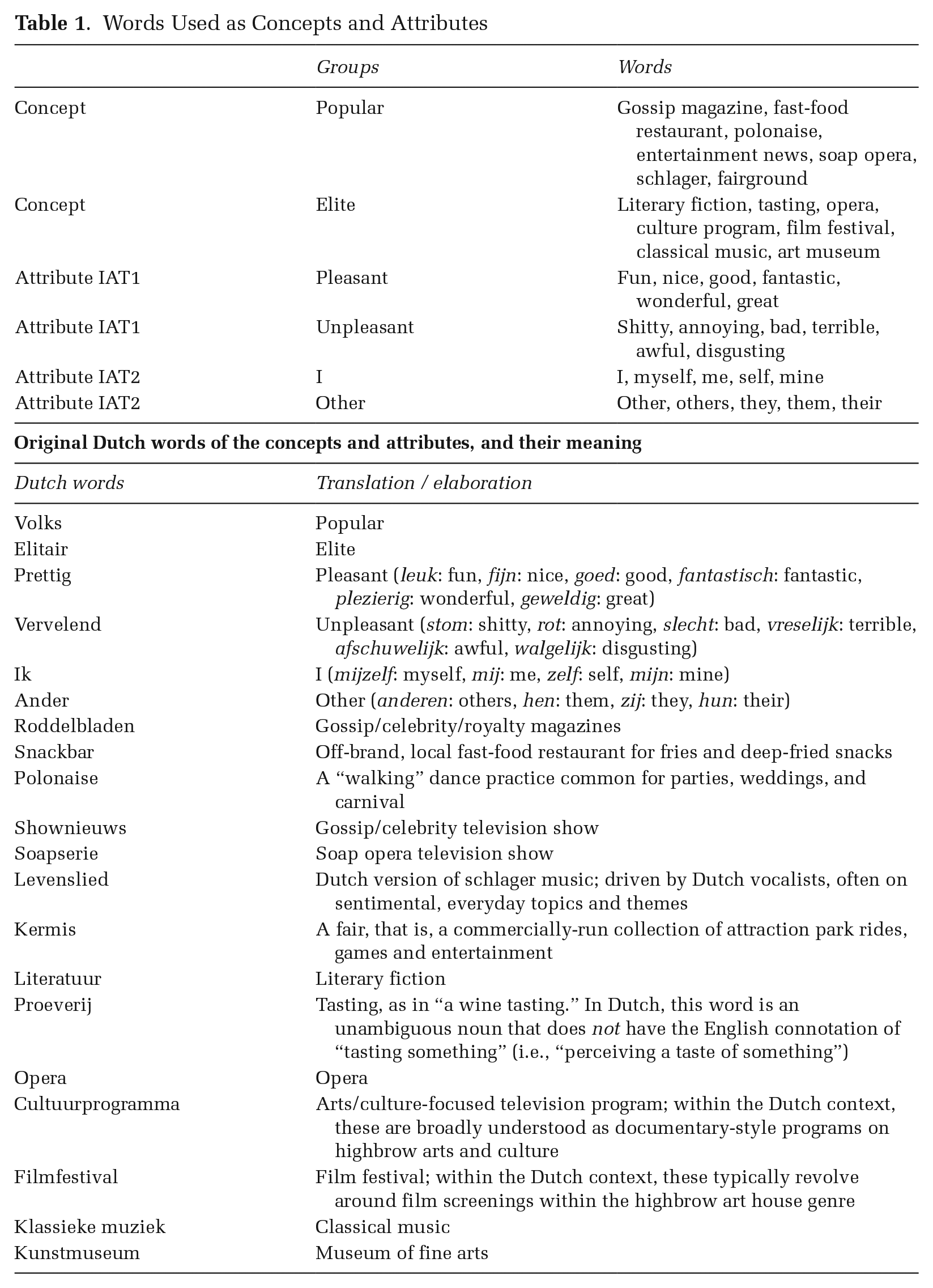
These words enable one to measure non-declarative cultural capital, operationalized more in line with its conceptualization than is typically the case with conventional measures (usually questions on cultural consumption, such as the frequency of visits to art museums, theater performances, classical concerts, operas, and ballets). Indeed, our words cover a much wider range of cultural expression. And unlike visits to art galleries or performances of elite culture, the preferences for and self-identification with elite culture in the domains measured by our IATs are less contaminated by practical considerations (e.g., available time, resources, transportation, distance), social constraints, and constraints related to physical and mental well-being.
We created two IATs that mirror two conventional designs: (1) one in which participants sort words that fit in “pleasant” or “unpleasant” attribute categories (known as an “attitude IAT”); and (2) one in which participants sort words associated with “self” or “other” attributes (a “self-concept IAT”) (Greenwald et al. 2002). Although these two IAT types tend to produce similar results, they measure things that are, at least conceptually, slightly different: the attitude IAT assesses a general positive or negative association with elite or popular culture, whereas the self-concept version measures whether people associate elite or popular culture with themselves or others. Most conceptualizations of non-declarative cultural capital encompass both types of association, so we used both IAT types. Based on extant theorizing on cultural reproduction, we do not expect the two IATs to associate differently with (parental) declarative cultural capital and (parental) socioeconomic position. To avoid overburdening respondents, one of these IATs was assigned randomly to each participant. For the attributes (rows 3 to 6 in Table 1), we used Dutch versions of the words commonly used in attitude (IAT1) and self-concept (IAT2) IATs.
After completing the survey in which the two IATs were embedded, respondents were randomly assigned to one of them. They were informed about the task in advance and given instructions to download and install the Inquisit Web browser plugin that recorded their responses (professional helpdesk support was available if required). Respondents were asked to carefully read the instructions for each block and then sort the words as quickly as possible without making mistakes. After installing the plugin, they were presented a table of words they were expected to sort and instructed to use the “E” and “I” keys on their keyboards to do so.
Within the IAT assigned to them, respondents were randomly given one of two combined task orders, as depicted in Table 2: (1) popular (elite) + pleasant/I (unpleasant/other); or (2) elite (popular) + pleasant/I (unpleasant/other). Previous studies have found the first combined task presented to respondents (blocks 3 and 4) tends to produce stronger implicit associations than the second (blocks 6 and 7) (Nosek, Banaji, and Greenwald 2002). Randomizing the combined task order minimizes this procedural effect (Greenwald, Nosek, and Banaji 2003).
Sequence of Trial Blocks
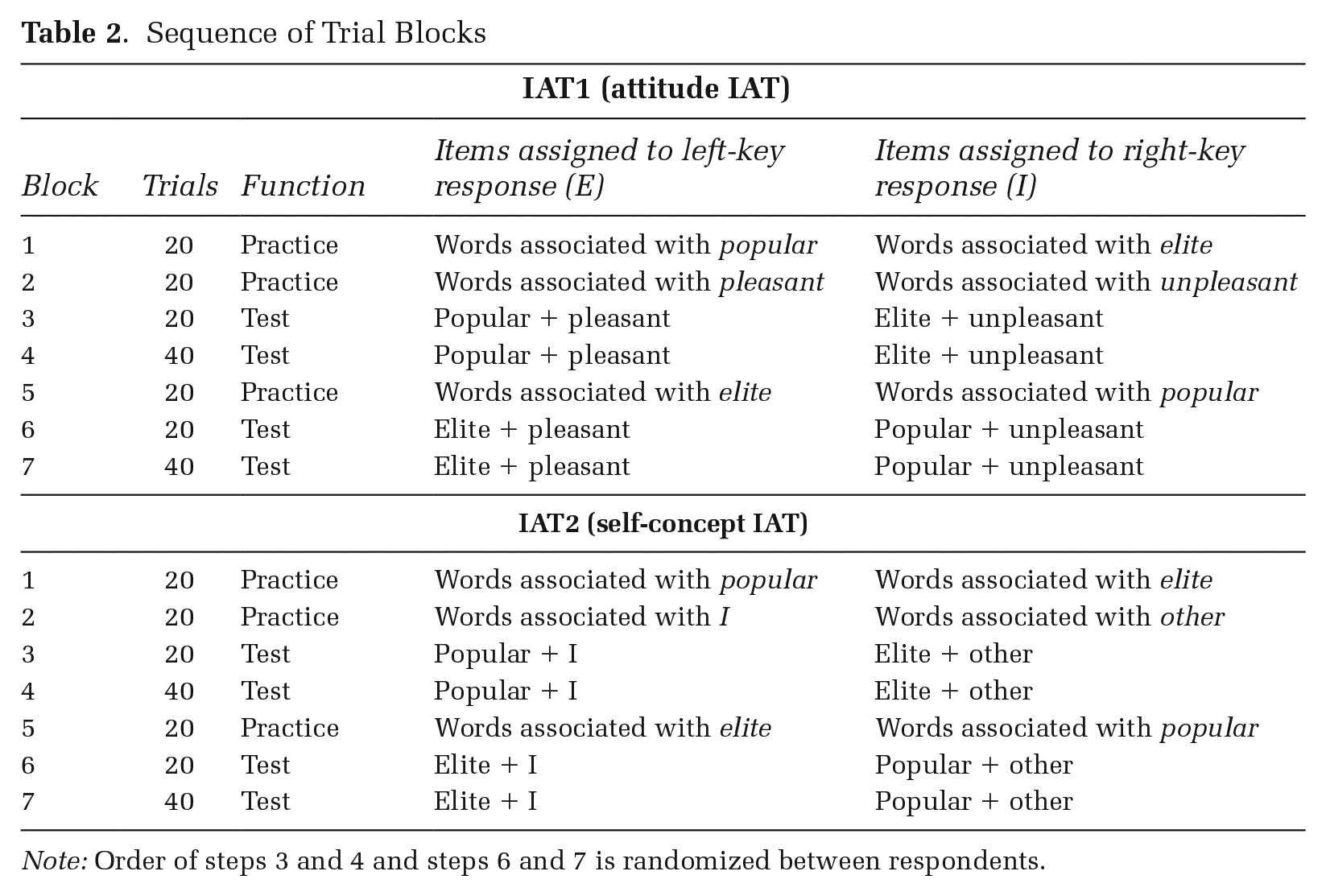
Note: Order of steps 3 and 4 and steps 6 and 7 is randomized between respondents.
Operationalization
We obtained IAT scores, or “D-scores,” via the scoring algorithm developed by Greenwald and colleagues (2003). This scoring algorithm includes the data from blocks 3, 4, 6, and 7 and focuses on the standardized mean difference between the two conditions (often discussed in the IAT literature as the congruent and incongruent conditions). The strength of the association is based on a conservative estimation of conventional Cohen’s d values, with cut-off points of 0.15, 0.35, and 0.65 indicating “slight,” “moderate,” and “strong” associations, respectively (Rudman 2011).
A total of 1,554 respondents completed an IAT: 764 in the group assigned to the attitude IAT (IAT1) and 790 to the self/other version (IAT2). IAT scores by respondents who made mistakes in more than 25 percent of the trials when sorting the words were coded as missing (Greenwald et al. 2003); this reduced the total number to n = 1,420 (n = 700 [IAT1]; n = 720 [IAT2]).
Because the cross-sectional nature of our study does not allow us to assess the test-retest reliability of our IATs, we used the different blocks that respondents completed to gauge their split-half reliability. Specifically, we estimated two D-scores, each based on the difference between two blocks with opposing task orders: a D-score based on blocks 3 and 6 and a D-score based on blocks 4 and 7. We then estimated the correlation between the two D-scores, repeating the analysis 5,000 times by means of bootstrapping to assess the variability of the estimated correlation coefficients in our sample. The results are shown in Figure S1 in the online supplement. The figure shows the correlation between the D-score of blocks 3 and 6, and of blocks 4 and 7, to be 0.78 (95 percent confidence interval: 0.75 – 0.81; n = 700) for IAT1 and 0.71 (95 percent confidence interval: 0.67 – 0.75; n = 720) for IAT2. The strong correlations with limited variation (as shown by the distributions in Figure S1) observed in both IATs speak to the high consistency between the D-scores collected in these different blocks—and support the reliability of our implicit measures.
We measured declarative cultural capital using a reliable scale (Cronbach’s α = 0.73) with three items to measure elite cultural consumption. Inspired by the 2002 survey of the National Endowment for the Arts, these items are among the most often used to measure cultural capital in the cultural reproduction literature (Jæger and Breen 2016). After reading the introduction “Below are listed a number of activities. Indicate how often you do these things,” respondents chose from seven answer categories for each of our three activities in a range from (1) never to (7) more than once a week: “attending a classical concert, opera or ballet performance” (item 1); “visiting a (visual) art museum” (item 2); and “attending a theater performance (excluding musicals)” (item 3).
We performed further analyses to explore expectations about the weak coupling of declarative and non-declarative cultural capital, using an alternative measure for declarative cultural capital that, compared to the conventional measure, is less affected by practical considerations such as time, resources, distance, and health issues. This measure has previously been used in studies of cultural capital (e.g., Noordzij, De Koster, and Van der Waal 2019; Ten Kate, De Koster, and Van der Waal 2017) and consists of one item. After reading “To what extent do you disagree or agree with the following statement?”, respondents read the statement “I consider myself a lover of the arts and culture” and then selected an answer ranging from (1) “completely disagree” to (7) “completely agree.” This alternative measure of declarative cultural capital correlates 0.57 (p < 0.001; n = 2,258) with the conventional measure discussed above. In contrast to the highly skewed distribution of the conventional measure, the alternative measure is quite normally distributed (see Figures S2 and S3 in the online supplement). This means the conventional measure of cultural capital would deem those who do not attend elite cultural events to have limited cultural capital when, in reality, their affinity with elite culture can be high.
We measured parental declarative cultural capital using a reliable three-item scale (Cronbach’s α = 0.84) with the same three items used to measure respondents’ declarative cultural capital. Respondents were asked how often their parent(s) or caregiver(s) engaged in the same three elite cultural activities referred to above. Like the questions on parental education and income (addressed below), these items were included in a set of questions introduced with the following: “The part of the survey that follows focuses on your parent(s) or caregiver(s) when you were between 12 and 14 years of age. If you do not know the precise answer, provide an estimation.”
We also used an alternative measure for parental declarative cultural capital, mirroring the alternative measure for respondents’ declarative cultural capital, to lessen the role of any practical or financial barriers respondents’ parents may have experienced in participating in cultural activities. The alternative measure for parental declarative cultural capital is based on the question “To what extent do you disagree or agree with the following statements? My parent(s) or caregiver(s) . . . were lovers of arts and culture.” The answer categories ranged from (1) completely disagree to (7) completely agree. This alternative way to measure parental declarative cultural capital correlates 0.57 (p < 0.001; n = 2,128) with parental declarative cultural capital as measured through attendance of elite cultural events.
We measured level of education by recoding the six educational categories used in the Netherlands into three categories more familiar to an international audience. For this we used the International Standard Classification of Education (ISCED): (1) low (no education, primary education, secondary education; ISCED 0–2); (2) medium (intermediate vocational education and higher secondary education; ISCED 3–4); and (3) high (higher vocational education and university; ISCED 5–7). We measured parental level of education in the same way as for respondents, and we focused on the highest educated parent.
Household income was based on respondents’ self-reported net monthly household income, recoded into quintiles. Answers by 14 respondents who indicated they had no income were coded as missing, as this is highly unlikely in the context of the Dutch welfare state. We also excluded three others (retirees) who reported improbable, extremely high net monthly incomes of 47,000, 146,652, and 178,677 euros, respectively.
Parental household income was based on a seven-point Likert scale ranging from (1) much lower than average to (7) much higher than average, recoded into three categories: lower than average (scores 1–2), average (scores 3–5), and higher than average (scores 6–7).
To more precisely estimate the association between (parental) socioeconomic position and (non-)declarative cultural capital, we used the following control variables: gender (the respondent [1] is or [0] is not a woman); age in years; non-native (the respondent [1] has or [0] does not have at least one parent born abroad); center (the respondent lives in [1] the center—“Randstad,” that is, the culturally and economically hegemonic provinces—or [0] one of the peripheral regions); dummy variables for marital status ([1] never married, [2] married, [3] divorced or separated, or [4] widowed); having children at home ([0] none or [1] one or more); and urbanity of the respondent’s place of residence (ranging from [1] not urban to [5] very strongly urban). Table S1 in the online supplement provides descriptive statistics for all variables used in the analyses.
Results
Before scrutinizing our expectations, we explore the distribution of IAT scores by respondents’ level of education. Figure 1 shows the distribution of scores from IAT1. Respondents with negative scores have an ingrained preference for popular cultural expressions. Those with positive scores have an ingrained preference for elite cultural expressions, which, according to the Bourdieusian notion of cultural reproduction, has various benefits for navigating educational institutions and higher segments of the labor market.
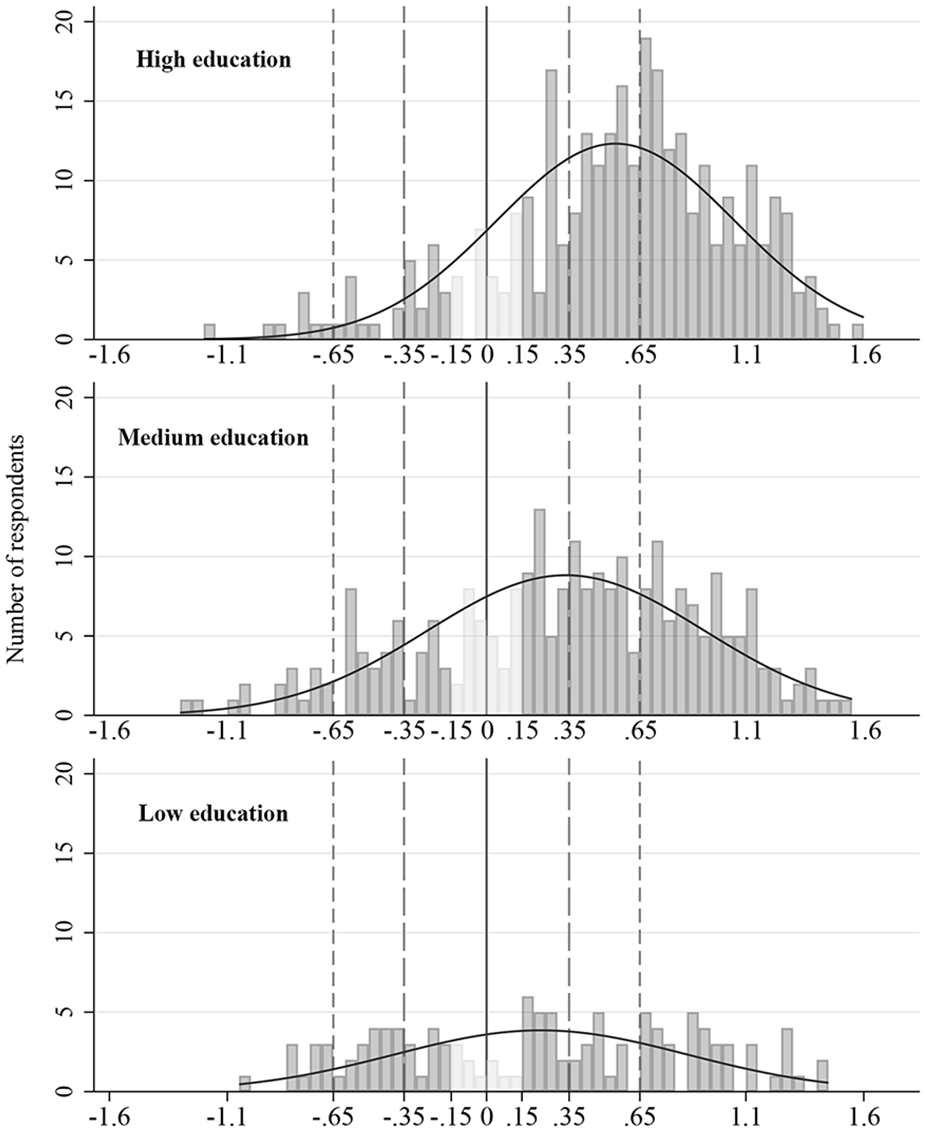
Histogram of IAT1 by Level of Education
Three patterns stand out in relation to IAT1. First, the mean score of 0.41 indicates a moderate to strong positive implicit association with elite culture among the general Dutch population. Most respondents assigned to this IAT (76.1 percent) had a positive implicit association with elite cultural expressions. IAT research conventionally only regards associations stronger than 0.15 as meaningful. For respondents in Figure 1 with scores between –0.15 and 0.15, there is thus no meaningful implicit association between popular or elite cultural expressions and (un)pleasantness. These scores are therefore depicted in Figure 1 as light gray bars. Nevertheless, the skewed ingrained preference for elite culture indicates the hegemonic nature of this taste pattern and the cultural dominance of the institutions in which it is inculcated.
Second, in line with the central tenets of Bourdieusian class analysis, there is substantial stratification of the scores in IAT1, that is, respondents with higher levels of education displayed stronger positive implicit associations with elite culture: the mean scores for the less-, medium-, and more-educated respondents were, respectively, 0.23 (i.e., slight to moderate), 0.34 (i.e., moderate), and 0.55 (i.e., moderate to strong). Even more tellingly, 43.3, 52.9, and 69.9 percent of these respondents had moderate or strong positive implicit associations (i.e.,
Third, the distribution of scores in IAT1 is substantially more dispersed among less- and medium-educated respondents than among their more-educated counterparts, with interquartile ranges of 1.04, 0.84, and 0.62 for the less-, medium-, and more-educated respondents, respectively. In other words, the more-educated group is more homogenous in its ingrained taste patterns than the less- and medium-educated groups. In line with Bourdieusian theorizing, this can be understood as resulting from the different life-worlds in which these educational groups have been socialized. The greater similarity among the more-educated respondents probably arises from their—and by extension, their parents’—prolonged socialization in institutional settings such as higher education and professional occupations, where an appreciation of elite culture is the norm.
Figure 2 depicts scores for IAT2, which measured whether respondents implicitly associate themselves with elite or popular culture. The mean score was 0.00, with 46.5 percent of respondents having a negative score and 53.5 percent a positive one. Narrowing it down to respondents with moderate or strong scores, 23.8 percent had a negative score and 26.0 percent a positive one. Respondents with negative scores implicitly associated popular culture with themselves and elite culture with others; the reverse was the case for those with positive scores. These patterns indicate that the implicit self/other identification with popular or elite culture is distributed quite evenly across the Dutch population, which clearly differs from the skewed positive implicit associations with elite culture shown in Figure 1 for IAT1. In other words, having an ingrained appreciation of elite culture—for which we found ample evidence in IAT1—does not automatically translate into self-identifying with a group with ample cultural capital, as the results from IAT2 indicate. Instead, part of the population with internalized hegemonic cultural preferences seems to feel socially distant from the people they associate with elite culture. Following Bourdieusian theorizing, we assume this reflects self-exclusion and low feelings of entitlement among respondents who have modest positive implicit associations with elite culture and look up to people in milieus with higher levels of cultural capital. Unfortunately, the structure of our data—different subsets of respondents for each of the two IATs—does not allow us to explore this empirically.
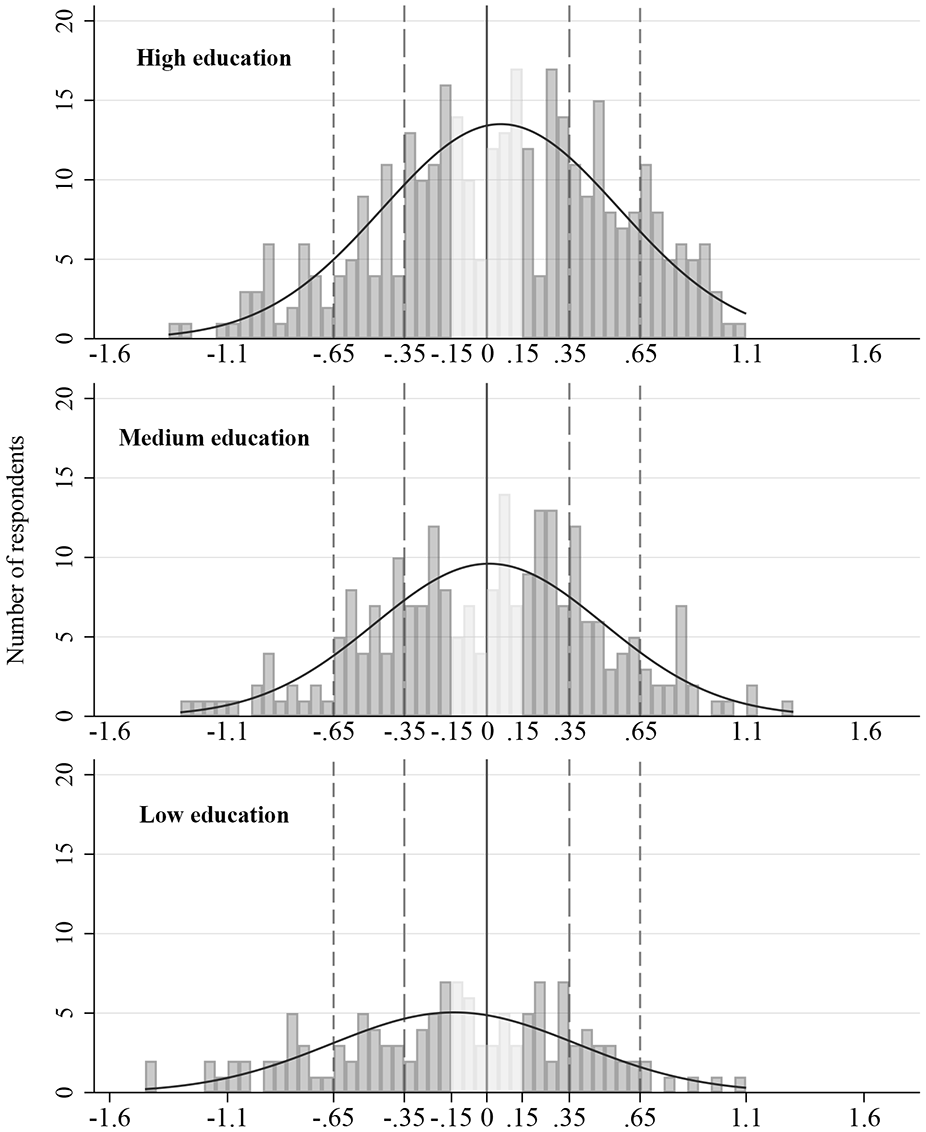
Histogram of IAT2 by Level of Education
The dissimilarity with IAT1 was also notable in the distribution of the IAT2 scores per educational group. There was almost no difference between more- and medium-educated respondents, both with a mean score close to zero. Still, 23.9 percent (24.4 percent) of respondents educated to a medium level implicitly associated themselves with popular (elite) culture, which held for 20.0 percent (30.6 percent) of more-educated respondents (counting only moderate and high scores). Less-educated respondents tended to associate themselves with popular culture (moderate or high self-identification with popular and elite culture of 32.6 and 17.4 percent, respectively). We assume—and Bourdieusian class analysis implies—this is because low feelings of entitlement among less-educated individuals who have positive implicit associations with elite culture (IAT1) inhibit them when it comes to self-identifying with elite culture (IAT2). Again, we cannot test this empirically because the two IATs were completed by different sets of respondents.
Turning to our expectations, we first assess how our IATs associate with (parental) declarative cultural capital. As expected, both IAT1 and IAT2 were weak to moderately correlated with the standard measure of declarative cultural capital (self-reported affinity with elite culture, evaluated using attendance at a limited set of elite cultural events): r = 0.26 (IAT1 p < 0.001; n = 700) and r = 0.20 (IAT2 p < 0.001; n = 720); as well as parental declarative cultural capital (respondents’ reporting of their parents’ or caregivers’ affinity with elite culture, also measured using attendances at a limited set of elite cultural events): r = 0.13 (IAT1 p < 0.001; n = 678) and r = 0.09 (IAT2 p < 0.022; n = 696). This aligns with the idea of a weak coupling between declarative and non-declarative cultural capital due to the different ways they are acquired (Lizardo 2017).
The correlations of the IATs with the alternative measure for declarative cultural capital (untainted by practical constraints impeding attendance at elite cultural events) are also low to moderate. IAT1 and IAT2 are correlated with the item asking whether respondents considered themselves lovers of arts and culture as follows: r = 0.35 (IAT1 p < 0.001; n = 700) and r = 0.22 (IAT2 p < 0.001; n = 720). They are correlated weakly with the item asking whether respondents considered their parents to be lovers of arts and culture: r = 0.16 (IAT1 p < 0.001; n = 680) and r = 0.18 (IAT2 p < 0.001; n = 694). To further ascertain that the correlation between our measures for declarative and non-declarative cultural capital is indeed low to moderate, we calculated the variability of the correlations listed above. We did so by bootstrapping the correlations between IAT1 or IAT2 and the standard or alternative measures of declarative cultural capital using 5,000 replications. Figures S4 to S7 in the online supplement show the results. For both IAT1 and IAT2, the upper bounds of the 95 percent confidence intervals are in line with the interpretation of low to moderate correlations between non-declarative and declarative cultural capital.
To further assess the robustness of this finding, we used an alternative way to estimate these correlations. Our list of words denoting cultural activities to categorize in the IATs differs in two ways from the cultural activities included in the conventional survey measure: (1) our list includes both popular and elite activities, and (2) it includes more activities. The former is required by design and therefore unavoidable. However, it is possible to calculate IAT scores based on a subset of the activities included in the IAT. We did so by pairing three elite cultural activities included in conventional cultural capital survey measures—opera, classical music, and art museum—with three popular cultural activities that best represent their opposites, given the available options—polonaise, schlager, and the fairground, respectively. This resulted in alternative IAT scores that mirror the conventional cultural capital survey measure as much as possible without violating the methodological underpinning of the IAT. These alternative IAT scores correlate in a very similar way to the standard measure of declarative cultural capital as the original IAT1 and IAT2 scores: r = 0.25 (IAT1 p < 0.001; n = 684) and r = 0.18 (IAT2 p < 0.001; n = 697). Their correlation with parental declarative cultural capital also strongly mirrors how the original IAT1 and IAT2 scores correlate to parental declarative cultural capital: r = 0.12 (IAT1 p = 0.002; n = 662) and r = 0.09 (IAT2 p = 0.024; n = 674).
Next, we explore how our IATs associate with parental declarative cultural capital and (parental) income and level of education, simultaneously modeled with a set of control variables in regression analyses. Table 3 outlines three sets of analyses in which we regress IAT1 (Models 1a and 2a), IAT2 (Models 1b and 2b), and declarative cultural capital (Models 1c and 2c) on (1) parental declarative cultural capital, level of education, and income; and (2) respondents’ level of education and income.
The Link between Socioeconomic Status and (Non-)declarative Cultural Capital
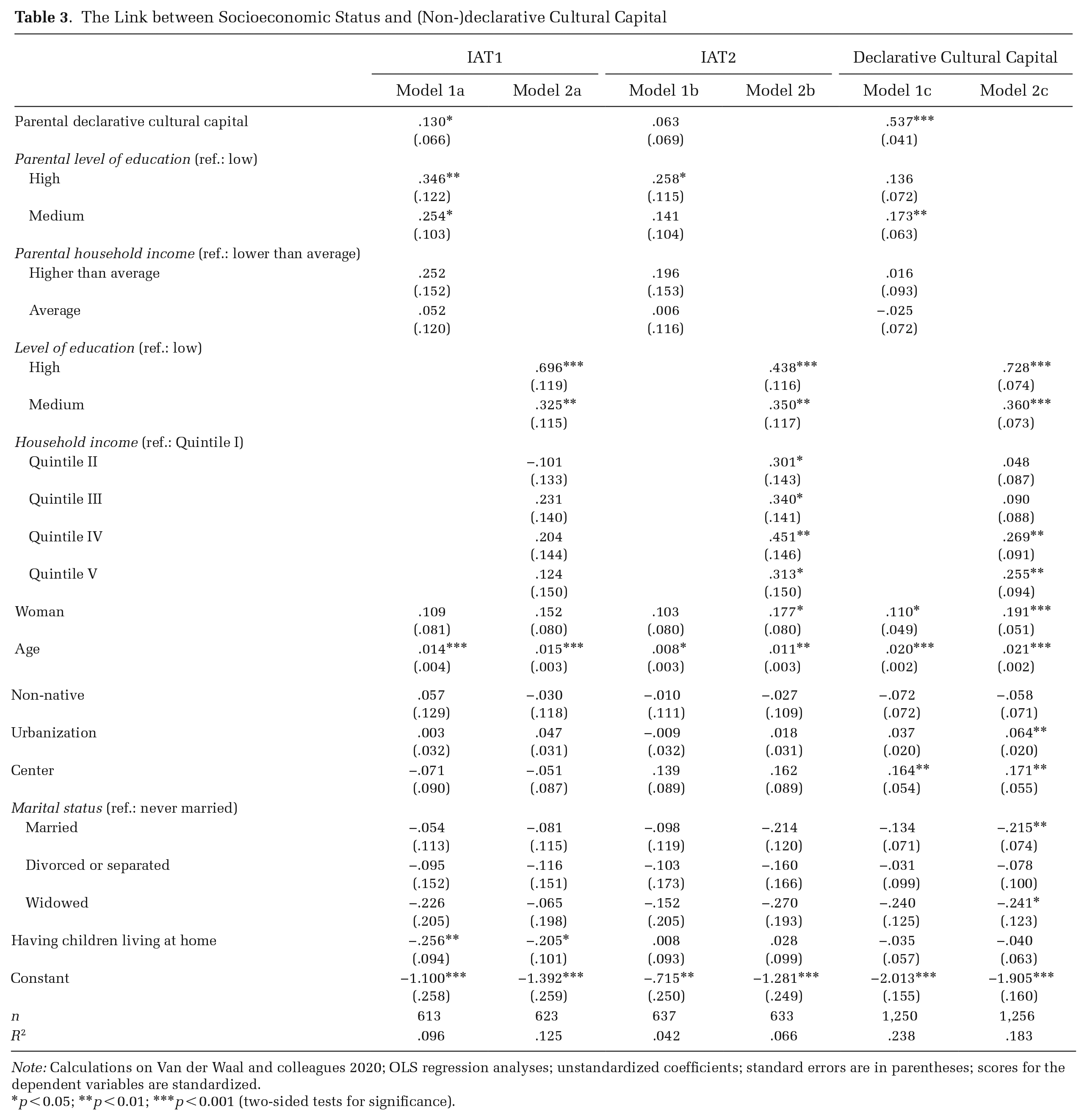
Note: Calculations on Van der Waal and colleagues 2020; OLS regression analyses; unstandardized coefficients; standard errors are in parentheses; scores for the dependent variables are standardized.
p < 0.05; **p < 0.01; ***p < 0.001 (two-sided tests for significance).
As expected, parental declarative cultural capital is more strongly positively associated with respondents’ declarative cultural capital than with respondents’ non-declarative cultural capital. We expected this given the assumed weak coupling between the two types of cultural capital. Statistical tests corroborate that the coefficient of parental declarative cultural capital in the regression analysis on declarative cultural capital (Model 1c) is stronger than its coefficient in the regression analyses on IAT1 (p < 0.001; Model 1a) and IAT2 (p < 0.001; Model 1b).
Turning to our expectations regarding non-declarative cultural capital’s association with parental socioeconomic position, we see that both IATs associate with parental level of education but not with parental income. The scores of IAT1 are more gradually associated with parental level of education, and those of IAT2 are especially high for respondents with parents who completed tertiary education. In both cases, the association with parental level of education seems more convincing than for declarative cultural capital, which is highest among respondents whose parents are medium-educated. However, formal statistical comparison of the regression coefficients of parental level of education across models indicates that none of these coefficients are statistically significantly different at the 5-percent level.
Models 2a to 2c in Table 3 roughly replicate the findings of the histograms for IAT1 and IAT2 as well as the outcomes obtained by the conventional measure of declarative cultural capital used in previous research: they are all, rather gradually, stratified by level of education. In addition, IAT2 and declarative cultural capital are stratified by income. The latter is especially noticeable among the two most affluent quintiles, whereas the scores of IAT2 only seem to differ between the poorest quintile and the rest.
Finally, a robustness check (see Table S2 in the online supplement) shows that the outcomes of the regression analyses on the conventional measure were not affected by the introduction of COVID-19 restrictions during the period of data collection. The effects of (parental) income and level of education did not differ between respondents who completed our survey before or after lockdown measures were imposed.
Conclusions and Discussion
Although widely assumed to be important in the everyday (re)production of inequality, non-declarative cultural capital has thus far escaped empirical scrutiny (cf. DiMaggio 1979; Lizardo 2004; Schaap et al. 2019). To address this lacuna in Bourdieu-inspired stratification research, we developed a measure that can be embedded within surveys conventionally used to uncover the role of cultural capital in (re)producing inequality. Our aim was to add to other recent improvements in the field. Alongside the stricter assessment of mechanisms and claims of causality in cultural reproduction (e.g., Jæger and Karlson 2018; Jæger and Møllegaard 2017), our study shows it is possible to empirically include non-declarative cultural capital in statistical analyses. Our research thus answers DiMaggio’s (1997) call to engage the study of culture and cognition—a call repeated by Cerulo, Leschziner, and Shepherd (2021) and Guhin, Calarco, and Miller-Idriss (2021).
Informed by the sociological scholarship on dual-process models and automatic cognition (Miles et al. 2019; Vaisey 2009), we developed two IATs that measure implicit associations with elite culture: IAT1 (positive/negative associations with elite/popular cultural expressions) and IAT2 (self/other-identification with elite/popular cultural expressions). Operationally, these mirror conventional measures of declarative cultural capital, with survey items inquiring about cultural consumption. But our new measures encompass a substantially wider range of both elite and popular cultural expression. The IATs show that Dutch respondents can quite easily and consistently sort all concepts as either popular or elite, indicating their validity in measuring non-declarative cultural capital. The strong similarities in the results of the different test blocks further suggest the IATs are reliable.
By embedding the IATs in a high-quality panel representative of the Dutch population, we were able to explore three expectations: (1) declarative and non-declarative cultural capital are weakly coupled; (2) non-declarative cultural capital is positively associated with parental socioeconomic position; and (3) non-declarative cultural capital is positively associated with respondents’ socioeconomic position. For the latter two expectations, theorizing on cultural reproduction suggests non-declarative cultural capital will be most noticeable among the highest strata.
Regarding the first expectation, the low to moderate correlations between our measures of non-declarative cultural capital and conventional measures of declarative cultural capital indicate the two are weakly coupled. This was expected due to their allegedly separate enculturation pathways (Lizardo 2017), and our study is the first to establish it empirically. This means extant cultural reproduction research (for an overview, see Jæger and Breen 2016) has incompletely modeled cultural reproduction by solely relying on measures of declarative cultural capital. The weak coupling of declarative and non-declarative cultural capital demonstrated here means that associations of measures of the former with variables of interest have often been interpreted incorrectly in studies of cultural reproduction. In many cases, researchers wrongly assumed that measures of declarative cultural capital also captured non-declarative cultural capital. As seen in the theoretical section, scholars have often invoked the non-declarative aspect of cultural capital in studies that only include declarative cultural capital in their empirical models. Given the lack of a survey measure for non-declarative cultural capital, this has been standard research practice, as pioneered in the pages of this journal over 40 years ago (DiMaggio 1982).
The weak coupling of the two aspects of cultural capital indicates they need to be modeled simultaneously to empirically assess the role of each in cultural reproduction and other stratified patterns. Extant stratification research has thus far only captured associations with the former; our IATs allow us to simultaneously examine the role of the latter. The simultaneous modeling of declarative and non-declarative cultural capital is also necessary because they are assumed to contribute to stratified patterns in different ways. For instance, displaying declarative cultural capital can inspire favorable treatment by gatekeepers in education and the high-end of the labor market (Rivera and Tilcsik 2016), whereas non-declarative cultural capital seems more relevant for interacting with those gatekeepers with ease and confidence (Friedman and Laurison 2019). This latter mechanism mirrors that of stereotype threat, where feelings of cultural subordination hamper women (Correll 2004) and people of color (Zhou and Pan 2023) in successfully navigating institutions in the United States. The influence of such feelings on members of the lower classes could be assessed more thoroughly by including measures of non-declarative cultural capital.
Our measures for non-declarative cultural capital could also enrich the study of stratified patterns in other institutional domains, such as in politics and health, where associations have been found between declarative cultural capital and variables of interest such as political trust and body weight (e.g., Noordzij et al. 2019; Pampel 2012). The sense of ease that accompanies non-declarative cultural capital can optimize patient–professional interactions (Shim 2010), which in turn are beneficial for one’s physical (Oude Groeniger et al. 2020) and mental (Ten Kate et al. 2017) health. In the political domain, less-educated citizens’ non-declarative affinity with popular culture may contribute to feelings of misrecognition that, for example, underlie their support for populist politicians and parties (Laurison 2016; Noordzij, De Koster, and Van der Waal 2021). The study of stratified patterns in political attitudes and behaviors and health-related outcomes would thus also benefit from simultaneously modeling declarative and non-declarative cultural capital.
Turning to our findings on the association of non-declarative cultural capital with (parental) socioeconomic position, our analyses revealed three patterns relevant for debates on cultural reproduction and beyond. First, seminal theorizing on cultural reproduction emphasizes the crucial role of childhood socialization in the higher strata for amassing non-declarative cultural capital (Bourdieu 1977, 1984). Yet, our analyses instead point to the importance of socialization at a later age, as non-declarative cultural capital is more convincingly associated with the socioeconomic position of respondents than that of their parents. This needs to be interpreted with care, as we measured non-declarative cultural capital among adult respondents. Future research could administer IATs measuring non-declarative cultural capital among children (which is possible; for an overview, see Nosek, Banaji, and Greenwald 2007) and link their scores to their parents’ socioeconomic position to study the role of classed intergenerational socialization patterns in the amassing of non-declarative cultural capital. These IAT scores could also be used to assess the assumed favorable treatment of children with high levels of non-declarative cultural capital by gatekeepers in education—a crucial element in cultural reproduction theorizing. As for the association between respondents’ level of education and their non-declarative cultural capital, the cross-sectional nature of our data does not allow us to empirically pinpoint causal direction. It likely goes both ways and this could be determined by future longitudinal research.
Second, (parental) education associates more convincingly with both measures of non-declarative cultural capital than does (parental) income, reflecting earlier findings on the stratified nature of declarative cultural capital in the Netherlands (Van der Waal and De Koster 2015) and the United States (Lizardo 2016). Whereas theorizing on cultural reproduction assumes that non-declarative cultural capital is especially distinctive among the tertiary educated and individuals with the highest incomes, our analyses suggest it more gradually relates to (parental) level of education and is not distinctive for the richest quintiles. The Dutch public education system might contribute to this finding. Recent signs of declining quality and increasing social segregation in primary and secondary schools (Inspectie van het Onderwijs 2023) notwithstanding, its quality was high by international standards in the preceding less-segregated decades when most of our respondents attended school (Antenbrink et al. 2005). Future research could examine whether non-declarative cultural capital is more distinctive for the higher strata in countries with less inclusive and less egalitarian educational systems, such as the United States.
Third, as cultural reproduction theorizing refers to both positive association and self-identification with elite culture as aspects of cultural capital (Bourdieu 1977, 1984, 1990), we fielded both an attitude and a self-concept IAT. Based on extant theorizing, we had no reason to assume they would perform differently in our analyses. Yet, we found relevant differences, most notably in how they are distributed among the population at large. The attitude IAT revealed a moderate to strong implicit positive association with elite culture among the overall Dutch population. This is broadly in line with findings of well-known IATs concerning other stratification axes like race and gender, where most respondents display a strong positive association with Whiteness and masculinity, consistent with prevalent hegemonic ethno-racial/gender beliefs (Nosek et al. 2002). But among the Dutch public, scores of the self-concept IAT are distributed normally around a mean of zero.
This unexpected difference between an implicit positive association and implicit self-identification with elite culture suggests future research should model them simultaneously to explore how each contributes to cultural reproduction and to the stratified patterns in health-related outcomes and political attitudes and behavior mentioned above. We were unable to do so because time constraints did not allow us to administer two IATs and a substantial number of survey questions to all respondents. When it comes to their contribution to the mechanisms assumed to be in play in cultural reproduction (e.g., exclusion by gatekeepers and self-exclusion due to feeling uneasy in elite settings), both implicit positive association and self-identification with elite culture likely contribute to stratified patterns in attitudes and behavior, as they can affect the ease with which citizens interact with, for instance, doctors and politicians.
Comparing the distribution of the two IATs among the Dutch population indicates that some people who view elite culture positively nevertheless feel distant from it. That they acknowledge its high status while feeling it is not for them suggests that some people with modest positive implicit associations with elite culture have low feelings of entitlement, which would likely undermine their sense of ease in elite settings, leading to self-exclusion. How implicit positive association and implicit self-identification with popular/elite culture combine to generate stratified patterns is an empirical question for future research.
The operationalization of our measures for non-declarative cultural capital speaks to previous and future research on cultural reproduction and cultural capital’s corollaries. In addition to measuring a non-declarative affinity with elite culture, our measures differ from the conventional measure of declarative cultural capital in three ways: (1) our measures encompass a broader range of elite and popular cultural expressions; (2) their scores are untainted by practical constraints on attending cultural events, such as lack of financial means and time or poor health; and (3) the scores are normally distributed rather than highly skewed because only a limited subset of people attend elite cultural events. We are confident that the validity of conventional cultural capital measures will improve when this is considered; the alternative measure of declarative cultural capital used in our analyses—the extent to which respondents consider themselves, and their parents, as lovers of arts and culture—strongly suggests this. Our alternative measure is untainted by practical constraints, which we assume underlies its more normal distribution.
The validity issues of the conventional measure for declarative cultural capital we addressed above likely affected extant findings on cultural reproduction and the corollaries of cultural capital that rely on this measure. Future research should examine this systematically. Future research could also complement our measure of non-declarative cultural capital with versions focusing on other (emerging) dimensions of cultural capital, for example, classed parenting styles (Lareau 2011) or moral traits (Lamont 1992, 2000).
The inclusion of popular cultural expressions—unavoidable given the set-up of our IATs—may have affected the IAT scores of “cultural omnivores,” that is, people who consume both popular and elite culture (Friedman and Reeves 2020). However, not all expressions of popular culture are valued by cultural omnivores to the same extent, and some are valued from a camp or ironic perspective (McCoy and Scarborough 2014; Peters, Van Eijck, and Michael 2018). Future research could examine whether the IAT scores of cultural omnivores, who are usually from higher strata, underestimate their non-declarative cultural capital. Should this be the case, it would mean that non-declarative cultural capital is more stratified than our research suggests.
Finally, future studies could develop a valid tool for conducting cross-cultural comparisons of non-declarative cultural capital. The fact that popular cultural expressions are generally more context-specific than their elite counterparts (Weenink 2008) may make this challenging. Nevertheless, such a tool would enable researchers to examine, for instance, whether non-declarative cultural capital is more stratified by class in countries with less extensive systems of public schooling and broadcasting than the Netherlands.
It is important to address the limitations of the study’s data, in addition to its cross-sectional nature and the separate random subsets of individuals who completed IAT1 or IAT2 already discussed. First, scholars have argued that the scores obtained with extant IATs have only modest temporal stability, which likely underlies their relatively low test–retest reliability (Gawronski et al. 2020; Gawronski et al. 2017). Future research should assess this for the IATs developed here. Our assessment of their split-half reliability suggests they do not suffer from excessive measurement error. Second, after answering the survey questions, the software we used required respondents to download and install a plugin before they could complete the IAT. Although professional helpdesk support was available, this likely contributed to participant attrition. Fortunately, future research will benefit from the fact that survey software decreasingly has such a requirement. Third, comparison of the full sample and the IAT subsets revealed that, after completing the survey, especially less-educated respondents did not proceed to take the IAT. These individuals likely have little affinity with elite culture. If so, the share of individuals in the lower strata with an implicit preference for popular culture would be higher than what was captured in our study. Consequently, the exclusionary practices associated with that preference would be more salient than our findings suggest, at least in the Dutch case.
In summary, by embedding IATs that measure implicit associations with elite culture in a population-based survey, we have developed a valid methodological tool for including non-declarative cultural capital in empirical studies of cultural reproduction and its corollaries. Use of this tool liberates non-declarative cultural capital from its deus ex machina status (DiMaggio 1979; Lizardo 2004) and thus allows researchers to avoid the black-box critique (Boudon 1998; Vaisey 2009) leveled against studies that invoke the Bourdieusian habitus as an explanation for various socially stratified patterns across a wide range of fields.
Supplemental Material
sj-pdf-1-asr-10.1177_00031224241261603 – Supplemental material for Advancing Stratification Research by Measuring Non-declarative Cultural Capital: A National Population-Based Study Combining IAT and Survey Data
Supplemental material, sj-pdf-1-asr-10.1177_00031224241261603 for Advancing Stratification Research by Measuring Non-declarative Cultural Capital: A National Population-Based Study Combining IAT and Survey Data by Jeroen van der Waal, Willem de Koster, Tim van Meurs, Kjell Noordzij, Joost Oude Groeniger and Julian Schaap in American Sociological Review
Footnotes
Acknowledgements
The authors would like to sincerely thank the editors and anonymous reviewers for their constructive in-depth feedback, which was of great help in improving their work. In addition, they would like to thank the participants in a Hot Politics Lab meeting for their feedback, and Takeo-David Hymans and Mara Nelson Grynaviski for polishing their text.
Funding
This study was funded by Vidi grants awarded to the first and second author by the Nederlandse Organisatie voor Wetenschappelijk Onderzoek (NWO) [grant numbers 452-17-009 and 016.vidi.185.207].
ORCID iDs
Data Note
Our research data will become freely available for scientific purposes from the LISS Data Archive repository, which has the international CoreTrustSeal certification. Replication files can be accessed via the online supplement.
 .
.
.
.
References
Supplementary Material
Please find the following supplemental material available below.
For Open Access articles published under a Creative Commons License, all supplemental material carries the same license as the article it is associated with.
For non-Open Access articles published, all supplemental material carries a non-exclusive license, and permission requests for re-use of supplemental material or any part of supplemental material shall be sent directly to the copyright owner as specified in the copyright notice associated with the article.
