




Abstract
Many studies invoke the concept of the Bourdieusian habitus to account for a plethora of stratified patterns uncovered by conventional social-scientific methods. However, as a stratum-specific, embodied and largely non-declarative set of dispositions, the role of the habitus in those stratified patterns is typically not adequately scrutinised empirically. Instead, the habitus is often attributed theoretically to an empirically established link between stratification indicators and an outcome of interest. In this research note, we argue that combining conventional methods in stratification research with latency-based measures such as the Implicit Association Test enables better measurement of the habitus. This sociological application of Implicit Association Tests enables researchers to: (1) identify empirically the existence of different habitus among different social strata; and (2) determine their role in the stratified patterns to which they have thus far been attributed theoretically.
Introduction
The habitus plays a pivotal role in research inspired by Bourdieu. It is commonly defined as ‘systems of durable, transposable dispositions’ (Bourdieu, 1990: 53), resulting in ‘the internalized form of class condition and the conditioning it entails’ (Bourdieu, 1984: 101). It is often invoked as an explanatory tool to account for differences based on class (e.g. Bourdieu, 1984; Oliver and O’Reilly, 2010) and other types of stratification, such as gender (e.g. McNay, 1999) and race/ethnicity (e.g. Bonilla-Silva et al., 2006). Nevertheless, it mainly serves as a post-facto explanation (cf. DiMaggio, 1979; Lizardo, 2004): it is attributed to stratified patterns, but its role in shaping them has thus far largely escaped empirical scrutiny.
In this research note, we focus on the role of the habitus in cultural class analysis (Savage et al., 2015). Cultural class analysis is very promising for understanding contemporary inequalities, and we argue it could be further improved by incorporating a method originated in psychology – Implicit Association Tests (IATs) – that enables the systematic empirical scrutiny of: (1) the existence of different habitus among different social strata; and (2) their role in a wide range of stratified patterns that have previously been uncovered by research using conventional social-scientific methods. We do this by focusing on an illustrative example of a prominent stratified phenomenon in contemporary western societies: obesity.
We hope to inspire future stratification research that measures the non-declarative components of the habitus. This would yield a more fruitful application of the rich Bourdieusian theoretical apparatus for stratification research and beyond, and can consequently contribute to a more thorough understanding of contemporary inequalities.
The Relevance of the Habitus
The Bourdieusian habitus (Bourdieu, 1977, 1990) features prominently in sociological research, despite criticism that it is a theoretical deus ex machina (DiMaggio, 1979; Lizardo, 2004). Fundamental in the habitus is the existence of a supposed ‘correspondence between social structures and mental structures, between the objective divisions of the social world […] and the principles of vision and division that agents apply to it’ (Bourdieu, 1996: 1). This idea takes centre stage in Bourdieu’s development of his social praxeology, in which objective structures and habitualised dispositions are studied in relation to each other (Bourdieu and Wacquant, 1992: 7–11). Social structures, in other words, become embodied in the shape of habitualised dispositions that become, at least partly, ‘hard-wired’ in cognitive structures, in short: the habitus. An individual’s everyday choices and actions are guided by this modus operandi, ‘of which he or she is not the producer and has no conscious mastery’ (Bourdieu, 1977: 79) – at least to a large extent.
The habitus plays a pivotal role in Bourdieusian theorising and the cultural class analyses it inspires. The social conditions of various strata instil both declarative and pre-discursive, non-declarative repertoires – that together constitute the habitus – which are vital for understanding exclusion from or inclusion in privileged locations (Lizardo, 2017). These repertoires are often held responsible for a wide range of problems especially found among the lower strata, such as unhealthy behaviours, physical aggression and disengagement from formal institutions like education and politics. Given the importance of its non-declarative aspects, the habitus has been conceptualised as ‘class unconsciousness’ (Bourdieu, 1977: 78), and is considered to be essential to understanding how strata reproduce inter-generationally, and why lower strata more often demonstrate preferences and behaviour perceived as ‘problematic’ or ‘dysfunctional’. Nevertheless, a crucial aspect of the ‘habitus is assumed or appropriated rather than “put into practice” in research accounts’ (Reay, 2004: 440). This is unsurprising, as conventional sociological methods are unable to directly measure non-declarative elements of the habitus empirically.
Conventional methods rely heavily on self-reporting, exclusively tapping into declarative cognition rather than practical, automatic sense. Consequently, they cannot accurately excavate the non-declarative elements central to the habitus. It may be that what researchers capture with surveys and interviews are declarative components or the consequences of the habitus (e.g. levels of familiarity, knowledge, cultural capital), only allowing a by-proxy, post-hoc interpretation of its role. Ethnographic studies focusing on verbal and non-verbal interactions arguably grasp the visible properties of embodied practical sense, yet are largely determined by researchers’ interpretations and decisions on which observed behaviour is declarative and which is non-declarative and habitual. While surveys, interviews and ethnographies have produced many theoretical and empirical insights pertaining to stratification, we argue that the field can be taken a step forward by including a direct measure of the non-declarative components of the habitus. This can be achieved by a sociological application of latency measures developed in psychology, such as the IAT (Greenwald et al., 1998). 1
The Implicit Association Test
The non-declarative ‘things that go without saying’ or the ‘innate pattern-recognition abilities’ (Bourdieu, 1977: 88) that are a key characteristic of the habitus are precisely the ‘blind spots’ (Banaji and Greenwald, 2013) that IATs can make visible – however briefly, partially and context-dependent (Greenwald et al., 1998). The IAT measures non-declarative cognitive schemas (‘implicit attitudes’ or ‘associations’). 2 Its main objectives were to shed light on the relative implicitness of everyday associations and preferences, and to circumvent social desirability in declarative self-reports (surveys, interviews). It measures respondents’ reaction times (latency) when sorting concepts (e.g. people, items) and attributes (e.g. pleasant versus unpleasant words). 3 IATs have proliferated in various fields (see Payne and Gawronski, 2010) and reached large audiences (e.g. Kahneman, 2011). Nevertheless, sociological applications remain surprisingly scarce (cf. Lamont et al., 2017).
The IAT’s basis is that when aspects are closely associated through repeated exposure (as in processes of socialisation), they activate each other. Building on this, the IAT calculates the difference in time it takes respondents to combine concepts and attributes they perceive as ‘congruent’, and the time it takes them to combine concepts and attributes they perceive as ‘incongruent’. A congruent task is typically completed (substantially) faster by a respondent than an incongruent task, and fewer mistakes are made. The overall difference in the time needed to perform congruent and incongruent tasks, measured in milliseconds, reveals the existence and strength of implicit associations between concepts and attributes.
While welcomed as a potential game changer, IATs have been criticised as being unable to live up to their promise of predicting behaviour (see Forscher et al., 2016). Furthermore, there has been considerable discussion about the IAT’s validity (e.g. Blanton et al., 2007), even though it continues to surpass comparable measures regarding internal validity (Lamont et al., 2017), and has good internal reliability (Lane et al., 2007). Unfortunately, however, these disagreements have led researchers to bypass the IAT – ‘throwing out the baby with the bath water’ (Carlsson and Agerström, 2016: 286).
Although IATs might not be as widely applicable as once hoped, they promise to be well suited for a specific purpose as demonstrated by discussions on implicit associations and ethno-racial discrimination (Oswald et al., 2013). In psychology, they have been particularly useful in overcoming social desirability (see Hofmann et al., 2005). Studies have demonstrated that IAT-survey combinations are sensitive to group-specific differences in shared implicit associations. Ample studies reveal significant differences in IAT results between groups based on background characteristics such as race-ethnicity (Devos and Banaji, 2005), gender (Rudman and Goodwin, 2004), body size (Schwartz et al., 2006) and consumption patterns (Swanson et al., 2001). A more fine-grained illustration is provided by Johann and Thomas (2018), who establish that, overall, Austrian citizens associate immigrants with a need for support, but that background characteristics (e.g. education, religiosity, regional location) influence the depth and even direction (positive/negative) of this association. These applications demonstrate that IATs could serve as a fruitful tool – in combination with conventional measures directed at gauging its declarative aspects – for assessing the habitus empirically.
Below, we outline how incorporating IATs in sociological research enables the empirical scrutiny of the habitus’ non-declarative components, using the well-established stratified obesity pattern as an example. While IATs could also be combined with qualitative methods, our example focuses on an IAT-survey combination, which allows explaining the role of the habitus in population-wide stratified patterns.
How to Scrutinise the Role of the Habitus in Stratified Patterns: The Example of Obesity
Scholars increasingly recognise that cultural aspects of stratification may be crucial for understanding the higher prevalence of obesity among lower strata (e.g. Pampel et al., 2010). More specifically, two stratified behaviours could account for the stratified obesity pattern: food intake (e.g. Sato et al., 2016) and physical exercise (e.g. Engström, 2008).
Bourdieusian stratification analyses theorise that stratified food and physical exercise preferences and practices are largely habitual, as they result from life-long, stratum-specific socialisation. This can, for instance, be due to asceticism or ‘self-imposed constraint’ (Bourdieu, 1984: 254) and reflexivity (Abel, 2008) cultivated by contemporary upper strata, and the (perceived) functionality of a ‘filling, “no-frills” meal’ (Wills et al., 2011: 734) among lower strata. Standard surveys enable stratification measures to be linked to obesity measures and allow analysing whether self-reported eating and exercising account for the social stratification of obesity prevalence (cf. Ball et al., 2003). Such analyses are valuable, but merely scratch the surface of a Bourdieusian stratification analysis, as they do not allow to assess whether the patterns found do indeed: (1) reflect non-declarative cognitive schemas; and (2) result from stratum-specific socialisation. However, by combining surveys with IATs, these crucial aspects of Bourdieusian class analysis come within sociologists’ empirical reach.
The most basic IATs needed for our example should uncover positive/negative implicit associations with, for example, unhealthy foods (cf. Hensels and Baines, 2016) and physical exercise (Markland et al., 2015). How do such IATs work? To illustrate this, we use as an example of an IAT of unhealthy foods used in recent psychological research (Hensels and Baines, 2016). This seven-block IAT includes three practice blocks and four actual data collection blocks. During the former, respondents sort ‘pleasant’ (e.g. ‘joy’) and ‘unpleasant’ words (e.g. ‘corpse’), or ‘healthy’ (e.g. ‘apple’) or ‘unhealthy’ food words (e.g. ‘cookie’). This is illustrated by the upper row of Figure 1, where respondents need to sort the word ‘corpse’ as unpleasant, via the right-hand-side button. If the respondent instead presses the left-hand-side button, the response is coded as incorrect, as depicted with the ‘x’ on the right-hand-side. Respondents normally quickly sort pleasant or unpleasant words correctly, and the same applies to sorting words denoting healthy and unhealthy food.
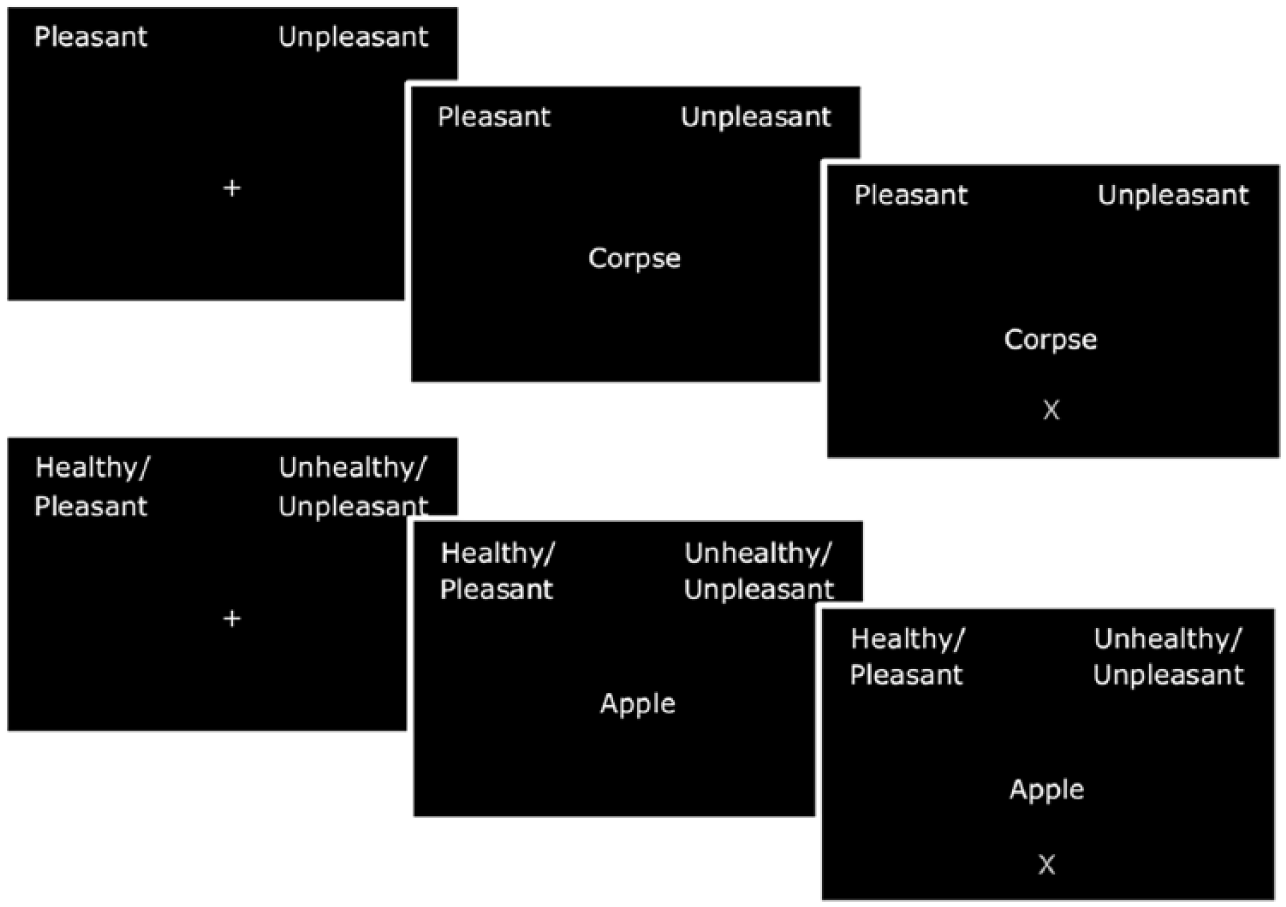
IAT screens in practice (upper row) and data collection blocks (lower row).
The two categorisation tasks are combined during the data collection blocks, as depicted in the bottom row of Figure 1. In this case, pleasant words and words denoting healthy foods have to be sorted via the left-hand-side button, and their opposites via pressing the right-hand-side button (in actual applications, different combinations of healthy/unhealthy and pleasant/unpleasant are assigned randomly). If respondents habitually associate healthy foods as pleasant, it is easier to sort these correctly (i.e. it is a congruent task) than if they habitually associate these as unpleasant (then it is an incongruent task). The difference in time needed to perform congruent and incongruent tasks – the IAT scores – indicates the existence and strength of the implicit negative or positive association respondents have with (un)healthy foods.
By linking IAT scores to survey data, it is, in a first step, possible to uncover whether a negative (positive) implicit association with healthy (unhealthy) foods is especially present among lower strata, as expected based on Bourdieusian theorising pertaining to, for example, the cultivation of asceticism or self-imposed constraint among higher strata. Second, by associating IAT scores with survey data on respondents’ current and childhood social conditions, one can assess whether a stratified pattern in implicit associations is based on stratum-specific socialisation or other cultural or material influences. In a third step, one can determine whether those stratified IAT scores account for the population-wide stratified patterns in food intake and obesity, which have been extensively reported by means of survey research – in other words: whether the non-declarative aspects of the habitus indeed underlie those stratified patterns, as widely assumed. To this end, IAT scores can be modelled as a link between a stratification measure on the one hand and indicators of food intake and obesity on the other. If significant mediation is found, the role of the non-declarative aspects of the habitus in the stratified patterns under scrutiny is no longer assumed, but actually demonstrated. While empirical research indicates that implicit associations are not always linked to actual behaviour (Forscher et al., 2016), we contend that theories claiming that implicit preferences guide behaviour (which are prevalent in Bourdieusian studies) can be assessed by using IAT scores as proposed here.
This example provides a simple illustration of how the role of non-declarative cognitive schemas that result from long-lasting, stratum-specific socialisation can be uncovered by combining IATs with survey data. Moreover, such an approach could also reveal differences based on gender, race/ethnicity and more fine-grained patterns of stratum-specific stratification. For example, groups in middle strata could demonstrate different associations than those in the lower and/or upper strata (Bourdieu and Whiteside, 1996; Vandebroeck, 2016). Of course, follow-up analyses could incorporate additional IATs, in order to assess whether the positive/negative associations discussed above ensue from internalised preferences relating to, for example, asceticism, as predicted by Bourdieusian theorising.
Discussion and Conclusion
The application of Bourdieusian theorising in empirical research could be improved substantially by systematic empirical scrutiny of a crucial and understudied aspect of the habitus: non-declarative cognitive schemas resulting from long-lasting, stratum-specific socialisation. Thus far, these have been widely attributed theoretically to stratified patterns but have escaped empirical scrutiny because conventional methods do not allow them to actually be measured. The sociological application of the IAT proposed here, however, does. We are not the first to stress the potential of studying cognition for answering sociological questions (see, for a recent example, Lamont et al., 2017). Note, however, that few sociological studies using latency-based methods such as the IAT have thus far been conducted (for exceptions, see Moore, 2017; Srivastava and Banaji, 2011), and none of these has scrutinised the existence and role of the habitus systematically. Importantly, rather than using the IAT in isolation, we suggest combining it with conventional methods, as these are essential for relating IAT results to: (1) the habitus’ origins; (2) its declarative components; and (3) its consequences.
Our plea is sensitive to warnings of over-interpreting the findings of IATs (cf. Oswald et al., 2013). We do not claim that implicit attitudes always unknowingly direct everyday actions. The habitus might inform actions, but not constantly or deterministically, for instance because deliberation may overrule implicit attitudes (cf. Carlsson and Agerström, 2016). Moreover, IATs are sensitive to contextual factors (such as priming: see, for example, Frantz et al., 2004), which demonstrates that IAT results could reflect stratum-specific socialization in early life, but also more recent stratum-specific socialization and/or more general cultural influences (e.g. national narratives or discourses). Take, for instance, the upwardly socially mobile: their IAT scores might resemble those of their immobile peers because they share early life stratum-specific socialisation, but could also diverge from these because of socialisation in their current stratum. Another example: comparing IAT scores across countries that differ in narratives surrounding healthy foods could reveal whether, and to what extent, such narratives shape stratum-specific associations with those foods. IAT-survey combinations are well suited to assess such research puzzles.
Taken together, IAT-survey combinations provide a valid and reliable measure of socially situated cognitive schemas (Lamont et al., 2017), enabling one to assess whether, and under what conditions, the non-declarative aspects of the habitus explain behaviour. Accordingly, instead of ‘throwing out the baby with the bath water’ (Carlsson and Agerström, 2016: 286), we plead for a sociological application of the IAT that allows for the inclusion of the non-declarative aspects of the habitus in empirical analyses, making its status as a post-facto explanation of stratified patterns a thing of the past.
Footnotes
Acknowledgements
We would like to thank Michaël Berghman, Pauwke Berkers, Stijn Daenekindt, Koen van Eijck, Roy Kemmers, Michèle Lamont, Andrew Miles, the Sociology editor (Vanessa May) and the three anonymous referees for their valuable comments on previous versions of this research note.
Funding
This work was supported by the Netherlands Organisation for Scientific Research (NWO PhD in the humanities #322-45-003 and NWO vidi #452-17-009) and by the Erasmus Trustfonds (2016). These funding sources have not been involved in the research and publishing processes.
Notes
 .
.
.
.