




Abstract
In this article, we chart connections between class and educational performance in comparatively egalitarian Norway. While viewing various forms of capital as integral parts of class background, we assess how educational performance is differentiated across the class structure. We use survey and register data to assess differences in grades in three school subjects – mathematics and spoken and written Norwegian – at the individual and school level. We focus on the year of graduation of students at lower-secondary schools in Bergen, Norway’s second largest city by population. Lending credence to Bourdieu’s model of the social space, we find differences according to both capital volume and capital composition. Students from class backgrounds rich in overall capital perform comparatively better than those from humbler class backgrounds. There are also differences within the upper class: those from homes rich in cultural capital perform comparatively better than those from homes rich in economic capital. Although between-school differences are low within the ‘unified’ Norwegian school system, the analysis indicates that grades are associated with the class composition of schools: a high proportion of upper-class students positively correlates with higher grades. In addition, there is some evidence of a collective form of class bias: in one of the school subjects, spoken Norwegian, there is a connection between individual grades and teachers’ perceptions of the culture pervasive at the school in question; this connection is contingent upon a school’s class composition. The analysis thus draws attention to the way in which class bias in grading varies between school subjects.
Introduction
Does class background affect educational performance, and if so, in what ways? Following the ‘cultural turn’ in class analysis (see e.g. Reay, 2011; Savage, 2003; Weininger, 2005), many scholars have turned to the work of Pierre Bourdieu to account for such divisions. A key idea in Bourdieusian scholarship is that an embodied form of cultural capital – a set of favourable dispositions for action and thought – is unevenly distributed in the class structure, and that displays of such dispositions are positively rewarded in the education system (Bourdieu, 1996; Bourdieu & Passeron, 1990). Bourdieu maintains that class reproduction is often veiled in and through a process of ‘misrecognition’, where teachers misperceive students’ symbolic displays of privileged class backgrounds, for instance by appraising them as indicative of ‘natural abilities’, ‘giftedness’ or ‘talent’. This process, Bourdieu holds, leads to class-cultural bias in the evaluation of students.
Despite the increasing interest in Bourdieu’s theory, there are two key concerns that are largely neglected by contemporary assessments of educational inequalities. First, although the model of the social space is a cornerstone in Bourdieu’s rethinking of class (Bourdieu, 1984; see also Flemmen et al., 2018; Weininger, 2005), it has received scant attention in empirical research on educational inequalities. The first dimension of this model depicts a vertical division in terms of the volume of capital, separating classes rich in capital from those that are comparatively poor in it. The second dimension depicts a horizontal, intra-class division in terms of the composition of capital, separating class fractions with a preponderance of cultural capital from their counterparts with a preponderance of economic capital. Although many studies have charted educational inequalities along the vertical dimension of class, as well as how different forms of capital (e.g. cultural, economic and social) are interwoven in such vertical divisions (see e.g. Archer et al., 2005; Atkinson, 2010; Ball, 2003; Bathmaker et al., 2016; Devine, 2004; Lareau, 2011; Reay et al., 2009), few studies have assessed the second dimension of capital composition (though see Andersen & Hansen, 2012; Strømme, 2021). In our analysis, we investigate whether there are differences in educational performance along both dimensions of the social space by using the Oslo Register Class Scheme (ORDC) (Hansen et al., 2009).
Second, few quantitative assessments show whether the grading of students is connected to teachers’ perceptions of characteristics associated with the student body as a whole, and whether this connection is contingent upon the class composition of a school. While individual-level class bias has drawn some attention (see e.g. Andersen & Hansen, 2012; Dumais, 2006), there are few enquiries into collective forms of class bias. However, a range of studies has assessed certain aspects relevant to such processes. Some accounts have suggested that individual performance is connected to the socioeconomic composition of a school, indicating classed ‘peer effects’ in and through the influence of reference groups at school (for an overview, see van Ewijk & Sleegers, 2010). Moreover, qualitative studies have detailed how specific school cultures constitute different conditions for students from different class backgrounds, manifested for instance in specific belief systems, values, norms and cultural styles pervasive at schools (see e.g. Calarco, 2018; Jarness et al., 2019; Khan, 2011; McDonough, 1997; Reay et al., 2009). Quantitative studies have shown how different school cultures – as perceived by teachers – are connected to inequalities in educational performance (for an overview, see Thys & Van Houtte, 2016). However, in studies of educational performance, teachers’ perceptions of school cultures are rarely seen as linked to a school’s class composition (though see Breinholt & Jæger, 2020).
In the following analysis, we investigate (1) whether school grades are connected to the two-dimensional model of the social space; (2) whether grades are connected to social capital in terms of the proportion of upper-class students at the school; (3) whether teachers’ grading of students is connected to their perceptions of the school culture, and whether this connection is contingent upon the proportion of upper-class students at the school; and (4) whether these connections vary across school subjects. We address this by linking data from two Norwegian surveys – one by teachers (N = 180), the other by students (N = 2094) – and official register data. The data were collected in 2014 at 25 lower-secondary schools in Bergen, Norway’s second largest city by population. We investigate grades in three different school subjects: mathematics and spoken and written Norwegian.
Norway is arguably an interesting case for mapping such connections. While previous research has shown marked class divisions in terms of social mobility, marriage patterns, residential segregation, lifestyles and symbolic boundaries (see e.g. Flemmen et al., 2017, 2018; Ljunggren & Andersen, 2015; Toft & Jarness, 2021), Norway is still comparatively egalitarian due to characteristics such as a compressed wage distribution and extensive and universal welfare services (Esping-Andersen, 2015). Specifically, the Norwegian ‘unified school’ system is explicitly geared towards reducing social inequalities (Strømme, 2019). This system is largely public and school fees are strictly capped and regulated. There is only a small private school sector and ‘elite’ schools are found among the state schools (Andersen et al., 2017). The tracking of students appears comparatively late on – students progress through the same system until the age of 16 – and this system is associated with comparatively low between-school differences in educational performance at the primary and lower-secondary levels (van de Werfhorst & Mijs, 2010). Since these low between-school differences are necessarily accompanied by a limited potential for the influence of classed ‘peer effects’ and collective forms of class bias in grading, this arguably makes the case of Norway a ‘strict test’ for assessing such connections. Indeed, if such tendencies are revealed within a unified school system such as this, there are reasons to suspect that such tendencies may be stronger in contexts with more stratified school systems.
Class-cultural reproduction in the education system
Bourdieu’s scholarship is both a key source of inspiration and a moot point in contemporary debates about class and education (see the accounts in Reay, 2011; Savage, 2003). Bourdieu (1984) defines classes as positions within the social space, along the dimensions of capital volume and capital composition. The social space represents a structure of ‘conditions of existence’ that are linked to the formation of class habitus, i.e. durable dispositions inscribed in the body and the mind (Bourdieu, 1984, pp. 169–225). The upper regions of the social space signify distance from a life of ‘necessity’, and thus an abundance of time, energy and resources to cultivate the symbolic mastery of legitimate, academic culture, or ‘cultural capital in the embodied state’ (Bourdieu, 1986, pp. 244–245). Thus, students from upper-class homes are predisposed to spending their time and energy on performing well at school; they have embodied a ‘libido sciendi’, or a ‘feel for the game’, that is favourable in the education system. According to Bourdieu, class conditions for acquiring such mastery – a ‘hereditary’ or ‘domestic’ transmission of dispositions (1986, p. 244) – are also different within the upper reaches of the class structure: for children growing up with a preponderance of cultural capital, the class conditions are comparatively more favourable than for those growing up with a preponderance of economic capital.
Bourdieu (1986, 1996) also highlights the role of social capital, understood as profitable resources embedded in social networks. Membership of resourceful networks implies the potential for ‘multiplier effects’, meaning that advantages may accrue from connections to other people who possess large amounts of capital, as well as capital you yourself possess. As people tend to engage in relationships of mutual recognition with people in similar class positions, Bourdieu (1986, p. 250) holds, this process has important implications for the conditioning of habitus. While Bourdieu clearly regards early experiences within the family as a primary condition, the conditioning of classed environments, such as neighbourhoods or schools, is also regarded as liable to influence the ambitions and values linked to educational performance.
Finally, Bourdieu stresses the role of symbolic capital, which is a ‘disguised’ or even ‘invisible’ form assumed by cultural capital, meaning that it is ‘unrecognized as capital and recognized as legitimate competence, as authority exerting an effect of (mis)recognition’ (Bourdieu, 1986, p. 245). In other words, a profitable asset held by a social actor may in some senses be misperceived as something else. Cultural capital in its embodied state is seen as particularly liable to function in this way, for instance through a process where teachers and students alike misperceive expressions of symbolic mastery acquired in early socialization as expressions of ‘natural abilities’. This process, Bourdieu holds, leads not only to a class-cultural bias in the evaluation of students, but also to a naturalization, and thereby legitimation, of class reproduction.
Although controversial (see e.g. Breen & Goldthorpe, 1997; Breinholt & Jæger, 2020; Kingston, 2001), Bourdieu’s account has drawn much empirical support. One stream of research has demonstrated how upper- and middle-class parents’ strategies to instil favourable dispositions in their children are finely attuned to the demands of the education system (Devine, 2004; Lareau, 2011). This chimes with research showing that students from upper-class families are more likely to be interested in academic culture for leisure (Hjellbrekke et al., 2015). Research has also detailed clear class differences in students’ modes of conduct in the classroom (Calarco, 2018; Dumais, 2006), and how specific school cultures (or ‘school-specific doxa’) – e.g. belief systems, values, norms and cultural styles – constitute different conditions for students from different class backgrounds (Atkinson, 2011; Ingram, 2018; McDonough, 1997). Studies focusing particularly on elite schools have examined the embodiment of ‘ease’, the way this favours fitting in at prestigious institutions (Jarness et al., 2019; Khan, 2011), and how a lack of such may make students feel out of place (Reay et al., 2009). Research has also pointed to class differences in educational choices (Ball, 2003; Strømme, 2019) and performance (Barone, 2006). Finally, some research has documented class bias in grading, especially in oral exams, where stylistic and symbolic aspects of class, such as eloquence and self-assurance, are particularly liable to influence teachers’ perceptions and evaluations (Andersen & Hansen, 2012).
However, despite the influence of Bourdieu, his distinct model of the social space is often neglected. Although most accounts recognize the vertical dimension of capital volume, the horizontal dimension of capital composition is often overlooked. Specifically, empirical assessments have mostly ignored whether educational inequalities are structured according to the chiastic structure of cultural and economic capital, dividing each main class into distinct class fractions (though see Andersen & Hansen, 2012; Strømme, 2021). We would highlight that the assessment of capital composition is distinct from measuring the ‘net effects’ of separate variables on economic and cultural capital, since this does not readily allow for the investigation of how fraction-specific capital profiles within each class affect various outcomes. It is also distinct from the use of conventional, one-dimensional class schemes (e.g. the NS-SEC) and socioeconomic status scales, since they do not operationalize horizontal intra-class divisions.
There has also been considerable disagreement about operationalizing cultural capital, especially between proponents of a ‘broad’ versus a ‘narrow’ understanding of the term. The broad understanding emphasizes the transmission of symbolic mastery from parents to children, for instance in terms of language skills and the modes of self-presentation and interaction associated with the development of an academic habitus (see e.g. Barone, 2006; Lareau, 2011; Sullivan, 2001; Tramonte & Willms, 2010). The narrow understanding, on the other hand, emphasizes exposure to specific ‘highbrow’ cultural activities, such as visiting art galleries, museums and listening to classical music (see e.g. Breinholt & Jæger, 2020; DiMaggio, 1982).
Expanding on Lareau and Weininger’s (2003) critique, we argue that the narrow understanding is problematic for several reasons. First, it implies a conflation of the crucial distinction between modus operandi and opus operatum, i.e. between general modalities of action flowing from dispositions embodied in the habitus, and particular manifestations of such modalities, such as enjoying specific works of art (Bourdieu, 1984, pp. 173 n3, 282–283, 573). Opus operandi pertains to how one relates to the social world, and there are qualitatively different ways of displaying knowledge at school. Bourdieu (1996, pp. 19–21) has highlighted a distinction between a modality characterized by ‘ease and naturalness’, signalling a confidence and a familiar rapport with academic culture, and a more strained modality of relating to such culture.
Second, the narrow understanding of cultural capital breaks fundamentally with Bourdieu’s (1984, 1996) original theorization of cultural capital as constitutive of class position. Among proponents of the narrow understanding, cultural capital is typically seen as something that crystallizes when all other imaginable background measures are controlled for. Thus, this approach tends to obscure how cultural capital may be incorporated in different forms of class habitus. This point also applies to some adaptions of the broad understanding of cultural capital (see e.g. Barone, 2006; Sullivan, 2001; Tramonte & Willms, 2010). While these studies avoid the problems associated with reducing cultural capital to narrowly defined opera operata, they attempt to measure the ‘net effect’ of cultural capital (e.g. language skills and modes of interaction) by controlling for measures of social background (e.g. parents’ education and income) in regression models.
More generally, in assessments of Bourdieu’s theory of class reproduction, a fixation on the notion of cultural capital has tended to imply less attention paid to the way in which Bourdieu models cultural capital versus economic capital in the social space. Although economic capital may very well be a less favourable class condition in terms of a ‘hereditary’ transmission of academic types of habitus, it may nevertheless be decisive in terms of transmitting an embodied motivational ‘drive’ for success (in addition to more obvious forms of advantage, such as the ability to pay for private tutoring or to move to ‘good school’ catchments). As demonstrated by Aarseth (2016), wealthy parents emphasize providing their offspring with emotional means to thrive in competitive environments; this contrasts with a style more common among parents rich in cultural capital, where the attainment of knowledge and symbolic mastery is seen as an end in itself. This is corroborated by Strømme and Helland (2020), who have shown how parents rich in economic capital tend to emphasize current school activities (e.g. help with homework), while parents rich in cultural capital tend to be more focused on future educational endeavours. Thus, the conditions for acquiring favourable dispositions cannot reasonably be seen one-dimensionally.
Data and analytical approach
We draw on data from the wider ‘International Study of City Youth’ project, encompassing a student survey (N = 2094) and a teacher survey (N = 180). These were conducted in 2014 at lower-secondary schools in the city of Bergen. All relevant schools were asked to participate, and all the 25 state schools participated. Students filled in an online questionnaire in class at school when they were in the 10th grade (aged 16). The response rate was 80.2%. Teachers teaching 10th graders filled in their own questionnaire. Official register data about the students’ grades were linked to the survey data by using anonymous ID numbers. The County Council of Hordaland provided the register data. Table 1 shows the descriptive features of the data.
Descriptive statistics.
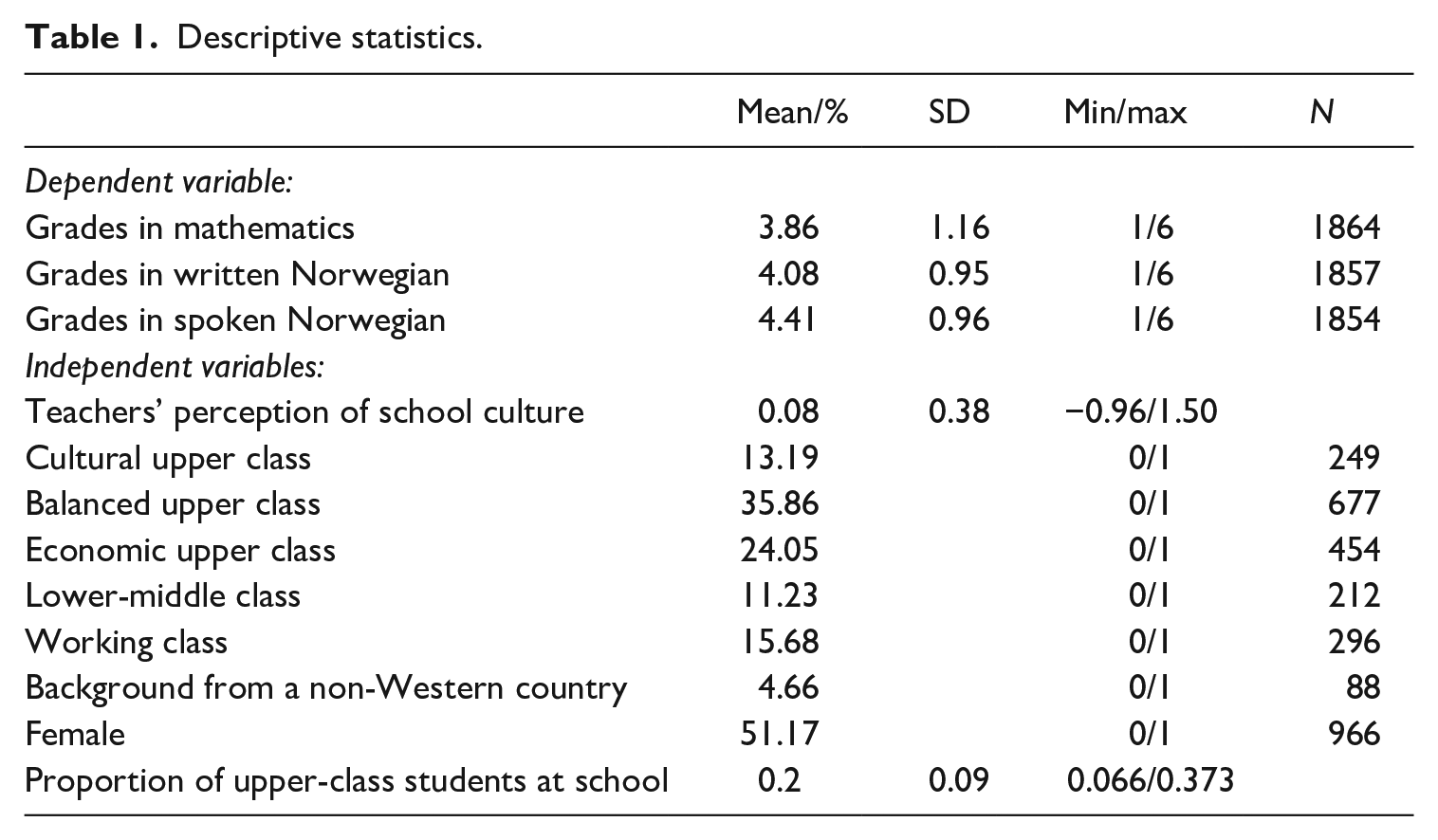
Since we have data about students nested in schools, we apply a multilevel regression approach, which is recommended to avoid underestimating the standard errors in a classic OLS model (see e.g. Gelman & Hill, 2007). In this approach, the regressions of the group-level and the individual-level models are estimated simultaneously in a ‘partial-pooling model’ (Gelman & Hill, 2007, p. 257). This is helpful in our analysis, since we are interested in both school-level and student-level variables (see below). 1
It should, however, be noted that there are some ‘rules of thumb’ as regards the effective use of multilevel regressions. Some recommend an Intra Class Correlation (ICC) above 0.05 to avoid making Type 1 errors (i.e. ‘false positives’) (see e.g. Gelman & Hill, 2007, pp. 270, 275). In our analysis, we use grades in three school subjects as dependent variables. The ‘null model’ for these variables reveals the following ICCs: spoken Norwegian (0.05); written Norwegian (0.04); and mathematics (0.03). While the first ICC satisfies the rule of thumb, the second two do not. The results for the school-level analysis of grades in written Norwegian and mathematics should thus be interpreted with some caution. We would, however, highlight that this rule of thumb is not seen as an absolute threshold, and that recent simulation studies have suggested that ICCs as low as 0.01 are justifiable (see the discussion in Huang, 2018).
Dependent variables
We focus on grades in three school subjects: spoken Norwegian, written Norwegian and mathematics. 2 The first two require knowledge of language and the Norwegian literary canon, and thus symbolic mastery of ‘legitimate’ culture. By including both, we can assess whether there are class differences in written and spoken displays of symbolic mastery. Mathematics is arguably less linked to such symbolic mastery – in the sense that mathematical skills require less knowledge of canonized and legitimate culture – but presumably more to a mastery of logical and abstract reasoning, as well as ‘technical’ problem solving.
According to the Norwegian Directorate for Education and Training (2021), grading in written Norwegian is based on ‘the competence the student has shown in a selection of texts in different genres and for different purposes’; in spoken Norwegian, it is based on the ‘competence the student has shown when the student has communicated academic content using spoken language’; in mathematics, it is based on ‘the competence the student has shown, in writing, in spoken language and digitally, by using mathematical forms of expression, using problem-solving strategies and reflecting on and arguing for solutions and models’.
We use the actual grades recorded at the end of the graduation year of lower-secondary school students. Since the tracking of students starts at this level in the Norwegian school system, and students’ average grade scores directly determine whether they are admitted to their upper-secondary school of choice, these grades are crucial for their future trajectories. Separate analyses are conducted for each subject, and the dependent variables depict grades for all the individuals in the sample.
Independent variables
Class background
We operationalize class background by using the ORDC class scheme (Hansen et al., 2009; see Figure 1). Inspired by Bourdieu’s (1984) model of the social space, it has a vertical dimension of capital volume and differentiates between four main classes: the upper, the upper-middle, the lower-middle and the working class. The horizontal dimension of capital composition crosscuts these: the three highest classes are divided into cultural, economic and balanced fractions. Our application of the ORDC is adjusted for the analysis of survey data and relies on the occupational classification of parents as reported by the students. It is constructed by considering types and volumes of capital typically associated with given occupations, with an emphasis on cultural capital (in particular education types and length) and economic capital (various forms of income). For instance, the cultural upper class is defined as those possessing the most cultural capital and consists of top positions in academia, the field of cultural production and cultural institutions; the balanced upper class as those possessing large volumes of capital, with a fairly balanced composition of both cultural and economic capital, and comprises top positions within the state bureaucracy and the elite professions; and the economic upper class as dominant positions in business, such as chief executives, financial brokers and owners of large businesses.
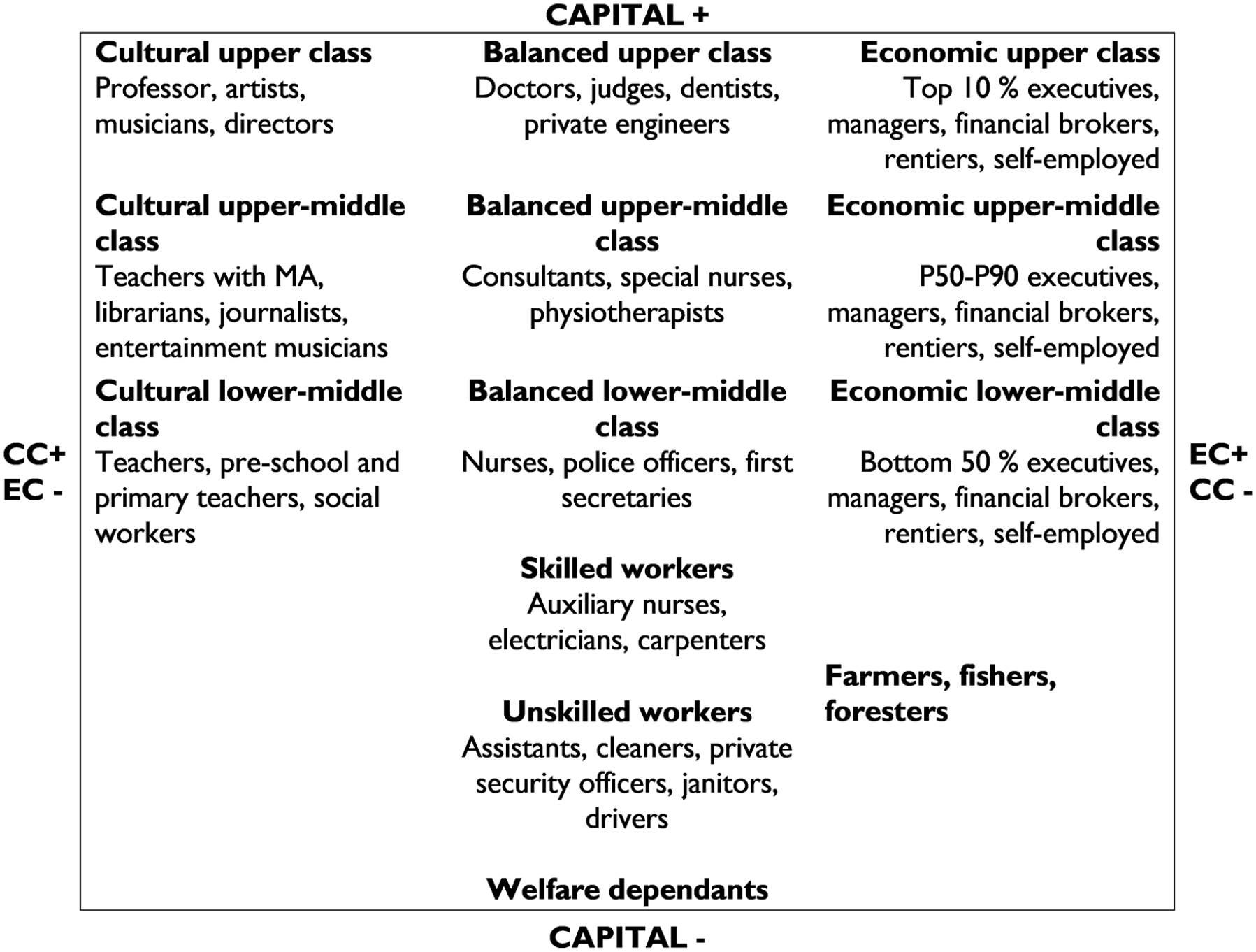
The ORDC class scheme.
We have opted for a ‘dominance approach’, using parents’ highest class position in terms of capital volume. If both parents are on the same hierarchical level but in different fractions, we have prioritized the cultural fraction as the highest position, since cultural capital is the dominant form of capital in the educational field. The upper and upper-middle class categories are combined in the following analysis because of low frequencies and because detailed information about income is not available to separate the economic upper from the economic upper-middle class. Working class background is used as the baseline in the regression models.
We would, however, highlight that we do not measure students’ dispositions directly but use the parents’ positions in social space as a proxy for class conditions in students’ family environments. Here, we rely on previous studies from Norway and other countries demonstrating how such class conditions are connected to parental styles, the symbolic mastery of legitimate culture, as well as students’ levels of emotional security and sense of entitlement when communicating with adults (see e.g. Aarseth, 2016; Calarco, 2018; Hjellbrekke et al., 2015; Lareau, 2011). We would also highlight that our use of occupational classification is used as a proxy for parents’ possession of cultural and economic capital. There is thus some risk of misclassification, in the sense that some respondents assigned to a given class category may have a non-modal capital profile.
Teachers’ perceptions of school culture
We operationalize teachers’ perceptions of the collective school culture as an index measuring teachers’ classifications and evaluation of their students in matters not directly related to their abilities and academic performance. The teachers were asked whether they agreed with the following: ‘I get along with my students’; ‘most students behave well’; ‘most students are eager to learn’; ‘many students dislike school’ (reversed); ‘most students get along’; ‘some students disturb those who want to learn’ (reversed); ‘most students cooperate and behave well’; ‘many students do not expect to complete upper-secondary school’ (reversed); ‘most students work hard to do well’. All questions were answered on a four-point scale. The responses were standardized and made into an index with a Cronbach’s alpha of 0.72. 3
The index can be interpreted as an indicator of what Thys and Van Houtte (2016) have dubbed ‘school culture’. Some of the questions used in the index also resemble to some degree what some scholars have referred to as students’ ‘non-cognitive skills’, including conscientiousness, belonging and behavioural engagement. These skills are regarded as important for educational performance but not equivalent to abilities measured by test scores (Kautz et al., 2014).
It is, however, important to note that since our analysis is based on cross-sectional data, we cannot point to any causal relationships. It may be that teachers at certain schools have a more positive perception of the school culture because these are schools where students receive higher grades, but it may also be that students receive higher grades at certain schools because these are schools where teachers have a more positive perception of the school culture.
Proportion of upper-class students
We measure the class composition of schools in terms of the proportion of upper-class students at a school by aggregating upper-class backgrounds to the school level. This variable can be seen as a proxy for social capital available at a school, for instance manifested as a ‘multiplier effect’ accruing from social ties with resourceful schoolmates (cf. Bourdieu, 1986). This proxy is admittedly somewhat crude, since we do not have information about individual students’ personal networks. We have, however, checked for interaction effects with individual class background with no significant results.
The variable is coded as a continuous one. Since the proportion of upper-class students does not move from 0 to 1 (no schools have either 0 or 100% upper-class students), the variable has been standardized to ease interpretation of the results.
Teachers’ perceptions × proportion of upper-class students
As an indicator of collective class bias, we use an interaction term between the teachers’ perceptions of school culture and the proportion of upper-class students at the school. This allows for an assessment of whether the connection between teachers’ grading of students and their perceptions of the culture pervasive at schools is contingent upon the class composition of the schools.
Control variables
We include both gender and ethnicity as control variables, since previous research has demonstrated that they are highly correlated with grades (see e.g. Dumais, 2002). Gender is coded 1 for female and 0 for male. Ethnicity is coded 1 if both parents are from a non-Western country (defined as outside of Europe, North America, Australia or New Zealand) and 0 if not. 4
Results
School-level connections
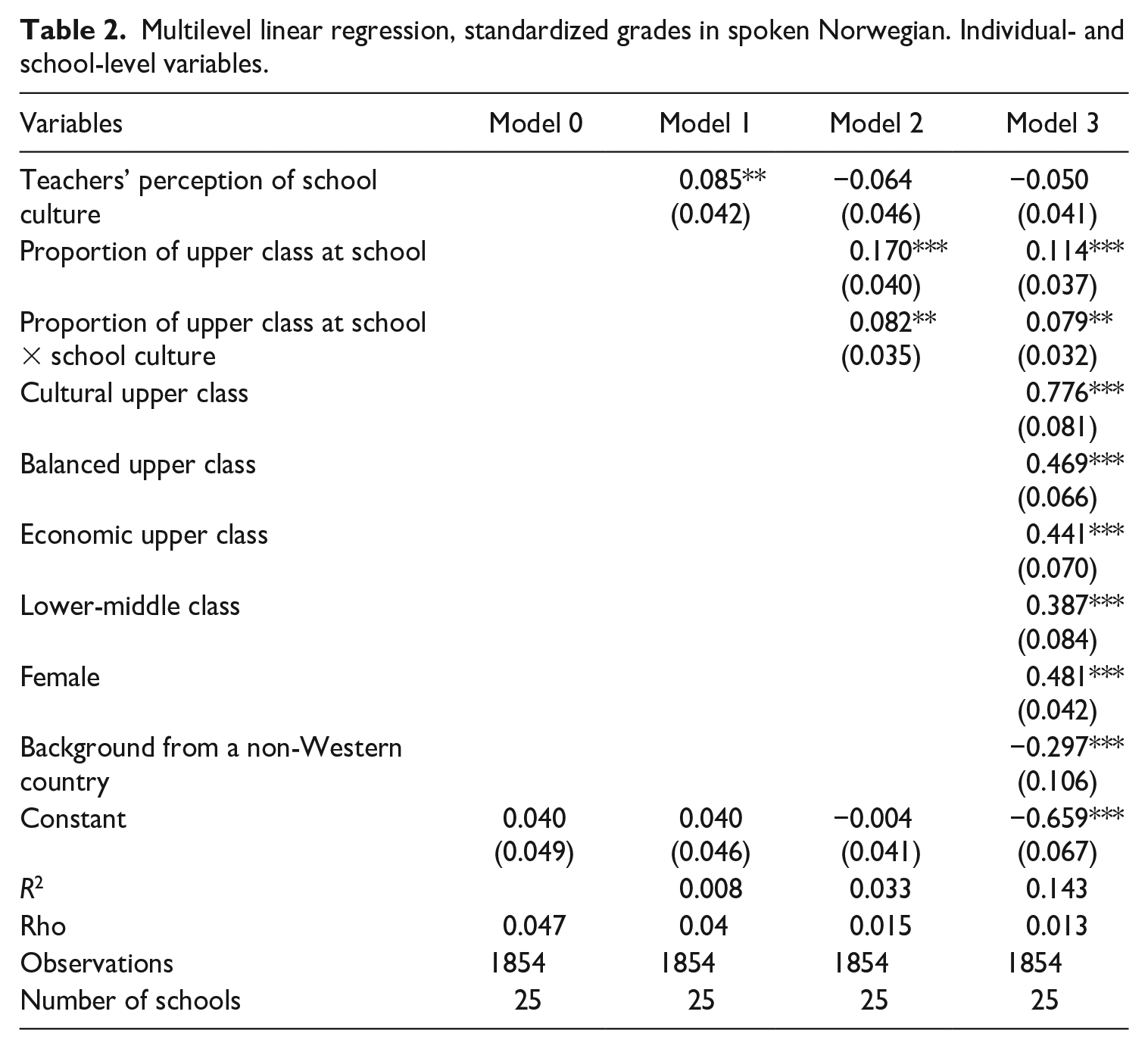
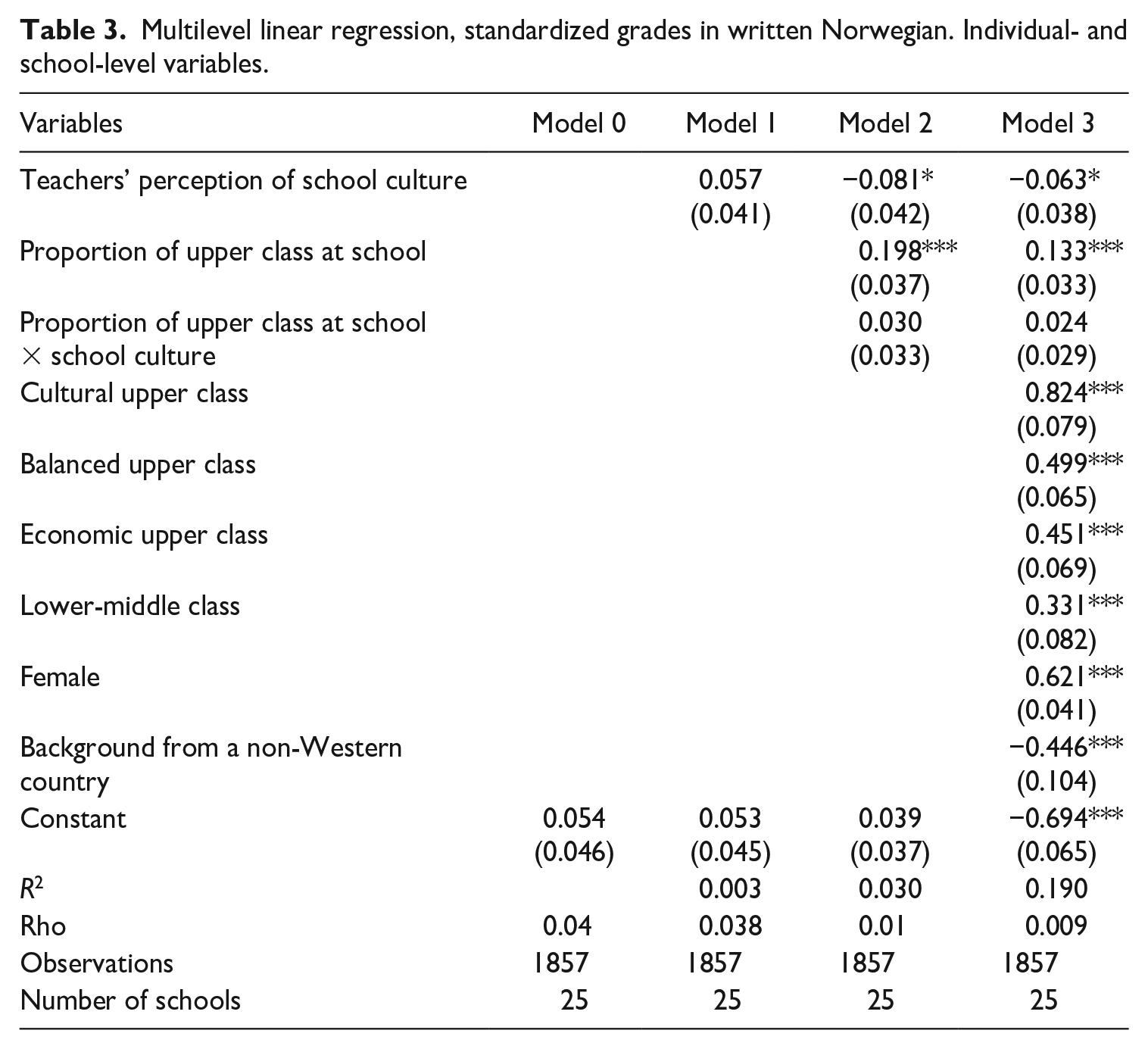
Because of the way we have designed the regression models, we start with the connections between individual grades and independent variables at the school level. Tables 2, 3 and 4 show separate models for each of the three subjects. In Model 1 in these tables, we can see that only spoken Norwegian exhibits a significant positive correlation between grades and teachers’ perceptions of school culture. When the value of the variable for teachers’ perceptions increases 1 SD, the value of the variable for grades increases 0.09 SDs.
Multilevel linear regression, standardized grades in spoken Norwegian. Individual- and school-level variables.
Multilevel linear regression, standardized grades in written Norwegian. Individual- and school-level variables.
Multilevel linear regression, standardized grades in mathematics. Individual- and school-level variables.
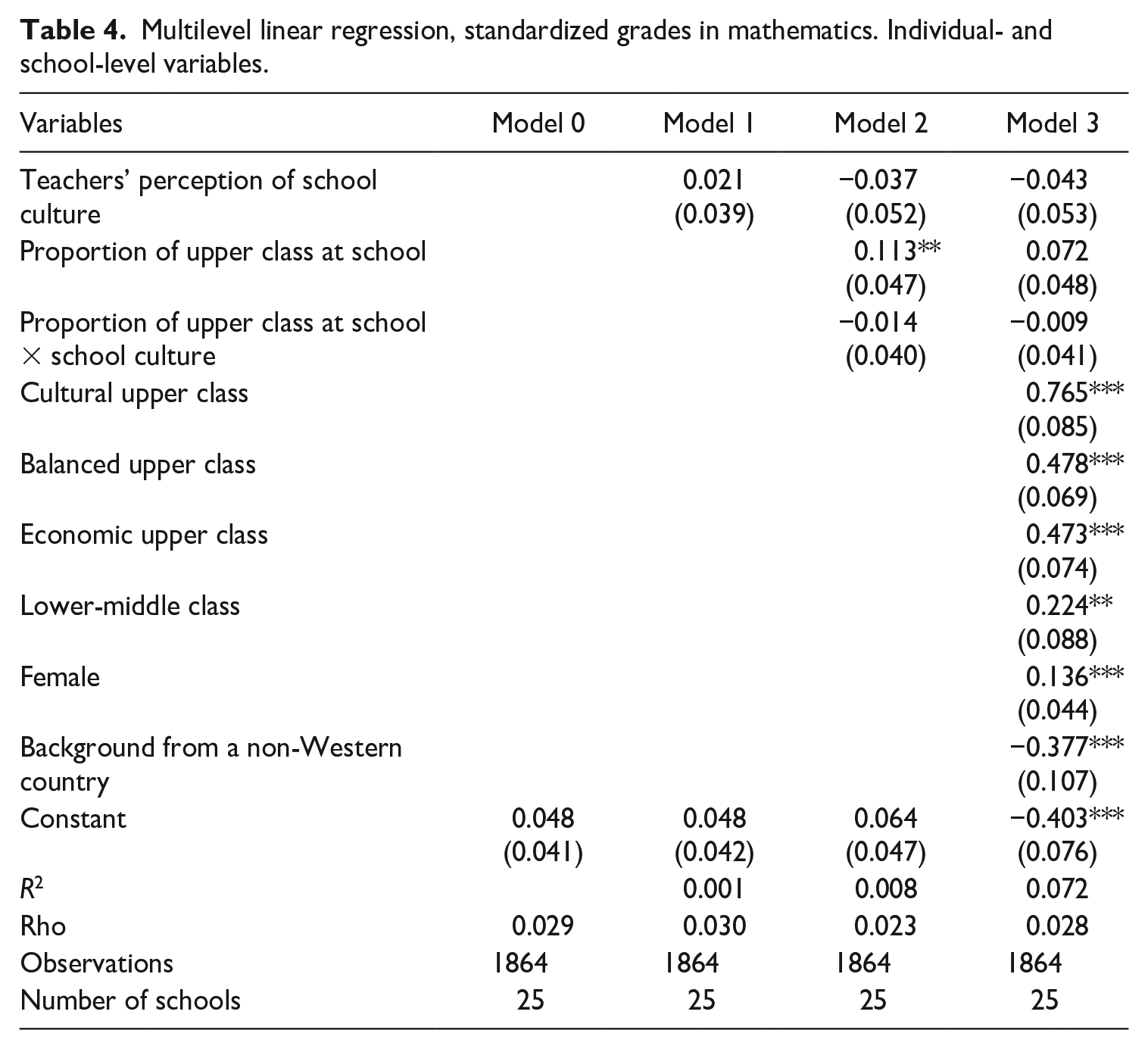
In Model 2, we assess the connection between grades and the class composition of a school. In all three subjects, there is a positive and significant correlation: the higher the proportion of upper-class students at a school, the higher the grades. 5
In Model 3, we assess whether the connection between grades and teachers’ perceptions of school culture is contingent upon the class composition of a school. We do this by adding the interaction term (teachers’ perceptions of school culture × class composition). This lets us investigate whether certain combinations of values for the two variables differ from others. In written Norwegian and mathematics, the interaction term does not yield significant results (although the effect of class composition at a school is still positive and significant in written Norwegian).
The effect of the interaction term is, however, significant and positive in spoken Norwegian, which means that the higher the proportion of upper-class students at a school, the stronger the correlation between grades and teachers’ perceptions of school culture. We can also see that the main effect of teachers’ perceptions is no longer significant, something that must be seen in relation to the interaction term. For those attending schools with an average level of upper-class students, the association between teachers’ perceptions and grades in spoken Norwegian is not significant. However, the effect of class composition at a school is still positive and significant. Among those attending schools with average teacher perception levels, grades increase 0.18 SDs when the proportion of upper-class students increases by 1 SD.
We may also note that the connections at the school level do not change noteworthily in spoken Norwegian when the individual-level variables are introduced in Model 3: the interaction term remains significant and as high as in Model 2. However, the coefficient for the connection between class composition and grades in written Norwegian is substantially smaller, and the significant correlation has vanished in mathematics. The latter is unsurprising, since the ICC is quite low. It also indicates that the significant and positive coefficient for class composition in Model 2 can be accounted for by individual measures of class.
Figure 2 depicts a visualization of the effect of the interaction term in spoken Norwegian. The first graph shows the linear prediction of grades from a regression of grades and the proportion of upper-class students, with values for teachers’ perceptions being more than 1 SD lower than the mean. The second graph depicts values for teachers’ perceptions more than 1 SD higher than the mean. The confidence intervals have been included. As we can see, higher grades are associated with higher values for both teachers’ perceptions and the proportion of upper-class students. Moreover, as the interaction term in Table 4 also indicates, the increase is steeper for higher values for the variable for teachers’ perceptions. In other words, if teachers’ perceptions of the school culture are high, the association between grades and the class composition of the school tends to be stronger.
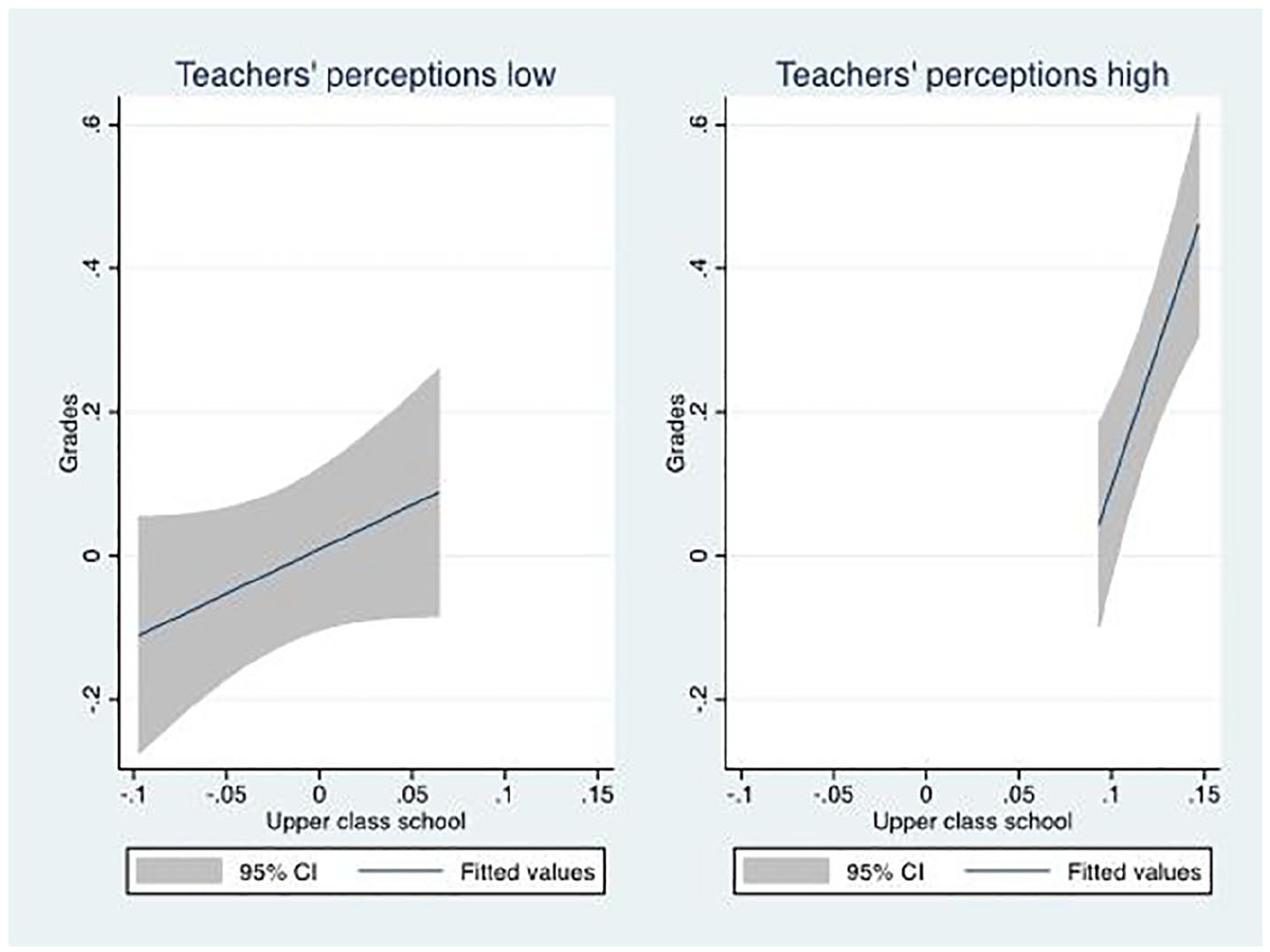
Linear prediction of grades from a regression of grades in spoken Norwegian and proportion of upper-class students. Teachers’ perceptions of students (centralized) one standard deviation down and up. Grades are standardized. Proportion of upper class is centralized.
But what does this mean for individual students? We do not find any significant interaction between the perceived school culture and individual class background. 6 This implies that the class composition of a school can be either an advantage or a disadvantage for individual students, regardless of their individual class background. Specifically, it implies that teachers at schools with a low proportion of upper-class students tend to be less influenced by their perceptions of the school culture when grading students, or, by the same token, that these teachers give grades that are in a sense based more on ‘pure’ academic performance. It also implies that teachers at schools with a larger proportion of upper-class students tend to a larger extent to recognize and reward what they perceive as ‘positive’ manners and attitudes, meaning that the grading process is more biased in the sense that grading is influenced by matters not directly related to academic performance.
Individual-level connections
We now turn to the connection between grades and individual class background. Working class background is used as the baseline. Model 3 in the tables clearly shows a systematic ordering of class in all three subjects: all the upper-class categories exhibit a markedly greater likelihood of achieving high grades compared to the working class. Those from the lower-middle class are also more likely to achieve high grades, though less so than those from the upper-class categories. Students from the working class are the least likely to achieve high grades. The largest differences are found between the cultural upper class and the working class: on average, the former achieve grades that are substantially higher than the latter: 0.78 SDs in spoken Norwegian; 0.82 SDs in written Norwegian; and 0.76 SDs in mathematics. We would highlight that the correlations are remarkably similar across the subjects and that additional analyses show that they do not differ significantly from one another.
Model 3 also exhibits clear intra-class differences according to the horizontal principle of capital composition within the upper class: students from homes endowed with a preponderance of cultural capital have the greatest likelihood of achieving higher grades (compared to the working class), followed by those from homes with balanced capital portfolios, and lastly, those from homes endowed with a preponderance of economic capital. The cultural fraction of the upper class stands out: their grades are significantly different from both the balanced and the economic fractions (who do not differ significantly from one another). Again, the coefficients are remarkably similar across the three subjects, and additional analyses show that the small differences between the subjects are not significant.
Finally, Model 3 shows that girls attain on average higher grades than boys: quite substantially in spoken Norwegian (0.48 SDs) and written Norwegian (0.62 SDs), but markedly less so in mathematics (0.14 SD). Those with non-Western backgrounds achieve on average lower grades than those without such backgrounds. The correlations are quite similar across the subjects: −0.30 SDs in spoken Norwegian; −0.45 SDs in written Norwegian; and −0.38 SDs in mathematics.
Concluding discussion
Our analysis suggests that the availability of cultural capital in the family environment is the most important class condition for educational performance. Although we cannot pinpoint the specifics of how such conditions foster advantage, previous work suggests possible explanations: the cultural fraction of the upper class in Norway is distinctive in terms of a parenting style emphasizing the attainment of academic knowledge and symbolic mastery as an end in itself (Aarseth, 2016; Strømme & Helland, 2020); they tend to engage in an intellectually oriented lifestyle, including a ‘knowing’ mode of appreciating legitimate culture (Hjellbrekke et al., 2015; Jarness, 2015); they disproportionally tend to mingle with and marry people in the same class fraction (Toft & Jarness, 2021); and they are the most closed in terms of intra-generational social mobility (Flemmen et al., 2017).
Although students from the economic upper class achieve on average lower grades than their counterparts from the cultural upper class, our results indicate that they perform comparatively well when we zoom out on the whole class spectrum: they achieve on average higher grades than both the working class and the lower-middle class. Previous Norwegian studies provide some clues about the kinds of advantages that accrue from economic capital. Studies of parenting styles suggest that although the cultivation of academic virtues is not a key concern among parents in the economic upper class, they emphasize qualities like competitiveness and ambition, and attempt to provide their offspring with emotional support to enhance goal achievement (Aarseth, 2016; Strømme & Helland, 2020). Moreover, economic capital provides favourable material class conditions, such as the ability to move to and reside in the geographical borders of ‘good school’ catchment areas. It thus seems plausible that economic capital provides an important, albeit secondary, class condition for educational performance.
More generally, the systematic interplay of economic and cultural capital draws attention to Bourdieu’s (1984, 1996) model of the social space, in particular the second dimension of capital composition. The results clearly indicate that there are horizontal differences within the upper reaches of the class structure. This chimes with previous Norwegian studies of class and inequality more generally (Andersen & Hansen, 2012; Flemmen et al., 2017, 2019; Ljunggren & Andersen, 2015; Toft & Jarness, 2021), and highlights the dangers of viewing vertically defined classes as monolithic entities and thus obscuring possible systematic differences within them. While our study does not contradict previous Bourdieu-inspired studies of educational inequalities in other countries showing clear vertical class divisions (see e.g. Atkinson, 2010; Bathmaker et al., 2016; Devine, 2004; Lareau, 2011; Reay et al., 2005), our study offers crucial nuance to this by accounting for systematic intra-class heterogeneity.
It is, however, an open question whether intra-class divisions in capital composition are salient in other empirical cases, since there are reasons to suspect that contextual differences – related for instance to the education system and the labour market – may affect the saliency of this dimension. Indeed, recent research suggests that capital composition is more pronounced in comparatively egalitarian contexts, and less so in contexts where economic privileges are more important for the attainment of educational credentials (Atkinson, 2020; Strømme, 2021). Nonetheless, we would argue that studies of educational inequalities should at the very least employ appropriate measures to assess such intra-class divisions properly – especially studies aiming to assess Bourdieu’s theory of class reproduction. In this regard, our study has demonstrated how the model of the social space can be effectively operationalized within ‘mainstream’ regression methodology.
Further, our school-level analysis indicates that the class composition of a school is associated with individual academic performance in two of the three subjects under scrutiny. Thus, it seems that social capital – i.e. profitable resources embedded in social networks at school (cf. Bourdieu, 1986, 1996) – constitutes an additional factor influencing educational performance. Previous qualitative studies have detailed how classed school cultures – e.g. cultural codes and styles, values and belief systems – constitute a ‘school ethos’ or ‘school-specific doxa’ pervasive at schools (see e.g. Atkinson, 2011; Ingram, 2018; Reay et al., 2005). Moreover, studies of Norwegian schools with a high proportion of upper-class students indicate that such styles and values are preserved in and through the sanctioning of deviance from group norms, resulting in strategies of conformity among students perceiving themselves as outsiders (Jarness et al., 2019; Pedersen et al., 2018). Our results lend credence to (but also expand on) this work by showing that the proportion of upper-class students at a school – and thus presumably the pervasiveness of upper-class culture within the student body – has an independent association with individual grades.
We would, however, highlight that the between-school variance is quite low and that the school-level connections are considerably lower than those of the individual class variables (cf. Breen & Jonsson, 2005). This indicates that class differences in educational performance largely stem from processes that take place outside the school institution, such as classed socialization within families.
As regards collective forms of class bias in grading, our results highlight important differences between school subjects. In the assessment of the connection between individual grades and the interaction term between teachers’ group-level perceptions and the class composition of schools, significant results are revealed in only one of the subjects: spoken Norwegian. We interpret this as a reflection of Norwegian being the ‘mother tongue’ of most students in Norwegian schools and thus it being particularly liable to processes of misrecognition linked to symbolic class signals displayed by the student body. For instance, it seems plausible that certain language-related features of school cultures – e.g. distinct sociolects and classed modes of displaying mastery of the mother tongue – influence teachers’ perceptions of such cultures. It also seems plausible that such perceptions are prone to influencing their grading of students in a subject that is explicitly centred on the verbal display of knowledge about Norwegian language and culture. Indeed, the largely standardized curriculum relies heavily on the Norwegian literary canon and, as shown in research on cultural consumption, Norwegian upper-class youth are disproportionally likely to engage in academic culture for leisure (Hjellbrekke et al., 2015). It thus seems reasonable to suggest that a collective form of class bias at schools with a high proportion of upper-class students at least partly involves teachers’ appraisals of the way in which the student body displays particularly ‘cultured’ modes of conduct.
We do not, however, find significant differences between subjects at the individual level: the class differences in grades are remarkably similar across the subjects. This is somewhat surprising, especially since Andersen and Hansen’s (2012) study of academic performance in graduation exams indicates clear differences between spoken and written Norwegian. This difference is interpreted as indicative of an individual form of class bias: while written exams are graded with the student being anonymous (i.e. based only on what the examiner can read from a written assignment), spoken exams are graded based on face-to-face interaction between students and examiners and this is thus more prone to influence by aspects not directly related to academic performance (e.g. classed modes of self-presentation).
There is, however, a crucial difference between grading exams and the type of grading under scrutiny in our analysis (based on student performance throughout the school year). Such grading is conducted by the same teacher in both spoken and written Norwegian and he/she has presumably come to know his or her students quite well (at least better than external examiners, who base their assessments on one encounter). There is thus more reason to expect greater differences when comparing the grading of spoken and written exams than when comparing the grading of spoken and written performances throughout the school year. Specifically, it seems plausible that, with the latter, there are fewer chances of bias compared to the grading of spoken exams but greater chances compared to the anonymous grading of written exams.
Arguably, our school-level analysis indicates that the Norwegian unified school is quite successful in its explicit social-democratic aim of reducing social inequalities; or, at least, it does not seem to propel them much. However, the fact that we find at least some significant school-level connections is arguably quite remarkable. Since previous comparative research has shown that Norway is quite distinctive in its low between-school differences at the primary and lower-secondary levels (van de Werfhorst & Mijs, 2010), we hypothesize that school-level connections are stronger within more stratified school systems. Moreover, the fact remains that the association between individual class background and educational performance is quite strong in our study. In this sense, the upper-secondary schools in Norway’s second largest city are clearly institutions of class reproduction.
Footnotes
Acknowledgements
We would like to thank Maren Toft, Patrick Lie Andersen and rest of the Classes and Elites research group at ISS at University of Oslo, the Career, Inequality and Recruitment research group at SPS at Oslo Metropolitan University, as well as three anonymous TSR reviewers for their insightful comments on earlier drafts of this article.
Funding
The authors received no financial support for the research, authorship, and/or publication of this article.