



Abstract
Citizenship is a fundamental boundary in contemporary societies that entails rights, a sense of belonging, and social status. Drawing on longitudinal census data, this article tracks individual changes in self-reported citizenship over 30 years in France. Respondents choose one of three categories: “French by birth,” “became French,” or “foreigner.” The first category should be stable over the life course: one is born, but cannot become, “French by birth.” Yet, our findings indicate that about 19 percent of foreign-origin respondents in a given census switch to “French by birth” declarations at the next census, in a process we call reclassification. Immigrant assimilation variables, such as nativity and length of stay, and events such as intermarriage, naturalization, and residential mobility, trigger reclassification. Yet reclassification is also higher among individuals with lower socioeconomic status and respondents of African and Southeast Asian origin, as well as those with origins in former French colonies. These findings suggest reclassification is a byproduct of immigrant assimilation, which triggers feelings of national identity, as well as status upgrading, whereby disadvantaged and discriminated groups change their citizenship declaration to compensate for low social status. Empirically novel, reclassification offers original theoretical insights into the meanings of citizenship, civic stratification, and boundary-crossing.
During the past decades, scholars have documented the proliferation of legal categories and their increasing use as a migration management technique in the “migration state” (Hollifield 2004). In contemporary liberal democracies, citizenship is the most basic of such instruments, tracing a legal boundary between the formal members of the polity and those who are excluded from political belonging (Anthias and Yuval-Davis 1992). In addition to this civic component, citizenship incorporates an ethnic and/or racial dimension (Brubaker 1992; Ignatieff 1994; Joppke 2010; Kohn 1944). In nation-states that emphasize ethnoracial 1 citizenship, inherited traits such as nativity or ancestry are more important than acquired criteria (i.e., compliance with laws, language proficiency, or economic integration). Whether citizenship regimes are primarily civic or ethnoracial is further meant to be decisive to their degree of openness. In civic regimes, citizenship boundaries are fluid via naturalization processes; in ethnoracial regimes, rules of membership are more rigid and the citizenship boundary more difficult to cross.
France has traditionally been considered to promote a civic conception of citizenship. Brubaker (1992) famously contrasted the open “assimilationist” political model of France with the more closed “ethnocultural” regime of Germany, where citizenship was long attached to blood descent. However, despite France’s potent civic and universalist national narrative, scholars also point to the strong ethnoracial component that underpins the boundaries of citizenship and national belonging (Beaman 2015; Laxer 2019; Simon 2013). This tension is embodied in the categorization tools implemented by the French state, which simultaneously encapsulate both civic and ethnoracial dimensions of citizenship. Indeed, the French census asks respondents to tick one of three citizenship 2 categories: “French by birth” (Français de naissance), “became French” (devenu Français), or “foreigner” (étranger). These options introduce a key distinction between two types of French citizens, the native-born and the naturalized, which is rare in census questionnaires in liberal democracies. 3
Although equal before the law, these two types of French are categorically different. By relying on inherited membership, determined at birth, the “French by birth” category is presumably rigid and closed in ways comparable to ethnoracial citizenship. The distinction thus carries significant symbolic weight: qualitative research suggests “French by birth” citizens are perceived as the most legitimate members of the national community and benefit from a higher social position in terms of perceived worth and status (Fassin and Mazouz 2007; Masure 2007; Mazouz 2021). From the perspective of civic stratification, which posits that citizenship and other legal distinctions create important social hierarchies (Lockwood 1996; Morris 2002), “French by birth” status can be considered to be at the top.
In this article, we investigate how individuals self-declare their citizenship in the French census over time. Drawing on a unique longitudinal dataset, the Permanent Demographic Sample (EDP), that individually links census data over 30 years (1975 to 2008), we focus on a legally inconsistent change in individual citizenship declarations: respondents who switch to “French by birth” declarations over time. These changes are observed for individuals who previously identified as either “became French” or “foreigner.” Crucially, because it is determined at birth, individuals are not meant to change their declaration toward the “French by birth” category. 4
Yet, our findings show they do. We call these changes in self-reported citizenship reclassification. 5 This phenomenon is not marginal: about 19 percent of “foreigners” or “became French” respondents observed in a given census switch to “French by birth” declarations at the next census date. We first argue that these changes are not mere statistical noise, nor are they mainly driven by respondents’ misunderstanding of citizenship categories. We then delve into the two main mechanisms theorized in the literature as possibly driving reclassification. First, we posit that the immigrant assimilation process triggers feelings of national belonging that translate into respondents switching to a “French by birth” declaration. In this sense, reclassification would be an act of embracing one’s national membership as “truly” French. Second, we hypothesize that reclassification could be a form of status upgrading, whereby, regardless of their subjective feelings toward French citizenship, respondents select the “better” French category to compensate for low social status, potentially in reaction to experiences of discrimination or socioeconomic disadvantage.
The findings suggest that both assimilation and status upgrading are at play. In line with assimilation, the probability of reclassification is higher among respondents born in France and immigrants with longer lengths of settlement. Longitudinal analyses further show that reclassification is triggered by marrying a French spouse, moving to an area with higher shares of French natives, and acquiring French citizenship. But we also show that respondents with low socioeconomic status and ethnoracial minorities of African and Southeast Asian origin are more likely to reclassify, suggesting disadvantaged groups opt for a high-status citizenship category to compensate for their marginalized position in French society. Finally, we find evidence that respondents with ties to France’s former colonies are more likely to reclassify as French by birth, which we believe to be consistent with both assimilation and status upgrading mechanisms.
Not only empirically novel, these findings are theoretically informative about the meanings of citizenship categories for individuals and their stratifying effects. Macro perspectives on citizenship have previously analyzed the degree to which nation-states advance a more civic or ethnoracial regime of citizenship (Brubaker 1992). From a micro perspective, scholars have asked people directly about how they conceive of citizenship (Jayet 2012; Reeskens and Hooghe 2010; Reijerse et al. 2013), investigated feelings of national belonging (Bonikowski and DiMaggio 2016; Verkuyten and Martinovic 2012; Yuval-Davis 2006), or studied the determinants of naturalization (Jasso and Rosenzweig 1986; Portes and Curtis 1987; Yang 1994). Our approach differs by drawing on the availability of long-term linked census data that shows individuals cross supposedly stable citizenship boundaries. By analyzing citizenship status as a boundary marker (Lamont and Molnár 2002; Wimmer 2008), our findings demonstrate that individuals engage in boundary-crossing even in cases where the boundary marker is not visible, and even when the categories substantively provide equal rights. Finally, our approach highlights the stratifying dimension of citizenship. Whether individuals enact these citizenship changes as a result of their assimilation trajectory or as status upgrading, reclassification reinforces the “French by birth” category as the most desirable status in the French civic stratification. As such, we forge links between citizenship boundary-crossing and the literature on ethnoracial fluidity and its consequences for inequalities (Saperstein and Penner 2012).
Background
The Multiple Boundaries of Citizenship
Citizenship is first and foremost a legal and administrative concept referring to individual membership within the political community of a nation-state (Joppke 2010). As national members, citizens benefit from a concrete set of rights (e.g., residency, voting, social benefits) and are bound by legal obligations.
In many societies, the separation between nationals and foreigners is not immutable. At the individual-level, citizenship status can change over the life course, as laws open the possibility of acquiring citizenship through naturalization. Foreigners are thus “citizens in waiting” (Motomura 2007), depending on naturalization intentions and the extent to which transitioning from foreigner to citizen is facilitated by the law. The acquisition of rights and other material benefits attached to citizenship have been identified as a primary driver of naturalization decisions (Jasso and Rosenzweig 1986; Portes and Curtis 1987; Yang 1994). Routes to citizenship are typically governed by jus soli or jus sanguinis regimes or a combination of the two. Jus soli opens the right to citizenship for persons born within a state’s territory; in jus sanguinis systems, citizenship is determined by the citizenship of one’s parent(s). Citizenship scholarship has long considered these naturalization policies to be grounded in different national philosophies of integration (Favell 2001); they reflect whether the citizenship regime promotes predominately civic or ethnoracial criteria. Jus soli is traditionally depicted as representing a more liberal, civic-oriented regime meant to trigger immigrant integration (Bloemraad, Korteweg, and Yurdakul 2008; Brubaker 1992, 2001; Favell 2001); it has also been interpreted as representing a less ethnoracial and more universal conception of citizenship (Joppke 2010; Weil 2002).
The framing of citizenship regimes around this civic/ethnoracial dichotomy is nonetheless more ideal-typical than empirically valid. Many scholars argue that both components are related and intrinsically present in citizenship regimes (Brubaker 2006; Kuzio 2002; Reeskens and Hooghe 2010). First, ethnoracial processes are embedded in the ways states divide populations into citizens and foreigners (Anderson 2013; Bosniak 2006; Goldberg 2002). Indeed, even in the most liberal jus soli state, the rules of citizenship are tied to birthright, which renders the conception of membership intrinsically essentialist and exclusionary (Milanovic 2016; Shachar 2009). Because belonging is tied to stable individual characteristics such as birthplace, immigrants may never lay claim to full citizenship (Reijerse et al. 2013). In other words, people defined by a national citizenship can be conceived of as a form of ethnoracial group. Research also points to how the ethnic and racial meanings of citizenship may be imbricated with cultural elements. Whereas nation-building relied in the past on beliefs in shared genealogic or even biologic roots, contemporary notions of nationhood derive from collective memories and historical or cultural repertoires (Anderson 1983; Mongia 2018).
Cross-border migration further feeds and sustains ethnoracial meanings of citizenship (Favell 2022; Safi 2020; Wimmer 2013). For instance, throughout the United States’ history, naturalization was long restricted to immigrants who were defined as White (FitzGerald 2017; Fox and Bloemraad 2015; Lopez 1996), and migration at the turn of the twentieth century specifically reinforced the White norm of citizenship (Fox and Guglielmo 2012). In France, Noiriel (1988, 2001) stresses how the construction of immigrants as foreigners contributed to the emergence of French national identity, overtaking previously strong regional identities. In many countries, recent immigration law reforms tend to enhance the ethnoracial meaning of citizenship by stressing the imperative of cultural integration for immigrants who apply for naturalization (e.g., through compulsory language training, citizenship tests, and “integration contracts”) (Goodman 2010; Orgad 2015). In this sense, even within civic citizenship regimes, attaining full membership is rendered more difficult for some immigrants on the grounds they are unassimilable or incompatible with the shared values of the nation-state. This is particularly true in France, where immigration and integration laws increasingly emphasize cultural values, such as secularism (laicité) or gender equality, as inherent components of Frenchness (Beaman 2015; Fassin and Mazouz 2007; Mazouz 2019; Safi 2014).
The civic stratification perspective theorizes how formal state-membership categories create social inequalities by generating an unequal distribution of rights and consequently material resources between groups (Morris 2002). Civic stratification is obvious when it comes to the distinction between citizens and foreigners, but it also operates within foreigners (their legal status and rights differ along administrative migratory categories), and most importantly for the present research, among citizens themselves. Indeed, even in states with jus soli laws, a hierarchy of rights and social status prevails between naturalized and native citizens. For instance, naturalized citizens do not always benefit from the same rights as native-born citizens. In the United States and Mexico, naturalized citizens are barred from holding certain types of political office (FitzGerald 2005). In several countries, citizenship can be revoked from naturalized citizens but not from native-born citizens (Mantu 2018).
Even when the acquisition of citizenship guarantees equal rights for the naturalized, the differential social status of naturalized and native-born citizens persists in terms of belongingness and perceived legitimacy as national members. Indeed, beyond differences in rights, the civic stratification perspective further stresses the symbolic hierarchies in moral worth and deservingness encapsulated in formal membership. Research shows these hierarchies affect recognition by others—the state, social institutions, and other citizens—that one is a legitimate member of the national community (Yuval-Davis 2006), as well as one’s own feelings of belonging or attachment to the nation or group (“feeling at home”) (Abrego 2011; Brown 2011, 2013; Menjívar 2006; Menjívar and Abrego 2012; Morris 2002). By delineating who is worthy and deserving of national membership, citizenship categories thus entail social status (Ridgeway 2014) and social closure (Brubaker 1992), and they contribute to producing a symbolic boundary between “us” and “them” (Lamont and Molnár 2002; Wimmer 2008). In ethnoracial regimes, ethnoracial criteria are decisive in shaping this boundary, as citizenship is conceived of as relying on inherited traits such as ancestry, place of birth, or religion (Reeskens and Hooghe 2010). Yet as ethnoracial meanings pervade definitions of national membership and belonging in civic regimes as well, they still play an important role in these contexts.
French Citizenship Categories
France offers a unique case study of the multiple boundaries of citizenship given the specificity of its citizenship regime and the widespread, long-term reliance on categorical distinctions between native-born and naturalized citizens. France is the oldest country of immigration in Europe, with high immigrant flows since the nineteenth century rendering it close to the “classical” countries of immigration, such as the United States and Canada (Freeman 1995). Migration waves in the early twentieth century were primarily from European sending countries. Workforce shortages in the post-war period accelerated labor immigration from former French colonies, particularly North Africa, as well as Southern Europe. Since the early 1970s, flows have been smaller, and most entries have been channeled through family reunification or asylum-seeking procedures, largely from sub-Saharan Africa and other non-European countries (INSEE 2018).
Nevertheless, French state-building has not used immigration as a central national repertoire. France hardly sees itself as a nation of immigrants (Hollifield 1994). On the contrary, the country has traditionally depicted foreigners as an out-group and relied heavily on naturalization as a universal pathway toward Frenchness (Noiriel 2001; Weil 2002). Acquiring French citizenship is framed as the culmination if not the crowning achievement of immigrants’ assimilation (Fougère and Safi 2009; Hajjat 2012). For this reason, comparative research tends to interpret the French Republican framework as a model of civic citizenship, assimilationist in nature, in contrast to multicultural and differentialist models (Brubaker 1992, 2001; Favell 2001).
Yet, some scholars argue that France is in fact a powerful example of ethnoracial citizenship (Beaman 2015; Escafré-Dublet and Simon 2014; Laxer 2019; Silverstein 2008; Simon 2013). This is rooted in France’s colonial history, when the French state used categorical distinctions between different types of populations living in its colonies. By separating nationality from the full rights associated with citizenship (Cooper 2016), French colonials were legally distinct from colonial subjects. In Algeria, for instance, Algerian Muslims were given French nationality starting in 1865, yet they did not benefit from full social, economic, and political rights. These individuals lost their French nationality following Algerian independence in 1962. Crucially, such restrictions did not exist for European-origin or Jewish populations living in Algeria under colonial rule (Couto 2023). Immediately following decolonization, citizenship categories were again used to distinguish French return colonials (rapatriés), considered fully French, from “Algerian Muslim immigrants,” in a context where both populations were “migrating” to mainland France (Alba and Silberman 2002; Couto 2013; Escafré-Dublet, Kesztenbaum, and Simon 2018). 6
The use of such racialized citizenship categories disappeared in France as the state’s formal position moved toward banning the collection of data on race/ethnicity in the census (Simon 2008). Instead, France relies on legally-grounded citizenship categories to distinguish between foreign-origin and native populations. The citizenship question included in the French census has historically distinguished between two categories of French citizens: “French by birth” versus naturalized citizens, sometimes referred to as “French by acquisition” or “became French” populations.
This practice of separating different types of citizens creates a form of civic stratification in French society. In terms of rights, “French by birth” and naturalized citizens are equal before the law, with one notable exception: nationality can be revoked from naturalized citizens. Cases of the state stripping naturalized persons of their citizenship are rare, but this issue has been salient in a long history of public and political debates in France on nationality removal, from the end of the nineteenth century, through the Vichy regime, to the terrorist attacks of 1995 and 2015 (Zalc 2018). More than a difference in rights, the risk of denaturalization serves as a reminder that citizenship is not an inalienable right but is ultimately conditional on being a “good” citizen (Beauchamps 2016; Mantu 2018), tracing a symbolic boundary between those who are worthy of French citizenship and those who are not.
Qualitative research further emphasizes how “French by birth” citizenship carries ethnoracial connotations. In political discourse, it is not uncommon to refer to native citizens as “Français de souche” (“purebred French”) to distinguish them from French citizens with a foreign origin (Geissier 2015; Mazouz 2017). Simon (2013) similarly documents the political use of the term “Français de papier” (“French on paper”) to designate naturalized immigrants and the French-born of immigrant parents, undermining the value of their citizenship. These terms suggest “true Frenchness” relies on an inherited trait and communicates the unattainability of native Frenchness. Furthermore, ethnographic research shows that during naturalization ceremonies, new citizens are often reminded of the path they have completed to finally access French citizenship, but also more or less explicitly of the insurmountable distance that still lies between them and native citizens. 7 This contributes to othering new citizens precisely at the moment when they are meant to celebrate the final step in the integration process (Calba 2015; Mazouz 2017, 2019). Hence, while candidates for citizenship must prove their worthiness by assimilating to Frenchness, demonstrating their commitment to the host country’s history, language, traditions, and norms, ethnoracial markers like skin color, religious signs, and names that signal foreign-origin persistently undermine naturalized citizens’ claims to native status (Escafré-Dublet and Simon 2014; Hajjat 2012; Jugé and Perez 2006; Masure 2008; Mazouz 2017).
Civic stratification is also embedded in French citizenship law itself, which is more complex compared to other immigration countries, and does not perfectly fit into the jus soli/jus sanguini distinction. This is particularly salient in the 1851 double jus soli law governing the citizenship status of children born in France to foreign parents. Double jus soli is more restrictive than standard jus soli and integrates elements of jus sanguinis: it allows birthright citizenship only to persons born in France to at least one parent who was also born in France. Hence, children born in France to foreign parents are not “French by birth” citizens. Instead, they remain foreign throughout their youth and only acquire French citizenship at the age of their majority if they fulfill certain residency conditions. The law governing this population has changed over time, notably with the reform of July 22, 1993, known as the Méhaignerie law, which temporarily removed the automatic right of citizenship acquisition, requiring children born in France to foreign parents to “manifest their will” to become French citizens via a legal procedure (Escafré-Dublet and Simon 2014). This law made the conditions of accessing French citizenship more restrictive for descendants of immigrants and undermined their legitimacy as full national members (Ribert 2006); it was repealed in 1998. Broadly speaking, the continued absence of direct birthright citizenship for children of immigrants promotes a closed and exclusionary conception of French citizenship.
Because of the complexity of citizenship laws linked to colonialism and double jus soli, research has highlighted the fuzziness of citizenship categories for immigrants and their descendants (Escafré-Dublet and Simon 2014; Tribalat 1991). In particular, children born in France to foreign parents, as well as immigrants born in French colonies prior to independence and their descendants, may believe they are “French by birth.” This complexity is likely reinforced by the fact that these categories are not used beyond the census or public surveys, which could contribute to census respondents’ misunderstanding of the distinctions between types of French citizens.
A final source of complexity comes from the rare cases of reintegrated French citizens, who mostly originate in former French colonies. 8 Nonetheless, the French Census Bureau explicitly instructs these respondents to declare themselves “French by birth,” which should reduce misunderstanding about their classification.
Becoming a “French by Birth” Citizen: Mechanisms and Hypotheses
We have argued that citizenship involves both civic and ethnoracial boundaries, and we highlighted how France is a powerful case study of this multidimensionality. Our empirical analysis investigates the determinants of atypical individual changes in citizenship declarations from “foreigner” or “became French” to “French by birth,” which we call reclassification. Building on the literature, we hypothesize that reclassification is driven primarily by two mechanisms: assimilation and status upgrading.
Reclassification as Assimilation
Reclassification could reflect a heightened sense of national belonging that is triggered by immigrants’ assimilation trajectories. Individuals could shift to a “French by birth” declaration over time, because as they integrate into the host society, they increasingly feel like a full member of the nation. Gordon’s (1964:169) famous typology of assimilation speaks of “identificational assimilation,” which occurs when there is a “development of sense of peoplehood based exclusively on the host society.”
According to classic assimilation models, several factors are likely to foster this process of identificational assimilation. First, length of stay in the destination country could be decisive, as immigrants’ positions converge with that of natives over time (Alba and Nee 2009; Gordon 1964). In a similar perspective, nativity in the host society is expected to reinforce the sense of attachment for the second generation compared to the first: in contrast to their parents, second-generation immigrants are not only in the host society but of it (Glazer 1954). Some studies provide empirical support for both these factors, finding that national identification with the destination country increases with immigrants’ length of stay and for the second generation (Manning and Roy 2010; Nandi and Platt 2015; Platt 2014). This leads to our first hypothesis:
Hypothesis 1a: Reclassification as “French by birth” will be higher among immigrants with a longer length of settlement in France and among individuals born in France compared to those born abroad.
National identification for immigrants and their descendants is also linked to specific events that have traditionally been considered key in assimilation trajectories (Gordon 1964). Naturalization has been shown to foster national belonging (Donnaloja 2020) as well as political and economic incorporation (Hainmueller, Hangartner, and Pietrantuono 2015; OECD 2011). Spatial assimilation (Logan, Shults, and Reynolds 2004; Massey and Denton 1985) might also bolster a sense of national identification, as documented by studies demonstrating links between spatial proximity to natives and migrants’ identification with the host society (Battu and Zenou 2010; Constant, Schüller, and Zimmermann 2023). Identificational assimilation might additionally be boosted by intermarriage, which affects ethnic identification and one’s sense of national belonging (Crul, Lelie, and Song 2023; Schroedter, Rössel, and Datler 2015; Vasquez 2014). Finally, upward socioeconomic mobility could play a role as migrants’ identification with the mainstream is bolstered along with improved social status (De Vroome, Verkuyten, and Martinovic 2014). This leads to our next hypothesis:
Hypothesis 1b: Key events in assimilation trajectories, such as naturalization, spatial assimilation, intermarriage, and upward social mobility, will result in a stronger degree of reclassification as “French by birth.”
Reclassification as Status Upgrading
The second mechanism that may be driving reclassification is related to the status distinctiveness of the “French by birth” category within civic stratification. In a context where foreign-origin respondents are asked to report their citizenship, they might be inclined to select the “French by birth” category because it is perceived as the most worthy and deserving. Reclassification may thus reflect a form of social desirability bias, by which respondents select the “most desirable,” the “highest status,” or, in short, the “best” category of Frenchness. Prior literature documents how similar biases operate when individuals report their citizenship. In U.S. surveys, for instance, social desirability at least partly accounts for why non-citizens misreport having U.S. citizenship (Brown et al. 2019; Van Hook and Bachmeier 2013). This trend would likely be accentuated in the context of the census, the official state-level form of data collection.
Regardless of their identity and sense of belonging, if respondents select “French by birth” because it is perceived as the better category, we would expect this form of reclassification to be more frequent for the most disadvantaged groups. Low-SES individuals may draw strategically on citizenship to signal a higher social status, from which they stand to gain more compared to those with advantaged characteristics (Bloemraad and Sheares 2017; Gilbertson and Singer 2003; Harpaz and Mateos 2019). Prior research from the U.K. has indeed found a negative correlation between socioeconomic advantage and national self-identification as British or White British (Kesler and Schwartzman 2018; Maxwell 2009). In this light, switching to “French by birth” might be interpreted as a form of status upgrading.
Hypothesis 2a: Respondents with low socioeconomic status—namely, the lowest educational and occupational categories—will be more likely to reclassify as “French by birth” compared to those with high socioeconomic status.
Ethnoracial minorities could also be more likely to reclassify as “French by birth” through a similar mechanism of compensating for their low status in the ethnoracial hierarchy. Abascal (2015) documents such citizenship-driven status upgrading dynamics for Black individuals in the United States. When asked to report the identity that best describes them in an experimental setting, Black respondents prioritized their U.S. citizenship to distinguish themselves from Hispanics, suggesting a desire to emphasize “the most privileged identity to which they can plausibly lay claim” (Abascal 2015:789). In the same way, ethnographic research in Switzerland shows how non-White citizens with migrant backgrounds often self-align with a White Swiss national identity to distance themselves from other immigrants, thereby “performing a ‘new’ national identity” (Cretton 2017:856). Qualitative studies from France further underline how non-White migrants from the French overseas departments strategically used their French-by-birth citizenship to distinguish themselves from other migrants (Haddad 2018).
In France, individuals with non-European origins are the most disadvantaged on an array of outcomes (Aeberhardt, Rathelot, and Safi 2015; Meurs, Pailhé, and Simon 2006; McAvay 2018). Audit studies show that having French citizenship fails to protect these groups against hiring discrimination (Arnoult et al. 2021; Duguet et al. 2010; Petit, Duguet, and L’Horty 2015). Non-European, and in particular African-origin, migrants and their descendants report higher levels of perceived discrimination, are less likely to believe others see them as French, and feel their membership within the national community is questioned (Donnaloja and McAvay 2022; Escafré-Dublet and Simon 2014; Jayet 2016; Safi and Simon 2013; Simon and Tiberj 2015). This experience of othering prevents these groups from achieving full citizenship in the eyes of society, even when they are French citizens (Beaman 2017). The increasing suspicion cast on minorities’ national belonging could therefore lead non-European-origin individuals to more resolutely affirm their identity as French citizens and demonstrate their “good faith and good will” (Sayad 1999:10, our translation).
Hypothesis 2b: Reclassification will be stronger among respondents with non-European origins compared to other groups.
Although we present assimilation and status upgrading as distinct mechanisms, the hypotheses outlined here should not be considered mutually exclusive. Some respondents may have experienced assimilation trajectories that genuinely triggered their feeling of “full Frenchness,” and they may also select the “French by birth” category because they interiorized its perceived higher moral worth. As the data do not allow us to grasp the underlying motivations of respondents’ citizenship declarations, our approach is to document evidence that points in favor of one or both of these mechanisms.
Data and Methods
Data
Data come from a large French longitudinal database, the Permanent Demographic Sample (EDP). EDP was created by the French Census Bureau (INSEE) in 1967 as a panel combining linked censuses with events reported in civil registries (e.g., birth, marriage, death, childbirth). The panel currently contains data from the 1968, 1975, 1982, 1990, and 1999 censuses and has been enriched every year since 2004, when the French Census Bureau began collecting the census on an annual basis. 9
EDP relies on simple individual sampling based on date of birth to produce a representative sample of the French population. The data include individuals born on four 10 days of the year (around 1 percent of the population) and for whom a census form or civil registry certificate is available. Sampling is thus the same for immigrants and natives. In the case of immigrants whose birth is not recorded in France, they enter EDP as soon as they are identified in a census or as soon as one of their civil status certificates is collected. Once individuals enter the panel, they are tracked in the same way across the following censuses. The panel is a valuable dataset for studying the trajectories of immigrants and their offspring over time (McAvay 2018; Rathelot and Safi 2014).
EDP has a particularly high-quality longitudinal structure. Because the data are drawn from compulsory census declarations, respondents face a fine if they refuse to answer. Furthermore, the full coverage of the population at most dates and the relatively short questionnaire minimize collection risks, such as failure to locate respondents or non-response. The omission rate was estimated at around 2 percent for the 1990 census (INSEE 1995). The French Census Bureau further guarantees EDP’s robust longitudinal design by matching successive census forms across individuals using a unique ID code. When this automatic procedure fails, manual case-by-case checks are used to minimize error in linking censuses over time. The error rate in matching, at around 1 percent (Couet 2006), is notably low compared to recent studies that re-create administrative panel data by linking individuals across censuses (Abramitzky et al. 2021).
Measuring Reclassification and Its Determinants
Citizenship is defined using responses to the nationality question with three suggested categories: “French by birth” (Français de naissance), “became French” (devenu Français), or “foreigner” (étranger) (see Appendix Figure A1). The “French by birth” category is, by definition, determined at birth and meant to be stable across an individual’s lifetime. We track individuals across census dates and investigate changes in citizenship declarations toward the “French by birth” category (reclassification).
To measure reclassification, we restrict the sample to individuals who were not “French by birth” at census date t, namely individuals who declared themselves “became French” or “foreigner” (Sample 1). The first set of models focuses on whether these individuals change their citizenship declaration to “French by birth” in the next consecutive census (t + 1) (Model 1). We exclude census year 1968 from the analysis due to the absence of key covariates. Census years t can thus be 1975, 1982, 1990, or 1999, and t + 1 is the next census date. These models require that individuals be present in at least two consecutive census dates (one inter-census period), and it is possible for them to be observed at several inter-census periods. For example, for an individual who appears in 1975, 1990, 1999, and 2008, the estimation will include two observations measuring whether reclassification occurred between 1990 and 1999 and between 1999 and 2008. This modeling strategy enables us to measure the probability of reclassification within a fixed time span (an inter-census period).
Model 1 is a random-effects logistic regression predicting reclassification between t and t + 1. All covariates in these models are measured in t prior to the potential reclassification event. We use individual random effects because we have repeated observations for the same individuals over time. The first specification (Model 1a) includes respondents’ citizenship declaration (“foreigner” versus “became French”), nativity and length of stay, ethnoracial group, marital status, number of children, education, occupation, age category, gender, the period of observation in the census, and two municipality-level indicators: the share of immigrants and the log of population.
Nativity is directly reported through the question on place of birth, but migrants (i.e., the foreign-born) are not asked about their arrival date before the 1999 census. Moreover, the data do not include self-reported ethnoracial categories but only detailed country of birth and nationality. Drawing on the longitudinal nature of the data, we compute a proxy for length of stay and group respondents into broad ethnoracial origin categories following Rathelot and Safi (2014) and McAvay (2018, 2020). Migrant length of stay is based on the first census year in which migrants were observed, resulting in five arrival periods: prior to 1968, 1969 to 1975, 1976 to 1982, 1983 to 1990, and 1991 to 1999. 11 We combine nativity and length of stay into a single six-level categorical variable. For ethnoracial categories, we create 12 groups based on country of birth (for respondents born outside of France) or parental nationality (for respondents born in France): 12 Western Europe, Eastern Europe, Spain, Portugal, Italy, Algeria, Morocco, Tunisia, Southeast Asia (Vietnam, Cambodia, and Laos), Turkey, sub-Saharan Africa, and other (all other countries). In the second specification, Model 1b, we use an alternative coding to identify whether respondents’ specific origin country or that of their parents was a former French colony. The variable has four categories indicating whether the origin country was a former colony in Africa, a former colony in the rest of the world, not a former colony in Africa, or not a former colony in the rest of the world.
We also run a second series of estimations that model reclassification over the entire individual trajectory of presence in the panel using a random-effects discrete-time logit regression (Model 2). In these estimations, the data are structured in a person/year format. Individuals who identified as “foreigner” or “became French” at time t are followed across every census date in which they subsequently appear (Sample 2). Individuals leave the panel either when they reclassify or due to permanent attrition. This strategy allows us to track all possible individual transitions over the full 1975 to 2008 period. Individuals must still be present at least twice to be included in this estimation sample, yet unlike the previous strategy, the observations may be non-consecutive (e.g., these models take into account potential reclassification transitions between 1975 and 1990 for an individual who is seen in 1975 and 1990 but not in 1982). The basic specification of this model (Model 2a) includes all the covariates described above, measured at each census date. Time to the event is also controlled for. As previously, Model 2b introduces a distinction between colonial and non-colonial origins. In both estimation strategies (Models 1 and 2), we restrict the sample to individuals age 20 and over in t to omit changes in citizenship that occur early in the life course, which are more likely to be related to the specificity of the French (double) jus soli. 13
Neither of these approaches focuses on what happens after individuals reclassify, that is, whether they stick to their new “French by birth” declaration, switch back, or leave the panel. Appendix Table A1 reports the top 15 most frequent trajectories of citizenship declarations among individuals who reclassify and suggests trajectories where individuals switch back to a “foreigner” or “became French” declaration are rare (only 3 of the 15 most frequent trajectories). Overall, we observe a subsequent change in citizenship declaration for 25 percent of reclassification observations at a later point in the trajectory. We estimated our models using a more restrictive definition of reclassification (i.e., if reclassification occurred in t + 1 and all subsequent declarations were also “French by birth”); we found no significant change in our findings (see Table S2 in the online supplement). We thus opted to focus in the main analysis on the less restrictive measurement of reclassification to ensure large sample sizes. We ran a robustness check to gauge panel attrition bias, which does not alter our results (see Table S3 in the online supplement).
Appendix Table A2 provides summary statistics for all variables in Samples 1 and 2. Looking at the sample for Model 1, 14 percent of respondents were born in France. Most immigrants born abroad arrived in France before 1968 (42 percent). The sample is predominantly working-class with a low level of education, consistent with studies of the foreign-born population in France (Brinbaum, Mauguérou, and Primon 2015; Tavan 2005). The largest ethnoracial groups are Southern Europeans (Italians, Spanish, and Portuguese) and Algerians. Among the sample, 48 percent said they were “became French” in t, and 15 percent were married to a French spouse in t.
Tracing the Effects of Dynamic Events on Reclassification
Our final analysis investigates whether specific changes over time in the covariates of interest trigger reclassification. To do so, we focus on the t, t + 1 sample used in Model 1, as this data structure allows us to test the effects of simultaneous transitions in covariates, controlling for individual heterogeneity in fixed-effects models. We first focus on three variables that are theoretically motivated by the assimilation model: marriage to a French spouse, residential mobility, and upward social mobility. These transition variables are all measured between t and t + 1. Residential mobility is measured by cutting the municipality immigrant share in t and t + 1 into deciles. We then construct a dummy variable indicating upward residential mobility in t + 1 into the first decile of the distribution of immigrants (i.e., mobility toward municipalities with the lowest shares of immigrants). Upward social mobility is measured with a dummy variable identifying individuals who belong to the two highest occupational categories in t + 1, either managers or an intermediary profession. We introduce an interaction between this dummy and their occupation in t to account for differential probabilities of accessing higher occupations. Model 3 estimates the probability of reclassification between t and t + 1, focusing on the effects of these three types of assimilation transitions, and controlling for the same set of covariates measured in t as Model 1a. An example trajectory of a respondent included in Model 3 who married a French spouse and reclassified is illustrated in Appendix Figure A2.
Model 4 focuses on a final key assimilation event, the effect of naturalization. This model is restricted to respondents who declared themselves “foreigner” in t, and are hence at risk of naturalizing in t + 1 and subsequently reclassifying as “French by birth.” To be able to observe naturalization and its consequences on reclassification, we must observe individuals in at least three consecutive census dates. The model is hence restricted to “foreigners” in t and focuses on the effect of a dummy indicating whether they declared “became French” or not in t + 1 on their probability of reclassification in t + 2. An example of an individual trajectory used in Model 4 is presented in Appendix Figure A2. Appendix Table A2 shows descriptive statistics for these transition variables. For example, 4 percent of individuals married a French person between t and t + 1, and 13 percent of “foreigners” in t were naturalized between t and t + 1.
For Models 3 and 4, we use two specifications: one with random effects and one with individual fixed effects. The fixed-effects models improve the causal estimation of these transition variables (intermarriage, residential mobility, social mobility, and naturalization), given that the same time-invariant unobserved factors may simultaneously affect the independent variables and the likelihood of reclassifying, such as skin color, religion, or other cultural characteristics not measured in our data. This increasing internal validity comes at the cost of a sharp drop in the estimation sample size. Indeed, to be able to identify the models with fixed effects, we need to measure the effect of these events within individuals, which can only be done for respondents for whom we observe changes in the explanatory variable of interest (i.e., individuals who do not naturalize between the first inter-census period but who do so in the second).
Results
Reclassification: An Unexpectedly Frequent Change
Table 1 shows the rate of reclassification. The sample for Model 1 is composed of 52,099 individuals who are observed in at least two consecutive censuses and declared being “foreigner” or “became French” at census date t. As individuals can be present at several inter-census periods (e.g., between 1975 and 1982 and between 1982 and 1990), the sample is composed of 97,535 individual × time observations, among which are 10,228 reclassification events (10 percent of all the individual × time observations). Among the 52,099 individuals present in two consecutive dates, 19 percent reclassify. As discussed earlier, the sample is slightly different for Model 2 and is composed of 54,301 individuals. The reclassification rate is consistent, with 19 percent of individuals reclassifying at least once over the observation period, that is, including transitions between censuses that are not necessarily consecutive.
Rates of Reclassification
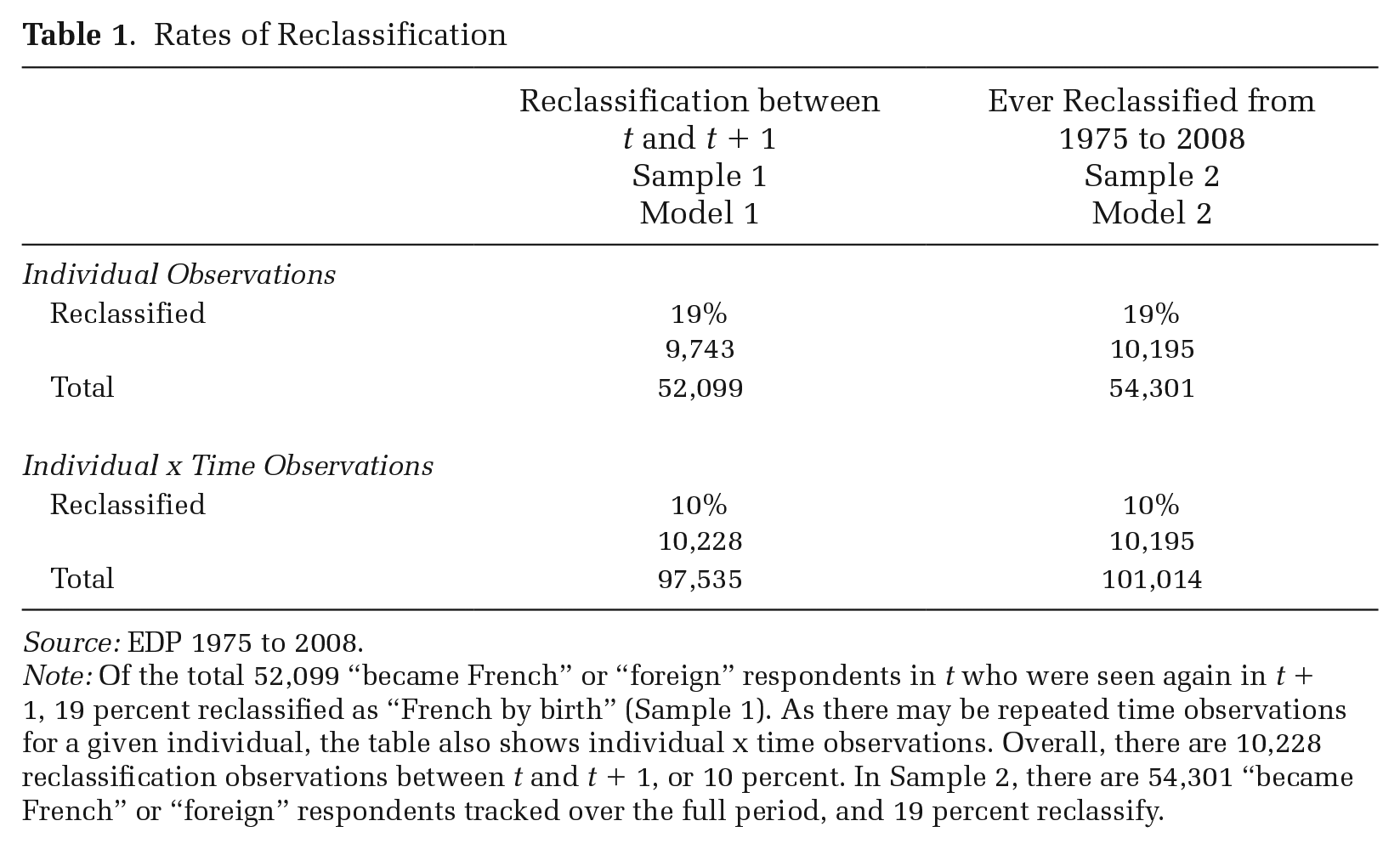
Source: EDP 1975 to 2008.
Note: Of the total 52,099 “became French” or “foreign” respondents in t who were seen again in t + 1, 19 percent reclassified as “French by birth” (Sample 1). As there may be repeated time observations for a given individual, the table also shows individual x time observations. Overall, there are 10,228 reclassification observations between t and t + 1, or 10 percent. In Sample 2, there are 54,301 “became French” or “foreign” respondents tracked over the full period, and 19 percent reclassify.
Reclassification is thus not a statistically rare phenomenon. By comparison, we explored changes to responses on another demographic question, place of birth, which directly precedes the citizenship question in the census form. Here, we find substantially lower rates of change. Less than .5 percent of respondents reported a different place of birth at the next consecutive census date to that reported in t, suggesting these inconsistencies may be statistical noise. 14 This comparison indicates that something specific is at stake when it comes to changes in citizenship declarations that cannot be reduced to data quality. 15
Given the complexities of French citizenship categories, it is possible that respondents misunderstand and hence misreport their citizenship status at a given census date. Nonetheless, it is unlikely that misunderstanding is the core driving mechanism of the change observed in citizenship declarations over time for several reasons.
First, one would expect that respondents who misunderstand their citizenship status would make consistently incorrect declarations over time. Assuming, for instance, that individuals who are legally “became French” falsely believe they are “French by birth,” this would lead to an overestimation of “French by birth” declarations cross-sectionally, but it would not result in changes between categories longitudinally.
Second, if misunderstanding were a source of instability in declarations over time, there is no reason to believe the change would happen in the direction of reclassification. We would instead expect to observe transition between categories in both directions, that is, toward the “French by birth” category as well as away from it. Appendix Table A3 explores this possibility by showing full transitions in citizenship categories between t and t + 1. Reclassification is in fact much higher compared to the opposite trajectory, namely “French by birth” individuals in t who reported being “became French” or “foreigner” in t + 1, a change we call declassification. Indeed, less than 1 percent of respondents declassify in the next census. Changes in citizenship declarations thus occur systematically in one direction.
Third, and perhaps most important, if misunderstanding were underpinning change in citizenship declarations, because of the complexity of citizenship categories in France, we would expect to observe the reverse pattern of transition. Indeed, due to double jus soli law as explained above, children born in France to foreign parents could be at greater risk of falsely declaring they are “French by birth” because they were born in France. Existing research shows these individuals may in fact wrongly report their citizenship, only learning they are not “French by birth” when they undertake administrative procedures to obtain identity documents (Escafré-Dublet and Simon 2014; Ribert 2006; Tribalat 1991). Yet in this case, such respondents would likely correct their misdeclaration at a later point in time. Rather than reclassification, this would result in declassification away from the “French by birth” category over time, which is not what we observe in the data.
Final grounds for arguing that reclassification is not merely terminological misunderstanding come from the French Census Bureau. As Appendix Figure A1 shows, the wording of the “French by birth” category changed in 1999 from “French by birth” to “born French.” The French Census Bureau specifically implemented this change to clarify the meaning of this category for respondents (Rouault and Thave 1997). If reclassification were due to inaccurate “French by birth” declarations based on respondent misunderstanding, one would thus expect a reduction in reclassification after 1999. Yet, the reclassification rate is stable before and after the change to the 1999 questionnaire: 10 percent between 1975 and 1982, 9 percent between 1982 and 1990, and 9 percent between 1990 and 1999. 16
Who Reclassifies?
Table 2 shows results from Models 1 and 2. 17 We compute the marginal effects of the covariates to allow for comparability within and across models. First, nativity is associated with the strongest change in the probability of reclassifying as “French by birth.” Compared to respondents born in France, all foreign-born respondents are significantly less likely to reclassify (Model 1a). For instance, immigrants who arrived in the most recent period (1991 to 1999) have a 25 percentage-point lower probability of switching to a “French by birth” declaration compared to those born in France.
Logistic Regressions Predicting Reclassification
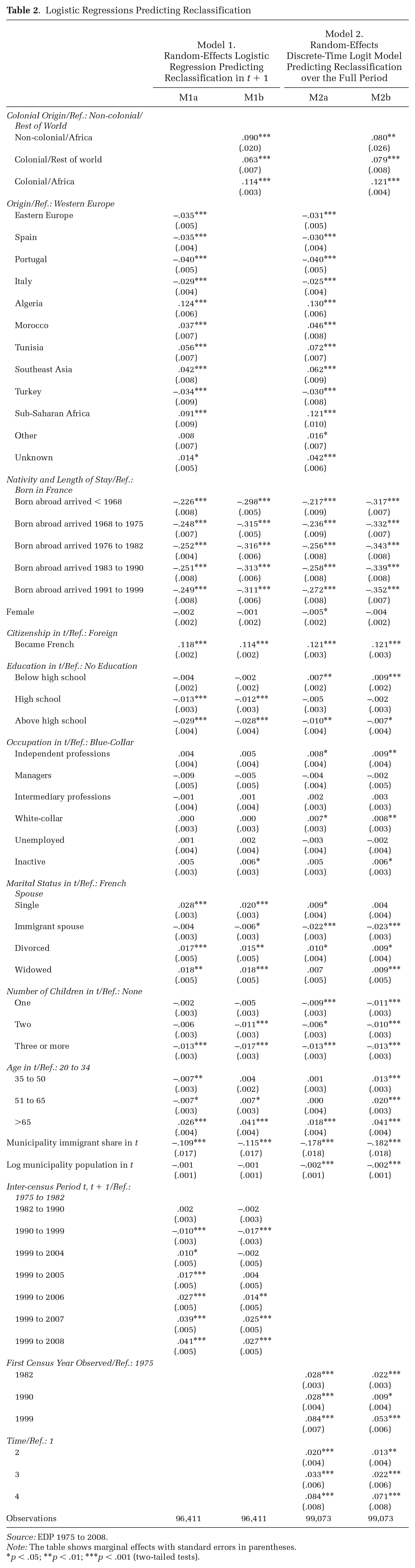
Source: EDP 1975 to 2008.
Note: The table shows marginal effects with standard errors in parentheses.
p < .05; **p < .01; ***p < .001 (two-tailed tests).
Changes in citizenship legislation over the period allow us to delve further into this strong association between being born in France and reclassification. In Table 3, we exploit an exogenous shock related to a change in citizenship legislation affecting this subpopulation. The July 22, 1993 reform, or Méhaignerie law, repealed direct access to citizenship for children born in France to foreign parents, requiring them to formally apply (“manifest their will”) for French citizenship before a judge or administrative authority. 18 This legislation was applied from 1993 to 1998 and abandoned thereafter. During this type of interaction with state agencies, individuals born in France without French citizenship at birth likely became aware of their formal citizenship status (Escafré-Dublet and Simon 2014; Ribert 2006). In the 1999 census, the French Census Bureau instructed respondents having undergone the “manifestation of will” to select the “became French” category (see Appendix Figure A1). Individuals affected by this change of law would arguably be less likely to misreport their citizenship after the reform.
The Effect of the 1993 Méhaignerie Law on Reclassification
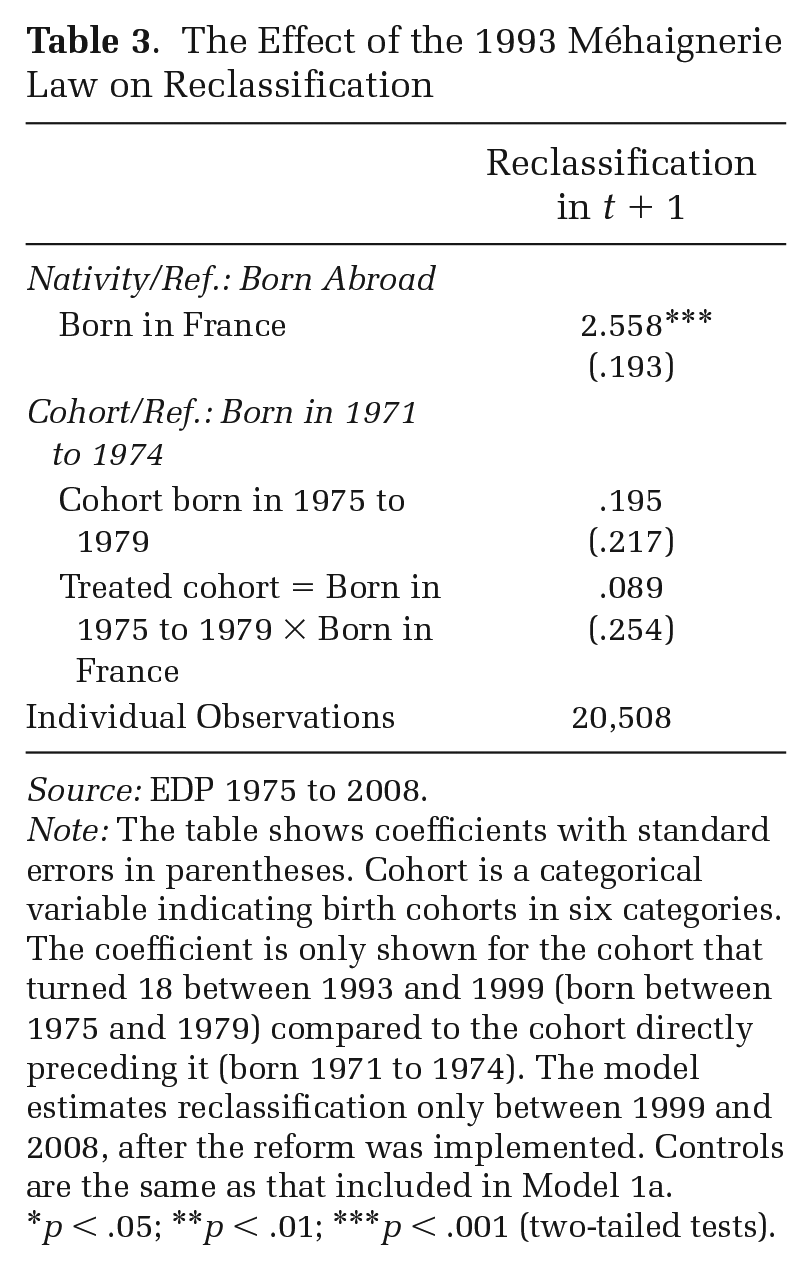
Source: EDP 1975 to 2008.
Note: The table shows coefficients with standard errors in parentheses. Cohort is a categorical variable indicating birth cohorts in six categories. The coefficient is only shown for the cohort that turned 18 between 1993 and 1999 (born between 1975 and 1979) compared to the cohort directly preceding it (born 1971 to 1974). The model estimates reclassification only between 1999 and 2008, after the reform was implemented. Controls are the same as that included in Model 1a.
p < .05; **p < .01; ***p < .001 (two-tailed tests).
We use a difference-in-difference estimation design to identify the causal effect of the exogenous reform on the probability of reclassification between 1999 and 2008. The treated cohort is identified in our sample as persons born in France between 1975 and 1979, that is, who turned 18 between 1993 and 1997 (N = 1,310). The model controls for the same variables as in Model 1a. Table 3 shows three sets of estimates that capture the difference-in-difference design: (1) nativity, or the effect of being born in France compared to being born abroad; (2) the 1993 to 1997 cohort effect; and (3) the interaction effect between the 1993 to 1997 cohort and nativity. Net of other factors, the results show that individuals who were born in France and experienced the Méhaignerie reform do not reclassify significantly less compared to the prior cohort. Thus, even with a procedure that would have increased this cohort’s awareness of their “formal” citizenship status, the probability of reclassification does not diminish. These findings suggest the higher reclassification probability of respondents born in France does not stem from their misunderstanding of the categories.
Table 2 shows substantial variation in reclassification by ethnoracial groups. European-origin respondents have the lowest chances of switching to a “French by birth” declaration; those from North Africa, sub-Saharan Africa, and Southeast Asia are the most likely. The probability of reclassification is particularly pronounced for Algerians and sub-Saharan Africans. Compared to respondents from Western Europe, Algerians have a 12 to 13 percentage-point greater probability of changing to “French by birth” status, and sub-Saharan Africans a 9 to 12 percentage-point greater probability. The only group that deviates from this European/non-European divide are Turkish migrants and their descendants, whose likelihood of reclassification mirrors that of European-origin individuals.
These origin-based patterns appear to reflect a higher propensity to reclassify among post-colonial migrants, as Southeast Asia, North Africa, and much of sub-Saharan Africa were French colonies. This is further observed in the effect of migrant length of stay documented in Table 2, as those who migrated in the immediate post-colonial period (i.e., before 1968) are somewhat more likely to reclassify than those who migrated at more recent dates (see also Table S1 in the online supplement). To delve further into this post-colonial effect, we recoded ethnoracial group to distinguish respondents based on their origin country’s colonial history and added it to the main model (Models 1b and 2b in Table 2). This specification allows us to disentangle the effects of colonial history and ethnoracial group as, within Africa, some countries were colonized by France and others not. Results show that those with origins in former colonies, whether in Africa or elsewhere, are significantly more likely to reclassify compared to respondents with no ties to countries with a colonial past. This probability is particularly strong for respondents originating in former African colonies: net of other factors, their likelihood of switching to a French by birth declaration is 11 percentage-points higher than those with no colonial origins (Model 1b). Yet colonial history does not account for all the variation in reclassification by ethnoracial groups. Reclassification also remains significantly higher for African-origin respondents without a colonial history.
As nativity and colonial origin capture the populations that are most exposed to the complexity of French citizenship law, and given their strong association with reclassification, we ran robustness tests on Models 1 and 2 excluding respondents born in France and respondents with colonial origins, respectively. The reclassification rate remains stable when excluding individuals with colonial origins (10 percent of individual × time observations, similar to what we observed in Table 1). It decreases yet remains considerable when excluding those born in France (5 percent). Moreover, the regression results, presented in Table S5 in the online supplement, show largely similar findings to the main models. Hence, a whole array of analyses consistently show that reclassification is a frequent phenomenon beyond the French-born and colonial-origin respondents, and that the higher probability of these two subpopulations to reclassify does not stem from mere misunderstanding.
Finally, Table 2 shows the effects of additional determinants of reclassification. Regarding citizenship declared at time t, compared to “foreigners,” respondents who ticked the “became French” category in t have around a 12 percentage-point greater chance of switching to “French by birth” in t + 1. Respondents with immigrant spouses are less likely to reclassify, as are those with greater shares of immigrants in their municipality. These results are similar for Models 1 and 2. Socioeconomic characteristics are also significantly linked to reclassification. Overall, the effects of education in Models 1 and 2 suggest high socioeconomic status reduces the chances of reclassification. In Model 1a, compared to respondents with no education, those with a high school education or above have about a 1 to 3 percentage-point lower chance of reclassifying. In the discrete-time logit model, Model 2a, we find a similar trend for education, albeit weaker and less significant. We find few significant differences for occupation.
Do Dynamic Events Trigger Reclassification?
We now turn to Models 3 and 4 to assess whether dynamic events trigger reclassification. Table 4 summarizes the coefficients for these key events (see Appendix Table A4 for full models). We compare estimations from random-effects logistic regressions with those drawn from individual fixed-effects models.
The Effects of Dynamic Events on Reclassification
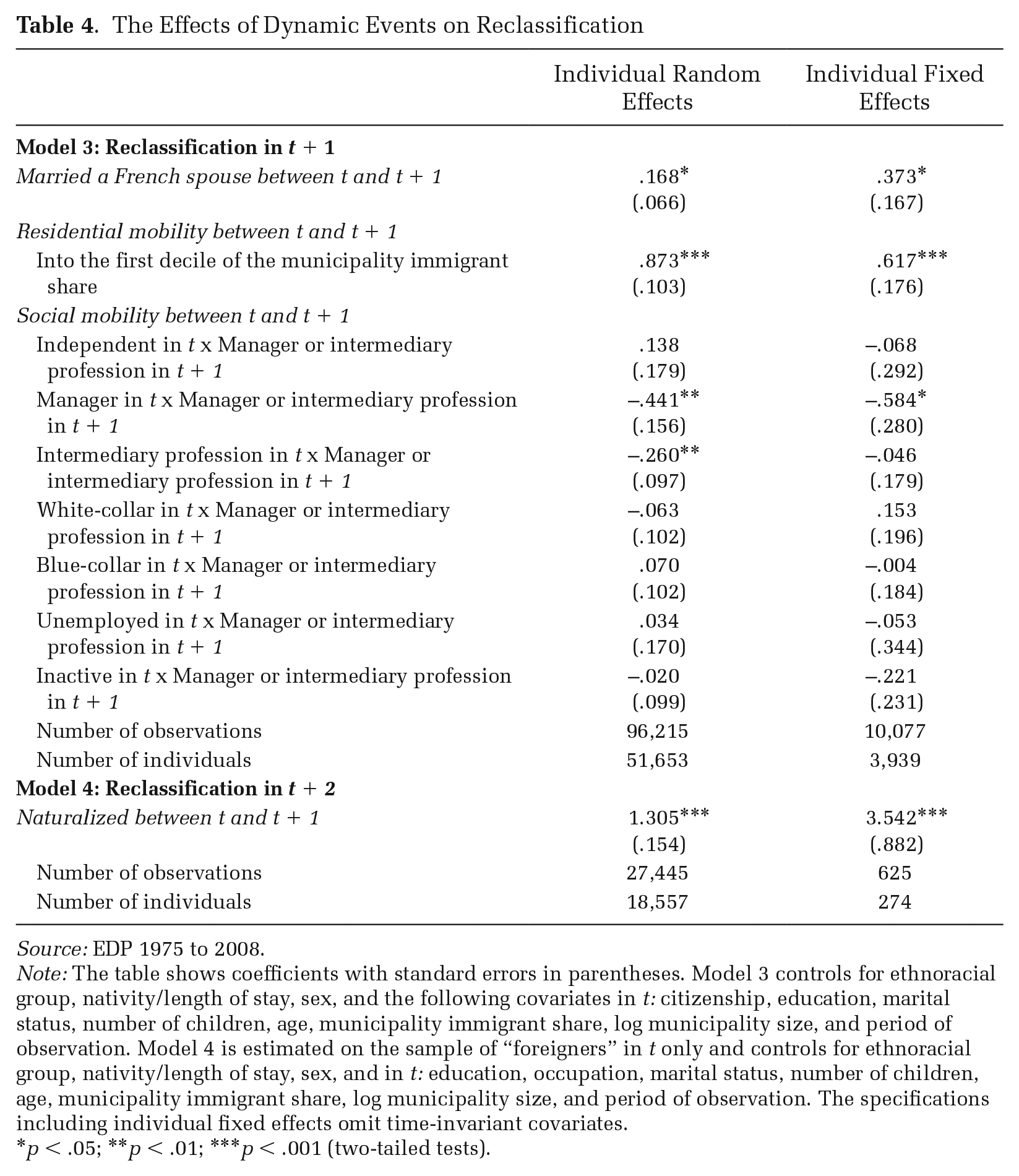
Source: EDP 1975 to 2008.
Note: The table shows coefficients with standard errors in parentheses. Model 3 controls for ethnoracial group, nativity/length of stay, sex, and the following covariates in t: citizenship, education, marital status, number of children, age, municipality immigrant share, log municipality size, and period of observation. Model 4 is estimated on the sample of “foreigners” in t only and controls for ethnoracial group, nativity/length of stay, sex, and in t: education, occupation, marital status, number of children, age, municipality immigrant share, log municipality size, and period of observation. The specifications including individual fixed effects omit time-invariant covariates.
p < .05; **p < .01; ***p < .001 (two-tailed tests).
Results from Model 3 show that marrying a French spouse between t and t + 1 has a positive effect on reclassification in t + 1. 19 Residential mobility exerts a similar effect. Controlling for the level of immigration in respondents’ municipality in t, moving to an area with a lower share of immigrants (specifically, in the first decile) significantly increases the probability of reclassifying. Model 4 highlights that “foreigners” in t who acquired French citizenship between t and t + 1 are more likely to switch to “French by birth” status in t + 2. Thus, we have shown in two ways that naturalization is an event that opens the path toward reclassification. First, in Table 2, by showing the higher probability of reclassification for “became French” respondents compared to “foreigners”; and second, by observing the specific within-individual effect of naturalization among “foreigners” in Model 4, which circumvents the potential selection bias of the previous specifications. More generally, the findings on intermarriage, residential mobility, and naturalization hold in models that do and do not control for individual unobservables, suggesting a causal link between these assimilation trajectories and reclassification.
Finally, Model 3 indicates that the role of social mobility between t and t + 1 is not decisive: accessing the highest occupational categories in t + 1 does not significantly increase reclassification. Moreover, remaining in the top two categories (managers and intermediary professions) significantly reduces the odds of switching to a “French by birth” declaration.
Discussion
The findings give strong support to reclassification as assimilation. In line with Hypothesis 1a, persons born in France compared to those born abroad were more likely to switch to “French by birth” status. Migrants’ period of arrival also increased the likelihood of reclassification, yet this finding appears to be less related to length of stay than to a specific propensity to reclassify among the cohort who migrated prior to 1968. We also found that having French citizenship and being married to a French spouse in t was positively linked with reclassification. Dynamic models further demonstrated the positive effects of naturalization, residential mobility out of immigrant-dense areas, and intermarriage, supporting Hypothesis 1b. Overall, this evidence seems to suggest reclassification is a form of “identificational assimilation” (Gordon 1964). As naturalization is often portrayed as marking the pinnacle of the assimilation process, acquiring citizenship could bolster identification as finally becoming “truly French.” Similarly, individuals with French spouses may feel more legitimate to claim the most native French identity, leading them to realign their citizenship classification. This echoes research showing how ethnoracial identity processes occur within family environments (Afful, Wohlford, and Stoelting 2015). Similar mechanisms may be at work for people living in proximity to French natives, to the extent that local environments also shape self-identification, although self-selection into residential environments still cannot be ruled out. All in all, this evidence indicates that assimilation gradually opens the way for immigrants to claim a “native” national membership.
However, contrary to the predictions of the assimilation model, we do not find support that upward social mobility, as measured by transitions in occupation estimated in dynamic models, triggers reclassification. Instead, we found that individuals with lower education compared to higher education were more likely to switch to “French by birth” status, and those remaining over time in the top occupational categories were less likely to make this change, in line with Hypothesis 2a. Similarly, except for Turkish-origin individuals, non-European minorities, namely respondents of North African, sub-Saharan African, or Southeast Asian origin, were more likely to reclassify, supporting Hypothesis 2b. All these patterns align with the interpretation that switching to “French by birth” declarations is also driven by a status upgrading mechanism to compensate for a low position in socioeconomic and ethnoracial hierarchies. These findings are consistent with prior research that illustrates how disadvantaged groups are more likely to discern and mobilize the symbolic boundaries of citizenship (Bloemraad and Sheares 2017; Joppke 2010). Whereas White immigrants and those with high socioeconomic status tend to have an instrumental relationship to citizenship, benefitting from the freedom of movement and settlement it affords but not necessarily developing an identity attachment (Bloemraad and Sheares 2017; Harpaz and Mateos 2019), the symbolic aspects of citizenship may have higher stakes for disadvantaged groups and ethnoracial minorities, who are more often perceived to be non-citizens and must continuously prove their membership. These groups also stand to gain more from the “protective” material and status benefits of citizenship (Gilbertson and Singer 2003), which could lead them to opt for the highest status category.
We also found some heterogeneity in reclassification patterns within non-European origins. Turkish-origin respondents proved to be an exception, with reclassification levels similar to European-origin individuals. Existing studies show that, compared to other groups, Turkish immigrants in France are strongly attached to their home country and are less likely to develop a strong sense of national belonging and identification with the destination country (Ersanilli and Saharso 2011; Safi 2008). Turkish-origin individuals also report lower levels of perceived discrimination than do African-origin individuals (Safi and Simon 2013). As Turkey was not a French colony, these respondents are not exposed to the stigma attached to post-colonial migration (Silberman, Alba, and Fournier 2007). The two mechanisms we suspect to be driving reclassification (i.e., assimilation and status upgrading) are hence less effective for Turkish-origin individuals, which helps explain their lower levels of reclassification.
The lack of information about respondents’ subjective motivations for reclassification does not allow us to be fully conclusive about its driving mechanisms. First, citizenship law in France is complex, and individuals might not understand these categories. As we lack a direct measure of respondents’ degree of understanding of these categories, we cannot rule out the possibility that their complexity at least partly accounts for the instability of citizenship declarations over time. Nonetheless, the specificity of this pattern of change in citizenship declaration (toward the “French by birth” category and not away from it), as well as a wide range of robustness checks, whether excluding the populations that are the most exposed to the complexity of citizenship law or focusing on individuals who have experienced formal citizenship procedures that should have sharpened their understanding of the categories, all suggest that misunderstanding is not the core driving factor of reclassification. Patterns of change in citizenship declarations are consistent across different populations and similarly correlate to the same set of independent variables identified in our theoretical section as pointing to either assimilation or status upgrading. Second, the nature of our data also prevents us from giving exclusive support to one or the other mechanism as, overall, the findings point in both directions. On the one hand, dynamic models demonstrating the positive effects of intermarriage, naturalization, and residential mobility provide the strongest evidence for the assimilation mechanism, because they capture the temporal dimension of assimilation trajectories while controlling for individual heterogeneity. On the other hand, the variation in reclassification linked to socioeconomic status and ethnoracial group (even net of colonial origin) are less consistent with assimilation and are more interpretable as status upgrading.
Some evidence suggests that the two mechanisms can be simultaneously at play and should not be thought of as mutually exclusive. This is particularly true for post-colonial respondents, in particular Algerian migrants, who were more likely to reclassify. On the one hand, as a result of their assimilation trajectories, they could increasingly identify with the “French by birth” citizenship status as, long after the colonial period, they may be less reluctant to view their country of birth as formerly part of France. On the other hand, as postcolonial migrants, and Algerians in particular, are disadvantaged and stigmatized minorities (Silberman et al. 2007), their greater likelihood of reclassification could reflect status upgrading. If such individuals always considered themselves French and yet felt society denied them this identity, switching to “French by birth” status might be a means of asserting their deservingness as native French citizens.
Whether driven by assimilation and increased sense of belonging or by status compensation mechanisms (or both), reclassification implicitly reaffirms the “French by birth” category as the desired norm in the citizenship hierarchy. The distinction promoted by the French citizenship regime between the “French by birth” and “became French” categories conveys a fundamentally nativist approach that makes Frenchness possible from a legal point of view, yet not fully attainable from a symbolic point of view. Reclassification transgresses this citizenship hierarchy but also implicitly reinforces the salience of this categorization, as reclassifying respondents indirectly assert the distinction between “became French” and “French by birth” citizens. Specific events, such as legally changing citizenship (i.e., naturalization), getting married to a French spouse, or moving to a low-immigrant neighborhood, appear to be “transformative” here—triggering the feeling of being “born again French”—similar to how the experience of legalization leads some undocumented migrants in the United States to reaffirm the profile of the “legal deserving” immigrant (Menjívar and Lakhani 2016).
Our findings stress the importance of the symbolic boundaries of citizenship categories and the underlying hierarchy of citizens they convey. From this perspective, studying changes in individual identification with citizenship categories invites a comparison with the literature on ethnoracial fluidity. Recent empirical studies use race/ethnicity as a dependent variable and show how ethnoracial identifications fluctuate over time, as individuals switch strategically between self-reported categories like “White” and “Black” in connection with life events such as social mobility, incarceration, and intermarriage (Carvalho et al. 2004; Davenport 2020; Loveman and Muniz 2007; Penner and Saperstein 2008; Saperstein and Penner 2012). 20 We have shown that individuals cross supposedly stable citizenship boundaries in similar ways. Despite citizenship being an invisible boundary marker, the identity and status components embedded in the categories motivate individuals to appropriate, emphasize, or even perform their “Frenchness” when filling out census forms, as has been documented in other empirical contexts, such as when social desirability shapes responses to citizenship questions in surveys (Brown et al. 2019; Van Hook and Bachmeier 2013), or when ethnoracial minorities promote a “good” French national identity in qualitative interviews (Escafré-Dublet and Simon 2014).
Connecting citizenship boundary-crossing to ethnoracial fluidity provides novel theoretical insights. Given the ethnoracial content of “French by birth” status, choosing this category can be equivalent to identifying with the ethnoracial majority group. Ethnographic evidence suggests that belonging to the “French by birth” class of citizens carries a distinct social advantage and bears potent ethnoracial connotations in which Frenchness and whiteness are confounded (Beaman 2019; Escafré-Dublet and Simon 2014; Fassin and Mazouz 2007). In this sense, reclassification may be interpreted as an attempt at “whitening.” Moreover, although France emphasizes the legitimacy of citizenship categories over ethnoracial measurements due to their supposed objectivity, our findings suggest individuals symbolically engage with the ethnoracial component of citizenship, and they do so in a “fluid” manner. Citizenship thus operates as a form of ethnoracial categorization in a civic regime and post-colonial state (FitzGerald 2017), where ethnoracial boundaries are officially invisible, but where ethnoracial minorities remain in many ways second-class citizens.
Similar to studies on ethnoracial fluidity (Bailey, Loveman, and Muniz 2013; Liebler et al. 2017; Saperstein and Penner 2012), we conclude by empirically investigating how citizenship reclassification patterns affect socioeconomic inequality as measured with these citizenship categories. This is especially crucial in France, where the definition of immigrants relies on both country of birth and citizenship at birth status, in contrast to many countries that accept the foreign-born definition used by international organizations. By redefining who is a “foreigner” and who is “became French” over time—and thus reshaping the contours of who constitutes an “immigrant”—reclassification could have concrete implications for the measurement of socioeconomic disparities between natives and immigrants in the French context.
We measure socioeconomic inequalities using unemployment rates. Figure 1 compares the magnitude of the unemployment gap with and without correcting for reclassification. Results are presented as marginal effects of the foreign-origin population compared to “French by birth” respondents for each census year. Estimations are based on logistic regressions. The uncorrected estimates rely on self-reported citizenship in a given year cross-section, regardless of potential changes in declarations over time. The corrected estimates take into account reclassification and impute to such individuals a foreign-origin in all years. We plot the unadjusted gap (from a baseline model including only citizenship and year as covariates) and the adjusted gap (adding sociodemographic controls). Although modest, the unemployment gap is consistently higher in estimates that correct for citizenship changes. The gap is statistically significant in the unadjusted models, but not after controlling for sociodemographics. Therefore, the standard use of self-reported citizenship under-estimates socioeconomic disparities by failing to account for the recomposition of these categories over time. Citizenship boundary-crossing thus has implications for social stratification and is therefore necessary to consider for any study on immigration and assimilation.
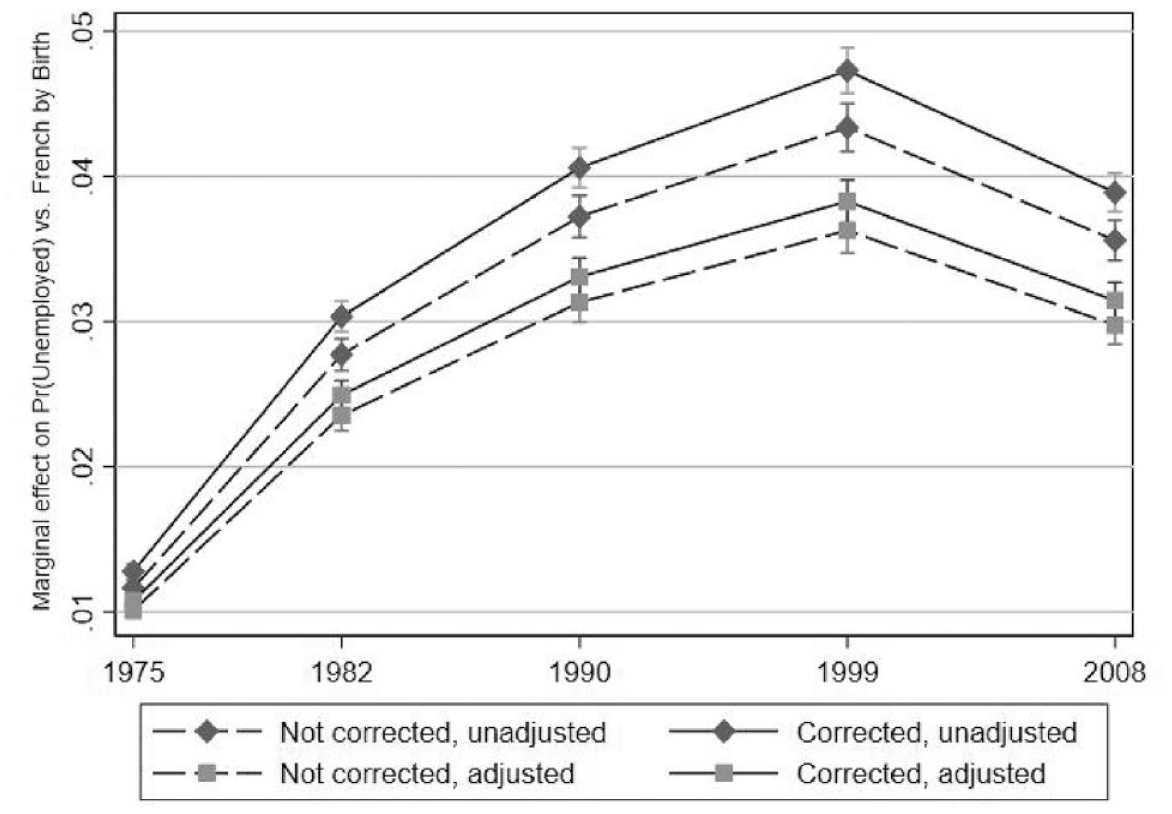
Estimations of the Unemployment Gap between “French By Birth” and Foreign-Origin Respondents
Conclusions
This article investigated the determinants of a legally inconsistent change in self-reported citizenship over time using French longitudinal data. The analysis focused on foreign-origin respondents who moved up in the hierarchy of citizenship categories by switching to “French by birth” status, or what we called reclassification. The administrative data used here provide a unique opportunity to study variations in self-declared citizenship over time. Covering more than 30 years, they offer a long-term individual follow-up for a large sample. This allows us to highlight the magnitude of the reclassification phenomenon as well as its specific patterns and determinants.
The findings showed that the likelihood of reclassification is frequent and appears to be driven by assimilation and status upgrading mechanisms. Overall, our findings illustrate that the “French by birth” category can be interpreted not only as a legal category in a civic regime, but also as a symbolic boundary that individuals can cross in line with their positions of disadvantage in French society and with assimilation events that bolster a “native” or “natural” French identity. Aligning with research that increasingly challenges the civic/ethnoracial citizenship dichotomy, our findings illustrate the ubiquity of both the civic and ethnoracial meanings encapsulated in citizenship categories, even in a context such as France, where the former is supposed to be more salient than the latter.
Despite the advantages of our approach, the data used here do not allow us to explore more in-depth the subjective dimensions of this process of citizenship change. In particular, we are not able to identify the degree to which ticking the citizenship box is experienced as a conscious or unconscious enactment of identity or status, or whether and how reclassification occurs in social interactions beyond filling out the census form. Nonetheless, our findings are consistent with qualitative research in France showing the symbolic dimensions of these categories (Mazouz 2019; Ribert 2006; Sayad 1993).
A further limitation of our analysis is the inability to assess how the context of data collection influenced self-reported citizenship. Completing the census form involves a direct or indirect interaction with an official representative of the French state, so interviewer characteristics may influence respondents’ instrumentalization of the “French by birth” category to signal their belonging. Still, if this type of social desirability bias indeed influences citizenship changes (Brown et al. 2019), this would not undermine our findings, but would support the hypothesis that individuals operationalize these categories in strategic ways to fit into a desired norm of Frenchness during social interactions.
Beyond the specific context of France, the ways legal categories are potentially understood and operationalized by individuals have important implications for social stratification in general. By infusing legal categories with subjective meanings and construing certain statuses as “better” than others, states reinforce the moral content of these classifications, distinguishing who is worthy and deserving of national membership. The symbolic appropriation of legal classifications by individuals reifies these distinctions and legitimizes the social inequalities built into them—even among the very groups who are most disadvantaged by their negative effects (Menjívar and Abrego 2012). Our findings speak to research that has analyzed the fragmentation of citizenship in the use of such categorizations and its consequences for the civic stratification that continues to operate in many Western societies in tension with their apparent legal-egalitarianism (Morris 2002; Motomura 2014; Stuart, Armenta, and Osborne 2015). The empirical case of citizenship changes in France contributes to this scholarship on civic stratification by highlighting the intersections with immigrant assimilation trajectories and ethnoracial inequality. This case also adds to a general critique of legal categories as neutral and objective, and resituates them as fluctuating, symbolic, and socially-constructed grounds for inequality-making that overlap and interact with other dimensions of social stratification. Our findings invite future research to continue to explore the fluid and symbolic content of supposedly rigid systems of classification in other national contexts.
Supplemental Material
sj-pdf-1-asr-10.1177_00031224231207392 – Supplemental material for Born Again French: Explaining Inconsistency in Citizenship Declarations in French Longitudinal Data
Supplemental material, sj-pdf-1-asr-10.1177_00031224231207392 for Born Again French: Explaining Inconsistency in Citizenship Declarations in French Longitudinal Data by Louise Caron, Haley McAvay and Mirna Safi in American Sociological Review
Footnotes
Appendix
Full Results for Models 3 and 4
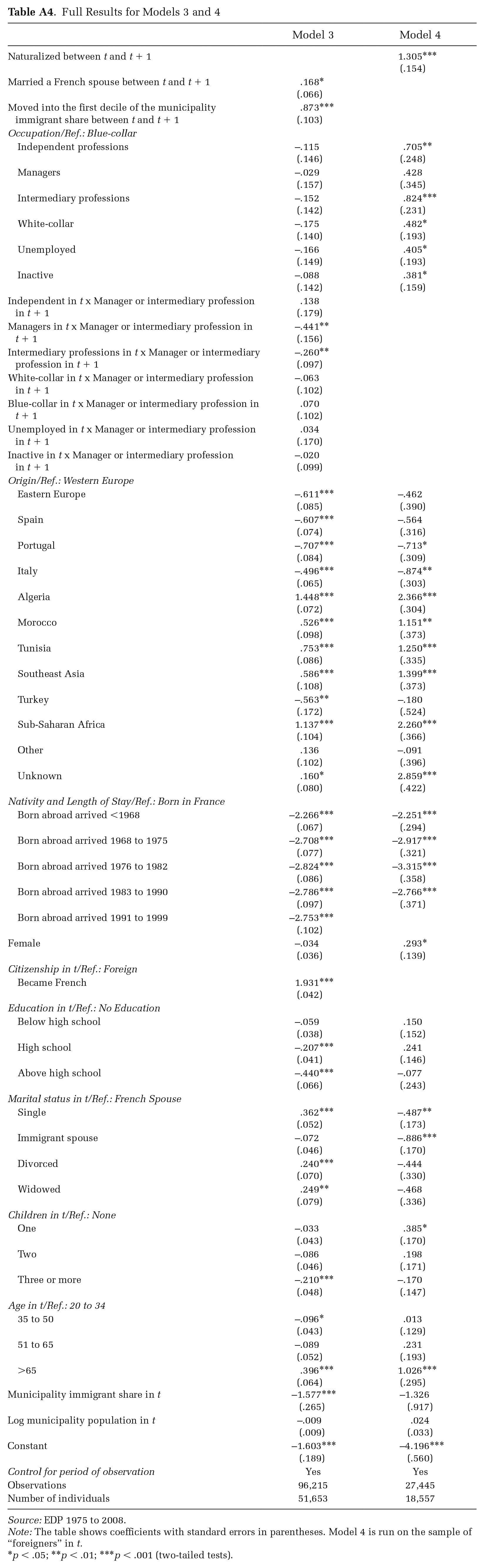
| Model 3 | Model 4 | |
|---|---|---|
| Naturalized between t and t + 1 | 1.305***
|
|
| Married a French spouse between t and t + 1 | .168*
|
|
| Moved into the first decile of the municipality immigrant share between t and t + 1 | .873***
|
|
| Occupation/Ref.: Blue-collar | ||
| Independent professions | −.115 |
.705**
|
| Managers | −.029 |
.428 |
| Intermediary professions | −.152 |
.824***
|
| White-collar | −.175 |
.482*
|
| Unemployed | −.166 |
.405*
|
| Inactive | −.088 |
.381*
|
| Independent in t x Manager or intermediary profession in t + 1 | .138 |
|
| Managers in t x Manager or intermediary profession in t + 1 | −.441**
|
|
| Intermediary professions in t x Manager or intermediary profession in t + 1 | −.260**
|
|
| White-collar in t x Manager or intermediary profession in t + 1 | −.063 |
|
| Blue-collar in t x Manager or intermediary profession in t + 1 | .070 |
|
| Unemployed in t x Manager or intermediary profession in t + 1 | .034 |
|
| Inactive in t x Manager or intermediary profession in t + 1 | −.020 |
|
| Origin/Ref.: Western Europe | ||
| Eastern Europe | −.611***
|
−.462 |
| Spain | −.607***
|
−.564 |
| Portugal | −.707***
|
−.713*
|
| Italy | −.496***
|
−.874**
|
| Algeria | 1.448***
|
2.366***
|
| Morocco | .526***
|
1.151**
|
| Tunisia | .753***
|
1.250***
|
| Southeast Asia | .586***
|
1.399***
|
| Turkey | −.563**
|
−.180 |
| Sub-Saharan Africa | 1.137***
|
2.260***
|
| Other | .136 |
−.091 |
| Unknown | .160*
|
2.859***
|
| Nativity and Length of Stay/Ref.: Born in France | ||
| Born abroad arrived <1968 | −2.266***
|
−2.251***
|
| Born abroad arrived 1968 to 1975 | −2.708***
|
−2.917***
|
| Born abroad arrived 1976 to 1982 | −2.824***
|
−3.315***
|
| Born abroad arrived 1983 to 1990 | −2.786***
|
−2.766***
|
| Born abroad arrived 1991 to 1999 | −2.753***
|
|
| Female | −.034 |
.293*
|
| Citizenship in t/Ref.: Foreign | ||
| Became French | 1.931***
|
|
| Education in t/Ref.: No Education | ||
| Below high school | −.059 |
.150 |
| High school | −.207***
|
.241 |
| Above high school | −.440***
|
−.077 |
| Marital status in t/Ref.: French Spouse | ||
| Single | .362***
|
−.487**
|
| Immigrant spouse | −.072 |
−.886***
|
| Divorced | .240***
|
−.444 |
| Widowed | .249**
|
−.468 |
| Children in t/Ref.: None | ||
| One | −.033 |
.385*
|
| Two | −.086 |
.198 |
| Three or more | −.210***
|
−.170 |
| Age in t/Ref.: 20 to 34 | ||
| 35 to 50 | −.096*
|
.013 |
| 51 to 65 | −.089 |
.231 |
| >65 | .396***
|
1.026***
|
| Municipality immigrant share in t | −1.577***
|
−1.326 |
| Log municipality population in t | −.009 |
.024 |
| Constant | −1.603***
|
−4.196***
|
| Control for period of observation | Yes | Yes |
| Observations | 96,215 | 27,445 |
| Number of individuals | 51,653 | 18,557 |
Source: EDP 1975 to 2008.
Note: The table shows coefficients with standard errors in parentheses. Model 4 is run on the sample of “foreigners” in t.
p < .05; **p < .01; ***p < .001 (two-tailed tests).
Acknowledgements
The authors would like to thank all of the anonymous reviewers and the editors for their valuable comments and suggestions. We are also grateful to Bastian Betthaeuser, Emmanuel Blanchard, Angéline Escafré-Dublet, Yajna Govid, François Héran, Ettore Recchi, and Pavlos Vasilopoulos for their insights.
Funding
This project benefited from the financial support provided by the French Agence Nationale de la Recherche (grant ANR-17-CE41-0009-01; M. Safi), which allowed us to access the data via the Centre d’accès sécurisé aux données (CASD).

Notes
References
Supplementary Material
Please find the following supplemental material available below.
For Open Access articles published under a Creative Commons License, all supplemental material carries the same license as the article it is associated with.
For non-Open Access articles published, all supplemental material carries a non-exclusive license, and permission requests for re-use of supplemental material or any part of supplemental material shall be sent directly to the copyright owner as specified in the copyright notice associated with the article.
