



Abstract
Past research has posited that occupations are distinct and exclusive communities of workers and used single-entry questions in surveys to measure occupational self-identification. Our study challenges that view by reporting the existence of polyoccupationalism, or workers’ simultaneous identification with multiple occupations. We predict this phenomenon co-occurs with postindustrial forms of work organization and that its expression varies with workers’ position in the occupational structure. Using a survey on creative workers that uniquely allowed respondents to identify with multiple occupations, we find individuals report higher levels of polyoccupationalism when their work is more contract- and project-based, net of other individual and occupational attributes. We further show that polyoccupationalism takes different forms at the top and the bottom of the occupational hierarchy: whereas the polyoccupationalism of high-status “entrepreneurs” stretches expertise—they identify with occupations that are similar in status but functionally distinct—that of lower-status “hustlers” stretches status—the occupations they report involve similar tasks but stand farther apart on the occupational status scale. We discuss the implications of these findings for understanding workers’ occupational identities and the dynamics of occupational hierarchies.
Over more than a century of study, sociologists have demonstrated the manifold ways occupations are a “main” or “master” source of identity for individuals (Durkheim [1893] 1984; Emmison and Western 1990; Grusky and Sørensen 1998; Marx [1867] 1976). As Hughes (1958:42) famously put it, occupation names are “a combination of price tag and calling card”: in addition to providing workers with the (dis)benefits of location within a hierarchical system of social stratification, occupations describe expertise domains or roles within the functional division of labor (Durkheim [1893] 1984; Grusky and Galescu 2005; see also Bouglé [1927] 1971). The deployment of an occupation name as a “calling card” may be even more important today, as evidence suggests individual income is a function of one’s ability to make “identity and resource claims” within the workplace (Tomaskovic-Devey and Avent-Holt 2019).
Scholars have documented how occupational identification—specifically, workers’ self-definition through an occupation name—issues not just from educational and professional socialization (Anteby, Chan, and DiBenigno 2016; Becker and Carper 1956; Becker et al. 1961; Ulfsdotter Eriksson and Linde 2014), but also from workers’ embeddedness in the ever-changing social organization of labor (Abbott 1989; Dubar 1991). In the earliest days of our discipline, Durkheim conceptualized “occupations” as cohesive social groupings, or “small classes” that “shape [the] individual values, life chances, and lifestyles” of workers accomplishing similar tasks (Grusky and Galescu 2005:55). By the middle of the twentieth century, sociologists turned their attention to the role of organizations in defining workers’ identities, in part because so many professionals in the United States spent their careers laboring for one employer (Baron 1994). Over time, however, as internal labor markets that supported this view of the “organization man” (Whyte 1956) withered, new, “postindustrial” forms of work organization developed (Grusky and Sørensen 1998). In contrast to the past, these relied on project-based work and nonstandard forms of employment (Barley, Bechky, and Milliken 2017; Bidwell and Briscoe 2010; Kalleberg 2000). How has this shift in the social organization of labor affected the way individuals define their occupation?
Existing answers to this question tend to fall into extreme positions: for some, recent transformations in the organization of work have ushered in a “post-occupational society” (Casey 1995), in which project-based teams and diffuse knowledge communities have become more relevant to workers’ identities than occupational affiliations. Others argue that these transformations resulted in the “occupationalization” of the labor market (Grusky and Galescu 2005), as the dissolution of durable ties to organizations left workers with occupations as their last stable source of work-related identity. In this article, we consider a third possibility: that workers in the postindustrial era increasingly assume multiple, concurrent occupational identities. We forge the concept of polyoccupationalism to describe workers’ simultaneous identification with multiple occupations. We offer empirical evidence of this phenomenon, a first theorization and test of its relationship with postindustrial forms of work organization, and an exploration of how polyoccupationalism takes different forms at the top and bottom of the occupational hierarchy.
An important body of qualitative research suggests that polyoccupationalism may exist. We know, for instance, that contemporary workers mitigate labor market uncertainties by building “portfolios” of activities that often cross occupational boundaries (Chong 2021; Handy 1989), increase their income and enrich their work lives through “multiple jobholding” (Caza, Moss, and Vough 2018; Sliter and Boyd 2014), perform “multi-layered labor” (Dumont 2016; see also Fine 1996), and use “hybrid” or “hyphenated” occupational titles to promote the distinctiveness of their expertise (Caza and Creary 2016; O’Mahony and Bechky 2006; Vallas and Christin 2017). Yet, a systematic account of polyoccupationalism has been precluded by predominant theoretical conceptualizations of occupations as distinct and exclusive communities (Abbott 1988; Freidson 1994; Larson 1977; Weber [1922] 1978), as well as the reliance in prior research on single-entry questions to measure occupational identification in surveys.
In this article, we explore polyoccupationalism by taking advantage of a large survey of creative workers in the United States—the Strategic National Arts Alumni Project (SNAAP) survey—which uniquely allowed respondents to identify with as many occupations as they deemed necessary from a list of nearly two dozen census-like categories. We start by clarifying the links between prior research and our concept of polyoccupationalism, before theorizing the relation of polyoccupationalism to postindustrial forms of work and work organization, and to workers’ position in the occupational hierarchy. Combining SNAAP’s multiple-entry occupation items with fine-grained information about respondents’ work characteristics, and with occupational-level data from the Bureau of Labor Statistics (BLS) and the Occupational Information Network (O*NET), we next document the magnitude of polyoccupationalism in a sample of 14,774 creative workers in the United States, and we show how reports of polyoccupationalism correlate with participation in contract-based and project-based work. Our analysis further demonstrates that different types of polyoccupational identities are predictably distributed across the occupational hierarchy: whereas the polyoccupationalism of high-status “entrepreneurs” stretches expertise—they identify with occupations that are similar in status but functionally distinct—that of lower-status “hustlers” stretches status—the various occupations they report involve similar tasks but stand farther apart in the occupational status hierarchy. Both polyoccupationalism and the varied forms it assumes in different regions of occupational space, we argue, have implications for understanding workers’ identities and the dynamics of occupational hierarchies.
Occupational Identification As A Social Process
When answering the question “What do you do?” in the context of a survey and in casual social interactions, most people offer names such as “baker,” “lawyer,” or “IT project manager.” In doing so, they engage in an interpretive process, an exercise of “self-identification” that takes place “in dialectic interplay with external identification” (Brubaker and Cooper 2000:15) as individuals translate what they think of themselves into available occupational classifications and categories jointly produced by the state (Amossé 2013; Conk 1978; Connelly, Gayle, and Lambert 2016; Sobek 1996), schools, firms (Abbott 1989), and occupational groups (Abbott 1988; Freidson 1994; Weeden 2002; Weeden and Grusky 2012).
Social scientists recognize occupational identification as a declaration of belongingness (Dubar 1991) to one group of workers who share a title and work experiences, values, and economic interests. This recognition is largely premised on a conception of occupations as distinct and exclusive communities—a conception that emerged from the study of the early modern economy, and which theorized occupations as products of the “division of labor” (Durkheim [1893] 1984). Consistent with this view, occupational scholars have long studied how “cliques” (Parsons 1939) or cohesive “communities” (Goode 1957) of workers engage in collective efforts to establish “social closure” (Weber [1922] 1978), “monopol[ies]” (Larson 1977), “jurisdictions” (Abbott 1988), or “market shelters” (Freidson 1994) for their occupation. The notion of a strong and exclusive bond between individuals and their occupation is likewise a tenet of research on occupational socialization (Becker et al. 1961; Van Maanen 1975; Van Maanen and Schein 1979). In this body of research, multiple occupational memberships are viewed as rare, deviant, or transitory (Morris and Murphy 1959; Strauss 1978).
This dominant view of occupational identification is reflected in the use of occupational survey instruments that force respondents to identify with single occupations. For example, the current coding guidelines from the U.S. Bureau of Labor Statistics (2017:10) for occupational identification items direct that “when workers in a single job could be coded in more than one occupation, they should be coded in the occupation that requires the highest level of skill. If there is no measurable difference in skill requirements, workers should be coded in the occupation in which they spend the most time.” Most major surveys likewise pigeonhole workers into one “primary,” “predominant,” “real,” or “true” occupation, thereby suppressing the expression of respondents’ whole occupational identity. 1
The way occupational data are collected and treated is known to reflect views of the labor force by government officials and social scientists (Conk 1978; Sobek 1996). We propose that existing occupational identity survey instruments are rooted in an industrial vision of the labor force as composed of workers performing a limited number of specialized tasks (Smith [1776] 2008). As scholars have documented the shift of increasingly large areas of the economy toward new forms of work and organization of labor, commonly labeled as postindustrial, we ask whether this shift should change how we think about, and measure, occupational identities.
Occupational Identities In A Postindustrial Era
How relevant and meaningful are occupations to workers engaged in postindustrial forms of work? Some commentators argue that recent transformations in the organization of work have led to the decline of occupational identities and solidarity (Hall 1988). Sennett’s (1998) examination of “flexible regimes” of work finds that employees who juggle multiple jobs and frequently change employers develop “weak” occupational identities. Kalleberg (2009:9) likewise suggests that nonstandard working conditions promote occupational “anomie” by demeaning occasional workers as “just temps” (see also Feldman, Doerpinghaus, and Turnley 1994; Svensson 2012). Studying skilled workers in design firms, Casey (1995:108) describes a “postoccupational society” where “knowledge” and “team” replace occupations as “a primary locus of class and self-identification.” In summary, these postoccupationalist narratives argue that, as a result of broader shifts toward a postindustrial organization of work, “occupational boundaries become more amorphous and occupational affiliations more ephemeral” (Weeden and Grusky 2012:1835).
In contrast, others argue that, in postindustrial sectors, occupational membership fills the identity space left vacant by the loosening of bonds between workers and workplaces (Barley et al. 2017; Barley and Kunda 2004; Piore and Sabel 1984). The “organization man,” Anteby and colleagues (2016:185) write, “is being replaced in many industries by someone who specializes in an occupation and moves between organizations over the course of his or her career or works outside of formal organizations—what we might call an ‘occupation (wo)man.’” Freidson (2001:78) argues that new kinds of careers emerging from the rise of nonstandard employment arrangements are one form of “professionalism,” understood as the control of the organization of labor by occupational groups, and non-bureaucratic, decentralized, project-based forms of work organization have been described as “a guarding of highly valued occupational identities” (Kellogg, Orlikowski, and Yates 2003:5). At the macro level, and against a backdrop of labor market flexibilization, Grusky and Galescu (2005:61) observe a “Durkheimianization” and “occupationalization” of the labor force, marked by the growth of the professional sector and the persistence of strong occupational unions and associations. In short, and despite transformations in the social organization of work, these occupationalization narratives suggest that individual identities and self-definitions remain strongly, and perhaps increasingly, shaped by occupational affiliations (Grusky and Sørensen 1998).
Can both of these narratives be true? Postoccupationalist accounts seem right in emphasizing that postindustrial forms of work organization relax workers’ exclusive identification with single occupations, yet we question their conclusion that workers de-identify with occupational groups as a consequence. Rather, we argue that nonstandard forms of employment and non-bureaucratic forms of work organization promote workers’ simultaneous identification with multiple occupations. This phenomenon, which we refer to as polyoccupationalism, is consistent with occupationalization narratives that stress the continued or increased relevance of occupational logics to workers’ careers and identities. In the next two sections, we theorize (1) how polyoccupationalism is related to the distinctive features of postindustrial labor, and (2) how different forms of polyoccupationalism are distributed at the top and bottom of the occupational hierarchy.
Polyoccupationalism And Postindustrial Work
One defining characteristic of postindustrial work is that it disproportionately involves “nonstandard” or “alternative” forms of employment, such as contracting and freelancing, in which individuals can work simultaneously for multiple employers or multiple units of the same employer (Barley and Kunda 2004; Kalleberg 2000, 2009). Because contracts with different employers can involve work on tasks that would fall within the purview of different occupations (Katz and Krueger 2019; Smith 1997), nonstandard employment makes it possible for workers to decouple themselves from a single occupational identity. To the extent that contract-based workers are free from the employer-employee relationship, they have been described as “self-directing” their “protean” careers (Briscoe and Hall 2006; Hall 1996) in ways that enable them to take jobs in diverse occupational areas to fulfill their multiple needs and earn different types of rewards. For example, Rowe (2019) argues that designers and digital-media artists use “side projects,” “freelance exploration,” and “strategic alternation” to combine lucrative and meaningful work, a combination they could not find in any single contract or with any single employer. Holding multiple occupational roles may also work as a strategy to mitigate the instability of labor markets and survive periods of un- or underemployment (Chong 2021; Handy 1989; Menger 2001), with workers often combining stable employment in “host” occupations (Freidson 1994, 2001) with other less dependable work (Gerber 2017; McRobbie 1998; Schlesinger and Waelde 2012; Throsby and Zednik 2011). O’Mahony and Bechky (2006) have shown that contract-based workers leverage their skills to “bridge” into occupational areas in which they have no prior experience, engaging in what the authors call “stretchwork.” When asked “What do you do?”, then, workers in nonstandard forms of employment should be more likely to use hyphenated or multiple descriptors, because their different jobs are likely to be in different occupations.
A second characteristic of postindustrial work is that it is disproportionately organized around “projects” in which specialized workers collaborate in relatively non-hierarchical and non-bureaucratic ways (Boltanski and Chiapello 2005; Faulkner and Anderson 1987; Hogson 2004; Stinchcombe 1959). Project-based work foregrounds projects over organizations and workers’ specific roles within them. This means that project-based workers are more likely to engage in “continual learning” as they regularly need to perform tasks associated with new work roles for the sake of the project (Valdés and Barley 2016). Consistent with this, Casey (1995) shows that occupational boundaries are considerably weakened when multi-occupational projects become the organizing unit of work relations. Likewise, members of cross-functional teams often report having acquired new skills as a result of project-based labor (Molleman and Broekhuis 2011; see also Abbott 1988:68; Barley 1983; Vaughan 2002), so that their domains of intervention become less clearly demarcated (Molleman et al. 2008). This may be because, when “jobs” are replaced by “projects,” workers need to handle continuously evolving work assignments or “shifts in what people do at their job” (Autor 2013:190) to meet the project’s goals. Workers themselves may also promote “task expansion” and engage in “job crafting,” one project after another, to increase their chances for leadership roles (Wrzesniewski and Dutton 2001). When prompted to answer the question “What do you do?”, workers in project-based forms of work should thus be more likely to cite hyphenated or multiple descriptors because any one of their jobs is likely to blend skills traditionally attached to multiple occupations.
Overall, we expect workers engaged in postindustrial forms of labor to accomplish work that is more occupationally diverse; this should translate into workers claiming a larger number of occupational identities when given the opportunity. Specifically, we expect workers to express more polyoccupational identities when their work is more contract-based and more project-based:
Hypothesis 1: Workers engaged in contract-based work—as their sole form of employment or in combination with a salaried position—identify with more occupations.
Hypothesis 2: Workers whose work is more project-based identify with more occupations.
Importantly, these two hypotheses posit two separate (although not exclusive) mechanisms linking postindustrial work and polyoccupationalism. The first one, underlying Hypothesis 1, suggests contract-based workers select different jobs located in multiple regions of the occupational structure. The second, underlying Hypothesis 2, stresses the occupational versatility of any of the jobs workers engage in when they engage in project-based labor. Both hypotheses posit that polyoccupationalism is a consequence of the transformations of work and work organization ushered in by the postindustrial regime. These transformations, we argue, make earlier theorizations of occupational identity—as bounded to one single occupational group—obsolete, justifying the concept of polyoccupationalism and calling for a deeper exploration of the forms polyoccupationalism can take and their distribution in the occupational structure.
Forms Of Polyoccupationalism Across The Occupational Structure
The available empirical evidence strongly suggests that combinations of occupational identities are not randomly distributed in occupational space. Beyond identifying polyoccupationalism and stressing its ties to postindustrial work, this article theorizes the existence of two key logics for combining occupational identities that appear to typify workers in different areas of the occupational hierarchy. These logics build on the classic distinction between two dimensions of the division of labor: the functional, horizontal dimension, based on the division of tasks and expertise; and the vertical, hierarchical ordering of occupations by social status (Durkheim [1893] 1984; Hughes 1958; Morris and Murphy 1959; Wright 1980). 2 We therefore construct two theoretical forms of polyoccupationalism, one that stretches expertise and one that stretches status, and we show how these forms are predictably distributed by workers’ primary position in the occupational hierarchy.
Polyoccupationalism stretches expertise when the occupations it involves require distinct bundles of skills, and therefore straddle distinct regions on the horizontal dimension of the division of labor. An example is provided by O’Mahony and Bechky’s (2006:930) research, in which they show how high-tech and film workers deploy multiple occupational identities to claim diverse forms of expertise and gain more work: “By adopting hybrid job titles, crew members framed themselves as capable of performing more than one job, which helped them access skill-extending projects. The ‘griptrician’ is an example of such a hybrid: a crew member who is both an electrician who handles lighting and a grip who performs mechanical work.” The “griptrician” engages in a relatively modest form of expertise stretch—adding one type of technical, material labor to another. A major stretch of expertise would be realized, in contrast, by a dancer-electrician or a grip-actor.
Although polyoccupationalism has not been the direct focus of earlier scholarship, existing research suggests that the extent to which polyoccupational workers stretch their expertise should vary across the occupational structure. For example, scholars examining attitudinal and behavioral differences between workers in advantaged positions (e.g., white-collar workers) and lower-prestige jobs (e.g., blue- and pink-collar workers) have shown that the former are more likely to engage in “job enlargement” (Hulin and Blood 1968) or “job crafting” (Wrzesniewski and Dutton 2001) that expand the portfolio of tasks they perform at work, because they enjoy more discretion and freedom in the workplace and place more importance on “expressing [their] full potential” (Lips-Wiersma, Wright, and Dik 2016:536). Another consistent theme in the literature is that members of higher-status occupational groups (e.g., physicians, engineers, or managers) feel more entitled to make expertise claims outside of their specific work role than do members of lower-status groups (e.g., nurses, lower-skilled technicians, or workers in non-managerial positions), who tend to ignore or repress such claims (Apesoa-Varano 2013; Tomaskovic-Devey and Avent-Holt 2019). Combining these two lines of thought foregrounding differences in professional autonomy and in entitlement to claim-making, we propose that the higher the status of polyoccupational workers’ primary occupation, the larger the number of new tasks they will claim expertise in when identifying with additional occupations.
Polyoccupationalism stretches status when the occupations it combines straddle different regions in the occupational hierarchy (Nakao and Treas 1994; Treiman 1977). Sociologists have long studied how individuals use occupational identification to claim status for themselves (Fine 1996; Hughes 1958). From a different perspective, role accumulation theorists point to multiple identification as a common way of enhancing or solidifying one’s status, resulting in different patterns of multiple identification in different regions of the social hierarchy. Actors in lower-status positions are more likely to extend their role set toward high-status roles to increase their social standing (Merton 1968); by contrast, higher-status actors tend to stick to their role or to accumulate roles with similarly high status that “guarantee status security” (Sieber 1974:574), as when corporate lawyers run for public office or when doctors “serve on the boards (and usually only the boards) of charity organizations” (Abbott 1981:832). In line with these insights, we propose that polyoccupational workers whose primary identity positions them at the bottom of the occupational hierarchy are more likely to report additional occupational identities that are higher status, whereas workers at the top of the hierarchy are more likely to identify with additional occupations that remain in the same status range as that of their primary occupation. We therefore hypothesize that the polyoccupational identities of workers whose primary occupation is lower status will stretch status to a greater extent than those of workers whose primary occupation is higher status.
Our second series of hypotheses thus posits that different forms of polyoccupationalism are unequally distributed in the occupational hierarchy:
Hypothesis 3: Among polyoccupationalists, multiple occupational identities stretch expertise to a greater extent when workers’ primary occupation is higher status.
Hypothesis 4: Among polyoccupationalists, multiple occupational identities stretch status to a greater extent when workers’ primary occupation is lower status.
These two hypotheses suggest that, like many other dimensions of postindustrial labor, polyoccupationalism is experienced differently by more advantaged and more disadvantaged workers (Kalleberg and Vallas 2018; Katz and Krueger 2019). Taken together, they delineate two ideal-typical polyoccupational workers. On the one hand, the polyoccupationalism of more elite workers makes them “entrepreneurs” (Erickcek, Houseman, and Kalleberg 2003; Kalleberg, Reskin, and Hudson 2000; Smith 1997) who identify with a diverse set of functionally distinct yet equally high-status occupations. On the other hand, the polyoccupationalism of more disadvantaged workers places them in the role of “hustlers” of the postindustrial economy: claiming additional occupational identities beyond their primary one enables them to enhance their occupational status without expanding the realm of tasks in which they report expertise.
Data And Methods
We study the creative industries, an area of the economy that has long been seen as the cornerstone of postindustrial forms of labor and labor organization (Faulkner and Anderson 1987; Menger 2001; Storper 1989). Creative workers, whom we define broadly to include workers in the media industries, graphic and web design, the visual and performing arts, architecture, and art education, often engage in contract- and project-based work—sometimes referred to as “gig work” (Gerber and Childress 2017; Lingo and Tepper 2013; Markusen 2006; Menger 1999; Neff, Wissinger, and Zukin 2005). Tracking a broader trend in the service economy toward subcontracting and the externalization of employment relations, self-employment and multiple jobholding are increasingly replacing full-time salaried work in the creative sector (Christopherson and Storper 1989; Conen and de Beer 2021; see also Vilorio 2018). Even when they work in standard employment conditions, creative workers are disproportionately likely to perform team- and project-based work—a result of the specialization of skilled knowledge and of the proliferation of user-centered approaches to the provision of goods and services.
Importantly, however, creative workers exhibit considerable variation in how postindustrial their work really is, even when they share a given occupation, which makes them an appropriate population for testing our hypotheses. For example, a dancer may work freelance or as the lifelong employee of a ballet company, and a web designer can collaborate on a succession of projects or be in a routine job maintaining the online interface of a given company. Furthermore, the creative industries are host to occupational groups whose status varies widely, from more highly regarded architects or art curators to medium-status interior designers and elementary arts teachers, to less prestigious craft artists. In our analyses, variation in the postindustrial character of creative work enables us to test our first set of hypotheses (Hypotheses 1 and 2), and variations in status give us the leverage to test our second set of hypotheses (Hypotheses 3 and 4).
Our data come from the Strategic National Arts Alumni Project (SNAAP), an institution- and subscription-based survey of all graduates from high school, college, and graduate arts and arts administration programs currently in the U.S. workforce, which asks respondents detailed questions about their education, employment, and work conditions. Since 2008, SNAAP has employed the Indiana University Center for Postsecondary Research to conduct its survey, first as a five-year pilot cycle, and from 2015 to 2017 in its final format. Our data combine responses gathered in this 2015 to 2017 cycle. In total, 81,902 arts alumni from 202 U.S. and Canadian institutions (nine arts high schools, 108 undergraduate programs, and 85 graduate programs) participated in this cycle. The survey defines the creative industries broadly to include the visual and performing arts, architecture and interior design, literary arts, media and entertainment, and digital content creation, among others. Although many SNAAP respondents were not working in the creative sector at the time of the survey, those who were constitute a reasonable sample of creative workers in the United States, given that the educational programs they attended are the primary means of acquiring training and credentials for work in creative fields.
Occupational identification questions
Large portions of the SNAAP survey, including demographic and work-related items, were drawn from the U.S. Census, and occupational items were adapted from the Standard Occupational Classification (SOC) system. 3 This adaptation of occupational items both benefits and challenges our investigation. On the one hand, two transformations were to our benefit: occupations were presented to SNAAP respondents already binned into 23 “arts and arts-related” occupations (see Appendix A), and respondents were allowed to select “all that apply” to a question asking them to “indicate those occupations in which [they] currently work[ed].” We thus join other scholars (e.g., Brubaker and Cooper 2000) in measuring occupational identities as the selection of one or more occupation(s) from a list on a survey. 4 Furthermore, the SNAAP survey asks respondents who reported more than one occupation to indicate “the occupation in which [they spent] the majority of [their] work time.” In the following, we treat the occupation selected in response to this question as the respondent’s primary occupation, and it logically serves as our sole indicator of occupational identity for non-polyoccupationalists. These innovations enable us to examine patterns of polyoccupationalism among creative workers for the first time. However, the SNAAP survey bundles and disaggregates certain occupations differently from the SOC system. To facilitate the use of occupational-level variables drawn from secondary data sources and measured in reference to SOC categories, we therefore restrict our analysis to the 18 occupations with an exact fit to those included in the detailed SOC occupation system (see Appendix B for a list of the 18 occupations and matching SOC categories).
Main sample
We focus on all SNAAP respondents who selected one or more options among these 18 occupations. Our dataset excludes respondents who were retired, in school full-time, or who worked as full-time caretakers, as well as those who worked outside the United States at the time of the survey. After removing respondents with missing data on our variables of interest, our final sample includes 14,774 respondents. Figure 1 displays the distribution of respondents by primary occupation in this sample. 5
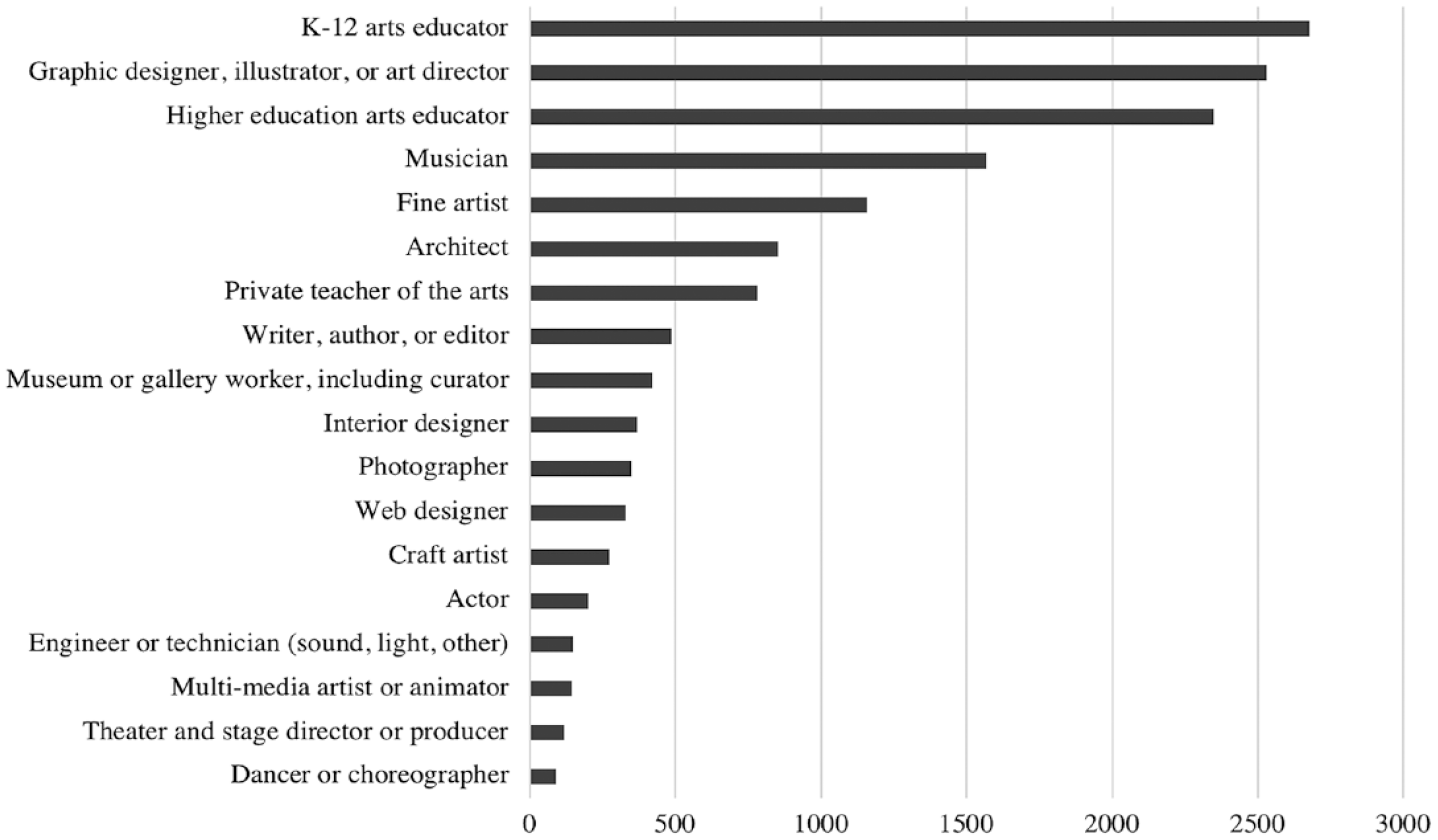
Distribution of Primary Occupations in the SNAAP Sample (N = 14,774)
Demographic Variables
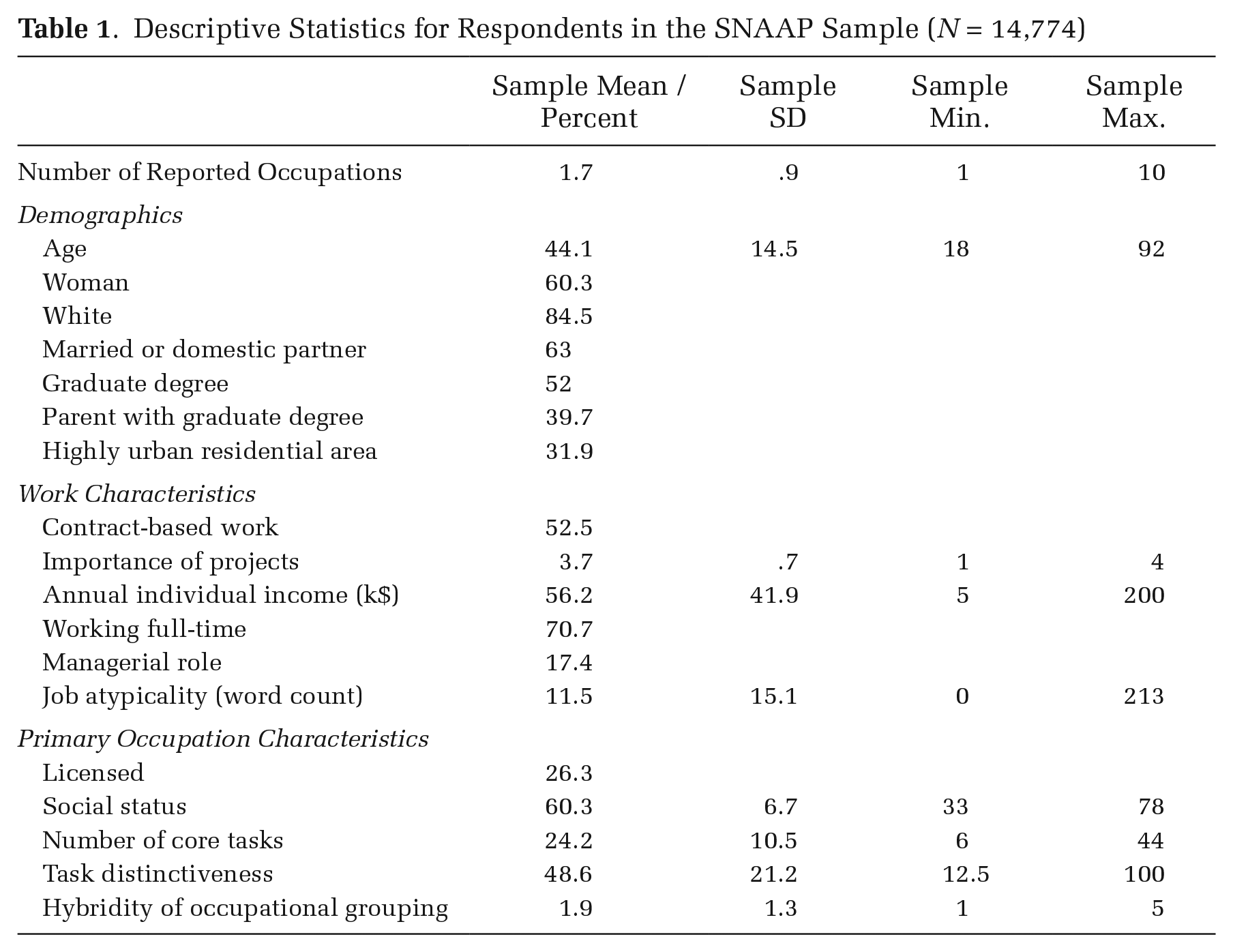
We created variables for age, gender, race (White versus others), marital status, and the level of education of respondents and their parents. Our educational variables report whether respondents completed a graduate degree, and whether they had a parent or guardian who completed a graduate degree. Using the ZIP codes provided by respondents, we created a binary variable indicating whether they lived in a highly urban area (with a density larger than 5,000 inhabitants per square mile in the 2010 Census). Overall, our sample is predominantly female (60.3 percent), White (84.5 percent), and married (63 percent). Respondents were highly educated (52 percent had a graduate degree), they hailed from highly educated families (39.7 percent had at least one parent with a graduate degree), and 31.9 percent lived in a highly urban area (see Table 1 for descriptive statistics).
Descriptive Statistics for Respondents in the SNAAP Sample (N = 14,774)
We use these variables in our first set of analyses because age, gender, race, and education are known to affect rates of multiple jobholding (Conen and de Beer 2021; Sliter and Boyd 2014) as well as the breadth of workers’ expertise claims (Lena and Lindemann 2014; Padavic and Reskin 2002; Tomaskovic-Devey and Avent-Holt 2019). Research also shows that features of local labor markets affect the availability of creative work (Dowd and Pinheiro 2013; Markusen 2006), and scholars have used residential density as a proxy for the local availability of jobs to creative workers (Markusen 2013).
Work Characteristics
Our two key predictors of polyoccupationalism are measured at the individual level as characteristics of the work respondents reported in the SNAAP survey.
Contract-based labor is a binary variable measuring whether respondents answered the question “Have you ever been self-employed, an independent contractor, or a freelance worker?” with “Yes, I do this currently.” It captures whether respondents worked in contract-based forms of employment, be it as their sole form of employment or in combination with salaried work. The rate of contract work in our main sample is 52.5 percent, higher than recent estimates from the 2010 General Social Survey, which reported the percentage of U.S. workers who are not or not exclusively a regular full-time or part-time employee at 24.2 percent (U.S. Government Accountability Office 2015:12). This lends support to the idea that, as far as work arrangements are concerned, creative work is prototypically postindustrial. We expect that respondents engaged in contract-based work will report a higher number of occupational identities.
Importance of projects
To capture the involvement of SNAAP respondents in project-based labor, we analyze their answers to the question: “How important are project management skills to perform effectively in your profession or work life?” Answers to that question were reported on a four-point Likert-scale. The average answer in our main sample was 3.66, suggesting the work of SNAAP respondents is highly project-based. Consistent with our hypothesis, we expect polyoccupationalism to be positively associated with reporting a greater importance of project management skills.
In addition to these key predictors, our models include four other work-related characteristics reported by SNAAP respondents and which we have reason to believe might affect the incidence of polyoccupationalism.
Income and hours
Respondents reported their annual individual income, excluding “spousal income or interest on jointly-owned assets.” They selected one of 12 income bands, ranging from “$10,000 or less” to “more than $150,000.” Survey administration staff transformed responses into our “annual individual income” variable, using the midpoints of each salary band ($200,000 for the top band). Respondents reported an average annual individual income of $56,200. They were also asked to declare their weekly work hours. We include a variable distinguishing respondents “working full-time (35 hours or more per week)” from those working part-time or seeking work. Some respondents reported struggling to describe their work hours—this was especially true of contract-based workers and freelancers, who experience significant weekly variation in their labor time. The majority of respondents reported working full-time (70.7 percent). Research suggests polyoccupationalism may be associated with income level and work hours (Rouault 2002), but the sign of the correlation is unclear. It may be negative, if part-time and low-income workers adopt more polyoccupational identities because they seek work outside their primary occupation so as to reach full employment and improve their income. Yet polyoccupationalism might also be positively associated with working full-time and earning higher incomes if enough respondents successfully implement this strategy.
Managerial role
Prior research demonstrates that supervisors, by virtue of overseeing the work of others, acquire additional expertise (Cheng and Park 2021), which may eventually congeal into newly acquired occupational identities. SNAAP respondents were asked, “Have you ever worked, either full- or part-time, managing or administering programs or people for an arts or arts-related organization or business?” We created a binary variable distinguishing those who responded “Yes, I do this currently” from others. In our sample, 17.4 percent of respondents reported working in a management capacity. In line with previous scholarship, we expect polyoccupationalism to be positively associated with reports of work in a managerial role.
Job atypicality
Finally, reports of multiple occupational identities may arise from the “bad fit” between the actual content of one’s job and available occupational categories, or job atypicality. Job atypicality is by no means unique to postindustrial work: in fact, high levels of atypicality were recorded in the heyday of industrialization, when existing occupational nomenclatures became irrelevant as a result of rapid shifts in work organization (Conk 1978). In a similar way, some commentators argue that job atypicality characterizes postindustrial work because occupational classification systems have not yet caught up with new forms of work and task hybridization (Bidet 2011; Grusky and Sørensen 1998; O’Reilly 1992). To measure the atypicality of respondents’ jobs with respect to available occupational categories, we count the number of words respondents used when asked to “provide [their] job title and, if the title is not self-explanatory, a brief description of [their] work in/as [their primary occupation].” This language explicitly directed respondents who thought their job was atypical to provide more words than those who did not. Therefore, the bad fit of one’s job with occupational categories is reflected in longer responses to this open-ended question. On average, SNAAP respondents used 10.6 words to answer this question, and responses ranged from 0 to 213 words. We predict that longer job descriptions will be positively correlated with reports of polyoccupationalism.
Occupational-Level Data
Although our theorization of polyoccupationalism emphasizes its relationship to work features and working conditions that are best observed at the individual level, the characteristics of workers’ occupations might also shape its expression. For example, Figure 2 illustrates patterns of occupational selection across primary occupations in our main sample. It shows that workers identifying primarily as “architects” reported the lowest level of polyoccupationalism (1.2 occupations per respondent on average), and that architecture displayed the lowest percentage of polyoccupationalists (15.4 percent). In contrast, “private teachers of the arts” were characterized by high levels of polyoccupationalism (two occupations per respondent, 72.9 percent of polyoccupationalists). Research suggests that two attributes of primary occupations might particularly affect the magnitude of polyoccupationalism among their workers: their degree of closure, or the stringency of their licensing requirements, and their position in the occupational status hierarchy. To measure these and other occupational-level characteristics in our sample, we use data from the BLS and from a comprehensive system of occupational descriptions, the Occupational Information Network (O*NET), which includes common job titles, skills, educational requirements, tasks performed, and working conditions for 974 detailed occupations covering the entire U.S. workforce. 6 As the most comprehensive resource of its kind, O*NET has become a staple of quantitative social science research on U.S. occupations (Autor and Dorn 2013; Horowitz 2018; Liu and Grusky 2013; Tilcsik, Anteby, and Knight 2015).
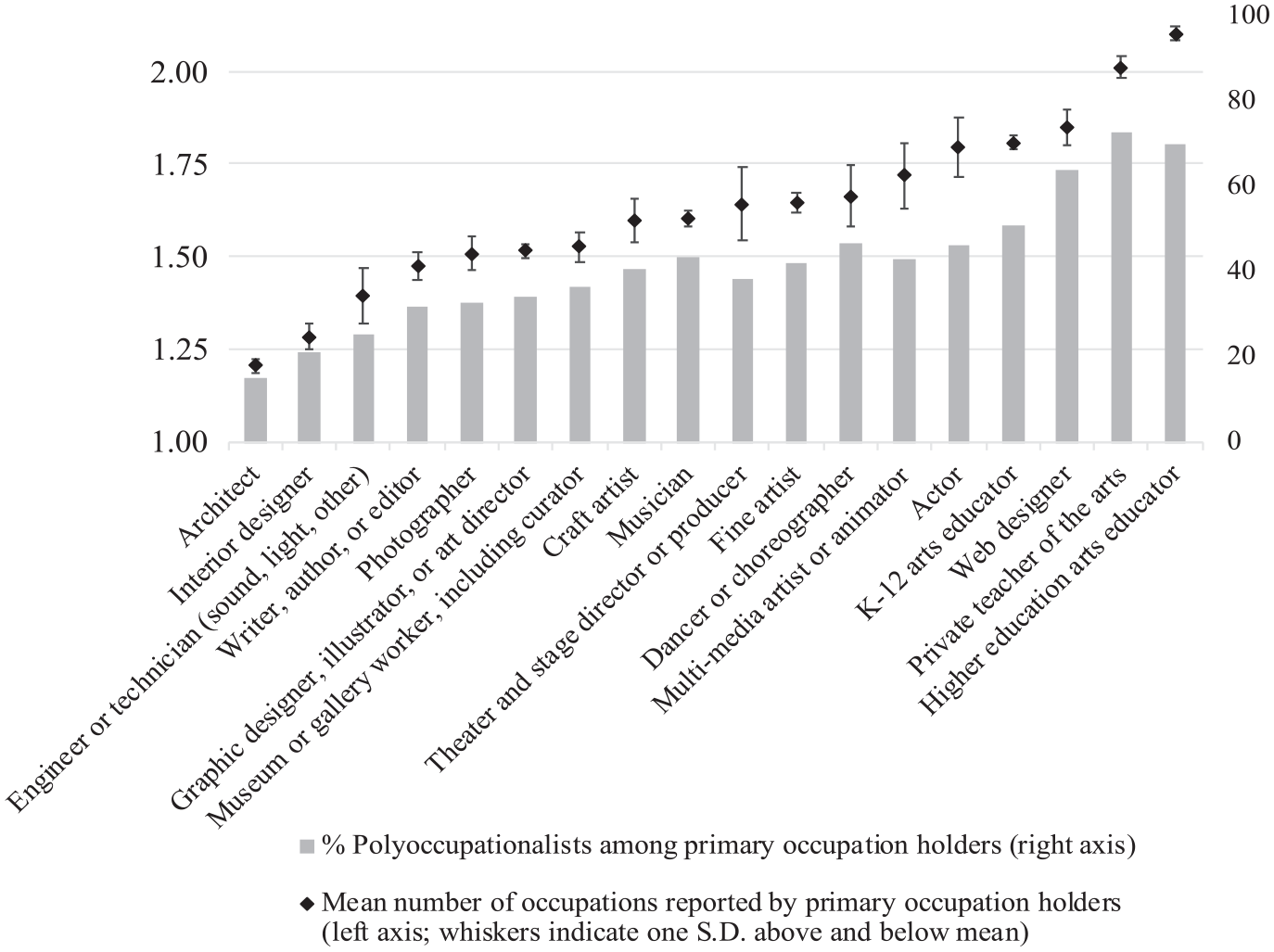
Patterns of Occupational Selection across Occupations in the SNAAP Sample (N = 14,774)
Licensure
Scholarship on licensing argues strongly that licensing requirements “close” occupations, both to outsiders who cannot access them and to members, who come to think of themselves as part of an “elite” or “exclusive” group (Meyer 1977; Redbird 2017; Weeden 2002). We therefore expect the greater closure of a worker’s primary occupation to depress their level of polyoccupationalism. We use a binary variable distinguishing “closed” and “open” occupations based on licensing data from the BLS Occupational Outlook Handbook (OOH). 7 Given the complexity of closure in the United States, we use a relatively unequivocal measure: an occupation is “licensed” if licensing requirements are in place in a majority of states and if a majority of the occupation’s members work under a license. Only three occupations in our sample meet these requirements: architects, interior designers, and K–12 arts educators. Most other occupations, including graphic designers, photographers, and sound engineers, have licensing requirements in some states or voluntary certifications that workers can receive to improve their chances on the job market. Most workers in our sample (73.7 percent) work in non-licensed occupations. Licensed and unlicensed respondents were not significantly different in terms of income or education, yet licensed respondents were more likely than non-licensed ones to have standard working conditions (salaried positions and full-time employment).
Status
Levels of prestige or social status associated with an occupation also affect occupational identification (Becker and Carper 1956; Faunce 1989; Ulfsdotter Eriksson and Linde 2014), yet existing literature describes two conflicting processes whereby workers’ location in the occupational status hierarchy might shape the expression of multiple occupational identities. As we observed earlier, workers in higher-status occupations, such as white-collar workers, physicians, and engineers, have greater professional autonomy (Hulin and Blood 1968; Wrzesniewski and Dutton 2001) and greater entitlement to claim-making (Tomaskovic-Devey and Avent-Holt 2019), which makes them more likely to claim expertise in new tasks and should therefore increase their likelihood of reporting additional occupational identities. At the same time, workers in lower-status occupations have been described as more likely to diversify their portfolio of activities for the sake of “status enhancement” (Sieber 1974). The former argument suggests workers’ higher occupational status should enhance their reports of polyoccupationalism. The latter suggests it should depress them.
To adjust for the effect of workers’ primary occupation’s status on their reports of polyoccupationalism, we calculate the status of occupations using O*NET’s “recognition scores.” These scores, which are regularly updated, are attributed by expert occupational analysts to all occupations in the SOC system and measure whether occupations “offer advancement, potential for leadership, and are often considered prestigious,” on a scale of 0 to 100 (Rounds et al. 2008). For SNAAP occupations that collapse multiple SOC occupations, we use the average recognition score across that set of occupations. 8 Although O*NET recognition scores are a less traditional measure of occupational status than are NORC/GSS occupational prestige scores (e.g., Smith and Son 2014), we use them because the SOC occupational nomenclature they rest on is more closely aligned with the nomenclature respondents were presented with in the SNAAP survey. 9 O*NET recognition scores in the SNAAP sample range from 33 to 78, with a mean of 58.7 across 18 occupations (see Appendix B). Among the 13 SNAAP occupations for which it was possible to calculate a GSS occupational prestige score, Pearson’s correlation coefficient between O*NET recognition scores and GSS prestige score was .76 (p < .01).
Core tasks
Among our occupational-level control predictors, we also include the number of tasks typically required to perform any primary occupation. A greater number of tasks might give workers more opportunities to branch out into other occupations (O’Mahony and Bechky 2006), therefore increasing reports of polyoccupationalism. Unlike the relationship we posit in Hypothesis 2, this mechanism rests on the task variety inherent to any occupation, not on the task expansion characteristic of project-based postindustrial work (Wrzeniewski and Dutton 2001). O*NET reports a list of “core tasks” for all its occupations. These tasks are performed by all workers in an occupation and are rated as particularly “relevant” and “important” by occupation incumbents (Donsbach et al. 2003). For example, “collaborating with actors as part of an ensemble” and “attending auditions and casting calls to audition for roles” are two core tasks for actors. 10 We use as our predictor the number of core tasks O*NET reports for each occupation in the SNAAP survey. This number ranges from 6 to 44, with an average of 21.6 core tasks among the 18 occupations (see Appendix B).
Task-distinctiveness
Complementing our measure of core tasks, we modeled how specific these tasks were to any occupation. Higher levels of task-distinctiveness should make it more difficult for workers in an occupation to bridge into new occupational areas. We compared O*NET core tasks across occupations to identify task overlaps within our sample; for example, both dancers and actors must engage in “attending auditions and casting calls to audition for roles.” In total, our 18 occupations involved 399 distinct core tasks, 229 of which (57.4 percent) were shared by more than one occupation. Of an occupation’s tasks, between 12.5 and 100 percent were exclusive to it, with a mean of 50.2 percent exclusive tasks per occupation (see Appendix B). This percentage of exclusive core tasks serves as our measure of task-distinctiveness. We expect polyoccupationalism to correlate negatively with the task-distinctiveness of respondents’ primary occupation.
Hybridity of occupational groupings
Finally, some occupation labels in the SNAAP survey’s occupational identification items violate the principle of exclusivity (Converse 1986; Ritchey 2008): they include two or more occupations (e.g., “dancer and choreographer”). This weakness of survey design might lead to mistaken interpretations (e.g., that all dancers are choreographers, or vice versa). More important for our study, hybrid response items may mechanically depress reports of polyoccupationalism, for example, because people would have chosen both “dancer” and “choreographer,” if offered separately, but were forced by this survey into a single hybrid occupational grouping. To control for this effect, we created a variable reporting the number of occupations included in respondents’ primary occupation answer. We predict that polyoccupationalism will be negatively associated with the hybridity of primary occupational groupings.
Analytic Strategy
Our first set of analyses uses our main sample (N = 14,774) to explore the correlates of polyoccupationalism and test our first two hypotheses. We operationalize polyoccupationalism as the number of occupations an individual reported in the SNAAP survey, and we explore its correlations with individual demographics, detailed work-related variables available from the SNAAP survey, and occupational-level variables measured by the BLS or O*NET data. Standard linear regression models are inappropriate to model count data confined to positive integers. Negative binomial regression is one alternative, yet the counts we are dealing with are not over-dispersed (mean = 1.7, SD = .92). To test our first pair of hypotheses, we therefore use Poisson regression with a log link function. 11 To test our second pair of hypotheses and examine how different forms of polyoccupationalism are distributed in the occupational hierarchy, we focus only on polyoccupational workers (N = 6,821), and our dependent variables are measures of expertise stretch and status stretch, which we model in an OLS regression framework.
Polyoccupationalism And Postindustrial Forms Of Labor
Overall, respondents in our main sample reported an average of 1.7 occupations, and 46 percent were polyoccupationalists, confirming that polyoccupationalism is not an exception but a typical identity among U.S. creative workers. Model 1 in Table 2 uses Poisson regression to examine the demographic correlates of polyoccupationalism. In line with the expectations we derived from prior research, it shows that three characteristics are significantly associated with workers’ polyoccupationalism: male gender identity, possession of a graduate degree, and residence outside a highly urban area.
Coefficients from Poisson Regressions
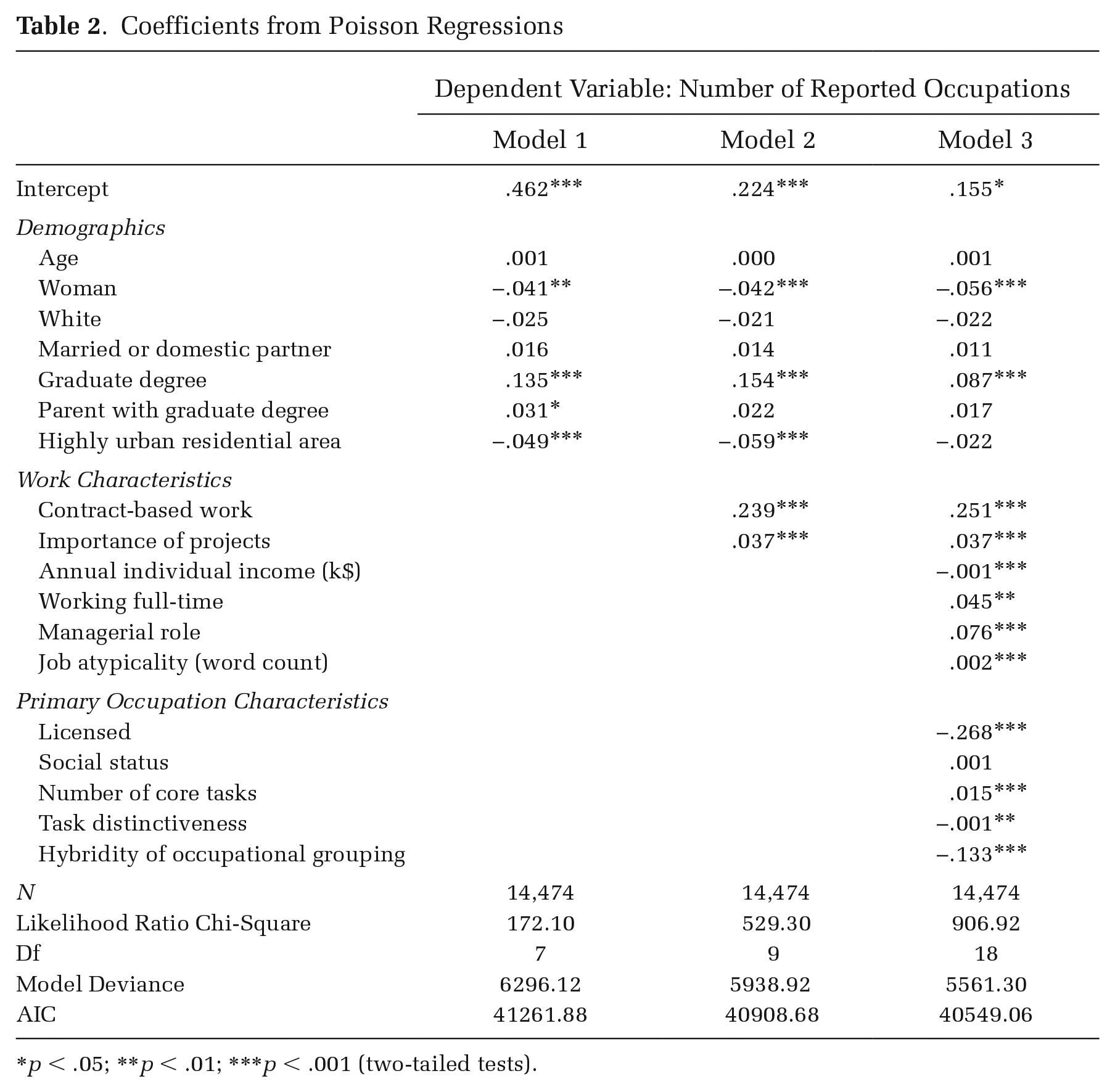
p < .05; **p < .01; ***p < .001 (two-tailed tests).
Model 2 incorporates our key predictors of interest. Lending support to Hypotheses 1 and 2, we find that workers’ participation in contract- and project-based forms of labor are both significantly and positively correlated with reports of more occupational identities. Specifically, working on contract is associated with a 27.0 percent increase in respondents’ number of reported occupations (b = .239, p < .001, e.239 = 1.27), and for each one-unit increase in the self-rated importance of project management skills for one’s job, workers cited 3.8 percent additional occupations (b = .037, p < .001, e.037 = 1.038). Neither the significance nor the magnitude of these correlations change in Model 3, in which we incorporate other work-related predictors and predictors associated with respondents’ primary occupation. With the exception of the status of workers’ primary occupation, these control predictors are all significant, and coefficient signs align with our expectations of how they would correlate with polyoccupationalism.
In particular, we find that workers in closed occupations and those in occupations whose tasks are more distinctive identify with fewer occupations, whereas workers in managerial roles, in occupations that involve a larger number of tasks, or whose job is not straightforwardly captured by existing occupational categories have more polyoccupational identities. The null coefficient associated with the status of workers’ primary occupation provides no clear evidence that the intensity of polyoccupationalism varies across the occupational status hierarchy. Most importantly, Model 3 lends further empirical support to our first two hypotheses by demonstrating that neither workers’ income, work hours, or position of authority, nor constraints particular to certain occupational communities or categories, explain away the association of polyoccupationalism with postindustrial, contract-, and project-based forms of work. 12
Expertise Stretch And Status Stretch Across The Occupational Hierarchy
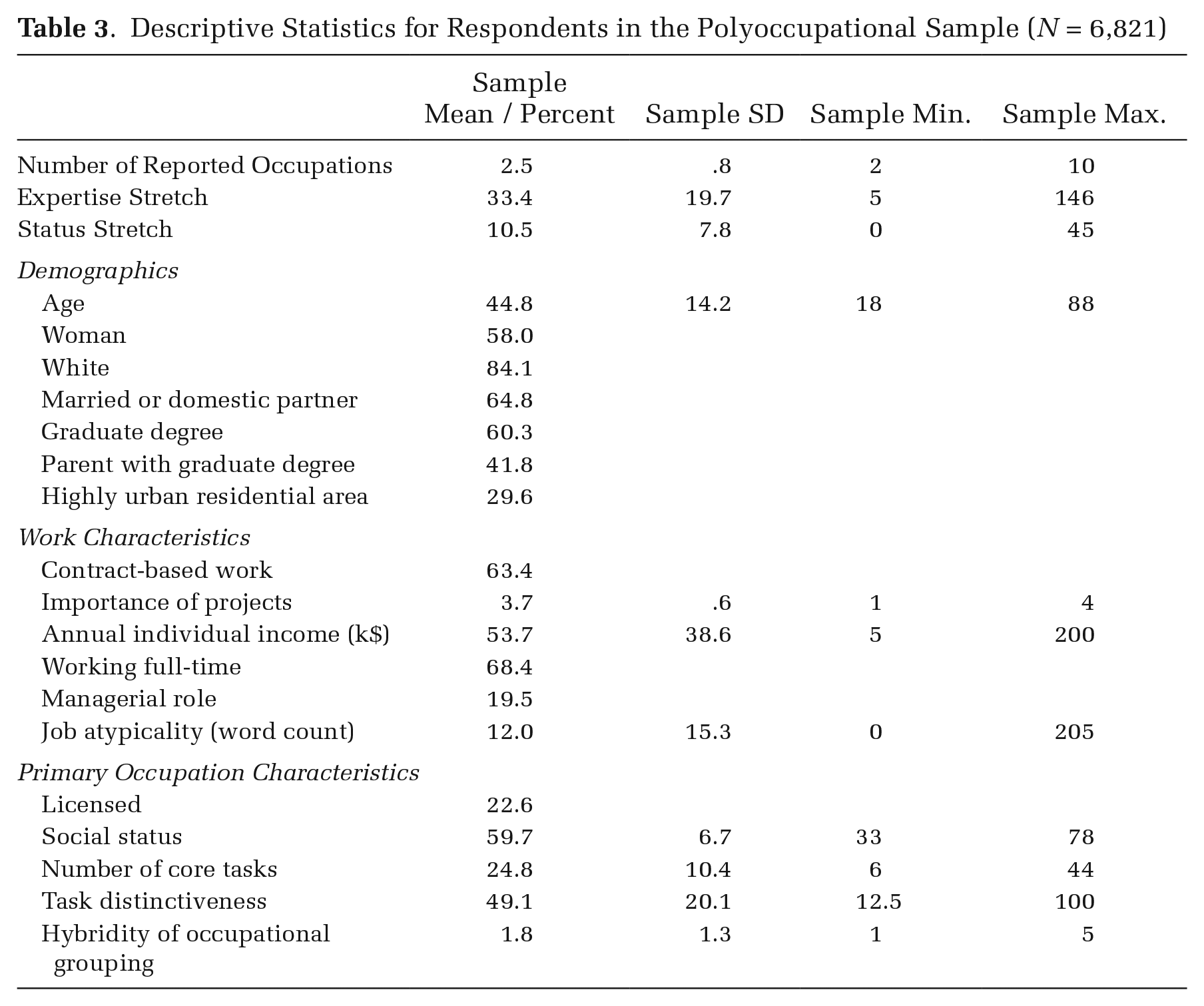
We next examine how different forms of polyoccupationalism are distributed in the occupational hierarchy. We therefore limit our sample to respondents who reported two or more occupations (N = 6,821). Table 3 presents descriptive statistics for this sample of polyoccupational workers.
Descriptive Statistics for Respondents in the Polyoccupational Sample (N = 6,821)
Measuring expertise stretch and status stretch
Using O*NET data, we operationalize expertise stretch as the number of unique tasks respondents add to their overall portfolio of claimed tasks when identifying with occupations outside their primary occupation. The average expertise stretch score in our sample of polyoccupationalists was 33.4, and this score ranged from 5 to 146 unique additional tasks (see Appendix C for computing methodology). We measure status stretch as the largest absolute difference between the social status associated with workers’ primary occupation and any other occupation they reported (see Appendix C for details). The average status stretch score among polyoccupationalists was 10.5. The score ranged from 0, for respondents who selected “actor” and “dancer,” for example, to 45, for respondents who claimed identities as both “theater directors” and “craft artists,” or “architects” and “craft artists.” These two measures of expertise and status stretch constitute the dependent variables in our second set of analyses.
Findings
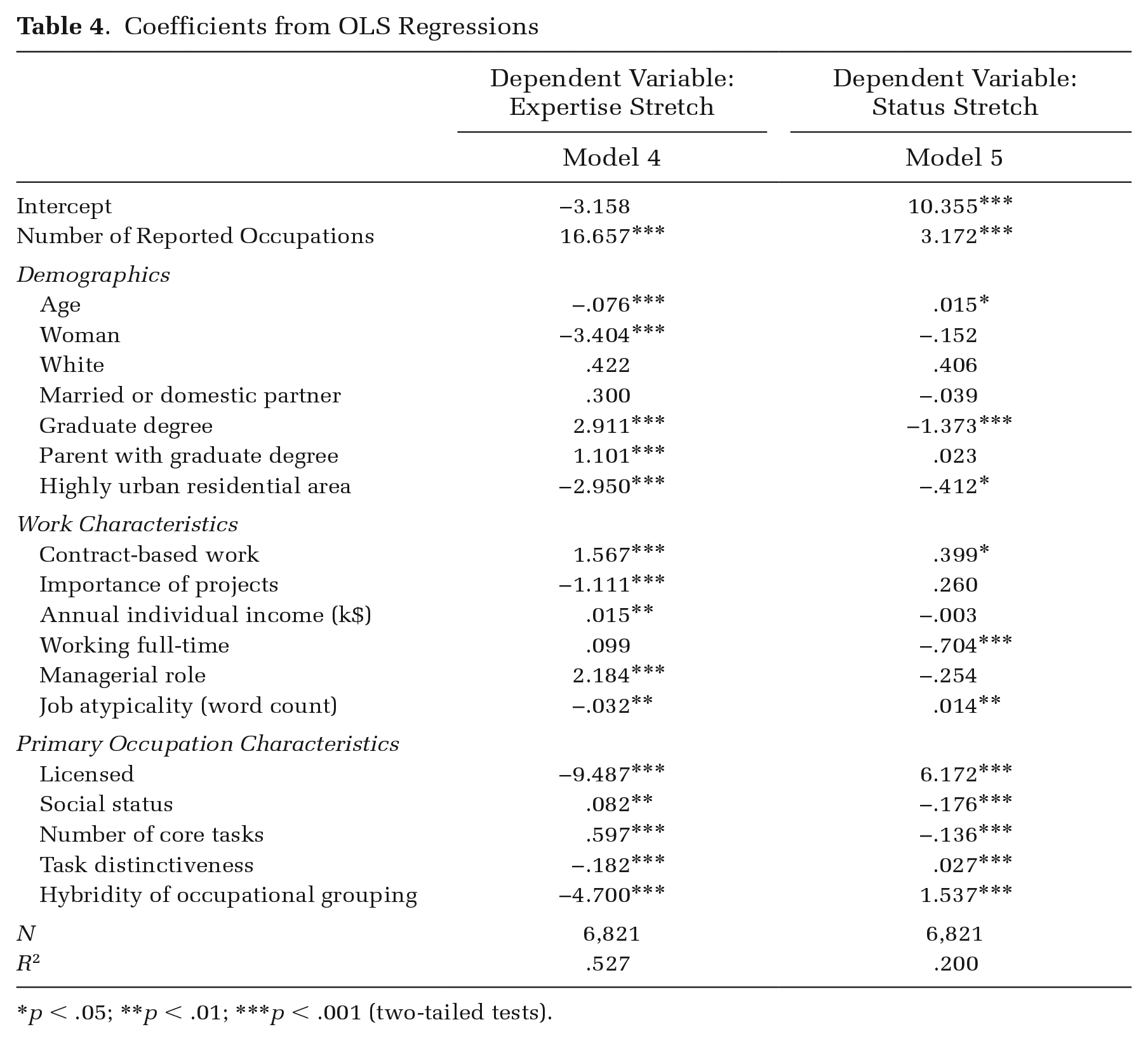
In Table 4, we use ordinary least squares models to examine the strength of individual demographics, work characteristics, and occupational features in predicting the expertise stretch (Model 4) and status stretch (Model 5) of polyoccupational respondents. Models 4 and 5 further include as a predictor the total number of occupations with which polyoccupational respondents identified, as a larger number of reported occupations is likely to mechanically increase the number of new tasks workers claim expertise in by reporting their non-primary occupation(s) (i.e., their expertise stretch) as well as their level of status stretch. Both effects are borne out by empirical evidence in Models 4 and 5 (b = 16.66, p < .001, and b = 3.17, p < .001, respectively).
Coefficients from OLS Regressions
p < .05; **p < .01; ***p < .001 (two-tailed tests).
Confirming Hypothesis 3, we find evidence of a significant and positive relationship between workers’ primary position in the occupational status hierarchy and the degree to which their polyoccupationalism stretches expertise (b = .082, p < .01), even after adjusting for demographics and other work- and occupation-related characteristics in Model 4. We also find that expertise stretch correlates positively with individual- and work-related characteristics generally associated with advantaged workers, such as being a man, holding a graduate degree, working in a managerial role, or earning higher income.
Confirming Hypothesis 4, in Model 5 we find a significant and negative correlation between workers’ primary position in the occupational status hierarchy and the degree to which their polyoccupationalism stretches status (b = −.176, p < .001), net of the effect of control predictors. Taken together, Models 4 and 5 provide clear evidence in support of our second set of hypotheses, which predicted that polyoccupationalism assumes different forms at different levels of the occupational hierarchy.
Conclusions And Discussion
In this article, we offer the first quantitative investigation of polyoccupationalism, or workers’ simultaneous identification with multiple occupations. This phenomenon has been hypothesized by scholars interested in the transformation of labor under the “new” postindustrial economy (Arthur 2014; Arthur and Rousseau 1996; Barley et al. 2017; Kalleberg and Vallas 2018; Weeden and Grusky 2012). Yet polyoccupationalism remains understudied, partially because of the absence of multiple-entry occupational identification items in standard occupational surveys. Examining a new dataset of creative workers that let them describe their work identity using multiple occupational categories, we showed that, net of other individual- and occupational-level effects, identifying with multiple occupations is strongly associated with two of the most defining characteristics of postindustrial work: contract-based employment and project-based labor. The bottom line is that more flexible forms of employment and work organization are favorable terrain for the development and expression of polyoccupational identities.
Our study further highlights stark differences in the forms polyoccupationalism assumes for different types of creative workers, thereby adding to a growing body of research showing that postindustrial forms of work are experienced very differently by more “advantaged” and more “disadvantaged” workers (Kalleberg and Vallas 2018; Katz and Krueger 2019). Specifically, we theorized the existence of two stretch logics among polyoccupationalists, and we showed that the prevalence of these logics hinges on workers’ primary location in the occupational hierarchy. At the higher end, the polyoccupationalism of high-status “entrepreneurs” straddles functionally distinct but equally high-status occupations, increasing the number of tasks over which they claim expertise. In contrast, the polyoccupationalism of lower-status “hustlers” enables them to claim membership in higher-status occupations without significantly expanding their expertise. The extent to which expertise-stretch and status-stretch elude conscious, strategic career-building by individuals remains an open question, and although the population we used to document their distribution is typical of the postindustrial economy, it is not a representative sample of the workforce at large. Nevertheless, the patterns we highlighted confirm that the transformations of workers’ experiences ushered in by postindustrialism differ starkly at the top and bottom of the occupational hierarchy.
Although we should stress that our empirical findings are limited to graduates of arts and arts administration programs currently in the U.S. creative workforce, and that the baseline levels of polyoccupationalism we report are likely unique to our sample, examining variation within this sample enables us to envision how our results might generalize beyond the creative economy. The association we established between polyoccupationalism and postindustrial forms of work suggests that the former is not a phenomenon limited to creative labor. 13 From this association one might conjecture that claiming multiple occupational identities will be more widespread in areas where work is more contract-based, such as personal care or seasonal agriculture, and more project-based, such as event planning or software development, than in industries where employment and work are less flexible, such as elementary education. One should also expect industries wherein work is becoming more postindustrial to host rising numbers of polyoccupationalists. One example is the passenger transportation industry, where self-employment and part-time work have been fueled by the growth of app-based ride services. Likewise, one should expect rates of polyoccupationalism to be growing in the health and social care industry, where the diffusion of “integrated services” (Scott et al. 2000) means the work increasingly assumes the form of patient-centered projects featuring diverse professionals in “hybrid work roles” (Caza and Creary 2016).
We further believe that some of the empirical associations we highlighted, although not core to our main theoretical framework, are of general interest. In particular, we found that women claimed fewer occupational identities, and that female polyoccupationalists were less likely to stretch expertise. These results corroborate earlier work documenting how, in a wide range of industries, women’s awareness of their labor market disadvantage leads them to assume “simple, focused identit[ies]” rather than risk being regarded “as dilettante[s] who [are] not competent at any type of work” (Zuckerman et al. 2003:1067; see also Bielby and Bielby 1996; Padavic and Reskin 2002). We also found that working in a licensed occupation depressed rates of polyoccupationalism and, among polyoccupationalists, levels of expertise stretch, an association we expect to observe outside the creative industries as well, as licensed occupations in our sample share the same characteristics as those in the rest of the economy: they require highly vocational and institutionalized training (Becker et al. 1961; Ulfsdotter Eriksson and Linde 2014), offer strong “school-to-work linkages” that deter workers from pursuing outside skills (DiPrete et al. 2017; Redbird 2017), and rely on powerful associations to cultivate workers’ commitment to the occupational community and its “professional project” (Larson 1977). We should therefore expect workers in these occupations, such as physicians, firefighters, or funeral directors, to report single, focused occupational identities to a greater degree than those in more “open” occupations.
Implications for the Study of Occupational Identities
Our discovery and theorization of polyoccupationalism proposes a double challenge: to the long tradition of scholarship that has conceptualized occupational self-identification as the exclusive bond between a worker and an occupational group, and to the large body of research relying on single-entry survey items to capture occupational identities. Our study first brings occupation research into conversation with scholarship on social identity demonstrating that occupational identities are “constructed, fluid and multiple” (Brubaker and Cooper 2000:1). For example, race and ethnicity scholars have studied multiple identification as a way of claiming forms of identity that elude the categories of institutional classifications (Harris and Sim 2002; Perlmann and Waters 2002). Likewise, our study reveals that pigeonholing survey respondents into one occupational identity often fails to capture their subjective, occupational self. We further affirm prior research on identity by showing that multiple occupational identifications can obey different logics, and that the prevalence of various logics varies with individuals’ position in social structure (e.g., Waters 1990). This shows that a conceptualization of occupational identification that attends to its subjective complexity need not come at the cost of obscuring its broader social determinants.
Practically, our work suggests that, while it remains crucial to regularly update the occupational categories and classifications we use in occupational surveys, especially as these categories shift in use and in meaning among workers (Conk 1978), this may not be the only way to improve the study of occupational identities. Besides regular tests of the validity and reliability of the occupational taxonomies, social scientists and survey administrators could let survey respondents or those in charge of coding their answers use multiple identifiers. More research might help assess the benefits of this change for occupational research. For example, scholars should examine whether introducing multiple-entry occupational identification items in surveys permits a better apprehension of the “occupational rhetorics” (Fine 1996) individuals rely on to describe their work in “real-life” settings such as workplaces, job interviews, or social gatherings, and whether it better reflects individuals’ qualitative accounts of how they relate to the occupations with which they identify (Brubaker and Cooper 2000).
Directions for Further Research
Finally, the concept of polyoccupationalism lays the groundwork for lines of investigation that both complement and build on classic research in the sociology of work and occupations. This article has drawn attention to factors facilitating the formation of polyoccupational identities and to the various forms these identities may assume in different regions of the occupational hierarchy, yet further research is needed to examine the consequences of polyoccupationalism for perceptions of the occupational structure, broader occupational dynamics, and the subjective experiences of polyoccupational workers.
Polyoccupationalism and perceptions of the occupational structure
Examining individuals’ perceptions of where various occupations stand relative to one another in the occupational hierarchy and in the functional division of labor has long been a central concern in the study of class and mobility (Lynn and Ellerbach 2017; Martin 2000). This article’s identification of polyoccupationalism begs the question of how polyoccupationalism may alter these perceptions, both for polyoccupational workers themselves and for others who are exposed to workers identifying with multiple occupations. Thus, it would be valuable to know if polyoccupational workers’ spanning of functionally diverse occupational identities entails a blurring of the functional boundaries people perceive between occupations—that is, if experiences of polyoccupationalism undermine traditional understandings of expertise as divided between separate and specialized trades.
Likewise, one may want to explore whether exposure to “hustler” polyoccupationalists leads observers to flatten their perceptions of the occupational status hierarchy, as occupations that used to stand clearly apart in this hierarchy become linked in the identities of these polyoccupational workers (Accominotti, Lynn, and Sauder 2022). Finally, because we know that expertise- and status-stretching forms of polyoccupationalism are unlikely to be equally distributed in occupational space, we may ask how understandings of the occupational hierarchy are influenced by exposure to these forms in combination. In particular, we may want to test whether polyoccupationalism results in a compression of perceived status differences at the bottom of the occupational hierarchy, where polyoccupational workers are more likely to stretch status, and in the emergence of a perceived class of multitalented workers at the top, where they are more likely to stretch expertise.
Polyoccupationalism and occupational groups
A second avenue of potential research is to examine how occupational groups, as collective entities often represented by professional unions and associations, react when their members adopt polyoccupational identities. Is there a threshold beyond which the share of polyoccupationalists within an occupation threatens its solidarity and legitimacy? When are polyoccupationalists more likely to be seen as “positive deviants,” or individuals whose atypicality is perceived favorably in their respective occupational groups, versus “negative deviants” whom group members might seek to punish or expel (Hogg and Terry 2000)? More generally, it would be beneficial to examine polyoccupationalism as a source of occupational dynamics. In light of recent scholarship emphasizing the emergent nature of expertise claims (Anteby and Holm 2021; Carr 2010; Eyal 2013; Kahl, King, and Liegel 2016), one may wonder whether and under what circumstances groups of polyoccupationalists straddling the same areas of expertise seek to be recognized as a new occupational group.
Subjective experiences of polyoccupationalism
The focus on multiple occupational identities we advocate further suggests that it may be valuable to examine workers’ experiences of polyoccupationalism. Drawing inspiration from research on multiple identities (Ramarajan 2014; Thoits 1983), we urge scholars to examine the nature, intensity, and multiplexity of the bonds formed with various occupations, as well as the ordering of multiple occupational identities. In the wake of recent work highlighting the subjective “tensions” (Rowe 2019), “dilemmas” (Chong 2021), and “authenticity struggles” (Caza et al. 2018) associated with individuals’ combination of multiple work identities, future research might also investigate whether certain groups of workers experience polyoccupationalism in more conflictual or harmonious ways, whether certain combinations of occupational identities lead to lower levels of tension than others, or whether the discordance experienced by individuals correlates with the number of occupations they report or the extent of expertise and status stretch in which they engage. It may also be useful to examine how polyoccupationalists manage these tensions on a daily basis. Qualitative studies usually distinguish workers who segment their multiple occupations from those who strive to create an integrated view of their work (Caza et al. 2018; Hénaut, Dubois, and Lévy 2023; Rowe 2019), yet more research is needed to understand how these strategies are distributed in the workforce. Future scholarship might thus examine whether status-stretching polyoccupationalists seek to incorporate their multiple identities under a single, high-status one to enjoy the full benefits attached to it, or if expertise-stretching, elite workers tend to maintain firm boundaries between their multiple identities to emphasize the diversity of their expertise.
Footnotes
Appendix
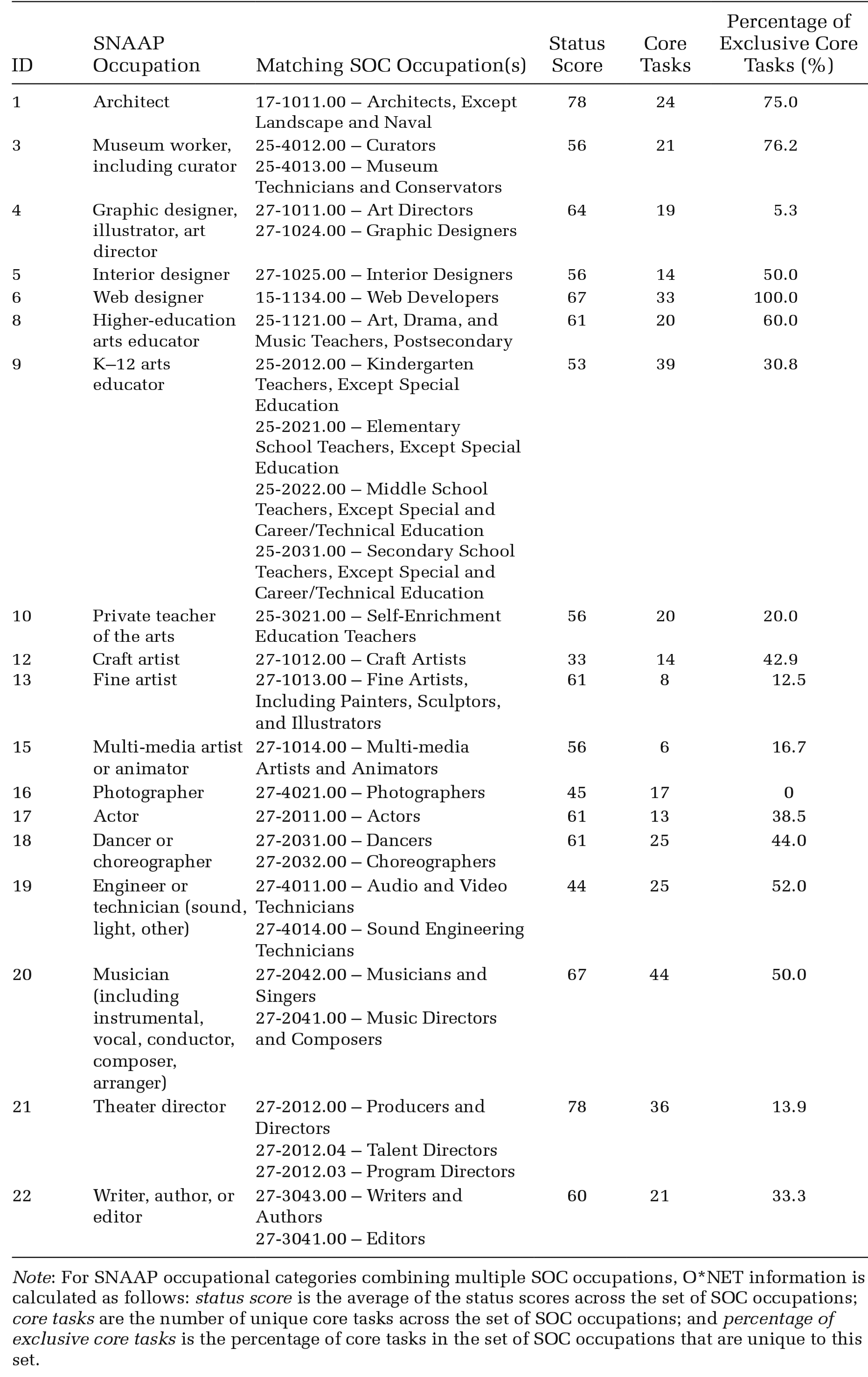
Appendix B. List of 18 SNAAP Occupations in Our Main Sample,with Matching SOC Categories and Associated O*NET Data
| ID | SNAAP Occupation | Matching SOC Occupation(s) | Status Score | Core Tasks | Percentage of Exclusive Core Tasks (%) |
|---|---|---|---|---|---|
| 1 | Architect | 17-1011.00 – Architects, Except Landscape and Naval | 78 | 24 | 75.0 |
| 3 | Museum worker, including curator | 25-4012.00 – Curators 25-4013.00 – Museum Technicians and Conservators |
56 | 21 | 76.2 |
| 4 | Graphic designer, illustrator, art director | 27-1011.00 – Art Directors 27-1024.00 – Graphic Designers |
64 | 19 | 5.3 |
| 5 | Interior designer | 27-1025.00 – Interior Designers | 56 | 14 | 50.0 |
| 6 | Web designer | 15-1134.00 – Web Developers | 67 | 33 | 100.0 |
| 8 | Higher-education arts educator | 25-1121.00 – Art, Drama, and Music Teachers, Postsecondary | 61 | 20 | 60.0 |
| 9 | K–12 arts educator | 25-2012.00 – Kindergarten Teachers, Except Special Education 25-2021.00 – Elementary School Teachers, Except Special Education 25-2022.00 – Middle School Teachers, Except Special and Career/Technical Education 25-2031.00 – Secondary School Teachers, Except Special and Career/Technical Education |
53 | 39 | 30.8 |
| 10 | Private teacher of the arts | 25-3021.00 – Self-Enrichment Education Teachers | 56 | 20 | 20.0 |
| 12 | Craft artist | 27-1012.00 – Craft Artists | 33 | 14 | 42.9 |
| 13 | Fine artist | 27-1013.00 – Fine Artists, Including Painters, Sculptors, and Illustrators | 61 | 8 | 12.5 |
| 15 | Multi-media artist or animator | 27-1014.00 – Multi-media Artists and Animators | 56 | 6 | 16.7 |
| 16 | Photographer | 27-4021.00 – Photographers | 45 | 17 | 0 |
| 17 | Actor | 27-2011.00 – Actors | 61 | 13 | 38.5 |
| 18 | Dancer or choreographer | 27-2031.00 – Dancers 27-2032.00 – Choreographers |
61 | 25 | 44.0 |
| 19 | Engineer or technician (sound, light, other) | 27-4011.00 – Audio and Video Technicians 27-4014.00 – Sound Engineering Technicians |
44 | 25 | 52.0 |
| 20 | Musician (including instrumental, vocal, conductor, composer, arranger) | 27-2042.00 – Musicians and Singers 27-2041.00 – Music Directors and Composers |
67 | 44 | 50.0 |
| 21 | Theater director | 27-2012.00 – Producers and Directors 27-2012.04 – Talent Directors 27-2012.03 – Program Directors |
78 | 36 | 13.9 |
| 22 | Writer, author, or editor | 27-3043.00 – Writers and Authors 27-3041.00 – Editors |
60 | 21 | 33.3 |
Note: For SNAAP occupational categories combining multiple SOC occupations, O*NET information is calculated as follows: status score is the average of the status scores across the set of SOC occupations; core tasks are the number of unique core tasks across the set of SOC occupations; and percentage of exclusive core tasks is the percentage of core tasks in the set of SOC occupations that are unique to this set.
Appendix C. Measurement of Expertise Stretch and Status Stretch
Acknowledgments,Funding,and Data
We are grateful for the guidance and comments we received from ASR reviewers and editors, as well as from Michel Anteby, Brianne Dubois, Hajar El Fatihi, Taylor Laemmli, Chaeyoon Lim, Terry McDonnell, Anna Milewski, Dave O’Brien, Yannick Savina, Denis Segrestin, Chana Teeger, Nate Wilmers, Michael Zaslavsky, and participants at the 2019 Creative Industries Conference, the 2019 Eastern Sociological Society Conference, the 2021 SNAAP Research Symposium, and workshops at University of Notre Dame, Boston University, and the University of Wisconsin-Madison. We would also like to thank the Alliance Program for a Joint Project Grant that supported the early stages of this project. SNAAP data were used with permission from the Indiana University Center for Postsecondary Research.
