



Abstract
This study develops and applies a framework for analyzing variability in individuals’ occupational prestige trajectories and changes in average variability between birth cohorts. It extends previous literature focused on typical patterns of intragenerational mobility over the life course to more fully examine intracohort differentiation. Analyses are based on rich life course data for men and women in West Germany born between 1919 and 1979 from the German Life History Study and the German National Educational Panel Study (N = 16,854 individuals). Mixed-effects growth-curve models with heterogeneous variance components are applied. Results show that birth cohorts systematically differ in their variability; cohorts who entered the labor market in the late 1950s and 1960s and experienced mostly closed employment relations have exceptionally homogenous trajectories. Earlier and later cohorts, who experienced more open employment relations, are more heterogeneous in their trajectories. Cohorts with higher variability at labor market entry are characterized by persistently strong intracohort differentiation. Women’s variability within employment is similar to men’s but markedly increases once employment interruptions are considered.
How do transformations in economic institutions affect intragenerational mobility—that is, changes in individuals’ labor market positions over their careers? This question has received renewed interest in recent years, for a number of reasons. First, fundamental transformations in labor market institutions, such as changes in employment relations, have been linked to increasingly precarious work characterized by unstable, insecure, and uncertain careers, which may have severe consequences beyond the work domain, impairing workers’ well-being, their family life, and even undermining political stability (Kalleberg and Vallas 2017). Second, institutional restructuring has coincided with increasing inequalities between workers in many rich democracies (Hollister 2011; McCall and Percheski 2010). These parallel developments have received much attention (Morris and Western 1999; Thelen 2014), and researchers are increasingly recognizing that studying intragenerational mobility can provide crucial insights into the links between these developments by identifying how individual workers are assigned to stratified social positions via dynamic patterns of allocation (Bernhardt et al. 2001; Jarvis and Song 2017).
Yet, the conventional approach to intragenerational mobility—which often examines mobility in terms of occupational prestige attainment trajectories (Kalleberg and Mouw 2018)—is of limited use for understanding how changes in economic institutions affect inequality and precarity. This is because the approach focuses on differences in typical patterns of intragenerational mobility between groups, for the most part between birth cohorts, where comparing intragenerational mobility between cohorts allows for situating individual careers in historical time (for occupational prestige, see Barone, Lucchini, and Schizzerotto 2011; Härkönen and Bihagen 2011; Schulz and Maas 2012; but see Stawarz 2015). 1 The literature using the conventional approach provides important evidence of increasing mean prestige levels across birth cohorts in Germany, Italy, and Sweden. However, this exclusive focus on mean prestige ignores within-group inequality in cohorts, which is relevant for gauging overall inequality. In addition, crucial transformations in economic institutions—such as changing employment relations between workers and firms from closed relations to open, more market-based ones—have changed the mechanisms for matching individuals to jobs by weakening the linkages between labor market positions across individuals’ careers (Kalleberg 2011:83ff). These developments cannot be satisfactorily considered by approaches that focus on mean prestige alone.
We propose a complementary approach that draws on a life course perspective on inequality. This perspective situates individuals’ sequences of biographical experiences and social positions in institutional and historical contexts (Mayer 2004), which is why birth cohorts are expected to be particularly relevant in molding life courses in at least two ways (Elder 1974). First, the life course perspective posits an internal homogeneity in typical life course experiences, which leads to substantial similarities in individual-level intragenerational mobility within given birth cohorts; this is in line with the conventional approach described earlier. Second, and crucially for our approach, the perspective emphasizes the “internal differentiation of cohorts” (Dannefer 1987:212), which is a group-level property of cohorts depending on how diversified mobility trajectories are within these cohorts. Intracohort differentiation refers to the long-term dynamics of inequality between individuals within a cohort; these emerge as individuals move up, move down, or stay in the same place in the occupational hierarchy as they age (Hillmert 2011). It is this intracohort differentiation of overlapping birth cohorts that shapes the cross-sectionally observed snapshots of inequality in a society (Morris and Western 1999).
Variability refers to the degree to which individuals’ trajectories typically differ from one another; it is a group-level property of cohorts directly related to intracohort differentiation. We distinguish three types of variability: variability in the initial occupational prestige of an individual’s first job (entry variability), variability in the growth of occupational prestige (growth variability), and variability around smoothed individual-specific trajectories (fluctuation variability). More variability indicates that individual trajectories within a cohort are more heterogeneous and that measures of central tendency, such as the mean trajectory, are less representative of the experience of individual cohort members. For some decades now, popular accounts have emphasized increasing insecurity, instability, differentiation, destandardization, and, therefore, more variability (Bauman 2000; Beck 1992; Davis 2016). Nevertheless, there is mixed empirical evidence to back up such claims (Hollister 2011).
The current study contends that transforming economic institutions of employment relations may have systematically influenced variability in occupational prestige trajectories by modifying the allocation mechanisms, which in turn create changes in intracohort differentiation. By considering variability, the current study addresses two new research questions: How variable are occupational prestige trajectories? How does this variability change across cohorts? One important social change in the twentieth century related to changing economic institutions is women’s increasing labor force participation after World War II in many rich democracies (Charles 2011). More women in younger cohorts are in paid employment, and they are more likely to re-enter or stay in employment after becoming mothers, which may have created new forms of variability in women’s trajectories. Therefore, the current study pays close attention to gender.
In answering the research questions, this study makes three unique contributions. First, it extends the theory on heterogeneity in life course trajectories (Cheng 2014; Dannefer 1987). We conceptualize systematic variability as an important aspect of trajectories, where some groups—such as birth cohorts—will have trajectories that systematically vary to a greater extent than others, causing greater intracohort differentiation and affecting aggregate inequality. We integrate employment relations theory (Baron 1988) and accounts of increasing liberalization (Baccaro and Howell 2017; Thelen 2014) to explain how changing economic institutions relate to heterogeneity in life course trajectories. In so doing, we respond to calls from stratification researchers to look beyond between-group inequalities in mean values to study within-group inequality (e.g., VanHeuvelen 2018; Western and Bloome 2009).
Second, the study contributes empirically by providing the first test of systematic variability in occupational prestige trajectories. The research design is especially suited to detecting changes in variability between cohorts, because the data—which are drawn from the German Life History Study (GLHS) and the National Educational Panel Study (NEPS)—cover 60 years of birth cohorts (1919 to 1979) for West Germany and long spells of life histories for a large number of individuals (N = 16,854). Our empirical findings thus provide new insights into the long-term, biographical processes that underlie dynamics in cross-sectional labor-market inequalities.
Third, the study contributes methodologically by introducing mixed-effects models (also known as multilevel models or hierarchical linear models) with heterogeneous variance components (Leckie et al. 2014) to the study of trajectory variability. The most innovative aspect of this approach is that it substantially and methodologically focuses on the degree of deviation from typical trajectories instead of ignoring such diversity between individuals within and across birth cohorts. Instead of treating variance as a statistical nuisance, it deliberately models it. This approach allows us to directly quantify different aspects of variability and their changes across birth cohorts, and it can be easily applied to other attainment outcomes.
West Germany is an intriguing setting to study variability in occupational prestige attainment because it represents an ideal type of a coordinated market economy and conservative welfare state with predominantly closed employment relations after World War II (Esping-Andersen 1990; Hall and Soskice 2001) followed by profound liberalization of employment relations (Baccaro and Howell 2017:97ff; Thelen 2014:47ff). This makes Germany a “productive prism for understanding processes of institutional transformation that operate cross-nationally” (Rothstein and Schulze-Cleven 2020:311). Transformations in Germany may be particularly consequential because they generated substantial differences between birth cohorts (Chauvel and Schröder 2014). We focus on West Germany because of the different political, social, and economic systems in East Germany between 1949 and 1990.
Variability in Occupational Attainment Trajectories and Intracohort Differentiation
Constraining and enabling labor market structures—such as employment relations—interact with individuals’ efforts and their resources to dynamically allocate individuals to stratified social positions. This leads to distinct life course trajectories of occupational attainment. Each trajectory is defined by the initial entry point, expected growth rate, and deviations from the expected growth rate. When individual trajectories differ from one another, we observe variability.
To conceptualize meaningful aspects of variability in trajectories, Cheng (2014) proposed the (1) trajectory heterogeneity property and the (2) random variability property.2,3 Trajectory heterogeneity refers to unequal levels of occupational attainment in individuals’ first job placement (i.e., entry variability) and heterogeneity over the course of a career, which arises when individuals progress at unequal rates (i.e., growth variability). This property describes between-individual heterogeneity but does not allow us to systemize which individuals differ and how. The random variability property captures the fact that attainment over the life course is subject to shocks such as unemployment, which create volatility within individuals around smoothed trajectories and that may differ in magnitude between individuals (i.e., fluctuation variability).
These properties can usefully describe distinct aspects of trajectory variability within a given cohort, but they cannot capture the changing variability between cohorts that leads to distinct intracohort differentiation. Therefore, we additionally propose the systematic variability property. The systematic variability property posits that life course attainment trajectories are characterized by substantial dissimilarity in entry, growth, and fluctuation variability between relevant social groups such as birth cohorts. In contrast to the other two properties, the systematic variability property explicitly refers to between-group differences in variability, which allows us to examine changes between cohorts.
To illustrate our argument, in Figure 1, we show occupational attainment trajectories for four exemplary individuals from two birth cohorts. When we only consider the cohort-specific mean trajectories (thick lines), or when we consider variability across all individuals, crucial aspects of intracohort differentiation are obscured: Cohort 1 has greater entry variability than Cohort 2. In other words, in Cohort 1, individual attainment levels at labor market entry are farther away from the cohort-specific mean. High entry variability indicates relative start disadvantages for some, which can have an effect long into later career phases. This is particularly true in the German context, where there is a tight link between standardized qualifications and labor market positions, as well as high barriers to mobility (Brückner 2004; DiPrete et al. 1997).
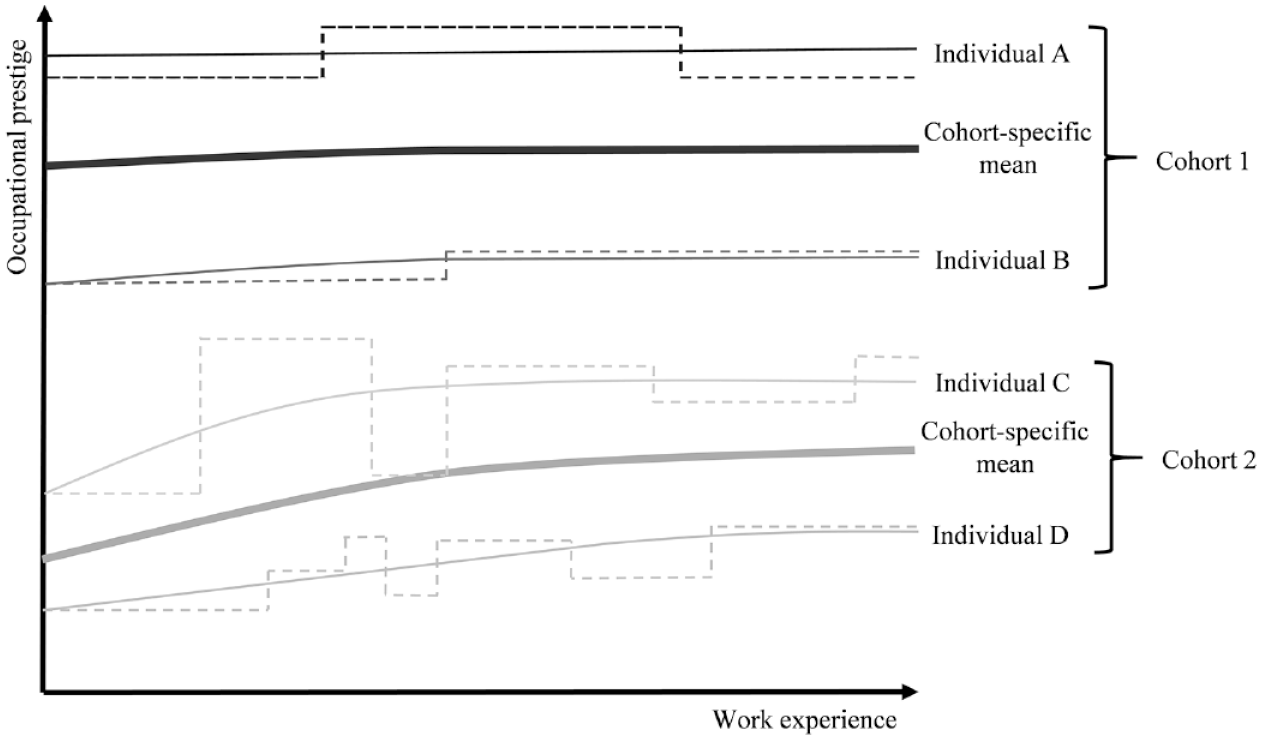
Types of Variability in Occupational Prestige Trajectories
In contrast, regarding growth, Cohort 2 exhibits more variability than Cohort 1. Growth variability indicates the extent to which opportunities to advance into more prestigious positions are unequally distributed. If growth variability is low, start inequalities are perpetuated across the life course. If growth variability is high, start inequalities may be reinforced or attenuated depending on the association between entry and growth variability, which is related to processes of cumulative (dis)advantage. For instance, if individuals with below-average start prestige experience below-average growth rates, initial inequalities between individuals will increase as individuals age (cumulative disadvantage).
Regarding fluctuation, variability is also lower in Cohort 1 than in Cohort 2, and thus attainment is less volatile in Cohort 1 than in Cohort 2. Fluctuation variability quantifies the amount of unexpected deviations from smoothed individual-specific trajectories caused by upward and downward moves. Unexpected downward moves have clearly negative consequences for individuals, but even unexpected upward moves may be experienced as disruptions in coherent trajectories of advancement (Wilensky 1961), threatening long-term planning in a wide range of life domains. In other words, if individuals do not follow predefined career ladders but are promoted erratically, this will increase insecurity in life course planning.
Prior Empirical Evidence on Variability in Occupational Prestige
Stawarz (2015) is one of the few studies to examine differences in variability in occupational prestige across labor market entry cohorts. Overall, Stawarz (2015) provides prima facie evidence that entry variability increased between cohorts from 1932 to 1989 for West Germany, with the exception of the 1940–1949 entry cohort. The study also finds preliminary evidence that growth variability decreased in labor market entry cohorts from the 1930s to 1950s and increased afterward. However, the study does not examine the substantive or statistical significance of this increase. In addition, because it pools women and men, this study may overlook crucial gender differences in variability caused by women’s changing labor force participation. Descriptively, Hillmert (2011) shows increasing variance at career entry in Germany over the birth cohorts 1919 to 1971 for women and men. Manzoni, Härkönen, and Mayer (2014) find that for German men born between 1919 and 1971, about 84 percent of the variance in occupational prestige is between-individual variance (85 percent for women); thus, only around 15 percent of variation is attributable to changes over individuals’ working lives. Previous empirical work has not addressed changes in fluctuation variability between cohorts.
Employment Relations and Occupational Trajectories
We build on employment relations theory to understand how changes in economic institutions influence systematic variability in individuals’ occupational trajectories. We argue that the degree of variability in trajectories depends on the type of employment relations, because these relations shape trajectories through distinct mechanisms of allocation to occupational positions, specifically regarding hiring procedures, career advancement mechanisms, and protection against external labor market shocks (Sørensen and Tuma 1981). More generally, employment relations determine the linkage between current and future positions in the labor market. Employment relations can be defined as the “dynamic social, economic, psychological, and political relationships between individual workers and their employers” (Kalleberg 2011:82; see also Baron 1988), however, these are rarely directly observable. We distinguish two ideal-typical forms of employment relations (Kalleberg 2011:83ff): closed and open employment relations, which differ fundamentally in how they protect workers from employers’ discretion and market competition. These two forms of employment relations are extremes on a continuum, with most actual employment relations lying somewhere between the two (Sørensen 2001).
In closed employment relations, there is a strong linkage between occupational positions over a career, leading to predictable trajectories. As an ideal type, closed employment relations rely on long-term commitments by employees and employers and build on relational employment contracts that are co-produced by firms and unions (Hollister 2011). Workers in closed employment relations trade loyalty and effort for security and protection against outsiders (Cappelli 2001). Promotions and demotions mostly take place in internal labor markets within firms, which are governed by bureaucratic rules, seniority, and institutionalized procedures (Bidwell et al. 2013; Dencker and Fang 2016).
Regarding hiring, in closed employment relations, educational credentials are only relevant at entry to the internal labor market and determine individuals’ relative positions in the labor queue (Sørensen 2001). Because closed employment relations provide rewarding career ladders, individuals accept lower and less stratified initial occupational positions, which should lead to lower entry variability. Subsequent occupational positions are mainly determined by an individual’s prior occupational position and time spent in the current position (Althauser 1989). This should lead to low variability in growth rates between workers. Fluctuation variability resulting from external market shocks, such as offshoring of jobs and cyclical demand fluctuations, should be reduced by protective institutions such as strong employment protection legislation (DiPrete et al. 1997; Gangl 2006).
In contrast, because open employment relations are more market-driven, they increase the contingency of employment and reduce linkages between positions. This means trajectories may become less predictable. Open employment relations rely on hiring from external labor markets; they are performance- and credential-based and are hence more adaptive to environmental changes, such as (global) market competition due to increased employers’ discretion (Dencker and Fang 2016; Hollister 2011). Open employment relations build on transactional employment contracts, which are more likely to be short term and to provide less protection against market competitors.
Because open employment relations do not provide predefined career ladders for promotion, individuals have incentives to seek high rewards from the beginning, which should lead to higher entry variability. Allocation to subsequent occupational positions is mainly determined by workers’ (anticipated) productivity. Educational credentials are important for an individual’s entire career because they signal a person’s skill set (Bidwell et al. 2013). In the absence of predefined career ladders, mobility is determined by patterns of skill enhancement. General skills are particularly important for competing in the external labor market. Because improvements in general skills require investments by both employers (further training) and employees (training and taking the risk of job and occupational mobility), individuals’ growth rates should be more variable in open employment relations than in closed ones; this leads to job churning and divergent trajectories. Market shocks affect individuals in open employment relations more directly, because there are fewer protective institutions and policies in place (Bidwell et al. 2013). Hence, fluctuation variability should be higher in open employment relations than in closed ones.
The prevalence of open employment relations should have different implications across and within educational groups because of varying patterns of skills use and transferability. The strong linkage between training and job-specific skills evident among vocational education and training (VET) graduates (Müller and Gangl 2003) should cause low variability at labor market entry in closed employment relations. A shift toward open employment relations may only affect entry variability if accompanied by a reduction of entry positions. However, reduced job tenure in open employment relations should lead to higher growth variability for VET graduates. In this case, due to lower skills transferability, the strong linkage may also limit job mobility (Shaw 1986). In addition, VET graduates in open employment relations are at a greater risk of being in employment below their qualification level or long-term unemployment after job loss, which would lead to larger increases in fluctuation variability.
Generally, tertiary-educated employees should have higher levels of variability than VET graduates. Because there is a weak linkage between training and jobs for tertiary graduates, entry and growth variability should be higher. Both types of variability should further increase in open employment relations, but in the event of external shocks, tertiary-educated employees lose fewer job-specific investments than do VET graduates, which reduces variability (Gathmann and Schoenberg 2010). There may be large variations within tertiary-educated employees in open employment relations because employers’ and employees’ investments in transferable skills vary considerably (Müller and Jacob 2008).
There is a lack of theoretical clarity concerning how shifts toward open employment relations affect variability among individuals with limited formal qualifications (i.e., people without VET and tertiary education). On the one hand, these individuals can only access a very limited range of occupational positions, which likely suppresses prestige variability. On the other hand, their lack of labor market resources might be related to exceptionally pronounced growth and fluctuation variability.
The West German Case: Changes in the Labor Market and Occupational Prestige Trajectories across Birth Cohorts
Different employment relations coexist in labor markets, but in most economies a dominant type has historically prevailed. After World War II (the “golden age”), Germany was mostly characterized by closed employment relations, whereas the United States was characterized by open employment relations (Hall and Soskice 2001). Since this golden age, economies have followed “divergent trajectories of liberalization” (Thelen 2014:6) driven by distinct political-coalitional alignments across countries, which responded to pressures due to competition in international markets, hypermobile capital, deindustrialization, and the rise of neoliberal ideology.
Whereas the United States followed a trajectory of wholesale deregulation (e.g., by dismantling union rights), Germany followed a trajectory of dualization, mainly because stable institutions persisted despite marked sectoral restructuring but also due to a combination of political inaction and directed deregulation (e.g., for agency workers and marginal employment) (Thelen 2014:33ff). Interest groups in manufacturing succeeded in preserving regulated and closed employment relations, but pervasive liberalization unfolded outside of this core. Recent scholarship has argued that managerial discretion increased greatly even in manufacturing employment, mainly because works councils shifted from being union representatives to company-level agents undermining central coordination in Germany (Baccaro and Howell 2017:97ff). The literature has extensively described the consequences of general liberalization trends for cross-sectional inequality in the labor market (Morris and Western 1999; McCall and Percheski 2010; Thelen 2014:43ff), but the link to variability in occupational trajectories remains less well understood.
Given West Germany’s history of having an ideal-typical closed employment system that subsequently eroded, it is a particularly interesting case for studying how transformations in employment relations influence changes in prestige variability across birth cohorts. World War II is another important factor; it was a severe structural shock that temporarily eliminated the established institutions of the labor market. It is important to recognize that changes in career variability are likely caused by a combination of cohort and period effects. Birth cohorts share the experience of specific historical or period events, such as economic recessions. Period effects likely play a smaller role in closed employment relations than in open ones, because of the strong protection against market competition in closed employment relations. When the coverage of closed employment relations erodes, period effects likely become more important for prestige variability.
We now describe the historical changes in Germany in more detail, starting with the cohorts born in the 1940s. Members of these cohorts, who began their working lives in the golden age of the late 1950s and 1960s, experienced the ideal-typical setting of a labor market with closed employment relations (Normalarbeitsverhältnis); a key feature of this system was that individuals’ initial job placement had a large effect on their future trajectories (Hillmert 2011; Kurz, Hillmert, and Grunow 2006). Employment protection was co-produced by employer associations, trade unions, and works councils. Employer–employee commitment was built on investments in the acquisition and maintenance of (firm-)specific skills that, in return, offered life-long occupational continuity and security against economic downturns, in particular for workers in manufacturing and production (Thelen 2014:119). The VET system was governed jointly by the state and firms to generate the specific skills required by firms producing high-quality goods (Becker and Mayer 2019). 4 Moreover, Germany’s VET system was and still is characterized by rigid occupational boundaries that limit subsequent mobility, more so than in other countries (DiPrete et al. 1997). As a consequence, we expect low levels of entry, growth, and fluctuation variability for the 1940s birth cohorts.
The birth cohorts of the 1920s and early 1930s entered the labor market shortly after the Great Depression (1929 to 1932) and during World War II. These individuals experienced conditions resembling open employment relations, which should have led to higher levels of variability in all three dimensions. First, the majority of the workforce was employed in agriculture or unskilled manufacturing jobs and VET was not yet widespread (Kocka 1981), leading to high rates of job-to-job mobility (Brown and Neumeier 2004). Second, given the shortage of men in the “civil” labor market, the remaining men and women were recruited outside of institutionalized channels, sometimes directly at factory gates. Third, because of the war, most men interrupted their civil careers and were re-employed in spot markets. In addition, directly after World War II, unemployment skyrocketed, hampering many people’s chances of steady career progression (Hillmert 2011).
Cohorts born in the 1950s and later, who entered the labor market after the golden age of the 1950s and 1960s, experienced the incipient erosion of closed employment relations. In the wake of the recessions following the 1973 and 1979 oil price shocks, it became more difficult to access core sectors of the labor market. However, the careers of core-sector workers with vocational or tertiary education were still highly stable (Mayer, Grunow, and Nitsche 2010). One central feature of closed employment relations in the core sectors was comprehensive short-term work policies aimed at retaining workers with industry- and firm-specific skills (Thelen 2014:113).
For cohorts born in the 1970s, further economic restructuring—including deindustrialization, technological change, and concomitant institutional transformations—may have accelerated the shift toward open employment relations and hence toward more prestige variability. This may have accelerated the polarization of allocation mechanisms in the labor market across educational groups, specifically regarding returns to work skills. Among individuals who entered the labor market in the late 1980s and early 1990s, those with a tertiary education were well-equipped to deal with the ramifications of economic restructuring because they often worked in jobs with high, non-replaceable skill requirements (Buchholz and Grunow 2006). This group should have experienced lower skill depreciation due to rapid technological innovation, because employers largely only invested in continued training for members of this group (Thelen 2014:73). Moreover, during periods of unemployment, this group was less likely to lose their general and transferable people-processing or nonroutine manual skills than were VET graduates. Yet they may have had the highest risk of inadequate entry, especially in unfavorable times (Borgna, Solga, and Protsch 2019).
The advantages of VET—that is, a strong link between qualifications, labor market entry, and further career progression—may have been a liability for the 1970s cohorts, who witnessed further development toward open employment relations. There are two reasons for this. First, in the growing service sector, an increasing number of jobs that VET graduates performed required routine manual and routine cognitive skills. These were often replaced by technology (Autor, Levy, and Murnane 2003; for Germany, see Spitz-Oener 2006), creating fewer entry positions and more variable growth patterns. Second, external shocks led to large losses of (firm-)specific skills and hence greater fluctuation variability. Finally, individuals without formal qualifications likely faced the most severe repercussions in the form of increasing job instability—within and outside of the core sectors (Baccaro and Howell 2017). This was because the labor market reforms of the early 2000s scaled back employment protections and increased atypical employment, especially in the low-skill sector (Brady and Biegert 2017).
Variability in Prestige for Women across Birth Cohorts
Women had less access to closed employment relations in West Germany (Bucholz and Grunow 2006) than did men and therefore likely experienced higher levels of prestige variability overall. One reason is that educational and occupational gender segregation limited women’s access to sectors that offered opportunity for steady advancement, such as manufacturing, mining, and steel production. In addition, women most often left the labor market after family formation; for a long time, they left directly after marriage. However, women’s role in West German society, and consequently their labor market behavior, changed profoundly over the twentieth century (Trappe, Pollmann-Schult, and Schmitt 2015). We thus expect women to have comparable trends but different levels of prestige variability compared to men.
Like men in this cohort, women born in the 1940s likely had somewhat better access to closed employment relations in the prosperous (late) 1950s and 1960s, due to their greater educational opportunities and access to higher-status occupations. However, although women had disproportionate gains in education in comparison to men—the decline in the number of women without vocational qualifications was particularly strong (Blossfeld 1987)—the ongoing diversification of the occupational structure, which prompted women to work across a wider range of occupations, likely limited any reduction in entry variability. 5 In addition, women still mainly worked in a number of small, competitive industries, such as wholesale and retail trade or hotels and restaurants, which offered no job ladders and little opportunity for steady advancement.
The earliest cohorts (born 1919–1921 and 1929–1931) experienced typical open employment relations, despite gender-specific wartime effects. In a short period during and immediately after World War II, the demand for female labor was high, even in typically male occupations. However, the long-term influence of this period on women’s employment behavior was limited (Killingsworth and Heckman 1986; Long 1958). These women, born in the late 1920s and early 1930s, mostly entered a limited range of routine nonmanual lower-status occupations. And although a larger proportion of women gained access to career tracks linked to higher-status jobs, this did not translate into lasting changes (Manzoni et al. 2014).
For women born in the postwar period (1950 and later), the erosion of closed employment relations likely led to increased levels of variability. During the economic restructuring in the crisis years of the 1980s (Blossfeld 1987), access to the fields in which women were most likely to have prospects for steady advancement—such as service and administration (Gundert and Mayer 2012)—was especially difficult. Moreover, interventionist policies fostering the male breadwinner model (Kahn 2012) put women at greater risk of unemployment and becoming outsiders with less access to employment segments that offered steady career paths.
From the 1980s onward, women increasingly sought to combine the caregiver and additional wage-earner role by selecting into more flexible employment arrangements, such as part-time employment (Drobnič, Blossfeld, and Rohwer 1999). These jobs were often marginalized, offering little stability and few prospects (Budig and England 2001), and they were therefore likely associated with higher growth and fluctuation variability. In labor markets that increasingly relied on spot hiring, time out of the labor market might have been especially harmful to women’s careers (Härkönen, Manzoni, and Bihagen 2016). The introduction and extension of parental leave since the mid-1980s might have further fueled these disadvantages (Gangl and Ziefle 2015).
In summary, we expect trends in employment relations to be associated with the three dimensions of variability—entry, growth, and fluctuation—in a u-shaped pattern (see Table 1). In particular, we expect to see high levels of variability for pre- and postwar cohorts because of the low prevalence of closed employment relations and the structural shocks to institutionalized hiring and advancement patterns caused by World War II. In contrast, for the 1940s cohorts, we expect closed employment relations to have caused low levels of variability. For the cohorts born from the 1950s onward, the erosion of closed employment relations likely led to higher levels of variability.
Summary of Expected Cohort Changes in Variability
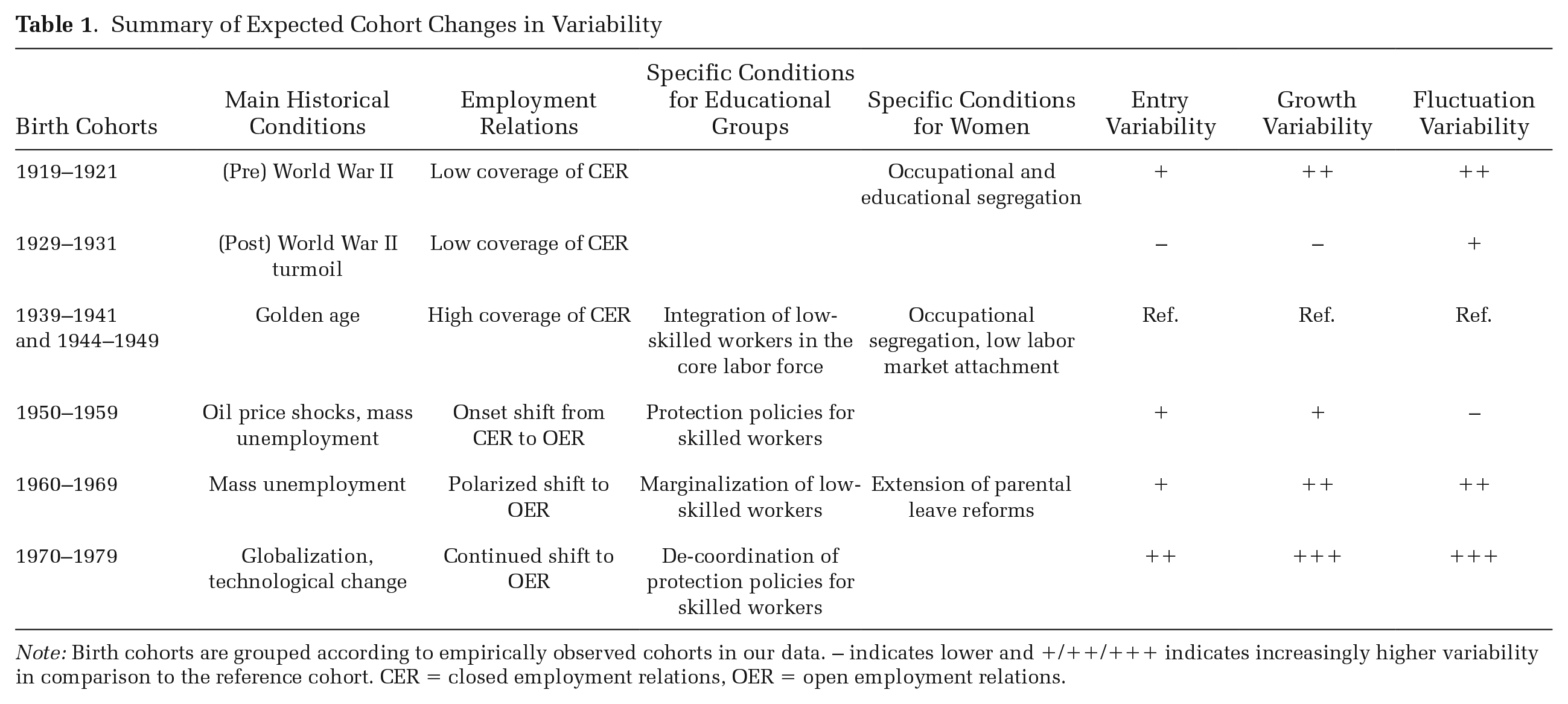
Note: Birth cohorts are grouped according to empirically observed cohorts in our data. – indicates lower and +/++/+++ indicates increasingly higher variability in comparison to the reference cohort. CER = closed employment relations, OER = open employment relations.
We further expect differentials across educational groups and particularly for the youngest cohorts born in the 1970s, with VET graduates experiencing the least variable careers. Open employment relations should increase fluctuation variability for VET graduates and for people without formal qualifications. Tertiary-educated individuals should have higher levels of variability in entry and growth compared to other educational groups, and this likely increased further among the youngest cohorts. We also expect to find higher levels of variability in women’s careers. The increase in variability from the 1950s onward should be more pronounced for women than for men, even if both groups follow a similar trend.
Data and Methods
Our empirical analysis focuses on three objectives. 6 First, we model individual-level trajectories of prestige attainment to decompose entry, growth, and fluctuation variability and to test the trajectory heterogeneity property (i.e., the idea that occupational trajectories are characterized by unequal levels of occupational attainment at individuals’ first job placement and unequal growth rates) and the random variability property (i.e., the notion that trajectories are characterized by random shocks). Second, we examine between-cohort differences in variability to test the systematic variability property (i.e., the supposition that trajectories are characterized by substantial variation in variability between social groups). Third, we examine the contribution of education and family-related employment interruptions to these changes between cohorts. Throughout, we study women’s and men’s trajectories separately.
Data
We use two data sources to cover birth cohorts for a large part of the twentieth century for West Germany. First, we draw data from the German Life History Study (GLHS; see Mayer 2015). 7 The GLHS is a retrospective cohort study, which includes detailed monthly employment histories. For several cohorts born between 1919 and 1971, the study includes nationally representative samples; between 1985 and 1999, face-to-face and telephone interviews with about 12,000 respondents were conducted. The GLHS implemented several measures to ensure the quality of the retrospective data (Mayer 2015).
Second, we draw data from the German National Educational Panel Study (NEPS) for starting cohort 6, release 9.0.1 (Blossfeld, Roßbach, and Maurice 2011). 8 NEPS starting cohort 6 is a nationally representative sample of the birth cohorts 1944 to 1986. The respondents have been interviewed annually since 2007, and the study is still ongoing. NEPS uses telephone and personal interviews to collect a wide range of information, including retrospective monthly employment histories comparable to the GLHS. In our analysis, we pool the data from both sources to increase statistical power. 9 The data are organized in a longitudinal individual-month format.
Sample
We selected West German respondents for the analysis. For reasons of consistency, we exclude non-German nationals, because they are partly excluded from the sample frame in the GLHS. We follow respondents from their first job of at least six months to occupational maturity, that is, up to 15 years in employment, which is in line with previous research (Manzoni et al. 2014). We right-censor observations at age 50 to discard increasingly selective careers (for a similar approach, see Härkönen et al. 2016). We only consider monthly observations in which respondents are (self-)employed. Career interruptions are excluded from the main analysis, but we include control variables for time out of the labor market. We revisit this issue in the additional analysis described below. It is important to note that the characteristics of individuals selecting into (re)employment may change across cohorts, in particular among women, which may contribute to observed changes across cohorts. 10 We include 810,664 months for 7,218 individuals from the GLHS, and 1,336,774 months for 9,636 individuals from NEPS in our analysis.
Measures
Our outcome of interest is occupational prestige. To measure prestige, we use the Standard International Occupational Prestige Scale (SIOPS) (Treiman 1977). 11 SIOPS is an internationally standardized gradual measure of the social standing of an occupation. Compared to other measures of occupational attainment, such as income or status, prestige has a number of benefits for our purpose. First, occupational prestige is remarkably stable across historical time and countries (Hout and DiPrete 2006). 12 Second, direct measures of occupational prestige are more suitable for comparisons across genders (Warren, Sheridan, and Hauser 1998). 13 Such direct measures are more suitable than composite measures of socioeconomic status, such as the International Socio-Economic Index, including education and income, which vary substantially between women and men across occupations. Third, occupational prestige can be more easily observed retrospectively than income, for example (Härkönen et al. 2016). By using a gradual measure of prestige, we avoid arbitrary cut-off values when defining the upward or downward moves in occupational trajectories; these are common in studies utilizing event history analysis (Manzoni et al. 2014). For our purpose, workers who change jobs but remain in the same occupation (horizontal mobility) have a flat occupational prestige trajectory. Only changes in occupations (vertical mobility) with the same employer (internal mobility) or to a different employer (external mobility) will cause changes in the occupational prestige trajectory.
To examine differences in variability, we include birth cohort. We distinguish seven birth cohorts covered in our data: 1919–1921, 1929–1931, 1939–1941 (reference category), 1944–1949, 1950–1959, 1960–1969, and 1970–1979. We select the 1939–1941 cohort as the reference category, because we expect this birth cohort (along with the 1944–1949 cohort) to be most exposed to closed employment relations. The earlier birth cohorts cover fewer birth years because of the GLHS sample frame. Later birth cohorts (from 1944) include sample members from GLHS and NEPS.
To examine occupational prestige trajectories, we use months since labor market entry as a time variable. The variable starts to count at the first job with a duration of at least six months. We create three linear splines, which cover the first 60 months, 61 to 120 months, and 121 to 180 months to account for potential changes in growth rates between career stages. To capture interruptions, we include additional variables that measure months in parental leave (including all family-related interruptions), months unemployed, and months out of employment (residual category that includes, e.g., further training) since first labor market entry.
We include a few additional covariates in our models. We measure parental background using education of parents (dominance rule) with the following categories based on the Comparative Analysis of Social Mobility in Industrial Nations (CASMIN) classification: lower-secondary or less (ref.), lower-secondary or less plus training, middle/higher-secondary, middle/higher-secondary plus training, and tertiary education. We also control for the data source (GLHS subsamples and NEPS). In additional analyses, we adjust for respondents’ own education using the same CASMIN classification that we use for parents. See Tables S1 and S2 in the online supplement for descriptive statistics for all variables.
Analytic Strategy
First, we estimate linear mixed-effects growth-curve models to predict individual-specific occupational prestige trajectories and to decompose variability in occupational attainment in entry variability, growth variability, and fluctuation variability. This allows us to test the trajectory heterogeneity property and the random variability property proposed by Cheng (2014). All estimated parameters are constrained to be constant across cohorts at this stage of analysis, which is in line with most previous research. Our fully specified model can be written as follows:
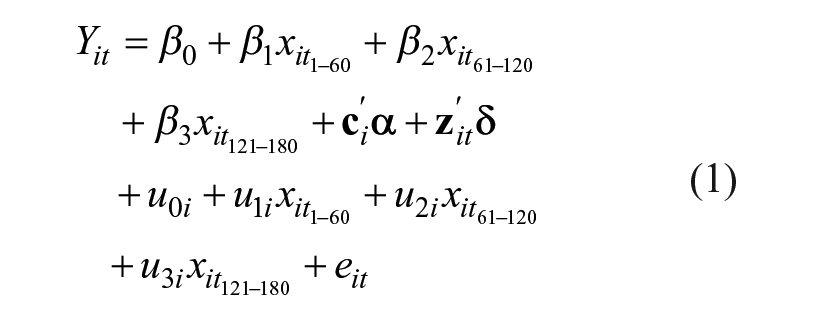
with
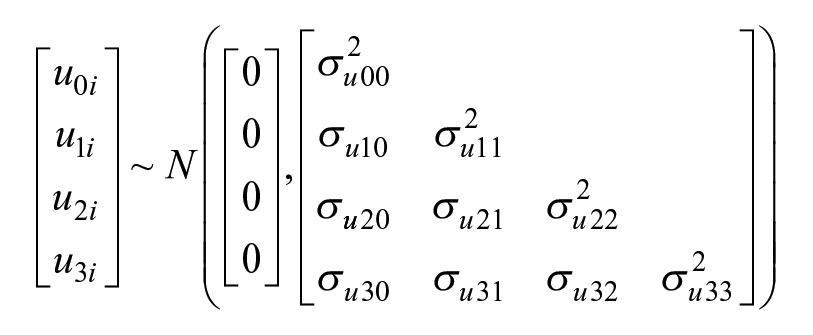

where Yit is the occupational prestige of respondent i at time t. β0 is the average intercept in cohort c, capturing mean occupational prestige at entry at that point in time; u0i is the random intercept effect, capturing between-individual variation in intercepts (entry variability). xit is the time since labor market entry in months, entered in the model as three linear splines. The related coefficients β1, β2, and β3 may vary across individuals when including the random effects u1i, u2i, and u3i. Variance in these three random effects indicates growth variability.
Second, we relax the assumption of constant parameters and homoscedastic residual variance across cohorts to evaluate heterogeneous variance components, to test the systematic variability property, and to describe changes in variability across cohorts. This approach reduces potential model misspecification in Equation 1, where only the intercept was allowed to vary across cohorts. We extend the above model with cohort-specific parameters indicated by superscript c:
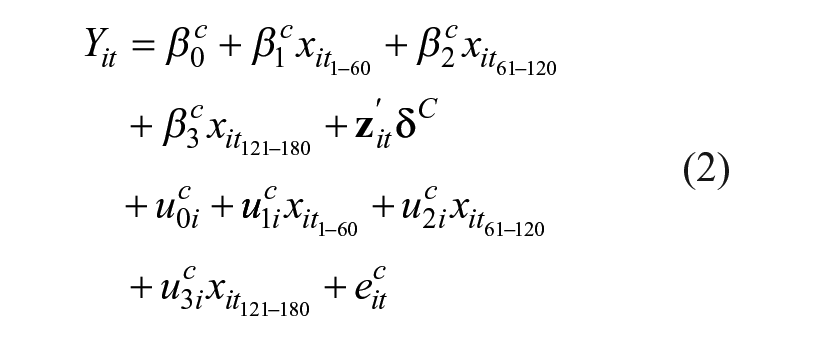
with a corresponding cohort-specific variance-covariance matrix as described earlier. The key extension compared to Equation 1 is to allow the variances of the random effects uc0i, uc1i, uc2i, uc3i, and the residuals ecit to vary across cohorts. This model is similar to running separate regressions for each cohort. However, by estimating the cohort-specific parameters jointly in one model, we can flexibly constrain parameters to be equal across cohorts. Furthermore, we can compare model fit across these differently constrained models, which allows us to test hypotheses about systematic variability using likelihood ratio tests. By comparing the variance parameters for the cohort-specific random effects and residuals, we can evaluate our expectations about cohort change in entry variability, growth variability, and fluctuation variability in line with the systematic variability property. Again, the model is estimated separately by gender. Based on these models, we predict individual-specific occupational prestige trajectories and describe these trajectories to assess the substantial influence of entry, growth, and fluctuation variability on intracohort differentiation. For this, we use the coefficient of variation (CV) as a measure of inequality, which is defined as the ratio of the standard deviation to the mean, that is, relating the variation to the level.
Finally, we build on the model with heterogeneous variance components to undertake two additional analyses. We examine the influence of education on changes in variability by adjusting for individuals’ education and by estimating models separately by educational groups. Furthermore, we consider the influence of family-related employment interruptions on women’s variability. To do so, additional analyses assign hypothetical SIOPS values for employment breaks for women (and men) who are out of employment for family reasons. Based on the assumption that being a housewife should be considered an occupation (Cohen 2004), we use a SIOPS prestige score of 54, which is equivalent to being a nurse and which an early survey study (Dworkin 1981) identified as the prestige of being a housewife. 14
Results
Figure S1 in the online supplement shows the mean prestige for each cohort, which we do not further discuss here due to our focus on variability. Our findings regarding mean trajectories are in line with previous literature (e.g., Manzoni et al. 2014). Overall, about 28 percent of individuals in our sample changed their occupational prestige once, 14 percent changed twice, and 9 percent changed their occupational prestige at least three times. About 49 percent of individuals in our sample did not change their occupational prestige during the observation window, which highlights the substantial stability in occupational trajectories in West Germany.
Testing Trajectory Heterogeneity and Random Variability Properties
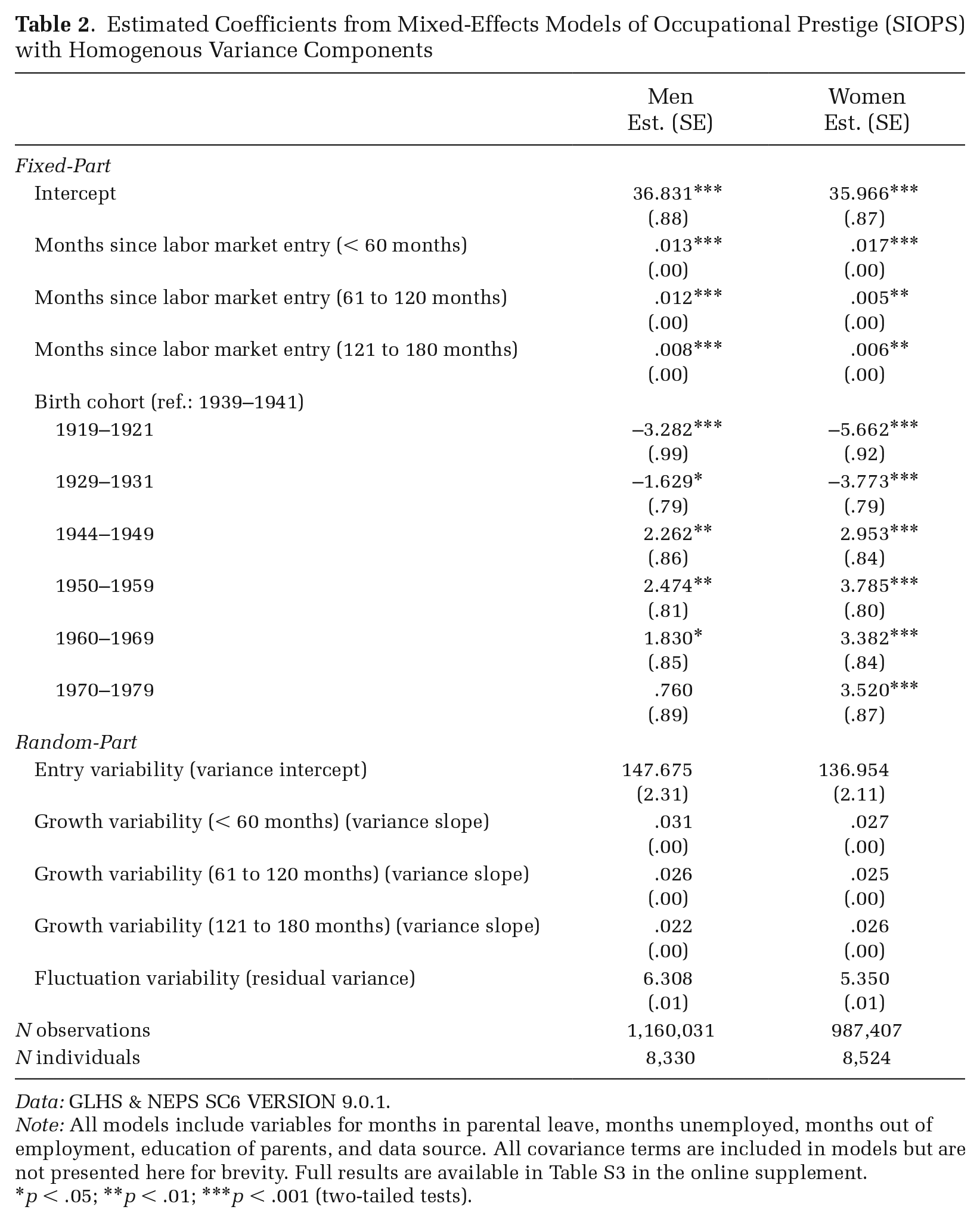
We begin by decomposing variability in occupational prestige attainment into three components—entry variability, growth variability, and fluctuation variability—using multivariable mixed-effects growth-curve models with homogenous variance components to estimate individual-specific occupational trajectories. As expected, we find that occupational prestige slightly increases with time since labor market entry for men and women, but this is less applicable in later career stages (see Table 2). For instance, for each year in employment, men gain about .17 (= 12 × .013) SIOPS points in the first five years, but only .10 points between years 10 and 15 of their careers; the SIOPS scale ranges from 13 to 78 with a standard deviation of 12.64 for men in our data (see Table S1 in the online supplement). Although women initially experience slightly higher growth rates, their growth rates are lower than those of men after 60 months following labor market entry. The coefficients for birth cohorts are in line with occupational upgrading for men and women, as found in earlier research (e.g., Manzoni et al. 2014), but the increase in mean prestige was slower for the youngest cohorts born after 1959 than for the 1939–1941 birth cohort; we even observe a slight decrease in mean prestige for men in the youngest birth cohorts. Additional control variables behave as expected and are not further discussed (see full estimation results in Table S3 in the online supplement).
Estimated Coefficients from Mixed-Effects Models of Occupational Prestige (SIOPS) with Homogenous Variance Components
Data: GLHS & NEPS SC6 VERSION 9.0.1.
Note: All models include variables for months in parental leave, months unemployed, months out of employment, education of parents, and data source. All covariance terms are included in models but are not presented here for brevity. Full results are available in Table S3 in the online supplement.
p < .05; **p < .01; ***p < .001 (two-tailed tests).
The models reported in Table 2 are based on individual-specific trajectories of prestige attainment. These models allow us to separate entry variability (variance in intercept), growth variability (variance in the slopes of months since labor market entry), and fluctuation variability (variance in residuals) between individual trajectories (see “random-part” in Table 2). 15 We find that for men and women, all variance components are different from 0. Allowing for all three types of variability substantially and statistically significantly increases model fit for women and men. 16 Thus, individuals differ in their occupational prestige at entry and their growth rates in accordance with the trajectory heterogeneity property after adjusting for factors such as parental education and time unemployed. We also find statistically significant fluctuation variability, in line with the random variability property.
The variance components indicate that individual trajectories vary considerably from each other. For instance, whereas the mean occupational prestige for men grows by .01 points each month in the first five years, the model estimates that for the 95 percent of men in the middle of the predicted trajectories, there was SIOPS growth between .36 and –.34
Testing the Systematic Variability Property
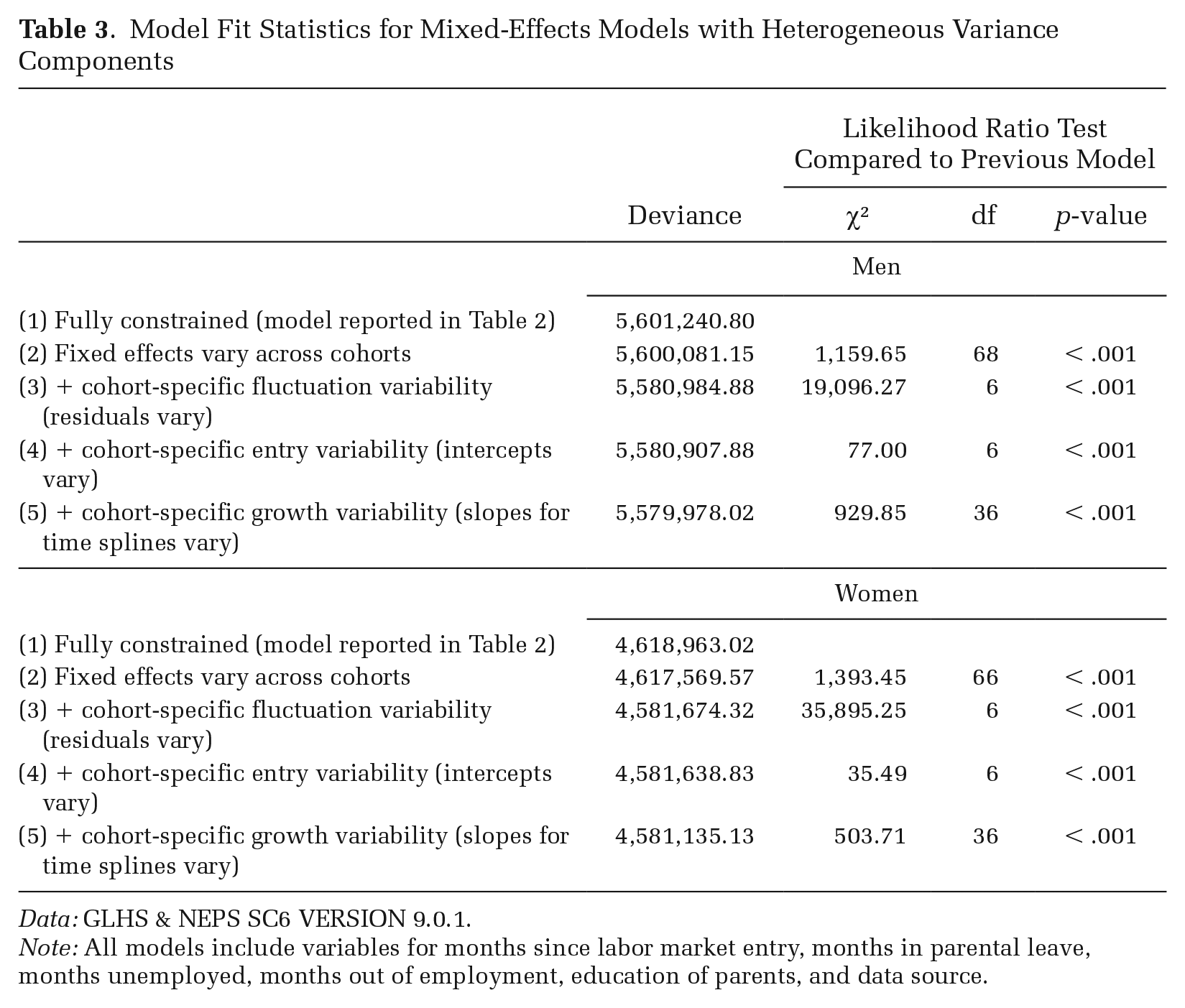
Having established that there is considerable entry variability, growth variability, and fluctuation variability in occupational prestige among men and women in West Germany, we now examine whether this variability differs between birth cohorts because of changing employment relations, in accordance with the systematic variability property. In Table 3, we compare model fit statistics and conduct likelihood ratio tests for increasingly flexible model specifications in which we allow additional sets of parameters to vary between cohorts based on the models reported in Table 2.
Model Fit Statistics for Mixed-Effects Models with Heterogeneous Variance Components
Data: GLHS & NEPS SC6 VERSION 9.0.1.
Note: All models include variables for months since labor market entry, months in parental leave, months unemployed, months out of employment, education of parents, and data source.
First, we find that model fit significantly increases if we allow the fixed parameters (for months since labor market entry, months in parental leave, months unemployed, months out of employment, education of parents, and data source) to vary across cohorts. The cohort-specific fixed parameters are available in Table S4 in the online supplement. Second, allowing the fluctuation variability to differ across birth cohorts additionally increases model fit in both samples, which provides evidence that this dimension of variability statistically significantly changed across cohorts. Third, we find that allowing the entry variability to differ between birth cohorts increases model fit. Finally, allowing the growth variability to differ between cohorts clearly increases model fit for men and women, which provides evidence that growth variability also significantly changes across birth cohorts. Thus, we find clear statistical support for the systematic variability property for men’s and women’s occupational trajectories in West Germany. Life course trajectories of attainment are characterized by variation in typical entry, growth, and fluctuation variability between birth cohorts, leading to changes in intracohort differentiation. In other words, we observe changing career patterns across cohorts that may contribute to dynamics in between-individual inequality in Germany over time.
Do changes in variability align with our expectations derived from changing employment relations in Germany? Based on the most flexibly specified models, in which all dimensions of variability are allowed to vary between cohorts, we present the estimated variances in random effects and residuals by cohort and gender as our measures of variability in Figure 2. This allows us to examine patterns of change in variability. The upper-left panel shows the cohort-specific entry variability. For instance, for the 1919–1921 birth cohort, the mean prestige level for men at entry is 37.07 (see Table S4 in the online supplement). The variance components indicate that entry prestige for the middle 95 percent of men ranges from 15.19 to 58.95
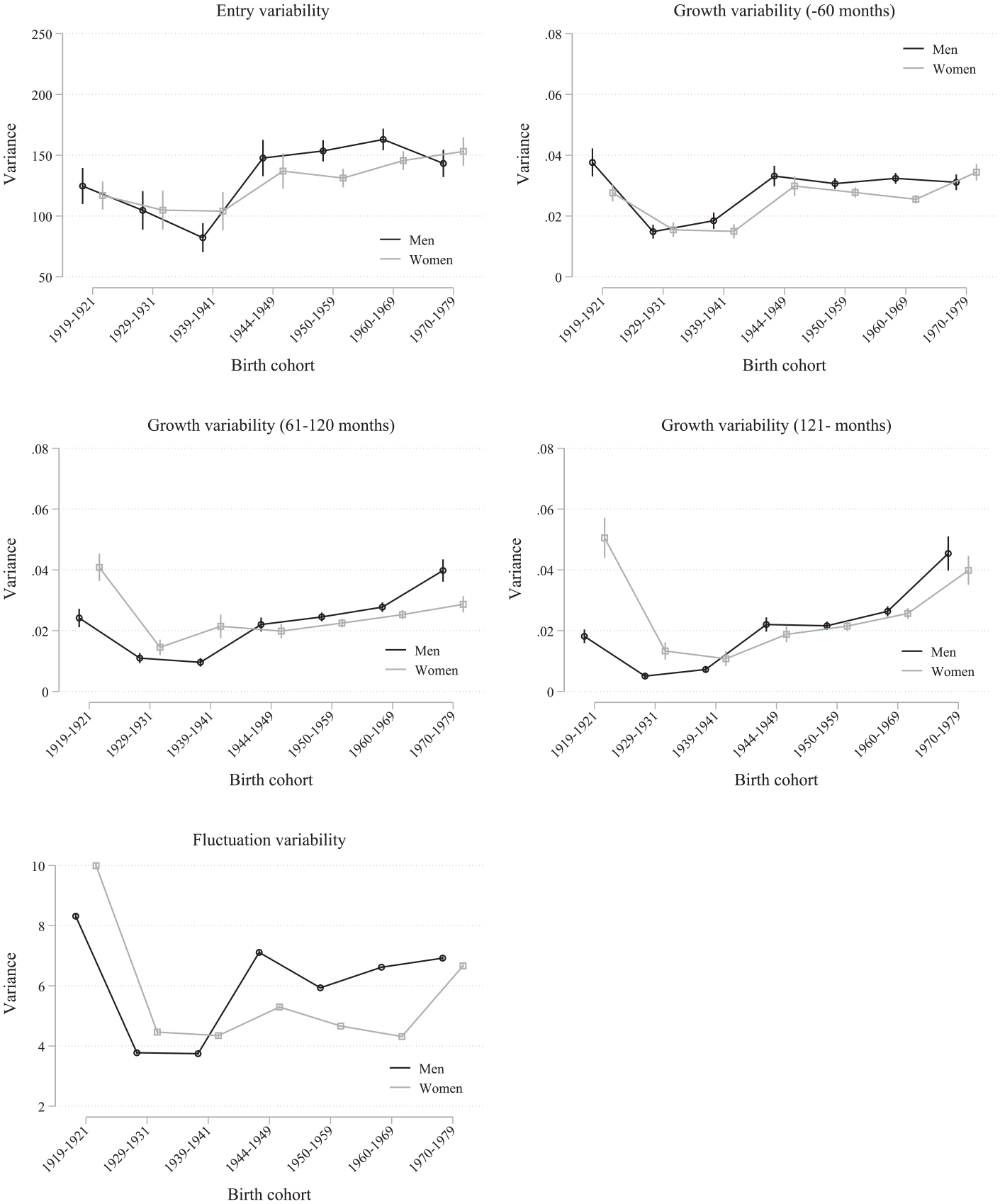
Estimated Random-Part Variance Parameters from Mixed-Effects Growth-Curve Models of Occupational Prestige (SIOPS) with Heterogeneous Variance Components by Birth Cohorts, Separately Estimated for Men and Women
For men and women, we find the lowest entry variability for the 1939–1941 birth cohort, for which closed employment relations were dominant. For women, this runs contrary to our expectation that the diversification of occupational opportunities may cancel out the variability-hampering effects of the prosperous golden age. For older birth cohorts—that is, those born before World War II, who entered the labor market just before the war, during the war, or shortly after the war at a time when open employment relations were prevalent—entry variability is higher, but the differences are small for women. We also find higher entry variability for later-born cohorts, starting with the 1944–1949 birth cohort, but in contrast to our expectations, which are based on increasingly open employment relations, there is no clear trend in entry variability for birth cohorts born from 1950 onward. These results suggest that entry variability was exceptionally low for the 1939–1941 birth cohort, which experienced mostly closed employment relations, but that other birth cohorts experienced modest changes in entry variability. Overall, entry variability is similar for men and women, with slightly higher entry variability for women in older birth cohorts and slightly lower entry variability for women in younger birth cohorts, which contradicts our expectations of generally higher variability for women.
Next, we consider changes in growth variability across cohorts, which we model using three linear splines to capture differences in growth rates by career stage. For the three splines—1 to 60 months, 61 to 120 months, and 121 to 180 months since labor market entry—we observe high variability among men and women for members of the oldest birth cohort, 1919–1921, who were most negatively affected by World War II, which occurred in the middle of their careers. The 1929–1931 and 1939–1941 birth cohorts show considerably lower growth variability. These cohorts experienced the most uniform within-cohort career progression according to our data. For later-born cohorts, starting with the 1944–1949 cohort, we again observe an increase in variability. Although growth variability does not further increase for younger birth cohorts for the first 60 months of trajectories, we find increasing growth variability in younger cohorts for later career stages (61–120 and 121–180 months after labor market entry). In particular, the 1970–1979 cohort is characterized by growth variability in later career stages, which is similar to the experience of the 1919–1921 cohort. Thus, for younger cohorts and the oldest cohort, career progression is substantially less uniform within cohorts than for the 1929–1931 and 1939–1941 birth cohorts; this is in line with our expectations about more open employment relations for these cohorts. The u-shaped trend is similar for men and women. Overall, we find women’s growth variability to be much higher than men’s variability in the oldest birth cohort, but in the youngest birth cohorts men’s variability is higher (only for later career stages).
Fluctuation variability is lower in the golden age birth cohorts 1929–1931 and 1939–1941 than in all other birth cohorts. Fluctuation variability is highest in the 1919–1921 birth cohort, which experienced the “shock” of World War II most directly. For men, fluctuation variability does not show a clear trend over time. It increases substantially from the 1939–1941 to the 1944–1949 birth cohorts, slightly decreases for the 1950–1959 birth cohort, and then increases again for subsequent birth cohorts. For women, the increase between the 1939–1941 and 1944–1949 birth cohorts is less pronounced than for men. In younger birth cohorts, fluctuation variability again decreases for women, but it increases in the youngest birth cohort (1970–1979) to a level similar to the fluctuation variability for men. In most older cohorts, fluctuation variability is higher for women than for men, whereas the opposite is true for younger cohorts. These developments are only partly in line with our theory, as we expected continuously increasing fluctuation variability in younger birth cohorts due to more open employment relations, with the trend being especially pronounced for women. Thus, although careers have become less predictable for cohorts born after 1941, our results do not suggest a clear trend of increasing destabilization as suggested in previous literature (e.g., Beck 1992). Rather, the 1929–1931 and 1939–1941 cohorts stand out as having experienced very stable occupational trajectories.
Predicted Intracohort Differentiation
Our approach allows us to identify how career changes can be related to dynamics in cross-sectional, between-individual inequality in the aggregate. To this end, we examine cross-sectional, point-in-time inequality within cohorts to gauge the relative influence of entry, growth, and fluctuation variability for intracohort differentiation since labor market entry. How this inequality within cohorts affects overall population-level inequality at a given point in historical time depends on the relative population shares of cohorts, which we do not consider here.
We use the model underlying Figure 2 to do two things: first to predict individual-level trajectories of occupational prestige by gradually adding the three types of variability to the predictions, and second to compute the coefficient of variation as a measure of inequality within cohorts based on these trajectories in our sample. The baseline prediction without the inclusion of variability only captures the inequality that can be explained by observed differences in months since labor market entry, months in parental leave, months unemployed, months out of employment, and education of parents (i.e., the fixed-part of the mixed model). 17 Consistent with the expectations summarized in Table 1, a u-shaped pattern in inequality across cohorts can be expected overall. Given the important role of initial placement in the German labor market resulting from the dominance of closed employment relations, entry variability should have a large influence on point-in-time inequality. We show the results for the 1919–1921, 1939–1941, and 1970–1979 birth cohorts in Figure 3 and focus on describing three main findings (due to space restrictions, results for the remaining cohorts are in Figures S3 and S4 in the online supplement).
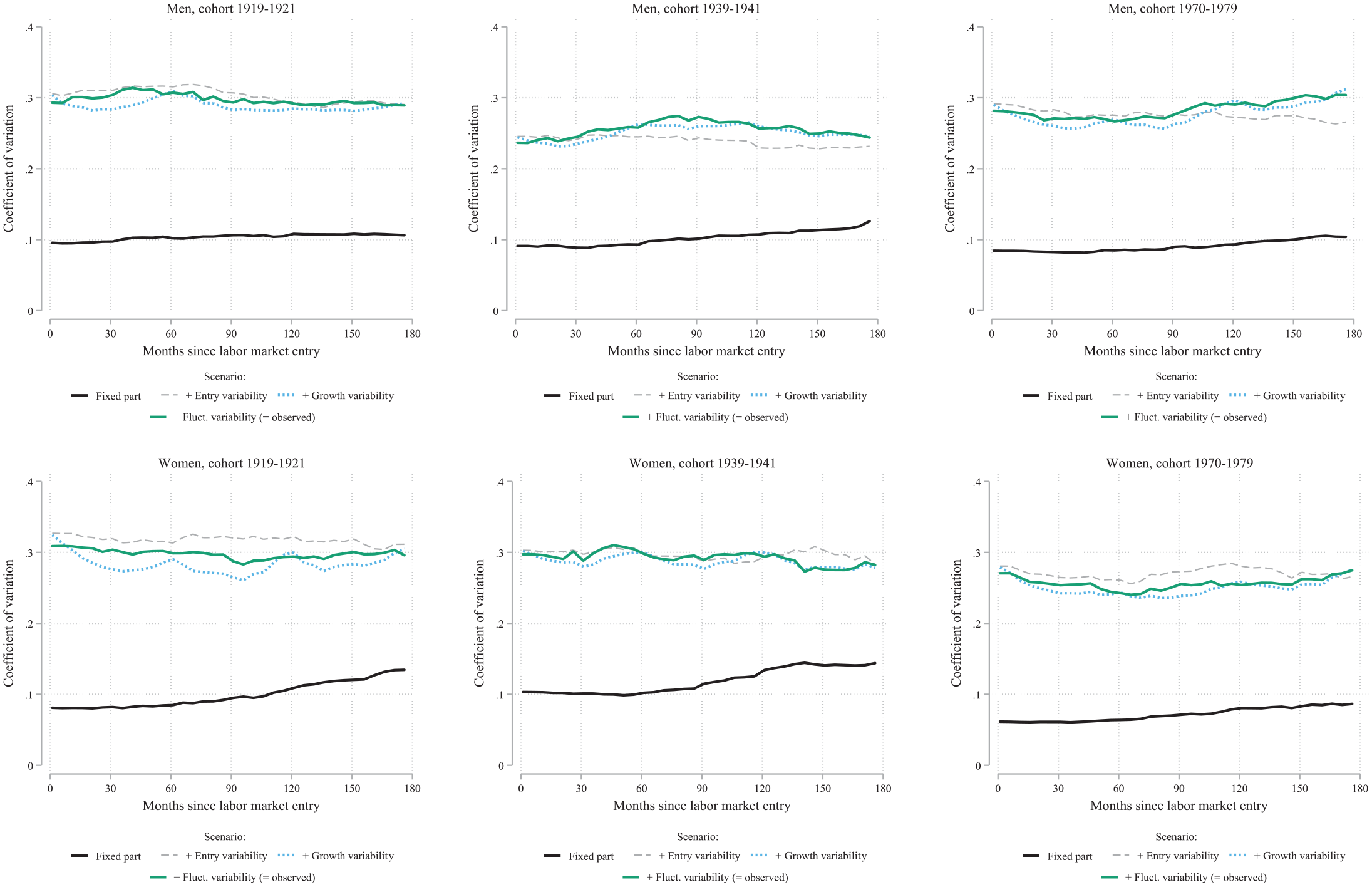
Predicted Intracohort Differentiation in Occupational Prestige
First, we find clear evidence that entry variability has a larger influence on intracohort differentiation than do the other types of variability. After adding entry variability, inequality in prestige at any point in time is two to three times larger than in a hypothetical scenario without entry variability (“fixed-part”) in all cohorts. Adding growth variability only marginally influences intracohort differentiation. In most cases, point-in-time inequality declines because entry and growth variability are negatively correlated (see note 15). Similarly, fluctuation variability only has a minor influence on intracohort differentiation and leads to a small increase in inequality. Thus, intracohort differentiation is mainly driven by initial labor market placement for women and men in West Germany, in line with previous research (e.g., Brückner 2004). This dominant role of entry variability has not changed across birth cohorts despite changing employment relations. Because growth and fluctuation variability have a minor influence on intracohort differentiation, we also find little change in point-in-time inequality over months since labor market entry. It is noteworthy that even if growth and fluctuation variability do not substantially contribute to intracohort differentiation in occupational prestige, variability in growth and fluctuation may nonetheless be consequential at the individual level; for example, higher fluctuation variability can be interpreted as higher insecurity of employment for individuals.
Second, for men, the 1939–1941 cohort is characterized by less overall differentiation when measured with point-in-time inequality compared to the 1919–1921 cohort, because entry variability decreases for the former. However, inequality measured by the fixed-part of the model does not change. In other words, the reduction in differentiation between these cohorts cannot be explained by factors such as parental education or time in unemployment but is caused by factors not directly included in our model. We will come back to this point shortly. Comparing the 1939–1941 and 1970–1979 cohorts, we find that the differentiation attributable to observed factors in our model decreases, whereas entry variability increases, again leading to more differentiation overall compared to the 1939–1941 cohort and similar differentiation as the 1919–1931 cohort.
Third, we find a similar pattern for women when comparing cohorts 1939–1941 and 1970–1979. For women, the point-in-time inequality explained by the fixed-part of the model decreases from the older to the younger cohort. At the same time, overall differentiation decreases little, because differentiation caused by entry variability increases for women. Thus, for women and men, the relative influence of (entry) variability on intracohort differentiation becomes stronger in younger cohorts. Considering the other birth cohorts not shown here (see Figures S3 and S4 in the online supplement), this trend emerges for men and women for cohorts born after 1941. Several factors may have led to this increasing role of entry variability over time, as outlined earlier, of which educational expansion with a larger group of tertiary-educated individuals may be particularly relevant. We address this issue next.
Educational Differences
We expected changes in employment relations to have distinct consequences for educational groups due to their skill profiles, which particularly shape career trajectories in open employment relationships. To understand the influence of education, we first extend the model presented in Figure 2 by adjusting for individuals’ education (as main effects and interacted with months since labor market entry). We find that adjusting for individuals’ education reduces entry variability and modestly reduces the changes in entry variability across cohorts (see Figure S5 in the online supplement). However, our estimates of growth variability and fluctuation variability do not change after adjusting for education. Thus, although our results suggest that educational expansion contributes to changes in entry variability, educational expansion does not explain changes in the other types of variability.
Second, we estimate models separately by educational groups. To have sufficient sample sizes for these groups, we aggregate education to three groups: tertiary education, VET (combining lower-secondary or less plus training and middle/higher-secondary plus training), and no training (lower-secondary or less without training and middle/higher-secondary without training). We omit tertiary-educated women from the three oldest cohorts due to small cell sizes. When estimating variability separately by education, we find, as expected, that individuals with tertiary education exhibit higher variability in entry and growth than do the other educational groups (see Figure 4 for men and Figure 5 for women). Partly in line with our expectations, we find marked increases in variability for female university graduates in the youngest cohorts but only minor increases for men.
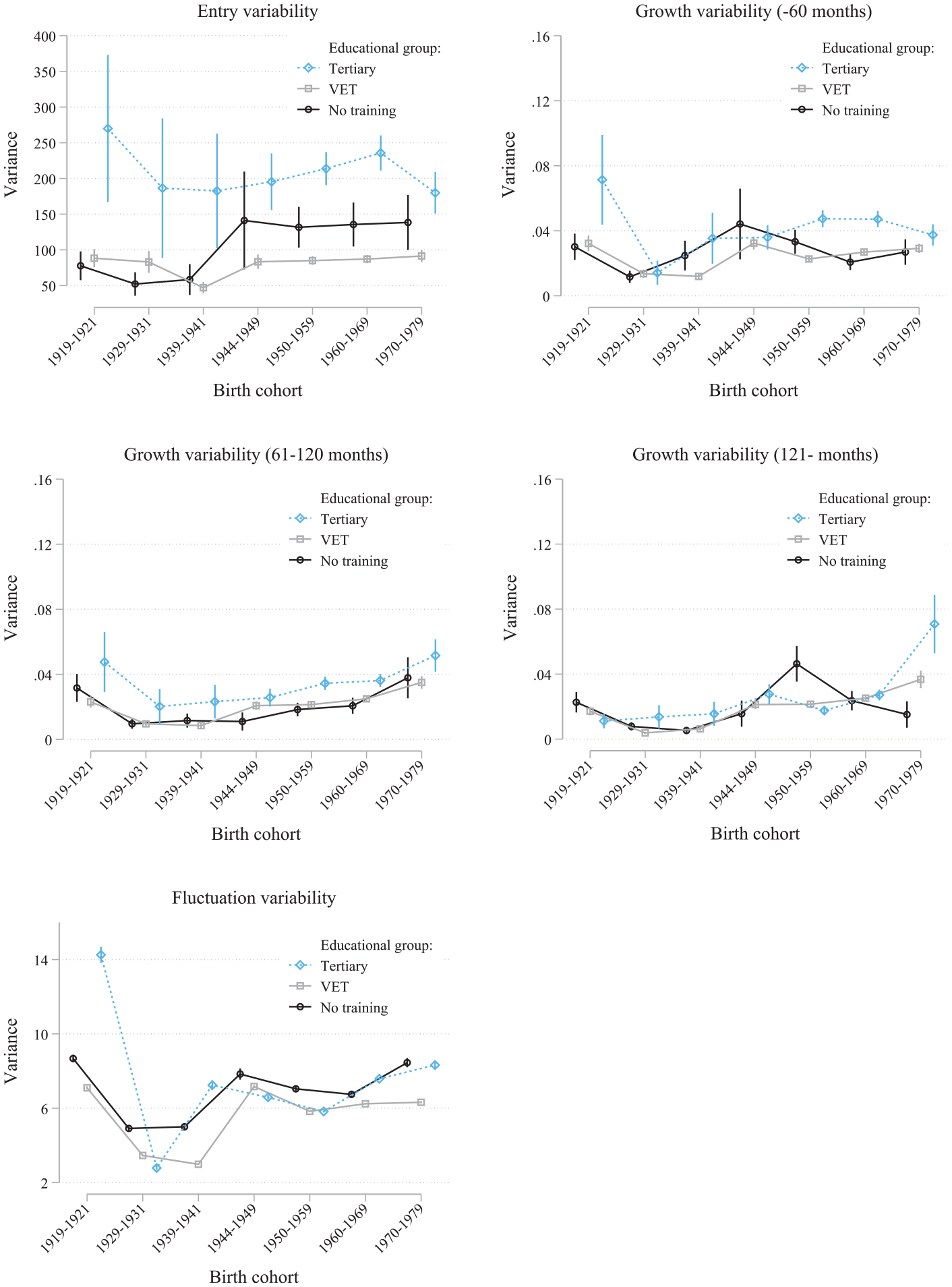
Estimated Random-Part from Mixed-Effects Growth-Curve Models of Occupational Prestige (SIOPS) with Heterogeneous Variance Components by Birth Cohorts, Separately Estimated by Educational Group for Men
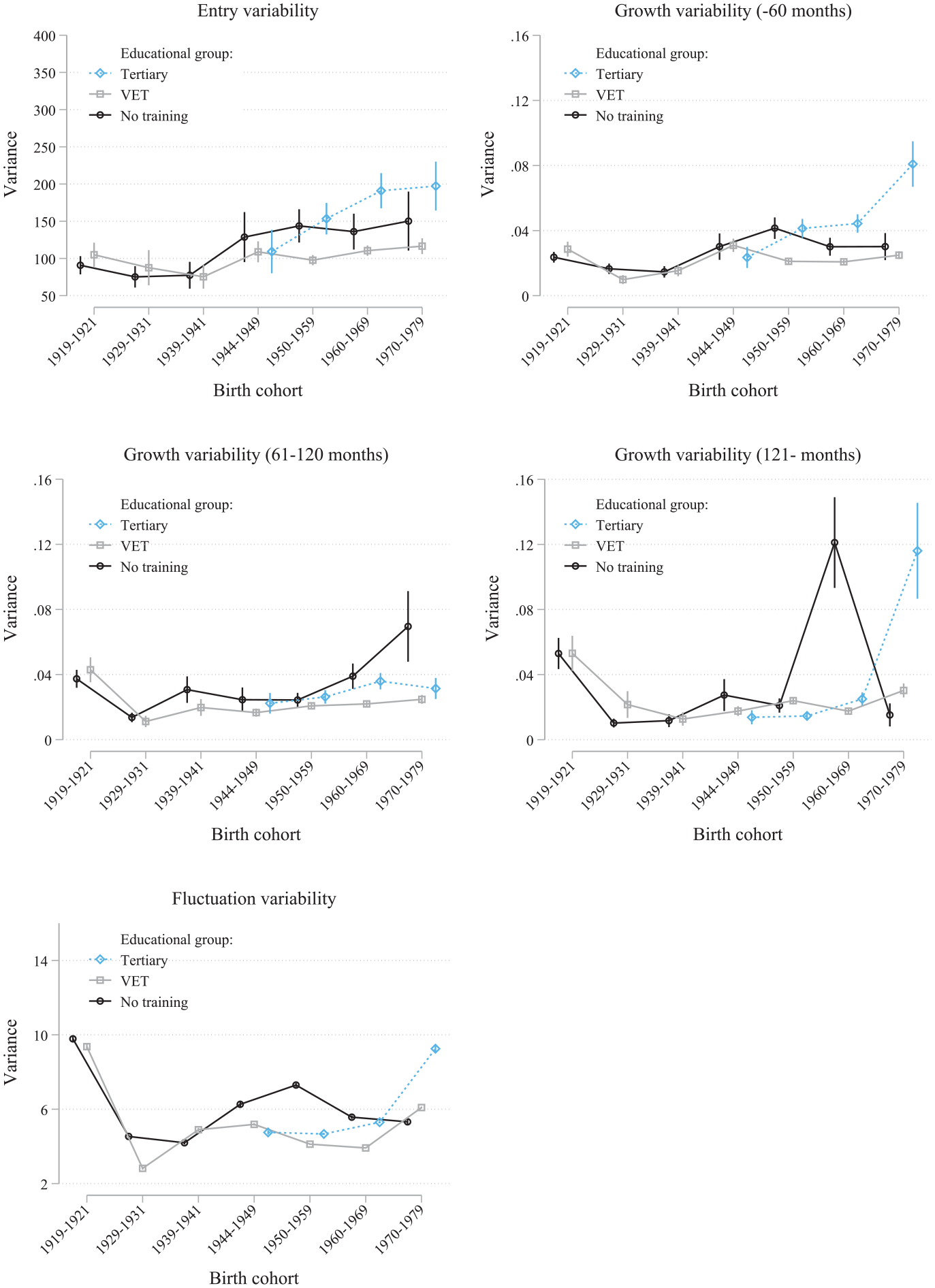
Estimated Random-Part from Mixed-Effects Growth-Curve Models of Occupational Prestige (SIOPS) with Heterogeneous Variance Components by Birth Cohorts, Separately Estimated by Educational Group for Women
Individuals with VET generally show the least variability, which is in line with expectations; for this group, we do find some increases in variability for the younger cohorts compared to the 1939–1941 and 1944–1949 birth cohorts, but it is less pronounced than expected. That is, despite compositional shifts in the VET group due to the growing service sector and the rapid changes in technological innovations, this group experienced no marked increase in variability.
Individuals with no training exhibit low variability overall, with the noteworthy exception of fluctuation variability: men without training show higher variability than other educational groups and also a clear increase for the youngest cohorts, in line with our expectations. Overall, these results indicate that intracohort differentiation is not only characterized by level differences in occupational prestige between educational groups, but also by differences in within-group variability between educational groups, where VET graduates experience the lowest variability because of strong training–job linkages that persist in open employment relations.
Considering Family-Related Employment Interruptions
The results so far show that, conditional on employment, entry, growth, and fluctuation variability has changed similarly for women and men across cohorts—with some exceptions, such as the tertiary-educated—and the resulting intracohort differentiation is comparable for women and men in West Germany. However, conditioning on employment ignores an important aspect of variability in women’s life courses, namely family-related employment interruptions. Therefore, we now present alternative results in which we include the women (and the few men) who interrupt employment for family reasons by assigning them a SIOPS value of 54 for employment breaks, which is the average prestige level assigned to housewives in a survey study (Dworkin 1981; see also note 14 for alternative specifications).
Looking at Figure 6, women show substantially more variability once we include family-related interruptions, as we would expect. With the exception of entry variability (which, theoretically, should be less affected by [anticipated] family-related interruptions), women experience more variability than men in all other dimensions. However, for the purpose of this study, we are more interested in changes in variability. Interestingly, we find that growth variability in the first 60 months after entering the labor market decreases sharply over all birth cohorts up to 1960–1969, which may be explained by increasing delays of first births and related employment interruptions across cohorts. For later career stages, we find a more pronounced increase in growth variability after the 1944–1949 birth cohort when including interruptions, which is in line with our expectations about increasing variability due to mothers returning to employment. Fluctuation variability is clearly higher for women compared to men across all birth cohorts once employment interruptions are included. We find a v-shaped pattern, with the lowest fluctuation variability in the 1944–1949 cohort and clearly increasing fluctuation variability for earlier and later birth cohorts.
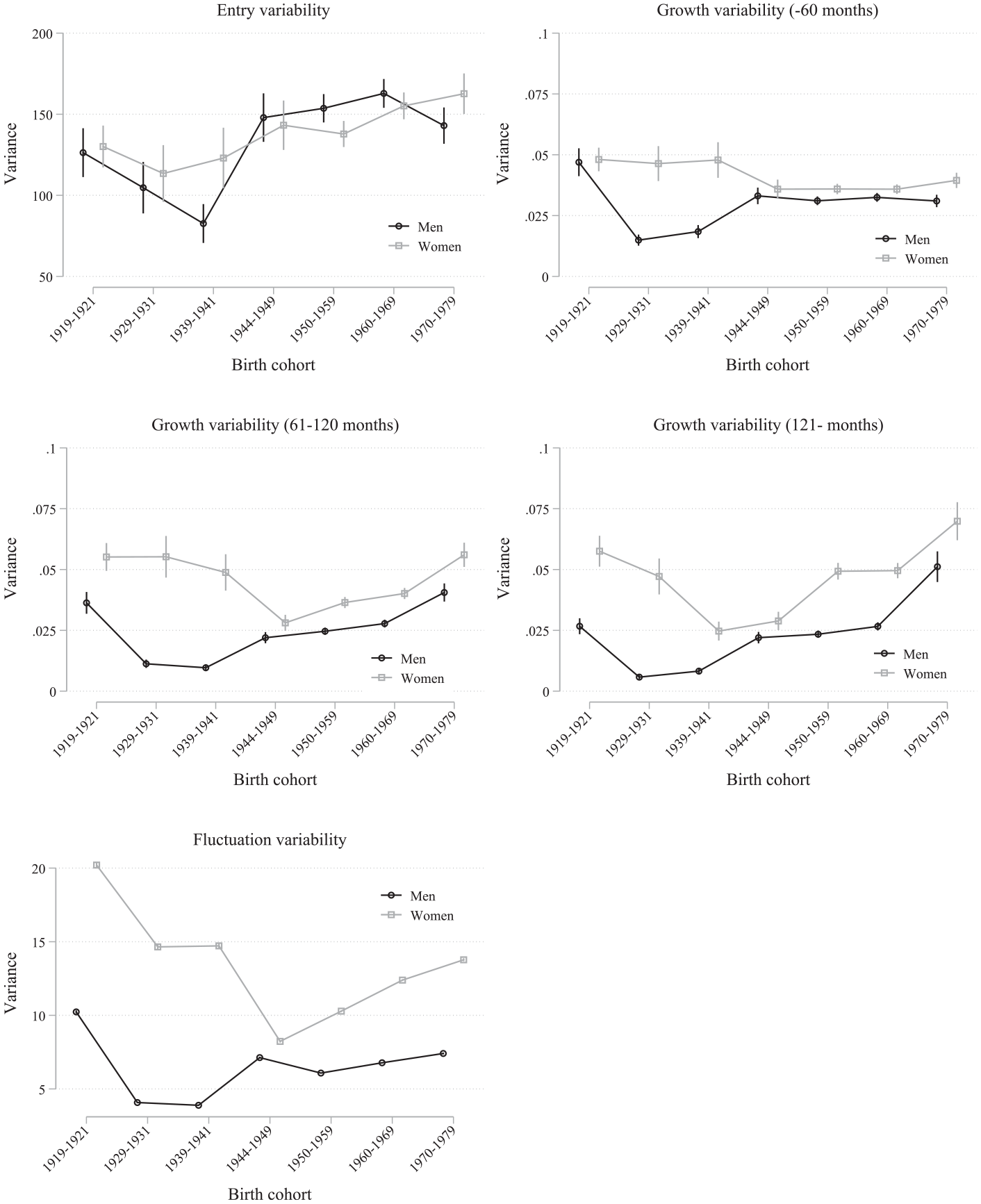
Estimated Random-Part of Mixed-Effects Growth-Curve Models of Occupational Prestige (SIOPS) with Heterogeneous Variance Components by Birth Cohorts, Separately Estimated for Men and Women with SIOPS for Family-Related Employment Interruptions Set to 54 (Nurse)
Overall, for women, the 1944–1949 birth cohort exhibits the lowest variability of all the cohorts once we include interruptions (birth cohorts 1929–1931 and 1939–1941 show the lowest variability for women when excluding interruptions). In summary, these results suggest that although women experience high variability (compared to men) and starkly increasing variability (compared to older cohorts of women) in their employment careers in terms of moving in and out of employment, their variability while in employment is similar to men’s overall.
Discussion and Conclusions
Research on intragenerational mobility can provide crucial insights into the processes underlying recent increases in precarious employment and labor market inequalities in many rich democracies if it moves beyond the study of typical occupational trajectories and acknowledges the substantial variability in trajectories. To this end, we study entry, growth, and fluctuation variability in occupational prestige trajectories by drawing on retrospective life history data for the case of West Germany. We historically situate changes in variability across birth cohorts of men and women between 1919 and 1979 by considering fundamental transformations in employment relations during this period. We address two research questions: How variable are occupational prestige trajectories? How does this variability change across birth cohorts who experienced marked transformations in employment relations?
Summary of Results
The study presents a number of original and relevant findings. First, in accordance with the trajectory heterogeneity property and the random variability property (Cheng 2014), we find that occupational prestige trajectories are characterized by large entry, growth, and fluctuation variability. Of the three dimensions of variability, we show that in the context of West Germany, entry variability at initial job placement is the most consequential for intracohort differentiation in occupational prestige. In doing so, we provide new and compelling evidence that initial intracohort inequalities are preserved as individuals move through their occupational trajectories; this supports findings from previous studies (Brückner 2004; Hillmert 2011). Previous research was unable to show that systematic variability played a role because it focused on average trajectories. While fluctuation variability also adds to intracohort differentiation, growth variability reduces both point-in-time inequality and differentiation, because more variability at labor market entry is associated with more homogeneous growth patterns (see also Cheng 2014).
Second, in line with our contention that patterns of prestige variability align with dominant employment relations, we provide novel evidence that the three dimensions of variability differ systematically across birth cohorts. Generally, we find that the 1929–1931 and 1944–1949 birth cohorts—those that experienced the highest coverage of closed employment relations in Germany—are characterized by exceptionally low variability in all dimensions. Increases in variability for younger cohorts are less clear and less pronounced than postulated by popular accounts of increasing destabilization and destandardization (e.g., Beck 1992). Rather, our findings support the notion of a golden age in which “institutions of egalitarian and coordinated capitalism” coincided with and complemented postwar growth (Thelen 20014:195); this provided closed employment relationships for a large share of the labor force, which produced low variability in occupational prestige trajectories. Nevertheless, we find evidence that the youngest birth cohorts in our data (1970 to 1979) exhibit markedly more variability than older cohorts. This is most clearly evident in a stark increase in growth variability in later career stages in younger cohorts. We also find that the role of entry variability for intracohort differentiation increased across birth cohorts in the second half of the twentieth century. Part of the increase in variability for the youngest cohorts may be due to the continued diversification of the occupational structure.
Third, we find differences across educational groups in the levels and trends of variability, mostly in line with our expectations. In particular, for the youngest cohorts (1970 to 1979), university graduates’ growth variability in later career stages increased as closed employment relations eroded, whereas the generally lower levels of variability for people with VET persisted across cohorts. Overall, we find that tertiary education is related to higher variability, but individuals without formal education experience particularly high fluctuation variability. One possible explanation for high variability among the tertiary-educated is that in the course of educational expansion, more and more university graduates came to be employed in jobs that require lower levels of general transferable skills, such as analytic skills (Horowitz 2018).
Fourth, with few exceptions, the trends in variability across cohorts are similar for women and men, although we expected more pronounced trends for women. Conditional on employment, women’s occupational trajectories are also not generally more variable than men’s, in particular in younger cohorts. However, conditioning on employment ignores women’s frequent family-related employment interruptions in West Germany, which constitute an important aspect of labor market instability and increase the variability in their trajectories. Thus, on the one hand, family-related employment interruptions do not seem to create substantially more variability in occupational prestige for women than for men once they are re-employed. On the other hand, family-related interruptions are an important form of variability in life course trajectories in their own right (Aisenbrey and Fasang 2017).
Limitations
We acknowledge some limitations of our study. First, our empirical approach does not directly quantify the contribution of selection into employment to variability across cohorts. This is particularly relevant for women’s employment. Across the cohorts we study, overall employment rates for women increased substantially, but full-time employment rates declined (Trappe et al. 2015). At the same time, there is an increasing educational gradient in full-time employment for women (Konietzka and Kreyenfeld 2010), and women continue to work in a limited range of occupations (Gundert and Mayer 2012). It would be interesting to gain a better understanding of how these partly counteracting processes jointly produce women’s career variability and contribute to intracohort differentiation, which was beyond the scope of the current study.
Second, we do not consider the direction of intragenerational mobility in our global measure of fluctuation variability. We argue that upward and downward deviations from expected growth trajectories may both be meaningful for individuals, but we acknowledge that their consequences may vary. Unexpected upward mobility may cause a threat to long-term planning in a wide range of life domains (Wilensky 1961). Unexpected downward mobility may have severe consequences for individuals’ well-being and life chances. Considering such asymmetry in mobility would allow us, for instance, to more directly speak to employment insecurity as an important aspect of precarious employment for workers.
Third, we do not directly observe the nature of employment relations for workers in our data. Because employment relations are firm- or occupation-specific, it would be necessary to collect detailed organizational and occupational data that could be matched with individual life history data on occupational trajectories. More generally, organizational case studies (e.g., Dencker and Fang 2016) and studies of individual-level occupational trajectories currently provide separate evidence of the links between employment relations and occupational outcomes (Bernhardt et al. 2001:23). Building on relational inequality theory, recent empirical work using longitudinal employee–employer linked register data demonstrates how the gap between case studies and individual-level studies can be bridged (Tomaskovic-Devey, Hällsten, and Avent-Holt 2015).
Implications for the Study of Intragenerational Mobility and Inequality
Our findings provide strong support for our extension to the theory on heterogeneity in life course trajectories of intragenerational mobility. The proposed systematic variability property states that life course trajectories of attainment are characterized by substantial variation in typical entry, growth, and fluctuation variability between sociologically relevant groups. In other words, groups can be characterized by how their members deviate from the typical group-specific mobility trajectories. This is in line with recent calls in sociology to look beyond between-group inequalities and study within-group inequality (e.g., Western and Bloome 2009). Considering the systematic variability property means crucial processes generating intracohort differentiation and changes therein become analytically traceable. Furthermore, the property reveals the heterogeneity of individuals’ mobility experiences, which is hidden in the conventional study of intragenerational mobility. Because individuals are likely to compare their mobility to relevant reference groups, such as members of their birth cohort (Heslin 2005), heterogeneity in mobility can have a profound influence on individuals’ perceptions and valuation of their biographic experiences. Finally, our study generates new insights into the predictability and instability of occupational careers, which can have important consequences for individuals’ well-being and other life course outcomes, such as their family dynamics and fertility (Hofmann, Kreyenfeld, and Uhlendorff 2017).
Our study highlights the theoretical and empirical relevance of the life course perspective on inequality. Because intracohort differentiation of overlapping birth cohorts shapes the cross-sectionally observed inequality in a society, our approach complements prior research on dynamics in inequality, which mostly draws on cross-sectional snapshots of workers and treats individuals as single observation points (for an overview, see McCall and Percheski 2010). We show that, as far as occupational prestige in West Germany is concerned, shifts in entry variability seem to lead to changes in overall inequality over time. Moreover, additional analyses suggest these changes cannot entirely be accounted for by changes in educational structure. This finding directs attention to economic transformations that affect the initial placement of workers, whereas factors affecting later career stages seem less relevant for explaining trends in inequality. Despite liberalization in the German labor market (Baccaro and Howell 2017; Thelen 2014), the importance of initial placement remains a central feature of the German inequality regime (Brückner 2004). The relative weight of the different dimensions of variability may vary in other country contexts and for other life course outcomes. Our approach allows us to develop expectations about these variations and to test them empirically, which will further refine theory on the causes of changing inequality.
Employment relations theory, in combination with a life course perspective, is particularly useful for studying intragenerational mobility, because employment relations are inherently dynamic and built on a long-term perspective on careers, which is not always reflected in empirical work in this area. We argue that changing economic institutions of employment relations systematically influence variability in occupational prestige trajectories, leading to changes in intracohort differentiation, because employment relations shape hiring procedures, career advancement mechanisms, and protection against external labor market shocks. Stated simply, compared to closed employment relations, open employment relations reduce the linkages between individuals’ current and future labor market positions by increasing the marketization of work. The concept of linkages between life course positions can also be extended to other life course domains, such as the family. If linkages between positions in this domain are reduced—for instance, if marriage is deinstitutionalized (Cherlin 2020)—variability across the life course is likely to increase. As a result, life course trajectories in the family domain will fan out within cohorts.
Implications for Future Research
Our study has important implications for future research beyond those arising from the aforementioned limitations of our work. First, we applied mixed-effects growth-curve models with heterogeneous variance components, which are a powerful tool to study life course inequality. Instead of treating unexplained variance as a statistical nuisance, this approach redirects attention to variance components as sociologically meaningful parameters. The approach can easily be extended to other individual-level characteristics (Leckie et al. 2014) and may be used to study within- and between-group inequalities in other life course outcomes, such as earnings and outcomes in the family domain. In the current study, we focused on birth cohorts as groups, but the systematic variability property can be applied to other groups (e.g., based on family of origin). Studying life courses beyond typical trajectories provides a new and deeper understanding of how social processes structure individual biographies and how intragenerational mobility creates distinct patterns of societal differentiation over individuals’ lifetimes.
Second, a comparative approach can shed further light on the extent to which institutional contexts may filter the effects of transformations of employment relations for individuals’ prestige trajectories. We examined variability in the West German context of a coordinated market economy and conservative welfare state with tight links between standardized qualifications and labor market positions and high barriers to mobility. We argued that the rigid German system may lead to stronger between-cohort changes in variability than in other contexts. This is in line with other studies showing that cohorts in Germany experienced less structural-change-induced career mobility than did cohorts in the United States (DiPrete et al. 1997). We would expect to generally find larger variability in the United States, given its very different structure of job mobility and general trends toward higher variability for recent cohorts caused by the increase in intragenerational mobility (Jarvis and Song 2017). The erosion of closed employment relations, also found in the United States, may have substantially increased (growth) variability by increasing differential returns to firm tenure, as Mouw and Kalleberg (2010) have found for wage inequality.
An alternative hypothesis follows from recent research that shows cross-national variations in the structural effects of educational credentials for labor market outcomes. Bol and colleagues (2019) show that a strong link between educational credentials and occupational positions is more common in Germany than in the United States. A shift to open employment relations, accompanied by weakening linkages between occupational positions across the career, might have prompted a larger increase in variability in Germany, where strong linkages have structurally been more common. This further suggests a fruitful direction for future research is to analyze how different institutional settings, such as educational and labor market institutions, co-produce structures of career variability.
Supplemental Material
Lersch_online_supplement_ – Supplemental material for The Variability of Occupational Attainment: How Prestige Trajectories Diversified within Birth Cohorts over the Twentieth Century
Supplemental material, Lersch_online_supplement_ for The Variability of Occupational Attainment: How Prestige Trajectories Diversified within Birth Cohorts over the Twentieth Century by Philipp M. Lersch, Wiebke Schulz and George Leckie in American Sociological Review
Footnotes
Acknowledgements
The authors thank Florian Hertel, Karl Ulrich Mayer, and Nico Stawarz for helpful advice. Earlier versions were presented at seminars at SOFI Stockholm, WZB Berlin, and at the ISA RC28 spring meeting 2019.
Funding and Data
P. M. Lersch’s research was funded by the Support Network for Interdisciplinary Social Policy Research (FIS) of the German Federal Ministry of Labor and Social Affairs. This study uses data from the National Educational Panel Study (NEPS): Starting Cohort Adults, 10.5157/NEPS:SC6:9.0.1. From 2008 to 2013, NEPS data was collected as part of the Framework Program for the Promotion of Empirical Educational Research funded by the German Federal Ministry of Education and Research (BMBF). As of 2014, NEPS is carried out by the Leibniz Institute for Educational Trajectories (LIfBi) at the University of Bamberg in cooperation with a nationwide network. This study also uses data from the German Life History Study (GLHS) headed by Karl Ulrich Mayer between 1979 and 2010 and funded through the German National Science Foundation (DFG), the Max Planck Institute (MPI) for Human Development in Berlin, and the Center for Research on Inequalities and the Life Course (CIQLE) at Yale University.

Notes
References
Supplementary Material
Please find the following supplemental material available below.
For Open Access articles published under a Creative Commons License, all supplemental material carries the same license as the article it is associated with.
For non-Open Access articles published, all supplemental material carries a non-exclusive license, and permission requests for re-use of supplemental material or any part of supplemental material shall be sent directly to the copyright owner as specified in the copyright notice associated with the article.
