



Abstract
Prior literature finds stability in personal culture, such as attitudes and values, in individuals’ life courses using short-running panel data. This work has concluded that lasting change in personal culture is rare after formative early years. This conclusion conflicts with a growing body of evidence for changes in personal culture after significant life course transitions, drawing on long-running panel data. To integrate these conflicting findings, the current study develops and applies a life course adaption model of personal culture, accounting for early imprinting and the continued possibility for change. Drawing on rich data from six long-running panel studies from five countries (BHPS, HILDA, PSID, SHP, SOEP, UKHLS) and 428 measures of personal culture, I test the theoretical expectations using mixed-effects modeling and an individual participant data meta-analysis. Results support the life course adaption model. Although lasting, non-transitory, within-individual changes in personal culture are relatively small compared to stable between-individual differences, I find strong support for the proposition that individuals change persistently in their personal culture as they move through the life course. These changes are partly dependent on prior biographical experiences. Finally, personal culture fluctuates substantially from year to year. Change in personal culture is increasingly varied for younger birth cohorts.
Does people’s declarative personal culture (Lizardo 2017), such as their attitudes, worldviews, beliefs, and values directed at the social world around them, change as they move through their life course? 1 How rigid and crystallized is personal culture? A rich sociological research tradition is concerned with these questions for at least three reasons (e.g., Alwin and Krosnick 1991; Danigelis, Hardy, and Cutler 2007; Kiley and Vaisey 2020). First, these questions are fundamental to our understanding of the individual-level dynamics that contribute to aggregate social change in public culture (i.e., the extrapersonal culture that manifests in public discourses, institutions, and symbols) and specifically public opinion (Alwin and Krosnick 1991; Ryder 1965). Second, these questions are fundamental to our understanding of life course processes. They illuminate how changing social circumstances and embeddedness in historical time and place influence inner-individual states as individuals’ lives unfold (Bernardi, Huinink, and Settersten 2019).
Third, answering these questions helps refine theory about the formation of personal culture. Recently, Kiley and Vaisey (2020) contrasted two theoretical models of individual change that (implicitly) underlie most research in this area: the settled disposition model, which suggests personal culture is formed and imprinted in early life and fluctuates around this baseline only randomly with age, and the active updating model, which suggests personal culture is malleable and lastingly changes over people’s life course due to new experiences. Testing these two models against balanced, three-wave panel data covering four years from the U.S. General Social Survey (GSS), drawing on more than 180 items of personal culture, one of their key findings is that the vast majority of observed changes in individuals’ personal culture is random fluctuation compatible with the settled disposition model. From their findings, and supported by other empirical work (e.g., Hill and Kriesi 2001; Prior 2010), Kiley and Vaisey (2020:500) conclude that “[o]ur results ultimately suggest that real, persistent attitude change is an uncommon phenomenon among adults.” Although the authors acknowledge that persistent change occurs for a substantial minority of personal culture items, their conclusion highlights social reproduction and long-term stability in personal culture.
This conclusion, however, is in contrast to results from a second, growing strand of literature broadly concerned with within-individual changes in personal culture in response to life course events and transitions, such as parenthood, partnership formation, (un)employment, and migration. This literature reveals within-individual changes in outcomes of personal culture, such as moral progressivism (Broćić and Miles 2021), generalized trust (Mewes et al. 2021), gender role attitudes (Perales, Jarallah, and Baxter 2018), perceptions of the unemployed (Danckert 2017), and concerns about immigration (Kratz 2021). To be clear, the estimated effect sizes of within-individual change in these studies are often small—although small year-to-year changes can accumulate to significant differences in the long run—and only rarely are dramatic changes in personal culture observed. These studies are generally not concerned with how lasting individual-level changes are. Still, this growing body of research strongly suggests that life course events may continue to influence personal culture in later life. Such changes are theoretically meaningful because they indicate the relevance of socially embedded life course experience for forming personal culture beyond early imprinting.
In this study, I address the question of whether personal culture changes persistently over individuals’ life courses. Persistent change refers to lasting development in personal culture by age—a shift in baseline—that shows in trends in personal culture observed over repeated measurement points (Long 2020:93). In other words, persistent change occurs if a change in personal culture in one direction is not followed by a similarly sized change in the opposite direction. Persistent change differs from transitory and ephemeral fluctuations, after which people return to their prior baseline. I contend that an adequate understanding of stability and change in personal culture needs a biographical lens that is provided by the life course perspective. Life courses can be conceptualized as sequences of biographical states embedded in social and historical contexts and linked through transition events in parallel life course domains, such as family and work, that unfold with age, where birth cohorts situate individuals in historical time (Elder 1985; Mayer 2004).
A life course perspective allows for both change in response to social circumstances and stable dispositions that play a continuing role in people’s lives. I argue that previous theory on change in personal culture, such as the active updating model, is too limited in considering life course processes, such as within-individual, long-term biographical dependencies, thereby stacking the odds against finding support for persistent change. Moreover, I contend that empirical models that adequately test theories of change in personal culture need to reflect these within-individual biographical dependencies. Finally, these models need to be applied to rich and long-running panel data to separate signal from noise to detect persistent change and capture the “long view” on life courses (Mayer 2009).
Thus, this study makes several distinctive theoretical and methodological contributions, producing substantial new results. First, building on a life course perspective, I extend prior theory and introduce the life course adaption model of personal culture. In the life course adaption model, I integrate aspects of the settled disposition model and the active updating model with key principles of the life course perspective to arrive at a dynamic and biographically sensitive account of the formation of personal culture, considering changing social contexts in individuals’ lives. A central point of the life course adaption model is that early life imprinting has an enduring effect on personal culture through stable dispositions. However, socially and historically embedded life course transitions and novel social interactions filtered through prior experiences can move individuals’ personal culture in new directions and lead to persistent change as people age.
Second, going beyond the current state-of-the-art empirical models of change in personal culture (Vaisey and Kiley 2021), I apply mixed-effects growth-curve models to test the life course adaption model. These models (also known as multilevel or hierarchical models) improve the identification of persistent change given biographical dependencies over the life course and allow for decomposing variance in personal culture into stable between-individual differences, person-specific trends (i.e., persistent change), and random fluctuation. The empirical models directly test the life course adaption model against alternative theoretical models, such as the settled disposition model. In addition, these models easily scale to long-running and unbalanced panel data.
Third, using simulated data, I show that data-generating processes compatible with persistent change cannot be reliably identified in the context of a three-wave panel such as the GSS. Therefore, I use six complementary, long-running panel surveys to adequately capture long-term change in many facets of personal culture in five affluent countries and to cover a wide range of birth cohorts. 2 I draw on the British Household Panel Study (BHPS; 1991–2008); the Household, Income and Labour Dynamics in Australia (HILDA; 2001–2019) Survey; the U.S. Panel Study of Income Dynamics (PSID; 1968–2019); the German Socio-Economic Panel Survey (SOEP; 1984–2019); the Swiss Household Panel (SHP; 1999–2019); and the U.K. Household Longitudinal Study (UKHLS; 2009–2020). I summarize results from these six panel studies and a wide variety of 428 personal culture outcomes to investigate general patterns of persistent change over the life course, drawing on meta-analytical tools.
Through these contributions, I find broad support for the life course adaption model compared to the settled disposition and active updating models. Although persistent within-individual changes in personal culture are small compared to stable between-individual differences, I find strong support for the proposition that individuals change lastingly in their personal culture as they move through their life course, with age as a proxy for biographical progression. Using parenthood as an illustrative case, I find personal culture changes systematically with this highly salient life course transition. Furthermore, changes in personal culture depend on prior biographical experiences, and substantial temporary fluctuations characterize individuals’ personal culture. Change in personal culture is increasingly varied for younger birth cohorts. There is no systematic variation in results across surveys from Australia, Britain, Germany, Switzerland, and the United States.
Background
How does people’s personal culture, such as attitudes, beliefs, and values, change over their life course? Kiley and Vaisey (2020) recently proposed two seminal and straightforward theoretical models to answer this question: the settled disposition model and the active updating model. The critical difference between these two models is the persistence of changes in personal culture (Figure 1): Do people fluctuate around stable baselines, or do people’s baselines change lastingly? However, in responding to this question, the models propose a needless dichotomy between stable dispositions and persistent change and are too limited in considering biographical dependencies.
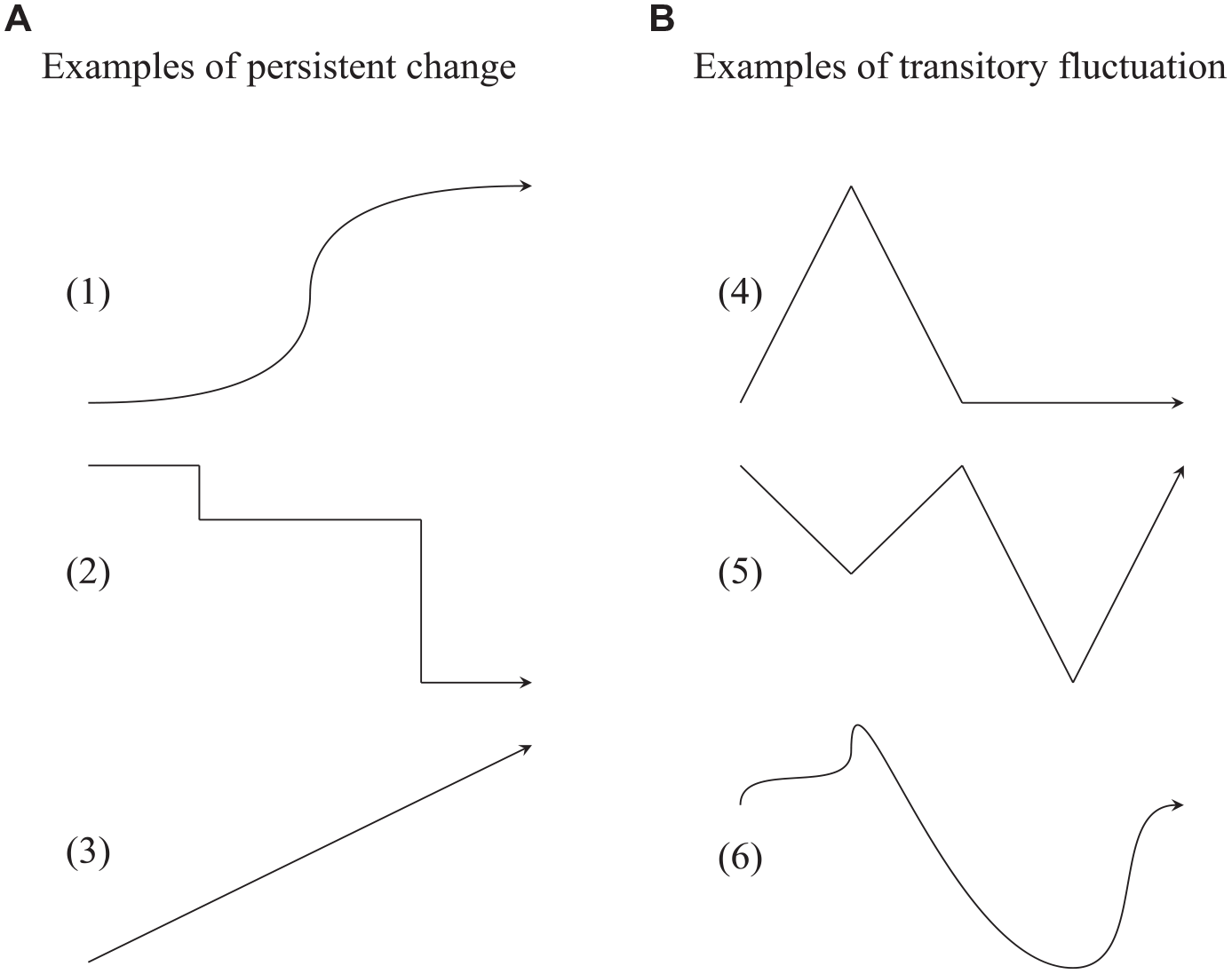
Examples of Persistent Change and Transitory Fluctuation
The settled disposition model (SDM) assumes that people do not persistently change their attitudes and beliefs (Ct in Figure 2, Panel A) formed in early life (Kiley and Vaisey 2020). Importantly, this does not imply constant personal culture, but that any changes are only ephemeral, random fluctuations (νt), after which people return to their baseline (D). Experiences over the life course do not influence this baseline. However, experiences may temporarily influence personal culture, where any deviation from the baseline is not related to systematic change over repeated time points. These random fluctuations can be sizable, leading to what may appear as inconsistent attitudes and beliefs.
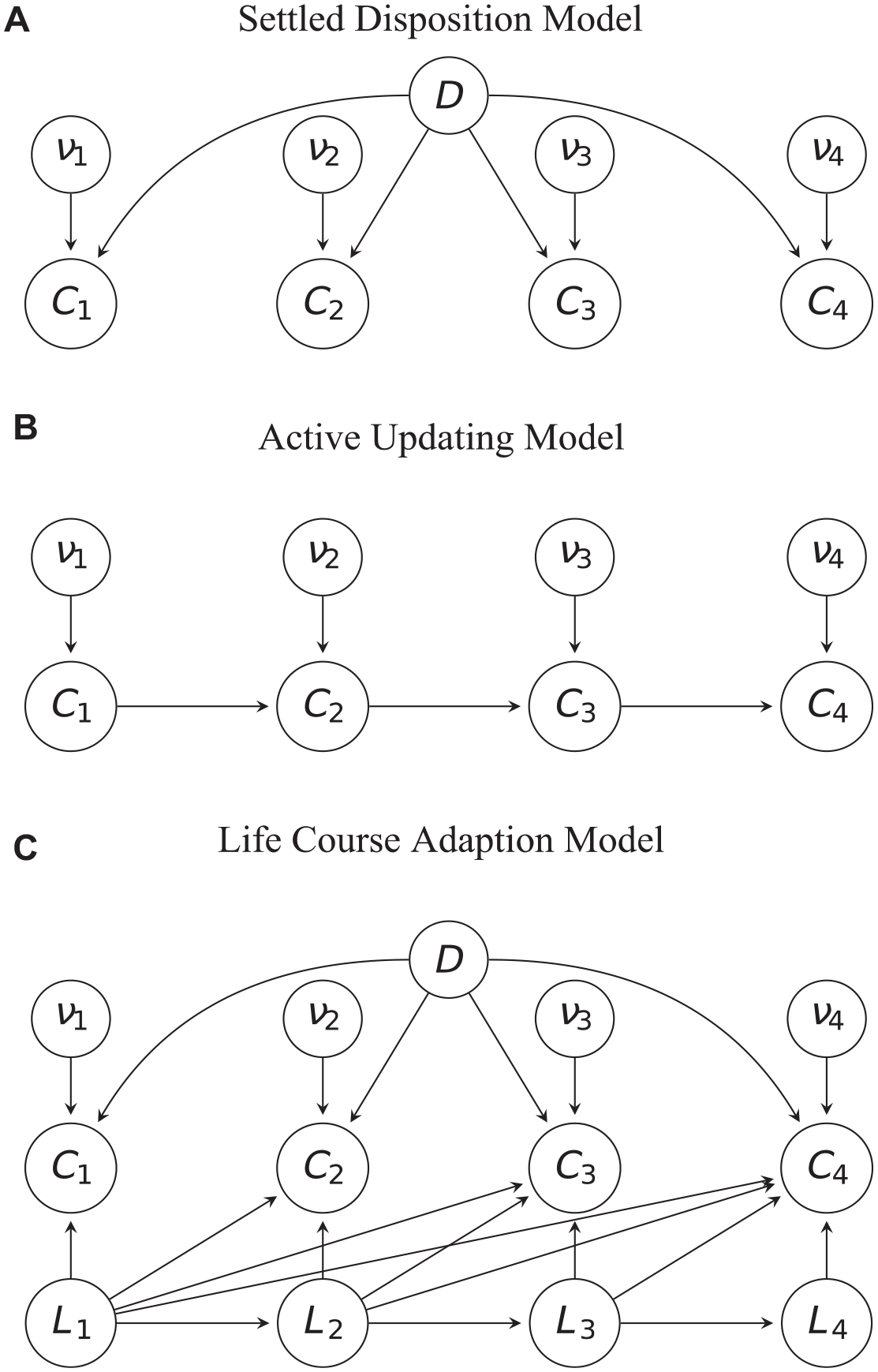
Three Theoretical Models of Change in Personal Culture
In contrast, the active updating model (AUM) argues that individuals have the continued capacity to change as they age and that personal culture can change persistently over the life course (Kiley and Vaisey 2020). The model assumes personal culture at time point t is only influenced by personal culture at t – 1 updated by shocks and new experiences between t – 1 and t (Figure 2, Panel B). Individuals are assumed to be “memoryless” beyond what they responded at the last interview, updated by the experiences they have had since then (νt). Knowledge about biographical experiences and attitudes before t – 1 does not add additional information in this model (i.e., a time-homogenous, first-order Markov process).
Life Course Adaption Model
I develop the life course adaption model (LCAM) to go beyond the needless dichotomy of settled dispositions versus persistent change and integrate a life course perspective on the formation of personal culture. The model builds on critical principles of the life course perspective and emphasizes “social circumstances . . . and social interactions as the building blocks of change” (Hendricks 2012:226). The model has four key propositions: (1) Individuals have dispositions for personal culture rooted in early imprinting (D in Figure 2, Panel C). (2) Individuals change their personal culture persistently through life course transitions and adaption to new life course states (Lt). (3) People fluctuate in their personal culture due to fleeting environmental conditions (νt). (4) Individuals draw on prior biographic experiences when adapting their personal culture (arrows from all prior L to Ct).
Early Imprinting Proposition
The life course adaption model, similar to the settled disposition model, suggests that social, early-life imprinting and biological make-up have an enduring effect on personal culture through stable dispositions (i.e., individual, time-constant propensities to articulate a particular personal culture). Empirical evidence for the role of dispositions is strong (Kiley and Vaisey 2020). Thus, individuals are not blank slates continuously filled with life course experiences as they age; rather, they draw on dispositions as they move through their life course. Such dispositions can be understood as life course inertia or resistance to change that can only be overcome by relevant life course transitions (for a similar argument regarding the onset, persistence, and desistance of criminal behavior over the life course, see Sampson and Laub 2005). Thus, abstracting from fleeting contextual impressions, people would hold consistent personal culture by age without significant life course transitions (which may be obscured in observational data because of measurement error).
The origins of stable dispositions can be found in early social imprinting—particularly in the family of origin—and the biological make-up of individuals, although these factors are difficult to distinguish empirically (but see Jæger and Møllegaard 2022). Early imprinting occurs through enculturation, “a process of internalization of experiential patterns encountered in the world via a developmental learning process” (Lizardo 2017:91). Internalization is the (re-)shaping of networks of neural associations in memory systems. These associations become a stable aspect of people’s knowledge inventory through cognitive schemes (Vaisey 2009), which can be used when prompted by external cues (Lizardo and Strand 2010). Next to early imprinting through the social environment, the biological make-up of individuals and their genetic predispositions shape their cognitive functioning and the expression of neural networks, contributing to the stability of personal culture (Hatemi and McDermott 2016; Ksiazkiewicz et al. 2020).
Persistent Change Proposition
Individual dispositions do not preclude lasting changes in personal culture later in life. This idea starkly contrasts with the settled disposition model. It integrates the notion of persistent change central to the active updating model, building on the principle of lifespan development in life course sociology, which states that human development is a lifelong process that continues after age 18 (Elder, Johnson, and Crosnoe 2003). Whereas early imprinting is likely associated with particular personal culture, transitions across the life course can move individuals’ personal culture in novel but potentially expected directions. For instance, the transition to the social role of parenthood may persistently reinforce traditional gender ideology (Perales et al. 2018). However, depending on dispositions, the shift may occur at different levels of ideology. Two questions are relevant in this context: What triggers change? What makes change persistent? In particular, the answer to the second question differentiates transitory, ephemeral fluctuation from a lasting and persistent change in personal culture.
I conceive of personal culture as an inert system (due to individual dispositions) that needs social triggers to change, where specific triggers will be relevant for particular aspects of personal culture. Thus, change in personal culture can be caused by life course transitions between social positions and roles, foremost in the family and work domains (Longest, Hitlin, and Vaisey 2013), with age as an index for biographic progression. Importantly, I conceive of changes in personal culture and, more broadly, “human development as socially organized and socially produced” (Dannefer 1984:106), in contrast to an ontogenetic approach in which change in adulthood is a natural and uniform process within individuals regardless of context.
Transitions in the life course expose individuals to new social environments, including novel interactions, experiences, considerations, and different sets of resources and constraints. First, individuals may adapt aspects of their personal culture in new environments in line with their goals. For instance, if an individual’s goals of economic achievement benefit from more egalitarian attitudes in a new social environment, the person may adapt their attitudes accordingly (Bolzendahl and Myers 2004). Second, exposure may change people’s personal culture if it leads to cognitive inconsistencies and dissonance (Bardi and Goodwin 2011). Individuals may strive for consistency between their personal culture and experience to avoid unpleasant emotions (Festinger [1957] 2001; Rawlings 2020). Third, and closely related, exposure may help create new cognitive consistencies in personal culture (Rawlings 2020). In other words, new information may lead to updating beliefs inconsistent with other beliefs.
In addition, environmental cues may also lead to deliberating about otherwise unconscious personal culture, which can lead to the reconsideration and re-evaluation of personal culture (Bardi and Goodwin 2011; Goodwin, Polek, and Bardi 2012). Social contexts may incidentally trigger the deliberation of personal culture. For instance, women may experience discrimination in the workplace, which may lead to deliberating about their gender ideology without others directly prompting this reflection (Bolzendahl and Myers 2004). Reconsideration may also be due to a deliberate challenging of personal culture through others, such as when discussing political topics among co-workers. Furthermore, reconsideration may be caused by direct persuasions, such as in interventions or training programs. However, direct persuasion may create reluctance against change in individuals (Bardi and Goodwin 2011). Importantly, social environments can change and trigger reconsiderations without individuals experiencing life course transitions, but here I prioritize transitions to explain change.
How do momentary considerations translate into a lasting and persistent change in personal culture? Through processes of secondary enculturation and internalization of new experiences, networks of neural associations may be (re)shaped later in life, creating novel cognitive schemes similar to what occurs in early imprinting. The human brain remains plastic (Lövdén et al. 2013; May 2011), and social context remains influential into old age (Dannefer 1984). Single, temporarily isolated events, or exposures such as a one-off discussion with a friend, only rarely lead to internalization and persistently change personal culture. Persistent change becomes more likely after repeated exposures, where new neural associations gain relevance as they are repeatedly triggered. Repeated exposure after life course transitions depends on the permanence and salience of these transitions. For instance, the transition to the role of parenthood is generally permanent and, for most individuals, very salient. Such a transition likely has an enduring effect on personal culture.
Two qualifications of the life course adaption model are necessarily informed by the life course perspective. First, people do not lose their changeability as they age. However, they are less exposed to transformative events and experiences because crucial life course transitions often occur at a relatively young age. This builds on the principle of timing, which states that the timing of transitions in the life course is consequential (Elder et al. 2003). Thus, personal culture may change more at younger ages (Bardi et al. 2009; Kratz 2021). With ongoing demographic changes, such as increases in gray divorce in older age and less stable labor market trajectories (Brown et al. 2019; Lersch, Schulz, and Leckie 2020), transitions in social environments may become increasingly common even at older ages, which may lead to continuing change in personal culture.
The second qualification relates to social change indexed by birth cohorts and its consequences on personal culture (Perales, Lersch, and Baxter 2019). The principle of time and place states that individuals’ life courses are historically and geographically embedded, leading to heterogeneity in life course patterns between birth cohorts. For example, life courses for those born in the first half of the twentieth century exhibited a high degree of standardization in industrialized societies for the first three decades after World War II (Brückner and Mayer 2005). However, in the post-industrial life course regime, de-standardization and differentiation of life courses—particularly in the family domain—increased (Mayer 2004). For instance, age at first marriage is more varied in younger cohorts, more people decide to cohabit instead of marry, and transitions in the family domain are increasingly decoupled from other statuses (e.g., marriage no longer requires stable employment) (Brückner and Mayer 2005; Elzinga and Liefbroer 2007). Consequently, life courses are generally more varied in the family domain in younger cohorts (McMunn et al. 2015; van Winkle 2018). In addition, life course variability in the work domain has increased in younger cohorts (Lersch et al. 2020; van Winkle and Fasang 2021). All of this suggests the direction and magnitude of change in personal culture may become less uniform in younger birth cohorts as transition experiences are increasingly varied between individuals (Perales et al. 2019). 3
Fluctuation Proposition
The life course adaption model proposes substantial fluctuation in personal culture beyond individual dispositions and persistent change. Fluctuation is defined as transitory, ephemeral changes in personal culture without trends over repeated observation points. Previous research on personal culture finds substantial fluctuation by age (Hill and Kriesi 2001; Hout and Hastings 2016; Vaisey and Kiley 2021). Different explanations are offered. First, people may temporarily adjust their personal culture to influences but quickly return to baseline; for instance, the death of a close relative may temporarily cause negative emotions affecting personal culture (Meier 2022). Second, people may not hold strong opinions about many matters and choose more or less randomly from the offered response choices in survey situations (Converse [1964] 2006). Third, people may hold stable opinions, but measurement error prevents observation of these opinions (Achen 1975; Alwin 2007:6). 4 Finally, people may have competing considerations and respond based on whatever is “at the top of the head at the moment of response” (Zaller 1992:54), and more salient issues may receive more consistent responses.
Based on the above arguments, myriad fleeting environmental conditions may trigger distinct neural associations and considerations without reaching the internalization of new associations through repeated exposure. For instance, the current weather influences how people respond to questions about global warming (Egan and Mullin 2012), but it may not lead to lastingly altered opinions about climate change. Also consistent with the life course adaption model, some aspects of personal culture are more crucial to individuals and therefore may trigger more consistent responses by age, as described above. Beyond these substantive causes of fluctuation, measurement error certainly complicates the separation of noise and signal in repeated measurements of personal culture (Alwin 2007:16ff).
Biographical Experience Proposition
Finally, in contrast to the active updating model, where a first-order Markov process is assumed, the life course adaption model proposes that individuals draw on prior biographical experiences beyond t – 1 when adapting their personal culture over their life course. In other words, life course transitions may generally change personal culture (persistent change proposition), but these changes are conditional on individuals’ histories and timing of earlier experiences (principle of timing). This proposition builds on a fundamental insight of life course sociology regarding self-referential biographical processes, where individuals act “on the basis of prior experiences and resources” (Mayer 2004:166); this work emphasizes the long reach of earlier life course experiences and path dependencies (Bernardi et al. 2019). Instead of seeing behavior and life course transitions as isolated events, they are part of a “causally connected episode within a more temporally extended and personally relevant chain of meaning” (Winchester and Green 2019:262). Moreover, interactions between various life course states create unique biographical experiences.
One way prior biographical experience can influence current life course outcomes is through the relationship between stable dispositions, which reflect biographical experience during early life, and the experience of and response to transitions throughout the life course. First, stable dispositions will affect the propensity to experience particular life course transitions and thus change personal culture. Individuals can actively self-select into their social environments (Hatemi 2013; Hitlin and Johnson 2015), which is likely dependent on their dispositions. Thus, dispositions will affect exposure to new environments, potentially triggering change. Second, stable dispositions are likely to affect responses to life course transitions. Recent experiences may be evaluated differently depending on a range of experiences from long ago. For instance, an adaption of personal culture following parenthood may depend on biographical experiences involving one’s own parents during childhood (Vidal et al. 2020).
Current Study
In the current study, I address the following question: does personal culture change persistently over individuals’ life courses? Persistent change refers to a lasting shift in personal culture by age that shows trends observed over repeated measurement points. To answer this question, I introduce the life course adaption model. This model integrates the settled disposition model, allowing a continuous influence of early imprinting on personal culture through stable dispositions. However, these individual dispositions do not preclude lasting changes in personal culture throughout the life course in response to socially embedded life course transitions, such as the transition to parenthood. The life course adaption model goes beyond the active updating model, which also allows for persistent change, by relaxing the assumption that individuals are memoryless beyond their personal culture at t – 1 updated by experiences gained since then. The central propositions of the life course adaption model and the ensuing theoretical estimands outside of any statistical model and observable data (Lundberg, Johnson, and Stewart 2021) are summarized in Table 1.
Overview of Propositions and Empirical Tests of Life Course Adaption Model
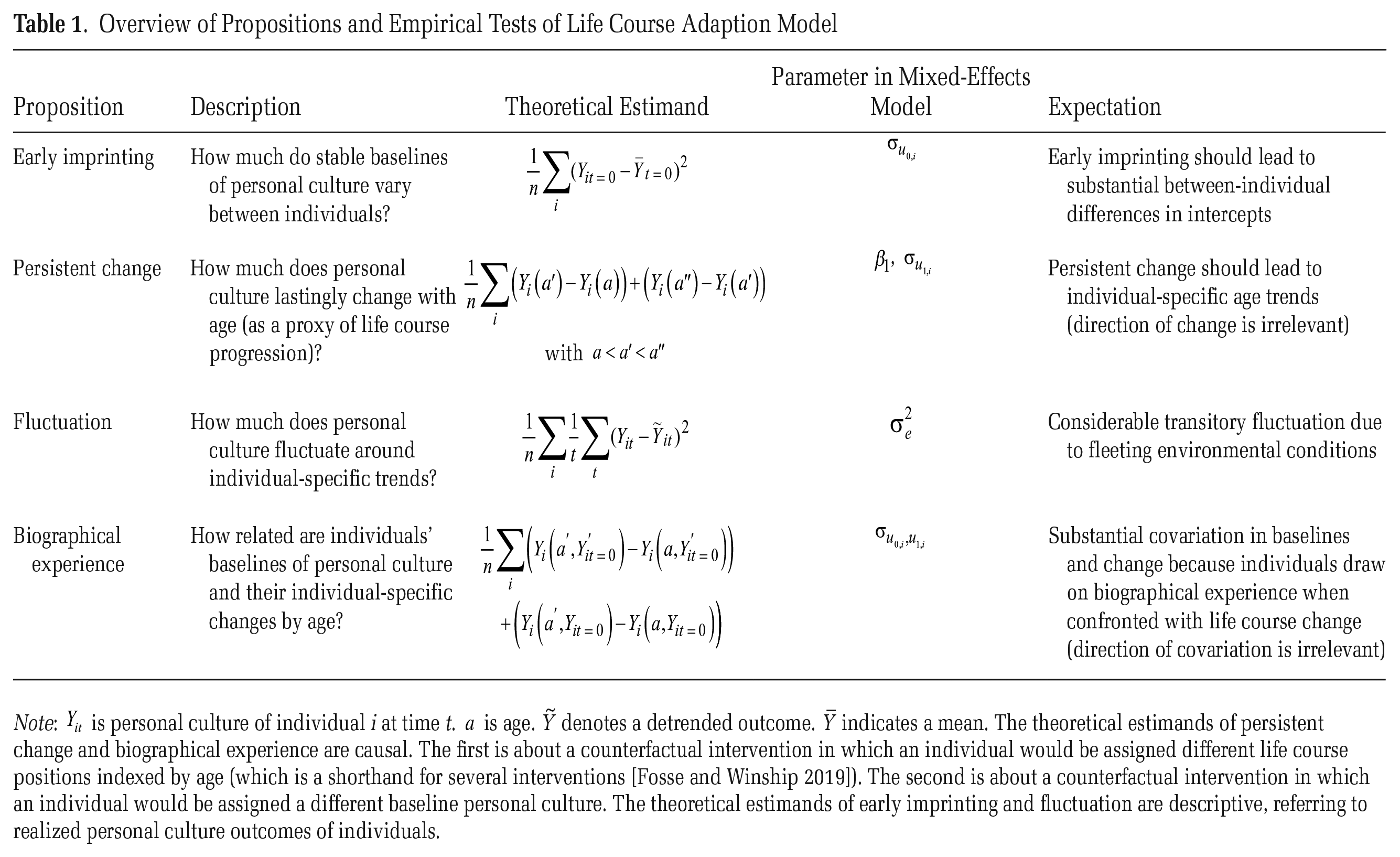
Note:
By dissolving the dichotomy of stable dispositions versus persistent change and considering long-term, within-individual biographical dependencies, I expect the life course adaption model to better represent observed longitudinal patterns in personal culture compared to the settled disposition and active updating models in an empirical “tournament of models.” Furthermore, I expect each of the four propositions of the life course adaption model to find empirical support with variation in effect sizes across birth cohorts. To this end, I analyze data from six high-quality longitudinal surveys covering a wide range of birth cohorts using a mixed-effects modeling strategy that accounts for biographical dependencies (see Figure E.1 in Part E of the online supplement for a directed acyclic graph and identification assumptions for the empirical estimands). Finally, I summarize the information across different surveys and model specifications using meta-analytical tools to describe general patterns of change and stability in personal culture.
Data and Method
Data
Data come from nationally representative panel studies from Australia, Britain, Germany, Switzerland, and the United States (Table 2). 5 All surveys are nationally representative, part of the Cross-National Equivalent File (CNEF) of household panel studies, and comparable in their design. I selected these surveys because individuals are repeatedly observed for many years, and thus individuals’ personal culture can be tracked over extensive observation periods. The long-running nature of these surveys is crucial because, in a simulation, I show that in the context of a three-wave/four-year panel such as the GSS, data-generating processes compatible with persistent change cannot be reliably detected (see Part B of the online supplement). At the same time, the inclusion of several surveys allows me to cover a wide variety of personal culture outcomes, following Kiley and Vaisey’s (2020) approach. Here, the empirical goal is to establish general patterns rather than systematically study the contextual conditions of personal culture across countries; nevertheless, the analytic strategy considers potential heterogeneity between countries and surveys.
Overview of Data
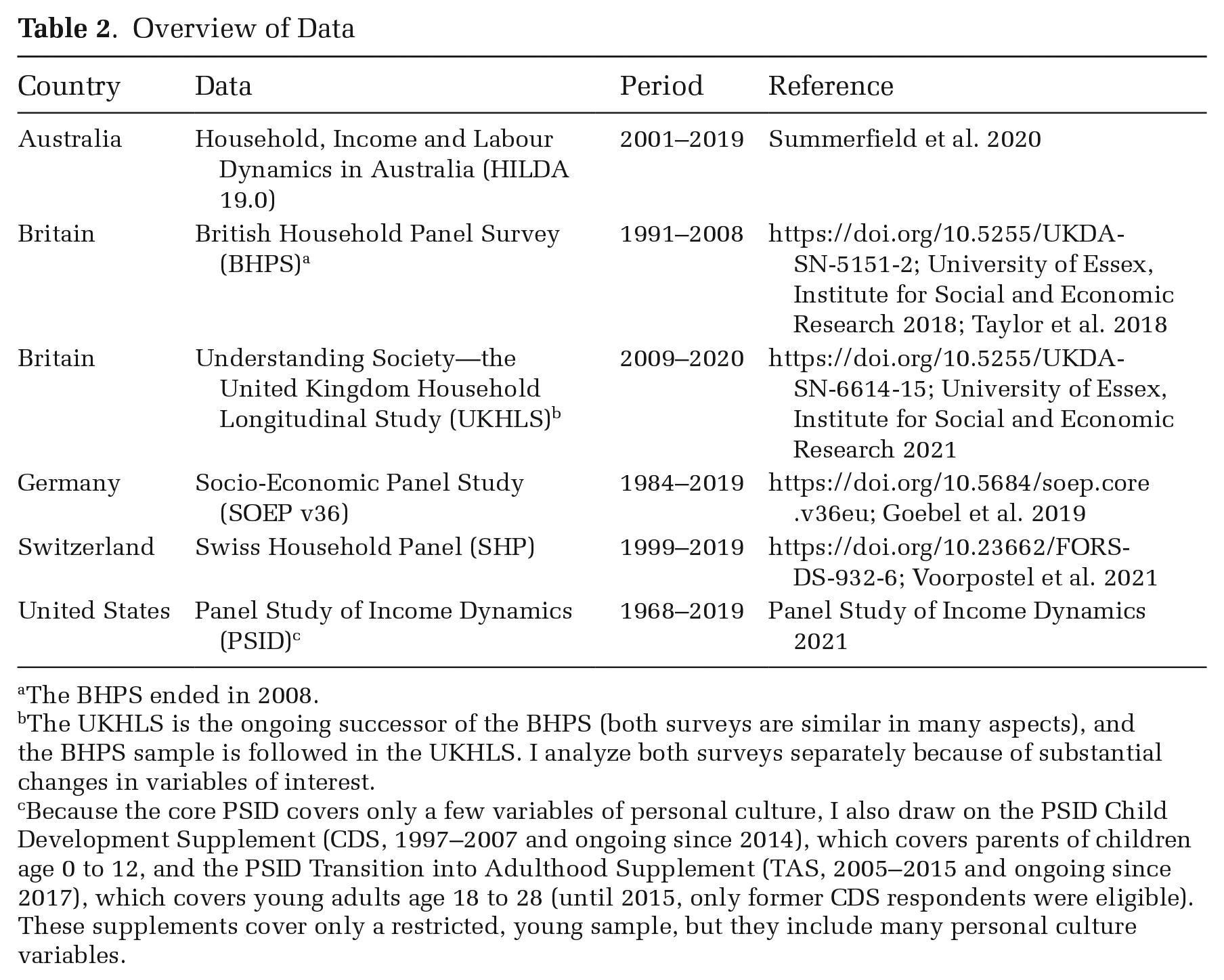
The BHPS ended in 2008.
The UKHLS is the ongoing successor of the BHPS (both surveys are similar in many aspects), and the BHPS sample is followed in the UKHLS. I analyze both surveys separately because of substantial changes in variables of interest.
Because the core PSID covers only a few variables of personal culture, I also draw on the PSID Child Development Supplement (CDS, 1997–2007 and ongoing since 2014), which covers parents of children age 0 to 12, and the PSID Transition into Adulthood Supplement (TAS, 2005–2015 and ongoing since 2017), which covers young adults age 18 to 28 (until 2015, only former CDS respondents were eligible). These supplements cover only a restricted, young sample, but they include many personal culture variables.
Sample
The sample is inclusive and consists of repeated observations for respondents age 18 to 79 years. I chose the upper limit due to small case numbers beyond age 79. 6 No further sample restrictions are imposed. I apply listwise deletion for missing values. The sample is unbalanced; that is, respondents can be observed for a varying number of waves. Sample sizes and the number of repeated observations vary by outcome. Tables A.1 to A.6 in Part A of the online supplement show respective case numbers across the surveys and outcomes.
Measures
Outcome variables
I consider a wide range of outcome variables to measure personal culture comprehensively and provide a general test of the life course adaption model. The selection of outcome variables is different across surveys to maximize the facets of personal culture captured in the data. In the first step, I select all available variables for each survey that measure beliefs, attitudes, values, or subjective self-descriptions (Alwin 2007:123). I exclude statements of facts (e.g., year of birth). Selected variables cover gender ideology, policy issues, moral behavior, party affiliation, interests in politics, concern about crime, national identity, and many others. In the second step, I exclude all variables that are not measured in at least three survey waves. This leaves 428 outcome variables across surveys (where some outcomes are observed in more than one survey). Very few outcomes are measured for specific age groups. For example, questions about the subjective importance of job characteristics in the UKHLS are only asked for respondents below age 23. See Tables A.1 to A.6 in Part A of the online supplement for a complete overview of all outcome variables. Time intervals between measurements are mostly more extended than in the GSS and vary from one to five years, with resulting observation windows ranging from 3 to 36 years. On average, personal culture outcomes are measured in about seven waves, with an average gap between observations of about three years (see Table A.13 in Part A of the online supplement).
Covariates in individual-level regression
I use age as an index of biographic progression to model trajectories of personal culture over individuals’ life courses. I center age at 18 years and divide by 10. As an example of a life course transition, I consider parent (0 = no [ref.], 1 = yes) as a time-varying variable indicating whether a respondent is a mother or father of at least one child (including children not living in the same household) in additional models. The transition to parenthood is highly salient and permanent for most individuals and has been linked to specific aspects of personal culture, such as gender ideology (see Perales et al. 2018). Because my overarching empirical aim is to establish general patterns of change in personal culture related to age, I adjust only for basic demographic variables in all models to avoid overcontrol bias (see Part E of the online supplement): gender (0 = men [ref.], 1 = women), first-generation immigration status (0 = no [ref.], 1 = yes), and birth cohort (–1939, 1940–1949, 1950–1959, 1960–1969 [ref.], 1970–1979, 1980–) (Bartram 2021; Kratz and Brüderl 2021). 7 Finally, I add period fixed effects. Periodical differences that have a lasting effect on personal culture are generally compatible with the life course adaption model, but it is informative to estimate the age coefficients net of fleeting period effects (for summary statistics, see Tables A.7 to A.12 in Part A of the online supplement).
Covariates in meta-analysis
I summarize the findings from the six surveys and different outcome variables using meta-analytic tools. I include the following covariates to adjust for measurement heterogeneity: scale of variable (binary [ref.], more than two but less than or equal to five response categories, equal to or more than six response categories), maximum number of waves of measurement, average gap between waves in years, first year of measurement, and mean age of respondents (for summary statistics, see Table A.13 in Part A of the online supplement). 8
Analytic Strategy
Individual-Level Regression
To test the life course adaption model against the competing theoretical models, I draw on a set of nested longitudinal model specifications for repeated observations of individuals in a mixed-effects modeling framework, similar in essence to models proposed by Bollen and Gutin (2021). In contrast to the latter and recent work on personal culture (Vaisey and Kiley 2021), I use mixed-effects models rather than structural equation models for estimation, because mixed-effects models can readily handle unbalanced panels that are common in long-running panel surveys, where respondents may temporarily drop out or attrite from the sample. Mixed-effects models also efficiently scale to large numbers of observation points. The main conclusions are unaffected when using structural equation models with balanced samples, reducing the sample size considerably (see Part C of the online supplement).
I start with an empirical specification corresponding to the settled disposition model:

where
The second empirical specification corresponds to the active updating model: 9

where
The third and final empirical specification corresponds to the life course adaption model (labeled life course hypothesis by Bollen and Gutin [2021]):

where
Finally, the covariance between
I implement two further extensions. First, I add the parent covariate to examine the change in personal culture directly related to this life course transition. Second, I estimate models separately by birth cohorts to examine whether changes in personal culture by age are more varied in younger cohorts (
To compare the three outlined empirical specifications, and thus test the life course adaption model against the settled disposition model and the active updating model, I use the Bayesian information criterion (BIC), which is based on the likelihood function of the models penalized by the number of model parameters. 10 A smaller BIC value indicates a better fitting model, where differences in BIC of less than two are considered inconclusive. Because of different sample requirements, first, I compare all three empirical specifications on the restricted sample needed to test the active updating model. Second, I test the life course adaption model against the settled disposition model using the full sample available for each outcome. For model comparisons, I estimate models using iterative generalized least squares (equivalent to maximum likelihood). For the final life course adaption models, I use restrictive iterative generalized least squares (equivalent to restricted maximum likelihood). I use Stata 17.0 (StataCorp 2021), the runmlwin routine (Leckie and Charlton 2012), and MLwiN 3.05 (Charlton et al. 2020) to fit the models. Overall, I estimate 2,568 models for the main analysis. 11
Meta-analysis
I assume the different outcomes in the individual-level regression are all measures of the same underlying construct: personal culture. Therefore, I synthesize results across outcomes and studies by estimating average effect sizes in a two-stage individual participant data meta-analysis (Riley et al. 2021). Traditionally, meta-analysis draws on aggregated data extracted from (un)published research studies to synthesize effect sizes. In individual participant data meta-analysis, the analyst has access to the raw data, which increases the accuracy and flexibility in synthesizing effects. In the current study, the first stage of the meta-analysis is the separate estimation of individual-level regression models on the raw data, as described earlier. Next, I transform the estimated quantities from the first stage to comparable effect sizes for the second stage and compute the associated sampling variance of effect sizes and resulting standard errors (Raudenbush and Bryk 2002:205ff). I then use a multilevel model to estimate average effect sizes in a meta-regression with random intercepts at the survey level accounting for the uncertainty in the first-level estimates (Hox, Moerbeek, and van de Schoot 2017:206ff). The multilevel approach allows one to handle the dependence of several effect sizes from each survey sample (Borenstein et al. 2009:225ff).
Results
Illustrative Results from Three Exemplary Personal Culture Outcomes
I first discuss illustrative results from three items of personal culture before moving to the full results across all outcomes. Note that results for these illustrative items are not necessarily representative of the full results for all outcome variables but demonstrate the interpretation of results. I select three items from the HILDA that show different degrees of within-individual change (indicated by the intra-class coefficient [ICC]): “working father can have as good relationship to child” (atwkwfr) has an ICC of .34; only about a third of the total variance in this outcome is between individuals, and two-thirds is within individuals. For the outcome “child should start living independently by 18-20” (mcindpc), the ICC is .45, and for “importance of religion” (relimp) it is .82; about four-fifths of the variation in this outcome is between individuals.
Figure 3 depicts 10 randomly selected trajectories in personal culture by age for the three illustrative outcomes from the HILDA. Trajectories for “importance of religion” are stable and relatively flat, with some downward trends by age corresponding to the high ICC, indicating that most variation in this outcome is between rather than within individuals. Trajectories for “working father can have as good relationship to child” and “child should start living independently by 18-20” show more volatility, and little systematic trend is visible. There is more within-individual variation in these outcome variables compared to “importance of religion,” but visual inspection of the randomly selected trajectories does not provide further insights. Therefore, I turn to the individual-level regression models to systematically compare how well the three theoretical models fit the data and to test the four propositions of the life course adaption model.
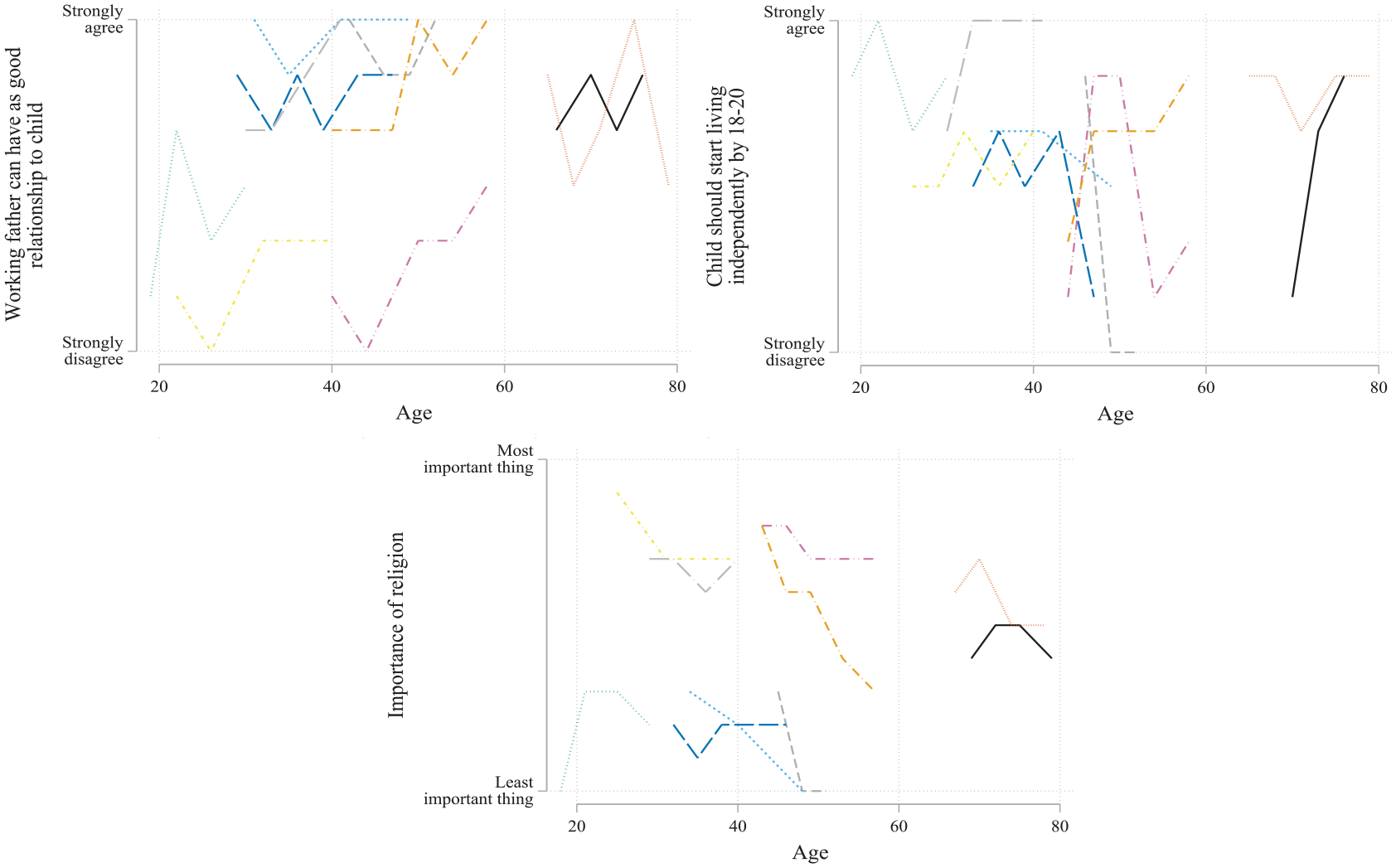
Examples of Randomly Selected Trajectories with at Least Three Observation Points
Table 3 shows model fit results across the three empirical specifications corresponding to the settled disposition model, the active updating model, and the life course adaption model for the restricted sample, including lagged observations, and the full sample. Using the BIC, where smaller values indicate superior model fit (and a difference of less than two is considered inconclusive), the life course adaption model is the preferred empirical specification for “child should start living independently by 18-20” and “importance of religion.” The stable disposition model is the best fitting model for “working father can have as good relationship to child” and performs second-best for the other two outcomes, with the active updating model showing the worst performance for all three outcomes.
Exemplary Model Fit Results
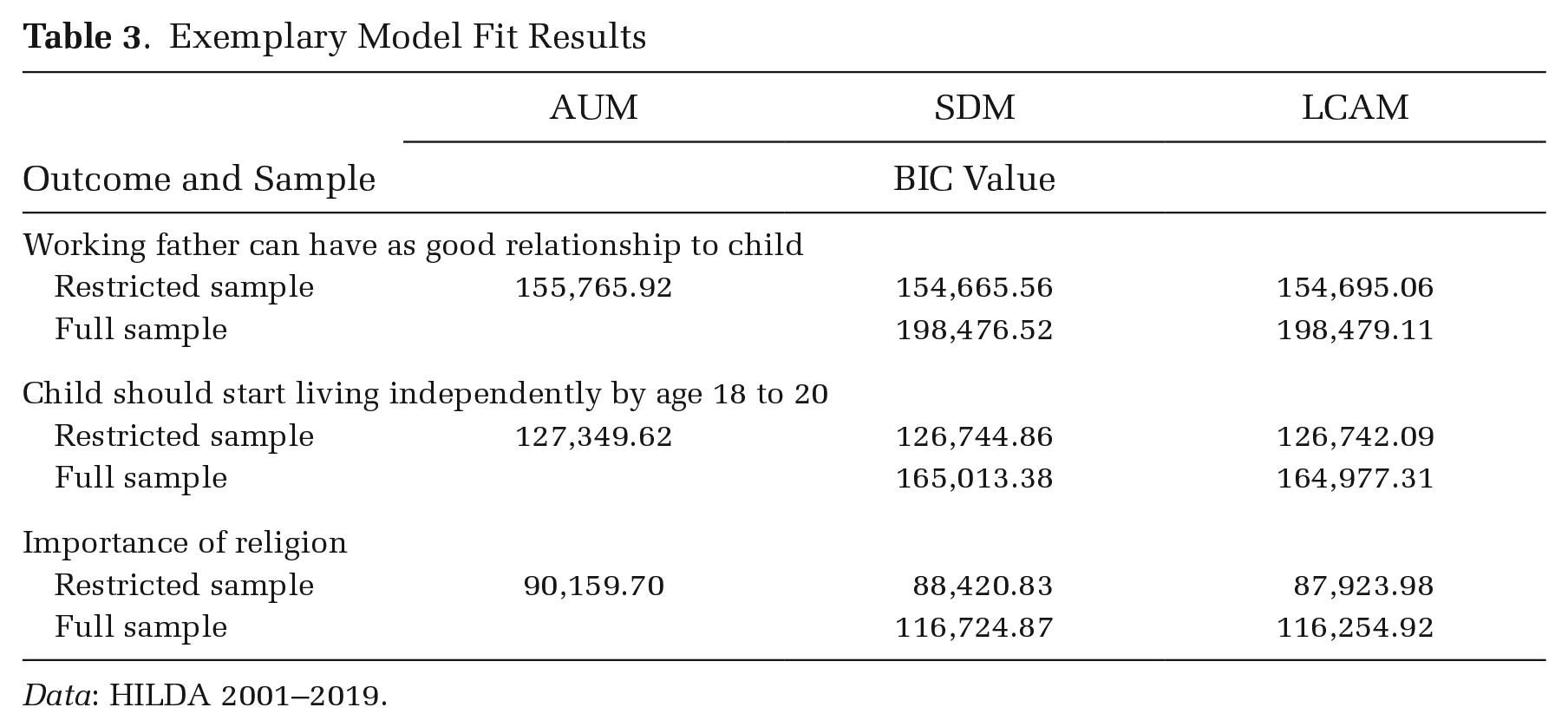
Data: HILDA 2001–2019.
Table 4 shows point estimates and 95 percent confidence intervals for the preferred life course adaption model specification for the three illustrative outcomes based on restrictive iterative generalized least squares estimation. Most estimates support the propositions (see Table 1 for an overview of propositions and empirical tests). The significant intercept variances support the proposition of early imprinting resulting in stable dispositions and heterogenous baselines of personal culture. For instance, the model for “working father can have as good relationship to child” estimates that for the 95 percent of individuals in the middle of the predicted trajectories, their intercepts were between −1.34 and .86
Exemplary Results from Mixed-Effects Regression Using Life Course Adaption Model Specification
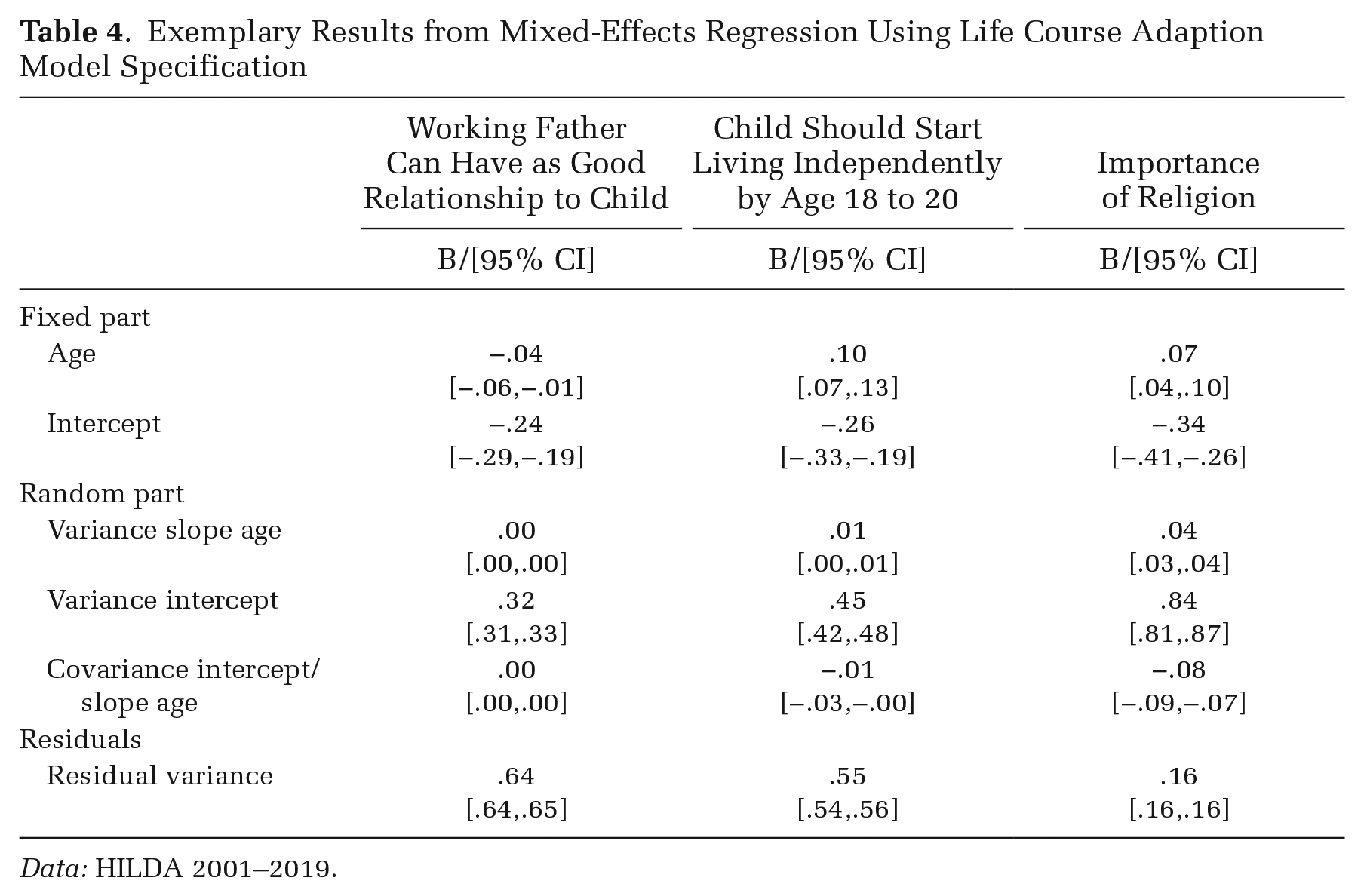
Data: HILDA 2001–2019.
The statistically significant age trends indicate a persistent change in individuals’ personal culture. However, the estimated coefficients are small—particularly compared to the variance in intercepts—and vary considerably. The largest changes are observed for “child should start living independently by 18-20,” with .10 standard deviations of change over 10 years of age. For the outcome “working father can have as good relationship to child,” I find only –.04 standard deviations of change over 10 years of age. Variance around the mean age trend is minimal for the outcomes “working father can have as good relationship to child” and “child should start living independently by 18-20.” Variance in age trends is more extensive in the model of “importance of religion,” which estimates that for the 95 percent of individuals in the middle of the predicted trajectories, there is growth between –.32 and .46
The statistically significant estimated covariance between the intercept and slope of age for “child should start living independently by 18-20” and “importance of religion” provides evidence for the biographical experience proposition. Individuals with higher-than-average baseline values have lower-than-average growth rates for these two outcomes. I do not find evidence for the biographical experience proposition for the outcome “working father can have as good relationship to child.” Finally, the models indicate statistically significant and substantial fluctuation around the age trend (residual variance estimate).
Individual-Level Regression Results
Comparison of Model Fit
Figure 4 shows the results from comparing model fit using the BIC for the stable disposition, active updating, and life course adaption models across all outcome variables separately for the restricted sample, including lagged observations necessary for the active updating model, and the full sample. For the restricted sample, in which all models are compared, the active updating model is preferred in 27 percent of successfully estimated models. In 48 percent of models, the life course adaption model is preferred. In only 22 percent of models, the stable disposition model shows the best model fit. In 11 of 415 models (or 3 percent), the comparison of the BIC is inconclusive. Thus, in almost half of all cases, the life course adaption model is preferred over the other two models. In contrast to earlier findings (Kiley and Vaisey 2020), the active updating model receives more empirical support than does the stable disposition model. The life course adaption model is preferred over the stable disposition model in 71 percent of the successfully estimated models when moving to the full sample, excluding the active updating model. 12
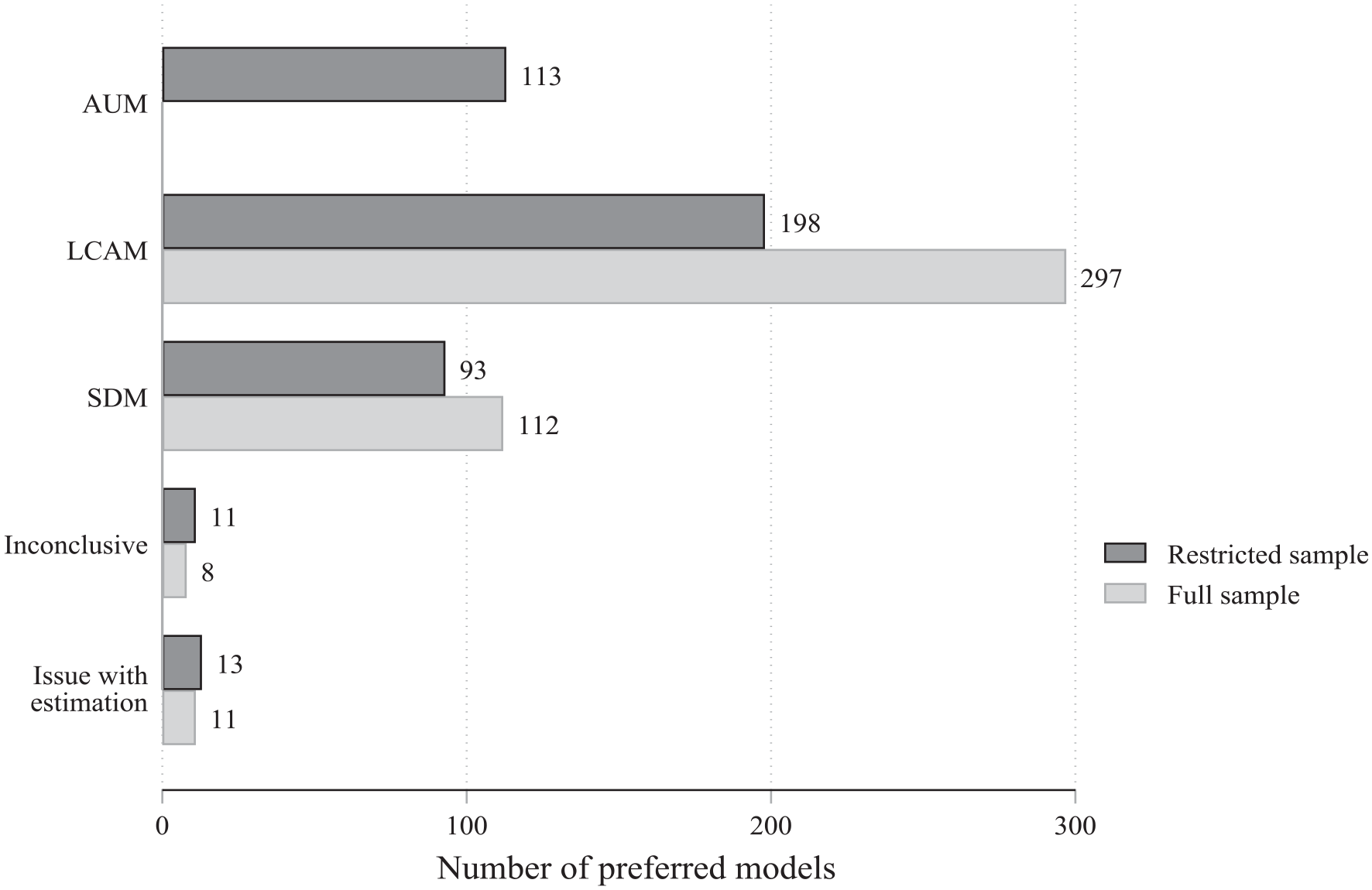
Count of Preferred Empirical Model Specifications
Evidence for Propositions of the Life Course Adaption Model
All four propositions of the life course adaption model find considerable support, but evidence for the biographical experience proposition is less consistent than for the other propositions. Figure 5 shows evidence regarding the propositions across 418 outcome variables. The figure shows the estimated coefficients and variance components with their 95 percent confidence bands from the full sample using restrictive iterative generalized least squares.
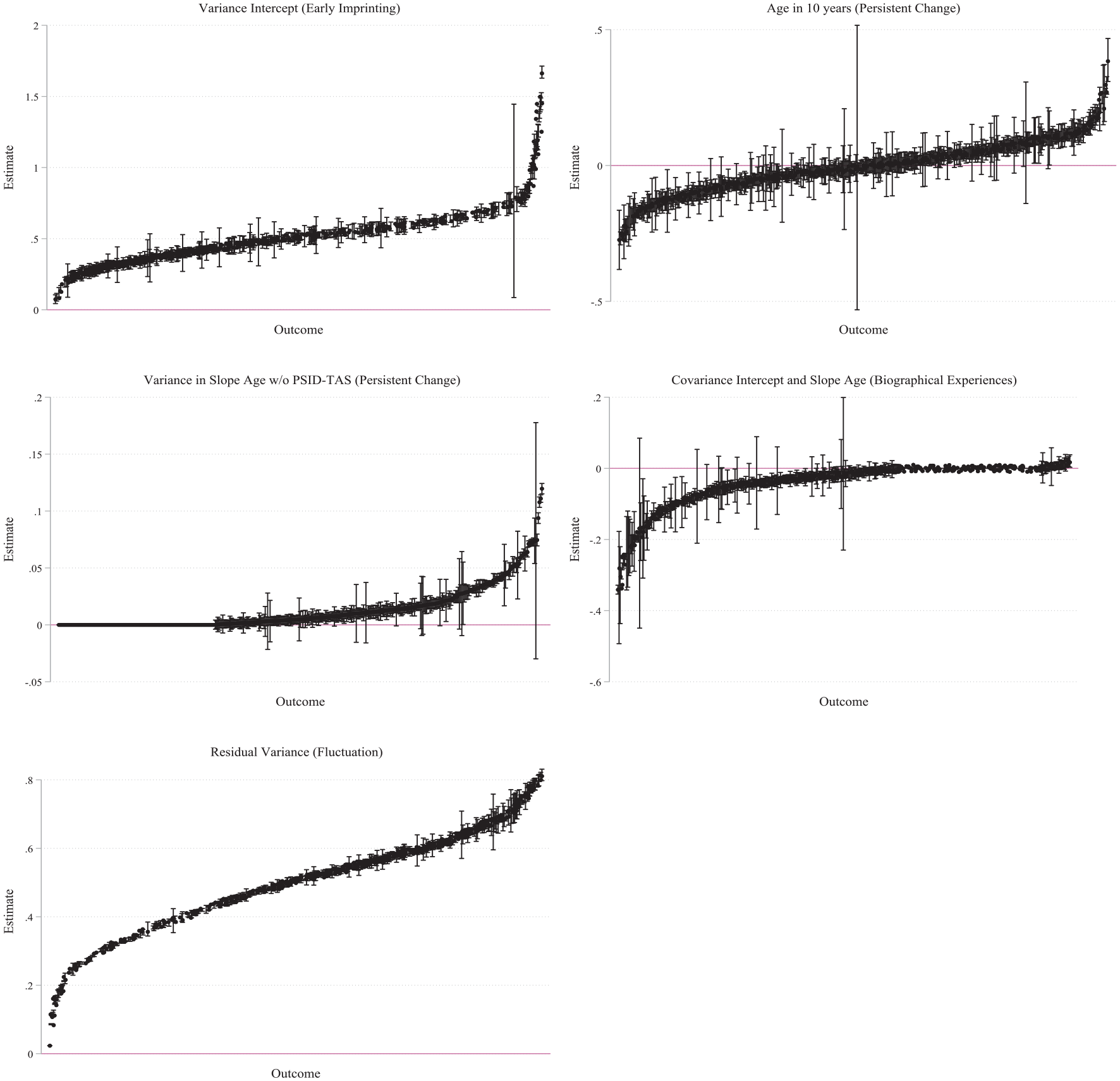
Evidence for the Propositions of the Life Course Adaption Model
The upper-left panel shows clear support for the early imprinting proposition. I find substantial variation in individual-specific intercepts for all outcomes, indicating heterogeneous personal culture baselines. The estimated variances fall primarily between .20 and .70, indicating that at the lower end of the estimated variances, intercepts for the middle 95 percent of individuals would vary about ± .88
Next, the upper-right panel shows evidence regarding the persistent change proposition using the estimated mean coefficients for age (in 10-year increments). At this stage, I consider linear trends in age, and I discuss a more flexible functional specification later. The estimated fixed coefficients mostly fall between –.20 and .20, indicating that with every 10 years of age, personal culture shifts by less than a fifth of a standard deviation. These estimated effect sizes are small, particularly compared to the between-individual differences in baselines just discussed. Nevertheless, they support the expectation that personal culture persistently changes with age. I generally find slight variance in the age slopes with a considerable share of variances estimated close to 0. Most of the variances in age slopes are below .03. Noteworthy exceptions can be found in the PSID-TAS data (see Figure D.3 in Part D of the online supplement), where estimated variances in age slopes are typically by a magnitude of 10 higher. This may be due primarily to the younger age in this sample and the more heterogeneous trajectories of personal culture in this age group.
The bottom panel in Figure 5 shows estimated residual variances across outcome variables and provides clear evidence of the fluctuation proposition. The residual variance is estimated to be chiefly between .30 and .80, with some outliers closer to 0. The residual variances indicate that individuals’ personal culture varies considerably around individual-specific baselines and linear trends by age. These fluctuations can be considered the nonpersistent, transitory changes in personal culture from one measurement occasion to the next, making up a considerable share of the total variance in personal culture.
Finally, I consider the biographical experience proposition, which states that individuals draw on prior biographical experiences when adapting their personal culture over their life course. I consider the covariance between the random intercept and the random age slope to test this proposition (middle-right panel, Figure 5). The variance in age slopes is estimated to be low in most cases. The covariance in a substantial share of cases is estimated to be 0, showing no relationship between random intercepts and random slopes. I find small, mostly negative covariances for the other cases, indicating that individuals with higher-than-average baseline values have lower-than-average growth rates by age. Thus, I find evidence favoring the biographical experience proposition, but the evidence is less consistent than for the other propositions based on the inspection of individual model results.
Meta-Analysis
I now include the results from the last section as raw data for an individual participant data meta-analysis (see Table 5). I consider the absolute values of the coefficients for age and the covariances between intercept and age slope as the outcomes of interest in the meta-analysis, because the direction of change and the sign of the correlation between intercepts and slopes are not of substantive interest in the current study. The 418 outcomes are nested in six surveys. The model reflects this structure by introducing random intercepts at the survey level. However, the variance in random intercepts is virtually zero in all models. Thus, the current analysis does not indicate systematic variation in effect sizes across surveys from Australia, Britain, Germany, Switzerland, and the United States. The results can thus be interpreted as showing general patterns of change for this selection of affluent societies.
Meta-Regression Results
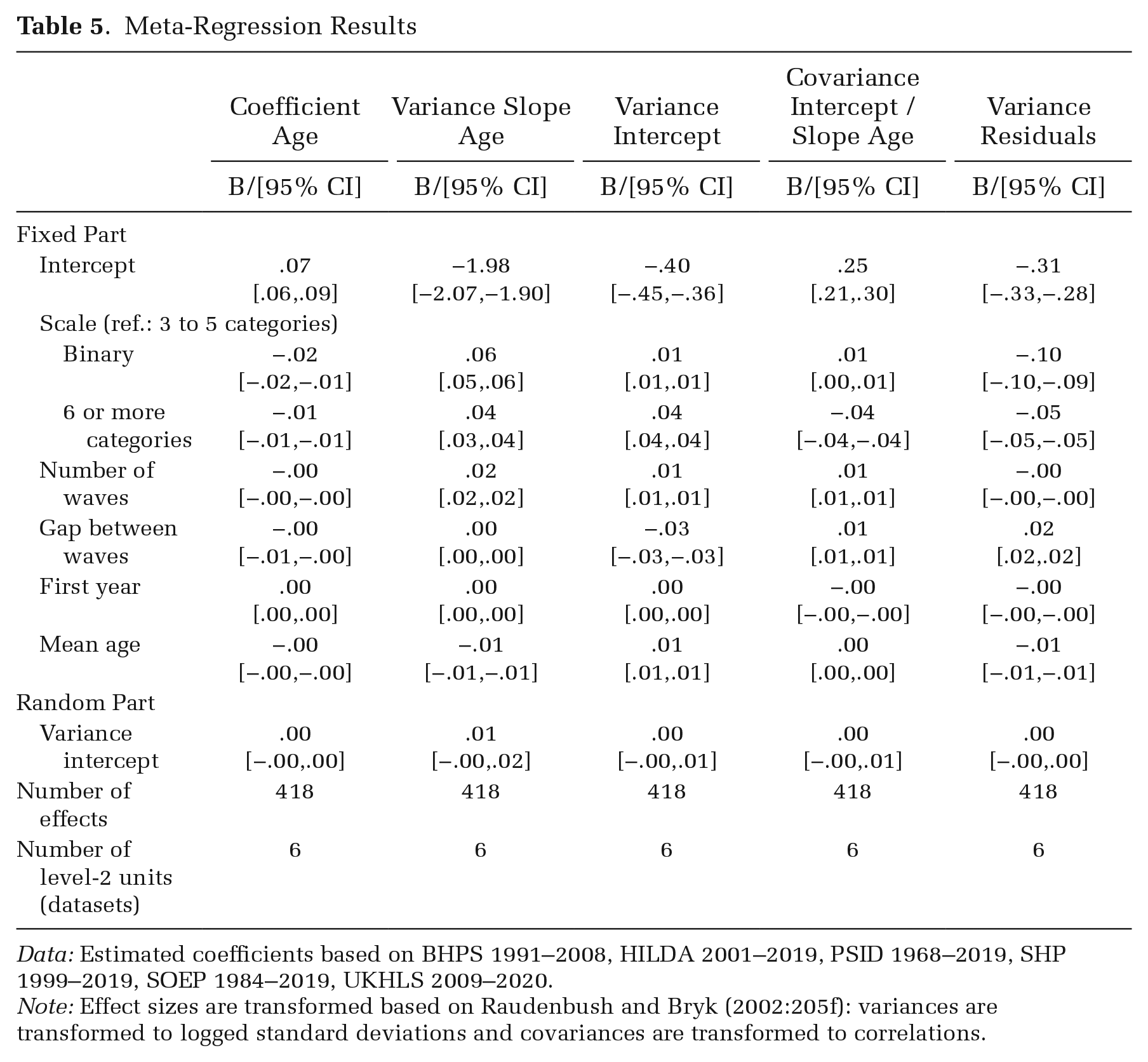
Data: Estimated coefficients based on BHPS 1991–2008, HILDA 2001–2019, PSID 1968–2019, SHP 1999–2019, SOEP 1984–2019, UKHLS 2009–2020.
Note: Effect sizes are transformed based on Raudenbush and Bryk (2002:205f): variances are transformed to logged standard deviations and covariances are transformed to correlations.
The meta-analysis again shows strong evidence for the persistent change proposition of the life course adaption model. The coefficient of primary interest is the intercept in the fixed part of the model, which indicates the synthesized mean effect size combining information from all outcome variables. The typical change in personal culture is .07 standard deviations for every 10 years of age adjusted for period effects. The effect size can be compared to typical differences in personal culture across birth cohorts, gender, and immigration status. For instance, the current data suggest birth cohorts born before 1940 score .18 standard deviations differently on personal culture outcomes than the birth cohort 1960 to 1969. Women compared to men score .13, and immigrants compared to natives score .15, standard deviations differently on personal culture outcomes. The 95 percent confidence interval for the synthesized effect size of age is .06 to .09 and does not include 0. As shown earlier, it is important to note that these are average effect sizes with considerable individual-level variation in the direction and size. 13
The meta-analysis also supports the early imprinting, fluctuation, and biographical experience propositions. The associated synthesized effect sizes for each of these propositions are substantially different from 0, with the 95 percent confidence intervals far from including 0. Of the three variance components, the variance in the age slopes is the smallest by a wide margin. The variance in intercepts and residual variance are of similar magnitude, with the residual variance being slightly larger. The estimated synthesized correlation between random intercepts and random age slopes is about .25, considered moderate in size (Cohen 1988).
The differences in estimated effect sizes when adjusting for characteristics of the outcome variables are mostly minuscule (Table 5). The most considerable differences are observed across different scales of variables. For instance, binary outcome variables show less persistent change with age and less residual variance, but more variance in age slopes and intercepts and higher covariance than non-binary outcome variables with five or fewer categories. Note that neither the number of waves for which the outcome is observed nor the average gap between observation points has a measurable effect on the estimated change by age.
Transition Into Parenthood
In the main analysis, to provide a general overview of the patterns of change in personal culture over the life course, I use age as an index for life course progression to proxy many potentially relevant life course transitions that may occur at different ages. To produce further empirical evidence regarding my argument about change in personal culture following life course transitions, I now zoom in on the transition into parenthood, which exposes many individuals to novel social contexts and interactions and substantially alters available resources and constraints in their lives.
Table 6 shows meta-analytical results based on individual-level regression models as discussed previously, which also include a time-varying parenthood indicator in addition to age. I find clear evidence for changes in personal culture related to parenthood, with parents scoring, on average, .07 standard deviations differently on personal culture items compared to non-parents. The estimated effect of parenthood is thus similar in size to changes in personal culture for every 10 years of age. Additional analyses show that most of this change is concentrated in the domain of “gender and family,” but parenthood is also associated with personal culture in all other domains, with the exceptions of “politics, government & economy,” “religion & spirituality,” and “national identity, ethnicity, & immigration” (see Figure D.5 in Part D of the online supplement). Finally, results for the relationship between parenthood and personal culture are similar when estimating individual-level fixed-effects models only considering within-individual variation in parenthood and personal culture (see Table D.8 in Part D of the online supplement). These results provide further evidence of the persistent change proposition and the life course adaption model.
Meta-Regression Results Including Parenthood
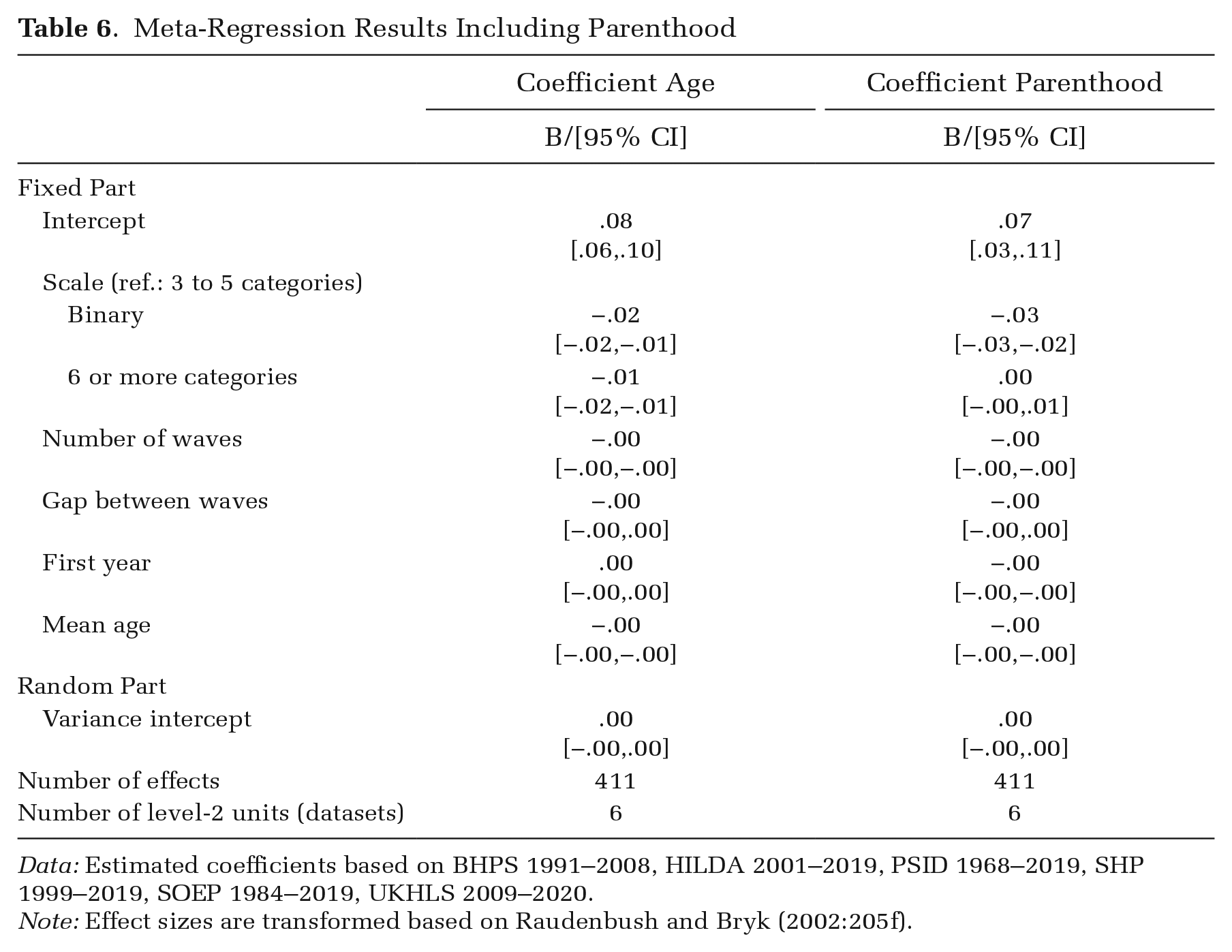
Data: Estimated coefficients based on BHPS 1991–2008, HILDA 2001–2019, PSID 1968–2019, SHP 1999–2019, SOEP 1984–2019, UKHLS 2009–2020.
Note: Effect sizes are transformed based on Raudenbush and Bryk (2002:205f).
Variation By Birth Cohorts
Returning to general patterns by age, I now consider differences in personal culture change across birth cohorts drawing on the life course principle of time and place. I expect that the direction and magnitude of change in personal culture may become less uniform in younger birth cohorts, as the experience of life course transitions in the family and work domains is increasingly varied between individuals because of historical changes in demographic behavior and labor markets across birth cohorts. I consider the variance in age slopes based on cohort-specific, individual-level regression models to evaluate this expectation.
In line with my expectations, I find that the variance in age slopes increases for younger birth cohorts (see Table 7). For birth cohorts born before 1940, the variance in age slopes is 12 percent lower
Meta-Regression Results with Separate Individual-Level Regression by Birth Cohorts
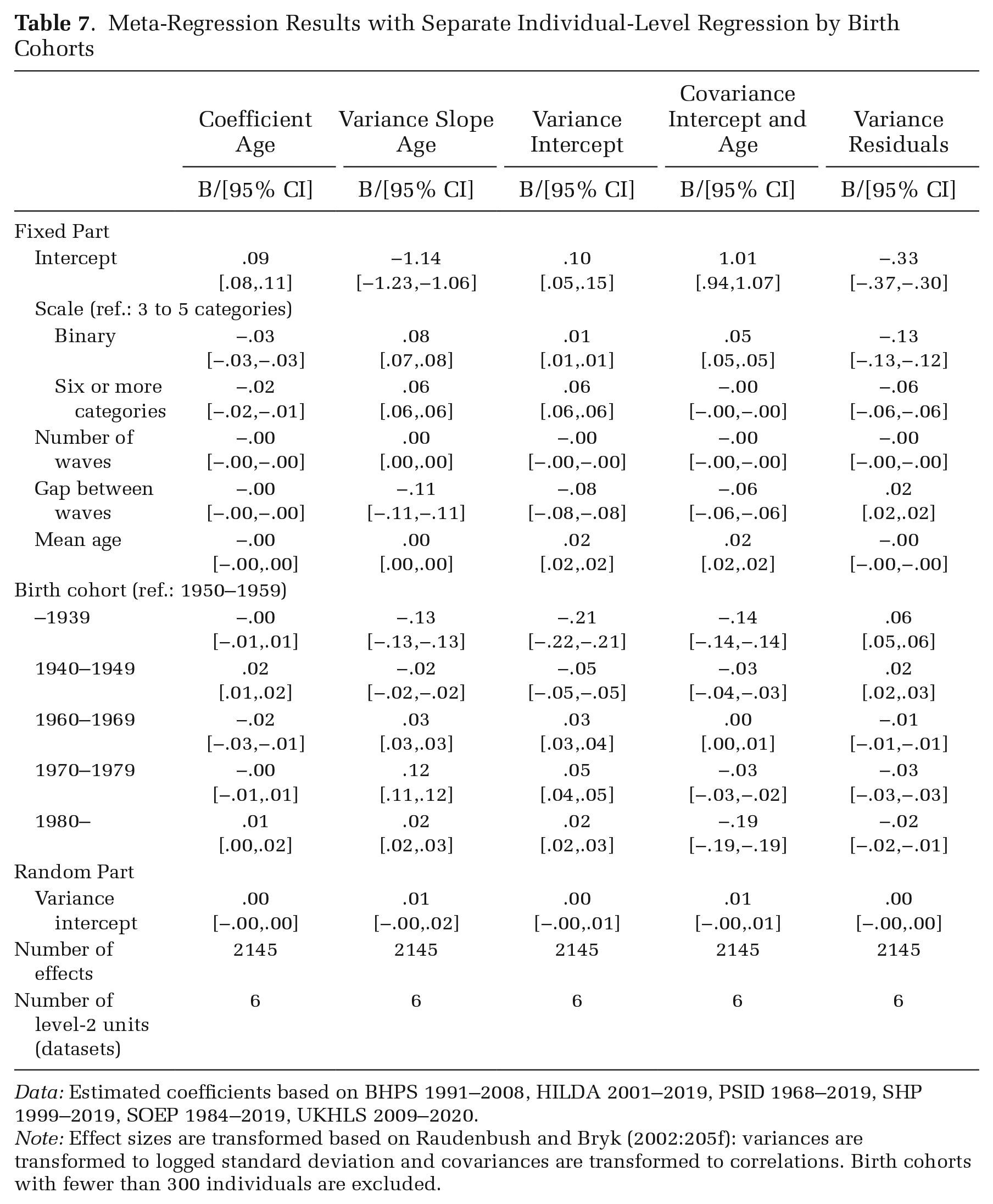
Data: Estimated coefficients based on BHPS 1991–2008, HILDA 2001–2019, PSID 1968–2019, SHP 1999–2019, SOEP 1984–2019, UKHLS 2009–2020.
Note: Effect sizes are transformed based on Raudenbush and Bryk (2002:205f): variances are transformed to logged standard deviation and covariances are transformed to correlations. Birth cohorts with fewer than 300 individuals are excluded.
Supplementary Analyses
I conducted several supplementary analyses to probe the robustness of the results. Here, I only discuss the results as they relate to the persistent change proposition of the life course adaption model. First, I modeled age more flexibly by including separate linear age splines for 10-year age windows instead of a single linear age term (see Table D.3 in Part D of the online supplement). While age slopes are smaller at older ages in these supplementary analyses, even for individuals age 70 to 79, I find an age coefficient of .10, indicating that with every 10 years of age, personal culture shifts by about a tenth of a standard deviation in this age group, on average. The results suggest that from age 20 to 60, personal culture can be expected to change by a total of about .70 standard deviations. Note that change is likely episodic and not continuous for individuals.
Second, I excluded singletons, that is, respondents with only one observation on a given outcome who do not contribute within-individual variation to the analysis. Again, results are consistent (see Table D.5 in Part D of the online supplement). Third, I ran fixed-effects regression models, which only consider within-individual variation in outcomes and explanatory variables, with linear age splines for 10-year age windows, and period dummies. For instance, by differencing out time-constant heterogeneity, fixed-effects models relax the assumption that unobserved characteristics of individuals are not related to mortality and personal culture. In these fixed-effects regression models, estimated coefficients for age are larger than in the main analysis and vary between .22 for individuals age 18 to 29 and .14 for respondents age 50 to 59 (see Table D.6 in Part D of the online supplement). Finally, response behavior in the first and subsequent panel waves may differ due to panel conditioning, creating artificially persistent change in outcomes. Therefore, I exclude the first observations of respondents for a given outcome, and again, results are consistent (see Table D.7 in Part D of the online supplement).
Conclusions and Discussion
In this study, I addressed the question of whether personal culture changes persistently over individuals’ life courses, which is crucial to our understanding of, for instance, the formation of personal culture and life course processes. The study, drawing on long-running panel survey data from five countries, presents several original and relevant findings. First, I compared how well the life course adaption model, which predicts persistent change in personal culture accounting for early imprinting, fits the data relative to the stable disposition model, which predicts no persistent change, and the active updating model, which predicts a time-homogenous, first-order Markov process of change. I find strong support for the life course adaption model. For 48 percent of outcome variables measuring personal culture, the life course adaption model is preferred when comparing all three models. For only 27 percent of outcomes, the active updating model is preferred, and for 22 percent of outcomes, the stable disposition model shows the best model fit. Using long-running panel data, I find more robust support for the active updating model than for the settled disposition model, in contrast to Kiley and Vaisey (2020).
Second, I find consistent evidence for persistent change in personal culture, which is the essential proposition of the life course adaption model, distinguishing it from the settled disposition model. The meta-analysis synthesizing the results for 418 outcomes of personal culture suggests a typical change in personal culture of .07 standard deviations for every 10 years of age, where age is an index of life course progression. However, results also suggest that change in personal culture becomes less likely with age, in line with previous literature (Glenn 1980; Kiley and Vaisey 2020). The individual-specific age trends become less uniform in younger birth cohorts as the experience of life course transitions in the family and work domains increasingly varies between individuals compared to older birth cohorts. Considering the transition into parenthood as one example of life course progression proxied by age, I find personal culture changes by about .07 standard deviations. Changes in individuals’ personal culture over the life course are small compared to between-individual differences in baseline personal culture. Nevertheless, the observed change is substantial when compared, for instance, to typical differences in personal culture across birth cohorts (e.g., individuals born before 1940 score, on average, .18 standard deviations differently on personal culture outcomes compared to the birth cohort 1960 to 1969). I find no systematic variation in results across surveys from Australia, Britain, Germany, Switzerland, and the United States.
Third, the results support the other propositions of the life course adaption model. Across all personal culture outcomes, I find considerable between-individual differences in baselines. These between-individual differences are considerably larger than persistent within-individual changes and suggest the critical relevance of early social imprinting and biological make-up for personal culture throughout the life course. Across the broad range of personal culture variables considered here, I also find sizeable residual variation in personal culture net of stable between-individual differences in baselines and linear age trends. The residual variance is similar in size to the between-individual variance. Thus, individuals’ personal culture is characterized by substantial transitory fluctuations. Finally, I find evidence for the biographical experience proposition, which states that individuals draw on prior biographical experiences beyond t – 1 when adapting their personal culture over their life course. In particular, I focused on the relationship between stable dispositions, which reflect biographical experience during early life, and the experience of and response to transitions throughout the life course. However, evidence is less consistent for this proposition than for the other three propositions of the life course adaption model.
Implications for Cultural Sociology
These findings support the theoretical notion that transitions—most likely in the family and work domains (Longest et al. 2013:1504)—and new experiences over the life course, which expose individuals to new social environments, including novel interactions, and different sets of resources, can persistently move individuals’ personal culture in novel directions and lead to general patterns of change observable across individuals. For example, results suggest that the transition into parenthood is consequential, in line with previous literature (Perales et al. 2018). Changes in personal culture may happen through enculturation and internalization of new exposures, which (re)shape networks of neural associations throughout the life course and create novel cognitive schemes. Persistent change may be more likely after continued exposures, where new neural associations gain relevance as they are repeatedly triggered. The findings suggest individuals remain open to change even though the degree of openness decreases with age, as the stickiness of personal culture increases (Visser and Krosnick 1998). This openness extends to all dimensions of personal culture observed in the current study.
A critical insight of the current study is that we should not consider stable dispositions and persistent change to be mutually exclusive (Perales et al. 2019). While people remain open to change throughout their life course, early life imprinting and biological make-up have an enduring effect on personal culture through individual dispositions. Such dispositions can be understood as life course inertia or resistance, where, abstracting from fleeting contextual impressions, people would hold consistent personal culture by age without significant, socially embedded life course transitions. Note that within-individual change is consistently smaller than between-individual differences in baselines. Thus, at the population level, social change will mostly occur through cohort replacement (Alwin and Krosnick 1991; Firebaugh 1992). However, it is noteworthy that even if within-individual change does not substantially contribute to population-wide social change, it may nonetheless be consequential at the individual level.
Furthermore, change in personal culture seems to be directly related to earlier biographical experiences and the social context in line with key principles of the sociology of the life course. Stable dispositions are related to the degree of change observed in individuals. This finding refutes earlier theories, such as the active updating model, which assume that all prior life course history can be folded into the last state of a person to predict the current state. In other words, individuals are believed to be memoryless beyond what they have responded at the last interview, updated by the experiences they have had since then. My findings indicate that such a “‘memoryless’ process is inappropriate for modeling change that unfolds over long periods of time” (Egan 2020:706). Furthermore, changes in personal culture depend on the social context of birth cohorts, which situate individuals in historical time. Individuals born later in the twentieth century, who often experience more varied family and work life courses, change their personal culture less homogeneously compared to earlier birth cohorts.
Implications for Life Course Sociology
This study contributes to recent efforts in life course sociology to more systematically address the multilevel nature of life-course dynamics by linking (1) inner-individual biographical states such as values and attitudes; (2) individual biographical states such as socio-structural positions and resources (proxied by age in the current study); and (3) supra-individual characteristics of the environment such as public culture (Bernardi et al. 2019). This effort builds on and integrates insights from life-span psychology (e.g., Heckhausen, Wrosch, and Schulz 2010), but it is firmly placed in a sociological tradition of studying the social determinants of change at the personal level (Dannefer 1984; Hendricks 2012). The current study shows how malleable inner-individual biographical states are, arguing for the influence of socially embedded individual biographical states on these changes. Conversely, inner-individual biographical states will influence individual biographical states leading to bi-directional adaption processes (Bernardi et al. 2019:5). A practical implication of this model is that interventions at the supra-individual level, such as public health campaigns against smoking or corporate training to reduce implicit bias, seem futile if inner-individual states are not malleable (McDonnell, Stoltz, and Taylor 2021).
In addition, the current study has important methodological implications for researchers interested in persistent change in individuals over the life course. Long-running panel data with sufficient numbers of repeated observations of individuals are necessary to detect change. In a simulation, I show that three observation points over four years, which the GSS offers, are often insufficient to identify actual changes in data. A low number of repeated observations is likely more critical if the underlying change is gradual and relatively small. Thus, the minimum number of repeated observations necessary to detect change will depend on the context of a particular study and should be considered carefully. Many high-quality, mature, and nationally representative panel surveys covering a broad range of topics are available for affluent countries; social scientists should take advantage of these surveys.
Implications for Social Mobility and Inequality
My findings have implications for other areas of sociological research, of which I highlight one example for the study of social mobility and inequality. Public culture and personal culture (and their interplay) are crucial in generating inequality and facilitating and hindering social mobility (Bourdieu 1984; Lamont, Beljean, and Clair 2014). For instance, Rivera (2012) shows how cultural matching is central in hiring processes in elite labor markets, where gatekeepers use cultural similarity to approve newcomers. Personal culture is also relevant in low-skill labor markets, as employers can use it as a shorthand to weed out other characteristics in workers (Zamudio and Lichter 2008). If personal culture is mostly stable following stable dispositions, such influence of personal culture on occupational attainment would depend on parental background and other aspects of early imprinting alone. If personal culture is malleable, changes in personal culture can initiate intragenerational social mobility in line with the multilevel life course model just outlined. Again, these influences are bi-directional, with intragenerational social mobility likely changing personal culture.
Limitations
I acknowledge some limitations of the current study. First, personal culture is influenced by age, period, and cohort (Alwin and Krosnick 1991; Ebner, Kühhirt, and Lersch 2020). Disentangling these influences remains challenging and can only rest on (untestable) assumptions about the relationships between these factors (Fosse and Winship 2019). In the current study, I prioritize interpreting age effects while adjusting for coarse birth-cohort categories and period fixed effects. Importantly, I argue that periodical events that induce persistent change are also compatible with the life course adaption model, but adjusting for period effects accounts for fleeting environmental influences. Second, using age as an index of life course progression for the primary analysis is a convenient and necessary shorthand when considering various outcome variables, which a plethora of life course transitions can affect. However, it remains a distal proxy of the biographical changes across individuals, and age has no causal influence on personal culture. The transition to parenthood examined here provides an example of a trigger of persistent change.
The current study leaves open the question of which further transitions and new experiences trigger persistent change. In this regard, this study is strictly associational, without analytic attention to the concrete mechanisms underlying change in personal culture. For instance, recent research based on experimental data suggests that re-classification may be one mechanism leading to change in personal culture (McDonnell et al. 2021). Finally, the current study ignored the interrelatedness of different aspects of personal culture. Recent literature highlights how different aspects of individuals’ personal culture relate to each other and how this web of relations may condition changes in personal culture (Keskintürk 2022; Rawlings 2020).
Implications for Future Research
The current study lays the foundation for a systematic examination of the effect of life course transitions on personal culture. Previous literature provides scattered results examining one aspect of personal culture and one life course transition at a time. Transitions in the family and work domains that lead to repeated exposure to new experiences seem most relevant to study. Repeated exposure will depend on the permanence and salience of life course transitions. For instance, the transition to parenthood is almost always permanent and salient, so it will likely have an enduring effect on personal culture, as revealed in the present study. In contrast, unemployment can be very salient, yet it is rarely a permanent transition, as most people find a new job at some point (but see the discussion on long-term scarring effects [Gangl 2006]).
In addition, two principles of the life course perspective not directly addressed in the current study can motivate future research. First, the principle of agency highlights how individuals construct their life courses within the opportunities and constraints of social and historical contexts (Elder et al. 2003). Does agency shape the consequences of life course transitions on personal culture? For instance, are unintended births and the support of significant others in the transition to parenthood differently associated with personal culture compared to intended births (Steinberg, Harrison, and Boudreaux 2020)? Relatedly, agency regarding life course transitions and their timing are stratified by socioeconomic status (Billari, Hiekel, and Liefbroer 2019). Future research should explore the consequences of this stratification for personal culture.
Second, the life course perspective provides a productive tool for studying the influence of social networks on personal culture through the principle of linked lives, referring to the social convoy with which individuals move through their lives (Moen and Hernandez 2009). For instance, due to positive assortative mating on characteristics such as education (Blossfeld 2009), new romantic partners are unlikely to fundamentally challenge individuals’ personal culture. However, it is unclear how personal culture develops interdependently for each partner during their union. Studying such interdependencies is relevant to better understand the conditions of personal culture change. The interdependencies of personal culture can also have consequences for demographic outcomes, where dissimilarities in personal culture between different-sex partners are found to reduce the likelihood of childbirth (Hudde and Engelhardt 2021). For future research, more generally, this study’s theoretical and empirical contributions underline how lasting within-individual changes in personal culture need to be analyzed jointly with individuals’ stable dispositions for an improved understanding of the formation of personal culture.
Supplemental Material
sj-pdf-1-asr-10.1177_00031224231156456 – Supplemental material for Change in Personal Culture over the Life Course
Supplemental material, sj-pdf-1-asr-10.1177_00031224231156456 for Change in Personal Culture over the Life Course by Philipp M. Lersch in American Sociological Review
Footnotes
Acknowledgements
This research is supported by the Support Network for Interdisciplinary Social Policy Research (FIS) of the German Federal Ministry of Labor and Social Affairs. I thank Kevin Kiley for generously sharing his analysis code. Franziska Sesser provided excellent research assistance. I thank Anette Fasang, George Leckie, and Francisco Perales for helpful advice.
Data Note
The BHPS data were made available through the UK Data Archive. The data were originally collected by the ESRC Research Centre on Micro-social Change at the University of Essex (now incorporated within the Institute for Social and Economic Research). Neither the original collectors of the data nor the Archive bear any responsibility for the analyses or interpretations presented here. The HILDA Project was initiated and is funded by the Australian Government Department of Social Services (DSS) and is managed by the Melbourne Institute of Applied Economic and Social Research (Melbourne Institute). The findings and views reported in this paper are those of the authors and should not be attributed to either DSS or the Melbourne Institute. The collection of the PSID was partly supported by the National Institutes of Health under grant number R01 HD069609 and R01 AG040213, and the National Science Foundation under award numbers SES 1157698 and 1623684. This study has been realized using data collected by the Swiss Household Panel (SHP), which is based at the Swiss Centre of Expertise in the Social Sciences FORS. The project is supported by the Swiss National Science Foundation. The SOEP is administered at the German Institute for Economic Research (DIW Berlin) under the umbrella of the Leibniz Association (WGL) and funded by Germany’s Federal Ministry of Education and Research (BMBF) and state governments. Understanding Society is an initiative funded by the Economic and Social Research Council and various Government Departments, with scientific leadership by the Institute for Social and Economic Research, University of Essex, and survey delivery by NatCen Social Research and Kantar Public. The research data are distributed by the UK Data Service.

Notes
References
Supplementary Material
Please find the following supplemental material available below.
For Open Access articles published under a Creative Commons License, all supplemental material carries the same license as the article it is associated with.
For non-Open Access articles published, all supplemental material carries a non-exclusive license, and permission requests for re-use of supplemental material or any part of supplemental material shall be sent directly to the copyright owner as specified in the copyright notice associated with the article.
