



Abstract
This article investigates the intensity and character of interaction between the climate movement and countermovement in the online sphere. Theoretically, we contribute by proposing a novel categorization of movement–countermovement interaction that considers whether the action directly or indirectly targets the adversary, their argument, or their actions. While in physical interaction, the activists clash on the streets, in social media, rival actors can address each other via direct responses (e.g., retweets, mentions) or indirect discursive actions that aim to delegitimize opposing actors, their arguments or actions via text or images. We adopt a multimodal approach to illustrate these patterns. More specifically, we have extracted climate change-specific posts from Twitter (now X) using several hashtags typical of the climate movement and its counterpart (e.g., #climateaction; #climatehoax) during the weeks of Global Climate Action in September and the COP25 meeting in December 2019. The movement and countermovement accounts were identified interactively by examining network diagrams and structural network properties and manually inspecting samples of the tweets posted inside each group. The results of the multimodal analysis indicate that the level of direct and indirect interaction between climate activists and their adversaries is small, asymmetrical, varies based on language, and is unexpectedly similar during the weeks of strike and COP. The countermovement targets climate activists, their arguments, and actions much more than vice versa. The presented discursive and visual struggle demonstrates movement–countermovement interaction on social media.
Introduction
Social movement (SM) mobilization often evokes a countermovement (CM), especially when the movements manage to achieve social change that is perceived to threaten the interests or lifestyle of other societal groups (Andrews, 2002; Ayoub & Chetaille, 2020; Banaszak & Ondercin, 2016; Meyer & Staggenborg, 1996; Useem & Zald, 1982). Countermobilization strategies may mirror the movement’s repertoire, and range from verbal outbursts or peaceful protests (e.g., demonstrations) to acts of civil disobedience or violent riots. In the contemporary world with many hybrid SMs (Showden et al., 2023), confrontation and competition for public attention occur in digital as well as physical space. While there has been some scholarly attention to SM–CM interactions in general, and the dynamics of protests and counterprotests in the physical space in particular (e.g., Haunss et al., 2025, this issue Inclán, 2012; Reynolds-Stenson & Earl, 2018), we know less about such interaction in the digital sphere. Even though scholars have described how adversaries of a movement such as Black Lives Matter criticize and delegitimize it online (e.g., Freelon et al., 2018; Solomon & Martin, 2019; van Haperen et al., 2023), they do not analyze the interaction between the movement and the countermovement. Moreover, the few studies that do look at the interaction have a narrow focus on the United States (Keyes & Keyes, 2022; Shahin, 2023) and do not theorize the role of the Internet or social media for the SM–CM dynamics (but see Peckham, 1998). How do we translate the existing knowledge about the intensity and characteristics of SM–CM interaction to the digital sphere?
We propose an answer to this question via an empirical investigation of the online interaction between the climate movement and its adversaries in a global context. Environmental and climate movements not only aim to change the behavior and decisions of their targets—the public, governments, and businesses—they are also challenged by the countermobilization of a heterogeneous network of actors ranging from climate change deniers and climate change skeptical actors to think tanks representing specific corporate interests (Staggenborg & Meyer, 2022). Despite numerous studies about the youth climate movement “Fridays for Future” (FFF) and their online mobilization (Molder et al., 2022; Nasrin & Fisher, 2022) and the digital activism of “climate deniers” (Vowles & Hultman, 2021a) and “climate contrarians” (Xu & Atkin, 2022), the interaction between the two groups has received less attention.
We make three important contributions to research on SM–CM interaction. First, we shift the focus to the digital sphere, where the contact between the adversaries is not physical. There is no “police line” between the two groups, and the potential audience is much larger than in the case of “traditional” clashes of counterprotesters (Reynolds-Stenson & Earl, 2018). Second, we propose a novel categorization that relates the traditional offline interaction to online episodes of such activity. Categorizing interactions as direct or indirect and as targeting the opposing actors, their argument, or their actions provides a structure for empirical description and analysis of the interaction between antagonists or opposing actors. Eventually, it should allow further theory-building regarding the mobilization and consequences of SM–CM interaction in the digital age. Third, we apply the proposed framework to online communication about one of the most salient issues of our time by conducting a multimodal analysis of climate activists’ and their adversaries’ posts (roughly 3.6 million) on Twitter (now X).
The data were gathered during two distinct events to demonstrate the contextual dependency of SM–CM interaction. The first, the Global Week of Future, was mobilized by Fridays For Future in relation to the UN Climate Action Summit in New York. It was one of the most extensive global protest campaigns against climate change, lasting from September 20 to 27, 2019 (De Moor et al., 2021). The second event differs from the first by its character and element of power—the UN Climate Change Conference or a COP25 meeting in Madrid, from December 2 to 13, 2019, involved political elites, business, and civil society representatives negotiating over the terms of how to implement the Paris 2015 agreement to reduce CO2 emissions (Newell & Taylor, 2022). Protests also surrounded the event, but to a much smaller extent than in the case of our first event (Soler-i-Martí et al., 2024). We expect the intensity and character of SM–CM interaction to be different on these two occasions because CMs are known to increase their mobilization at times when the initial movement is mobilizing, getting media attention, or is likely to achieve some of its goals (Meyer & Staggenborg, 1996). The two first conditions were fulfilled in the case of Global Week of Future.
New knowledge about the dynamics of the climate movement and its adversaries in social media is important for SM research. Nevertheless, it also has broader relevance, as this interaction potentially impacts public opinion about climate change (cf. Dorf & Tarrow, 2014; Gamson & Modigliani, 1989). The polarization around climate change, particularly noteworthy in social media (Falkenberg et al., 2022), challenges the options for improving climate policies and managing the negative consequences of the process. In line with such work, this study demonstrates the complexity of the interaction dynamics between the groups supporting and opposing climate action and shows that both sides use various (de)legitimization strategies that potentially feed polarization.
The Intensity of the SM–CM Interaction
Meyer and Staggenborg (1996) called attention to the dearth of knowledge about the dynamics of movement–countermovement interaction already 30 years ago (p. 1630), but there is still little research on the short-term dynamics of protest and counterprotest (for exceptions, see Alimi & Hirsch-Hoefler, 2012; Haunss et al., 2025, this issue; Reynolds-Stenson & Earl, 2018; Wood, 2021). The relative lack of scholarly attention to interaction is surprising since SM strategies develop in interaction with different actors (Tilly, 2004).
Seminal work in the field emphasizes that the intensity of interaction between the movement and countermovement accounts deserves particular attention. Increases in material resources and attention to the initial movement intensify interaction (Meyer & Staggenborg, 1996; Zald & Useem, 1987). 1 This has knock-on effects, such as generating new protest repertoires, increasing mobilization, radicalizing the movements, and changing the activists’ framing of the issue at stake (Staggenborg & Meyer, 2022). Moreover, the intensity of the countermobilization may increase the media coverage of SM issues (Jennings & Saunders, 2019), impact the mobilization of the initial movement (Hager et al., 2022), and eventually have broader societal and political effects, including in public opinion (Ellinas & Lamprianou, 2024).
We contend that the intensifying dialectic of movement and countermovement interactions may have its own salience in the digital sphere, in which social media platforms offer affordances for networked counterpublics to contribute to the public debate (Jackson & Foucault-Welles, 2015). While there are many forms of digital activism, we limit our focus here to SM–CM interaction, which takes the form of discursive struggle. Making opposing claims about an issue or engaging in framing and counterframing (Benford & Hunt, 2003) is particularly relevant in this context. Accordingly, there is suggestive evidence of affective discursive strategies emerging in competing protests (Shahin, 2023) and counterframing via competing hashtags (Freelon et al., 2016; Gallagher et al., 2018).
More specifically, we argue that the contemporary social media ecology offers the potential to intensify discursive clashes between movements because of the way that it supports a range of both direct and indirect interactions. Social media platforms offer numerous opportunities to engage in direct interaction, for example, via digital affordances that make it possible to reply to them or participate in their hashtag streams. Crucially, they also give traction to episodes of indirect interaction due to the emphasis on public visibility that characterizes contemporary social media ecosystems. This publicity enables discursive attacks in which a speaker talks publicly about their opponents (not to them) to delegitimize or mock them. Prior research on SM–CM interaction has focused on physical clashes occurring in the same temporal and spatial context (e.g., Inclán, 2012; McCaffrey & Keys, 2000; Reynolds-Stenson & Earl, 2018). We propose that significant clashes can also be more distant in terms of time and space (see Haunss et al., 2025, this issue) and the directness of the interaction.
This distinction between direct and indirect interaction is salient because it illuminates the potential for distinct intensification dynamics. In the case of direct interaction, the other side is made aware of it because digital affordances push the content at the addressee and provide opportunities to respond. In the case of indirect interaction, the targeted actors may remain unaware or removed from attempts to delegitimize them in public. The direct interaction is, therefore, more likely associated with “escalation” or “outbidding” processes that are reminiscent of a traditional street clash dynamic (Alimi et al., 2015). The indirect interaction is less likely to lead to direct exchange in the moment but still has the potential to contribute to intensifying long-term dynamics by building oppositional networks, developing counterframes, and amassing further media and public attention. The amplified potential for interaction in different modes means that while the proportion of SM–CM clashes is relatively low in traditional street protests (7%, Reynolds-Stenson & Earl, 2018), the discursive interaction between opposing groups in the digital sphere can be expected to bring an extra impetus and edge.
The Character and Content of Discursive Struggles in Social Media
Understanding the development of movement and countermovement interaction requires knowledge not only about its sheer intensity in terms of frequency but also about its character and content. Aside from discerning the directness of the address, a central feature is the discursive target. The interaction with the adversary occurs when a movement actor targets the other side, as opposed to simply talking about the own movement’s events, ideas, or calls for action.
We distinguish three key aspects that movement and countermovement adversaries can discursively target associated with their opponents: their arguments, their actions, or the opposing side (or its leaders) as actors. Which aspects are targeted depends on the movements and their context. It is possible that adversaries select the aspect they perceive to be the weak link or, conversely, what they perceive to be the strongest mobilizing or attention-getting factor on the other side. The targets have different potential effects. While the potential outcome of SM–CM interaction targeting the “argument” is a reframed claim or impact on support for the claim, targeting the “actor” or “actions” is likely to shape public attitudes toward the movement and its actions. Prior research extensively documents discursive targeting strategies in SM–CM interaction, but typically does not differentiate the types in analyzing the intensification of interaction. Most focus on how activists target arguments. For example, Benford and Hunt (2003, pp. 162–164) discussed that counterframing can take the form of problem denial, counter-attribution, and counter-prognosis. McCright and Dunlap (2000) showed that the conservative movement developed clear counterframes to challenge the environmental movement’s argument that global warming is a social problem. Others examine the targeting of actors, that is, the opposing group or its leader, and show that strategies to attack or ridicule their competence, character, or moral standing can have significant implications for undermining support (e.g., Ellinas & Lamprianou, 2024). Surprisingly, few studies have examined the role of targeting actions. Still, Hirschman (1991) outlined how the countermovement condemned the SM-initiated mobilization (e.g., the French Revolution), and more recent work studies strategies to delegitimize COVID-19-related protests (Hunt, 2022; Rohlinger & Meyer, 2024). In these cases, the adversaries’ actions are framed as harmful events with long-term societal consequences and used to call authorities to introduce or increase repressive measures to prevent such events.
There is suggestive evidence of strategies involving some or all of these target types in SM–CM interactions in the digital sphere. Yates’s (2007) analysis of animal rights activism shows how the movements gave different meanings to terms such as “animal rights” or ”animal welfare,” with implicit targeting of argument and actors as both sides labeled their adversary as a threat. In the context of climate activism, several studies examine the online contestation over Greta Thunberg as a symbolic leader (e.g., Arce-Garcia et al., 2023; Elgesem & Brüggemann, 2023; Mede & Schroeder, 2024). Knight and Greenberg (2011) traced diverging strategies in Canadian climate movement websites, showing that while the movement referred more frequently to their adversaries’ actions, the countermovement focused on the moral character of the opponents’ arguments.
Building on such work, we propose systematizing the two types of direct and indirect interaction by target, as outlined in Table 1. A social media post may address just one or several of the three aspects (actor, argument, action). We note that many social media affordances (Bucher & Helmond, 2017) involve distinct interface mechanisms that support direct targeting. The reply function is self-explanatory and is used in many platforms. Another more generic social media interaction function is the opportunity to use “@username” in a message, as this allows a user to tag any possible other user to “address” that user (Draucker & Collister, 2015). There are also platform-specific affordances. For a platform such as Twitter, this includes the retweet function, which enables users to forward others’ tweets without comments, and the quote Tweet function, which allows forwarding tweets with comments. In the direct interaction, therefore, the activists may target their opponents by (a) addressing the adversary via retweets (also called reposting), replies, or @mentions or actor-specific hashtags; (b) referring to typical arguments via hashtags; or (c) referring to recent actions (e.g., demonstrations, social media campaign) via protest-specific hashtag or by reposting a climate activist’s post about a significant climate strike with a comment (e.g., “fake news”).
The Types of Interaction by Target.
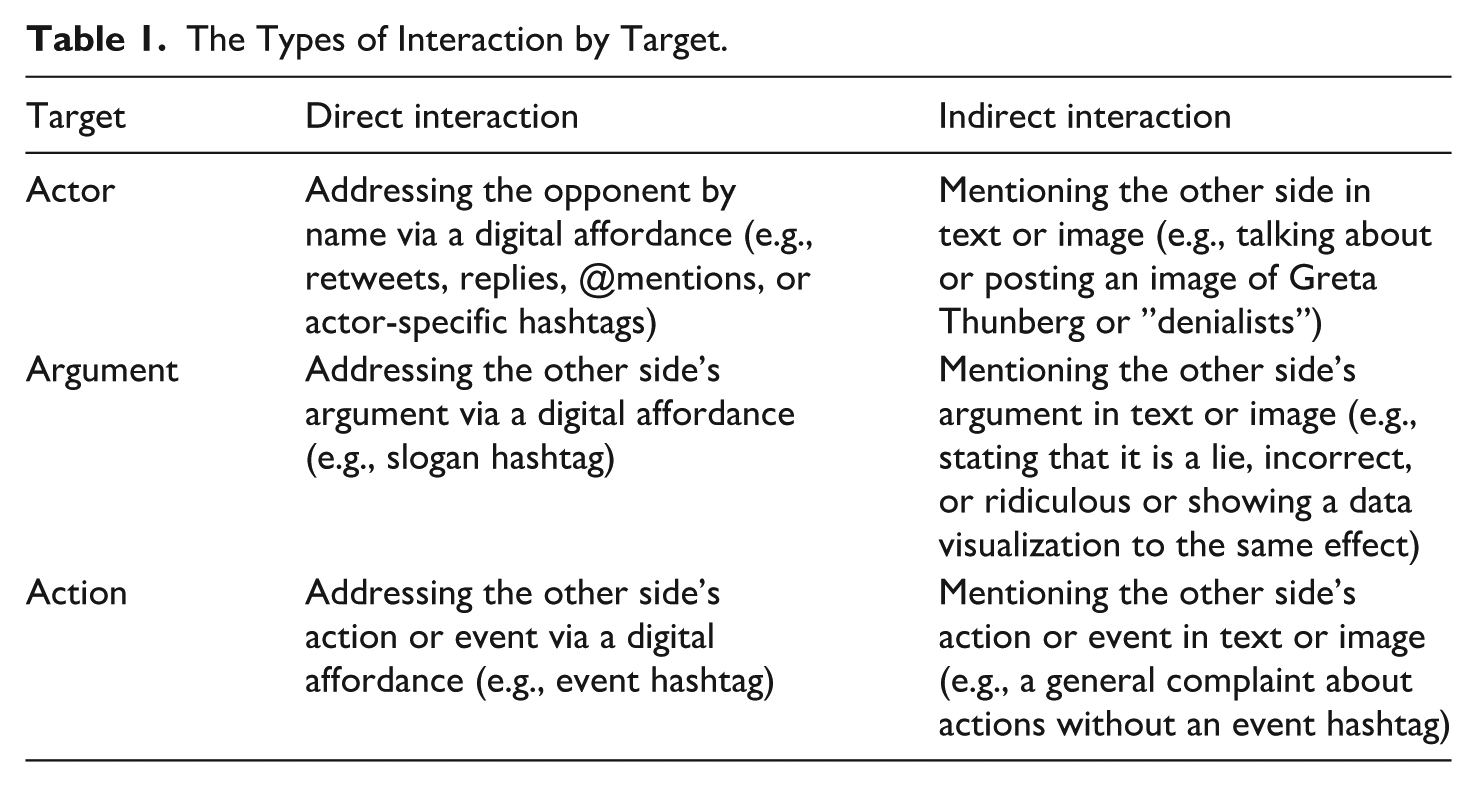
Instances of indirect interaction occur in discursive content that is only featured as text or image without other digital affordances pushing the content to the opposition. In indirect interaction, activists may target their opponents in their social media posts by (a) referring to the actors on the other side in text or image by naming or showing images of the movement (e.g., FFF, deniers, or skeptics) or symbolic leaders and representatives (e.g., Greta Thunberg, young activists); or referring via text or image to the (b) arguments, or (c) actions of the other side (typically condemning, delegitimizing, mocking, or showing as grotesque).
Distinguishing direct and indirect discursive strategies between activists across distinct targets has the potential to give traction to the dialectics of SM–CM interaction online. We expect the online dynamic to follow the profile of traditional clashes. Since countermovements mobilize more when the initial movement is particularly active and achieving media attention (Meyer & Staggenborg, 1996), we expect the intensity of interaction in the digital sphere to shift across episodes. Similarly, as the framing contest reflects its context (Benford & Snow, 2000), it is also likely that the character and content of the targeting strategies, that is, focusing on either the perceived weak link or symbols providing the most visibility (e.g., Greta Thunberg), will follow the conditions of the context.
We illustrate this argument by examining the online interaction of climate movement and countermovement actors. This is an area in which we, in general, can expect intensifying clashes between activists, given rising climate movement influence (e.g., the mobilization of young people, significant media coverage) and the perceived threat to established interests such as the fossil fuel industry (Meyer & Staggenborg, 1996). While most studies of online climate communication do not focus specifically on the interaction dynamics, they indicate the potential for discursive struggle. Big data analysis of COP-related tweets (2014–2021) suggests an online trend of increasingly prominent climate skeptical activism and ideological polarization (Falkenberg et al., 2022). Studies of climate communication in blogs and on social media suggest that movement and countermovement actors largely move in distinct spheres (Bloomfield & Tillery, 2019; Brüggemann et al., 2020; Kaiser & Puschmann, 2017; Van Eck et al., 2021), but analyses that examine different affordances suggest there may be more contact between the two sides than is first apparent (Rossi et al., 2025; Treen et al., 2022; Williams et al., 2015). Even where there is little direct contact, several studies find vilifying discourse on both sides (Brüggemann et al., 2020; Van Eck & Feindt, 2022) or with countermovement actors being less numerous but more aggressive (Effrosynidis et al., 2022; Elgesem & Brüggermann, 2023).
We assume that interactions between climate movement actors and their adversaries, both direct and indirect, will be prominent in the digital context, encompassing all three targeting aspects. To assess this, we estimate interaction intensity by volume and analyze its variation across contexts. Consistent with research on traditional clashes, we expect that episodes of heightened movement mobilization and media attention, such as the Global Week for Climate (marked by peak climate strike activity), will elicit greater countermovement attention and direct attacks compared to broader events like COP meetings, where activist and media focus shifts toward other powerful actors, such as business and political leaders.
Data Collection and Categorizing Climate Movement and Countermovement Accounts
The study examines climate movement and countermovement communication on Twitter during the 2019 Global Week for Climate and the COP25 summit in Madrid. While close in time, the events differ: the first centers on SMs with limited political power, while the second is a global political summit dominated by political and business leaders with minimal civil society involvement.
We focus on Twitter, a well-established platform for politicians, journalists, and activists in the period under analysis (Falkenberg et al., 2022; Molyneux & McGregor, 2022), making it a likely site for observing inter-movement communication, including public-facing indirect interactions. Social media, including Twitter, enables multimodal interaction, allowing users to try to delegitimize opponents or their arguments verbally, visually, or both. Previous studies highlight how the more substantial emotional impact of visuals compared to text extends to movement contexts (Doerr, 2017; Lefsrud et al., 2020; Mann, 2012), particularly on social media (Hopke & Hestres, 2018). Accordingly, we deploy a multimodal analysis, anticipating that SM–CM interactions on climate issues will feature numerous delegitimizing images.
Using the Twitter Academic API, we extracted four Twitter datasets: two from September 20 to October 4, 2019 (Global Climate Strikes) and two from December 2 to 20, 2019 (COP25, Madrid). We used climate movement and oppositional hashtags such as #climateaction, #climatecrisis, #climatehoax, and #climatealarmism (see the complete list in Supplemental Appendix Table A1) 2 and employed no language or region restrictions. We analyzed approximately 3.5 million tweets, finding higher hashtag activity during the strikes than during COP25. Unlike others (e.g., Shahin, 2023), we did not use hashtags to classify accounts, as we did not expect these movement and countermovement hashtags to be exclusive to their respective sides.
Instead, we used a combination of network analysis and qualitative assessment to categorize accounts as “climate movement” (SM) or its adversary (CM). We first constructed distinct retweet networks for each period. We visualized them with a force-based layout, using different colors to mark accounts that employed only movement- or countermovement-specific hashtags, or a combination of the two. Using an interactive interface, we manually selected account clusters from the network visualization, drawing rectangular bounding boxes around visible clusters. Detailed visualizations and cluster descriptions (50 for the strikes, 35 for COP) are provided in Supplemental Appendix.
We assume most retweets signify endorsements, supported by literature showing that clusters in political retweet networks reliably reflect political affiliations (Barberá, 2015; Hanteer et al., 2018). While not all retweets indicate endorsement, the predominance of such cases is sufficient to produce primarily homogenous clusters of movement or countermovement accounts. This method also identifies retweets between opposing groups, enabling the detection of direct interaction.
For each period, we selected well-connected, analytically relevant clusters for qualitative analysis. Since initial cluster selection relied on manual inspection of network visualizations, we tested their connectivity using the Louvain algorithm, which groups well-connected nodes (further details in Supplemental Appendix). Only clusters where the algorithm confirmed that the majority of the nodes belonged together were retained. Clusters were then labeled according to predominant movement profile (movement, countermovement, or mixed) and language (or mixed). This process identified as analytically significant 11 clusters from the strike data and 15 from the COP data, including movement and countermovement clusters with clear language patterns. We did not assume any relationship between the most active accounts or clusters across the two periods. 3
Table 2 and Figure 1 summarize information about all collected tweets, showing a higher volume of tweets during the Climate Strike compared to COP. Additionally, the accounts we labeled as coming from the climate movement (SM) posted significantly more tweets than the countermovement (CM). This concurs with the results of previous research (Falkenberg et al., 2022).
Statistics About Collected Data for the Period of Climate Strikes and COP.
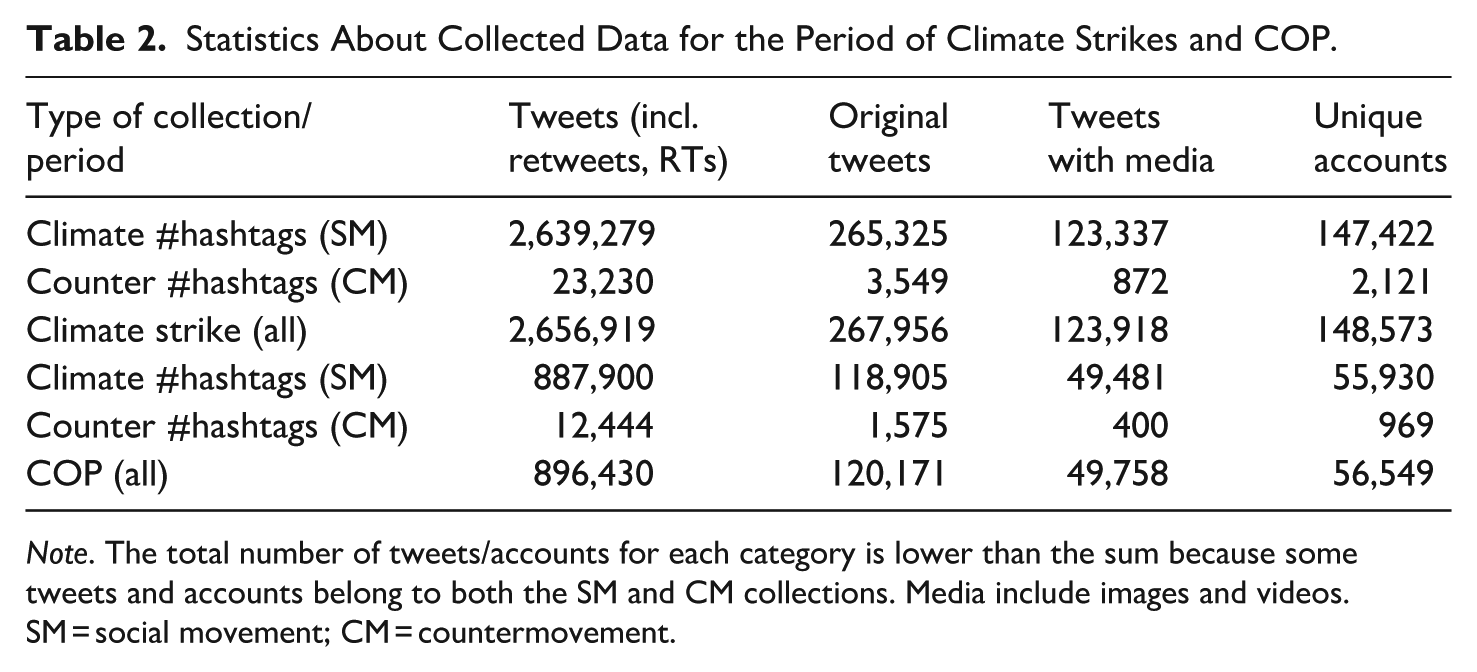
Note. The total number of tweets/accounts for each category is lower than the sum because some tweets and accounts belong to both the SM and CM collections. Media include images and videos. SM = social movement; CM = countermovement.
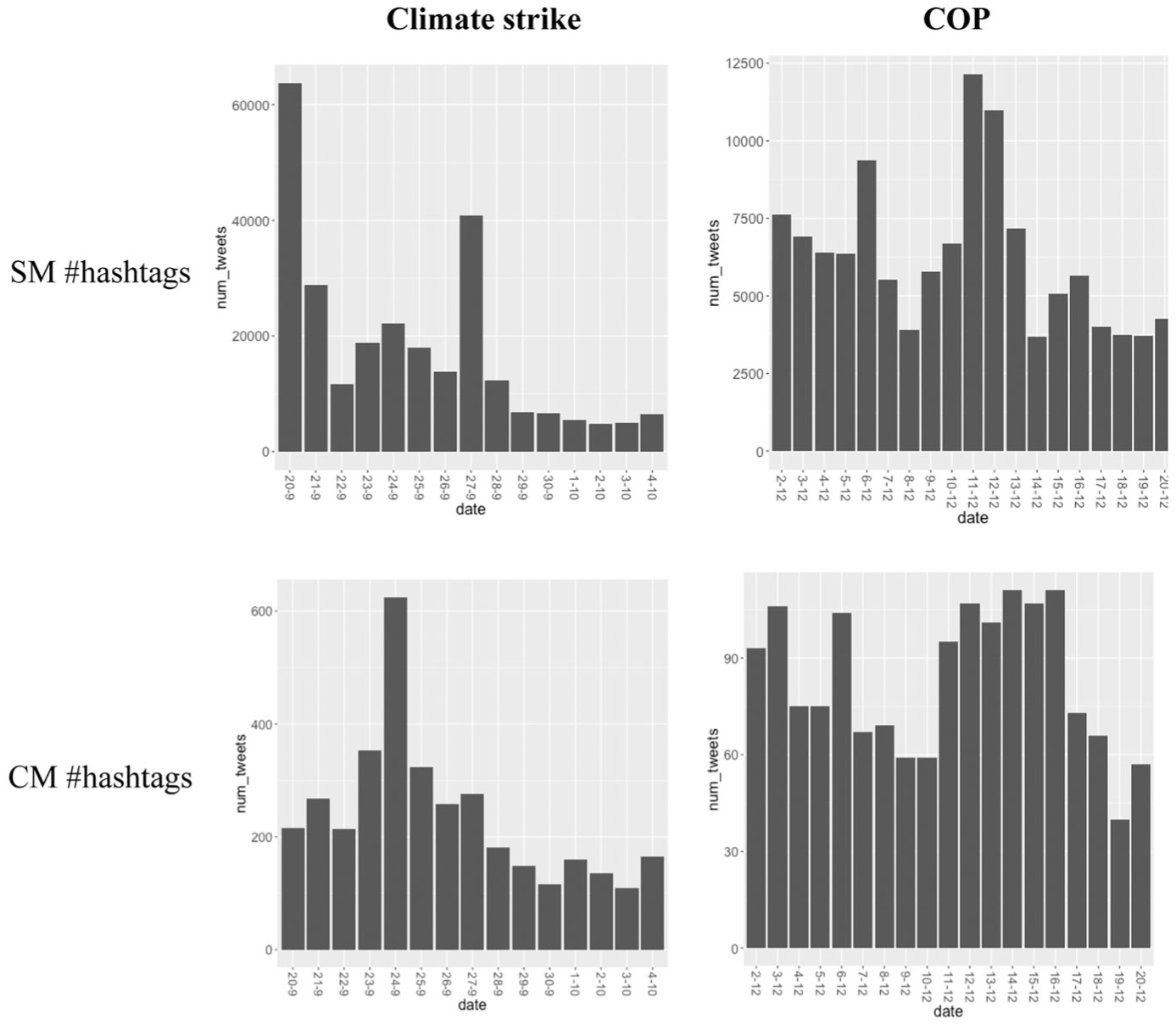
Number of tweets per day (notice the different ranges on the axes).
We examined the verbal and visual content of the selected messages to measure the intensity of the interaction, characterize it as direct/indirect, and detect references to actors, arguments, and actions. We measure the degree of direct interaction by counting the number of retweets, replies, or mentions of the adversary, including the occasions when either side uses the hashtag associated with its opposition or the CM tweets tag Greta Thunberg (via @). Greta Thunberg is considered the “leader” and “icon” of the Fridays for Future movement (Mede & Schroeder, 2024; Wahlström & Uba, 2024), therefore tagging her would be a direct interaction with the climate movement. There is no similarly relevant actor tag for the more heterogeneous network of the countermovement. We measured indirect interaction by counting the number of times SM or CM accounts “talk” about their counterparts. For example, when messages mention “Greta” without using the direct tag (@). We acknowledge that such a measure of indirect interaction only detects occasions when the CM targets the SM and not vice versa.
To detect whether the posts primarily referred to movement actors, arguments, or actions, we used qualitative coding of 20 randomly selected multimodal messages in each cluster (a total of 520 messages). 4 One of the authors performed the coding in this part, and another author validated the consensus. 5 Examining samples of tweets more closely also allowed us to check whether it seemed typical for either side to refer explicitly to the other in visual terms only, in which case our approach of analyzing digital affordances and textual traces could be assumed significantly to underestimate interaction. For ethical reasons, we illustrate our results using only a few quotes that we translated into English from other languages.
Results: There Is Little Interaction, But It Follows the Context
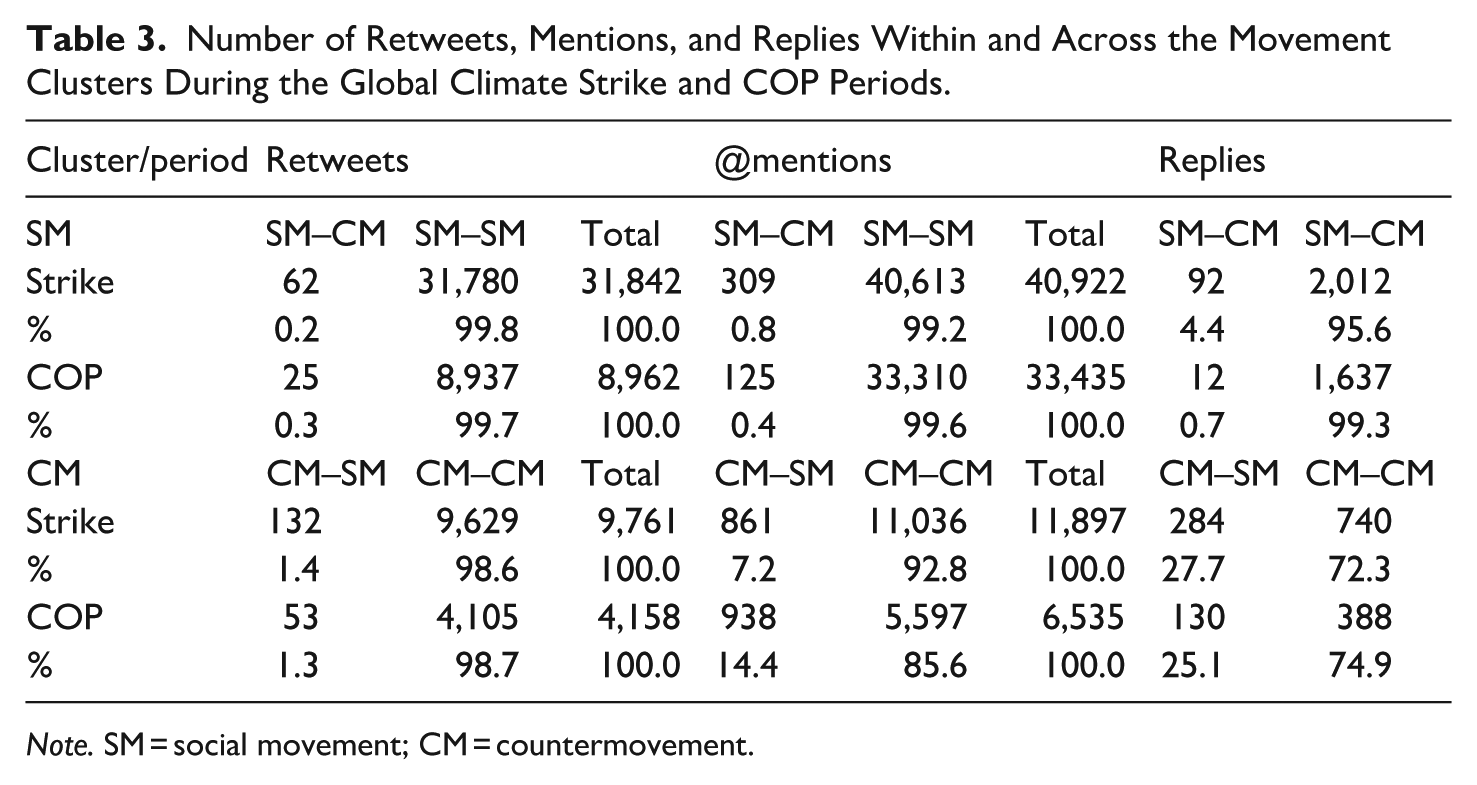
While prior studies have found relatively little counterdemonstration at initial demonstrations, we expected that social media affordances would facilitate and thereby amplify SM–CM interaction in the digital sphere. However, the picture that emerged shows the opposite—out of the about 150,000 tweets (no retweets) produced by accounts in our SM and CM clusters, the proportion of posts where one can detect any direct SM–CM interaction is tiny (2% of all tweets). Table 3 shows that the primary exchange of posts occurs as expected within the movement (SM–SM) or countermovement (CM–CM), and that SM accounts are more active (have more tweets) than the CM. Direct interaction occurs rarely via retweets and most often via replies or @mentions. 6
Number of Retweets, Mentions, and Replies Within and Across the Movement Clusters During the Global Climate Strike and COP Periods.
Note. SM = social movement; CM = countermovement.
Only 1.4% of the retweets posted by the CM actors directly addressed SM actors during the climate strike. Meanwhile, as much as 25.1% of the replies posted by the CM actors during the COP addressed a tweet posted by an SM actor. There is also a clear asymmetry, as CM actors address the climate movement (SM) more than the other way around. Whereas less than 1% of the SM retweets and @mentions directly address CM actors, countermovement accounts in our sample use @mentions to target their adversaries from 7.2% (during the week of climate strikes) to 14.4% of their tweets (during COP). For replies, the contrast is even bigger, confirming the results of prior research, which note how those opposed to climate action tend to be more aggressive towards the climate movement than the other way around (e.g., Effrosynidis et al., 2022; Elgesem & Brüggemann, 2023).
Interestingly, only some of the clusters that we categorized as representing the climate movement (SM) or their adversaries (CM) interact with each other (Supplemental Appendix Tables A2 and A3). In the case of strike data, SM–CM interaction is more frequent in particular between clusters dominated by French, German, or Italian posts. For example, actors in the German-language CM cluster (c1) interacted (via reply) with actors in the German-language SM cluster (c19) with tweets like the following (Google translated from German): “Patrick #Moore, co-founder of #Greenpeace, says that people are being made too afraid (#climate hysteria). Banning the fuel is like a #hoax, the planet has too few #CO2 resources. Quote: Greenpeace is a parasite on people’s backs! #Greta”
7
The post directly addressed specific climate movement actors (e.g., Greenpeace, Greta Thunberg) and their arguments (e.g., banning fossil fuels) in a clear, negative manner. We can only speculate that the SM–CM interaction in the specific language clusters is related to their size and the fact that both sides are more aware of each other here than in the case of the larger and more heterogeneous set of English-language accounts. This is a topic to pursue in future research.
Furthermore, we expected that direct interaction would be more intense during the Global Week for Climate (the strike) than during the COP. As is clear in Table 3, the data do not provide empirical support for this hypothesis. There are no consistent differences in SM–CM interaction during these two time periods. While climate activists target their adversaries via replies more often during the strike, the countermovement actors target the climate movement via @mentions proportionally more often during the COP. We can conclude that either the patterns of SM–CM interaction in the digital sphere do not reflect the intensity that Meyer & Staggenborg (1996) observed regarding clashes in the physical sphere, or else the interaction is indirect and therefore not detected in Table 3.
Our analysis of indirect interaction via counts of “Greta” mentions in tweets that do not tag her via @mention (but may use the #Greta hashtag) demonstrates that the countermovement targets climate movement actors directly as well as indirectly via “Greta” tweets.
8
During the week of the climate strike, the countermovement accounts mentioned “Greta” 4,343 times (20% of their posts) and during the COP week 1,555 (15% of all their posts). At the same time, the climate movement clusters only mentioned “Greta” in their tweets, from 5% (strike) to 3.5% (COP). The following is an example of a much-retweeted post that comes from the above-mentioned countermovement cluster during the Climate Strike (c1) (Google-translated from German): “I will no longer distribute videos or articles by, with and about #Greta #Thunberg. The child is seriously ill and is being abused by power-hungry and evil people or institutions with the consent of his parents. Something like that should be reported and custody withdrawn.”
This tweet clearly focuses on the actor rather than their argument or action and is typical of many of the CM tweets. These results align with prior studies that show the large extent to which climate denialist social media campaigns negatively reference Greta Thunberg (Elgesem & Brüggemann, 2023; Mede & Schroeder, 2024; Vowles & Hultman, 2021b). The pattern—that a more significant proportion of CM posts focus on Greta during the strike than COP—supports our expectations that interaction would be more intense when the SM mobilizes.
Targeting Actors, Arguments, and Actions
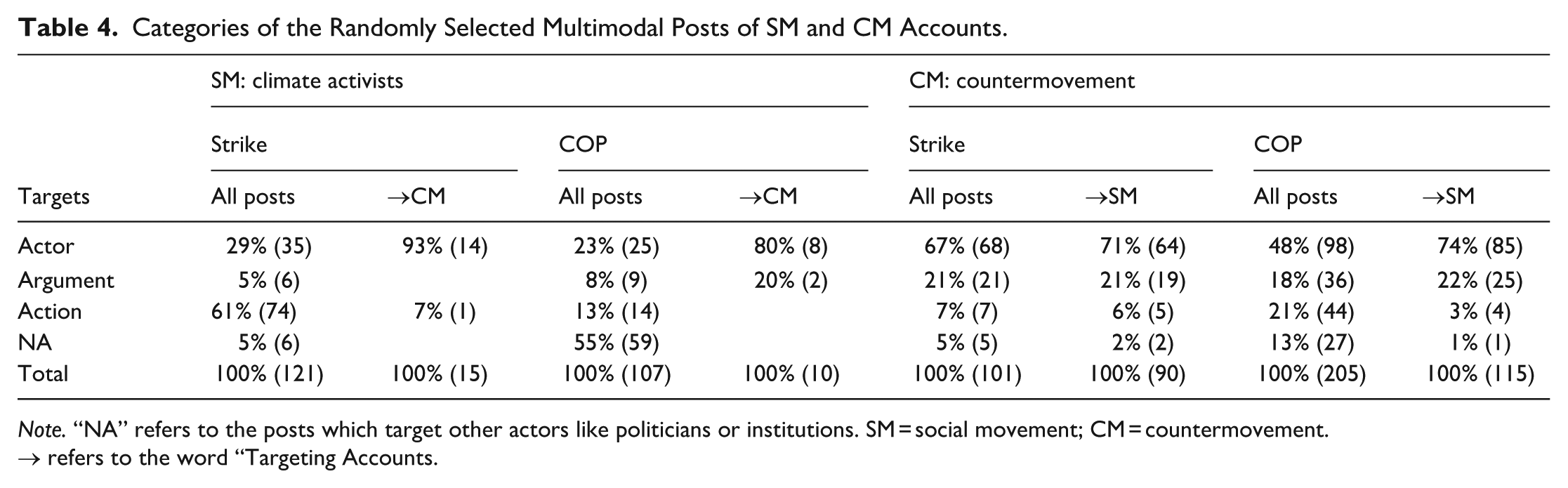
The results of the qualitative content analysis of the selected 500 posts also show little direct or indirect interaction, and, where there is interaction, suggest that this follows an asymmetrical pattern (see Table 4). Most CM posts target the climate movement and its actors, arguments, and actions, while only a small proportion (10%) of climate movement posts target their countermovement. On those occasions when climate movement actors target the countermovement actors, they focus on specific speakers in public events or authors of a social media post. The countermovement, on the other hand, focuses on Greta Thunberg. Almost 60% of the CM’s multimodal posts from the strike period referred to Greta Thunberg in text, and 38% used a photo or drawing of her. The respective numbers for the SM were 24% and 7%.
Categories of the Randomly Selected Multimodal Posts of SM and CM Accounts.
Note. “NA” refers to the posts which target other actors like politicians or institutions. SM = social movement; CM = countermovement.
→ refers to the word “Targeting Accounts.
Content-wise, a typical example of CM accounts targeting the climate movement’s argument can be found in posts referring to the weather (e.g., it is so cold, how can there be global warming) or posts with some variation of the famous “hockey stick” figure (Mann, 2012). SM accounts that target the CM refer to their protest claims or, if targeting the actor, mock the opponent, for example in the form of a cartoon of men eating meat. Messages about action on the movement side were in support of the movement’s own protests. The posts that were mainly about something or someone else (“Not Applicable”), but still coded as targeting the other side, were instances in which the post smeared the other side by association. Some posts made the operative reference only in the attached image—so would not have been caught in our other interaction analyses—but these were in fact very few. Even messages consisting of only a comment, such as “No comment needed,” typically included a clarifying hashtag (e.g., #Greta). In sum, the countermovement posts focused primarily on the actors (Greta) rather than their arguments or actions. The climate movement sometimes took a defensive stand—calling for support for Greta Thunberg or mocking the CM actors and arguments (especially in the Italian and German clusters). However, in keeping with previous studies (Brüggemann et al., 2020; Elgesem & Brüggemann, 2023), the CM is more offensive.
Unlike the interaction analysis based on affordances and references, which showed no significant change between contexts, the analysis of multimodal posts presented in Table 4 reveals a shift: during the strike, movement posts focused on their own protest, while during COP, they shifted to general COP activities (“Not Applicable”). The focus on the movement as a target also lessened in CM posts (from 90% to 50%). Both sides highlighted the hypocrisy of political elites flying to the summit (Falkenberg et al., 2022).
Discussion and Conclusion
This article argues for more precise attention to social media-facilitated interaction between SMs and their CMs. Similar to prior studies that focus on episodes of interaction, such as protests and counterprotests, we consider occasions when movement actors interact online. Hence, instead of observing one side—either the climate movement or its adversaries—and its offline and online mobilization, we contribute by shifting focus to the interaction between these actors in the digital sphere and providing an analytical framework to study it. The analysis of such interaction is important, as this digitally mediated communication reaches a broad audience quickly and is rarely interrupted by the police (as would be the case with the street actions). We emphasize the importance of focusing not only on the intensity of interaction, which in our empirical example is relatively small, but also on the character and targets of these verbal and visual struggles. The direct interaction via retweets, @mentions, and replies will probably have more potential to escalate and polarize the audience than the indirect interaction.
We also argued for categorizing the “interaction” as the targeting of actors, arguments, and actions because this would demonstrate what the adversary perceives as the other side’s weak link or most provocative signal of success. The intense targeting of actors, actions, or their arguments online might also spill over to the movement’s offline actions. In our empirical case, the countermovement targeted climate activists more than vice versa, in particular focusing on the iconic leader figure of the youth climate movement, Greta Thunberg. The asymmetry in aggressive attention to the other side has been observed both in earlier work on online climate communication (Brüggemann et al., 2020; Elgesem & Brüggermann, 2023; Van Eck & Feindt, 2022) and other issues areas (see Meier et al., 2025, this issue). Whether the targeting of specific actors is typical for social media-facilitated movement and countermovement interaction or just for the contemporary climate movement is a question for future research. Similarly, the proposed framework for distinguishing direct and indirect SM–CM interaction could be applied to other movements, and it can also take place across several social media platforms. Scholars can use these distinctions to elaborate theories on how the actors’ characteristics and societal conditions impact the movements’ choice of direct or indirect interaction or how the varying intensity of targeting actors, arguments, or actions impacts the consequences of SM–CM interactions.
Finally, following the prior scholarship on the dynamics of SMs and CMs, we investigated the context dependence of the SM–CM interaction. The two significant events in close temporal proximity, the week of Global Climate Strikes and the COP25 meeting in 2019, provided an excellent opportunity to examine how countermovement reacts to intensified movement mobilization and media attention (the strike) and the general attention to the issue (climate change and climate action) of their shared interest (COP). Interestingly, the extensive analysis of Twitter posts produced by the clusters of climate and countermovement accounts and the multimodal analysis of randomly selected posts did not show a clear expected trend. The direct interaction between the movements at the time of the strike was not significantly more frequent than at the time of COP. The indirect interaction in terms of referring to “Greta,” however, followed the expected trend, and so did the randomly selected posts. Furthermore, the character and content of the interaction changed on both sides between the two periods, as the focus shifted to delegitimizing politicians or actors other than the movement adversary during the COP meeting.
While this study demonstrates the value of analyzing SM–CM interactions in the digital sphere and introduces tools for examining this vast data, it has limitations. First, we focus on interaction rather than its potential causes or consequences, which future research should address. Second, our design and data do not capture interactions between climate activists and opponents before the 2018 wave of climate activism. The conclusion regarding the dynamics of SM–CM interaction should be understood in this context. Third, the study shares common limitations of API-based research, including the partly arbitrary selection of hashtags and reliance on the completeness or representativeness of API results. Additionally, our cluster selection emphasizes distinct groups of accounts, excluding individual SM and CM accounts that retweet each other frequently. Finally, cluster membership is determined through an interactive interface, consistently including central accounts but variably including peripheral ones based on the selection and visualization algorithm. Although the connectivity in the clusters was also tested with the Louvain algorithm, the numerical results should still be interpreted with care (e.g., as high or low interaction levels rather than as precise figures).
This said, the study provides evidence of contextual effects, asymmetrical interaction, and the specific focus on actors rather than their arguments, laying the ground for future theory-building regarding the mobilization and effects of SM–CM interaction online and offline.
Supplemental Material
sj-docx-1-abs-10.1177_00027642251377868 – Supplemental material for Climate Clash: A Multimodal Analysis of Movement–Countermovement Interactions in the Digital Sphere
Supplemental material, sj-docx-1-abs-10.1177_00027642251377868 for Climate Clash: A Multimodal Analysis of Movement–Countermovement Interactions in the Digital Sphere by Katrin Uba, Alexandra Segerberg and Matteo Magnani in American Behavioral Scientist
Footnotes
Acknowledgements
The authors would like to thank the editors of the special issues, two anonymous reviewers, and participants of the session “How Protests and Counterprotests Interact: Mutual Influences and their Context Conditions” during the ECPR Joint Sessions of Workshops, 2023.
Funding
The authors disclosed receipt of the following financial support for the research, authorship, and/or publication of this article: This work was supported by the Swedish Research Council (Grant 2021-02769) and the POLARVIS project, funded by FORTE, the Swedish Research Council for Health, Working Life and Welfare (Grant 2021-01646) under the CHANSE ERA-NET co-fund program, which has received funding from the European Union’s Horizon 2020 Research and Innovation Programme (under Grant Agreement 101004509).
Declaration of Conflicting Interests
The authors declared no potential conflicts of interest with respect to the research, authorship, and/or publication of this article.
Supplemental Material
Supplemental material for this article is available online.
Notes
Author Biographies
 ). His research is centered on social data mining, particularly methods to analyze (multilayer) social networks and (visual) online social communication.