




Abstract
This article localizes the traveling concept of permaculture in Timor-Leste as a pathway into studying the juventude permakultura (permaculture youth) movement, its pedagogies of hope, sensory learning, and emotional mobilization. Focusing on permaculture-based community gardening and water conservation projects in Timor-Leste in relation to projects implemented by the nation’s significant government-NGO nexus opens up anthropological inquiries into various social, political, and ecological phenomena. It contrasts divergent imaginaries of shaping young persons’ selves and futures and taps into issues of food security, environmental awareness, and alternative knowledge construction. Although ongoing research localizes the traveling concept of “permaculture” in Timor-Leste through tracing, exploring, and juxtaposing methodologies, this article focuses on the practice-oriented sensorial pedagogy of permaculture youth camps. It inquires how the eco-social youth movement contests the marginalization of vulnerable communities by acknowledging local knowledge and connecting it with translocal permaculture techniques. More precisely, the article focuses on the sensory and affective dimensions of learning in vulnerable communities and disaster-prone landscapes. It zeroes in on tasting the soil and mobilizing the future as pedagogies of hope and considers these powerful ways of securing (future) livelihood.
Introduction
This long-term research localizes the travelling concept of “permaculture” in Timor-Leste through tracing, exploring, and juxtaposing methodologies. In this article, I zero in on permaculture pedagogy as practice in East Timorese permayouth (juventude permakultura) camps. More precisely, I focus on their affective atmospheres and sensory dimensions of learning. I also explore practices of tasting the soil as an exemplary pedagogic trajectory of contesting vulnerability and crisis in disaster-prone environments. In addition, I define the juventude permakultura camps as an eco-social movement and aim to theorize the movement’s substantial expansion in scale and intensity from an emotion theory perspective.
The article first summarizes the core features of permaculture ethos and practice before zeroing in on its resonance in the young nation-state of Timor-Leste. The article sketches its underlying research methodology after introducing permaculture and Timor-Leste as context. It moves on to scrutinize the following two questions: First, it asks how permaculture is taught and learned in juventude permakultura camps that are organized and held in communities that are exposed to droughts in the “hunger season” and landslides in the wet season. Second, it theorizes why and how permaculture youth camps have become particularly impactful in mobilizing youth across the country to care for their environment and future. To work on these two main questions, I will draw on theories of critical pedagogies of hope, affective atmospheres, and their relationship with sensory learning and emotional mobilization. The article aims to contribute to an ethnographically rooted understanding of learning in eco-social movements that care for soil and society and thrive in contexts of vulnerability. It is an ongoing attempt to highlight alternative and creative eco-social movements at the grassroots level (see also Harcourt et al., 2023) that integrate different formations of knowledge into their pedagogy and practice. It foregrounds critical perspectives on development and progress through fieldwork and ethnography, which I perceive as collaborative action research and affective scholarship (Stodulka, 2017).
Localizing Permaculture: Tracing, Exploring, Juxtaposing
Permaculture is a set of gardening and agricultural design principles centered on whole systems thinking and simulating or directly utilizing the patterns, connections, and resilient features observed in living ecosystems. Permaculture’s globally circulating principles were first articulated by the Australian psychological ecologist Bill Mollison and environmentalist—biologist David Holmgren in 1978. Its 12 core principles group around nature-based self- and other-awareness, the recycling and reuse of naturally existing energies and materials, the downscaling of consumption patterns, waste reduction and collaborative practices, diversity and slowness, the valuing of edges and margins, and embracing technologies of change (Lockyer & Veteto, 2015). To localize the traveling concept of permaculture in Timor-Leste, I have followed three methodological steps: (1) tracing permaculture discursively and historically, (2) exploring communities and contexts in which permaculture has an impact, and (3) juxtaposing these with capital intensive projects governed by international NGOs and governmental proxies in comparable initiatives of sustainable education and environment.
Tracing
Tracing the connectivities and pathways of permaculture to Timor-Leste through a paratext analysis of East Timor’s first permaculture manual, in addition to conversations with permaculture protagonist and pioneer Ego Lemos illuminates how and with whom permaculture traveled to the young nation (see Stodulka, 2020 for detailed description).
Ego Lemos, who is the co-founder of Timor-Leste’s first permaculture NGO Permakultura Timor Lorosa’e (Permatil), co-author of the guidebook, and initiator of the juventude permakultura movement, directly refers to Mollison and Holmgren in the foreword to the Permaculture Guidebook from East Timor (first edition 2006; second edition 2008), as pedagogical founding figures and sources of inspiration. As a translation and adaption to the East-Timorese context, the guidebook is based on a collaboration between local communities, translocal activists and artists—who have illustrated the guidebook—and transnationally operating NGOs, who have co-funded its production (see Figure 1). After a series of reprints in both the Timorese language Tetum and English, which had a significant impact on Timor-Leste’s educational, political, and social sectors, Permatil co-founded a transnational solidarity network of NGOs and permaculture practitioners titled Permatil Global, in 2018. The launch of the network’s website coincided with the international edition of The Tropical Permaculture Guidebook, which comprises three books in both Tetum and English and carries the subtitle “A Gift from Timor-Leste.” Since then, over 120,000 chapters have been downloaded in 160 countries, and extensive international NGOs have utilized the guidebook for various programs, including sustainable agriculture, livelihoods, climate resilience, and health. The National University of Timor-Leste uses the guidebook for teaching sustainable agriculture, and it was also translated and adapted for Indonesia by the IDEP Foundation, who re-published the guidebook in English and Indonesian, with now over 200,000 chapters downloaded. Since its publication, the guidebook has been used in Sri Lanka, Samoa, Nepal, Australia, The Philippines, Solomon Islands, Uganda, and Haiti because there were no tropical permaculture books available at this scale and nowhere near enough literature available for creating sustainable households and communities as well as environmental restoration, especially in so-called low to middle-income countries (LMIC). The guidebook is written and illustrated in genre and style for indigenous and non-indigenous, urban, rural, and remote communities in tropical and subtropical regions. On Permatil Global website, where the books can be downloaded in return for a donation, the not-for-profit collective articulates its global future vision and aspiration as follows: We aim to make permaculture tools and knowledge accessible to everyone across the globe, working with people to strengthen food sovereignty, facilitate environmental regeneration, mitigate climate change, and build resilient and sustainable communities everywhere. We acknowledge that this is an ambitious vision, but to create comprehensive and long-lasting change, we need to think big and do not plan to do it alone (Permatil Global website).
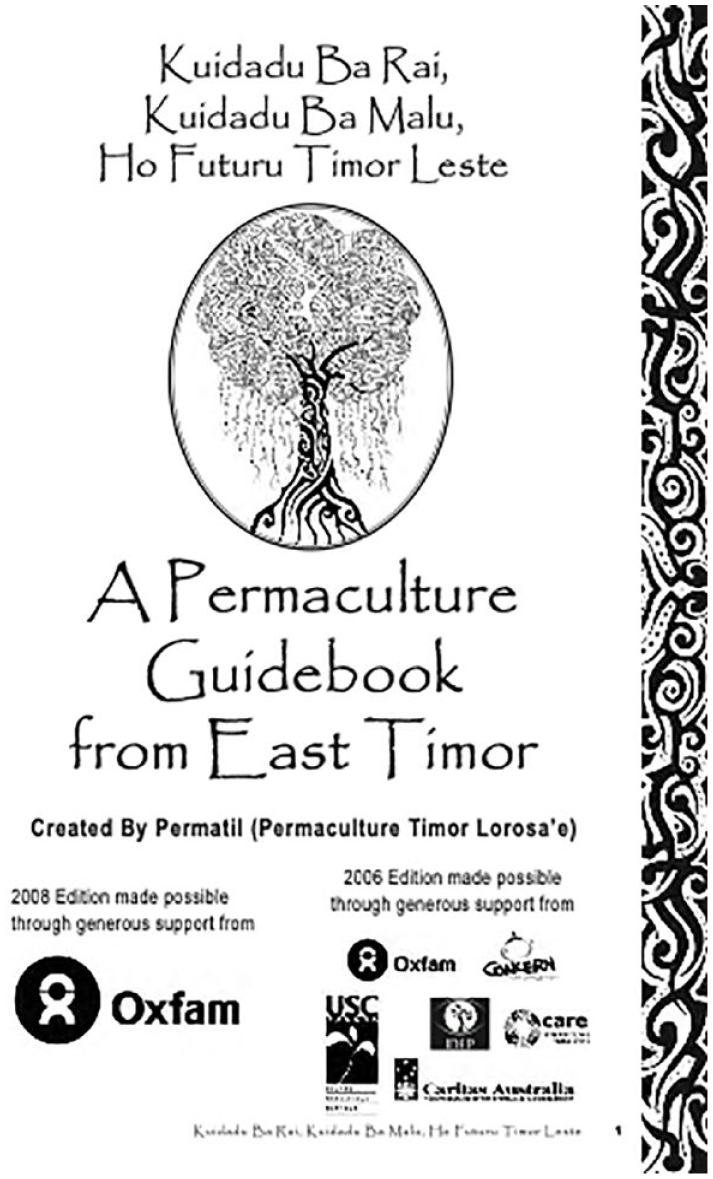
Second edition of Timor-Leste’s first permaculture guidebook (Permatil, 2008).
Although the first two editions of the guidebook were translations of permaculture knowledge from Australia to the Timorese context, the new guidebooks published 10 years later are conceptualized as gifts from Timor-Leste to the world; hence, no longer an adaption of traveling permaculture knowledge but its self-conscious dissemination. Indeed, only 19 years after Permatil’s foundation as an NGO (1999) and 16 years after Timor-Leste’s independence from Indonesia (2002), the small NGO, which comprises only a handful of permanent employees but dozens of educators and volunteers, managed to become a hub for tropical permaculture in Asia and Oceania. In addition to the transnational connections and networks that Permatil has shaped and the many national and international awards bestowed upon its co-founder, Ego Lemos, the permaculture movement started spreading rapidly across Timor-Leste’s 13 administrative districts. Compared to the first permaculture youth camp in 2008, where 400 youth above 17 participated, the fifth camp 2018 hosted over 1,000 youths over 1 week. Moreover, since 2021, youth camps have been organized quarterly instead of biannually, with participants between 400 and 1,500. In 2024, Permatil will also host an international permayouth camp, hosting over a thousand participants worldwide. Today, permaculture knowledge no longer travels to Timor-Leste to localize it there. Permatil has become a global player in disseminating permaculture knowledge and practice across Asia and the Pacific.
Exploring
Next to tracing, I have explored different contexts in which persons and communities were affected by permaculture. So, in addition to tracing permaculture through paratextual and website analyses, interviews, and FGDs with the movement’s protagonists, children, youth, and local village leaders between 2015 and 2019, I participated in juventude permakultura camps in 2022 that I will attend in more detail in the later sections of this article. Over the years, I also learned from water conservation projects in the Aileu, Manatuto, and Atauro Island districts and from interviewing and conversing with participants. I inquired into how permaculture was perceived from different perspectives. Although there has been a wide range of opinions, permaculture is mainly agreed upon as a collaborative practice of learning together (aprende hamutuk) that works together with our land and communities and not against them.
In addition, with interlocutors, I explored permaculture’s demographic and historical resonance with the Timorese context during consecutive collaborative fieldwork engagements and a series of online FGDs during the COVID-19 lockdowns in 2020. Conversations focused on why permaculture community initiatives have such potential to resonate with the geography, demography, history, and political landscapes of contemporary Timor-Leste. Let me share some of the factors we came up with regarding why permaculture continues resonating significantly in the young nation-state.
Timor-Leste gained independence in 2002 after over four centuries of Portuguese colonialism, 24 years of illegal annexation by Indonesia, and an interim civil administration and peacekeeping mission provided by the United Nations (Sakti, 2017). Today, the young nation is home to an estimated population of 1,400,000 people, with the population continually growing. Two drastic drops in population growth in the late 1970s and the late 1990s marked outbreaks of collective violence, starvation, torture, and killings. These relate to Timor-Leste’s colonial past when the Indonesian military and respective-sponsored militias engaged in strategic and structural atrocities against its population (Sakti, 2013). This is important to consider, as some also describe permaculture education in schools and camps as decolonial learning in opposition to the decade-long domination of Indonesian and Portuguese curricula and language (Jaramillo & Carreon, 2014). Hence, school, campus, and youth camp curricula and pedagogy remain subject to Timor-Leste’s ongoing contestation over its colonial history and imagined future (Da Costa Cabral & Martin-Jones, 2017; Hill, 2007). Apart from disputes on language proficiencies and priorities—as to whether Tetum, the vernacular spoken in and around the capital Dili, Portuguese, or even Indonesian were appropriate languages of education (Ogden, 2017), the prospect of permaculture-based school garden curricula, permaculture youth, and community development initiatives also responds to international investors’ initiatives. These continue targeting Timor-Leste’s various economies, ideas of the land, and the country’s transformation concerning large-scale agricultural undertakings, and everyday consumption patterns.
With a mean age of 17.4 years, Timor-Leste is one of the youngest populations in the Asia Pacific region, with 40% of the total population below the age of 14. If compared with the mean age of Germany (47.1 years) or Singapore (34.6 years), the reasons why the articulation of permaculture as ecotopia and rhetoric of Timor-Leste’s future is so prominent in Permatil’s permaculture guidebooks become more comprehensible. Future-driven public discourse also manifests in visions of nation-building and other entrepreneurial projects within the private and state sectors (Kammen, 2009; Bovensiepen & Meitzner Yoder, 2018). Timor-Leste is a young nation with considerable, yet disputed, oil resources and an entrepreneurial class within the government. Therefore, contemporary features of the national development plans (ten Brinke, 2018) include the planning and development of special economic zones giving tax reductions catering to transnational investors and consumers and the rapid development of infrastructures. However, despite Timor-Leste’s rapidly changing infrastructures and aspirational economic megaprojects, it ranks among the highest in the region for maternal mortality rates and malnutrition. This seems paradoxical because Timor-Leste is a largely agrarian economy with approximately 70% of its population living in rural and often hard-to-reach areas, where—aside from few jobs as civil servants including teachers and administrators—small-scale agriculture, horticulture, forestry, and fishing are primary income-generating activities.
Juxtaposing
In addition to tracing permaculture and exploring its resonance in Timor-Leste, we continue juxtaposing permaculture-based initiatives focusing on community gardening and water conservation with projects implemented by international NGOs and their governmental proxies. We anticipate that these three methodological steps continue opening up anthropological inquiries into a variety of phenomena, such as contrasting the shaping of young persons’ selves, personhoods, and citizenship, issues of planetary health, nutrition, and well-being, or ways of (un-)learning and contesting normative gender roles in customary socialites. Although this comparative ethnographic perspective remains the broader context of this ongoing research collaboration with activists, artists, youth, teachers, and local administrators, this article focuses on how embedded modes of permaculture are taught and learned in youth camps. The subsequent sections aim to illustrate how the youth movement merges locally rooted environmental knowledge with permaculture’s ethos by amplifying the role of sensing and feeling as agricultural skills. Such sensory and affective dimensions of learning became particularly apparent when juxtaposed with more conventional forms of skilling and learning in comparably short-term, bureaucracy-driven, and capital-intensive initiatives that promote and aspire to social, cultural, and ecological sustainability.
Permayouth Camps: Atmospheres, Senses, and Pedagogies of Hope
When tracing, exploring, and juxtaposing pathways of permaculture, it seems fair to say that permaculture initiatives thrive mainly at societies’ margins and resonate with considerably vulnerable rural communities and landscapes. In Timor-Leste, the juventude permakultura movement has grown exponentially in number and influence in Timorese society, especially in the aftermath of COVID-19 regimes, highlighting the importance of localized self-sufficiency and food security. The eco-social movement is coordinated by the staff and hundreds of volunteers of the local NGO Permatil, who have also pioneered the trailblazing of permaculture-based national school curricula over the last decade (Stodulka, 2020). They invite youth groups or representatives of youth groups and clubs, including teachers and village heads aged 17 and above, to join permayouth camps organized in their district. Permatil’s shifted priorities from creating school gardens to community gardening and water conservation responded to political change in the government, which halted the permaculture-based school curriculum in 2021 (only to take it up again in 2023), and environmental crises. The latter manifested as landslides and mudslides in the wet season and existential droughts in the dry season, resulting in intercommunity conflicts over access to water. In the subsequent sections, I describe the design of the traveling permaculture youth camps through text and photography and illustrate the relationship between atmospheres and sensory experiences. The combined writing and visualizing genre aims to highlight the affective dimension of camp structure and experience. It is followed by a case study on sensory learning that foregrounds tasting as an essential skill in creating fertile community gardens that provide food for villages and neighborhoods in the wet and dry seasons. I argue that the permayouth camps create an affective atmosphere encouraging sensory learning and emotionally mobilizing vulnerable and marginalized communities through “pedagogies of hope.”
Permaculture Pathways and Affective Scholarship
As we drove up to one of the quarterly organized traveling permaculture youth camps in Labubu, Manatuto, a rough 4-hour ride from the capital Dili in a four-wheel drive pick-up, Ego Lemos, key interlocutor, and research partner, stressed: “People lost faith and trust in the government to solve their problems. The whole country, the government, and the communities got used to being helped by someone instead of helping themselves. The whole country has been made dependent upon international aid. Almost every project is titled ba futuru (‘for/toward the future’), yet our children will have none if we continue like this. The government spends millions of dollars to create monuments like this one all across the country.”
He points to a grayish concrete structure with a dried-up faucet at the side of the road (see Figure 2).
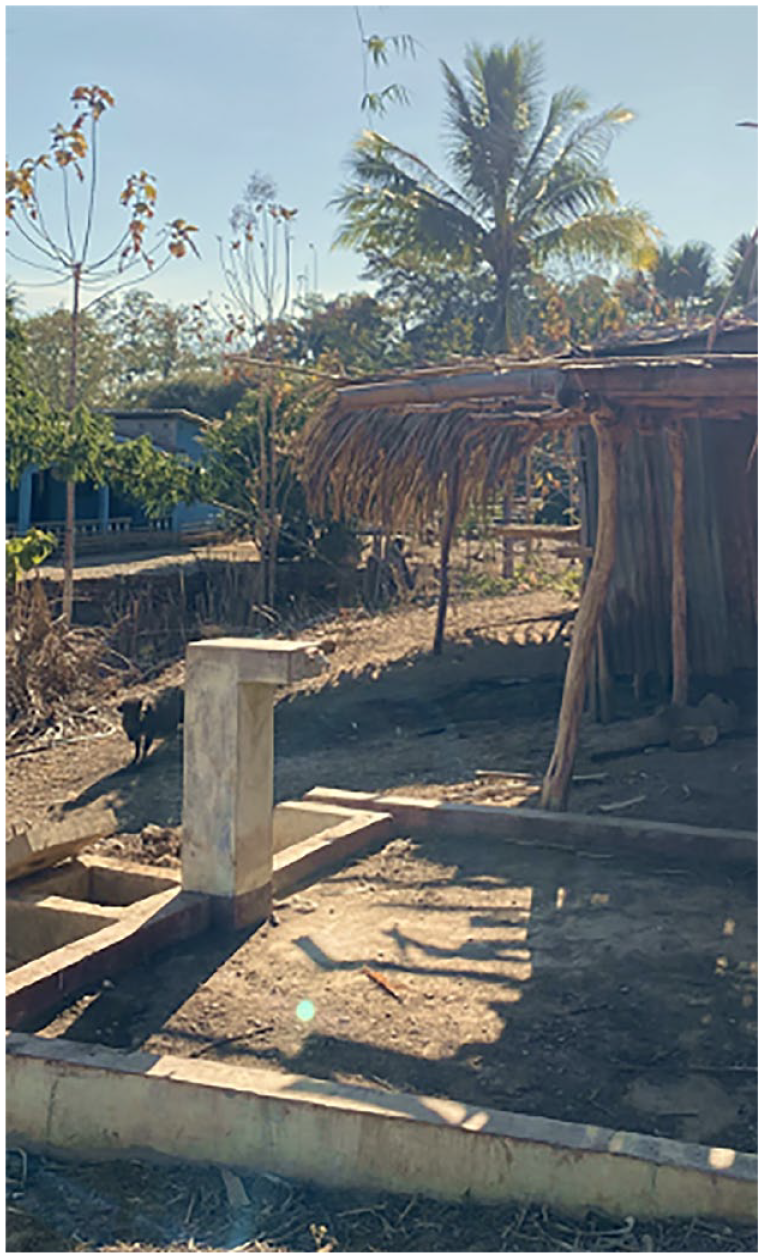
“Monument”: Dry faucet.
“We call them monuments because they have no other function than to remind us of another failed megaproject,” he then honks at a passing cross-country motorcycle—the first that passes us in 2 hours on our bumpy ride on the washed-out dirt road up and down the hills spreading into the dried-up and dusty countryside (Figure 3).
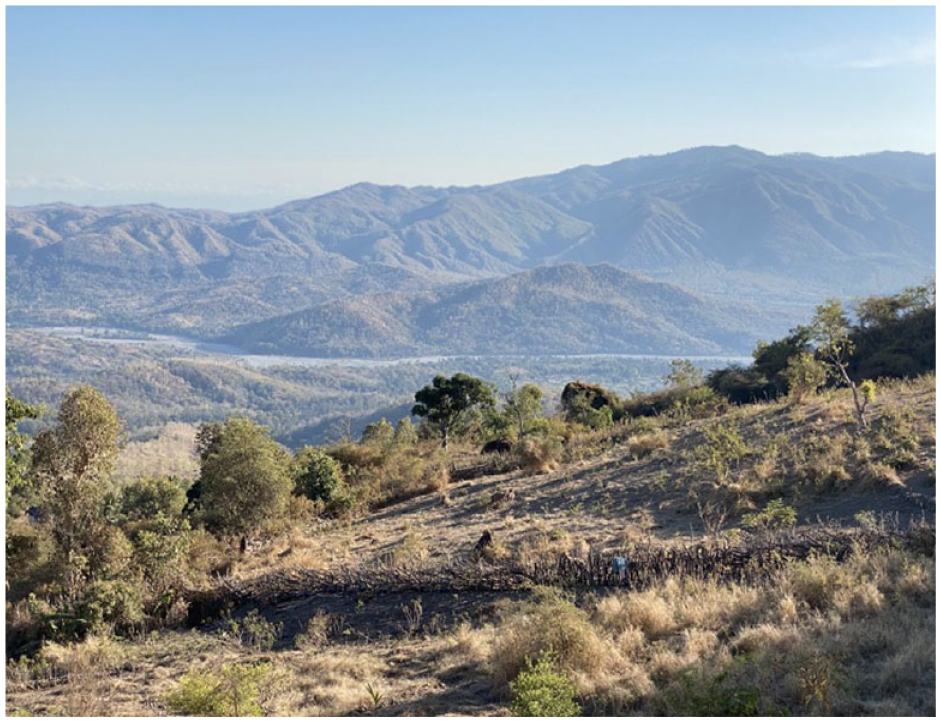
The hills of Manatuto and Aileu districts in the dry “hunger” season.
Critical perspectives on hegemonic collations of international aid organizations and governmental departments were common among researchers and activists. Since Permatil itself also collaborates with the Department of Youth and Sports, respective district administrations and village leaders, their transnational branch Permatil Global, the French and Japanese Embassies to Timor-Leste, and a handful of small international organizations, the critique is not directed at relatively common collaborations of the NGO–government nexus per se. Activists and government advisors are concerned with the estimate that most collaborations are based on overly Eurocentric postcolonial assumptions and mindsets and do not integrate local knowledge or decolonial perspectives into their project-driven agendas. East Timorese permaculture practitioners regard such practices as neocolonial undertakings that create more economic dependencies than sustainable knowledge among targeted vulnerable communities. When juxtaposing the dried-up faucets, ruptured and demolished concrete water channels at the side of gravel roads, built, abandoned, and never used airports, segments of asphalted highways on steep mountain slopes that turn into raging water streams in the rainy season, and parched residues of deserted monoculture fields with slowly recovering water sources, trees, and community gardens resulting from permaculture initiatives, I was reminded of the limits of disembodied understanding and plotting from a distance (Figure 4).
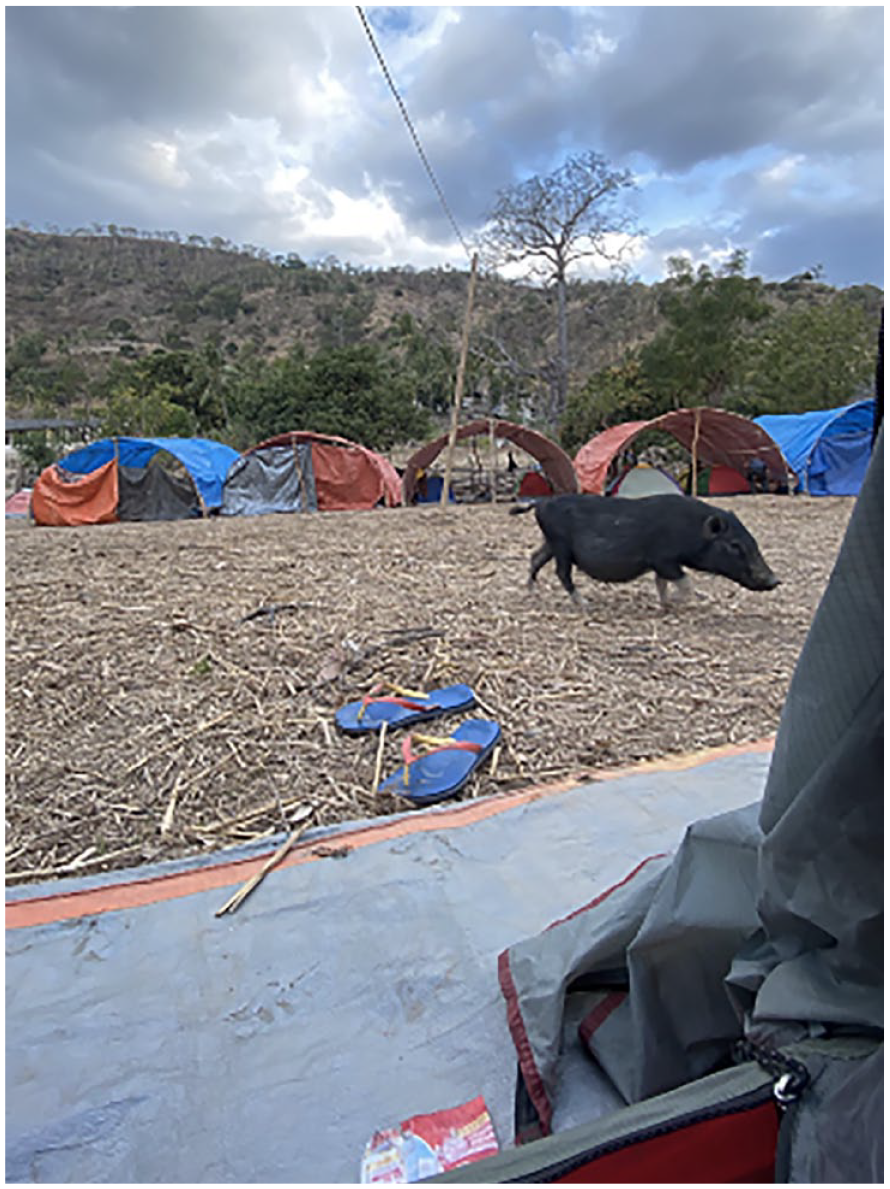
Pig and tent.
Although this article is not interested in criticizing well-intended (non-)governmental policy and practice from the safe distance of academic writing, I nevertheless intend to underline the significance of in-situ fieldwork and co-habitation in both ethnographic knowledge construction and (non-)governmental project planning and implementation. I am aware of colonialist notions, ethical conundrums, the murky business of knowledge extractivism, and the privilege that comes with fieldwork (Bexley & Nygaard-Christensen, 2017; Stodulka, 2021). However, this potentially colonialist minefield can be a powerful source of mutual learning and understanding if navigated with an action-oriented, long-term, and group-based collaborative ethos and practice. In addition, critically reflecting on the researcher’s positionality and bias regarding affective and moral projection is vital to both anthropological and (non-)governmental knowledge construction and implementation.
Expanding on what has been dubbed “affective scholarship” (Stodulka et al., 2019), I try to take the embodied, sensorial, and emotional dimensions of fieldwork encounters with persons, animals, and environments seriously as ethnographic data. For me, there is no other way of grasping a phenomenon intellectually if not immersing into the lifeworlds I intend to learn with. Affective scholarship systematically explores ethnographers’ relational engagements with interlocutors, the practices studied, and the things and places encountered. It compels the researcher to pay due methodological attention to affects and emotion, document them during fieldwork, and consistently use them as ethnographic data during analysis and writing. Affective scholarship also recognizes the affective force that emerges from the diverse encounters between humans and humans and the nonhuman (Smith & Tucker, 2015). This does not only count for social interactionist research, as posthumanist scholars have reminded us (Ingold, 2000). In highlighting senses as significant generators of affect, I find Low’s (2023) approach helpful, accentuating that sensory phenomena can best be studied through narrative analysis and embodied sensory awareness. Extending affective scholarship through a methodological focus on sensory learning, I have concentrated on documenting both affective and sensory experiences during fieldwork in previously established emotion diaries (Stodulka et al., 2018) (Figure 5).
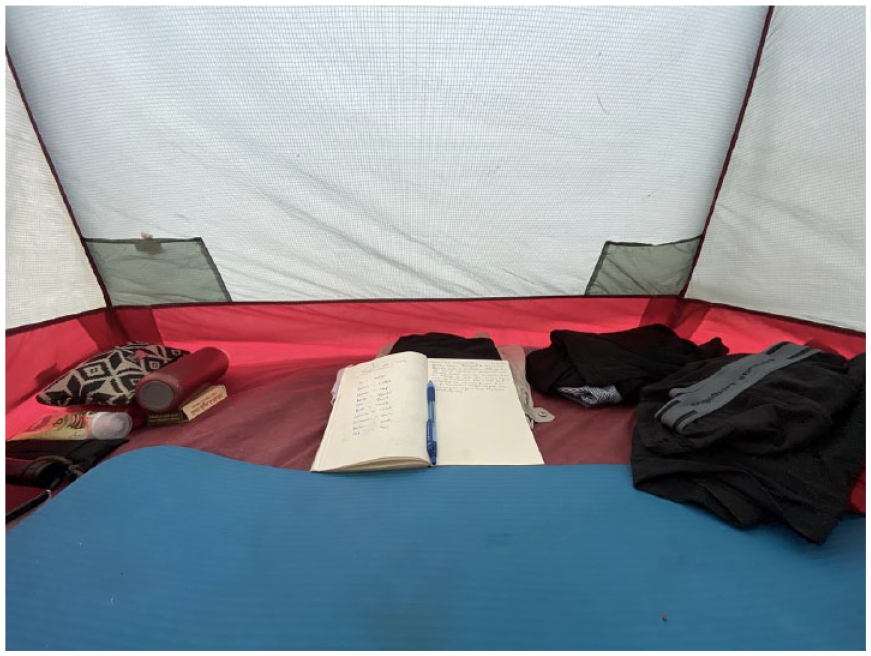
Tent and emotion diary.
Herein, I have aimed to describe the permayouth camp’s atmosphere and integrated a focus on my own and other’s descriptions of tactile, olfactory, and tasting experiences while learning permaculture practice. In order to grasp visual and auditory impressions, I have taken photographs, audio-recorded omnipresent songs, and joking oratories during work at the community gardens, which we later discussed and laughed about together. Ego Lemos, the many at least trilingual permaculture educators, and James Palmer (the other “malae” or foreigner among the 400 participants), an overseas volunteer and alternative community development scholar working at Permatil at the time, were tremendously helpful in translating Tetum language context that I often lacked into English or Indonesian.
Camp Design
After arriving at the campsite the afternoon before the official opening ceremony the following day, I set up my tent on a dried-up lawn assigned to male participants. The large lot was located right next to the diesel generator (which should keep me up many hours after dark for the following seven nights) and between the kitchen, the eating and learning area, and the washing and toilet facilities. The latter were all made of local bamboo and thatched roofs; no other materials were used (Figure 6).
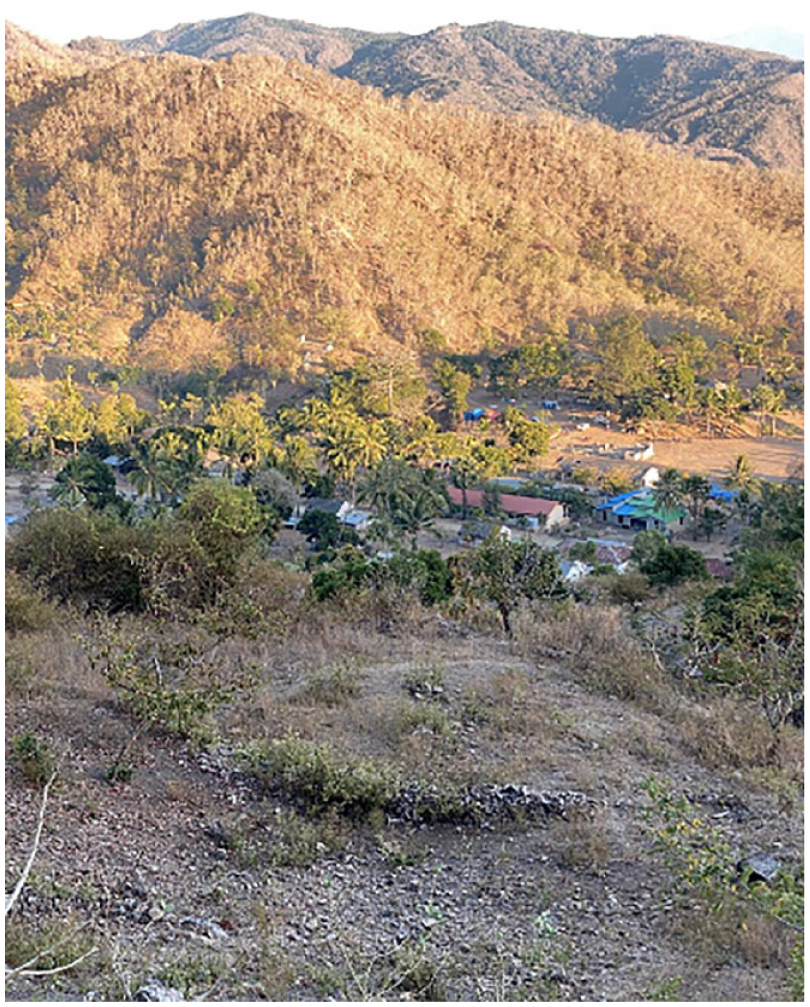
Overview of the village, tents of male participants in the background.
The opening ceremony the next day was held near the ancestral tree of the village when the village elders and youth performed welcome rituals for Permatil, the national minister of youth and sports, and the Japanese and French ambassadors to Timor-Leste and their entourages through dance, song, and customary speech (Figure 7).
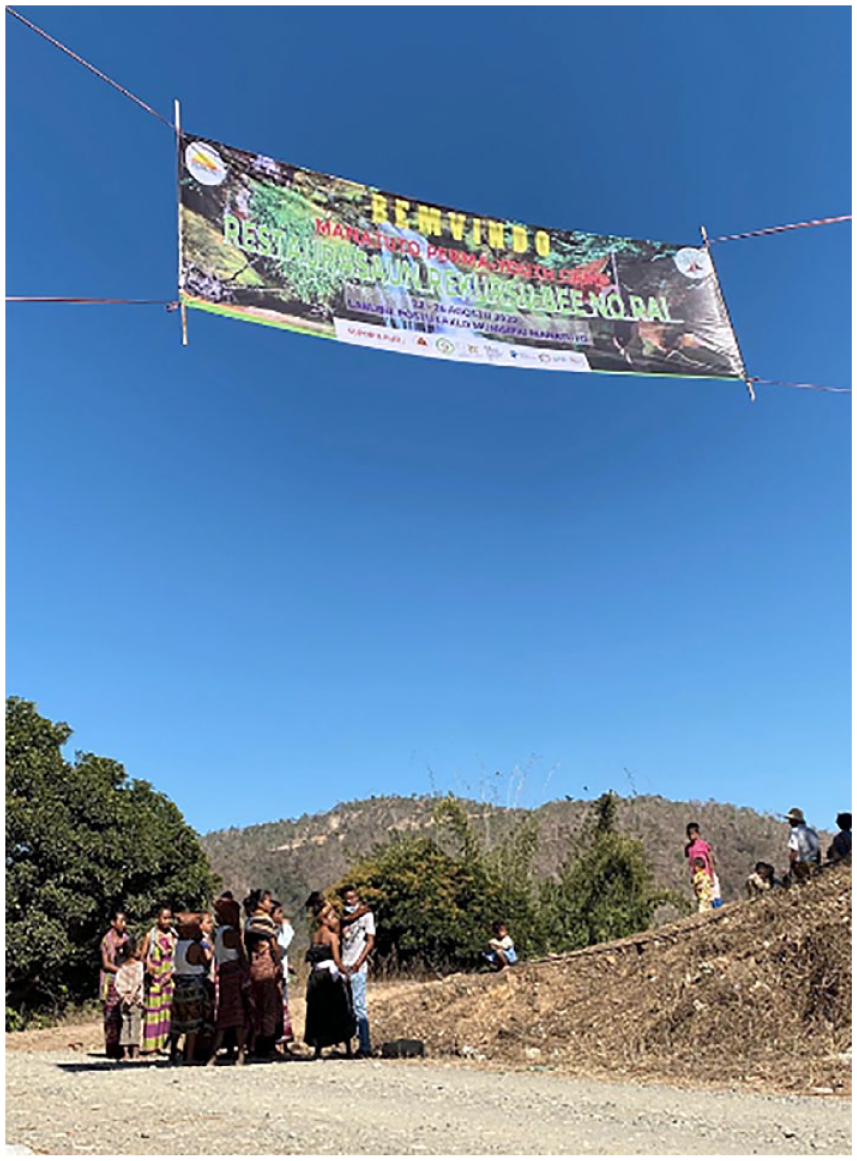
Welcome banner and preparing the welcome ritual.
After the honorary guests were welcomed, they were invited to the ancestral tree to sit and chew betelnut leaves with the male village elders. The village residents and the participants, mostly from neighboring villages and subdistricts and sometimes walked for many hours to participate in the youth camp, proceeded to the football field, where the co-organizers, local and district chiefs, ministers, and ambassadors held speeches. During the following nights, famous artists who drove up from Dili and back gave concerts and invited participants to sing along to popular songs previously known to us only via social media (Figure 8).
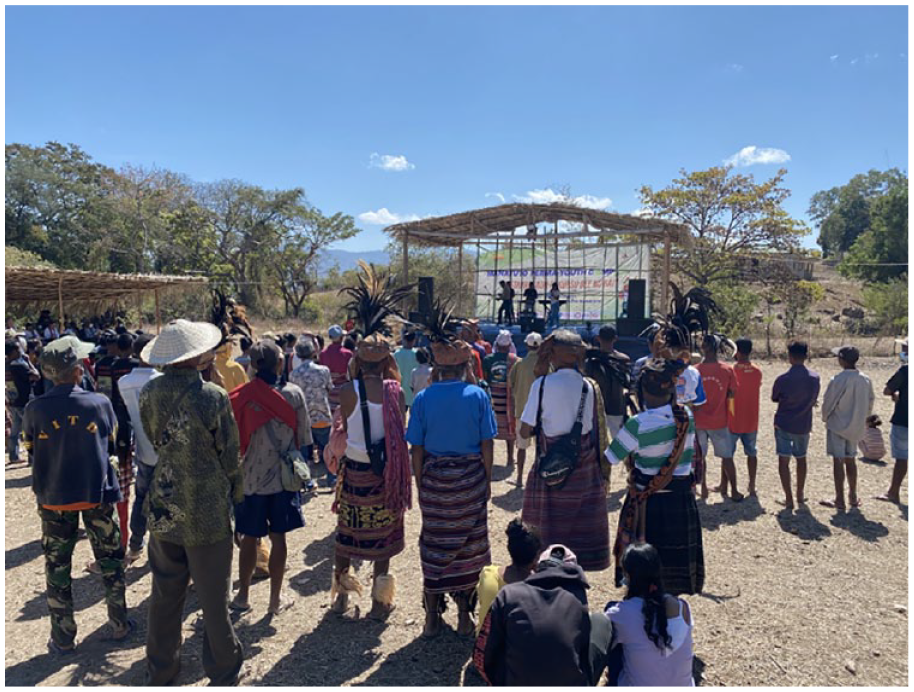
Opening ceremony at the bamboo stage, shelter for honorary guests on the left.
Where learning, working, and eating together was of primary concern during the hot days, dance, karaoke, speeches, and jokes at the bamboo stage filled the cold evenings. Residents and guests cheered for national celebrities, such as Mana Cidalia Goncalves, Maun Izo Pereira, and also Ego Lemos, prominent volunteers and educators of the permaculture youth movement. The latter three also wrote and composed the juventude permakultura hymn. This uplifting march-like song was played loudly over the stage speakers every morning at 7 a.m. to invite the participants and learners for breakfast at the long bamboo tables: Take care of nature/Take care of each other/Take care of the future of our land/Permaculture Youth/Permaculture Youth/Together we learn/For our environment/Together we learn/Long live Timor-Leste.
Tasting as Skilling
After 5 days of learning how to look for adequate lots of soil and building soon-to-be fertile community gardens, the participants of the learning group titled “terraced gardens” (the other two groups were “community school gardens and nutrition” and “water conservation”) went for their final check as to whether the knowledge taught “from heart to heart” in open air classes under two trees and through humorous hands-on sessions had already seeped in. Today’s task was to taste the dry earth and thus assess its pH value via our taste buds on the tongue (Figure 9).
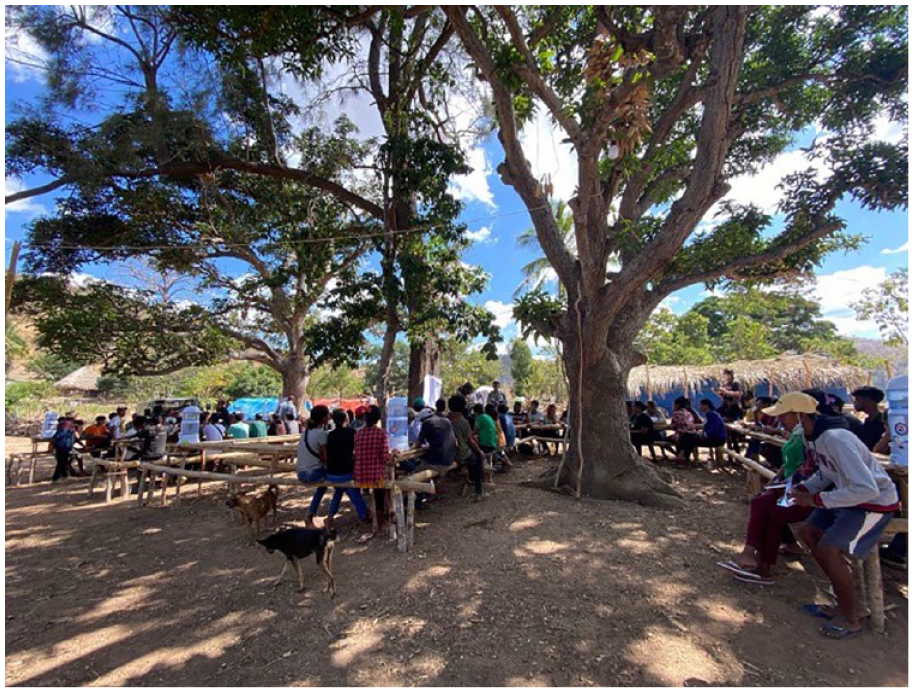
Learning together under trees on bamboo constructions, kitchen and tents in the back.
Before digging the soil and building more terraces as community gardens and protection from mudslides at the steep hills, Amanu, a volunteer and educator, asked the 20 participants of the group to taste the soil first in order to check whether the following tasks of digging, mulching, and planting seeds would stand a chance to create future fertile gardens. Since no one volunteered, Amanu approached me, took me by the arm, and asked me to taste the soil. I had failed the days before, so the scene for failure, slapstick, and gentle mocking would be set. I played my part—and got it wrong again. By contrast, most young women and men tasted, touched, and sensed the soil right. It was “too gravely,” “too sour,” and looked “too gray,” so we had to look for another lot, some 30 m uphill, where it felt, tasted, and looked “just right.” From a sensory perspective, participants narrated “just right” as a composition of the soil’s texture, assessed visually and by a sense of touch and taste.
Three hours later, after the whole group gouged out two terraces, which included digging, measuring, and mulching the beet with dry weeds, we sat under the only remaining shade-giving tree to take a break. Amanu joked about how slow we were but praised us for how promising our efforts were if we kept practicing and implementing the learned skills of looking at, touching, and tasting the dry earth once we returned to our home communities. As long as we continued collecting soil from different lots in used and transparent plastic water bottles and kept learning to compare them in terms of color, grades of sourness, and granular composition, “no one will ever have to be hungry again.” He then closed his speech with a short yet fervent reminder that stuck with me: “And remember, your head is in Timor-Leste, your heart is in Timor-Leste, but your stomach is in Vietnam!” (Figure 10).
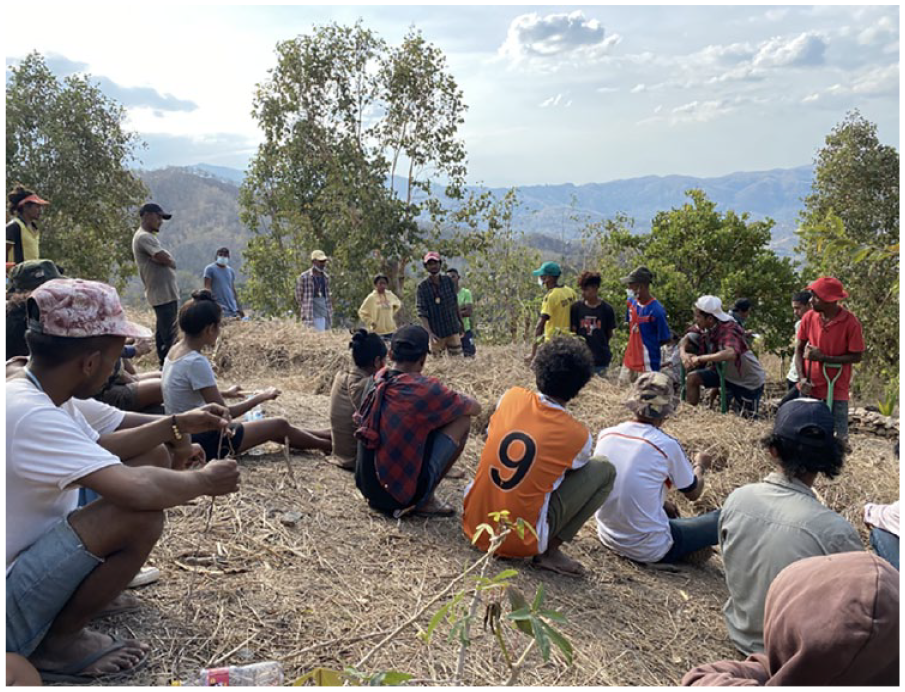
Learning together: Tasting the soil and raising eco-political awareness while building terraced gardens.
When a young high school teacher from the district capital asked, “What is wrong with Vietnam?” Amanu explained that “nothing, of course, but even if ‘we’ tried our hardest to finally become independent from Portugal, Indonesia, and international companies, we will never really be, if our food is not secured, if we cannot provide for ourselves! If our stomachs cannot be filled with healthy food! Remember that!”
Rooting Pedagogies of Hope
Although staff and volunteer educators never openly drew on Freirean critical pedagogy as a conceptual way of teaching permaculture-based water conservation and gardening techniques to vulnerable communities aside from its sensory practice, its political ethos and rhetoric, when learning together, fundamentally resembled its core values (Freire 1970/2017). In permaculture youth camps, the trained volunteers invited participants to overcome formal schooling arrangements deeply rooted in colonial pedagogy of repetition and reproductive obedience. Through hands-on teaching and learning by using their bodies and senses and inviting learners to follow their example, the educators invested in hope in a non-idealistic but ontological and tangible manner, acting in the world to transform oppressive conditions, expanding possibilities for social and environmental justice through food security and emancipation. One key to achieving a conversational and embodied way of learning from each other is aimed at what Freire (1992) describes as “opening up to the thinking of others” (p. 110). To the ethnographer interested in pedagogies, the way of teaching and learning together through “less talking and more doing” permayouth camp pedagogy reminded of an “invitation to build from change that begins in ourselves—‘ourselves’ in a collective rather than an individualizing sense, since for Freire, as unfinished beings we cannot be without others; a change both in the ways we relate and build knowledge with others instead of about others” (Torres-Olave, 2021, p. 1).
Hope emerged through comprehensive and inclusive language that uses the body and the senses to communicate and describe permaculture principles. Instead of language and concept-heavy pedagogy, educators integrated local procedures of water conservation, gardening, and horticulture into their embodied teaching style, which primarily and ultimately served only one purpose: the pursuit of previously and collectively identified goals of reestablishing food and water security and reviving customary sociality. The poster attached to one of the three central trees (Figure 11), whose shade provided space for outdoor classes, exemplifies permayouth’s aspiration of inclusive communication using a famous proverb, often used in critical pedagogy endeavors, and highlights the focus on collaborative, sensory, and embodied learning. When a community development lecturer provocatively asked Ego Lemos whether he thought farmers would understand the complex language of permaculture guidebooks during his Ramon Magsaysay Award Ceremony in Manila, The Philippines, in November 2023, he answered, “We do not teach with books. The message is simple: grow what you eat, and eat what you grow.”
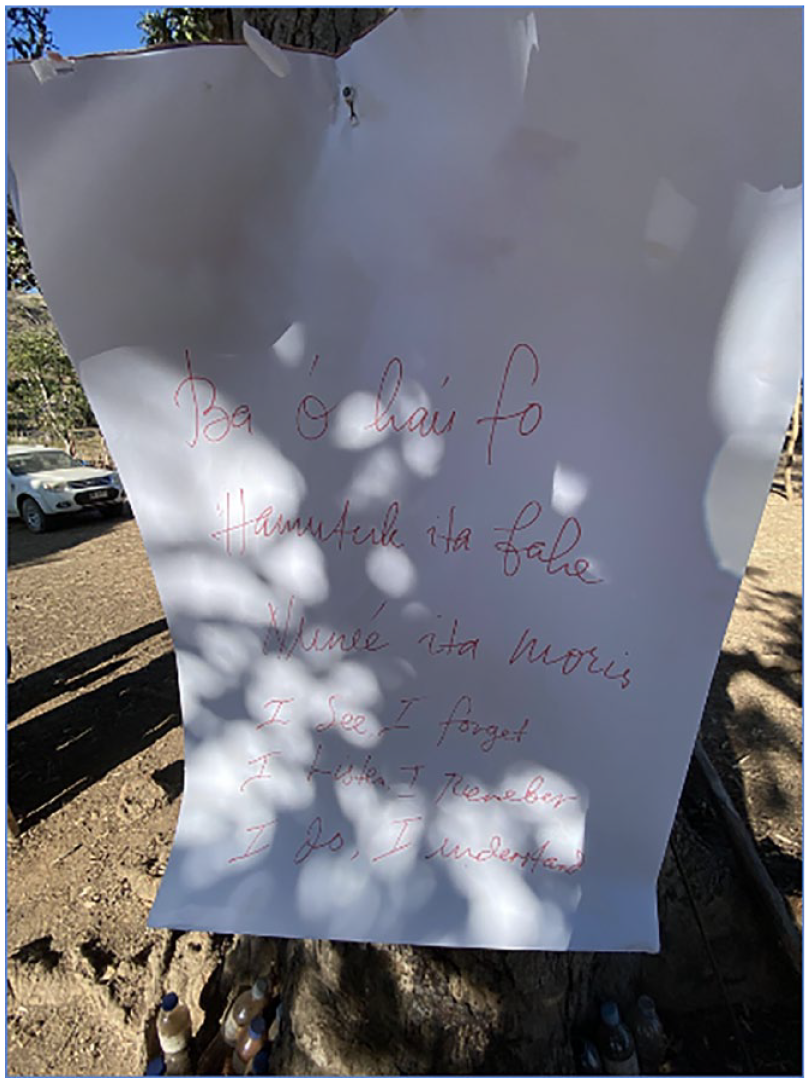
Learning together: “From you I receive, to you I give, together we share, so we live. I see, I forget/I listen, I remember/I do, I understand.”
Such integrated pedagogy that recognizes local knowledges and feeds on translocal permaculture guidelines, invites sensory and embodied intersubjectivity as practical tools for learning together. In addition, hope arises from empirical evidence. Wherever collaborative and consensual permaculture initiatives were applied and pursued longer-term, either as community projects or disaster relief endeavors, formerly dried-up water sources revived, ancestral trees saved from dying, and trees, plants, fish, birds, and insects started returning in their own “slow” pace.
Relating the practice-oriented and embodied ways of learning to theories of pedagogy, permaculture teaching resembled the core themes of Freire’s (1992) Pedagogies of Hope, where he writes that “there is no change without dreams, as there is no dream without hope” (p. 81). We find similar themes of relating hope to praxis in the writing of hooks (2003), where she sees a successful pedagogy of hope built on students’ and teachers’ interactions in an anti-oppressive form that encourages reflexivity, dialog, and criticality.
Permaculture educators in the youth camps demonstrate that hope must be grounded in practice. They encourage an approach to learning that is forward-thinking, posing questions and ideas for the future, but at the same time relates to fundamental issues of the time. Bourn (2021) reminds us that such hopeful approaches have potential limitations regarding scale and influence. Le Grange (2011) notes the dangers of hope becoming merely a political slogan that is easy to advertise and with which few could disagree. He notes further that a pedagogy of hope must be grounded within people’s lives, not part of some corporate or political agenda. To ground permaculture pedagogy and hope for the future in the lives of both participants and host communities, permaculture youth camp coordinators and educators took the concerns of local communities seriously and worked toward jointly defined aims and targets of the 7-day event. After villages who are exposed to ongoing crises and sudden disasters requested Permatil’s assistance through either community projects or permaculture youth camps through village heads, district administrators, or inhabitants who were familiar with Permatil’s work, a Permatil delegation traveled to the area and met with community representatives. Permatil then applied for funding from governmental and non-governmental organizations if the parties agreed to host a youth camp. Depending on the number of participants and the size of the camp, between five and ten Permatil volunteers and educators stayed in the village, where they slept in tents for 1 month and built the above-described bamboo structures with residents (Figure 12).
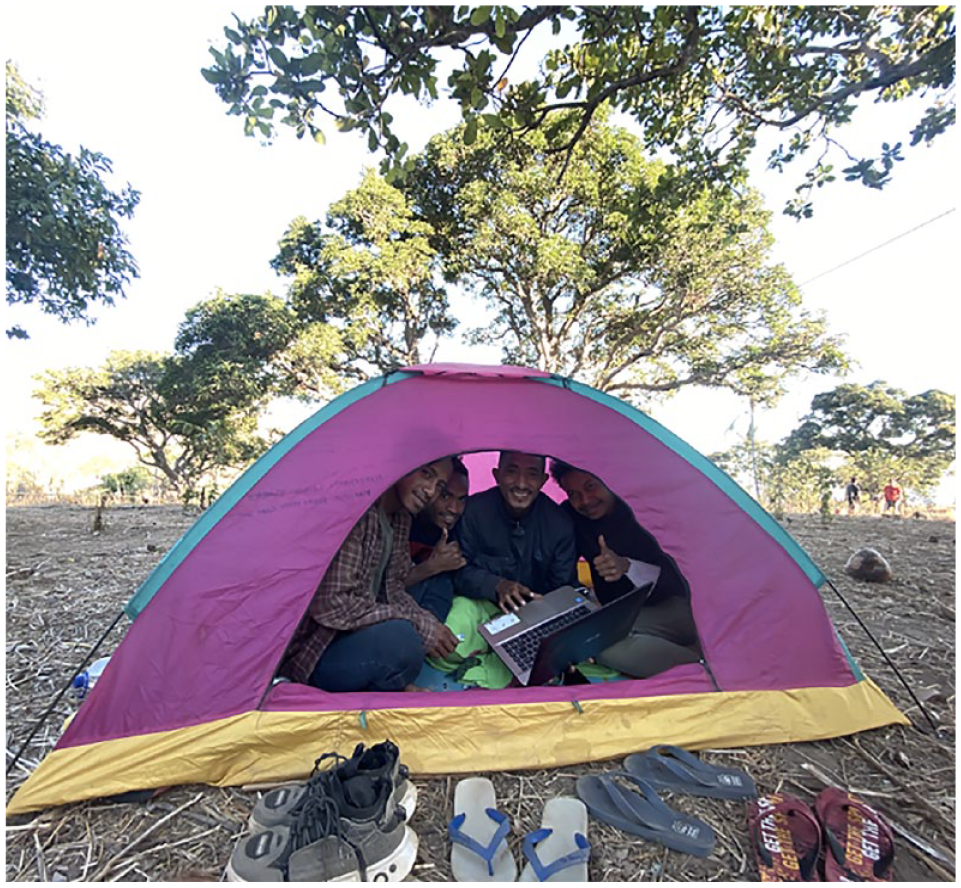
Volunteers preparing the camp together.
The building of the infrastructure was accompanied by conversations on livelihood, education, and the challenges and hardships of living in conditions of crisis and vulnerability. Local hosts accompanied Permatil volunteers to sites of concern, like dried-up wells, withered gardens, or destroyed houses, to jointly work on permaculture-based endeavors and turn places of concern into sites of potential. Because the villages and contexts of crisis were different in each site, the volunteers learned from the communities how they had dealt with similar crises in the past and then jointly worked toward solutions inspired by permaculture practice. Hence, the teaching focus and pedagogy during the youth camps were not based on standardized tools and contents but on the principle of learning together for a future goal. In Labubu, for example, existential issues were at stake. After a mudslide destroyed more than half of the village’s houses in 2021, the district administration ordered the whole village to a distant subdistrict, except the village managed to recover from the disaster on their terms and revive the land and customary sociality. This would have meant losing ancestral trees, wells, houses, and spirits that have guarded the community for centuries. Where there was desperation before the collaboration with permayouth, hope for renewed soils and water sources and revived customary sociality emerged. Hope was not prescribed as a political trajectory but sustained through shared practice and concern resulting from long-term conversation, empathetic listening, collaboration when preparing for the 1-week youth camp, and a teaching style during the permayouth camp manifesting in mutual recognition, sensory skilling, and embodied learning.
Mobilizing Atmospheres of Aspirational Futures
This final section revisits the learning atmosphere during the 7 days at the youth camp. Although I have briefly sketched the atmosphere during the opening ceremonies, evenings, and learning sessions above through description and photographs, I now theorize the camp atmosphere from an affective perspective. In order to learn from each other and apply acquired permaculture knowledge back home, participants needed to be mobilized sensibly and affectively to stay committed to creating sustainable impact for their communities’ future. Eco-social movement mobilization can be theorized from a variety of perspectives. I focus on the structural, practical, and affective dimensions of creating sustainable learning atmospheres to understand the significant spreading of permaculture beyond youth camps on a larger social and political scale. My argument is that to spread beyond the temporal and local boundaries of the permayouth camps and to impact social lives, hope needs affective atmospheres to emerge, atmospheres, and fellow feelings that mobilize persons and communities to sustain the potentialities of imagining aspirational futures together. Corresponding to definitions of aspirations themselves (Appadurai, 2004; Bryant & Knight, 2019), I consider acts of imagining aspirational futures as social rather than individual formations, “intertwined with the practicalities of everyday life but also tied to broader social, political, economic, and cultural projects and imaginaries” (Amrith et al., 2023, p. 4). Aspirational futures that mobilize collective action based on learned sensory skills and emancipatory consciousness of political autonomy and food sovereignty directly relate to everyday lives, challenges, and opportunities. In addition to understanding permaculture’s economic, environmental, and social logic as an eco-social project, affective experience, emotional contagion, and mobilization are key.
About its structural dimension, Permatil invited committed young persons and activists to join the preparation and organization of youth camps as volunteers. After volunteers had accumulated enough knowledge while learning with experienced educators, they could become educators themselves. More often than not, former youth camp participants became volunteers and, later on, educators or even staff. Yet, former participants could only become volunteers if they had implemented the permaculture skills learned during a 1-week camp in their villages and communities in gardening, terracing, or water conservation initiatives. Only after successful application (under the guidance of more experienced volunteers and educators) were youth camp participants awarded a certificate that officially qualified them as skilled permaculture learners.
From a practical perspective, participants of youth camps were provided with learning opportunities, food, and shelter in tents, but no monetary compensation or remuneration. In addition, there were no participation fees to register for a camp. Participation was based on communal interest and necessity, which sometimes created confusion among participants who got used to being paid so-called transport money that compensated for their time and inconvenience and economically rewarded their participation. By contrast, the juventude permakultura movement worked based on emotional reward and promise. Participants have described their excitement and mentioned that they felt emotionally rewarded (“haksolok”) through the youth camp’s pedagogy, encouraging them to aspire to a better future through collective and communal efforts and working with the soil to revitalize water sources and rural livelihoods.
Moreover, by spending 1 week together in learning, singing, dancing, and sharing stories and concerns with dozens of other village communities during the camp through embodied pedagogy and in Timorese languages (mostly Tetum), the juventude permakultura movement mobilized them through emotionally promising evidence-based progress and reward through collaboration, mutual respect, and co-learning instead of top-down teaching. I have mentioned above permaculture initiatives’ evidence-based results from a longer-term perspective, such as revived water sources and the return of multispecies life around formerly barren land. Moreover, witnessing the results of communal work within only a few days, such as dozens of terraces, water reservoirs, or a community school garden with very little economic capital or tools but through substantial and collective sensory practice, created hope and commitment to work on their communities’ futures jointly. Although the theoretical perspective of “emotional reward and promise” emerged from symbolic interactionism and sociological analyses of inequality (Fields et al., 2007), I consider them helpful in explaining the mobilization of hundreds, even thousands of young persons, in non-monetary but long-term economic (agricultural) terms.
During the permayouth camp, I learned that creating an atmosphere of trust and hope rooted in and relevant to participants’ everyday lives of producing enough food even during the “hunger season” affected participants emotionally and motivated them to continue threading permaculture pathways in their own lives. Combining the structural and practical dimensions of creating conducive learning atmospheres with a focus on and documentation of affective experience and sensory practice illustrates that atmospheres are shaped by their multisensory properties: how spaces and places are physically encountered via their visual, haptic, aural, olfactory, and taste properties is central to the feelings they generate (Riedel, 2019). Conducive affective atmospheres of learning together for common futures provide a nourishing ground for emotional rewards and promise to develop motivational forces so that hope can expand temporally and travel beyond the camp’s location.
Conclusion
Eco-social movements, which carefully combine transnational solidarity initiatives with localized knowledge and expertise, reveal the short-sightedness of bureaucracy-obsessed, capital-intensive, and project-minded international aid and charity conglomerations. Permaculture youth camps thrive at the margins because they attend to the existential concerns of the growing number of communities that do not feel heard, seen, and cared for in ways that speak to their needs instead of forcing them into abstract systems of universal education and agricultural development. Although dominant pedagogical frameworks of neoliberal project logics obfuscate the sensory and the affective, they remain essential and central in permaculture pedagogies of hope. They contest state-tolerated inequalities and marginalities through respecting and revitalizing local knowledges in combination with globally traveling critical permaculture pedagogies that not only consider but also work, sense, and taste with vulnerable soils and communities instead of exploiting them.
The juventude permakultura movement steers away from pedagogic buzzwords of “international development” and “education for all” that, more often than not, homogenize learning practices and infrastructures based on universalized Eurocentric values that devalue local knowledges. Their evidence-based results of thriving gardens, revived water sources, and the revitalized yet shifted conviviality of communities (such as revisited rituals and celebrations) increasingly attract the attention of those globally operating aid and development agencies that ultimately created the juventude permakultura movement as a critical response to the former’s failures and disappointments. The permaculture youth movement emanates hope through their sensorial practices of learning together with ecological and cultural environments instead of solely disciplining, extracting, and exploiting them.
Oddly enough, since I have tasted the soil again and again and even witnessed the Japanese and the French cultural ambassadors to Timor-Leste, who visited the opening ceremony of the youth camp, do so as well, I am convinced yet and again by the epistemic and political force of embodied, affective, and sensorial knowledge as pedagogies of not only sensing but also collaboratively building livable planetary futures. Instead of investing in capital-intensive technologies of learning and knowing, learning institutions and political organizations might also benefit from taking a few steps back and reflecting on the power of body-sensory experiences and practices that social actors acquire and deploy to work towards more sustainable futures. The continuously growing permayouth camps elucidate that acts of knowing and doing are primarily sensorial, aspirational, and collective. Such shifts in perspective invite a rethinking of researchers as sensory beings, adding to the craft of ethnography more refined awareness and relational interpretation of senses, affect, and atmospheres.
Footnotes
Acknowledgements
A big thank you to the participants of the workshop “Embodied, Emotional and Sensorial Knowledge: Perspectives From Asia,” held at NUS in February 2023, the DFG-network “Shaping Asia,” Maun Ego Lemos, Maun Ximenes Felipe, Maun Gilberto, James Palmer, and the many friends at Permatil for their generous advice and opportunities of learning together.
Declaration of Conflicting Interests
The author declared no potential conflicts of interest with respect to the research, authorship, and/or publication of this article.
Funding
The author received no financial support for the research, authorship, and/or publication of this article.