



Abstract
The hotel industry in Timor-Leste is female-dominated, but women are under-represented in management and senior executive positions. The objective of this study is to examine gender differences in the relative importance of individual and organizational factors and their effects on career advancement in the hotel industry in Dili. A survey of hotel employees in Dili was undertaken, yielding a total of 385 respondents. Data were analyzed using structural equation modeling. The hypothesized model predicted that individual factors of personality traits, education, work experience, and organizational variables of opportunities for promotion and corporate training and development would have a positive effect on career advancement. The results found that for both genders, education and work experience were two common factors with a direct effect on career advancement. However, for male employees, conscientiousness directly predicted career growth, while corporate training and development mediated the effect of harmonious passion for work on career advancement. On the other hand, among female employees, corporate training and development directly influenced career progression and mediated the effect of openness to experience and opportunity for promotion on career advancement. This study is the first to examine the factors facilitating the career advancement of hotel employees in Timor-Leste and the extent to which their path to advancement differed for males and females. We present the theoretical and practical implications of the role of individual and organizational factors on career advancement and possible ways to mitigate gender inequality in organizations.
Introduction
Career advancement refers to the upward progression of employees’ career, which means employees can advance by moving from an entry-level job to a management position (Jauhar & Lau, 2018; Ting et al., 2020). However, women are rarely promoted to organizations’ highest level (Powell & Greenhaus, 2010; Thomas et al., 2018). Women are occasionally denied opportunities merely because of their gender (Acker, 2004). This critical issue is faced by many organizations globally, in which the majority of the employees are women (Mišić-Andrić, 2015; Mooney & Ryan, 2009). As gender inequality persists in organizations and in various industries worldwide; thus, this issue warrants further investigation.
Women remain under-represented in management positions even in female-dominated sectors (Catalyst, 2019; Ibarra et al., 2013). Previous studies have generally found that only a few women are in the management level, which is mainly occupied by men. The hotel industry is no exception (Calinaud et al., 2020). A Castell Report (2017) indicated that men are likely to be promoted to the principal/partner or president level (Beck, 2018; Castell Report, 2017; C. Costa et al., 2017). Although studies have been conducted in other countries to explore the reasons for women’s under-representation in the hotel industry, the current study is the first to address this particular issue in the context of Timor-Leste.
The Democratic Republic of Timor-Leste, or better known as Timor-Leste, is one of the world’s newest countries and geographically located in Southeast Asia. Timor-Leste gained independence in 2002. The total population of Timor-Leste is approximately 1.27 million inhabitants (Statista, 2020). The following brief discussion focuses on Timor-Leste’s cultural norms that influence the role of women and men in society, and government regulations and national policies that are supportive of gender equality and career in the hotel industry.
First, Timor-Leste’s cultural values or norms and male-dominated society limit professional advancements for women in the country. Timorese has a patriarchal cultural system, and men are expected to be responsible for decision-making and be major earners in the family. The inherited custom of bride-price (bridegroom has to pay cash to a bride’s family before their marriage) (Asian Development Bank [ADB], 2016) plays a vigorous part in professional development because culturally, females are considered to be housewife after marriage and responsible to take care of their family only. That is, culturally, Timorese live in a male-dominated society. Although the people’s minds are set that men are more dominant than women in terms of becoming manager, this situation should be changed. Therefore, gender equality in Timor-Leste should be further investigated.
Second, the national policies of Timor-Leste reflect the goal to achieve gender equality in the country (SPD, 2011–2030). Equality between men and women in all areas is recognized as key to national development. Accordingly, some priorities are included as follows. In education and literacy, more men participate in higher education (80 women for every 100 men), and some progress has been made toward more equitable education opportunities. Adult literacy (aged 15+) is 60% for women compared with 69% for men (Financas, 2015). In decision-making, although female representation in suco (village) councils is relatively high, only 5% of suco council chiefs elected are women. By contrast, Timorese women’s participation at the national level is high, as 25 of 65 (38% quota) National Parliament seats are held by women (ADB, 2016). Thus, Timor-Leste has the highest number of women parliament representatives in the Asia-Pacific regions, particularly with the support of the quota system (Leopold et al., 2016). The aim to achieve gender equality is also officially included in Timor-Leste’s constitution with two sections: Section 16 is on universality and equality, while Section 50 is on the right to work for all citizens. Therefore, the Timor-Leste government planned to pursue gender equality priorities by establishing several programs, such as gender responsive policies and laws at the national and local levels. In addition, the gender awareness program raises initiatives for schools and vocational education and training institutes, as well as for the general public. Moreover, policies and training and leadership programs are established to support women in taking on decision-making roles in the public and private sectors. Thus, gender equality is one of the priorities in developing Timor-Leste.
The tourism industry is one of the pillars of Timor-Leste’s Strategic Development Plan (SDP 2011–2030). In particular, the hotel industry is one of the focus areas in tourism, although it is currently not accommodating tourists since the COVID-19 pandemic started in 2020 but to spearhead quarantine for travelers repatriated from other countries back to their home countries. The hotel industry business in Timor-Leste is expanding as part of the country’s private sector (Freitas et al., 2016). To work in the hotel industry, Freitas et al. (2016) explained that skills and abilities are required. Women constitute 62% relative to 38% of men among hotel employees in Timor-Leste (Freitas et al., 2016). However, in management positions, only 25% of the women compared to 75% of men occupy top management positions (Freitas et al., 2016). Moreover, Freitas et al. (2016) also demonstrated that the number of female students enrolled in Hotel Management programs from 2009 to 2016 has significantly increased and evidently higher than that of male students. The ratio between female and male students is 13:1. Accordingly, we have yet to determine still whether the increased number of women studying hotel management at the university level (i.e., being better educated) translates into more opportunities and advancement for women in the hotel sector. Hence, this study focuses on the hotel industry to fill in the aforementioned gap.
The present study contributes to the literature in several ways. First, many studies have been based on female-only samples (Hallward & Bekdash-Muellers, 2019). Thus, establishing the extent to which the findings are unique or specific to women would be impossible without a comparison group (Joshi et al., 2015). The present study includes men as a comparison group, thereby enabling the assessment of the extent to which the factors that explain career advancement are similar to or different from those for women and men (Garavan et al., 2006; Nasurdin et al., 2014). Second, prior studies have focused on either individual factors or organizational variables without considering the combined influence of such variables on career advancement (Mišić-Andrić, 2015). By contrast, the current study considers the simultaneous effects of individual and organizational variables on career progression through the use of structural equation modeling. Finally, research in the context of Timor-Leste’s hotel industry is limited, thereby providing minimal information on the factors that enhance or hinder the careers of women and men in this industry (Freitas et al., 2016). Accordingly, this situation calls for additional research.
The factors that contribute to career advancement should be understood, and prior studies have provided evidence that these factors are at the individual level (e.g., personality), while other factors are within the organizational context (e.g., promotional opportunities and corporate training and development). The remainder of this paper is structured as follows. The second section reviews the literature relating to prior research on the factors contributing to career advancement, hypothesis development, and conceptual framework of the study. The third section presents the methodology, including data collection, questionnaire development, and data analysis. The final section discusses the results and concludes with some implications of the research findings.
Literature Review
Career Advancement, Individual and Organizational Factors and Hypothesis Development
Career advancement refers to the extent to which employees perceive that they have clear opportunities within organizations, and is defined in terms of occupational level, salary, number of subordinates, and number of promotions that individuals had obtained (Calinaud et al., 2020; Metz, 2003; Nasurdin et al., 2014; Tharenou et al., 1994). Furthermore, career advancement is associated with opportunities for employees to perform numerous significant tasks, shoulder crucial responsibilities, and have considerable autonomy at work (Chang & Gong, 2008). Career advancement also provides employees with opportunities to learn new skills and experiences associated with new positions. Previous study on hotels has indicated that career advancement is a predictor of frontline employees’ career growth (Nasurdin et al., 2014).
Considerable evidence has accumulated related to the factors of career advancement. A review of the career advancement literature (e.g., Cast, 2018; Metz, 2003; Ragins & Sundstrom, 1989; Tharenou et al., 1994) has identified several category variables that influence career advancement. The most commonly investigated influences are human capital attributes, such as trainings (Bashir et al., 2020; Minett et al., 2009), work experiences (Sullivan & Baruch, 2009), and demographic factors, such as age, gender, marital status (N. E. Rogers, 1998; Schneer & Reitman, 2002), and number of children (Schneer & Reitman, 2002). Although these classes of influences have provided important insights into the purpose of career advancement, further development is possible in this aspect. Some previous studies on career advancement in the hotel industry have mostly been conducted in Western countries only (Garavan et al., 2006; Jani & Han, 2014; Yoo & Gretzel, 2011) and rarely in Southeast Asian countries, such as Malaysia (Nasurdin et al., 2014). Thus, the current study will identify the factors influencing career advancement in the hotel industry in Dili, Timor-Leste. Moreover, this research will investigate individual and organizational factors and the extent to which they affect career advancement. The following section presents an explanation of the individual and organizational factors and the subsequent hypothesis development.
Individual factors in this study include the Big Five personality traits, harmonious passion for work, and human capital (education and work experience).
Personality traits
In general, personality refers to the psychological qualities that contribute to individuals’ enduring and distinctive patterns of feeling, thinking, and behaving (Bleidorn et al., 2019; Cervone & Pervin, 2010; Jani & Han, 2014; Kazako et al., 2013). Many factors are dependent on individuals’ personality traits (Cervone & Pervin, 2010). The “Big Five factors” (BFF) of personality are considered a widely accepted framework for studying personality traits (Carvalho et al., 2020; Jani & Han, 2014; John & Srivastava, 1999; McCrae & Costa, 1999). BFF comprises extraversion, agreeableness, conscientiousness, openness to experience, and neuroticism (Rossberger, 2014). The following section explains each BFF and the proposed hypotheses.
First, extraversion is the extent to which individuals engage with the external world and experiences enthusiasm and other positive emotions (Holman & Hughes, 2021; Rossberger, 2014). People who score high on extraversion are considerably enjoyable interacting with people, and are often perceived as full of energy, thereby enhancing performance and tending to report for career growth (Seibert & Kraimer, 2001; Wille et al., 2013). Extravert people tend to be enthusiastic, action-oriented individual and hold considerable positive evaluations, thereby enabling them to be promoted compared with employees who are less action-oriented at work (McCrae & Costa, 1991; Seibert & Kraimer, 2001; Wille et al., 2013). Therefore, the current study proposes the following hypothesis:
Second, agreeableness is the extent to which individuals value cooperation and social harmony, honesty, decency, and trustworthiness (Holman & Hughes, 2021; Rossberger, 2014; Wille et al., 2013). People who score high on agreeableness are more likable and popular; hence, they are more likely to be promoted than those who are less likable (Judge & Ilies, 2002). Agreeable employees tend to be cooperative, compliant, trusting, kind, and warm, thereby predicting behavior success in their career (P. T. Costa & McCrae, 1992). Thus, the following hypothesis is formulated:
Third, conscientiousness is the extent to which individuals’ value planning, show persistence, and is achievement-oriented (Holman & Hughes, 2021; Jiang et al., 2020). Previous studies have indicated that conscientiousness predicts career growth (Jiang et al., 2020; Judge et al., 1999). Given that conscientious employees tend to be well organized, plan ahead, and responsible with their work, they are more likely to be promoted than those who are less organized and less achievement-oriented (Jiang et al., 2020; Judge et al., 1999). That is, if employees score high on conscientiousness, then there is a high probability or chance to report high career growth (Judge et al., 1999). Therefore, the following hypothesis is presented:
Fourth, openness to experience is the extent to which individuals exhibit intellectual curiosity, self- awareness, and individualism/non-conformance (Holman & Hughes, 2021; Jiang et al., 2020; Rossberger, 2014). That is, if employees score high on openness to experience, then there is a high probability or chance to report high career growth (Jiang et al., 2020). Employees who are open to experience tend to engage their intellect and cognitions at work, pursue knowledge, show interest in new information, and enjoy trying new things at work. Hence, their effort to engage in new ideas at work can improve work outcomes and enhance their overall performance, thereby leading to the likelihood of promotions. Moreover, these employees tend to report experiencing high career growth (Jiang et al., 2020). Thus, the current study formulates the following hypothesis:
Finally, neuroticism (emotional instability) is the extent to which individuals experience negative feelings and tend to emotionally overact. People tend to experience negative emotions, such as anger, anxiety, or depression; are inclined to experience negative emotional feelings; and interpret situations in a pessimistic manner. Thus, these employees would be unable to perform well because they tend to be anxious and depressed in their work, thereby making them less likely to be promoted (P. T. Costa &McCrae, 1992; Holman & Hughes, 2021; Judge et al., 1999). In the current study, the score of neuroticisms is measured in terms of emotional stability (positive pole of neuroticism). That is, high and low scores reflect emotional stability and emotional instability (or neuroticism), respectively. Accordingly, people tend to have the ability to control their emotions or remain stable and balance. Emotionally stable employees tend to be positive, experience low pressure at work, calm, and learn to listen to their emotions, thereby enabling them to perform well in their job and more likely to be promoted than those who are under pressure at work. Therefore, the following hypothesis is formulated:
Apart from the Big Five personality traits, individuals’ harmonious passion for work may contribute to career advancement via an intense drive to pursue professional goals. Hence, the following section explains the relationship between harmonious passion for work and career advancement.
Harmonious passion for work
When people describe the work that they are passionate about, they describe jobs that make them happy and they find meaningful. Ho et al. (2018) and Vallerand et al. (2003) explained that the notion of passion is a personal, intense drive to obtain something, and drives individuals to act upon and pursue personal goals. The dualistic model of passion (DMP) involves harmonious and obsessive passion (Vallerand et al., 2003). The current study focuses only on harmonious passion for work. Individuals who are harmoniously passionate are likely to be involved in work activities because they perceive work to be enjoyable, have a sense of control in their work, and their work is in harmony with other activities in their life, thereby enabling them to enhance their performances and have the likelihood for promotions for career progress (see Vallerand et al., 2003). Hence, the following hypothesis is proposed:
Human capital
Becker (1993) articulated that human capital is the knowledge and skills that people accumulate over time. People who are more knowledgeable and possess the required skills are more likely to perform better than those who lack the requisite skills. If people perform well, they are also likely to be promoted. Hence, there should be a positive effect of human capital on career advancement. Human capital is an integral component of individuals’ success (Bullough, 2015; Lenihan et al., 2019). In the current study, human capital includes education and work experience.
Education
Education is the process of acquiring general knowledge, particular knowledge, or skills from other intellectuals for profession (Becker, 1993; Putnam, 2000). Previous studies have found that education level plays an important role on individuals’ career progress or significantly predicts employees’ career advancement (Becker, 1993; Metz, 2003; Tharenou et al., 1994). That is, better educated individuals are likely to outperform those who lack the necessary education to do their jobs successfully, thereby increasing the former’s chances to be promoted and for career advancement (Becker, 1993; Hoobler et al., 2009; Nafukho et al., 2004; Phillips & Grandy, 2018). Hence, education would have a positive effect on career advancement.
Work experience
The widely accepted definition of work experience by Sullivan and Baruch (2009, p. 1543) indicates that a job consists of “an individual’s work-related and other relevant experiences, both inside and outside of the organizations that form a unique pattern over the individual’s life span.” Individuals’ work experiences would enhance their skills and abilities. Previous studies have indicated that the more work experiences that employees gain, the more skills and abilities they obtain, thereby enhancing performance and reporting for promotions (Mooney & Ryan, 2009). Therefore, having working experience could enhance individuals’ careers. Accordingly, employees could enhance their performance and likelihood for promotion. This study proposes the following hypothesis:
After individual factor, organizational factors should also be considered. Some studies have concluded that organizational factors are among the major unconsidered areas in managerial advancement (Mišić-Andrić, 2015). There are many aspects that organizations could pursue for employees to obtain the foremer’s needs. The two aspects that should be considered by organizations for employee retention and career are providing (a) opportunities for promotion and (b) corporate training and development (T&D) (Allen et al., 2016; Ragins & Sundstrom, 1989; Tharenou et al., 1994).
Opportunities for promotion
Opportunities for promotion involve chances, prospects or favors for employees to be promoted to a high rank or high salary range based on their good performances (Helitzer et al., 2016; Rinny et al., 2020). Companies can use promotion opportunities as a reward for highly productive workers to exert substantial effort (Brownell, 1994; Mustapha & Zakaria, 2013). Providing opportunities for promotions for employees are less likely for them to leave their employers, have low rates of absenteeism, and high productivity (Allen et al., 2016; Mustapha & Zakaria, 2013; Rinny et al., 2020). Previous studies have indicated that employees who perform well and gain the trust of management tend to be promoted (Allen et al., 2016; Helitzer et al., 2016). Therefore, an affirmative connection exists between opportunities for promotion and professional development (Allen et al., 2016; Helitzer et al., 2016; Ragins & Sundstrom, 1989). Moreover, employees who perform well gain trust by being superior in their job, thereby qualifying them for promotion. Hence, the following hypothesis is proposed:
Corporate T&D
Corporate T&D is a system of professional development activities provided by organizations to educate employees (Sartori et al., 2018). Corporate T&D is designed by organizations to train employees on specific aspects of their job processes or responsibilities (Bashir et al., 2020; Minett et al., 2009). Employees who are trained and perform well at work are more likely to be promoted than those who are provided with T&D (Bashir et al., 2020; Shani et al., 2014). That is, employees who obtain training provided by organizations would enhance their skills and abilities, thereby enhancing their performance at work and likelihood for promotion. Hence, corporate T&D is necessary for organizations and employees. Therefore, the following hypothesis is proposed:
Hypothesized Model
Figure 1 illustrates the hypothesized model for the present study. The model depicts the five hypothesized relationships among the independent variables of BFF, harmonious passion for work, human capital, opportunity for promotion, and corporate T&D on career advancement as the dependent variable. This hypothesized model draws upon research on women and men’s career advancement by Allen et al. (2016), Helitzer et al. (2016), Metz (2003), and Tharenou (2005).
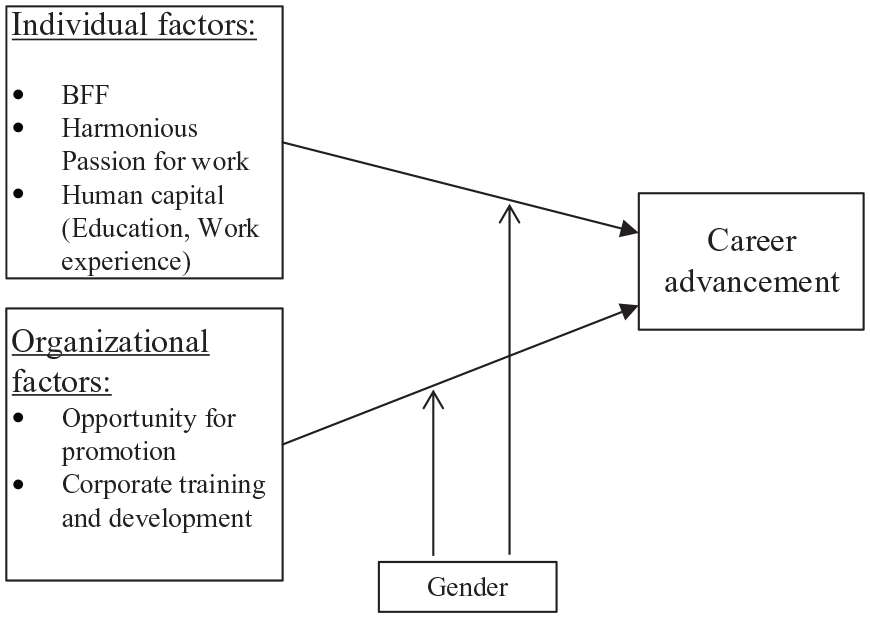
Hypothesized model.
Methodology
Research Design
The study employs a cross-sectional research design and utilizes a questionnaire as the survey instrument. The questionnaire was developed on the basis of prior research studies and was administered to employees working in hotels in Dili, Timor-Leste. Data were analyzed using structural equation modeling to test the hypothesized model (Figure 1) and the effect of the predictors on career advancement. The following section discusses the sample, development of the questionnaire, data collection, measures for the independent, and dependent variables and statistical techniques for data analysis.
Sample
The sample size is based on the total number of hotel employees in Timor-Leste’s capital city of Dili (based on the Timor-Leste government statistics survey in 2015; Lopes, 2015). The sample size is calculated using the formula of Yamane (1973), with a 95% confidence level. The sample size of this study is 398.
Survey Instrument
A questionnaire was used in this study as a survey tool to collect data from the participants, and consisted of three main parts. The first part was demographic information, such as gender, age, marital status, educational background, and work experience, and the dependent variables of functional level, salary, number of subordinates, and number of promotions. The second part consisted of individual factor variables that focused on six main variables (i.e., BFF personality traits and harmonious passion for work). The third part included organizational factors that focus on the two main variables (i.e., opportunity for promotions and corporate T&D). These variables (in the second and third parts of the questionnaire) were measured using a scale ranging from 1 (“strongly disagree) to 5 (“strongly agree”).
The questionnaire was translated into Tetun (national language of Timor-Leste), as it is the back translation technique to ensure equivalence (Brislin, 1970). Back translation involved translating text that has already been translated back to its original language again to test the quality and accuracy of the original translation.
Data collection was conducted by contacting each hotel and obtained agreement to survey their employees. The hotel employees were asked to complete the questionnaire. As stressed in the cover letter, participation was voluntary, anonymous, and no compensation was provided. Thereafter, the pilot test was conducted to ensure that the questionnaire was understood and tested for reliability and factor analyses. A total of 16 top hotels granted approval to survey their employees. A self-administered questionnaire was distributed to 450 hotel employees in Dili. Out of 385 respondents who complete the survey, 226 are women and 159 are men.
Participants
The majority (59%) of the respondents were women and the remaining were men (41%). The respondents who hold the highest education level (i.e., master’s degree) were men (1%), while no women hold graduate degrees. The highest education level for women was bachelor’s degree (12%). The respondents in the executive level (e.g., HRM managers, front office managers, and F&B managers) were men (3%) and women (2%), and most of the respondents in the operational levels (i.e., front office and back-office subordinates) were women (51%) and men (35%). Approximately one-fourth (25%) of the women respondents have been working between over 1 and 9 years, while the men were at 17%. Table 1 shows further demographic information for the survey participants.
Sample Characteristics.

Note. Diploma 3 (Bacherelato): degree diploma of 3 years studying at a university.
Measures
Dependent variable
Career advancement
The dependent variable, which is career advancement (CAD), was measured using four items and indicated good reliability with α of .774. The four items were the respondents’ functional level, salary, number of subordinates, and number of promotions (Metz, 2003; Tharenou, 2005). Given that the four items had different response categories, they were standardized before averaging to form a score.
Independent variables
Personality traits
The five BFF personality traits were adopted from Digman (1990) and Judge et al. (1999) and measured in this study. Each BFF personality trait consists of five separate questions, and the response range was measured using a five-point scale. The five personality traits and their Cronbach’s alpha are extraversion (α = .74), agreeableness (α = .67), conscientiousness (α = .78), openness to experience (α = .84), and emotional stability (α = .79).
Harmonious passion for work
Harmonious passion for work items were adopted from Vallerand et al. (2003). The response range of the four-item questions was measured using a five-point scale and indicated good reliability with α of .707.
Human capital
This study measured the two main factors for human capital of education and working experience. First, the highest level of education completed was quantified on an eight-point scale based on the questionnaire items discussed by Metz (2003) and Tharenou et al. (1994). Second, work experience was measured as a single questionnaire item asking about how long have the participants have worked in their respective hotels. A five-point scale depicted experiences from under 1 month to over 10 years (Tharenou et al., 1994).
Opportunities for promotion
Opportunities for promotion items were measured using an eight-item scale (Mooney & Ryan, 2009; Ragins & Sundstrom, 1989; Tharenou et al., 1994). The responses related to the eight items to opportunity for promotion were obtained using a five-point scale and indicated satisfactory reliability with α = .882.
Corporate T&D
The corporate training program provided by organizations and frequency of participation in in-house or external T&D activities of the individual respondents were measured using a five-point scale based on the questionnaire items considered by Tharenou et al. (1994). The response indicated acceptable reliability with α = .882.
The independent variables with their abbreviations, means, standard deviations, reliabilities, and component matrixes are further explained in Table 2 in the result section.
Means, Standard Deviations, and Scale Reliabilities.
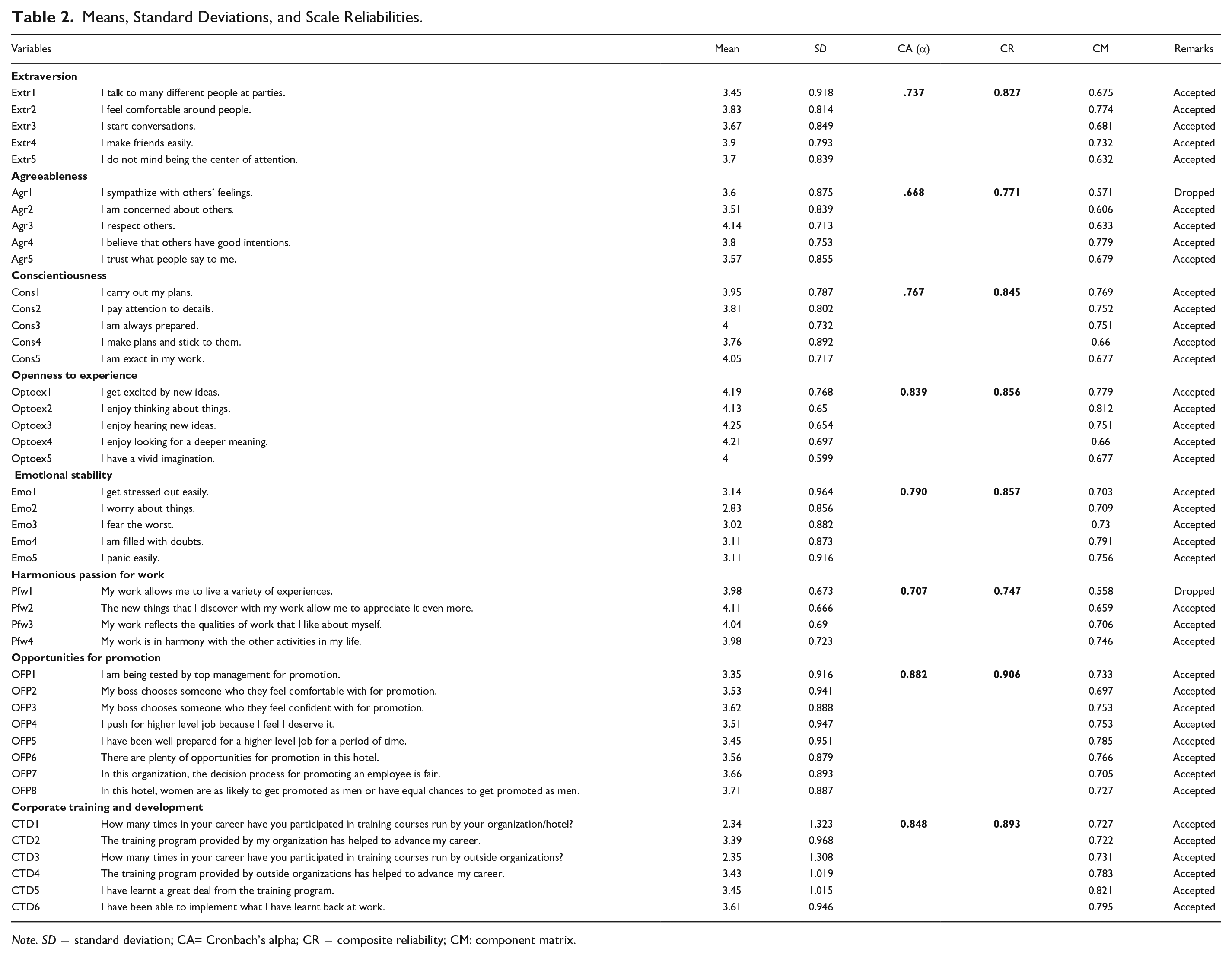
Note. SD = standard deviation; CA= Cronbach’s alpha; CR = composite reliability; CM: component matrix.
Analytical strategy
The analytical strategy mainly follows the widely recommended three-step approach of structural equation modeling (SEM; Arbuckle, 2010). The first step, which is exploratory factor analysis (EFA), validated the group constructs. The second step, which is confirmatory factor analysis (CFA), validated the overall measurement model. Finally, SEM tested the proposed structural model specifying the relations between constructs. SEM was used to test the effects of the 10 predictor variables on the dependent variable (i.e., career advancement).
Goodness of fit indices were used to assess the fit of the measurement and structural models. The relative chi-square compares the observed matrix with the estimated matrix. The chi-square divided by its degrees of freedom (CMIN/DF) is a means to assess model fit. A relative chi-square ratio of under 2 or 3 indicates an acceptable model fit (Arbuckle, 2010). The root means square error of approximation (RMSEA) index constitutes a measure of parsimony describing the discrepancy between the observed and estimated covariance matrices per degree of freedom. RMSEA values below 0.08 are considered a good fit (Arbuckle, 2010).
Results
Measurement Model
Exploratory factor analysis
First, the Kaiser–Meyer Olkin (KMO) of sampling adequacy and Barlett’s test of sphericity measures were used to examine the EFA. The chi-square value is 6729.96 with 861 degress of freedom and significant at 0.00, which represent a sufficient correlation among variables to proceed. The KMO measures of sampling adequacy is 0.82, which is above 0.50 (Hair et al., 2018). Hence, EFA is considered an appropriate technique for further data analysis.
Thereafter, the principal component analysis method and rotated component matrix were used to identify the items under each factor in EFA. Table 2 presents the factor loadings and reliability of each construct. All factor loadings vary between 0.60 and 0.80, which is higher than the minimum acceptable factor loading of 0.60 (Hair et al., 2018). Table 2 shows that the following two items were dropped owing to their low factor loadings (≤0.60): (Agreeableness 1) as component matrix loading as 0.57 and (Harmonious passion for work 1) with 0.56. The composite reliability value of group items showed that the value is greater than 0.7 indicating acceptable inter consistency with the indicator variables (Hair et al., 2010). The remaining items were retained and used for the next phase of the analysis.
The following CFA analysis showed that the proposed model is appropriate because it indicates adequate fit of the statistics test.
CFA
CFA of each factor and the standardized factor loadings were evaluated. The chi-square statistics of the model is significant and indicated adequate model fit. In the maximum likelihood estimates for covariance, all exogenous variables are positively significant. The three items correlation with p-value significantly below .001 on career advancement are education level (r = .412), work experience (r = .300), and corporate T&D (r = .209). Therefore, human capital of education and work experience dominated the correlations on career advancement. That is, human capital plays an important role in association with career advancement.
Structural model
SEM is a technique used to explain the effects of exogenous (independent) variables on endogenous (dependent) variables in models (Byrne, 2010). In the current research, an endogenous variable (i.e., career advancement) was added to the model after the measurement model was constructed and confirmed. Thereafter, the proposed model was analyzed using AMOS statistical software.
The chi-square statistics of the model is significant (χ2 = 163.795 p ≤ .01) and the relative chi-square suggests good fit with a χ2/df = 1.883 (below 3 as required (Arbuckle, 2010; Bentler, 1999). Goodness of fit index (GFI) measures the fit between the hypothesized model and covariance matrix of the observed variables, and indication model fit for values above 0.90 (Arbuckle, 2010; Bentler, 1999). GFI of the model (0.96) suggests acceptable fit. Comparative fit index (CFI) was also measured, which, according to Arbuckle (2010), should be above 0.9. CFI of the model (0.95) indicates adequate fit. The last absolute index fit refers to RMSEA, which measures the adequate fit of the tested model with the population covariance matrix (Arbuckle, 2010). RMSEA of the model (0.03) suggests acceptable fit, which approaches the value of 0.08 as required (Arbuckle, 2010).

Structural model (Arbuckle, 2010).
The SEM results in Figure 3 show evidence that corporate T&D is a mediator variable between openness to experience and CAD, harmonious passion and CAD, and opportunity for promotion and CAD. Therefore, further testing was conducted. Further analysis confirmed corporate T&D to be a mediator variable because the result of the model fit meets the requirements as well.

Modified structural model.
The mediating role of corporate T&D in particularly linking personality traits to career advancement has not been extensively tested. Thus, it is examined in this present study. Previous research has been conducted to investigate the extent to which BFF is related to learning from training (Hassan et al., 2015) and leader effectiveness (see Judge et al., 2002). Research evidence has suggested that extraversion (Rewold, 2007), agreeableness (C. L. Rogers, 2005), conscientiousness (Studer-Luethi et al., 2012), emotional stability (low score on neuroticism) (Herold et al., 2002), and openness to experience (Herold et al., 2002) have positive influences on motivation to learn from training. Hence, the Big Five personality traits may be associated with the motivation to learn from training and improve performance at work, thereby enhancing career advancement.
The result indicated that the chi-square statistics of the model is significant (χ2 = 99.24 p ≤ .01) and the relative chi-square suggests good fit with a χ2/df = 2.07 (below 3 as required (Arbuckle, 2010; Bentler, 1999). GFI of the model (0.90) suggests acceptable fit. CFI of the model (0.97) indicates adequate fit. RMSEA of the model (0.04) suggests acceptable fit approaching the value of 0.08 as required (Arbuckle, 2010).
The research hypotheses were tested according to the outputs of the structural model. The results of the test are presented in Table 3. The modified model indicated that corporate T&D provided the mediation link to CAD.
Results of the Tested Hypotheses for the Combined Sample.

Note. N = 385, ***p ≤ .001, **p ≤ .05, *p ≤ .10.
The SEM results in Figure 3 and Table 3 show the path coefficients in the standardized estimate of regression weight. Thus, H1c, H3, and H5 are supported. In addition, the new findings of corporate T&D positively significantly mediated openness to experience, harmonious passion, and opportunity for promotions on career advancement (see Figure 3). Thus, the result can be expressed in model modification as follows.
Model modification
The results of the modified structural model in Figure 3 and Table 3 indicated that exogenous factors that contribute to career advancement are conscientiousness, education, work experience, and corporate T&D. The chi-square statistics of the model is significant (χ2 = 93.56 p ≤ .01) and chi-square indicated good fit with a χ2/df = 2.23 (below 3 as required (Arbuckle, 2010; Bentler, 1999). GFI of the model (0.92) resulted in acceptable fit. CFI of the model (0.94) indicated adequate fit. RMSEA of the model (0.04) showed acceptable fit approaching the value of 0.08 as required (Arbuckle, 2010).
The modified structural model (Figure 4) indicated that conscientiousness, education, work experience, and corporate T&D had a direct effect on career advancement. However, openness to experience, harmonious passion, and opportunity for promotion had a direct influence on corporate training and development but no direct effect on career advancement. Table 4 shows the standardized weight loadings of the modified model for the combined sample.

Modified model.
Results of the Tested Hypotheses of the Modified Model for the Combined Sample.

Note. N = 385; ***p ≤ .001; **p ≤ .05; *p ≤ .10.
Openness to experience, harmonious passion for work, and opportunity for promotion relationships on corporate T&D are not hypothesized in the model.
The following is the test for differences between women and men based on the modified model. Accordingly, the objective of this study is to examine gender differences in the relative importance of individual and organizational factors and their effects on career advancement.
Gender differences analysis on career advancement
Model fit (male sample)
Figure 5 shows that 33 percentages of variance of the dependent variable were explained by the independent variables of the model. The examination of the path coefficients indicated that education significantly influences career advancement in a direct manner (0.45; p ≤ .01). The direct effect of work experience on career advancement was significant (0.33; p ≤ .01), and the direct effect of conscientiousness on career advancement was also significant (0.14; p ≤ .05). In the male sample, the relationship of corporate T&D as mediation for harmonious passion for work on career advancement is significant (0.14; p ≤ .05).

Model fit for the male sample.
The results tested according to the outputs of the structural model for the male sample are presented in Table 5.
Results of the Hypothesis Testing for the Male Sample.

Note. N = 159; ***p ≤ .001; **p ≤ .05.
Model Fit (Female sample)
Figure 6 shows that 24 percentages variance of the dependent variable were explained by the independent variables of the model. The examination of the path coefficients indicated that education significantly influences career advancement in a direct manner (0.39; p ≤ .01). The direct effect of work experience on career advancement was significant (0.29; p ≤ .01), and the direct effect of corporate T&D on career advancement was also significant (0.10; p ≤ .05). In the female sample, the relationship of corporate T&D as mediation to career advancement is significant, particularly opportunities for promotion (0.30; p ≤ .01) and openness to experience (0.10; p ≤ .05).
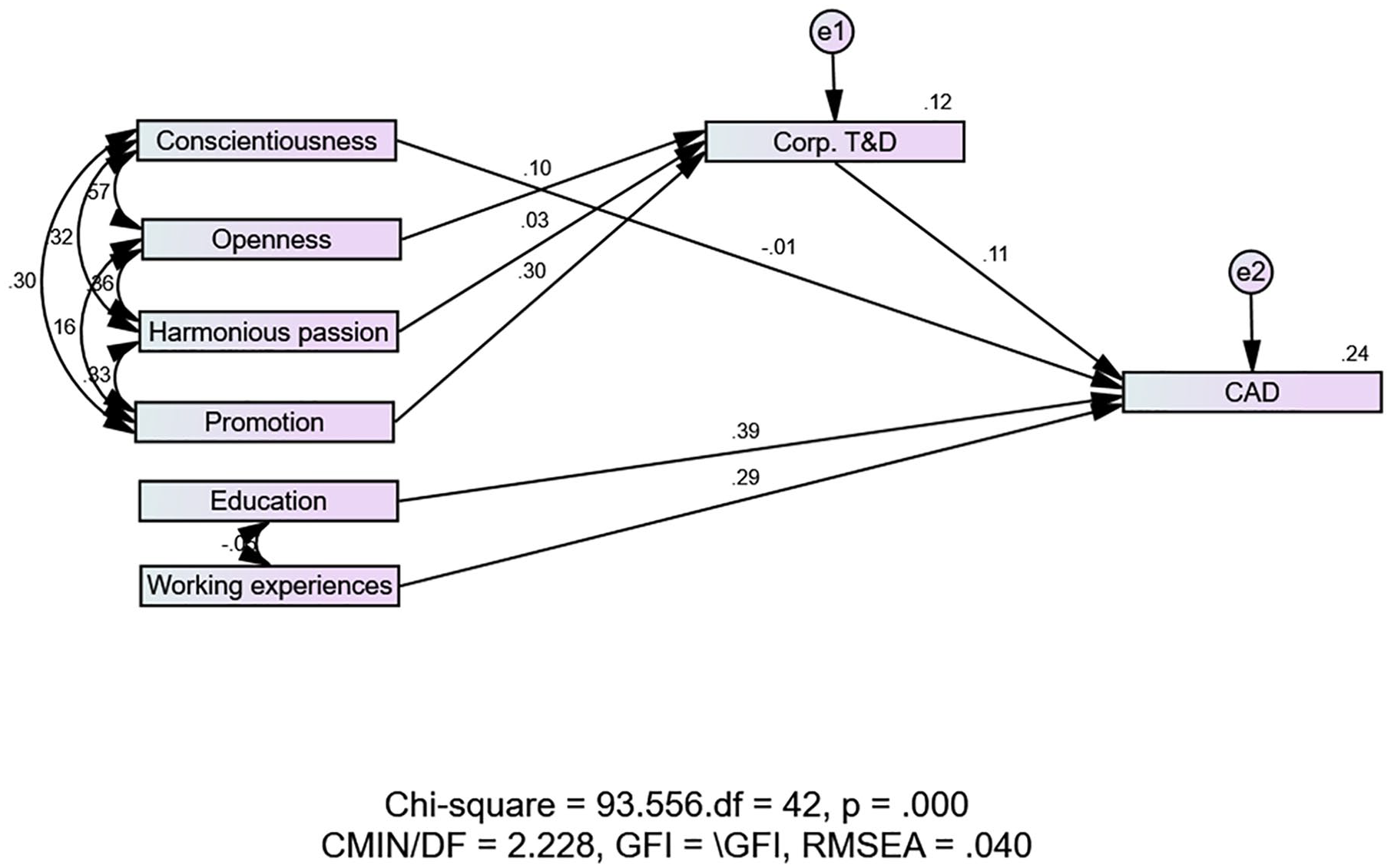
Model fit for the female sample.
The results tested according to the output of the structural model for the female sample are presented in Table 6.
Results of the Hypothesis Testing for the Female Sample.

Note. N = 226; ***p ≤ .001; **p ≤ .05.
Discussion
The purpose of this study was to examine gender differences in the relative importance of individual and organizational factors, and their effect on career advancement in the hotel industry in Dili using SEM. The SEM analysis result indicated that the standardized path coefficient analysis between men and women are different. For male employees, the personality trait of conscientiousness was a significant predictor of BFF on career advancement, and corporate T&D mediated the effect on harmonious passion for work on career advancement. However, for female employees, corporate T&D predicted career progression and mediated the effect openness to experience and opportunity for promotion on career advancement. By contrast, education and work experience for men and women were two common factors that had a direct effect on career advancement. The following section further discusses the hypotheses of the individual and organizational factors effect on career advancement.
H1 revealed that conscientiousness for male employees had a direct effect on career advancement. This result is consistent with Ali (2018), who found that conscientiousness is necessary in individuals’ career because it involves people’s point of association, perseverance, and enthusiasm in goal-directed performance. Therefore, employees who perform well at work tend to report career progress. The result of the present study is also consistent with those of a previous study, which found that the personality traits of conscientiousness of employees in innovative organizations are strongly related to organizational career growth (Jiang et al., 2020). That is, if employees score high on conscientiousness, then there is a greater probability to report high career growth. Conscientious employees tend to be well organized, plan ahead, consistent with the plan, and responsible with their work. Therefore, these employees tend to report experiencing promotions. Previous studies have also tested the BFF personality traits and career growth, namely, extraversion, agreeableness, openness to experience, and emotional stability (e.g., Busic-Sontic et al., 2017; Holman & Hughes, 2021; Judge et al., 1999; Wille et al., 2013). However, conscientiousness in the current study was positively significant in the male group (see Table 5) and all combined group (Table 3). Therefore, H1c is supported.
Furthermore, extraversion and conscientiousness yielded the most significance in gender difference analysis in the ANOVA test. The result showed a significant difference between the male and female groups for extraversion (F = 4.304, p ≤ .05) and conscientiousness (F = 3.344, p ≤ .07). Men scored significantly higher than women on extraversion and conscientiousness on career advancement. These results suggest that male employees who tend to be dominant, ambitious, and action-oriented (high on extraversion), as well as achievement striving, planned, and reliable (high on conscientiousness), are likely to reach their goals. Thus, they achieve a high probability of being promoted. Evidently, this study has more male employees in the executive level (n = 11, 3%) compared with female employees (n = 7, 2%). Furthermore, the possible assumption is that extraverted and conscientious employees often take corrective actions when their career situations do not meet their demand, thereby enabling them to obtain additional chances to climb up the career ladder (Crant, 1995).
The SEM results indicated evidence that corporate T&D is a mediator variable. Previous research has been conducted to investigate the extent to which BFF is related to learning from training (Hassan et al., 2015) and leader effectiveness (see Judge et al., 2002). First, research evidence has suggested that for extraversion, employees who score high are more enjoyable interacting with people and often perceived as full of energy, thereby enhancing motivation to learn and tend to report for career growth (Rewold, 2007). Second, employees who score high on agreeableness are more likable; that is, they are more popular and tend to motivate in learning new things, and are more likely to get motivation to learn than those who are less likable (Judge & Ilies, 2002; C. L. Rogers, 2005). Third, conscientious employees tend to be well-organized, plan ahead, and responsible with their work, thereby motivating them to learn compared with those who are less organized and less achievement oriented (Studer-Luethi et al., 2012). Fourth, employees who are emotionally stable (positive pole of neuroticism) tend to be positive, experience low pressure at work, calm, and learn to listen to their emotions and get positivity; hence, they could perform well in their jobs and are more likely to get motivation to learn than those who are under pressure at work (Herold et al., 2002). Finally, employees who are open to experience tend to engage their intellect and cognitions at work, pursue knowledge, have an interest in new information, and enjoy trying new things at work. Thus, they tend to have a positive influence on motivation to learn from training (Herold et al., 2002; Ramdhani et al., 2017).
The Big Five personality traits may be associated with the motivation to learn from training and to improve performance at work, thereby enhancing career advancement. The result of the path analysis for the female sample indicated that the personality trait of openness to experience supports career advancement. This evidence is consistent with the findings of previous studies (e.g., Ali, 2018; Busic-Sontic et al., 2017; P. T. Costa et al., 2001; Georgellis & Sankae, 2016; Judge et al., 1999; Wille et al., 2013). That is, if employees score high on openness to experience and been regularly provided training by organizations, then there is a greater probability or chances to report high career growth. These results suggest that female employees tend to engage their intellect and cognitions at work, pursue knowledge, have an interest in new information, and enjoy trying new things at work (high on openness to experience). Moreover, those who attend trainings and perform well at work are likely to reach their goals, thereby enabling them to achieve a higher probability of being promoted than male employees. This result is important for female employees because they try out new ideas at work, which can improve their work outcomes and enhance overall performance, thereby increasing the likelihood of promotions.
H2 predicted that passion for work would have a positive influence, but is not supported for the combined sample (see Table 3). This finding is inconsistent with Ho et al. (2018) and Vallerand (2010), who illustrated that harmonious passion for work indicates a positive effect on individuals to choose to engage in the activity that they like. That is, harmonious passion is important for people’s personality.
The new finding of this study is in the male sample. That is, harmonious passion for work exerted a positive influence on career advancement, although it must be associated with corporate T&D. The result suggested that male employees who score high on harmonious passion and provided with training by organizations tend to report experiencing high career growth. Harmonious passion for work employees tends to discover new things at their work and appreciate it substantially. That is, employees with harmonious passion tend to focus on their profession, thereby enhancing overall performance and obtain promotions. Through corporate T&D, individuals with harmonious passion may be considerably motivated to learn and transfer training to improve their job performances (Curran et al., 2011; Ramdhani et al., 2017).
H3 predicted that education and work experience would have a positive effect on career advancement. Evidently, H3 is supported (see Tables 3, 4, 5 and 6). The analyses indicated that career advancement is mainly related to human capital (i.e., education and work experience). This finding is consistent with those of previous studies (e.g., Becker, 1993; Lenihan et al., 2019; Nafukho et al., 2004), which explained that employees who more likely have obtained a higher level of education and have experienced working would have career progress. That is, employees who are more knowledgeable and possess the required skills are more likely to perform better than those who lack the requisite skills. Hence, if the former performs well, they are also more likely to be promoted.
Even though education and work experience variables are dominant in the significant variables related to career advancement, there are differences between men and women according to the examination of path coefficient loading.
First, the result of the analysis indicated that education has the highest examination of path coefficient. These results are higher for men (see Table 5) compared with women (see Table 6). The examination of the path coefficient 0.45 for men and 0.39 for women. That is, the higher the participants’ educational level, the more likely they are to achieve career advancement (Fearon et al., 2018; Fis et al., 2019; Lenihan et al., 2019; Metz, 2003). Therefore, it could be appropriate to encourage people to pursue higher education for career advancement.
Second, the examination path coefficient for work experience is 0.33 for men and 0.29 for women. The result suggested that men and women in the hotel industry agreed that the more years of work experience people have, the better their career prospects will be. This finding is similar to those of Izugbara et al. (2018) and Metz (2003), which indicated that a long period of working will increase people’s practical knowledge and enhance their abilities to deal with challenges at work. Therefore, work experience allows employees to gain practical knowledge, enhances their performances, and enable them to obtain promotion, thereby improving their future careers.
H4 predicted opportunity for promotion that would have a positive effect on career advancement. However, H4 is not supported (see Table 3). This finding is inconsistent with the results of Allen et al. (2016), Helitzer et al. (2016), and Lyness and Thompson (1997), which illustrated that employees’ opportunities for promotion contributed significantly to their career advancement.
The gender difference analysis for the female group showed a complete mediation between opportunities for promotion and career advancement. This finding is consistent with those of Datta and Agarwal (2017) and Dekker et al. (2002), which illustrated that opportunities for promotion must be associated with corporate T&D to lead to and enhance career advancement. The reason is that women employees who obtain promotion performed well in their jobs in terms of their skills and abilities (See Table 6). Therefore, they tend to report career growth. That is, organizations providing T&D for women employees can enhance their knowledge, skills, and abilities, thereby enabling them to perform well in their job.
H5 predicted corporate T&D would have a positive effect on career advancement for the combined sample and female group. Accordingly, H5 is supported (see Tables 3 and 6). The result obtained that corporate T&D supports career advancement is similar to those of Metz (2003), Sartori et al. (2018), and Schulz and Enslin (2014), which indicated that training provided by organizations would enhance employee skills and abilities, thereby enhancing their performance and likelihood of promotions. The result suggests that women employees tend to learn from training provided by organizations, thereby enabling them to likely report promotion. Thus, corporate T&D is compulsory for individuals’ career advancement.
Conclusion
The results obtained from the considered gender analysis concluded that for women and men, education and work experience are two common factors with direct effects on career advancement. The remaining factors are different between women and men employees. For the men, the higher percentage of variance of dependent variables was explained by the independent variables of the model. For male employees, conscientiousness was a significant predictor, and corporate T&D mediated the effect on harmonious passion for work on career advancement. However, corporate T&D for female employees predicted career progression and mediated the effect openness to experience and opportunity for promotion on career advancement.
This study purposefully intended to examine individual and organizational factors contributing to career advancement. The results indicated gender differences from the factors contributing to career advancement: conscientiousness (male group only), openness to experience (female group only), harmonious passion for work (male group only), and corporate T&D and the opportunity for promotion for female group only. On the bases of the results of this study, it could be recommended that to progress an individual (women and men) career in the hotel industry in the context of Timor-Leste, the influence of individual and organizational factors must be considered. First, individuals must invest in human capital. For example, obtaining higher education must be combined with conscientiousness, work experience, and actively enhancing skills by participating in corporate T&D programs. However, the mediated role of corporate T&D by organizations is essential for enhancing hotel employees’ career progress. In particular, corporate T&D mediated employees who tend to score high on openness to experience and career advancement. Employees who are open to experience tend to generate new ideas, be a good listener, and resourceful. These qualities lead to improved job performance, thereby enabling employees to report their career growth. Moreover, corporate T&D mediated harmonious passion for work and career advancement. Employees who have harmonious passion for work tend to appreciate new things that they discover in their work, love their work, and harmonize their work with other activities. Therefore, employees perform well and tend to report career progress. Finally, the role of corporate T&D mediated well the opportunity for promotion provided by organizations. In particular, organizations could provide promotion opportunities for employees who have performed well and prepared for the promotions because of their performances and experiences. This situation is also applicable for employees who are conscientious and open to experience.
For female employees, they could be advised and counseled to be trained to develop certain attributes that can lead to specific behavior (high score on conscientiousness and harmonious passion for work) and likely increase their opportunities for promotion. For male employees, they could also be advised and urged to be trained to develop certain attributes that can lead to specific behavior (high score on openness to experience) and increasing in attending training provided. Thus, they are likely to increase their opportunities for career progress.
Theoretical Implications
This study’s theoretical implications can be strengthened from two perspectives. First, this is the first study that tested individual and organizational factors on career advancement, particularly in the hotel industry in Timor-Leste. For individual factors, education and work experience play an essential role in career advancement (for both genders). However, the personality traits of conscientiousness for male employees had a direct effect on career advancement. On the other hand, corporate training and development, an organizational factor, directly affected female employees’ career advancement. Moreover, this research on the mediating role of corporate T&D as an organizational factor reflected its important role in fully mediating the BFF personality traits of openness to experience and career advancement and harmonious passion for work and individual’s career advancement. Second, corporate T&D also played an important role as fit mediation for the organizational factors of opportunity for promotion and career advancement. Therefore, future studies can extend this research by investigating on these variables. This theory enables employees to foster their career advancement. Finally, gender matters, thereby indicating that we cannot assume that a single model fits for men and women. Thus, this might be a combination model study or these two models as references for identifying factors related to career advancement in the hotel industry.
Practical Implications
The present study offers several practical implications for human resources management teams and practitioners in the hotel industry. First, by investigating the relationships between the Big Five personality traits and career advancement, the result indicated that conscientiousness positively predicts individuals’ career advancement for the male sample only. Therefore, practitioners may be interested in the finding that conscientiousness (for male employees) potentially contributes to the prediction of career growth, whereas openness to experience (for female employees) optimizes prediction of career success through corporate training and development. Depending on how career success is measured in organizations, different personality traits must be chosen to produce the most accurate selection system.
Second, the findings of this study suggest the significance mediation of corporate T&D with harmonious passion for work (for male group) and individuals’ career advancement. Therefore, it could enable HR practitioners to provide training equally for all employees and could be particularly for those employees who tend to score high on the harmonious passion. Thus, employees could perform better in their work area.
Third, the findings suggested positively significant relationships between opportunity for promotion (for female group) and career advancement through corporate T&D. Therefore, management line team could equally provide organizations with development resources and opportunities to male and female employees who performed well at their jobs, well prepared for promotions, and provided corporate training to enhance their skills to be considered reporting for their career progress. Finally, the findings of the study also found that education level and work experience played important roles on individuals’ career advancement. Therefore, it enables HR managers to recruit employees based on their education level (in the hospitality school) and work experience. Moreover, employees should invest on their education and obtain work experience.
Limitations and Recommendations for Future Research
The limitation of this study is that it only identified some individual and organizational variables. For individual variables, this study identified BFF, harmonious passion for work, education, and work experience. However, some other individual variables could have positive effects on career advancement in the hotel industry. Several researchers have shown that narrowly defined traits are conceptually more closely linked to performance criteria than the Big Five. In addition, assertive behavior can increase instrumental outcomes and predict career advancement or career promotion. Furthermore, leadership motivation refers to the extent to which individuals seek and enjoy leading positions, in which they can influence the work of others. Thus, future studies are suggested to investigate the aforementioned related variables. For organizational factors, affective commitment and work content must be considered for future studies on the influence on career advancement.
Although the present study has limitations, it also has strengths. The current study identified the factors related to career advancement from the individual and organizational and perspectives on female and male employees in the hotel industry in Timor-Leste. The two strengths of this study are as follows. First, this study is the first on conscientiousness, which has a positive effect on the career advancement of hotel employees in Dili, Timor-Leste. Thus, future researchers could use this study as a model guide for future research on BFF and career advancement. The result is interesting for the hotel industry, in which conscientiousness (for the male group) has a positive effect on career advancement. Second, the role of corporate T&D mediated well openness to experience (for female group), harmonious passion for work (for male group), and opportunity for promotions (for female group) on career advancement. Thus, Timorese hotel employees and organizations could use these concepts as a guide to foster and meet the hotel objectives and need. Overall, the unanticipated results on individual and organizational factors on progression of individual career development may vary based on industries. Therefore, industry-specific study is beneficial. Finally, this research considered females and males as samples, thereby facilitating the gender differences analysis.
Footnotes
Acknowledgements
The authors are thankful to the editor and the anonymous reviewers for the highly constructive feedback and exceptional service. We also thank the relevant governmental organizations for permitting and supporting the research conducted in Dili, Timor-Leste. Special thanks to all respondents (hotel employees) for their participation, contributions, and valuable time during the survey.
Declaration of Conflicting Interests
The author(s) declared no potential conflicts of interest with respect to the research, authorship, and/or publication of this article.
Funding
The author(s) received no financial support for the research, authorship, and/or publication of this article.
The Ethics’ Statement
The author(s) declared no research on animal and human studies with respect to the research, authorship, and/or publication of this article.
