



Abstract
While the deleterious impacts of parental incarceration are well documented, we know less about the experiences of children with parents imprisoned by immigration authorities. We draw from 62 multigenerational and multiperspective interviews conducted in California with school-age children experiencing parental immigration imprisonment (PII), and their nondetained caregivers. We find that children experiencing PII report feelings and behaviors suggestive of significant psychological distress, which leads to changes in engagement and behavior at school. While some children access academic support and counseling, often following advocacy from nondetained parents or interventions by teachers, others do not receive such support. Many children conceal their family’s situation and withdraw from school-based programs—alarmingly, the very same structures that could support them through PII. These behaviors are rooted in compounded vulnerability, that is, children’s overlapping experiences of parents’ imprisonment and precarious immigration status. Our study provides strong descriptive evidence of the extensive harms of PII for children. These results should prompt immediate action from policymakers who can legislate an end to incarceration in immigration legal proceedings. Our findings can also inform efforts by educators and schools to better support children experiencing PII.
Keywords
Introduction
Each year, U.S. Immigration and Customs Enforcement (ICE) imprisons hundreds of thousands of immigrants during the adjudication of their deportation proceedings. Although immigration law is civil law, detained immigrants can be held indefinitely and with no systematic mechanism for release such as bail, a process legal experts have described as “imprisonment without trial” (Arulanantham, 2022). In 2019, the average daily population imprisoned by ICE reached a record high of 55,000 (Patler et al., 2023; Transactional Records Access Clearinghouse, 2023). Many imprisoned immigrants have lived in the United States for decades and are parents of dependent, U.S.-born children (Patler & Golash-Boza, 2017). Indeed, nearly 6 million children, most of whom are U.S. citizens, live in mixed-immigration-status (herein mixed-status) families with at least one undocumented parent and could be at risk for experiencing parental immigration imprisonment (PII) and/or deportation (Warren & Kerwin, 2017).
Given the growing phenomenon of mass, indefinite imprisonment by ICE under administrative U.S. immigration laws, there is growing scholarly attention to how immigration imprisonment impacts mixed-status families, including children. In general, this literature finds that children with detained or deported parents experience mental health harms, educational barriers, and system avoidance or disengagement from key social institutions (Allen et al., 2015; Brabeck, 2010; Dreby, 2015; Golash-Boza, 2019; Gonzalez & Patler, 2020; Gulbas et al., 2016; W. D. Lopez, 2019; Patler & Gonzalez, 2021; Patler et al., In press).
As a comparison, an established literature details the effects of parental incarceration (PI) more generally (i.e., under criminal law). This body of scholarship documents a host of deleterious consequences for children experiencing PI, including poorer school performance and stigmatization (Foster & Hagan, 2009; Haskins, 2014; Haskins et al., 2018; Turney & Haskins, 2014; Wakefield & Wildeman, 2014). Relatively less research explores how children can develop resilience and coping mechanisms in the face of PI (Bomysoad & Francis, 2022; Haskins et al., 2018), nor does the literature fully address the role of caregivers and schools in that process (Nesmith & Ruhland, 2008, 2011).
Drawing on insights from the broader field of literature on PI, the present study describes how PII impacts children in mixed-status families, especially in the school setting, and how children, parents, and schools respond. We also examine the coping mechanisms children develop during their experiences of PII. We rely on 62 multigenerational and multiperspective interviews with children who experienced PII for at least 6 months, as well as their nonimprisoned caregivers. We find that children experiencing PII face significant psychological distress that often leads to changes in engagement and behavior at school. Schools’ reactions to children’s behavior vary greatly, and parents often intervene to secure accommodations for their children. While some educators are receptive and supportive of children’s experiences, others are not. Moreover, nearly all children go to great lengths to conceal their parent’s imprisonment, even withdrawing from school-based programs and extracurricular activities—troublingly, the same resources that could promote their resilience through the PII experience.
We find that children’s reactions to PII are similar to those of children experiencing PI more generally; indeed, many children have experienced both. However, we argue that when facing PII, the mechanisms producing behavior can be distinct. Specifically, children experiencing PII face compounded vulnerability—that is, the overlap of PI with the distinct experience of the imprisonment happening within the context of immigration legal proceedings, which can lead to permanent family separation via deportation and, therefore, generate significant uncertainty (Patler and Gonzalez, 2021).
Our study provides strong descriptive evidence that the compounded vulnerability of PII harms children in ways similar to, and distinct from, what we know from literature on PI more generally. These results should prompt immediate action from policymakers who can legislate an end to incarceration in immigration legal proceedings. Our findings can also inform efforts by educators and schools to better support children in mixed-status families experiencing PII.
Background
Understanding the Impacts of PI
We begin by highlighting key findings from research on PI to anchor our analysis of PII. More than 2.7 million children in the United States have an incarcerated parent (The Pew Center on the States, 2010). Children enduring PI are at increased risk of experiencing changes to behavior and well-being, including withdrawal, depression and anxiety, and negative emotions, all of which can adversely influence their academic performance (Geller et al., 2009; Haskins, 2014; Poehlmann, 2005; Wakefield & Wildeman, 2011; Wildeman & Turney, 2014). For example, young people with incarcerated parents face greater risk of regularly missing school, academic failure, grade retention, and even school abandonment, compared to their peers without incarcerated parents (Cho, 2011; Haskins, 2014; Haskins et al., 2018; Turney & Haskins, 2014).
PI can also generate stigma in children’s lives (Myers et al., 1999; Travis & Waul, 2004). Youth with incarcerated parents report bullying and shaming from peers (Haskins et al., 2018), and they perceive that teachers treat them differently because of their familial situation (Nesmith & Ruhland, 2008). These feelings may be justified: Studies have found that when teachers learn of a parent’s imprisonment, they develop negative perceptions of the child and may penalize them academically in lieu of offering academic and social support (Dallaire et al., 2010; Turney & Haskins, 2014; Wildeman et al., 2017). It is perhaps unsurprising, therefore, that children may feel conflicted about telling peers or teachers about their family’s situation (Haskins et al., 2018; Murray, 2012). However, few studies of PI or PII have addressed this question empirically.
While few studies address children’s coping mechanisms and resilience during PI (Bomysoad & Francis, 2022; Haskins et al., 2018; Nesmith & Ruhland, 2008), some research has identified protective factors that may allow children to adapt and persevere in the face of traumatic childhood experiences. There is growing evidence that school-based adults such as teachers, counselors, and after-school program staff may offer valuable support to children with incarcerated parents (Clopton & East, 2008; A. Lopez & Bhat, 2007). The child’s age and school context during PI may also influence the support they receive. Elementary school educators spend more time with children throughout the day and may be more likely to notice behavioral changes, compared to middle or high school teachers who see children for one class period (Dallaire et al., 2010). It is thus possible that younger children and their families may receive school-based interventions sooner, compared to older children.
Extracurricular activities such as clubs or sports can also serve as coping mechanisms. Children who participate in such activities can develop more positive behaviors (Bomysoad & Francis, 2022; Nesmith & Ruhland, 2008). Still, children’s resilience remains underexplored in the context of PI and unexamined altogether among children experiencing PII.
Understanding PII
PII may yield similarly deleterious educational consequences for children as PI, including poorer mental health and academic difficulties (Gonzalez & Patler, 2020; Patler & Gonzalez, 2021; Zayas et al., 2015). Yet, the mechanisms producing behavioral changes due to PII may be distinct and layered. PII can compound children’s vulnerability due to the added element of uncertainty of immigration legal proceedings (Patler & Gonzalez, 2021). When a parent is in the custody of immigration officials, children can experience anticipatory stress regarding not only the confinement itself, but also indefinite imprisonment and the possibility of permanent familial separation via deportation. This added layer of stress can enhance existing trauma, stigma, and strain and lead children to conceal their experience of PII.
Social isolation may be harmful to children experiencing PII for at least three reasons. First, PII can disrupt pathways to coping and resiliency linked to long-term well-being. For example, participation in extracurricular activities such as sports, music, and art (Bomysoad & Francis, 2022) is a protective factor that can build resilience against the harms of adverse childhood events. If PII leads children to withdraw or altogether avoid these activities, they could experience further harm (Patler & Gonzalez, 2021). Second, the legal status of the parent not in custody (particularly if that parent is undocumented) might lead the child to conceal their ongoing experiences of PII from peer networks and/or school-based adults. Children in mixed-status families often hide legal status (their own or that of their siblings and parents) from outsiders for fear of apprehension (A. S. García, 2019; Patler, 2018; Ramirez, 2023). The pressure to keep parental legal status secret in an effort to protect them may actually lead children to disengage from the very support networks key to protecting well-being. Third, and relatedly, while caregivers of children with incarcerated parents are key in advocating for children to receive support during PI, in the PII context, caregivers are most often immigrant Latina women. When these women are undocumented, their—or their spouse’s—legal vulnerability can make them hesitant to engage in institutions that keep records (Patler & Gonzalez, 2021), which may mean missing out on much-needed supports (e.g., public benefits) for themselves and their families. However, undocumented immigrants are also powerful advocates for their rights, including in their children’s schools (S. J. García, 2018; Ramirez, 2023; Terriquez, 2011). The present study examines the important role of caregivers in helping children navigate the school system in the face of PII.
Methods
We draw from 62 in-depth interviews with children (n = 26) and adults (n = 36) in 42 families that experienced PII in California for at least 6 months. Interviewees were recruited through a larger study of the impacts of prolonged U.S. immigration imprisonment on current and formerly detained people and their families (Gonzalez & Patler, 2020; Patler, 2022; Patler & Branic, 2017; Patler & Gonzalez, 2021; Patler et al., 2021). The study was a research–practice partnership with a prominent U.S. civil rights organization that advocates for individuals in immigration prisons and assisted in recruitment.
We used a multigenerational and multiperspective methodological approach to triangulate and supplement information, given that each set of participants engage with the world in distinct ways (Freeman et al., 2021). To participate in the study, children had to be at least 11 years old (for the purpose of ethically assenting to participation in research), living in the United States, and have had a parent imprisoned by U.S. immigration authorities who participated in the larger study. Adults had to be at least 18 years old, living in the United States, and have been a caregiver for a child of any age whose imprisoned parent participated in the larger study. Most often, adults were the current/former partners (usually wives) of imprisoned immigrants.
We conducted interviews in the participant’s home or a public location of their choosing such as a fast-food restaurant, park, or coffee shop. We developed separate interview guides for adults and children that captured multiple areas of life including educational experiences, behavior, economic and housing security, daily routines, family dynamics, health and well-being, and aspirations for the future. We adjusted children’s question schemes as necessary for older versus younger children (e.g., whether participants were in school and/or working). The interviews took place in 2015 and 2016 lasted between 40 min and 2.5 hrs, and participants received a gift card for participating. We conducted interviews in English and Spanish, per respondents’ preferences. Adults provided consent for participation and all children provided assent. All study procedures and materials were approved by the University of California (UC) Irvine and UC Davis Institutional Review Boards.
Families experiencing PII are an extremely vulnerable population given the structural inequalities they face, including their family member(s)’ ongoing vulnerability to deportation. We took this reality very seriously and took purposeful steps to protect participants’ privacy. First, as mentioned above, we worked with a well-known and trusted civil rights organization throughout the course of the study. Second, each research team member had academic, professional, and/or personal experience with the U.S. immigration and/or criminal legal systems. Prior to the interviews, we gave parents and children information about ourselves and the study and provided several opportunities to clarify and answer questions. At several points during the interview, we reminded participants that they could skip any question and/or end the interview at any time. Finally, given the hardships faced by many participants’ families, in addition to gift card incentives, we distributed a bilingual (English-Spanish) packet containing information about free- and low-cost services available to immigrants in participants’ geographic area, such as shelters, food banks, health clinics, and immigration legal services. On several occasions (e.g., when a child or their parent had a serious health concern or legal issue), we and/or our community partner helped them access services.
Following each interview, we wrote detailed field notes and observations, including a summary of themes from the interview. With the participants’ consent, we recorded and transcribed all interviews. We then engaged in several rounds of flexible coding using Dedoose (Deterding & Waters, 2018). We began by creating a set of open, deductive codes following the literatures on PI, system avoidance, and immigrant families. We then separated these codes into thematic categories. As new topics emerged, we created additional, targeted codes to capture patterns. We then engaged in a final round of selective coding to examine themes central to this manuscript. The examples in the sections that follow most clearly illustrate the patterns that emerged from the interviews. We translated all Spanish language quotes and changed respondent names to protect confidentiality. Table 1 provides descriptive demographic information on study participants.
Participant Characteristics.
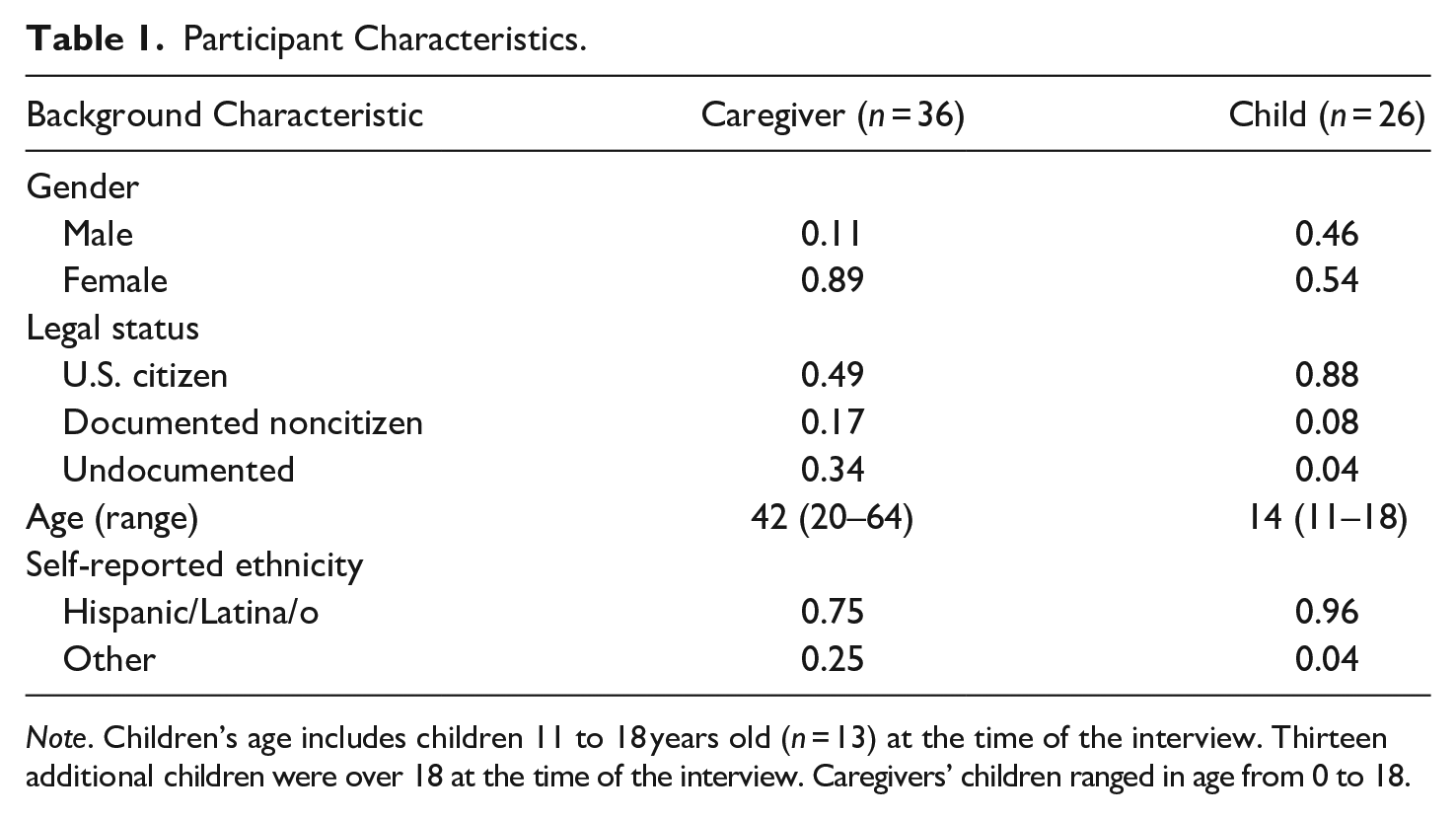
Note. Children’s age includes children 11 to 18 years old (n = 13) at the time of the interview. Thirteen additional children were over 18 at the time of the interview. Caregivers’ children ranged in age from 0 to 18.
Findings
Changes to Well-Being and Behavior
Nearly all children in the study described a series of co-occurring behavior changes following PII suggestive of significant and lasting psychological and physical stress. For example, 73% of children reported nervousness or sadness, 65% reported irritability or anger, and 65% reported problems with sleep. We begin with the story of Felipe, who was 13 years old and in junior high school when his stepfather, Angel, was imprisoned during an immigration raid at his workplace, in which ICE discovered he was undocumented and had a decades-old conviction for driving under the influence of alcohol. ICE imprisoned Angel for 21 months under mandatory, indefinite detention, which meant Felipe and his family did not know when Angel would be released or whether he would be deported. Felipe compared his health and well-being during Angel’s imprisonment to the time before the arrest: I always feel tired, but I have a hard time going to sleep and feeling relaxed. . . my health is more down than before he got detained. . . I [used to] eat more, [I was] more outgoing, I felt less tense, more confident. Now I’m less. . .everything. . .
Felipe describes multiple stress responses to PII that made “everything” in his life—his physical and mental health—feel “less.” Felipe further explained that these changes were due to constant worry about Angel and the family’s future: Being honest. . . . [the reason is] probably [worrying about] how am I gonna end up in the future, or what’s gonna happen with my stepdad? I think that’s the reason. . . I am more worried if he [gets deported], what are we gonna do next?
Felipe’s description highlights the compounded vulnerability he experienced; that is, the combined impacts of having an imprisoned parent while also enduring the uncertainty of the immigration legal system (Patler & Gonzalez, 2021). This had disastrous academic consequences: Ultimately, Felipe’s grades dropped significantly and he abandoned high school at 16 years old.
Twenty-three-year-old Sebastian also left school (community college) to contribute financially when his father was imprisoned by ICE. When describing his experiences with PII, Sebastian made an explicit comparison to incarceration under criminal law: In prison [under criminal law] you get hard sentences sometimes, and then. . .in detention [immigration prison], that. . .stresses people out. It’s like, “shit, I don’t know what’s goin’ on! My dad didn’t know what was going on for a while. And me, I didn’t know what’s goin’ on, like why is he in jail? Is he gonna get sentenced? Is he gonna get deported?” You know? I think it stresses people out.
Sebastian makes clear that the uncertainty in immigration legal proceedings generated extensive anticipatory stress.
Alison similarly compares PI to PII to describe the compounded vulnerability experienced by her 8-year-old daughter, Jessica. Jessica had experienced PI because her father Dante suffered from drug addiction and had been incarcerated in local jails several times in the past: He would go in and come back out [of jail]. . .when the cops catch him, I know they’re gonna let him go. . .because he got caught over something petty or self-inflicting, nothing dangerous to society. So I knew eventually he was gonna get let go. . .
But when Dante was transferred to ICE custody, Alison’s perspective changed: “But this time it was like—it’s immigration. It’s not like you just go in and come out. It was like, you go in and you’re going to Mexico. . .” Alison further described how Dante’s uncertain future impacted Jessica: Jessica used to ask me every week, “okay, is this the week [he might get out]?” And I had to tell her, “I don’t know when he’s coming. . .I don’t know when.” So when I told her that, she started crying. . . When you can tell a kid “tomorrow,” that gives them hope, or “next week.” But the fact that I told her “I don’t know,” it didn’t sit well with her.
Alison’s description makes clear that the uncertainty of Dante’s immigration case compounded Jessica’s already vulnerable experience of PI.
As we have seen, the stress and negative emotions of PII can spill over into children’s experiences at school. This was the case for the Cortez family, consisting of father Carlos, mother Azucena, and sons Carlos Jr., Jonathan, and Matthew (ages 12, 8, and 4 when Carlos was detained by ICE). Azucena recalled how Matthew responded to Carlos’ imprisonment: He would cry and cry when he went to daycare and the teachers would tell me “Señora, your child doesn’t want to eat.” “Señora, your child is very sad.” You could see it in his eyes that he wasn’t well. . .They would say, “it’s like he’s not even here, it’s like we don’t even exist.” I was very worried because they said “maybe he has autism.” But no! It was because of everything he was going through! He didn’t have autism, he wasn’t delayed, he didn’t have anything like that! He just shut himself inside himself. . .it affected him so much. . .Later, the psychologist told me that he was suffering from abandonment.
Azucena’s 8-year-old son, Jonathan, was also profoundly impacted: He cried so much. . .After going to immigration court [to attend his dad’s hearings], he would say, “But why? Why won’t the judge let him out?”. . .And it was just crying and crying and crying and crying. And here in the house there were times when I would find him with his face all swollen from crying so much.
When we interviewed Jonathan himself, he described how sadness and worry about his dad’s imprisonment and ongoing deportation proceedings began to interfere with his ability to concentrate in the classroom: I still remember when my dad left, I was even more sad. I just felt down. I didn’t even listen to the teacher when she said like, “go to these pages.” I was just thinking about when my dad would be back.
Jonathan’s older brother Carlos Jr. also began to show changes to his behaviors at school. Azucena told us: “He was so depressed. His grades went down. It affected him so, so much.” Carlos Jr. himself told us: When my dad left, I was 12 years old. I started getting aggressive, and sort of lonely, and [during recess] I would sit all the way over. . .on the edge of the field, away from people. . .I stay[ed] there for the whole year. All by myself. All by myself.
Seeking Support: Parental Advocacy in Supportive and Unsupportive School Environments
The preceding section made clear how compounded vulnerability manifested in behavioral changes at home and at school. We now describe how parents and schools responded to changes in children’s behavior. We begin with Denise, who recounted the behavioral changes expressed by her 10-year-old son, Lawrence, his school’s response, and how she addressed it: [Lawrence’s] behavior deteriorated significantly. He’s always been very active. . .but his behavior just got worse. He’d attend class crying. He was always at the principal’s office. He would disrupt the class a lot. . .He wasn’t focusing. . .It was almost as though he was seeking that attention from the class [that he couldn’t get from his dad].
School personnel often responded to children’s behavior changes with punishment, as is clear from Lawrence’s repeated trips to the principal’s office. At this point, parents often felt the need to intervene and advocate for their children. Denise made an appointment with Lawrence’s teacher to explain the family’s situation. The teacher expressed empathy and understanding and was able to intervene on Lawrence’s behalf: [After I told the teacher], [Lawrence] would still go to [the principal], but it wasn’t to get in trouble, because she was aware of the situation. . . [instead] they assigned him [a school counselor] on a weekly basis for about a year. . .and he followed Lawrence all the way to junior high, and he was available for Lawrence to see whenever Lawrence felt he needed him.
As this example reveals, parents like Denise often had to proactively or defensively intervene on their children’s behalf to garner empathy, patience, and services like counseling and/or academic accommodations. Similarly, Ariana, whose daughter Patricia was 5 years old and in kindergarten when her father was imprisoned by ICE, described how she successfully advocated for extra academic support for her daughter: [Patricia] would cry and she was so sad. I told the teachers right away when [her dad] was detained. I always told the teachers and, thank God, they helped me. . .for example, they gave her a special teacher to help her advance and give her a little extra help. . .They don’t just abandon her, they support her in her homework. She even stays an hour after class to get help with her homework, her readings, any coursework where her grades went down [after he was detained]. . .I felt a lot of support in the school.
While some children received academic support, counseling, and/or leniency and understanding, other families described a troubling lack of empathy and institutional support from children’s schools. Matias was just 6 years old when his mom, Sandra, was detained in 2013. Shortly thereafter, Matias began to display worsening behavior at school: He would cry constantly, talk back to his teacher, and his grades dropped significantly. The teachers called his father, Rafael, multiple times about Matias’ behavior, but did not provide any tangible support:
It was like 2 or 3 months after [Sandra was imprisoned]. They kept calling me to tell me that Matias was getting into this and that, being rebellious, crying. . .It affected him so much, he was traumatized. He missed his mom. . .
And did they recommend any program for him, like counseling?
No, nothing like that.
And what about help to keep his grades up?
No, never.
Unfortunately, despite significant distress throughout his mother’s apprehension and subsequent imprisonment, kindergartener Matias never received school-based support services.
Some older children also described apathetic and/or unsupportive school responses to their experiences. High school student Cassandra’s mother had died 2 years before her father, Alessandro, was imprisoned by ICE. Cassandra was extremely close to Alessandro and relied on him to help her manage her painful loss. Cassandra described having a panic attack at school following her father’s imprisonment, but receiving no support from the school: There was an in-school counselor, but she didn’t really care. I fainted in class once, because I had a panic attack, and I think she saw me one time after that, and then she never called me in. So it’s kind of like, “do you really care?” I don’t think any guidance counselor actually really cares in high school, you know? So it’s kind of like a job to them.
As the cases above reveal, the institutional responses to children’s behaviors can vary greatly, with elementary school students often receiving support more readily than their older counterparts. This variation was evident even between children from the same families, as the Torres’ situation demonstrates. Elizabeth and Jaime Torres have three children: Steven, Vanessa, and Elias (ages 13, 9, and 8, respectively, at the time of Jaime’s imprisonment by ICE). Elizabeth described the children’s struggles when Jaime was detained: “they didn’t want to go to school, they didn’t want to get out of bed, they didn’t want to get dressed. Nothing.” All three children also displayed behavioral changes and lower academic performance, but Elizabeth’s experiences advocating for them varied greatly by their school contexts. With regard to Vanessa and Elias, who were in elementary school, Elizabeth had clear and supportive communication with teachers almost immediately, which resulted in additional services for the children: They [teachers] said to me, “I’ve noticed that Vanessa works hard, but she’s really absent, it’s like she’s not thinking about what’s happening here [in the classroom], it’s like she’s somewhere else”. . .and with Elias, they told me the same thing: “I’ve noticed he’s a little absent, not like himself, and his grades have gone down.” So I told them, “we are going through all this process [with their dad]” and they told me, “oh, it makes sense. This is a hard process, really difficult for the family.” And so they recommended that I get the kids help from the school psychologist.
In contrast, Elizabeth had to advocate much more forcefully for Steven, who was in junior high school, eventually escalating his case to the principal to get extra support: All the teachers were telling me he was lazy and giving very bad versions of him, but they didn’t know what was going on. So I had to go to the principal and I said to her, “I need all Steven’s teachers to know this situation so they understand. I want them to hear my version of what’s going on so they understand, so they can help him, and so they can have patience with him. . .and understand that his behavior is justified.”
The principal agreed to convene all Steven’s teachers in one room, where Elizabeth nervously but firmly explained what Steven was facing. She recalls their reaction, “they all just sat there saying ‘wow’ and looking at each other.” But Elizabeth’s persistence paid off: “From right then and there, we filled out all the paperwork and he started getting therapy.”
Like Elizabeth, Luciana Ortiz had to advocate differently for each of her four school-aged children (ages 15, 11, 6, and 4, respectively, at the time of their father’s apprehension) when their father Roberto was imprisoned by ICE. Not only did they witness Roberto’s violent arrest outside a laundromat, but as his imprisonment by ICE dragged on indefinitely, Luciana struggled greatly to make ends meet, and the family was evicted from their home and had to live in their car. In addition, like many other mixed-status families in our study, the children were unable to visit their father throughout his imprisonment because of Luciana’s immigration status concerns. They hardly even spoke with Roberto except on rare occasions when the family had enough extra money to put funds in his phone account at the immigration prison. Although the family’s challenges were complex and overlapping, Luciana attributed the worst of it to Roberto’s imprisonment by ICE and the corresponding uncertainty of the family’s future: The problem to us was more—it was everything, but I believe it was more because of the immigration part, and him being there, or even for them to deport him. That was probably the big, big part of it.
PII took a toll on Luciana’s children and manifested in changes to their behavior and performance at school. While Luciana quickly secured counseling and therapy for her younger children, she had to advocate extensively for her teenage daughter: She was just acting up, not wanting to go to school, ditching school and all that. . .I had a lot of trouble even with the teachers and the counselors, you know, it was me arguing with the counselors, “cause they were just like ‘oh, she’s bad and she’s not gonna do nothing [in life].” And you know, I was like, “hello! I mean this is school and you’re supposed to be more educated than me, and you’re gonna tell me this?!”
As the preceding anecdotes make clear, there is great variation in the resources provided to children—often related to the age and school level of the child, and parents often have to advocate differently—and repeatedly—for each child.
Seeking Support Outside the Classroom
In addition to seeking academic support and/or counseling for their children, some families described extracurricular involvement such as religious activities, afterschool programs, and sports, as helpful supports for children experiencing PII. For example, Lawrence became very involved in the youth group at his church, which provided a key source of support and resiliency during Lawrence’s experience with PII. His mother, Denise, told us: Lawrence asked to go to church, and so we started going. . . and he got really into the youth group. We were just in church all the time, and that’s what we did. . .I didn’t tell anyone from the church [about the PII], but they provided support that we needed.
Similarly, Azucena, mother to Carlos Jr. and Jonathan, made sure her children continued their participation in a community center the family had been part of prior to Carlos’ imprisonment. She described how the center directors “knew the situation” and “the problems the children were having” and made sure to involve them in activities to “distract them” from the pains of their father’s imprisonment.
Other families described sports participation as a way to maintain structure in children’s lives. Alison told us how she re-enrolled her older son in multiple programs after he initially stopped attending due to the initial shock of PII: “I have him in his sport, like we sign him up for basketball, football practices. We’re very involved. He’s involved. And we go to church. We go to the church activities.”
However, not all parents felt comfortable advocating for their children, often due to legal status vulnerability. Ana’s son Efren was 6 years old when his father Damian was imprisoned following a drug conviction, first in a state prison and then transferred to an immigration prison after completing his prison sentence. Efren’s life was turned upside down when Ana could no longer afford the rent on their apartment and the family had to move in with his aunt. Like other families, due to compounded vulnerability, Efren and Ana were unable to visit Damian in the immigration prison due to Ana’s concerns about her legal status. Efren began refusing to eat and lost a lot of weight. He “couldn’t concentrate” in school and his grades dropped. But Ana felt too worried about disclosing both her and her husband’s legal status to tell his teachers at school: “I just didn’t know if it would be ok [to tell them].” For other families, the stress of PII was just too overwhelming and they did not pursue school-based resources for their children. Melissa told us why she did not seek counseling support for her 8-year-old son, even though the school recommended it: “I felt like I didn’t want more people knowing about this.”
Keeping Secrets: Children Avoiding School-Based Supports
We now turn to children’s accounts of revealing or concealing their family’s situation to school-based personnel. Almost universally, children expressed deep reticence to share their family’s situation due to distrust in their teachers and school-based adults and worry about being stigmatized, pitied, teased, or bullied by peers. Children also expressed concerns about people finding out about their parents’ vulnerable legal statuses. For example, 16-year-old high school sophomore Carolina told us she “put up a front” with others, but when she was alone, she would “burst into tears.” She said: “I never really wanted anybody to really know about that whole situation. . .I think it was embarrassment, and then also scared, like what’s gonna happen if I tell them, you know?” For Carolina, compounded vulnerability kept her from seeking support as she navigated PII.
The combination of fear and stigma led some children to disengage from school-based activities that had previously brought them joy. Natalia was 15 when her step-dad was arrested: I don’t remember actually sharing it with anyone. . .I kept to myself once he [was detained], and I just stayed quiet . . .Even with my friends. . .I didn’t talk with anyone. . . I ended up dropping out of [Anime club]. . . I just kind of stopped attending the meetings and everything, to avoid [telling anyone]. Before, I went there a lot, but I just stopped doing that by the end of the year. I just stopped going. . .I ended up being even more alone. . . more quiet, and more of a private person.
As Natalia’s case reveals, although children felt protected by keeping secrets, doing so also often meant missing out on access to institutional and peer supports, which can be critical to developing resilience against the challenges of PII. Indeed, many children confided that they wished they had had someone to talk to. Natalia put it like this: “I ended up not going to anyone regarding it. . .[sigh]. . .But sometimes, I did kinda wanna just talk to someone else about it.”
The same was true for Jonathan, who we met above, who also told us he “never told anybody” due to lack of trust (“I don’t like to trust teachers because if I do, of course, obviously they’re still going to tell someone”) and concerns about stigma (“then it would spread everywhere”), combined with worry about revealing family members’ immigration statuses (“the thing I was worrying about was my brother, because he didn’t have papers. If he went [to immigration prison], he wouldn’t be able to come back. . .And then it would be me and my little brother”). But after repeatedly stating that he never wanted to tell anyone, Jonathan paused and, quietly, said: “But I’d kind of like to tell—with someone I could trust. Because I like to just express my feelings with someone else, so they understand what I’m going through.”
Discussion
PI impacts millions of children in the United States. At the same time, the mass expansion of detention and deportation in the United States has left millions more children vulnerable to the harms of PII. Indeed, over 6 million minors currently live in mixed-status families headed by undocumented immigrant parents (Warren & Kerwin, 2017) and much of the growth of the U.S. immigration prison population has been driven by transfers from the criminal legal system (Armenta, 2017).
In this analysis, we have shared the stories of some of the young people experiencing PII. Our study makes at least four scholarly contributions. First, we offer a multigenerational analysis of the experiences of children in immigrant families, who are vastly understudied in PI literature (Haskins et al., 2018). Our study begins to shed light on the long-lasting consequences of PII for children’s well-being. Children described feelings and behaviors suggestive of significant psychological distress that often manifested in behavioral changes at school, such as expression of negative emotions, and/or disruptive behavior that often led poor academic performance, reduced participation, and disengagement in school-based activities.
Second, we contribute an exploration of the role of nonimprisoned parents in accessing resources for children experiencing PII that may help to improve their well-being. Our analyses suggest that families experience a stark binary in how schools respond to children undergoing PII: either supportive (lenient and helping to secure resources) or unsupportive (discouraging or apathetic). In addition, while many families expressed worry about revealing familial legal statuses, many still mobilized to access academic and/or emotional support for their children. Their success underscores the key role of immigrant parents—even those with precarious legal statuses—in supporting their children’s schooling (Terriquez, 2011).
Third, resilience and coping are understudied in both the PI and PII literatures. We show how some children and families cope with PII by getting involved in church groups, sports programs, and extracurricular activities. Still, nearly all children in our study went to great lengths to conceal their experiences from school-based personnel—alarmingly, the very same people who could help them develop resilience through the experience of parental imprisonment.
Last, our study reveals key similarities and distinctions between PI and PII. Most importantly, we find that children’s emotional and behavioral responses to PII are similar to those documented in the literature on PI more generally. However, the mechanisms producing those responses may be distinct. In particular, children in our study faced compounded vulnerability (Patler & Gonzalez, 2021) wherein concerns about the immigration legal process (e.g., prolonged uncertainty) and familial immigration statuses overlapped with the broader experience of PI. Feeling no choice but to conceal PII from peers and/or school personnel, children and their families faced barriers to accessing the potential supports their schools and peer groups could provide. In the long run, PII could sever or hinder traditional pathways to intergenerational immigrant integration and well-being (Jones, 2018)—with potentially devastating and long-lasting consequences.
Conclusion and Recommendations
Our study provides evidence for educational institutions and lawmakers concerned with developing formal strategies to better serve children experiencing (or who will experience) PII. Results suggest that children need institutionalized supports—not stigma or punishment—from teachers, counselors, and peers early on and throughout their parent’s imprisonment, as well as after it concludes. School districts must develop evidence-based wrap-around programs for these students, as well as train teachers and staff who regularly interface with students on how to respond to the unique challenges faced by children of legally vulnerable immigrants, in addition to and together with children experiencing PI. Findings also point to the need for schools to ensure empathy and flexibility for children, alongside ongoing academic support and referrals to psychological counseling services when needed. Combined, these strategies can instill a sense of belonging in students and strengthen their attachment to, rather than isolation from, school and school-based adults.
While schools play a key role in supporting students, they must not be left to manage the failures of federal policies. Federal and state lawmakers can immediately act to reduce the harms of PII for children. Congress has the power to legislate an end to immigration detention. There is no evidence that imprisonment is necessary for the successful completion of immigration legal proceedings (Eagly & Shafer, 2015). Yet the practice continues, thereby continuing to cause harm to children. Congress also has the power to return to pre-1996 immigration laws that could reassert judicial review, expand opportunities to adjust legal status, and lessen the penalties associated with criminal offenses, therefore reducing the prison-to-deportation pipeline in the first place. In the absence of federal action, state lawmakers can pass laws that significantly limit the flow of immigrants from local law enforcement to federal law enforcement, as California has done with its 2018 Sanctuary State legislation (Senate Bill 54) and other laws. These policy actions can promote the well-being of millions of children, most of whom are U.S. citizens.
Footnotes
Declaration of Conflicting Interests
The author(s) declared no potential conflicts of interest with respect to the research, authorship, and/or publication of this article.
Funding
The authors disclosed receipt of the following financial support for the research, authorship, and/or publication of this article: Caitlin Patler is grateful for research support from the Russell Sage Foundation (Grant #93-16-15; any opinions expressed are those of the authors alone and should not be construed as representing the opinions of the Foundation), UC Davis Humanities Institute Faculty Research Fellowship, UCLA Institute for Research on Labor and Employment, and the University of California-Mexico Initiative.