



Abstract
With its physical distancing rules, the COVID-19 pandemic regulations urged researchers working in a qualitative paradigm to find pandemic-ready approaches to data collection. While many researchers turned to modern videoconferencing software, we explored an alternative route, and revisited audio observations. Audio observations replace the researcher as observer with audio recorders. Audio observations were pioneered in the 1960s, and continued to attract interest into the 1980s. Connecting with the methods literature from this earlier phase of interest, we evaluate a study design that combines audio observations with an interactive task that we applied to study active parental mediation of harmful media content. Drawing on a re-coding of data from two waves of data collection, we report on participants’ awareness of the observation episodes, issues with the recording quality, and the situational control during the observation episodes. We conclude that, although truly not a panacea, the combination of audio observations with interactive tasks not only helps to confront the challenges of physical distancing but also constitutes a serious alternative to more established qualitative data gathering approaches—even beyond pandemic restrictions. Thus, this article contributes to the extension of the methods repertoire in qualitative research.
Introduction
The COVID-19 pandemic posed tough challenges in many areas of life. The pandemic-related restrictions notably affected the organization of private life, yet they also jumbled up well attuned routines in the professional realm. This held true for research in the social sciences, too. From the perspective of qualitative research, the rules for physical distancing hit work processes particularly hard, as they severely restricted field access (Tremblay et al., 2021). Like other researchers working in a qualitative paradigm, we too faced the challenge of introducing distance into our data-gathering approach. A further challenge of the family-related research we conducted resulted from the pressure that COVID-19 put on families who had to carry the double burden of organizing home schooling and work, possibly in a home office mode. Finding sufficient time to participate in a study and to coordinate time schedules with researchers, many of them facing the same double burden, proved difficult.
We responded to these challenges by revisiting an approach that was pioneered from the 1960s to the 1980s (e.g., Christensen et al., 1980; Johnson et al., 1976; Soskin & John, 1963), but that has since well-nigh fallen into oblivion: audio observations. These remote observations sometimes also sail under the broader banners of impersonal observations or (technology-)mediated observations. At its core, this method gathers data via technical recording devices while researchers are not present—neither physically nor virtually through means of (video)conferencing software. Using an audio recorder as observation agent, we were able to audio-observe parent–child interactions during an interactive task on advertising in the family homes.
In this article, we offer an evaluation of our experience with this study design to address some of the unanswered questions in the literature on audio observations. Besides, we position this article in the discourse on the use of technology to introduce distance into qualitative research designs. In the wake of the COVID-19 pandemic, qualitative researchers have experimented with many distance-preserving designs (e.g., Høg Utoft et al., 2021; Lobe et al., 2020). Respective approaches explored how researchers can use videoconferencing applications, such as Zoom, to join study participants from a distance. In doing so, they investigate ways of converting simultaneous on-site data collection into simultaneous remote data collection. Using videoconferencing software, however, comes with its own pitfalls such as outdated hardware, limited webcam or microphone functionality, and poor internet connections (Archibald et al., 2019). In contrast, we present and evaluate a study design that does not require simultaneousness and avoids these pitfalls.
Audio Observations
Using Audio Observations in Qualitative Research
Soskin and John are credited for having conducted the first audio observation without observer presence in 1963 when they used audio recorders to study couple conversations. In the following years, audio observations were adopted in particular by family researchers who applied the method to collect naturalistic data in family homes (e.g., Christensen et al., 1980; Johnson et al., 1976; Reisinger & Ora, 1977). For these ends, researchers usually placed microphones either in high interaction areas in homes or instructed participants to attach microphones to their clothing. These microphones were then connected to tape recorders that were tucked away in non-intrusive places. Researchers utilized different strategies to activate recordings. While in some studies, they employed time switches to randomly record audio snippets, in others they agreed with the participants on specific time periods during which recorders were activated. In yet other studies, participants were instructed to start and stop recordings manually. Despite an initial interest, however, the total number of studies that used audio observation remained low throughout the decades.
Most studies used audio observations to gather data in naturalistic settings, such as family homes. This is remarkable, because audio observations could, at least in theory, also be used in the laboratory. It seems that the controlled environment of laboratories makes it easy to set up recording technology to capture audio and visual data, and thus a greater quantity of information. In naturalistic settings, however, the greater ease of setting up audio recorders that capture all, or nearly all, relevant data can motivate the decision not to collect video data. Indeed, the challenge to install a video camera at an optimum angle for capturing all relevant details is a recurrent theme in the methods literature (e.g., Loizos, 2001).
Why Should Researchers (not) Audio-observe?
Proponents of audio observations point to several benefits. One such benefit is the non-selectivity of the recording device (Gehrau, 2017; Torretti, 1986). Unlike human observers who are bound to their selectivity, audio recorders capture all technically detectable incidents. This feature is crucial when observers must register a variety of information. It also helps in reducing observer bias (Johnson & Bolstad, 1975). Another advantage of audio observations is the permanence of the observation episode. As the episode is recorded, researchers can return to it to deepen their analysis and increase its reliability (Johnson & Bolstad, 1975). At closer sight, however, these two advantages apply to the use of recording devices in general, notwithstanding the presence or absence of researchers.
An advantage that is unique to audio observations is their convenience for participants (Hansen et al., 1985; Johnson & Bolstad, 1975). Audio observations do not require joint appointments with researchers. Instead, study participants conduct the data collection whenever it fits their schedule. Given the double burden that families faced during COVID-19 lockdown periods, this advantage hugely gained in significance. A second benefit lies in the fact that audio observations enable the recruitment of study participants who are hard-to-reach (Hansen et al., 1985; Johnson & Bolstad, 1975). Audio recorders can be sent by mail, and study participants can set them up autonomously. Under ordinary conditions, this advantage comes into play especially when observing small populations that are locally dispersed. Under COVID-19 conditions, however, it was this feature in the first place that enabled us to observe parent–child interactions in compliance with physical distancing regulations. Third, the methods literature identifies audio observations as cost-efficient (Hansen et al., 1985; Johnson & Bolstad, 1975). Compared to observations with present researchers, audio observations do not produce costs for traveling to and from the site, as well as for the time the researchers spend observing. This led Hansen et al. (1985) to conclude that audio observations “may help researchers and clinicians generate more data per dollar” (p. 397). Fourth, some authors suggested that audio observations are less obtrusive than data collection procedures during which the researchers are present and thus produce less reactive behaviors (“observer effects”) (Christensen, 1979; Gehrau, 2017, p. 43; Jayasinghe, 2015). Jayasinghe (2015) states that video observations capture rich “data about naturalistic (. . .) behavior not always possible to capture through other ethnographic methods” (p. 268). This claim holds true also for audio observations. Christensen (1979) even contended that audio observations trigger less reactivity than video observations. However, this fourth advantage is debated. Other authors show less confidence in the naturalism of the data obtained. Johnson and Bolstad (1975) found that audio-observed behaviors of family members did not differ from the behaviors displayed when observers were present. More fundamentally, the “observer’s paradox” holds that any observation will transform the behaviors of study participants (Labov, 1972). In trying to productively handle this paradox, Hazel (2016) argued that study participants engage in doing being observed. Following Hazel, doing being observed should not be regarded as evidence for obtrusiveness, and hence a potential contamination of the data. Rather, it indicates that study participants understand what it means to participate in a scientific study, and act accordingly. Such a take on study participants’ behaviors opens new perspectives on supposedly artificial behaviors and mitigates the debate about the obtrusiveness of observations; yet it remains silent on whether audio observations trigger different modes of doing being observed than observations with present researchers.
The advantages of audio observations are countered by several disadvantages. First, when present, researchers can gain knowledge of the situation and the observed persons. This knowledge can help to contextualize the data and to avoid misinterpretations during data analysis (Gehrau, 2017). However, Hansen et al. (1985) compared the coding of audio-observed parent–child interactions by coders who had either directly observed the interaction or only listened to the recording, and they did not find evidence for inferior audio-only coding. Second, the non-selectivity of recording devices, while usually being an advantage, can cause problems when background noise disturbs the recording (e.g., Margolin et al., 1998). In such situations, present researchers may be better able to follow the most relevant events, be it by selectively focusing their awareness, or by changing their physical position. Third, audio observations offer very limited situational control (Birmingham & Wilkinson, 2003). The recording device does not possess any agency to act upon the observed events. In contrast, present researchers may interact with participants in a more or less intense manner, depending on the mode of observation they adopt (Gold, 1958), for example, by bringing interviews back to track when they drift off topic. Low control over the situation also carries implications for the observation of infrequent, non-institutionalized behaviors (Margolin et al., 1998).
Revisiting Audio Observations
Audio observations never made it to the big stage. The discussion of their advantages and disadvantages in the methods literature reflects this situation: It is sparse, fragmented, at times dated, and, inconclusive. This state is unsatisfactory, especially when considering the advantages of audio observations within the COVID-19 pandemic. We identified three issues in the debate that, in our opinion, merit closer examination. First, we found diverging evaluations of how naturalistic or reactive the behavior is that study participants display. It seems firmly established that study participants will always engage in doing being observed when knowingly participating in an observational study. Yet, beyond this fundamental fact, the way and the intensity with which participants do so can vary considerably. We therefore ask:
RQ1: How do study participants display awareness of being part of an audio observation?
Second, the methods literature holds that noise can disturb the recording of observation episodes. Apart from noise, other instances can also result in incomplete or incomprehensible recordings. For example, study participants may speak too softly to capture what they say, or they may stop the recording. We therefore want to know:
RQ2: How great is the risk of incomplete or incomprehensible data in audio observations?
Third, some confusion exists regarding situational control during the data collection. In the empirical study that builds the foundation for this article, we combined the audio observation with an interactive task to maintain some control over the situation, and to direct the interactions toward our research interest. This suggestion leads to our third research question:
RQ3: What situational control does the combination of an audio observation with an interactive task afford?
The Study Design
The Rationale of the Original Study
We conducted an audio observation to study how parents mediate the effects of potentially harmful media content in parent–child interactions. Parental mediation theory distinguishes different mediation styles, and among these styles, active mediation is described as the gold standard for empowering children in handling media content (e.g., Hudders & Cauberghe, 2018). Essentially, active mediation involves parents discussing media content with their children. Given the relevance of active mediation, however, we know relatively little about what actually happens during active mediation episodes. This is why we wanted to explore how parents and children (aged 8–12 years) interact during these episodes. We chose advertising as a potentially harmful media content as use case for our study.
Data Collection Procedure
General Procedure
We provided participants with several study materials that we sent to them by mail. Our parcel included: cover letter; instructions (“game instructions”) (see Appendix A); audio recorder; materials for an interactive task (see Appendix B); standardized questionnaire to collect further sociodemographic data; consent form to be signed by the participants, including a separate page with information on objective of the study, data processing and storage, and rights of the participants; preaddressed and prepaid envelope for sending materials back to us. If participants returned the materials, we reimbursed them with a voucher worth 20 euros.
The Interactive Task
We used an interactive task, which we referred to as a “game” in the correspondence with participants, to provide an occasion for parent–child interactions. We assumed that active parental mediation of harmful media content constitutes an infrequent, non-institutionalized behavior for which there are no fixed times in families, but which is mostly woven into the fleeting stream of everyday life. The task should motivate the display of such behavior. As the use of tasks in family research showed, they can stimulate focused active conversations in which conflict resolutions unfold (Berge et al., 2019).
The task centered on advertising. We created scenarios that illustrated four media usage situations (“theme worlds”) in which media users typically encounter advertisements: television programs, video games, movies, and YouTuber videos. We decided to develop gendered scenarios for the latter two theme worlds so that, ultimately, we provided six scenarios for the four theme worlds. The cover letter invited participants to choose one theme world and scenario they deemed most relevant for their family.
Each theme world had its own color. Envelopes in the colors of the theme worlds contained the task materials for the scenarios: manual, four picture cards per scenario (numbered from 1 to 4 on the back), and eight question cards. Additionally, we provided a playboard showing a ladder with three rungs (“ladder card”) and a game piece. The task included three phases. In phase one, the child reversed the four picture cards one by one, describing what they saw on each picture. Parent and child then discussed the entire scenario displayed on the pictures. We invited them to also speak about any other experiences they had made with the respective advertising format. In phase two, the eight question cards served as impulses. Parent and child could resort to these cards if the conversation came to a halt, or if they felt they needed assistance. In phase three, parent and child decided how to handle the advertising format in the future. While performing the task, participants moved the game piece over the ladder card to visually indicate which phase they were at.
The Audio Recorder
We asked our participants to self-record while performing the task. Hence, our approach stands in the tradition of studies that let participants activate the recordings manually (e.g., Johnson et al., 1976). Consequently, our main criterion in selecting an audio recorder was its ease of use to avoid operational and technical problems and robustness of the recorder. The audio recorder we selected is the Sony VoiceTracer DVT1110 (4 GB of storage capacity, 12 hours recording with one set of batteries). Recordings can be started in two steps. The recorder has proven to be suitable and reliable in practice for our use.
Data Collection
We recruited 37 families. We collected data from 25 parent–child dyads (i.e., our cases) from 22 families in the first wave, and another 8 parent–child dyads from 7 families in the second wave. Eight families never returned the materials so that we draw on data from 33 dyads from 29 families (see Appendix C for details). The mean length of the observation episodes was 40 minutes 12 seconds (SD = 17 minutes 47 seconds). We discarded one case (case 18) because the recording was too short to provide information-rich data. Participants completed a total number of 81 scenarios. This implies that many participants voluntarily completed more than one scenario we instructed them to fulfill.
Data collection required considerable cooperation from the research participants. While for many participants the cooperation ran smoothly, for others we had to invest additional effort to get back the requested materials. After 3 weeks, we sent a first reminder, but in some cases as many as five reminders were necessary. Specifically, we received 27 recordings before or shortly after this reminder and another six recordings only after repeated requests to return them and with delays up to 9 months.
Procedure for Evaluating the Study Design
To answer our research questions, we coded the data in a qualitative content analysis (Schreier, 2012). Using a theory-driven approach, we consulted the methods literature on audio observations to develop a coding frame that included the particularities that occur when using the method. In a second step, we used the strategy of subsumption (Schreier, 2012) to add inductive categories where necessary. The coding frame is available in Appendix D. We trained a student coder to conduct the coding of all documents. We provided ongoing guidance during the coding process. As recommended by Schreier (2012), we sat down together and resolved uncertainies in a joint discussion. We also evaluated the validity of our instrument. Following Schreier (2012), we controlled for abnormalities in coding frequencies across subcategories and for the miscellaneous categories. Since we could not detect such abnormalities, we consider our coding frame valid.
Results
Participants’ Awareness of the Observation Episode
RQ1 concerns the awareness of the observation episode that study participants displayed, and thus manifestations of doing being observed in an audio observation. We identified doing being observed in different kinds of references (to researchers, audio recorder, and task) and in reluctant behavior. Figure 1 illustrates manifestations of doing being observed over the course of the observation episodes.
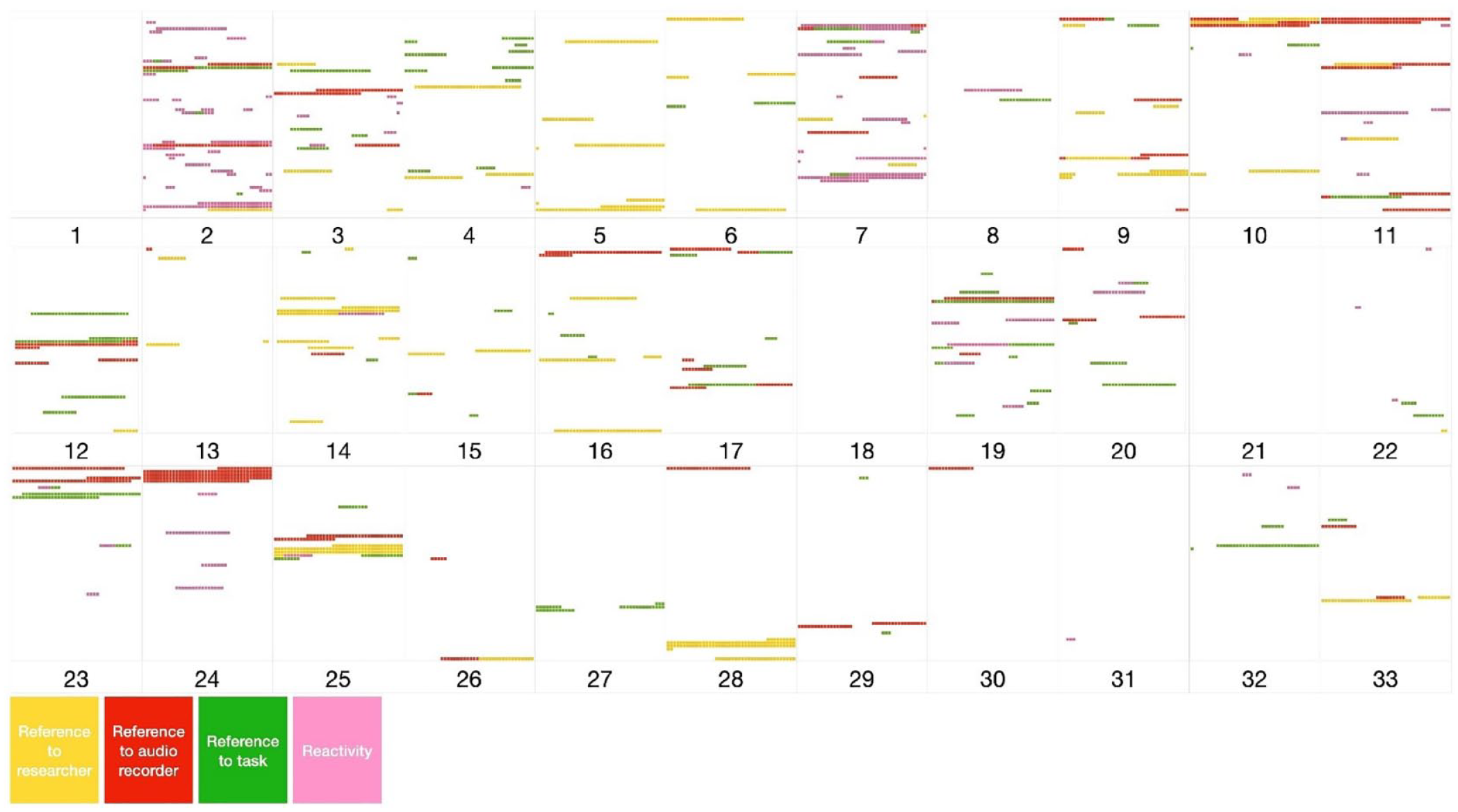
Manifestations of doing being observed over the course of the observation episodes. Images 1–33 represent the individual cases. Colored squares represent the occurrence of different manifestations of doing being observed. The number of squares represents the extent of the manifestations in relation to the length of the transcript of the observation episode. The position of squares represents the location of the manifestations over the course of the observation episodes. Calculated with MaxQDA function “document portrait.” Note that MaxQDA standardizes the length of the transcripts.
First, parents and children referred to us, the researchers. Some references simply resulted from politeness. In particular, participants wished us farewell at the end of the observation episode. Some participants also demonstrated an understanding of scientific routines by their behavior during these sign-offs. For example, a mother concluded the observation episode by saying (case 28):
I think we can stop now. Yes? Good. So, we wish the researchers much fun with analyzing our conversation.
Beyond such concessions to politeness, participants used the observation episodes to position themselves and their families. Importantly, they felt a need to comment on their general media consumption patterns, specifically when reflecting on the theme worlds we had supplied. So did these participants (case 33):
We maybe need to say that we do not have a TV. Only Netflix and Prime. But at grandma and grandpa’s place, you watch. . .
Yes.
Television every now and then.
Other aspects that participants outlined to us were past experiences with advertising or media content, as well as their general consumption patterns. Occasionally, parents also remarked on their children’s advertising literacy, or on their past efforts to educate their children about advertising.
Some participants, usually the parents, described non-verbal behaviors that were occurring during the observation episodes. Acknowledging that we would only have the audio recording for making sense of the conversation, they addressed interruptions (e.g., when other family members entered or telephones rang) and explained how they handled the task materials, as did this mother (case 5):
Ok, we are opening the envelope “video games.” Next to me is sitting Finn, and we will see. There are many cards in the envelope, and I am giving the first card to Finn. What are you seeing, Finn, on this first card?
Notably, verbalization of the task handling became less frequent as the episodes progressed. This did not pose a problem because we were familiar with the phases of the task, and thus inferred task-related behaviors from the recording. Additionally, the last quoted snippet includes another manifestation of doing being observed: In some instances, parents spoke about their participating children in the third person. As the children were present, we assume that parents directed the respective statements to us.
Second, participants referred to the audio recorder. For one thing, they addressed its functioning. Most commonly, participants made sure that the recording was running. They did so particularly at the beginning of the observation episodes. They also explored how to handle the recorder. In addition, participants addressed the quality of the audio recording. For example, parents reminded their children to speak louder so that the recorder could capture what they said. Parents also urged them not to mess around with the recorder.
Third, participants referred to the task. Parents explained the task instructions and oversaw that the children followed them. While preparing the picture cards for the first phase of the task, a mother supervised her son in this way (case 23):
In ascending order, Fabian, from 1 to 4, on the table. Stop. That’s descending. From your perspective.
Like this?
No, you must put them next to each other, not on top of each other, next to each other. Like this. Yes.
Furthermore, some parents prompted their children to further elaborate on the picture cards and answer the question cards in more detail. Such prompts did not only help us to understand the perspective of the children, they also satisfied the parents’ wish to learn more about their children’s attitudes and desires.
Besides by references, we suspected manifestations of doing being observed in participants’ reluctance to disclose certain information. We suggest understanding this reluctance as a form of reactivity. While we did not find any situations in which participants pointedly withhold information, we identified situations in which the participating children, specifically, whispered or hesitated before sharing information. Children did so when they were insecure whether their answers were correct or whether they would be approved, for example when conceding advertising-induced desires or specific media preferences. This happened in an interaction on movie-branded products (case 7):
You see [the advertisement for the product] and say: I want to have this. Only because there is an image on it that you like. And maybe it’s complete rubbish. Your notebooks, for instance. You have often realized that it is rubbish sometimes. Let them [the researchers] hear that it’s all rubbish.
(whispering) But maybe they will think that we are crazy.
No, they won’t think that we are crazy.
In most cases, though, it was hard to determine if the behavior followed from an awareness that the audio device recorded the episode, or from an uncertainty about the parents’ reaction. In response to this difficulty, we coded all situations in which participants displayed reluctant behavior, notwithstanding their motivation. Thus, we possibly overreport instances of reactivity in Figure 1.
Incomplete and Incomprehensible Recordings
RQ2 inquired about the risk of incomplete or incomprehensible data in audio observations. In the transcripts, we identified various sources of recording issues. First, external influences interrupted the task and, at times, the recording. One such cause were other household members. For example, siblings entered the observation episodes and posed questions. Such instances represent common situations of everyday family life and accordingly, study participants handled them with ease. Some participants also wanted to be prepared for such situations. For example, we observed a mother acquainting herself with the audio recorder at the beginning of the observation episode (case 30):
Can one press pause, if [sister] enters? Yes, one can. Fine.
Another cause of interruptions were people from outside the household. They rang the doorbell or called on the phone. If a study participant decided to answer, they interrupted the completion of the task and sometimes also the recording, as in the following situation (case 3): (Telephone rings)
Oh, we need to make a break and answer the phone. How do you pause this? Here, don’t you?
I will answer it.
How do you pause this? There is no pause.
(Recording ends) (Recording starts)
Does it record?
It continues.
Although some participants paused the audio recording, they all, as in this situation, resumed the recording after having handled the incident. A further external source for incomprehensible recordings can be background noise. The service provider that transcribed the recordings was instructed to register disturbing noises. We found such noises in two observation cases (five instances combined). However, only in one case did the noise make parts of one sentence hard to understand.
Incomprehensible recordings resulted from within the parent–child dyad, too. More common reasons that could, but did not inevitably, cause difficulties in comprehensibility, were soft speaking, unclear pronunciation, and speaker overlaps. Another internal cause was breaks from the task. This happened in two cases, but the participants later returned to finish the task. Finally, although we instructed the participants to sit at a table during the task, the children did not always follow this instruction. This behavior could lead to incomprehensible recordings, like in the following case (case 33):
Do you think that an advertisement has ever made you want something that you see? In football or Brawl Stars?
No.
Okay.
(moving away) I think that, because of our car, because I want a new car. I will (incomprehensible).
Wait, speak, when you are back here, because I think that one doesn’t hear you otherwise. Say it again.
Because we have this car and I want a new one. But [advertisements] do not make me want an Opel or Audi.
This situation illustrates not only how the recordings were at times incomprehensible, but also how the participants cared about maintaining a sufficient quality of recording.
In summary, we found that there were instances in which we could not observe the entire conversation due to recording issues. However, only single words or sentences were incomprehensible. Furthermore, we have no reason to suspect that participants sent in incomplete recordings. Thus, the risk of incomprehensible or incomplete recordings is negligible.
Situational Control
The absence of researchers during the observation episode reduces opportunities for situational control. To counter this disadvantage, we combined the audio observation with an interactive task. RQ3 asked whether this design proved productive. As no control group exists that operated without a task, we need to resort to indirect evidence that, admittedly, allows no definite answer.
First and primarily, we can state that we were able to observe active parental mediation of harmful media content. The task stimulated the behavior we were interested in. One could justifiably argue that triggering active mediation via a task threatens external validity. In defense of our approach, we argue that even if we risk the task not triggering what participants typically do, it clearly reveals what they are capable of doing (Margolin et al., 1998). Even if they typically apply other mediation styles, active mediation is within the repertoire of most parents (Smetana, 2017). Furthermore, from a pragmatic perspective, we argue that if we want to observe active parental mediation instead of relying on self-reports, stimulating this infrequent, non-institutionalized behavior is more resource-effective than recording any parent–child interactions in the hope of capturing and identifying respective behavior in the large data set that such an approach yields.
Second, participants were generally willing to follow our instructions. We identified five cases (four families) in which families deviated from the planned procedure and skipped phase 3, which concerned decisions on how to handle the advertising formats in the future. In another case, the parent–child dyad started by discussing the question cards (phase 2) instead of describing the picture cards (phase 1). In this case, we could infer that the participants had not read the instructions. In all these cases, we could nevertheless observe active parental mediation, so that the deviation from the instructions did not affect the informativeness of the data negatively. Furthermore, one parent–child dyad did not use the question cards. Although the use of these cards was largely optional, we noticed that the respective data was not as rich in information. In other instances, the conversations shifted away from advertising for some time and addressed the media content that the scenario had introduced. For example, some participants discussed video games instead of advertisements in video games. As advertising merely constituted the use case for our study, such shifts were unproblematic. Moreover, the task materials helped to re-center the focus on advertising.
Third, beyond the more fundamental willingness to follow instructions, situational control also depends on the clarity with which the task is spelled out. Therefore, we searched the data for situations in which participants showed uncertainty about the instructions. Both parents and children showed such uncertainty, although they were more frequent in children. Children’s uncertainty concerned the question cards. In these instances, parents were able to help out, as in this situation (case 20):
(reads out a question card) “Have you ever asked yourself how video games succeed in enthusing other children with a product? Tell more about it!”
Did you understand the question?
No.
The question asks whether you know how a video game makes you tell, for example, [friend] that he should also play the game. So how does the game do it?
Because I think it is cool, for instance.
Parents’ uncertainty resulted from unfamiliarity with the examples that the picture cards provided, particularly video games and their operating mechanisms and sponsored influencer posts. In these instances, children could sometimes explain the example to their parents, or participants could make sense of the example together.
We interpret these findings as implying that combining an audio observation with a well-designed interactive task is a workable solution for establishing some situational control.
Discussion and Conclusion
In this article, we reported our experience with a COVID-ready study design: an audio observation, combined with an interactive task. Audio observations are a method that has largely fallen into obscurity. However, the conditions for collecting qualitative data during the COVID-19 pandemic prompted us to revisit the method. Two advantages of audio observations strongly stand out under these conditions: the possibilities of collecting data despite physical distancing regulations, and the convenient participation in the face of the double burden that the pandemic imposed on families. At the same time, audio observations offer an alternative to other COVID-19-inspired study designs that rely on videoconferencing software (e.g., Høg Utoft et al., 2021; Lobe et al., 2020). In contrast to such designs, audio observations minimize the presence of researchers, and thus possibly reduce participants’ reactivity. We combined the audio observation with an interactive task to provoke active parental mediation of harmful media content.
We addressed some of the loose ends in the methods literature on audio observations. First, we seized on more recent proposals to overcome the somewhat unproductive confrontation of either naturalistic or artificial observational data that can be traced in the literature’s discussion of reactivity and obtrusiveness. Drawing on Hazel’s (2016) work, we examined how participants do being observed in audio observations. We found that participants clearly displayed an awareness of being part of a scientific study. Therefore, the study design we developed cannot be said to produce naturalistic data. However, the collected data are not artificial, either. Rather, participants demonstrated what they are capable of doing when engaging in active parental mediation. Furthermore, the doing being observed essentially played into our hands because it motivated cooperative behaviors in participants. For example, parents verbalized non-verbal behaviors and oversaw compliance with our instructions.
Second, we evaluated the risk of incomplete or incomprehensible data. While this risk caused some concern in older methods literature (e.g., Margolin et al., 1998), we found that it is negligible in the setting we created. For one thing, the quality of audio recorders has improved significantly since the earlier high-water mark of audio observation-based research. For another thing, the interactive task produced a relatively stable environment, requiring participants to remain in place. This setting helped to achieve good recording quality. Furthermore, doing being observed also contributed to the quality of the recording. Knowing that we needed comprehensible recordings for our analysis, participants carried out the task in quiet environments, and parents ensured that their children spoke loudly enough and did not move away from the recorder.
Third, we explored how an interactive task can be used to establish some situational control in audio observations. Generally, we found that participants were willing to read up on the instructions that we had provided and to follow them during the observation episodes even without us monitoring compliance. Participants were also willing to help one another when they encountered problems in understanding our instructions or task materials.
Aside from these three debates, the methods literature lists another advantage of audio observations that we did not reflect on in this article. According to Hansen et al. (1985), audio observations are cost-efficient and deliver “more data per dollar.” This claim possesses some face validity, yet one should consider it from a proper perspective. Equipment that provides good recording quality may not cost much, but it is necessary to have several recorders available during the data gathering period. In our case, 10 audio recorders were in use simultaneously during peak times, and in total, we purchased 25 recorders to replace lost recorders. One recorder broke, supposedly during shipping. Ten further recorders were not returned to us by the participants, seven of them in the second wave in which we reached out to harder-to-recruit populations. We assume that settings in which researchers meet study participants in person generate a higher level of commitment and obligation. In contrast, audio observations require the cooperation of the participants to a larger extent and this requirement may limit their applicability in research with harder-to-recruit populations.
Reaching beyond the existing methods literature, we identified three further benefits of our study design that are worth consideration. First, our design found broad acceptance among the study participants. On average, parent–child dyads returned data on 2.39 scenarios and thus noticeably more than the one scenario that we instructed them to return, as a minimum. Furthermore, some participants expressed their liking of the instrument during the observation episodes (e.g., they said they enjoyed performing the task, or suggested repeating it another time). Second, the audio observations allowed us to collect information-rich data with a population that traditionally tends to be shy with strangers, namely children (Asendorpf, 1986). Third, audio observations can be considered a data-parsimonious mode of observation. In applying observational approaches, researchers are usually interested in studying behavior in natural environments. Thus, they necessarily advance into private spaces, yet such intrusions raise ethical issues (Adler & Adler, 1994). By limiting themselves to auditory data, researchers embrace the principle of data minimization. This is particularly important in post-pandemic times. The COVID-19-elicited upsurge of videoconferencing applications in qualitative research has established data collection techniques that produce more extensive data than do audio observations. However, it may not always be necessary, and thus justified, to collect such extensive data.
Researchers should be aware, however, that many methodological issues related to audio observations remain unresolved. We need more methodological reflection on audio observations to obtain a comprehensive understanding of the method’s implications. Future research should explore how researchers can apply audio observations in settings that are less stable than ours, and in which participants switch locations. Moreover, future research should investigate differences between audio observations and simultaneous audio(visual) observations. It would prove fruitful to compare the modes of doing being observed in the different observational settings. In our study, parents and children primarily talked to each other and occasionally to us as the absent researcher. In simultaneously recorded audiovisual observations, we would expect additional forms of doing being observed when participants address the present researchers.
In conclusion, we think that revisiting audio observations as a method for remote qualitative data collection is a worthwhile endeavor, especially when combining it with an interactive task. We argue that, although truly not a panacea, audio observations not only help to confront the challenges of physical distancing but also constitute a serious alternative to more established qualitative data gathering approaches—even beyond pandemic restrictions.
Supplemental Material
sj-docx-1-abs-10.1177_00027642231207074 – Supplemental material for Revisiting Audio Observations to Collect Qualitative Data During the COVID-19 Pandemic
Supplemental material, sj-docx-1-abs-10.1177_00027642231207074 for Revisiting Audio Observations to Collect Qualitative Data During the COVID-19 Pandemic by Nils S. Borchers, Mandy Badermann and Guido Zurstiege in American Behavioral Scientist
Footnotes
Declaration of Conflicting Interests
The authors declared no potential conflicts of interest with respect to the research, authorship, and/or publication of this article.
Funding
The authors disclosed receipt of the following financial support for the research, authorship, and/or publication of this article: This work was supported by the Gemeinsamer Bundesausschuss (G-BA) (Federal Republic of Germany) under grant number 01NVF18013.

Supplemental Material
Supplemental material for this article is available online.
Author Biographies
References
Supplementary Material
Please find the following supplemental material available below.
For Open Access articles published under a Creative Commons License, all supplemental material carries the same license as the article it is associated with.
For non-Open Access articles published, all supplemental material carries a non-exclusive license, and permission requests for re-use of supplemental material or any part of supplemental material shall be sent directly to the copyright owner as specified in the copyright notice associated with the article.
