



Abstract
Latin Americans are one of the most relevant migrant minorities in Spain. In this article, we analyze their political representation at the local level by describing how councilors of Latin American councilors perceive three stages on their “pathway to power”: the selection method most frequently used by them to become electoral candidates, their ranking as candidates in the Spanish closed and blocked lists system, and their view of political representation once in office. The article contributes to a better understanding of the political incorporation of sizable minority groups in politics in recent immigration countries by implementing a mixed method strategy with survey data and in-depth interviews. The results show how candidates of Latin American origin are included in electoral lists following more participative ways of internal selection than their native-born counterparts, who are more frequently appointed by a party leader. Despite this, those who eventually get elected perceive that they have been ranked in “unsafe positions” of the electoral lists, and therefore with no guarantee of being appointed. Interestingly, once in office, councilors of Latin Americans perceive that they represent immigrants to a lesser degree, compared with their native-born counterparts.
The incorporation of immigrants in electoral politics has been a much-debated topic among social scientists on both sides of the Atlantic for some time now (Hochschild et al., 2013; see also Bird et al., 2010; Morales & Giugni, 2011). Against this backdrop, our article examines the political representation of Latin American immigrants in local electoral politics in Spain. To do so, we ask a series of questions that revolve around three interrelated themes that the literature considers central when studying access to electoral politics, namely, the selection method to be included in electoral lists, the ranking in these lists by the party, and the perceptions of political representation once in office. These questions are examined through an online survey with 1,254 respondents (all of them councilors elected in the 2015 local elections, including 25 councilors of Latin American origin) and 44 in-depth interviews with parties’ gatekeepers, immigrant associations, and candidates with an immigrant background.
As previous research shows, factors of the political opportunity structure of the host countries might be conducive to the inclusion of immigrants in the political system (Bloemraad & Schönwälder, 2013; Garbaye, 2005; Ireland, 1994; Koopmans & Statham, 2000), by granting voting rights to migrants or improving their societal inclusion. Although citizenship regimes or the broader context of reception are important factors to explain the political incorporation of immigrants, this article focuses primarily on the role of parties, and more specifically on their candidates’ selection processes. Political parties act as key “gatekeepers” for minorities (Donovan, 2007; Geddes, 1998; Saggar, 2000; Triviño-Salazar, 2020) by directly controlling who enters the electoral competition. This is especially relevant in electoral systems based on closed and blocked lists (Bird et al., 2010) as in the Spanish case. Political parties have traditionally selected within a pool of—mainly native—candidates, those considered more suited to get the best electoral results, while at the same time keeping a certain balance of power among different factions (Kakepaki et al., 2018). Over time, this tension puts pressure on parties to broaden up the selection criteria to achieve gender balance; and bring in younger or new social profiles, including candidates with immigrant backgrounds. At a first stage, these internal tensions were more frequently resolved through exclusive mechanisms (Rahat & Hazan, 2001). Party leaders—essentially local leaders in this case—would elaborate lists based on the formal mechanisms established by the party (party statutes) to balance the representation of previously neglected groups. More recently, parties—under the pressure of growing demands for direct democracy—are adopting more inclusive mechanisms such as primaries to select their candidates (Cordero & Coller, 2018; Cross & Katz, 2013; Sandri et al., 2015).
However, the extension of more inclusive selection mechanisms does not necessarily lead to a more socially diverse political elite. In this respect, previous empirical work has shown contradictory results. While some studies demonstrate that inclusive selection methods might indeed promote the election of political chambers that are more diverse in terms of age or education (Kakepaki et al., 2018; Pérez-Nievas et al., in press), studies on women representation go in the opposite direction, indicating that gender balance in politics might be more easily achieved by using exclusive selection methods in addition to inclusive ones (Bhavnani, 2009; Bjarnegård & Zetterberg, 2011). The first issue that the article addresses is the empirical debate on whether more participative selection methods, such as primaries, contribute to improving the levels of political representation of traditionally neglected groups. What can we expect from the growing trend by parties to implement more inclusive selection methods? Can this trend contribute in the short/medium term to improving the representation of immigrant minorities in political chambers?
Additionally, we analyze the main reasons perceived by councilors for being selected to be part of the party lists. Given that Latin Americans are appointed to a lesser extent by the party leadership, traditional motivations such as loyalty to the party could have been replaced by other forms of merits, such as their dedication or experience. The way of selection (following more open or exclusive methods) and the motivations behind this selection have very relevant implications on the political career of the representatives. As the literature suggests, candidates selected by the party elite are more loyal (Cordero & Coller, 2015; Depauw & Martin, 2009) and tend to have faster and longer political careers (Folke et al., 2016; Indriðason & Kristinsson, 2018).
Once selected as candidates, closed lists parties have the additional capacity of ranking the existing pool of candidates, deciding who is placed on rather “safe” or “winnable” positions of the list (Mügge, 2016; Shomer, 2009). In this additional step toward becoming a representative, parties might be tempted to place minority candidates on rather symbolic, “filler positions” of the list, using “diversity” as an electoral claim, even if these candidates do not stand any chances of winning a seat. The contribution by Pamies et al. in this volume, based on results from a questionnaire on the origin of electoral candidates provided by party organizations, suggests that this might indeed be the case. Our article precisely digs into this issue using the above-mentioned mixed method strategy, combining survey data with Latin American and native-born local councilors and in-depth interviews. Our article aims to answer the following questions: To what extent do local councilors perceive that they have won their seat in relatively “safe” or “unsafe” positions on the list? Do councilors of Latin American origin perceive that they ran in less safe positions compared with their native-born counterparts? What are the reasons presented by party leaders that explain the inclusion of Latin Americans origin candidates in electoral lists? Are these candidates satisfied with the role attributed by party leaders?
As mentioned previously, electoral rewards might be one of the anticipated reasons that incentivize parties to recruit immigrant-origin candidates. This might be particularly the case when migrant minorities are highly concentrated in specific constituencies, with stronger potential to act as a “voting block” (Anwar, 2001; Dancygier et al., 2015; Fieldhouse & Cutts, 2008; Sobolewska 2013). If candidates of immigrant origin perceive they have been included on the list to mobilize their minority group, once they have been elected as councilors, they might feel compelled (or not) to see themselves as representative of the interests of immigrant minorities more than those of other groups. This is related to debates involving the relationship between descriptive and substantive representation. In fact, one of the main arguments put forward by those who defend criteria of descriptive representation is the idea that the interests of traditionally neglected groups might be best represented by members of the minority themselves (Mansbridge, 1999; Phillips, 1994; Young, 2000). This article makes a limited, yet valuable, contribution to this long and controversial debate by examining the perceptions of immigrant-origin councilors themselves. Do they see themselves as representatives of immigrant minorities more than of other relevant social groups (as defined at the local level)? And how does this perception compare with the way native-born councilors see their own representative role (of immigrants, as well as other groups)? In our analysis below, we explore the extent to which minority councilor’s views on this might be linked to their feelings of belonging to the host society at large.
Case Study and Data: The Political Incorporation of Latin American Minorities in Local Elections
Spain represents an interesting case study: As it rapidly shifted from being a country of emigration to a country of immigration. Within the geographical origins of these population flows, Latin American immigration represents the most important group, with one third of the total immigrant population in Spain. The importance of this community does not only solely rests with its size but also with its (in relative terms) privileged access to political rights. While other noncommunity immigrant groups need 10 years of legal residence to obtain the Spanish citizenship and participate in local elections as voters and candidates, Latin American immigrants only need 2 years. This relatively fast-track mechanism makes the study of this group of immigrants especially interesting.
The access of candidates of Latin American origin to local councils is also relatively recent in Spain (see the article by Pamies et al. in this special issue). In the general elections of 2011, it was primarily the traditional left parties that included these candidates (Pérez-Nievas et al., 2014; Vintila & Morales, 2018). However, there is no previous literature on how these parties select candidates of immigrant origin in Spain. Traditionally, the role of parties and their elites in drawing up electoral lists has been especially relevant in Spain. Not only because they are systems in which the party elite plays a primary role but because the Spanish system of closed and blocked lists leaves the ranking of candidates in the hands of the party, having the ability to decide who is placed in “safe” and “unsafe” positions. Analyzing whether it is the elites or the grassroots who select these candidates is one of the objectives of this article. As the literature indicates, the method of selection has relevant consequences, as candidates selected by the party elite tend to be more loyal, disciplined, have longer political careers, and are selected to a greater degree for responsibility roles (Cordero & Coller, 2015; Folke et al., 2016).
Additionally, the local elections of 2015 represent a crucial change in Spanish politics. The unprecedented electoral success of young parties such as Ciudadanos and Podemos (and other left-wing coalitions close to this party) not only meant a radical change in the party system in Spain but also helped spread the use of democratic methods of internal selection. The extended use of primaries by these young parties meant that, by “contagion effect,” traditional parties also embraced these mechanisms that were previously limited to the selection of their leading candidates (Cordero & Coller, 2018).
In this article, we rely on two main data resources, all of them belonging to the APREPINM project. First, we use a survey conducted among 1,254 councilors, 25 of them being Latin councilors. Given the low number of immigrant origin councilors and the difficulty to gain access to this population, the second data set consists of 44 in-depth interviews with immigrant councilors and candidates, leaders of immigrant associations, and political parties’ gatekeepers at the local, regional, and national levels. These interviews were carried out in municipalities and cities with approximately 10% of immigrant population, located in five regions that have acted as the main focus of the immigrant reception in Spain, including Community of Madrid and Catalonia.
Results: Candidates and Councilors of Latin American Origin in Spanish Local Politics
With regard to the selection process, we use as an analytical tool the dimension identified in the classical work by Rahat and Hazan (2001) on the degree of exclusiveness/inclusiveness of “selectorates.” Following that distinction, a selection of candidates that is made by the leader of a party or a reduced number of party elites would make the selectorate more exclusive. On the contrary, inclusiveness is a characteristic of primaries since different selectorates—members of the party, sympathizers, or even citizens at large—can participate in the selection of candidates. It is important to highlight that being elected by primaries or by appointment of a leader/local member are not mutually exclusive. This is because sometimes the main selection method (for instance, by the leader of the party) is then accompanied by primaries, thus ratified by a broader number of party members. Nonetheless, in our survey, councilors were asked what they considered the “most relevant” selection method for their inclusion in the list (primaries, local members and delegates, leader/group of leaders) and were given the possibility to tick only one answer.
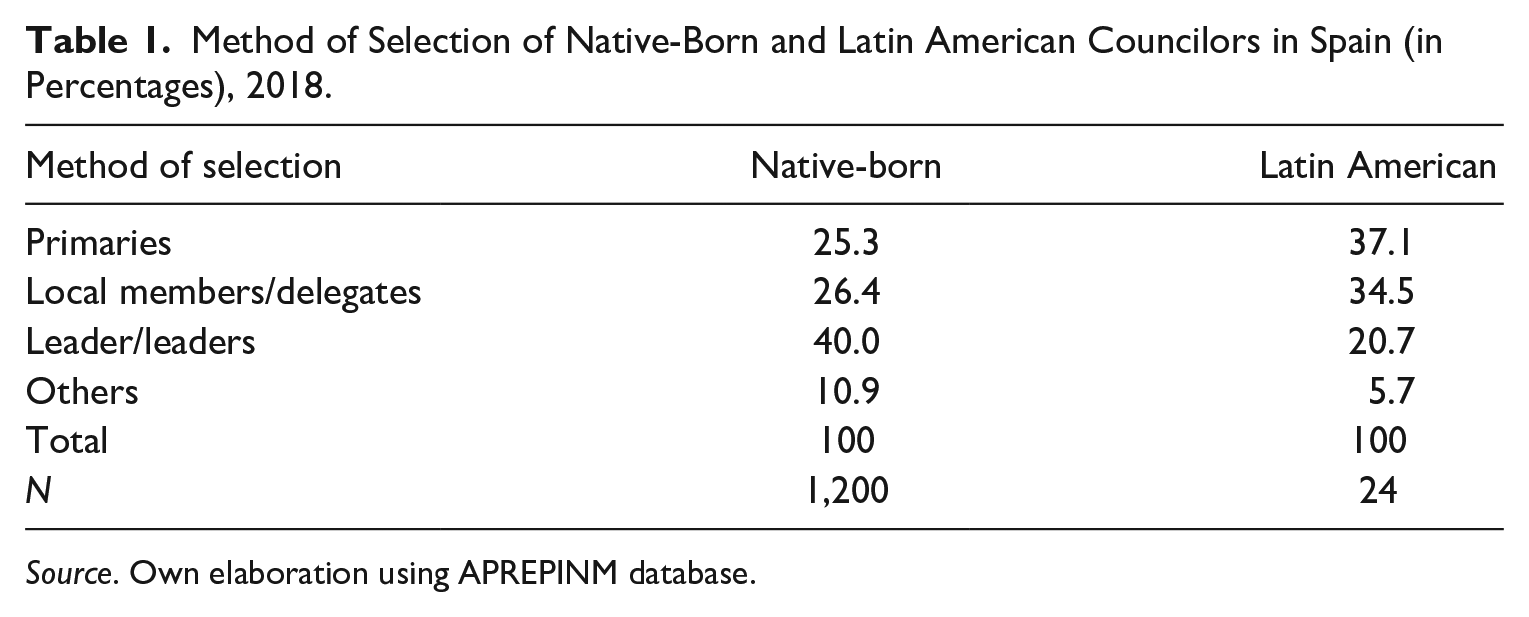
Following the results of the survey, 71.6% of the councilors of Latin American origin indicated primaries or local members and delegates as the main method for their selection as candidates (see Table 1). Specifically, 37.1% of councilors with Latin American background were elected in primaries (vs. 25% natives) and 34.5% by local members or delegates of the party (only 26.4% among native-born). By contrast, 40% of the native-born councilors were elected by the leader of the political party, a method of selection only mentioned by 20.7% of their Latin American counterparts. These results suggest that informal ties with local leaders have an important role in the selection of native-born councilors whereas this impact is far more limited in the case of Latin American councilors. In this sense, we argue that the changes within Spanish political parties toward more democratic and less ad-hoc selection procedures in the last decades may have benefitted more diverse councils with a greater presence of representatives with a Latin American background.
Method of Selection of Native-Born and Latin American Councilors in Spain (in Percentages), 2018.
Source. Own elaboration using APREPINM database.
One of the potential benefits of implementing primaries has been the enhancement of social diversification in the electoral lists. However, the role of party elites is still very relevant in Spain, where the electoral system establishes closed and blocked lists for local elections. These systems are characterized by the active involvements of the party leadership on inserting, ranking, and maintaining candidates in the lists, where loyalty to the same party elite is crucial (Cordero & Coller, 2015). For this reason, we may expect the party to rank the most loyal candidates (those handpicked) in safe positions and those elected in primaries in less secure positions. This thus raises the following question: Among the many reasons to be included in party lists, how important is loyalty for natives and Latin American councilors?
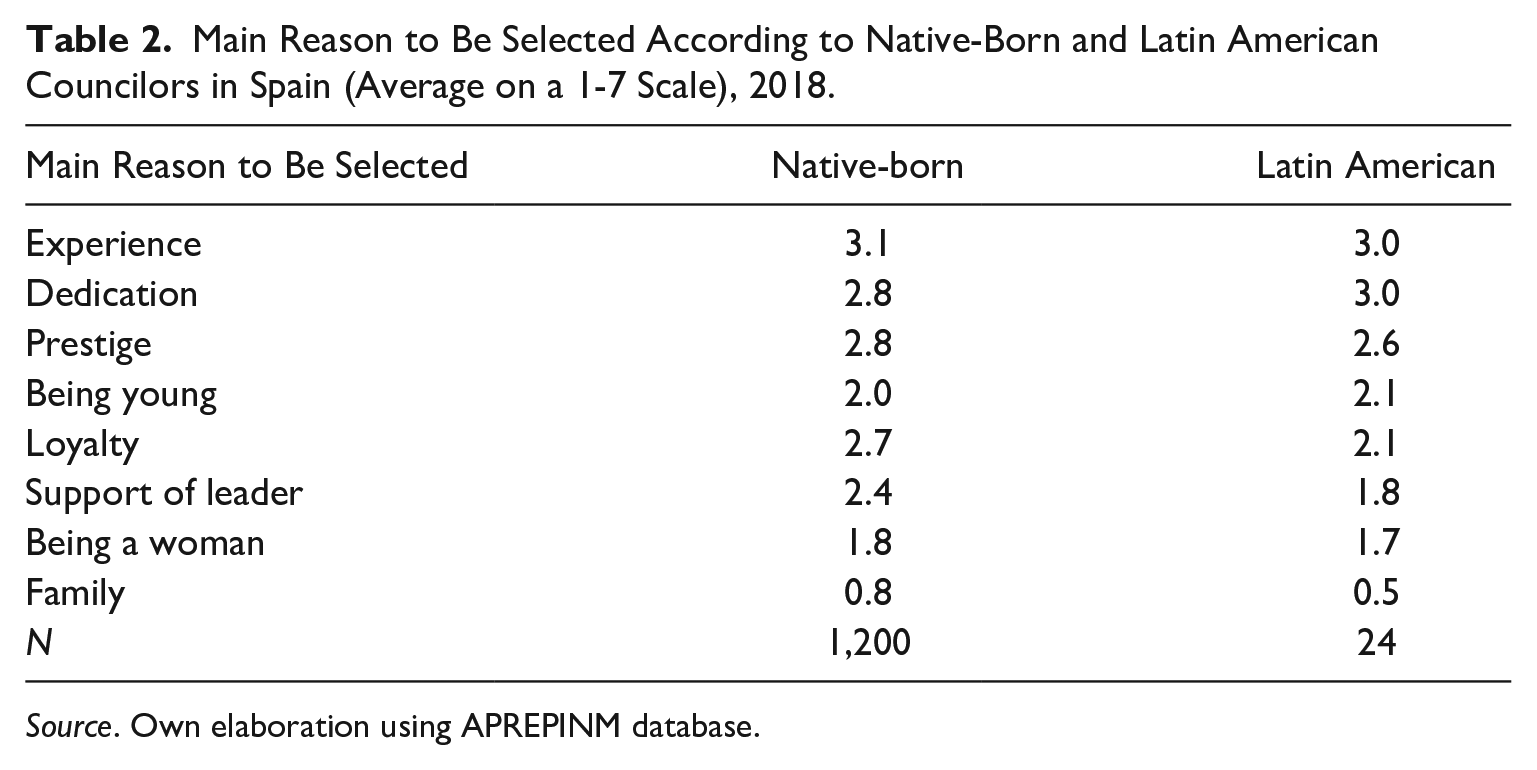
When it comes to the motivation to be elected, both native-born and Latin councilors argued, with a slight difference, that “experience” is the main criteria (see Table 2). With regard to the second reason, “dedication” to the party, it seems to be more important for Latin American councilors than for their native-born counterparts. The following quote illustrates this idea. When asked on the relation with the party before being a candidate, a Colombian-origin councilor mentioned a previous work as advisor:
Main Reason to Be Selected According to Native-Born and Latin American Councilors in Spain (Average on a 1-7 Scale), 2018.
Source. Own elaboration using APREPINM database.
Well, firstly, I set up an intercultural association in 2005. I arrived in (name of the town) in 2004 and one year after I set up an association called “Immigrant Association” (name of the town). And, well, that’s how I started to make myself known because I felt an inner emptiness as a newcomer. I didn’t know anybody ( . . . ). Afterwards (in 2015), they were drawing up the list and I told my friend (name of the friend) that I would like to know people of the party. I did not meet them; I knew them only by sight. Therefore, I asked her to introduce me in order to advise them on the guidelines on how to engage with the immigrant population. (Latin-origin councilor of a left-wing party)
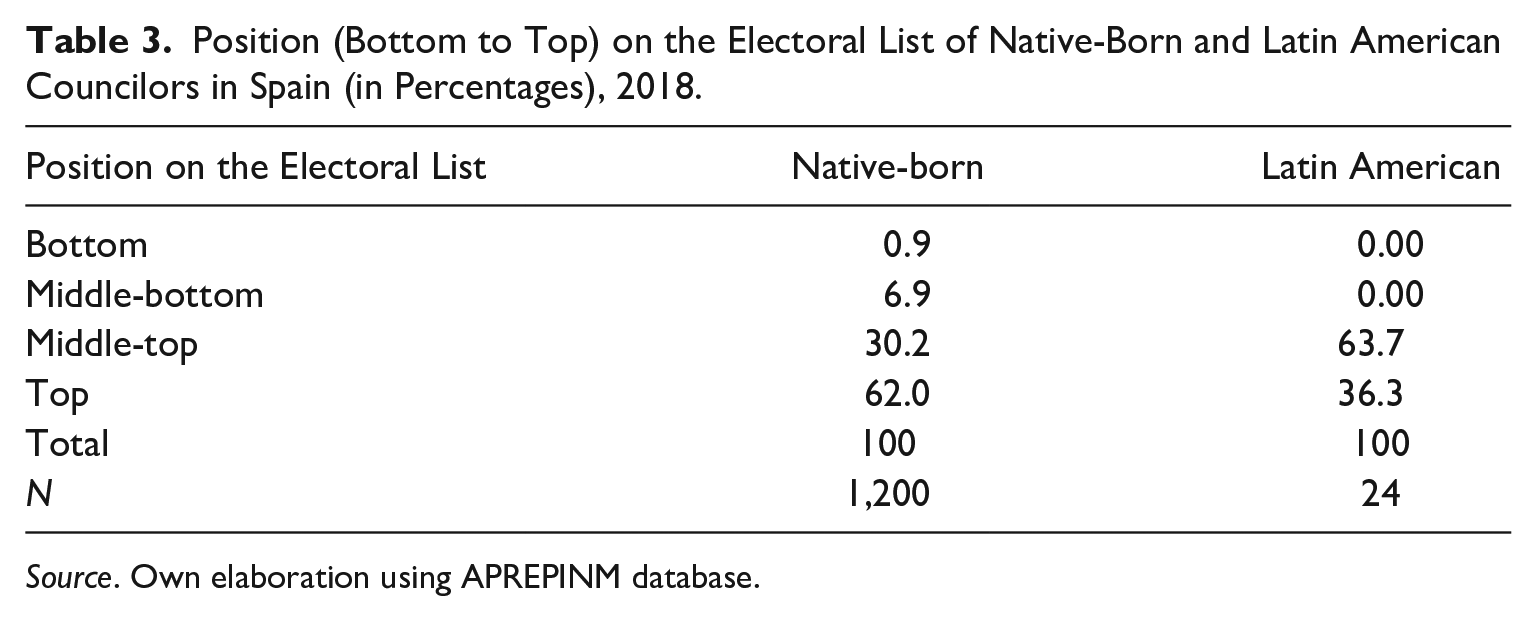
However, the largest gaps between both groups of councils are “loyalty” and “support of the leader,” with higher percentages for the native-born councilors. As mentioned above, this might be linked with their better location in lists compared with Latin Americans. The data raise the following question: Were immigrant-origin councilors ranked in less secure positions compared with their native-born counterparts? In our survey only 11% of the councilors of Latin American origin considered that they were in a “secure position,” versus 50% among the native-born population. These perceptions match with the information reported on their location in party lists in the article by Pamies et al. in this special issue. Only one out of three Latin American elected councilors (Table 3) mentioned being in the first quartile of the ballot, compared with a ratio of almost two out of three among native-born councilors. In the in-depth interviews Latin American councilors and party leaders mentioned different reasons for this. On the one hand, candidates with an immigrant background explain that their underrepresentation is due to a lack of trust of local leaders:
Position (Bottom to Top) on the Electoral List of Native-Born and Latin American Councilors in Spain (in Percentages), 2018.
Source. Own elaboration using APREPINM database.
We certainly know that we are selected for irrelevant positions. Why? What is the negative side of this? They do not think an immigrant might be in secure positions. I have yet to see an immigrant in a secure position. . . . It is very difficult. (Latin American candidate—finally not elected as councilor—of a right-wing party)
On the other hand, party leaders mention immigrants’ rejection of holding top positions for fear of losing their jobs or being socially stigmatized: It is very difficult (to include immigrant-origin candidates in list), even if it is just in a symbolic way . . . in the lowest positions . . . not in secure positions ( . . . ). With regard to the electoral list, we prioritize direct contact, socially active people. At least in our case. We have always prioritized those who have previously collaborated with us in some way. Beside this, at a certain point we have to fill up the list, we have to reach the minimum, and at this point yes, friendship . . . close people. . . . But, we have to guarantee them that it won’t harm them. Quite often their first answer is “no.” Then, you tell them ‘it is at the end of the list, there is no any legal consequence. Moreover, you will have a day off to be an electoral observer . . . (Local leader of a left-wing party, Native-born)
To summarize, Latin American councilors tend to be selected to a greater extent through inclusive formally established processes, notably in primary elections. The results also indicate that although they show a stronger dedication to party activities, they were included in positions that they perceived as less safe compared with their native-born counterparts—who mention their loyalty and support to the party leadership as the main reason for their selection. After studying the mechanisms behind the selection of Latin American councils to be part of the electoral lists, we turn to issues related to their political representation, once elected. To what extent do they consider that the election results of their party were affected by the vote of nonnatives? (Bergh & Bjorklund, 2011; Maxwell, 2012). Do Latin-origin councilors consider themselves as representatives of the immigrant community?
With regard to the link between the presence of Latin American councilors and “immigrant vote,” our data confirm this idea. Forty-one percent of the Latin-origin councilors considered that the vote of immigrant-origin population was significant in their parties’ results, compared with only 29% for native-born councilors (results not shown in tables due to space constraints). The interviews carried out with political leaders in municipalities with a high concentration of immigrant population also point in this direction. When asked for the reasons to include candidates with a Latin American origin, they underlined the need of having representatives from immigrant communities: Well, regarding the criteria . . . the criteria you always try to achieve. . . . You normally try to select social leaders from their respective communities. If possible . . . There are six people from the five most important immigrant communities settled in the town and in the Community of Madrid and Spain, I think—in our list. . . . For us it is important to send out a powerful message. (Local leader of a left-wing party, native-born) We need to open (the party) more. We need to understand that in a city like this with 20% of newcomers, even more, you want (your party) to resemble the population you represent. . . . In our case, the most important contacts are with the Uruguayan and British communities, the latter are very worried about Brexit and do not know whether they will vote. Also the Argentinean community. (Local leader of a left-wing party, native-born)
The gap in the perceived importance of the immigrant-origin voters in the electoral outcome of the party (12% difference between native-born and Latin American councilors, data not shown in tables) indicates that the latter (who also tend to be selected in municipalities with higher proportion of immigrant-origin population), may perceive themselves as part of a party strategy addressed to obtain electoral gains.
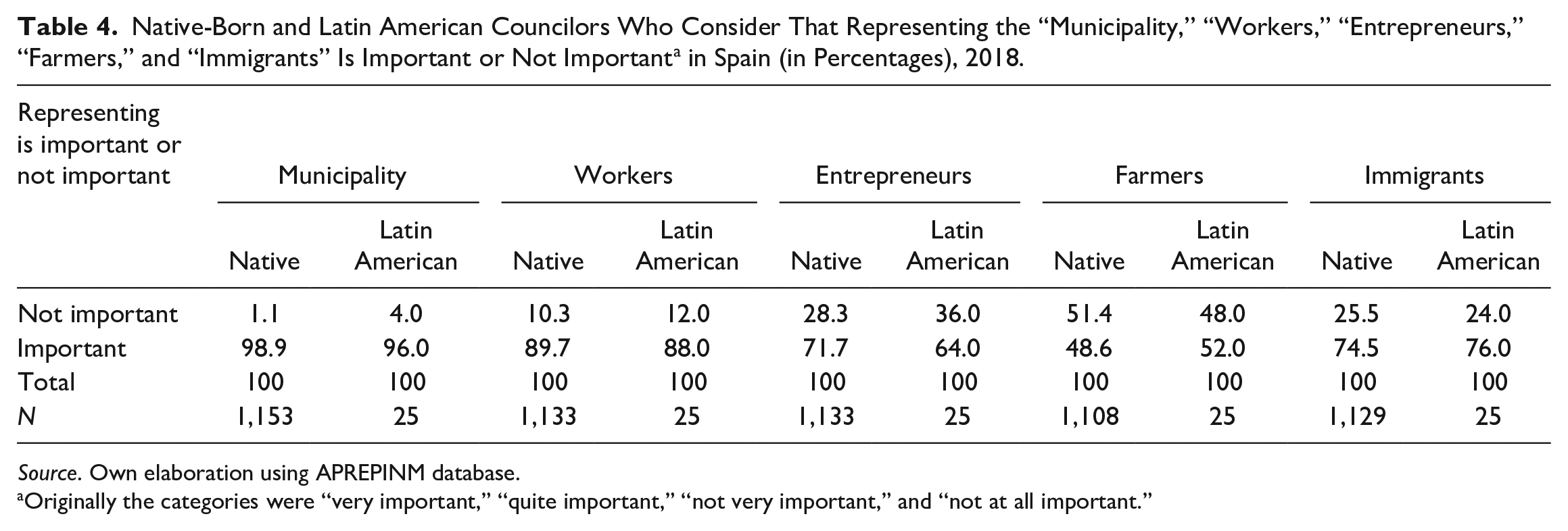
Following this argument, we investigate the extent to which these councilors considered themselves as figureheads of the local immigrant community. Table 4 shows the importance attached by elected councilors to immigrant representation, compared with other relevant social groups and the municipality as a whole. Among Latin American councilors, 76% believe that “representing immigrants” is very or quite important. Surprisingly, the difference with native-born councilors (75%) is smaller than we may expect. The greatest gap between both groups is in the importance attached to represent “entrepreneurs,” a group mentioned by 72% of the native-born and 64% of the Latin American councilors, which is probably explained by their position in the labor market (see the Introduction of this special issue for more details on how Latin Americans are overrepresented “in the lower paid and less qualified strata of the labor force”).
Native-Born and Latin American Councilors Who Consider That Representing the “Municipality,” “Workers,” “Entrepreneurs,” “Farmers,” and “Immigrants” Is Important or Not Important a in Spain (in Percentages), 2018.
Source. Own elaboration using APREPINM database.
Originally the categories were “very important,” “quite important,” “not very important,” and “not at all important.”
Although Latin American councilors are aware that they might be placed as electoral totems of the local immigrant community, they give more relevance to the representation of other groups such as “workers” (or the “municipality” at large), as is also shown in the contribution by Mora et al. for the U.S.-Latino population in this special issue. In-depth interviews with Latin American–origin candidates also point at this direction:
Which part of the electorate do you feel closer to you?
It is difficult to be representative of a specific community because, as everyone, they have different perceptions and opinions . . . ( . . . ). Well, I think some people identify you thanks to the daily contact . . . not only because you are part of a specific community but because you socialize . . . and, well, I think that thanks to this. . . . It is broader than to be part of a specific minority group. (Candidate of Latin American origin—finally not elected as councilor—of a left-wing party)
Which groups, maybe foreign population, or women, I don’t know, do you represent?
( . . . ) maybe people perceive me as a black person because of my appearance, as well as I see you as a white person. This is your outer appearance. But I see you as a human being, you are a woman and that’s all. Then, inasmuch as I perceive people in this way I think they also perceive me in the same way, so I would like to represent the entire population: kids, young adults, of any political party, any race . . . (Latin American–origin councilor of a left-wing party)
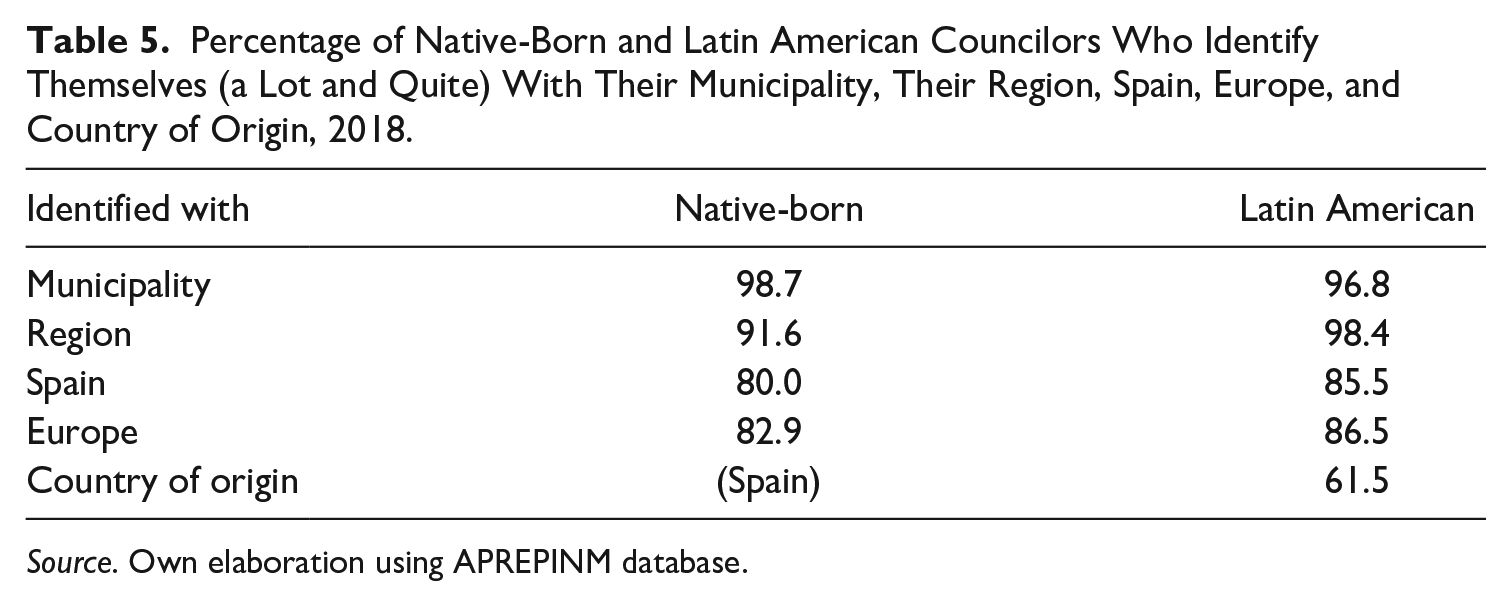
In this vein, our interviews suggest different views among leaders and Latin American candidates on why the latter are included in electoral lists. While leaders tend to incorporate them as a way to reflect the local diversity, that is, to attract new voters, among Latin American councilors, the reasons to engage in politics would transcend the representation of the immigrant community. We argue that a potential explanation behind the wish of the Latin American councilors to represent other local groups, in addition to the immigrant community, might be due to their self-identification and sense of belonging, which goes beyond the identification with their country of origin. Our survey includes a question on the degree of identification with the municipality, the region, Spain, Europe, and, in the case of immigrant-origin candidates, their country of origin (Table 5). While the percentage of councilors of Latin American origin who identify themselves with their country of origin is 61.5%, they show much higher levels of identification with the municipality (96.8%), the region (98.4%), and Spain (85.5%). The gaps with the native population are especially relevant to the identification with the region and the country: only 91.6% and 80% of the Spanish councilors identify themselves with their region and country. These results suggest, on the one hand, that identification with the country of origin and the receiving society are not incompatible (see the article authored by Mallet & García-Bedolla as well as the article authored by Lobera in this special issue). On the other hand, the results suggest that Latin Americans, once they overcome the obstacles in a hard pathway to power, reach very high levels of social and political integration in Spain.
Percentage of Native-Born and Latin American Councilors Who Identify Themselves (a Lot and Quite) With Their Municipality, Their Region, Spain, Europe, and Country of Origin, 2018.
Source. Own elaboration using APREPINM database.
Conclusion
Our study is in line with research that points at the problems of underrepresentation in electoral politics that immigrant minorities suffer in Spain, including those of Latin American origin. Following their “pathway to power,” the analysis of our online survey indicates that councilors with Latin American background report having been selected by more inclusive ways (that is, primaries or selected by local members and delegates) than their native-born counterparts. In-depth interviews also reveal that candidates had previously established informal contacts with political parties through immigrant associations. Regarding the motives for inclusion in the list, Latin American councilors in the online survey report “loyalty” and “the support of a leader” to a lesser extent than their native-born counterparts while they also perceive that they hold less secure positions on the list than the native-born ones. This result suggests that ad hoc selection practices by party elites play an important role in enhancing or restricting the participation of migrant minorities.
In terms of representation, once elected, councilors of Latin American origin give greater importance to the immigrant vote for the result of their respective parties than those of native-born origin. However, they perceive themselves as representatives of immigrant minorities to a similar degree than their native-born counterparts. Although Latin American councilors might see themselves as part of a party strategy to appeal to the immigrant vote, they show a tendency to reject the role as mainly representatives of migrant minorities, and prefer to see themselves as representatives of society at large or specific groups like workers. A potential explanation may lie in their strong sense of belonging to the local community. Interestingly, Latin-origin councilors show stronger feelings of attachment to Spain, the region where they live, and Europe than their native-born counterparts. In fact, these feelings of attachment to the host society are stronger than attachment to their original countries of origin. The data shown in this article suggests that, once elected following a not easy access to power, Latin American councilors exceed the role of representatives of a specific community to become representatives of society at large.
Our research contributes to studies on the political integration of immigrant minorities through electoral politics in new countries of migration such as Spain. Findings open empirical avenues to study the extent to which other sizeable minorities are selected and represented in the political system of new migration countries such as Spain, as well as, the role of party elites in the participation of these minorities.
Footnotes
Declaration of Conflicting Interests
The author(s) declared no potential conflicts of interest with respect to the research, authorship, and/or publication of this article.
Funding
The author(s) disclosed receipt of the following financial support for the research, authorship, and/or publication of this article: This article uses data from the APREPINM Project that received funding from the Spanish Ministry of Economy and Competitiveness in the framework of the Call of the National Research Program Oriented to Societal Challenges (reference CSO-2016-79540-R). We would like to thank all members and collaborators of this project for their assistance with the data collection. The article and its open access publication is also based upon work funded by COST Action 16111 EthmigSurveyData ( ), supported by COST (European Cooperation in Science and Technology) and funded by the Horizon 2020 Framework Programme of the European Union; the University of Oxford; the Universidad Autónoma de Madrid, and the Casa de Velázquez in Madrid.