



Abstract
TikTok is commonly known as a playful, silly platform where teenagers share 15-second videos of crazy stunts or act out funny snippets from popular culture. In the past few years, it has experienced exponential growth and popularity, unseating Facebook as the most downloaded app. Interestingly, recent news coverage notes the emergence of TikTok as a political actor in the Indian context. They raise concerns over the abundance of divisive content, hate speech, and the lack of platform accountability in countering these issues. In this article, we analyze how politics is performed on TikTok and how the platform’s design shapes such expressions and their circulation. What does the playful architecture of TikTok mean to the nature of its political discourse and participation? To answer this, we review existing academic work on play, media, and political participation and then examine the case of Sabarimala through the double lens of ludic engagement and platform-specific features. The efficacy of play as a productive heuristic to study political contention on social media platforms is demonstrated. Finally, we turn to ludo-literacy as a potential strategy that can reveal the structures that order playful political participation and can initiate alternative modes of playing politics.
Introduction: TikTok as a Political Force
In March 2019, a month before the Indian general elections, the Election Commission issued a model code of conduct for political parties. This included a mandate not to exploit deeply divisive issues to sway voters and stipulates on social media advertisements. To ensure compliance, the Commission held a meeting with representatives from the major social media companies—Facebook, Twitter, Instagram, ShareChat, and TikTok. TikTok’s inclusion in this list was surprising. It is a short video platform, similar to Vine or Dubsmash where people share videos that are 15 seconds or less in duration. This usually takes the form of lip-syncing to popular songs and movie dialogues. How does such a silly, playful platform emerge as a political actor?
Today, the political potential of TikTok is obvious. A year later, in June 2020, the Indian government banned the app outright (alongside 58 others Chinese apps), citing national security concerns (Pahwa, 2020). Furthermore, a similar move has been flaunted two months later by the U.S. administration, and at the time of writing it seems TikTok will be banned in the United States unless purchased by an American company (Lerman, 2020). Through this prism, the Election Commission’s gesture can be read as an early acknowledgement that social media, including the “silly” ones, are spaces where politics is being performed today. Thus, throughout the article, we suggest treating our case study not as singular or “Indian” instance of the interrelation between play, politics, and power—but as part of a global media ecology that changes what it means to be politically engaged. As 800 million Indians use TikTok, deeper exploration into the platform and its political roles are necessary (Bhattacharya, 2020). News reports note that right-wing content (Ananth, 2019; Maanvi, 2019), disinformation (Kozlowska, 2019), hate speech, and abusive content that discriminates against marginalized sections (Christopher, 2019) thrive on this platform. They underscore the potential similarity of TikTok’s current state to what we now associate with the vernacular meme culture of the alt-right and its influence on political events (Tuters et al., 2018; Tuters & Hagen, 2019). However, unlike alt-right meme production that originates in corners of the web like 4chan and then spreads to other social media platforms, TikTok is “still primarily an app for normies” who create, watch, and interact with videos (Jennings, 2019). This distinguishes TikTok from current scholarship on trolling and griefing, as it does not (yet) permit the creation of idiosyncratic vernacular communities to perform direct attacks, relying on hashtag disseminations across wide nonspecific audiences (Coleman, 2010; Phillips, 2015, 2019).
As TikTok is now the most downloaded social media application in the world, we need to understand how political participation takes place on the platform and how it is structured (Chan, 2019). This is pertinent as, TikTok’s architecture engineers viral spread and replication of content into its very DNA (see following section). Furthermore, leaked internal documents about TikTok’s content moderation guidelines in China indicate that it toes the party line and censors content critical of the socialist system or the government (Hern, 2019). This shows the paradoxical state of the app that attempts to harness the attention (and data) of its users, while being rooted in an undemocratic media regime. An investigation of TikTok moderation by The Intercept has shown a range of “undesirable” content bordering on the Kafkaesque, from merely mentioning a public official to censoring “ugly” users (Biddle et al., 2020). Those posting on a list of “banned” topics will have no idea that their videos’ visibility has been purposefully impeded by the platform and would likely attribute it to the vagaries of the algorithm (cf. Bucher, 2017). Fighting for the attention of its (young) user-base (Terranova, 2012), TikTok is stuck in a double bind of openness and control, often trying to persuade non-Chinese users to participate by ceding moderation control to local agents (Fingas, 2020). The “nonserious” nature of TikTok further obscures its actions as a playfield for (political) persuasion. How do we begin to understand platform accountability when we are not privy to what the Chinese-owned platform even considers “political”?
In this article, political contention on TikTok is studied through the body of work on play as a mode of political participation. Playful political engagement, including memes, satire, parody, and so on, has been theorized as democratizing politics and eliciting participation from audiences that are conventionally hard to reach (Hartley, 2010). Theorists also raise caution about its distorting impacts on political discourse and participation and the shift toward ironic and issue-centric modes of light-touch activism, or slacktivism (Morozov, 2009). As we show through our central case study in the 2019 Indian elections, TikTok’s playfulness can, in fact, be very activating.
Starting with a brief overview of our main arguments, we will situate our examination of TikTok within the contentious issue of women’s entry into Sabarimala, a temple that women of menstruating age are barred from entering on religious grounds. It is among the divisive issues the Election commission guidelines forbade political parties from weaponizing in their campaigns. Yet TikTok videos on this issue spread virally both on and off the platform. By drawing on a set of videos filed under the [Sabarimala] hashtag, we examine the forms that political engagement on TikTok take, the critical work they undertake and what shapes this activity. As we show, one cannot indulge in celebratory accounts of playful political participation without considering how the platform and broader sociopolitical structures influence the kind of critique that takes root. Yet, rather than dismiss playful ways of doing politics and clamor for reinstating rationality as the cornerstone of participatory politics, new forms of action can flourish when citizens and policy makers exhibit ludo-literacy. Play, thus, becomes a productive heuristic in unveiling how power insidiously enters banal social media practices and the implications they can have on the broader political setting.
Literature Review: Playing Politics Through TikTok
TikTok as an Interface
A cursory overview of TikTok is in order given its novelty and absence in English language academic discourse, and scarce presence in regional ones. TikTok is a social media network for creating and sharing short-form mobile videos that are 15 seconds or less in duration. These take the form of lip-syncing, acting out or dancing to songs or dialogues from popular culture. Users can record videos with sound or upload their own track by splicing together audio fragments from different sources and adding in the video later. The latter is more popular since lip-syncing is the staple form. They can like, comment, and share (off the platform) videos by other users. Hashtags work like they do on Twitter, allowing for content to be filed under topics or themes. Users also have a range of editing options, filters, and effects, similar to other popular visual platforms such as Snapchat or Instagram (Highfield & Leaver, 2016).
What makes the platform distinct is that replication and virality, or “spreadability” (Jenkins et al., 2013), are encoded as features of the platform; every TikTok video has the potential to spur the creation of another. Users can click on the soundtrack used by a video to reveal other videos that use the same track and press the “Use this sound” button to act out their own version (Figure 1). Furthermore, the “react” feature may be utilized to record and display their reaction to an existing video, picture-in-picture. All the videos in Figure 1, except the first one, employ the react feature to record reactions to the original video of a prank. Duets too, are visually shown picture-in-picture, but users join in on the enactment of the soundtrack, lip-syncing to another part of the dialogue or song that the original user had dubbed. In all these three cases, the original video is reproduced and acquires more reach.
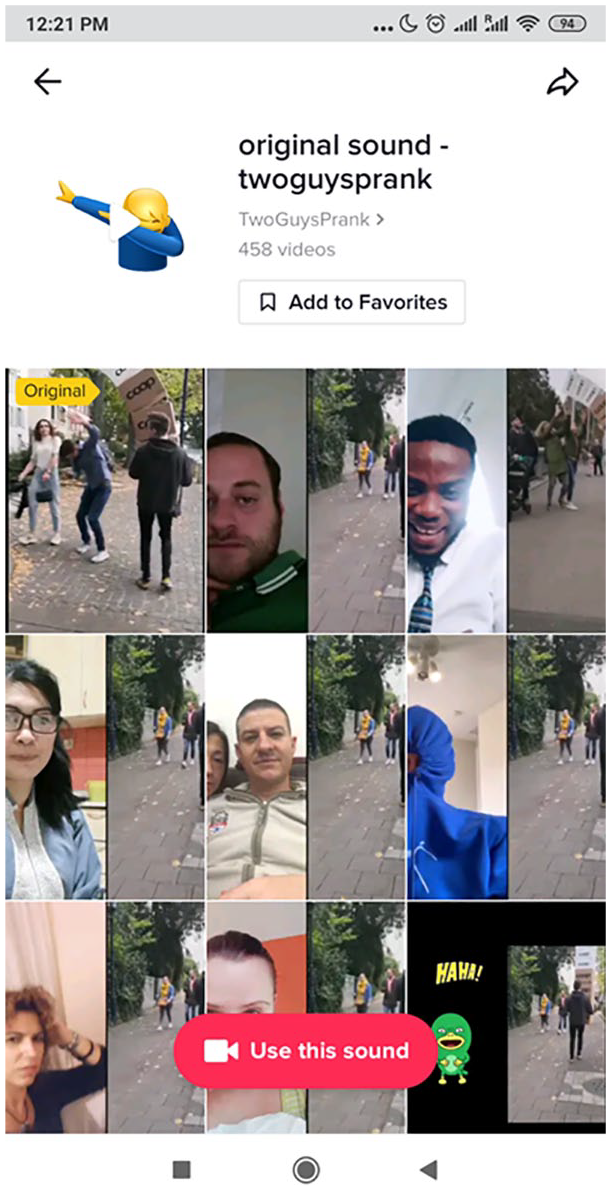
Screenshot of the TikTok app showing the videos that use a soundtrack.
Another unique feature is the centrality of the algorithmically curated “For You” feed (similar to Instagram’s “Explore”), rather than the now-standard personalized feed based on followed accounts. TikTok users are greeted with this feed (Figure 2) on opening the app and tend to spend most of their time here. Only 22.5% of people check the followed accounts page, based on a sample survey (Wang, 2018). Users can scroll through the auto-play enabled feed where each video starts playing as you scroll down. Prima facie, the algorithm controls what users see on TikTok to a greater extent than other platforms.
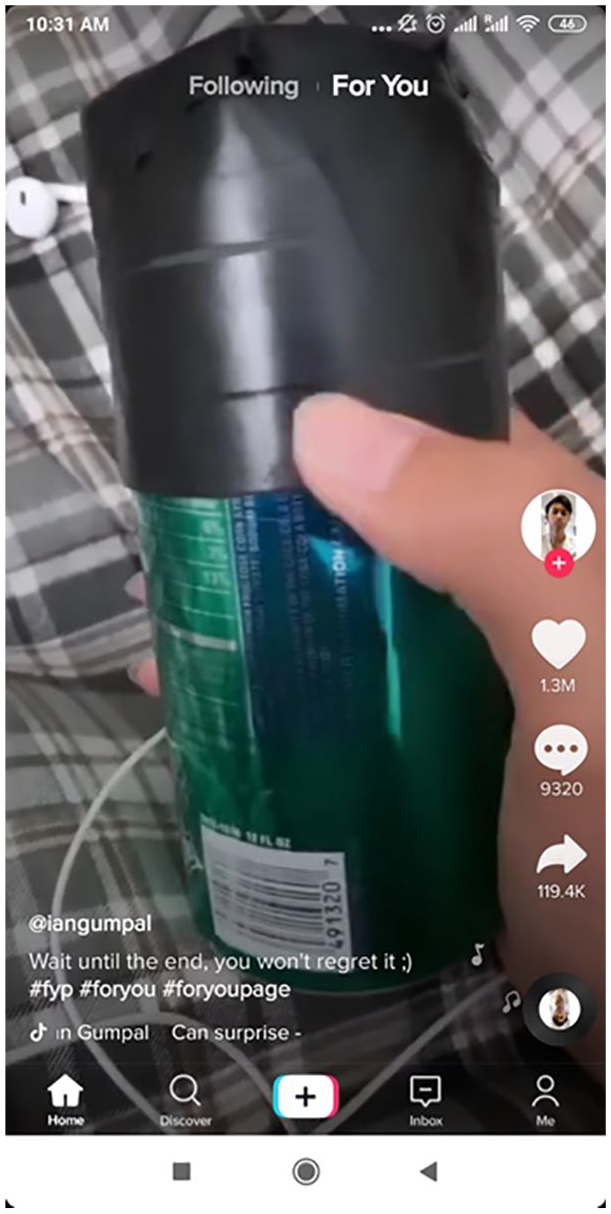
The “For You” feed displaying a video with another cued automatically.
Recent work on contemporary user interfaces highlight how they can normalize certain behaviors (Stanfill, 2015), fine-tune users’ time and money expenditure (Ash et al., 2018) and potentially redefine sociality itself (Bucher & Helmond, 2018). Thus, when users create TikTok videos about contentious political issues, how does the platform’s design shape such expressions and their circulation? What does the playful architecture of TikTok mean to the nature of its political discourse and participation? To answer these questions, we review existing research on play, media, and political participation and then examine the case of Sabarimala through the double lens of ludic engagement and platform-specific features.
Playing Politics
Memes, GIFs, lip-synced videos, parodies, and so on, that critique contemporary political events are an integral part of our social media experience. Glas et al. (2019) posit that play, media, and technology exist in a triadic relationship with each other, when the media technologies we use become more playful and are spaces where acts of citizenship take place. Play is no longer restricted to the playground but enters previously nonplayful domains, with the enactment of citizenship acquiring a ludic character. Affective, playful ways of political engagement become legitimized, unseating the centrality of rationality in the Habermasian public sphere (Chouliaraki, 2010). This also confers citizenship a more productive, participatory, and performative dimension—one becomes a citizen by participating playfully in politics (Gordon & Walter, 2019; van Zoonen et al., 2010). This necessitates two frames of inquiry: play as a way of doing and play as a way of looking (Glas et al., 2019, p. 16). The first studies the playful and silly civic practices through which citizenship is enacted. Second, play as a transgressive force stretches and explores the limits of political participation, laying bare the conditions of possibility: what forms of play are permissible, what are not and to what extent. Therefore, play serves as a productive heuristic that reveals how sociopolitical structures and institutions shape and constrain the enactment of citizenship. By combining these two aspects, we can analyze how the transformative potential of play to rework existing power relations are modulated by the structures within which we play. In our inquiry, we need to take into account both what users do on TikTok and how the platform and other structures facilitate certain expressions over others.
Play as a way of doing takes as its objects of analysis the various individualized, networked, and affective forms of engaging in politics exemplified by memes, satire, lip-syncing, and so forth. These practices emerge out of a shift in media consumption wherein passive users give way to ‘produsers’ (Bruns, 2007). Deuze (2006) points out that users are aware of the mediated construction of their reality and intervene in the construction of reality by engaging in “highly personalized, continuous, and more or less autonomous assembly, disassembly, and reassembly of mediated reality” (p. 66). They comment on and rework existing cultural imaginaries and narratives by refashioning old media forms and fusing them with influences from contemporary lifestyles and issues. This is immediately visible in TikTok users combining audio fragments from movies and TV news with mimicry to poke fun of current events. Yet such fluidity can constitute emergent vernacular discourses that are difficult for outsiders to penetrate, potentially masking hurtful or violent ideas away from the public eye (Tuters & Hagen, 2019).
The subversive nature of bricolage—the making-as-one-goes-along—finds an ally in play and its world-making function (Sicart, 2018). Players and bricoleurs reontologize their existing reality by bending extant forms of meaning-making in new ways. TikTok users might perceive in a song a 15-second segment suitable for replication, just as a trained sculptor can see a potential statue in a marble block. The ontologizing capacity of play is facilitated and mirrored by computational processes that remake reality in informational terms—bits and bytes, feedback loops, and so on. Social media, in general, translate previously unquantifiable aspects of our reality such as affect in numerical and programmable terms (likes, “sad reactions,” claps, etc.), often to the benefit of platforms and potential detriment of meaningful use (Grosser, 2014; Terranova, 2012). Mobile phones and their explicitly playful interfaces embed playfulness in the mundane, and wherever we take them (Hjorth, 2018). This enables a politics on the move wherein political expression takes on a fleeting, casual character similar to games like Candy Crush that one would play while commuting (Gekker, 2019). They inaugurate a form of political participation that Gekker terms “casual politicking” which is characterized by ease of access, lack of ideological commitment and short-cycle repetitive patterns of use (Gekker, 2019, p. 402). Sharing a “funny” video that has a certain political stance does not mean committing or aligning to that politics. It can be picked up and left off at one’s convenience. As noted by researchers studying the emergence of the so-called Alt-right in United States and elsewhere, this practice can also normalize previously unacceptable behaviors. “It’s just a joke!” is a claim hard to refute, especially when conducted on platforms known for irreverence. Yet such jokes can propagate and legitimize racist or homophobic speech in wider communities (Lewis, 2019; Tuters et al., 2018)
Clearly, the intertwining of play, media, and citizenship poses certain challenges too. One, play is autotelic in nature: the prime purpose of play is the activity itself (Gekker, 2019; Sicart, 2018). Consequently, it does not lend itself to concrete ideologies or sustained engagement. Second, playful forms of political participation can easily become commodified and co-opted because of their popular appeal (Miltner & Highfield, 2017) and their personalized nature (Chouliaraki, 2010; Kligler-Vilenchik & Thorson, 2016). Play in the online landscape is an undulating landscape of resistance and submission as platforms, especially, modulate the democratizing potential of bricolage (Hjorth, 2018; Sicart, 2018). The design affordances of platforms exercise a soft power in shaping and constraining our actions by defining what is permissible and valuable.
Platforms and their architecture afford to varying degrees: they “request, demand, allow, encourage, discourage and refuse” different actions (Davis & Chouinard, 2016, p. 242). TikTok’s soundtrack feature, for instance, encourages users to replicate existing soundtracks, promoting its viral spread. While they allow people to insert themselves into political discourse, some modes of participation get sedimented over time: it becomes common sense to reserve rational, political commentary for Twitter (or better, keep to oneself) and silly dances for TikTok. There is limited room for disagreement as users can only leave a comment, create an entirely different video or “react” with angry expressions. As adversarial interaction is discouraged, vitriolic or provocative content fails to produce sustained political engagement that leads to identification and agreement unlike in agonistic spaces like YouTube comments (McCosker, 2014). Beyond that, Kligler-Vilenchik and Thorson (2016) remark that “frames” of citizenship that align to dominant power structures are more likely to persist. This could be because algorithms that are trained to sustain users’ attention favor, reproduce, and reaffirm normative identities (Dobson et al., 2018, p. 19). As daily active users and time spent on the platform are metrics that platforms leverage to attract revenue from advertisers, they have a vested interest in providing easy, conflict-free, and engaging experience to users. TikTok, in this case, acts not as a neutral entity, but a vested party willing to promote a form of “outrage politics” as long as it keeps the users engaged—whether they adhere to it ideologically or not (boyd, 2017). Thus, play is strategically channeled to consolidate the multistable technologies that mediate our experience (Sicart, 2018). The democratizing and subversive potential of play that hands users control over creating their own worlds is modulated and constrained by platform interests. That is, we are asked to play a game whose rules are set by technology and the various forms of power that flows through it. We keep playing without realizing that we are being played.
Play as a way of looking paves way to this realization. Instead of critically analyzing the platform guided by a conceptual framework, users can acquire literacy in the conventions that order TikTok through play. Ludo-literacy entails learning the rules of the game by playing it and realizing through experience what is possible and desirable on the platform. Play as a heuristic demands giving more freely into play and trying to go beyond the rules that circumscribe it, thereby identifying how the activity is structured (van Vught & Glas, 2017). As we explore, transgress and give into play, the structural factors that nudge our actions and capabilities in a certain direction will be revealed, affording insight into the cultural, generic, and technological contexts that shape our play. TikTok and the shifting landscape of practices and associations that take shape there cannot be considered as an immutable, passive object, but a process. They result from ongoing negotiations between Tiktok’s architecture, the rules it imposes, the user practices that they foster and those that go against the grain, within specific contexts.
In the following sections, we apply the insights from this literature review to dissect a case study on how TikTok as an explicitly playful platform mediates a deeply divisive issue.
Method: #Sabarimala on TikTok
Sabarimala is a temple in the South Indian state of Kerala dedicated to the deity Ayyappan, a celibate god. Devotees undergo a 40-day period of abstinence, ritual purity, and prayer before visiting the shrine. As menstruating women cannot observe this ritual purity for 40 days, they are not allowed to enter the temple. In September 2018, the Supreme Court of India ruled this practice discriminatory and held that women of all ages should be granted entry. This was seen by many practicing Hindus as an affront to their beliefs. Several devotees took it on themselves to protect their god and make sure that no woman enters the temple.
The LDF government in Kerala 1 stood by the Supreme Court verdict. This created a political opportunity for Hindutva organizations and the BJP to align with the devotees and expand their meager voter base. What ensued was a constant battle between these two camps on the ground and on the major news channels. Several women who tried to enter the temple were turned away and were subjected to harassment on their return. On 2nd January, 2019, two women assisted by the police covertly entered the shrine and offered prayers. The temple was “purified” afterward (“Sabarimala Temple Shut for ‘Purification,’” 2019)
The Sabarimala issue was chosen as a case study because it elicited much debate in Kerala society and has been weaponized by Hindutva parties to create a shift in the political landscape of the state. Consequently, it is a contentious topic the Election Commission advised political parties not to exploit in their campaigning. Two, the videos on TikTok that bear the hashtag #sabarimala have amassed almost 28 million views, offering a substantial site for empirical work. These include all sorts of content: parodies of news snippets, devotional songs, individual opinions, and so forth. Furthermore, the feed for the hashtag displays a literal saffronization (saffron is the color associated with the BJP and other Hindu nationalist parties) of content (Figure 3). Several video thumbnails include people sporting saffron accessories, flags, and ritual markings on their forehead.
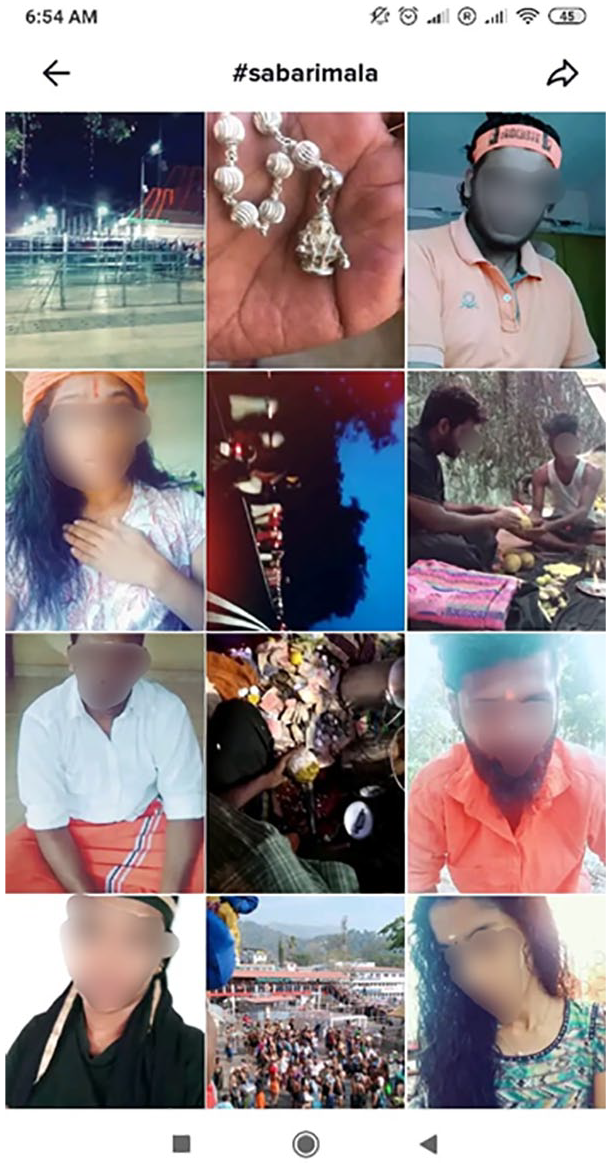
Screenshot of a portion of the #sabarimala feed on TikTok.
To analyze how political engagement around the Sabarimala issue took place on TikTok and what forms of engagement gains prominence, this article focuses on the most popular (most liked) video and 3,494 others that use the same soundtrack. Therefore, this analysis is by no means exhaustive, yet is indicative of the central themes present in the specific case and should be seen as an initial foray into broader understanding of TikTok’s politics. The account name and facial features have been obscured for maintaining the privacy of users 2 .
Results: Mary Sweety Spoofs
Mary Sweety, a 46-year-old woman tried to enter Sabarimala twice in October and November 2018. She was turned away both times by the public and the police. Mary received wide media attention as one of the first few women who attempted this feat. The most popular video under #sabarimala is a parody of Mary Sweety’s interview telecast by TV channels (91,500 likes and 513 comments). As our analysis progressed, this topic became emblematic of the uneasy alliance of playfulness and radical politics cohabitating on the platform.
The soundtrack contains isolated bits from what Mary said in her interview as responses to questions about her whereabouts and intentions. These questions are edited-in from various movie dialogues uttered by several male actors, moving from a stern voice demanding an answer to a simpleton character who is puzzled by the exchange. Here is the transcript of the soundtrack: Q: What do you want, child? Mary: I came to see Ayyappan Q: Where are you from? Mary: Kazhakkoottam Q: What is your name? Mary: Mary Sweety Q (Aside): Eh, why does she look like a mentally unstable patient? Mary: It is hard for us (women) to climb with the irumudikettu [the bundle that devotees have to carry on their head when they ascend the stairs to the shrine]. We have to take care of our shoes . . . we might slip Q: Is there a history of mental illness in your family?
Most of the videos under this soundtrack have the user lip-syncing to Mary’s side of the dialogue. Some others “react” to preexisting videos, laughing, clapping, sighing, or facepalming. Others used the duet feature to act out the other side of the dialogue, assuming the interrogating/commenting voice. The absurdity of Mary’s claims is heightened by hyperbolic expressions alluding insanity and by using props. The most popular videos stretch the absurdity of props and exaggeration of mannerisms to the maximum. Instead of the bundle, “Marys” carry heavy suitcases and hold fluffy slippers, for example. In other versions, the impersonator sports a rosary—to underline that Mary is a Christian and not a true devotee—or as overly made-up or dressed inappropriately (mostly the case with male impersonators, Figure 4).
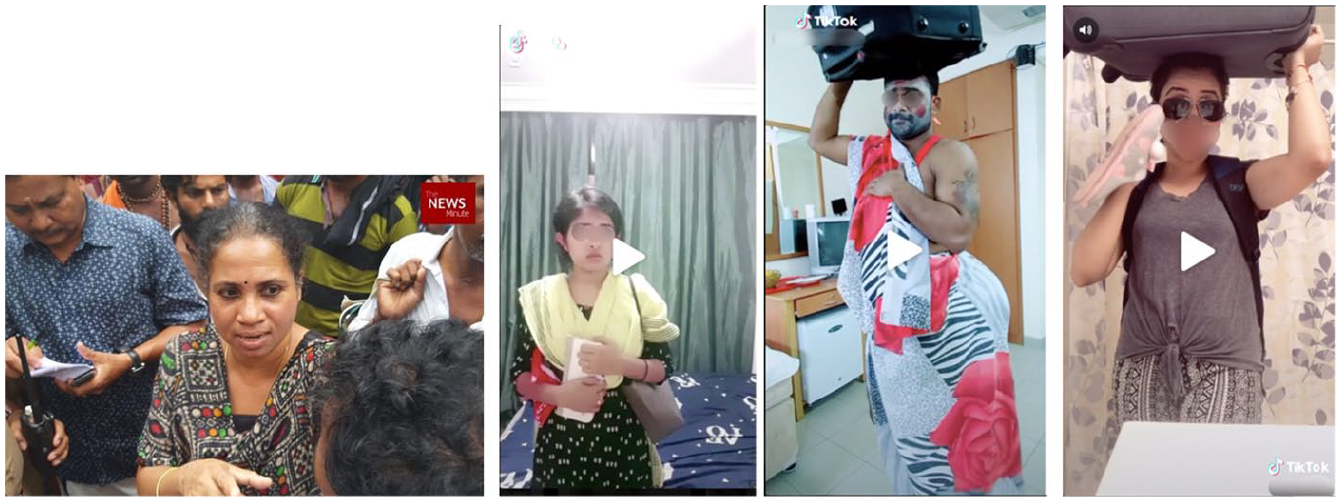
From left to right: Mary Sweety interviewed by reportersa, the “original” spoof that used the soundtrack, a male impersonator and the most popular video of the lot.
In the next section, we analyze the critical work done by these videos and identify what forms of political engagement are possible within the frame of the platform and the societal context. Through these two foci, we reveal the shaping effects of power relations at the platform level and the contextual level.
Discussion: How Do #Sabrimala TikTok Users Play Politics?
This section examines how political contention takes place on TikTok by simultaneously analyzing the critical work users perform and the platform affordances they make use of in this process. The possibilities and limitations offered by the soundtrack, the primary mode of critical activity, are discussed. As adversarial interaction cannot be realized within the limits of the soundtrack, alternative options are sought.
The Soundtrack
Mary Sweety spoofs use humorous formats like parody and mimicry to make fun of her attempt to enter Sabarimala and its televised coverage. The soundtrack serves as a template that frames the critical work, reontologizing Mary’s attempt as a farce and portraying her as inadequate (Sicart, 2018). Mary’s utterances in the news coverage are isolated from context and juxtaposed with movie dialogues to exaggerate absurdity. The authority of dominant media channels to define the meaning of Mary’s protest is undercut through the introduction of a dissenting voice (here, the movie dialogues that paint her as immature and mentally unstable). The event’s claim to historical significance is challenged by questioning its reality—it is just a media text, a scripted performance. In this sense, TikTok users exemplify Deuze’s (2006) bricoleurs who are aware of the constructed nature of mediated reality and improvise creative ways to participate in its production. Rather than live in a world where Mary is an activist, they create their own world through playful practices where she is just a joke. Any user who creates their version of the soundtrack replicates and sediments this framing of events.
The alternative version of reality proposed by the Mary Sweety spoofs acquire more force and undermines the aura of the original text through endless repetition, like digital memes. Kumar (2015) notes that parody in the Indian context enacts a “new grammar of critique” not just by humorously deconstructing an event, but by spreading virally via networks, generating new meanings in varied contexts (p. 233). Similarly, when Chinese political satire is shared online, it produces networks of users—similar-minded communities and affinity groups—and texts. Yang and Jiang (2015) liken it to grassroots movements that criticize hegemonic power while emerging as a mobilization against it. Here too, Mary Sweety spoofs accrues significance as a critique of power and strength in numbers when it is replicated by 3,500 users.
The networked, user-generated nature of cultural production can limit their capacity for critique. TikTok videos, like GIFs are created by users (unlike emojis that are supplied by developers) by decontextualizing fragments from other texts. They are “self-contained narrative(s)” that offer the viewer the set-up, resolution, punchline, and affect all within a tiny snippet (Miltner & Highfield, 2017, p. 6). But their ability and scope for political and critical commentary are limited by the forms of cultural knowledge they draw from and the affective engagement they seek to trigger. These institute in-group and out-group delineations. Here, these videos assume and reinforce an exclusive understanding of religious identity and the patriarchal baggage from movies that infantilize and delegitimize women. This results in the erasure of the progressive underpinnings of Mary’s actions: the revolt against the patriarchal ascription of women’s bodies as polluted. As the Mary Sweety spoof becomes an easily replicable template spread all over social media, Mary the activist disappears under Mary the simpleton.
Moreover, the soundtrack is restrictive and prescriptive. It highlights the absurdities—her name, religion, vague excuses—and suggests a formula for its enactment even as it accrues new layers of meaning and use cases through articulation in different contexts. TikTok users can choreograph the mimicry that accompanies the soundtrack differently based on whichever aspect of Mary’s performance they want to mock the most. She could be overly made-up, hinting that she is an image-obsessed attention-seeker disrespectful of tradition, uncouth (blackened teeth), mentally unstable (tea strainers hanging from her ears), and so on. The cutoff soundtrack of the specific interview segment as a self-contained narrative does not really permit an alternative reading; nor is it possible within TikTok’s user interface to alter it to the degree required to facilitate such reading. Built for homogenizing distribution, users must stick to the same audio track to operate within this discursive field. This forecloses any possibility to see Mary in a kind light or recognize her as someone revolting against an oppressive practice.
Adversarial Interaction and Polarization
What are the options afforded by the platform to a TikTok user who views a Mary Sweety spoof video in their “For you” feed and disagrees with the point of view presented there? They can watch it and move on, interact with it (like, comment), share it to other social platforms, do a duet (lip-sync to the other side of the dialogue and post it) or react to the video (record your reaction to the video and post it). In a platform that is visual-first, commenting does not have the same valence as it does on Facebook or Twitter. While users can register their disagreement with a particular video, it will be seen only by those who click on the comment button, unlike Facebook or Instagram that show the most popular comments. The endless, mob-like replication of Mary Sweety spoofs is akin to trolling, although it does not take place via comments. Here too, “short, biting sarcasm” wins popularity and is the norm rather than sustained debate (Hannan, 2018, p. 220). Using Davis and Chouinard’s (2016) terminology, we could say that TikTok allows comments but discourages sustained public debate via comments, while actively encouraging more of the same (video/soundtrack). Trolling serves to increase the number of videos on the platform.
Users always have the option to upload their own videos with sound or create soundtracks that express their discontent with Mary Sweety spoofs. However, relating these videos to the corpus of Mary Sweety spoofs will be challenging as users do not have much control apart from using the same hashtags. Within the hashtag stream “#sabarimala” there were few videos that advocated women’s entry into the temple. Vanitha mathil (women’s wall), a popular protest organized by the leftist state government and allied organizations against the regressive politics propagated by the Hindutva parties on the Sabarimala issue, occupies another corner of the platform (“Kerala wall: 50 lakh women form 620-km Vanitha Mathil,” 2019). Captured in Figure 5, this exhibits a visible sea of red as much as there is saffron in Figure 3. While most of these are visuals of the human chain formed by women, all are accompanied by sensational, (progressive) propagandist music. Adversarial interaction is confined to besting the other party’s visibility on the platform, symbolically and in numbers. As videos under a hashtag are arranged by interactions, it would be easy to tell who “owns” a particular issue. Yet unlike other “hashtag publics” competing narratives rarely intersect on TikTok (Bruns et al., 2016). While one cannot conclusively say which political party creates more politically charged content on TikTok overall, leaving populist rhetoric unopposed in the hashtags they “own” can lead to the formation of political echo chambers, furthering the polarization of public discourse.
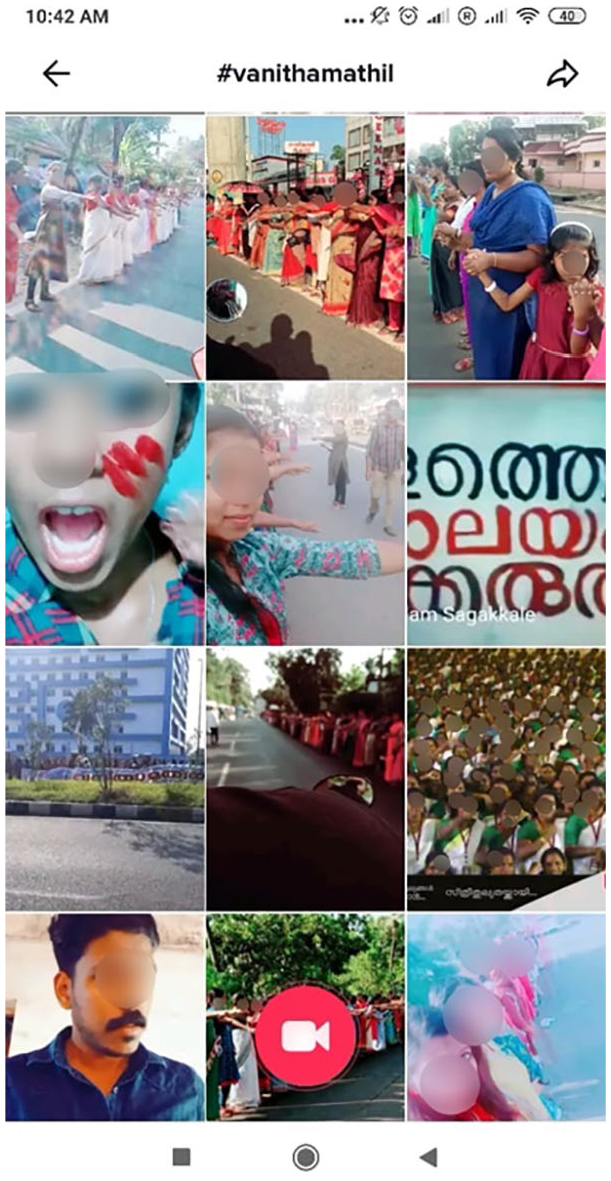
A portion of the #vanithamathil feed on TikTok.
Polarization at the issue level is combined with the disavowal of politics at the video level: users who post Mary Sweety spoofs often reply with “It was funny so I also wanted to act it out” when the political view endorsed by the video is questioned in comments. A light-touch, “inconsequential” activism is fostered by the interruptibility afforded by the interface, as users can watch and create Mary Sweety spoofs according to their convenience. TikTok is also forgiving: users can make mistakes and move on without fear of being held accountable because of the endless, speedy flow of content on the “For You” feed where videos occupy most of the screen while the username and other paratext are liminal (visible in Figure 2). Often, one’s impression of a video is exclusively based on the content and not what they know about the person who published it. The networks of association algorithmically forged by the “For you” feed are also ephemeral and not necessarily connected to their preexisting social networks (unlike Facebook) or interest group affinities. They do not really need to maintain or legitimize their political position because it shifts, cannot be mapped easily and moves on. On 4chan too, Tuters (2018) notes that the quick purging of threads and the anonymity trains users to exhibit fluency in the alt-right vernacular, avoid lengthy political debates and engage in sensationalist behavior to be noticed. TikTok’s affordances, similarly foster a culture of ironic political engagement that favors the populist right-wing. Play’s autotelic nature (“just for fun”) masks the divisive and hegemonic politics that happen on TikTok, just like alt-right content takes cover under irony.
#Sabrimala as Local Political Culture
Just as in trolling, revelry in “fun” and funny require unpacking as they are established on a bedrock of gender and caste-based exclusion and privilege (Phillips, 2019). As discussed, questions of inclusivity are averted by the autotelic nature of play wherein the end-goal is often the activity itself and an indulgence in its sensational qualities: the humorous content and the visual and aural gratification provided by the interface (Gekker, 2019) The exclusion and privilege that underlies the Mary Sweety spoofs require an examination of the extra-platform forces amplified by technology (O’Neill et al., 2016). The playful, irreverent parodying visible in TikTok videos build on Kerala’s vibrant culture of mimicry as an art form ever since the 1980s (George, 2019). Stage shows and, later, reality shows mix satire, political commentary, movie references, and mimicry, often stereotyping feminists and marginal communities for easy laughs. Such casteist, ableist “humor” is replicated in how Mary is reframed: an uncouth, deranged, Christian woman (Boxman-Shabtai, 2018). TikTok videos combine the Kerala society’s liking for mimicry with their awareness of topical events and their mediation (as an engaged news-hungry public) to offer a new form of quick-fix, enjoyable political engagement (Cris, 2018). Hindutva parties that do not have a strong base in the state might be channeling this format to spread their agenda assiduously, as outright propaganda might be a turn off.
At the level of ideology, we could say that cultural production and online public formation under the banner of #Sabarimala draws on a retrograde Hindu-identity politics (Roslyng & Blaagaard, 2018). In this sense too, they seem connected to the global resurgence of far-right politics. Tuters (2018) remarks that the alt-right in the U.S. perceives their centrality as chief subjects of society as under threat because of migration, globalization, and leftist politics. The deep vernacular web rife with frog memes and Nazi symbolism is erected as an oppositional subculture to combat this perceived loss of privilege and harkens back nostalgically to a lost paradise—the early internet (and the White, male safe space it was). Their avant-garde activism aims to disrupt the “consensus reality,” the leftist version of truth that politicians and academics are trying to impose on everybody (Tuters, 2018, p. 45). In parallel, the TikTok videos protect and protest the Hindu (nationalist) identity being targeted by the Communist government by reclaiming sexist, elitist, and casteist vocabulary and sentiments. The need to save the Hindu identity from assault by the marginalized, the judiciary and the state is pronounced as commonsense. Mary Sweety spoofs can be seen as a manifestation of the general view that her quest was a state-sponsored activist ploy to undermine tradition while also criticizing news channels for falling prey to her publicity stunts. The Sabarimala issue becomes such a watershed moment because it restages the Temple Entry Proclamation issued in 1936 by the king of the Princely State of Travancore permitting lower castes the right to worship in temples, which paved the way to Kerala’s inclusive modernity (Bijukumar, 2019). By opposing women’s entry to this temple, this history is elided.
Platform Accountability
TikTok’s affordances and the contextual sociopolitical power relations shape the political discourse that takes place on the platform, effecting an alignment with majoritarian politics, as demonstrated. This can affect electoral politics, as the Indian Election Commission cautioned. How does the platform take up the responsibility of ensuring fair play? Figure 6 shows an advisory put up on TikTok’s website regarding the Indian elections, as a distinct category from broader “Law Enforcement” or “Antibullying.” They acknowledge that people engage in political expressions on the platform but they do not consider themselves responsible for ensuring healthy or civil exchange. If there is unlawful content on the platform, TikTok’s responsibility ends with informing the user of their “duty” to identify problematic content and alert concerned authorities. They have no incentive to foster interactions between political camps that occupy separate spaces on the platform or curtail the spread of vicious content.
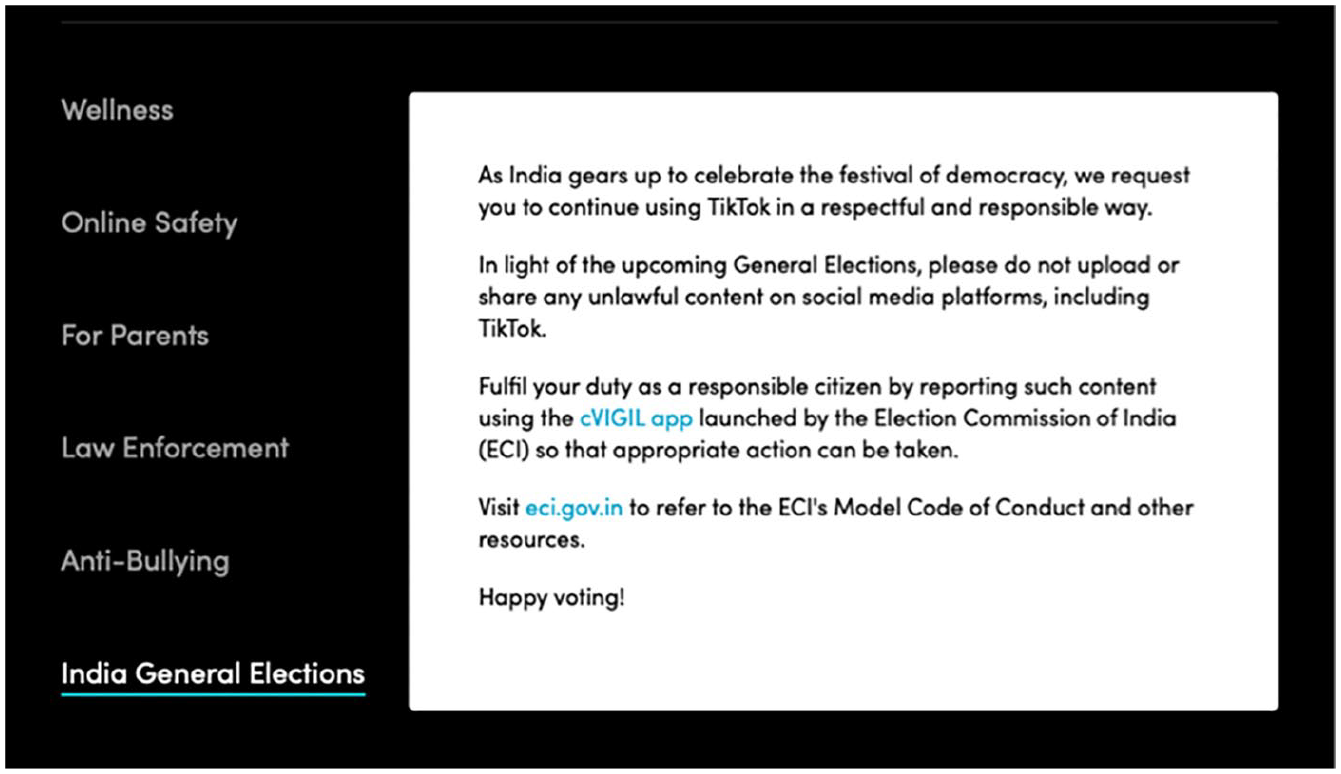
The Indian general elections advisory on the TikTok website.
“Public service announcements” (Figure 7) were also displayed when users searched for certain political hashtags. However, this does not apply to issue-specific or campaign-slogan-based hashtags, casting doubt on the efficacy of this tactic (Thaker, 2019). For instance, the advisory is not shown for #sabarimala though it is a contentious topic that the Election Commission advised political parties to not misuse in their campaigning.
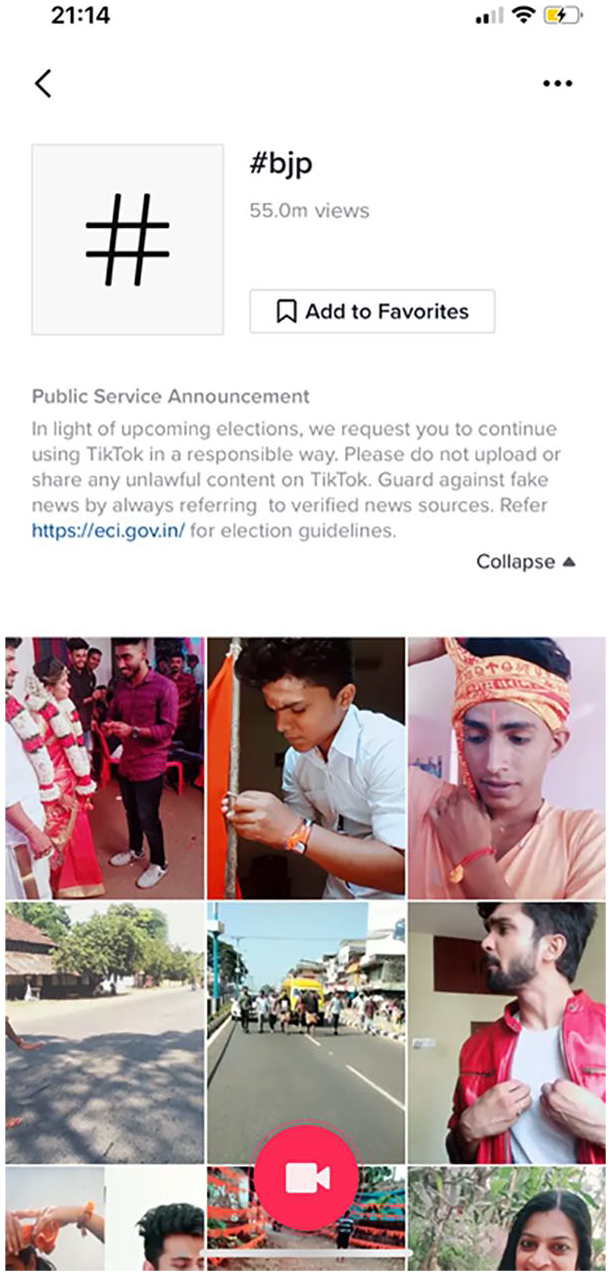
Screenshot showing the public service announcement.
Affective engagement and identity-based politics is a part of political participation today. We need to be cautious of how platforms like TikTok are channeling these flows into their platform to amp up their capital. Recently, TikTok announced that they will no longer carry political advertisements as it is at odds with the light-hearted, fun experience the platform offers (Kozlowska, 2019). They also launched an education initiative in India, which Findlay (2019) suggests is an attempt to attract advertisers who are becoming wary of TikTok with every political controversy involving the platform. These combined with the leaked local content moderation guidelines in China discussed earlier, make it clear that TikTok acts toward accentuating their economic and popular value. Political content that might turn advertisers away will be suppressed or written off as the behavior of rogue actors. When India–China border disputes escalate, calls to delete and ban TikTok are often voiced (Chatterjee, 2020). Yet this show of “patriotism” does not problematize the ownership of user data by a foreign country or the design aspects that enable bad behaviors like trolling and fake news. This is evident from the “Indian” alternatives that have come up, which replicate—not reform—TikTok (Saha, 2020).
As long as TikTok enjoys such a large number of users, there will be political content alongside the advertiser-friendly funny videos. How do we square this contradiction and make visible the slanted lines along which political expression takes place on TikTok and its part in steering vitriolic practices?
Gaming the Game
The limitations of playful political participation discussed so far are not meant to deride the ludification of culture. Rather, we believe the problematic presented here demands a ludic disposition and concomitant literacies that fully exploit the transformative, resistant potential of play. Users’ proficiency in using TikTok is only a part of ludo-literacy; Glas et al. (2019) posit that we should move toward critical and creative literacy. Through their use of the platform, users should unpack the meaning-making activity underway in games or game-like political activities and re-work them. This entails identifying and critically reflecting on the stereotypes, codes, and conventions that order games (Kellner & Share, as quoted in Glas et al, 2019, p. 21). Through free play, TikTok users can identify what modes of play are encouraged by the platform and what fails to gain currency: an active engagement with the platform and its politics. By gaming the game, that is, bending the rules and playing unusually, the structures that constrain play can become visible.
Here, users can try “playing” Mary in various ways—as an attention-seeking fraud, an activist or a religious fanatic. The relative ease with which some versions of Mary finds acceptance and popularity and the resistance from the platform affordances to others can be revealed in the process. Users, even those without a political position, can easily abuse Mary by replicating the soundtrack “just for fun” and gain visibility and popularity, whereas it takes considerable effort to take an alternate position. It would be very difficult to show the legitimacy of Mary’s actions or connect her feat to the history of gendered and casteist exclusion from spaces of worship within this silly platform. Users can go against the grain and oppose the transient flow of content by purposefully engaging in debates in the comments section, for instance. Or attempt to parody the parodists, casting them in the same ridiculous light as done to Mary. Would such counterusers be engaged in adversarial interaction or will the others ignore and move on? The relative success of types of content, user behaviors and subject positions can reveal that play is structured by the platform and the broader striated sociopolitical landscapes within which we play.
As we are not privy to what the platform considers as malicious content or the criteria they use to arrive at such a judgment, we can only play our way to identifying these restrictions. The view of power thus afforded can fuel the need for agonistic spaces where everyone can find representation without fear. Like Sicart (2018) argues, we need to engage in Quixotean play and demand to be in control of how we (re)make our worlds through play. The new worlds we create in negotiation with technology should have a notion of social responsibility committed to the recognition and transformation of the conditions of precarious others. Having said that, we wonder, once users gain critical and creative literacy, will they stay on TikTok?
Conclusion
This article has presented a theoretical framework that draws from the scholarship on playful politics to problematize the structural constraints on play and proposes a more engaged and active play as a possible remedy. The dialectic of playing politics with TikTok and being played by TikTok and the larger political landscape is valuable for studying “silly” and playful political participation in online environments. We have also tried to emphasize the importance of placing TikTok on the research agenda as the app gains momentum in the West and raises policy challenges and privacy concerns (Kang, 2019; Zolfagharifard, 2019). The rapid policy changes and the alarmist discussions that arose around the app in the west during the writing of this article, further stresses the urgency of this research direction. In addition to discussing the specificity and peculiarities of TikTok, this article has identified emergent forms of political participation in the Indian context that are shaped by the platform and distinct sociocultural and political factors.
The dynamics of the playfully political space explored here could benefit from more data-backed methods of study. This could uncover if the spread of divisive content is orchestrated by vested interests, more concretely. The nonfeed and filmic nature of TikTok makes it more resistant to traditional types of content analysis, opening opportunities for visual and hybrid methods. Furthermore, a study that situates the popularity of playful political participation within the historical significance of play in the Indian public sphere could be productive in highlighting contextual influences and what the platform taps into, influences or reactivates.
Footnotes
Declaration of Conflicting Interests
The author(s) declared no potential conflicts of interest with respect to the research, authorship, and/or publication of this article.
Funding
The author(s) received no financial support for the research, authorship, and/or publication of this article.
