




Abstract
Environmental nongovernmental organizations (ENGOs) need resources in order to mount campaigns and ensure their stability over time. What is the most effective strategy to attract these resources? Building upon research on social movement strategy and resource mobilization, we examine how a diversity of income sources, tactics, and issue focus affects three measures of mobilization outcomes: income, staff, and members. We examine these relationships using a unique panel data set of ENGOs in the UK collected by the Environmental Funders Network in 2013 and 2016. Our analyses show that using a more diverse range of tactics in wave 1 is associated with mobilizing more staff and members in wave 2. However, there is no significant penalty or payoff for groups that engage in issue or income diversification. We argue that diversifying tactics benefits organizations by helping them accrue the necessary human resources required for environmental action.
Keywords
In the face of Brexit, environmental nongovernmental organizations (ENGOs) in the United Kingdom report feelings of uncertainty in their future ability to accumulate the resources required for sustained action on environmental protection, conservation, and education. In a 2017 report by the Environmental Funders Network (EFN), ENGO leaders explained that they are bracing for the worst: nearly two-thirds expected to lose funding as a consequence of the UK’s decision to leave the European Union (Miller et al., 2017). These anticipated difficulties for the environmental movement pose an interesting empirical problem: what strategies can ENGOs enlist to mobilize resources? More specifically, should ENGOs specialize and become niche, or should they diversify to appeal to a wider audience? Such strategic considerations have important organizational implications. On the one hand, groups could benefit from specialization as they create strong identities and niches for themselves and their work. On the other hand, groups that diversify may be better equipped to survive over time when there are changing interests and foci for mobilization.
While strategy is critical for mobilization outcomes, there is a dearth of research that addresses how strategic choices shape the ability of organizations to accumulate resources (McCarthy & Wolfson, 1996). 1 While scholars tend to assert the benefits of diversification as a strategy, this has been largely untested empirically (Olzak & Ryo, 2007). Instead, a majority of research assesses how already accumulated resources affect social movement organizations (SMO) and dynamics (Abromaviciute et al., 2019; Edwards et al., 2019; Lind & Stepan-Norris, 2011; Walker & McCarthy, 2007, 2010). Missing in this approach is a consideration of antecedent concerns, namely, how organizational resources are accumulated in the first place. This has sparked an interest in scholarship that assesses how strategy shapes resource mobilization, particularly given its important role in ensuring ENGO maintenance and survival over time (Berny & Rootes, 2018).
Our research on UK ENGOs is based on survey data gathered by the EFN in 2013 (wave 1) and 2016 (wave 2). Using this data, we ask three main research questions: (1) How does using a diversity of tactics affect mobilization outcomes? (2) How does working across a variety of issue areas affect mobilization outcomes? (3) How does specializing or diversifying sources of income affect mobilization outcomes? The EFN panel data is uniquely suited to answering our research questions because it allows us to examine how selecting to specialize or diversify in terms of income sources, tactics, and issue focus in 2013 shapes mobilization outcomes (total income, full-time staff, and members) in 2016. 2 We find that neither the number of income sources nor the number of issues adopted by ENGOs is associated with growth in organizational resources. However, our findings show that using a diversity of tactics is associated with growth in human resources in the form of both full-time staff and members. This is likely because ENGOs adopting more tactics have a greater need for people with different skill sets, knowledge, and experiences to carry out the research, institutional advocacy, and protests organized by the group.
We begin by considering why and how groups may select to employ a strategy of specialization or diversification. We consider these strategies in relation to tactical selection, issue focus, and income sources. We then examine how these strategies are related to outcomes for movement organizations, particularly focusing on how they are related to income, staff numbers, and members over time. Finally, we provide information on our case of analysis, the environmental sector in the UK before turning to the findings of our research.
Strategy and Tactical Selection
Strategy involves the planning and decision making that helps groups advance their claims and achieve their goals (Smithey, 2009). Tactics are the “means and actions by which activists express their grievances” (Wang et al., 2018, p. 175). The two are distinct, but related; tactics are selected in accordance with the overarching strategy of a given SMO (Ganz, 2004; Wang et al., 2018). Social movement organizations select their tactics from larger repertoires which provide “toolkits” of tactics available to social movements (Swidler, 1986). Contemporary movements pick and choose from these different repertoires to more effectively engage in a “claims-making routine” against opponents (Tilly, 1978, 2006).
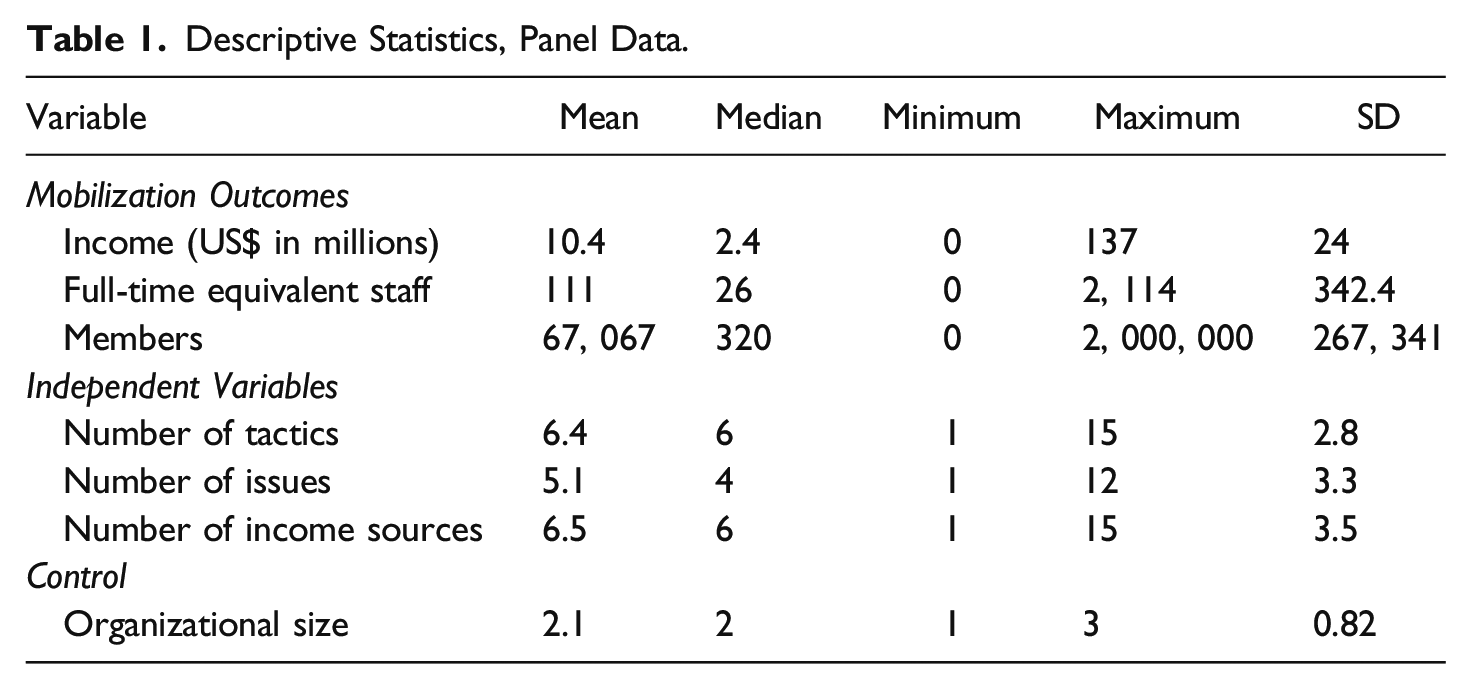
There are a variety of tactics from which movement organizations and actors can select. For modern social movements, the repertoire of action available to activists includes a large variety of contentious and non-contentious tactics. Protest, such as demonstrations in the street or marches, is the tactic most readily associated with modern social movements (Tarrow, 2011). However, many social movement groups do not engage in protest activity, instead choosing a variety of non-contentious ways to gain attention for their issues. In fact, the top four tactics adopted by the ENGOs in this study include three non-contentious tactics (raising awareness about specific issues, environmental education, and providing research and expert advice) and only one contentious tactic (advocacy to influence public policy).
Given the variety of tactics available to social movement actors, it is not surprising that researchers have investigated the link between the use of a particular tactic and outcomes for groups and campaigns. While much of this work has focused on the use of contentious tactics (Christens & Speer, 2011; Gamson, 1975; Giugni, 1998; Klandermans, 1993; McAdam, 1982; McAdam et al., 2004), scholars are also focusing on non-contentious tactics aimed at social or cultural change (Armstrong & Bernstein, 2008; Binder, 2002; Dyke et al., 2004).
Groups also differ in the diversity of tactics they use. Some groups engage in a wide array of tactics while others become specialized in a single or small set of tactics. The extent to which tactical diversity or specialization is beneficial for social movements has been debated in the literature (Chewinski, 2019; Edwards & Marullo, 1995; Reger & Staggenborg, 2006; Singh & Lumsden, 1990; for counterexamples see Gamson, 1975; Olzak & Johnson, 2019). Conventional wisdom holds that diversity benefits social movements, however, this can be contingent on the concentration within the social movement industry (Soule & King, 2008).
In general, research has found that when SMOs use a diversity of tactics, it tends to increase the size of the mobilized population, allow SMOs to achieve their goals, and increase the chances of organizational survival (Bernstein, 1997; Olzak & Ryo, 2007; Pousadela, 2016; Soule & King, 2008). Bernstein (1997) found that identity movements, in particular, receive substantial rewards from diversification because strategies and goals that appeal to a broader audience increase participation. Bernstein (1997, p. 544) argues that a “celebration of differences” (or diversity) within identity movements increases the numbers of potential supporters by offering a wider repertoire of goals and tactics, which enhances the movement’s chances for success (see also Gamson, 1996; Minkoff, 1995). Pousadela’s (2016, p. 125) work on the women’s movement for legal abortion in Uruguay found that the success of the campaign was the result of the breadth of its repertoire of actions, progressively expanded to include various (and sometimes innovative) strategies.
The research on tactical diversity tends to highlight how social movements benefit from using a diversity of tactics (Olzak & Ryo, 2007; Soule & King, 2008). It is less clear, however, what the benefits are of using a diversity of tactics within one organization. Specializing in a small number of tactics, or even using one tactic repeatedly, could be beneficial. This focused strategy could help an organization to develop a strong identity in the eyes of members and the public. Because of this, groups may benefit from using a small repertoire of tactics repeatedly, which creates a strong identity or “brand.” The penalties and payoffs of using a diversity of tactics within one organization is a central focus of our research and we expect ENGOs adopting a diversity of tactics approach to benefit in their resource mobilization efforts.
Strategy and Issue Focus
Most research examining the strategy of specialization or diversification focuses on tactical choices. However, organizations also make strategic decisions about their issue focus, selecting to focus on a small set (or single) issue or working across a variety of issue areas. Historically, the literature has highlighted the relative success of enacting a more generalist strategy with regards to issue foci (Aldrich, 1979; Carroll, 1985; Edwards & Marullo, 1995; Heaney & Rojas, 2014; Walker & McCarthy, 2010). For example, Walker and McCarthy’s (2010) research on poor people’s organizations shows that groups who have a specialized issue focus and actively seek to differentiate themselves from other organizations tend to die over time. The payoff of diversification has also been evident in the American Peace movement, where SMOs that category spanned (embracing a broad set of issues) had significantly reduced mortality odds (Edwards & Marullo, 1995).
However, more contemporary research in organizational ecology has produced different findings. Olzak and Johnson (2019) note that across diverse organizational contexts, category spanning has detrimental consequences. Informed by this research tradition, Olzak and Johnson (2019) test whether category spanning for American environmental SMOs over a 50 year period hinders their chances of survival. The authors find that environmental SMOs who choose to span multiple and dissimilar issues have “a significantly diminished lifespan” when compared to organizations adopting a narrow issue niche (Olzak & Johnson, 2019, p. 191).
Although research on specialization has focused on the implications of diversification or specialization on the life span of a population of organizations, a separate body of work has focused on how issue framing, and frame extension in particular, is related to various mobilization outcomes such as the accumulation of valuable human resources (Benford & Snow, 2000; Brulle & Benford, 2012; Cornfield & Fletcher., 1998; Edwards & McCarthy, 2004; Johnston, 1980; Snow et al., 1986). Frame extension is related to issue foci because it highlights how groups can focus on a narrower set of issues or connect a larger set of issues through meaning making work. For example, the American Federation of Labour relied on frame extension—from a narrow issue focus on labor law to a wider focus on “social welfare and the regulation of private-sector employment conditions”—to gain members (Cornfield & Fletcher, 1998, p. 1311). In the environmental movement, Brulle and Benford (2012, p. 79–80) find that the discursive shift from game protection to wildlife management (accompanied by the establishment of wildlife protection laws in the 1930s) prompted the growth of SMOs working within this issue area throughout the 20th century.
As evidenced above, the majority of research on diversification or specialization with regards to issue focus has been influenced by organizational ecology and is thus interested in population changes over time via organizational mortality rates. While some contemporary research in the environmental movement sector indicates that organizations are penalized for adopting a generalist strategy (Olzak & Johnson, 2019), most research in the area finds that diversification acts as a benefit (Aldrich, 1979; Carroll, 1985; Edwards & Marullo, 1995; Heaney & Rojas, 2014; Walker & McCarthy, 2010). This is especially true for research that specifically examines the effects of focusing on a diversity of issues on resource mobilization (Brulle & Benford, 2012; Cornfield & Fletcher., 1998; Johnston, 1980). We expect that ENGOs adopting a generalist or diverse portfolio of issues will experience a payoff in mobilizing organizational resources.
Strategy and Funding Sources
A central tenet of the resource mobilization perspective is that resources, including income, are critical for social movements and the development of organizations (Corrigall-Brown, 2016; Edwards et al., 2019; McCarthy & Zald, 1977, 2002). Contemporary SMOs rely on a variety of sources of funding. These sources include elite support, such as funding from governments, foundations, and corporations, as well as grassroots support from members and constituents. The role of these sources and the effects that this funding has on movements has long been of interest to social movement scholars (Chewinski & Corrigall–Brown, 2020; Jenkins et al., 2018; Jenkins & Eckert, 1986; Zchout & Tal, 2017).
Although social movement scholars have examined the consequences of funding sources for social movements, few have considered how the diversification or specialization of funding sources shapes mobilization outcomes such as resource accumulation or organizational survival/mortality (Walker & McCarthy, 2010). We know from scholarship on non-profit organizations, some of which are ENGOs, that financial vulnerability is a key obstacle to organizational maintenance and survival (Carroll & Stater, 2009; Froelich, 1999; Hung & Hager, 2019; Tuckman & Chang, 1991). In an effort to become financially secure, organizations need to make the difficult choice of deciding whether to specialize in seeking revenue from one type of source or diversify their fundraising efforts. Each of these approaches has costs and benefits. On the one hand, diversifying income sources involves an increased risk of losing other revenue sources (Grasse et al., 2016), increased administrative costs (Sacristán López de los Mozos et al., 2016), and mission drift since heterogeneous income sources may shift focus to funders (Kearns et al., 2014). On the other hand, having a diversity of income sources could increase organizational flexibility when weathering shocks such as a global financial crisis (Carroll & Stater, 2009), autonomy in mission selection (Mitchell, 2014), and income and organizational growth (Hung & Hager, 2019).
Given this balance of costs and benefits, what are organizations to do? Empirical research examining the relationship between funding source strategy and financial health has produced mixed results. Historically, much of the research on the topic has found a positive relationship between diversifying income sources and financial health (Alexander, 1998; Bielefeld, 1994; Carroll & Stater, 2009; Greenlee & Trussel, 2000; Grønbjerg, 1993; Hager, 2001; Tuckman & Chang, 1991). However, more recent examinations - including the one article that specifically addresses social movements organizations (Walker & McCarthy, 2010) - have not found support for the relationship between income diversification and the financial health of non-profit organizations (Chikoto & Neely, 2014; Lin & Wang, 2016; Prentice, 2016; Sacristán López de los Mozos et al., 2016). Hung and Hager (2019) conducted a meta-analysis of 40 original research articles on the relationship between income diversification and non-profit organizational health. The authors found a small but statistically significant relationship between the diversification of income sources and organizational health (Hung & Hager, 2019). Given the importance of this variable for non-profits, it is surprising that few social movement scholars have considered it. Our research is some of the first to consider the effects of income source diversity on ENGO growth and based on this literature review we expect to see a positive relationship.
The Case: Waves of Environmentalism and UK ENGOs
The organizations in this analysis are in the environmental nongovernmental sector in the United Kingdom. They are mostly large organizations originating in the first and second waves of the environmental movement (Dalton, 1994). The first wave focused on the preservation and protection of nature (Dalton, 1994) and included, for example, the Royal Society for the Protection of Birds. The second wave of the environmental movement began in the 1970s, with a change in focus from environmental protection to addressing the consequences of industrial pollution (Dalton, 1994; Saunders, 2012). This wave included the founding of new organizations (such as Friends of the Earth and Greenpeace) as well as an increase in the organizational resources (income and membership) available to groups working on environmental issues (Berny & Rootes, 2018; Hilton et al., 2012).
Environmental nongovernmental organizations in the UK since the 1970s have become increasingly professionalized and focused on moderate goals and tactics (Doherty et al., 2007; Krieger & Rogers, 2010). Some movement activists became disillusioned with this more moderate approach, inspiring the birth of the third wave of the environmental movement in the 1990s—radical environmentalism (Saunders, 2012). These new groups adopted a more radical critique of society and engaged in more confrontational actions (Doherty, 1999; Doherty et al., 2007; Saunders, 2012; Wall, 1999). A body of scholarship has been concerned with tracing the emergence of direct action groups as well as the changing character of third wave radical environmentalism (Doherty, 1999; Doherty et al., 2007; Rootes, 2015; Saunders, 2012; Wall, 1999). 3
There have been at least three other areas of foci within the literature on UK ENGOs. First, research has focused on the determinants of success within the environmental movement (Carter & Childs, 2018; Ogilvie & Rootes, 2015; Plows, 2008; Rootes, 2009, 2013). A second area of research is focused on the determinants of collaboration within the environmental movement or network (Saunders 2007, 2008a, 2008b, 2013) and between specific movement actors and corporations (Krieger & Rogers, 2010; Rootes, 2006). Finally, contemporary scholarship considers tactical innovation within the environmental movement. Here, researchers have specifically focused on the determinants of legal and judicial mobilization (Doherty & Hayes, 2014; Vanhala, 2018) as well as the opportunities associated with legal mobilization (Goodman & Connelly, 2018; Hilson, 2016; Vanhala, 2012).
In their overview, Berny and Rootes (2018) argue that ENGOs are at a cross-roads: do they continue with the radicalism associated with third wave environmentalism, or do they opt a more pragmatic approach to challenge the most pressing environmental concerns of today? Acknowledging that this binary is an oversimplification, the authors highlight the need for an organization-centered perspective that addresses the challenges of ENGO strategy and maintenance. Our research is a direct response to this call for additional research, and moves beyond the aforementioned tactical binary by considering how diversity as a strategy affects organizational maintenance and growth.
Data and Methods
The organizations in this analysis responded to surveys collected by the EFN, a UK based charity comprising a diversity of individuals, trusts, and foundations. The EFN conducted surveys of ENGOs at two time points: the first wave was collected between February and April 2013 and the second was collected between September 2016 and January 2017. The first wave of the survey was sent to 300 ENGOs operating in the UK (Cracknell et al., 2013). Of the 300 ENGOs, 150 were identified through data provided the Third Sector Research Centre (TSRC), which lists the largest SMOs in the UK according to income. The remaining 150 were selected by the EFN based on past research on UK ENGOs (Cracknell et al., 2013). The second wave of the survey was sent to 330 ENGOs, including the same 150 organizations identified by the TSRC with an additional 180 groups representing a diverse mix of environmental groups in the UK (Miller et al., 2017). The organizations responding to the surveys include large ENGOs such as the Royal Society for the Protection of Birds and Greenpeace UK in addition to smaller and more specialized organizations such as the Lydd Airport Action Group and Biofuelwatch (for participating organizations, see Cracknell et al., 2013; Miller et al., 2017)). The response rate for wave 1 was 46.3% (139 ENGOs) and for wave 2 was 27.9% (92 ENGOs) (Cracknell et al., 2013; Miller et al., 2017). Given that we are interested in understanding changes over time, the analysis in our article is based on the 72 organizations that completed surveys in both waves one and two. 4
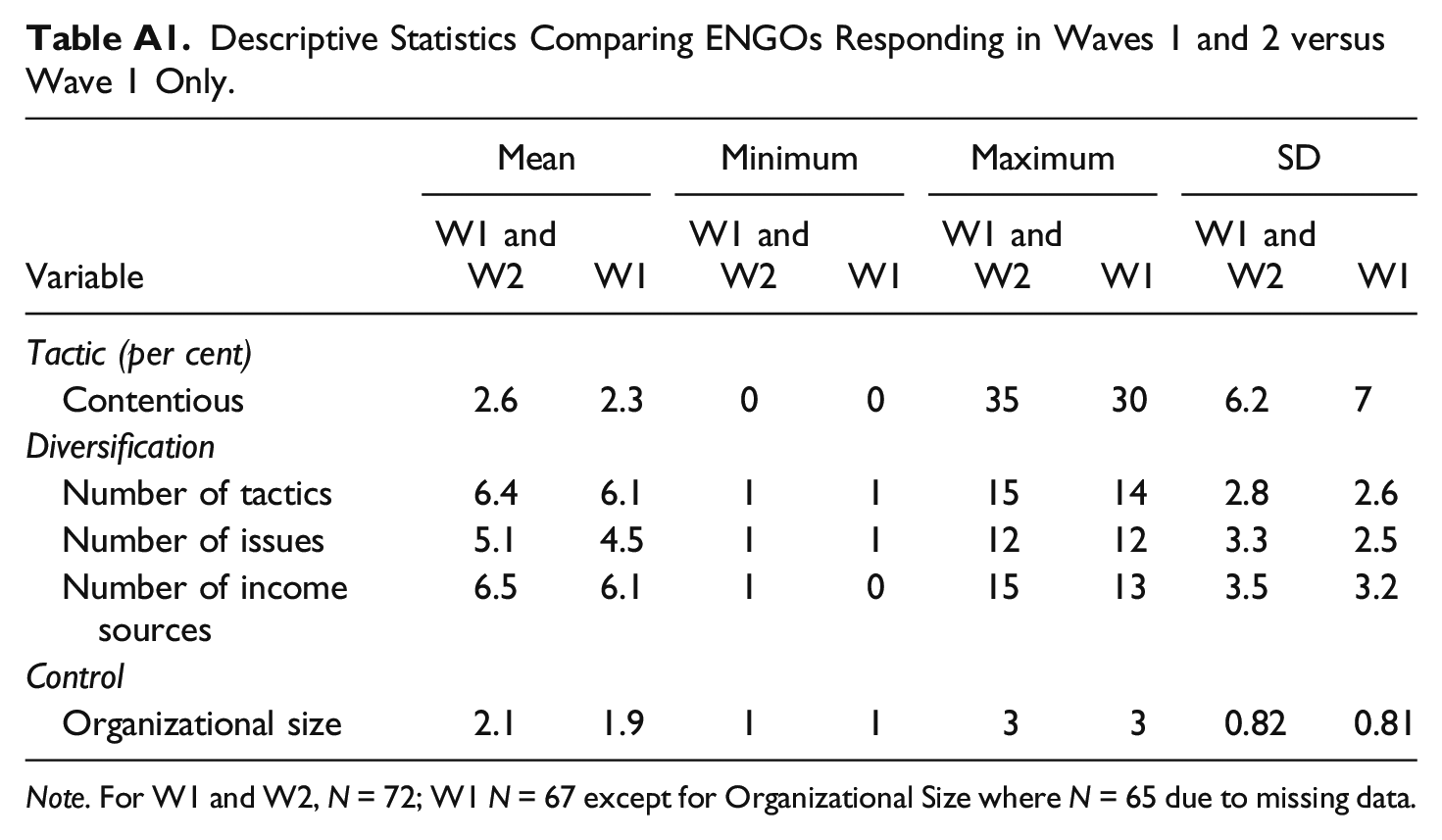
Appendix Table A1 compares the descriptive statistics of our sample to the 67 organizations responding to wave 1 only. The groups that responded in wave 1 and those in our panel study are very similar in terms of number of tactics, issues and income sources—there are, on average, very minor differences between our sample and the organizations responding in wave 1 only. The overall similarity between the two samples suggests that the organizations included in our sample do not vary significantly from the organizations lost to attrition. For a complete list of survey questions, more details on methodology, and a list all surveyed ENGOs, please see Cracknell et al. (2013) and Miller et al. (2017).
While existing survey sets, including the Register of Charities and the National Survey of Third Sector Organizations, have larger sample sizes, they do not include a standardized measure of tactical choices, relying instead on individual organizations to self-report their tactics and strategies. This makes it difficult to compare across groups. Thus, the EFN data set is the best available for understanding how the strategic choice to diversify or specialize affects an ENGOs mobilization outcomes.
Dependent Variables: Mobilization Outcomes (Organizational Resources)
Resources continue to be an important consideration for social movements. Resource mobilization theory posits that organizations rely on a multitude of resources including cultural, informational, moral, material, and human resources (Cress & Snow, 1996; Edwards et al., 2019). Our research focuses on the material and human resources organizations work to accumulate. Material resources such as money, property, equipment or supplies are clearly critical to social movements’ ability to mobilize (Edwards et al., 2019). An organization’s human resources include people who donate money, time, and/or energy either as leaders, volunteers or staff (Cress & Snow, 1996). Our research uses three measures of organizational resources: income, full-time equivalent staff (FTE), and members. First, the survey asked respondents to list their total income for the last full financial year as well as the total number of FTE that work on environmental issues for the organization. Second, respondents were asked to include the total number of members who contributed money or time to the organization on a regular basis. All three of our dependent variables were log transformed to correct for skewness. As such, we examine the log of income, staff, and members at wave 2 (2016).
Independent Variables: Number of Tactics, Issues, and Income Sources
We examine three independent variables. Our first variable is the total number of tactics in which each organization engages. It is a composite variable derived from the response to the question: “Please provide an estimate (in percentages) of how your organization’s work or effort breaks down between the following approaches” with 16 tactics listed (see Cracknell et al., 2013: 50–51 for a complete list). The 16 tactics listed are both contentious and non-contentious. Contentious tactics include, for example, activism (direct action, demonstrations, boycotts, etc.), advocacy (working with decision-makers to shape policy) or litigation that is directed at governments or corporations (Cracknell et al., 2013). Non-contentious tactics include providing research or expert advice, using the media, internet or leaflets to spread awareness around a particular issue or species-specific conservation work such as breeding programmes (Cracknell et al., 2013). We counted the number of tactics used by each organization. A higher number indicates the adoption of a diversity of tactics approach whereas a lower number indicates tactical specialization.
The second variable included in our models is the number of issues adopted by each organization. It is also a composite variable created from the response to the question “Please provide an estimate (in percentages) of how your organization’s expenditure in your last full financial year breaks down between the following 12 thematic categories” and includes issues such as biodiversity and species conservation, toxics and pollution, energy, and climate and atmosphere (for full list, see Cracknell et al., 2013, p. 50). We counted the number of issue areas listed by each organization. As with tactics, a higher number of issues indicates diversification (or a generalist approach) whereas a lower number indicates issue specialization.
Our final independent variable is the total number of income sources from which an ENGO receives its funding. This variable is based on responses to the question “Please estimate what percentage of your organization’s funding in the last year came from each of the following sources” with 15 sources listed (Cracknell et al., 2013, p. 50 for a complete list). The sources include grants or donations from trusts, foundations, charities, local authorities, central government departments, European Union sources, businesses or membership fees, and dues. We counted the total number of income sources.
Control Variable: Organizational Size
In addition to the independent variables listed above, we include organizational size as a control variable in each of our three models. 5 This categorical variable is based on the income variable from wave 1 (2013). Total income is often used as measure of size in research on organizations (Gallo & Christensen 2011). Organizations in our sample were divided into three sizes: small (income less than US$500, 000), medium (income greater than US$500,000 but less than or equal to three million) and large (income greater than three million). Of the 72 organizations included in our sample, 21 were small, 24 medium, and 27 large.
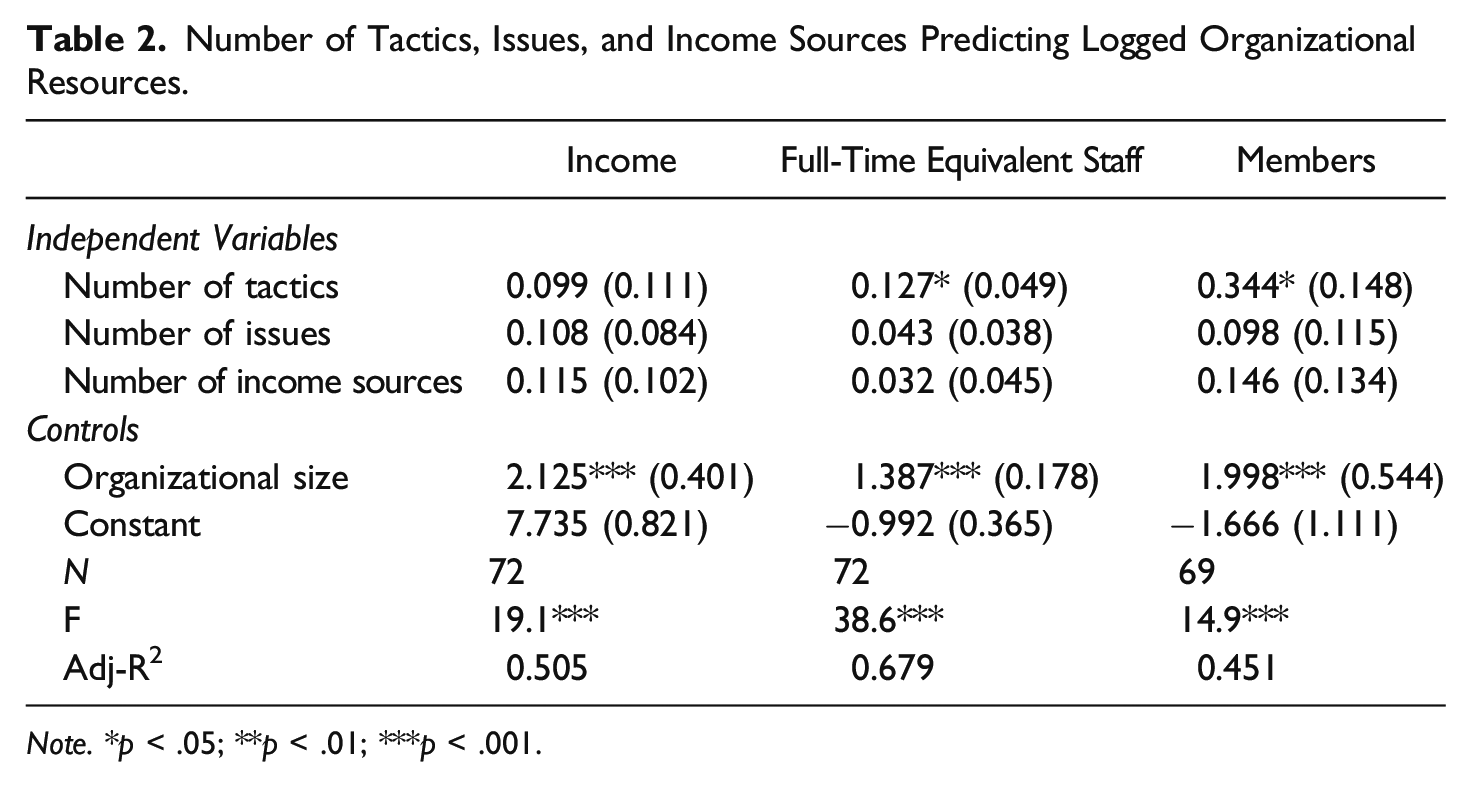
We conducted multiple linear regression models in STATA 15.1 to assess the relationship between the number of tactics, issues, and income sources in wave 1 on each of our three mobilization outcomes from wave 2: total income, FTE and members.
Results
Descriptive Statistics, Panel Data.
Number of Tactics, Issues, and Income Sources Predicting Logged Organizational Resources.
Note. *p < .05; **p < .01; ***p < .001.
The second model shows the effects of diversification on the ability of ENGOs to hire FTE. The model shows that all of our measures of diversification in wave 1 are positively associated with FTE staff in wave 2. However, of the three measures of diversification, number of tactics in wave 1 is the only measure that is significantly (p < .05) associated with the log of FTE staff in wave 2.
Figure 1 provides a visual depiction of the effects of tactical diversification on FTE staff. We used the mean values of each of the independent variables and then changed the number of tactics used by the organization. We also transformed the logged outcome for ease of interpretation, allowing us to see the effect of the number of tactics on FTE staff more clearly. The figure shows that, on average, an ENGO adopting one tactic (specialists) will have 13 FTE staff while an ENGO using nine different tactics (diversity of tactics) will have 32 FTE staff. Expressed as a percent change, ENGOs moving from one tactic to nine will see a 146% change in FTE staff. In addition, the curvilinear nature graph shows that the effect of tactical diversification is much stronger when more tactics are being used. The effect of moving from one to two tactics is only associated with an increase of two staff members. However, if an organization moves from 10–11 tactics, they can expect to see an increase of four staff members. The dashed lines indicate the confidence intervals and it is worth noting that these confidence intervals increase at the higher and lower levels because most organizations use the mid-range of tactics. Line graph showing number of tactics and number of full-time equivalent staff.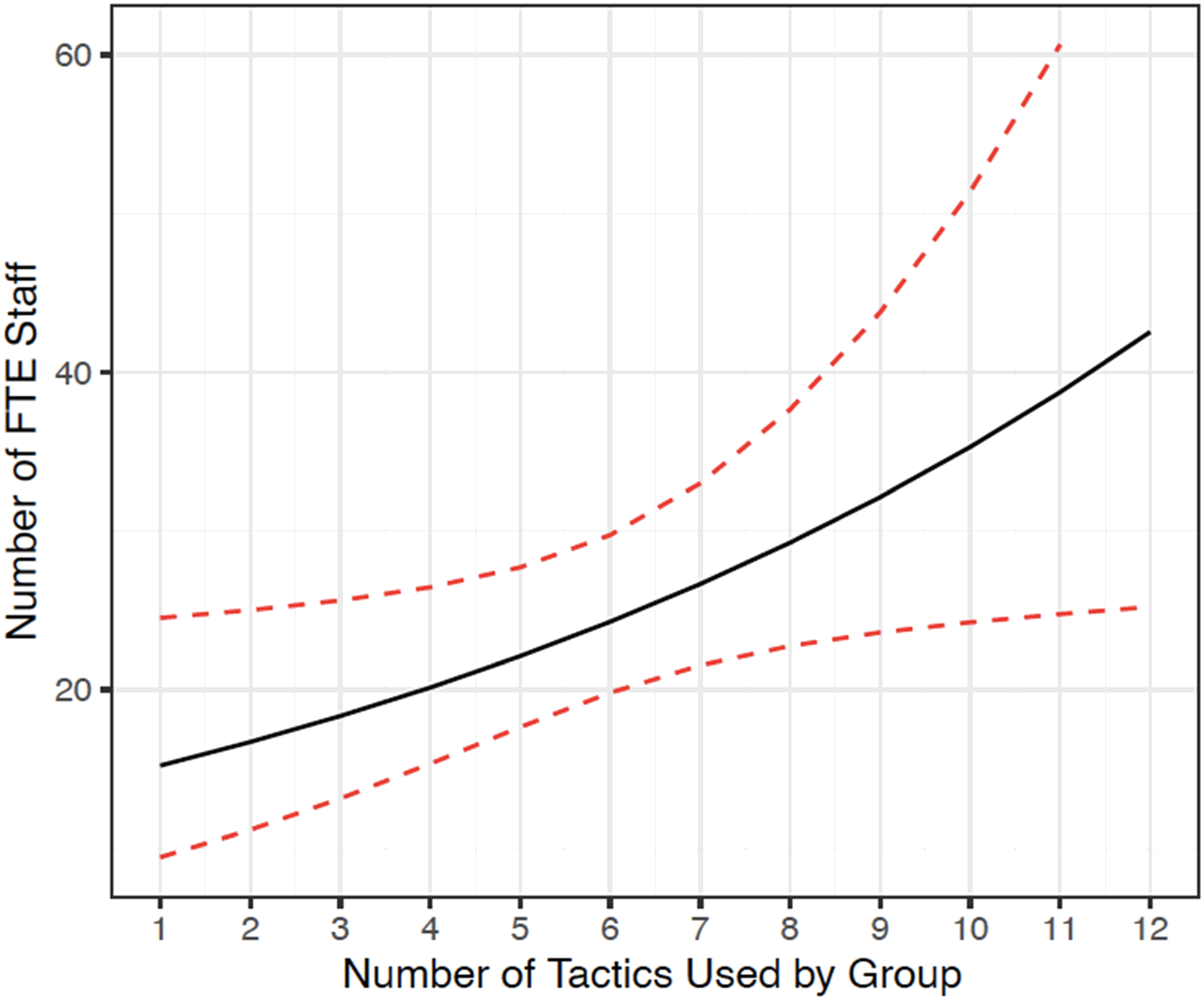
The third and final model in Table 2 shows the effects of diversification on the ability of ENGOs to expand their membership. All measures of diversification are positively associated with membership. However, only the number of tactics at wave 1 is both positively and significantly (p < .05) associated with the log of members at wave 2. Figure 2 illustrates this relationship, revealing the effect of diversification on membership numbers. We examined the effect of tactics on members by using the average of all variables and only changing the number of members and transforming the logged outcome. On average, an ENGO adopting one tactic will have 62 members while ENGOs with eight tactics have 730 members. Put another way, this is a 1077% change in membership, indicating a very large payoff in members as ENGOs engage in a diversity of tactics. Again, this relationship is curvilinear. There are much stronger benefits when more tactics are used. When an organizations moves from one to two tactics this only yields an increase of 26 members (moving from 62–88 members) whereas moving from using eight to nine tactics is associated with an increase of 255 members (from 730–985). In essence, an organization is getting 10 times the benefit of increasing their tactics by one if they are already using a large diversity of tactics. Line graph showing number of tactics and membership.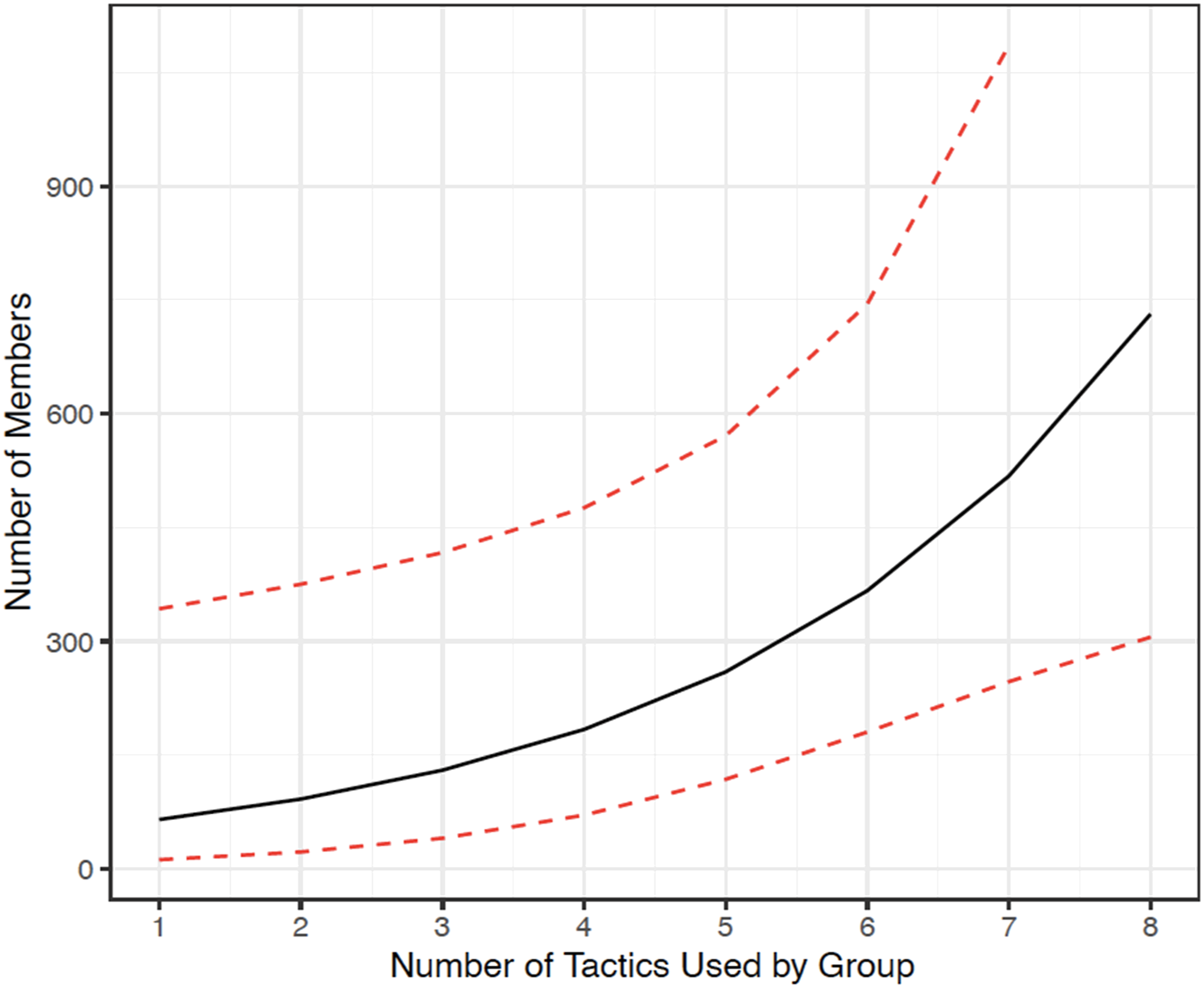
Discussion and Conclusion
Since the 1970s, the environmental movement in the United Kingdom has experienced widespread growth in the number of organizations working on environmental issues ranging from environmental conservation and protection to climate change (Berny & Rootes, 2018; Hilton et al., 2012). However, there is a lingering concern among ENGOs over the appropriate strategies for accumulating the organizational resources required to survive over time (Berny & Rootes, 2018). Such concerns have been amplified by ENGO leaders who believe that they may lose up to two-thirds of their funding as a result of Brexit. How do the strategies that ENGOs adopt shape their mobilization outcomes? In particular, how does a strategy of diversification or specialization shape an organization’s ability to accrue the much needed resources required for organizational maintenance and growth? This research question is the core concern of our study, and we focus on determining whether ENGOs in the UK are penalized or experience a payoff when adopting a strategy of specialization or diversification. In doing so, our research addresses noted gaps within the resource mobilization tradition (Cress & Snow, 1996; McCarthy & Wolfson, 1996), and builds on research related to diversification as a strategy (Olzak & Ryo, 2007; Soule & King, 2008). The role of strategy has also been recently highlighted as of particular concern for ENGOs (Berny & Rootes, 2018).
As originally stressed by resource mobilization theory, “the aggregation of resources (money and labor) is crucial to an understanding of social movement activity” given that organizations require income, staff, and members to engage in collective action (McCarthy & Zald 1977, p. 1216). Since its formulation, the focus has been on the role on resources in predicting movement outcomes (Abromaviciute et al., 2019; Cress & Snow, 1996; Edwards et al., 2019; Lind & Stepan-Norris, 2011; Minkoff, 1999; Walker & McCarthy, 2007, 2010). In other words, scholars have treated resources as an independent variable predicting a series of different outcomes. However, such an approach leaves antecedent concerns, namely, on how resources are successfully mobilized in the first place, largely unaddressed. This absence in resource mobilization was noted by McCarthy and Wolfson (1996), but not subsequently addressed in the literature. Yet, scholars claim that “… people do not have power if they are unable to mobilize or deploy their resources in ways that influence the interests of others” (Ganz 2004, p. 180–81).
Mobilizing resources to influence environmental practices and policy is partly informed by social movement strategy. Research has consistently shown that a diversity of tactics approach produces positive outcomes, from constituent mobilization and organizational survival to specific social movement wins in the realm of policy (Bernstein, 1997; Olzak & Ryo, 2007; Pousadela, 2016; Soule & King, 2008). Our research findings contribute to this scholarship by highlighting the specific organizational impacts of using a diversity of tactics approach across numerous ENGOs in the UK. We find that, over time, using a diversity of tactics positively and significantly influences the ability of ENGOs to accumulate human resources (FTE staff and members) but not material resources (income). Why might this be the case?
We know that SMOs, including ENGOs, require both human and material resources to survive over time. However, because a majority of the organizations in our sample are older and have an established and reliable revenue base, they may rely on the same foundations, governments, members, and grants year after year to fund their activism. It could very well be the case that funders of these specific organizations are not as influenced by strategies of specialization or diversification as they are by the historic legitimacy and identity of the organization they support. As a consequence, ENGOs may not be able to adopt new tactics considered off brand in fear of losing funding. But when ENGOs are capable of diversifying their tactics, they either need to hire new FTE staff or mobilize members that can carry out, for example, research on climate change or organize direct action campaigns. Because each of these tactics rely on a different set of skills, knowledge, and experience, it is likely that multiple people will have to be hired or mobilized for the job.
In addition to using a diversity of tactics, SMOs may also diversify or specialize in terms of the number of issues they adopt or the number of income sources they rely on to successfully mount their campaigns. Scholarship on issue diversification as a strategy often relies on an organizational ecology perspective that is interested in population changes over time. In this tradition, research on the American environmental movement specifically has found that organizations are actually penalized for adopting a strategy of diversification (Olzak & Johnson, 2019). However, research shows that it is more often the case that movements and organizations experience a payoff as a result of issue diversification (Aldrich, 1979; Carroll, 1985; Edwards & Marullo, 1995; Heaney & Rojas, 2014; Walker & McCarthy, 2010) and this is particularly true for their ability to accumulate resources (Brulle & Benford, 2012; Cornfield & Fletcher., 1998; Johnston, 1980). Our research challenges this trend by showing that issue diversity does not have a significant impact on mobilization outcomes as measured by income, FTE staff, and members. As mentioned previously, this may be in part due to the fact that funders, members, and FTE staff are more attracted to an organization’s identity and legitimacy than whether or not it adopts issues related to conservation, climate change, and/or building sustainable communities.
Finally, ENGOs must work to attract funding, and funding can come from a diverse set of sources. However, social movement scholarship has largely ignored how diversity in funding sources shapes organizational outcomes (for an exception, see Walker & McCarthy, 2010). Research in the non-profit sector has a long history of considering how income diversification impacts organizational resources and health. While the empirical evidence appears mixed, there is stronger evidence to support the claim that non-profits do experience positive outcomes as a result of income diversification (Alexander, 1998; Bielefeld, 1994; Carroll & Stater, 2009; Greenlee & Trussel, 2000; Grønbjerg, 1993; Hager, 2001; Hung & Hager, 2019; Tuckman & Chang, 1991). Interestingly, our own findings stand out from this tradition; we do not find income diversification to perform a significant role in the accumulation of organizational resources. Our finding of non-significance mirrors that of the only other study (to our knowledge) on SMOs specifically (Walker & McCarthy, 2010). The discrepancy between our findings and the larger literature on non-profits is likely a function of the political work in which ENGOs engage. Since ENGOs are engaging in political advocacy, they can be limited in terms of the numbers of income sources that they can attract.
However, it is not only the political advocacy of ENGOs that may threaten funding but also the larger political environment in which these organizations are situated. A survey of ENGO leaders in the UK has found that organizations fear significant funding shortfalls as a result of Brexit (Miller et al., 2017). Consequently, ENGOs must consider the most effective strategies for securing or increasing the resources required for organizational maintenance and growth. Our research uses the best available data on UK ENGOs to show that a strategy of diversification is associated with positive outcomes for organizations seeking to expand their resource base. In doing so, our research builds on existing scholarship on social movement strategy, provides a novel engagement with resource mobilization theory, and responds to Berny and Rootes' (2018) call for additional organization-centered research that analyzes the relationship between tactical strategy and ENGO maintenance and growth. Within the UK, a strategy of diversification pays-off in terms of recruiting the members and staff required for mobilizing for environmental protection, conservation, and justice.
Footnotes
Acknowledgments
We gratefully acknowledge the Environmental Funders Network (EFN) and Florence Miller for allowing us access to their panel dataset of environmental groups in the UK. Our research was financially supported by the Social Sciences and Humanities Research Council of Canada Insight Grant program.
Declaration of Conflicting Interests
The author(s) declared no potential conflicts of interest with respect to the research, authorship, and/or publication of this article.
Funding
The author(s) disclosed receipt of the following financial support for the research, authorship, and/or publication of this article: This research was supported by a Social Sciences and Humanities Research Council Insight Grant. We would like to thank the Environmental Funders Network and Florence Miller for allowing us to use their data in this research.

Notes
Author Biographies
Appendix
Descriptive Statistics Comparing ENGOs Responding in Waves 1 and 2 versus Wave 1 Only.
| Variable | Mean | Minimum | Maximum | SD | ||||
|---|---|---|---|---|---|---|---|---|
| W1 and W2 | W1 | W1 and W2 | W1 | W1 and W2 | W1 | W1 and W2 | W1 | |
| Tactic (per cent) | ||||||||
| Contentious | 2.6 | 2.3 | 0 | 0 | 35 | 30 | 6.2 | 7 |
| Diversification | ||||||||
| Number of tactics | 6.4 | 6.1 | 1 | 1 | 15 | 14 | 2.8 | 2.6 |
| Number of issues | 5.1 | 4.5 | 1 | 1 | 12 | 12 | 3.3 | 2.5 |
| Number of income sources | 6.5 | 6.1 | 1 | 0 | 15 | 13 | 3.5 | 3.2 |
| Control | ||||||||
| Organizational size | 2.1 | 1.9 | 1 | 1 | 3 | 3 | 0.82 | 0.81 |
Note. For W1 and W2, N = 72; W1 N = 67 except for Organizational Size where N = 65 due to missing data.