




Abstract
Older adults report high emotional well-being, but age-comparative studies of emotion regulation strategies have not identified systematic age differences. We propose that emotion regulation tactics may be more promising. Emotion regulation tactics involve strategy implementation in a specific situation, and have features shared across strategies involving positive or negative elements (objects/thoughts) in the environment that may be approached or receded from in the regulation attempt (i.e., a valence dimension about the environmental element, and a direction dimension indicating movement toward or away from it). Across several studies, older adults used more positive-approaching than negative-receding tactics. Positive-approaching tactics may also be more effective at regulating mood. We consider implications for aging, as well as group differences in emotion regulation behavior generally.
Older adults tend to report greater emotional well-being than their younger adult counterparts (see Charles & Carstensen, 2010). This robust finding of an age difference in self-reported affective experience is especially striking, given well-documented negative changes in cognitive and physical functioning with age. Researchers have tried to investigate the mechanisms underlying this surprising age effect on emotional well-being, with emotion regulation being a reasonable candidate. Do older adults regulate their emotions differently than younger adults in a way that helps them feel better? Theories such as socioemotional selectivity theory (SST; Carstensen, 2006) suggest that older adults prioritize emotion regulation efforts in everyday life and seek out positivity in their relationships and daily experiences to a greater extent than younger adults. Thus, SST posits that age differences in intentional emotion regulation behaviors are one component of higher emotional wellbeing with age. While an appealing and logical option, research to date that has focused on emotion regulation strategies has found little evidence for systematic age differences (Isaacowitz, 2022). This finding has led to the conclusion that perhaps emotion regulation may not underlie age differences in emotional experience and well-being.
In this paper, we review recent evidence suggesting that emotion regulation may still underlie age differences in emotional experience, but the focus solely on emotion regulation strategies to date may obscure the key locus of age differences. Instead, age differences exist in emotion regulation tactics: specific ways a strategy is implemented, with features/dimensions that may be shared across strategies. We first provide a more concrete definition of tactics– highlighting two particular tactic dimensions that exist across strategies– and distinguish tactics from goals and from strategies. Then, we review evidence from recent studies suggesting that age differences emerge in tactics but not in strategies, highlighting the importance of tactics. Next, we discuss possible mechanisms for age-related shifts in emotion regulation tactics. Finally, we consider the implications of focusing on tactics for the study of emotion regulation more generally.
Emotion Regulation Tactics: What are They?
The extended process model of emotion regulation (Gross, 2015) defines emotion regulation as a three-stage process: (a) identifying whether or not to regulate, (b) selecting a strategy to use, and (c) implementing that strategy through a particular tactic. Thus, deciding on a regulation goal is conceptualized as a stage prior to and separate from making a plan about how to regulate (the strategy) and then implementing it (the tactic). Gross (2015) specifies five families of emotion regulation strategies, which represent five general approaches to changing affective states: situation selection, situation modification, attention deployment, cognitive change and response modulation. These strategy types are well-known and well-investigated. While strategies dominate research on emotion regulation behaviors, each of the five families of strategies can be broken down into more specific sub-strategies, or tactics.
In developing the extended process model of emotion regulation, Gross (2015, p. 15) defined tactics as the specific ways that general strategies are implemented: “The task of the implementation stage is to translate this general strategy (e.g., cognitive change) into tactics that are appropriate to the specific situation one is in (e.g., think about this particular rebuff as an accidental oversight rather than a deliberate insult; McRae, Ciesielski, & Gross, 2012). To enable the translation of a general strategy into situation-specific tactics, the perceptual substep must represent relevant features of the world as well as various ways of implementing a particular strategy. At the valuation substep, these various tactics are evaluated, and the most promising are selected for implementation. It is this implementation that constitutes the output of the action substep.”
While this conceptual definition of tactics was published some years ago, research on emotion regulation tactics has been slow. One major challenge regarding emotion regulation tactic research is that there are many potential tactics that could exist, but unlike strategies, they have not been clearly defined by a predominant model of emotion regulation. Potential implementations of strategies (i.e., tactics) are thus almost infinite because they could vary along a number of different dimensions (e.g., avoidance vs approach tactics, object-level vs meta-level tactics, decommitting vs committing tactics, etc.). With the existence of many possible tactics and no predominant model to organize them, research on tactics thus far has been mostly descriptive and rather disjointed.
Prior work on tactics has predominantly focused only on tactics under the strategy of reappraisal. For example, some studies have compared the effectiveness of instructed positive versus detached reappraisal (i.e., Shiota & Levenson, 2009). Other early work on reappraisal tactics delineated eight specific tactics: explicitly positive, change current circumstances, change future consequences, reality challenge, acceptance, distancing, technical-analytic problem solving, and agency (McRae et al., 2012). These tactics were tested once in the context of group differences as a function of psychopathology (McRae et al., 2012) and a second time in terms of differences in lay persons’ frequency of use while viewing negative images (Vlasenko et al., 2024). Recently, Uusberg et al. (2019) proposed a different model that delineated a number of reappraisal-specific tactics which varied across 3 distinct dimensions, each with two levels, to form a 2 × 2 × 2 matrix. Their first dimension involved either reconstruing the situation itself or changing one's goals (i.e., activating other goals that are more congruent with the ongoing situation) to repurpose the situation. The second dimension involved reappraising physical objects/environments versus mental thoughts/representations. The third dimension involved decommitting from/undermining initial appraisals versus committing to new construals. In sum, while reappraisal tactics have arguably received the most empirical attention thus far, the specific tactics being measured vary widely from study to study with limited overlap in tactic operationalization across labs.
Beyond reappraisal, other strategies of the process model can be associated with various tactics. For instance, attentional deployment may involve trying to maintain attentional focus on something or shifting attention to something new, as well as attention focused internally on thoughts and feelings or externally on the environment (DiGirolamo, Kibrislioglu Uysal, et al., 2023).
Limitations of Focusing on Strategy-Specific Tactics
Most of the limited prior research on tactics has thus focused on strategy-specific tactics rather than dimensions of tactics that are shared across strategies. For example, only attention deployment involves focusing vs. shifting of attention and only reappraisal involves reconstruing vs. repurposing the situation. Strategy-specific approaches to tactics such as these are descriptively useful and have highlighted the interesting variability across tactics within a given strategy. However, given the high between-person and within-person variability in strategy use, digging deeper into tactics for one specific strategy at a time may yield results that are only applicable to narrow/rare situations or only to people that rely heavily on that strategy family in the first place. For instance, knowing the nuances of just reappraisal does not tell us anything about the many instances when reappraisal is not used, either because it is not possible given the affordances of the situation (e.g., high emotional intensity situations; Ford & Troy, 2019; McRae et al., 2012) or is not selected by those individuals in those particular situations (e.g., people who prefer less cognitively-demanding strategies). In fact, reappraisal may be used much less frequently in everyday life than other emotion regulation strategies (e.g., Diefendorff et al., 2008; Livingstone & Isaacowitz, 2021; Southward et al., 2019). Thus, elaboration of reappraisal-specific tactics provides an interesting but narrow window of insight into how people regulate their emotions in everyday life.
In sum, we believe that deep dives into strategy-specific tactics can be important but limited. They may provide descriptive insights but are less likely to directly test concrete theory-driven predictions. Instead, we argue that it will be most conceptually useful moving forward to consider tactics (especially in the context of potential group differences) in ways that reflect more general dimensions or groupings and thus are applicable across strategy families. Below, we propose two dimensions of tactics that we believe will be especially useful for moving forward the study of group differences in emotion regulation behavior.
Strategy-General Tactic Dimensions
Tactics fundamentally involve what an individual is doing in a moment to try to change how they feel: some emotion-eliciting event has taken place, and now they are trying to modify their response to it. To do this, they may rely on elements of the internal or external environment they find themselves in at that moment. As stated by Gross (2015, p. 15), “to enable the translation of a general strategy into situation-specific tactics, the perceptual substep must represent relevant features of the world as well as various ways of implementing a particular strategy.” We focus on two dimensions of how tactics relate to these “relevant features,” which we consider to be particular element(s) in the regulator's environmental context. These elements can be any attribute of the emotional situation that is utilized as part of the regulators’ attempt to regulate, ranging from something internal (e.g., a thought, a memory) to an external object (e.g., what is on TV, a social partner).
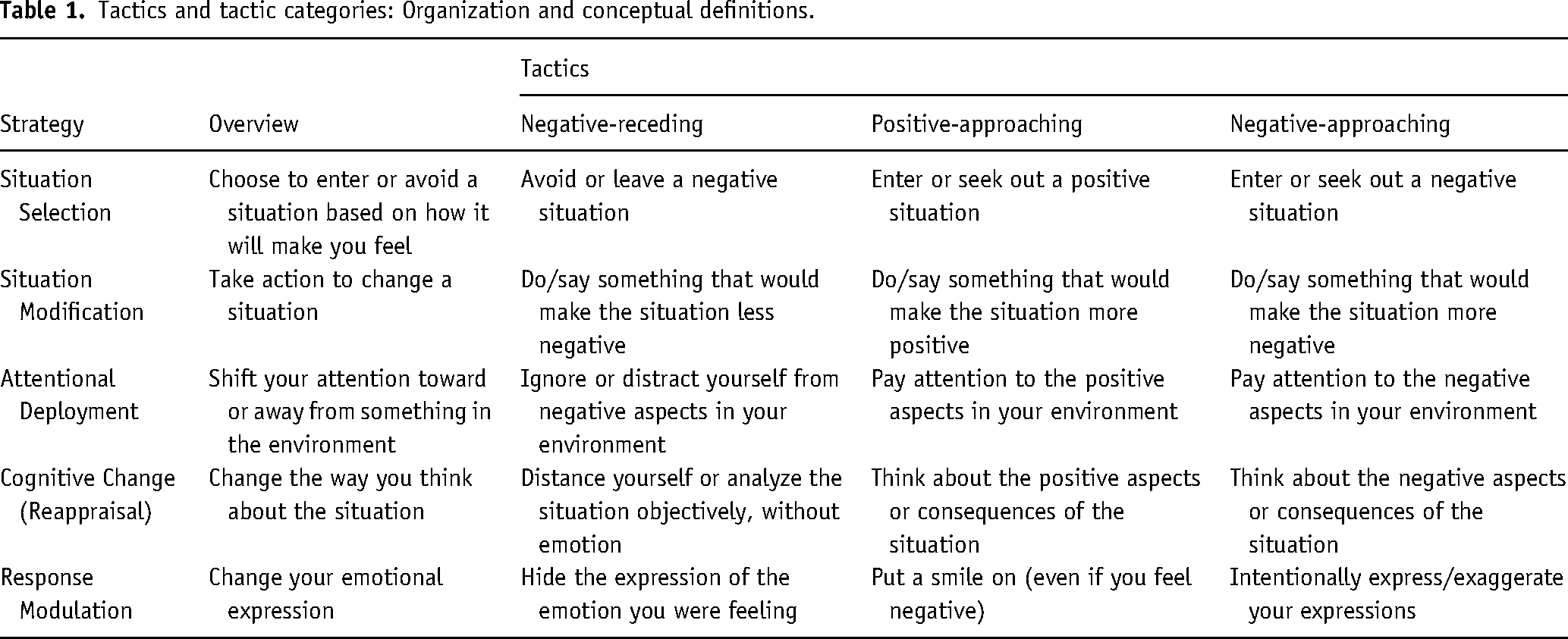
The two specific dimensions are: (a) the
Tactics and tactic categories: Organization and conceptual definitions.
Tactics and tactic categories: Examples.
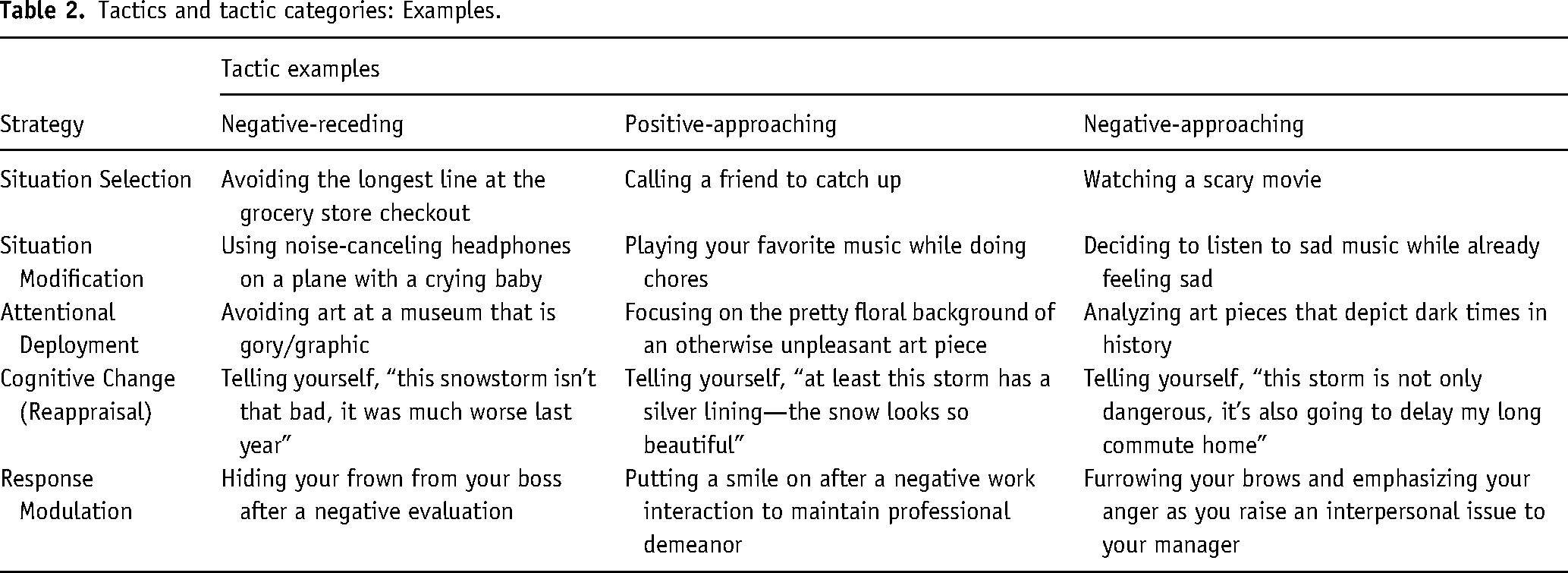
While one can think of how each strategy can have a tactic behavior along these Valence and Direction dimensions (such as attention deployment approaching something positive), it is also useful to combine tactic behaviors into overarching tactic groupings/categories; this is ultimately better for testing potential group differences and changes within individuals. The base rate of a single tactic behavior (e.g., positive-approaching attention deployment) may be too low for meaningful comparisons between groups (i.e., a similar issue to reappraisal-specific tactics), but the larger category of positive-approaching tactics may be viable for testing differences in frequency between groups or over time.
Crossing Valence and Direction yields four tactic categories: positive-approaching tactics, negative-receding tactics, negative-approaching tactics, and positive-receding tactics. While all four categories are potentially interesting, we will not focus on the category of positive-receding tactics because all the evidence we draw from involves emotion regulation in the face of negative elicitors. While these negative situations may feature minor positive elements that could be approached as part of the regulation effort (such as a small flower in the background of a negative image), the notion of receding from positive elements does not make much sense in such predominantly negative contexts. That said, future work on regulation to positive elicitors should consider positive-receding tactics in more detail.
Next, we turn to some common conceptual questions about tactics: whether they are meaningfully different from goals, and whether grouping tactics into categories adds value beyond emotion regulation strategy families.
Tactics are Not the Same as Goals
Importantly, emotion regulation tactic behaviors are distinct and separable from emotion regulation goals. Emotion regulation goals have been the target of much recent attention, as they are critical for ascertaining whether an emotion regulation effort was successful or not (Springstein & English, 2023). In alignment with the extended process model (Gross, 2015), emotional regulation tactics are regulatory behaviors selected and enacted to achieve a goal. Thus, the same emotion regulation goal may be achieved using different tactics, and the same emotion regulation tactic behavior can support different emotional goals. For example, if someone has an emotional goal of feeling more positive, they may select tactics that either approach positive elements of the situation or they may recede from negative elements of the situation (or both; e.g., after hearing that your flight is delayed, you may remove yourself from the gate full of grumbling angry people and approach a positive element of the situation by telling yourself “now I have time to get a snack”) in order to feel better. Similarly, positive-approaching emotion regulation tactics may be used both when the goal is to feel more positive emotion as well as to feel less negative emotion (e.g., watching a funny video in order to dampen a negative feeling). Critically, “valence” in emotion regulation tactic behavior refers to the valence of the element in the situation being used as part of the emotion regulation attempt (e.g., the pretty, positively-valenced flower in the background of a negative image that is being attended to), not the regulator's emotional goal (e.g., to feel more positive).
This distinction between emotion regulation tactics and emotional goals is a conceptual one but is also reflected in empirical evidence. In one study (Wolfe et al., 2022), an adult lifespan sample engaged in emotion regulation behaviors while being assigned to one of four goal conditions: just-view, information-seeking, increase-positive emotions, or decrease-negative emotions. They were instructed to carry out these emotional goals during three different emotion regulation behavioral tasks representing three strategy families: a situation selection task, a situation modification task, and an attentional deployment task. In the situation selection task, participants were presented with various valenced videos, news articles, and slideshows on a computer screen (as thumbnails) that they could choose to interact with by clicking on them. In the situation modification task, participants viewed 20 valenced videos and were told that they could skip parts of the videos that they did not wish to view. Finally, for the attentional deployment task, participants viewed a series of valenced images while their eyes were tracked.
Thus, in each task, there were positive, neutral, and negative valenced objects in the environment that participants could either approach (by selecting them/watching them all the way through/focusing attention on them) or recede from (by not selecting them/skipping through them/focusing away from them). This allowed for an analysis of emotion regulation tactic use within each strategy (i.e., within each task) as well as across all strategies (i.e., across the three tasks). Planned contrasts were used to define and assess emotion regulation tactic use; positive-approaching tactic use was operationalized as a significant preference for positive stimuli over neutral, negative-approaching as a preference for negative stimuli over neutral, and negative-receding as a lower engagement with negative stimuli compared to positive/neutral. Interestingly, the manipulation of emotional goals by and large did not influence emotion regulation tactic use; instead, younger adults tended to consistently use positive-approaching tactics across the three tasks regardless of the goal condition they were assigned and older adults preferred using negative-receding tactics. Thus, this study suggests that Valence × Direction emotion regulation tactics are indeed distinct from emotional goals to increase or reduce positivity/negativity.
It is important to note that while we have used the category labels of “positivity-upregulating” and “negativity-downregulating” to describe emotion regulation tactic behavior in past work (e.g., DiGirolamo, Neupert, et al., 2023; Wolfe et al., 2022) for simplicity (referring to what we now call “positive-approaching” and “negative-receding,” respectively), we acknowledge that these earlier terms may have caused confusion about how tactics differ from directional goals regarding affective experience (as in, upregulating affective positivity or downregulating affective negativity). Because tactics refer not to desired affective end-states (i.e., goals) but instead describe regulatory behavior with regard to whether the regulator is trying to move toward or away from positive or negative environmental elements, using similar terms for the goals and tactics makes it unnecessarily difficult to track which is meant and how they are distinct. For this reason, we propose here to use terminology for emotion regulation tactics that highlights the Valence × Direction dimensions while reducing overlap with goals (i.e., positive-approaching, negative-receding, negative-approaching) and we will use this updated terminology, even when presenting past findings that may have used the earlier different terminology for the same tactics.
Tactic Categories Do Not Just Recapitulate Strategy Families
Emotion regulation tactic behaviors are not synonymous with emotion regulation goals, and are conceptually embedded within emotion regulation strategy families such that tactics describe how strategies are implemented in specific, contextually-relevant ways (i.e., attentional deployment positive-approaching is a tactic within the attentional deployment strategy family). However, grouping emotion regulation tactic behaviors into Valence × Direction categories (positive-approaching, negative-receding, and negative-approaching) as we propose raises the question of whether that is merely recapitulating the strategy families using different terminology. How can this concern be addressed?
Frequency data from EMA studies has shown that positive-approaching tactics are the most often used regulatory behavior in everyday life for all adult age groups, across strategy types (e.g., DiGirolamo, Kibrislioglu Uysal, et al., 2023; Livingstone & Isaacowitz, 2021). In Livingstone and Isaacowitz (2021), the most frequent emotion regulation behaviors were (in order from most frequent): positive situation modification, positive situation selection, attentional deployment to the positive, positive reappraisal, distraction, detached reappraisal, negativity-reducing situation modification, mask expression, avoid negative situations, suppression, situational acceptance, exaggerate expression, emotional acceptance, stay in current situation, negative-focused reappraisal, attentional deployment to the negative, seek out negative situations, make the situation more negative. In sum, specific sub-strategy tactics that belong to the positive-approaching tactic category were the most frequently used emotion regulation behaviors, followed by negative-receding tactics, followed by negative-approaching tactics. Tactic categories may, therefore, be more relevant for understanding everyday emotion regulation behaviors than strategy families, as the positive-approaching tactics are overall more frequently used in everyday life than any one strategy (e.g., reappraisal).
If the field of emotional aging is trying to describe emotion regulation preferences and investigate group differences, then this frequency data is one important justification for the focus on tactics, and especially on Valence × Direction tactic categories that are shared across strategies. Of course, EMA studies that only include strategies but not tactics would not be able to identify these patterns. In fact, only measuring regulation behaviors at the strategy-level may obscure interesting results; Livingstone and Isaacowitz (2021) found no significant Age × Strategy interaction but did find a significant Age × Tactic Category interaction. In sum, including assessments of not only strategies but also how strategies are implemented via tactics and measuring tactics using dimensional features across strategies (i.e., tactic categories) can help better capture emotion regulation behaviors, as supported by frequency data showing more organization into tactic categories than into strategies.
While the extended process model proposes that tactic selection and implementation comes after selection of a strategy, these findings suggest that this assumption requires further elaboration and testing. From the perspective of the extended process model, strategies are plans made as a function of goals, and tactics are behaviors to implement those plans: for instance, first, someone makes a plan to use attention deployment in pursuit of their prohedonic emotional goal, and then they implement it by focusing on a positive object in the otherwise negative environment (i.e., approaching-positive attentional deployment). However, it is alternatively possible that after determining a regulation goal, people first select a tactic category by determining the contextual element of focus and directional movement related to it that they prefer, and then afterwards decide which strategy they would like to use in order to implement that tactic category; for example, a person might notice a child laughing in the background of an image where a dog with sharp teeth is growling and about to attack, and that person may first decide that they would like to approach the positive object of the child laughing, so they then deploy their attention to the child and/or they reappraise the meaning of the image (e.g., “that child is laughing so maybe he knows the dog and this is actually a harmless trick they play on strangers”). This is, of course, all speculation; the general point is that the temporal interplay between selection of strategies and tactics will require empirical attention and may or may not map on to the proposed timeline of the extended process model.
Summary: “Emotion Regulation Tactics: What are They?”
In summary, emotion regulation tactics are behaviors that describe how an individual regulates using valenced elements (i.e., thoughts/objects) in their internal and external environment. Emotion regulation tactic behaviors are used in support of emotional goals but are distinct from goals, and the valence of tactics—which refers to the valence of the element being used in support of regulation—may or may not match the direction of the regulator's emotional goals. Specific instances of emotion regulation tactic use are nested within strategy families, but categories of tactics can give us different information about emotion regulation behavior than focusing on strategy families alone. Considering the Valence × Direction dimensions of tactics that are shared across strategy types may thus provide added value for understanding how individuals (and groups) toggle among the various options they have for managing their affective state in a broader range of situations.
A conceptual framework for specific dimensions on which tactics may vary, such as Valence × Direction tactic dimensions, further allows us to generate and test concrete hypotheses about why some tactics may be more frequently used (particularly by certain groups), or may be more effective, across strategy types. It also allows us to more systematically test theories of aging that make predictions about how emotional goals (e.g., SST; Carstensen, 2006) or levels of arousal (e.g., the strength and vulnerability integration model; Charles, 2010) may influence emotion regulation behaviors across adulthood. While both SST and the strength and vulnerability integration model are theories about age differences in emotion and emotion regulation, neither make specific predictions about particular strategies, so it is hard to directly test them using strategy-level regulation behaviors; considering emotion regulation tactics may instead allow more concrete tests of these (and other) theories.
Next, we consider what has been learned about aging specifically from focusing on Valence × Direction tactic categories and how measuring these tactics has allowed for more direct tests of age-related theories of emotion regulation.
Tactics Change the Story About Emotion Regulation and Aging
It is intuitively appealing that older adults should be better at regulating their emotions, given robust findings of age differences in emotional experience that typically favor older adults (e.g., Mroczek & Kolarz, 1998). At the same time, there is ambiguity in what would be meant by older adults being “better” (Isaacowitz, 2022). At minimum, differences in some aspects of emotion regulation behavior—either in its use or effectiveness (Isaacowitz & Blanchard-Fields, 2012)—would be needed as a locus by which older adults might be better. Given the prominence of the process model of emotion regulation (Gross, 2015), it is not surprising that the majority of studies to date of age differences have investigated strategies specified by it. However—and surprisingly—studies to date that are focused on possible age differences in emotion regulation strategies have by and large not found much evidence for age differences in use or effectiveness (as summarized in Isaacowitz, 2022). Even among the young old (66–69 years) versus very old (84–90 years), there are minimal age differences in strategy use and strategy effectiveness (Kunzmann et al., 2024).
This lack of age differences in emotion regulation strategies is problematic if one major goal of studying emotion regulation in aging is to understand the sources of older adults’ high emotional well-being: if there are no age differences in use or effectiveness at the strategy level, how can studying emotion regulation help us understand age differences in emotional well-being? Thus, a new approach is needed to consider dimensions of possible age differences in emotion regulation-related behavior, and we believe that Valence × Direction tactic dimensions offer an important and promising new perspective.
Why Valence and Approach Dimensions of Tactics? Relevance to Aging Research
Why focus on element valence as a key feature when considering how tactics may shift with age? Valence has been a key focus in the study of emotional aging, related to robust evidence of decreases in negative affect and stability in positive affect across the lifespan (i.e., Mroczek & Kolarz, 1998). The perhaps surprising trend that older adults report such high levels of emotional well-being despite negative changes in physical and cognitive processes has been deemed the “paradox of aging” and has motivated many researchers to try to uncover what age-related changes in emotional processes may drive this paradox. For example, one line of work has considered the role of “age-related positivity effects.” Age-related positivity effects were first highlighted in a 2003 study, which found that older adults’ memory was significantly biased towards positive stimuli and away from negative, whereas the opposite was true of younger adults (Charles et al., 2003). This finding has led to an abundance of subsequent research investigating Age × Valence interactions. Positivity effects research also uses valence to refer to properties of elements in the internal or external environment (such as a memory or an image on a screen), similar to our dimension of tactic valence. While conceptual work on age-related positivity effects has not differentiated between increased positive vs. decreased negative processing within the overall Age × Valence interaction (see Reed & Carstensen, 2012), examining the actual pattern of results for some positivity effects research nonetheless highlights the distinction between approaching positive elements and receding from negative elements; for instance, one dot-probe study (Isaacowitz et al., 2006) found that older adults were faster at identifying dots behind happy faces than neutral faces (i.e., approaching positive elements of the environment), but did not exhibit a bias for sad–neutral face pairings (i.e., not receding from negative elements of the environment). Thus, this finding emphasizes that approaching positive elements is a distinct behavior from avoiding negative elements. In this manner, age-related positivity effects relate to the notion of older adults approaching/receding from valenced elements in their environments.
While valence-based attentional and memory biases in the age-related positivity effects literature are thought to be relatively subconscious outcomes of age differences in emotional goals as specified by SST (Carstensen & Mikels, 2005), this work raised the possibility that Valence and Direction may be especially relevant to consider regarding emotion regulation behavior in the context of aging, especially given that age-related positivity effects were conceptualized as “in the service of emotion regulation” (Scheibe & Carstensen, 2010, p. 137). Our earlier conceptual work on tactics was influenced by age-related positivity effects, such that we began to consider how different strategies of the process model could be implemented via tactics that vary in terms of positivity (Livingstone & Isaacowitz, 2016). Building on this conceptual framework, recent studies have tested whether regulation tactics organized around both valence and direction dimensions would provide greater insight (compared to strategies) into how emotional processes change with age.
Evidence for Age Differences in the Use of Valence × Direction Emotion Regulation Tactics
Across several studies, age differences in emotion regulation were more likely to emerge for tactic categories than for strategy families. While age differences in tactics from some lab studies have been minimal (e.g., Livingstone & Isaacowitz, 2019), one study found interesting age differences in tactics across three different laboratory-based emotion regulation tasks (Wolfe et al., 2022). In this lab study, younger, middle-aged, and older adults completed a situation selection task, a situation modification task, and an attentional deployment task, in which participants engaged with various valenced stimuli (articles, images, videos). Three regulation tactics were measured within each task—positive-approaching, negative-receding, and negative-approaching—by comparing time spent engaging with positive, negative, and neutral contextual stimuli during these tasks. For the situation selection and situation modification tasks, older adults exhibited negative-receding tactics and younger adults engaged in positive-approaching tactics (age differences did not emerge for the attentional deployment task). This finding suggests that there may be interesting age differences in emotion regulation at the tactic level, such that younger and older adults regulate their emotions using different regulatory tactics.
In a different lab study (Hamilton & Allard, 2021), age differences in tactics were measured by asking younger and older adults to provide negative autobiographical memories and then recall those same memories two weeks later while regulating. The memories—both at initial retrieval and at the delayed recall— were rated on their positive and negative content. This study measured goal-manipulated reappraisal by asking participants in the latter recall session to either remember the memories naturally, to increase their negative reactions, or to decrease their negative reactions. Thus, they conceptualize this latter recall session as the “regulation” stage. The researchers looked at changes in negativity and positivity ratings of the memories from first recall to the 2-week delayed recall.
While the study did not aim to measure emotion regulation tactics directly, tactics can nonetheless be assessed in this study by looking at changes in the positive vs. negative content ratings of the memories as an indirect measure of what valenced elements people were approaching or receding from within these memories while regulating; these ratings of inherently negative memories could become more positive (positive-approaching), less negative (negative-receding), or more negative (negative-approaching). A more positive rating at the secondary recall (i.e., regulation stage) would suggest that a person approached the positive elements of their autobiographical memory, while a less negative rating would suggest that person receded from the negative elements of that memory while recalling it a second time. Interestingly, across both goal conditions (increase negativity and decrease negativity), everyone's memories became less negative, but younger adults’ memories became less negative to a greater extent than older adults’ memories. This could be interpreted as a greater use of negative-receding tactics by younger adults (i.e., younger adults receded from the negative content of the memories during the regulation phase). In addition, across all goal conditions, memory ratings became more positive for older adults than younger adults; this could be interpreted as a greater use of positive-approaching tactics by older adults.
Findings from everyday life studies have yielded more consistent results about the effects of age on valence-based tactics; experience sampling and context-based survey methods have shown that older adults appear to rely more on positive-approaching tactics than negative-receding tactics across strategy types (Livingstone & Isaacowitz, 2021; Wolfe & Isaacowitz, 2023a). Though these findings from studies of everyday life run contrary to certain lab studies (e.g., Wolfe et al., 2022), they align with other lab studies (e.g., Hamilton & Allard, 2021). Next, we will describe these findings of experience sampling studies that point to an overall shift away from negative-receding tactics and towards positive-approaching tactics with advancing age.
Specifically, in one experience sampling study (Livingstone & Isaacowitz, 2021), participants were prompted 5 times a day for 10 days to report on their use of both general strategies and valence-specific tactics (positive-approaching, negative-receding, and negative-approaching). Older adults reported using positive-approaching significantly more frequently than younger adults, whereas they did not differ for the remaining tactic types. Thus, while everyone preferred to use positive-approaching tactics, older adults relied on this tactic type even more than their younger counterparts.
Another context-focused study (Wolfe & Isaacowitz, 2023a) asked younger and older participants to reflect back on their regulatory behaviors during specific historical events of 2020 in the United States (data was collected in February 2021). Regulation strategies and tactics were measured via a branching response. Specifically, for each historical event, participants were first asked whether they used each of the five main emotion regulation strategy families laid out by the process model as well as the strategy of acceptance. If they reported using a strategy, they were then asked how they implemented that strategy (i.e., which tactic[s] they used). For analyses, tactics were grouped across all strategies into four distinct types: positive-approaching, negative-receding, negative-approaching, and acceptance. For the outbreak of the coronavirus disease 2019 (COVID-19) pandemic, older adults relied significantly less on negative-receding tactics than younger adults. For the killing of George Floyd, younger adults relied significantly more on negative-approaching tactics. This study also replicated previous findings that “positive-approaching” was the most frequently selected tactic across age groups (excluding acceptance).
One experience sampling study on only attentional focus and deployment tactics also supported age-related increases in positive-approaching tactics and decreases in negative-approaching tactics (DiGirolamo, Kibrislioglu Uysal, et al., 2023). In this longitudinal study, participants were surveyed five times per day for five days, and these surveys occurred in five bursts over the course of a year. Overall, older adults focused more on positive thoughts and less on negative thoughts (i.e., greater positive-approaching and less negative-approaching) than younger adults; they also focused less on negative internal feelings and external aspects of their environment than younger adults. Similarly, in regards to attentional shifting, older adults used less negative-approaching tactics by shifting their attention to the negative less so than younger adults. Interestingly, the onset of the COVID-19 pandemic (which occurred during data collection) differentially shifted younger and older adults’ tactic preferences. Older adults’ use of positive-approaching and negative-receding tactics was reduced after the onset of the pandemic (whereas younger adults’ use of these tactics was not affected) and younger adults’ use of negative-approaching was reduced. In this manner, the COVID-19 pandemic may have reduced age differences in tactic use by driving older adults to exhibit tactic preferences more similar to younger adults and vice versa.
Finally, in a recent 3-month measurement burst experience sampling study of young, middle-aged and older adults, each participants’ data was used to create an emotion regulation convoy: the convoy divided tactic use into those tactics they most frequently used (top tactics), moderately used, and least used. Focusing on top (most frequently used) tactics in the convoy, age differences were observed: older adults, in particular, had fewer negative-receding tactics in this category (DiGirolamo, Neupert, et al., 2023). This finding further supports what may be a general age-related shift away from reliance on negative-receding tactics and toward relatively more use of positive-approaching ones.
Linking Tactics Findings to Theories
Returning to overarching theories of aging and emotional experience, SST posits that older adults achieve greater emotional well-being due to greater emphasis on emotional goals and goal-directed regulatory behaviors (Carstensen, 2006). As noted above, SST does not make clear predictions about age differences in emotion regulation strategy use, but our attempt to apply SST to tactics led us to test whether older adults show tactic patterns that parallel age-related positivity effects. The evidence from studies of tactics thus far suggests age differences in Valence × Direction tactic use, such that older adults tend to rely more on positive-approaching tactics and relatively less on negative-receding tactics in everyday life compared to younger adults.
Importantly, these age differences in Valence × Direction emotion regulation tactics may indeed contribute to age differences in emotional well-being, aligning with SST; studies of tactics in everyday life suggest differential effectiveness of tactics (DiGirolamo, Neupert, et al., 2023). While a range of tactics may be associated with better moods, our most recent EMA findings suggest that positive-approaching tactics appear to be overall more effective than negative-receding ones. In this study, we calculated the effectiveness of emotion regulation tactic use by comparing post-regulation affect ratings to pre-regulation ratings within a regulation episode. Across adult age groups, positive-approaching tactics were associated with better affective experience after regulation attempts than negative-receding tactics. While there was no interaction with age for the affective benefits of using positive-approaching tactics, negative-receding tactics did interact with age: specifically, use of negative-receding tactics was associated with relatively worse mood outcomes after regulation, especially for younger adults. This is interesting given that younger adults used negative-receding tactics the most (DiGirolamo, Neupert, et al., 2023). Thus, age differences in well-being may emerge from more frequent use of more effective tactics. Put another way, an age-related shift in Valence × Direction tactics away from less effective ones may be a plausible emotional regulation-based mechanism that could underlie age differences in emotional experience.
Thus, older adults are not necessarily better at implementing regulatory behaviors overall, but rather, older adults more frequently choose regulation tactics that help them feel better. This conclusion is important because the field of aging is still trying to uncover what specific mechanisms contribute to older adults’ high levels of emotional well-being, and we suggest that differential use of Valence × Direction tactics may be one such mechanism.
Evidence for Age Differences in Use of Other Tactic Dimensions
In the longitudinal experience sampling study that investigated attentional focus on deployment tactics specifically, the tactic dimensions of internal versus external were also investigated (in addition to the Valence and Direction dimensions; DiGirolamo, McCall, et al., 2023). For instance, attention could be focused on internal thoughts and feelings or external aspects of the environment. No age differences were observed in the use of external focus tactics, but younger adults used internal focus tactics less frequently than the middle-aged and older adults. This study shows the possibility of combining our Valence (and Direction) tactics with other tactic dimensions to more comprehensively map the space of possible age differences in emotion regulation behavior.
Additionally, Growney and English (2023) used an exploratory factor analysis on their various emotion regulation strategies captured in a self-report survey to create three categories of regulation behaviors: immersive-engagement (perspective taking; bodily awareness; emotion absorption), disengagement (distraction; detached reappraisal; suppression), and positive-engagement (savoring; positive reappraisal; positive expression). They hypothesized that age would be associated with higher use of positive-engagement strategies given theories regarding positivity goals in older adulthood. They found that older adults used more immersive-engagement and less disengagement strategies, but there was no main effect of age on positive-engagement strategies. Though the authors do not frame their emotion regulation measure in terms of tactics specifically, this paper serves as an example of the utility of creating tactic categories to analyze conceptually interesting age differences in regulatory preferences, again providing a more comprehensive account of how emotion regulation behavior, beyond strategies, may vary with age.
Why Might Age-Related Tactic Shifts Happen?
We have presented evidence suggesting that age differences exist on the level of emotion regulation tactics rather than strategies. What might account for such age differences? SST would suggest any age-related changes in emotional processes result from time-perspective-related shifts in goals. However, one study in which goals aligning with SST were manipulated—including information-seeking and hedonic regulation—found that these goal manipulations had minimal effects on tactic use (Wolfe et al., 2022). Below, we consider a typical candidate psychological mechanism—the effects of cognitive aging—and contrast it with a less typical but nonetheless plausible candidate mechanism, situational characteristics.
Do Normative Age-Related Changes in Cognition Drive Shifts in Tactic Use?
The selection, optimization, and compensation with emotion regulation model (SOC-ER) posits that older adults compensate for losses in cognitive resources by selecting and optimizing emotion regulation strategies that instead rely on maintained or improved resources (Urry & Gross, 2010). For instance, SOC-ER posits that older adults will avoid using cognitive reappraisal because it is a strategy that requires relatively more cognitive control, which may be reduced in older adulthood (Lloyd et al., 2021; Opitz et al., 2012). Thus, a core tenet of the SOC-ER model is that emotion regulation requires cognitive effort and that different emotion regulation strategies require varying levels of cognitive effort, which in turn drive age-related shifts in strategy preferences. But what about tactics? Thus far, there is limited work investigating the relative cognitive effort associated with Valence × Direction tactics and whether that might underlie age-related shifts in tactic use.
While most studies of age-related positivity effects consider both positive-approaching and negative-receding as functionally equivalent, we can also review findings from this literature through the lens of tactics, which considers them as potentially distinct. For example, Mather and Knight (2005) present findings across three studies that suggest higher levels of cognitive control are required for implementing positive-approaching/negative-receding tactics, including evidence that trait-level cognitive control predicted a positivity bias (i.e., positive-approaching) in older adults’ information processing. They also found that distraction reduced this positivity bias, suggesting concentrated cognitive effort is required for positive-approaching tactics. Instead, when distracted, older adults were drawn towards negative stimuli, suggesting that negative-approaching tactics may be less cognitively demanding (Knight et al., 2007). Similarly, Isaacowitz et al. (2009) found that older adults engaging in positive-approaching tactics benefitted more (as measured by changes in affect) if they had higher executive control. However, in a separate study, positive-approaching and negative-receding tactics were not associated with greater pupil dilation (a measure of cognitive effort; Allard et al., 2010). Further, preliminary data that measured cognitive capacity (verbal fluency and working memory) and everyday use of emotion regulation tactics via experience sampling methods found no correlation between the cognitive capacity composite score and any of the tactics (Wolfe & Isaacowitz, 2023b). In sum, there does not yet appear to be conclusive evidence for differences in cognitive demands across Valence × Direction tactics that might explain age-related shifts in tactic use, but there is still much work to be done to test the role of cognitive abilities and cognitive demands on tactic use across the lifespan.
Do Situations Constrain Tactic Use in Aging?
Typically, when an age difference is observed in some emotional process, it is assumed to reflect some developmental process such as aging-related goal shifts or developed expertise. It may also be reasoned to result from age-related changes in underlying cognitive and/or neural processes. However, we have noted that evidence to date does not conclusively support either goal shifts or cognitive shifts as underlying mechanisms of age-related tactic shifts. In tandem with continued work to test these possible mechanisms, it will also be important to consider a more mundane reason: what if adults of different ages use emotion regulation tactics in distinct emotion regulation-demanding situations? In other words, could age differences in tactic use be, in part, a side effect of different situational affordances typically experienced by different age groups? While there has been attention to the importance of context in emotion regulation in general (Aldao, 2013), prior work has also documented age differences in situational characteristics (Brown & Rauthmann, 2016). It is certainly plausible that some tactics are more or less possible to use in some contexts, given differential situational affordances for emotion regulation, perhaps related to features that are present or absent, or acceptable or unacceptable, in that environment. For instance, in a workplace setting, it may be easier to recede from negative elements of the environment— such as avoiding a difficult coworker or using detached reappraisal during an unpleasant work task—than to approach positive elements— such as seeking out work-related tasks that are enjoyable to you or moving your desk to a more pleasant location (neither of which may be permitted at work). In this manner, it is possible that the situations in which younger adults find themselves may demand restricted use of particular tactics, whereas older adults may seek out or simply find themselves in more flexible situations. Thus, older adults may generally be afforded greater context-dependent ability to engage in certain tactics, driving age differences in tactic use. These contextual differences across age groups therefore need to be measured/accounted for when investigating tactic use via experience sampling measures in order to isolate when age-related tactic differences may result primarily from context differences.
That said, when the nature of the situation is comparable across age groups, such as in the lab or during historical events, some age differences nonetheless emerge, suggesting any age differences in tactic use are likely not solely due to age-graded differences in experienced situations alone. In fact, we have started investigating whether different situations (like at work versus at home), as well as different perceived situational characteristics (like the dimensions proposed by the DIAMONDS model; Rauthmann et al., 2014) predict more/less use of specific emotion regulation tactics across age groups. Preliminary evidence suggests both main effects of context and Age × Context interactions on tactic use (DiGirolamo et al., in prep). Thus, there may be both situational and developmental processes at play.
Conclusions About Mechanisms
While we believe that age differences in tactics are likely robust, we clearly have much to learn about how and why any age-related shifts in tactics take place. Cognitive and situational mechanisms are both plausible, but future work will need to test them more directly. And, there are numerous other possible mechanisms that could still play a role as well, from goal shifts to beliefs, and our hope is that researchers will consider these in their upcoming work.
Focusing on Tactics: Implications and Future Directions Beyond Aging
In some sense, the literature on emotion regulation and aging has been stuck: older adults report higher levels of emotional well-being, but studies of emotion regulation strategies have yielded little evidence for age differences that would provide a good explanation (Isaacowitz, 2022). While other work has suggested explanations for age-related differences in emotional experience that do not specifically involve emotion regulation, such as age-related changes in interoceptive processes (MacCormack et al., 2023), part of the issue may be how emotion regulation has been approached. Focusing on tactics rather than strategies provides an avenue to better link emotion regulation and emotional well-being in aging.
Beyond determining to what extent age differences in emotion regulation tactic use, when observed, result from age-graded situational characteristics or developmental changes in psychological and/or neural processes, another important direction will be to ascertain what other types of tactics are worth considering, both in the context of aging and in the general emotion regulation literature, beyond the Valence (i.e., positivity/negativity-focused) and Direction dimensions. Some of these may be strategy-specific (such as attentional shift vs. focus for attentional deployment, or various forms of reappraisal). But, it will be most useful conceptually to identify and test tactics that might be shared across multiple strategies, and vary on some dimensions that might facilitate conceptual development as well. For example, internal/external dimensions have also been considered in some work (DiGirolamo, Kibrislioglu Uysal, et al., 2023), and likely warrant further consideration in terms of when a regulator decides to use an external object vs. an internal thought or image as a tool for their regulation effort. Arousal could also be crossed with Valence and Direction to provide an even more nuanced account of emotion regulation behaviors.
Rather than formulate a finite list of critical tactic dimensions to consider, we believe that it will be especially fruitful for emotion regulation researchers to consider tactic dimensions that could be shared across strategies that may be most relevant for their questions of interest. Overarching theories may guide which dimensions are particularly relevant for a field of research, such as theories of aging's focus on positivity. While considering group differences at the level of strategies may lead to some dead ends in aging research (Isaacowitz, 2022), tactics have the potential to open up new directions, theories, and hypotheses for understanding emotion regulation behavior both within and beyond the field of aging. This will likely entail collecting additional data that specifically defines and focuses on tactics, but it may also be possible to leverage existing datasets where tactics were collected but only ever aggregated into strategies for the primary analyses.
Importantly, considering emotion regulation tactics can potentially provide a roadmap for investigating other group differences in emotion regulation, beyond the study of aging. This is especially relevant given findings that frequency data suggests rank ordering of use in everyday life is a function of tactic more than strategy (Livingstone & Isaacowitz, 2021). Cultural differences could be investigated at the level of tactics rather than strategies, to provide more nuance to considering how cultural features covary with emotion regulation behavior. For example, do some cultures specifically value or encourage negative-receding tactics rather than positive-approaching ones?
Differences related to pathology could also be considered using tactics, both in terms of inter- as well as intra-individual differences in emotion regulation. For example, when considering whether psychotherapy changes emotion regulation behavior, the variability within each type of strategy might make it hard to detect any differences from pre- to post-therapy. Also, it might not be clear which strategy changes would be most encouraged by psychotherapy, and whether these changes would push people in a more adaptive direction. In general, it has not been easy to identify which strategies are actually more vs. less effective at improving moods than others, beyond the early studies of reappraisal vs. suppression (e.g., Gross & John, 2003). It is not clear, for example, that reappraisal is overall more effective than attention deployment; though the Webb et al. (2012) meta-analysis found no effect of attention deployment overall on mood, the pattern varied depending on which particular type of attention deployment was considered, and this was also true for cognitive change despite this strategy family overall showing a positive effect on mood. Conversely, it may be the case that measuring changes in– and subsequent affective outcomes of—emotion regulation tactics pre-to-post treatment may yield more clear and consistent intervention results: for example, does the balance of tactics shift away from negative-receding to positive-approaching over the course of therapy? Considering emotion regulation tactics provides another perspective on how emotion regulation might change after some event or intervention like therapy.
Moreover, studying tactics may suggest alternate directions of focus for therapy or other interventions, if indeed some tactics are more effective than others. Interventions to improve emotion regulation abilities in populations struggling with emotion dysregulation have typically focused on improving strategy types thought to be most useful; for example, given the focus on the adaptiveness of reappraisal, not surprisingly the focus of past interventions has been on increasing use or success of reappraisal (e.g., Wang et al., 2022). Work on tactics suggests that interventions will need to go beyond strategies and consider the particular tactics that dysregulated groups may be using too little or too much. If a group seems to be using too many negative-receding tactics and too few positive-approaching ones, an intervention would need to target this rather than general strategies. Luckily, there are already some interventions that appear promising for increasing positive-approaching tactics. Savoring interventions, for instance, are centered on prolonging positive experiences, memories, or expectations (i.e., Klibert et al., 2022; Smith & Hanni, 2019), and thus could plausibly increase the use of more effective positive-approaching tactics.
Finally, assessing outcomes beyond immediate post-regulation affect will be important to further characterize the effects of using different emotion regulation tactics (and potential tactic-focused interventions), including measuring downstream post-regulation behaviors or motivations. For instance, work from Ford and colleagues have shown that types of reappraisal that could be considered negative-receding in our approach were associated with reduced COVID-19 pandemic-related fear but also reduced health-related behaviors (e.g., social distancing, washing hands), whereas reappraisal that was positive-approaching was associated with improved affect and preserved health-related behaviors (Smith et al., 2021). Ford and colleagues have also shown that disengagement tactics (reappraisal and distraction) were associated with similar trade-offs between emotional well-being and motivation to take action in political contexts (Ford et al., 2023), and these researchers theorize that engagement versus disengagement tactics also have differential impacts on experiences of White fragility (Ford et al., 2022). Thus, studying tactics may be relevant not only for explaining how people regulate their current affective states, but also for understanding how immediate regulation choices can have longer-term broader psychosocial impacts on everyday life.
These possible directions for studying and leveraging emotion regulation tactics beyond aging raise the reasonable question of when should researchers focus on tactics and when should they focus on strategies? While we believe in the value of tactics, it also seems important to continue studying strategies as well, given the ways in which strategies and tactics are interconnected, and given ambiguity in terms of how selection of one vs. the other (vs. both) might happen temporally. In general, it seems like it will be important for researchers to include measures of both strategies and tactics in studies of between-group differences or within-person changes whenever possible in order to isolate the locus of any potential group differences or within-person changes over time.
General Conclusions
Emotion regulation tactics offer an important alternative way to investigate emotion regulation behavior in everyday life beyond what has typically been the focus to date, by focusing on the concrete ways in which features of the environment are used as part of emotion regulation efforts. In fact, a recent editorial on the future of affective science specifically identified emotion regulation tactics as a concrete future direction for “dramatically expanding the questions asked in the next generation of emotion regulation” (Shiota et al., 2023, p. 7). In particular, studying tactics seems especially promising for making progress in domains where focus on emotion regulation strategies has not provided robust and conceptually compelling explanations for differences between groups or within individuals over time in emotion regulation behavior and/or outcomes. While we believe that Valence × Direction tactic dimensions are especially useful for understanding the effects of aging on emotional processes as they provide a plausible account of how age differences in emotion regulation behavior may actually predict emotional experience outcomes, we are optimistic that these (and other) tactic dimensions will be valuable for researchers investigating a wide range of emotion regulation behaviors and their effectiveness. Our hope is that emotion researchers will be willing to move away from a strategy focus to, in tandem or instead, more seriously consider the concrete tactic level of emotion regulation as they pursue research questions involving interindividual differences and intraindividual changes in emotion regulation behavior.
Footnotes
Declaration of Conflicting Interests
The authors declared no potential conflicts of interest with respect to the research, authorship, and/or publication of this article.
Funding
The authors disclosed receipt of the following financial support for the research, authorship, and/or publication of this article: This work was supported by the National Institute on Aging (grant number R56AG048731).
