



Abstract
This study presents the results of a quasi-experiment to assess the effects of viewing a strategically manipulated portion of a 2020 Democratic Primary debate. Our aim was to assess the polarizing potential of primary debates on both ingroup (Democratic) and outgroup (Republican) viewers. Viewing the primary debate resulted in less perceived closeness with members of the opposing political party, greater feelings of social distance, and more attribution of malevolent intentions. These effects were consistent regardless of whether the viewer was a member of the political ingroup (Democrats) or outgroup (Republicans). Conversely, there was no effect of debate viewing on evaluations of outparty candidates (with respect to negative trait attributions or lower feeling thermometer evaluations)., nor did support for political compromise change as a result of viewing the debate. Both Democrats and independents reported improved evaluations of participating candidates, though Republican evaluations did not change.
The purpose of this study is to better understand the persuasive effects of presidential primary debates. In it, we seek to discover the extent to which partisan-motivated reasoning affects viewers’ perceptions of presidential candidates, with special attention paid to the potentially polarizing differences between in-party and out-party viewers. Because past research on primary debates separated participants into pro-partisan viewing environments (e.g., no Republicans view a Democratic debate and no Democrats view a Republican debate), this study provides the first opportunity to test out-group effects.
The persuasive effects of presidential debates are best understood as a consequence of partisan-motivated reasoning (Cho & Ha, 2012; Holbert, 2005; Mullinix, 2015; Warner, McKinney, et al., 2020). Viewers rate pro-attitudinal arguments as being stronger (confirmation bias) and counter-attitudinal arguments as weaker (disconfirmation bias; Jarman, 2016; Murno et al., 2002). With regard to the persuasive outcomes of viewing a general election debate, a multi-year study found that viewers consistently increased their ratings of in-group candidates, though there was no consistent pattern of change with out-group candidates. While some out-group candidates gained ground with viewers from the opposing party, others lost ground; and a third set of candidates saw no change in how they were evaluated by cross-partisan viewers (Warner, McKinney, et al., 2020).
None of these studies tested partisan-motivated reasoning as an explanation of primary debate effects. In fact, there is limited research on primary debates overall, and what does exist tends to focus on the normative effects of debates (i.e., increasing political knowledge and efficacy and reducing cynicism—see, McKinney & Warner, 2013; Warner et al., 2018). The few studies on persuasion in primary debates finds that these debates have greater potential to persuade, likely because viewers at this stage of the campaign know less about the candidates and their issue positions and attitudes are not constrained by partisan-motivated reasoning (McKinney & Warner, 2013).
The Effects of Viewing a Presidential Primary Debate
This study provides a novel test of intergroup dynamics in the context of a presidential primary debate. Most past research on primary debates has focused on normative outcomes such as information acquisition (Benoit et al., 2002), political information efficacy (McKinney & Warner, 2013), and cynicism (McKinney & Warner, 2013). In addition, primary debates generally have significant persuasive effects that influence candidate preference (Benoit et al., 2002; Lanoue & Schroff, 1989; Yawn et al., 1998) and evaluation (McKinney et al., 2001; McKinney & Warner, 2013).
In most cases, the persuasive effects of debates were larger in primary debates than general debates (Benoit et al., 2002; McKinney & Warner, 2013). The differences in primary versus general-election debate effects can be explained by the distinctive characteristics of intra-party debates. First, primary debates include candidates all of the same party, and therefore, debate viewers are much less likely to be influenced by party affiliation (Jennings et al., 2017; McKinney et al., 2001). Also, a study of primary debates by Holbrook (1999) revealed that debates occurring earlier in a primary cycle, when voters possessed less information about the candidates, had a greater impact on voters. In this respect, primary debates held during the initial phase of a prolonged primary election are more likely to influence and shape voters’ decisions.
However, the limited research that does exist on the persuasive effects of primary debates focuses almost entirely on how in-party viewers respond. In aggregate, candidates participating in primary debates see their favorability increase (McKinney et al., 2001; McKinney & Warner, 2013). There is also evidence that primary debates with a larger field of candidates participating result in more vote-shifting than debates with fewer participants (Warner et al., 2018). Combining these findings, it is inferred from the extant primary debate research that significant change occurs among in-party viewers. Yet, what remains entirely unexplored are the possible effects of primary debate watching on out-party voters.
The Practical and Theoretical Exigences of Partisan-Motivated Reasoning
The relative dearth of research on primary debate effects is surprising for both practical and theoretical reasons. From a practical perspective, primary debates are an increasingly significant source of campaign communication. Indeed, roughly 14 million viewers tuned into the third 2019 Democratic primary debate held on September 12, 2019 (Wu, 2019). This is equal to the 14 million people who watched the telecast of the series finale of Game of Thrones (Pallotta, 2019) and dwarfs the three and a half million viewers garnered by the most viewed prime-time partisan news program (Joyella, 2021; Walsh, 2021). Thus, primary debates reach a much broader audience than other forms of political media.
From a theoretical perspective, primary debates are important for two key reasons. First, primary debates should generally attract a like-minded audience (Benoit et al., 1998; Holbrook, 1999). Thus, primary debates should often serve as echo-chambers in which pro-partisans hear numerous in-group exemplars advance arguments (undoubtably some of them novel) in support of prior attitudes. Primary debates are therefore likely to generate corroboration (“more people think what I think”) and attitude-consistent learning (“there are more reasons to believe what I already believe”), two key mechanisms linked to attitude polarization (Sunstein, 2009). Hence, we hypothesize:
Second, primary debates pose a theoretically interesting opportunity to test disconfirmation bias as a mechanism for polarization. Some people who affiliate with the out-party are likely to tune into the primary debate out of curiosity (Festinger, 1962) or because they believe it will be useful to know about opposing candidates (Knobloch-Westerwick & Kleinman, 2012). Taber and Lodge (2006) hypothesize that exposure to attitude incongruent information will result in greater attitude polarization because people will counter-argue incongruent information in a way that rehearses and reinforces their prior attitudes. This cognitive effort will cause people to double-down on their prior attitudes. Viewing an out-party debate should also increase polarization because debate participants will praise their own group and attack the party leader of the out-group, creating a threat to the social esteem people derive from their partisan group identifications (Huddy et al., 2015).
Evidence that out-group arguments increase polarization is somewhat mixed. Garrett et al., (2014); Levendusky, (2013); and Stroud, (2010, 2011) all found that those who primarily consume attitude-incongruent partisan media were actually less polarized (though Garrett et al. also found that those who consumed both pro- and counter-partisan media may become more polarized). Furthermore, Feldman (2011) found that people exposed to attitude-incongruent partisan media were likely to be persuaded by it. Thus, partisan media may have message-consistent effects rather than polarizing effects.
These findings invite questions about what type of effects we should expect from primary debates. On the one hand, viewers of debates featuring out-party candidates might have more motivation to counter-argue because they perceive out-party candidates as a direct threat to the in-party’s ability to win. On the other hand, many people lack the ideological motivation and political knowledge necessary to counter-argue (Kinder & Kalmoe, 2017); thus, they may find the out-party arguments persuasive. Hence, we offer two competing hypotheses:
Because political independents are (by definition) not affiliated with a political party, they should not feel any group-based threat or motivation to counter-argue the messages received in a primary debate. Their reaction to a primary debate should therefore follow the direct persuasion hypothesis (Feldman, 2011). They will receive a series of novel arguments echoed by multiple candidates. Lacking the motivation (and perhaps ability) to counter-argue, independents should accept the one-sided persuasive appeals encountered in a primary debate. Hence:
Method
Procedure
To test the hypotheses, a study was conducted with the October 2019 Democratic presidential primary debate. Because only the Democratic Party held primary debates in the 2020 election cycle, our study was restricted such that Republicans always represented the political out-group and Democrats always represented the political in-group. Approximately 1 week after the live airing of this debate, college students were invited to attend one of the three research sessions—October 23, October 24, or October 28—where they viewed a portion of the debate edited to reduce the duration and highlight the most theoretically salient content. Participants viewed the debate in a large classroom in groups of roughly 40 students and were compensated for their participation with extra credit. Prior to the debate, all participants completed a pre-test questionnaire on their personal electronic devices. Immediately after viewing the debate, they completed a post-test questionnaire. Procedures were approved by the host university institutional review board.
Stimuli
The October 15, 2019 Democratic primary debate included passionate discussion of sitting U.S. President Donald Trump. This debate presents an ideal test of intergroup dynamics because, for Republicans, the content threatens their group-derived esteem and, for Democrats, the discussion provides additional attitude-confirming information about President Trump. The debate was hosted by Otterbein University and sponsored by CNN and The New York Times. The candidates were former Vice President Joe Biden, US Senator Elizabeth Warren (MA), US Senator Bernie Sanders (VT), Mayor Pete Buttigieg (IN), US Senator Kamala Harris (CA), US Senator Cory Booker (NJ), former Housing and Urban Development Secretary Julian Castro, US Representative Tulsi Gabbard (HI), US Senator Amy Klobuchar (MN), former US Representative Beto O’Rourke (TX), billionaire philanthropist and liberal activist Tom Steyer, and business entrepreneur Andrew Yang. The stimulus included all 12 candidates.
The debate was downloaded from the CNN website and edited for time to reduce it from approximately 3 hours to 48 minutes in length. The edited version of the debate included four segments: (1) the opening impeachment segment, during which all 12 candidates argued that Trump should be impeached for soliciting election interference from Ukraine; (2) an edited version of the income inequality segment, which included exchanges from Sanders, Steyer, Biden, and Warren; (3) the full Syria segment, during which candidates forcefully criticized the Trump administration’s foreign policy decisions; and (4) an edited version of the gun control segment, which included remarks from O’Rourke, Buttigieg, Warren, Harris, and Biden. The impeachment and Syria segments of the debate were the crucial theoretical segments as they included strong intergroup attacks, with all Democratic candidates aggressively condemning and calling for the removal of Trump.
Participants
Six-hundred undergraduate students enrolled in public speaking courses at a large Midwestern university were recruited to participate, of which 214 attended one of the three research sessions. Of these, 200 individuals provided valid and complete responses, a participation rate of 34%. Of the 200 respondents, 52% (n = 103) were males, 48% (n = 96) were females, and one respondent identified as gender-nonbinary. Most (85%) were 18–21 years old. Regarding partisanship, 39% (n = 79) self-identified as Republican, 34% (n = 67) as Democrat, and 27% (n = 54) as Independent. The racial/ethnic composition was white (n = 138, 69%), Black (n = 15; 7.5%), Asian (n = 12; 6%), Hispanic or Latinx (n = 19; 10%), with 7.5% (n = 15) identifying with another race or ethnic identity.
Measures
Polarization Variables Summarized by Partisanship Before and After the Debate.
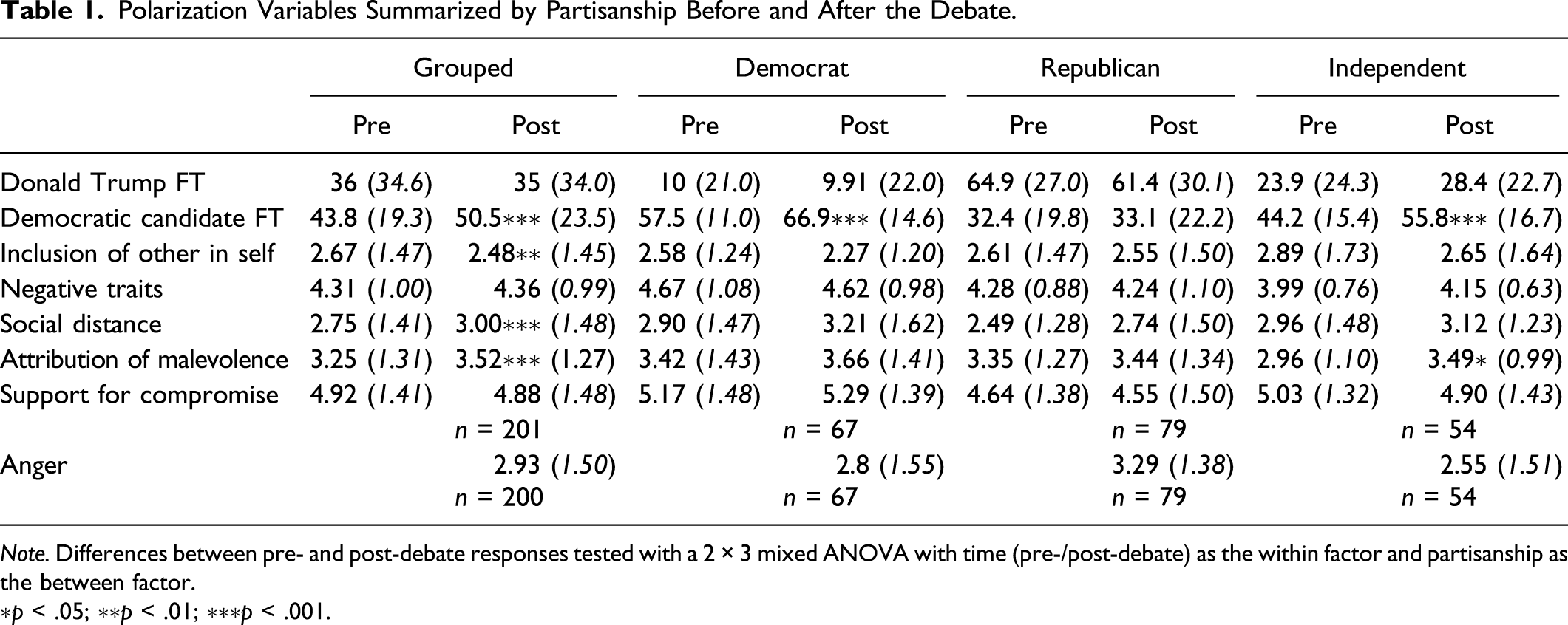
Note. Differences between pre- and post-debate responses tested with a 2 × 3 mixed ANOVA with time (pre-/post-debate) as the within factor and partisanship as the between factor.
∗p < .05; ∗∗p < .01; ∗∗∗p < .001.
Many variables were phrased with regard to the out-group. In other words, Democrats were asked about Republicans and Republicans were asked about Democrats. To achieve this within the survey, we programed a display logic that used responses to a partisan identification question to present a version of the questions with either Democrat or Republican specified as the attitude object. Partisan identification was measured with a 1–7 scale ranging from 1 = Strong Democrat to 7 = Strong Republican. People who selected the middle option (4 = independent) were asked, “I know you don’t have a preference between the two political parties, but based on everything you know, who would you be more likely to vote for?” with response options “Democrat” or “Republican.” Though independents were separated for analysis, this question was used to assign the party categorized for their out-group.
Feeling Thermometer Ratings
Respondents were asked to evaluate Donald Trump and five Democratic candidates ranked highest in the polls at the time of the debate (Joe Biden, Pete Buttigieg, Kamala Harris, Bernie Sanders, and Elizabeth Warren) using a 101-point feeling thermometer rating scale, from 0 (Most Unfavorable) to 100 (Most Favorable). The five Democratic candidates were aggregated to create a single measure (αpre = .84; αpost = .86). Feeling thermometers are the most common measure of affective polarization (e.g., Iyengar et al., 2012; Stroud, 2010).
IoS
Respondents were presented a series of Venn-style circles with varying levels of overlap from circles with no overlap (1) to circles that almost entirely overlap (7). People were asked to select the image that best describes how they identify with Democrats and Republicans. These responses were transformed to indicate closeness with the out-group (i.e., a Democrat’s overlap with Republicans; a Republican’s overlap with Democrats). IoS was originally developed in the interpersonal literature to measure relational closeness (Aron et al., 1992) but was later applied to intergroup contexts (Tropp & Wright, 2001) and has been validated as a measure of affective polarization (Warner, Horstman, et al., 2020; Wojcieszak & Warner, 2020).
Social Distance
Social distance was measured by asking participants four questions about how comfortable (or uncomfortable) they would be to have an out-party supporter as (1) a close relative by marriage, (2) a close personal friend, (3) a neighbor, and a (4) co-worker (αpre = .95; αpost = .96). This is a common measure in intergroup research that has been frequently applied to the study of affective polarization (Garrett et al., 2014; Iyengar et al., 2012; Wojcieszak & Warner, 2020).
Negative Traits
Trait evaluations were measured by asking participants to what extent they think supporters of the [Republican/Democratic] Party are (1) hypocritical, (2) selfish, and (3) mean (all directed toward the out-party, αpre = .76; αpost = .77). This scale is adopted from previous research on affective polarization (Garrett et al., 2014; Wojcieszak & Warner, 2020).
Attribution of Malevolence
To assess attribution of malevolence, participants were asked the extent to which they agree or disagree (on a scale of 1–7) with the statements: “I worry that the [Democratic/Republican] Party is deliberately trying to hurt America,” “[Republicans/Democrats] are knowingly sabotaging the country,” and “[Democrats/Republicans] don’t care about America” (all directed toward the out-party, αpre = .89; αpost = .88)). This measure has emerged from the literature on affective polarization as a crucial marker of the health of democratic attitudes and is linked to the acceptance of political violence (Warner et al., 2019).
Support for Political Compromise
Respondents were presented four pairs of statements and asked to place themselves on a 7-point bi-polar scale according to which of two statements most closely reflects their view: (1) “Politicians need to hold to their principles no matter what, ” versus “Politicians need to work together to get things done,” (2) “Politicians should never compromise their values” versus “Sometimes compromise is necessary when addressing major problems,” (3) “I want politicians who hold their ground,” versus “I want politicians to work together,” and (4) “Principles should never be compromised” versus “Principles should never block progress,” (αpre = .87; αpost = .91).
Anger
After the debate, respondents were asked, “Please indicate to what extent you felt each of the following emotions while viewing the debate,” with response options ranging from 1 = none to 7 = a significant amount. They were presented 16 emotions, four of which measure anger: angry, mad, outraged, and disgusted (αpost = .89).
Results
Results of 2 × 3 Mixed ANOVA Tests.
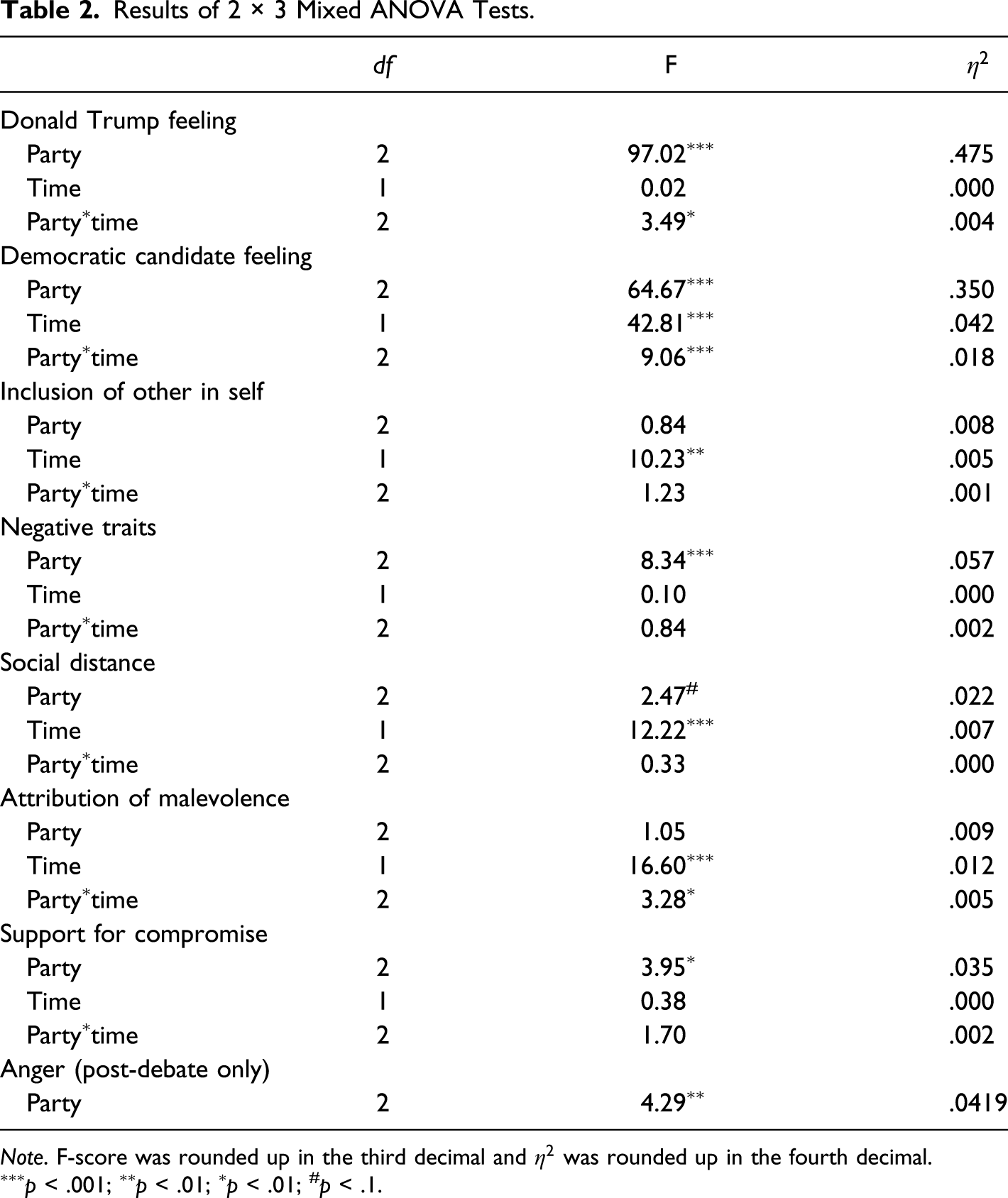
Note. F-score was rounded up in the third decimal and
∗∗∗p < .001; ∗∗p < .01; ∗p < .01; #p < .1.
Candidate Evaluations and Anger
The first hypothesis predicted that viewing an in-group primary debate would increase polarization. Polarization can occur both when in-group members develop more positive evaluations of other members of the in-group and/or when they develop more negative evaluations of out-group members. With regard to the first mechanism, Democrats did become more polarized—their aggregated feeling thermometer evaluation of the Democratic candidates participating in the debates increased by nearly 10 points from just over 57 to approximately 67.
With regard to out-group evaluations, Democratic participants did not change their evaluations of President Trump. However, this is likely due to a floor effect. Democrats’ pre-debate evaluation of Trump were, on average, only a 10 on the 101-point scale. Furthermore, 34 of the 67 Democrats in our study assigned Trump a score of zero in both the pre- and post-debate feeling thermometer score. There was thus little room to observe any further reduction in Democratic evaluations of Trump in our study.
The second and third hypotheses presented competing theoretical expectations of how Republicans would react to viewing the Democratic primary debate. The second hypothesis, following the theory of motivated reasoning, predicted increased polarization. Conversely, the third hypothesis adopted the view that message-consistent persuasion would occur and thus Republicans would become less polarized. Despite the fact that a majority of our stimulus featured Democratic candidates forcefully attacking President Trump, Republican evaluations of Trump did not change, nor did their evaluations of the Democratic candidates. Thus, neither H2 nor H3 was supported. Republicans appeared to be entirely resistant to change in either direction with regard to their evaluations of the candidates. Though Republican feeling thermometer evaluations did not change, they did report more anger than Democrats or independents. However, overall anger was low. Democrats and independents reported anger below three on the seven-point scale, whereas Republicans reported anger slightly above three.
The final hypothesis predicted that independents would be polarized in the direction of the messages they viewed—more favorable toward the Democratic candidates and more hostile toward President Trump. This hypothesis was only partially supported. Independents did become more favorable toward the Democratic candidates, but their evaluations of Trump did not change.
Support for Compromise and Negative Trait Attributions
On two of the remaining measures of polarization, there was no (main or conditional) effect of debate viewing. The debate did not influence participants’ support for compromise, though readers may be interested to know that Republicans were significantly lower on this scale than Democrats or independents. The extent to which supporters attributed negative traits to supporters of the other party also did not change.
Closeness, Social Distance, and Attribution of Malevolence
There were main effects of debate viewing on IoS, social distance, and attribution of malevolence. In all three cases, debate viewing increased polarization. Viewing the primary debate resulted in a modest reduction (roughly one-fifth of a point) in IoS—indicating less perceived closeness with the other party. Social distance and attribution of malevolence each increased approximately a quarter of a point. These effects were statistically and substantively equivalent across partisanship (see Table 1).
Discussion
This study examined the polarizing effects of presidential primary debates. Though these debates garner massive real-time audiences and dominate the political conversation on legacy and digital media, they receive far less scholarly attention. This study is one of a very few examining the persuasive effects of these debates and is perhaps the first to consider the potential polarizing consequences for viewers. By exposing Democratic and Republican viewers to a Democratic Party primary debate, we were able to test both in-group and out-group processes. We found evidence of polarization in three normatively troubling measures. With regard to candidate evaluations, support for compromise, and trait assessments, we observed little evidence of polarization—though candidates participating in the debate experienced improvement in evaluations from both pro-partisans and independents. In what follows, we discuss the implications of these findings and consider limitations.
Evidence of Polarization
Viewing this primary debate resulted in more polarization on three important metrics: attribution of malevolence, perceived closeness, and social distance. Attribution of malevolence is an especially pernicious attitude. People high in attribution of malevolence are likely to see the other party as illegitimate, nefarious, and potentially evil; high scores have been linked with acceptance of political violence (Warner et al., 2019). Both social distance and IoS are measures of social polarization. Viewing a primary debate resulted in people perceiving the out-party as having less in common with them and as perceiving out-partisans as less socially desirable members of interpersonal networks. Thus, primary debates may amplify social disconnection people feel toward those they disagree with politically (Chen & Rohla, 2018; Huber & Malhotra, 2017; Warner, Colaner, et al., 2020). It is also worth noting that Republican viewers expressed more anger than Democrats and independents; a finding that suggests the experience of viewing out-party attacks did arouse some level of agitation.
The size of these effects was modest but still somewhat alarming considering the participants only viewed a 45-minute primary debate. We deliberately selected a debate that featured a considerable amount of intergroup criticism. The Democratic candidates leveled robust criticisms of Trump. These effects may be somewhat of an artifact of the unique context of the Trump presidency. It is historically unusual, if not unprecedented, for a sitting president to be mired in an impeachment-level controversy. Nevertheless, the intensity of partisan animus toward Trump is more likely a continuation, rather than a deviation, of the hostility members of the political out-group directed toward Presidents Obama, G. W. Bush, and Clinton.
Absence of Polarization
Compared to the normatively troubling outcomes summarized in the previous section, the effects of viewing the primary debate on the participants and on Trump himself were somewhat surprising. Both Democrats (+9) and independents (+12) provided warmer evaluations of the participating candidates after viewing the debate. Despite the vociferous attacks on Trump, Republican evaluations of the Democratic participants did not change—a finding contrary to both the message-consistent persuasion expectation (Feldman, 2011) and the disconfirmation bias (Taber & Lodge, 2006) articulated in our competing second and third hypotheses.
Similarly, evaluations of Trump did not change after viewing the debate regardless of the partisanship of the respondent. We deliberately selected the strongest possible stimulus to test this; in no primary debate that we can recall have the attacks on the sitting president been as aggressive. Nevertheless, Republicans were not persuaded to reduce their support for Trump, nor did they show any evidence of rallying to his defense. Similarly, Democrats entered the debate with historically low evaluations of Trump (approximately 10 on the 101-point feeling thermometer) and did not budge. Perhaps most surprisingly, independents did not change their evaluations of Trump either. Partisans could be expected to have fairly stable evaluations since they tend to be more interested in politics and would likely have already formed evaluations of Trump based on much of the same information presented in the debate. However, we expected independents to be more susceptible to persuasion because they were more likely to encounter novel information and less inclined to counter-argue this information. In total, these findings suggest that, after 4 years of a Trump presidency, viewers had formed stable attitudes toward him. It is not likely that any amount of new or reinforcing information would change these attitudes, for Democrats, Republicans, or independents.
With regard to the Democratic participants, the finding that they improved their standing among in-party viewers is consistent with past findings that these debates—in aggregate—have mostly upsides for the party hosting them (see also, McKinney & Warner, 2013; Warner et al., 2018). Greater in-party enthusiasm can drive greater polarization because it increases the distance between in-group favorability and out-group hostility. However, in a political context, out-group hostility is the primary area of concern from a normative democratic perspective. In-group favorability is associated with many behaviors that are often considered desirable in a democracy (e.g., greater participation, higher propensity to vote, and more attention to news about the campaign—see also Warner, McKinney, et al., 2020 for further discussion of the benefits and potential downsides of in-party enthusiasm).
It is noteworthy—and a novel finding—that debate participants also gained favorability among independent viewers. These gains were actually somewhat larger than the in-party gains we observed. In general, we might expect independents to react favorably to a primary debate because the participants are attempting to make the most persuasive possible case for themselves. However, this debate presents a conservative test of that logic given the aggressive attacks on the other party. One could argue that independents would find this sharp partisanship unbecoming and punish the candidates for their attacks. That they did not, that the reverse was observed, suggests that these debates hold little downside for the participants. Even when they go negative, they gain with the in-group and unaffiliated and do not lose ground with the out-group.
Support for Compromise
One of the most oft-cited concerns regarding political polarization is that it will reduce support for political compromise (Gutmann & Thompson, 2010). Given this, we included a novel measure of support for compromise. Viewing the debate did not affect people’s support for compromise. Because this is the first (to our knowledge) use of this measure, it is unclear how to interpret this result. It may be that support for compromise is a stable attitude unaffected by new information. Conversely, it is possible that people can be primed to be more or less supportive of compromise but that this debate did not succeed in generating change. Because concerns about legislative gridlock are central to discussions of political polarization, more research is needed using this measure.
Limitations
As with many debate studies, ours is limited by the number of debates examined. Because we tested a single debate—and because we selected one in which there was a considerable amount of negativity directed toward the incumbent president—it is unclear how many of the effects would be observed in a primary debate in which the bulk of the time was spent contrasting in-party candidates. Furthermore, because the Republican Party did not hold primary debates in 2020, we were unable to test in-group effects on Republicans, nor could we test out-group effects on Democrats. It is important for future primary studies to continue to examine the effects of viewing a debate on members of the political out-group. Our use of a convenience sample also suggests caution be applied when generalizing our findings to the broader population—though a meta-analysis of debate effects found no difference in effects observed in student samples versus adult population samples (Benoit et al., 2003).
Conclusion
This study demonstrates that viewing a primary debate can increase political polarization. This effect was observed for three of the most normatively troubling outcomes: attribution of malevolence, social distance, and IoS. These effects occurred regardless of partisanship. Thus, primary debates do appear to have the capacity to add fuel to an already contentions political environment. These findings occurred despite the fact that hostility to out-party exemplars remained unchanged. Democrats did not become more hostile toward Trump despite the repeated and aggressive criticisms of him. Republicans did not react to this negativity from the out-group with more negativity toward the Democratic candidates, nor did they rally to Trump’s defense. Democrats and independents did become more favorable toward the candidates participating in the debate—an effect that reinforces the persistent finding that participating in primary campaign debates holds more upside than downside for the candidates. In total, these results suggest that primary debates, like many other facets of the 2020 campaign, are part-and-parcel of an increasingly divisive political culture in the United States.
Footnotes
Declaration of Conflicting Interests
The author(s) declared no potential conflicts of interest with respect to the research, authorship, and/or publication of this article.
Funding
The author(s) received no financial support for the research, authorship, and/or publication of this article.