




Abstract
This study advances research on the role of protest in individual-level participation repertoires by examining how latent class analysis can be used to identify distinctive types of political participants. This methodological approach requires shifting researchers’ traditional theoretical and analytical focus on protest as a single political act to the ways in which political actors combine protest with other political behaviors. From a theoretical perspective, the study examines the increased salience of research on the causes and consequences of protest in the context of individuals’ broader participation repertoires. From a methodological perspective, an illustrative analysis is conducted using the 2016 American National Election Studies survey to test theoretical expectations about the relationship between protest and civic duty. The study concludes with a discussion of how latent class analysis can be used to advance research on protest as one political act in individuals’ broader repertories of political participation.
In a widely viewed speech given during the 2016 U.S. Presidential election campaign, former President Barack Obama urges rally attendees: “Don’t boo—vote!” The timing of this call to engage in a specific political behavior immediately followed the crowd’s boisterous booing of the Republican candidate, Donald J. Trump, in a campaign that ended in Trump’s victory over his Democratic rival, Hillary Rodham Clinton. 1
This viral campaign moment clearly had the rhetorical intention of mobilizing voter turnout, regardless of whether voters also continued to loudly protest against the opposition. For scholars of political behavior, however, this vivid campaign moment puts a spotlight on an increasingly important theoretical and methodological research question, namely: How do individuals combine protest with other political acts in their personal repertoire of political participation? Research on this topic has become more salient with the accumulation of evidence highlighting the importance of better understanding the causes and consequences of protest in contemporary democracies.
From a theoretical perspective, the current study examines the role of protest in individuals’ broader participation repertoires, and the distinctive sociodemographic characteristics of different types of political participants. From a methodological perspective, an illustrative latent class analysis (LCA) is conducted using the 2016 American National Election Studies (ANES) survey to test expectations about how individuals’ participation repertoires relate to their sense of civic duty. In an era characterized by multiple governing crises and worldwide protest, this study examines how researchers can use LCA to advance theory and analysis of expanding repertoires of political participation.
Protest as One Political Act in Individuals’ Participation Repertoires
Scholars of political behavior have long recognized the importance of studying protest, and a vibrant line of research on this political activity continues to yield new insights. For example, recent advances include studies on methodological approaches for investigating street protest (Fisher et al., 2019), the future of nonviolent resistance (Chenoweth 2020), the relationship between dissatisfaction and protest (Christensen, 2016), and regional distinctions in protest and ideology (Borbáth & Gessler, 2020). These studies represent an extensive literature on protest that focuses on this specific political act as worthy of close attention within the broader study of political participation. Yet, the empirical relationship between protest and other acts of political behavior—particularly how individuals combine protest with other acts—has received less attention.
While empirical large-N survey research on political behavior has focused predominantly on the act of voting, scholars began paying close attention to diverse acts of political participation beyond the electoral arena already in the 1970s (e.g., Barnes & Kaase, 1979; Verba & Nie, 1972). Subsequent research has affirmed the increased prevalence over time of nonelectoral participation in a variety of political acts and in diverse contexts (e.g., Albacete, 2014; Copeland & Boulianne, 2020; Dalton, 2008, 2015; Giugni & Grasso, 2018; Grasso, 2016; Ohme et al., 2018; Oser & Boulianne, 2020; Schlozman et al., 2018; Theocharis & van Deth, 2018; van Deth, 2020; Verba et al., 1995; Vráblíková, 2014, 2016). The increased prevalence of political participation beyond the electoral arena highlights the importance of developing theories and research designs that consider how individuals combine the full range of political behavior in their personal repertoires of participation—from the most common act of voting, to the relatively rare act of protest.
Most research on political behavior has focused on the sociodemographic and attitudinal determinants of various political acts. The study of participatory inequality is one of the defining areas of scholarship on political participation, and this research has found consistent evidence of increased participation among sociodemographically advantaged individuals (Marien et al., 2010; Oser et al., 2013; Quaranta, 2018; Schlozman et al., 2018; Schradie, 2018). Research on the normative and attitudinal determinants of different types of participation has also been a mainstay of research on political behavior, beginning with A. A. Campbell et al.’s (1960) classic study, The American Voter, and continuing to more recent research on citizenship norms (e.g., Dalton, 2008, 2015; Loewen & Rubenson, 2019).
In addition, researchers have produced a growing body of evidence related to the consequences of political behavior beyond the electoral arena, with recent studies indicating that a variety of political behaviors influence political representation and democratic responsiveness. For example, in U.S.-focused research, Gillion’s (2012) study of minority protest between 1961 and 1991 revealed the impact of this activity on congressional roll call votes; and Leighley and Oser (2018) showed that in 2012, participation beyond voting enhanced congruence between participants and their representatives for the highly partisan and salient policy issue of health care reform. Examples of recent cross-national research on this topic include Htun and Weldon’s (2012) findings that women’s mobilization in autonomous social movements has affected policies to combat violence against women in 70 countries over four decades; and Rasmussen and Reher’s (2019) empirical results showing that civil society engagement has strengthened the relationship between public opinion and public policy across 20 policy issues in 30 European countries. These studies represent a growing body of literature that illustrates how scholars are increasingly tracing the linkages between a variety of political acts and representational outcomes (Ansolabahere & Kuriwaki, 2021; Dassonneville et al., 2020; Esaiasson & Wlezien, 2017; Hooghe et al., 2019; Hooghe & Oser, 2016; Wasow, 2020; Wouters & Walgrave, 2017).
As McAdam and Tarrow (2010) noted in their examination of the reciprocal relationship between elections and social movements, research on different types of political acts is often conducted in separate siloes, with experts on voting and experts on protest engaging in separate scholarly conversations. Informed by Charles Tilly, social movement scholars have often used the term “repertoire” to describe the broad range of individuals’ political behavior (Alimi, 2015; Bojar & Kriesi, 2021; Gade, 2020; Tilly, 1995, 2006). However, this actor-oriented conceptual approach is not common among scholars who use large-N survey research to analyze political behavior. The following discussion of LCA outlines the theoretical and methodological importance of shifting the unit of analysis from separate political acts (e.g., analysis of a single political behavior such as voting or protest) to the ways in which political actors combine multiple political behaviors.
Latent Class Analysis: Identifying Participation Repertoires
In one of the first large-N survey studies of political participation in the United States, Verba and Nie (1972, pp. 390-402) argued for the importance of studying different types of participants, and discussed the technical limitations (at the time) of objectively selecting optimal models. In recent years, however, LCA has emerged as a widely used technique for conducting model-based clustering in the social sciences. LCA empirically identifies groups of respondents who share similar combinations of responses on multiple indicators (Ahlquist & Breunig, 2012; Hagenaars & McCutcheon, 2002).
Social science researchers have used LCA to analyze a wide variety of topics, including tolerance (McCutcheon, 1985; Sniderman et al., 1989), party support (Breen, 2000), opinion-changing behavior (Hill & Kriesi, 2001), citizenship norms (Hooghe et al., 2016; Hooghe & Oser, 2015; Oser & Hooghe, 2013; Sampermans et al., 2020); revolutionary groups (Beissinger, 2013), technocratic attitudes (Bertsou & Caramani, 2020), nationalist sentiment (Bonikowski & DiMaggio, 2016), democratic ideals (Hooghe et al., 2017; Hooghe & Oser, 2018; Oser & Hooghe, 2018a, 2018b), and political donor types (Rhodes et al., 2018). Although LCA is not yet widely used for the study of political participation repertoires, a handful of recent studies have used the technique to identify distinct types of political participants (e.g., Alvarez et al., 2017; Johann et al., 2020; Keating & Melis, 2017; Oser, 2017; Oser et al., 2013; Oser et al., 2014; Steenvoorden, 2018).
One of the main advantages of LCA relative to traditional cluster analysis is that probabilistic estimation yields objective goodness-of-fit statistics. These measures serve as reliable indicators for the assessment of the optimal number of latent classes (Raftery, 1995; Vermunt & Magidson, 2002). The Bayesian information criterion (BIC) is widely used for this purpose, with a smaller BIC indicating better model fit (Nylund et al., 2007). Two key results inform the interpretation of findings. First, conditional probabilities of each latent class indicate the likelihood of providing a positive answer on all indicators, given that the respondent belongs to a specific latent class. In the current study, the conditional probabilities indicate the likelihood that respondents in each participant type engage in each of the political acts. Second, the probability that individual respondents are members of each latent class is estimated, which allows researchers to analyze individual-level correlates of membership in the distinctive latent classes. Furthermore, the size of each latent class is obtained, showing the prevalence of different types in the population.
It is useful to contextualize this illustrative analysis by noting that two main technical obstacles have hindered the widespread use of LCA for investigations of political participation. First, instruction in LCA is not yet common in the graduate school training of students who research protest and political participation. Second, the statistical software packages that empirical researchers of political behavior have most commonly used are either not currently equipped to conduct LCA, or include recently developed modules that do not yet have the capacity to efficiently analyze multiple indicators from complex data sets. While statistical and political methodologists are increasingly advancing sophisticated adaptations of LCA that use different approaches for addressing latent variable measurement error (Di Mari & Bakk, 2018; Vermunt, 2010), LCA is not yet a common approach among substantively oriented students of protest and political behavior. These technical obstacles have become less salient in recent years due to both increased enrollment in specialized methods workshops (in addition to standard graduate school training), and to recent advances in several of the software platforms that conduct LCA.
This methodological background highlights the usefulness of conducting an illustrative analysis to clarify the theoretical and methodological underpinnings of this approach. Thus, the following section shows how LCA can advance scholarship on the role of protest in repertoires of political participation. The analysis presented in the current study was conducted using Bayesian LCA in Latent Gold software (version 5.1), setting the Bayes constant to 1, which avoids boundary solutions that can appear due to empty cells. Since LCA’s use of maximum likelihood estimation can yield boundary solutions for complex data that may produce unstable results, the use of Bayesian priors on the estimator can overcome this problem. The sociodemographic correlates of the latent classes were analyzed in Stata 15.1 via multinomial logistic regression analysis, with the dependent variable of the modal classification of respondents into latent classes. 2
Illustrative Analysis: Protest as One Political Act in Participation Repertoires
As an illustrative analysis of the study of protest as one political act in individuals’ participation repertoires, the current study investigates the relationship between distinctive types of political participants and their sociodemographic correlates. A theoretically informative correlate of participant types to focus on for the purpose of this illustrative analysis is individuals’ sense of “duty,” which received early attention in Almond and Verba’s (1963) cross-national survey research on civic attitudes. Research on civic attitudes has expanded to encompass more recently prevalent norms, alternately referred to as “engaged” (Copeland & Feezell, 2017; Dalton, 2008, 2015), “critical” (Geissel, 2008; Norris, 1999, 2011), “assertive” (Dalton & Welzel, 2014; Welzel et al., 2005), “expressive” (Bennett, 2012; Lane, 2020) or “self-actualizing” (Bennett, 2008; Shehata et al., 2016). Even as these norms have become increasingly prevalent, research has found that duty has remained a meaningful civic attitude worldwide (Blais & Daoust, 2020; D. E. Campbell, 2006; Feitosa, 2020; Feitosa & Galais, 2020; Hooghe et al., 2016; Hooghe & Oser, 2015; Hur, 2020; Oser & Hooghe, 2013).
Examples of recent research on the continued importance of duty for understanding political behavior include multiwave panel studies that generated evidence of sizeable causal effects of civic duty on voter turnout (Blais & Achen, 2019; Galais & Blais, 2016). A variety of experimental studies have also clarified the causal impact of civic duty on voting (Davenport et al., 2010; Feitosa et al., 2020; Gerber et al., 2008; Gerber et al., 2016). Although this line of research continues to document a strong duty-voting connection, some longitudinal studies have indicated that civic duty norms have become somewhat less prevalent over time, which seems to have contributed to declining turnout rates (Blais et al., 2004; Blais & Rubenson, 2013; Fieldhouse et al., 2007). These findings show that duty is an important attitudinal determinant of voting, as well as an important focus for future research that seeks to assess the causes of changing turnout levels over time.
An unresolved puzzle emerges, however, when synthesizing prior findings that show a consistently strong association between civic duty and the specific political act of voting, with the findings on the relationship between duty and other political acts. A comprehensive cross-national investigation of the relationship between civic norms and participation patterns concluded that those with a high level of civic duty engage in a variety of political behaviors in addition to voting, including protest (Bolzendahl & Coffé, 2013, p. 54). In contrast, a study that focused primarily on the relationship between individuals’ duty to vote and voting behavior found strong evidence for this relationship—but no evidence that duty matters for participation beyond voting, based on an analysis of indicators such as talking about politics and donating (Blais & Achen, 2019). Blais and Achen (2019) thus observed that “duty affects only turnout, not other aspects of political participation” (p. 490). These studies follow the common practice in the field of using either single political acts (e.g., voting, donating), or additive indices of similar types of acts (e.g., political activism) as distinct dependent variables in separate regression models.
The current analysis assesses these seemingly contradictory findings by investigating the relationship between expectations about duty and individuals’ broader repertoires of participation. Empirical validation of Blais and Achen’s (2019) conclusion would be evident if findings show that duty is a predictor of repertoires that are characterized by high levels of voting, regardless of the additional activities in the repertoire. Alternatively, affirmation of Bolzendahl and Coffé’s (2013) study would be evident if duty is a predictor of repertoires that are characterized by high levels of engagement in multiple political acts, including voting. The analysis assesses these seemingly contradictory expectations using a methodological approach that allows researchers to investigate the relationship between civic duty and individuals’ broader repertoires of political participation.
Data
The 2016 ANES survey is a useful data set for testing these expectations because it contains rich data on both political behavior and civic duty (ANES, 2017b; ANES et al., 2017). The ANES is one of the most widely used data sets for the study of political behavior, and is often considered the gold standard for empirical research on this topic (Robison et al., 2017). The political behavior questions in the ANES ask about a diverse range of political activity, including electoral-oriented acts as well as participation beyond the electoral arena.
Table 1 shows the prevalence of each participation indicator used in the analysis. Notably, the classic protest indicator—joining a protest march—is the least commonly reported political act (3.3%) among the indicators used in the analysis. The ANES includes an additional indicator related to protest: “went to political meetings, rallies, or speeches,” which is also relatively uncommon (7.7%). The most common act was voting in the general election, followed closely by voting in Senate and House races. As with all survey data, the responses for voting are likely biased toward higher levels of turnout than the general population due to sampling and social desirability bias (Selb & Munzert, 2013). After voting, some of the most commonly reported political acts are those that have become more prevalent recently, such as political consumerism (57.6%), and using Facebook or Twitter for political communication (34.5%). Electoral-oriented acts beyond voting are less common, such as contacting a U.S. Representative or Senator (10.8%), or working for a political party or candidate (3.5%).
Political Participation Indicators Used in the Analysis.
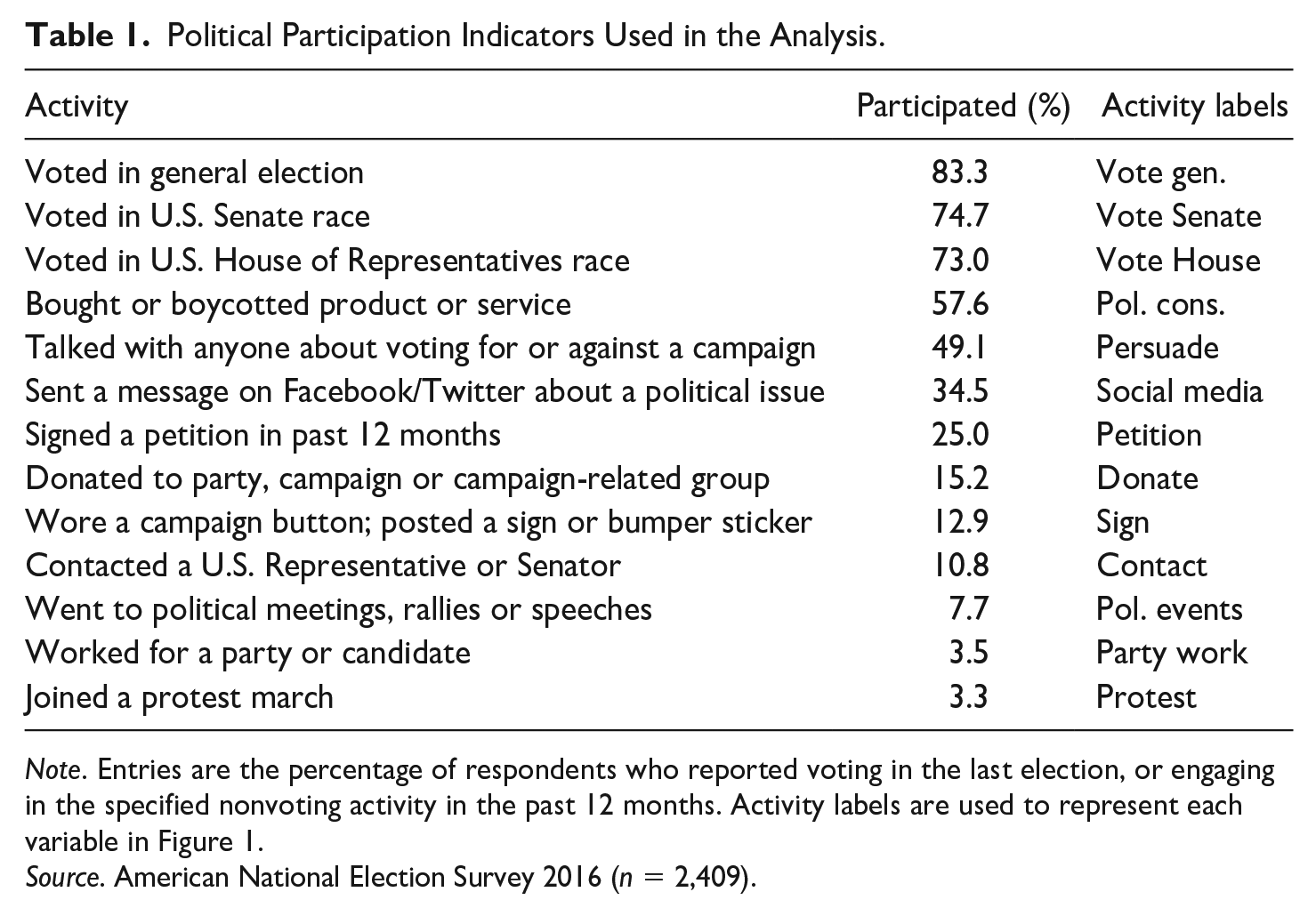
Note. Entries are the percentage of respondents who reported voting in the last election, or engaging in the specified nonvoting activity in the past 12 months. Activity labels are used to represent each variable in Figure 1.
Source. American National Election Survey 2016 (n = 2,409).
With regard to the measurement of duty, despite early documentation of the empirical importance of civic duty for understanding electoral behavior (e.g., A. A. Campbell et al., 1954), the topic has received sporadic attention over time in the ANES survey instrument (for a historical review of survey questions related to duty, see Blais & Achen, 2019; Blais & Galais, 2016; Goodman, 2018). An important recent advance for scholarship on civic duty is research that has improved the operationalization of this concept (Blais & Achen, 2019; Blais & Galais, 2016). A new battery of questions based on this research was first implemented in the 2016 ANES survey. The current analysis uses measures of duty based on responses to the ANES 2016 question, which was designed to avoid social desirability bias.
The question is as follows (ANES, 2017a): Different people feel differently about voting. For some, voting is a duty—they feel they should vote in every election no matter how they feel about the candidates and parties. For others, voting is a choice—they feel free to vote or not to vote, depending on how they feel about the candidates and parties. For you personally, is voting mainly a duty, mainly a choice, or neither a duty nor a choice? (pp. 35-36)
A subsequent question then assessed the strength of the choice-duty selection, as follows: “How strongly do you feel that voting is a duty/choice? 1. Very strongly 2. Moderately strongly 3. A little strongly.” Combined, these questions yield a seven-category variable that ranges from strong choice (1) to strong duty (7).
Using LCA to Identify Participant Types
To identify distinctive types of political participants, LCA was used to analyze the ANES sample. The LCA model fit statistics shown in Table 2 identify five classes as the optimal number of classes to fit the data. As noted, the BIC is widely used to assess model fit, with the smallest value indicating optimal fit.
Latent Class Analysis Model Fit Statistics.
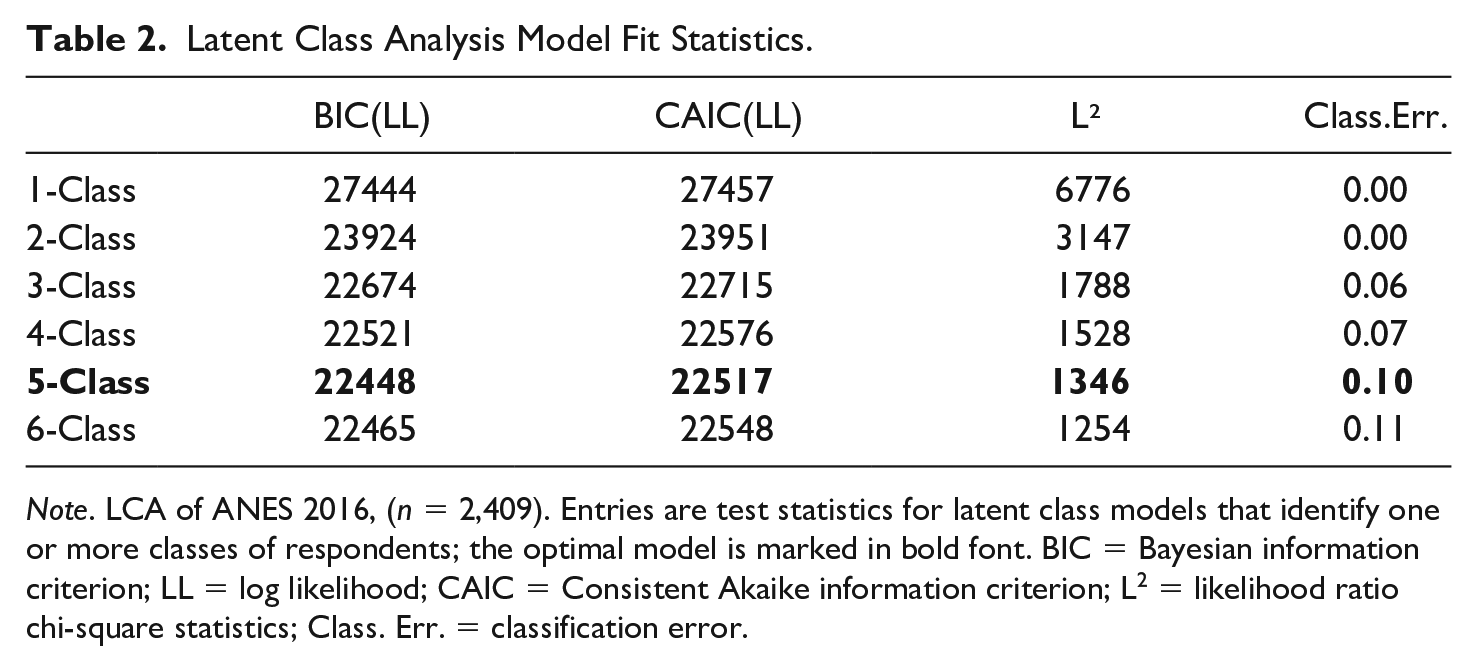
Note. LCA of ANES 2016, (n = 2,409). Entries are test statistics for latent class models that identify one or more classes of respondents; the optimal model is marked in bold font. BIC = Bayesian information criterion; LL = log likelihood; CAIC = Consistent Akaike information criterion; L2 = likelihood ratio chi-square statistics; Class. Err. = classification error.
The analytical approach of focusing on the repertoires of political actors rather than their separate political acts leads to the identification of the five distinct participant types shown in Table 3. The five classes identified in the optimal LCA model represent five types of political participants. Table 3 presents the conditional probabilities of these five latent classes in tabular form, as well as the standard errors for each point estimate, thereby clarifying the robustness of the substantive distinction between the specific point estimates for the five repertoires. The labels chosen to describe each repertoire reflect the distinctive characteristics of each latent class, as evident in the following summary of key findings.
Latent Class Conditional Probabilities With Standard Errors.
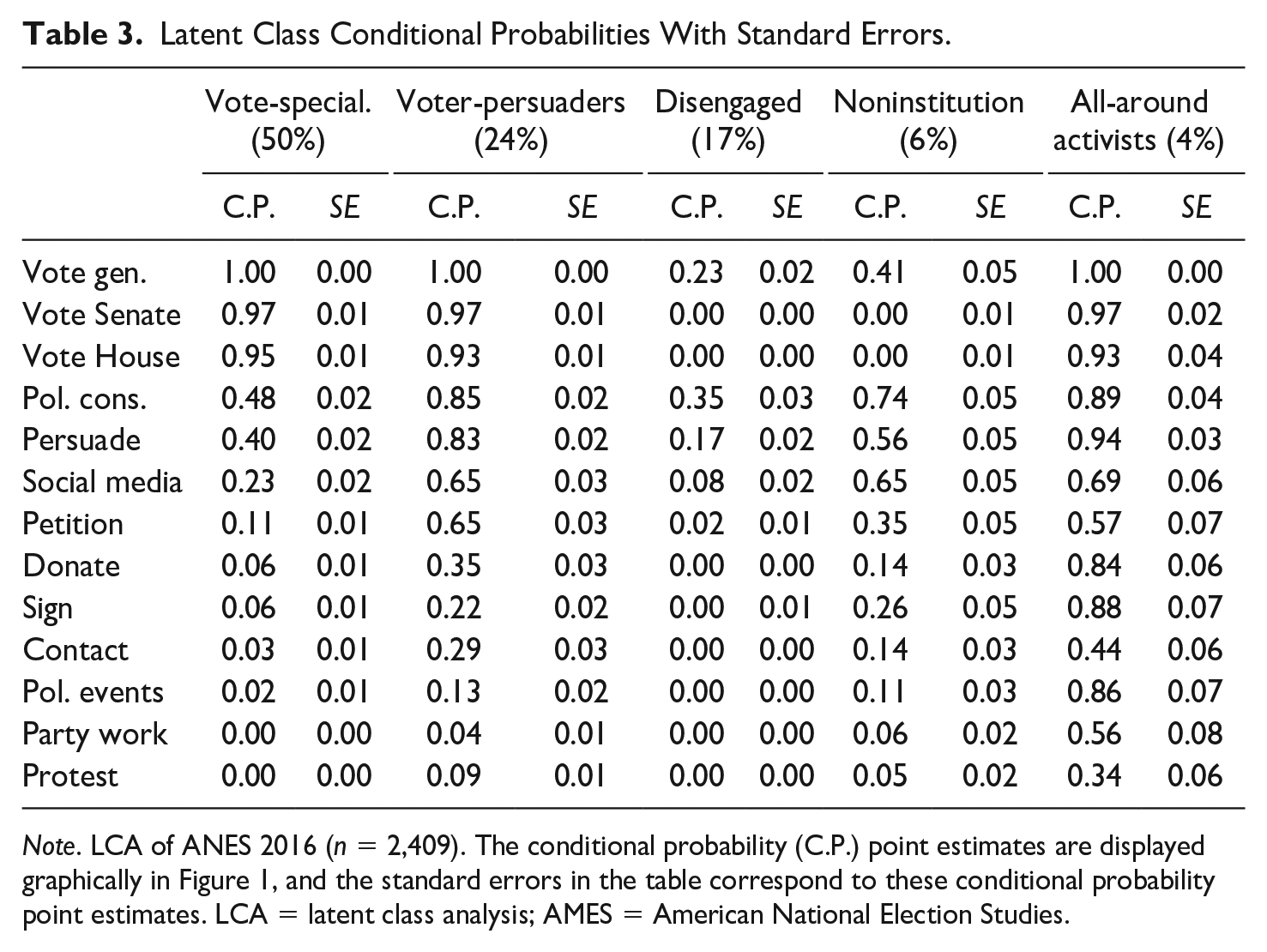
Note. LCA of ANES 2016 (n = 2,409). The conditional probability (C.P.) point estimates are displayed graphically in Figure 1, and the standard errors in the table correspond to these conditional probability point estimates. LCA = latent class analysis; AMES = American National Election Studies.
To interpret the results in relation to the theoretical focus of this analysis on protest—the least prevalent political act—recall that the two classic indicators related to protest reviewed in Table 1 are relatively rare in the population as a whole. Only 3.3% reported joining a protest march (labeled “protest”), and only 7.7% reported attending political meetings, rallies, or speeches (labeled “pol. events”). 3
As shown in Table 3, the likelihood of participating in these protest-related activities is not equally distributed across the five participant types. Two groups have almost zero probability of engaging in protest of any kind: the “disengaged” group, which constitutes 17% of the sample, and the “vote-specialists” group which accounts for 50% of the sample. Although these two groups differ meaningfully in their likelihood of participating in other political acts, they are similarly uninvolved in protests.
In contrast, the small group of “all-around activists,” which constitutes only 4% of the general population, has a very high probability of engaging in protest. While only 3.3% of the general population reported engaging in protests, this group has a 34% probability of protesting. Furthermore, relative to the general public’s 7.7% mean prevalence of attending political events such as rallies, fully 86% of this group reported attending such events. In sum, members of this all-around activist group exhibit a high level of protest behavior and have high scores on all other participation indicators relative to the general population.
Two other latent classes have a meaningful probability of engaging in protest but have much lower scores than the all-around activists. The voter-persuaders group has a 9% probability of protesting (compared with the 3.3% probability in the overall population); and a 13% probability of attending political events such as rallies (compared with the 7.7% population mean). Finally, the noninstitutionalized specialists score near the population mean for both protests and attending political events. The noninstitutionalist group also scores high on classic noninstitutionalized political acts of political consumerism and political social media use, as well as communication-oriented acts of petition and persuasion. Notably, although this group’s probability of voting is relatively low (41%), members of this group are almost twice as likely to vote as the disengaged group, and are on par with the general population’s likelihood of working for a political party. Thus, while this group places particular emphasis on noninstitutionalized political acts, it is clearly not narrowly focused on protest to the exclusion of all other political engagement. The analytical approach of LCA’s identification of political actors’ distinctive participation repertoires clarifies that in this ANES 2016 data set, there is no “protest specialist” group that engages in only protest but is otherwise politically inactive.
To visually summarize the distinctive emphases of each latent class, Figure 1 plots the conditional probability point estimates for each participant repertoire to facilitate substantive clarity on the distinct emphases of each participant type. The x-axis plots the participation indicators from the most to least prevalent so the conditional probabilities for each latent class can be compared with the mean participation levels for each political act (noted in the x-axis labels).
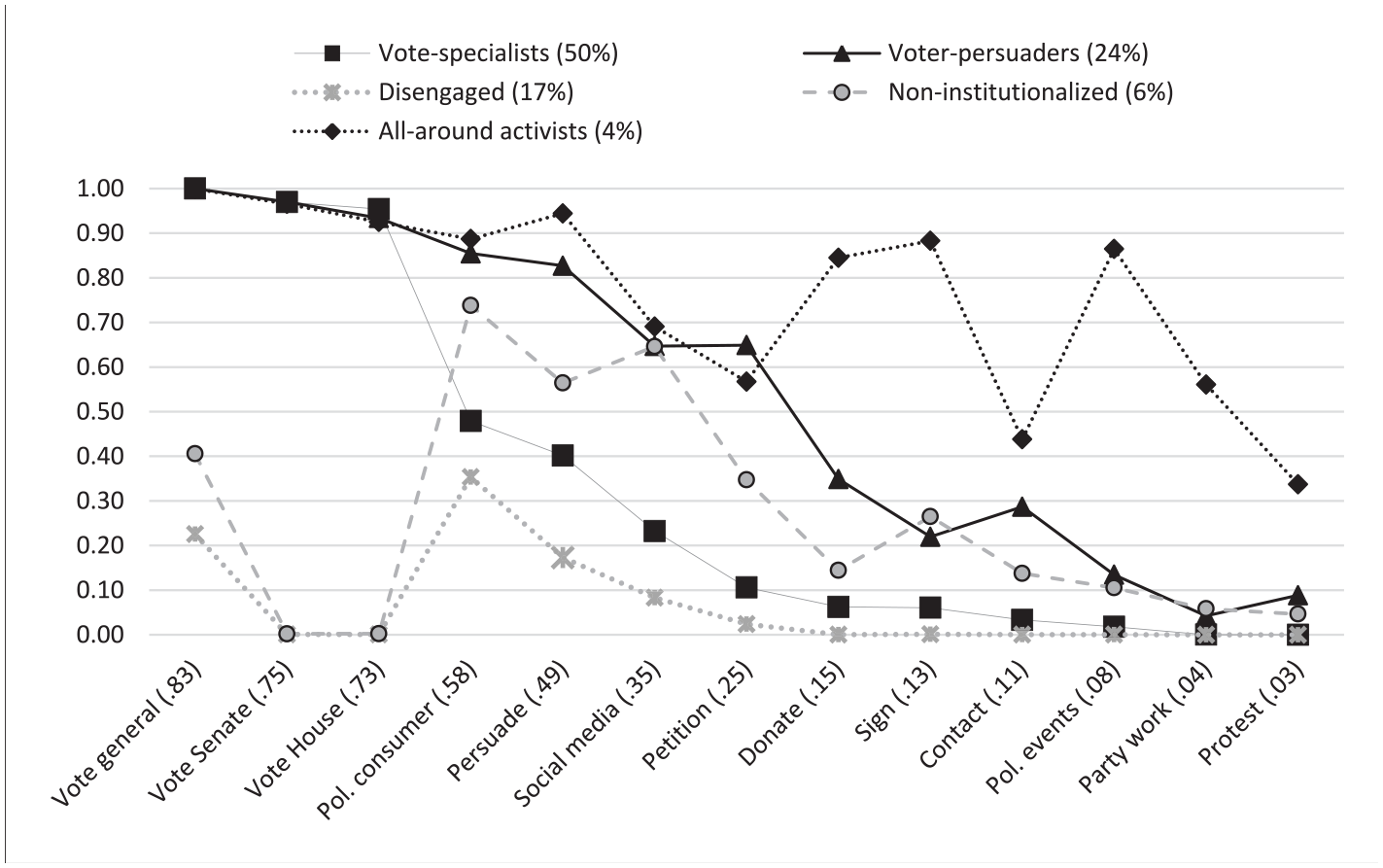
Five types of political participants in the ANES 2016.
In sum, this review of the LCA findings with a theoretical focus on protest clarifies that the act of protesting has a relatively high probability of inclusion in three distinct participant repertoires (all-around activists, voter-persuaders and noninstitutionalized). Furthermore, the individuals who are members of two of these participant types are certain to vote (all-around activists and voter-persuaders), while the noninstitutionalized group has a lower probability of voting. The LCA findings clearly indicate that those who protest have broad and diverse repertoires of political participation that include engaging in other political acts, and that there is no set of “protest specialists” in these data.
Participant Types and Civic Duty
The next stage of the analysis examines the relationship between the identified participant types and civic duty. Table 4 presents the results of a multinomial logistic regression that analyzes the determinants of membership in the five participant types. In addition to the key independent variable of civic duty, the regression model includes the standard control variables of party identification, internal efficacy (mean scale of three variables, 1 = low, 5 = high), political interest (1 = not at all; 4 = very), age (continuous year), gender (0 = male; 1 = female), education (16-category), income (28-category), race (African American, Hispanic, Other non-White). 4 The multinomial logistic regression results in Table 4 defined “disengaged” as the reference group, and Figure 2 plots the average marginal effects of civic duty on membership in the five participant types based on the results of the fully specified model. 5 The results for the control variables are consistent with the literature (Smets & van Ham, 2013).
Civic Duty and Participation Repertoires.
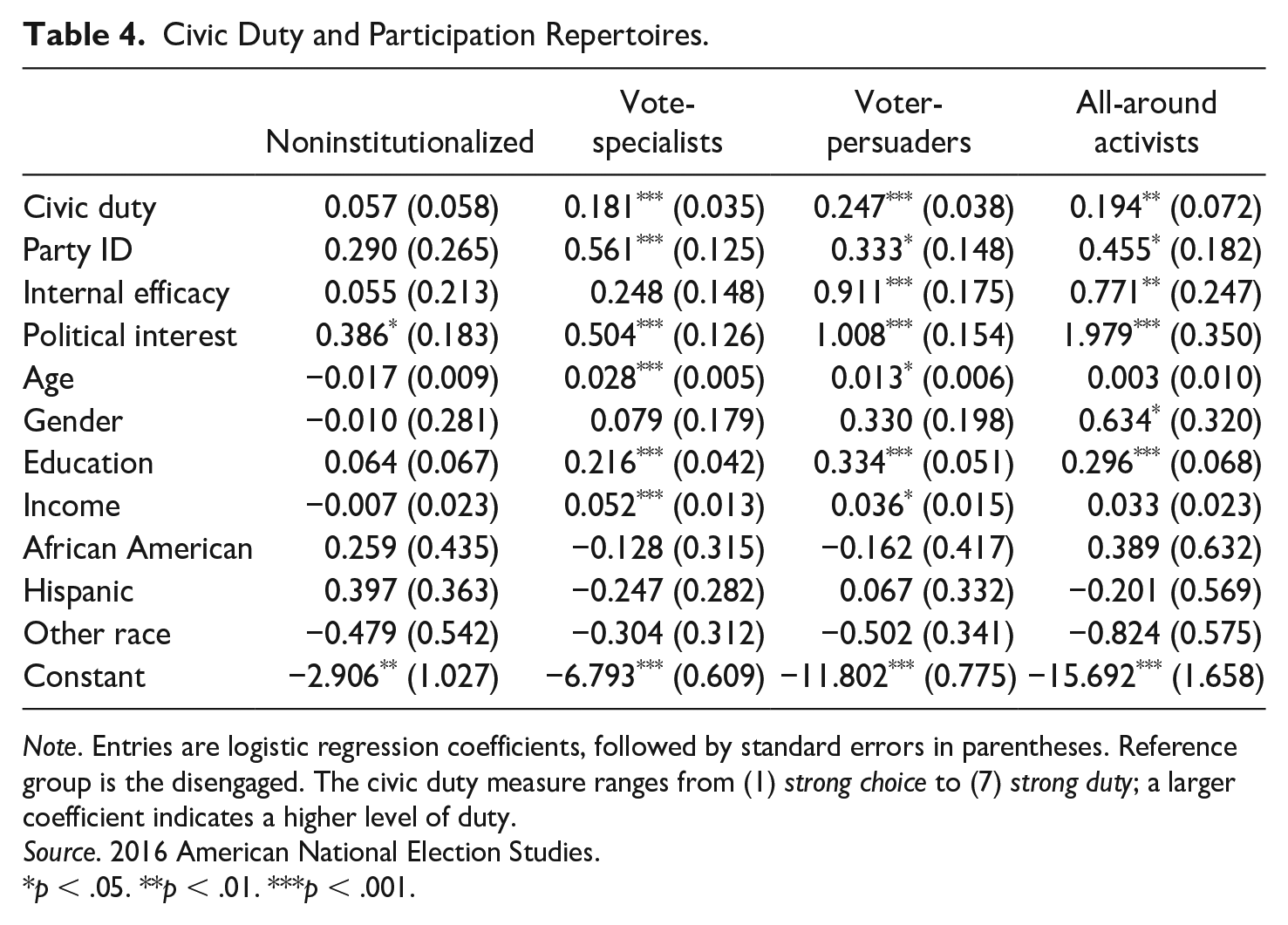
Note. Entries are logistic regression coefficients, followed by standard errors in parentheses. Reference group is the disengaged. The civic duty measure ranges from (1) strong choice to (7) strong duty; a larger coefficient indicates a higher level of duty.
Source. 2016 American National Election Studies.
p < .05. **p < .01. ***p < .001.
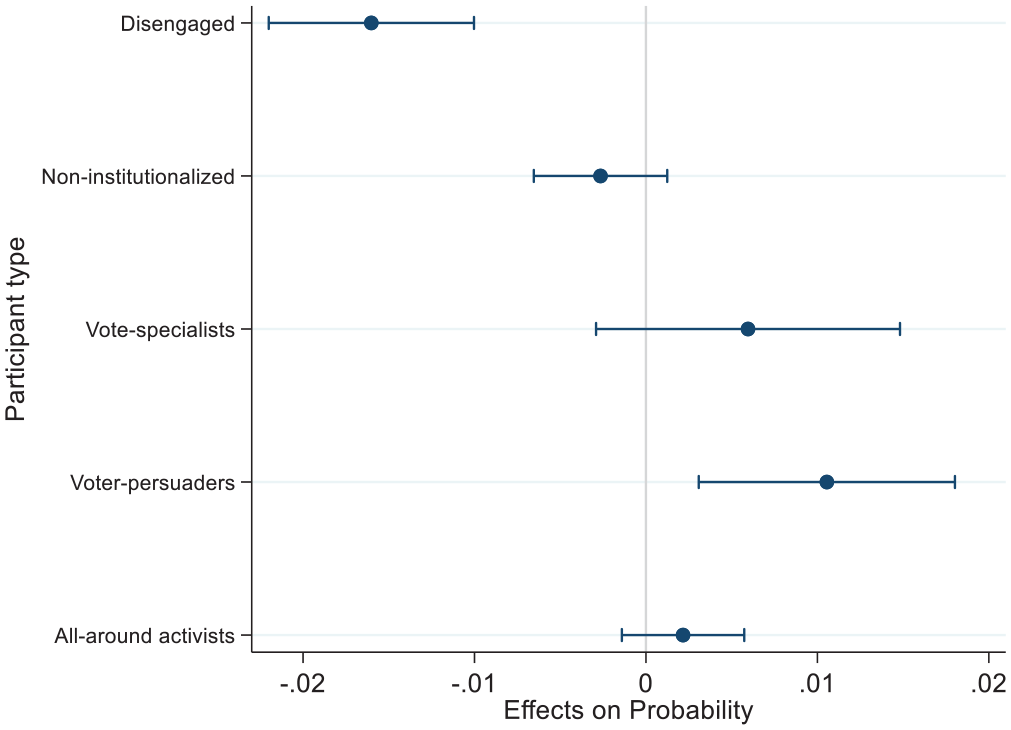
Duty and participant types: Average marginal effects.
One of the main findings revealed by the regression results is that all three participation repertoires that have high scores on voting (all-around activists, vote-specialists, and voter-persuaders) are also characterized by relatively high levels of civic duty relative to the disengaged reference group. This finding affirms Blais and Achen’s (2019) theory and findings regarding civic duty as a strong predictor of voting. Yet Figure 2 clarifies that the noninstitutionalized group, which is characterized by relatively low levels of voting (41% conditional probability), has relatively high mean levels of duty that are on-par with two of the three high-voting groups. Specifically, the noninstitutionalized group has levels of duty comparable to those of the vote-specialists and the all-around participants, and lower levels than only those of the voter-persuader group. Thus, the regression results also confirm Bolzendahl and Coffé’s (2013) finding that civic duty is predictive of voting as well as additional nonvoting political behaviors. Taken together, these findings show that the probability of voting is not the only important characteristic of participation repertoires in relation to individuals’ levels of civic duty.
An additional substantive finding that is worthy of further research is the distinctively low level of duty among the disengaged group. This group, which constitutes 17% of the population is uninvolved in most political acts, including protest; for every indicator, the group’s conditional probability of engaging in the behavior is lower than the population mean. In addition to having a nonzero probability of voting in the general election (23%) this group is somewhat likely to engage in activities such as signing a petition, posting about a political message on social media, persuading, and especially political consumerism. Yet, relative to the other participation types identified in the analysis, the disengaged group is clearly characterized by lower levels of civic duty.
Focusing specifically on the act of protest in relation to participation repertoires, it is important to note that the analysis identifies two participant types that have almost no probability of engaging in protest, but differ in important ways in terms of their broader repertoire of participation: the “vote-specialist” type, which is characterized by high voting levels and levels of civic duty that are comparable to other high-voting participant types; and the “disengaged” participant type, which is characterized by a low probability of voting and low levels of civic duty.
Taken together, these findings show that in contrast to research designs that focus on analyzing the determinants of separate indicators of political participation, LCA enables the empirical identification of individuals’ broader participation repertoires and their correlates. For example, Table 4 shows that in the current analysis the standard predictors of participation (e.g., partisan identification, political efficacy, political interest) predict all three of the more active participant types, while female gender predicts membership in the all-around group, and older age predicts membership in the vote-specialists group. Future research can leverage this approach to test expected sociodemographic correlates of participant types in different geographic contexts and time periods.
Discussion
An important conclusion from these findings for the study of protest is that research designs that focus specifically on a dichotomous distinction between protestors versus nonprotestors are studying two populations that are likely to differ in important ways in their broader participation repertoires and sociodemographic correlates. This study therefore clarifies the theoretical and methodological importance of studying political behavior such as protest in the context of individuals’ broader repertoires of political participation. This illustrative analysis shows how LCA can be used as a powerful analytical tool to identify participant repertoires and their sociodemographic correlates.
The findings in the illustrative analysis in the current study shed light on how to reconcile two apparently contradictory findings in the literature about the expected relation between different types of political acts and the norm of civic duty. The LCA results confirm Blais and Achen’s (2019) finding that civic duty is positively related to voting, while showing that their expectation that duty is unrelated to nonvoting political acts is dependent on the distinctive emphases of broader participation repertoires. Similarly, the findings also confirm Bolzendahl and Coffé’s (2013) expectation that duty is positively associated with voting, while showing that their expectation that duty’s positive association with political acts beyond voting is dependent on the distinctive emphases of individuals’ broader participation repertoires. The findings demonstrate how a theoretical and methodological perspective that focuses on broader repertoires of participation can offer a deeper understanding of how individual participants combine specific acts of participation—such as protest—with the full range of participatory possibilities.
The illustrative analysis also contributes a new perspective to the speculation in the literature about the existence of a nonvoting “protest specialist” group. In research and public discussion of recent protest phenomena on the far right (e.g., white nationalist) and far left (e.g., antifa), the question has arisen as to whether a meaningful subgroup of the general population engages in protest while abstaining from all other political activity. The noninstitutionalized group is the closest approximation to this expectation, but the findings show that this group also has meaningful probabilities of engaging in multiple traditional, electoral-oriented activities.
A related important finding is the identification of the need for further research on the distinctive “disengaged” repertoire that is characterized by low scores on all opportunities for political action. In siloed studies of separate political indicators, there is no analytical window for the identification of this segment of the population. Experts on the sociodemographic predictors of voting have revealed how voters differ from nonvoters (Leighley & Nagler, 2014; Nevitte et al., 2009) and experts of protest have established how protestors differ from nonprotesters (Klandermans, 2014; van Stekelenburg & Klandermans, 2014). However, few studies have focused on those who engage in almost no political activities from the perspective of individuals’ broader repertoire of political participation. The findings of the current study showed that in 2016, this disengaged group constituted a sizeable 17% of the U.S. population, and its members had distinctively low scores on duty relative to all other participant types. In an era marked by rising levels of populism and concerns about democratic legitimacy, this methodological approach for identifying participant types may provide a deeper understanding of the causes and consequences of political activism, as well as political disengagement.
An additional contribution of this methodological approach for future research on protest is to further investigate how protest relates to representational outcomes and democratic responsiveness. The majority of large-N cross-national survey research on the connection between political behavior and political outcomes has tended to focus on the act of voting. Research on this topic has shown that voters’ views tend to be better represented than nonvoters, but the causal mechanisms connecting voting and political outcomes remain a topic of debate. A potential mechanism that has received considerable attention in the literature is that people who vote also tend to engage in additional political acts that communicate their views to decision makers (Bartels 2018; Giugni & Grasso, 2019; Griffin & Newman, 2005; Han, 2016; Han et al., 2021). Yet large-N survey-based methodological approaches that identify and analyze individuals’ broader participation repertoires are not yet widely used in empirical research on these topics. In this substantive field and others, the use of LCA to analyze participation repertoires has the potential to shift research on political behavior from siloed studies on seemingly unrelated political behaviors (i.e., voting; protesting) to a clearer identification of the causes and consequences of individuals’ broader repertoires of political participation.
A final important area of future research using LCA to identify participant repertoires is to expand the single-context focus of the current study on U.S. data to test cross-national and longitudinal theoretical expectations. For example, in contexts with higher average levels of protest such as Spain or Italy, results may identify distinctive protest repertoires that merit further study. Due to recent development in latent class methodology related to measurement equivalence and multilevel classification (e.g., Alvarez et al., 2020; Bakk et al., 2020; Oberski et al., 2015), this sort of robust cross-national comparison will allow researchers of protest and political behavior to broaden and sharpen our theoretical and analytical vision in future research on these topics.
Supplemental Material
sj-pdf-1-abs-10.1177_00027642211021633 – Supplemental material for Protest as One Political Act in Individuals’ Participation Repertoires: Latent Class Analysis and Political Participant Types
Supplemental material, sj-pdf-1-abs-10.1177_00027642211021633 for Protest as One Political Act in Individuals’ Participation Repertoires: Latent Class Analysis and Political Participant Types by Jennifer Oser in American Behavioral Scientist
Supplemental Material
sj-zip-1-abs-10.1177_00027642211021633 – Supplemental material for Protest as One Political Act in Individuals’ Participation Repertoires: Latent Class Analysis and Political Participant Types
Supplemental material, sj-zip-1-abs-10.1177_00027642211021633 for Protest as One Political Act in Individuals’ Participation Repertoires: Latent Class Analysis and Political Participant Types by Jennifer Oser in American Behavioral Scientist
Footnotes
Authors’ Note
Acknowledgments: For comments on early versions of the study that helped shape its focus I thank Shelley Boulianne, Lauren Copeland, Ruth Dassonneville, Anselm Hager, Sofie Marien, Katerina Vráblíková, and members of the 2019 APSA panel on “Collective Action and Deliberation in the Digital Era.” For insightful comments on the full version of the manuscript, I thank Zsuzsa Bakk, Roberto di Mari, and Marc Hooghe. The final manuscript was greatly improved by J. Craig Jenkins’ editorial enthusiasm and guidance. Any remaining errors are my own.
Declaration of Conflicting Interests
The author declared no potential conflicts of interest with respect to the research, authorship, and/or publication of this article.
Funding
The author received no financial support for the research, authorship, and/or publication of this article.
Supplemental Material
Supplemental material for this article is available online.
Notes
Author Biography
References
Supplementary Material
Please find the following supplemental material available below.
For Open Access articles published under a Creative Commons License, all supplemental material carries the same license as the article it is associated with.
For non-Open Access articles published, all supplemental material carries a non-exclusive license, and permission requests for re-use of supplemental material or any part of supplemental material shall be sent directly to the copyright owner as specified in the copyright notice associated with the article.
