



Abstract
Are politicians willing to betray their ideology, party, voters, and/or own principles to reach agreements with rivals? Focusing on the case of Spain, this article shows that there are two types of parliamentarians: those who are purely practical when making decisions (pragmatic) and those who consider their voters and electoral program in that process (responsive). We use latent class analyses to identify such profiles and conduct multinomial regression analyses to examine who are the most likely to be responsive or pragmatic parliamentarians. Our findings suggest that the former tend to have populist attitudes, support citizen involvement in decision-making, reject expert involvement in the political process, and show high levels of affective polarization. In the concluding section, we discuss how the profile of decision-makers exposes tensions in the functioning of democracy.
Introduction
Conflicts and agreements between rivals nurture political life in democracies. Parliaments are the representative vertex of the institutional framework in which political conflict and consensus are expressed, built, and managed. Members of Parliament (MPs) may have diverse motivations (e.g., the common good, electoral opportunity) to build agreements, or they may be the result of distributive or integrative negotiations (Binder & Lee, 2015), or being “classic compromises” or “common ground consensus” (Gutmann & Thompson, 2012, p. 12). But in essence, when MPs reach political agreements such as in the passing of legislation, they show a degree of elite integration and cohesion (Hoffman-Lange, 2018). 1
As the introduction to this special issue describes, the number of agreements between political rivals in Spain is high but declining, with oscillations in different periods. The factors that explain these variations generally depend on the proximity of elections, the type of majority that sustains the government, the degree of parliamentary fragmentation and affective polarization, and the party in power. Previous research in other countries has also considered the structure of the legislative norms and procedures for lawmaking (Baron & Ferejohn, 1989), the incentives for politically relevant actors to engage in fruitful negotiations to build agreements with rivals (Lawrence, 2017), and implicit norms leading rivals to build agreements (Levitsky & Ziblat, 2018).
Agreements between political rivals in any democracy occur because different political outlooks coexist and rival actors show some propensity to negotiate and concur. 2 In this article, we examine such a propensity to establish a typology of MPs based on inclinations to reach political agreements and explain their socio-political foundations. Using the third survey on a sample of Spanish MPs data and latent class analyses, we reveal two mutually exclusive types of MPs’ mindsets that could be called “pragmatic” and “responsive.” Those who fit the former category do not consider that their ideology, principles, electoral programs or voters’ wishes are barriers to reaching agreements with political rivals. The responsive MPs, however, are willing to make agreements with their adversaries as long as they do not betray their voters, electoral program, ideology, and principles.
Thus, we understand pragmatic and responsive mindsets as categories deriving from the more general idea of “propensity to reach agreements,” which may be fostered or hindered by several factors, such as ideology, electoral program, principles/core beliefs, and voters’ reaction. The distinction between mindsets is relevant because, following Pareto’s theory of elite circulation, the predominance of a particular mindset in the political elite can tilt the balance toward conflict or compromise to the point that “even when they have no direct causal effect on lawmaking, mindsets indirectly reinforce resistance to compromise or support striving for it” (Gutmann & Thompson, 2012, p. 206).
Pragmatic and Responsive Politicians
Lawmaking in democracies entails negotiation and compromises among MPs, who often have adversarial perspectives. To reach agreements, political adversaries might require a pragmatic approach or what Gutmann and Thompson (2012, pp. 16–17) call “mindsets of compromise” based on “principled prudence (adapting one’s principles) and mutual respect (valuing one’s opponents).” 3 A pragmatic or compromising approach in parliamentary politics may not fit well with a responsive one. Responsiveness is based on a binding relationship with voters via electoral programs or firm ideological principles subjected to electoral competition. Although the classic perspective understands democracy to have a strong dimension of responsiveness on the side of governments (Dahl, 1971) and representatives, tension emerges when responsibility (and accountability) is introduced in the equation of democratic theory (Mair, 2009).
Responsibility is behind political decisions that consider society’s long-term needs, constraints from international actors, and commitments that limit the wishes and expectations of electorates (Bardi et al., 2015). From this standpoint, compromising and reaching agreements with rivals seems to be an approach linked to responsibility rather than responsiveness. Being responsive to electors and responsible for making the “best” decisions based on electoral programs or ideological principles may generate contradictions in the process of politics resting on considering demands versus needs, long- and short-term scenarios, and claims from subnational and international actors.
Max Weber reflected on people who make politics their life. He said that politicians orient their actions according to “one of two fundamentally differing and irreconcilably opposed maxims: conduct can be oriented to an ‘ethic of ultimate ends’ or to an ‘ethic of responsibility’” (Weber, 1946, p. 120). The former refers to the idea of the politician who puts their ideology and vision of how the world should be before any other consideration, and, consequently, their actions are oriented to achieve this vision. Failure is not the responsibility of the politician but of external factors such as fate, God, or people’s stupidity. An ethic of ultimate ends tends to bind voters and representatives strongly via electoral programs and promotes behavior that is barely compatible with negotiation and compromise.
Contrary to this, the ethic of responsibility alludes to politicians who make decisions keeping in mind that they will be hold accountable for their actions either by fellow politicians or voters. This type of ethic seems to promote a more pragmatic approach to political action in democracies.
Although Weber (1946, p. 127) understood that both types of ethic tend to be combined in real political life, the predominance of the ethics of ultimate ends as a guide to action suggests a low propensity for agreements insofar as they can distort precisely those ultimate ends pursued. Contrarily, the predominance of the ethics of responsibility as a guide to political action suggests an inclination toward pact and agreement (possibilism). This ethic is especially relevant to the Spanish case. Spain shares several social and territorial cleavages with other parliamentary democracies, where actors are led to build agreements with rivals, generating compromise and inclusive politics rather than majoritarian outcomes (Lijphart, 1999, p. 33).
This discussion shows that these two elements produce very different approaches to compromise and the building of political agreements. Since compromise is an essential feature of democracy (Gutmann & Thompson, 2012), understanding MPs’ responsive or pragmatic mindset would expose their incentives and limitations to reach agreements with rivals and make democracy work.
We might expect that those following a logic of ultimate ends or being responsive to electors (for whatever reasons) to show a lower inclination to reach agreements with rivals. On the contrary, we expect that those exhibiting a pragmatic profile (mindset for compromise) will tend to establish political pacts with adversaries. To identify whether politicians follow one or the other approach, we study the responses to questions associated with four considerations that MPs might keep in mind when deciding whether or not to establish agreements with rivals: ideology, program, principles/core beliefs, and fear of voter reaction. Analyzing the position of MPs will help to better understand whether, beyond conflicts and polarization, Spanish politics is driven by politicians who are prone to build agreements or by MPs who make conflict with rivals the centerpiece of their political actions.
The Obstacles to Reach Political Agreements
First, MPs were asked to indicate their degree of agreement on a 0 to 10 scale with two phrases that identify willingness to agree despite two obstacles that are common in the cognitive schemata of politicians–ideology and its embodiment in electoral programs. The first sentence is: “[i]n politics, it is desirable to reach agreements with political rivals, even if they are ideologically distant.” Ideological beliefs entail different perspectives about how the world should be. Thus, a robust indication of the propensity to agreement is the degree to which the parliamentarian understands that agreement is desirable despite ideological differences with rivals. A higher score reflects a greater propensity to agree.
The second item is “[r]eaching agreements with rivals implies betraying the electoral program.” The sentence is based on the assumption that in democracies, the electoral program links the politician to the citizenry and that agreement implies transgressing this link. From this perspective, the item measures the inclination not to agree with that which goes against the electoral program that links parties, candidates, and electors (Budge, 1994; Kitschelt, 2000). So, disagreeing with this phrase implies that there is an inclination toward agreement regardless of the contents of the electoral program. We have reversed this scale to make its interpretation more intuitive.
Along the same lines, the third item also shows a propensity to reach agreements despite the parliamentarian’s principles, which is another barrier to establishing pacts. The parliamentarians were asked to indicate their degree of agreement on a 5-point Likert scale with the following sentence: “In politics, what is known as ‘agreement’ or ‘compromise’ consists of renouncing your own principles.” This is based on the Weberian assumption that political activity is guided by an ethic, or what Jenkins-Smith (2018) calls “core principles driving political actions.” MPs who understand that reaching agreements with rivals implies ignoring or rejecting these core beliefs will show a less intense inclination toward agreement in lawmaking than those who understand that finding a middle ground does not necessarily mean ignoring the general principles on which political actions are based. We have reversed this scale to align it to the previous and ease interpretation.
Finally, one element that may deter politicians from building agreements with rivals is the possible negative reaction of voters in future elections. MPs were asked to indicate on a five-point Likert scale their degree of agreement with the following statement: “Voters would punish my party if I made more deals with rivals.” A disagreement with this statement also suggests an inclination to political census insofar as it overcomes one of the barriers that is frequently used to reach pacts with rivals. This scale has also been reversed to make it more intuitive.
The four items were harmonized on a 5-point scale, where 1 means “strongly disagree” and 5 means “strongly agree.” Supplemental Appendix Figure A1 shows the distribution of MPs on the four scales. In sum, most MPs (around 70% on all items, albeit fearing voter reaction items) show a high propensity to build pacts. Such propensity is, on average, higher (4.17) when ideology is discarded as a hindering factor than when the electoral program (3.95), principles (3.78), or fear of voter backlash (3.15) are considered. See Supplemental Appendix Table A3 for further details on the distribution of responses.
Identifying the Profiles of Consensual Politics
We now turn to the question of whether we can identify politicians who exhibit similarities based on specific combinations of item responses that form the basis of consensual decision-making. For this purpose, we employ Latent Class Analysis (LCA) as the most adequate technique (Hagenaars & Halman, 1989; Magidson & Vermut, 2004). Unlike factor analysis, 4 LCA is designed to study the similarities of response patterns in a sample of heterogeneous groups and responses. 5
We aim to identify two meaningful groups of politicians—pragmatic and responsive parliamentarians—based on their responses to the four items discussed above. As Gutmann and Thompson (2012) suggest, both mindsets are necessary, but the balance between both tilts democracies toward more conflicts or more negotiation and compromises. 6
We follow the standard practices in LCA for model selection (Nylund et al., 2007; Weller et al., 2020). First, we use goodness-of-fit statistics and researcher judgment to select the best model to describe our data. Second, we show each group’s mean response value on individual items and on the four scales. Third, we estimate the probability that respondents belong to each class. We assign each respondent to one class following the modal probability of class membership, and later, we estimate the share of MPs in each class and examine its characteristics. 7
Figure 1 presents profile plots following a three-class model. This model fits our data best, with a low Bayesian Information Criterion (BIC = 5060.63) and lowest Log-Likelihood (L-L = −2375.402) compared to other combinations of class-model (see Supplemental Appendix Table B2). A two-class model has a slightly better fit (BIC = 4994.192), and the two groups discriminate between pragmatic and responsive decision-makers, as expected. However, we noticed that a third class is necessary. Specifically, it gathers politicians whose response pattern appears to track average responses across all survey items and does not give an indication of preferences. We called them “tracker MPs.” Therefore, the three latent classes constitute an exhaustive classification of decision-maker profiles while allowing us to isolate likely biased responses from our analysis. Supplemental Appendix B3 replicates our regression models using the two-class model and another model that includes MPs whose response pattern unambiguously falls into the pragmatic or responsive class. Our result remains robust.
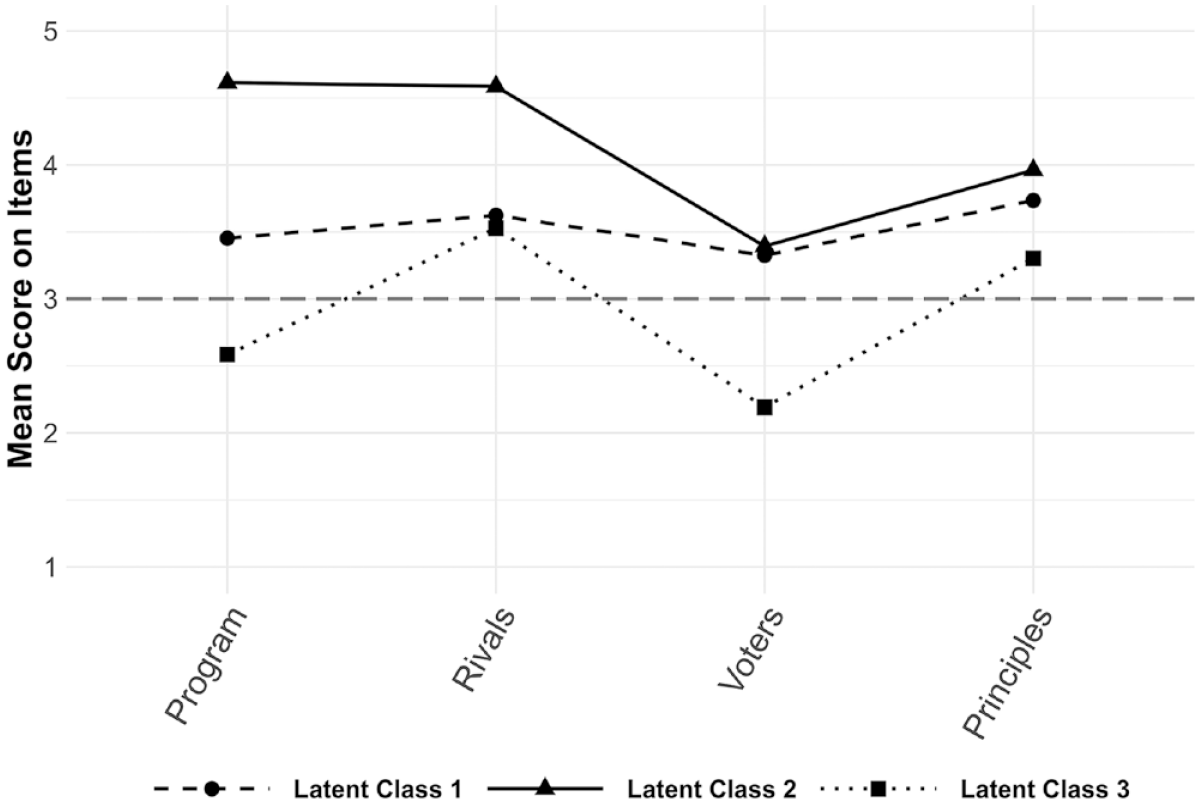
Profile plots for Three-Class LCA model.
Each line in Figure 1 represents one class of respondents. The lines trace the classes’ mean score (5-point scale on the y-axis) on each item. From these plots, three distinct profiles emerge: pragmatic (Class 2, triangle markers), responsive (Class 3, square markers), and tracker profile (Class 1, circle markers). Table 2 shows the mean scores for each class on the four scales and the size of each class. The pragmatic group (Class 2) exhibits the highest average scores across the four indicators, especially in Program and Rivals items (4.6 in both), suggesting they consider these four “barriers” for agreements as relatively dispensable. We label Class 3 as responsive because it exhibits the lowest scores on the four items, but it is more clearly below the average on the Program and Voter items (2.5 and 2.2, respectively). This suggests that this group of politicians is willing to reach agreements if the decision does not go against their electoral program and what they understand is the will of their voters.
Fifty-eight percent of respondents were found to be pragmatic, while responsive represented 18% (see Table 1). The remaining group gathers a relatively large group of politicians who tend to select the middle category across all items (means range between 3.3 and 3.7) and suggest responses with unspecific criteria, as previously indicated. To further ensure the validity of our measure, we show in Supplemental Appendix B how it varies across the political parties and chambers represented in our study. An absence of variation would suggest that categories are empty of content. However, our data indicate that there is a substantial mix of pragmatic, responsive, and tracking politicians (see Supplemental Appendix Figures B2 and B3).
Group Profile Mean Scores on All Survey Items and Group Size.
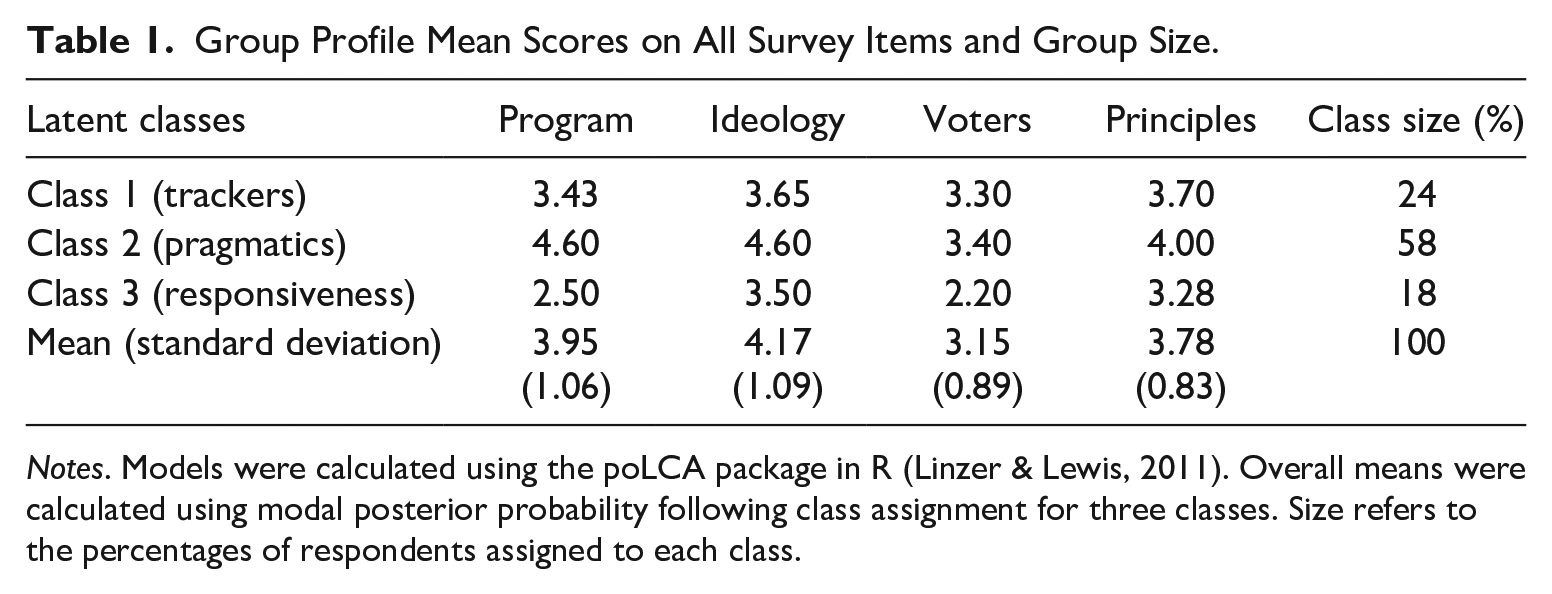
Notes. Models were calculated using the poLCA package in R (Linzer & Lewis, 2011). Overall means were calculated using modal posterior probability following class assignment for three classes. Size refers to the percentages of respondents assigned to each class.
Regression Analyses
How, if at all, do politicians who fit in a pragmatic or responsive profile differ in terms of demographic characteristics and other political attitudes? We turn to examine whether and, if so, to what extent politicians who follow varying approaches to decision-making also show differences in other characteristics.
We evaluate the factors that make it more likely for politicians to be assigned to one class rather than another. We carry out multinomial logistic regressions with class assignment as the dependent variable. We present results from the comparisons between assignments to the two classes: the likelihood of being assigned to the “responsive” as opposed to the “pragmatic” class. These are the two most distinct profiles and allow us to address the question of the challenge of consensual politics posed by a commitment to the electoral program and voters. Supplemental Appendix C shows the full multinomial logistic regression results where we compare trackers with the responsive and pragmatic Class.
Among the factors that could make politicians more likely to be assigned to the responsive class over the pragmatic, we first focus on attitudes toward the political process. An emerging literature examines the identification and origins of citizens’ preferences for political processes with diverging citizen involvement. Some seek greater citizen involvement in decision-making, embrace populist leaders, or demand giving more political power to experts to solve the country’s problems (del Río, 2024; Hibbing et al., 2021; Pilet et al., 2023).
These preferences are not trivial, as they influence citizens’ willingness to accept policy outcomes, trust in the political system, and participation in politics (Bertsou, 2022; Boulianne, 2018; Esaiasson et al., 2019; Jäske, 2019; Lavezzolo et al., 2021; Towfigh, 2016). Beyond citizens’ opinions, the literature lacks evidence about whether such preferences for political processes are also present among politicians and their effects. To the best of our knowledge, our survey is the first to address this issue through indicators of MPs’ support for experts in decision-making, referendums, and populist attitudes.
Our measure of populism refers to the extent to which politicians need to follow the will of the people. The item phrasing mirrors Akkerman and Zaslove’s (2013) widely used measure of populist attitudes among citizens, which has proven to be a good proxy (Bertsou & Caramani, 2022; Castanho Silva et al., 2020). Second, expert involvement aggregates four 0–10-point scales that assess politicians’ support for experts in designing policies, supervising their implementation, having the last say in decision-making, and evaluating policies. Finally, citizen participation aggregates two 5-point scale indicators where politicians evaluate whether citizens should initiate a binding referendum and whether referendums express the will of the people and are good mechanisms for the decision-making process. 8 We harmonized these three scales to range from 0 to 1.
Second, we also include in our model a measure of affective polarization. This consists of the average politician’s response across three items on the extent to which they are willing to hire someone, have friends, or allow their offspring to have close personal relationships with someone ideologically distant from the politicians’ ideology. To facilitate the interpretation of results, the scale is harmonized to range from 0 to 1. We should expect that MPs will be more reluctant to reach any type of agreement as affective polarization increases.
We also added several control variables that account for the politician’s socio-political background. Beyond party affiliation, we included variables related to the politician’s past political experience in the national or regional Chamber, whether their parents were politicians, and their education, religion, age, and gender. Finally, our multinomial regression models clustered standard errors by Chamber. MPs can belong to national or regional chambers. By clustering standard errors, we control for unobserved sources of heterogeneity at the chamber level that might affect the error structure of our models.
Table 2 shows the multinomial regression results. We focus on Model 4 because it includes all covariates, and we comment on robust effects based on their average marginal effects (Figures 2–5). We find that MPs with higher levels of populist attitudes are more likely to belong to the responsive than the pragmatic class (Table 2, Model 4). Predicted probabilities in Figure 2 (upper panel) show more clearly the effect of populism on the likelihood of being assigned to a class (as opposed to all remaining two categories). While holding all other variables constant, there is a 0.17 probability that an MP is responsive, the more populist the MP self-report on our survey item. For example, MPs who rank 0 on the populist scale have an almost 0 probability of being considered responsive.
Multinomial Regression Models. Likelihood of Being a Responsive Versus Pragmatic Politician.
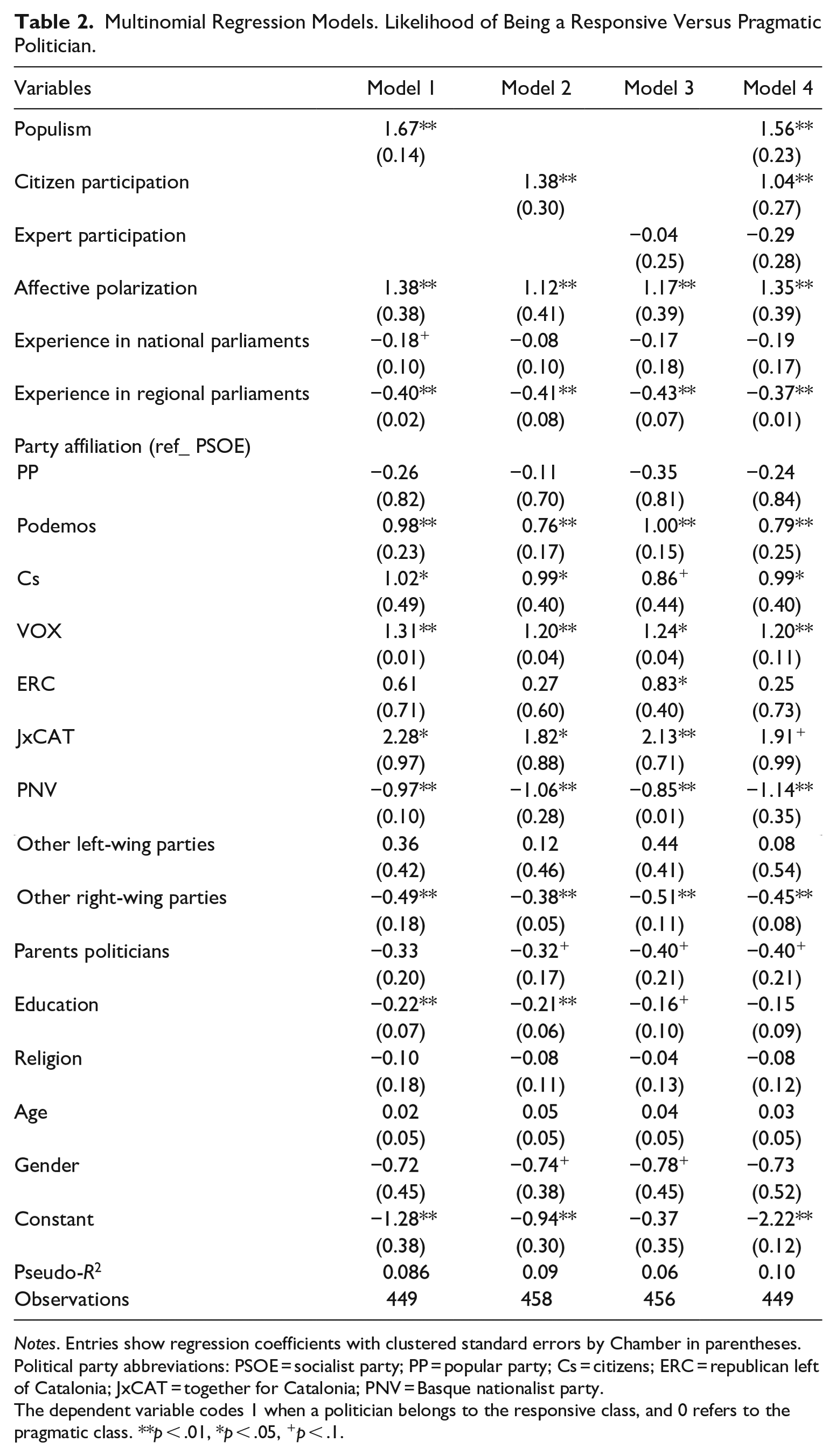
Notes. Entries show regression coefficients with clustered standard errors by Chamber in parentheses. Political party abbreviations: PSOE = socialist party; PP = popular party; Cs = citizens; ERC = republican left of Catalonia; JxCAT = together for Catalonia; PNV = Basque nationalist party.
The dependent variable codes 1 when a politician belongs to the responsive class, and 0 refers to the pragmatic class. **p < .01, *p < .05, +p < .1.
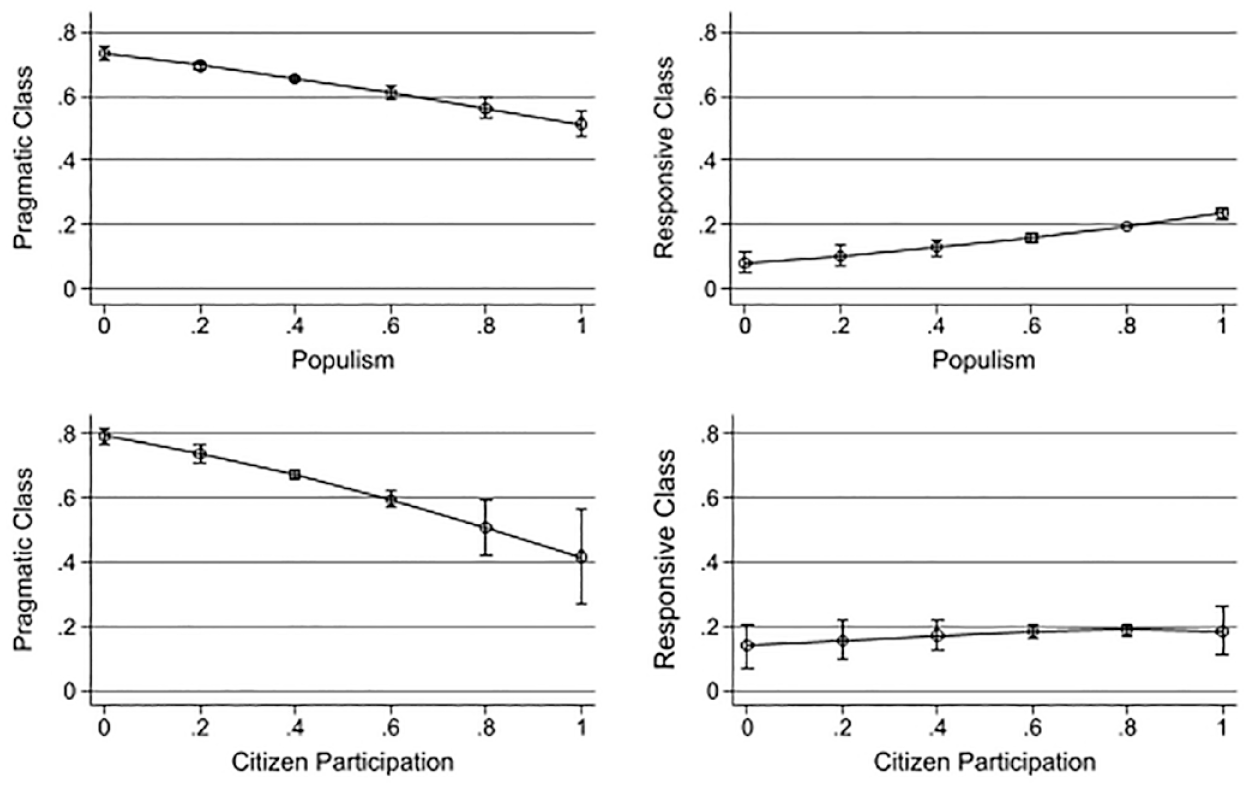
Predicted probabilities of assignment to the pragmatic and responsive classes for politicians’ levels of self-reported populism and support for referendums.
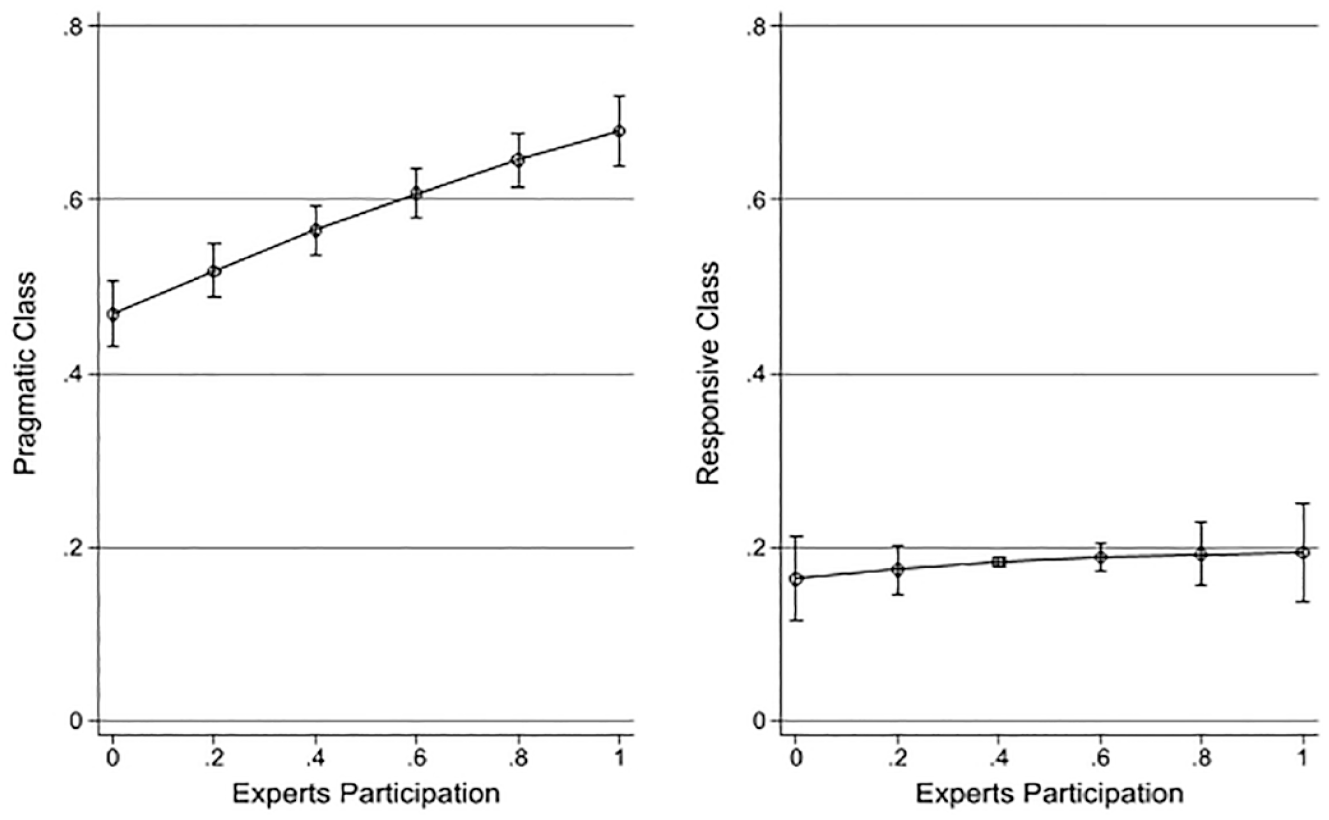
Predicted probabilities of assignment to the pragmatic and responsive classes for support for experts in decision-making process.
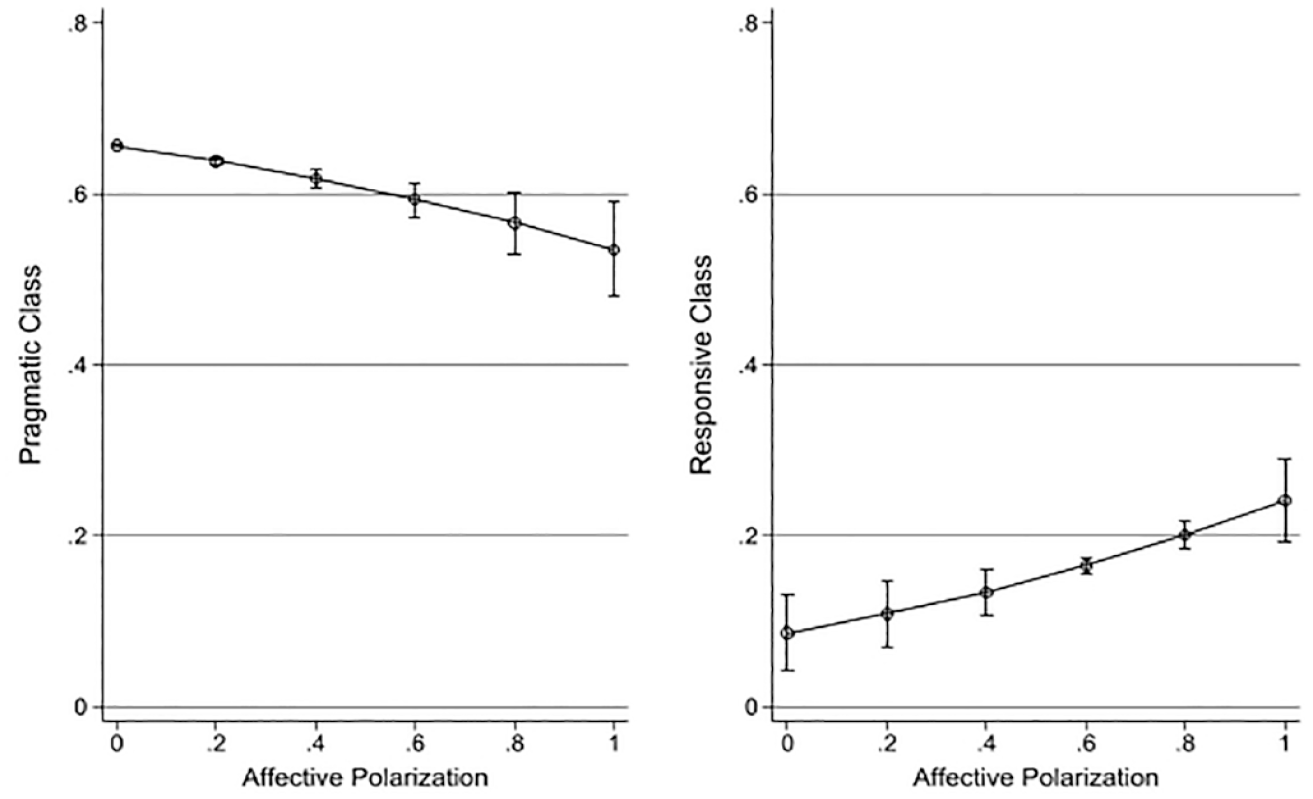
Predicted probabilities of assignment to the pragmatic and responsive classes for affective polarization.
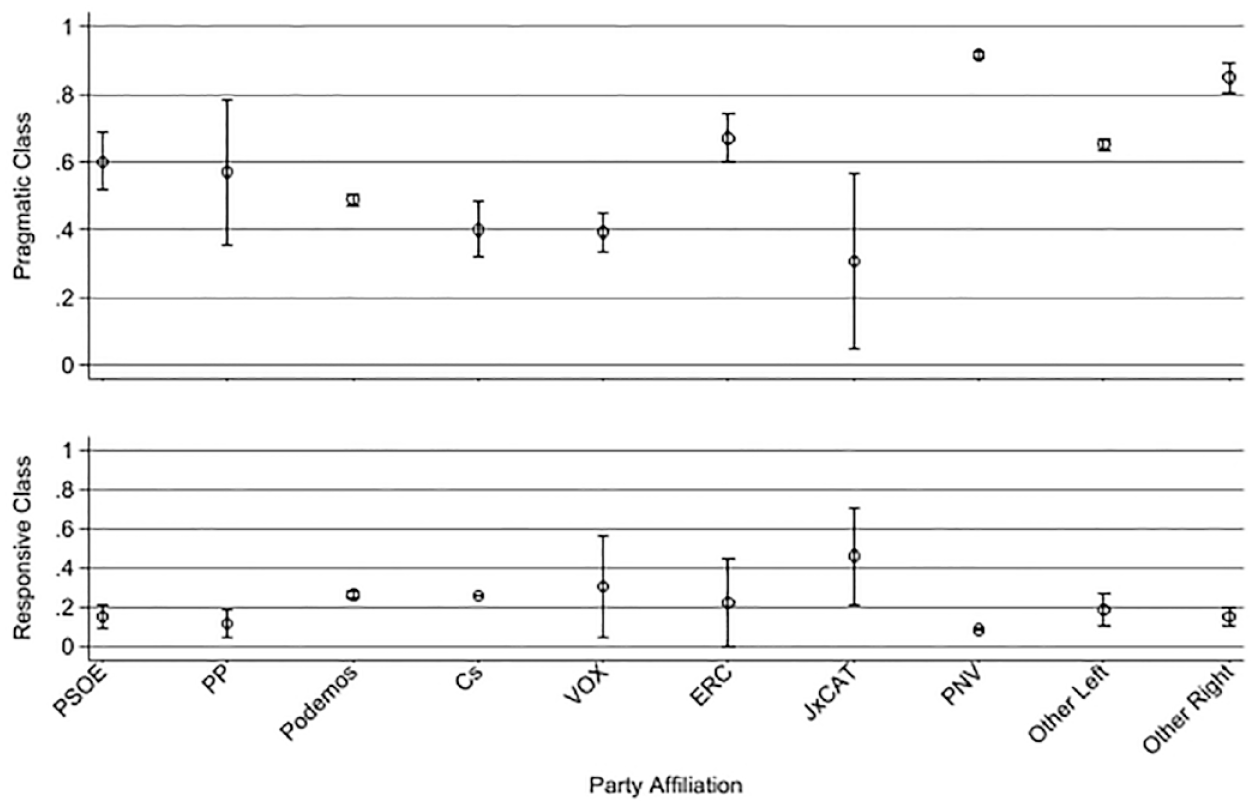
Predicted probabilities of assignment to the pragmatic and responsive class for party affiliation.
However, those who rank the highest on the populist scale have a 0.24 probability of being part of such a class. By contrast, a one-unit increase in the “will of the people” item reduces the odds of being assigned to the pragmatic class (as opposed to the responsive class or trackers) by 0.24. While the effect sizes may seem small, note that the items on populism and dependent variables are harmonized ranging from 0 to 1 and have five categories.
Consistent with the above results, pragmatic politicians also tend to reject citizen involvement in decision-making via referendum. For example, while holding all other variables constant, those politicians who strongly support the use of a referendum have a 0.40 probability of being classified as pragmatic, and those who oppose this type of political process have a 0.80 probability of belonging to such a class. In addition, support for referendums improves the odds of being classified as a responsive politician. However, the size effect is quite small, albeit statistically significant– the relative risk ratio is 0.025.
Greater involvement of experts in political processes is more appealing to pragmatic MPs than responsive MPs or trackers. In fact, the effect of support for expertise is substantial. One unit increase in support for experts in decision-making increases by 0.22 the probability of being assigned to the pragmatic class-in contrast to the remaining classes. However, as Figure 3 shows, the effect of support for experts on the probabilities of being assigned to the responsive class is not statistically significant.
Looking at comparisons of the pragmatic and responsive classes, we also see that MPs’ self-placement in the affective polarization scale and party affiliation are also relevant factors. In particular, Figure 4 shows affective polarization substantially increases the probability of belonging to the responsive class by 0.18 and reduces the chances of being classified as a pragmatic politician by 0.14. In this respect, this finding supports Gutmann and Thompson (2012, p. 19) and Levitsky and Ziblat’s (2018, p. 255) suggestion that a compromise mindset reduces the negative effects of polarization since agreeing with rivals helps to see them as cooperating adversaries, rather than enemies. In this special issue, Sánchez-Ferrer and Torcal examine in detail the relationship between affective polarization and propensity to consensus.
However, our analyses advance the idea that affective polarization among parliamentarians is positively associated with responsive MPs because they are unwilling to trade the electoral program and voters’ expectations to reach agreements in the legislative process. These are the two key dimensions in which responsive MPs are different from pragmatic MPs. And this suggests that electoral concerns are behind MPs’ reported affective polarization rather than hate or intolerance towards political rivals. Affective polarization, therefore, seems to be part of MPs’ political theatricalization to highlight ideological differences with rivals for the sake of mobilizing and gathering votes for the upcoming elections (Coller, 2024).
Figure 5 shows the effect of party affiliation on class assignment. While holding all other variables constant, MPs affiliated with the PNV (the Basque Nationalist Party) and other minor (usually subnational) right-wing parties substantially increase the probability of being pragmatic. Interestingly, the odds of being pragmatic among PP (Partido Popular; a Spanish right-wing party) politicians range from 0.39 to 0.79. This broad range suggests that these politicians are as pragmatic as other diverse rivals, such as PSOE (Partido Socialista Obrera Español; a Spanish left-wing party), VOX (extreme right), Podemos (extreme left), or ERC (Republican Left of Catalonia). This result suggests that our sample of politicians is heterogeneous within each party and that party affiliation is unhelpful in identifying pragmatic politicians. This is in line with current research on political elites that emphasizes that political parties, either in democracies or autocracies, should not be assumed to act as unitary actors (Mershon and Shvetsova, 2015; del Río, 2022).
Nevertheless, party affiliation improves the chances of classifying politicians from populist parties as responsive in contrast to other categories. Being affiliated to Podemos, VOX, and JxCAT (Together for Catalunya) tend to increase the chances of identifying responsive MPs almost twice as much as affiliation with any of the two mainstream parties (PP and PSOE). Diversity in large parties seems to dilute populism, while smaller parties are more inclined towards populist attitudes (perhaps as a consequence of their very nature –that is, nationalist, regionalist– combined with open selection methods and competition in small districts). Future studies might benefit from examining this hypothesis—which is beyond the scope of this article.
Conclusions and Implications
Lawmaking in democracies entails negotiation and compromises among parliamentarians from competing parties. To reach agreements, MPs might need to “cross red lines” that reveal information about what principles and goals they are open to sacrificing. Would they be willing, for example, to adapt to the demands of ideologically distant rivals and risk voters’ punishment to approve what they see as a vital law? In this article, we created a typology of decision-makers based on MPs’ propensity to make flexible their principles, ideology, voters, and the electoral program to build agreements in the lawmaking process. We found that a large share of MPs (58%) follows a pragmatic and, to a lesser extent (18%), responsive approach to decision-making. The former aims to make pacts despite the costs, while the latter maintains an eye on the repercussions that agreements might have on their electorate.
Next, we examined why politicians would follow a responsive vis-a-vis a pragmatic approach in lawmaking. On the one hand, we found that pragmatics reject citizen involvement in the political process via referendum and believe that politicians should not necessarily follow the will of the people. They support ‘expert participation’ in political processes. These MPs also do not tend to be polarized, based on our scale of self-reported affective polarization. On the other hand, an increase in affective polarization, support for citizen involvement, and populist attitudes make MPs more likely to be classified as responsive. They also tend to belong to populist parties like Podemos, or VOX, as well as secessionist parties such as JxCAT.
Our results reveal trade-offs in parliamentarians’ decision-making and their consequences in democracies that future research could further develop. On the one hand, being pragmatic implies that ideology, electoral promises, and political principles are flexible enough to favor pacts with political rivals who hold different worldviews. Building agreements is the cornerstone of democracy, especially in societies with multiple cleavages. Agreements allow alternative views and groups to be incorporated, consensus rather than conflict, and governments to be supported by large parliamentary pluralities (Lijphart, 1999, p. 33). However, agreements among rivals may show citizens that political elites are not committed to fulfilling their electoral promises and that political parties are “all the same.” This could also increase feelings among citizens that “politicians” are liars or turncoats, leading to political apathy and detachment from political institutions. This is the path to down-sliding democracies.
On the other hand, being responsive to citizens is key for the quality of democracy—politicians are scared/consider voters’ ability to reward and punish parties for their performance. However, in our study, we show that responsiveness has been “distorted” as this principle is captured by populist parties, which are often considered to be anti-elitist and polarizing machines. Divisions of this kind might be a precondition for democratic collapse (divided elites and society, unwilling to listen to each other). Moreover, the fact that this group of responsive politicians wants greater involvement of citizens in political processes implies that the production of laws and decisions is more likely to be inefficient. That is, making responsive decisions would be time-consuming and require more resources than if politicians did not count on citizens. Therefore, solutions to problems will come late or be costly.
However, the relationship between greater citizen involvement and responsive politicians exposes another interesting trade-off between accountability and responsiveness. By including citizens in decision-making, responsibility for the decision’s outcome is diluted. Thus, citizens would face more difficulties in holding a responsive politician accountable for bad agreements/policies than one who is pragmatic.
Supplemental Material
sj-docx-1-abs-10.1177_00027642241285020 – Supplemental material for Building Political Agreements: Pragmatic and Responsive Decision-Makers
Supplemental material, sj-docx-1-abs-10.1177_00027642241285020 for Building Political Agreements: Pragmatic and Responsive Decision-Makers by Adrián del Río and Xavier Coller in American Behavioral Scientist
Footnotes
Declaration of Conflicting Interests
The authors declared no potential conflicts of interest with respect to the research, authorship, and/or publication of this article.
Funding
The author(s) disclosed receipt of the following financial support for the research, authorship, and/or publication of this article: The authors received financial support through competitive calls of the following institutions: the Junta de Andalucía (P18-RT-5234 project) and the Agencia Estatal de Investigación (Spanish Ministry of Science and Innovation) (PID2019-108667GB-I00 project).
Supplemental Material
Supplemental material for this article is available online.
Notes
Author Biographies
References
Supplementary Material
Please find the following supplemental material available below.
For Open Access articles published under a Creative Commons License, all supplemental material carries the same license as the article it is associated with.
For non-Open Access articles published, all supplemental material carries a non-exclusive license, and permission requests for re-use of supplemental material or any part of supplemental material shall be sent directly to the copyright owner as specified in the copyright notice associated with the article.
