




Abstract
Hit by the economic and political crisis, young people in Italy face increased labor precarity and the disillusionment derived from the disappearance of the radical Left from the parliamentary arena. In the Italian context, economic hardship, the decrease of resources available for collective action, and the weakened mobilizing capacity that traditional mass organizations (such as trade unions and political parties) retained in the first decade of the 2000s brought about a general decline in intensity and visibility of street protests, leading to an apparent retreat of activism to the local level of action. Although the crisis had a negative impact on collective action, evidence reveals that more creative and less visible forms of societal and political commitment were adopted by young generations in these years. This article explores how the Italian youth in times of crisis engaged actively in alternative and unconventional forms of political commitment aimed at re-appropriating space, free time, and access to leisure, mainly by means of mutualistic practices. Based on data from qualitative semistructured interviews with key informants and activists, this article sheds light on recreational activism, adopted as a political practice by the Italian youth active in counter-cultural spaces, nowadays at the forefront of the struggle to oppose the commodification of free time and leisure.
Keywords
Introduction
Different social, political, and cultural dynamics have affected the second decade of the 2000s, shaping the ways in which the Italian youth have engaged in political action. Unlike the first decade of the 2000s, characterized by a phase of expansive movement activity and by the rise of the alter-globalization cycle of protest known as the Global Justice Movement (della Porta, 2007), since 2010 social movement activity has witnessed a decline. Exceptions in Italy are the feminist and LGBTQ movements (and, in particular, the Italian section of the “Non una di meno” movement against male violence; see Chironi in this issue), the environmentalist movement (see Bertuzzi in this issue), and anti-racist mobilization, which some activists say has increased in salience to the detriment of labor and materialistic grievances (IntSCS6, IntSCS7; see the appendix for a list of interviews.). Against a backdrop of circumstances unfavorable to mass mobilization and to the organization of collective action in the public space, the ways in which the Italian youth organize differs nowadays from that of the previous decade. In recent years, a horizontal way of organization, the rejection of the delegation principle of power and representation by leaders—a legacy of the Social Forums experience of the 2000s—and of a hierarchical type of organization in favor of a more inclusive, fluid, and individually oriented type of engagement have emerged “with more generational protagonism” (IntSCS9). What Bauman called the individualization of contemporary society (Bauman, 2007) is reflected in youth participation, to the extent that youth engagement appears nowadays driven by individualistic concerns such as labor precarity (della Porta, 2015), and the present has become the main temporal area of reference for political action—a phenomenon that Leccardi termed presentification (Leccardi, 2005, p. 141). Other scholars have noted that the process of individualization has affected collective action, as it has translated into a shift “from general organizations to single-issue movements, and finally to single-event mobilization” (Alteri, Leccardi, & Raffini, 2017, p. 718) in the last two decades. Often not lasting beyond the organization of a onetime protest event or strike, single-issue campaigns and “networks of purpose” (IntSCS7) are currently a widespread organizational method, albeit one raising concerns over hindering the possibility of long-lasting political projects encompassing different grievances from emerging.
Several factors account for the low level of contention characterizing the post-2008 crisis period in Italy. Among these are the mutated political and economic conditions, the increased and preventive use of repression, the rise of the right-wing and of the Five Star Movement, the weakening of the Left, or, more precisely, the disappearance of the radical left from the parliament arena, as well as the moving to the right of the main center–left party. Moreover, the declining ability of mass organizations to mobilize on a large scale has brought about a decrease in the number of street demonstrations (IntSCS3, IntSCS7). As an interviewee concisely summarized, a widespread feeling of uncertainty also characterizes the political means so far adopted to achieve social change. In that regard, he claims, “The old models on which we [the previous generation of activists] have been politically formed are not that incisive nowadays, but it does not exist yet a formula of organization or of political intervention really efficient” (IntSCS9).
Although in times of crisis the Italian youth appear less inclined to engage in traditional forms of political participation, like voting, party membership, and street protests, this article argues that they nevertheless experiment with innovative and nonconventional modes of societal and political action. Among these, this study explores in particular alternative recreational counter-cultural practices, related to the field of leisure and aggregation, through which the Italian youth strives to achieve social change in the sphere of everyday life. Rather than through the ballot box or on the streets, these alternative forms of everyday political engagement emerged mostly in the framework of self-managed social and cultural spaces—which throughout the article I identify with the acronym SCCs, standing for social and cultural centers. In spite of sharing some traits with other forms of engagement, recreational practices present some novelties as they are adopted to pursue a political vision of aggregation framed in terms of right to space, health and aggregation, inclusiveness, opposition to social inequalities, and exploitation produced by the neoliberal dynamics governing young people’s everyday life.
Contributing to scholarship dealing with youth political participation in times of crisis, this study focuses on unconventional forms of social and political engagement performed by the Italian youth in the context of the crisis of neoliberalism and of declining movement activity. It adds also to existing research delving into the manifold participation approaches and repertoires of action adopted by the so-called Millennial generation, defined as composed by those born between 1980 and 2000, and in particular on the specific forms of mobilization to have emerged in a context dominated by precarization, individualization, and presentification of life-projects (Leccardi, 2014; Alteri et al., 2017). By shedding light on different expressions of recreational activism, this article illustrates how participation repertoires and collective action models changed in the last decade to leave more room to aggregation and leisure activities. Considered during the early modern period as merely enjoyable activities not aimed at political change, over the years recreational initiatives acquired a political meaning. By taking a generational perspective, this article explores different types of recreational activism as forms of social and political engagement, striving to answer the following questions: By what means do the Italian youth articulate their political participation in times of crisis and political disillusionment? Which repertoires of action do they adopt? To what extent and how did aggregation acquire a political meaning allowing precarious youth to express their discontent? Which are the values informing these initiatives? What is the collective identity of the youth engaged in everyday recreational activism?
In the cases analyzed, the interviewees belong to diverse groups and collectives mobilizing inside the framework of self-managed and autonomous social centers (usually squatted dwellings) and cultural–recreational clubs (mostly rented spaces). In these spaces, activists and militants enact recreational practices aimed at re-appropriating free time and space for socialization and leisure, subtracting it from traditional consumption logics and individualization tendencies that make aggregation difficult. With the intent to fight the rising cost of leisure activities, in these spaces alternative sociopolitical models of organization are performed, informed by mutualistic and horizontal principles. Besides exploring the Italian youth’s strategies and practices, this piece of research delves into the political and social context in which they are embedded, elucidating the extent to which the social and economic crisis shaped the choice of their action repertoires and the forms of action they employed as well as the targets of their action.
The article is organized as follows. The next section delves into the theoretical framework; it is followed by a section that explores the research design. A description of social and recreational activities undertaken in times of crisis comes after. Then, a section highlights two important dimensions of recreational activism, namely, (a) the re-appropriation of space and time and (b) the diverse political functions this type of activism practice performs. The following part focuses on the strategies and ideological principles underpinning recreational activism—specifically self-management, mutualism, and horizontality, while the following explores the collective identity of a generation that self-defines as “betrayed.” Finally, the conclusions summarize the main findings.
Youth Mobilization and Unconventional Political Practices in Times of Crisis
In academic and public debates, times of economic hardship have been often associated with a low degree of political participation and civic engagement (della Porta, 2013, 2014). In contrast, other scholars have noted an increasing tendency to engage in participation actions in similar circumstances (Alteri et al., 2017; Forno & Graziano, 2014; Grasso & Giugni, 2016). Grasso and Giugni, in particular, have argued that the economic and political crisis that hit Europe since 2008 had among its consequence the rise of protest movements across Europe targeting national governments as responsible for worsening living conditions (Grasso & Giugni, 2016). Contrary to other European countries like Spain, the United Kingdom, or Greece, anti-austerity movements did not emerge as strongly rooted in the Italian context. In the post-2008 period, contentious actors in Italy have experienced a withdrawal into the local sphere of action, concentrating their mobilization on localized issues rather than on networking and the organization of broad collective movements. The reasons for such a retreat “inside one’s own social center” (IntISCS7), coupled with the refusal “to opening up to the world” (IntISCS7), have been attributed to the impact of the economic and political crisis that reduced opportunities, motivations, and resources available for mobilization, to the disenchantment with politics, stemming mostly from the disillusionment derived from the exit of the radical Left parties from the parliamentary arena, and to the considerably weakened mobilizing capacity and loss of credibility that traditional mass organizations retained in the previous decade. The conditions of job insecurity and life precarity experienced by the Italian youth dramatically affected their ability to engage politically both at the individual and collective levels, making “participation a more costly ( . . . ) and uncertain act” (Alteri et al., 2017, p. 726). In a similar vein, the loss of enthusiasm for political activities conducted by means of traditional representative channels converted into a declining attachment of young people to institutionalized political participation in favor of the rise of other forms of political engagement.
If, on the one hand, street protests observed a decrease in intensity and visibility in the Italian context hit by the crisis, more creative and critical forms of political and societal commitment were elaborated.
By labelling this change in forms of political participation “the reinvention of participation in the age of individualization and presentification” (Alteri et al., 2017, p. 718), Alteri et al. (2017) argue that the personalization and individualization of political engagement “does not equate with depoliticization” (p. 718). On the contrary, they claim that the decline in conventional participation forms brought about the emergence of new “personally meaningful and individually oriented” (p. 718) practices, in which individual considerations and concerns drive political engagement. Similarly, Bosi and Zamponi (2015) noted that, in the context of economic crisis, nonconventional forms of resilience like solidarity actions, self-management practices, occupations, and the like grow, gaining increasing relevance in numbers and size, in alternative to, or alongside, conventional forms of action. Along similar lines, Forno and Graziano (2014) provide evidence that, although in periods of crisis protest waves tend to be short-lived, in contrast, mutualistic and cooperative experiences characterized by a strong political and ethical dimension, such as participation through politically conscious consumer actions, appear to increase and consolidate (Forno & Graziano, 2014; Monticelli & Bassoli, 2017). Acts of political consumerism, like boycotting and solidarity purchasing groups, are telling examples of these unconventional and innovative forms of political participation in which individuals attribute ethical and political weight to daily choices. Influenced by the process of individualization of contemporary societies, which resulted in the increasing reflexivity about an individual’s identities, values, and actions (Beck & Beck-Gernsheim, 2002), private choices become thus imbued with “a politically significant public act of altruism” (Forno & Ceccarini, 2006, p. 198). In political consumerism, the territorial dimension assumes importance as well: These practices aim in fact at re-embedding “the economic system within social relations, starting from the local level” (Forno & Graziano, 2014, p. 139).
Among research concerned with unconventional practices of political engagement, little so far has been written about the political use of aggregation. An exception is Micheletti and McFarland (2011), who, with the term Creative Participation, indicate the ways in which “people from different walks of life in the mature democracies of the Western world develop their politically productive capacities into creative activities to take responsibilities for the common good of their immediate community and societies at large” (Micheletti & McFarland, 2011, p. 2), using their personal networks and everyday routines to influence societal development. In my analysis, I opted for the use of the less comprehensive term recreational activism, with which I mean a type of engagement in which “politics is ( . . . ) understood as emerging from artistic, cultural, and ludic activities,” as della Porta noted in the Conclusions of this issue. This study sheds light specifically on the political practices widespread among the Italian youth, which promotes different patterns of cultural and recreational consumption, relies on relational social capital, and requires less commitment in terms of time and energy than traditional activism (Gubernat & Rammelt, 2017). In recreational activism practices, the creative, ludic aspect of engagement is attributed a political meaning. Similar to alternative forms of political consumerism, the territorial level of action assumes central importance, as these activities are mostly performed inside the framework of SCCs, strongly embedded in the local context in which they intervene. This piece of research explores recreational activism practices as both a repertoire of action adopted by the Italian youth in times of crisis, individualization, and political disillusionment, and a means through which they perform their political and social engagement.
Research Design and Methodological Note
The analysis relies on seven in-depth qualitative interviews of representatives of social movement organizations, groups, and collectives active in different parts of Italy, specifically in the framework of social and cultural spaces, such as self-managed social centers and cultural–recreational clubs. SCCs share several common cultural and organizational traits, although they vary mainly in their status. Autonomous social centers (like the squats XM24 in Bologna and CSO Pedro in Padova) can be defined as political squatting, as they consist in vacant or abandoned dwellings occupied without the consent of the owner, a tactic usually adopted by activists driven by an antisystemic political motive (Pruijt, 2013). In this, they differ from housing occupations, squatted with the sole purpose of satisfying housing needs (for a detailed political and historical geography of Italian social centers, see Mudu, 2012). In contrast, sociocultural clubs consist in institutionalized spaces, usually under a lease, similar to political squats in that they address a need for political and cultural expression by creating space and opportunities for aggregation. Among the targets of SCCs are the youth, mainly students living off campus, precarious workers, and young freelance professionals (known in Italy as partite IVA), migrants, and other categories of people particularly hit by the economic crisis and marginalized by the process of neoliberal transformation of society. Inside their premises, SCCs host a wide array of cultural, political, and leisure initiatives provided mostly free-of-charge. Different types of organizations have been chosen for analysis, among ARCI clubs (whose acronym stands for Associazione Ricreativa e Culturale Italiana, Italian Cultural and Recreational Association) with both a long-standing or recent history, and political squats belonging to different political orientations. In order to grant equal national representation, SCCs have been selected to cover metropolitan areas (Rome and Naples) and medium-size cities (Padua and Bologna). Interviews were conducted between December 2017 and April 2018 in the cities of Bologna, Padua, Rome, and Naples, with spokespersons and representatives of ARCI clubs (ARCI Nadir in Padua; ARCI Ritmo Lento in Bologna, ARCI Sparwasser in Rome) and political squats (CSO Pedro in Padua, XM24 in Bologna, ESC Atelier in Rome, ex OPG “Je so’ pazzo” in Naples). 1 The interviewees belong to the 25 to 35 age cohort and were chosen from among representatives and/or militants having a long-term involvement in SCCs, as well as members of collectives (such as sports clubs) active in their premises and participating in the daily activities of SCCs. Among those, I have looked to include in the sample individuals in charge of cultural projects, sport, and taking care of recreational activities in general. In spite of trying to guarantee equal gender representation, only one out of seven respondents was a woman, demonstrating a tendency to male leadership in SCCs.
Politics Through Social Action and Recreational Activities in Times of Crisis
The reasons motivating the choice of organizing social and recreational activities in self-managed spaces are manifold. One interviewee connects it to the crisis of the representative institutions, claiming that self-managed social and recreational centers were established as an attempt to change strategy by adopting a hybrid approach. In his opinion, this approach has to combine political engagement with leisure, in order to give individuals the possibility to organize collectively and to engage in politics also by means of activities that are particularly appealing to the precarious youth: The choice of opening an ARCI club [was born] from the idea that politics could no longer be done through traditional instruments, such as trade unions or the party, but it had to go through a more hybrid type of cultural-musical aggregation, [working on] individual activities. . . . To try to build a place in which to reconstruct a generational fabric and a collective idea of staying together, of living the precarious conditions in which one lives in Rome. (IntISCS5)
The same interviewee perceives the choice of self-organization as an attempt to react to the “trauma of defeat” (IntSCS5). By using this expression, the young activist in a cultural club pointed at the feeling of disillusion toward the Italian left parties and politics more broadly, which lead the Italian youth to shift their forms of political participation outside the traditional channels of representative democracy toward noninstitutionalized and local forms of political action. As she explained further in the following excerpt, such a shift toward the local level of action stems from the loss of enthusiasm for and feeling of defeat toward traditional left parties: All of us lived the trauma of defeat: the fact that nobody among us is nowadays able to be enthusiastic in doing politics at a different level than an ARCI circle, or of a small social movement, the fact that we do not identify ourselves with political parties and we do not have a precise point of reference I think depends upon the fact that we lived a drama of being orphaned of a Left that betrayed our generation and that, at a certain point, did not exist for us as a point of reference anymore. And probably something that united us a lot was the fact that we were the first to suffer the consequences of the disillusion of facing a future that has little to give [us]. (IntSCS5)
However, it is not only the crisis of the institutions of representative democracy that stands at the root of the decision to establish a cultural and recreational club, or to squat an abandoned building. At times this emerges also to react and fill the void which the disappearance of the extra-parliamentarian left has created for movements. For instance, the occupation (and consequent re-opening) of the former psychiatric judicial hospital ex OPG “Je so’ Pazzo” in Naples in 2015 originates from an in-depth reflection and analysis of the crisis of the extra-parliamentarian left and of its incapacity to mobilize large crowds, and at the same time inability to analyze and interpret social reality, let alone intervene in it (a reflection developed into a publication by Clash City Workers, a radical political collective focusing on labor issues—see Clash City Workers, 2014).
2
As a respondent explains, The history of the OPG begins 10 years ago, when all the extra parliamentary left of the movement has entered a crisis. Not only the institutional left, which had lost representation at the parliamentary level when the Communist Refoundation Party [Rifondazione Comunista] exited the parliament, the [end
of] experiences like that of the Rainbow Left [Sinistra Arcobaleno] were always a sort of tool for movements to have a voice within the institutions, critical or non-critical. In the last 10 years there has been a serious problem within the movements, because it was no longer possible to mobilize large masses of people in the squares, the mobilizations had been limited. In Naples there was a very profound analysis of the situation, where it was seen that the extra parliamentary left and the movement also had lost the theoretical concepts to analyze social reality and to intervene politically in it. (IntISCS7)
The activists involved in SCCs employ different repertoires of action, and share some common traits in the forms of contention they resort to. Recreational activism, for instance, is not intended as a confrontational tactic, but a means directed at fulfilling aggregation and the satisfaction of social needs threatened by commercialization, consumerism, and commodification dynamics. In the Italian context, SCCs provide spaces and, in many cases, free-of-charge services—although the interviewees contest the very definition of “services” to label their activities, which they perceive as resting upon a mutualistic approach (IntISCS1). Besides recreational activities, such as the organization of concerts, sports training, theatre plays (and groups), and regular talks, other daily activities range from offering free legal counselling and support to undocumented migrants and precarious workers, 3 classes of Italian language to migrants, after-school and recreational activities for children, and self-organized medical services. 4 These practices have a prefigurative character, for they do not aim at changing the status quo by addressing state authorities or reclaiming certain rights, but they prefigure in themselves an alternative by directly enacting a diverse, inclusive type of society (Graeber, 2002; on the prefigurative dimension of political actions in the alter-globalization movement, see Maeckelbergh, 2011; in the context of the crisis of neoliberalism, see della Porta, 2015). To that end, social bonds and relationships of solidarity become salient, as they make it possible to provide social services and activities at low or no cost and to guarantee continuity to activities and projects.
In a context in which the youth are confronted with precarious working conditions, and the job “consumes their lives” (IntISCS7), young activists’ views converge around the concept that the capitalist organization of labor steals time that could (and should) be devoted to leisure and socializing. To oppose this trend, they reclaim and strive to re-appropriate free time and the right to enjoy it outside market logics, by making it accessible to everybody at no or low price. The choice of engaging in recreational activism usually stems from the criticism and opposition to the neoliberal dynamics that transformed leisure into a luxury activity, a privilege of some, from which part of the population (and in particular marginalized individuals) is excluded (IntISCS3). Recreational activism assumes thus a political meaning, the embodiment of a need to re-appropriate free time and the right to leisure. An activist of Ritmo Lento (Slow Rhythm), an ARCI club whose name recalls a slow way of working and living, explains that the choice to open a club by a group of young people who moved to Bologna as students and decided to remain in the city afterwards, rests upon the need to take back a slow rhythm of life and an attempt to “rebel against time.”
5
He said, [Our] common trait is the working environment, the existential precariety, the subtraction of free time, the commodification of the time you do not have . . . [contrariwise] we strive to appropriate our time in the way we choose, a self-determination of how to spend time without following commercial logics. (IntISCS4)
A critique of the neoliberal system emerges also in the words of an activist in the ex OPG “Je so’ pazzo” in Naples, who volunteers as a boxing trainer, and explains the extent to which grassroots sports practices like those available at the ex OPG popular gym (palestra popolare) retain a strong political meaning: We conceive politics as a 360 degrees activity, which is not strictly taking to the streets and opening a dispute [vertenza] or organizing a protest. It is also a cultural, recreational matter, a matter of organization of a space. We are making progress on that. In the last months we managed to aggregate many people at the gym, people who are also motivated to do this political step [starting] from the gym. (IntISCS7)
Sport practices are conceived thus as an attempt to resist and fight against the exploitation of bodies produced by the capitalist order, in a world that “physically massacres us” (IntISCS7). As another respondent recounts, several practitioners at first approached the popular gym owing to the lack of economic means to afford the enrolment in a traditional one. Not always politically aware of the gym’s values, they have often decided to remain and embrace the gym’s (and squat’s) principles.
In what follows I touch upon two important dimensions of recreational activism, namely, the re-appropriation of space and time, and the diverse political functions that recreational activism practices perform in these fields.
Reclaiming Space: Creating Safe Spaces for Social Networking
As explained above, recreational practices conducted in the framework of self-managed autonomous spaces represent at the same time a channel for social action having a political meaning, and embody also a need to escape from an oppressive society (IntISCS1). Self-organized social and recreational centers convert therefore into meeting spaces where “the excluded” can eventually organize collectively. A respondent thus addresses the need for physical spaces for gathering people as a need for mutual recognition: We believe that these should be physical places where precarious youth, students and not, can meet and recognize each other. (IntISCS6)
The emotional sphere assumes importance as well. Recreational activities constitute also a way to handle, and to strive to overcome, a widespread feeling of loneliness and alienation, deriving from the prolonged condition of job, social and existential precariety, and economic insecurity affecting young people’s lives. Similarly, SCCs become the “safe places” in which social bonds are forged, as they provide a physical space where people can gather together, communicate, have fun, and socialize. An interviewee, for instance, attributes a pre-political function to this social dimension, which he deems particularly important for the new generations less inclined to “live collectively”: Bringing people together to talk has an important political or pre-political function. For me, the attention to personal relationships that a collective space can give is important, as well as living collectively the same things. (IntISCS3)
While trying to provide an answer to global concerns such as the consequences of the economic crisis, at the same time SCCs are strongly anchored in the local context in which they operate. Usually, local governments are in fact the main actors with which squatting activists “test their political strategies” (Martínez, 2007, p. 388). The evidence proves true for SCC activists as well. With their daily activities, they often strive to react to the changing urban dynamics of the cities, hit by a growing gentrification process that is mutating the social and economic fabric of the space they inhabit. The local dimension of action appears salient, as well as the local community in which activists intervene through recreational activities. The importance of the neighborhood as the first space of political socialization emerges in all the interviews, as this is seen as the milieu in which recreational actions are grounded, and the first level in which activists aim at having an impact. In Rome, ESC premises were squatted as a way to open the “university to the city” (IntISCS6), while in Padua an ARCI circle began its activities from the need to animate the city from a cultural point of view, to participate in the civic and social life of the city ( . . . ), trying to build long-lasting social ties that, without a physical space, ended up lasting for a very short period of time. (IntISCS3).
Over time, SCCs became part of the social fabric of the neighborhood: together with the municipal government, the members of ARCI Nadir are currently involved in a project of urban refurbishment of the square where the club is located, traditionally devoted to drug trafficking; while ARCI Ritmo Lento hosts inside its premises workers’ collectives and gig economy workers’ unions.
Addressing Security Concerns and Urban Blight
Since the more spatially proximate environment represents the first level of action, the activities organized in the SCCs are decided on the basis of the investigation of the needs of people living in it. Following on from this, the impact of such activities is assessed mostly at the local level, as explained by an activist of the ex OPG in Naples: Immediately, the former OPG has become a gathering place not only for political militants, and for young people looking for a political collective, but for all citizens: the people of the neighborhood, the elderly people . . . it was a very important step, recognizing this aspect as a response, a countertrend to the general tendencies of the movement, which in a phase of crisis developed identity-oriented perspectives ( . . . ) At the economic, social and political level, we are experiencing a very deep phase of crisis. So this occupation has had this perspective right away: to investigate, to understand with the citizens of the neighborhood what are the concrete needs, the concrete, social needs of the people who live in this area, and develop activities to respond to these needs. (IntISCS7)
The experience of ESC activists in Rome recalls that of the ex OPG: The impact [on the neighborhood] was very positive: the space is located in San Lorenzo, an overloaded neighborhood—due to lack of spaces ( . . . ) So ESC plays a role with an important impact for those who live in the neighborhood. In addition, the projects that we animate here make people participate, and with them we recompose relationships, providing services—we do not really like this term, but we also provide legal and fiscal assistance, school [of Italian language] . . . it is quite an important impact, as these are services that affect people’s lives ( . . . ) A whole series of services that allow, in their own small way, to be able to affect a little bit people’s lives. (IntISCS6)
The actions are well connected at the territorial level, as is the case of the CSO Pedro in Padua, active in the area for decades, and constantly striving to connect different territorial struggles. For instance, in the last year the activists of CSO Pedro have been working in the field of environmental rights, together and side by side with grassroots environmental committees all over the region.
Social centers and recreational circles often recover and re-qualify buildings and places that had been abandoned in the city or that are placed in areas considered at risk. In so doing, activists and militants strive to provide them with a new function, often in opposition to market logics and mainstream regeneration policies promoted by municipalities endorsing the so-called urban blight (lotta contro il degrado). To that end, the choice to engage in recreational activism represents also an attempt to respond to urban speculation and gentrification processes affecting the main Italian urban centers. As an activist of ESC Atelier in Rome stresses, the occupation of the vacant building hosting ESC in 2004 represented “a way to recover spaces left empty because of the urban speculation, and especially [a way] of being active without the need to be contextualized in a pre-existent structure. It is a diverse way to be active and participate” (IntISCS6). Through the occupation, ESC activists re-appropriated also the topic of security and degradation that in Italy is mostly the prerogative of far-right groups. In their view, young activists get engaged in activities aimed at re-vitalizing, rather than re-qualifying, the local territory and the neighborhood. A female activist of the ARCI Sparwasser in Rome explains how the club of which she is part strives to connect the debate on security to the struggle for gender equality, intertwining it with the social inclusion of the migrant population living in the district. Believing that “safety is produced by the social fabric you are able to create” (IntISCS5), Sparwasser’s activists opted for addressing security concerns “as related to gender equality” (IntISCS5), working together with other associations in the area on the relationship between social security and the perception of security, and on the inclusion of migrants in the territory. Such a view is diametrically opposed to that promoted by far-right groups (like Casa Pound) with a strong presence in the neighborhood, which frame migration as a threat to public order and stability, and articulate the issue of security as a paternalistic male protection of Italian women to be fulfilled through the militarization of the district (IntISCS5). Although aware of living the ambivalent situation of being at the same time object and subject of the gentrification processes of the Pigneto neighborhood for the services the club provides, the members of Sparwasser decided to rent a space to promote cultural initiatives as a way to “give back to the citizenry something from our presence, and at the same time to provide a place of aggregation to those who decided to live in this city, and need a new place where to settle” (IntISCS5).
Re-Appropriating Bodies and the Right to Health Through Sports Practices
Another peculiar aspect of recreational activism are popular gyms (palestre popolari), participation in which has increased in recent years. According to the interviewees, the economic situation and worsening living conditions drove more and more individuals to question not only their political but also their everyday leisure and recreational choices. Similarly, economic hardship and the progressive precarization have favored the diffusion of “popular sport” (sport popolare) in Italy, defined as “a set of physical disciplines, widespread in the main cities of the country, carried out in specific spaces and according to alternative forms of organisation compared to mainstream sport and leisure institutions” (Pedrini, 2018, p. 2).
Many squats are equipped with gyms for practicing a type of sport freed from consumerist and competitive logics, as sports training is offered completely free of charge or at a very low cost, due to the “accessibility policy” (Pedrini, 2018, p. 12) informing the idea of popular gyms. The training provided includes mostly—but not exclusively—combat sports. Sport assumes a political and social role, as it serves as a tool to enhance social inclusion, to strengthen the community, while popular gyms become safe spaces for vulnerable people deprived of their right to leisure and health, which through sports activity can be socially included and become empowered. Besides aggregation purposes, the sports practice is conceived as “spread(ing) the values of an alternative political community” (Pedrini, 2018, p. 10)—in particular antiracism, antifascism, antisexism (intended as anti-homophobia and transphobia), and self-determination (autogestione) (IntISCS1). The sport practiced in popular gyms is explicitly free from racial, gender, and class discrimination, and is framed as the right to health, as the following excerpt of an interview with a volunteer boxing trainer elucidates: Doing sports means to be physically well; however, we also link it to the wider issue of body health: we integrate our discourses with access to health, with the hospitals that are closing, which do not allow you to have access to basic services or [the fact] that you have to pay for basic services. These things go together. We organize prevention days together with the clinic [ambulatorio popolare], trying to link it to the sport activity. (IntISCS7)
The free access to gyms and sport are thus interpreted as a way to overcome the economic and social obstacles that prevent people from having access to sports activities. If sport practices respond initially to a need of socialization, as they constitute an instrument to aggregate people in an atomized and individualized social context “and [to treat them] not as merely users, as it is in commercial gyms” (IntISCS1), it is also a means to guarantee a right to health to those who cannot afford to pay for it. As a sports trainer of the “Teofilo Stevenson” popular gym in Bologna claimed, “Popular gyms aimed at breaking this scheme: that health and sport are a right of everybody, everybody has the right to do it” (IntISCS1). In popular sport, trainers and practitioners openly refuse antagonistic practices and a type of combat practice that is “violent ( . . . ) aimed at KO, aimed at doing harm” (IntISCS1) in favor of an inclusive training and approach to sport, accessible to all.
Strategies and Values: Self-Management, Mutualism, and Horizontality
By enacting an alternative form of democracy in which self-management and mutualism are conceived as both tools and ends, movement actors aim at transforming the existing model of representative democracy. As a respondent articulates, “It is this relationship between participation, decision-making and realization of the decision that is the basic concept of democracy we want, and that we are trying to practice internally” (IntISCS4). Activists thus envision and actualize democracy as they imagine it in the practices of their activism. In this regard, another respondent underscores the political dimension of mutualism: Our idea, and this is the mutualistic basis of our activity, is that we do not conceive mutualism as simply a mutual aid of the exploited and the oppressed, but we see it as a tool for doing politics. (IntISCS7)
Along similar lines, another one stresses how a mutualistic concept stands at the basis of the activities undertaken, in which a network of people gets together to provide mutual support: Our areas of intervention are mostly three: the cultural area—organizing debates, presenting books . . . music and theatre—which cover around 90% evening activities; mutualism, even if we have not yet properly established mutual activities in the strict sense—in the social area of services, Italian courses for migrants and a free legal office. It is called mutualism because we want not only to provide services, but to put together a network of people who build a strong social network of mutual aid. ( . . . ) Even at the spontaneous level, moments of mutual help have been created, because of the young people we have helped and who are mainly migrants, they give us a hand or participate in some activities. (IntISCS3)
If self-management and mutualism stand out as inspiring values in all SCCs, other principles underpinning recreational actions are horizontality, openness, assembly-orientated political participation, and debate, as well as the search for consensus and the promotion of direct action. Usually, in all self-managed spaces open assemblies take place on a weekly basis, oriented at discussing, but also at organizing the activities to undertake. All SCCs are run according to “participatory models and diffused leadership” (IntISCS2) aimed at the “distribution of power, rather than at taking it” (IntISCS6).
The type of organization is at the same time fluid and horizontal, in line with the experiences and/or models that inspired those social initiatives. For instance, the popular gym “Teofilo Stevenson,” run by one of the collectives that participate in the XM24 squat, is named after a Cuban boxer who refused a professional career in the United States “for the love toward his people” (IntISCS1). The figure of Stevenson was deliberately chosen for the “anti-capitalism approach it had toward sport, which concerns us directly, as our gym is completely free, organized in a horizontal way through an assembly” (IntISCS1). The same horizontality is reflected in access to the gym, open to everybody, regardless of gender, status, or nationality.
Precarious Youth and Collective Identity: The Betrayed Generation
Diverse age cohorts engage in recreational activism practices, ranging from 20 to 40 years old, although the majority of activists belong to the 25- to 35-year-old cohort. The social composition varies, including lower middle-class members and precarious and/or autonomous workers, generally having a high educational level. Mostly, the respondents identify themselves as precarious workers and students. Precariety constitutes a common generational trait mentioned by all the interviewees. As one of them notes, generation does not however displace class: I believe we consider ourselves as part of the same generation especially because a lot of us lived or are living the drama of precariety, of being constantly forced to re-imagine and re-invent yourself, and to face long moments of uncertainty. I think this is our common trait. We have a strong awareness of it. You feel part of a generation because we have common characteristics ( . . . ) I also think a certain class identity remains, not only an age dimension ( . . . ) What influenced my generation and our feeling of belonging to a generation are Berlusconism, the post-Berlusconism (the final idea of it), the large social movements, from the Anomalous Wave of 2008 to the referendum on water (in 2011). Although we did not live [the protests against the G8 summit in] Genoa, we lived the post-Genoa: the altermondism phase, the boycotts, Palestine . . . we all have similar references we identify with. (IntSCS7)
Although at times not agreeing with the concept of belonging to the generation known as “Millennials,” the majority of interviewees acknowledge that certain historical and social events have marked their lives to an extent that they consider themselves, and their peers, as belonging to a generation sharing some common traits. Among the historical and political events identified as influencing the development of a shared generational identity, the interviewees of the 30- to 40-year-old cohort mentioned as an important shared historical experience the Social Forum in Genoa and the protests against the G8 summit of 2001 (often calling themselves “the Genoa generation”—IntISCS1, IntISCS5), and the alter-globalization (Global Justice) movement that emerged in its aftermath, “Berlusconism,” the “post-Berlusconism” period and, above all, the economic crisis. In contrast, younger activists (25-30 years old) do not retain memories of Genoa and the alter-globalization movement and take rather as a reference point their experience of political mobilization as participants in the Anomalous Wave movement (l’Onda, the student movement against the Gelmini reform of education taking place between 2008 and 2011—see Caruso, Giorgi, Mattoni, & Piazza, 2010). Both cohorts acknowledge that socioeconomic conditions had a strong impact on their lives and in the definition of their collective identity.
Against this background, the economic crisis is portrayed as a watershed marking their generation, as well as the disappearance (described often with the term betrayal) of the Left from the political and electoral arena. The economic crisis had similar consequences on the interviewees’ personal lives, contributing to cementing a feeling of generational belonging based on the experience of phenomena such as precarization, deprivation, and life uncertainty. The precarization of working and living conditions, a widespread feeling of uncertainty for the future and the growing awareness that economic, political, and social conditions were certainly more favorable for previous generations, emerged in all conversations. A shared generational identity appears thus as resting upon the awareness of being part of a group of young people whose future has been stolen, as a respondent clearly stated: “This is among the first or the first generation that will be worse off than the parents” (IntISCS6). In the same vein, another respondent claimed to feel part of a generation whose members are very aware of the mutated living and working conditions, by saying the following: We became aware that ( . . . ) the future we took for granted would not be there. We realized that, after few years, a lot of things would not be there, for instance a job and acceptable living and working conditions, let alone the possibility to do what we dreamt to get. (IntISCS3)
The perception of being “left aside” and progressively excluded from society constitutes another element that allows the youth to self-identify as belonging to a generation. Aggregation constitutes thus a way to re-create a collective identity overcoming the “inability [of the youth] to identify itself in a collective social condition” (IntISCS5), and through this, it is also a means to engage the younger cohorts in political activities. The latter are in fact perceived as less inclined to get together in the collective spaces, as “for young generations aggregating with the others is not taken for granted, as they spend much less time in collective places” (IntISCS3).
Precariety is perceived as a condition that does not exclusively involve the working domain, but also, and especially, the personal life of the youth, translating into existential and emotional instability. Growing up within the rhetoric of “unstoppable progression” (IntISCS5), the youth had to face the disillusionment of finding themselves instead deprived of the opportunity to fulfil their dreams because of the mutated economic situation. In the words of a respondent, the link between the declining phase of movement activity and the changed economic conditions became thus starkly clear, as he explains in the following excerpt: [Ours] is also a generation that has found itself in a politically super-expansive movement phase, like that of the beginning of the 2000s—of Genoa, Seattle, the Social Forums, the Anomalous Wave, which was, if you want to make a hypothesis, the closure of a big cycle, of a decade, which went from the beginning of the years 2000 to 2010. Then, a much more complicated political phase began—within which the organizations have contracted from the numerical point of view, and it was difficult to organize in the places where it was usually done before, in the working places as well as in the university. (IntSCS6)
In his opinion, the economic crisis anticipated a phase of decline in mobilization and collective action, and a widespread individualization and retreat into the private sphere—or the political sphere of small circles, as explained in the introduction of this article. In turn, this phenomenon reverberated on the ability to organize collectively after a long cycle of mobilization (lasting approximately from 2000 to 2010) and in the traditional places of mobilization, such as universities and workplaces, pushing for innovative forms of mobilization.
Conclusions
Notwithstanding the decline observed in conventional forms of youth political participation, this article has revealed that Italian youth in times of crisis do engage politically, bringing forth innovative and unconventional forms of political action, such as recreational activism practices. Opposing the privatization of collective spaces, and the increasing costs of leisure activities, these actions are brought about as attempts to reactivate the social structures starting from the neighborhood where they emerge, to provide free access to leisure and socialization opportunities in particular to the categories that have been hit harder by the crisis. In a context characterized by the process of individualization, alienation, and widespread loneliness, recreational activities conducted in the framework of SCCs are intended at opposing the commodification of leisure and free time, contrasting the gentrification and degradation of the urban environment, and re-socializing the youth, disillusioned by the traditional representative organizations.
This analysis revealed also the local and global orientation of SCCs: On the one hand, activists in self-organized spaces strive to provide a response to the economic crisis and the crisis of representation emerging at the global level. On the other hand, they engage in initiatives grounded at the local level, anchored in the social, educational, and recreational needs of the area in which they emerge and with which they interact. Such a hybrid approach to politics, which tries to combine recreational and social actions having a mutualist and horizontal character with a more traditional political approach (through, among others, syndicalist activity and political organization), aims also at answering to a general tendency toward political and individual retreat to the personal and individual dimension that followed the economic crisis and the phase of intense movement activity between 2000 and 2010. The recreational and social fields thus assumed a political meaning, and leisure activities were converted into new practices of resistance able to affirm a collective generational identity.
Finally, what emerged from the analysis is also the portrait of a generation affected by worsening economic conditions, which at the individual level had strong repercussions on the personal and emotional spheres, and at the collective level translated into a crisis of political identity and the inability to provide a political answer to it through traditional organizational channels. While, on the one hand, the youth are aware that their future “has been stolen,” on the other hand, they find it particularly difficult to make sense of this economic, personal, and political betrayal in a collective way. The growing uncertainty and precariety, coupled with disenchantment and distrust toward the traditional representative channels of participation, translate thus into the inability to organize collectively in the public space, made even harder by the crisis of representation and the absence of a left-wing subject in which the youth could recognize itself, and the worsening conditions for collective action (at the personal level, disillusionment and the shortage of economic means; at the political, the lack of a subject to trust). Under these difficult conditions, mobilizations required therefore new forms.
Footnotes
Appendix
List of Interviews
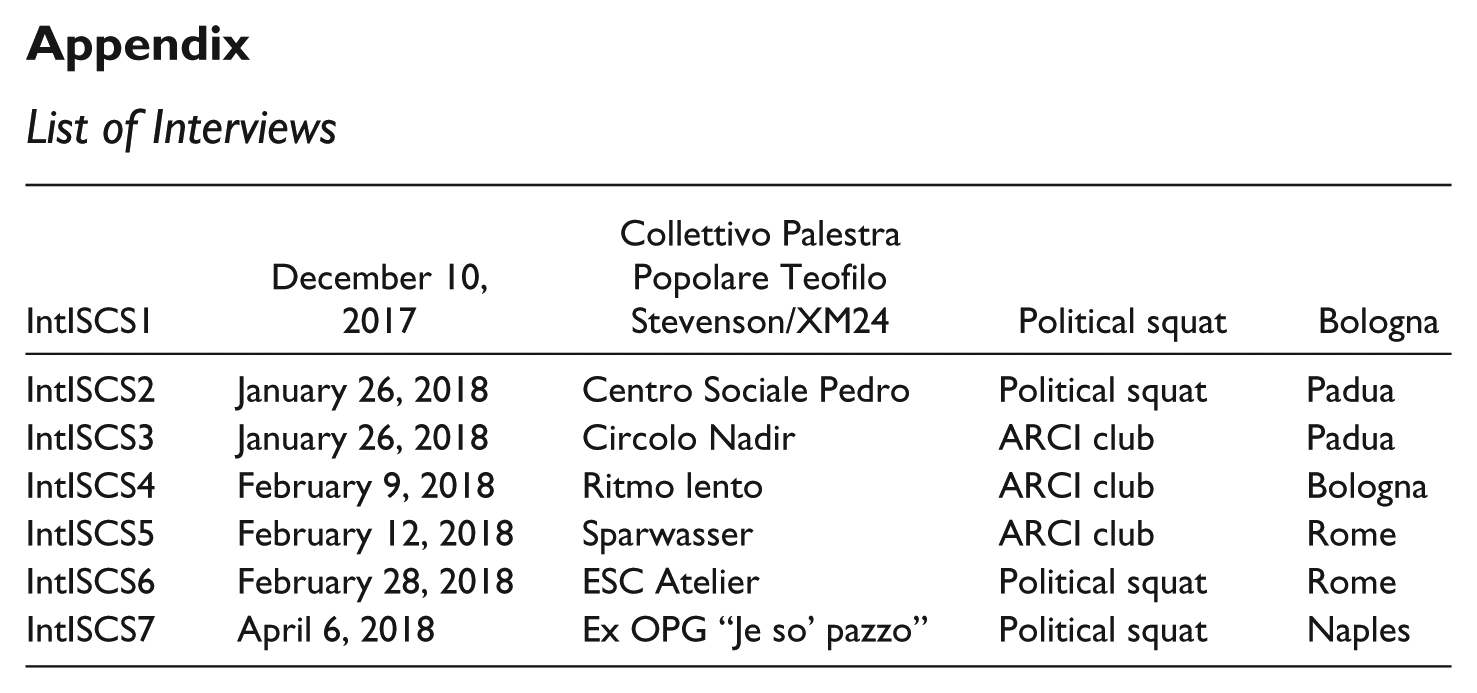
| IntISCS1 | December 10, 2017 | Collettivo Palestra Popolare Teofilo Stevenson/XM24 | Political squat | Bologna |
| IntISCS2 | January 26, 2018 | Centro Sociale Pedro | Political squat | Padua |
| IntISCS3 | January 26, 2018 | Circolo Nadir | ARCI club | Padua |
| IntISCS4 | February 9, 2018 | Ritmo lento | ARCI club | Bologna |
| IntISCS5 | February 12, 2018 | Sparwasser | ARCI club | Rome |
| IntISCS6 | February 28, 2018 | ESC Atelier | Political squat | Rome |
| IntISCS7 | April 6, 2018 | Ex OPG “Je so’ pazzo” | Political squat | Naples |
Declaration of Conflicting Interests
The author declared no potential conflicts of interest with respect to the research, authorship, and/or publication of this article.
Funding
The author disclosed receipt of the following financial support for the research, authorship, and/or publication of this article: This article was funded from the Italian Ministry of Education, Universities and Research (MIUR) and Scuola Normale Superiore. This project has received funding from the European Union’s Horizon 2020 research and innovation programme under the Marie Skłodowska-Curie grant agreement No 792782.
