



Abstract
We introduce this volume, which investigates a range of topics about poverty, including its measurement, policies intended to alleviate it, and the role of the economy in the likelihood of being in poverty. The volume was conceived as a tribute to Rebecca Blank, who was a leader in scholarship and policy translation and served at the highest levels in government and academia. The final section of the volume explores topics of special interest to Blank, including financial aid policy, the evolving roles of women in leadership, the ways in which academics can be more effective in policymaking, and motivations for her work.
Conceived as a tribute to the accomplishments of Rebecca Blank, this volume investigates a range of topics related to poverty: its measurement, policies that intend to alleviate it, and the role of the economy in its exacerbation or mitigation. Known to many as simply “Becky,” Dr. Blank was both a leading scholar of poverty and inequality and a public servant whose career demonstrated the ways in which academic pursuits and civil service can combine to bring manifold benefits to society. In her extraordinary career, she made major contributions to policy analysis and implementation in academic research, in government, and in university administration. Becky, who died in February 2023, was president-elect of Northwestern University and immediate past chancellor of the University of Wisconsin–Madison. She served previously as dean of the Ford School of Public Policy at the University of Michigan, had held academic positions at Northwestern and Princeton, and was a senior fellow at the Brookings Institution. She served as acting secretary of commerce during the Obama administration and as a member of the Council of Economic Advisers in the Clinton administration.
A unifying theme throughout her career was her dedication to using her formidable administrative, analytical, communication, and research skills to improve economic outcomes for the least economically well-off. This dedication led her to focus on improving poverty measurement—both for its own sake and to illuminate the extent to which public programs designed to alleviate poverty achieved their aims, often in the context of a widespread belief that policy was not working. Her research also focused on the economic experiences of the poor, the ways in which economic trends and fluctuations affect the poor, and the impacts of antipoverty programs.
Because much of Becky’s academic and professional career was dedicated to work on poverty, this volume, which contains new and original research on measuring poverty’s costs and consequences, quickly came together after her death. And Becky herself is the unifying force behind it: it is our hope that this collection carries forward her remarkable contributions across academia and policy—which include making the University of Wisconsin–Madison more accessible through Bucky’s Tuition Promise, her trailblazing status among economic policymakers, and her pathbreaking career as a professional woman—in some small way.
Measurement Matters: Who Is in Poverty in America?
One of the most important changes in poverty policy in recent decades has been the attention being paid to better defining and measuring it. Fundamentally, a poverty measure defines the level of resources below which a family is considered to be “poor” and is effectively able to count up any given family’s resources to determine if they actually are “poor.” To be sure, many important conceptual decisions need to be made that influence measurement, including what time frame to consider and how to adjust for differences in family size and geographic costs of living. In addition, there are definitional questions of what to include as needs (e.g., are needs based on consumption or income?) and as resources (e.g., do they include wealth or just income?). Furthermore, we face the practical consideration that a useful metric for measuring poverty must be implementable; that is, we must be able to collect the data to conduct the measurement regularly and at a reasonable cost.
The Official Poverty Measure (OPM) is used to determine eligibility for some social benefits programs, such as Medicaid and free or reduced-price meals. This measure’s flaws have long been understood and are described in more detail by Johnson et al. in the first section of this volume. On the “needs” side, the poverty threshold was set at a level equal to three times the cost of a bare-bones food basket that was measured in the 1950s and has been adjusted for inflation since then. On the “resources” side, only cash income is counted, leaving out important antipoverty benefits that are administered through the tax system or delivered in kind. We can surely do better.
The Supplemental Poverty Measure (SPM), built on decades of research by Blank, her coauthors, and others, improves measurement on both sides of the ledger. The SPM’s measure of needs is based on contemporary spending on a wider range of necessary goods (including food, clothing, shelter, and utilities). Importantly, it also includes a more comprehensive measure of resources that incorporates the range of our antipoverty programs, including refundable tax credits like the Earned Income Tax Credit (EITC) and in-kind benefits like the Supplemental Nutrition Assistance Program (SNAP). Put simply, the OPM did not count much of the government spending designed to combat poverty, and the SPM made substantial improvements along this dimension. (That said, although the SPM was a tremendous innovation, there is need for continued improvement in poverty measurement, as described by Johnson et al.)
The measurement of poverty matters because it changes the number and composition of who is considered poor. Figure 1 shows OPM and SPM poverty rates from 1967 to 2022. Note that, while the Census started producing the SPM in 2009, thanks to careful work from the Columbia University Center on Poverty and Social Policy, we now have estimates of the SPM across the entire time period (Wimer et al. 2022). The light dashed line represents the OPM rate over time. In 1967, 13.4 percent of the population was in poverty under this measure. Poverty tends to increase during economic recessions (represented by shading in the graph), with ebbs and flows that reached 16 percent or higher during the recessions in the early 1980s and the aftermath of the Great Recession that started at the end of 2007. According to this measure, we have made little more than cyclical progress against poverty. Indeed, President Ronald Reagan once quipped that the “federal government fought the war on poverty, and poverty won.”
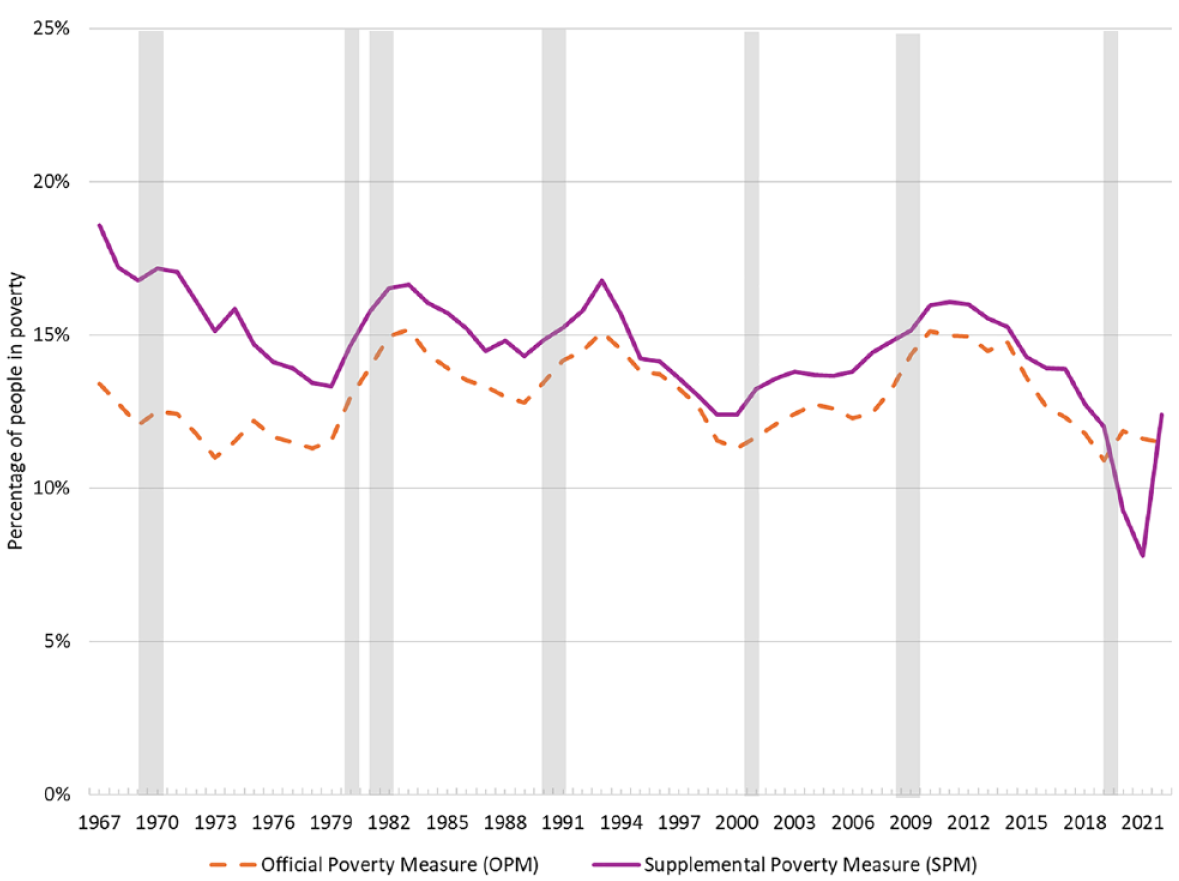
Percentage of People in Poverty, Official Poverty Measure Versus Supplemental Poverty Measure
The dark solid line displays the SPM poverty rate over the same time frame. Here a different picture emerges with poverty starting off higher and falling sharply prior to 1979. The SPM moves largely—though not perfectly—in parallel to the OPM across much of the 1980s until the COVID-19 pandemic, with the SPM rate averaging 1.1 percentage points higher than the OPM rate from 1990 to 2019. One can clearly see differences in how these measures respond to policy changes over time. Most noticeably, the SPM shows a sizable decline in poverty during the COVID-19 pandemic and recovery (2020–2021) because it includes the historic relief payments made during that time. The OPM ignores many of these payments and, as a result, shows an increase in poverty during this period.
Not only does the overall poverty rate vary across the OPM and SPM measures, but the differences in rates vary across population subgroups. Figure 2 shows both poverty rates overall and by age groups in 2022. For the overall population, the SPM poverty rate is higher than the OPM rate, at 12.4 percent and 11.5 percent, respectively. For children under age 18, however, the SPM rate is lower (12.4 percent) than the OPM rate (14.9 percent). This largely reflects that the SPM counts sources of income, including refundable tax credits (the EITC and refundable Child Tax Credit [CTC]) and in-kind benefits (SNAP and school meals), that lift millions of children above the poverty threshold. Older adults ages 65 and over have a higher poverty rate according to the SPM than the OPM—14.1 percent versus 10.2 percent. While the primary government program that reduces poverty among older Americans, Social Security, is counted in the resource measure in both approaches, the SPM’s subtraction of medical expenses from counted resources drives much of the difference across measures. Adults ages 18 to 64 are 1.3 percentage points more likely to be considered in poverty under the SPM than under the OPM.
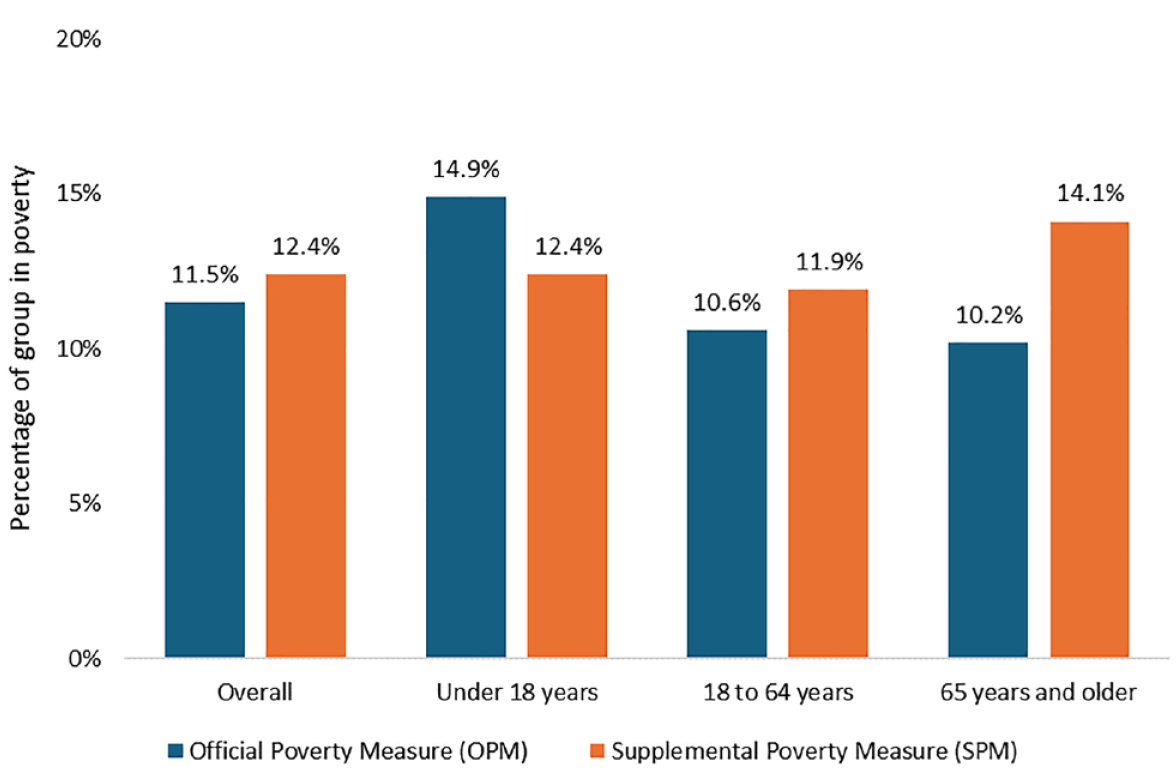
Percentage of People in Poverty in 2022, by Age and Poverty Measure
Because of differences in how resources and needs are counted across measures, the composition of people living in poverty is different across measures as well. The percentage of adults who worked full time and year-round and were in poverty was 1.9 percent according to the OPM but nearly twice that—3.6 percent—by the SPM measure, a difference of about 2 million people. As a result, when we categorize adults in poverty by their work status, as shown in Figure 3, we see that 17 percent of adults in poverty were full-time workers according to the SPM. By the OPM’s measure, only 10 percent of adults in poverty worked full time. The differences across measures are likely due to the fact that the SPM subtracts taxes paid and work expenses from its measure of resources. The share of part-time workers is similar across the two measures (25 percent by the OPM, 26 percent by the SPM).
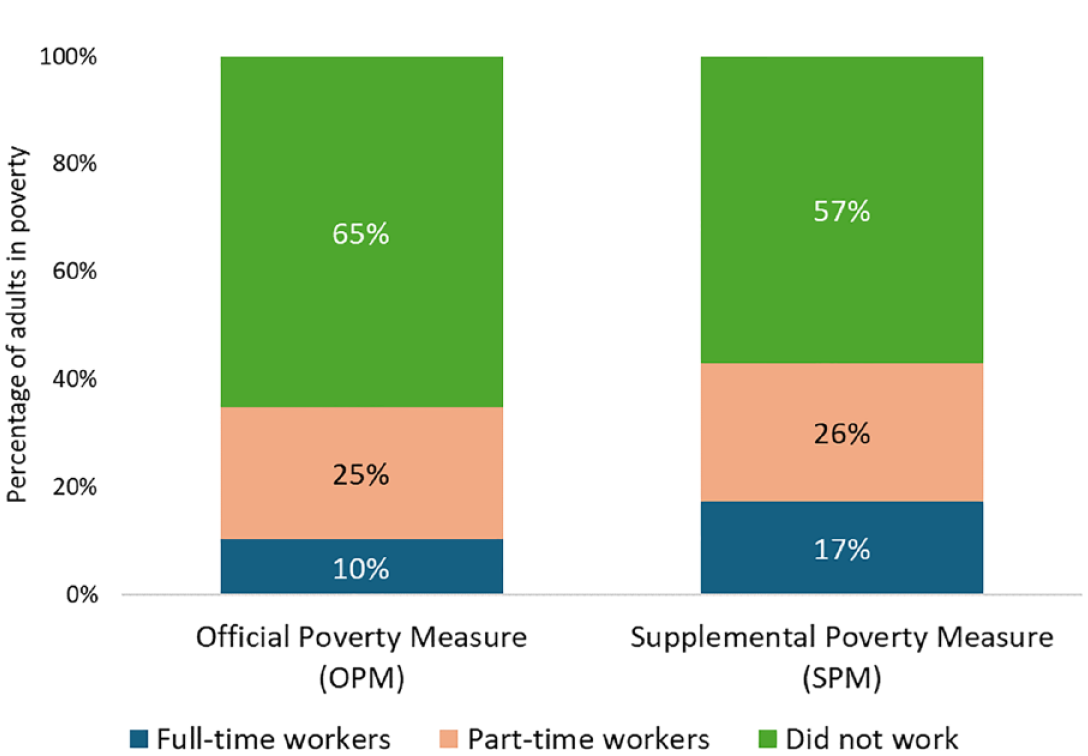
Work Status of Adults in Poverty, 2022
There is an old maxim in business: “What gets measured gets done.” What do we want to get done when we measure poverty? We measure poverty to monitor the well-being of the population. We measure it to understand the effects of policies, economic conditions, and changes in social norms on the rate of poverty. But we need to measure poverty in a manner that is capable of assessing these factors. Improvements in poverty measurement, such as the SPM championed by Blank, will help us better understand the causes, costs, and consequences of poverty.
Overview of This Volume
This volume begins by investigating recent innovations in measuring poverty as well as the changing demographics of the poor; impacts of the social safety net; and interconnected relationships among the economy, demographic change, policy, and poverty. The final section explores a range of topics related to real-world impacts, policy engagement, and motivations for this work.
Poverty and antipoverty programs
The first section includes articles on the measurement of poverty and the impact of social safety net policies that build upon many of Blank’s foundational works. Blank served on the National Academies panel that in 1995 recommended the adoption of both a framework to update the poverty measurement to better account for the resources available to households and an empirically updated measure of the poverty threshold. As described above, a key innovation of the SPM was to account for the impact of safety net policies in the poverty measure. When Blank was acting secretary of commerce in 2010, she announced that the Census Bureau would adopt the SPM as an alternative lens on poverty in addition to the OPM.
To begin this section, David S. Johnson, Helen Levy, Jordan Matsudaira, Barbara L. Wolfe, and James P. Ziliak write on recent advances in the measurement of poverty. The authors were all members of the National Academies of Science, Engineering, and Medicine (NASEM) panel that issued a 2023 report—which was dedicated to Blank’s memory—on recommendations to improve the Census Bureau’s SPM (NASEM 2023). The authors describe the history of poverty measurement and stress the complexity of the task and the need for careful research and expert judgment to continue to improve how we conceptualize and measure poverty. They highlight the case for measuring insurance for medical care, housing, and child care and emphasize the need for better systems for data collection and measurement.
Next, Sung Ah Bahk, Robert Moffitt, and Timothy M. Smeeding document how the impact of the social welfare system on SPM poverty has evolved from 2012 to 2022. This article builds on earlier work by a team of authors, including Blank, that chronicled the evolution of the welfare system and poverty in the nearly 60 years since the advent of President Lyndon Johnson’s War on Poverty (Haveman et al. 2015). They show that declines in poverty during the “long recovery” from the Great Recession (2012–2019) were mostly driven by the strong economy in those years when the tax and transfer system was relatively stable. By contrast, the sharp decline in poverty rates between 2019 and 2021 was driven by an unprecedented increase in spending on government relief programs in response to the COVID-19 pandemic. By 2022, though, poverty rates had reverted essentially to their 2019 levels. Highlighting the heterogeneous impact of the social welfare system, the authors show how programs alter the levels and trends of poverty separately for children, parents, childless adults, and older adults.
Rounding out this section, Paul N. Courant, Lucie Schmidt, and Julia Yates bring a fresh, new look at Blank’s book It Takes a Nation (Blank 1997), update its analysis, and draw out its enduring lessons for research and policy. Blank’s insight that people living in poverty are a complex and heterogeneous group, varying across age, geography, and racial and ethnic groups, has grown more important over time. Further, as highlighted throughout this volume, they argue that how we measure poverty impacts who we consider to be poor. The authors emphasize Blank’s advice that we need more high-quality research to better inform policy, especially on issues of measurement, the interaction of various social safety net policies, and the understudied benefits (and not just the costs) of the safety net.
Dynamics of poverty, work, and policy
There was a seismic shift in the safety net in the 1990s, when welfare reform imposed strict time limits and other changes on the cash welfare system and expansions of the EITC substantially increased benefits available to low-income workers with children. More recently, the passage of the Affordable Care Act (ACA) in 2010 increased the share of people who have health insurance. In addition, changes to eligibility for safety net policies for immigrants impacted immigrants and many U.S.-citizen children born to immigrants. There also have been changes in broad economic conditions, including multiple recessions, wage stagnation among people with low levels of education, and increasing returns to education.
Coming to her studies of poverty as a labor economist, Blank always included careful analyses of macroeconomic conditions and labor market factors in her work, and this section explores labor market factors and policy changes that impact low-income families and poverty rates.
In the first article in this section, Marianne P. Bitler, Hilary Hoynes, and Elira Kuka build on pioneering studies of the relationship between the macroeconomy and the poverty rate by Blank and Blinder (1986) and Blank and Card (1993). In this article, the authors use the modern SPM and consider the relationship between the macroeconomy and poverty both before and after the impacts of taxes and benefits. They further explore these relationships after the combination of welfare reform and the expanded EITC shifted the safety net toward more benefits paid to workers during the long recovery from the Great Recession and in response to the acute COVID-19 recession. They demonstrate that the relationships are not monolithic and that the impact of the safety net with economic downturns does not impact the well-being of some groups—defined by adults’ ages, race or ethnicity, and presence of children—more dramatically than others.
Next, Lisa Barrow, Diane W. Schanzenbach, and Bea Rivera trace employment patterns among adults in low-income families over the past three decades. Over this broad period, employment among nonelderly adults was trending downward in a similar manner both overall and among those living in low-income families. The exception to this pattern was an increase in employment from 1992 to 1999 among women with children during the period that encompassed welfare reform and the EITC expansions. They show that payments from social benefits programs make up an increased share of income among low-income families with children and relatively high earnings, while the role of social benefits programs is little changed over time among low-income families without children.
The following article, by Rebecca M. Blank, David Card, and Hanns Kuttner (completing work that was started during Becky’s life), investigates economic and household characteristics of women who enter into poverty after having income above the poverty level for an extended period of time. Across three periods—1990–1992, 2001–2003, and 2008–2010—the causes of entry into a poverty spell are very similar and generally reflect losses in earnings either by the woman or by her partner (significant losses that may result, of course, from the exit of a partner from the household). In the early period, cash income from welfare increased after a household’s entry into poverty. After the implementation of federal welfare reforms in the 1990s, though, cash welfare benefits did not increase, although SNAP benefits did in the months after a poverty spell began.
Next, Katharine G. Abraham and Henry S. Farber investigate how health insurance coverage among part-time workers, who are more likely to be low-income (Bureau of Labor Statistics 2022), has evolved over time in response to provisions of the ACA. Part-time workers are less likely to have health insurance coverage than are full-time workers, a pattern known as the “coverage gap.” They find that the coverage gap declined from 6.5 percentage points in 2013 (before the ACA) to 3.1 percentage points in 2021. The ACA included a range of policy changes, including an employer mandate to provide coverage to full-time workers, a policy that dependents can stay on their parents’ health insurance plans until age 26, extended Medicaid coverage, and the introduction of health insurance exchanges and subsidies to pay for health insurance for some low-income people. They apportion the change in the coverage gap into these sources of policy change.
In the final article in this section, Kristin F. Butcher, Luojia Hu, and Ryan Perry investigate how the use of social programs by U.S.-born children reflects the more stringent restrictions on their immigrant parents. They focus on how SNAP and Medicaid participation of children who are U.S. citizens respond to a change in the public charge rule; this rule adds SNAP, Medicaid, and housing benefits to the list of programs used to determine whether immigrants are likely to become a public charge and whether they should be awarded a green card. The authors document a decline in program participation among eligible U.S. children of immigrant parents.
Policy translation
Becky was unusual in part due to her service at the highest levels of academia, policy, and government. She brought her keen intellect, indefatigable energy, directness, and a good dose of Midwestern common sense to every task she undertook. She approached her work grounded in both her academic training as an economist and her religious faith (Blank and McGurn 2004), and, as described by Rev. Bliss Williams Browne, who preached at Becky’s memorial service, she “lived and made decisions from a deep sense of purpose and a clarity about mission” (Browne 2023). The third and final section of the volume explores some areas of policy and practice where she made major contributions.
As chancellor of the University of Wisconsin–Madison, Blank implemented Bucky’s Tuition Promise. Named after Bucky Badger, the university’s mascot, this initiative represented a simpler, more transparent approach to granting aid and covered full tuition costs for in-state students from families with annual incomes less than $56,000 in 2018. Elise A. Marifian, Jeffrey A. Smith, and Sarah E. Turner describe Bucky’s Tuition Promise and draw from it lessons on the design and implementation of student financial aid policy. In recent years, more elite private and public universities have adopted a “high-tuition, high-discount” model under which the posted prices for tuition and board are increasingly bad proxies for the amount a family must pay after aid. Implementing need-based aid policies raises questions that have long interested Blank about how to measure family need. The federal government relies on a complex formula based on information in the Free Application for Federal Student Aid (FAFSA). Instead, Bucky’s Tuition Promise bases eligibility on the family’s adjusted gross income (AGI) from their income taxes, a measure that is much more salient and better understood by families. The authors provide a compelling analysis and highlight the trade-offs between simplicity and a targeted design of student financial aid policy.
Next, Francine D. Blau and Lisa M. Lynch provide a tour de force of documentation of women’s progress over the past 50 years across education, economics, government, public policy, medicine, and business. While in 2019–2020, a majority of degrees—bachelor’s, master’s, PhDs, and professional—went to women, we are far from parity along a range of dimensions, including the share of women who are professors, university presidents, and even undergraduate economics majors. The authors consider potential explanations for enduring gender differences and highlight the significance of Becky’s remarkable career.
Alan S. Blinder brings his unique perspective as one of relatively few academic economists who, like Becky, has “ventured into the world of real-life policymaking, a place where politics reigns supreme.” He starts by giving advice to “politicos” about how (realistically) to improve their economic decision-making. He concludes by offering sound advice to economists to make them more effective in the real world of policymaking, which bears precious little resemblance to arguments in the academic seminar room or the faculty lounge.
In the final article, Matthew Desmond reflects on what he terms as Becky’s “economic theology.” Becky often wrote of the influence of her Christian faith on her work and wrestled with what this meant in practice (Blank 1992). She chaired a United Church of Christ committee that produced the document Pronouncement on Christian Faith: Economic Life and Justice, which informed positions adopted by the church’s governing body in 1989 (United Church of Christ 1989). Desmond frames his article in terms of a guiding question rooted in scripture that Becky used to analyze policy questions: What will this do for the poor?
Conclusion
The volume builds on a broad range of Blank’s work and includes a range of scholars who were connected to Blank as coauthors and through her academic legacy of teaching, mentoring, and research. It highlights the role of measurement, data, heterogeneity, thoughtful policymaking, the macroeconomy, and motivation for the work of understanding poverty and addressing attendant economic needs. The authors include her PhD advisor (Farber), some PhD advisees (McGranahan and Schmidt), former coauthors (Blinder, Card, Smeeding, and Moffitt), academic colleagues, policy colleagues, and also her spouse (Kuttner), along with many others whose own careers were inspired and influenced by Becky and her work. The volume was made possible by many generous contributors, including the Ford School at the University of Michigan; the Industrial Relations Section at Princeton University; the Department of Economics, Institute for Policy Research, and Office of the President at Northwestern University; the Department of Economics, the Institute for Research on Poverty, and Office of the Chancellor at the University of Wisconsin; the Federal Reserve Bank of Chicago; and the American Academy of Political and Social Science. Special thanks go to Joseph Altonji, Sheldon Danziger, Austan Goolsbee, Emily Kuttner, Hanns Kuttner, Katherine Magnuson, Anna Paulson, Rob Porter, Jesse Rothstein, Michael Schill, Christopher Taber, and Celeste Watkins-Hayes; the participants of the authors’ conference; and Lauren Shelby and the Federal Reserve Bank of Chicago’s events team for hosting the extraordinary event in February 2024, where we celebrated, with scholarship and stories, the many ways that Becky inspired and spurred people on to do better work, on more important areas, to improve policy and practice.
Footnotes
NOTE: Any views expressed in this article do not necessarily reflect those of the Federal Reserve Bank of Chicago or the Federal Reserve System.
Leslie McGranahan is a senior vice president and the director of regional research and engagement at the Federal Reserve Bank of Chicago.
Diane W. Schanzenbach is Margaret Walker Alexander Professor in Education and Social Policy and faculty fellow in the Institute for Policy Research at Northwestern University. She is a research associate of the National Bureau of Economic Research.