



Abstract
Reform of the U.S. welfare system in 1996 spurred claims that cuts to welfare programs effectively incentivized single mothers to find employment. It is difficult to assess the veracity of those claims, however, absent evidence of how the relationship between welfare benefits and single mother employment generalizes across countries. This study combines data from the European Union Labour Force Survey and the U.S. Current Population Survey (1992-2015) into one of the largest samples of single mothers ever, testing the relationships between welfare generosity and single mothers’ employment and work hours. We find no consistent evidence of a negative relationship between welfare generosity and single mother employment outcomes. Rather, we find tremendous cross-national heterogeneity, which does not clearly correspond to well-known institutional variations. Our findings demonstrate the limitations of single country studies and the pervasive, salient interactions between institutional contexts and social policies.
Following the 1996 welfare reform in the United States, American social policy research largely concluded that single mothers can be pushed to work (e.g., Blank 2002; Corcoran et al. 2000; Danziger et al. 2002; Herbst 2010; Heinrich 2014; Hoynes and Stabile 2019; Noonan, Smith, and Corcoran 2007). For example, by claiming that the increased employment of single mothers “has been achieved to a much greater degree than anyone expected,” Moffitt (2002) affirmed classic arguments about how generous social policies have adverse labor supply effects (e.g., Bitler and Karoly 2015; Cascio et al. 2015; Immervoll et al. 2007). This conclusion also affirmed the intuition that single mothers would be especially responsive to cuts in benefits (Brady and Burroway 2012; Damaske, Bratter, and Frech 2017; Destro and Brady 2011; Gonzalez 2004; Herbst 2010; Jaehrling, Kalina, and Mesaros 2015). Utility-maximizing single mothers, the argument goes, could find parenting to be more meaningful and rewarding than low-wage work, while generous welfare programs subsidize the decision not to work. Conversely, the inescapable costs of raising children could be a particularly strong incentive to work in the absence of generous welfare programs. Consistent with this line of thinking, the reduction in welfare generosity in the United States did coincide with a substantial increase in single mother employment (Hoynes and Stabile 2019).
Despite the prominence of this American literature, its conclusions have been subjected to little cross-national scrutiny. Indeed, the American literature rarely acknowledges that the U.S. case is unusual in terms of high inequality, weak social policies, and lack of institutions supporting working mothers (Hegewisch and Gornick 2011; Misra et al. 2012; Nieuwenhuis and Maldonado 2018). Compared to other rich democracies, the risk of poverty and unemployment for single mothers is also unusually high in the United States (Brady, Finnigan, and Hübgen 2017; Damaske, Bratter, and Frech 2017).
The U.S.-based literature has nonetheless been quite influential for economic and social policy debates since the 1990s. Albeit less punitive than the U.S. reforms, the Working Families Tax Credit introduced in the UK in 1999 similarly aimed to increase employment of single mothers (Hills and Waldfogel 2005, Francesconi and Van der Klaauw 2007). The UK subsequently documented rising employment rates among single mothers and doubled down on restricting lone parents’ entitlements to social assistance in 2008 (Rafferty and Wiggan 2011). By contrast, though, a reform similar to the Personal Responsibility and Work Opportunity Reconciliation Act in the Netherlands in 1996 did not increase single mother employment (Knijn and van Wel 2001).
Is the U.S. case unusual? If, indeed, the American findings are not robust across countries, this should qualify the general conclusions drawn from the U.S. case. Rather than a general relationship between welfare generosity and single mother employment, the observed relationship may be idiosyncratically dependent upon the contingencies of the United States. Moreover, a robust comparative literature would enable the United States to learn from other rich democracies, both in terms of the limitations of welfare disincentives and how institutions and social policies can support single mothers.
This study provides unique cross-national scrutiny by investigating two research questions. First, do generous welfare benefits discourage single mother employment generally across countries? Second, if not, how does the relationship between welfare generosity and single mother employment vary cross-nationally? We combine individual-level data from the European Union Labour Force Survey (EU LFS) for Europe and the U.S. Current Population Survey (CPS) from 1992 to 2015. In one of the largest samples of single mothers ever assembled, we analyze nearly 600,000 single mothers in up to 363 country-years across twenty-three countries. We assess single mothers’ employment and work hours and model welfare generosity by constructing a unique indicator that captures minimum income protection for single mothers specifically. Using two-way fixed effects models, our analyses yield three key contributions. First, we demonstrate that welfare generosity does not generally undermine single mother employment across countries. Second, we describe the extent of cross-national variation in the relationship between welfare generosity in single mother employment. And third, we compare the prominent U.S. case against other rich democracies to contextualize the limitations of the U.S.-based findings. We argue that no generalizations should be drawn from single country studies, especially when based on the U.S. case, and that research should pay close attention to the pervasive and salient interactions between institutional contexts and social policies.
The Case for Cross-National Comparison and Variation
There are at least four reasons for meaningful cross-national variation in the relationship between welfare generosity and single mother employment. First, a universal theory of welfare as a disincentive to employment has been undermined by a growing comparative literature that uses natural experiments and randomized controlled trials (e.g., Banerjee et al. 2017; Marinescu 2018; Salehi-Isfahani and Mostafavi-Dehzooei 2018). For example, welfare reforms in the Netherlands that reduced benefit levels for single parents resulted in little change in employment (Knijn and van der Wel 2001). These studies encourage skepticism about research that relies disproportionately on formal models, simulations, and single countries like the United States.
Second, descriptive cross-national patterns in welfare generosity and single mother employment contradict the purported relationship (Gonzalez 2004; Misra et al. 2012; Nieuwenhuis and Maldonado 2018). While country-level cross-sectional patterns cannot identify causal relationships, they provide prima facie evidence that generous welfare states do not necessarily lower the employment of single mothers (Cascio, Haider, and Nielsen 2015; Gonzalez 2004; Gornick, Meyers, and Ross 1997; Hegewisch and Gornick 2011). For example, in a cross-national study, Destro and Brady (2011) find that single mother employment is actually highest in more generous welfare states (e.g., Sweden), and lowest in weaker welfare states (e.g., Australia). Cross-national findings, thus, suggest that even if there might be welfare-related disincentives to work within countries, there must be countervailing forces that mitigate any possible negative effects of welfare generosity on single mother employment (Gonzalez 2004).
Third, some social policies have been shown to actually facilitate single mother employment. In contrast to the American literature, European social policy scholars focus less on welfare disincentives and more on the employment-enhancing effects of work-family and other social policies as well as policy design (e.g., Hegewisch and Gornick 2011; Jaehrling, Kalina, and Mesaros 2015; Nieuwenhuis and Maldonado 2018; Marchal and van Mechelen 2017; Clasen 2020). For instance, Misra and colleagues (2012) show that public childcare and paid family leave encourage single (and all) mothers to stay in employment. For the United States, studies show the California paid leave program boosted mothers’ employment (Baum and Ruhm 2016; Rossin-Slater, Ruhm, and Waldfogel 2013). This is partly because public childcare reduces the costs of employment and effectively subsidizes employers (Herbst 2010). Moreover, paid leave increases the likelihood of mothers staying at their jobs (Cascio, Haider, and Nielsen 2015; Gornick, Meyers, and Ross 1997)—partly because generous welfare programs improve the health and well-being of single mothers (Brady and Burroway 2012; Corcoran et al. 2000; Heinrich 2014; Marinescu 2018; Nieuwenhuis and Maldonado 2018). Related to this, tax credits function as employer subsidies that boost employment (e.g., Hamersma 2008). Evidence from the UK suggests that working family tax credits increased single mother employment (Hills and Waldfogel 2004). In the United States, the Earned Income Tax Credit (EITC) was particularly effective at raising single mother employment in the 1990s (Heinrich 2014; Herbst 2010; Noonan, Smith, and Corcoran 2007). Likewise, countries like France and Germany have introduced (temporary) earnings disregards for people on social assistance that allow them to retain their full benefit if they earn some extra income (Clasen 2020; Marchal and Marx 2018). Closely related is the general trend towards more conditionality, monitoring, and sanctioning associated with the receipt of welfare benefits, which may have also facilitated employment. In the Netherlands and some of the Nordic countries, for instance, social assistance recipients are made to sign “integration contracts” and need to actively look for work and accept job offers in order to receive benefits (Marchal and van Mechelen 2017). Hence, the aforementioned push of cuts to welfare benefits may actually be due to the pull of policies incentivizing work. Since generous welfare states are complex and interdependent combinations of more extensive work-family policies and higher benefit levels, countries with more generous welfare benefits may have higher single mother employment (Cascio, Haider, and Nielsen 2015; Misra et al. 2012).
Fourth, any social policy is unlikely to have the same causal effect across contexts (Deaton and Cartwright 2018). Given the focus on internal validity and causal identification in social policy research, external validity and causal generalization are often neglected (Olsen et al. 2012). However, there is considerable evidence that social policies do not have the same effect across every institutional, economic, and cultural context (e.g., Biegert 2017). Social policies are always part of a complex of interdependent and intricately interacting institutions (Cascio et al. 2015; Jaehrling, Kalina, and Mesaros 2015). In turn, a specific policy effect is effectively moderated by “helping factors” in the underlying institutional context, for example, the availability of affordable housing, active labor market policies, or minimum wage regulations. Therefore, we cannot be certain how much of the effect is actually and solely due to the policy as opposed to the implicit interaction between the policy and context. Since there are strong reasons to suspect that results from the highly unusual U.S. case might not generalize to other rich democracies, it is essential to remain cautious in drawing general conclusions. For all of these reasons, the relationship between welfare generosity and single mother employment warrants cross-national scrutiny. In the following, we present a cross-nationally comparative study to assess how the relationship between generous welfare benefits and single mothers’ employment and work hours varies across different economies. By this, we demonstrate generous benefits do not necessarily disincentivize labor market participation. Lessons from U.S studies in that spirit should not be taken at face value and applied to other contexts. Rather, the United States can be seen to be an outlier and economies that embed generous benefits in alternative contexts can still achieve high employment among single mothers.
Data and Methods
Sources, sample, and variables
We harmonize cross-sectional individual-level data from the EU LFS and the CPS for the years 1992 to 2015. We then pool this merged individual-level dataset with macro-level indicators from several different sources (Biegert 2017; Hipp and Leuze 2015). Even though some countries entered the EU LFS later, the necessary information to identify single mothers is not available for all country-years, and we lack macro-level information for some country-years, our analyses incorporate almost 600,000 single mothers in up to 363 country-years across twenty-three countries. 1
We identify single mothers as all female household reference persons who live without a partner in the same household but with at least one child below the age of 15 (Brady and Burroway 2012; Brady, Finnigan, and Hübgen 2017; Destro and Brady 2011; Heuveline and Weinshenker 2008; Misra et al. 2012; Rainwater and Smeeding 2004). To limit bias that may occur due to differences in education and retirement across countries, we restrict the sample to mothers aged 25 to 54. 2
Figure 1 shows that the ratio of single mothers to all mothers aged between 25 and 54 with children less than 15 years varies considerably between countries and over time. While some countries (e.g., Austria, Italy, Slovenia, or Slovakia) have had a relatively stable and low proportion of single mothers, in other countries the proportion of single mothers has grown over time (e.g., Ireland or Latvia) or has constantly been on a high level (e.g., the UK). Figure 1 illustrates the U.S. case is actually fairly unusual for having such stability at such a high level.
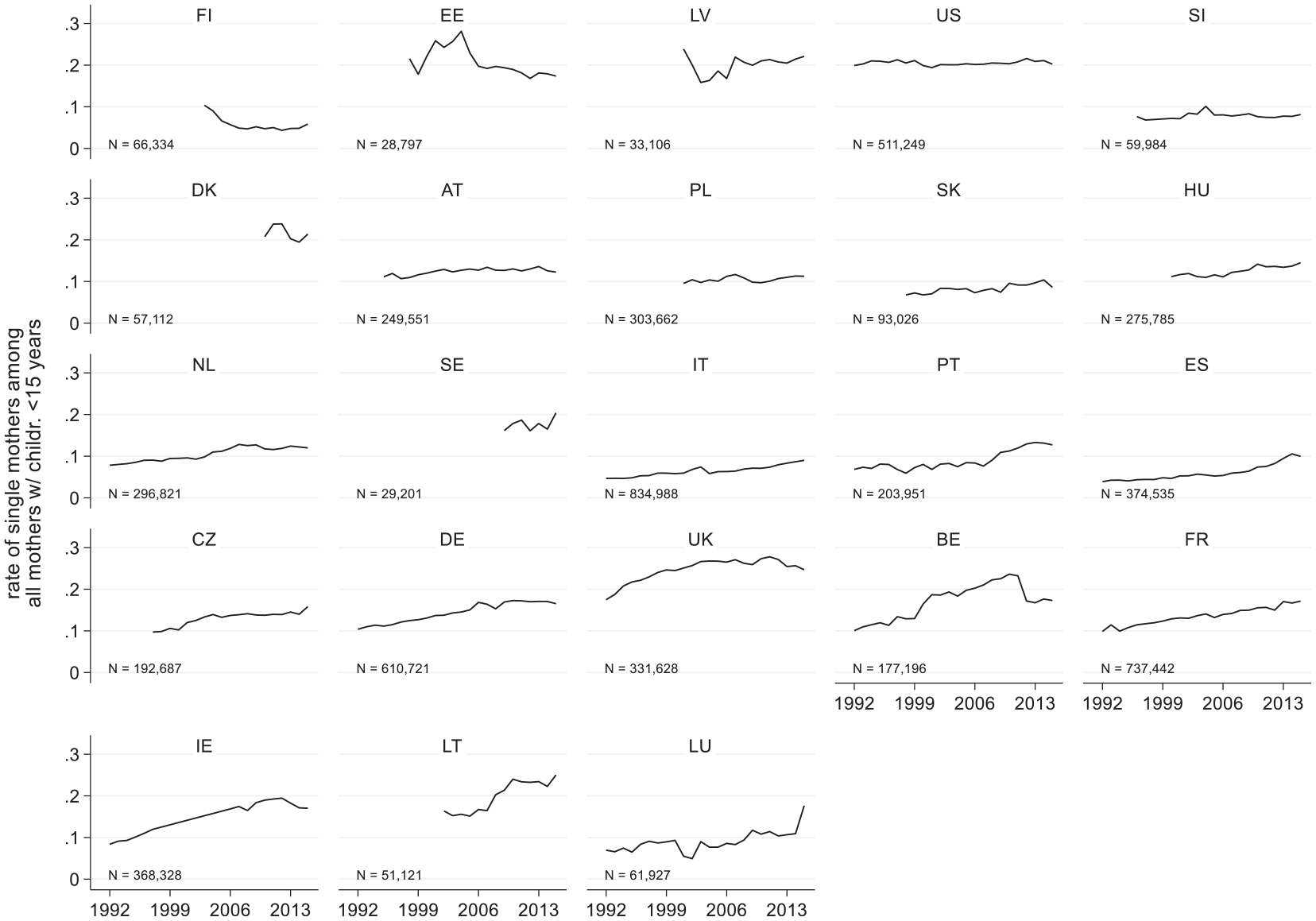
Proportion of Single Mothers among All Mothers Aged 25–54 Years with at Least One Child < 15 Years between 1992 to 2015
We analyze two outcomes. Following the International Labor Organization (ILO) definition, single mothers’ employment status is coded 1 for (self-)employed single mothers who work at least one hour per week and 0 for those single mothers who do not. Among the jobless, we do not distinguish between unemployment and inactivity to avoid the issue that generous benefits might lead job-seeking individuals to withdraw from the labor force. Our second dependent variable is single mothers’ working hours volume, which further assesses the extent to which individuals are economically active. This variable captures single mothers’ working hours in all jobs in the reference week. In order to make cross-country comparison possible, we assign a value of 0 to those who currently do not pursue paid employment.
Our main explanatory variable is welfare generosity for single mothers. Using data from Nelson and colleagues (2020), our measure concentrates on minimum income protection for single parent households. The main component of this measure is social assistance payments; housing supplements, child support, and other benefits are added as long as they are not deducted from social assistance. To be able to compare generosity across countries, we take a relative perspective on generosity and use Nelson and colleagues’ (2020) absolute numbers to construct the ratio of welfare payments to the average wage in the respective year and country (the data for these conversions are from OECD 2019). The online appendix (Figures A1–A3, Tables A3–A6) features two alternative measures to assess the robustness of our results: (1) data on public expenditure on social policies as a percentage of gross domestic product (GDP) obtained from the OECD’s Social Expenditure Database (2019) and (2) Scruggs, Jahn, and Kuitto’s (2017) welfare state generosity index. These measures assess the generosity of welfare benefits in general and have been used widely in existing studies.
We include the following micro-level covariates to adjust for compositional differences and potential confounding: age (six categories in 5-year bands), education (three categories, ISCED0-2/low, ISCED3-4/medium, ISCED5-6/high), the number of children aged 15 and younger living in the household (three categories, one child as the reference category), a dummy indicating if at least one of the children is below the age of 5, a dummy indicating whether there is an additional working-age individual present in the household who might take on care responsibilities or provide additional income, and a dummy variable indicating whether there is an older person in the household (65 years or older) who might either help with or add to the care responsibilities.
We adjust for the following macro-level indicators to rule out alternative explanations for variation in single mothers’ labor force involvement across countries and over time and that are correlated with welfare generosity: active labor market policies (ALMPs) as a percentage of GDP (adjusted for national unemployment rates) 3 and public expenditure on early childcare and early education (ECEC) as a percentage of GDP (OECD 2018, 2019). To control for the business cycle, we also include men’s unemployment rate, which we calculate based on our micro-level data from the EU LFS and the CPS.
Analytical strategy
To assess the effect of welfare generosity on single mother employment and working hours, we estimate two-way fixed effects models with robust standard errors clustered at the country-level. The online appendix provides a technical description of the models. 4 Despite some debates on two-way fixed effects models (Hill et al. 2020; Kropko and Kubinec 2020), the two-way fixed-effects coefficients can be interpreted as the average difference in within-country deviations from the mean in the single mothers’ employment and work hours at a given time point for each one-unit within-country increase in the respective benefit indicator at a given time point, averaged across time points. 5
For both dependent variables, we proceed as follows. We first estimate a model that includes the respective dependent variable, minimum income protection, and the country and year fixed effects. Next, we introduce the micro-level covariates. The third model introduces the macro-level covariates. The final model introduces interactions between benefit indicator and country dummies. This enables us to compute country-specific associations between benefit levels and the outcomes. The estimated coefficients are based solely on variation within the specific country and thus will be less robust for countries with shorter time series. However, without delivering causal estimates of the policy effect for each country, the approach clearly illustrates the variation in the relationship of interest.
We display this sequence rather than only the full models because we want to compare the coefficients for the benefit indicators as well as the country-specific coefficients across different specifications. Some of our covariates, especially the macro-level policies, could be affected by benefits (rather than the reverse) and including them could lead to overcontrol bias. Showing coefficients across these models clarifies how large of a problem this might pose. All analyses use standardized, one-year lagged measures for all country-level variables. Standardization facilitates the interpretation and comparison of coefficients in multivariate analyses. Lagging partially addresses issues of reverse causality and recognizes that policy changes tend to have a delayed effect. 6
Results
Descriptive patterns
We first present employment rates and average working hours of single mothers, partnered mothers, and single childless women aged between 25 and 54 years (Figures 2 and 3) to provide some comparison and context for how women’s employment varies cross-nationally and over time. In most countries, single mothers’ employment rates have been rising since the early 1990s, as have employment rates of partnered mothers and all working-age women. Notable exceptions are Austria and Germany, where single mother employment remained stable or declined relative to the comparison groups, albeit from a comparatively high starting level. Several countries also show a decline in employment around the time of the 2008 economic crisis. In several countries, for example, Spain, Ireland, and the Slovak Republic, single mothers were particularly affected by labor market developments during the crisis.
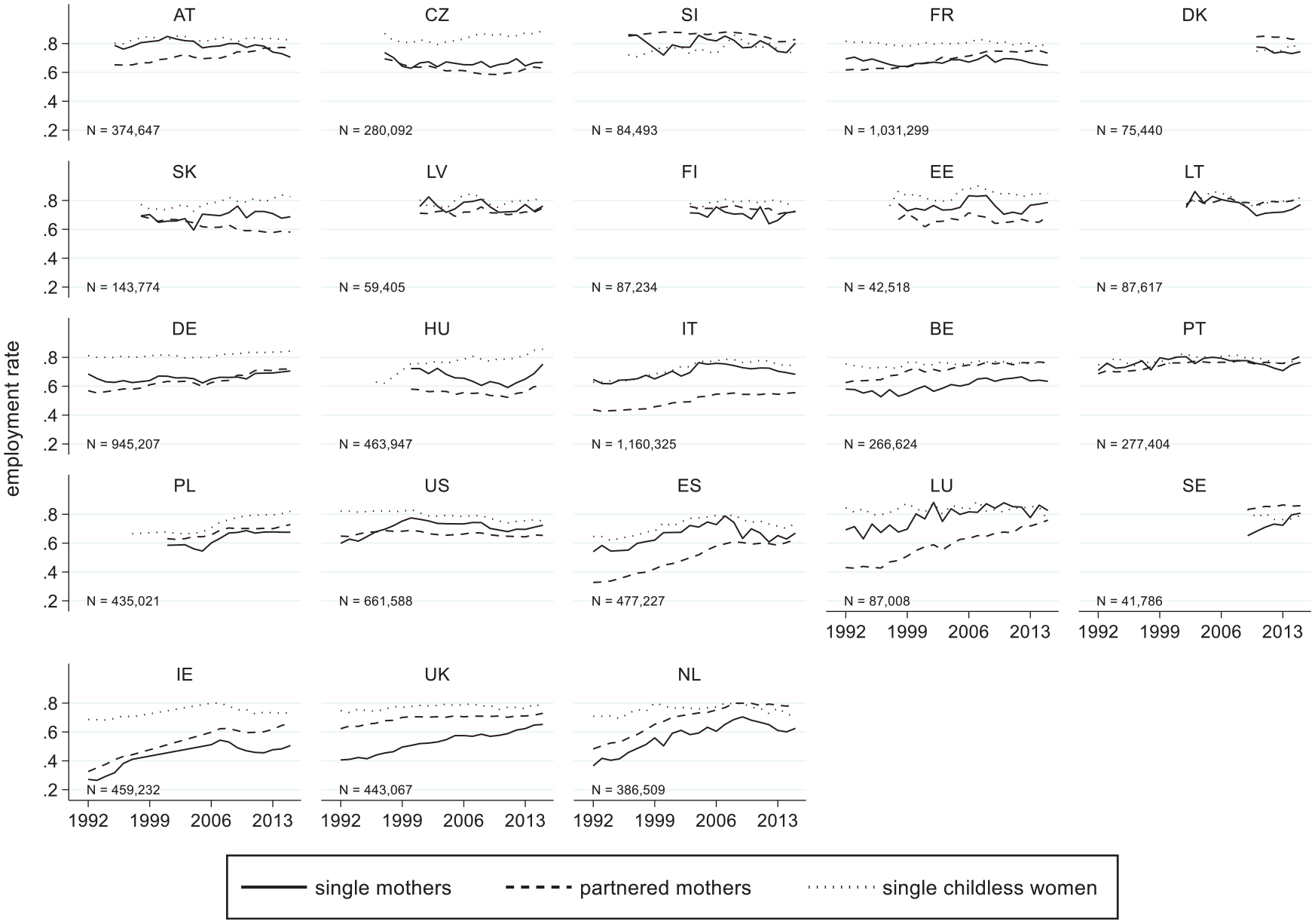
Growth of Employment Rates of Single Mothers, Partnered Mothers, and Single Childless Women (25–54 Years) in Twenty-Three Countries
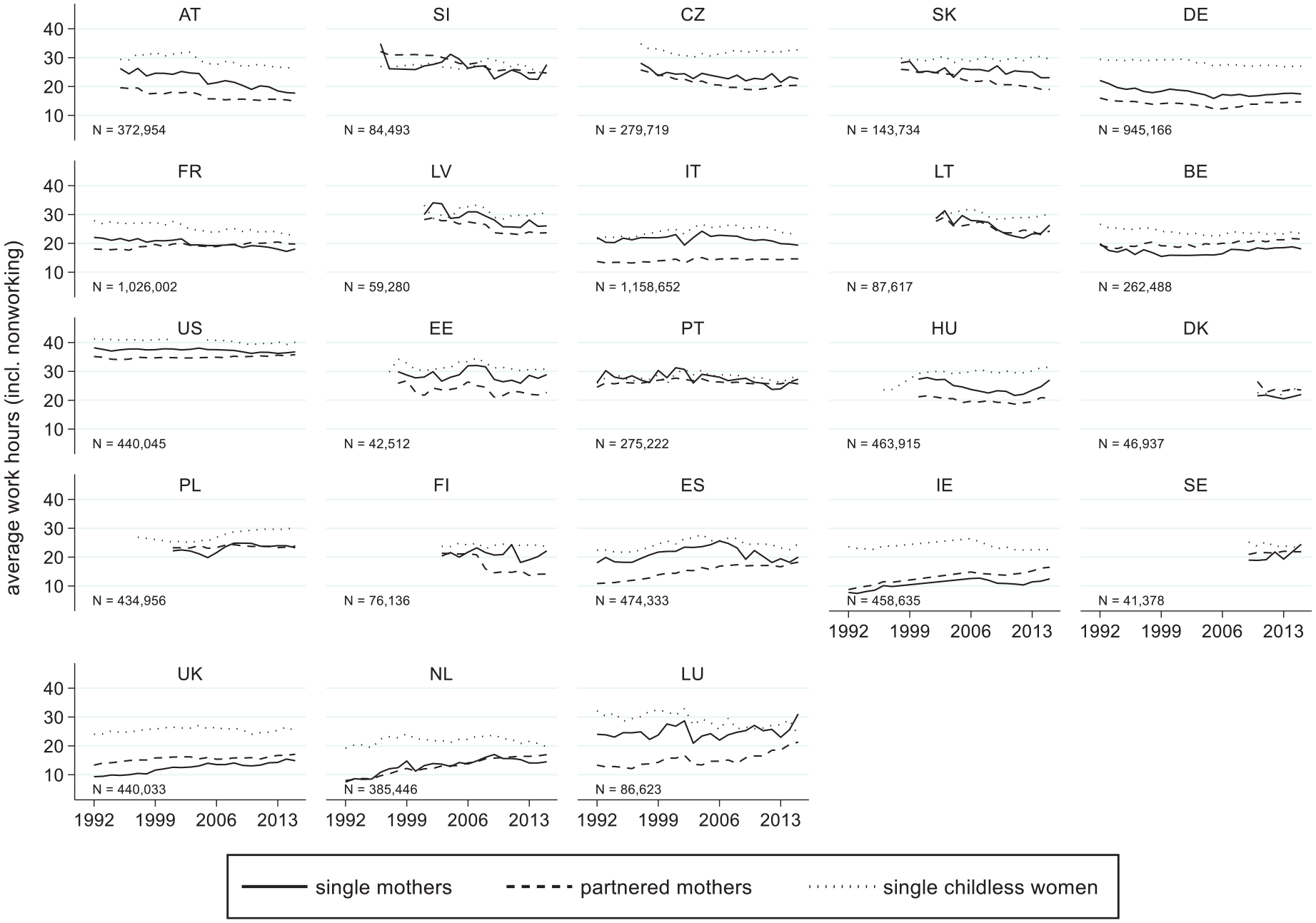
Growth of Average Work Hours of Single Mothers, Partnered Mothers, and Single Childless Women (25–54 Years) in Twenty-Three Countries
Consistent with the welfare reform literature, the United States did see a significant increase in single mother employment in the 1990s. However, that increase began as early as 1992, several years before the 1996 welfare reforms. Further, most countries saw an increase in single mother employment regardless of any welfare reforms. The United States was not unusual for seeing an increase in single mother employment. Hence, it did not require U.S.-style welfare reforms to experience rising single mother employment. In this longer-term period, the more notable quality of the United States is that since 1999, single mother employment has been stable at a high level or even modestly declined from a high level. This has happened despite any change in welfare generosity.
Because the dichotomous variable employment neglects variation in the extent to which individuals pursue paid work, we next display the average work hours of single mothers, partnered mothers, and single childless women in Figure 3. Nonworking women are coded as working zero hours in order to establish comparability across countries, over time, and across the different groups of women. While there is less variation in single mothers’ working hours over time than in their employment rates, the cross-national variation is still considerable. In the UK, the average working hour volume has been about 15 hours per week; in the United States, it was about 35 hours per week. Again, we see the unusualness of the U.S. case as single mothers’ average hours worked is both high and stable. In the majority of countries and years, single childless women tend to work longer hours on average, and partnered mothers work shorter hours than single mothers. In France, Latvia, the Netherlands, Poland, Portugal, and Sweden, single mothers’ work hours have been approximately the same as that of partnered mothers on average. Only in Denmark, Ireland, and in the early 2000s in Slovenia have single mothers worked fewer hours than partnered mothers.
To display the degree to which single mothers’ employment rates and work hours correlate with countries’ welfare generosity, we inspect bivariate associations in Figure 4. Figure 4 plots the differences between the first and last year for each country for single mothers’ employment rates (upper row) and working hour volumes (lower row) against the change in minimum income protection over the same period. This difference between first and last year mimics the over-time changes analyzed in the subsequent models. Figure 4 shows no association between over-time changes in single mothers’ employment rate or work hours and changes in minimum income protection.
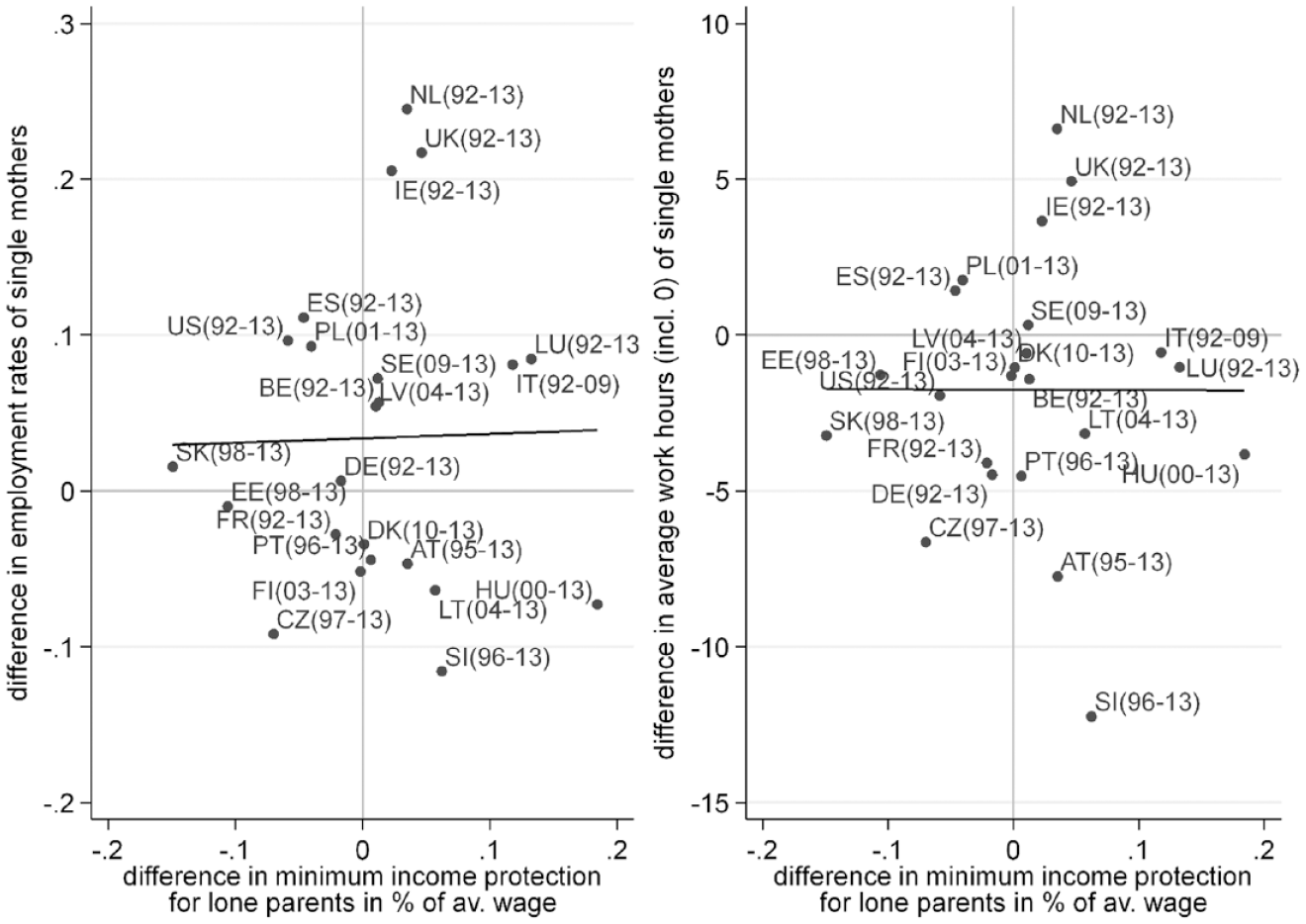
Bivariate Associations of the Change in Single Mothers’ Employment Rates and Average Work Hours with the Change in Minimum Income Protection
Two-way fixed effects models
We now turn to the two-way fixed effects models.Figure 5 shows the marginal effects of our welfare generosity measure on employment and work hours of single mothers. M1 is based on the model that only includes the lagged minimum income protection indicator and country and year fixed effects. The coefficients for minimum income protection reveal a negative but statistically nonsignificant association with both single mother employment and working hours. The association is statistically significant in M2, which includes micro-level covariates. Here, a standard deviation increase in minimum income protection is associated with a 2-percentage-point decrease in the probability to be employed and a 0.6 hour decrease in working hours, respectively. This negative effect is small by any reasonable standard. More importantly, the association is 0 between minimum income protection and employment or work hours in M3, which also includes macro-level covariates.
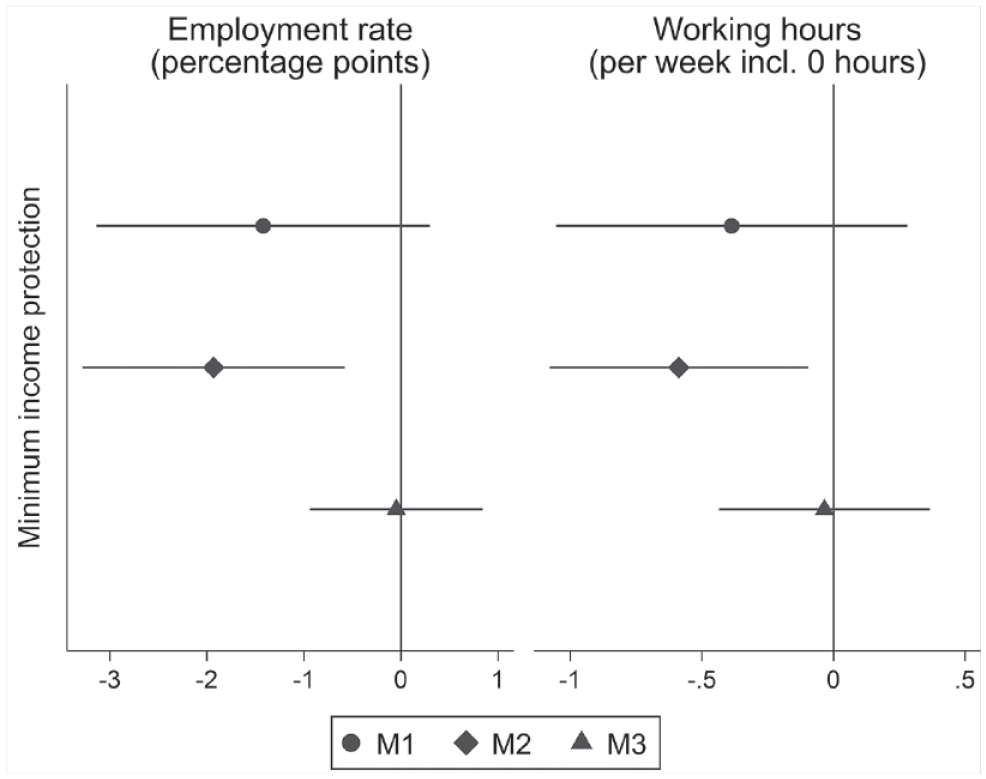
Marginal Effects of Minimum Income Protection on Single Mothers’ Employment Rates and Average Work Hours across Three Specifications
Thus, in our analysis the association between welfare generosity for single mothers and their employment outcomes is basically zero, when adjusting for potential confounders. To examine the degree to which the association between welfare benefits and single mothers’ employment varies across countries, we interact our benefit measure with the country dummies included in our regressions. The results of these analyses are graphically displayed in Figure 6.The marginal effects of minimum income protection on single mother employment vary considerably from around −7 or −8 percentage points per standard deviation (Italy, Netherlands) to around +14 percentage points (France) or +5 percentage points (Finland, United Kingdom). The marginal effects on weekly work hours vary from −3 hours (Finland) to +5 hours (France) or +4 hours (Belgium). There are indeed some countries in which the association between welfare benefits and single mothers’ employment outcomes is consistently negative (Italy, Portugal).
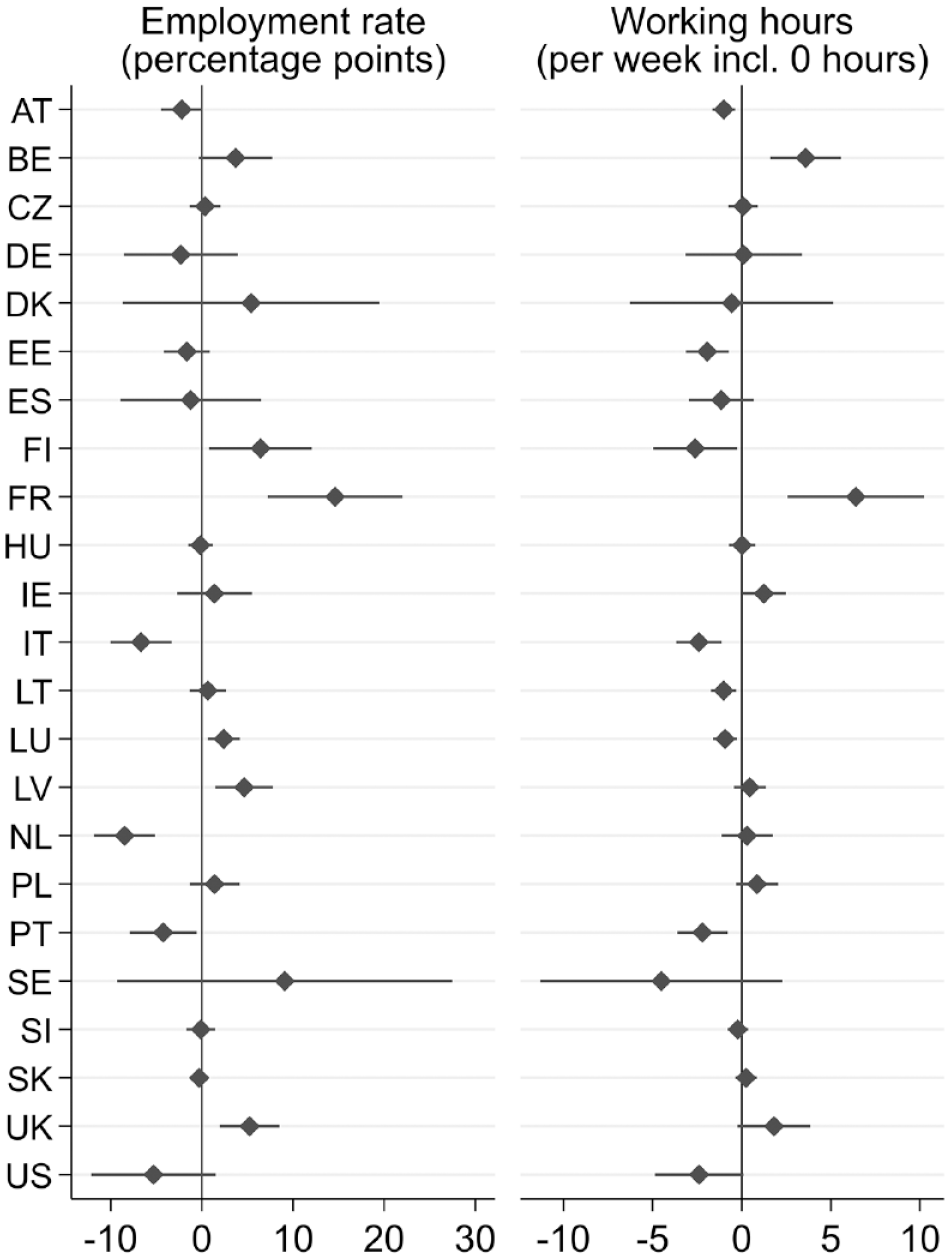
Cross-National Variation of Marginal Effects of Minimum Income Protection on Single Mothers’ Employment Rates and Average Work Hours
Additionally, in some countries, there is a negative association with one of the two outcomes (Estonia, Finland, Netherlands). In many countries, however, the associations are zero—or close to zero—and/or statistically insignificant (Austria, Czech Republic, Germany, Denmark, Spain, Hungary, Ireland, Lithuania, Luxembourg, Poland, Sweden, Slovenia, Slovakia). The United States is negatively signed, but the coefficients are not statistically significant. Moreover, there are some countries that show positive associations (Belgium, France, Latvia, UK). The U.S. case is still unusual as only Italy and the Netherlands have a larger negatively signed point estimate. Given the variance in the associations, it seems inappropriate to conclude welfare disincentives are powerful and cross-nationally robust. In sum, and in line with the findings from the main effect models (Figure 5), we find wide variation across countries in the association between benefits and single mothers’ employment outcomes. Strikingly, two of the countries that are well known for their attempts to increase single parent employment through welfare reform and increasing incentives, that is, the UK and United States, show positive or no association.
Conclusion
Because of the influence of evidence from U.S.-based studies since the 1990s, there has been a general expectation that generous welfare benefits undermine single mother employment. Recent findings based on cross-country comparative studies challenge this prevailing assumption, though (e.g., Biegert 2017), and simple cross-sectional comparisons have shown that generous welfare states do not feature lower single mother employment (e.g., Destro and Brady 2011). Further, in most countries, single mothers have higher employment rates than women in general (e.g., Nieuwenhuis and Maldonado 2018). In turn, we systematically examine the relationship between welfare generosity and single mothers’ employment rates and work hours across countries and over time.
We used data on twenty-two European countries and the United States to construct an indicator of minimum income protection for single parents to model the relationship between welfare generosity and both single mother employment and work hours. Neither our descriptive nor our two-way fixed effects analyses showed an association between minimum income protection and single mother employment and work hours. When assessing country-specific associations, we found that some countries show negative, some positive, but most countries show no associations for both single mother employment and work hours.
These findings undermine the prominent argument that cutting benefits will lead to higher employment among single mothers. Understanding the specific situation of single mothers’ employment, poverty, and well-being calls for understanding the complex interactions between various social policies and institutions. Rather than viewing reduced welfare benefits as a generic effective policy tool to incentivize single mother employment, we conjecture that single mother employment is shaped by a constellation of policies and institutions. Combining a stable safety net with work-activating and family-supportive policies that foster employment for single mothers (e.g., tax credits and housing allowances) is most likely to encourage both employment and economic well-being. For instance, generous benefit levels are potentially more harmful to work effort in countries with comparatively low wage floors. Minimum wages set wage floors and thus the potential minimum rewards to work. Other institutions, such as union strength and collective bargaining coverage, may matter even more in this context.
Our analysis has limitations. First, because our sample spans only twenty-three countries, we are limited in the number of macro-level covariates, which leaves us vulnerable to omitted variable bias. Second, some might argue that generous benefits create incentives for single motherhood. If true, endogenous sample selection might bias our estimates. Third, we do not address actual job quality aside from work hours. Thus, we cannot make claims about whether single mothers obtain jobs that enable them to escape poverty or low wages. Finally, the question of why there is so much variation in the association between benefits and single mothers’ employment outcomes is beyond the scope of this study. Promising avenues could be to analyze the availability of public childcare or to investigate the availability of quality labor market opportunities as potential moderators of the relationship.
Overall, our analysis makes three major contributions. First, we show welfare generosity does not generally undermine single mother employment across countries. Second, we demonstrate substantial cross-national variation in the relationship between welfare generosity and single mother employment. Third, we qualify how the U.S. case is unusual relative to most countries. As a result, we urge greater caution and modesty about what can be learned from the U.S. case or any single country. Instead, other contexts might offer lessons to U.S policy-makers. The variation across countries demonstrates that high single mother employment is possible while maintaining generous social policies (see also Aerts, Marx, and Parolin, this volume). Rich democracies provide a variety of mixtures of policies and institutions that reveal blunt welfare disincentives are not likely to generate high single mother employment. Thus, rather than exporting the policy lesson that the 1996 welfare reform proved how single mothers can be pushed to work, we encourage understanding of how social policies interact with other policies and institutions. We ultimately encourage the social policy research community to value, highlight, and learn more from institutional variation rather than simple generalities about disincentives.
Supplemental Material
sj-docx-1-ann-10.1177_00027162221120760 – Supplemental material for Cross-National Variation in the Relationship between Welfare Generosity and Single Mother Employment
Supplemental material, sj-docx-1-ann-10.1177_00027162221120760 for Cross-National Variation in the Relationship between Welfare Generosity and Single Mother Employment by Janet C. Gornick, Laurie C. Maldonado, Amanda Sheely, Thomas Biegert, David Brady and Lena Hipp in The ANNALS of the American Academy of Political and Social Science
Footnotes
Notes
Supplemental Material
Supplemental material for this article is available online.
Thomas Biegert is an Assistant Professor in Social Policy at the London School of Economics and Political Science. His research on social policies and labor market inequalities has been published in journals such as American Sociological Review, Socio-Economic Review, European Sociological Review, and Journal of European Social Policy.
David Brady is a professor in the School of Public Policy at University of California, Riverside. He is also a Research Professor in Inequality and Social Policy at the WZB Berlin Social Science Center. He authored Rich Democracies, Poor People and edited The Oxford Handbook of the Social Science of Poverty.
Lena Hipp is the head of the research group “Work & Care” at the WZB Berlin Social Science Center and holds a professorship at the University of Potsdam/Germany. Her research on social inequalities related to gender and family has been published in various journals, including European Sociological Review, Journal of Marriage and the Family, Social Forces, and Socio-Economic Review.
References
Supplementary Material
Please find the following supplemental material available below.
For Open Access articles published under a Creative Commons License, all supplemental material carries the same license as the article it is associated with.
For non-Open Access articles published, all supplemental material carries a non-exclusive license, and permission requests for re-use of supplemental material or any part of supplemental material shall be sent directly to the copyright owner as specified in the copyright notice associated with the article.
