



Abstract
In the context of the Finnish welfare state, this article examines the role of occupational welfare in the interplay between public and occupational sickness benefits from 1947 to 2016, to analyse how the two sickness benefits have interacted over time and the role occupational welfare has played in sickness provision. Previous research has noted that occupational benefits may support or compensate for the much-debated declining welfare state. Hence, it is important to acquire greater knowledge about the public-occupational interplay. The study uses in-depth individual-level analysis from a retrospective point of view, which has been rare in previous research, and examines the public-occupational interplay in the Finnish sickness benefit system from the first national collective agreements to 2016. Based on the reforms made to the public system, the article identifies and utilises six different phases of the Finnish sickness allowance system in the main analysis. The institutional development of sickness provision is investigated by analysing the compensation rate and benefit period, using metalworkers as a representative example of blue-collar workers. The results indicate that occupational benefits are strongly institutionalised in the Finnish sickness benefit system. The interplay between statutory and occupational sickness benefits has taken different forms over time, and occupational benefits have been re-negotiated as the statutory system has been reformed. The article provides valuable information on the historical development and relevance of occupational welfare, in terms of not only understanding its significance for individuals but also comprehending the logic of the interplay in the public-private mix of welfare provision.
1. Introduction
In most welfare states, social provision is based on a multi-tiered system comprising a mix of actors, including the state, employers, social partners, and individuals. The different layers of the mix have developed over time, forming an interplay unique to each country and time and place. The role of the state and the markets lies at the heart of the ongoing discussion of how to provide welfare in the future and to whom. Recently, researchers have started to pay attention to the role of occupational welfare, an important factor in many countries, in either supplementing or substituting public provisions. Occupational arrangements may play an important role in ongoing welfare state transformations, such as by compensating for the gaps in, or cuts to, public welfare provision (e.g. Johnston, Kornelakis, & d’Acri, 2011; Trampusch, 2006, 2007a, 2007b; Yerkes & Tijdens, 2010; Natali, Pavolini, & Vanhercke, 2018a). It has even been argued that social policy based on collective agreements can support and accelerate welfare state retrenchment policies and can thus form part of Pierson’s (1996) ‘new politics of the welfare state’ (Trampusch, 2006).
Despite the growing interest in occupational welfare, the information available is still relatively narrow, largely due to limited data. Information on different kinds of occupational schemes is either not readily available or available but scarcely comparable. In general, the tendency has been to analyse occupational welfare in a broader context, for example by examining macro-level data such as social expenditure on occupational welfare (e.g. Greve, 2007; Natali & Pavolini, 2014; Natali et al., 2018a). These studies have provided important insights into the general trends in the public-occupational interplay in Europe; however, in-depth individual-level analysis has been rare, especially from a retrospective point of view. This article aims to fill this gap. A retrospective study enables us to investigate the development of the interplay over time in a way that is not possible in cross-sectional research. This article examines the public-occupational interplay in the Finnish sickness benefit system over an exceptionally long period of time, from the first national collective agreements in 1947 to 2016.
Most of the research on occupational welfare has focused on occupational pensions (e.g. Shalev, 1996; Rein & Wadensjö, 1997; Ebbinghaus, 2011; Pavolini & Seeleib-Kaiser, 2018; Natali et al., 2018a), though some studies have examined other social policy fields such as family policies (e.g. Seeleib-Kaiser & Fleckenstein, 2009, 2011; Chung, 2018; Wiβ & Greve, 2019) and unemployment (e.g. Natali et al., 2018a). This article focuses on one aspect of social policy that has received less attention (see Jarvi & Kuivalainen, 2013; Grees, 2015): the role of occupational welfare in the sickness benefit system. In most European countries, sick pay arrangements are among the occupational benefits that are most commonly negotiated through collective agreements, and sickness provision forms a field of social policy where interplay usually exists.
The importance of occupational welfare varies between countries and the social policy field in question, but it has grown in almost everywhere in Europe (Natali, Pavolini, & Vanhercke, 2018b). This is also the case in the Nordic countries, which have traditionally been characterised by a strong state, a high degree of universalism, social rights, and corporatism (e.g. Esping-Andersen, 1990). Occupational welfare has implications for inequality by increasing dualisation not only between those in and out of work but also between people participating in the labour market (e.g. Seeleib-Kaiser, Saunders, & Naczyk, 2012). Research suggests that this is also true to some extent in the Nordic welfare states, as occupational welfare affects the key principle of universalism (Kvist & Greve, 2011; Jarvi & Kuivalainen, 2013; Greve, 2018). However, more knowledge is needed about the precise role of occupational welfare in these welfare states.
A variety of pre-existing arrangements, whether public, private, or occupational, influence and pave the way for future developments (Bislev & Lindqvist, 1990; Kuhnle, 1981). Furthermore, the public system may reinforce or mitigate existing occupational benefits, and vice versa (e.g. Rein & Turner, 2001). Public and occupational provisions have co-existed for decades in the Finnish sickness benefit system and during this time Finnish sickness insurance has gone through several developmental phases, changing aspects such as the generosity of the system. However, the effects of these changes on occupational benefits and institutional structures are unknown. In most welfare studies, Finland is grouped with other Nordic countries; however, with regard to sickness insurance, Finland differs from its siblings for several reasons. First, the establishment of the Finnish welfare state, and sickness insurance in particular, deviates from other Nordic countries, with its agrarian heritage and late timing (Kangas & Palme, 2005). Second, the involvement of social partners in welfare policies in Finland has been exceptionally strong. Broad-based national income policy settlements between social partners and the government from 1968 onwards have been comprehensive and have included vast social and economic policy issues, forming the institutional framework within which the Finnish welfare state has evolved (Bergholm, 2015.)
In the context of the Finnish welfare state, this study examines the role of occupational welfare in the interplay of public and occupational sickness benefits from 1947 to 2016. The focus is on cash benefits providing security during sickness, i.e. on statutory sickness allowance and sick pay provided by the employers. Other occupational benefits and services, such as health care, are left out of the scope of the research. The article addresses the question of how public and occupational sickness benefits have interacted over time, using metalworkers as a representative example of blue-collar workers. In the analysis, occupational benefits are compared to state-provided benefits by analysing the compensation rates and benefit periods of sickness benefits. The article provides valuable information on the historical development and relevance of occupational welfare, in terms of not only understanding its meaning for individuals but also comprehending the logic of the public-private interplay in welfare provision.
2. Public-private interplay in welfare provision
2.1. Occupational welfare as part of the welfare mix
Occupational welfare refers to welfare distributed from employers to employees as an employment benefit. Broadly speaking, occupational welfare includes many kinds of benefits and services, not all of them necessarily related to social welfare, such as ‘fringe benefits’ like a work phone or car (see Farnsworth, 2004). Furthermore, occupational welfare may refer to welfare organised collectively by social partners or welfare that is based on individual contracts between the employer and the employee. In this study, the concept is narrowly defined as social protection that is functionally equivalent to public welfare (for example, Greve, 2007; Shalev, 1996; Cutler & Waine, 2001). Such occupational welfare is approached through collective agreements, the strongest institution of occupational welfare in most European countries.
The line between the public and private components of occupational welfare is often quite complex and blurred. First, parts of occupational welfare are strictly private in their nature, such as occupational pensions, which are often provided through private markets. Second, occupational welfare may include benefits that are in principle private, as they are provided by the employers but based on contractual arrangements or national legislation (see Trampusch, 2007a). In the latter case, employers are legally obligated to participate in financing and providing benefits and services, in what is referred to as mandatory occupational welfare. Benefits based on contractual arrangements, however, are either collective or individual, and are usually referred to as voluntary occupational welfare (Natali et al., 2018a).
Occupational welfare is an important counterpart to publicly provided welfare, and their relationship can be either supplementary or substitutional in nature. The former refers to a situation where the public welfare system provides basic economic support, while occupational welfare delivers additional, supplementary benefits. A substitutive relationship refers to a situation where occupational welfare provides welfare instead of the welfare state (Greve, 2007). The role of occupational welfare in each country might at first sight seem simple to assess, but in reality, it typically varies greatly between different social policy areas; for example, it may be significant in pensions but limited in other policy areas (Natali et al., 2018b). Generally, the role of occupational benefits in the Nordic countries can be characterised as supplementary (Greve, 2007), though there is also evidence of occupational benefits acting as a substitute for public welfare (Jarvi & Kuivalainen, 2013).
Furthermore, the interplay between public and occupational welfare may take different forms, including trade-off (crowding out) and joint growth (crowding in). Trade-off refers to high-level public benefits crowding out voluntary occupational benefits, i.e. public welfare reducing the role of occupational welfare, or vice versa, with a greater role of occupational welfare in less generous social security systems (Rein & Turner, 2001). In the case of crowding in, however, public and occupational welfare develop in tandem, with less competition between the state and employers, which results in extensive statutory welfare encouraging investment into occupational welfare, and vice versa (Wiβ & Greve, 2019).
The state has its own interests in respect of occupational welfare. The concern, for example, the advancement of organisational and economic performance as well as shifting welfare costs and/or responsibilities outside of the state’s domain (Brunsdon & May, 2007). Rein (1982) presents a typology of four different ways in which the state may shift welfare activities into the care of employers: mandating, stimulating, regulating, or supporting. Of these, mandating is the most relevant to the payment of benefits, as the state obligates employers to deliver specific social objectives through legislation. One example is sick pay, which many countries require employers to pay employees during the first days of illness. Rein also points out that there is often an interplay between benefits arising through collective bargaining and those mandated by the state. For example, interventions made through collective bargaining are often regulated through extension procedures set out in the collective bargaining system as well as other legislation, usually labour laws.
2.2. Public-private mix of sickness benefits in Finland
The public-private-occupational mix of the sickness benefit system can be examined by dividing it into different pillars and tiers, which is commonly done in pension policy analysis. Table 1 presents the pillars and tiers of the Finnish sickness benefit system. Pillars reflect the welfare providers - in this case, the providers of sickness benefits: the state (public pillar), employers and/or social partners (occupational pillar), and the individual (personal pillar). Tiers refer to different layers of income protection. Benefits related to tiers consist of means-tested, earnings-related, and voluntary benefits. The focus of this article lies specifically on earnings-related benefits: statutory sick pay, statutory sickness allowance, and collectively negotiated sickness benefits (highlighted in Table 1).
Pillars and tiers in the Finnish sickness benefit system.
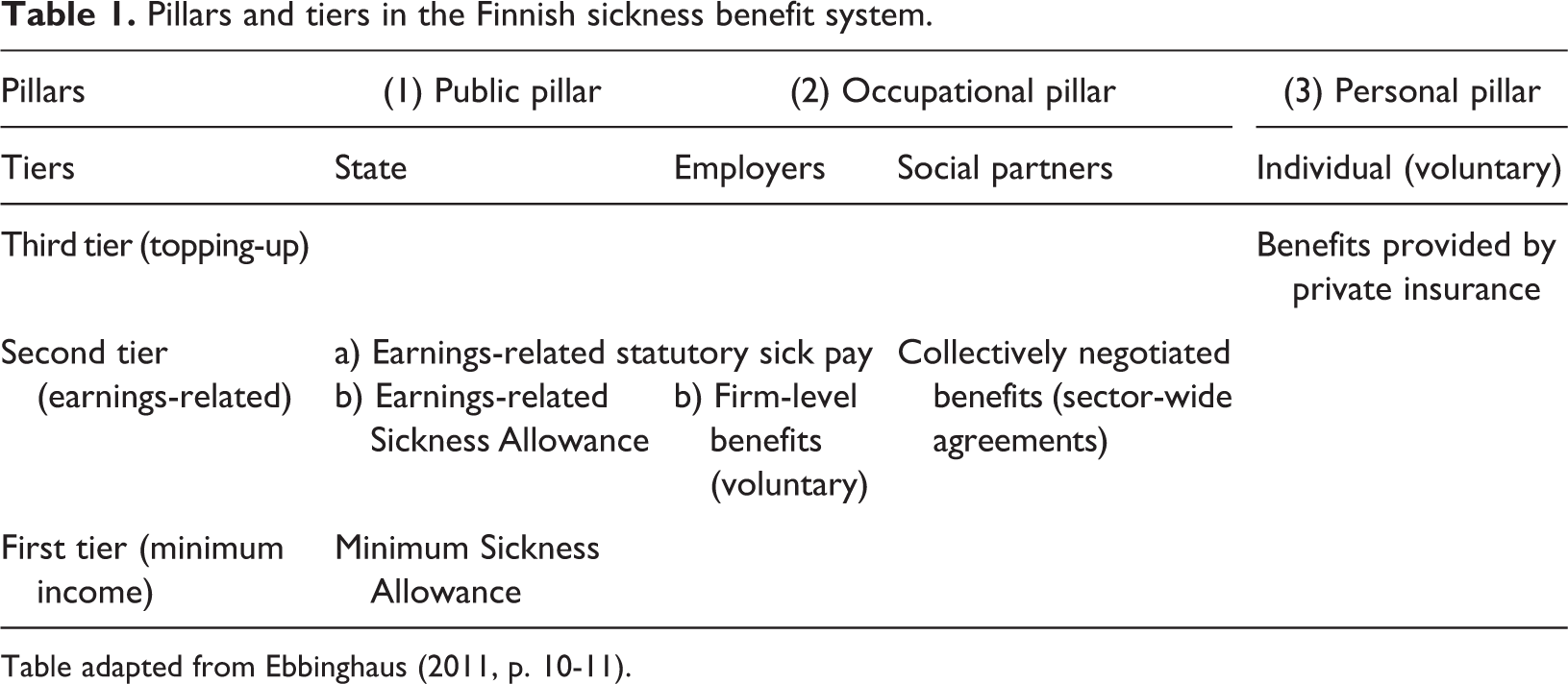
Table adapted from Ebbinghaus (2011, p. 10-11).
In the case of sickness benefits in Finland, the first tier refers to the state-provided minimum sickness allowance for people who have a very low or no wage income. This universal nature of the system reflects the agrarian inheritance in the development of the Finnish social insurance system (see Kangas, 1991). The second tier includes two earnings-related aspects related to the public pillar: statutory sick pay and sickness allowance. The former covers the first nine days of illness, for which the employer has a legal obligation to provide sick pay, and the latter is the benefit paid by the Social Insurance Institution of Finland (Kela) after these nine days. This so-called wage continuation can be seen as a ‘semi-public’ practice which exemplifies a borderline case between the public and occupational pillars (Kangas, 1991, p. 44). This also reflects the substitutive nature of occupational welfare, as occupational benefits are provided instead of those from the welfare state. The second tier also includes occupational benefits which are regulated in collective agreements negotiated by social partners. Finnish collective bargaining takes place most commonly at the sector level. There are four main spheres of agreement: 1) municipal and 2) government (public), 3) blue-collar and 4) white-collar sectors (private). The general practice is that, if an employee is eligible for occupational benefits, he or she receives the whole sickness provision from the employer, and the employer is reimbursed by the Kela. (Toivonen, 2012.)
The third tier corresponds to the personal pillar in the form of voluntary, market-provided benefits that top up the first- and second-tier benefits. In the Finnish context, only a few private insurances provide complementary daily allowance type benefits for income losses during sickness. Thus, third-tier benefits have so far been insignificant in the Finnish sickness benefit system.
3. Research design
3.1. The example of metalworkers
The lack of pre-collected data on occupational sickness benefits makes data collection a time-consuming part of this study. For the sake of feasibility, the analysis is narrowed down to private sector blue-collar workers by using metalworkers as an example. The metal industry is an old trade with long traditions of unionisation and collective bargaining. Together with the other important production industry, paper, the metal industry was the first to gain many benefits, providing the basis for national and sector-level collective bargaining arrangements in different industries thereafter. In addition, the metalworker represents the average production worker for whom sickness insurance was originally established in industrial society.
Metalworkers are seen as reflecting the situation of all blue-collar workers. Though each industry has its own sector-level agreements and negotiating power is known to vary between occupations, the occupational sickness benefit schemes for all blue-collar workers roughly share a similar design (Toivonen, 2012). This is partly explained by national-level General Agreements (covering all blue-collar workers) that have formed the basis of many reforms made to collectively negotiated sickness benefits throughout history. Hence, the regulations in sector-level agreements among blue-collar workers have mostly followed the same pattern, although the exact timing of the reforms may have differed between industries.
There are more differences between blue-collar workers and white-collar workers, and between private and public sector employees. These differences mainly concern the length of the benefit period, which is shorter for blue-collar workers. 1 Overall, the collectively bargained sickness benefit system is still relatively universal in Finland: at the national level, collective agreements have provided high coverage throughout the period studied 2 and in addition, all employee groups eligible for occupational benefits receive the same full income loss compensation. 3
3.2. Data
The data are based on national legislation, centralised agreements negotiated between labour marker organisations and the state, and sector-level collective agreements negotiated in the metal industry (see list of data presented in Appendix). No international or national micro-level databases exist on occupational benefits. Hence, with regard to occupational sickness benefits, this study uses newly collected data, which consists of a total of 42 sector-level collective agreements concluded between 1947 and 2016, and 16 tripartite Income Policy Settlements. The old collective agreements were obtained from the Finnish Labour Archives and the archives of the Finnish Metalworkers’ Union, and photographed. The first national collective agreement in the metal industry was concluded in 1945, but as this agreement was not found in the archives, the analysis took 1947 as the starting point. All legislation regarding sickness allowance and collective agreements between 1947 and 2016 has been analysed, but only periods relevant to the interplay are highlighted in the final analysis.
3.3. Analysis
The analysis focuses on two dimensions of public and occupational sickness benefits: the compensation rate and the benefit period. From the perspective of the person who is absent from work due to illness, one of the most important aspects of sickness insurance is adequate compensation in relation to the wage previously received. Indeed, compensation rates have been one of the most common measures used in welfare state studies (see for example, Esping-Andersen, 1990; Allan & Scruggs, 2004). The length of the benefit period also provides important information about the overall significance of occupational benefits. If an employee is eligible for benefits for only a short period of time, even high compensation becomes trivial.
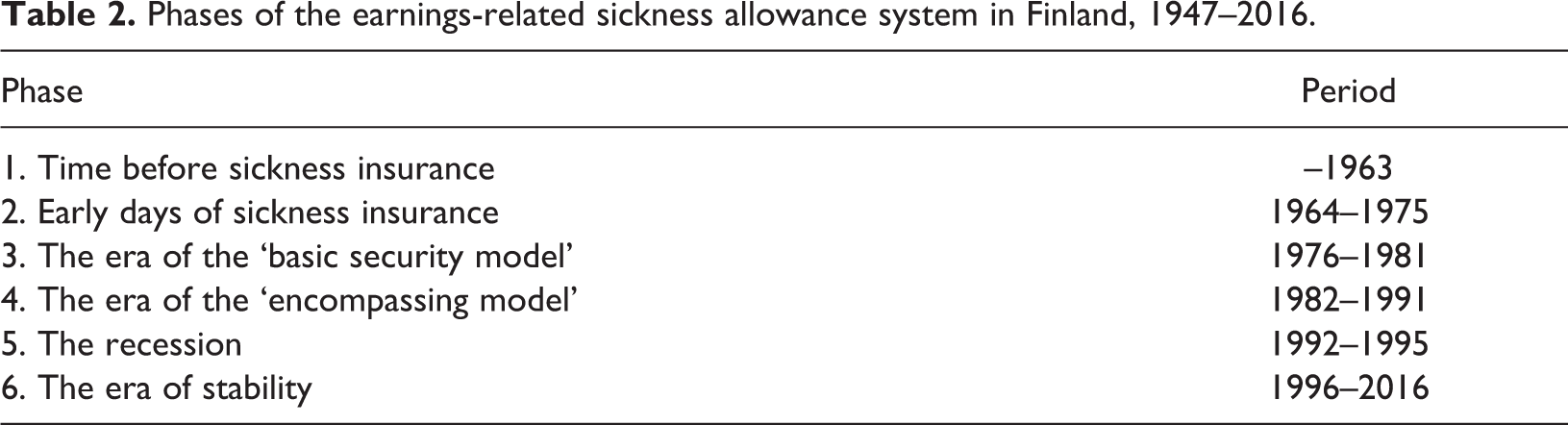
In order to investigate the role of collectively negotiated benefits and the public-occupational mix in the Finnish sickness benefit system, it is necessary to know the history of reform of the statutory sickness allowance system. System reform may occur at three different levels: 1) benefit entitlements (level and duration of benefits); 2) benefit eligibility (access requirements); and 3) the scope of reform, that is, the degree to which a reform alters the fundamental character of benefit programmes (Kangas, 2006). This article focuses on the first and third levels. Following Kangas (1991, 1992, 2006) and based on the reforms introduced in respect of compensation and benefit periods of the earnings-related sickness allowance, six different phases of the Finnish sickness allowance system are identified (see Table 2) and used as a basis for further investigation.
The study uses a stylised cases method (also referred as model family analysis/method or hypothetical household simulations) which has been utilised in cross-national social policy comparisons in particular (e.g. Kuivalainen, 2004; Bradshaw, 2010; cf Hufkens et al., 2019). The Social Policy Indicators (SPIN) (originally Social Citizenship Indicator Programme, SCIP) and Comparative Welfare Entitlement Dataset (CWED) are examples of large international dataset projects that are based on the idea of stylised cases (see Nelson et al. 2020; Scruggs, Detlef & Kuitto, 2017). The method offers the possibility of studying how the system works at the individual level. The idea is to create a stylised case defined in terms of household type and the duration of the incapacity to work, and to calculate what level of benefits the case would receive at a specified point on the salary scale. In this study, the stylised case is created with simple assumptions: an average metalworker who is married with two children 4 . The analysis focuses on the duration of sickness absence, when the employee is eligible for collectively negotiated benefits (which has varied across the time period studied from seven days to 56 days). Analysis of the compensation rate does not require the length of absence to be specified because the benefit level does not vary according to the duration of absence. A key concept in measuring the level of benefits provided is the compensation rate. The compensation rate is the ratio of normal wage income to income while on sick leave. Based on the calculation rules set out in laws and collective agreements at each point in time during the study period, compensation rates have been calculated according to the average wage of metalworker, collected from Statistics Finland. Focus is placed on gross compensation rates.
The analysis presents the positions and motivations of different actors only with the most significant parts to play. The reforms have often been a result of complex negotiations that have involved additional aspects (i.e. other social reforms) and hence, reflect compromise rather than consensus.
4. Phases of the earnings-related sickness allowance system in Finland
Finland is often described as a latecomer in terms of economic and welfare state development. Compared to other European countries, and even other Nordic countries, Finnish social policy emerged in a more agrarian context, and the process of legislating for social insurance took a longer time (e.g. Kangas, 1991; Kangas & Palme, 2005). This is especially true for sickness insurance; whereas in other developed OECD countries sickness insurance was one of the first social insurances to be established, it was the last income transfer scheme to be set up in Finland (Kangas, Niemelä, & Varjonen, 2013). An idiosyncrasy of the Finnish case is that, even though Finland was the last European country to establish sickness insurance in 1964, the system was immediately universal, providing the most extensive coverage in Europe, alongside Sweden (Kangas, 1991).
The development of Finnish sickness insurance highlights the importance of structural as well as political configurations. Industrialisation came later to Finland than in Western Europe, delaying the structural preconditions required for social policy reform. In addition, the institutional form of Finnish sickness benefits has been caused primarily by societal actors and class-based politics (Kangas, 1992). However, the Finnish sickness benefit system is not a result of the politics of class struggle in the same sense as in other Nordic countries, where the Social Democratic labour movement played a distinctive role (Korpi, 1980). Instead, the Finnish case highlights the role of rural population (Kangas, 1991).
The following section describes the main highlights of the history of statutory earnings-related sickness allowance, and based on this, introduces the six phases of the Finnish system (Table 2).
Phases of the earnings-related sickness allowance system in Finland, 1947–2016.
4.1. From before sickness insurance to the early days
Similar to social policy in general, sickness insurance started as a labour question, first concerning only the working class and gradually expanding to cover the whole population as a form of national social insurance. Before the establishment of sickness insurance, workers could participate in different aid funds serving a similar function. The timing of the first law on voluntary funds in Finland (1897) was similar to that of other Nordic countries. However, the difference was that the state of Finland did not participate in the financing, constraining the development of the funds (Kangas, 1992). Before the Second World War, participation in such voluntary funds was quite modest, and only industrial workers had sickness funds (Jaakkola, 1993). Nevertheless, the first aid funds provided the foundation for the establishment of national sickness insurance.
National sickness insurance was nearly established several times, but conflicting interests and complex political struggles - mainly between the two main political forces, the Social Democrats and the Agrarian Party - delayed the reform. The primary aim of the Social Democrats was to deliver adequate compensation with income-gradation to all wage earners, while the Agrarian Party demanded universal coverage with high minimums for the whole population (see Kangas, 1992; Niemelä, 2014). The final institutional solution, established in 1963, was a compromise: all citizens between 16 and 65 years of age were covered, with the insurance comprising two kinds of daily allowance: an earnings-related allowance and a flat rate minimum income for those without a regular wage. Due to a limit, the maximum level of sickness allowance was relatively low. The waiting period, on the other hand, was initially comparatively long, 14 working days, 5 but a few years later this was reduced to seven working days (Niemelä, 2014). However, from the employees’ perspective, this waiting period was in practice removed in 1970, when employers were obligated to pay wages during the first seven days of sickness.
4.2. From a ‘basic security model’ to an ‘encompassing model’
During the 1970s, no major reforms were made to the statutory sickness benefit system. However, daily allowances were not indexed, and the limit was not increased. Wages, on the other hand, were rising rapidly, which led to a situation where most employees were receiving the maximum daily sickness allowance. By the end of the 1970s, the initial rationale behind sickness insurance changed, transforming into a flat-rate system (Kangas, 2006; Kangas et al., 2013). This phase is referred to as the era of the ‘basic security model’. Despite this radical shift, neither political parties nor employee organisations saw an urgent need to reform the system. The employers and the social insurance bureaucrats were the first to call for changes to be made to the deteriorating statutory sickness benefits and the reform was implemented in 1982 (Kangas 1992). The new Sickness Insurance Act was one of the most significant social policy reforms made during the 1980s, a decade when an economic boom enabled the Finnish welfare state to reach the level of the other Nordic countries (Kangas & Palme, 2005).
The new Sickness Insurance Act of 1982 marked the beginning of the era of the ‘encompassing model’. The main purpose of the reform was to place the sickness allowance within the taxation system, as was the case in the other Nordic countries (Niemelä, 2014). The most notable change involved benefit levels: even though the benefits were now subjected to taxation, the compensation rate increased substantially to 80%. The limit was first removed, but this was later moderated in 1983 by introducing cut-off points that lowered the compensation rate for those with higher incomes. 6 Even after this adjustment, however, the benefit level for all employees was still higher than before the reform.
4.3. From cuts to stabilisation
The so-called ‘golden age of the welfare state’ lasted for about 10 years in Finland. A significant change took place at the start of the 1990s when Finland fell into a deep recession that had severe consequences for whole Finnish economy. For example, the unemployment rate rose from 3% in 1990 to 18% in 1994, and between 1991-1993 GDP dropped by 12%. As a result, the direction of the Finnish welfare state changed dramatically (Kalela et al., 2001).
The earnings-related sickness allowance system moved to next phase: recession. The Left and the Central Organisation of Finnish Trade Unions in particular were against sickness insurance retrenchments, but in the end, several reforms were made to the compensation and waiting period (Niemelä, 2014). In 1992, changes were made to the cut-off point system, which ultimately meant cuts to the compensation rates. However, at the same time, the income frames were extended, meaning that the decline in benefit levels was not so drastic overall. In 1993, the waiting period was extended to nine working days, and remains that way today. Later, in 2001, the employer’s statutory duty to pay sick pay set at the same length of time. Additionally, in 1993, the basic compensation level was cut once again, to 66%, but it was restored to 70% in 1995.
Though the recession had long-lasting consequences for Finnish society, after 1995 the economy gradually started to recover. Sickness insurance was reformed during the 1990s and 2000s but these reforms concerned other parts than earnings-related sickness allowance, the focus of this study. Consequently, the reforms of the 1990s turned out to be the last ones and the earnings-related sickness allowance system shifted to its last phase: the era of stability.
In the following analysis, the six phases of earnings-related sickness allowance are used to examine occupational benefits and, more specifically, the interplay and role variations between the benefits.
5. The interplay between public and occupational benefits, 1947–2016
5.1. Development of the compensation rate
The 1940s are noted as one of the major turning points in the history of Finnish labour market policy. Before the Second World War, employers dominated the labour market. Even though the first legislation on collective agreements was implemented as early as in 1924, it was not until January 1940 that employers officially recognised workers and trade unions. The Russo-Finnish War of 1939-40 forced employers to unite with the working class, and gradually, the bargaining power of the labour unions grew. In 1944, social partners made their first national-level General Agreement. Afterwards, the negotiation of sector-level collective agreements began in many industries, and the first national collective agreement for the metal industry was concluded (Mansner, 1984). Figure 1 demonstrates the development of the compensation rate through all the reforms made to public or occupational benefits of metalworkers. In the early days of collective agreements, the basic compensation rate was 60% of gross income, in accordance with the guidelines set in the General Agreement. Sickness income consisted entirely of benefits provided by collective agreements and sickness funds, which compensated for the comparatively late introduction of public insurance. In the first phase, therefore, the role of occupational benefits was clearly substitutive due to the lack of a public system. There was a risk that existing occupational benefits would crowd out statutory benefits. However, it was in the interest of all actors to ultimately establish public sickness insurance (Niemelä, 2014; Mansner, 1990), which led to the second phase, the early days of sickness insurance.
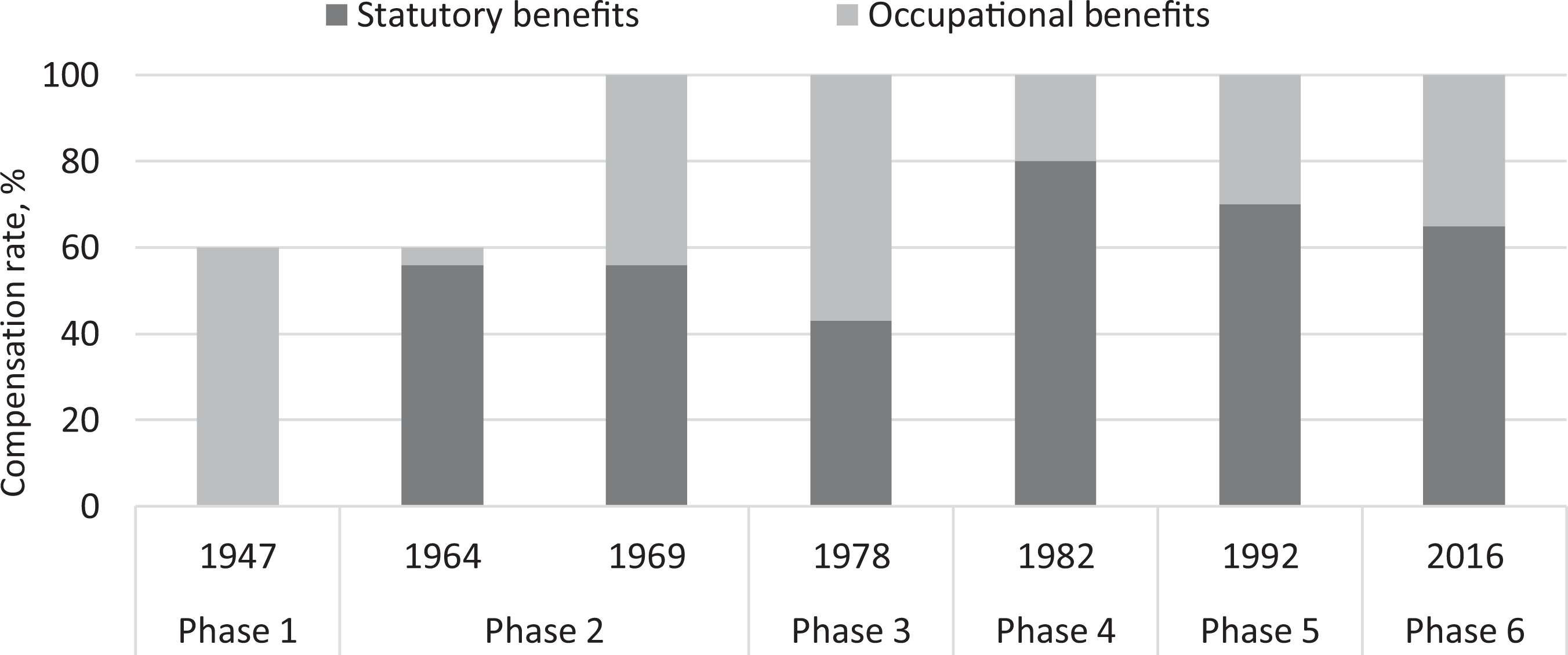
Development of the compensation rate of the public and occupational sickness benefits of metalworkers in different phases (including all years with reforms)
During the second phase, two decisive reforms took place. The first one occurred when sickness insurance was implemented in 1964. The total compensation rate remained the same, but the main responsibility shifted to the state, with only 4% of the total compensation coming from the employer. For a short period of time, therefore, occupational benefits became all but obsolete. Later, in 1968, a significant shift occurred in Finnish labour market policy, when the first tripartite agreement was concluded and the era of income policy began (see Kettunen, 2001). This new era generated more ground for collective bargaining negotiations. Consequently, another important reform took place in 1969, when employers were obligated to pay the full salary during the specified benefit period (seven days at first). In practice, this meant that a little over half of the metalworkers’ compensation came from public sources, while the rest was provided by the employers. During the second phase, therefore, public and occupational benefits grew in tandem, exhibiting a crowding-in effect, as expanded public provision encouraged greater investment in occupational benefits.
During the era of the ‘basic security model’ (Phase 3), the compensation rate of public benefits decreased significantly due to growing wages and a lack of indexing, which meant that most employees received the same maximum amount of sickness allowance. The significance of occupational benefits increased considerably, and their role became substitutive. Temporarily, the crowding-out effect dominated, as employee organisations in particular were not interested in reforming the public system due to the provision of sufficient occupational benefits which offered good compensation to employees (Kangas, 1992). Without these occupational benefits, the compensation for the average worker would have been significantly lower, but as it stood, employees hardly noticed any difference.
Ultimately, significant reform of sickness insurance took place in 1982. Social partners played a significant role in bringing about this reform, as they made it clear that, if Parliament did not agree to the proposal of the labour market organisations, parallel private systems would be established to secure compensation for employees during periods of sickness (Kangas, 2006). This threat of a trade-off spurred on the reform. During Phase 4, compensation rose to the highest level ever in the history of sickness allowance, while the importance of occupational benefits diminished. For the first time, occupational benefits took on a distinctly supplementary role.
The recession that had a great effect on the Finnish economy in the early 1990s changed the situation also with regard to the role of occupational benefits. During Phase 5, reforms were made to the statutory allowance, cutting the compensation rate of metalworkers by 10 percentage points. The cuts were said to be only temporary but were permanent (Kangas, 2006). However, the recession did not have an effect on occupational benefits, which compensated for the reduced public benefits.
Following this turbulent period, the Finnish sickness benefit system stabilised and shifted to the last phase: the era of stability. No significant changes occurred, despite different periods of economic growth and decline in the new millennium. However, indexation caused a minor decrease in the statutory allowance. In terms of labour market policy, the final phase was characterised by an erosion of tripartite negotiations and the changing role of social partners. This, however, did not affect the level of occupational sickness benefits or the interplay between the benefits.
5.2. Development of the length of the benefit period
Since the establishment of national sickness insurance in 1964, the duration of the benefit period for the sickness allowance has been around one year, approximately the same as in other Nordic countries (Jarvi & Kuivalainen, 2013). Although the length of the benefit period for occupational benefits has grown over the years, it is still significantly shorter than that of the statutory allowance: at present, it is a maximum of 56 days for blue-collar workers and three months for white-collar workers (Toivonen, 2012). In this respect, the role of occupational benefits has always been supplementary. Since the first national collective agreement of metalworkers, the length of previous employment with the same employer has defined the duration of the benefit period. The benefit period for blue-collar workers has been - and still is - different for employees with shorter and longer employment histories, something which is unique to Finland, compared to the Nordic countries (Jarvi & Kuivalainen, 2013).
Figure 2 presents the development of the length of the benefit period in respect of occupational benefits in the minimum case (employment lasting less than one year) and the maximum case (this has varied over time from five to ten years of employment). The reform of the benefit period took place during the first four phases of statutory sickness allowance development. Before the establishment of the statutory system, the duration of the benefit period of metalworkers grew steadily, from 18 to 36 days, for those employees with longer employment. However, no changes occurred in respect of the minimum benefit period, indicating that occupational benefits were designed for those with permanent employment, as employees with longer employment records were rewarded more for their work.
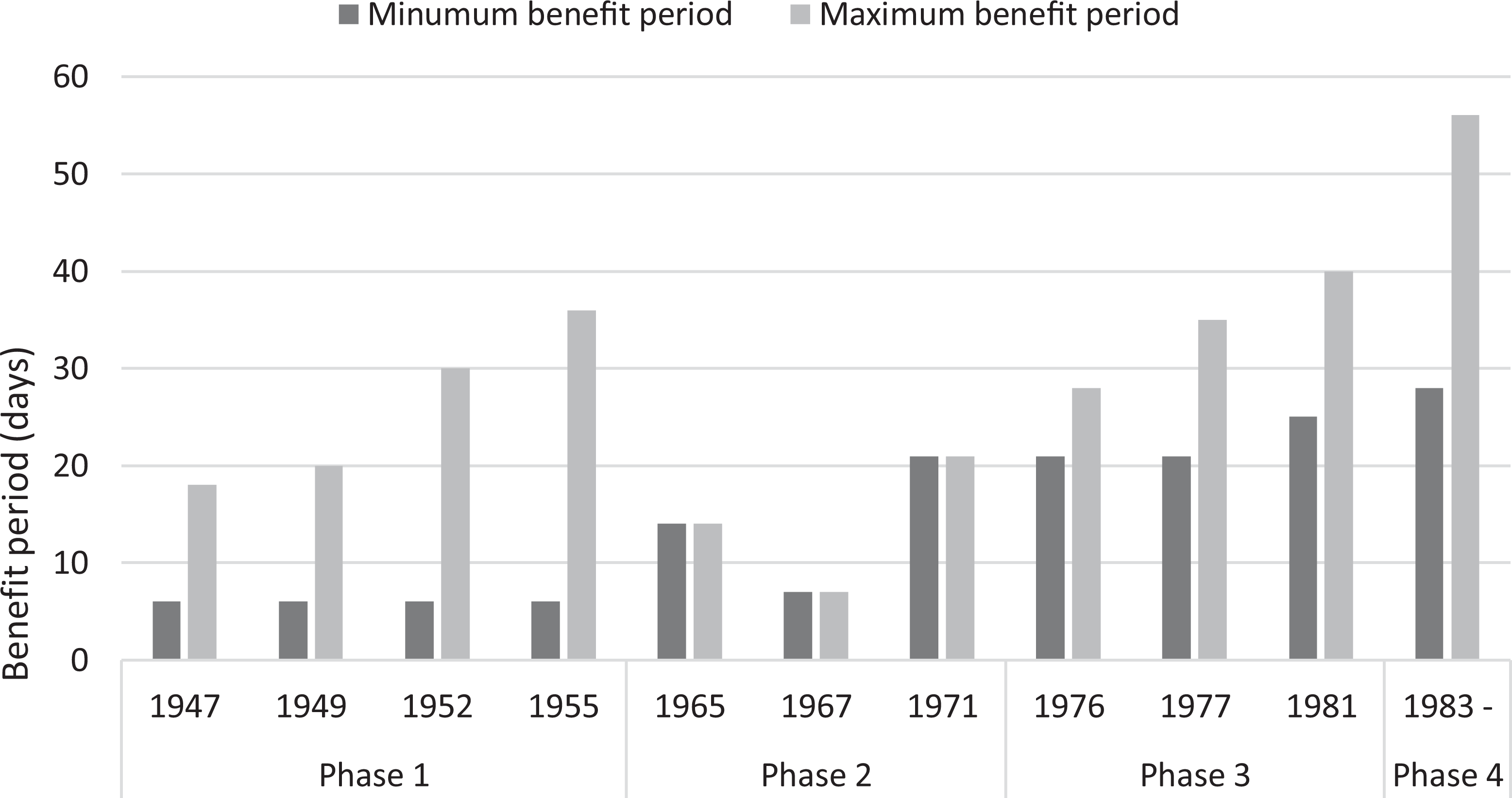
Development of the length of the benefit period in respect of the occupational benefits of metalworkers during different phases (including all years with reforms): minimum and maximum cases.
The establishment of the statutory system had an effect on the benefit period conditions: workers were entitled to occupational benefits only during the statutory waiting period, which was 14 working days in 1965 and seven working days in 1967. This is an example of how occupational benefits can be re-negotiated in relation to reforms in public insurance. Until 1971, occupational benefits were supplementary and provided no ‘extras’, functioning merely to ensure that employees were not left without compensation during the waiting period. All metalworkers, regardless of the length of employment, received sick pay for the same period of time until 1976. Comparing Phase 1 to Phase 2, it can be concluded that, for those employees who were entitled to benefits for only a short time (the minimum benefit period), the benefit period improved. However, for those eligible for the maximum benefit period, the reform had negative consequences, as the benefit period was reduced from 36 days to only seven days. These cuts undermined the important reform made to the compensation rate in 1969, which mandated full compensation. While high levels of occupational benefits were offered, they were provided only for a short period of time.
In 1970, all employers were legally obliged to provide sick pay for the duration of the statutory waiting period (i.e. during the first seven working days of sickness). In other words, voluntary occupational benefits were supplanted by mandatory benefits and this way, the waiting period became an institutionalised guarantee of sick pay during the first week of sickness. This, in turn, affected the willingness of employee organisations to pursue reforms in sickness insurance, as previously discussed. During the 1970s, the winds of change in labour market policy and the lack of indexation of the statutory allowance put pressure on the system to provide extra benefits on top of the mandatory ones (see also Kangas, 1992). Hence, during Phases 3 and 4, the benefit period was gradually lengthened. In fact, in the Incomes Policy Settlement of 1979, the benefit period was lengthened at the national level to a maximum of 35 days. In the metalworkers’ collective agreement, this reform had already occurred two years previously, in 1977. The extension of the length of the minimum benefit period was delivered more slowly and was less significant than was the case for the maximum benefit period, which quickly reached the level it had been at before the establishment of sickness insurance. Overall, the maximum length of the benefit period continued to be extended until 1983, when the last changes were made. Consequently, the differences between short and long employment became starker once again, and since this reform in 1983, the length of the benefit period has been regulated the same way.
6. Conclusion and discussion
This article has added value to previous social policy research, by examining not only the legally institutionalised part of benefits that offer security during sickness, but also the part that is organised on the basis of collective agreements. This is important, because focusing only on the public benefits underestimates the quality of benefits and fails to reveal the whole picture of welfare provision (e.g. Greve, 2007; Trampusch, 2007a). The scope of this article concentrated on the development of the institutional interplay between occupational and statutory sickness benefits in Finland. These two benefits have formed a public-occupational mix, which has varied across time. The first part of the study distinguished six phases of earnings-related sickness allowance in Finland. Each of the phases reflects a unique period in the history of Finnish sickness allowance and society. The second part of the study focused on the development of compensation rate and the length of the benefit period. Here, the analysis of the role of occupational benefits can be divided into four stages: 1) fully substitutive, 2) no role, 3) partly substitutive, and 4) supplementary. Role variations are in large part explained by reforms made to the statutory system, but the eligibility period of occupational benefits has also had an effect. Overall, the article corroborates previous research by showing that, when there are shortcomings in the statutory provision, occupational benefits take on a more substitutive role.
The public and occupational benefits provided to compensate for the loss of income during sickness have developed together throughout the history of sickness insurance. This article shows that there has been an interplay between the benefits on several occasions, and occupational benefits have been re-negotiated in connection with reforms to the statutory system. The base for the public-occupational mix was formed during the 1960s, when sickness insurance was established and labour market relations stabilised. Overall, the results of the study support the crowding-in hypothesis presented by previous research: high-level public benefits are accompanied by quite generous occupational benefits. During the second and the last two phases of sickness insurance in particular, public and occupational benefits reinforced each other. The threat of a move towards a more occupational-oriented sickness benefit system was one of the key triggers for the 1980s reform to sickness insurance. On the other hand, improvements in the 1980s were likely needed to encourage the continuance of occupational benefits. This reform also indicates that social partners were able to develop the statutory system through occupational benefits, exemplifying how occupational benefits can be used as a ‘hook’ by social partners or trade unions, forcing decision-makers to avoid cutting public benefits or, as in the Finnish case, increase and improve the sickness benefits (Natali & Pavolini, 2014).
Overall, occupational benefits have been remarkably resilient to change. Despite economic ups and downs and changes in the labour market system, no reforms have taken place: changes to the compensation rate have been practically non-existent, and the length of the benefit period has remained the same for almost 40 years. After delivering the institutional solution, no serious attempts have been made to introduce a new one. This indicates that occupational benefits are strongly institutionalised in the Finnish sickness benefit system. However, one could also argue that this lack of change is the reason why occupational benefits are outdated and have, in fact, deteriorated. Originally, both the statutory and occupational sickness benefit systems were built for an industrial society that relied on long-term and stable employment. In post-industrial society, the labour markets have changed profoundly and are better characterised by short-term and precarious employment. In addition, flexible working arrangements and self-employment have increased, making the distinction between employers and employees blurred (Harsløf & Ulmestig, 2013). Hence, labour market changes have also altered the need for welfare provision, which adds to the argument in favour of reforming both the statutory and occupational systems. As occupational sickness benefits are tailored to wage earners with longer employment histories, there is a growing group of employees who receive benefits for a shorter period of time and may even be left without any occupational benefits. There are also differences between the wage earners themselves. Although the collectively bargained sickness benefit system is comparatively quite universal (as most employees are covered by collective agreements) and all employees who are eligible for occupational benefits receive full compensation, not all occupational categories are entitled to receive sickness benefits entirely on equal terms: the length of the benefit period varies, and most importantly, high-earning white-collar workers and civil servants gain relatively more from occupational benefits. This seems to be the case in all Nordic countries (Järvi & Kuivalainen, 2013). Indeed, one of the primary reasons for the academic interest in occupational welfare is its impact on inequality. The redistribution pattern of occupational welfare differs from that of social insurance: occupational benefits are linked to labour market status, and may create types of inequality that the public welfare scheme attempts to fight against (Järvi & Kuivalainen, 2013). Thus, occupational welfare can perpetuate and even reinforce labour market inequalities and occupational divides, deepening insider-outsider divides - a process labelled as dualisation (Seeleib-Kaiser et al., 2012). Though the inequality aspect of occupational benefits is increasingly relevant also in the Nordic welfare states, the risk of welfare dualism is greater in countries where industrial relations are more decentralised and fragmented, such as in the UK and Germany (Natali et al. 2018b).
The significance of occupational welfare has grown in Europe, but the results of earlier research do not point towards a clear, generalised trade-off between public and occupational welfare (Natali et al. 2018b). With regard to sickness benefits, the information is scarce, and more investigations are required, especially from a micro-level perspective. The results of this study do not indicate that there has been a radical long-term institutional transformation in the Finnish sickness benefit system, even though the public-occupational mix has changed in the past. This somewhat contradicts the findings from neighbouring Sweden (see Grees, 2015). Compared to Sweden, the Finnish system generates fewer inequalities because the statutory system does not have the same kind of income ceiling, the length of the benefit period for occupational benefits is significantly shorter (Swedish occupational benefits are paid for approximately a year), and the total compensation rate is the same for all employee groups. In addition, Sweden has legislation stating that compensation rates of collectively negotiated benefits cannot be higher than 90% (Grees, 2015). This has resulted in a need for complementary private insurances offering better financial protection. However, the Finnish system has taken steps in the Swedish direction. In a reform of 2017, the calculation rules for sickness allowance were adjusted. The reform made no significant change to the average worker’s compensation, but compensation was reduced for high-income earners. Hence, the decline in statutory benefits has increased the need for occupational benefits for high-income earners. This highlights the importance of bringing different income groups, as well as different occupational categories, under the scope of investigation, an aspect that was missing from this study.
In the future, if occupational benefits are negotiated more often at the local or even individual levels, greater inequality will most likely emerge because negotiating power varies between industries and occupations. With an increase in decentralisation, collectively negotiated benefits may also face the threat of retrenchment. Thus far, market-provided private insurance has not been common in Finland because the level and coverage of occupational benefits has been high. It seems that, in Finland, collective arrangements have been substituting for private, market-provided benefits. If, however, the level of occupational benefits were to deteriorate without a rise in the level of statutory benefits, this could lead to the expansion of the private sector, further disengaging from the core nature of the traditional Nordic welfare model.
Footnotes
Declaration of conflicting interests
The author(s) declared no potential conflicts of interest with respect to the research, authorship, and/or publication of this article.
Funding
The author(s) received no financial support for the research, authorship, and/or publication of this article.

Notes
Appendix
List of data
Legislation:
Sickness Insurance Act (Sairausvakuutuslaki) 1963
Sickness Insurance Act (Sairausvakuutuslaki) 2004
Labor Contracts Act (Työsopimuslaki) 1922
Labor Contracts Act (Työsopimuslaki) 1970
Labor Contracts Act (Työsopimuslaki) 2001
Collective Agreements Act (Työehtosopimuslaki) 1946
Available at Finlex.fi/en/
Collective agreements: 7
Collective agreements between Central Association of metal industry and Metalworkers’ union, 1947-2016
National income policy agreements
National income policy agreements between the state of Finland and central organizations of employees and employers, 1969-2001