




Abstract
Migration decisions are made in the context of personal needs and desires, and the individuals making these decisions face uncertain outcomes. Information about future opportunities is incomplete, and whether migration turns out to be a personal success or failure depends mostly on circumstances that are ex ante unknown and ex post not fully under the control of the individuals who migrate. This article elaborates on four dimensions of the complex process of migration decision-making: the formation of migration aspirations, the cognitive rules for searching and evaluating information about migratory options, the timing and planning horizons for preparing and realizing migratory decisions, and the locus of control and degree of agency in making migration decisions. We review the current state of evidence and identify opportunities for future empirical research that can help us to better understand these key dimensions of migration decision-making.
Understanding migration decisions is of fundamental importance for broader society and policy-makers, as well as migrants and potential migrants themselves. Migration decisions are made at important crossroads in people’s lives, determine and are determined by long-term life trajectories, and bring lasting consequences for the decision-maker and people affected by the decisions. Migration scholars often presume that due to their relative rarity and long-term implications, migration decisions should be highly rational and characterized by the best possible assessment of costs and benefits. In reality, however, migration decisions are often made in the context of idiosyncratic personal needs, stress, urgency, and, above all, uncertainty and limited information about livelihood opportunities. Imagine, for instance, a government worker in Afghanistan trying to make sense of whether she should try to leave the country, given the recent regime change, or a 20-year-old son of a subsistence farmer in Honduras who is considering whether he can contribute to better fortunes for his family by trying to find a job in the United States. Information about the future and its opportunities is incomplete, and whether migration turns out to be to a migrant’s benefit or a real failure depends largely on circumstances that are ex ante unknown and ex post not fully under control of the migrant.
In this article, we propose a typology of migration decisions that cuts across four interrelated dimensions of cognition in migration decision-making processes. We think of the formation of migration aspirations as a largely needs-driven process and as a fundamental prerequisite for self-determined migration decisions. To that end, we first review the state of knowledge regarding migration aspirations formation and adaptation, and then specify established cognitive features and biases that may be influential in migration decision-making.
Further, we examine migration decisions according to how informed they are and how long the decision-making process takes. On one hand, migration decision-making can be a highly conscientious multistep and gradual process of aspiration formation, resource accumulation, search for life and livelihood opportunities, and a decision among well-identified migratory options. This may ultimately lead to a highly informed, self-determined, and comprehensive assessment of multiple forms of costs and benefits, reducing the epistemic uncertainty surrounding the decisions as much as possible. But migration can also be the result of ad hoc decisions based on scarce information and minimal planning and preparation. All forms of migration decisions are surrounded by often very high and possibly irreducible uncertainty and are conceptualized as driven by some simple decision rules (heuristics) and other shortcuts such as imitation, affect, norms, and commitments.
We also distinguish migration decisions by the locus of control and the degree of human agency and self-determination. Decisions that are largely externally controlled—for instance, by members of the social network, including family, friends, or the community; but also other agents who may, for example, enforce displacement—embody a limited level of voluntariness, self-determination, and self-efficacy. This dimension extends and refines the established but controversial dichotomy between “voluntary” and “forced” migration. This dimension contrasts situations in which prospective migrants with a high level of agency and self-determination fully control internally the decision-making process and outcome with those where they are at the mercy of external drivers, with a limited number of options.
We begin the discussion by defining four conceptual dimensions of the migration decision process and considering each in turn: (1) formation of aspirations, (2) availability and use of information, (3) time and decision horizon, and (4) the locus of control. We then review the empirical work on migration decisions, based on both experimental and observational studies, and use that review in our conclusion to identify where gaps in our knowledge of migration decisions may exist and provide guidance for further research.
Dimensions of Migration Decisions Made under Uncertainty
One cross-cutting theme of all migration decisions is that they are made under conditions of high uncertainty with respect to the likelihood and potential outcomes of alternative choices (e.g., Williams and Baláž 2012). Literature often makes a distinction, dating back to Knight (1921), between measurable risk and unmeasurable uncertainty, the latter more difficult to elucidate and manage. Coupled with the lack of knowledge about possibilities and outcomes, this can also lead to situations of ambiguity under risk, or ignorance under uncertainty proper (Stirling 2010). In this article, however, we use the term uncertainty as an umbrella covering all four possibilities, noting that uncertainty in different guises can be either epistemic—reducible in the light of better knowledge and information—or aleatory—immanent and irreducible (e.g., Bijak and Czaika 2020). This is also to avoid a slight terminological confusion with respect to risk, which in cognitive science is often used in the context of uncertain events bearing negative consequences—a convention that we follow throughout this article.
The field of decision-making under uncertainty is interdisciplinary, covering psychology (Scholz 1983), statistics (Robert 2007), economics (Gilboa 2009), neuroscience (Bland and Schaefer 2012), and computer science (Kochenderfer 2015), with many cross-cutting themes, as evidenced throughout this volume of The ANNALS. At the same time, truly interdisciplinary efforts in the area of migration studies are rare (Vari-Lavoisier 2021). In this article, we also take an eclectic, multidisciplinary view to look at the four key dimensions of migration decision-making. We start from the aspirations of prospective migrants at the outset of the decision process, which are mediated by the availability and use of information and the time horizon of decisions, as well as the locus of control, that is, who makes the decisions. These four aspects are conceptually separate, as Figure 1 illustrates by delineating a four-dimensional migration decision space. For real-life decisions, some of these dimensions interact: for example, more information and internal locus of control enables longer planning horizons. We discuss these four dimensions in more detail next.
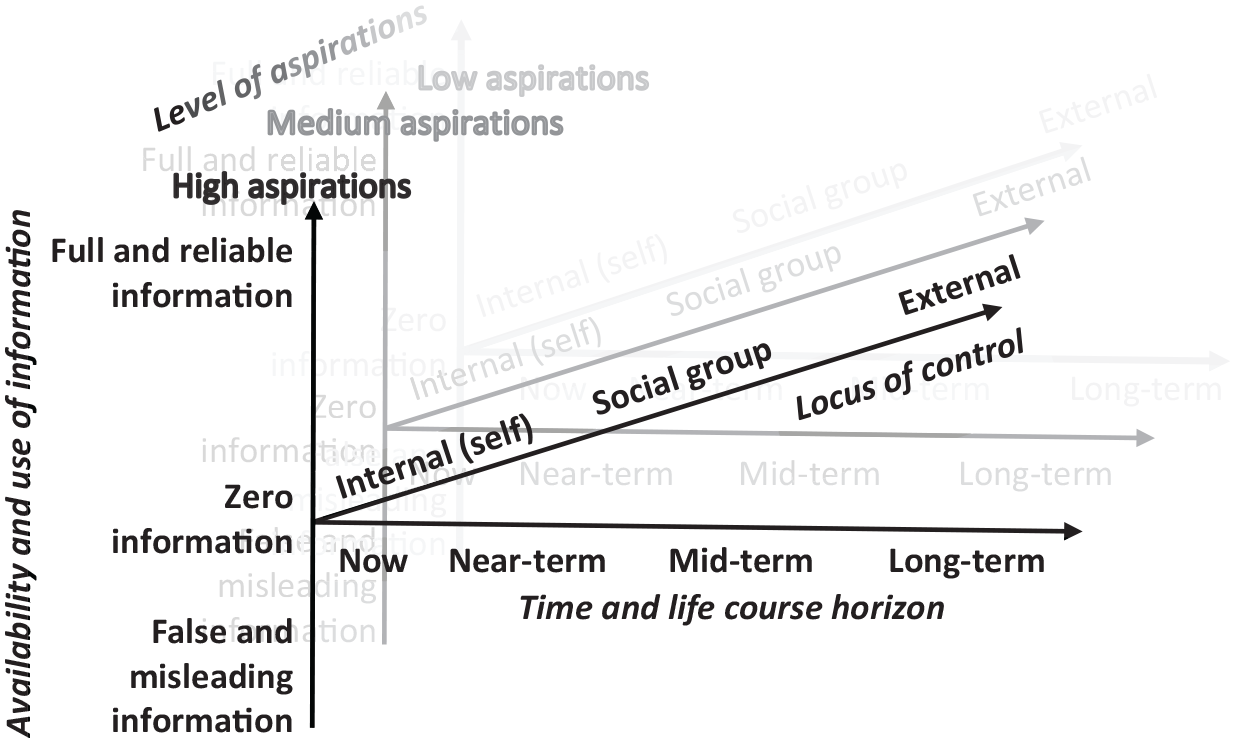
Key Dimensions of Migration Decisions Made under Uncertainty
Aspirations as precursor of migration decisions
People of all countries and cultures aspire to satisfaction, well-being, or simply a “good life” (Appadurai 2004), which is “not a state to be obtained but an ongoing aspiration for something better that gives meaning to life’s pursuits” (Fischer 2014, 2). Life aspirations are fundamentally nurtured by material and nonmaterial needs, including economic, social, cultural, and psychological factors (Maslow 1943; Aslany et al. 2021). External factors become effective in stimulating migration only if they translate into the volition and motivational capacity of people to change locational life circumstances. We, therefore, conceptualize aspirational gaps, that is, a mismatch of aspired and actual life circumstances, as the internal cognitive driver activating a personal reflection, desire, and decision-making process on migration (cf. Greenaway, Frye, and Cruwys 2015).
Differences between the state of needs satisfaction and individual aspirations are a precondition for considering migration as a viable option. While some long-term life goals and moral and ethical values might take years to evolve, other aspirations evolve and change arguably faster and in response to unfulfilled individual needs. Like Maslow’s hierarchy of needs, a hierarchy of aspirations exists, where lower aspirations correspond to unmet basic needs. For instance, in the context of food shortages due to a drought or a natural disaster, people’s unmet physiological needs may trigger the fundamental aspiration of never feeling hunger again. Immediate food aid might address this need and aspiration, but people may also, particularly during repeated or prolonged periods of food shortages, develop higher aspirations, for example, to reduce physiological vulnerability of one’s family without relying on food aid (see also Amartya Sen’s [1981] food entitlement theory). In this case, the motivation to change the status quo may also motivate migration as a behavioral option to change one’s status quo and to fulfil higher-order aspirations.
Beyond immediate needs, people’s aspirations are further influenced by their personality, socialization, and education, all constituting elements of a personal “capacity to aspire” (Appadurai 2004), which refers to the capacity to imagine a life that is superior but still achievable compared to the status quo. This capacity to aspire is multidimensional and nurtured by a person’s economic, social, emotional, and cognitive resources (Sell and De Jong 1978; Frye 2012).
Moreover, aspirations for greater quality of life are not static, but they may change dynamically through external stimuli, such as peer-group interaction, social comparisons of one’s own status quo with life situations of relevant others (as postulated by the New Economics of Migration theory, e.g., Stark and Bloom 1985), observation of other ways of living, or simply by exposure to information as transmitted by media and social networks. Migration is often a crucial step in the lifecycle to meet aspired goals and well-being through the pursuit of the good life. The endogenous nature of aspirations is often reflected by the fact that aspirations after migration are usually not the same as before but are often adapted (usually upward) through exposure to new, thus far unknown, lifestyles and environments at the place of residence (Czaika and Vothknecht 2014).
Paradoxically, the adapting of aspirations may trigger a “hedonic treadmill” effect by which migrants may feel more deprived and unsatisfied in the new environment—even if initial expectations for migrating have largely been met (Czaika and Vothknecht 2014). People may also adapt their life and migration aspirations by incorporating (positive or negative) migration experiences of others through social comparisons and role modeling. Thus, aspirations may not only adapt through one’s own experience but also by learning about the achievements, failures, and states of well-being of others (Selten 1998). Generally, people usually find it easier to adapt their aspirations upward and do so more rapidly than adapting downward (cognitive ratcheting); that is, downward corrections of aspirations seem to be perceived as more painful than upward adaptations (Engzell 2019).
Information and heuristics in searching and deciding about migratory options
An information search in the context of migration decision-making is both a multi-stage and multi-dimensional process. The different stages involve collection and processing of information about available migration opportunities, including information about potential destinations, possible entry routes, and possible job opportunities, but also assessing possible types of risk and uncertainty related to migration journeys and outcomes.
Access and control over various kinds of resources including knowledge and information about the good life and opportunities for its realization are important prerequisites for the formation of migration aspirations. People’s awareness of social, economic, political, and other opportunities may therefore increase their capacity to aspire (Appadurai 2004). The awareness is closely linked to the availability of information on such opportunities. Information might affect the formation and adaptation of life aspirations and perception thereof, but also of more concrete migration opportunities, experiences, and outcomes, including the multifaceted costs and benefits of an actual migratory move.
Perceptions of expected or actual migration outcomes have functional and cognitive-emotional attributes. Functionality in this context implies that migration can be a means to an end; that is, it can be instrumental to a higher goal such as improving one’s life circumstances. Cognitive and emotional aspects, on the other hand, refer to feelings associated with and characteristics of the migration journey itself, for instance whether it is enjoyable or bothersome, safe or dangerous, necessity or choice. These feelings about anticipated migration experiences are not binary in practice but, rather, fluid.
Furthermore, information directly affects life aspirations as people learn about ways of living and opportunities elsewhere. While this proposition is contrary to claims by De Jong and Fawcett (1981), who state that goals and values are independent of information, we can reasonably assume that goals, values, and aspirations can change—the hedonic treadmill effect being a prime example (Czaika and Vothknecht 2014). Moreover, information transmitted through media and the Internet can affect both aspirations to migrate (Vilhelmson and Thulin 2013) and actual migration behavior (Farré and Fasani 2013; Piotrowski 2013). Information might further affect how the link between life aspirations and migration is perceived, that is, whether migration outcomes have the potential to meet one’s aspirations. Information also affects how a potential migrant perceives migration costs and benefits before embarking on the migration journey (Goodman 1981). Information about expected economic benefits of migration has the potential to affect actual migration behavior (Farré and Fasani 2013; Gibson et al. 2010; Hugo 2003; McKenzie, Gibson, and Stillman 2013; Piotrowski 2013).
For the migration decision itself, information and awareness about potential destinations and respective opportunities is central to establishing a pool and, if evaluated, a hierarchy of potential destinations from which to choose (Wolpert 1965; Brown and Moore 1970). Search for migratory options might be guided by accurate, factual, and objective representations of conditions at potential destinations, but also by imaginations, expectations, and perceptions thereof (Haberkorn 1981; Thompson 2017). Information can therefore affect search behavior directly, but also more indirectly through its impact on aspirations, expectations, and perceptions (McKenzie, Gibson, and Stillman 2013; Thompson 2017; Volcˇicˇ and Erjavec 2013). Neoclassical economic theory states that individuals “try to obtain as much information as possible in order to make the best possible decisions” (Epstein 2008, 573). However, we also know that increasing the quantity of information beyond a certain amount does not necessarily improve the quality of decisions (Scheibehenne, Greifeneder, and Todd 2010). Rather, too much information can result in a poor, or even no, decision due to cognitive overload (Gigerenzer and Gaissmaier 2011; Keller and Staelin 1987; Peters et al. 2013).
The question, therefore, arises, When should individuals stop searching for information? According to economic theory, an optimal stopping rule requires that the information search should stop once benefits from doing so outweigh the costs (Stigler 1961). While intuitive and simple, this notion of optimally informed decision-making puts an unreasonable burden on decision-makers, as it requires a continued updating of cost-benefit calculations as a person acquires new information (Simon 1955, 1959; Selten 1998; Gigerenzer, Todd, and ABC Research Group 1999).
Insights from psychological and behavioral economic research present heuristics and simple decision rules as more realistic alternatives for understanding decision-making under uncertainty (Tversky and Kahneman 1974; Kahneman and Tversky 1979; Gigerenzer, Todd, and ABC Research Group 1999). Heuristics are “methods for arriving at satisfactory solutions with modest amounts of computation,” which are often used unconsciously or automatically (Simon 1990, 11). The subconscious use of a heuristic depends on heuristics that are cognitively available to the individual decision-maker. Factors that might affect the available set of heuristics include personality traits, sociocultural background, and social learning. Selten (1998), for instance, suggests satisficing as a simple search and decision heuristic, which implies that the search process for migratory options is stopped as soon as an individual finds some satisfactory options whose expected outcome is anticipated to reach or surpass a certain minimum level, which is usually less than the aspired level.
Processing migration-related information, that is, searching, editing, and evaluating migratory options, involves a cognitive assessment of the anticipated challenges and expected consequences of (a few) identified migration options, including the status quo option of nonmigration. The cognitive process of editing and evaluating involves heuristics to simplify, organize, reformulate, order, select, delete, and ignore information, such as on migration risks and opportunities (Gigerenzer 2015). In contrast with the rational expectation framework that the neoclassical migration theory uses (e.g., Harris and Todaro 1970), prospect theory suggests that a migration decision-maker compares and converts perceived or expected absolute outcomes into relative (i.e., reference-dependent) outcomes that are framed as gains or losses relative to a reference point that is often their own status quo (Tversky and Kahneman 1991; Kahneman and Tversky 1979; on reference points, see also Stark and Bloom 1985). Evidence shows that these framing effects are indeed affecting migration decisions and broader migration flows (Czaika 2015). The way information is framed or presented does influence the evaluation of migration options and, consequently, migratory action and inaction.
Planning horizon and timing of migration decisions
Migration decisions are situated in time—both historical and individual—and take time. In most instances, the migration event is preceded not only by the decision, but also by a period of careful planning and preparations for the actual move. At the same time, migration decisions are anticipatory: they take into account what can be gained by moving in the future, as compared with the counterfactual scenario of staying. From that point of view, migration decisions are clearly an example of intertemporal, as well as spatial, choice (for a review of the different aspects of time and temporalities in the migration context, see, e.g., Griffiths, Rogers, and Anderson 2013). Even though the fundamental uncertainty of the future remains aleatory, some aspects of it exist that are epistemic and about which we already can have some knowledge.
Time has several functional roles in migration decisions. One is time preference—a concept going back to the work by Eugen von Böhm-Bawerk and Joseph Schumpeter over a century ago (Anderson 1915)—whereby economic agents prefer current (certain) payoffs over future (uncertain) ones of the same or even somewhat larger magnitude (e.g., Aschheim, Tanzi, and White 1974). A range of psychological studies exist on time preference, importantly highlighting its dependence on demographic characteristics, such as age or health status (Chao et al. 2009; for an overview, see, e.g., Odum 2011). This notion is controlled by using intertemporal discounting, with the discount rate describing the degree of time preference. In migration studies, this feature has been reflected chiefly in neoclassical theories and models (e.g., Sjaastad 1962; Borjas 1987; Massey et al. 1993, 435).
The second temporal aspect of migration decisions is related to individual time—the position of agents on their life course trajectories. Known regularities in migration patterns by age (Rogers, Raquillet, and Castro 1978) are linked with other life course–based individual decisions, such as childbearing, education, or employment, as well as preferences and constraints (Courgeau 1985). Life course aspects can also manifest themselves in choices between alternative destinations (de Jong and de Valk 2020). Of temporal relevance is the economic distinction between transitory and permanent income (Friedman 1957), where the decisions may be either driven by current income status or future expectations, averaged over the life course to account for income and expenditure differences between the successive stages of life.
Third, migration decisions take time and are stepwise processes. The theory of planned behavior (Ajzen 1991), for example, describes how an interplay of norms, attitudes, and control leads to the formation of intentions, which in turn trigger decisions and drive actual human behavior. In the context of migration, Lu (1998) has used the theory of planned behavior, coupled with the theory of reasoned action to examine migration decisions based on survey data. Similarly, Kley (2017) used this framework to identify different stages of the decision process, and Klabunde et al. (2017) applied it to an agent-based simulation model of migration. In this context, intentions may be seen as a potential predictor of migration behavior (Van Dalen and Henkens 2013), but one that is obviously limited: intentions are a necessary, but not a sufficient, condition for human action.
Self-determination and locus of control of migration decision-making
The final dimension in our typology is the locus of control and level of self-determination in migration decision-making. Here again, we posit the existence of a spectrum, from decisions made chiefly by the migrants themselves, through group-based decisions, to external locus of control in the form of broader social and political forces. Most neoclassical models of migration decisions (e.g., Harris and Todaro 1970) are monadic with respect to decision-making in that the decision unit is an individual agent who decides whether to migrate. Other perspectives, such as the world systems theory (Wallerstein 1974), see migration chiefly as a product of interacting high-level macroscopic social, political, and historical forces. When it comes to the impact on individual decisions, this viewpoint is particularly pronounced in the case of forced migration and persecution, where the individual locus of control is substantially diminished.
The relevance of groups, such as families or households, came into the foreground with the work of Mincer (1978) on family migration decisions and the development of the New Economics of Migration theory (e.g., Stark and Bloom 1985). These ideas were further developed by others—for example, Borjas and Bronars (1991) showed the importance of household composition, whereas Haug (2008) extended the discussion to situate decisions in a broader context of social networks and social capital. The common thread is that families or households not only try to maximize income through migration of (some of) their members, but also use migration as a tool for managing financial and employment risk by spreading labor activities across different markets. At the same time, from the sociological and demographic points of view, the group-level locus of control is clearly linked with the life course and household and family composition (e.g., the presence of children), as discussed previously (Courgeau 1985; de Jong and de Valk 2020).
In this way, the level of self-determination interacts with time and aspirations, so that an internal locus of control is—ceteris paribus—associated with higher aspirations, longer planning, and decision horizons. A conjecture here, which requires further empirical investigation, is that the key underlying factor (or latent variable), influencing all four dimensions of migration decisions—including the demand for information—is related to individual attitudes toward risk and uncertainty. Attitudes toward risk have long been subject to experimental studies in psychology, and more recently within the context of migration decision-making. We discuss the emerging empirical evidence, reducing the epistemic uncertainty of human migration decisions somewhat, in the next section.
Migration Decision-Making: Selected Empirical Evidence
Experimental approaches, in the style of work conducted in psychology and behavioral economics, are an effective but rarely utilized approach for building a greater understanding of migration decision-making (Baláž and Williams 2017). For example, experimental approaches can provide insight into migration decision-making by (1) examining differences between migrants and nonmigrants, (2) examining hypothetical migration decisions within a controlled environment that allows for manipulation of variables (e.g., framing of decisions, attributes of destination country, changes in policy), and (3) testing for changes before and after migration (although see Arenas et al. [2009] and Beauchemin and González-Ferrer [2011] for discussions about potential difficulties and biases when attempting to track migrants across borders).
The role of risk attitudes is an area that has been of particular focus when examining individual differences between migrants and nonmigrants. Although not all research that examined this question has been experimental, research has regularly used measures and tasks from psychology and behavioral economics. Across several studies, using varied measures of risk tolerance, researchers have found that those who migrate are more tolerant of risk and uncertainty than those who do not migrate (Akgüç et al. 2016; Dustmann et al. 2017; Gibson and McKenzie 2011; Jaeger et al. 2010; Williams and Baláž 2014).
Of course, how to define and measure risk remains a contentious issue: in the context of migration, this contention is amplified by the need to reflect both risk and losses related to life and limb (in the case of forced migration), as well as those related to income and livelihood (economic migration). Measures attempting to reconcile both aspects exist (such as the Risk Number; Duckworth 2015), but nonetheless, the commensurability of diametrically different aspects of risk faced by prospective migrants and nonmigrants remains problematic.
In an early experiment within the field of migration, Baláž and Williams (2011) examined tolerance for risk and uncertainty using gambling tasks in a laboratory experiment. The study included both migrant and nonmigrant participants, finding that female migrants were more risk taking than nonmigrants. However, no significant differences existed between male migrant and nonmigrants, possibly due to the tendency for males to be more willing to take risk in general (Byrnes, Miller, and Schafer 1999). Ceriani and Verme (2018) and Mironova, Mrie, and Whitt (2019) also examined risk tolerance for migrants and nonmigrants using gambling tasks; however, they focused on migration away from conflict zones and found that those who stayed were more risk tolerant than those who migrated. These findings are in the opposite direction of the more general finding that migrants are more willing to take risks and highlight the important role of context for migration decisions.
Experimental research has also examined whether migrating changes risk attitudes. In a longitudinal study, Gibson et al. (2019) used both survey and gambling tasks to measure the effect of migrating on risk tolerance and time preferences (e.g., willingness to delay an immediate payoff to receive a larger payoff in one year). They found that these preferences were stable over time, with no significant changes in risk or time attitudes occurring as a result of migrating.
Cumulatively, this line of empirical research highlights that tolerance for risk and uncertainty are indeed key individual attributes relevant for the decision to migrate. When making a choice to migrate for economic or other reasons, deciding to migrate into an unknown situation requires considerable risk taking; and therefore, those who are more tolerant of risk are more likely to migrate. However, if living conditions in the current location have deteriorated because of conflict or other dangers, then deciding to migrate may be the least risky option because it allows for an escape from danger. Regardless of the actual reasons for migrating, and under any circumstances at a particular location, considerable variation exists in relevant decision factors between individual migrants. Moreover, judgments about risks and opportunities are subjective, which introduces even greater variation between individuals.
Furthermore, lab experiments examined the applicability of prospect theory (Tversky and Kahneman 1992; see also above) to migration decision-making. Here, Bocquého et al. (2018) elicited measures related to the prospect theory from asylum seekers in Luxembourg, finding support for propositions of the theory. Clark and Lisowski (2017, 2019) combined prospect theory in the context of migration with other sociological and psychological notions, such as social capital or the endowment effects. A recent study (Prike, Bijak, and Higham 2018) elicited utility and risk aversion in a migration context, framed as choices between destination countries. They found that loss aversion was present in the migration context and that participants showed diminished sensitivity to gains, indicating that the prospect theory is applicable to migration decision-making at the level of individuals. Czaika (2015) has shown that prospect theory is applicable to explaining migration processes at the level of populations (see also earlier economic work on similar topics, for example, Katz and Stark 1986). Empirical work on prospect theory and other formalized theories can be applied to models and simulations to generate further insights and greater understanding of migration (Jager 2017; Klabunde and Willekens 2016).
In addition, the role of information in migration decision-making can also be examined by using experimental methods. In a series of laboratory experiments, Baláž, Williams, and Fifekova (2016) and Baláž and Williams (2018) investigated how people, both with and without previous migration experience, conduct information searches to inform migration decisions. They found that potential migrants are most likely to request information about economic factors, such as wages and living costs, and that these factors are most important in the destination choice. They further find that migrants are more likely than nonmigrants to request information about quality of life, suggesting that migration experience may lead people to place more emphasis on noneconomic factors.
Also experimentally exploring the role of information in migration decision-making, Prike, Bijak, and Higham (2020) provided participants with information about the safety of traveling within two migration contexts: a boat journey across the sea and an internal migration journey to stay with loved ones during a pandemic. This study provided insight into how people respond to information from different sources as well as how they aggregate this information together to form overall judgements and decisions.
Knowledge Gaps and Ways Forward
This article demonstrated that the relatively new but rapidly growing body of theoretical and empirical research on migration decision-making has the potential to generate insights and provide greater understanding of individual differences in cognitive decision-making processes. More conceptual and empirical work needs to be done, though: future empirical studies can develop a more robust base of evidence about why people migrate, and that knowledge will, in turn, challenge and advance the theoretical work that attempts to explain complex migration decision-making processes.
The broad range of already existing empirical studies clearly demonstrates the potential of survey-based experiments and other micro-level analyses to provide insight into the process of migration decision-making. For instance, by employing vignette and scenario-based studies that experimentally manipulate the decision environment or context, we may learn more about cognitive processing of information, risk, and opportunities relevant for migration decisions. From a cognitive science perspective, we still have inconclusive answers regarding why some people decide to migrate while others do not, or what the impacts of the migration experience are on migrants’ cognition. While conceptual and empirical interest in migration decision-making and certain aspects of it, such as the role of aspirations or risk attitudes, seems to be steadily growing, we still see relatively little work on the more complex interplay between the dimensions discussed in this article. In addition, the links between attitudes to risk and the four dimensions of migration decisions are still in need of further and deeper empirical investigation.
Despite the focus of different strands of research on aspects such as aspirations, information, temporality, or human agency in decision-making, the fact that these dimensions are closely interconnected has hardly been addressed in the literature. For instance, we know that formation of aspirations is associated with the life cycle and that access to certain informational and educational resources enhances the capacity to aspire. At the same time, we are unclear how the locus of control and degree of agency are interlinked not only with life cycle stages but also with the quality and quantity of information available to take self-determined decisions. Or if the locus of control is external and comes with the strong influence of the family, friends, or social community, how does this interlink with the aspirations of the collective rather than of the individual when it comes to migrating, or not? These aspects bring about additional empirical challenges in the need to design a robust way to assess collective—as opposed to strictly individual—decisions in an experimental setting. This could be done by sampling groups (such as families or households) and carrying out experiments on different members of the group, in a similar way to survey-based studies, where sampling is often performed on the household basis, and then responses are recorded for all individuals in a household. This would enhance the analytical possibilities by applying multilevel modeling at the individual and group levels.
Furthermore, we know relatively little about how emotions and gut feelings interfere with cognitive processes of rationalization when it comes to evaluating, and ultimately deciding, about migratory options. New and emerging technologies may offer opportunities to overcome some of these limitations. For instance, the use of virtual reality has already shown promising results in areas such as pedestrian behavior and traffic management (Arellana et al. 2020; Farooq, Cherchi, and Sobhani 2018; Rossetti and Hurtubia 2020), emergency evacuations (Arellana et al. 2020; Moussaïd et al. 2016), and across a variety of domains in economics and psychology (for a review, see Mol 2019). Technologies such as these provide opportunities for more immersive and engaging experimental designs, allowing for a more thorough exploration of the role of emotions and other factors in migration decision-making. Whether the findings from such studies can lead to establishing causal links between psychological traits and different dimensions of migration decisions, as opposed to mere associations, remains an open question.
Addressing all these questions, and more, in a conceptually sound and empirically robust way, and examining the potential of different factors for either confounding or mediating the relationship between the underlying migration drivers and their cognition, offers a fascinating research agenda, bearing substantial promise to reduce the epistemic uncertainty about migration decision-making processes.
Footnotes
NOTE:
This work has received funding from the European Union’s Horizon 2020 research and innovation programme; grants no. 870299 QuantMig: Quantifying Migration Scenarios for Better Policy (MC and JB) and no. 725232 BAPS: Bayesian Agent-Based Population Studies (JB and TP). A preliminary version of this article is available as QuantMig project report D1.3 from  . This article reflects the authors’ views, and the Research Executive Agency of the European Commission is not responsible for any use that may be made of the information it contains.
Mathias Czaika is a professor in migration and integration and head of the Department for Migration and Globalization at Danube University in Krems, Austria. His research focuses on drivers, policies, processes of migration in the context of globalization, development, and inequality. He currently works on the QuantMig and MIGNEX projects.
Jakub Bijak is a professor of statistical demography and joint head of the Department of Social Statistics and Demography at the University of Southampton. His research focuses on applying quantitative methods to illuminate uncertainty in population and migration studies. He leads the Bayesian Agent-Based Population Studies and QuantMig projects.
Toby Prike is a research fellow in the Department of Social Statistics and Demography at the University of Southampton. His research background is in psychology, with specific focuses on judgement and decision-making, reasoning, non-evidence-based beliefs, and metacognition. He currently works on the Bayesian Agent-Based Population Studies project.