




Abstract
In political and academic debates, a knowledge gap exists regarding the impact of different strands of national policies on the number of asylum arrivals. This article analyzes the effects of policy reforms on the distribution of asylum seekers among a group of major European receiving countries. More specifically, we study significant changes in the legislation that regulate the following three areas: (i) access to the asylum procedure, (ii) the asylum processing, and (iii) the family reunification and family formation. Empirically, we study how national reforms within these policy areas in nine Northwestern European destination countries affect the distribution of yearly outflows from 48 countries of origin, during the period 1985 to 2015. Applying a statistical approach, which accounts for simultaneous changes in other destination countries’ asylum policies, we conclude that more restrictive legislation appears to have significant effects on the distribution of asylum seekers among destination countries. In relative terms, restrictions that make reunification with current and future family less probable have the strongest negative influence, followed by tightening of the rules that govern the outcome of the asylum procedures.
Introduction
Asylum and immigration policies remain high on national political agendas throughout Europe. Recently, the UNHCR estimated that the number of forcibly displaced persons in the world had passed 100 million. 1 A fraction of these, between 200,000 and 1.6 million, apply for asylum each year, often in Europe. There is reason to believe that people will continue to seek asylum in safe and affluent host countries, such as those in Europe. In political debates on asylum, claims are often made regarding the effects of policies, that is, laws and regulations, meant to affect and control the arrival of asylum seekers and other types of immigrants. However, despite attention from scholars over the past 20 years (Hatton 2020), a knowledge gap exists regarding the impact of such policies on asylum arrivals. In particular, this pertains to the effects of different strands of policies that influence access to residence in destination countries, both for the asylum seekers themselves and for their families. 2
The aim of this study is to determine the effects of such national asylum-relevant policies on the distribution of asylum seekers among destination countries. 3 That is, we analyze the impact of national policy reforms on the yearly asylum flows from 1985 to 2015 from specific origin countries into nine Northwestern European (NWE) countries. We do so while controlling for the total outflows of applicants from the countries of origin, and, thus, we analyze the distribution of these flows between destinations. 4 In the following, we use the terms dyads and dyadic flows when referring to the bilateral flows of asylum applicants from specific origin countries to specific destination countries. 5 These dyadic flows are the dependent variables in our statistical analysis.
A key challenge for governments in receiving countries has been to formulate asylum policies that secure their humanitarian obligations while also accounting for national pressures to limit the number of asylum seekers. Restrictive policies are often driven by a fear that relatively liberal legislation in their own country may open up for the substantial immigration of people from poor countries through this humanitarian channel.
The last several decades have seen a strong trend toward more restrictive asylum policies in Europe. Individual countries have introduced tougher measures, limiting access to the asylum procedure and tightening up the criteria for granting refugee status and residence permits on subsidiary reasons for protection (Brekke, Røed, and Schøne 2017; Hatton 2016). Reports from the European Migration Network 6 and data collected for this analysis also indicate that the policies for family reunification have become more restrictive over the last 20 years.
Since the late 1990s, efforts have been made to secure coordinated asylum policies at the European level through a list of directives, including the Common European Asylum System. Despite recent efforts calling for a new pact on migration from the EU Commissioner in September 2020, 7 policies are still far from harmonized, leaving room for country-specific rules and regulations (Hatton 2016).
While the EU Directive on the right to family reunification establishes core principles for legislation related to, for example, the scope, processing, and requirements for the approval of reunification, it still leaves wide room for member states to maneuver. Over the past 20 years, a growing number of scholars have shown interest in the impacts of policies and other types of push-and-pull factors 8 on the size and direction of asylum flows (see the Determinants of Asylum Flows: Previous Studies section below).
Our analysis builds on these earlier efforts while drilling into the distinct effects of three key policy areas relevant to asylum applicants. More specifically, we study the policy effects of national changes in i) the laws and regulations (legislation) that affect applicants’ access to the asylum process (ACCESS), ii) the legislation pertaining to the processing of asylum applications (PROCESS), and iii) the laws and regulations that govern access to family reunification for, among others, accepted asylum seekers (FAMILY). 9 While the first two types of policies affect the asylum seekers’ own probability of obtaining residence in a particular destination country, the last set of laws and regulations affects their chance of being united with family members. To study the effects of changes in these three policy areas, we have established a database with detailed records of policy reforms within the three areas of legislation. Here, we describe the content of the change, when it took place, and the sources of information. The point is to capture major/serious changes (see the Data and Variables section and the Supplemental Appendix for a detailed description).
Primarily, we refer to the quantitative research literature that studies the determinants of asylum flows in both sending and receiving countries. Our main contributions to this literature are three-fold. First, we study the effects of reforms in legislation pertaining to family reunification on asylum flows. That is, we investigate how policy changes that influence the applicant's chance of being united with present or future family members in the destination country affect dyadic asylum flows.
Second, we investigate the relative significance of reforms in this kind of family policy (FAMILY) compared to the impact of reforms in policies that affect the asylum seeker's own chance of gaining residence in the destination country (ACCESS and PROCESS).
Third, the analyses we perform take into account that the pull factors in question, the policy reforms and changes in GDP per capita, may be correlated between countries that are close destination substitutes to the asylum seekers. As elaborated below, such correlation may cause methodological problems in the context of our analysis. Intuitively, it seems reasonable that the estimated (negative) policy effect of implementing more restrictive national asylum legislation may be underrated if the same type of reforms simultaneously takes place in other relevant destinations.
Analyzing dyadic migration flows, Ortega and Peri (2013) and Bertoli and Fernandez-Huertas Moraga (2013) suggest different empirical approaches to manage these particular problems. In this research literature, the phenomenon is referred to as multilateral resistance to migration (MRM) and is closely related to what is called the “deflection effect” in Brekke, Røed, and Schøne (2017). With the exception of Bertoli, Brucker, and Fernandez-Huertas Moraga (2022), who analyze quite different policy measures, we are, to our knowledge, the first to apply these methods to dyadic asylum flows.
The paper proceeds as follows: in the Determinants of Asylum Flows: Previous Studies section, we review the literature on policy effects on asylum flows. In the Analytical Approach section, we first briefly outline the theoretical framework that underlies our empirical approach. Next, the different empirical procedures, and the methodological challenges they deal with, are described. Lastly, we present the data, that is, the samples of origin and destination countries, including the definitions and sources of the dependent and independent variables. In the Effects of Asylum Policies on the Inflow of Asylum Seekers section, we present the results, and we conclude in the Concluding Remarks section.
Determinants of Asylum Flows: Previous Studies
Asylum flows are, typically, a small share of international migration flows in general, which also consist of people who move due to family-, educational-, or work-related reasons.
Studies of the driving forces behind such general migration movements have expanded in recent years. At the same time, there has been a shift away from studies without any explicit micro foundation (Pedersen, Pytlikova, and Smith 2008; Mayda 2010) to studies that deduce their empirical specifications from random utility maximization (RUM) models (Beine, Docquier and Özden 2011; Grogger and Hanson 2011; Bertoli and Fernández-Huertas Moraga 2013; Ortega and Peri 2013; Beine, Bertoli, and Fernández-Huertas Moraga 2016). Our empirical analysis is based on this micro foundation, which implies that the individual asylum seeker's choice of destination country is the result of utility maximization. This, of course, is a theoretical simplification.
The question of choice involved in forced migration has a long history in migration studies (Havinga and Bøcker 1999; Robinson and Segrott 2002; Thränhardt 2003; Erdal and Oeppen 2018). Research has indicated the varying degrees of choice involved and the capabilities needed to realize migration (Crawley 2010). There is a related distinction between micro and macro explanations in the literature on migrants’ actions. While micro models stress the agency of migrants and the actors’ aspirations, abilities, and access to information (Koser and Pinkerton 2002; Carling and Schewel 2018), macro models, often push-and-pull models, typically emphasize the structural factors that influence migrant behavior (De Haas 2010; Van Hear, Bakewell, and Long 2018). The latter allows for studying large sets of data, making them ideal for analyzing patterns of behavior across time periods and countries.
From a wider perspective, our study also relates to the welfare magnet literature, that is, studies that investigate whether more generous welfare benefits in the receiving regions increase the inflow of primarily low-skilled immigrants. Borjas (1999) showed that US immigrants that are recipients of welfare benefits tended to cluster in high-benefit states. Similarly, Boeri (2010) found that low-skilled immigrants in the EU are concentrated in countries with generous welfare schemes. In a recent paper, Agersnap, Jensen, and Kleven (2020) used a Danish reform that considerably reduced the level of social support to immigrants from non-EU countries to present, according to their own claims, some of the first causal evidence in support of the welfare magnet hypothesis. Relying on qualitative data, specifically, interviews with asylum seekers residing irregularly in Italy, Brekke and Brochmann (2015) found that the generosity of national welfare regimes is an important factor in their considerations about where to apply for asylum.
Most strongly, this paper relates to the quantitative research literature that explores panel data on asylum flows, from origin countries to destination countries over time, to investigate the policy effects on asylum flows. Thielmann (2006) finds that a destination country's share of all asylum applications is reduced when the rules related to the determination of refugee status becomes more restrictive. Neumayer (2004) reveals a positive association between the destination countries’ recognition rates and their shares of asylum seekers from each source country.
Using yearly panel data from 1981 to 1999 of asylum inflows to 14 destinations, divided by continents, Hatton (2004) finds that a composite index of national asylum policy restrictiveness has a clearly negative effect on the inflows. Hatton (2009, 2016) also analyzes the effect of asylum policy in different areas of legislation using the log of yearly asylum applications from origin to destination countries as the dependent variable (dyadic flows). The periods observed and the dyads included vary somewhat between studies. 10 In both these studies, two composite indexes capturing polices related to ACCESS and PROCESS are used to measure changes in asylum policy strictness. In addition, Hatton (2009, 2016) employs a third index that identifies policies affecting the welfare of asylum seekers while waiting for the outcome of their application (WELFARE).
Following Hatton (2009, 2016), Brekke, Røed, and Schøne (2017) analyze the separate effects of three indexes that capture reforms in the same policy areas on yearly dyadic asylum flows. 11 Both Hatton (2009, 2016) and Brekke, Røed, and Schøne (2017) find mostly negative effects of more restrictive policies, but they do not share the same conclusion on the relative effect of different types of policy reforms. While Hatton (2009, 2016) finds that tightening reforms has a greater impact within ACCESS and less within WELFARE, Brekke, Røed, and Schøne (2017) obtained results that indicated the opposite.
The two studies used different samples of sending and, in particular, receiving countries, different periods of analysis, and to some extent, varying index contents. 12 Without a more thorough analysis, it is difficult to point to what explains the differences.
In addition to the measures of change in the destination countries’ asylum policies, Brekke, Røed, and Schøne (2017) regressed the dyadic flows on a measure of change in the policy tightness of countries that appear to be close destination substitutes. They find that more restrictive policies in one country are associated with a lower number of asylum arrivals in that country and with a higher number in the close destination substitutes.
Finally, one recent relevant paper is that by Bertoli, Brucker, and Fernandez-Huertas Moraga (2022). They analyze how monthly variations in dyadic asylum flows from 2008 to 2014 respond to the following policy measures in the destination countries: first, the recognition rate, referring to the share of first instances of asylum applications with a positive outcome; second, the expected processing time of the application; and third, the risk of repatriation if the asylum application is turned down. All the policy measures vary across origin countries. When accounting for the “deflection effect” in the estimation procedure, they find a positive association between the number of arriving applicants and the origin-specific recognition rate and a corresponding negative relationship between arrivals and processing time.
Analytical Approach
From Individual Asylum Decisions to Aggregated Flows
The empirical approach we apply is developed within the economic research literature analyzing the drivers of international dyadic migration flows, often referred to as gravity models. The theoretical foundation of this framework takes as its point of departure that the flows are the aggregated results of decisions taken by individuals about if and, eventually, where to migrate or, as in the present paper, apply for asylum. In this analysis, the entire population in the origin countries is regarded as potential asylum seekers.
Our interest concerns under which assumptions regarding the individual's behavior and preferences the asylum policy effect can be identified from our kind of data. To what extent are the assumptions we make plausible in relation to the decision making of potential asylum seekers and which statistical procedures can deal with the methodological challenges they give rise to?
Within the gravity model approach, the individuals’ behavior is described by a RUM model in which the migration decision is taken by comparing the expected utility from staying home and moving to other countries. The potential migrants then choose the available alternative that generates the highest utility. 13
Thus, asylum seekers are perceived as a subcategory of international migrants. That is, compared with, for instance, labor migrants, asylum seekers face different constraints and appreciate other kinds of push-and-pull factors. However, individuals in both groups make their decisions about going or not, and eventually where, based on a comparison of costs and benefits. From the researchers’ point of view, the comparison includes the following two types of variables:
The first are the observable indicators of the benefits and costs associated with the characteristics of the origin and destination countries or to specific pairs of them (dyads). In the gravity model literature, these variables are referred to as the deterministic factors and assumed to have an influence on the expected utility of all individuals, or a more closely defined group, in the origin country. In the present paper, these variables are represented by the measures of strictness in policies that affect the asylum seekers and GDP per capita in the destination countries.
The second type of variables is the unobserved impacts on the individual's utility from choosing one of the available options. Owing to a multitude of factors, potential asylum seekers have very different costs and benefits related to moving and eventually applying for protection and settling down in a foreign country. Groups of individuals in the origin countries may clearly have different preferences regarding the types of qualities they value at home and in the possible destinations. People who are more exposed to political persecution will, for example, in general, have a systematically higher preference for moving to countries that provide protection, and, thus, they are more likely to become asylum seekers. Also, within the group of the politically persecuted, individuals may differ systematically regarding the qualities they value in the available destinations. Some may, for example, only consider applying for asylum in countries with an established diaspora from their local area in the home country, while others will only choose between countries in which they believe that xenophobia is low. Thus, the shape of these preferences affects the way asylum seekers substitute between alternative destinations due to changes in their observable costs and benefits. In the following, we refer to such heterogeneity within the population of potential asylum seekers, which in our case is the population in the home countries, as variation in the location-specific preferences.
The statistical (stochastic) distribution of this unobserved element determines the shape of the average probability that each person in the population of the origin country will apply for asylum in a particular destination. More precisely, the researchers’ assumptions regarding this distribution define the expected (≈average) probability as a function of the observable indicators of costs and benefits, which in our case are the policy measures and GDP per capita in the destination countries. 14 This function is the theoretical basis for our estimations of asylum policy effects. That is, the empirical relationship between yearly fluctuations in dyadic asylum flows and the measures of changes in the asylum policy of destination countries is deduced from the shape of the average probability.
Estimation Strategies
In the following, Port signifies the expected probability that an individual from the population of a country of origin (o) moves to a destination country (r), in a specific year (t), and Poot signifies the corresponding probability that the same individual stays in the home country.
Port and Poot approximately coincide with the share of the origin population that, respectively, applies for asylum in a specific destination country and the share that stays put in the home country (Bertoli and Fernández-Huertas Moraga 2013). Thus, the following relationships between the expected probabilities and the dyadic asylum flows are established:

As discussed in seminal contributions to the gravity model literature, the way the observable costs and benefits enter Port and Poot depend on the asylum seeker's location-specific preferences (Bertoli and Fernández-Huertas Moraga 2015; Beine, Bertoli, and Fernández-Huertas Moraga 2016). In the economic literature on the drivers of dyadic migration flows, three main cases, each of which must deal with different methodological challenges, have been explored: Case I: The location-specific preferences of all potential asylum seekers, that is, the population in the origin countries, are not systematically different.
Grogger and Hanson (2011) (among others) show that, in this case, the odds ratio Port/Poot depends only on the observable costs and benefits of the specific origin countries and destinations and not on the corresponding variables in alternative receiving countries. Due to this property, the migration (or in our case asylum) flows can be analyzed by simple ordinary least squares (OLS) regression models that include only the dyad-specific drivers and not those associated with costs and benefits in alternative receiving countries. Hatton (2004, 2009, 2011) applies this approach when analyzing the drivers of dyadic asylum flows. Other studies have used such a procedure to analyze migration flows between specific origin and destination countries, including, among others, Pedersen et al. (2006), Mayda (2010), and Grogger and Hanson (2011).
These assumptions, however, place strong restrictions on the decision makers’ preferences and accordingly on how they substitute between different options (McFadden 1973).
16
Asylum seekers must, by their own means, complete a strenuous and often dangerous journey. In addition, the average recognition rates for asylum applications in most years and destination countries are much lower than 50 percent (Hatton 2021). It seems likely that individuals who go through with such a project expect systematically higher returns than the rest of the population in the home country. Given the data available, we are not able to capture this variation by the observable components of the individual's utility. Thus, in the context of our analysis, Case I does not seem plausible. Case II: The location-specific preferences of individuals who choose to apply for asylum in any destination country are systematically different from the preferences of those who do not.
In this case, those who apply are different from those who do not, but still, within the group of asylum seekers from the same origin, there are no systematic differences in such unobserved preferences. Asylum applicants may, in this case, be more prone to persecution than the rest of the population in their home country and, thus, have systematically higher return to the project of seeking protection abroad. Ortega and Peri (2013) (among others) show that when these assumptions apply, the odds ratio, Port/Poot, is a function of the deterministic factors in all destinations that appear as alternatives to r. As already mentioned, Bertoli and Fernández-Huertas Moraga (2013) refer to this as multilateral resistance to migration (MRM). 17 In the following, we refer to this as the MRM mechanism. However, Ortega and Peri (2013) also show that, since in this case, all asylum seekers from the same origin have homogeneous location preferences, the MRM mechanism affects Port/Poot, by a term rot, that only varies within origin over time.
The empirical specification of (1) may then be expressed in logarithmic terms:

Vort signifies the dyad-specific factors associated with the origin and destination countries, which are not accounted for by the X variables. rot represents the MRM mechanism, which, if the observable pull factors are correlated across alternative destinations, gives rise to a correlation between the regressors and the error term (
First, equation (2) is estimated by OLS on logs and a full set of dyad-specific (dor) and year × origin country-specific dot, dummies. By this procedure, we control for all possible confounders in the error term that varies between dyads and within and between the origin countries over time. This includes the MRM mechanism (rot) and the size of the population in the home country (Popot) and common time-varying factors that simultaneously affect all dyadic flows. 18 Examples of the last type of impact may be changes in the asylum policies that are coordinated at the supranational level, such as the EU, European Economic Area (EEA), or UN. By this procedure, we closely follow Ortega and Peri (2013) in analyzing dyadic migration flows with respect to the immigration policy restrictions and economic development indicators in the receiving countries.
We emphasize that including the dot dummies in equation (2) implies that the coefficients of the independent (X) variables are estimated for a given total level of yearly asylum outflows from the origins. Thus, we analyze the distribution of these flows between receiving countries. 19
This approach does not capture possible confounders that vary along three dimensions, within dyads, and across years. One such variable we are particularly concerned about in this regard is the size of the potential asylum seekers’ diaspora in the destination country. Even though the stock of compatriots who settled in the destination country before 1985 is accounted for by the inclusion of the dyad dummies (dor), the time-varying inflow during the following 30 years is not. In the literature, the network effect refers to a well-established positive relationship between the inflow of new migrants and the stock of earlier immigrants from the same ethnic group, local community, or source country who have already settled at the destination (see, e.g., Beine, Docquier, and Özden 2011 and Beine, DeCuire, and Oden 2015 for a discussion of the significance of diaspora or network effects on migration flows). Thus, an inflow of asylum seekers in the past probably triggered additional inflows in the present. If policymakers tend to tighten the asylum policy as a reaction to higher inflows of asylum seekers, this dynamic imposes an upward bias in the OLS estimates of the (negative) policy effects. To reduce the severity of this problem, we control for a measure of asylum inflows in the relatively recent past when we estimate (2).
Next, we estimate equation (2) in levels using Poisson pseudo-maximum likelihood (PPML), still including the same two-way set of dummies, dor and dot. When the unobserved elements of Case III: The location-specific preferences of individuals who choose to stay home are different from the preferences of those who go abroad to apply for asylum. In addition, this unobserved heterogeneity may vary systematically among asylum seekers who choose different destinations.
In this case, asylum seekers from the same origin differ systematically in the qualities they value in alternative destinations. Thus, when potential asylum seekers decide whether and eventually where to apply for protection, they are faced with clusters (nests) of destinations that share different kinds of unobserved qualities that are more or less attractive to them. Bertoli and Fernández-Huertas Moraga (2013) show that when the above assumptions apply, the odds ratio Port/Poot is a function of the deterministic factors associated with all alternative destination countries. However, in this case, this relationship works through an MRM term, rort, that varies both within dyads and over time.
In logarithmic terms, the empirical specification of (1) may now be expressed:

The key point is that the CCE procedure generates consistent estimates of the policy effects (and the GDP effects) on the dyadic flows, even though we only observe a subset of the countries which are possible destinations for the asylum seekers from specific origin countries. 21
Data and Variables
In this section, we describe our sample of yearly bilateral asylum flows and the independent variables with respect to mean values and development over time as well as their sources and definitions.
Dyadic Asylum Flows
What we actually observe as asylum flows are the yearly numbers of first-instance asylum claims by origin and destination countries. More precisely, the origin country is deduced from the citizenship of asylum seekers, while the destination country signifies the country in which an asylum application is submitted and processed for the first time. Our source of these data is UNHCR, which has collected them from the governments of the receiving countries since the early 1980s. 22
Owing to the time-consuming work required to document the changes in asylum policy measures from the mid-1980s, we have to limit the number of receiving countries included. During the last 40 years, the nine NWE countries we investigated have all been among the major European receivers of asylum seekers. There have been substantial fluctuations in asylum arrivals to all nine countries over the 30-year period (Figure 1a). Germany received by far the most applicants of the countries, with arrivals peaking because of the Bosnian war in the early 1990s and the war in Syria from 2011 onward. Other major countries of origin include Afghanistan and Iraq.
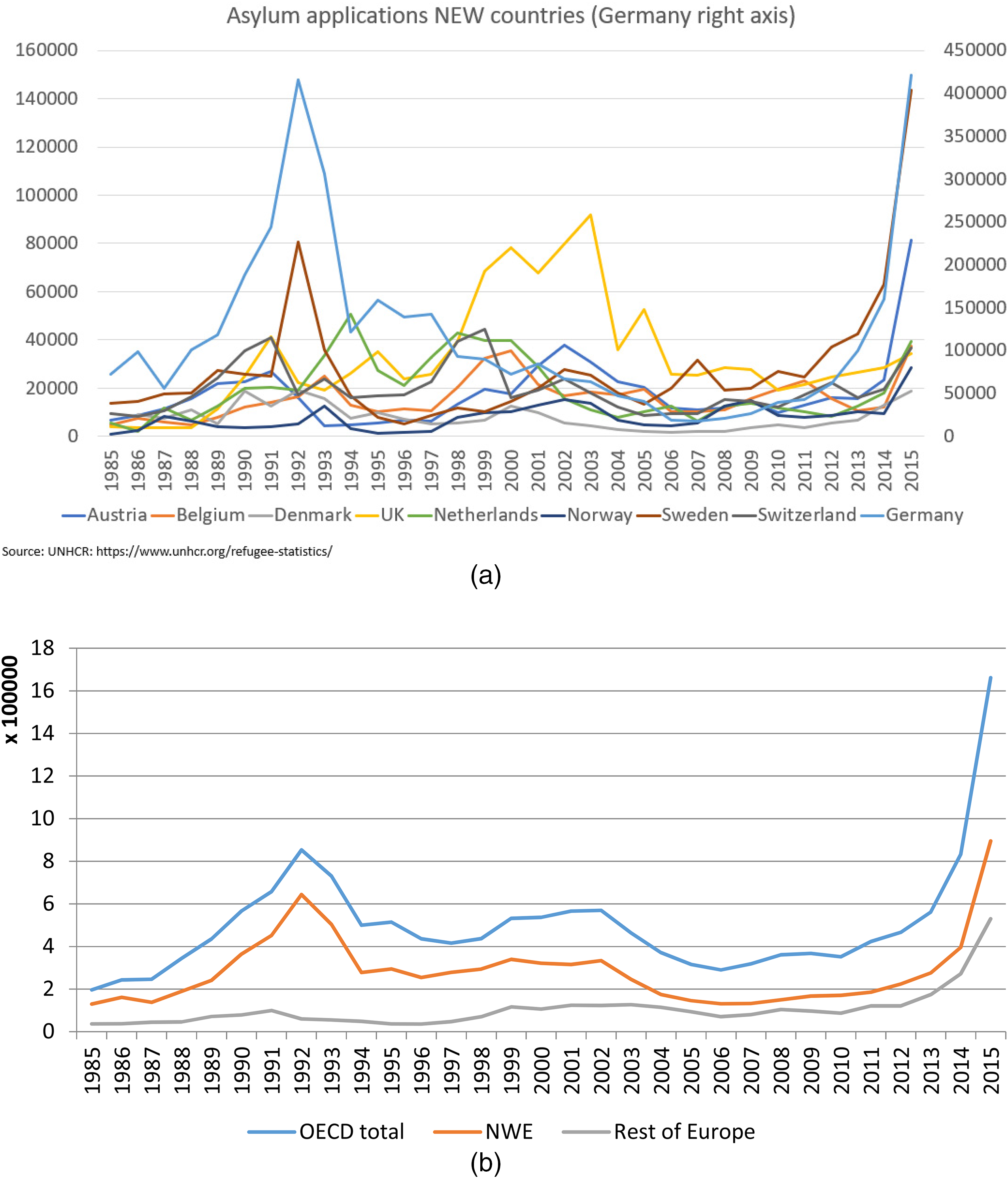
(a) Yearly Number of Asylum Applications Submitted in the Nine Northwestern European (NWE) Countries, 1985–2016. Germany is on the Axis to the Right. (b) Yearly Number of Asylum Applications Submitted in OECD, the Northwestern European (NWE) Countries, and the Rest of Europe, 1985–2016.
In addition to being major asylum destinations, the NWE countries share features that, to some extent, can make them appear as relatively close destination substitutes: (i) they are in a contiguous geographic area in the northern part of Western Europe; (ii) they are highly developed, mature economies; (iii) they have relatively generous welfare systems; and (iv) their majority religion is Christianity.
Figure 1b describes the development of asylum flows to OECD member countries in total and the NWE countries and the rest of Europe in the study period. Figure 1b clearly illustrates that Europe has received a large share of the total flow of asylum seekers and that the nine NWE countries we investigate have been the dominant destination countries within this region and within the OECD.
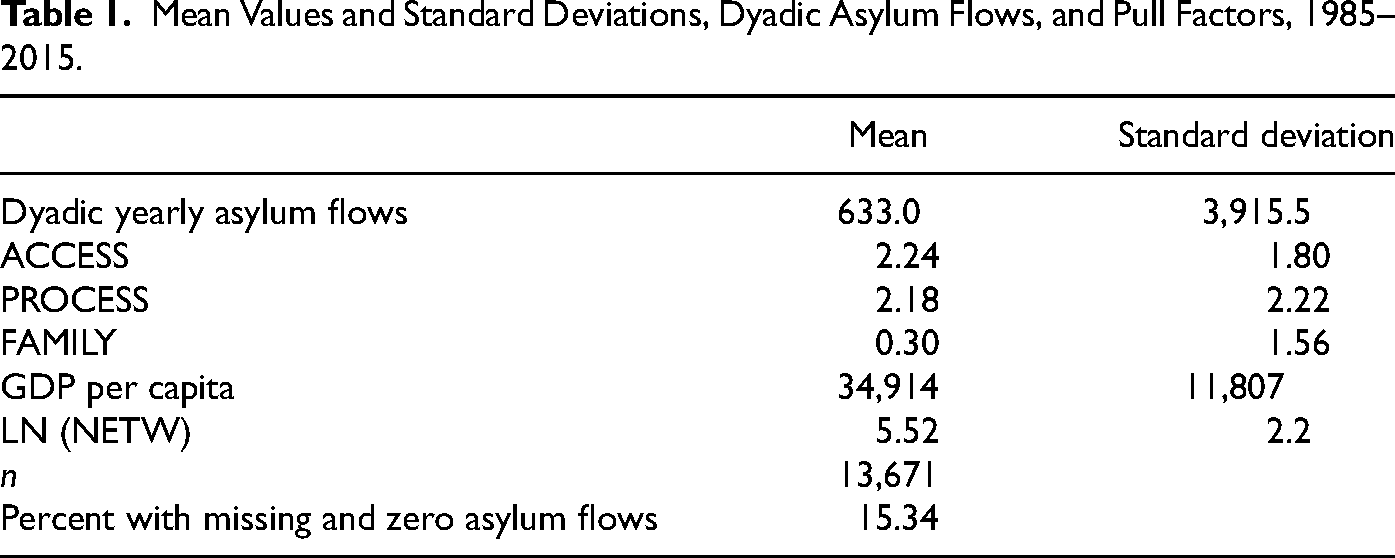
To avoid time series with small numbers and many missing values, we include only sending countries that contributed to at least 1 percent of the total number of asylum applications from 1985 to 2015 in at least one NWE country. Altogether, this rule identified 48 sending countries. 23 In the period we analyze, we potentially observe 13,392 yearly asylum flows. Of these, approximately 15 percent are recorded with zero or missing values.
National Policy Restrictions Toward Asylum Seekers and Family Immigrants
To assess the asylum policy reforms within the areas of access to apply (ACCESS) and the processing of applications (PROCESS), we build on the findings of Brekke, Røed, and Schøne (2017), who established a database containing the reforms in all the NWE countries within these policy areas from 1980 to 2010. For the purpose of the current paper, we extend this collection of changes in laws and regulations for the years 2011–2015. In addition, we established a database containing significant reforms in rules and legislation that govern family reunion (FAMILY) relevant to accepted asylum seekers. 24 Regarding the division of the asylum policy into the ACCESS and PROCESS categories, we partly followed the guidelines in Hatton (2009, 2016). However, the different types of policy reforms are not always classified in the same way (see footnote 12). The indexes are explained in more detail below.
The ACCESS index identifies reforms that affect the asylum seekers’ access to the host country and thus their possibility for submitting their applications. Examples include changes in penalties for trafficking, stricter carrier sanctions, and legislation that makes it easier to deny the applicant access to the country or to carry out a proforma asylum proceedings that does not assess the protection need of individual applicants.
The PROCESS index identifies reforms that influence the outcomes of asylum applications. These are reforms affecting the probability of obtaining a residence permit (or staying in the destination country without such a permit), conditional on the ability to apply. Examples include stricter requirements for documentation of the need for protection, a narrowing in the basic criteria for being granted refugee status, and the introduction of measures that influence the authorities’ possibilities to monitor and control the applicants.
The FAMILY index concerns policies that affect the accepted asylum seeker's possibility for family reunion and family establishment with citizens from their origin (or other foreign) country. Examples include tougher requirements regarding housing, minimum age, and annual income. The laws and regulations in these areas most often apply to a much wider group of people than accepted asylum seekers. In European countries, family migration regulations most often refer to all types of immigration, including forced migration (asylum seekers and resettled refugees), labor migration, and student migration. Some family immigration regulations are linked specifically to the sponsor's (the resident in host country who applies for family reunification or establishment) residence status. For example, asylum seekers attaining refugee convention status in Norway will have a different set of rights in regard to family reunification from those getting a secondary status (Eggebø and Brekke 2019). Other family regulations will cover all immigrant strands, including asylum seekers. These are typically regulations relevant after persons attain permanent residency and pertain specifically to the types of residence permits. For this study, we selected changes in family migration regulations that were relevant to successful asylum seekers.
The reforms that are included in all three indexes apply, in principle, to asylum seekers from many, if not all, origin countries at the same time. That is, we exclude policy changes that only affect people from one or very few countries of origin, such as visa restrictions.
When assessing how restrictive a policy change is, we refer to how a reform affects the likelihood that asylum seekers will obtain residence or achieve family reunification or establishment. If the reform seems to decrease (increase) this opportunity, the relevant index increases (decreases) by one in the year of implementation. If no significant changes took place within the policy area in question, the index remains unchanged during that year. The principles that guide the construction of the indexes and the different steps of the data collection are described in more detail in the Supplemental Appendix. The same applies for each concrete policy change in the different NWE countries that we have considered to be substantial enough to affect one of the indexes in the period 1980–2015.
The different policy indexes cannot be used to compare the level of restrictiveness between destination countries because they start at different levels in 1985, and the approaches of policy making vary considerably between countries. However, they are informative regarding the policy changes that take place within a country, over time.
In the Supplemental Appendix, Figure A1, the developments in the three indexes are presented separate for each of the nine receiving countries. The general picture is a pattern of increasingly restrictive policies within all areas. However, there is considerable variation, both over time and between countries. For example, Belgium and Germany develop less restrictive policies related to the PROCESS area from early 2000, while Switzerland stands out for implementing more lenient FAMILY policy regulations during the first half of the period we study. 25
To identify the relative effects of reforms in the three policy areas, we need to establish that they are not too closely correlated within destination country over time, because our analysis leverage on the yearly changes in policy and asylum flows within dyads. A visual inspection of Figure A1 indicates that the instance of simultaneous reforms within the different policy areas in the same country is rare. In Table A1 in the Supplemental Appendix, we present the results from estimating the bilateral relationships between the three policy indexes, within destination country over time. Reforms are clearly positively correlated between the policy areas. However, the main message to be taken from Table A1 can be taken from the low values of the within—R2, which means that changes in one of the indexes explain only a minor part of the variance in the two others. This indicates that multicollinearity is not a severe problem.
Economic Development and Network
As an indicator of economic development in the receiving countries, we include GDP per capita in USD 1,000 (2015 value; GDPrt − 1, The World Bank is the source of the GDP data).
To assess a time-varying network effect, we included the average inflow of asylum seekers from the origin country to the receiving country during years t − 2 to t − 4 when equation (2) is estimated. One important methodological problem is that the network effect establishes a positive relationship between earlier and future inflows. 26 If policymakers tend to tighten the asylum policy as a reaction to higher inflows of asylum seekers, these dynamics impose an upward bias in the estimates of the policy effects. By including the measure of past asylum inflows, we can reduce the severity of this simultaneity problem. This strategy is recommended by Neumayer (2005), who argued that the immediately preceding value of the lagged dependent variable (t = −1) should be left out to mitigate the correlation with the error term. Still, this procedure may impose problems related to including lagged dependent variables (Wilkins 2018).
In Table 1, the mean and standard deviations of our dependent and independent variables are presented.
Mean Values and Standard Deviations, Dyadic Asylum Flows, and Pull Factors, 1985–2015.
Effects of Asylum Policies on the Inflow of Asylum Seekers
Average Policy Effects
In this section, we present the main results from the analysis of the yearly dyadic asylum flows to the nine NWE receiving countries from 1985 to 2015. The focus is on the relative impacts of change in the three different types of asylum policies on the inflow of asylum seekers to the country that implements such reforms. More specifically, we analyze the effects of tightening these national asylum policies on the number of asylum arrivals to the destination countries given the size of the total outflow of applicants from their home countries.
The main results from implementing the two empirical strategies related to Case II and Case III, respectively, and described in the previous subsection are presented in Table 2. In all six specifications, we include full sets of dyad (dor) and origins × year (dot) specific dummies. This rich structure of fixed effects allows us to control for a wide set of potential confounders. However, the approach also creates a hard test for the identification of policy effects as the variation in the data is then severely reduced.
The Effects of Asylum Policy on Dyadic Asylum Flows, 1985–2015.
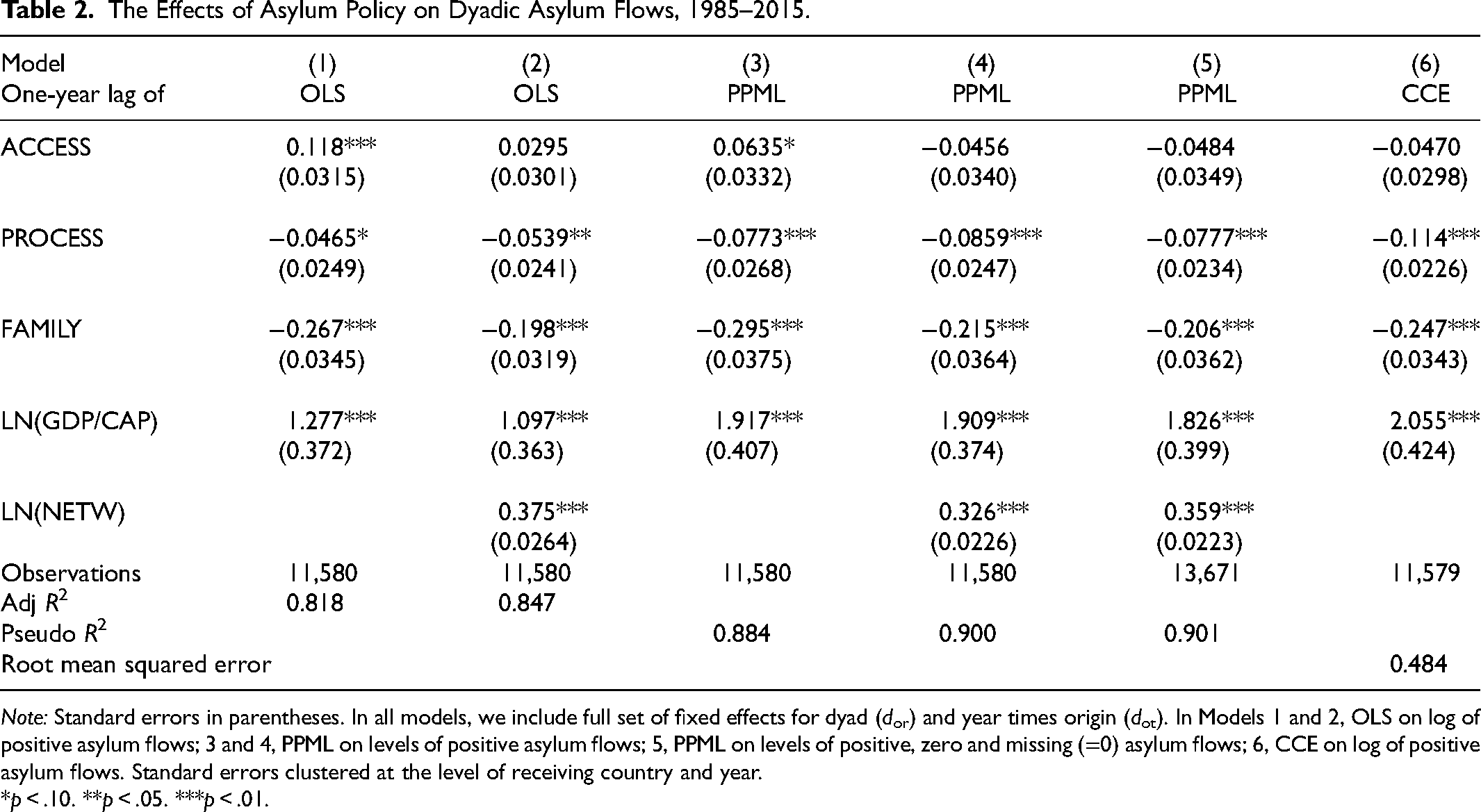
Note: Standard errors in parentheses. In all models, we include full set of fixed effects for dyad (dor) and year times origin (dot). In Models 1 and 2, OLS on log of positive asylum flows; 3 and 4, PPML on levels of positive asylum flows; 5, PPML on levels of positive, zero and missing (=0) asylum flows; 6, CCE on log of positive asylum flows. Standard errors clustered at the level of receiving country and year.
*p < .10. **p < .05. ***p < .01.
In Models 1 to 5, we estimate equation (2) with the different statistical procedures that work when Case II applies, that is, when the asylum seekers have systematically different location preferences from the rest of the home countries’ populations but are not different from each other in this regard. When these assumptions apply, the inclusion of the dot set of dummies accounts for the MRM mechanism. In addition to the changes in the average values of pull factors in the other NWE countries, the dot dummies also control for changes in the corresponding averages in destination, which are not included in the analysis.
In Model 1, we follow most closely the scheme used by Ortega and Peri (2013) when they analyzed the effects of immigration policies on international dyadic migration flows.
The key independent variables, all measured as annual variables in the destination countries and included with a one-year lag, are the three policy indexes (ACCESS, PROCESS, and FAMILY) and the GDP per capita in USD 1,000. In Model 2, we include the log of the network variable (NETW), which accounts for the relatively recent historical inflow of asylum seekers from the same origin country. These independent variables are all defined and described more closely in the Data and Variables section. Models 1 and 2 are both estimated with the OLS procedure.
Except for the ACCESS index, all the estimated effects of these two first specifications have the expected signs; that is, the relative inflow of asylum seekers to one country relative to others destination countries decreases when the policies become more restrictive and increases when economic conditions improve. There is clearly a strong positive relationship between current and historical inflows. However, the positive coefficient of the ACCESS index is not as expected and is clearly counterintuitive.
The coefficient of the ACCESS variable turns considerably less positive, and the negative coefficient of the PROCESS variable appears to be somewhat reinforced when the NETW variable is added in Model 2. This pattern indicates that the dynamics described above between the earlier and present flows and policy change may be at work and may induce a positive bias in these policy effects. Such a bias emerges if authorities in the destination countries tighten asylum legislation as a reaction to higher inflows in the recent past. At the same time, a positive relationship exists between the earlier and present inflows of asylum seekers. It may be that the counterintuitive sign of the ACCESS coefficient related to this kind of policy is a type of “first line of defense” measure, which means that the authorities’ immediate reaction to a sharp increase in asylum inflows is “to close the border.” If so, the ACCESS coefficient may be particularly vulnerable to this type of positive bias. However, the pattern is exactly the opposite in the case of the FAMILY variable; the value of the estimated coefficient increased strongly (became less negative) when the network variable was added in Model 2. Thus, a different kind of dynamic appears to be present between the inflow of asylum seekers and reforms within the FAMILY type of legislation compared with the two other policy areas. This may be related to the FAMILY type of policy often being applied to a much broader population group than just the accepted asylum seekers and, thus, is less sensitive (more exogenous) to fluctuations in the asylum inflows.
In Models 3 and 4, we estimate the same specifications as in Models 1 and 2, respectively, but with the PPML procedure at the levels of dyadic asylum flows, using only the positive values of the dependent variable. In Model 5, we re-estimate the specification of Model 4, including all the flows with zero (and missing) values. The PPML approach provided quite similar patterns of results to the OLS estimation on the log of flows. One important exception is that the ACCESS coefficient become negative (but not significant) when the network variable is included. Another feature is that the estimated coefficient related to the indicator of economic conditions in the destination country, GDP per capita, is higher and stable across the three PPML specifications. The interpretation of the estimated value of this variable in Model 4 is that a 1 percent increase in GDP per capita increases the average yearly inflow of asylum seekers by nearly 2 percent.
As described in the data section, many dyadic flows have a considerable number of years with missing or zero values. To shed light on the sensitivity of this issue, Model 5 was estimated including these zero and missing flow, where the missing value is approximated as zero.
However, as elaborated in the From Individual Asylum Decisions to Aggregated Flows and Estimation Strategies sections, when the unobserved location preferences varied systematically within the group of asylum seekers, the Case II strategies are insufficient to deal with the methodological problems emerging from the attractiveness of the alternative destination (the MRM mechanism). Thus, we turn to the CCE strategy, as described in Case III of the Estimation Strategies section. When this estimation procedure is used, the network variable and its cross-sectional average are no longer significant. Therefore, this variable was left out in the CCE specification. 27
Compared with the PPML results in Models 4 and 5, the effects of tightening the PROCESS and FAMILY policy areas turned out to be more negative when using the CCE procedure. This pattern may indicate that the PPML estimates are upward biased because of the simultaneous implementation of more restrictive policy reforms in alternative destinations. Otherwise, the pattern of results is quite similar across the two estimation procedures.
Our main objective was to analyze the relative strength of the different policy effects captured by the ACCESS, PROCESS, and FAMILY indexes. To achieve this goal, we closely followed the empirical approaches suggested in recent cutting-edge contributions to the literature on international migration flows. Table 2 shows that with regard to the relative policy effects, the results were quite consistent across the different methods and specifications.
Our results suggest that the most significant measure at the national level to reduce the relative inflow of asylum seekers to one country relative to other destinations is to tighten the legislation that regulates the conditions for the family reunification of accepted asylum seekers. The second most significant measure is to introduce rules that reduce the likelihood of approved asylum applications and increases the likelihood that the declined applicants will be effectively deported. According to our results, the least significant measure is the policy reforms intended to prevent asylum seekers from submitting their applications to the destination country. It should be emphasized that what we assess here is the effects of country-specific national policy reforms, not the type of supranational measures at the EU/EEA (Schengen) level, which are now preventing refugees and other immigrants from entering the European continent in the first place.
The interpretation of the estimated values of the PPML policy coefficients in Model 4 is that a one-point increase in the FAMILY index reduces the yearly average dyadic relative inflow to one country relative to other destinations by approximately 21 percent. The corresponding decreases for the PROCESS and ACCESS indexes were nearly 9 percent and 5 percent, respectively. When estimated by the CCE procedure, the policy effects are estimated at 29 percent, 12 percent, and 4 percent reductions in the share of the inflow to these particular countries resulting from a tightening in the FAMILY, PROCESS, and ACCESS fields of legislation, respectively. 28
Heterogeneous Effects
In Table 3, we present the results from estimating the PPML version of Model 5 in Table 2, removing “extreme value” observations step by step. The results in Table 4 are obtained using the same procedure but applied to the CCE results in Model 6 of Table 2. The purpose is to investigate whether the main results are driven by “extreme value” observations.
The Effects of Asylum Policy on Dyadic Asylum Flows, 1985–2015, Heterogeneous Effects, Poisson Pseudo-Maximum Likelihood Procedure on Level of Positive and Zero Flows (Model 5 in Table 2).
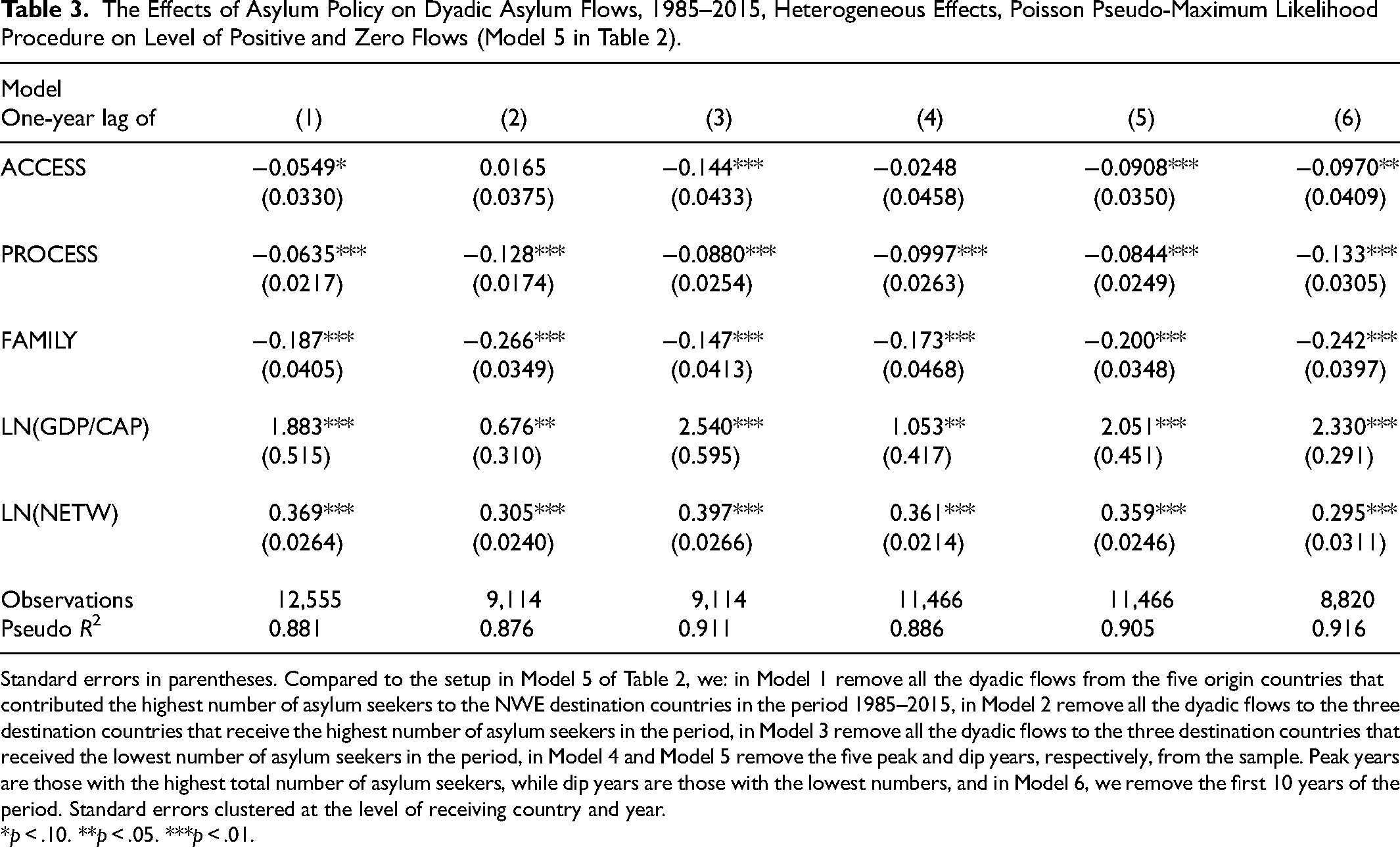
Standard errors in parentheses. Compared to the setup in Model 5 of Table 2, we: in Model 1 remove all the dyadic flows from the five origin countries that contributed the highest number of asylum seekers to the NWE destination countries in the period 1985–2015, in Model 2 remove all the dyadic flows to the three destination countries that receive the highest number of asylum seekers in the period, in Model 3 remove all the dyadic flows to the three destination countries that received the lowest number of asylum seekers in the period, in Model 4 and Model 5 remove the five peak and dip years, respectively, from the sample. Peak years are those with the highest total number of asylum seekers, while dip years are those with the lowest numbers, and in Model 6, we remove the first 10 years of the period. Standard errors clustered at the level of receiving country and year.
*p < .10. **p < .05. ***p < .01.
The Effects of Asylum Policy on Dyadic Asylum Flows, 1985–2015, Heterogeneous Effects, Common Correlation Effect Procedure on Log of Positive Flows (Model 6 in Table 2).
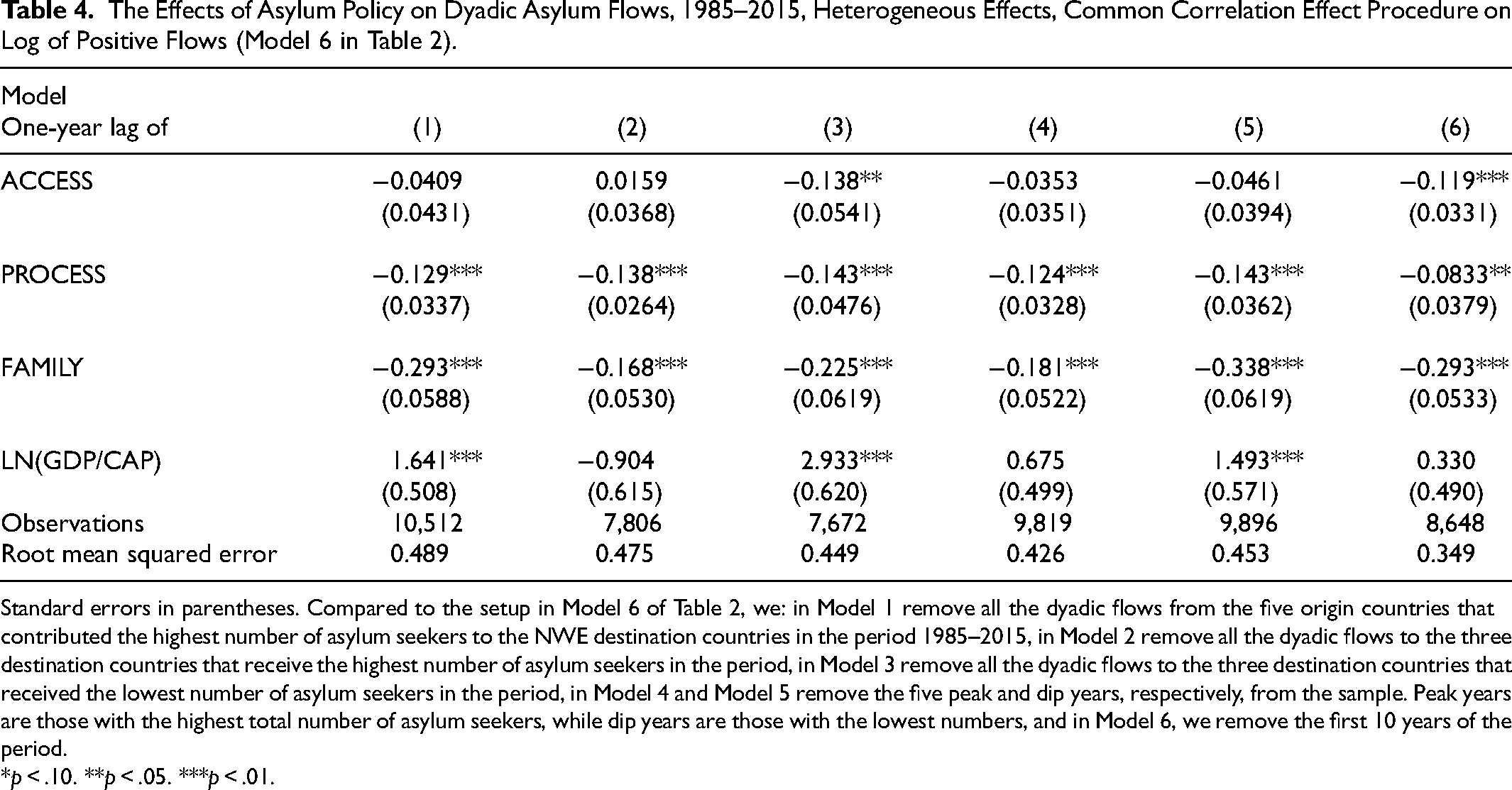
Standard errors in parentheses. Compared to the setup in Model 6 of Table 2, we: in Model 1 remove all the dyadic flows from the five origin countries that contributed the highest number of asylum seekers to the NWE destination countries in the period 1985–2015, in Model 2 remove all the dyadic flows to the three destination countries that receive the highest number of asylum seekers in the period, in Model 3 remove all the dyadic flows to the three destination countries that received the lowest number of asylum seekers in the period, in Model 4 and Model 5 remove the five peak and dip years, respectively, from the sample. Peak years are those with the highest total number of asylum seekers, while dip years are those with the lowest numbers, and in Model 6, we remove the first 10 years of the period.
*p < .10. **p < .05. ***p < .01.
When commenting on the impact of removing observations from the sample, we generally compare them with the corresponding models in Table 2, and when referring to “both tables” in this section, we refer to Tables 3 and 4.
In Model 1 (of both tables), we remove all the dyadic flows from the following five origin countries that contributed the highest number of asylum seekers to the NWE destination countries in the period 1985–2015: Afghanistan, Syria, Turkey, Iraq, and Serbia/Kosovo. In the PPML estimation, the effects of tightening within the different types of policies become less diverse, but the impact of a more restrictive FAMILY policy is still clearly the most significant policy measure to reduce the inflow of asylum seekers. In the CCE estimation of Table 4 (Model 1), the coefficients of all the independent variables remained more or less unaltered by the removal of the five highest contributors.
In Model 2 (of both tables), we remove all the dyadic flows to the three destination countries that received the highest number of asylum seekers in the period 1985–2015, namely Germany, the United Kingdom, and Sweden. In the remaining group of relatively small receiving countries, the policy effect of ACCESS appears to vanish, whereas the negative effect of tightening the PROCESS type of policy becomes stronger. The negative implications of a more restrictive FAMILY policy are reinforced in Table 3 and strongly reduced in Table 4. However, in both the PPML and CCE specifications, reforms in FAMILY policies still have the strongest impact.
In Model 3 (of both tables), we do the opposite and remove all the dyadic flows to the three destination countries that received the lowest number of asylum seekers in the period 1985–2015, namely Norway, Denmark, and Belgium. In the remaining group of relatively large receivers, the negative effect of the ACCESS index is strongly reinforced in the specifications of both tables. At the same time, the estimated effects of the FAMILY type of policies are somewhat reduced. In the PPML specification, such reforms are no longer the strongest measure to reduce the yearly inflow of asylum seekers.
In Models 4 and 5 (of both tables), we remove the five peak and dip years, respectively. Peak years are those with the highest total number of asylum seekers, whereas dip years are those with the lowest numbers of asylum seekers. Removing the years with the highest number of aggregated asylum applicants reduces the negative effects of tightening the FAMILY policy when estimated with both the PPML and CCE procedures. In the CCE case, the negative policy effect of tightening the FAMILY policy is somewhat reinforced when the dip years were removed from the sample. Removing the dip years also reinforces the negative effect of implementing a more restrictive policy within the ACCESS type of legislation but only when this is estimated using PPML. However, in Models 4 and 5 and irrespective of the estimation procedure, restricting the FAMILY policy is the most effective strategy for reducing the inflow of asylum seekers.
Finally, in Model 6 (of both tables), we leave out the first 10 years of the panel period. That is, the models are estimated for the period 1995–2015. With one exception, this exclusion of the early years strengthens the negative policy effects and those related to the legislation captured by the ACCESS index. The exception is the effect of tightening the PROCESS type of policy when this coefficient was estimated using the CCE procedure.
Overall, the investigation of heterogeneous effects indicates that the main patterns of relative policy effects, presented in Table 2, are quite stable across the different sample adjustments. Thus, this sensitivity check substantiates that among the three policies evaluated, a more restrictive FAMILY policy has the strongest negative impact on the yearly inflow of new asylum seekers, while tightening the PROCESS type of legislation is the second most efficient measure in this regard.
Concluding Remarks
In both political and academic debates, a knowledge gap exists regarding how legislation within various areas related to national asylum policies affects the distribution of asylum seekers between receiving countries. Studies on the influence of the rules that govern family reunification are lacking. The goal of this paper is to determine the relative effects of legal reforms on asylum flows that change access to apply for asylum (ACCESS), the probability that the application will be approved (PROCESS), and the probability of family reunification in the destination country if accepted (FAMILY).
Empirically, we analyze how national asylum policy reforms in the period 1985–2015 affect the yearly flows from 48 origin countries to nine NWE destination countries. We use statistical methods that considered the unobserved heterogeneity between individuals who chose to stay home and those who go abroad to apply for asylum in different destination countries.
Our main results are as follows: first, a tightening of the asylum policies within the areas PROCESS and FAMILY has a negative effect on the share of the inflow to these particular countries. Second, changes in regulation pertaining to asylum case processing (PROCESS) and the regulation of family migration (FAMILY) show strong and consistent relative policy effects across different specifications. Third, of the three areas of asylum-related policies, changes in family policies appear to have the strongest effect on the inflow of asylum seekers.
The most novel, and perhaps surprising, result of this study is that family-related policies (FAMILY) appeared to have such a strong relative influence on the distribution of asylum seekers between receiving countries. One may speculate that this result is related to that a substantial share of asylum seekers who arrived in Europe, during the period we study, were young men traveling on their own. To be able to reunite with family members in the destination country can obviously be of great value to this group and, in particular, if their families are persecuted in the home countries.
Finally, we mentioned in the Determinants of Asylum Flows: Previous Studies section that our study, in a wider sense, relates to the literature on welfare magnets, that is, studies that investigated whether generous welfare benefits in the receiving countries serve as magnets for migrants. One key result is that family-related policies appeared to have a strong effect on asylum streams. The components in the FAMILY index include policies that affect the primary asylum seeker's chance for family reunification in the destination country. Examples include tougher requirements for granting family reunification regarding housing, minimum age, and annual income. Even if the index does not directly measure the value of welfare benefits, housing and income requirements affect migration decisions through economic requirements. In this sense, our results shed light on previous results in the welfare magnet literature, specifically those reporting that reductions in benefits decrease the net inflow of immigrants.
Supplemental Material
sj-docx-1-cet-10.1177_01979183231187620 - Supplemental material for Family Matters: The Impact of National Policies on Asylum Destinations
Supplemental material, sj-docx-1-cet-10.1177_01979183231187620 for Family Matters: The Impact of National Policies on Asylum Destinations by Jan-Paul Brekke, Marianne Røed, and Pål Schøne in International Migration Review
Footnotes
Declaration of Conflicting Interests
The authors declared no potential conflicts of interest with respect to the research, authorship, and/or publication of this article.
Funding
The authors disclosed receipt of the following financial support for the research, authorship, and/or publication of this article: This work was supported by the Norges Forskningsråd (grant number 248337).

Supplemental Material
Supplemental material for this article is available online.
Notes
References
Supplementary Material
Please find the following supplemental material available below.
For Open Access articles published under a Creative Commons License, all supplemental material carries the same license as the article it is associated with.
For non-Open Access articles published, all supplemental material carries a non-exclusive license, and permission requests for re-use of supplemental material or any part of supplemental material shall be sent directly to the copyright owner as specified in the copyright notice associated with the article.
