




Abstract
This study examines how the re-emerging “informal” land demarcation systems contribute to the de-escalation of land conflicts and promotion of peace in post-war Northern Uganda. Although relative peace and normalcy have returned to Northern Uganda following the LRA war, the Acholi subregion continues to grapple with land conflicts, which have complicated the resettlement and development of rural communities. However, rural communities, which bear the heaviest brunt of land conflicts, are not merely spectators. This paper explores and theorises the ways in which communities mobilise a rich repertoire of “everyday resources” to counter and address the contestations over land. The initiatives “from below” include boundary-tree planting, engraving names of landowners on trees, and digging holes around the contested land as boundary demarcations and “identity” markers. By emphasising harmonious post-conflict co-existence, these initiatives contribute to a reduction in land conflicts and foster peacebuilding.
Introduction
Land continues to be a site of conflict in Northern Uganda. Land conflicts in Northern Uganda – of which the Acholi subregion is part – intensified in 2006 after the cessation of hostilities between the government of Uganda and the Lord's Resistance Army (LRA) (Kobusingye, 2018; Meinert and Whyte, 2023). While some people remained in IDP (internally displaced persons) camps that were developing into urban centres, the majority returned to their villages to reclaim their land (Atkinson et al., 2018). However, land conflicts arose in the wake of this return, reclaiming of land, and resettlement, as some people – whether intentionally or unintentionally – extended their land's boundaries, while others settled on other people's land. In other cases, the conflicts were fuelled by the disappearance of natural landmarks or the death of elders who had vast knowledge of the different land holdings before the war (Berry, 2023). In addition, the end of the conflict coincided with the intensification of the neoliberal land market, which covertly introduced commodification and individualised land ownership. Land that was previously held and utilised in a communal manner without anyone claiming exclusive ownership was commodified and individualised, increasing pressure and prospects for conflict (Ibid.: xi).
Currently, land disputes are not only increasing but threatening the survival of the local landed communities in the country (Berry, 2023). At the structural level, the conflicts are driven by the shifting modes of land use, growing individualisation of land through land registration, changes in the land laws, large-scale land acquisitions by investors of all kinds, speculation, and land grabbing (Atkinson et al., 2016; Kobusingye et al., 2017). At the local level, land conflicts are fuelled by unclear and poorly demarcated land boundaries, perceived land scarcity, displacement, segregation, distress land sales, illegal occupations, unfair allocations and widow inheritance, relative vulnerability, greed/commodification of land, population pressure, and relational feuds (Akin, 2012). Progressive increases in land-related conflicts at various scales have prompted numerous responses, ranging from Alternative Dispute Resolution (ADR) mechanisms to issuance of certificates of customary ownership (CCO) and documenting customary rules (Aling et al., 2017; Meinert and Whyte, 2023). Mediation and reconciliation processes resulting in boundary demarcations have also been utilised in some areas (Anying and Gausset, 2023). While there is a wide range of scholarship on land conflicts (Greiner et al., 2011; Peters, 2004; Tapela, 2013; Tsegaye, 2023; Wehrmann, 2008) and the attendant resolution mechanisms, the responses “from below” by grassroots and local communities have not been fully documented or well articulated, let alone sufficiently recognised in land and agrarian studies – specifically, how the emerging local responses and predominantly informal land-boundary demarcations are contributing to the de-escalation of land conflicts and building peace in the region.
This study draws on findings from fieldwork conducted in Amuru and Omoro districts in 2023. Interviews, focus group discussions, and observation were useful in identifying the different forms of “informal land demarcation systems” and how they contribute to the de-escalation of land conflicts and promote peace in post-war Northern Uganda. We held interviews and FGDs with local council leaders, members of the local communities, and cultural leaders. We held 30 Key Informant Interviews and 3 FGDs (22 people), making our sample size 52 people from Amuru and Omoro districts. We investigated 13 land cases, and the respondents were involved in different capacities.
The concept of informality has not been used to cement the conventional formal–informal binary where the former is rendered superior to the latter. Our conception of informality aims to clarify how these processes and modes of demarcation are historically formal and were historically and politically rendered informal. These demarcation systems were rendered informal (and thus inferior and devalued) only with the emergence of modern colonial and Western modes of land demarcation that were considered superior to the “indigenous” African systems. This article therefore proceeds as follows: First, it highlights the re-emerging informal land demarcation systems taking root in Northern Uganda. Second, it enquires into the ways in which such informal land demarcation systems and processes are contributing to the reduction of land conflicts and the promotion of peace. And, third, it reconceptualises land tenure security and formalisation by rethinking the problematic formal–informal binary through the conception of informal formalisation. This recentres and reevaluates practices which were rendered informal as formal, creating a basis on which we can theorise land relations.
Customary Tenure, Land Conflicts, and the Politics of Dispute Resolution
Historically, land across Africa was communally “owned” and regulated by socio-cultural customs (Okoth-Ogendo, 2006). However, the colonial state restructured the socio-cultural systems of land ownership through the introduction of parallel, competing, and overlapping land rights. While the colonial state introduced individualised and private property land rights, customary land relations were also allowed to flourish in many countries on the African continent. Mamdani (2015) argues that the colonial state reformed land relations through its framing of the customary. Customary right was a usufruct right, and customary land could not be sold. Considering customary land as such was meant to keep the peasants outside of the market while keeping them beholden to the dictates of traditional authorities and customary chiefs (Mamdani, 2017: xiv). Yet, this scholarship has been challenged by those who argue that customary land tenure has precolonial antecedents and was never defined by purely European jurisprudence, since the process was negotiated by Africans (Berry, 2002). This critique, however, downplays the structural considerations that shaped the agency of the Africans.
Other debates on individualised tenure systems, such as freehold, have centred on the idea that customary land tenure is anti-development, insecure, and breeds conflicts. This debate, which is more prevalent among the land-based NGOs in Uganda, points to the need to codify customary tenure by the state if contemporary land questions, including conflicts, are to be addressed. Many have argued for the obliteration of the customary both as an institution and a form of tenure due to its problematic nature (Uganda Land Alliance, 2010). The second and contrary position argues for the acknowledgement and strengthening of customary tenure in the statutory law mainly through “a codification of the customary” (Adoko et al., 2011: 7). Proponents argue that customary institutions can help to address land issues, especially on customary land, and that all that needs to be done is to codify it and integrate it into the state system. Another study on Northern Uganda has suggested that the failure to merge the customary with the statutory system should be blamed for the land problems, as the customary system's continued existence enables “forum shopping” by the elites (Kobusingye, 2018: 73–74).
Several scholars have argued, however, that customary tenure confers more security of tenure to the local population, because it is inclusive and aptly responds to societal pressures and social demands (Fitzpatrick, 2005). Others have argued that “African land rights systems address a wide range of social, cultural, economic and political issues, [and] they clearly confer adequate security in respect of the various functions for which access is granted by the state or respective communities” (Okoth-Ogendo, 2006: 7). Customary tenure should not be entirely replaced with the assumed development-oriented tenure systems as it is socially and politically embedded, robust, and accommodative (Whitehead and Tsikata, 2003). Meanwhile, Tim Allen warned that any attempt to codify and formalise practices and rituals will lead to a loss of flexibility, and that they will “no longer have all the many resonances and associations of lived ritual actions” (2010: 253). This leaves us with questions of how to think about and conceptualise formalisation and how to understand formality.
In Africa, contestations over land “excite deeper passion” and create conditions for giving rise to bloodshed, given its social, symbolic, cultural/traditional, economic, and political significance (Shipton, 1994). The recent period epitomises the deep connections between land and conflicts as it has been characterised by covert and overt land concentration, transfers and enclosure of the commons, land grabbing, expropriation, dispossession, and large-scale land acquisition (Hendricks et al., 2013; Kandel, 2017). Yet, the rise in land conflicts has, in turn, kindled scholarly discourses and elicited local community perspectives on how to address the emerging land-related challenges. The most common and widely held solution has been the use of formal legal process, with disputes being resolved by the statutory court system (De Soto, 2000). However, the statutory conflict resolution process may not be feasible for many communities where land is held under customary tenure 1 and characterised by parallel, competing, and overlapping tenure rights, along with a complex system of traditional rules (Mnisi and Claassens, 2009; Manji, 2006, 2003; Weiner and Glaskin, 2007). This constellation of issues conditioned the adoption of mechanisms of Alternative Dispute Resolution (ADR) – also dubbed Traditional Dispute Resolution (TDR) – a method that seeks to resolve disputes out of court (Kakooza, 2007). ADR is a negotiation process where the conflicting parties negotiate their own settlement with the help of intermediaries who are expected to be neutral and equipped through training with relevant skills and techniques (Kakooza, 2007). ADR, which is often conducted through mediation, provides more efficient, mutually satisfactory, time-saving strategies for resolving (land-related) disputes, as opposed to the formal court litigation, which can draw out the time frame (in many instances, cases are never resolved). The ADR “restores harmonious relationships between disputants and neighbouring communities” (Home, 2020: 82) and does not bring shame to the parties. Also, ADR ensures that conflict resolution and settlement is done locally, very close to the contested land and in languages best understood by the local communities (ibid.). The failure of ADR to meet higher expectations across Africa is attributed to inadequate financing, poorly defined mandates, corruption, and lack of legitimacy. Important as it is, this critique takes for granted the power relations between the institutions undertaking ADR. The state, for instance, wants any alternative to adhere to state-sanctioned rules, hence the subordination of customary practices (see Mamdani, 2015).
Other scholars have couched the multiple responses to land conflicts in the language of legal pluralism (Delville, 2007; Kobusingye et al., 2016; Peters, 2004; Unruh, 2003). Whereas legal pluralism scholarship suggests that multiple systems allow people and communities to make choices on where to report land-related cases and seek justice (communities’ agency) (Fitzpatrick, 2005), “tensions [often] arise between a statutory system and the more organic customary or traditional systems [as each platform has] unique laws and institutions to enforce them” (Pimentel, 2011: 59–60). This dilemma, for Pimental, can be resolved when there is sufficient respect for traditional systems and values, achieved by affording them “dignity as independent systems” (ibid.: 103). Pimentel concludes by stating that ensuring that the customary institutions and customary laws are subservient to the state and state law, and carried out on the state's terms, as dictated by normative legal pluralism, would be doing nothing more than “repackaging and relabelling tried-and-failed colonial approaches” (ibid.: 103). Rather, emphasis should be put on “maximising the role and impact of indigenous law, and giving equal dignity to the institutions that apply such law” (ibid.: 103). Consequently, the state and state courts will have to defer to community-based adjudication, even declining to exercise jurisdiction when the case can be appropriately resolved in the latter forum. It will grant concurrent jurisdiction wherever possible, supplementing it with consent jurisdiction for those who could not otherwise be subject to the authority of the traditional forum. (ibid.: 103)
In such a situation, conflicts between institutions are a breeding ground for what has been termed “forum shopping”: a condition where parties involved in a conflict choose institutions that can best serve their selfish interests (Kobusingye et al., 2016; Quintero et al., 2014; von Benda-Beckmann, 1981). Forum shopping gives the people the privilege to choose between custom or law, depending on the kind of interest they want served, and it often emerges from the lack of clarity on which rules apply where, and whether customary or statutory power must be considered for what kind of land (see Ribot and Peluso, 2003). In instances where legal pluralism results in institutional competition, the processes may portend more land conflicts than resolve them. As a response to these critiques, Anying and Gausset (2023) have suggested that aside from promoting competition, legal pluralism also promotes a spirit of cooperation. They use the example of a land conflict involving a woman and her brother-in-law to claim that “no forum in northern Uganda can succeed in resolving a land conflict alone” (2023: 86). Meanwhile, the informal land demarcation processes happening in Northern Uganda which are neither completing nor competing with the legal/formal process but taken as the first point of contact for the local communities, cannot be thought to reflect, or be understood as, legal pluralism. In this case, the informal land demarcation process is not fully sanctioned by the state as such but the local communities themselves, and the state does not fully define the contours of this process, even when the state may have power to frustrate the process.
The rebuttal notwithstanding, another set of literature offers a strong critique of the ways in which scholars have emphasised mediation between parties and strengthening the rule of law as the most pragmatic ways to deal with land disputes (van Leeuwen et al., 2022). They find this argument insufficient because it focuses on the conflict itself while ignoring the “long-term processes of exploitation and enclosure and a structural crisis of plantation agriculture that has been unfolding in the region” (van Leeuwen et al., 2022: 310). As such, they argue that inasmuch as resolving land conflicts may be appropriate for reducing local tensions, it should not come at the expense of engaging larger “questions of agrarian justice and making fundamental political choices about agrarian development” (ibid.: 310). The question of agrarian justice would demand an engagement with the structural origins of land disputes and why they persist. Ignoring them while designing interventions emerges because we fail to place the ongoing land disputes in a historical “process of marginalisation and dispossession and this in turn may result in sustaining the status quo that benefits those already in the strongest positions” (ibid.). The relevance of resolving land conflicts at the individual level notwithstanding, there is a need to move beyond and develop “strategies that nurture reforms of land and agrarian policies that meet the local understanding of justice and engage larger questions of agrarian transformation” (ibid.: 310).
This articulation, interestingly, places the land disputes into the context of historical processes and demonstrates an understanding that conflicts threaten the agrarian life of communities. This is a context from which we emerge to also suggest that there is a need to pay attention to disputes/conflicts and alternatives such as boundary demarcation, which are not necessarily conditioned but influenced by these larger processes. Our article suggests that there is a need to engage socially driven initiatives that emerge from the communities themselves as is the case with Northern Uganda – particularly Acholi, where such modes are not necessarily new but historical. Such non-structural responses can act as starting points to respond to structural forces. It is in this spirit that we engage the informal modes of boundary demarcations as responses to land conflicts which, in turn, can provide us with material to begin considering how best to deal with larger structural questions that condition land conflicts. In the following sections, we tease out some of the aspects contributing to the resolution of land conflicts (Figure 1).
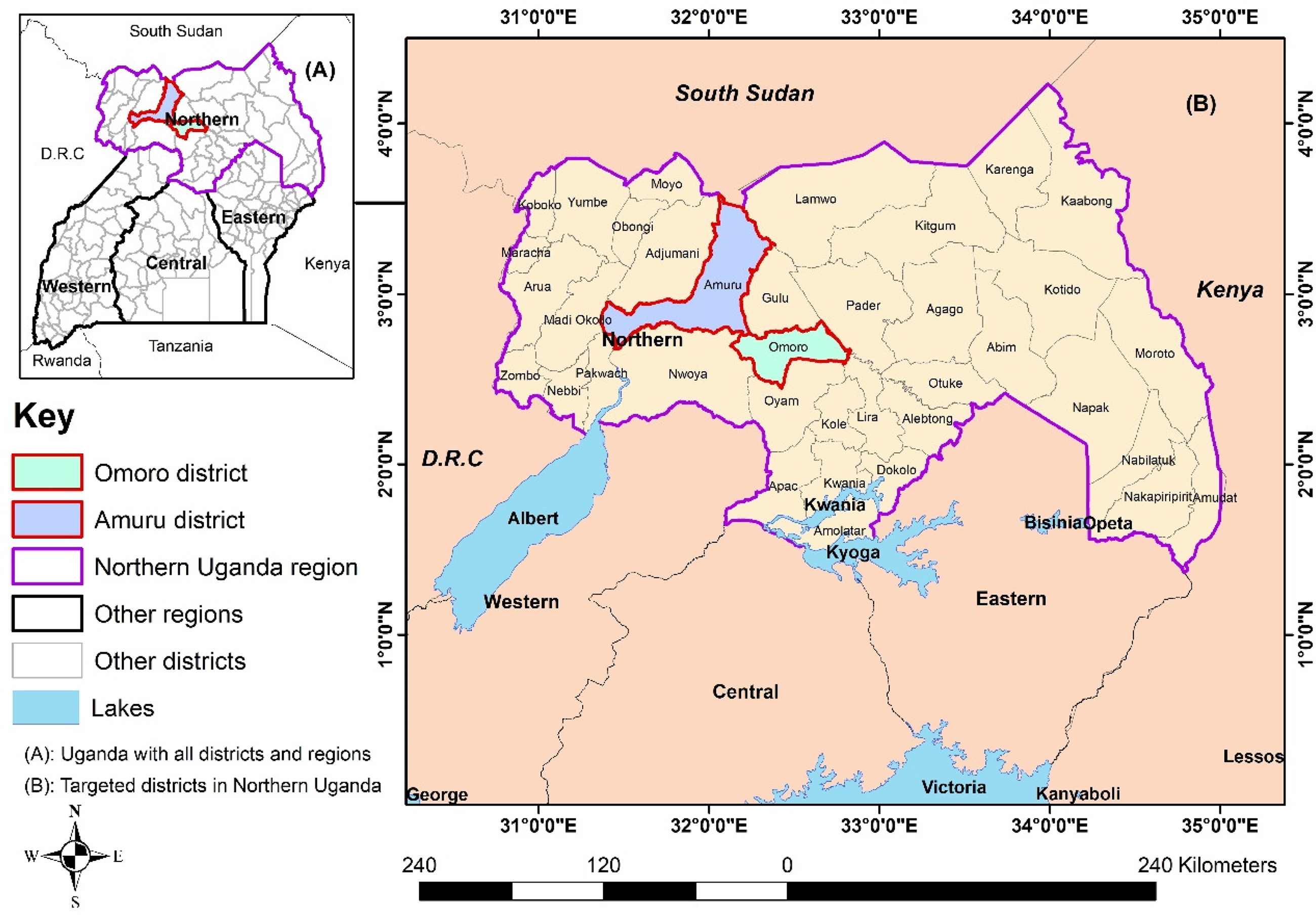
Map of the Study Area.
Typologies of Informal Land Demarcation Systems
The local communities in Amuru and Omoro have devised creative ways to navigate land conflicts. While some community members engraved the names of landowners on the existing trees, others planted a line of trees along the land boundaries of the contested land. Other land demarcation systems included the erection of signage and poles in a line around the land, drawing of sketch maps of the contested land on paper with a copy given to the adjoining neighbours for future reference, and digging of large holes which act as boundaries between two or more neighbours. These land demarcation typologies have been conceptualised in this study as “informal land demarcation systems” because the local communities deploy everyday tools “from below” as opposed to those initiated from above, particularly by the state institutions, to demarcate the land. The modes of boundary demarcation are examined below.
As shown in Figure 2, local communities engrave names of landowners onto existing trees as part of the emerging informal land demarcation systems in both Amuru District and Omoro District, though the practice was more prevalent in the former. The first part of the left-most photograph shows that the land belongs to Adula; the information on the right-most photograph shows that this land belongs to Karome, who lives in Pabbo Subcounty in Amuru District.
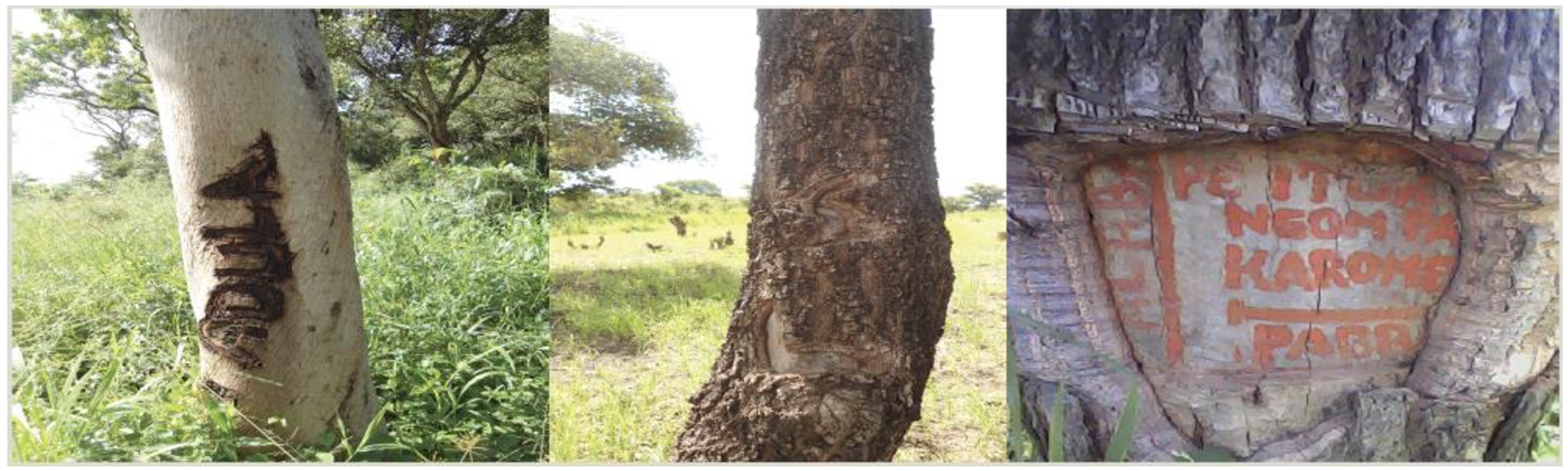
Trees with Engraved Names of Landowners.
Some plant trees around their land (Figure 3). Others plant tree stumps and poles around the land in question. The most common tree varieties used to demarcate the land include luchoro (as shown in the photograph on the left-hand side of Figure 3), moya trees (Shea butter trees, as revealed in the photograph in the middle of Figure 3), and poles (as shown in the photograph on the right-hand side of Figure 3).
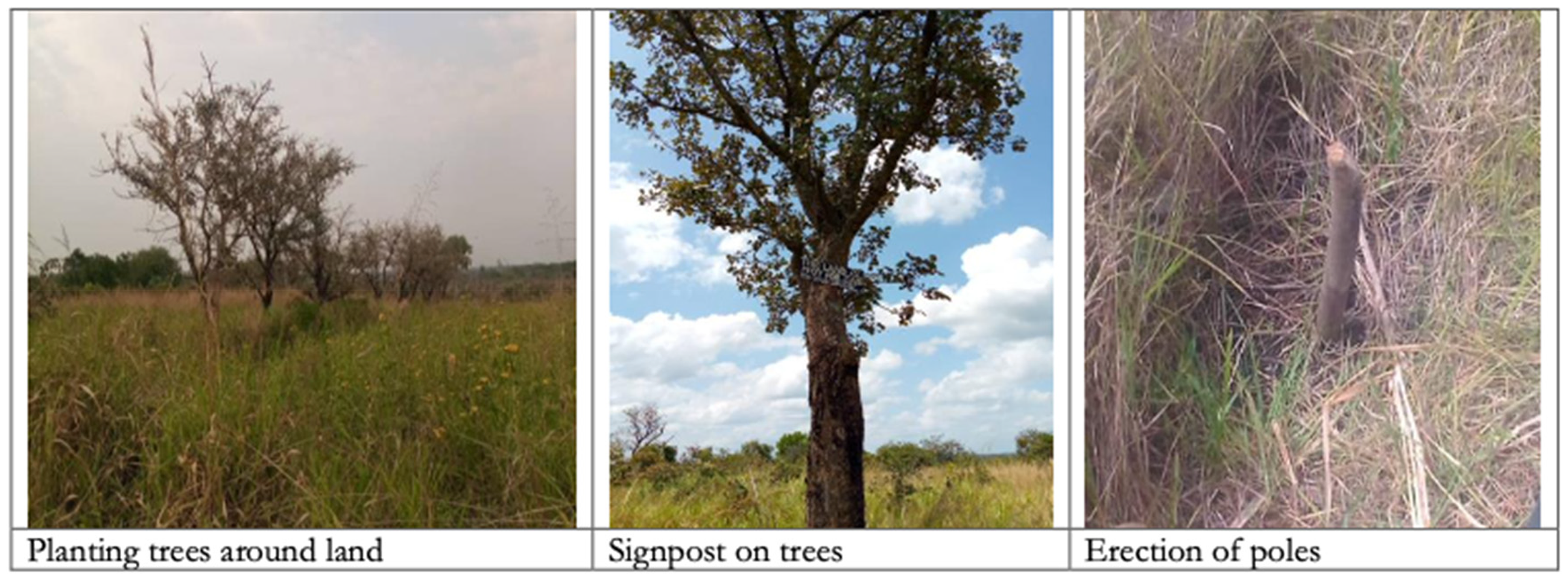
Live Trees, Signposts, and Poles.
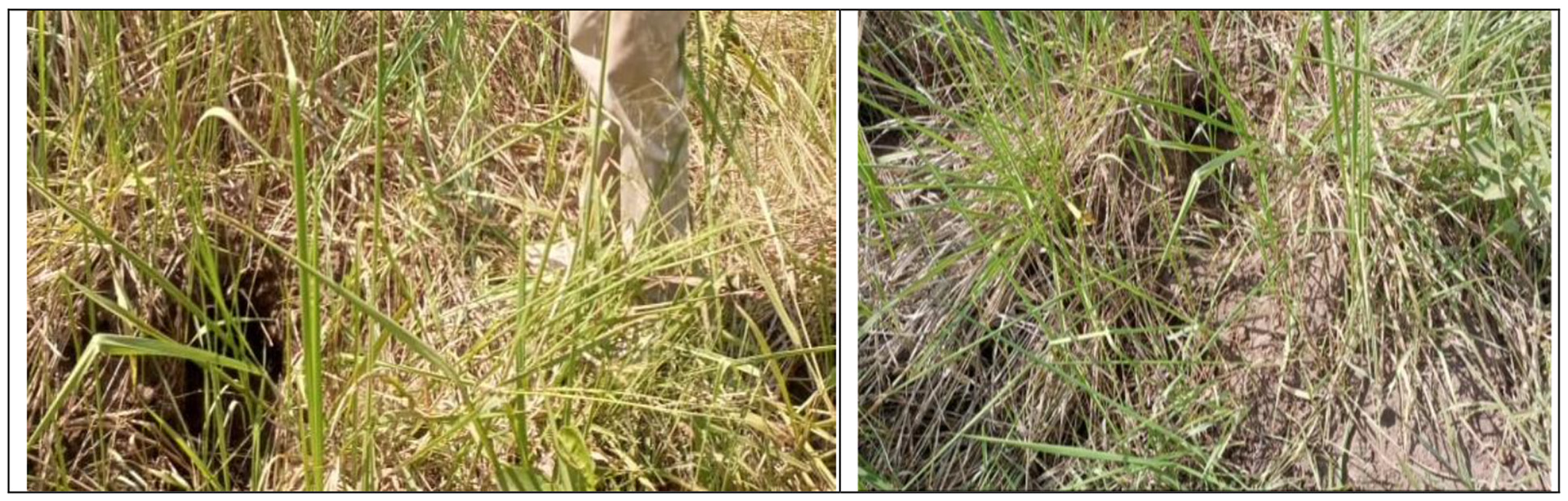
Holes as Boundary Markers in the Case of Orapwoyo Primary School vs. Three Families.
Others dig holes/pits around the contested land. The usually round holes are dug at an interval of five metres. In some cases, the holes are dug in a line. In other cases, holes are dug in between luchoro trees or in the spaces where there are no luchoro trees (Interview 1, 2023). We observed that the holes were up to 1.5 feet in diameter and two to four feet deep as seen in Figure 4 below. In other places, the conflicting parties fill the holes with cement to “ensure that the boundary marker does not disappear with time. But to avoid this scenario, the holes are cleaned by removing the overgrown grasses around them” (Interview 2, 2023). However, the majority of the local communities did not cement the holes due to the high costs involved. The choice of either using holes or planting new trees depends on the preference of the parties involved in the dispute and the convenience and/or availability of the tools.
One informant explained the dynamics of the land boundary demarcation this way: The choice of which item to use in marking the boundary varies. We ask the parties what to use to demarcate the boundary. Some people don’t prefer planting trees because they think a tree can expand in size as it grows and the boundary may be extended. So, the choice is entirely up to the two parties to choose which one they want but not the leaders to decide for them. In making the choice, the two parties consider the cost and availability of the boundary demarcation item. If cementing is expensive, then they go for what is available, like tree planting. Digging a hole is very important but some people may not have the money to cement the holes (Interview 2, 2023).
After demarcating the land either using luchoro or moya trees or using poles, the local people involved in the informal land demarcation often draw sketch maps to show the size of the land. The sketch map also shows the adjoining neighbours on all sides of the contested land. For instance, Sketch Map 1 in Figure 5 shows that the land area is 130 m×100 m. During the informal land demarcation process, it was divided into two portions. The first portion of 76 m×100 m was allocated to Odokonyero, and the second portion of 54 m×100 m was allocated to Opiyo. The informal land demarcation process was overseen by the Local Council One 2 (LC I) chairperson of Omee A cell, and the LC III chairperson of Acet Town Council. Sketch Map 2 in Figure 5 below provides the details of the demarcation in Omoro District.
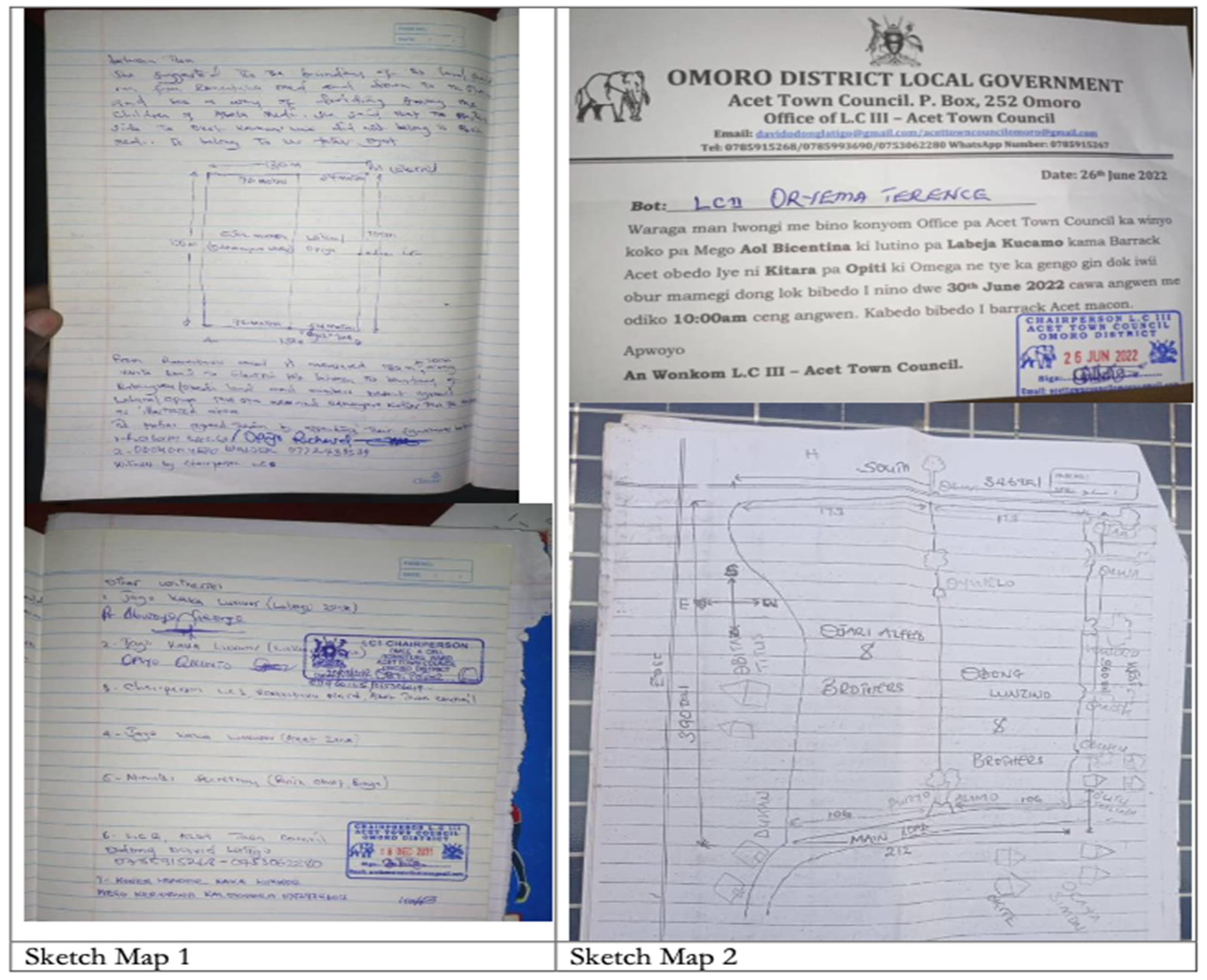
Sketch Maps Showing Boundary Demarcation after Dispute Resolution.
The Informal Land Boundary Demarcation Process
The informal land boundary demarcation process often involves four interrelated stages. The first is reporting and investigation. Here, when a party reports a case, a chief, clan head, or LC I (the choice of which remains the prerogative of the reporting party – often based on ease of access to the leader and the kind of trust they have in the institution) takes the initiative to investigate. The aims are to establish facts about the case, including understanding whether the conflict has ever been reported to any of the five channels through which reconciliation and mediation can be carried out; to eliminate false claims and allegations which would offend another party and tarnish the image of the institution mediating the case (Interview Acet Town Council, 2023); to establish the nature of land relations (family, clan, or individual) for the contested land; and to understand the nature and character of the conflict/dispute (whether violent or non-violent). This informs the choice and final outcome of the mediation and ultimate reconciliation. One respondent noted: The Local Council One (LC I) committee investigates by way of consultation with the neighbours, community leaders at different levels, elders, the chief, and the rwot kweri (boundary knower) to ascertain how legitimate the case is. This is to avoid instances of laying wrong claims to a piece of land (Interview 3, 2023)
Reporting and investigation is followed by mediation and reconciliation, which is overseen by traditional authorities and sometimes also state authorities. The authority to which the case is reported convenes the meeting in a neutral venue where none of the parties will feel threatened or discriminated against. The meeting is attended by the leaders, community members, and neighbours to the contested land for the purpose of listening to the conflict parties and acting as key witnesses during the mediation process. Mediation and reconciliation is considered to be a democratic process for which leaders do not have to dictate to the parties who should chair the mediation. Such a decision will be made by leaders only if the parties fail to agree in principle on their preferred chair. As one respondent revealed, “the contending parties are given a chance to choose and agree on who should chair the meetings during mediation/hearings” (Interview in Layoko Village, 2023). The contending parties are also asked if they wish their case to be heard in the local leadership structures or the courts of law (Interview 4, 2023). The contending parties are taken through the benefits of mediation and reconciliation and the disadvantages of opting for a formal court process, after which they are left to make a decision on whether they still want to proceed with the mediation or embark on a court process. One important observation was that emphasis is put on ensuring that the land conflicts are resolved without necessarily reaching the courts of law. Much as the courts of law always look for “winners and losers” in a land case, the informal land demarcation processes always aim to ensure reconciliation, mutual agreement, and harmonious co-existence of contending parties by emphasising forgiveness, togetherness, and “brotherhood.”
Contending parties’ approval is followed by notifying and inviting the rwot kweri, neighbours, community leaders, and other local leaders in the area. Afterwards, a meeting is convened and the cases are presented. The person who reported the case is given the opportunity to present the issues to the wider community, after which the accused party is also given a chance to tell their side of the story. Discussions are opened for other members to make contributions, with leaders providing guidance where necessary. The rwot kweri is asked to give a historical account of the land boundary in question. One respondent emphasised that when a dispute comes up, we make sure that we engage the rwot kweri to help us resolve the dispute by deploying their prior knowledge of the community lands and boundaries. They help us to point to the original boundaries based on their memory. After establishing the boundaries from the rwot kweri and community members, then a decision is taken. (Interview 6, 2023)
Following the mediation is the process of boundary demarcation, which takes place in many ways. First, if it is members of the same family in conflict over land, the norm is that the land in question is divided amongst the contending parties (Figure 5). When the land conflict involves unrelated community members, the boundary conflict is resolved and trees or poles planted or holes dug around the land. A sketch map is also drawn that shows the extent of the land for each party that is involved. A document spelling out the new boundary demarcation is written and signed by all the parties involved, and an attendance list is attached. For the case involving Orapwoyo Village and the three families highlighted above, the school retained the original copy of the agreement, while the family members (the three families) were given photocopies. The school's head teacher was unanimously selected as the secretary of the mediation meetings (Interview 1, 2023).
Documentation and appeal is the last phase of the process. If one of the parties involved in the conflict is dissatisfied with the reconciliation process by the clan council, chiefs, LC I, and LC II, they then forward their matter to the LC III at the subcounty level. The subcounty courts (local council courts, LCC) hear appeals. The mandate of the LC III is to review the proceedings of the LC I and LC II. Others sometimes choose to go beyond the LC III by approaching courts of law: a practice called legal pluralism (Delville, 2007; Kobusingye et al., 2016; Peters, 2004). However, courts are said to usually serve people with money at the expense of the poor: When complainants get to courts when they do not have money, the courts normally send them back to us. There is no true court in Uganda, most of the courts are corrupted. Court stands with people with money. (Interview 4, 2023)
Securing Land Through Informal Land Demarcations in Northern Uganda
Of the 13 land conflict cases that we examined in this study, 12 were resolved through mediation and reconciliation. Only one case was still pending while fieldwork was being conducted. The delayed disposition of the case was attributed to the fact that one member of the contending parties opted, on the advice of his lawyer, to go to the statutory court rather than engage in the reconciliation process. His choice was attributed to the fact that he could not get what he termed “justice” since his intention was to “get the land rather than share it with his family members fairly.” This was a clear case of the limits of liberal notions of justice, which often leaves people disgruntled and yearning for revenge, and does not necessarily create an inclusive community that lives in harmony with others. Von Benda-Beckmann, (1981), Kobusingye et al., (2016), and Quintero et al. (2014) highlighted that in a situation where there are multiple ways to seek justice, the likelihood of the contending parties engaging in forum shopping is high; this case exemplifies a situation where a contending party thought the statutory authorities would serve their interests better than the traditional processes would. Meanwhile, in all 12 other cases, the parties involved lived together in harmony without any threat or further conflict. Complete resolution of the cases was attributed to the value and respect the community had for community-driven land dispute resolution mechanism(s) and the willingness to listen to leaders, especially elders. It was also attributed to the involvement of multiple actors who play different roles. The multiplicity of actors, and respect for them and the roles they played, were vital to ensuring that corruption did not influence outcomes. Meinert and Whyte's (2023) edited book documented numerous successful land cases resolved through similar approaches (see Anying and Gausset, 2023; Seebach, 2023), and Atkinson et al. (2016: 2) had earlier suggested that traditional leaders across all chiefdoms in Northern Uganda have often managed to resolve land conflicts.
The land conflict resolution process is multilinear and complex, as multiple entities are mandated to carry out the mediation and reconciliation process; however, they often invite each other to be part of the conflict resolution process since they have particular roles to play either in the traditional sense or in the political and technical (state) arena. When asked about the working relationship between all the actors, including traditional authorities and other government authorities, one respondent noted that the traditional chiefs, heads of clans, and community elders are always consulted not only while listening to a land case but also when it comes to land transfers and land sales (where they happen). The traditional chiefs, he explained, have a council comprising 12 people with at least one member knowledgeable of “at least boundaries of some of the land” (Interview 1, 2023). The power of clan elders in land distribution and sale is fundamental, and their involvement becomes paramount in any mediation and reconciliation process. This important role, in most cases, continues despite the ever-waning power of customary authorities – this is evidenced in today's informal boundary demarcations.
Sometimes, the land conflict cases start with internal resolution at the family level. Given a stalemate at that level, the case is taken to the clan leaders. If any party is unsatisfied with the outcome at the clan level, the case is then forwarded to the chiefs. Others, however, choose to go to the local council directly. In the disputes brought before them, the chiefs involve the local council and their team of 12 members (Interview 1, 2023). The involvement of multiple actors and the possibility of having many mediation authorities evince the diversity and complexity of the customary processes of conflict resolution. This broad range of actors also questions the efficiency and effectiveness of the state's centralisation and hierarchisation of land dispute resolution processes. The “informal” thus becomes fluid and allows the contenders in a land dispute many possible choices of which entity to trust (LCs, elders, chiefs, clan heads) for their case, without necessarily having to follow a particular fixed hierarchy. The de-hierarchisation of resolution mechanisms builds trust and confidence in the system.
Nevertheless, informal land demarcation systems have not come without challenges. Our findings indicate that there are many intricate challenges encountered in the process of land conflict resolution, the first of which being the increasing securitisation of land matters, where the Uganda Police Force (UPF) often intervenes even when there has been no violence.
3
Second, there is an increasing decay in the moral fabric “from below” in that the children and youth who were born and raised in the IDP camps do not respect or trust the cultural institutions, which translates into them not respecting the outcomes of the land mediation processes. Third, the local communities pointed to insufficient financial resources to conduct full investigations; to mobilise all the community elders; to conduct mediation, reconciliation, and demarcation processes; and to carry out proper demarcation and documentation. The non-statutory institutions are not funded by the state. Rather, they depend on the goodwill of the local communities. A respondent noted that it becomes hard to get transport to facilitate the elderly to the mediation grounds since most of them come from far. We have to write letters of invitation and transport them. We also have to buy documentation materials like papers and pens and to provide water for the people involved in the process. (Interview 4, 2023) We have a lot of interference by the police during mediation processes. It ends up making things difficult especially in favour of those with money. If we want to succeed in mediating a land conflict, we make sure that we do not involve the police, because they are interested in money. Some people have the money and hire good lawyers. Those who know the law like lawyers threaten us because we have limited knowledge of the law governing land administration. Also, lawyers discourage their clients from going back home for mediation. We are threatened when resolving the land matters. (Interview 3, 2023)
Is “Informal Formalisation” of Land Demarcations Possible? A Conceptual Discussion
The positive outcomes of the informal processes of land demarcation that are underway in Acholiland provide opportunities for rethinking the conception of formalisation in Northern Uganda. These processes might also be suitable to be scaled up to other parts of the country, as land conflicts are a country-wide problem. Our coinage of the concept “informal formalisation” is a critique of the modern-liberal and neoliberal notions of formalisation, which devalue and silence alternative and/or context-specific modes of land relations, dispute resolution, boundary demarcation, and communal transformation. This conception emerges from the land boundary demarcation processes “from below” as practised in Northern Uganda. It aims to counter the logic of formalisation while recognising the “positive” aspects that the state laws provide. The word “positive” is used here to refer to aspects of the law that are acceptable to the local populace. In other words, we rethink the binary between “formal” state laws “initiated from above” and informal norms “initiated from below.”
The conceptual framing of informal formalisation is not intended to give primacy to neoliberal formalisation but to show how society in Northern Uganda has transcended the normative formalisation processes to deal with land problems without necessarily and wholly adhering to the principles of neoliberalism, capitalism, and liberal state jurisprudence. Given the fact that informal land demarcations are reducing land conflicts in Northern Uganda, it could be a good starting point to imagine possibilities of supporting similar processes where similar challenges exist and to extend the same logic (though not merely replicating the process, as contexts differ) to other places (without imposing them “from above” on the local people). The idea is to build on the context-specific and socially acceptable modes of land conflict resolution and boundary demarcation that exist in different places. In Central Uganda, for instance, informal land demarcations have existed alongside “formal” modes of boundary demarcation such as modern cadastral systems, although the latter is much more dominant. Despite most land sales and agreements in Central Uganda being conducted and overseen by statutory Local Council Ones (LC I), the boundaries of the land pieces sold are marked by local flora such as empaanyi 5 (dracaena fragrans), biroowa (jatropha carcus tree), or olukone (euphorbia tirucalli). Similarly, lucooro trees (arythrina abbyssinica) are used to demarcate land boundaries in Northern Uganda. In Eastern Uganda, land boundaries are marked using ebiroowa, olukoni, or ensalosalo/emyaala (loosely translated as “waterlogged trenches”). The challenge has been that much value has been given to modern forms of registration, such as titling and boundary-marking systems (such as mark stones), which have, in turn, devalued the informal land demarcations “from below” (see Lunyago, 2024). Yet these initiatives from below that are socially accepted by a large majority of the populace have enormous potential to avert land conflicts across the country and beyond. The key issue is to promote and support them – and scale them up. This should be done without necessarily codifying the relations and the processes, which would render the outcome of less value or subordinate to the “formal state” process (see Mamdani, 2015).
Alongside demarcation, neither the process of mediation nor that of reconciliation is unique to Northern Uganda. These processes continue to unfold in other parts of Uganda, such as in the Eastern region. In Karamoja, for instance, arbitration, negotiation, and reconciliation are very common. They are conducted through “Ekeno (Family meeting), Etem (Village meeting), Ekitoe (Inter-village meetings), Ekokuwa (Community court), Akiriket (Council of Elders)” (Lokwang et al., 2019). The result of such processes is boundary demarcation by way of “planting trees, marking of boundaries, and sharing of disputed land,” with the aim of peaceful conflict resolution and avoidance of post-mediation violence. The “gestures of peaceful conflict resolution” in Karamoja include “Akimala (shaking of hands/greetings), Akilot ngakan (washing of hands as a sign of total reconciliation), Akitoolim (sprinkling with water) or Ngikujit-chyme, Akimuj Kaapei (eating together [from] one container)” (Lokwang et al., 2019). These processes resonate with the mechanisms that are unfolding in Northern Uganda. Leveraging it and scaling it up could prove fundamental to reducing land-related conflicts but also to theorising responses from below. Our analysis and theorisation calls for rethinking the land question – especially land conflicts – to centre responses and articulations from below by way of taking seriously the local knowledge systems, processes, and practices on their own terms. We take as our starting point the concrete ways in which society responds to land contestations and the informal land demarcations as the basis and foundation for rethinking responses to the land question.
The realisation of such a process unfolding remains a huge task for everyone interested in having a violence-free society. On a positive note, informal formalisation is at least working in Acholiland, either as a mode of resistance to normative processes or as innovativeness within a constraining system. This outcome can be attributed to the fact that informal boundary demarcations leverage the tools available in society, meaning those methods are cost-effective and context-supportive. The materials used are locally available and thus easily accessible, since what people have access to is what they can use, and there is not just one single demarcation typology or item considered “legitimate.” Demarcation items are context-based and legitimate as long as society agrees to it – which is a bold rejection of the idea that the state has to sanction what is legitimate and what is not. This restores the agency of society in conflict resolution and peacebuilding.
Conclusion
Informal land demarcation systems that are gradually and progressively re-emerging provide new perspectives on conflict resolution and opportunities for peacebuilding both in Uganda and globally. These processes not only secure access to and utilisation of land by the local communities but also enable the different classes of people to reclaim and repossess their land, and (ultimately) to access justice (often hard to come by in the statutory system). We have shown in this article the numerous typologies of boundary demarcation and boundary demarcation items deployed by the communities to mark the lands, the choice of which lies in the hands of the contending parties. At the heart of the process is the need to build a harmonious society devoid of post-mediation, post-reconciliation, and post-demarcation conflicts. Our examination of informal boundary demarcation has aimed not only to provide an understanding of how everyday responses can reduce conflicts but also to theorise responses from below. The theorisation, coined as informal formalisation, contributes not only to scholarship on land conflicts and dispute resolution but also to historical debates on the informal–formal duality.
Footnotes
Acknowledgements
We extend our sincere appreciation to the local communities of northern Uganda, especially in Gulu and Omoro districts, and the leaders (cultural and local government). We thank Samuel Oneka for his support during our field visits and Milton Rochala for the language translations. We also want to extend our gratitude to Professor Adam Branch for his generous comments on our initial draft. We thank the funder International Peace Research Association Foundation, for funding the research.
Data Availability Statement
The data can be shared upon request, given the sensitive nature of the study, as it contains participants' names and addresses.
Declaration of Conflicting Interests
The authors declared no potential conflicts of interest with respect to the research, authorship, and/or publication of this article.
Ethical Approval and Informed Consent Statements
No ethical approval was required for this research.
Informed consent to participate in the research was verbally obtained from all research participants
Funding
The authors disclosed receipt of the following financial support for the research, authorship, and/or publication of this article: The research for this article was funded by the International Peace Research Association Foundation (IPRA).
