



Abstract
Struggles revolving around questions of land access and control occupy a central place in the political and social life of contemporary Cambodia. In this study, we examine three cases of struggles against economic [State] land concessions. In a context of unequal power distribution among the actors involved, we elicit the place of the peasantry and its agency to resist and engage in negotiations with multi-level State authorities and market actors. We show how conflict management occurs through hybrid institutions to produce contingent rules that are specific outcomes of the negotiation between actors. Despite the shrinking space of contestation in Cambodia, these contingent rules reveal that opportunities for negotiation can be created for smallholder farmers to protect their land resources. Beyond the specificities of each particular conflict transformation trajectory, we also argue that State land management is a dynamic process that combines a calculus by authorities to retain social legitimacy and reproduce their sovereign power in respect of land.
Introduction
In contemporary Cambodia, the neo-liberal rules and aspirations for development are entrenched in patronage-based and authoritarian forms of governance wherein the boundaries between public and private interests are blurry (Hughes, 2003; Springer, 2010). In the land sector in particular, the contradictions inherent in this multiplicity of norms have had important socio-economic impacts on smallholder farmers as well as political implications for the State (Un and So, 2011). In fact, tensions and struggles revolving around questions of land access and control occupy a central place in the political and social life of Cambodia: they shape the agrarian dynamics that affect the lives of a large number of smallholder farmers, and they animate the media discussions daily and are the subject of multiple political manoeuvres at all levels.
Claims to land are particularly disputed when they relate to the management of State land, a fuzzy category produced and mobilised by the State in its development and territorialisation efforts (Dwyer, 2015). State land can be categorised as State Public or State Private land. State land is identified as Public when it provides services to all citizens, but it can be reclassified as State Private when it loses its public interest use (Royal Government of Cambodia, 2011). Even if the ownership remains with the State, the reclassification is significant as State Private land can be transferred to the private sector either by sale or by concession. Yet the definition of “public interest” is a relative notion left to interpretation by State representatives. As State land is not publicly delineated, 1 State authorities can basically declare State Public or Private land to be anywhere. And in a context of patronage-based deviant governance, State land management is thus often directed to private interests through capture by State representatives, local elites, and foreign investors.
The upsurge in conflicts on State land also reflects a shift in the agricultural development model in Cambodia. While smallholder farmers were at the centre of agricultural development efforts in the 1980s and 1990s, they are now increasingly subordinated to and excluded by processes that promote foreign direct investment and large-scale agricultural modernisation. The government has granted large economic concessions to domestic and foreign companies for agro-industrial investments 2 on land deemed to be underdeveloped and supposedly extraneous to public utility. The premise is that large-scale concessions would support national development, creating employment opportunities in rural areas and restoring “degraded” land (Neef et al., 2013). But companies who are granted a concession contract often encroach upon land that is already cultivated or used by smallholder farmers as farmland or common pool resources, resulting in direct impacts on their livelihoods.
At the core of the issue are competing claims to land between smallholder farmers and State authorities. The starting point of our investigation is that the way in which these contradictions are addressed could potentially reveal something about the nature of power and State formation processes in contemporary Cambodia.
The different land dispute resolution mechanisms are seen as notoriously biased, politically, and usually unaffordable for smallholder famers (Cambodian Center for Human Rights, 2013; Leuprecht, 2004; Subedi, 2012). A more recent period of repression in respect of social movements and the intimidation of land right activists by the State has further limited the spaces of contestation and critical dialogues (Schoenberger et al., 2018). However, besides an increased authoritarianism, we suggest that spaces of contestation and resistance exist. Our story is based on three case studies that typify land struggle situations during which people have attempted and partly managed to protect their land and livelihoods against economic [State] land concessions. Conditions of successful resistance have received only scant attention in the Cambodian literature on land relations (Baird, 2017). With this in mind, we are interested in learning from conflict transformation processes to understand the conditions under which land resistance operates more or less successfully. We argue that the arena of conflict management entails its own political opportunity structure and occurs through the production of hybrid institutions, which are contingent outcomes of the negotiations between the actors. Beyond the specificities of each particular conflict transformation trajectory, State land management is a dynamic process that combines a calculus by authorities to retain social legitimacy and to reproduce their sovereign power in respect of land.
This article is organised into four parts. First, we frame the argument drawing on State formation theory and land conflicts. Second, we present our research methods and the profiles of the land conflicts discussed in the case studies. The third section provides a detailed description of the three land conflict transformations: the interplay between stakeholders and their outcomes in terms of smallholder farmers’ land rights. Finally, we discuss how the cases inform State formation processes in Cambodia.
Framing Conflicts in State Land Relations
In this article, we situate the mechanisms of State formation within what Sikor and Lund (2009) present as the mutual production of a socially legitimate authority and land property rights. The authors suggest that a relationship is nurtured between the authority that sets rules to allocate and secure access to the land and those who use this land. A relationship is produced because the process of supporting or complying with norms and rules regarding the allocation of resources works to legitimise those with the authority to implement the rules. In contrast, the process of contesting or resisting these rules tends to discredit and weaken those with the authority in charge of these rules. A conflict on State land signals a rupture in this “contract” between those representing the authority of the State and the farmers (Lund, 2016). We thus suggest that the attempts to address this fracture engage a confrontation and negotiation in State land relations.
Building on a rich literature relating to land conflicts and State-making in Cambodia, we specify this theoretical point of departure in three ways. We first envisage land conflicts as dynamic processes. Research on land conflict resolution and subsequent State formation processes reveals that efforts to resolve disputes involve complex negotiations with various levels of State authorities having different power relations and practices that change over time (Young, 2016). In particular, we do not see the State as a static power. It changes tone, position, and tactics depending on pressures and opportunities. The literature refers to the notion of “political opportunity structure” (Tarrow, 1994), which suggests that the change in power structure opens windows of opportunities for rural movements to resist. In 2012, for instance, the government issued an order (known as Order 01) that established a moratorium on new Economic Land Concessions (ELCs). Order 01 also initiated a process of revision for ongoing ELC projects as well as a land titling campaign aiming to provide smallholder farmers with land tenure security when their land rights were disputed by ELCs. Analysts suggest that the measures were politically motivated as they aimed to calm the social unrest ignited by the development of ELCs just before important communal and national elections (Biddulph and Williams, 2017; Grimsditch and Schoenberger, 2015). But as Schoenberger (2017) also argues, Order 01 created a rupture in the pre-existing tenure arrangements by sending agents of the central State out into the frontiers. Recently, the government established a countrywide initiative based within the Ministry of Land Management, Urban Planning and Construction to address land conflicts (Sek, 2017). It also reorganised the National Authority for Land Dispute Resolution to investigate and resolve high-profile land disputes and oversee land dispute resolution by the Cadastral Commissions and relevant authorities (Pech, 2018).
These initiatives, such as the upland titling campaign, ELCs evaluation or countrywide campaign to tackle land conflicts, raise all sorts of questions which cannot be addressed here. But given the resources mobilised by the government to implement them, they clearly indicate that the authority of the State is increasingly responsive to the erosion of its legitimacy resulting from abuses of land rights, particularly those of smallholder farmers.
Second, despite authoritarianism, the sovereign power of the central State is exercised through or challenged by a series of actors – at subnational and supranational levels – that all have a certain level of autonomy and some capacity to influence the course of actions. These complex webs of State authorities can either enhance or hinder land conflict resolution mechanisms. But land relations are animated by a large diversity of actors going far beyond the State and smallholder farmers. They also involve a constellation of networked actors, more or less visible (Schoenberger and Beban, 2018). Agency by local smallholder farmers and their internal and external networks may influence and reshape the political opportunity structures to pressure State authorities involved in land dispute resolution initiatives (Baird, 2017; Verkoren and Ngin, 2017).
Third, the pressures put on the State to address land conflicts are increasingly coordinated and result from the multi-scalar collective action of community, civil society, and transnational actors over space and time (Beban et al., 2017; Young, 2017). Power is unequally distributed among the actors involved, yet it is not always exercised in a coercive way. It also works in more subtle ways through informal political–business networks that are the fabric of patronage politics and are definitively a key aspect in political decision-making in Cambodia. These networks constitute what Beban et al. (2017) call the “power of informality,” which interacts with formal rules of law (Ngin and Verkoren, 2015). Similarly, inharmonious practices among State actors “through their everyday negotiations and actions to accumulate land and capital” complicate and exacerbate State-making processes (Mahanty, 2017).
Land Conflicts on State Land in Cambodia: The Magnitude of the Problem
Several organisations are committed to monitoring land conflicts in Cambodia, including governmental bodies. The figures they release differ because the methodologies and criteria used to compute them are based on different definitions of conflicts and rely on different sources of information. However, they all suggest that the magnitude of the problem is significant.
During the period 2000–2013, land conflicts and resultant evictions affected 770,000 people (ADHOC, 2014). According to the data collected by LICADHO (2014), the number of people affected by State-involved land conflicts between 2000 and 2014 passed the half-million mark. Based on a monitoring of media sources and reports from network members, the NGO Forum on Cambodia (2015) reported that a cumulated number of 352 land disputes broke out between 1990 and 2014, of which 77 per cent remain unresolved.
The problems have worsened as a result of the granting of ELCs. A total of 286 contracts relating to large-scale plantations were established in Cambodia by the end of December 2012 – all of these are located in the peripheral upland regions of the country – covering a total area 2,188,413 hectares, 92 per cent of which consists of ELCs. However, the rise in conflicts resulting from ELC mismanagement incentivised the government to issue a moratorium on new concessions in 2012 and initiate a full review of the existing ones. This is ongoing. In total, more than 30 ELCs have been cancelled, while 126 have been revised suggesting a total area decrease of 779,338 hectares. As a result of this reform, the total number of large-scale plantations has been reduced to 255, covering a total area of 1,401,551 hectares, 87 per cent of which consists of ELCs (Diepart and Sem, 2018). This shows that the issue of conflicts that has ignited the land concession landscape has been taken seriously by the government.
Up to 2015, 158 ELCs caused conflicts affecting 35,604 households or 134,309 hectares of land (NGO Forum, 2016). In 2014 alone, ELCs caused 86 land disputes, affecting 17,150 households or 78,890 people (NGO Forum, 2015).
Research Methods
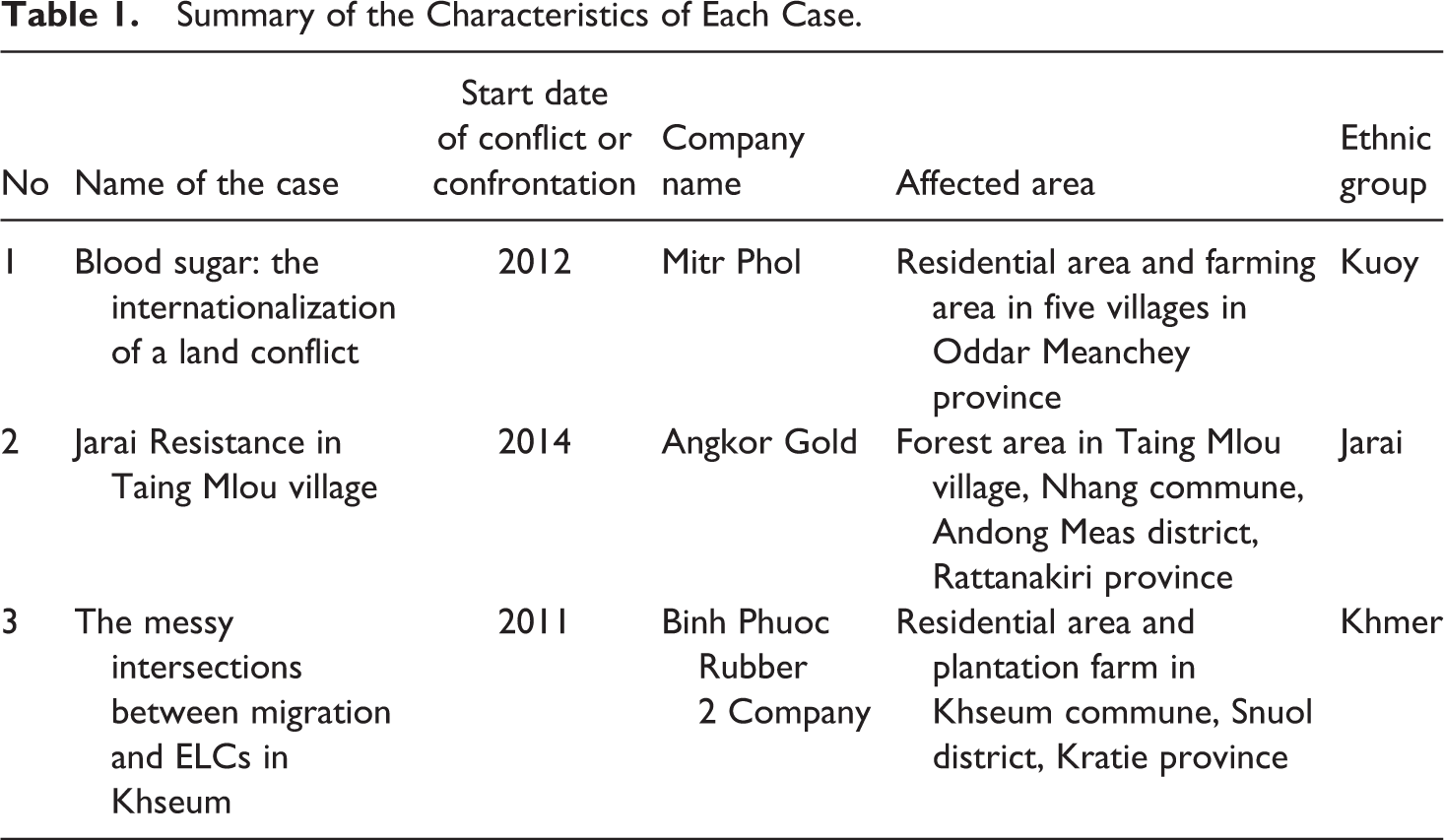
This study analyses three cases of land conflicts in three different provinces. These cases were selected because they present situations in which people in the communities who are affected have attempted to protect their land and livelihoods against land encroachment – and have partially succeeded. For each case, we elicit the place of the peasantry and its agency to resist and engage in negotiations with a complex web of actors including multi-level State authorities, markets, and civil society actors. The cases – presented in Figure 1 and in Table 1 – are located across the northern regions of the country. They involve different ethnic groups including indigenous peoples and investment companies from different countries in the Mekong region. The blood sugar case in Oddar Meanchey province involves a sugar cane plantation managed by a Thai company interested in selling sugar to Europe under the duty-free Everything But Arms (EBA) mechanism. The plantation is located in a frontier area in the north of the country (Figure 1) and has affected five villages. The area is home to the Kuoy, an indigenous ethnic group, but has also taken in a large number of Khmer migrants from different parts of the country. These migrants are mainly engaged in cassava production, but there have also been attempts by a local group to protect the forest through Community Forestry arrangements. The resistance case in Rattanakiri has involved the village of Taing Mlou, populated by the Jarai community who are an indigenous ethnic group living in Cambodia. The village is situated on a hill measuring 5 km2 that, until the end of the 1990s, was covered by dense forest and agricultural land mixed in a swidden mosaic. Since 2007, the whole region surrounding the village has been influenced by agricultural (rubber and cassava) and mining concessions (gold). The land use is now dominated by agro-industrial crops – rubber, cashew nut, and cassava plantations, as well as rice fields. Unlike the case outlined earlier, there are no in-migrants as the Jarai do not allow outsiders to settle in their village. Khseum commune consists of seven villages located in the Snuol district of Kratie province. The area was subject to timber logging operations in the 1990s under a forest concession acquired by the Samling Group. Samling ceased operations in 1999, but the roads built to transport timber logs facilitated subsequent illegal logging activities and also provided an opportunity for clearing forests for cash crop cultivation. The rapid and massive development of agriculture has attracted a considerable number of immigrants from different corners of the country. The commune is situated on fertile red soil that is favourable to agro-industrial development, especially rubber. The main investor is Binh Phuoc, a Vietnamese company named after the Vietnamese province adjacent to Kratie. Binh Phuoc is a member of the Vietnamese Rubber Group.
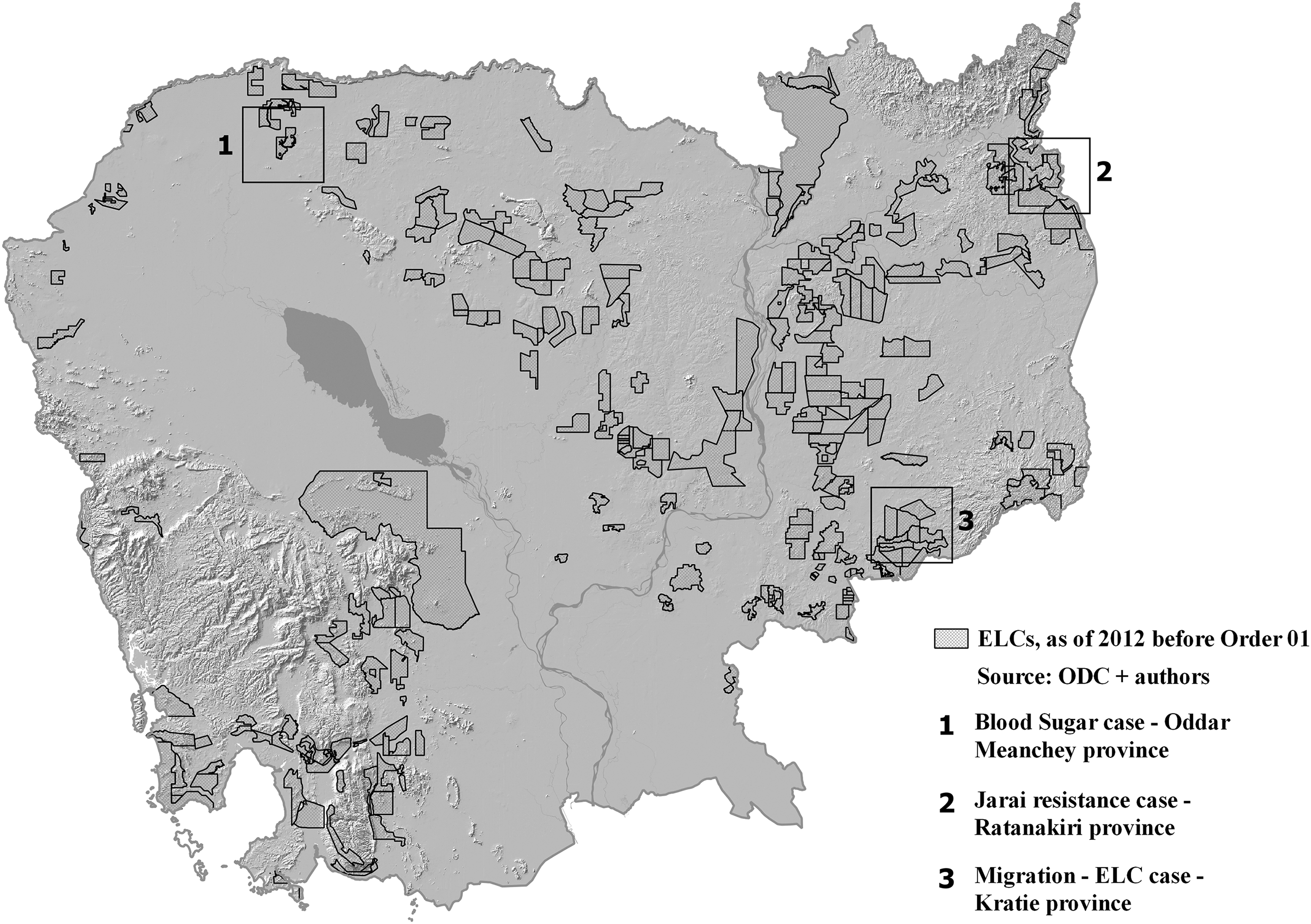
Location of Case Studies (mapping by the authors).
Summary of the Characteristics of Each Case.
The research emerged and was conducted in the context of a learning alliance involving a number of national organisations interested in collaborating to study land conflict transformation processes. The research process was supported by the Mekong Region Land Governance project. The third author took the leading role in coordinating fieldwork. The first and second authors are responsible for framing the analysis. The investigation into the cases is primarily based on the field research that took place from December 2015 to early January 2016. The field team consisted of three people who spent approximately one week in each location. They conducted a total of twelve key informant interviews (including with representatives from community-based organisations) and organised five focus group discussions involving a total of forty five participants. We also undertook interviews with representatives from legal organisations to gain an insight into the conflict resolution from their perspective. The field research team also benefited from their personal familiarity with the three locations, having been involved in field research in those areas since 2014 and even earlier in the case of Khseum commune.
Blood Sugar: The Internationalisation of a Land Conflict
Context and Origin of the Conflict
In 2001, the European Union (EU) launched the EBA initiative to provide duty-free access to the European market for less developed countries (Equitable Cambodia & Inclusive Development International, 2013). The initiative aims to promote economic growth through agricultural investment, including in sugar cane plantations. Seizing this opportunity, Thai companies jumped into the sugarcane business in three provinces of Cambodia: Koh Kong, Kampong Speu, and Oddar Meanchey. In Oddar Meanchey, the Ministry of Agriculture, Forestry and Fisheries (MAFF) and the Ministry of Environment granted 17 ELCs covering an area of 108,019 hectares (Sherchan, 2015). Of these, Angkor Sugar Company, Cambodia Cane and Sugar Valley Company, and Tonle Sugar Company were granted ELCs in February 2008 for sugarcane production, covering a total of 33,846 hectares. These companies are related to the Thai sugar giant Mitr Phol (an important sugar supplier to Coca-Cola) and have an affiliation with Ly Yong Phat, a prominent tycoon and ruling party senator in Cambodia (Equitable Cambodia & Inclusive Development International, 2013).
In 2008, conflict over land was ignited between the sugarcane companies and the villagers when the companies’ guards started to demarcate their concession area. The companies also undertook a series of actions to clear the land and forced villagers to move out. Of the twenty six villages reported to have been affected by the actions of these three companies, O’Bat Moan and Bos villages suffered the most severe impact. In 2008 and 2009, 214 families from both villages were forced to leave their residential land, and their houses were burned down by security guards and hired military personnel, working in agreement with local authorities (Sherchan, 2015). In addition to the affect they had on residential and agricultural land, the three companies also grabbed almost half of the originally proposed area of the nearby Community Forest (Rattanak Ruka) initiated since 2000 and consisting of 26,036 hectares of evergreen and semievergreen forestland.
Conflict Transformation Processes
At first, the villagers had no inkling of the existence of the land concession projects as they were simply not consulted during the identification process. 3 The presence of surveyors hired by the companies, and the initial demarcation of land, came as a surprise to them. In response, the villagers turned to the local authorities and the companies for an explanation. In 2008, the villagers gathered in front of the company office in Samraong, the provincial town. As is often the case in such circumstances, the companies refused to negotiate, arguing that they were in legal receipt of the land from the government. Later, villagers approached the provincial governor who convened a meeting with the company representatives who reiterated that the concessions had been granted on State land and that the communities were thus not affected. The villagers filed a petition to the cabinet of the prime minister, the Ministry of Interior, and MAFF. In response, the deputy provincial governor promised to address the issue and find a solution.
In 2008, an ad hoc Dispute Resolution Committee was established to examine the conflict. The committee consisted of representatives from the municipality, the Cadastral Commission, the Forestry Administration, the District Chief, and the police and military law enforcement. This committee was first tasked with assessing and preparing the list of agricultural lands that formed the territories of each village. The committee then surveyed the land claimed by villagers that fell within the concession area and found that a total area of 9,428 hectares was claimed by both parties.
As a result, the provincial governor agreed to return cleared, claimed, and cultivated agricultural land to the villagers via a land swap mechanism to relocate the agricultural land of the families affected by the concession. The Dispute Resolution Committee undertook a detailed survey of the area using global positioning system, and the commune and village chiefs were asked to find vacant land in their villages to provide compensatory land for villagers. But due to limited land availability in the commune, the area identified for the agricultural land swap was already occupied by families, who were asked to allocate part of their land to the newcomers. At the end of this long land swap process, 3,588 hectares were provided for the families affected in exchange for the 9,428 hectares lost to the company. The solution was unsatisfactory for everyone. It made the original occupants of the area identified as land swap angry about and resentful of the newcomers who received some of their land. Likewise, the villagers affected by the land grab were unhappy because they had lost more than half of their land, and the agricultural land that was provided in the swap was poor with rocky soil.
To execute the land swap, the recipients had to sign a contract named “Resolution to End the Dispute between the People and said Companies” containing detailed information about each recipient’s household and the amount of land being accepted. Even though the villagers were still frustrated with this land swap, the majority accepted this contract because they were afraid of receiving nothing amid threats and violence.
In the process, the villagers also turned to civil society organisations for assistance. This move was successful as a number agreed to provide legal support. These support groups launched national and international campaigns to demand justice and fair compensation. Domestically, they helped villagers to send petition letters to the local and national authorities for intervention; internationally, they created a campaign to persuade international organisations, governments, and companies to put pressure on the “offending” companies. They particularly urged the EU to advocate for the placing of restrictions on the import of sugarcane from Mitr Phol on the grounds that this company had failed in its basic commitment to human rights law (Equitable Cambodia & Inclusive Development International, 2013). In a series of meetings with government officials, the EU ambassador to Cambodia said that they had made good progress on the issue of Mitr Phol and on compensation for the villagers in Oddar Meanchey who had been affected. 4
In a parallel process, another campaign was initiated in partnership with the National Human Rights Commission of Thailand (NHRCT) to put pressure on Mitr Phol to stop human rights violations committed by their sugarcane business in Oddar Meanchey and to provide reasonable compensation for villagers who had been affected. The NHRCT was persuaded to join the investigation and to support the dissemination of the results. In a dissemination workshop in mid-2015, the Thai committee presented the results from the investigation, which highlighted the severe impact the sugarcane business has having on villages, especially those of O’Bat Moan and Bos. The committee urged the Thai government to take action against the company, especially to encourage the provision of compensation to cover the villagers’ losses.
Outcomes
As a result of these campaigns and because the financial risk of bankruptcy was too high, the companies withdrew and their concession contracts were cancelled. A few local villagers subsequently came back to cultivate rice on their former land. However, by early January 2016, only ten families had returned to cultivate land that had been part of the dispute. The other families indicated that the prevailing uncertainty about the future of the disputed land discouraged them from returning and investing in it. However, the land from the cancelled concessions is still under the management of MAFF, and it is unclear what will become of it. Will it be reallocated to the smallholder farmers as pledged by the government during the implementation of the Order 01, or will it be reassigned as State land and reallocated to another investor?
Jarai Resistance in Taing Mlou Village
Context and Origin of the Conflict
In 2007, the Jarai 5 community in Taing Mlou village experienced their first exposure to a foreign company – specifically, a rubber and cassava company named Pram Pi Makara. 6 Back then, the company and local authorities explained to the local people that they wanted to bring development to the village by building new roads and schools and by creating new employment opportunities. The company tried to convince the elders by promising to give back the plantation land to the community after they had finished operations. However, Jarai villagers were successful in resisting the proposed encroachment by this company and managed to protect their land.
Four years later, a company called Angkor Gold came to conduct mining exploration in Taing Mlou. Angkor Gold is a Canada-based company that started operations in Cambodia in 2009. At the initial stage, Angkor Gold’s main activities focused on gold and copper mining exploration in the Northeast area of Cambodia. In 2011, a Memorandum of Understanding signed between the Ministry of Industry, Mines and Energy and the Angkor Gold Company paved the way for the company to acquire licences – for exploration purposes only – over a total area of 1,556 km2 in Rattanakiri province. In April 2014, a Chinese consortium became the major shareholder in the company and injected more than USD 10 million to boost exploration activities in Cambodia.
Group discussions with the village chief, prominent young leaders and elders, and key informant interviews conducted on 26 December 2015, confirmed that, in 2011, the company had sent workers and experts to dig and drill land in different locations in Taing Mlou to test the level of mineral deposits in the area. The presence of the company’s workers was a source of concern for the villagers, who started meeting to discuss the land digging activities and to mobilise internal resources through discussions among fellow villagers. With the support of partner NGOs, the villagers discovered that those workers were affiliated with the Angkor Gold Company and, as other Jarai communities in Oyadav district 7 could verify, they had already cleared spirit forestland.
The villagers’ wariness of outsiders, coupled with intrusion on their land by the company employees, became the root cause of complaints.
Conflict Transformation Processes
From 2012 to 2015, the company arranged three formal meetings with the villagers. They came to the village and presented the results of their mining exploration as well as the measures they would be taking to reduce the impact on farmland, trees, and water quality. They told the villagers that the mining exploration would not affect even small trees because they would drill only small holes to acquire samples for experiments. In addition, the company promised to build new roads, schools, and ponds and to bring electricity to Taing Mlou village. However, all this was received with by the villagers with great scepticism. In addition to the three formal meetings with the community, the company also sent its people to conduct interviews with every single family in the village. But their efforts to persuade the villagers to accept the mining operations failed.
One local village leader described the atmosphere at such village meetings in the following way: They brought a lot of biscuits and beef to the meeting. They asked us to eat, but we refused to eat their food. So, the company representatives told us to show them some respect because of their willingness to offer food for the villagers. However, the villagers responded that they were afraid that, after eating beef and biscuits, they would lose their land. Thus, they preferred not to eat in order to protect their land.
After the failure of conciliation and the soft communication approaches, the company started trying to scare the villagers with violent threats. A few times, the representatives of the company (Khmer workers) and local authorities told the villagers that they would use military force or security guards to deal with the Taing Mlou people. However, this failed to frighten the villagers or to deter them in any way: indeed, it might actually have strengthened their collective voice. They stood firm in protecting their natural resources regardless of the consequences. The roles of the traditional elders and the community chief were key here. As the leaders committed to protecting land and forests, they had a strong role in influencing the thinking and practice of the community. They placed more importance on the mobilisation of the villagers against the company than on their relations with higher authorities as they rarely joined meetings convened by commune authorities. Two respondents (a young man and an old lady) told us that women played a crucial role in the campaign to protect their resources. In one of the meetings, the women told the company representatives and local authority that “we are strong and we could serve in the army if needed. We are committed to protecting our resources even if we become physically impaired.”
Later, villagers were also invited to join meetings chaired by the commune chief. These meetings were among other attempts to persuade the villagers to allow the company to start mining exploration in Taing Mlou and to re-emphasise that this would bring development to the village. But despite a few attempts by the commune authorities, the villagers in Taing Mlou remained united in their resolution to deny permission for any concessions in their community. The villagers told the local authority that they were not against development initiatives, but that they wanted development that was not harmful to their land or forest. One prominent male villager (aged around thirty) said: “we want development to allow us to go and buy products from the market while we continue enjoy meals on our forestland; we do not want development to drive us out of our land.”
After prior consultation with the company, the commune authority presented two proposals to the villagers. The first consisted of a study tour to visit Lumphat to see other villages that had experienced mining exploration. They invited fifteen villagers from Taing Mlou to take part, but the villagers refused the offer because they were afraid of being cheated. Second, the commune authority proposed a joint trip into the forest in order to identify the resource boundary and jointly delineate mining exploration areas. The villagers also rejected this offer, saying that they had no reason to take a separate walk into the forest because they went there often to collect non-timber forest products.
The commune authority then started to threaten villagers arguing that there was little hope that they could fight against the company who had already received an exploration licence from the central authority. However, the villagers maintained their stance. During negotiations between the villagers and the district authority, the village representatives refused to allow the company to enter their village, and the district authority blackmailed by threatening to isolate the community from any further development interventions. Commenting on the episode, some respondents told us even if we are given dollars, we do not know how to use them. We are illiterate and we do not know how to live on fresh air. We only know how to live from our land. Thus, we have to protect our land and forest for our livelihoods.
Outcomes
The villagers had the last word and the company withdrew. The strategy deployed by the Jarai community in Taing Mlou was to refuse cooperation with the company representatives regardless of the efforts they and the local authorities made. The villagers were firmly united in protecting their resources because they had a robust internal strength that resulted from their past experience with agricultural concessions. The practice of their traditional customs in respecting their leaders (Mekantreanh) appeared to dominate. They listened to the advice and decisions of their leaders because they were seen to work to protect their people’s interests. It was noteworthy that the leaders in the village set up an informal group of elders, comprising about fifty people, to be advisers to the village with the role of monitoring the general situation of the village and helping to resolve potential problems. As a result, Angkor Gold has never been to the village areas for exploration purposes.
The Messy Intersections between Migration and ELCs in Khseum
Context and Origin of the Conflict
Since 2004, the population of Khseum commune (Snuol district, Kratie province) has significantly increased due to the in-migration of people from lowland regions of the country. As a result, the existing villages have expanded significantly to create sub-village clusters (krom). Initially, Peam Por Obei and Trapaing Chhouk were clusters in Srae Thmey village, one of the eight villages of Khseum commune. 8 This area was recognised as a krom by the commune authority in 2012. Subsequently, the continued influx of migrants led to the formation of a new sub-village area named Trapaing Chhouk, consisting mainly of houses stretching along a road from Peam Por Obei. The migrant population has come to these areas in search of new land for residence and for agriculture. In 2008, 60 migrant families came to live in the Peam Por Obei area, and, in 2009, another 181 arrived. By 2012, there were 405 new migrant families installed in the area 9 of Peam Por Obei and Trapaing Chhouk.
Such migrations away from central plain areas are representative of a wider process across Cambodia. These movements are primarily driven by a search for agricultural land and, to a large extent, they can be seen as an expression of the agency of peasant households in responding to rural poverty (Diepart et al., 2014). However, the migrant population has little security in respect of land tenure under the 2001 Land Law institutions because the land they appropriate is classified as State land.
Between 2010 and 2011, ELCs were granted to five companies in and surrounding Khseum commune: the Memot Rubber Plantation (2010), Sovann Vuthy (2010), Trach Nhiem Han Dau (2010), Binh Phuoc Kratie Rubber 2 (2011), and Eastern Rubber Cambodia (2011). The Vietnamese rubber company, Binh Phuoc Rubber 2, has been in conflict with the local communities in relation to its operations in the Khseum commune since 2011 because the concession covers the new settlement area of Peam Por Obei and Trapeang Chhouk mentioned earlier. 10 The conflict was ignited in 2011 when people living in Peam Por Obei encountered some people – claiming to be representatives of Binh Phuoc Rubber 2 Company – while they were marking ELC boundaries with cement demarcation poles.
Conflict Transformation Processes
In 2012, during the land titling campaign known as Order 01, 300 plots of land were recognised by a temporary letter (chong sanleuk) from the students who were in charge of the titling efforts. 11 However, the land was not measured and no land titling was delivered. Afterwards, in order to gain more tenure security on their land, representatives from Peam Por Obei and Trapeang Chhouk submitted a request for land registration to the district authorities. The request aimed to obtain titles on a total area of 2,025 hectares based on the assumption that each of the 405 households would receive 5 hectares.
At the same time, the communities of Peam Por Obei and Trapeang Chhouk have been threatened with land encroachment by a group of people claiming to work for Binh Phuoc Rubber 2 Company. Without any response from the local authorities – especially at the district level – some community leaders submitted a complaint to a Cambodian NGO working on land rights. However, this request related only to a close-knit group comprising 104 households who occupied around 200 hectares of farmland. These 104 households consisted of migrants coming from the same region who were bound by stronger social ties with their fellow migrants than they were with the group of 405 households as a whole.
In 2012, after receiving the complaint document from the villagers, the Cambodian NGO started an investigation and provided legal support to help the villagers who filed it (the 104 households). In the process, the District Land Management Committee conducted a survey to check the legality of the people’s settlement. They explained that the 104 families were living in a State forest area under the management of the Forestry Administration, which had been allocated to the company. However, the company agreed to concede the 200 hectares claimed by the 104 households and to dig a ditch to delineate this area from their concession land.
This manoeuvre put the other 301 households living in the Peam Por Obei and Trapeang Chhouk area in a difficult situation as they were excluded from the deal although some of their land was also located inside the concession licensed area. This created tension, resentment, and a split in the community. But the determination of the 301 households was undiminished, and they continued their advocacy campaign to target elite politicians and national authorities. They submitted a request for a Social Land Concession (SLC) to the national institutions – especially the cabinet of the Prime Minister Hun Sen. SLCs are tools the government has promoted to address the problem of landlessness and near landlessness. They constitute a legal mechanism to transfer Private State land for social purposes to households who lack land for residential and/or family farming purposes.
The villagers also asked the provincial authority to intervene and received promises that this would happen after the national elections in July 2013. But, to the people’s consternation, the national elections came and went with no activity, so they filed another complaint to the national authorities. The complaint strategy included the submission of petitions and a letter of intervention, the organisation of protests, and a long march from the village to Phnom Penh. The march comprised about 100 people who walked to the National Assembly and the cabinet of the prime minister. As a result, an intervention letter (instructive letter) was issued to the subnational government, especially the provincial governor, for appropriate action.
The Binh Phuoc Rubber 2 Company started activity that affected the movement of villagers whose land was inside the concession licensed area. They set up a number of barriers to prevent people from reaching their farms and homes, intended as a warning. They placed security guards along the road to the plantation and prevented access to the farms, which made the villagers furious. To deal with the situation, two human rights NGOs facilitated a meeting with community representatives to start an investigation. They also sent another letter to the provincial governor. As a result, even though both parties could not reach an agreement, in 2013, the company unblocked the road to the plantations and the farms, allowing the villagers temporary access for cultivation.
The first national response to the issue came in 2014 when the provincial governor and a representative from MAFF, led by Deputy Prime Minister Yim Chhaily, met with the villagers. This group of authorities offered 100 hectares to the villagers, which meant that each family would receive less than one hectare of land. Consequently, the villagers refused the offer, which led to another approach submitted, with support from the Cambodian NGOs, to the cabinet of the prime minister, as well as to that of Yim Chhaily.
On 30 April 2014, the company conducted an aggressive demolition of 274 houses, but none of the people moved out. Instead, the outraged householders protested by blocking road number 115. The subnational government did not make a single move. On 5 May 2014, about 300 people went to Phnom Penh, staying at the Samaki Meanchey pagoda, to submit another petition to the government. On 27 May 2014, the provincial governor of Kratie came to negotiate, bringing another offer, and produced a detailed list of the people in the movement and the land areas they occupied. 12 Finally, the people agreed to return home and to accept the 750 hectares of land granted to them as an SLC during this latest negotiation. However, as Lamb et al. (2017) rightly note, there was confusion over who was eligible to gain a plot of land within the SLC because the government did not make explicit the number of families for whom the SLC was intended, nor the criteria for eligibility.
On 2 and 3 June 2014, the commune and district authorities came to identify the families and to give them temporary land receipts. However, the number of families at this point had increased to 746, 13 which was not proportionate to the land size that was initially requested. Because of the constant increase in the number of in-migrants into the Trapeang Chhouk area (which, according to community representatives, had reached 791 households by April 2016), the total land area requested by the people reached 4,275 hectares, amounting to 5 hectares for each of 855 households, which was much higher than the area requested by the communities in the first place (2,025 hectares).
Outcomes
Out of the land claimed by the people, the company returned only 750 hectares. There are now fences surrounding the other contested land, while the remainder is now categorised as State forestland and cannot therefore be used by the people of Peam Por Obei and Trapeang Chhouk. This issue remains unresolved, although the situation between the company and the villagers is now calm, especially in Trapaing Chhouk, which is located within the area licensed by the company.
Resistance and the Transformation of Conflicts on State Land in Cambodia: A Discussion
The three cases have revealed situations in which State land relations were in crisis as a result of the encroachment upon “State” land cultivated by smallholder farmers. But what did we learn from the conflict transformation processes and their particular outcomes? And how does that inform our knowledge about the dynamics of State land management in Cambodia?
Lessons from the Cases
We have presented three cases in which resolution processes have both commonalities and divergences. A common feature was the involvement of NGOs in the advocacy campaigns, the provision of legal advice, and the facilitation of complaint filing. Another common characteristic was the multiplicity and diversity of stakeholders that the villagers approached to seek solutions. Moreover, a lack of trust by the people towards local authorities, particularly at commune and district levels, was a common element in the three cases. Also, these cases pinpointed the absence of the implementation, or the partial enforcement, of the existing legal instruments regardless of which parties in the dispute were in the wrong.
However, these three cases illustrate different resolution mechanisms and varying relationships between stakeholders, which resulted in different outcomes. The Mitr Phol case presents the weak role of State agencies, especially local authorities, in land conflicts that involve a big international company. The resolution process highlighted the fact that the local authorities were not effective, nor were they trusted by the villagers. What worked in this case was the collective and coordinated strategy of NGOs, along with the determination of the villagers to identify the company’s business partners or buyers and launch concerted advocacy campaigns targeting influencers who had a stake in the issue (i.e. the EU, Coca-Cola, and the Thai HRC). Moreover, the company’s economic interests, rather than corporate social responsibility or human rights, compelled it to withdraw from the concession. Even so, this issue remains unresolved, reflecting the weak rule of law in Cambodia.
The Taing Mlou case presents a resolution process that comprised both negotiation and intimidation by the local authorities and the company. This case was unique in that a series of peaceful negotiations were conducted to convince the villagers to allow the company to conduct mining in their village. Moreover, despite various threats, no violence occurred. Two key factors enabled the villagers to safeguard their village from the company’s incursion. First, their vigilance – inspired by the negative experiences of their village and those of others – encouraged them to categorically decline any offer delivered by the company and local authorities. Second, their collective might, embedded in their cultural norms, empowered them to make a unified and firmly footed stand against the encroachment. This social capital, in the sense given by Pierre Bourdieu (1994), was reflected in, and bolstered by their Jarai identity, their traditional practice of leadership, and the current practices of the elderly advisor group and reciprocal help groups (such as the savings group). These cultural and livelihood assets were moulded together to form a mighty, collective bargaining power against the external forces.
The Khseum case illustrates a “political opportunity structure” that the local community employed in the resolution process. Since they had lived on the State land, they took advantage of the Order 01 titling campaign to mobilise authorities at multiple levels and had them check the land situation on the ground. Further, sensing the populist politics, the villagers sought assistance from the political elite, such as the prime minister and a deputy prime minister, before the 2013 national election. They also approached NGOs that offered legal support and facilitated documentation, mediation, and complaint filing. This case illustrates that the social dynamics of resistance can exacerbate the tensions and complicate the conflict resolution when they are not structured and organised to speak with one voice. Moreover, it reveals a lack of enforcement of the existing legal instruments and a tendency to compromise in the negotiation process, which worsened the conflict.
There are challenges in comparing the cases as they each took place in a specific context with particular actors and dynamics, but a comparison does help to identify the different features that led to the varying degrees of success of each case. In the case of Mitr Phol, the intervening NGOs worked in a concerted manner to investigate the conflict, identify the chief influencers within the company, plan coordinated lobby campaigns, and attack the company on an economic front in presenting evidence of human rights abuses. However, in the other two cases, the intervening NGOs appeared uncoordinated in their efforts to assist the villagers in the resolution processes. While the villagers in the three cases approached various levels of State institutions, the communities in the Khseum case were distinct in the sense that they tapped into the opportunities at the right time and with the right actors. This approach to some extent helped them to secure some land even if they were considered illegal trespassers on State land with regard to the Land Law institution. Another divergent pattern was evident in the unity of the communities in the face of threats or violence, and this had a strong influence on the success or failure of the cases. In the Khseum case, the resisting population consisted of an assemblage of different migrant groups who had no history in common. This made the community socially fragile, which enabled outsiders to exploit the resolution process. The bonding ties with communities in the Taing Mlou case were historically grounded, which enabled them to protect their resources from encroachment by external forces. Finally, these cases elucidated two different modes employed by the companies to deal with the villagers. In the Mitr Phol and Khseum cases, the companies used forceful and violent means to evict the people, while the company in the Taing Mlou case used peaceful negotiations and later issued verbal intimidation through local authorities. These tactics elicited corresponding responses from the communities.
From Political Opportunity Structures to Contingent Rules
The cases show that, while formal laws and regulations were referred to during the resolution processes, they were bent, compromised, and manipulated by the actors involved in the conflicts. This occurred in the particular remit of “political opportunity structures” – in the sense of Tarrow (1994) – that are inherent to power dynamics within the State (e.g. Order 01) but also commercial agreements between States (e.g. EBA).
A political opportunity structure is, however, often a necessary but never a sufficient condition for resisting parties to become audible and engage in meaningful negotiations with the State and other parties. It takes not only dedication and courage – given the inherent risks – but also the capacity to mount a collective action. The agency of the communities to organise the mobilization is central in the resistance movements we have described. This is a finding that echoes the work of Verkoren and Ngin (2017) on land grabbing in Cambodia. In particular, the cases have shown how a collective mobilization is shaped by historically constructed social relations nurtured around a particular place. It relates to what Bourdier (2019) calls the “socio-territorial order and social fabric on which relies a local citizenship that regulates the access to land resources.”
Collective action is driven by the communities who are affected but is not limited to their villages. The cases have also shown the importance of social networks to enhance mobilization and resistance. Networks facilitated information flows among members and enabled individuals or organisations that were not based in the villages to join the collective action. The literature on land conflicts in Cambodia has already highlighted the fact that the strength of resistance movements depends on social networks, of which smallholder farmers are a part. But networks varied in our cases, and they went far beyond the relationships nurtured between the community and the local civil society organisation that were trying to defend their interests. While State authorities attempted to legitimise their actions through formal laws and regulations, at times they also engaged in arrangements with communities in informal ways. In certain instances, community representatives reached out to authorities through secretive and exclusive personalised networks to access the decision-making power or to help to bring the issue to a higher level. This “power of informality” in the sense of Beban et al. (2017) is also prominent in our case. But networks can also have a transnational scope and connect the village community to global actors. The construction of all of these networks is also nurtured over time, and they work most effectively when the different forces of the networks operate in conjunction and are aligned in a timely and appropriate manner with the collective action of the community that is affected.
When these conditions are met, land conflict management occurs through institutional pluralism wherein hard law is one element in a wider continuum of statutory and customary norms, including personalised networks or perceptions of justice that are locally generated and validated. But the pluralism is not just the addition of multi-layered institutions. These institutions are not mutually exclusive, but interact with each other and are mutually enforced. It is the negotiation between actors along the conflict transformation that blends them to create what we call “contingent rules.”
We use the term “contingent” following Baird (2017). The cases presented here indeed show that the resistance and the conflict transformation are dynamic and evolve over time according to actors involved in the process and the balance of power between them. They depend on particular conditions and are the specific outcomes of the negotiation between actors. The production of “contingent rules” – reflecting the concerns and preoccupations of the different actors – is possible when the conditions discussed earlier are met: a political opportunity structure, a capacity to organise on the part of the communities affected and supportive social networks. “Contingent rules” reveal that, despite the shrinking space of contestation, opportunities for resistance and negotiation are still open and can potentially lead to successful results for smallholder farmers to protect their land resources.
This point is usually overlooked in the literature on land conflicts in Cambodia. But “contingent rules” do not suggest that actors are evolving on a level playing field. Conflict transformation is still dominated by power and exclusion and tends to benefit some groups at the expense of others. Beyond the specificities of each particular conflict transformation trajectory, State land management is a dynamic process that combines a calculus by authorities to retain social legitimacy and reproduce their sovereign power in respect of land.
Conclusion
The granting of ECLs in Cambodia has frequently been associated with violent evictions and dispossession under authoritarian forms of land governance. The three cases highlighted in our study exemplify how conflicts on State land create a rupture between those representing the authority of the State and the farmers who claim rights to the land.
When a political opportunity structure opens, when the affected community organises collective action and receives support from their various and differing social networks, the actors involved in land conflicts mobilise statutory law and customary norms, including patronage networks in which the State-making process is embedded. We have argued that the conflict transformation processes produce “contingent rules” that are the specific outcomes of the negotiation between actors. These processes highlight both non-linearity and complexity in the land transformation processes.
Despite the increase in authoritarianism and the repression of land activists in Cambodia, the production of “contingent rules” reveals that, nevertheless, spaces for resistance and contestations do exist. We have tried to elicit the conditions under which “contingent rules” may contribute to these movements. More attention could be brought by researchers and activists to identify “contingent rules” and to understand how actors mobilise them. This could be seen as an important prerequisite to support smallholder farmers in their attempts to secure access to and use of land and natural resources.
Footnotes
Acknowledgements
This article has emerged from the research activity of a team from the Analyzing Development Issues Centre (ADIC), technically and financially supported by the Mekong Region Land Governance (MRLG) project. The authors appreciate all the villagers who provided information about their particular circumstances and all civil society organizations who were consulted along the research process. They thank Ngo Sothath, MRLG National Facilitator in Cambodia, who helped frame the study and provided useful comments on earlier drafts. They are also immensely grateful to Thol Dina and Keo Bora who were involved in field research and in the development of a first version of the research report, and to both peer reviewers who made insightful comments and suggestions.
Declaration of conflicting interests
The author(s) declared no potential conflicts of interest with respect to the research, authorship, and/or publication of this article.
Funding
The author(s) received no financial support for the research, authorship, and/or publication of this article.