




Abstract
Why do politicians intervene in some chieftaincy succession disputes but not others? The key actors and their motivations in these processes remain understudied. In this article I leverage a comparative analysis of two similar chieftaincy disputes in Ghana's Upper West Region, and develop inductively a theory of local aspirants – political actors with dual memberships in chieftaincy and politics. I find that local aspirants from disputing factions that seek to change the status quo of the dispute have particular interests in politicising the chieftaincy disputes. These findings contribute to our knowledge about how chieftaincy disputes become politicised, by emphasising the roles played by politicians embedded in chieftaincy.
Introduction
Disputes over chieftaincy succession 1 have long plagued West Africa (Albert, 2008; Anamzoya, 2009; Awedoba et al., 2009; Minikin, 1973; Tonah, 2012) and southern Africa (Mustasilta, 2021; Simusokwe, 2018), often leading to security challenges. Political interference in chieftaincy disputes worsens the problem, prolonging conflicts and escalating tensions (Bukari et al., 2021). Although political intervention in traditional affairs is not new (Ladouceur, 1979; Rathbone, 2000), its significance has grown amid processes of democratisation and “traditional resurgence” (Englebert, 2002; see also Logan, 2009, 2013). With traditional leaders playing important roles in electoral politics (Baldwin, 2013; Koter, 2013a, 2013b), politicians have increasingly sought to exploit chieftaincy disputes for electoral gains (Tonah, 2012). Politicised disputes thereby heighten the risk of political conflicts, such as electoral violence, which pose grave threats to peace and democratic processes.
Why do politicians intervene in some chieftaincy disputes but not in others? While scholars have emphasised the benefits of such interventions, such as co-opting chiefs (Mustasilta, 2021) and securing electoral support (Tonah, 2012), these explanations often overlook the costs of political interference and oversimplify the political actors in dispute politicisation. As a result, our understanding of why some chieftaincy disputes become politicised but not others remains limited.
Drawing on evidence collected during my field research 2 in Upper West Region, Ghana, I argue that the key actors in politicising chieftaincy disputes are local elites with dual memberships in chieftaincy and politics. They are, on one hand, members of the disputing factions who actively pursue chieftaincy titles. On the other hand, they are connected with political parties and/or government, enabling them to mobilise resources to support their factions’ claims to the throne. I label these actors as local aspirants because of their embeddedness in local communities and their political aspiration.
I argue that local aspirants in challenger factions – factions who seek to change the status quo in chieftaincy disputes – politicise chieftaincy disputes and increase the risk of political conflicts. This argument emerges from a most-similar case comparison between two chieftaincy disputes in Wa East District of Ghana. The disputes in the Funsi and Kundugu Traditional Areas (TAs) share key similarities, but only the Funsi dispute became politicised and witnessed significant tension and violence. I find that when neither faction in a dispute has previously established exclusive control over the chieftaincy title, local aspirants from each faction have strong incentives to politicise the dispute. Conversely, when one disputing faction is content with the status quo, such as after securing exclusive control of the chieftaincy title, local aspirants face greater constraints in politicising the dispute. The case studies also suggest that local aspirants from factions not involved in chieftaincy disputes lack the motivation of politicising the disputes.
While prominent, violent Ghanaian chieftaincy disputes, like those in Bawku and Yendi, have garnered significant attention; Funsi and Kundugu's disputes, which are relatively less violent, are actually more representative of Ghanaian chieftaincy disputes. According to Awedoba et al.'s (2009) comprehensive survey of chieftaincy disputes in Northern Ghana, twenty-six out of the total thirty-six disputes were non-violent, and six of the remaining ten were low intensity with fewer than twenty five deaths. 3 These data suggest that the exceptionally violent cases like Bawku and Yendi are outliers and the Funsi and Kundugu disputes are more representative of patterns in Ghana.
Understanding politicised chieftaincy disputes is crucial, as traditional leaders are deeply involved in democratic processes. Ghana is notable for its robust politics-chieftaincy interactions. Although the 1992 Constitution proscribes political influence on chieftaincy affairs, Ghanaian chiefs play active roles in elections (Gyampo, 2011). Politicised chieftaincy disputes pose a significant challenge to national stability in Ghana (Anamzoya, 2009; Anamzoya and Tonah, 2014; Boakye, 2016; Bukari et al., 2021).
This article contributes to our knowledge about why and how chieftaincy disputes become politicised. It is one of the first to theorise the mechanisms of politicisation of chieftaincy disputes, highlighting the motivations and constraints of local aspirants. Moreover, the empirical approach adopted by this article, including the most similar case design, augments existing literature of chieftaincy disputes, which rely on in-depth single-case studies rather than cross-case comparisons, with only a few exceptions (e.g. Mustasilta, 2021). While the existing case studies have offered invaluable knowledge about specific chieftaincy disputes, their empirical strategies are, by design, incapable of assessing competing explanations for why some chieftaincy disputes are politicised but not others. With a more rigorous research design that combines case comparison, this article compares the argument of local aspirants with the alternative explanations that focus on political elites at higher (regional or national) levels.
Politicisation of Chieftaincy Disputes
Politicisation of a chieftaincy dispute occurs when party politics and chieftaincy dispute influence each other. On the one hand, the government and/or political parties provide support to one of the disputing factions to influence the outcome of a chieftaincy dispute. On the other hand, the disputing factions mobilise in elections to support their allied parties/politicians. Existing literature highlights that disputing factions welcome political support because of the power and resource advantage political actors can bring (Mustasilta, 2021; Tonah, 2012). Similarly, politicians can benefit from interfering with chieftaincy disputes, which gives them opportunities to co-opt chiefs (Mustasilta, 2021), who can, in turn, help mobilise votes at election time (Tonah, 2012).
However, these explanations fail to account for why some chieftaincy disputes became politicised whereas others did not. Although meddling with chieftaincy disputes is beneficial, not all chieftaincy disputes are politicised (Awedoba et al., 2009). What these explanations have overlooked is the cost of politicisation. Because a chieftaincy dispute is a zero-sum game (Mustasilta, 2021), supporting one faction's claim equates to opposing the claims of others, which risks provoking the ire of not only the other chieftaincy candidates but also their kin and supporters. 4 The unsupported factions thus have a strong motivation to vote against the politicians, potentially costing them substantially at the polls. Ghanaian chieftaincy systems have a hierarchical structure in which higher-ranking chiefs, such as the King of Dagbon as studied in Tonah (2012), hold significant influence across multiple traditional areas. Consequently, backing rival factions vying for superior chief positions carries heightened consequences, as politicians risk inciting widespread opposition spanning multiple electoral districts. Overall, the net return for politicians to politicise chieftaincy disputes is more uncertain than existing studies have asserted.
While it is plausible that election-related conditions (e.g. characteristics of electoral candidates, electoral competitiveness, relative size of disputing factions) shape the net return of politicisation, this article argues that a more fundamental issue with the existing literature is the insufficient conceptualisation of the actors involved. Existing theories construct two ideal types of actors: disputing factions, whose interests centre on chieftaincy succession, and outsider politicians, who seek electoral support (Mustasilta, 2021; Tonah, 2012). However, in reality, key actors often have interests in both domains of chieftaincy and politics. Several case studies (Boakye, 2016; Bukari et al., 2021; MacGaffey, 2006) demonstrate that local politicians from disputing factions play pivotal roles in introducing politics into chieftaincy disputes. Such local aspirants and their interests in chieftaincy disputes remain under-theorised in relevant literature. This underdevelopment hinders our understanding of the politicisation of chieftaincy disputes. The goal of this article, therefore, is to inductively develop a local-aspirant-centred explanation of the politicisation of chieftaincy disputes, which identifies the costs and benefits for local aspirants to politicise a dispute.
The Ghanaian Context
Political interference with chieftaincy in Ghana began during colonial rule and has persisted since the country's independence. One notable example is the succession of the Dagomba Kingship, known as the Yendi Skin, 5 which was influenced by both colonial and post-independence governments (Ladouceur, 1972; MacGaffey, 2006; Staniland, 1975). Beyond the Dagomba Kingdom, post-independence nationalists used deskinment/destoolment as a weapon to remove chiefs who opposed the government and to favour those who supported the party in power. Dr Kwame Nkrumah, for instance, was known for employing this strategy to garner support for his Convention People's Party in northern Ghana (Ladouceur, 1979; Rathbone, 2000).
Since Ghana's reembrace of multi-party elections, the dynamic between politics and traditional authorities has changed dramatically. The 1992 Constitution prohibits influence from partisan politics on chieftaincy affairs. Nonetheless, major political parties, including the National Democratic Congress (NDC) and the New Patriot Party (NPP), are involved in various chieftaincy disputes (Amankwaah, 2013; Boakye, 2016; Brukum, 2007; Bukari et al., 2021; Tonah, 2012). Whereas some politicised disputes, such as the Yendi Skin dispute, have historical roots in the state–chieftaincy relationship before 1992; many others, such as the Bimbilla Skin dispute (Anamzoya and Tonah, 2014; Bukari et al., 2021) and the Funsi Skin dispute, only became politicised after 1992.
Ghana serves as a valuable context to study politicisation of chieftaincy disputes. To begin with, it is representative of other countries where the institutionalisation of traditional authorities and their powers has led to politicised chieftaincy disputes. An increasing number of African countries have adopted parallel institutions of the state and traditional authorities, which are resembled by Ghana (Mustasilta, 2019). In these parallel systems, the state recognises, to varying degrees, the autonomy of traditional authorities and grants certain governance functions to them. Parallel institutions make politicised chieftaincy disputes more likely for two reasons. First, defeated claimants for chiefs have higher stakes due to the governance functions of chiefs, which entail substantial power and resources. These heightened stakes motivate claimants to seek support to increase their odds of winning, including from politicians. In addition, despite the intention of parallel institutions to insulate chieftaincy from politics, the state continues to wield profound influence over chieftaincy affairs (Adotey, 2019). With limited formal and legal avenues to intervene chieftaincy disputes, politicians may resort to extra-institutional means, including coercion and violence.
Many enduring chieftaincy disputes in Ghana involve political parties (Amankwaah, 2013; Boakye, 2016; Bukari et al., 2021; Tonah, 2012). The high number of disputes in Ghana 6 allows for the study of the motivations of various political actors in chieftaincy disputes based on controlled comparison. This article focuses on disputes over the Funsi and Kundugu Skins in Wa East District, Upper West Region. According to records from the National House of Chiefs, the two skins were originally divisional chiefs but were promoted to paramount chiefs at the same time in 2015. 7 Both chieftaincies have experienced on-going disputes that remained active in 2022 during my visit to the district. The Funsi dispute first emerged in 2002, and the Kundugu dispute emerged in 2014, but only the Funsi dispute has been politicised.
Case Selection and Methods
I adopt a most similar case design to develop my argument inductively (Seawright and Gerring, 2008). This design enables me to control for confounders that shape outsider politicians’ decision to interfere with chieftaincy disputes. Because the Funsi and Kundugu traditional areas (TAs) are in the same constituency, I can hold constant environmental conditions and characteristics of candidates for the Member of Parliament (MP), which could otherwise confound the outcome of interest. Moreover, intra-TA ethnic difference and traditional institutions could independently lead to grievances that trigger political violence and opportunities that politicians could exploit (Lund, 2003; Mustasilta, 2021). Because Funsi and Kundugu are both predominantly Sissala, sharing similarities in the succession rules and number of royal gates, 8 this possibility is reduced. The two skins are at the same level in the chieftaincy hierarchy. In addition, the cases are similar in the dominance of the NPP party in each area. 9 Chieftaincy disputes can be used to mobilise voters, which may be particularly valuable when political parties face high electoral competition (Wilkinson, 2004). Thus, it is important to control for this variable. The NPP's dominance in Funsi and Kundugu suggests that political parties may lack the motivation to support any factions there. For NPP, to provoke another faction risks losing their electoral advantage, whereas for NDC and other political parties, its net return in election is uncertain. As I elaborate in the case analysis, however, the Funsi dispute become politicised, and it therefore cannot be explained by NPP's dominance. 10
My cases also allow me to control for connections to regional and national-level politicians, which previous research indicates incentivise their intervention in local affairs (Tonah, 2012). None of the MP candidates for Wa East since 1992 come from Funsi or Kundugu. Nor has anyone from Funsi or Kundugu held regional- or national-level office in the government since 1992.
Table 1 presents alternative explanations for dispute politicisation (Columns 2–5) and the explanation advanced (Column 6) by this article. Column 7 contrasts the outcomes of interests in Funsi and Kundugu.
Most Similar Case Studies in Wa East, Ghana.
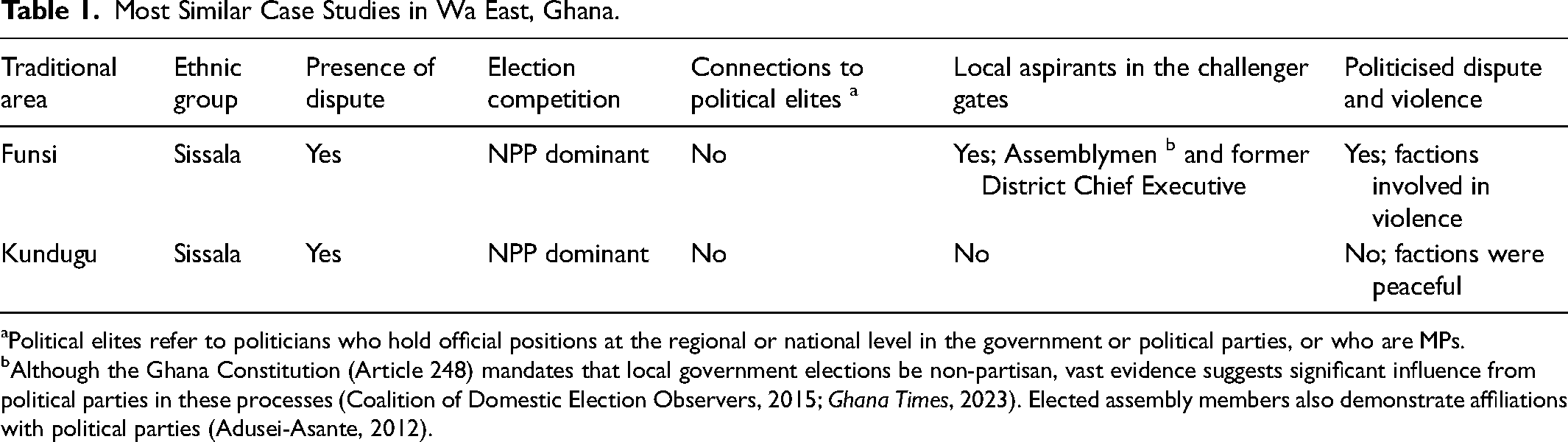
Political elites refer to politicians who hold official positions at the regional or national level in the government or political parties, or who are MPs.
Although the Ghana Constitution (Article 248) mandates that local government elections be non-partisan, vast evidence suggests significant influence from political parties in these processes (Coalition of Domestic Election Observers, 2015; Ghana Times, 2023). Elected assembly members also demonstrate affiliations with political parties (Adusei-Asante, 2012).
The empirical strategies adopted by this article have their strengths and limitations. In-depth case studies are useful in identifying causal mechanisms and improving internal validity (George and Bennett, 2005). The most-similar case design allows for systematic evaluation of an explanation against its alternatives (George and Bennett, 2005; Seawright and Gerring, 2008). However, these strategies do not definitely eliminate alternative theories, such as intervention by outside politicians (Seawright and Gerring, 2008). This inability is partly because of equifinality – that different causal pathways can result in similar outcomes (George and Bennett, 2005). Moreover, the relatively small size of cases also limits the external validity of the findings. I reflect on the generalisability of my findings and discuss the implication of these limitations at the end of this article.
Measurement and Data
The outcome of interest for this study is whether particular political parties and disputing factions supported each other in their respective objectives in elections and chieftaincy disputes. Specifically, it includes actions in two directions: 1) parties supported factions in chieftaincy disputes, and 2) factions supported parties in elections. To identify the first type of action, I determine whether governmental resources (e.g. government funds, security forces) and party resources (e.g. party funds, party footsoldiers) were used in the TA to benefit one faction more than the others. To identify the second type of action, I assess whether members of a faction were mobilised during local or national elections to vote for particular parties or politicians that lent or promised to lend support to their faction in the dispute. Because the action of one side does not guarantee a return of favour from the other side, I code the dispute as “politicised” if either one of these two conditions is met.
My explanation focuses on the existence of local aspirants in challenger factions. Local aspirants are members of disputing factions who hold political positions at the local level. A faction is a challenger if its member(s) lays claims to a skin but have not gained exclusive control of it. I then identify the local aspirants if they are a member of any royal gates and hold or was holding any formal position at least at the constituency/district-level in any political party and/or local government. Examples of local aspirants include royal gate members who are also members of a district assembly, district chief executives, or party cadres at the constituency level. These political positions grant local aspirants sufficient resources and power to interfere with chieftaincy disputes, such as dispatching polices.
I relied on in-depth interviews and archival sources to construct my analysis of the cases. I conducted semi-structured interviews with various stakeholders and experts in the Funsi and Kundugu disputes, including politicians, party supporters, gates elders, ordinary citizens, local academics, civil servants, during my two rounds of fieldwork in the summers of 2021 and 2022. 11 My visit to Funsi and Kundugu took place in April and May 2022. I supplemented my interviews with limited immersion (Krause, 2021) during my stays in the sites, which balances effectiveness and ethics in fieldwork in conflict settings. In addition to interviews, I consulted various archival sources, including news reports from Ghana News Agency (GNA), local newspapers, and online media (e.g. Daily Graphics, Ghana Times, and Modern Ghana). I also referred to election observation reports from Coalition of Domestic Election Observers (CODEO), as well as chieftaincy registries and judicial records concerning chieftaincy disputes from the National House of Chiefs. These archive sources allowed me to corroborate the information gathered through interviews.
Funsi Traditional Area
The Funsi TA includes the district capital of Wa East, Funsi, and its surrounding communities. According to custom, the skin rotates between royal gates. When the skin rotates to a royal gate, the elders (“kingmakers”) of the gate select a member to be enskinned as the Chief of Funsi (Funsi Kuoro) (Author Interviews 102, 104 12 ).
The number of the royal gates eligible to hold the Funsi Skin is the first point of dispute. There is consensus within Funsi TA that Gbelonosi and Kunkonboni 13 are two royal gates. But disagreement exists on whether a third gate, Mulliebelle, is royal (Waala Traditional Council, 2006). The major opponents to Mulliebelle's claim are from Gbelonosi, whereas some from Kunkonboni have accepted that Mulliebelle is royal (Suler, 2020). These three gates cluster in the town of Funsi. Gbelonosi is the largest gate and lives in southern Funsi with Kunkonboni. Mulliebelle is smaller than Gbelonosi and occupies a section 14 of northern Funsi.
The relevant chieftaincy dispute emerged in 2002 when the immediate late Funsi Kuoro passed away. Mulliebelle made claim to the skin and was supported by some Kunkonboni (Author Interview 104). This decision was strongly opposed by Gbelonosi and other Kunkonboni, who believed it was Gbelonosi's turn to be enskinned, and two Gbelonosis also laid claim to the Funsi Skin. The dispute was brought to the Paramount Chief of Wa (Wa-Naa), who oversaw the then divisional TA of Funsi. The Wa-Naa supported the claim of Mulliebelle, and Mr James Baduon Duma was selected as the Funsi Kuoro in 2004 and enskinned in 2005 (Suler, 2020). Wa-Naa's decision nonetheless failed to settle the dispute. Gbelonosi continued to appeal to the Waala Traditional Council in 2006 (Waala Traditional Council, 2006) and the Upper West Regional House of Chiefs in 2019 (Upper West Regional House of Chiefs, 2019). But Gbelonosi's petition to deskin the Funsi Kuoro was not supported by either the Traditional Council or the Regional House. The Funsi Kuoro was officially gazetted by the National House of Chiefs in 2019. The official decision failed to appease the Gbelonosi, and the tension continued during my fieldwork in 2022.
Dispute Politicisation and Political Violence
The first sign of politicisation in the Funsi dispute surfaced publicly with the enskinment of Mr James Baduon Duma in 2005 (GNA, 2005). During his enskinment ceremony in Funsi, police shot two individuals from Gbelonosi. Some Gbelonosis allege that the police were sent by the then presiding member of Wa East District Assembly, who was a Mulliebelle (Author Interview 187). When interviewed, a politician from Mulliebelle did not deny that the former assemblyman sent the police, but he contended that the police were necessary to protect the chief and the ceremony (Author Interview 159).
In the subsequent 2008 general election, NDC and NPP supporters clashed during campaigns (CODEO, 2009). Although the clash initially appeared to be between supporters of different political parties, interviews with Funsi residents revealed that the dispute between Gbelonosi and Mulliebelle was a significant underlying factor fuelling the conflict. In 2008, NPP had more supporters from Gbelonosi, whereas Mulliebelle had more NDC supporters (Author Interviews 112, 114, 159). Politicians and party supporters recognised the intersecting party and gate differences contributing to the incident (Author Interview 108).
Following the 2008 clash, political parties and the government implemented measures to separate the Gbelonosi and Mulliebelle sections during election-related activities (Author Interview 118). Campaigning and voting occurred exclusively within respective sections, and MP candidates arranged separate campaign meetings to avoid provoking conflicts between the two gates (Author Interviews 114, 116, 117), even though they only held one campaign meeting in other towns in Wa East (Author Interviews 134, 157, 158). 15 Governance institutions, such as the National Commission for Civic Education (NCCE), sent a workforce to Funsi during general elections to engage with disputing factions and prevent further violence. Since the 2008 general election, voters from Gbelonosi and Mulliebelle went to different polling stations and refrained from crossing into rival sections to register or vote (Author Interviews 116, 117).
Some residents in Funsi believe that the separation of sections has helped prevent large-scale clashes in general elections (Author Interviews 114, 117). For example, a party supporter commented that “the chieftaincy dispute doesn’t affect elections, because the gates use different polling stations” (Author Interview 117). Workers at the Electoral Commission Office confirmed that, since 2012, the general election in Funsi has been more peaceful (Author Interviews 115, 118). However, this strategy does not ease the overall tension in town during election years. Respondents from Gbelonosi and Mulliebelle concur that the Funsi dispute has become intricately intertwined with politics (Author Interviews 108, 114, 159, 187; see also Gyader et al., 2020; Suler, 2020). Some fear potential attacks if they venture into rival sections during the elections and opt to avoid them altogether (Author Interviews 106, 108, 111, 114). Alleged assaults on party supporters when walking by the houses of rival gates have also occurred (Author Interview 114, 116). The separation between Gbelonosi and Mulliebelle sections has extended to various aspects of life. For example, the two disputing gates have stopped attending each other's funerals (Author Interview 159). I also observed that the two disputing gates rarely cross the boundary between their sections in daily life.
In summary, the Funsi dispute has been repeatedly politicised before and after the enskinment of Funsi Kuoro, evidenced by the shooting incident in 2005 and the clash during the 2008 election. While preventative measures have been implemented since 2008, effectively diminishing the scale of violence thereafter, ongoing politicisation by local politicians still fuels tensions, especially evident during elections such as in 2016.
Aspirants in Mulliebelle and Gbelonosi
Local aspirants are not evenly distributed across gates. One source of this uneven distribution is a gate's dominance in chieftaincy (Nathan, 2023). In groups where chieftaincy was created by the British government, including Sissala, particular gates tend to dominate the skins. Consequently, members from dominant gates are more likely to succeed in politics due to the resources associated with the skins. As a result, dominant gates often have more local aspirants than non-dominant ones.
In Funsi, since 1920, four out of seven Funsi Kuoro have come from Gbelonosi, while none have originated from Muliebelle (Suler, 2020). This dominance of the chieftaincy helps to explain why Gbelonosi has produced more local aspirants than Muliebelle and the significant political positions some of these aspirants have held. Following the establishment of the Wa East district in 2004, Funsi gained two seats in the District Assembly. One of these seats represents Funsi South, which includes Gbelonosi and Kunkonboni sections. Since 2004, two NPP members from Gbelonosi have been elected to this position (Author Interviews 114, 187). Furthermore, an NDC member from Gbelonosi served as the DCE of Wa East from 2014 to 2017 (Author Interviews 105, 114).
Despite Mulliebelle's long exclusion from the skin, its members have managed to secure a political position. The second seat for Funsi in the District Assembly represents Funsi North, where Mulliebelle section is located. The way Funsi is divided offers a great opportunity for members of Mulliebelle to dominate the seat for Funsi North, as Mulliebelle is the more populous gate there. Two NDC members from Mulliebelle have held this position since 2004 (Author Interviews 112, 159).
Some politicians in Gbelonosi and Mulliebelle have leveraged their political connections to intervene in the Funsi dispute both before and after the enskinment and gazetting of the Funsi Kuoro. Their tactics include deploying police to facilitate the enskinment and mobilising their gate during various elections after the enskinment. Rather than grasping the skin for their own, politicisation of Funsi dispute has served the political goals of these local aspirants.
The former assemblyman from Mulliebelle used his political influence to support the enskinment of Mr James Baduon Duma (Author Interviews 104, 187). Specifically, he ordered the police to escort Mr James Baduon Duma back to Funsi, which was met with fierce protest by Gbelonosi. The police shot and killed two Gbelonosi (GNA, 2005; Author Interviews 104, 187). After the enskinment, however, chieftaincy disputes no longer offer a focal point for Mulliebelle politicians to mobilise their gate, as they have become incumbent of Funsi Skin. Mulliebelle politicians cannot credibly claim that politics is necessary to defend the skin, unless the challenger gate has mobilised politically in the first place. It is also difficult for Mulliebelle politicians to misrepresent Gbelonosis’ behaviour. Misinformation can be quickly dispelled because the royal gates are deeply interwoven, often facilitated by intermarriage (Author Interview 114). No respondents from either Gbelonosi or Mulliebelle accused any Mulliebelle politician of mobilising political supports in the name of the Funsi dispute after the 2005 shooting.
However, according to my interviews, the 2005 shooting was not the start of the politicisation of the Funsi dispute. According to a Mulliebelle respondent, the former assemblyman of Funsi South promised that “he would fight to bring the skin to Gbelonosi,” which persuaded the majority of Gbelonosi to support him in the 2004 assembly election (Author Interview 114). Gbelonosi respondents validated this Mulliebelle story. One opinion leader in Gbelonosi recalled that the assemblyman made a promise to help Gbelonosi get the skin at the early stage of the dispute but failed to deliver it (Author Interview 104). The former NPP assemblyman of Funsi South continued to mobilise Gbelonosi following the 2005 enskinment, driving many Mulliebelle to support the NDC in 2008 to prevent the NPP from winning the election, which raised the tension and eventually led to the conflict (Author Interview 159).
The former DCE reportedly made a similar promise to Gbelonosi before the 2016 general election. 16 Interviews with Mulliebelle and Gbelonosi respondents offered similar accounts of the former DCE's actions during the election campaign in 2016. The former DCE assured Gbelonosi that the NDC would help them secure the skin if the NDC remained in power after the 2016 election, urging them to vote for the NDC (Author Interviews 114, 159, 187). This promise by the former DCE heightened tensions between the disputing gates before the general election. In response, many NDC supporters in Mulliebelle switched to the NPP in 2016 (Author Interview 159).
My field research in Funsi found no high-ranked politicians involved in the Funsi dispute. Respondents from neither Mulliebelle nor Gbelonosi suggested that MPs or other politicians from regional- or national-government had anything to do with the dispute. An outside politician commented on the Funsi dispute, “I don’t think NPP or NDC will put anyone from Funsi to important positions. The conflict is so complicated, and they don’t want to appear biased in the conflict” (Author Interview 189). This comment reveals the political elites’ concerns in getting involved in the Funsi dispute. The uncertainty in its impact on electoral outcomes makes them reluctant to politicise this dispute.
In summary, my field research suggests that local aspirants played crucial roles in politicising the Funsi dispute, when their factions sought the exclusive control of the skin. The dispute was first politicised when a Gbelonosi assemblyman vowed to help their gate acquire Funsi Skin in 2004. Tensions escalated further when a Mulliebelle assemblyman sent police to guard the enskinment of the Funsi Kuoro in 2005, resulting in the first major bloodshed in the dispute. The involvement of Gbelonosi and Mulliebelle politicians in the dispute heightened the political tension between the disputing gates, leading to the conflict in the 2008 General Election. Despite the efforts at conflict management after 2008, the Funsi dispute was once again politicised during the 2016 General Election, following an intervention by the DCE of Wa East. This intervention reignited fears among Funsi residents related to elections.
Kundugu Traditional Area
The Kundugu TA encompasses the town of Kundugu and its surrounding communities, with a smaller population than Funsi TA. Kundugu Skin was promoted to a paramount chief in 2015. Following a custom similar to that of Funsi Skin, Kundugu Skin rotates among three royal gates: Walabelle, Dansoabelle, and Kalabelle; each time when the skin turns to a royal gate, the kingmaker of that gate selects a member to be enskinned as the Kundugu Kuoro (Author Interview 119). The majority of these royal gates live in the town of Kundugu, with Dansoabelle being the largest.
The late Kundugu Kuoro from Walabelle passed in 2014, and the skin rotated to the Dansoabelle. Two compounds 17 in the Dansoabelle failed to reach an agreement on which compound the Kundugu Kuoro should be selected from. Although the senior-most elder of Dansoabelle – that is, the kingmaker – eventually determined the chief compound, the other compound challenged the kingmaker's decision. Both the chief and the challenger compounds have sympathisers in Kalabelle and Walabelle (Author Interviews 127, 128, 157). The challenger compound sued the chief compound in the Regional and National Houses of Chief in 2014 and 2017, respectively (Author Interview 120; National House of Chief, 2020), but they failed to gain support from either of the houses. During my fieldwork in Kundugu in 2022, the dispute remained unresolved, with the challenger compound preparing to appeal to the Supreme Court.
One might note that unlike the Funsi dispute, which is inter-gate, the Kundugu dispute broke out within the same royal gate. However, there are several reasons to believe that these distinctions have little impact on the comparability of these two cases regarding politicians’ decisions to interfere with these disputes. To begin with, the legal process to address these disputes has been the same, offering no additional incentives or opportunities for outside politicians to intervene in one dispute than the other. In addition, intra-gate conflicts, like the Yazori dispute involving two brothers, can be as violent as those among non-siblings (Awedoba et al., 2009). Moreover, the disputing factions in Kundugu, though nominally in the same gate, are rather distant relatives. This is evident from the fact that the challenging compound has started to identify themselves with an independent gate called “Komponiabelle,” indicating a division from Dansoabelle (Author Interview 158). As familial ties between these compounds are attenuated, the Kundugu dispute should resemble the intensity of contention seen in the Funsi dispute, motivating disputing factions to use all possible means to secure their hold of the skin.
Furthermore, the intra-gate dispute in Kundugu offers no less political motivation for local aspirants to exploit than the inter-gate dispute in Funsi. The sizes of both the chief and challenger compounds are large enough to significantly influence the electoral outcome in Kundugu (Author Interviews 157, 158). Politicising the Kundugu dispute can thus benefit local aspirants, enabling them to mobilise sufficient supporters to help them win in local or national elections, just as local aspirants in Gbelonosi seek to do in Funsi. Politicisation could also entail substantial cost for local aspirants in both places, if rival factions mobilise against them in elections. Overall, local aspirants in Kundugu face similar cost–benefit calculations in interfering with the dispute as those in Funsi. Funsi is not unique in experiencing a dispute over gate legitimacy. Such disputes are commonplace in chieftaincy disputes across Northern Ghana (Awedoba et al., 2009), yet most chieftaincy disputes over gates are not politicised. 18 To understand why Funsi experienced politicisation, it is important to examine the absence of politics in disputes like Kundugu's.
A Dispute Absent of Politics
Respondents across different royal gates agreed that the Kundugu dispute has not been politicised (Author Interviews 121, 122, 125, 126, 127, 128) and has remained peaceful overall. It has not broken the connections between the chief and the challenger compounds. There have been no violent conflicts between the two disputing compounds, and members of the two compounds “can go to each other's area and will collaborate” (Author Interview 128). During my stay in the community, I observed that individuals from the chief compound regularly visited the section of the challenger compound unaccompanied without fear.
The general elections in Kundugu have also been peaceful despite the chieftaincy dispute. All my respondents in Kundugu reported no incidents of violence or intimidation during general elections. Even though voters from the disputing compounds use the same polling station to register and to vote, there has been no tension (Author Interviews 121, 123). In sum, evidence from my interviews and observation suggest that the Kundugu dispute has remained free from political interference. Major political processes in Kundugu, mainly elections, have been peaceful, and the dispute has not given rise to violent conflict. This lack of politicisation and the peacefulness of the dispute can be attributed to the absence of local aspirants in the challenger compound.
Aspirants in the Dansoabelle and Kalabelle
Unlike in Funsi, no gates in Kundugu have dominated the Kundugu Skin. Records from the National House of Chiefs suggest that succession to the Kundugu Skin has been less frequent in the twentieth century, but when it has, the rotation between the three royal gates has been uninterrupted (Author Interviews 118, 119). There is no evidence that the current chief compound from Dansoabelle has historically dominated the skin. Although respondents across royal gates acknowledged that today the chief compound has a larger population and greater wealth than the compound challenging the chief compound's right to the skin, they noted that this difference in resources is relatively recent in the history of Kundugu Skin (Author Interviews 156, 157).
The absence of dominant gates in Kundugu resulted in the relative lack of concentration of local aspirants in specific gates. Local aspirants in Kundugu are dispersed among the chief compound and other royal and non-royal gates. Kundugu has one assemblyman in the Wa East District Assembly. Since the dispute broke out, two members from the chief compound have been elected to this position: the former assemblyman is an NDC and the current an NPP. In addition, an NDC from the chief compound is the constituency youth organiser of the party. The NPP constituency youth organiser is from a non-royal family in Kundugu. Lastly, an NPP member from Kalabelle has been appointed as the DCE of Wa East from 2017 to 2021.
Despite the many political aspirants across the gates, the challenger compound has no local aspirants since 2014. The challenger compound therefore lacks the political connections and resources to influence the chieftaincy dispute. As a result, the enskinment of Kundugu Kuoro has been quick and smooth (Author Interviews 119, 120). The peaceful development of the Kundugu dispute offers little opportunity for aspirants from the chief compound to exploit the dispute for voter mobilisation. The chief compound never needed to – as Mulliebelle did – seek political support to enskin their chief. After the enskinment, like in Mulliebelle, chieftaincy dispute no longer serves as a framing for any political mobilisation in the chief compound.
Nor do the aspirants from Kalabelle or non-royal gates have strong incentives to politicise the Kundugu dispute. The former DCE from Kalabelle is believed to be a sympathiser to the challenger compound because his wife comes from that compound (Author Interview 157). Despite this connection, it is not in the interest of the former DCE to politicise the dispute because it will divide his own gate (Author Interview 128). Such a division would not only cost him politically – as he relies heavily on the support from Kalabelle – but also undermine his reputation in Kalabelle and the community (Author Interview 157). The NPP youth organiser, though having close relationship with the chief compound, maintains a neutral position in the dispute. It was said that the NPP youth organiser was accepted by the chief compound as a member and regarded as a “brother” by the NDC youth organiser (Author Interview 130). Yet the NPP youth organiser must consider the attitudes of his own gate. A neutral position better serves the interests of his gate and himself.
In summary, all local aspirants in Kundugu lack the motivation to politicise the dispute. The challenger compound lacks major politicians to politicise the dispute. The smooth enskinment of the Kundugu Kuoro has diminished the need/opportunity to politicise the dispute for politicians from the chief compound. Moreover, politicians from other royal/non-royal gates are less likely to benefit from politicising a dispute in which their gates are not directly involved.
Discussion
The case studies of Funsi and Kundugu reveal that intervention from outside politicians is not a necessary condition for the politicisation of chieftaincy disputes. Rather, local aspirants from the challenger factions emerge as the major actors in politicising the dispute. 19 These case studies also allow for the inductive development of a theory about local aspirants and their cost and benefit of interference with chieftaincy disputes.
Local aspirants are members of disputing factions, and they are at the same time important local politicians. Their dual memberships in chieftaincy and politics shape their benefit and cost in politicising the chieftaincy disputes. Not only do local aspirants gain access to communal and governmental resources by having a close kin as chief or by becoming a chief themselves (Tonah, 2012), but chieftaincy disputes themselves can also offer local aspirants an opportunity to advance their political careers. Politicians need support from the local community to beat their political rivals for positions in political parties and in local government (Author Interviews 108, 188, 189). Chieftaincy disputes can enable local aspirants to mobilise support from gate or compound-based factions for this party and electoral political competition. The former assemblyman and former DCE from Gbelonosi, who mobilised their gate during local and national elections by leveraging the issue of chieftaincy dispute, exemplify this approach.
However, politicising chieftaincy disputes has potential costs, including the risk of antagonising members of other factions. When one disputing faction mobilises politically over a chieftaincy dispute, other factions typically counter-mobilise. The impact of the counter-mobilisation on local aspirants varies depending on the institutional configurations. In cases where formal political institutions insulate local aspirants from such counter-mobilisation, the electoral cost is minimised. For example, politicians in Gbelonosi can safely politicise the dispute during elections for assemblymen of Funsi South without facing punishing votes from Mulliebelle in Funsi North. However, in the absence of such institutional insulation, counter-mobilisation can significantly impact local aspirants. The example of the former DCE from Gbelonosi, who faced backlash from the Mulliebelle, highlights the substantial cost of politicising the Funsi dispute before the general election.
Furthermore, politicising chieftaincy disputes is a viable strategy only for factions that seek to change the status quo in chieftaincy disputes. Gbelonosi throughout the Funsi dispute and Mulliebelle before the enskinment of the Funsi Kuoro are examples of such challenger factions. In factions satisfied with the status quo, such as when they hold exclusive incumbency, 20 local aspirants cannot initiate disputes for political purposes even if they would like to mobilise their faction for political purposes. Instead, political aspirants can only mobilise incumbent factions if a challenger faction has begun to mobilise politically. For instance, after the Mulliebelle candidate was enskinned as Funsi Kuoro and the candidate from the chief compound was enskinned as Kundugu Kuoro, local aspirants from these factions no longer involved themselves in chieftaincy disputes.
Lastly, for local aspirants in gates that are not involved in chieftaincy disputes, interfering with chieftaincy disputes entails different sets of benefit and cost. While these aspirants can form coalitions with one of the disputing factions and gain political support, they risk dividing their own gates, as non-disputing gates tend to have sympathisers for both sides. In addition, promises made by these local aspirants also tend to be less credible to the disputing factions, because these aspirants are not a member of them (Awedoba et al., 2009: 14–15). As a result, they should generally prefer not to politicise disputes. The former DCE from Kalabelle and the NPP youth organiser from a non-royal gate, who remained neutral in the Kundugu dispute, present the difficulties for non-disputing gates to politicise chieftaincy disputes.
Conclusion
In this article, I examined the actors and motivations behind the politicisation of chieftaincy disputes in Ghana. Local politicians have diverse incentives and costs depending on their factional membership. I introduced the concept of “local aspirants,” that is, local politicians who are also members of the gates seeking to occupy, or currently occupying, the chieftaincy. I found that when there are influential local aspirants in factions seeking to challenge the chieftaincy, these individuals are likely to use the chieftaincy dispute for their own political gain. Their intervention can turn a chieftaincy dispute into a larger political dispute and escalate into political violence when local aspirants in parties or political office mobilise governmental coercive forces or their kin to influence the outcome of the chieftaincy dispute. These findings by no means suggest that politicians outside of disputing factions cannot politicise a chieftaincy dispute. Rather, they indicate that outsider political intervention is not necessary for politicisation or violence to occur.
How well do these findings generalise to other cases? Preliminary evidence suggests that a focus on local aspirants is useful in understanding politicised disputes in Ghana. For example, Bukari et al. (2021) showcase how Naa Dasana Andani use his connections with NDC in Tamale to support his struggle for the Bimbilla Skin; MacGaffey (2006: 90) notes that the Yendi dispute since 2002 has been repeatedly exploited by “enlightened members of the Dagbon community” and “local Abudu majority” for their own purposes; and in the Ga Mashie dispute, the then Mayor of Accra and brother of a claimant was a major actor in its initial politicisation (Boakye, 2016). Nonetheless, further research is needed to examine the roles of local aspirants across a broader set of cases in Ghana and other African countries.
These findings also open avenues for future research. A potential avenue of inquiry centres on the variation within the chieftaincy system. This includes examining how politicisation of chieftaincy disputes is affected by diverse factors, including the stages of the disputes (e.g. before/after the enskinment/enstoolment) and of the judicial process (e.g. appeals at different levels of courts) or the hierarchy and clout of the disputed skin/stool. The limited number of cases included in this research cannot adequately address these questions. Future studies could explore these relationships through additional case studies.
Other important questions revolve around nuanced cost-benefit calculations of local aspirants regarding their strategies, which are shaped by various local conditions. For instance, are local aspirants less inclined to politicise disputes when challenger factions have fewer supporters? Under what conditions are local aspirants coerced or co-opted into chieftaincy dispute? Furthermore, the net return of politicisation is also weighed against that of alternative strategies, such as forming political coalitions across disputing factions. What conditions shape local aspirants’ decision to adopt one strategy than the other? These inquiries are beyond the scope of this article, as its research design can only examine the variation of the types of local aspirants, rather than the variations of local conditions and alternative strategies. With a broader range of cases, future research might explore these nuanced aspects of the costs and benefits of politicisation, allowing for a better understanding of local aspirants’ decision-making processes.
Supplemental Material
sj-docx-1-afr-10.1177_00020397241271303 - Supplemental material for Local Aspirants and Politicised Chieftaincy Disputes: Evidence from Northern Ghana
Supplemental material, sj-docx-1-afr-10.1177_00020397241271303 for Local Aspirants and Politicised Chieftaincy Disputes: Evidence from Northern Ghana by Xiran Chen in Africa Spectrum
Footnotes
Acknowledgements
I am grateful to Jessica Maves Braithwaite, the two anonymous reviewers, and the co-editor of Africa Spectrum, Martha Johnson, for their insightful feedback. I also extend my thanks to George Bob-Milliar for his generous support of my field research in Ghana. Alhassan Ibn Abdallah provided excellent assistance with my field research and offered valuable perspectives as an insider. All errors are my own. This research was approved by the institutional review board of the University of Arizona (Approval No. 2106880638).
Declaration of Conflicting Interests
The author declared no potential conflicts of interest with respect to the research, authorship, and/or publication of this article.
Funding
The authors disclosed receipt of the following financial support for the research, authorship, and/or publication of this article: This research was made possible in part by a grant from the American Political Science Association. It was also partially supported by grants from Social & Behavioral Sciences Research Institute and Graduate & Professional Student Council at the University of Arizona. The statements made and views expressed are solely the responsibility of the author.

Supplemental Material
Supplemental material for this article is available online.
Notes
Author Biography
References
Supplementary Material
Please find the following supplemental material available below.
For Open Access articles published under a Creative Commons License, all supplemental material carries the same license as the article it is associated with.
For non-Open Access articles published, all supplemental material carries a non-exclusive license, and permission requests for re-use of supplemental material or any part of supplemental material shall be sent directly to the copyright owner as specified in the copyright notice associated with the article.
