




Abstract
As global economies become increasingly interconnected, the movement of people across borders has intensified, generating significant debate on the implications for both sending and receiving countries. Amid this debate, studies continue to report the return of some migrants to out-sourcing countries. While extra-regional return migration (henceforth, return migration) to Africa has received scholarly attention, there is no periodic systematic literature review to establish emerging themes on this topic. In this paper, we use standard procedures to analyse twenty peer-reviewed articles published between 2000 and 2022. From the findings, it emerged that return migration is a complex process shaped by multiple factors, such as family considerations and policies. The findings also highlight the differential experiences of returnees as they reintegrate into life in their home countries. Therefore, stakeholders should provide the necessary policy support to enhance the contributions of returnees to development.
Introduction
Migration has become a defining feature of the global economy (Bove and Elia, 2017). Estimates from the 2022 World Migration Report suggest that there were about 281 million extra-regional migrants in 2020 (IOM, 2022). The same report indicates that Europe is currently the largest destination for extra-regional migrants, with 87 million migrants (30.9 per cent), followed by the 86 million extra-regional migrants living in Asia (30.5 per cent). However, these figures are most likely underestimated given the recent increase in global migration partly driven by globalisation, and the overreliance of some developed economies on migrant workers (e.g. Canada, United States of America, and Italy) (Oklikah et al., 2024). Most migrant workers gravitate towards regions with greater opportunities as economies grow, and labour markets evolve (IOM, 2022). As a result, regions like Africa witnessed substantial emigration to high-income economies, especially Europe and North America. For instance, the number of Africans living outside the region increased from around 17 million in 2015 to over 19.5 million in 2020 (IOM, 2022). As of 2020, most African-born migrants living outside the region reside in Europe (11 million), Asia (nearly five million), and North America (around three million) (IOM, 2022). Most of these migrants maintain transnational connections to their home countries (Levitt and Jaworsky, 2007; Levitt et al., 2003), with some of them returning home at some point.
Return migration has been hailed as an integral element that connects sending and receiving countries (Dhar and Bhagat, 2021). The first strand of human mobility and migration-related literature examines the drivers of return migration, focusing mainly on why people make such decisions (Adebayo, 2020; Kleist, 2017; de Haas et al., 2015). What is common from this body of scholarship is that return migration decision-making is a complex process, often moderated by individuals, households, and macro-factors, such as family considerations, economic circumstances, personal aspirations, and existing policy regimes in both host and native countries. Moreover, what is clear from these studies is that return migration can either be voluntary or involuntary. The second strand of literature investigates the contribution of returnees to the socio-economic development of their sending countries (Bensassi and Jabbour, 2022; Sinatti, 2019). In the current migration literature, there is no consensus on the socio-economic and political contributions of return migrants to out-sourcing communities (Sinatti, 2019; de Haas et al., 2015). Significant debates and contentions about return migration still linger within policy circles (Zhao, 2002). The third strand of literature examines the implications of return migration and the challenges associated with re-integration (Nwozor et al., 2022; Samari, 2021).
In Africa, existing research on return migration mainly focuses on its determinants (Adebayo, 2020), post-return migration experiences (Kleist, 2020, 2017), and the contributions of returnees to the development of their home countries (Sinatti, 2019; Fransen et al., 2017). Moreover, return migration remains a comparatively understudied aspect of extra-regional migration within the African context. Most research on this subject tends to focus on how extra-regional migration affects migrants’ savings and remittances – and the extent to which return migration affects human capital accumulation (El-Mallakh and Wahba, 2021). Despite the growing literature on return migration in Africa, there has not been a systematic literature review and analysis of existing studies that highlight the role of migrants and returnees as development agents.
To address this gap, our study centres on the literature about return migration in Africa. It focuses on peer-reviewed studies published between 2000 and 2022. Twenty-two years is a sufficient timeframe to allow the study to extensively analyse themes involving return migration on the continent. Our search strategy focused on studies about the impacts of return migration on development in Africa. The following questions guide the study: (1) what themes have emerged within the return migration literature in Africa regarding the impact of returnees on the development of their home countries, and (2) how do these themes fit within the larger literature on return migration?
This study highlights some key issues on return migration on the continent that need attention. It also captures the diverse factors shaping return migration to the African region. The study also has policy implications for African governments seeking to effectively design strategies that integrate returnees into mainstream development and migration policies. The study promotes a context-sensitive analysis of the return migration subject by including literature using empirical methods in the review. For the purposes of this review, extra-regional return migration is defined as the relocation of individuals to their country of origin after spending a significant amount of time in destinations outside of the African continent. Therefore, studies on internal return migration, return intentions, visitations, and vacations to Africa were excluded from this review.
The next section provides an overview of return migration. This is followed by a presentation of the methodology used in conducting the systematic literature review. Next, the emerging themes from the reviewed studies are outlined and then discussed, and their implications for return migration scholarship and development policy are analysed.
Return Migration: An Overview
Globally, there is substantive scholarly interest in return migration, with most studies focusing on the determinants of return decisions, the various impacts of return migration on both host and home countries, as well as the socio-economic status of returnees (Efstratios et al., 2014). Current research demonstrates that return migration is marked by different ambitions and outcomes (Sinatti, 2015). However, there is no scholarly consensus on what determines return and the circumstances under which it occurs (Adebayo, 2020). Return migration is a complex and multi-layered process that can happen in different ways, either planned or spontaneous through voluntary or coercive means (Mensah, 2016).
Studies on return migration identify factors that shape people's return migration decisions, including economic, social considerations, among others (Kyeremeh et al., 2023). Other scholars also outline the differences between highly skilled and unskilled migrants. Some scholars, for instance, argue that highly skilled migrants have a higher propensity to return compared to lower skilled migrants, perhaps possessing higher skills makes it more likely for returnees to find well-paid job opportunities in their home countries if they choose to come back (Massey and Akresh, 2006; Reinhold and Thom, 2009). In the case of Vietnamese skilled return migrants, evidence suggests that highly skilled migrants with foreign or dual nationality are more likely to return home because of the advantages that their status confers on them in their country of origin (Nguyen-Akbar, 2017). Furthermore, in Egypt, return migration increased the probability of upward occupational mobility among highly educated returnees (El-Mallakh and Wahba, 2021; Wahba, 2015). Furthermore, some returnees contribute financially to their countries by transferring their savings to local banks (Black and Castaldo, 2009), while others transfer the skills acquired abroad for local activities (Sinatti, 2019). Chacko (2007), for instance, observed that several Indian return migrants might be attributed to the rigid immigration laws and the integration challenges faced by migrants.
In examining the motivations of Turkish return migrants from Western Europe, Kunuroglu et al. (2018) identified perceived discrimination and a strong sense of belonging as the most important factors in the return decisions. A study with Albanian returnees also revealed that restrictive immigration policies in Greece influenced return decisions (Efstratios et al., 2014). However, restrictive migration policies might discourage returning because migrants know that remigration may be problematic (Flahaux, 2017; Flahaux and Reeve, 2015).
Some researchers interrogate the connection between return migration and transnationalism. The decisions to return are not only shaped by the availability of transnational ties in the home country; but also by the possibility of maintaining post-return transnational networks (Sinatti, 2019; Carling and Erdal, 2014). This is specifically important for returnees who rely on connections to their former place of residence for their livelihood (Sinatti, 2019). Social considerations (e.g. family reunification) also play a role in influencing people's decisions to return. For instance, a study involving Senegalese migrants demonstrated that those with families in Senegal were more likely to return than those with families in Europe (Flahaux, 2017). Likewise, family considerations are deemed important determinants of return migration for Nigerians living in Guangzhou, China (Adebayo, 2020) and ranked among the top three causes of return in Ghana and Côte d’Ivoire (Elijah, 2013; Tiemoko, 2004).
Studies also investigate the difficulties migrants face in their struggle to adjust to life back home (Bisong, 2022; Kleist, 2020). From this perspective, some scholars examined the dynamics of what is called returnees’ “economic embeddedness” (van Houte and Davids, 2008), which depicts the extent to which returnees can build sustainable livelihoods. From this perspective, involuntary returnee migrants may struggle to build their livelihoods, especially those in economically weak societies (Kleist, 2017; van Houte and Davids, 2008). Van Houte and Davids (2008) used the concept of “psychosocial embeddedness” to assess the experiences of returnees. The degree to which a returnee has had a “successful” migration experience strongly affects how returnees are viewed by the sending-country society (Kleist, 2020). Returnees whose migration projects “fail” are usually stigmatised, shamed, and discriminated against negatively affecting their sense of belonging in their native communities (van Houte and Davids, 2008). The unplanned returns and “unsuccessful” migration projects occasionally burden family members – especially in less wealthy households – who helped finance journeys by selling their property or taking loans (Bisong, 2022). This can cause tension between the returnee and their family, which negatively affects their sense of “social embeddedness” upon return (Kleist, 2020). Therefore, when migrants choose to return, a process of re-acculturation starts. Re-acculturation is the readjustment process after significant time spent away from one's own culture (Kunuroglu, 2021). This process can generate additional psycho-social stresses for returnees. Studies have shown that returnees who have the support of their family members fare better in reintegrating and adapting to life after returning compared to those who have weak social support from family (Bisong, 2022; Kleist, 2020).
Other studies also show that return migration decisions are influenced by the availability of robust support systems (e.g. child support, health services, etc.). A study conducted on an Austrian return migrant group demonstrated that their return decisions were shaped by their home country's high quality of life, security, and social welfare system (Konzett-Smoliner, 2016). However, unstable and poor societies could spiral into crisis because of additional strains of returnees on an already fragile economy and social support systems (van Houte and Davids, 2008). Thus, poorly executed return programmes may worsen migrants’ vulnerabilities rather than aid their integration (Bisong, 2022).
The preceding section demonstrates the trends across the general return migration literature. To date, no systematic analysis of the themes across the African return migration literature has been conducted despite its relevance for the continent's policymakers. Hence, there is a need for such a review to examine emerging trends around some of the issues discussed.
Method
This study aims to systematically synthesise existing scholarship on extra-regional return migration in Africa through a rigorous process based on predefined criteria. This approach enables researchers to analyse a wide range of studies on a particular subject (Akobeng, 2005). To achieve this, we modified and used a version of Mengist et al.'s (2020) six-step process for systematic literature review (i.e. protocol, search, appraisal, synthesis, analysis, and report). To address the research questions, search terms were adjusted to identify relevant literature, while adhering strictly to inclusion criteria. Given the extensive body of literature on the topic, employing a systematic literature review approach was deemed necessary to ensure transparency and replicability (Mengist et al., 2020).
Inclusion Criteria
All the articles included in this review were based on the following criteria. Notably, no studies on return migration to southern Africa were included, as no studies on return migration in the region met the proceeding four criteria for inclusion.
First, the study focused on extra-regional return migration to Africa. Thus, studies on return migration to non-African contexts were excluded as were comparative studies that included African and non-African contexts.
Second, the study focused exclusively on extra-regional return migration (as operationalised by the study). The study focuses on extra-regional migration because of the unique scale and scope of prospects and challenges associated with this type of migration, which differs from internal and regional migration. This is premised on the assumption that emigrants acquire new skills, resources, or knowledge when they migrate outside of Africa. These developments may impact trends in their reintegration and contribution to development on return to their respective home countries in Africa.
Third, the articles selected were primary data studies published in peer-reviewed journals. Primary research in this context refers to studies where research data were directly collected by the author(s). We omitted non-peer-reviewed articles, such as working papers, presentations, keynotes, book chapters, and grey literature.
Fourth, the study focused only on articles written in English for the past twenty-two years (2000–2022); consequently, our findings do not represent trends from Francophone and Lusophone literature. The temporal scope of 2000–2020 was chosen as this period witnessed a renewed interest in return migration to Africa among African emigrants from the continent. We focused on African migrant returnees who emigrated for various reasons, including war, education, and economics. The year 2022 was selected given the recent revamp of the back to Africa movement epitomised through “The Year of Return” celebration in 2019 to mark 400 years of slavery. The 2000–2022 timeline is of the essence and worthy of appraisal to understand trends and developments in returnee experiences to Africa.
Search Strategy
The study commenced with the selection of five databases: Google Scholar, Science Direct, Scopus, Web of Science, and JSTOR. The databases are renowned for their comprehensive academic citation directories, which are useful for bibliographical cross-checking. The official search for articles employed keywords operationalised through Boolean operators (i.e. AND, OR, NOT, quotation marks “”, parentheses (), and asterisks *). Additionally, search phrases were truncated to broaden the search results (see Figure 1). The search strings mainly concentrated on “return migration,” “Africa” (determinants of return), and “development.” Various phrases were entered into the search engines, including combinations like (international ret[urn] migrat[ion], deport[ed], remov[ed], displac[ed]) AND/OR (Africa, North Africa, South Africa, East Africa, West Africa,) AND (development, economic dev*, social dev*, political dev* OR cultural dev*). Search terms were run separately or with phrases that met the eligibility criteria.
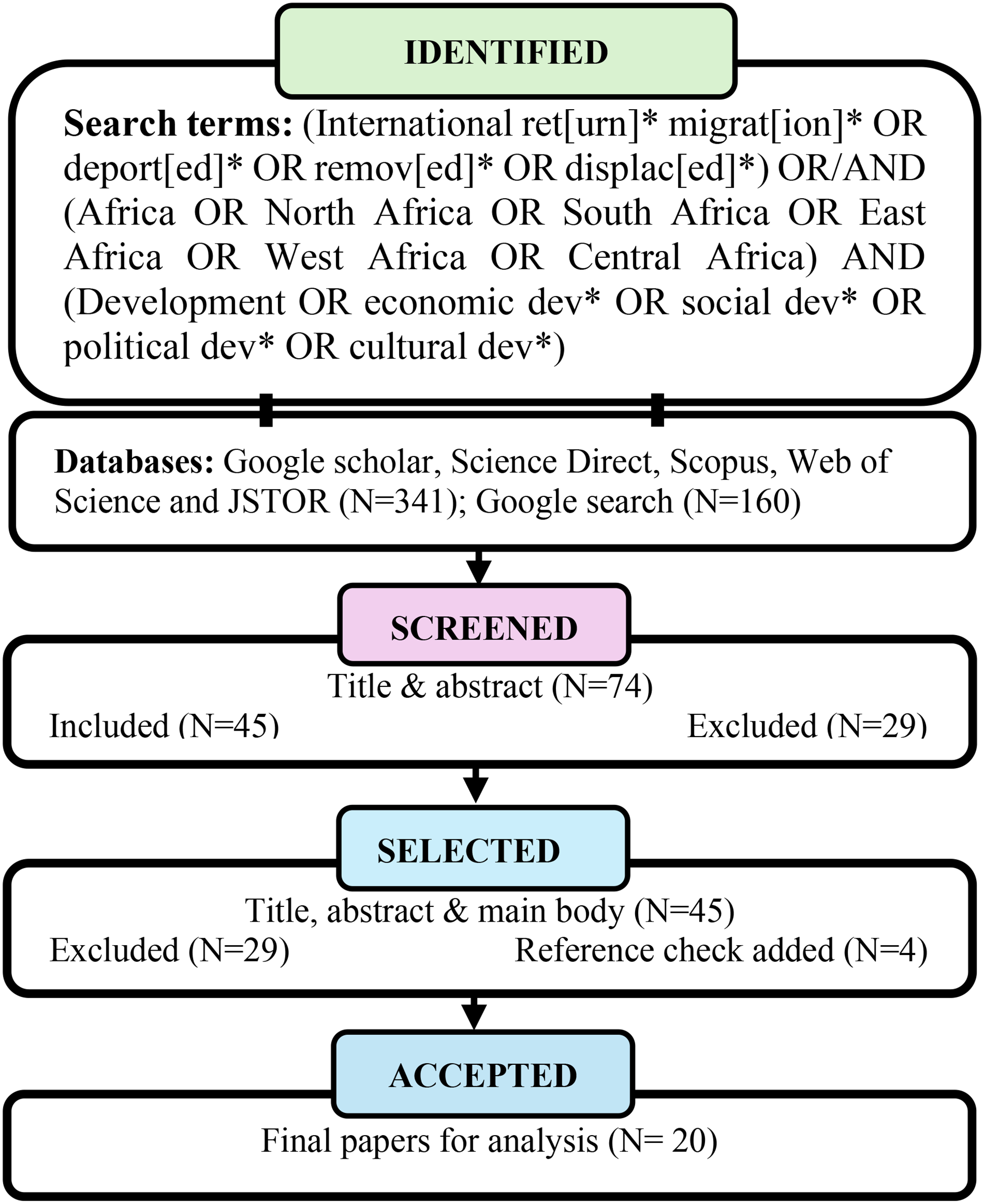
Flowchart of the Study Methodology.
Initial searches yielded 501 articles from the designated database, with an additional 51 articles from Google searches. Using Zotero, titles and abstracts were reviewed, removing duplicates and unrelated topics, reducing the count to 74. A reference list for the 74 articles was compiled and exported to Covidence for further screening. Three reviewers conducted a meticulous examination of title and abstract, resulting in a working list of 45 articles. Throughout the identification and screening process, articles that did not meet the inclusion criteria were excluded. Consequently, a final list of 17 papers was assigned to team members for in-depth reading. From the main text reading, four articles from a reference check were added to the working list, bringing the total to 20 articles.
Data Synthesis
Figure 1 gives an insight into the data collection, aggregation, and synthesis process of the articles identified, screened, accepted, and selected for final review. The flowchart also includes useful information on the search terms, locations, study criteria, sample size, and number of final articles reviewed.
Results
The 20 articles covered nine African countries in total: Morocco, Nigeria, Ethiopia, Burundi, Ghana, Senegal, Kenya, and Côte d'Ivoire (see Table 1). Six of the articles reported on the experiences of voluntary and involuntary returnees, determinants of return migration, and returnee health professionals in Ghana. Two other studies examined the role of the family in return migration and the contributions of returnees to development using data from Ghana and Côte d'Ivoire. In addition, four articles discuss the mental health of Ethiopian returnees, socio-economic reintegration challenges, and the effects of gender and age on the marriage prospects of returnees. Returnees’ labour reintegration and entrepreneurship were the subject of two studies on Senegal. Two articles on Burundi examined return migration, post-conflict violence, and economic outcomes in conflict-affected regions. The subject of one article was Moroccan returnees and domestic politics. Another study investigated the impact of returnees on repeated migration in Nigeria, while return migration challenges, liabilities, and entrepreneurship in Kenya were the subject of one article. One study discussed return migration and economic development in Cabo Verde. Surprisingly, no empirical studies focused on return migration in Southern Africa. The publications made two explicit observations. First, most of the selected studies concentrated on countries in eastern and western Africa, with only one study examining the dynamics of return migration in North Africa. Second, since 2000, the number of studies on this topic has increased, indicating growing significance.
Summaries of Reviewed Studies. 2
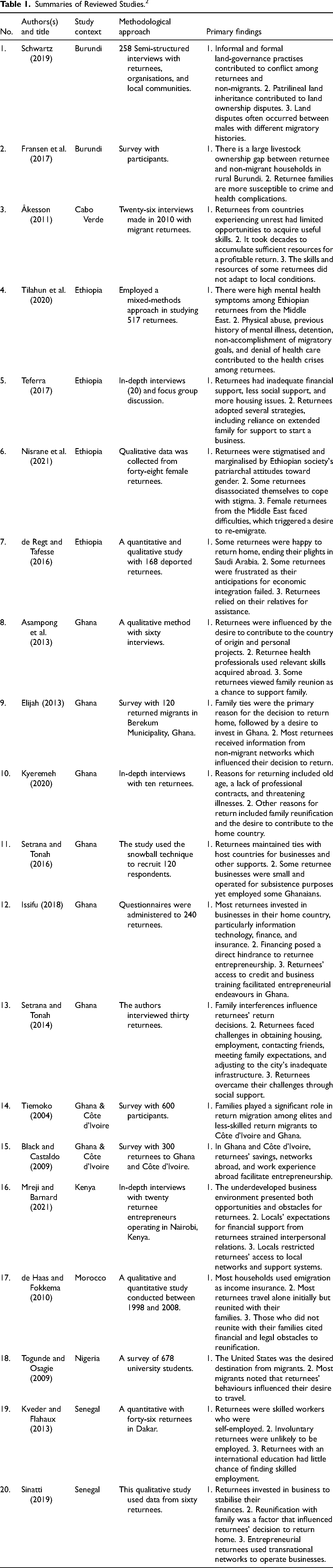
The authors identified five major themes from the literature and organised the analysis accordingly: drivers of return migration (i.e. why migrants return to their home countries), post-return lived experiences (i.e. what are the returnees’ experiences – both negatives and positives), returnees-socio-economic development nexus (i.e. the role of returnees in the socio-economic development of their home countries), involuntary return migration, and returnees’ roles in further migration (i.e. how returnees influence non-migrants to cultivate the desire to migrate overseas).
Drivers of Return Migration
A recurrent topic in the reviewed studies is the drivers of return migration, which are evaluated at the macro, meso, and micro level and operate either independently or jointly to influence return migration decisions. Five out of the 20 studies explored issues pertaining to the drivers of return migration (Kyeremeh, 2020; Sinatti, 2019; Elijah, 2013).
At the micro-level, evidence suggests that the desire to enjoy retirement in their homeland or family reunification were some of the motivations for return migration (de Haas and Fokkema, 2010). For example, in Senegal, family reunification is the topmost motivation among Senegalese entrepreneurs in their return migration decision-making (Sinatti, 2019). Besides, these returnees leveraged their transnational networks to run successful businesses (Sinatti, 2019). These findings also align with Åkesson's (2011) study, which found that feelings of moral responsibility to family members and the social importance of homecoming are drivers of return migration among Cape Verdeans. Among Ghanaians, some of the determinants of return migration are family-related factors and the quest to invest in Ghana (Kyeremeh, 2020; Elijah, 2013; Tiemoko, 2004). Specifically, among elite and less-skilled return migrants to Côte d’Ivoire and Ghana, Tiemoko (2004) found that familial considerations play an important role in return decisions. Another study also indicated that ageing and career-threatening ailments are push factors driving return migration among Ghanaian footballers (Kyeremeh, 2020).
Post-Return Lived Experiences
The reviewed articles also commonly addressed post-return migration experience. It is evident that the issue of how returnees fare upon return is a major research interest from the eight studies that address this theme (see Mreji and Barnard, 2021; Kleist, 2020; Teferra, 2017).
Evidence suggests that returnees’ differential migration experience plays a major role in their reintegration process in the labour market of their home countries. This is the case in Senegal, where returnees with short stays abroad are more likely to be unemployed compared to their counterparts who work abroad and are more likely to establish their own businesses (Kveder and Flahaux, 2013). Moreover, the nature of the return – voluntary or involuntary – affects the re-integration outcomes of returnees. In Ghana, the notable challenges voluntary returnees face in Kumasi are meeting the high expectations of family members, difficulty securing jobs, and adjusting to the poor amenities in the city, among others (Setrana & Tonah, 2014). Similarly, in examining the challenges that Ethiopian returnees face after their mass deportation, Teferra (2017) documents inadequate financial support, lack of support systems, housing issues, and unemployment issues as noteworthy challenges. However, in both Ghana and Ethiopia, returnees address these challenges primarily through the support of social networks, such as family and friends, who provide financial support as initial capital to returnees to start businesses (Teferra, 2017; Setrana and Tonah, 2014).
Setrana and Tonah (2016) discuss the use of transnational links by return migrants. In examining this nexus, Setrana and Tonah (2016) identify three typologies of returnees who sustain transnational ties for the growth of their business: professionals, business, and investor returnees. The authors indicate that returnees’ transnational connections allow them to obtain resources (mostly financial) that might not be handy, thereby increasing their business competitiveness in Ghana. More so, returnees improve their quality of life by offering specialised services in education, health, and other fields (Setrana and Tonah, 2016).
In Ethiopia, the primacy of common mental disorders (CMDs) is high among returnees from the Middle East. Participants’ level of CMDs upon return is mediated by the lack of pre-migration preparation and unsafe migration trajectories, where migrants are exposed to abuses and exploitation (Tilahun et al., 2020). Upon return, certain integration factors may likewise affect returnees’ well-being. For example, returnees may be deterred from seeking medical assistance in instances where they resettle in different localities from their original hometown, within their native country, due to their unfamiliarity with that locality's healthcare systems or languages.
Other studies report stigmatisation, marginalisation, mistrust and mismanagement of assets, and cultural tension as one of the post-return experiences of returnees. In a more recent study, Nisrane et al. (2021) demonstrate that gendered attitudes in Ethiopia rooted in patriarchy interact with age and other experiences of returnees to create stigmatisation and marginalisation. Consequently, returnees tend to dissociate themselves from others or keep their experiences secret as a coping mechanism and to increase their marital prospects, as well to avoid stigmatisation (Nisrane et al., 2021).
Evidence also suggests that returnees experience cultural tensions. Explicitly, Mreji and Barnard (2021), note that Kenya returnees, by virtue of a Western lifestyle, develop a more individualistic approach to life even after their return. This individualism is at odds with the communitarian value system in their home country. The locals perceive the returnees as part of a collective culture, where their initial overseas journey was through the collective support of community resource pooling. However, there were also cultural tensions that heightened returnees’ suspicion and mistrust for locals. Illustratively, de Haas and Fokkema (2010) find that Moroccan returnees from Europe observed a lack of trust, poor work ethic, sharp socio-economic disparity, and materialistic mindset among Moroccans and public officials. Kyeremeh's (2020) study of Ghanaian returnees also highlights similar findings with the most notable challenge being the mistrust and mismanagement of assets – a situation that left some returnees disappointed and contemplating remigration.
The Returnees-Socio-Economic Development Nexus
Five of the studies explored the relationship between returnees and the socio-economic development of their home countries (Issifu, 2018; Fransen et al., 2017; Asampong et al., 2013). This focus is unsurprising because the migration-development nexus is a hotly debated topic – compelling scholars, such as de Haas (2010), to describe the migration-development nexus as swinging like a pendulum. The assumption underpinning the presumed migration-development relationship is that migrants are expected to possess social and financial remittances and skills that contribute to poverty reduction and lead to sustainable long-term development. It is envisaged that returnees facilitate development in their home regions through the ideas, skills, and resources acquired overseas. Åkesson (2011), for instance, explores the role that returnees’ skills and savings play in local development, especially through the lens of entrepreneurial activities. It becomes clear that returnees play a significant role in local development, where a growing number of returnees use their experiences and savings from abroad to establish strong entrepreneurial ventures (Åkesson, 2011). Similar evidence of returnees contributing to the socio-economic development of their home country is found in other studies. Issifu (2018)'s study of Ghana, however, finds that access to finance directly hinders returnees’ entrepreneurial activities. In a comparative study exploring factors that facilitate socio-economic development through entrepreneurship among Ghanaian and Ivorian returnees, Black and Castaldo (2009) reveal that the most important predictor is work experience acquired overseas.
The health sector is another sector where returnees’ contributions manifest. Findings from Ghana indicate that health professional returnees offer employment opportunities to locals through the establishment of clinics, diagnostic centres, and laboratories (Asampong et al., 2013). They apply their skills acquired abroad in areas such as in-vitro fertilisation, dialysis, oncology, haematology, and paediatrics (Asampong et al., 2013). Similar findings of employment generation in Ghana are reported among football player returnees (Kyeremeh, 2020). However, the returnees’ role as development agents in the home country is not mechanical and must be contextualised in the broader socio-political and economic structures that impact their abilities to augment positive development (Åkesson, 2011). Notwithstanding the socio-economic development contribution of returnees, evidence also suggests that returnees concurrently experience challenges upon return: the lack of support from governmental agencies and the health sector, the long wait to secure appointments for interviews, and interpersonal challenges, mostly manifesting at workplaces (Asampong et al., 2013).
Does geographic context matter regarding the returnee–socio-economic–development nexus? In Burundi, which experienced large-scale conflict-induced emigration and post-war return, Fransen et al. (2017) note that compared to non-migrant households, returnees’ households have considerably lower levels of livestock – a principal form of capital accumulation. The fact that returnees in Burundi have lower wealth than non-migrants presupposes that their ability to contribute to their home country's development is limited. Among the barriers to capital accumulation by returnee households are the legal restrictions imposed economic activities, which resulted in high inactivity and potential loss of skills (Fransen et al., 2017). This revelation suggests that factors outside contexts have the potential to support or hinder returnees’ efforts as development agents.
Phenomenon of Involuntary Return Migration 1
Deportation has implications for returnees, their families, and the receiving community. In exploring the pre-, during and post-deportation experiences of returnees, de Regt and Tafesse (2016) reveal that Ethiopian returnees initially feel delighted to be home because of the stressful experiences during their incarceration in Saudi Arabia. However, returnees become frustrated after their return due to inadequate assistance from the Ethiopian government to re-integrate. Specifically, “almost all of them complained about the lack of opportunities and facilities to realise their aspirations to work” (de Regt and Tafesse, 2016: 241). As such, their economic prospects were limited or non-existent. Inadequate support systems for returnees to fully re-integrate and contribute to home countries is a common finding in other studies (Teferra, 2017; Asampong et al., 2013).
Security Implications of Return Migration
Another study focuses on the security implications of return migration. Even though the large-scale repatriation of refugees to their homelands symbolises greater peace and stability, it also represents a source of fear, particularly for countries that are recovering from civil conflict. In Burundi, Schwartz (2019) argues that return migration can aggravate old rivalries, and create new divisions, between returnees and locals. Specifically, segregation, animosity, and tensions between returnees and non-migrants are the most common sources of conflicts over land – where returning to the country is not a matter of just crossing the border into Burundi but also about regaining a portion of ancestral land (Schwartz, 2019). Thus, the contestation over land is a source of tension between returnees and residents in the Burundian context.
Returnees’ Roles in Further Migration
Only one study of the twenty reviewed articles interrogates the returnees’ role in propelling further migration. Examining this connection, Togunde and Osagie (2009) reveal that among Nigerian undergraduates, returnees create numerous senses of America through their mannerisms, economic success, lifestyles, and frustrations – which collectively influence their intentions to migrate or otherwise to the United States. Specifically, “71.2% of the students think that the United States is a land of socio-economic opportunities. Furthermore, four out of ten students in our sample [are] actively participating in the annual U.S Lottery Visa Program” (Togunde and Osagie, 2009: 126).
Discussion: Implications for the Broader Literature and Future Research
The study systematically reviewed the relevant literature to identify themes that have emerged from extra-regional return migration in Africa. Our review found that while several factors contribute to return migration in Africa, family considerations are among the most significant individual-level drivers of return migration in Senegal, Ghana, Cabo Verde, and Côte d’Ivoire (Adebayo, 2020; Kyeremeh, 2020; Åkesson, 2011). Similarly, in the broader return migration literature, the significance of family considerations was found in various contexts, like Pakistan, Norway, and Italy (Sala and Baldassar, 2017; Erdal et al., 2016). These observations indicate that return migration is not solely influenced by economic factors. Rather, “return migration is not always a process of simply going home” (Ruben et al., 2009, p. 908) and complex factors influence post-return experiences. The extent to which returnees’ migration projects are branded as “failure” or “success” impacts the ways in which their societies perceive them. Returnees with “failed” projects are usually stigmatised or marginalised, which negatively affects their sense of belonging in their native communities (van Houte and Davids, 2008).
A striking feature of the reviewed studies is the focus on (in)voluntary return migration, which brings out different dynamics about the drivers, post-return experiences, and implications for development in returnees’ home countries. This suggests that the different typologies of return migration have implications for returnees’ immediate family (micro-level), community (meso-level), and home country (macro-level). For instance, the contribution of involuntary returnees to their home country is limited and sometimes unplanned, which can be a burden to their immediate family and country. This suggests that studies could benefit from exploring the causal relationship between how voluntary the return was and the returnees’ consequent social reintegration.
Surprisingly, none of the reviewed studies investigate how educational qualifications and skills influence return decision-making. This issue has been substantially covered in the broader return migration literature. For example, highly skilled migrants are noted to have a higher propensity to return to home countries because of stronger human capital, which makes it easier for them to penetrate the labour market (Nguyen-Akbar, 2017; Massey and Akresh, 2006). Therefore, an area that the extra-regional return migration in African literature should investigate is the extent to which education and skills affect decisions to return to the continent.
Relatedly, the reviewed studies reveal that returnees primarily contribute to the socio-economic development of their countries through the transfer of skills and knowledge. These skills and knowledge can potentially be tapped to steer local economic development and revitalise the healthcare and education sectors, among other pressing priorities across the continent. However, there is a recognition that the contribution of returnees to the socio-economic development of their home countries is not an automatic process; it is largely shaped by broader political, economic, and social structures that impact the returnees’ abilities to augment positive development in their homeland (Åkesson, 2011). This is a critical observation because the labour market conditions in returnees’ home countries might not be conducive to effective reintegration. Most African countries have been facing significant economic challenges over the years. Given these realities, to what extent can return migrants contribute to the economic development of their home countries by applying their skills and experiences under conditions of shrinking labour markets? This is not a simple question to answer, but it is clear that returnees with solid professional networks in their home countries are more likely to fare well in terms of applying their skills compared to those without access to such networks. Therefore, such dynamics require a more robust and nuanced analysis of how the differential social conditions (education, skills, experiences, and/or professional networks) influence their contribution to the countries’ socio-economic development.
Notably, the reviewed studies do not adequately explore the gendered dynamics of return migration in Africa, despite the increased evidence that both men and women are engaged in extra-regional migration, and that their experiences may differ. The feminisation of migration has become a relatively recent phenomenon due to globalisation and its influence on migration processes. For instance, questions on the extent to which the experiences of skilled male and female return migrants differ are important to investigate. Thus, future research should consider the gendered dynamics of extra-regional return migration in order to ensure a more holistic understanding of the socio-economic drivers of return migration, and experiences thereof.
Conclusion and Policy Implications
This systematic review has provided a comprehensive overview of the existing literature on extra-regional return migration in Africa based on insights from twenty studies. The findings suggest that return migration is a complex and multi-faceted phenomenon that is influenced by a wide range of micro, meso, and macro-level factors. First, at the micro level, family considerations emerged as one of the most important drivers of voluntary return migration. Second, the studies reviewed suggest that returnees face a range of challenges, including difficulties reintegrating into their home communities and accessing employment, health, and other essential resources. Third, some returnees can leverage the skills and experiences acquired abroad to enhance their status and opportunities in their home countries, potentially strengthening their social mobility prospects. Our systematic review reveals that the body of evidence on return migration in Africa is still limited, and there is a need for more rigorous and comparative studies to further our understanding of this phenomenon on the continent. Future research should also examine the potential impacts of return migration on sending and receiving countries and explore the experiences of different subgroups of returnees, such as women and youth, skilled and unskilled, voluntary and involuntary.
Although the study highlights key issues regarding extra-regional return migration in Africa, some limitations of the study include the exclusion of non-English peer-reviewed papers. Also, the study does not include research on regional return migration in Africa. Notwithstanding these limitations, the findings of this study have implications for policymakers in the fields of development and migration. For example, the Migration Policy Framework for Africa (2018–2027) recognises the need for governments to implement sustainable re-integration of return migrants through investing in social, economic, and psychological support services. As most reviewed studies reveal multiple social, economic, and psychological challenges facing returnees, African governments and development partners should establish effective response support structures and systems to ensure proper integration of returnees. These support structures, systems, and services should target voluntary and involuntary returnees. By doing so, governments can effectively harness and mobilise the skills and experiences of returnees to support their social and economic development goals. The policies, programmes, and strategies aimed at supporting returnees should be based on holistic and evidence-based approaches that consider returnees’ differential experiences and needs to create favourable conditions for their integration and enhance their contributions to development.
Furthermore, there is a need for greater collaboration between sending and receiving countries to facilitate the smooth transition of returnees to ensure full participation in home country socio-economic and political development. This collaboration can be operationalised through multi-lateral and bilateral agreements and treaties, where return, readmission, and reintegration are given urgent policy attention not only among sending and receiving countries. There have been return, readmission, and reintegration (3×R) agreements between the European Union and some African countries. The 2018 African Union (AU) Migration Policy Framework for Africa (MPFA) has developed protocols and guidelines grounded in legal statutes and policies to facilitate the return, readmission, and reintegration of excluded migrants in accordance with pertinent international legal frameworks (African Union, 2021). Following these commitments, several African countries such as Cameroon, Malawi, Morocco, Mauritius, and Nigeria have minimal legal and policy frameworks on return, readmission, and reintegration (African Union, 2021). This suggests that other regions could learn from the African experience and develop policies that encourage multi-lateral approaches to promoting reintegration.
Footnotes
Acknowledgements
Not applicable.
Author Contributions
Conceptualisation: [Senanu Kwasi Kutor and Godwin Arku], writing – original draft preparation and methodology: [Desmond Oklikah Ofori, Elmond Bandauko, Senanu Kwasi Kutor, and Akosua Boahemaa Asare]; writing – review and editing: [Desmond Oklikah Ofori, Elmond Bandauko, Senanu Kwasi Kutor, Akosua Boahemaa Asare, Reforce Okwei, and Amanda Odoi]; supervision: [Godwin Arku].
Declaration of Conflicting Interests
The authors declared no potential conflicts of interest with respect to the research, authorship, and/or publication of this article.
Funding
The authors received no financial support for the research, authorship, and/or publication of this article.
