




Abstract
This paper studies how the Tokombéré Youth Centre, a secular place attached to the Roman Catholic Church, has led to the political formation of young people in Tokombéré, northern Cameroon. This is a place of socialisation that grew from the missionaries’ work, and which has politically guided youth since 1974 through an awakening based on empowerment and self-reliance. The Centre, with its members structured within a “government,” has helped foster the values of citizenship through activities like Youth Weeks, Kirditude days, amateur journalistic writing in the newspaper Kudumbar, and film screenings. This substitution for the state has sometimes been a source of conflict, sometimes of co-existence.
Introduction
On 16 September 1981, the Foyer Aimé Césaire (Aimé Césaire Centre, FAC, a Catholic facility for youth support services 1 in Tokombéré) 2 was accused of championing a “revolt against Muslims,” 3 thus being closed down following a joint decision by both local and administrative authorities. Since the eleventh century, Tokombéré has suffered indeed from the ravages of slave raids by the Wandala State to the Bornu Empire (MacEachern, 1993: 256–257). This context of insecurity fostered by the predation of mountain dwellers 4 (David, 2014: 373) was backed by the jihad in 1806 marked by territorial conquests in the Emirate of Yola (Abubakar, 1977; Delancey et al., 2010: 19–20; Mohammadou, 1981). The antiquity of Islam, the African Traditional Religions aside (Messina and Van Slageren, 2005: 218), thus reinforced the illusion of both cultural and religious homogeneity of northern Cameroon – an impression purposely maintained by the political regime of Ahmadou Ahidjo, a Muslim (President of the Republic of Cameroon 1960–1982).
Consequently, the request for the reopening of the Centre three years later (see Figure 1) under the presidency of Paul Biya (1982–Till present), a Christian, 5 showed the FAC's political impact. This stood out in the fact that it was not part of the programme of the Roman Catholic Church's (RCC) youth service – that is, youth chaplaincy. In contrast to an “ordinary” youth chaplaincy which focuses on the spirituality of the members of the faith community, the Foyer des Jeunes de Tokombéré (Tokombéré Youth Centre, FJT), as it is now called, is concerned with people's physical, intellectual, and social development while also opening its doors to non-Catholic youth. Rather, it is part of the larger Projet de Promotion Humaine de Tokombéré (Tokombéré Human Promotion Project, PPHT), a legacy kept alive by the missionary work with the ultimate aim to empower the Kirdi (Aurenche and Beaufils, 2005: 8–9; Seignobos and Tourneux, 2002: 154–157; Van Andel, 1998: 36) in its Youth Project component.
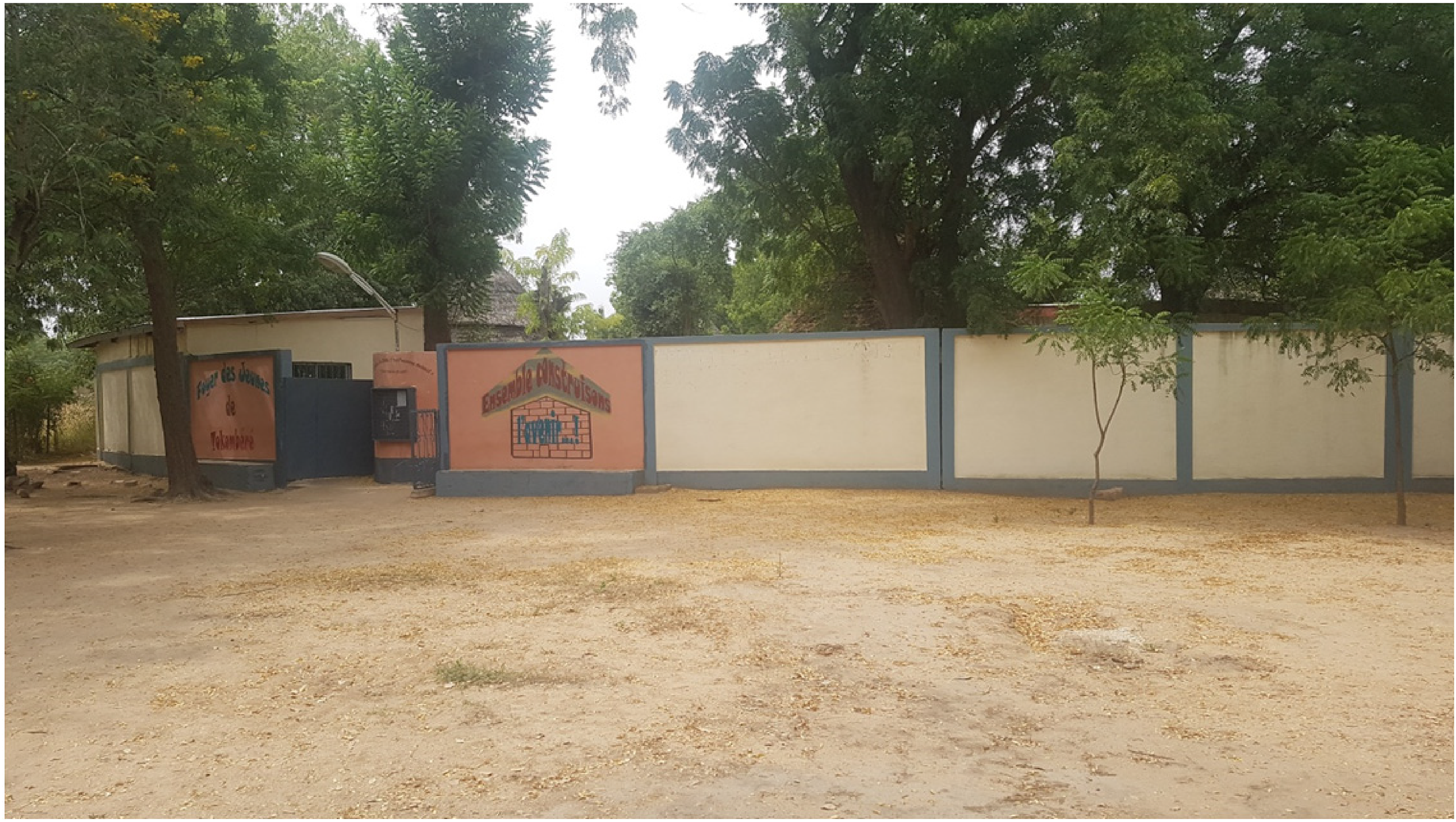
Tokombéré Youth Centre Main Entrance. Source: Author's own image (2012).
Broadly speaking, it is proven that religion has played a prominent role in Africa in empowering the subalterns vis-à-vis the State by means of their increased political function (Bayart, 1973; Ellis and Haar, 1998; Foster, 2019; Otayek, 1997). As for Tokombéré, the emergence of an educational model drawn from African liberation theology has even been observed (Bowers, 2002; Gifford, 2008; Mokoko, 2014; Ukpong, 1984). Therefore, it has resulted in a new mode of critical thinking (Abbink and Van Kassel, 2005; De Boeck and Honwana, 2005; Eboussi et al., 2011; Mbembe, 1985) cherished within a missionary institute for youth support first called the Aimé Césaire Centre and later the Tokombéré Youth Centre. In addition to having contributed to the awakening of the political consciousness of the subalterns in a space of public patriarchy, the Centre has also made it possible to give impetus to the youth's underlying desire to assert themselves vis-à-vis the country's political authorities.
Thus, this paper analyses the role of the Centre in the way its members talk about both politics and politicians. In other words, though the FJT essentially operates as a place of recreational, intellectual, and cultural guidance for youth, it should also be seen as a learning school for political life which is endorsed by missionary work. From this, I argue that the Tokombéré Youth Centre, as the training of elites by the RCC as an opposition force in West Africa (Kantrowitz, 2018; Otayek, 1997), is a missionary place for youth support which has enabled the Church to extend its political function to the Diocese of Maroua–Mokolo in northern Cameroon. 6 With the application, in practical terms, of historical liberation theology (Assogba, 1999: 57; Awazi-Mbambi-Kunga, 2002: 247; Tchonang, 2010: 176), the Centre aims to train up citizens who are actively part of political life (Freire, 2000) as they are aware of the issues at stake. The elders who are also given responsibility for the Centre strive to weigh in on moulding the youth's behaviour by sensitising them to local issues and raising their awareness of the realities of the country – such as a rural exodus, school-dropout rates being high, or else intergenerational and interreligious conflicts (Tizi, 1984). This requires the implementation of a system of co-management by the youth and adults in accordance with FJT's internal rules.
The research draws on interviews conducted in Tokombéré since 2012. The sample is comprised of the Youth Project coordinators, missionaries of St. Joseph Parish, permanent and executive members of the FJT (President, Directors of the Youth Week, and editors of the Centre's newspaper Kudumbar, etc.). Document analysis for the period 1993–2006 was carried out in the archives related to both the Tokombéré Youth Week and to Kudumbar. Similarly, non-participant observation of the Centre's activities and management during my field research since 2011 is included too. With these various instruments, I use an empirical-inductive approach. This facilitates, first, the research on the sociopolitical context which led to the creation of the FJT in 1974. Second, I explore the mode of organisation governing the Centre through the significant process of autonomy it proposes to its members. Third and finally, I underscore the social impact of the Centre on Tokombéré's youth, especially in the aspect of helping raise awareness during the 1990s.
From the Aimé Césaire Centre to the Tokombéré Youth Centre: Narrative of the Conflictive Creation of a Missionary Institute (1974–1984)
Since its creation, the primary goal of the Centre has been to exist as “a training, educative, supportive, leisure place as well as a spiritual provider which the youth long for and for which they are to be epitomes and moral authorities” (Kudumbar, 1986: 10, translated from French). This mission was established in the earlier-described sociopolitical context. Namely, the one which saw first the closure of the FAC and then later it’s reopening under the name of the Tokombéré Youth Centre.
Sociopolitical context to the creation of the Aimé Césaire Centre
During the decade 1960–1970, the hyper-centralisation of postcolonial power was underway in Cameroon. As such, the official creation of the Cameroon National Union (CNU) on 1 September 1966 and the referendum on the formation of a unitary State on 20 May 1972 (Chem-Langhëë, 1995: 22–24; Delancey et al., 2010: xxxiii) worked to strengthen the autocratic nature of Ahidjo's power (Deltombe et al., 2016: 162). The deliberate absorption of all sociopolitical organisations masterminded by the one dominant party extended to the trade union movements, women , and youth organisations.
In the last case, the CNU Youth Wing is the avatar that spurred this integration process. Very few youth movements withstood this trend of centralisation because of the autocratic nature of the State and its legal framework, which outlawed the creation of identity-based associations (see Article 4 of Law No. 67/LF/19 of 12 June 1967). One must look at the peripheries, specifically at the Church, to see the vitality of youth movements like the Association des Étudiants Chrétiens du Cameroun (Christian Student Union of Cameroon) or the Fédération de la Jeunesse Scout (Scout Federation) (Bayart, 1973: 525) in striving to understand the opportunity that existed at the time for the establishment of the Aimé Césaire Centre. Its name at inception is reminiscent of the poet's literary work denouncing colonialism, of which the post-independence political systems in Africa are possible – albeit pale – copies in reproducing an “unequal form of intercultural relations” (Ashcroft et al., 2007: 41).
The relationship between the RCC and political power in Cameroon is expressed in the former substituting the country's political institutions and the State in its pronounced presence in the education and health sectors. 7 In the case of northern Cameroon, formerly islamised, the balance of power between Yves Plumey (Archbishop of Garoua 1955–1984) and Ahidjo reflects the political function of the Church (Bayart, 1973: 523). In fact, the president nurtured for the sake of his political agenda the illusion of a homogeneous region, predominantly Islamic and Fulani, using the lamibés’ (powerful rulers) influence to his advantage – since regarded as the “ayatollahs of Northern Cameroon” (Baskouda, 2017: 59). This thinking crumbled under the impact of the missionary work sometimes resulting in physical reprisals against Catholics in northern Cameroon (Lasseur, 2005: 13, 95). Instances like arson attacks on chapels and Christians being manhandled following the political trial of Archbishop Albert Ndongmo in 1970 (Cador, 2000: 178–179) attest to that, reflecting the prevailing atmosphere during the creation of the FAC.
From this perspective, the opening of the Centre should be highlighted as occurring within an environment characterised by the perpetuation of cultural and political hegemony over mountain dwellers. In many respects, these prevailing circumstances are illustrated in the administrative position of Tokombéré itself, which had been under the Margui Wandala division since 1960. The latter was attached to “the Federal Inspection of the Northern Administration” (Vincent, 1991: 39) headed by Ousmane Mey. He was known for his long tenure as the governor of the then large north province (1972–1982) and for allowing leeway in its administrative and political management. He was an important protagonist in the marginalisation of non-Muslims in that area. Therefore, the creation by the RCC of a facility for the youth turned out to be an innovative effort which would limit the local ruling order.
From the establishment of the Aimé Césaire Centre (1974) to its closure (1981)
The establishment originated from a Catholic working group made up of ten young parishioners of St. Joseph of Tokombéré and led by a devoted volunteer adult called Degdjek (Babaya, 2004: 18). In the late 1960s, 8 meetings were held regularly and had on their agendas recreational-based activities and forms of entertainment (learning music, prayer sessions, free intellectual discussions, etc.). Youth from various religious backgrounds came together within the Catholic mission's premises.
In 1973, Father Jean-Marc Ela, the parish priest, saw the enthusiasm of the emerging group. Concerned with their spiritual and educational support, he decided to put in place an institute that would take charge of its young members’ development. Upon his arrival in Tokombéré, Father Mpecke – who was heading the parish – tasked him with youth guidance and the training of catechists. 9 The guidance given focused on discussion groups in which issues were raised on the lifestyles of the communities where the youth (both Catholics and worshippers of the African Traditional Religions) came from. So, one of the major activities was the assistance of the young people as guides to the great mountain priests Nglissa for the Muyang people and Chédéché for the Zulgo people (Aurenche, 1966: 11–19; Baskouda, 1988: 77) in carrying out ethnographic research.
This also led to another intellectual exercise involving the initiation into the understanding of theological debates by the Second Vatican Council. 10 These activities spurred young people to develop a passion for reading and writing, resulting in the creation of monographs on the mountain dwellers. While his boukarou (traditional hut) was getting smaller and smaller due to all these activities, the sharing of books with the youth was increasing. 11 Also, Father Ela was motivated in this sense by the reflection in the diocese since 1971 on youth care (Babaya, 2004: 18). In this way the Aimé Césaire Centre was founded, which at the start had thirty boarding students (Laraba, 1996: 3–4), rapidly turning into the heart of the activities of Tokombéré youth – including young Muslims. A year later, on 10 May 1974, the Centre was officially recognised and inaugurated in its premises still located between the chapel/meditative area, the presbytery, and the Sisters Servants of Mary's residency (Babaya, 2004: 18).
However, the then local and administrative authorities proceeded with the closure of the institute in 1981 under the pretext that subversive-like activities were taking place there (Assogba, 1999: 85–86). 12 It is important to recall the context of a political system in which one party overwhelmingly dominated, as established in 1966 by a central power hostile to any form of digression from the official discourse that promoted “national unity.” So, the application of Ordinance No. 62/OF/18 of 12 March 1962 to counter subversion, a security mechanism of the brutal postcolonial State, facilitated the repression of opponents with the help of the ambiguous usage of that concept.
Nevertheless, the Centre's educational content started gaining ground from its notable influence on African theology through the historical liberation theology, with Father Ela as its exponent. 13 It aimed at supporting “people from below” to achieve liberation from the domination of the socio-economic and sociopolitical structures keeping them in misery (Awazi-Mbambi-Kunga, 2002: 247). As a result, Father Ela drew a link between mission and theology, because “it is the missiological context that frames the language of theology” (Ngong, 2010: 4). This resulted in the “theology under the tree,” a form of teaching geared towards the subalterns which draw from the tradition of the palaver tree found among the mountain dwellers of northern Cameroon. In this vein, the theology is highly critical of the abuse of power (Ndongala, 2009: 558–559; Ngong, 2010: 11), which it denounced particularly during training sessions on the importance of paying tax, the best strategy to sell one's harvest, or else the importance of fundamental rights (Assogba, 1999: 85). This literacy programme for subalterns, which made them conscientised (Freire, 2000: 119), was the trigger for the Centre becoming a place of youth emancipation from all kinds of hegemony. The action thus became eminently political because the rhetoric on liberation was grounded in the daily life of the local people, who faced bullying and corruption known as “the gorro days.” 14
The reopening of the Aimé Césaire Centre under the name of the Tokombéré Youth Centre (1984)
In 1982, Biya came to power in accordance with the Cameroonian Constitution, after his predecessor had stepped down. However, as the years went by, the relationship between the two politicians became frosty and caused a two-headed executive to emerge in the country. This resulted in the “abortive coup” of 6 April 1984, driving the new president – out of political strategy – to closer collaboration with the Kirdi elites, who became prominent decision-makers (Njoya, 2002: 249), while keeping his grip on power over the Islamic Fulani – which Ahidjo had built his own legitimacy on.
Therefore, in this new political atmosphere, the noose was loosening around the RCC's neck, enabling it to implement on 4 November 1984 its envisaged programme for the Tokombéré youth. This room for manoeuvre was reflected in the act of the officer heading the Tokombéré district, Joseph Fawa. He told the then parish priest to proceed with the reopening of the Centre, but under certain conditions. The two most important ones were the change in appellation and assurances that the Centre would not be a place destined to be the breeding ground for a revolt against the former oppressors by igniting a memory of victimisation. 15 That set, the FJT was put in place; activities restarted with the first iteration of the Youth Week, the annual gathering in St. Joseph Parish of Tokombéré.
It extends through seven days of sporting (Baba Simon football tournament, cycling, etc.), intellectual (conference, debates, round tables, etc.), and cultural (the Kirditude days, film screenings, sketches, etc.) activities in August. This event has put youth at its heart, overseen by the Director of the Youth Week and his team – the youth have also been the main target of the visiting delegations (from France, Chad, the northern and southern parts of Cameroon) often present. Moreover, these activities became increasingly important in 1984 with the publication of the first issue of Kudumbar – essentially a newsletter “for liaison among the friends of the Tokombéré Youth Centre,” being written for the Parish partners in France and for the sarés youth. 16 In the newsletter, a set of topics mainly related to the denunciation of the ills plaguing the region are dealt with, drawing at times a link with Christian morals. These series of developments worked as the second major influence on the educational model used in the FJT. The model drew from libertarian education to reflect on the aforementioned PPHT, within the auspices of which the idea of the Centre was originally formed (Aurenche, 1987: 21). Libertarian education “involves a constant unveiling of reality [and] strives for the emergence of consciousness and critical intervention in reality” (Freire, 2000: 81).
Following this, action learning is at the heart of the educational philosophy of the Centre, which gave to the youth in its statutes “the entire responsibility for FJT activities, from their suggestions to their realisation and analyses” (Kudumbar, 1986: 10, translated from French). This philosophy was demonstrated by the role of the members of the Cercle des Étudiants de Tokombéré à Yaoundé (Tokombéré Students’ Club in Yaoundé, CETY) in the preparation of speakers or of the youth leadership, with many preparation committees for the Youth Week. So, in complement to African liberation theology, Father Aurenche took an approach which situated the FJT as an unconventional educational model aiming at empowering young people as well as overseeing the training of a community. This is in line with the Church's general social role, notably in its set goal for youth's, women's, or peasants’ empowerment (Garner, 2000; VonDoepp, 2002). This goal is clearly visible in the internal organisation of the institute and the symbolism that it incarnates.
Organisation of the Institute's Functioning and Empowerment of its Members: “Government of the Tokombéré Youth Centre”
As an institute that promotes youth empowerment in order to make these individuals citizens who do not find themselves under the control of any form of subjection, the Centre enables young people to formulate, achieve, and evaluate activities by considering a specific pattern of choice.
Councils and general assemblies
The Centre is independently managed by young people through the “Permanent Council” and the “Board of Management.” The first of these organs of coordination is also called the “Youth Council.” It is made up of forty members, mostly high school students who are elected and meet monthly. It is mainly composed of FJT's leaders: that is, the president and his collaborators. 17 As to the second organ, the “Board of Management” (also called the “Youth Project Council”), it has twelve members – made up of youth and adults, who are mainly supervisors, former FJT presidents, the current president, and the coordinator of the Youth Project. The latter has always been a clergyman. In this dual character is also seen the specificity of the FJT model in their guidance for youth within a Catholic parish. With a focus on the comprehensive development of its members 18 beyond just Catholics, the FJT strengthens accordingly its influence as an organisation in the social field. It also meets on a monthly basis. 19
A legislative body called the “General Assembly” is also an operating organ within the FJT. The first meeting, held in August each year, is mainly for the launching of the annual activities to come. It is about having a general report on the activities that have taken place during the year coming to a close and evaluating the work of the outgoing team. During the meeting, the president and the composition of the FJT bureau are chosen. In the course of the year, from March to April, a second meeting is held which evaluates what has been done so far per the policy proposed by the current team. Then they proceed with the election of the Youth Week director, which takes place in the following August. 20 As such, the Centre is permanently managed by a team whose members are elected and then monitored by other members and the clergy.
Government of the Tokombéré Youth Centre
Living in the social field of postcolonial Cameroon, the Tokombéré youth have had to develop habits which partially copy the simulacra making up contemporary life – in which obedience and adherence to the codes of political power have been established (Mbembe, 2001: 102–103). It is in this context that the structural organisation of the Centre is fairly similar to that of executive power in the State of Cameroon, where the quest for status (Zambo, 2003: 75) is set as a value to aspire to. This is the reason the organisation is qualified as the “Government of the Tokombéré Youth Centre,” as attested to by the minutes signed by the appointed members. It is governed both by internal regulations and by principles which organise its establishment by consensus.
Drawing from this, one can notice a form of mimicry aiming at giving a symbolic lecture to the postcolonial state on the proper management of power (Mbembe, 2001: 110). Here, parallels can be drawn between the names of the positions of the FJT officials and those of the ministries in Cameroon under the presidency of Biya (see Table 1). The fact of choosing the term “minister” to refer to the leadership roles in the Centre was to satisfy the youth who desired a political career. However, by mutual agreement with the supervisors, it was decided that the term would not be taken in the honorific sense of a government member but rather that of a servant: The young leader wanted to see his country well managed by the ministers appointed by the President of the Republic of Cameroon. The Centre supervisors planned that each youth does his best, that they should see themselves as real ministers and see the Centre as a nation. That was a way to conscientise the Tokombéré youth on the management of the country.
21
Tokombéré Youth Centre (FJT) Organisation Chart and Connection with the Cameroonian Government.
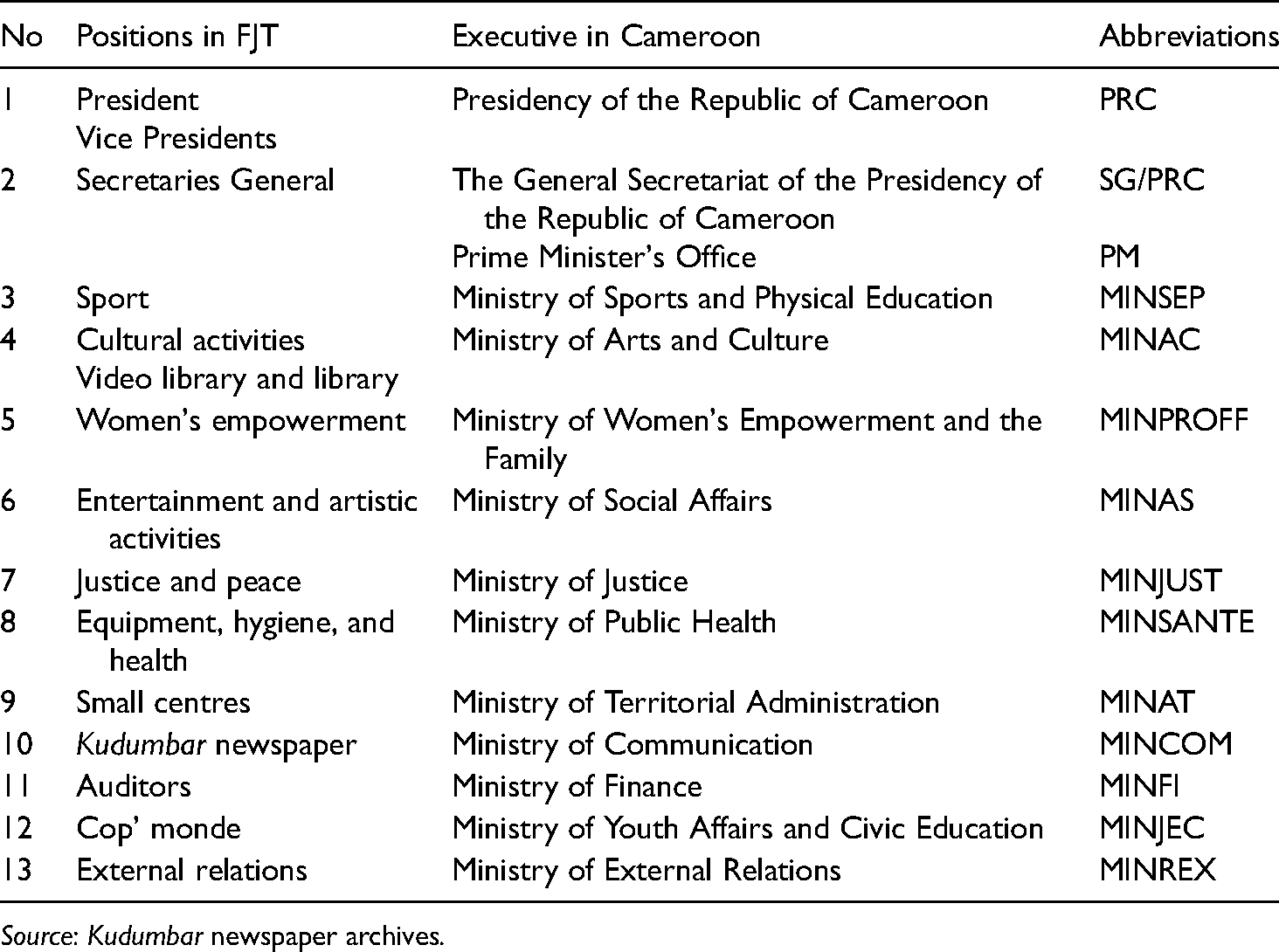
Source: Kudumbar newspaper archives.
This approach finds its inspiration also in the motto of the Maroua–Mokolo bishop Jacques de Bernon (1973–1994): “Serve, not serve yourself.” Here, the contrast between the respective number of ministries is highlighted: less than ten in the FJT and more than thirty for the State of Cameroon, which seeks to satisfy a regional-balance policy. With this choice, the young people focus on service and the usefulness of the ministries, as this extract demonstrates: “The Ministry of Women's Empowerment is one […] offered to girls who wish to empower themselves in the Centre” (Akis, 1996: 14, translated from French). It is therefore a muted criticism by the young people because “mimicry is never very far from mockery, since it can appear to parody whatever it mimics” (Ashcroft et al., 2007: 125) – but one which also serves as a learning framework that has facilitated some political careers (see Table 2). This structural organisation has made it possible to entrench the educational model advocated by the Centre to its young members. Through the administration of the FJT, which is governed by a set of rules reinforcing its position as a place where the youth spend most of their time, the choice of operating on the basis of the Cameroonian government model occurs. And this has a major impact on the definition of their social status.
Political Careers of the Youth Members of the FJT.
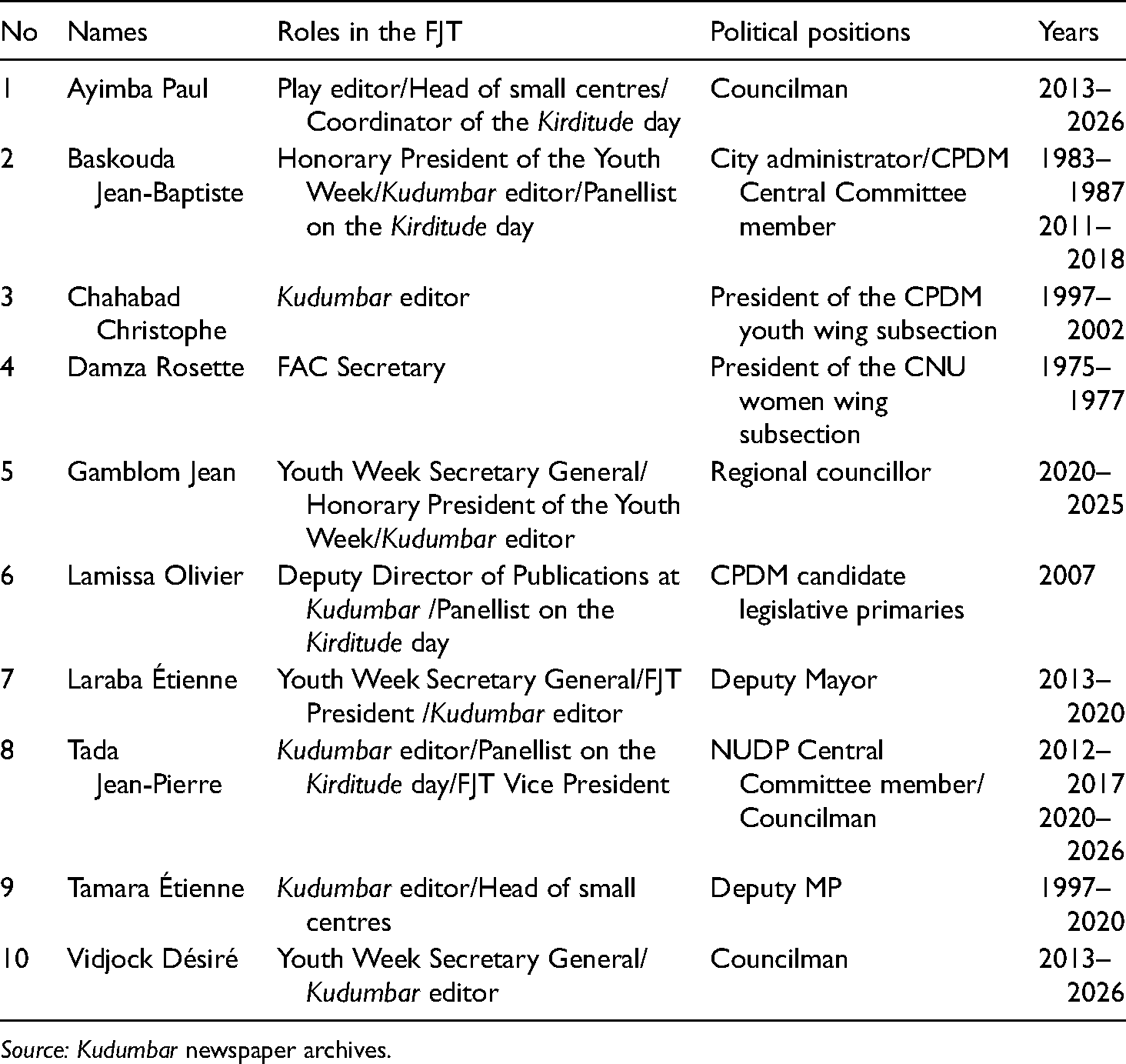
Source: Kudumbar newspaper archives.
Social Impact of the Tokombéré Youth Centre
The FJT as an institute of supervision initiated by Catholic missionaries has had a significant influence on the lives of several generations of youth since its reopening in 1984. This impact is perceptible through the modelling of an ideal type of citizenship advocated and encouraged by the Catholic clergy. The transformation taking place vis-à-vis the youth is seen on three levels: namely, the freedom of expression and opinion; mind awakening and awareness; and, renewed interest in the Kirdi question.
The freedom of expression and opinion in Kudumbar
The Centre offers specific support aiming to nurture an understanding of citizenship which values freedom. Thus, through the publication of the quarterly newspaper Kudumbar, young people share their perceptions of society in the pages of this public forum. They express in a direct way their views and take a critical look at the way their city is being run. Though benefitting from the political changes occurring in Cameroon in the early 1990s (see Law No. 90/053 of 19 December 1990 on freedom of association), the liberation of speech came about through the symbolic impact of Biya's accession to the country's highest office in 1982 (Baskouda Shelley, 2022: 8). It is no coincidence that 1984, the year of the first issue of Kudumbar, was also the one of the reopening of the FJT.
Thus, the themes discussed in the newspaper are a response to the burning social issues of the day, such as the corruption mentioned in Kudumbar No. 43 of March 1998. The young people select the themes to be discussed, very often drawing from the happenings that impact contemporary society. This is illustrated, for instance, by the publication of an open letter by a young HIV-positive person to draw attention to the dangers of the AIDS pandemic: “My dear brothers […] do not fall victim of this dreadful disease” (Bridgi, 1998: 4–5, translated from French). Kudumbar is much closer to L’Étudiant noir, a monthly magazine by the Association of Martinican students in France (founded by Aimé Césaire) from which it copies. It was the means of expression of the social elite, such as Jean-Baptiste Baskouda, Étienne Zikra, and Olivier Lamissa. 22 Besides, it benefitted from the collaboration of the CETY, who from 1990 onwards were influenced by the university context marked by student movements.
Therefore, most of the featured articles point to the use of “the State as an instrument of domination and a factor of inequality” (Ela, 1990: 17, translated from French) in the hands of the postcolonial power. This paper, which is a good medium of expression for the youth in Tokombéré, can be linked to more global initiatives seen within the RCC. Indeed, the bitter recriminations articulated in the forty issues released during the 1990s are close to what was done also in L’effort Camerounais, a private denominational press publication. As an illustration, it is possible to quote issue No. 39 which deals with democracy and in which a young man is puzzled by the inadequacy of the political system in Africa: People impose themselves in power, trample on the rights of citizens, deny others’ freedom, cancel elections, decide for the masses. [Consequently] democracy can be defined for a normal African as the government or better still, the management of a country by a tribe and for the tribe alone (Laraba, 1996: 3, translated from French)
It should be noted that young people often bore the brunt of political violence during the 1997 legislative and presidential elections in Tokombéré. As a matter of fact, the tensions with the political and administrative authorities began at the same time as the campaign of democracy awareness the youth had organised in 1996 did (Babaya, 2004: 21). This initiative is also to be regarded in the same light as the multiple forms of public speaking by the clergy, such as pastoral letters and episcopal conferences (Akoko and Oben, 2006: 45).
Awakening of mind and consciousness through film screenings
Fully enjoying citizenship requires the construction of a spirit of "en commun" (togetherness). Therefore, young people are required to make the shift from the status of “breakers,” a destructive force, to “makers,” a constructive force that renders them the spearhead of the nation in the eyes of the authorities (De Boeck and Honwana, 2005). The multi-faceted cultural activities of the Centre thus aim to build in members an exaltation of awareness of their proactive role. Debates have been held during Youth Weeks among and with prominent figures in the Cameroon social field (Cardinal Christian Tumi, Ambroise Kom, Pius Njawé, etc.) in order to produce a particular type of “political agency,” the aim of which is to refute the negative rhetoric about them by those in power (Alava, 2018: 159).
Watching films and documentaries on Apartheid, slavery, and similar issues became moments of sensitisation of the youth to situations where parallels can be drawn with their own daily life. This is seen with the screening of Laagan: Once upon a time in India on the margins of the twentieth Youth Week in 2004, which was about taxation injustice in the peasant world in India (and by implication, northern Cameroon) and revived the denunciations begun by Father Ela on the “masked servitude” (Assogba, 1999: 59, translated from French) suffered by the subalterns – helping to remind us of the importance of human dignity. Although most types of screenings were from the West, the youth did not face censorship but rather benefitted from a pedagogical initiative which is part of the Church's mission to empower them. Besides, the exchanges between the youth and filmmaker Bassek Ba Kobhio in his conference – “How and why to express one's culture” – during the Arts and Culture Day in 1999 in Tokombéré reinforced this. The approach works to make Christianity a weapon used by the youth to resist the domination of the postcolonial power (Mbembe, 1988). In the same vein, performances on stage during the indigenous-music dance and song parties serve, beyond the training of artistic talent, to strengthen the development of activities nurturing the youth's critical mind towards power. The resurgence of the traditional frameworks of expression that music offers enables young people to voice their convictions.
The Kirditude day and the resurgence of the Muntu
In line with Fabien Eboussi Boulaga's (2014) thinking, as expressed in a paper he presented as a keynote speaker at the twelfth Youth Week in 1996, the need to rediscover one's African identity is the basis for a genuine social existence. As such, the Tokombéré youth have embedded the search for their true identity as a fundamental principle of their citizenship, as demonstrated by the attempts to revive the skills and knowledge they have defined as their goal (Lamissa, 1995: 60; Tada, 1995: 57). This identity, corrupted by clichés inherited from the turbulent imperialist history in the Mandara Highlands, is reflected by the perpetuation of the Islamic Fulani hegemony from the colonial period (1884–1960) to the postcolonial era (1960–1982) under the Ahidjo regime.
The popularity of the Kirditude 23 days, with involvement by the Muyang and Zulgo Academies, is another example of the place of the Muntu – a movement of self-definition understood as “being endowed with intelligence” (Kagamé, 1956, translated from French) in the making of the young active citizen in Tokombéré. They are working to reconcile their social being with their history, to maintain their traditions in a globalised world – and that in a locality that has long suffered the ravages of the cultural Islamic Fulani “season of the shadow” (Chétima, 2015, 2020; Miano, 2018, translated from French). This destruction happened in slave raids which forced a territorial withdrawal to the mountains as well as societal (political, religious) disorganisation. The result is the perpetuation of the phenomenon of identity transfiguration in the face of the traumatic denial of Kirdi cultural origins, which are considered inferior vis-à-vis assimilation into the Islamic Fulani's skin. This youth highlights in his editorial: “Some peoples known as the Kirdi and classified as such by history deny to be so today” (Dang, 1994: 1, translated from French).
The Kirditude days are also noticeable through the lens of self-presentation. They bring out the dissonant view that the Tokombéré youth have on the Kirdi question (Bigombé Logo, 1999; Mouiché, 1996: 189–191) through the refocusing on the cultural aspects hereof. This is done to the detriment of the political approach of the Dynamique Culturelle Kirdi (Kirdi Cultural Dynamics) (Houli, 2006: 99; Issa, 2005: 198). The early 1990s, therefore, helped to define a philosophy of Kirditude (Ela, 1994), the primary goal of which is to help assert the identity of the mountain dwellers of northern Cameroon and strip them of the maligned image that the Islamic Fulani had attempted to seed in people's minds. This refocusing, culturally speaking, on the Kirditude within the local church was envisaged by Father Grégoire Cador as a missionary innovation which could contribute to improving the educational offer of the Youth Week. The philosophy sounds like a criticism of the young people towards their elders, who had their heads turned towards the politicisation of ethnicity. The attention given to these dimensions aims to help the youth better understand their own culture, as a student mentioned during the third Kirditude day: The Muyang Academy was founded in 1985 after a deep reflection by the Muyang secondary school students. The goals of the Academy were to collect from the elders tales, proverbs, sacrifices, since there was a break between the elders and the youth and finally to be able to write and read in Muyang language (Tada, 1995: 57, translated from French).
This reorientation is also significant in terms of a political theology whose most outstanding figure in Cameroon was Cardinal Tumi (Bongmba, 2015), bishop in Yagoua (1979–1982) and archbishop in Garoua (1984–1991). Therefore, it was obvious that he would be invited to speak during the eleventh Youth Week in 1995.
Conclusion
This paper has examined the FJT as a missionary institute of youth support which enabled the RCC to exercise its political function in the diocese of Maroua–Mokolo, Cameroon, from 1974 onwards. This was made possible with the socialisation of its members, specifically by emphasising the elements of empowerment and self-reliance. In fact, the RCC has very often played the role of the State (Bayart, 1973) – this has led to conflicting relations (closure of the FAC in 1981) or, conversely, to coexistence (reopening of the FJT in 1984). Consequently, the use of both historical liberation theology (Assogba, 1999: 57; Awazi-Mbambi-Kunga, 2002: 247; Tchonang, 2010: 176) and of libertarian education (Freire, 2000: 81) by St. Joseph Parish of Tokombéré has seen a special experience be achieved, one which does not abide by the standard ways pursued by “ordinary” chaplaincies in the support of young Catholics.
Thus, the critical thinking nurtured on-site exists between mimicry and mockery, while regarding the youth as ambivalent persons (Bhabha, 2007: 85–92) fascinated by the power they devote to deconstruction in the context of the progressive liberalisation of the social field in Cameroon. First in 1984, with the release of Kudumbar – the FJT's newspaper. This facilitated greater freedom of expression and opinion. Then, from 1993 onwards, with the impacts of film screenings which brought increased awakening and awareness. Finally, with the influence of the Kirditude days, which cultivated a renewed interest in the Kirdi question. To sum up, the political side has just been the desired consequence underlying the work, though it was not explicitly outlined in the objectives originally stated by the Centre's Catholic missionaries.
Footnotes
Acknowledgements
The paper benefitted from the generous funding for translation into English provided by the Sulzmann Foundation from the Johannes Gutenberg University of Mainz. The text was translated by Joseph Lionel Foh and copy-edited by James Powell. I would like to express my gratitude to Christelle Amina, Adam Mahamat, and Téclair Mokong respectively for their comments, and the translation of the Abstract into German. I am also indebted to both Denis Djamba and Simon Foudama, who provided me full access to the Tokombéré Catholic Mission archives, and to the two anonymous reviewers of Africa Spectrum for their valuable suggestions.
Declaration of Conflicting Interests
The author declared no potential conflicts of interest with respect to the research, authorship, and/or publication of this article.
Funding
The author received no financial support for the research, authorship, and/or publication of this article.

Notes
Author Biography
References
Supplementary Material
Please find the following supplemental material available below.
For Open Access articles published under a Creative Commons License, all supplemental material carries the same license as the article it is associated with.
For non-Open Access articles published, all supplemental material carries a non-exclusive license, and permission requests for re-use of supplemental material or any part of supplemental material shall be sent directly to the copyright owner as specified in the copyright notice associated with the article.
