




Abstract
The African “youth” population is growing at a fast and steady pace, attracting attention from scholars, policymakers, and politicians. Yet, we know relatively little about this large and heterogeneous segment of the population. This paper presents data from 110 interviews and ten focus groups with youth engaged in commercial agriculture across all four regions of Uganda. Capitalising on this ethnographic data, we provide an analytical framework for studying complexity among the heterogeneous social category of youth agripreneurs. The aim of the paper is twofold: First, to reconcile anthropological studies that highlight the heterogeneity of African youth with demographic understandings of youth as a statistical category defined by an age bracket. Second, to advance an operational definition of youth that allows for more context-sensitive and tailored programmes. Our results suggest that while “youth” is an important category demographically, the opportunities and challenges faced by youths are often not related to age.
Introduction
“Stop calling me a youth! I’ve been circumcised!,” Alex informs us. Alex is a twenty-five-year-old fruit vendor at Nakasero central market in Kampala, originally from the eastern sub-region of Mbale. 1 We have been interviewing Alex about his career and aspirations in commercial agriculture. Sitting on a pile of fruit boxes in perhaps the busiest spot in Ugandan's capital city, Alex felt he should make his identity as an adult clear to us, as well as any indiscrete passer-by. After all, he has obtained a social status that is insulting not to recognise – a status marked on his body in one of the harshest and most difficult rites of passage in Eastern Uganda. Yet, later the same morning, without blinking an eye, Alex asked for advice on how to access a youth development project. Although initially puzzled by this apparent contradiction, we later realised that it was just a reflection of the fluidity around the social category “youth.” Although this category is perceived as a transitory phase, it is also a situational, opportunistic and interchangeable identity. How do we reconcile the social and transitory nature of youth with the pressing demographic need to understand and analyse the contemporary “youth bulge” 2 in Africa?
The academic literature on youth in Africa is divided between studies that define youth by using one's birth year and those that analyse youth as a context-dependent social category. The first body of literature, which is largely rooted in the social sciences (e.g. political science, sociology, and economics), focuses on youth as a category that is clearly delineated by age. This literature often asserts that youth are both “at risk,” but also a potential “threat” (Burton, 2007). At best, they are a marginalised segment of the population. In particular, attention is paid to the challenges of both underemployment and unemployment (Baah-Boateng, 2016; Cramer, 2010), including the correlation between high numbers of unemployed male youth and violence (Urdal, 2004, 2006).
The second body of literature, which is rooted in anthropology and critical development studies, emphasises that youth is a social category that takes on different meanings in different contexts (Aime and Pietropolli Charmet, 2014; Blum, 2007; Butler and Kebba, 2014; Christiansen et al., 2006; Honwana and De Boeck, 2005; Ighobor, 2013; Sommers, 2015; Sumberg et al., 2012; Van Dijk et al., 2011). For these scholars who primarily use ethnographic methodologies, youth and adulthood are more than one's age. “Youth” is a concept deeply connected to social status and context. As Christiansen et al. (2006: 10) argue, “[y]outh is differently constituted and configured in different times and places. It may be an influential social category in one context, a marginal one in another and obsolete in a third.”
The objective of this article is to bridge these two bodies of literature by providing an analytical framework to study the heterogeneities among youth. Inspired by critical ethnographic studies of youth, we understand youth to be a heterogeneous, socially-defined category that varies in different contexts and over time. However, we also recognise the need to study “youth” as a demographic reality, both in theoretical analyses and in policy. The median age in Africa is half that of the European population, and the African population is expected to double in size by 2050 (European Union, 2019). Both theoretically and pragmatically, scholars and practitioners need to be sensitive to the needs and ambitions of this highly-salient demographic group – without ignoring the vast heterogeneities present across this growing segment of the population.
As a first step in mapping youth heterogeneities, we conducted multi-sited, qualitative fieldwork in four regions of Uganda. In total, we carried out 110 semi-structured interviews and ten focus groups with Ugandan youth aged eighteen to thirty-five years engaged in commercial agriculture, that is, “agripreneurs.” 3 We focused on youth agripreneurs, because they have received large amounts of attention and funding from both Ugandan politicians and the international development community. Agriculture is by far the most common profession among young people across Africa (Filmer and Fox, 2014). And, although the majority of African youth remain engaged in subsistence agriculture (i.e. cultivating produce for their own household consumption), it is those who have expressed an interest in commercial agriculture (i.e. cultivating for both consumption and sale to make a profit) who are commonly targeted by development schemes. There is, therefore, an immediate and pressing need to better understand this segment of the African youth population.
To analyse our interviews, we used inductive coding to identify twelve factors contributing to the heterogeneity of youth agripreneurs: belonging, ecosystem, ethnicity, values and norms, family background, gender, age, self-identification, specialisation, market proximity, rural-urban nexus, and politics. Building on previous research (Blum, 2007; Hess, 2004; Methorst et al., 2017; Peatrik, 2020), we clustered these twelve factors into three dimensions: territory, socio-cultural, and network embeddedness. Rather than being individual standalone factors affecting youths’ identity and engagement in agribusiness, these factors and dimensions intertwine and interact with each other. However, labelling them as distinct heterogeneities allows us to identify key dimensions of variation that should be accounted for in both theory and policy.
Our results make three key contributions to the literature on youth and youth agripreneurs. First, we provide an analytical framework and approach that can be used to study youth – and particularly youth agripreneurs – across the continent. Our results were developed in the Ugandan context and are not intended to be directly generalisable beyond the sample population. Nevertheless, the analytical framework we developed suggests a number of important sources of heterogeneity that are likely to be important beyond Uganda and can be tested and extended in other contexts. By systematically analysing youths’ heterogeneity using in-depth interviews with youth themselves, we believe that it is possible to bridge scholarship on African youth – analysing “youth” as a (contested) social category, without overlooking the complexities of identity among this vast group.
Second, our results provide descriptive evidence on the factors that define a young Ugandan agripreneur. Our research clearly shows that what defines youth, for this sub-section of the population, goes far beyond a simple age bracket. Consistent with the anthropological literature on youth (i.e. Christiansen et al., 2006; Sommers, 2015; Ungruhe, 2010), for the majority of Ugandan “youth” we interviewed, the passage from youth to adulthood was not bound to age, but rather dependent on personal and material achievements. Moreover, the ambition to exit the social category “youth” into adulthood drove youth ambitions in and beyond agribusiness. Particularly for male youth, the achievement of “adult” status is related to their social inclusion in their ethnic group as men.
Third, our results provide important insights for a development sector increasingly interested in engaging youth in commercial agriculture. Youth identity – and even one's basic understanding of what it means to be a “youth” – varied substantive across the four different regions where the interviews were carried out. Differences were strongly linked to identity markers, such as ethnicity, but also to access to transportation and local markets, as well as particular value chains. If practitioners are to avoid mismatches between what different groups of youth need and what development policies and programmes supply, they need to be cognisant of these variations so that they can design programmes that sufficiently address the heterogeneities in this social category.
Setting the Scene: Why Study Youth Agripreneurs?
“‘Youth is just a word,” wrote Bourdieu (1993), referring to the somewhat arbitrary and contextual definitions of this social category. As a phase between childhood and adulthood, “youth” is a condition of liminality, both marginal and transient in nature. However, despite the apparent marginality of this social category, the concept of “youth” has recently assumed a very prominent role in public debates around development in Africa (ILO, 2021: iv–v). This is not surprising given the demographic realities.
In terms of rapid demographic growth, Uganda is an extreme case study. With a population of over forty-five million (Worldometer, 2020), Uganda faces a “youth bulge.” In 2020, the Ugandan median age was 16.7 years, well below the continent average of 19.7 years (Worldometer, 2020). Nearly 50 per cent of the population are under fifteen years of age (Uganda Bureau of Statistics, 2017). Among this segment of the population, it is only intuitive to expect heterogeneity. There are fifty-six different ethnic groups living in Uganda, and youth are made up of an almost equal share of males and females (Ministry of Gender Labour and Social Development, 2001).
Importantly, the category of youth also has political leverage in Uganda. As youth constitute a significant share of the economically-active population and the electorate, they are targeted by both politicians and the international development sector (Sommers, 2012, 2015; Sumberg and Hunt, 2019; Van Dijk et al., 2011). As a strategy to tackle unemployment, investment in youth often targets the agricultural sector, in particular youth agripreneurs. Despite processes of urbanisation, the majority of Ugandan youth still live in rural areas (Ahaibwe et al., 2013: 6) and are engaged in agricultural activities (IFAD, 2019: 31). Although the majority of Uganda youth in the agriculture sector are subsistence farmers, programmes like the United States Agency for International Development's “Feed the Future,” the Government of Uganda's “Youth Livelihood Programme,” and the Association of Volunteers in International Service's “Skilling Youth for Employment in Agribusiness” target those aiming to engage in agribusiness.
Within development schemes in Uganda (and beyond), youth are commonly discussed as a statistical and demographic reality. However, “youth” are also young persons embodied by a social personal that goes beyond the temporal category of age (Peatrik, 2020). There is not a fixed moment in our lives when we stop being children and enter adulthood. Rather, this transition is determined culturally within our specific social environments (Aime and Pietropolli Charmet, 2014: 11–20). Christiansen et al. (2006) explain that generational categories like “childhood,” “youth,” and “adulthood” are historical, cultural, and social processes. In East Africa, and Uganda in particular, youth as a generation has been studied as a social category in tension with patriarchal and gerontocratic systems of order (e.g. Burgess and Burton, 2010; Summers, 2010).
More recently, scholars have observed that “youth” has become a category of transition, and there is little pride in being considered “young” and access to “adulthood” can be frustrated by competition for scarce resources (Sommers, 2015). Across the continent, youth struggle with employment and increased population growth means more competition for jobs and resources (Hanson and Leautier, 2013; ILO, 2020; Yeboah and Jayne, 2018). As a consequence of structural marginalisation, Sommers (2015: 13) argues that many men across the continent remain “youthmen” or in a state of “failed adulthood.” This condition is also commonly referred to as a “waithood” (Finn and Oldfield, 2015; Honwana and De Boeck, 2005; Sommers, 2015) and understood as “a prolonged and uncertain stage between childhood and adulthood that is characterised by their inability to enter the labour market and attain the social markers of adulthood” (Honwana, 2012: 19).
Besides economic status, Blum (2007) identifies factors such as gender, education, and family formation as determinants of youth identity. These dimensions embed youth in their socio-cultural context. As Van Dijk et al. (2011: 5) argue: “Not when one is youth but also where one is youth – the ‘situational’ exploration of youth has at least allowed for the possibility of looking at space and place as new modes of understanding.” The positioning of youth within a specific context embeds the conceptualisation of youth beyond the generational passage of time.
Considering that the majority of African youth live rural lives connected to agriculture, Mueller and Thurlow (2019) argue that the identity of many youth is closely connected to that of a farmer. Like all identities, the identity of “farmer” is also embedded in its socio-cultural context. Drawing from the work of Hess (2004), Methorst et al. (2017) elaborate on three dimensions of farmers’ embedding in their context: territorial, societal, and network embedding. For Methorst et al. (2017), territorial embedding is operationalised as geographically-bounded resources and capabilities (i.e. the ecosystem and urban/rural context), while societal embedding is the socio-cultural context, including norms and values, family background, perception of age and identity. Finally, network embedding is operationalised as agribusiness and value chain relations, including market access and agribusiness aspirations.
Despite the growing attention being focused on young farmers in both scholarship and policy, a systematic understanding of youth agripreneurs – their key identity markers as well as constraints – is lacking. Qualitative studies on this social category have highlighted variations across the broad category of “youth,” but left unanswered the question of how we might be able to analyse and account for such heterogeneities in analysis and policy. This literature has largely problematised the concept of youth, rather than attempting to explore sources or types of variations within sub-sections of this population, such as youth agripreneurs. At the same time, quantitative studies of youth largely take this category as unproblematic, utilising (different) age ranges to define what it means to be a “youth.” As Abay et al. (2021: 2) stress: “There is as yet no coherent story of how young people across rural Africa engage with rural economies […] and no analytical frame has been proposed that seeks to harness the diversity of rural contexts for more relevant policy towards rural youth.”
Research Design and Methods
Research Design and Sample Selection
The objective of this research is to bridge the gap between those who problematise the concept of youth and those who take for granted the definition of youth, by identifying key sources of heterogeneities across Ugandan youth agripreneurs. In order to accomplish this goal, our research methods are hybrid. Inspired by ethnographic methods, we conducted intensive fieldwork and narrative analysis, but favoured a wider sample instead of long-term engagement within one community. This meant that we did not produce thick descriptions of the field. However, as our fieldwork was multi-sited, we were able to account for, and map, the heterogeneities of youth agripreneurs throughout Uganda. Although not a statistically representative sample, the large sample of informants, which were purposefully sampled to account for a wide range of experiences, allows for some degree of internal generalisation.
In total, we carried out 110 semi-structured interviews and ten focus group discussions with Ugandan youth aged eighteen to thirty-five years living in all four regions of Uganda (Table 1). In selecting respondents, we targeted youth engaged in, or seeking to be engaged in, commercial agriculture, as this is the population targeted by development programmes. What was important to us in selecting respondents was whether the interviewees sought to make a profit from their agricultural products, not whether they actually did. 4 We selected the age range 18–35 to account for the different age ranges used by relevant development actors: that is, fifteen to twenty-four years by the United Nations, eighteen to thirty-five years by the African Development Bank, and 18–30 years under the Ugandan Constitution. The bracket eighteen to thirty-five years provided the widest possible age range, while excluding youth under eighteen due to ethical concerns with sampling underage populations. Moreover, it is difficult for young farmers to pursue agribusiness in Uganda before the constitutional threshold of coming of age (eighteen years), as it is at this point that capital becomes accessible.
Summary of Multi-sited Fieldwork With Youth.
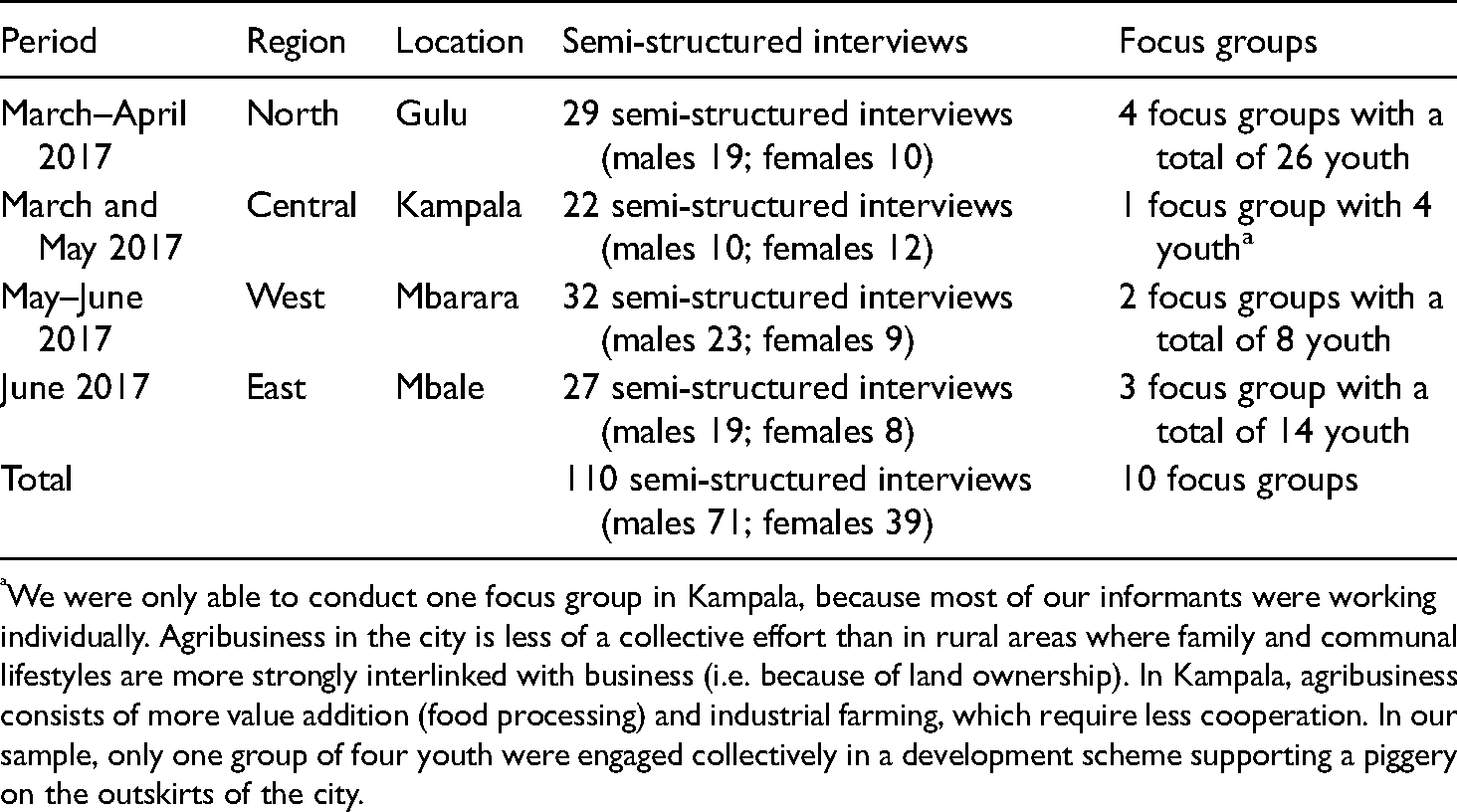
We were only able to conduct one focus group in Kampala, because most of our informants were working individually. Agribusiness in the city is less of a collective effort than in rural areas where family and communal lifestyles are more strongly interlinked with business (i.e. because of land ownership). In Kampala, agribusiness consists of more value addition (food processing) and industrial farming, which require less cooperation. In our sample, only one group of four youth were engaged collectively in a development scheme supporting a piggery on the outskirts of the city.
Because we wanted to capture potential regional diversity, we sampled youth from all regions in Uganda (Figure 1). Geographical and economic diversity strongly influence the economic opportunities of youth (IFAD, 2019: 25). In rural areas, for example, opportunities are largely determined by the extent of market access (agricultural output, input, labour, finance and other markets). This, in turn, determines the area's potential for commercialisation and, according to the natural resource base, the potential agricultural productivity of the area (IFAD, 2019).
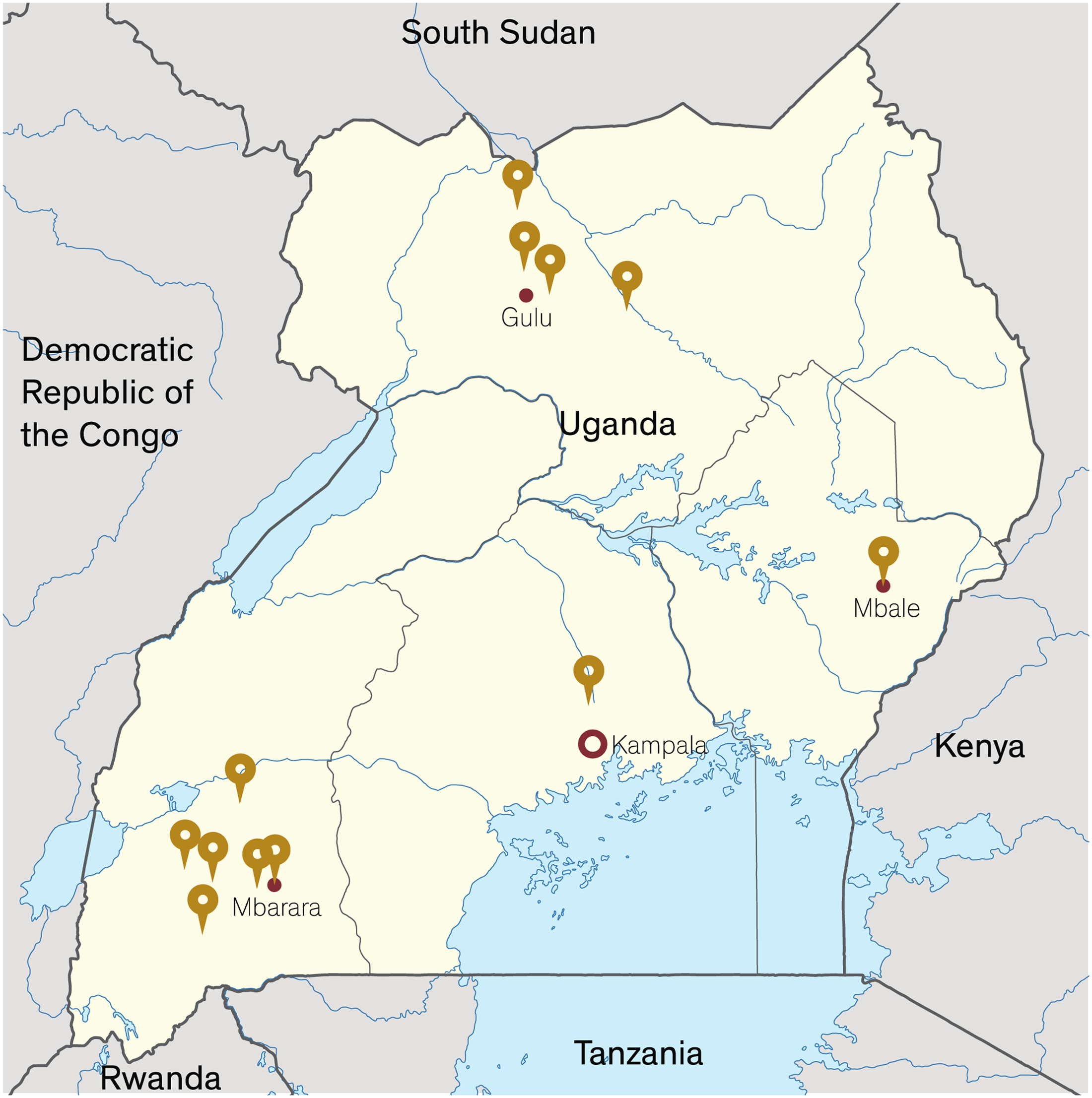
Map of Uganda With Main Field Sites.
To select the field sites, we identified a development project in the vicinity of agri-food trading hubs in each region and then, to capture a diversity of experiences, sampled individuals working inside and outside of the development project of comparable age and social status within the same communities. The initial selection of respondents who were engaged in a development scheme was facilitated by the donor of the project, which provided a list of beneficiaries. However, we independently followed up with our own selection of respondents without the further involvement of the donor, so as not to introduce bias. For individuals working outside of major development schemes, we randomly started the selection of respondents at marketplaces, and subsequently adopted a snowball approach (respondents indicated others in their community). In total, we sampled seventy youth who were part of an established development project and forty youth who were not. Of those who were part of a development scheme, the names of twenty were originally provided to us by a donor.
As Table 1 shows, males are overrepresented in our sample. This is because we wanted our sample to broadly mirror the types of youth engaged in commercial agriculture in Uganda, and males are over-represented in most value chains. Because of both gendered social responsibilities and land ownership titles, the socio-economic ownership of most agribusinesses is with men. The vast majority of respondents were also Christian, however, there were also a few Muslims. In and around Kampala, respondents generally had at least a high school diploma (and in some cases a university degree). In the rural regions, the majority had limited education (elementary school or lower). The exception was the Western Region, where particularly dairy farmers are more highly educated.
In each of the four regions, we also selected one to two key informants whom we interviewed multiple times and in a more unstructured and informal way, including participant observation of daily practices (e.g. family life, market visits, and agricultural work in the field). The selection of these key informants was determined by their privileged position in the community (e.g. they owned a shop or had achieved a high status in the local agri-food market). Given their extensive network and experience in agribusiness, these individuals helped us to contextualise and understand the local environment. In addition, we also conducted twenty-four semi-structured interviews with development practitioners, working mainly in Kampala. The data from these interviews informed our understanding of development policy towards youth and agriculture in Uganda, but are not reported in this article.
All of the interviews were carried out by the first author, with the support and supervision of the co-authors, between 2016 and 2018. 5 Interviews took between 30 and 60 min and were conducted in either English or local languages with the support of a local translator (Acholi in the Northern Region, Lugisu in the Eastern Region, Luganda in Central Region, and Lunyankore in the Western Region). Most interviews were recorded and transcribed. However, on a few occasions, we relied on notes for reasons of sensitivity. 6 During the interviews, we used a common interview protocol, but deviated from the protocol when interesting ideas and topics emerged, depending on the context and respondent. 7 All interviews were analysed in Atlas.ti using inductive coding, an analytical process by which recurring ideas and concepts are highlighted and clustered (Boeije, 2009). In the next section, we provide a more extended overview of our field sites, before presenting the results of the analysis.
Overview of Field Sites
In the Central Region, fieldwork was carried out in the urban district of Kampala and the neighbouring district of Wakiso. Kampala is not only the capital of Uganda, but also the largest urban centre. The city stretches over an extended area, covering about 200 km2 across seven hills (Uganda Bureau of Statistics, 2017). It has a hectic business and trading centre and an extended residential area that reaches the shores of Lake Victoria. Most government institutions are located in Kampala and the surrounding areas, as are most offices of (inter)national private sector companies and development agencies. Officially, about 1.5 million people live in the city (City Population, 2018), but unregistered inhabitants and daily commuters means that the city swells during the day. Residents of Kampala have the highest level of literacy and years of education anywhere in the country (Banks and Sulaiman, 2012). Although Kampala is a metropolitan area with many residents from other regions and countries, historically, the city was (and still is) the capital of the Kingdom of Buganda (Reid, 2017). This meant that slightly more than half of our respondents in Kampala were of Baganda ethnicity, while the remainder belonged to the other ethnicities.
In the Northern Region, we conducted fieldwork in the districts of Gulu, Pader, and Amuru. Gulu is a town of approximately 150,000 inhabitants, located in a widely uninhabited area that experiences an arid dry season and a rainy season. There are small villages scattered throughout the countryside, mostly concentrated along the main roads. Outside of Gulu, people mostly live in communities of extended families, around commonly owned and cultivated land that is inherited patrilineally. Land tenure is communal and the social structure is closely tied to agricultural production as a community effort. The main agricultural products include grains and other food crops (i.e. millet, sorghum, beans, and groundnuts), and the expansion of large-scale farming has recently increased the production of maize, soya, and rice. The region's economy and socio-political context continues to be heavily impacted by the long war, which took place in this region between 1987 and 2006–2008 (Reid, 2017). All of the informants we interviewed in this region belonged to the Acholi ethnic group and reported experiencing the atrocities of the war either personally or in their family.
In the Eastern Region, fieldwork was conducted in the districts of Mbale, Sironko, and Bududa, on the slopes of mount Elgon. Mbale is a small town of 81,000 residents, approximately 1000 m above sea level, at the border with Kenya, and 240 km from Kampala. Sironko and Bududa are villages that stretch along the main paved road that goes up the mountain. The majority of the people in this region belong to the Bagisu ethnic group and speak their own language – Lugisu. The environment is dominated by the lush green mountain and the land is densely cultivated and fragmented in small patches. The main agricultural production is coffee, which generates a variety of jobs along its chain. However, for youth, the main value chain is horticulture, which supplies not only the local market, but also markets in Kampala and Kenya. Some crops (onions and cabbages mostly) even make their way up to South Sudan.
In the Western Region, we conducted fieldwork in the districts of Mbarara, Kiruhura, Sheema, Ntungamo, and Bushenyi. The area around Mbarara is popularly known as “the land of milk and honey,” because it is a verdant and fertile part of Uganda. With less than 70,000 inhabitants, Mbarara is the biggest urban centre in the region. The most important value chains in terms of revenue are coffee and dairy, while horticulture is the main sector in terms of agricultural employment, with matooke (green bananas or plantains) being the main food and cash crop. The dominant ethnicities in Mbarara are the Hima and Iru – or, as the local language declines the plural, the Bahima and Bairu. These groups share the same language, Lunyankore, and in fact both belong to the Nkore ethnic group. The strong ethnic identities and class relations between the Hima and Iru were not only important to our informants in that region, but are also crucial for national and regional politics. President Museveni belongs to the Hima ethnic group and has allegedly favoured Nkore (and Hima people in particular) in the allocation of political, military, and economic positions of power (Reid, 2017).
Findings and Discussion
In line with ethnographic scholarship on youth, our conversations with young Ugandan agripreneurs supports the argument that youth is a liminal phase of transition, 8 as well as an iterative process that can be redefined, undone and contextually (re)negotiated (Christiansen et al., 2006; Van Dijk et al., 2011). Fred, a twenty-eight-year-old agripreneur from the Eastern Region, for example, elaborated extensively on the complex and contradictory meanings of being a “youth”:
Actually, when you look at the Government of Uganda, youth are considered any person from 18 up to 35 years of age. But, when you come to us in Mbale, here they will consider youth to be any person who is not married or doesn't have children. So, you may get a person who is 15 or 16 who has produced children and may be considered an adult, but to me that does not mean that he is an adult.
What do you consider yourself?
I consider myself to be a youth, because of the Constitution of Uganda. But, then, because I am circumcised, I would be considered an adult. Here they say once you get circumcised you are no longer a youth, you are initiated into adulthood and have to have responsibilities… After circumcision you can get married, and that initiates you into adulthood.
As Fred illustrates, the meaning of youth varies considerably across different contexts and, therefore, may have limited explanatory power if broadly applied to (contested) age brackets.
Yet, despite this contestation, our interviews also revealed shared heterogeneities among this generation. Via inductive coding, twelve factors emerged as being most influential in determining youths’ heterogeneity of identity and agribusiness practices (see Table 2). We then grouped these twelve factors into the most recurrent dimensions, which – consistent with Hess (2004) and Methorst et al. (2017) – we label territorial, socio-cultural, and value chain embedding. 10 As Figure 2 suggests, these twelve factors and three dimensions should not be seen as mutually exclusive, but rather as broad, overlapping categories useful for understanding the many different layers of youth identity.
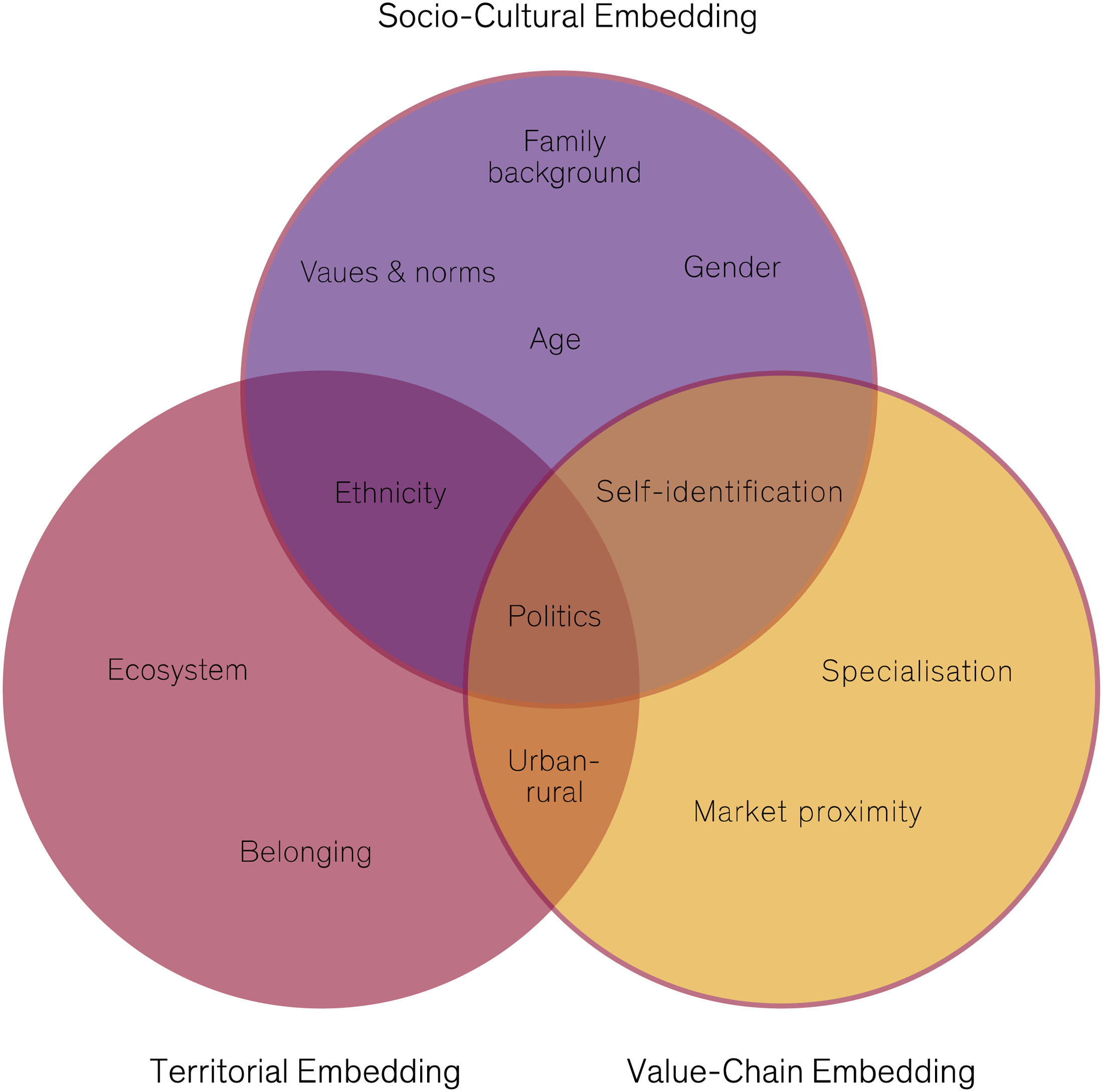
Embedding Dimensions and Heterogeneity Factors.
Heterogeneity Factors across Territorial, Socio-cultural, and Network Dimensions Based on Inductive Coding.
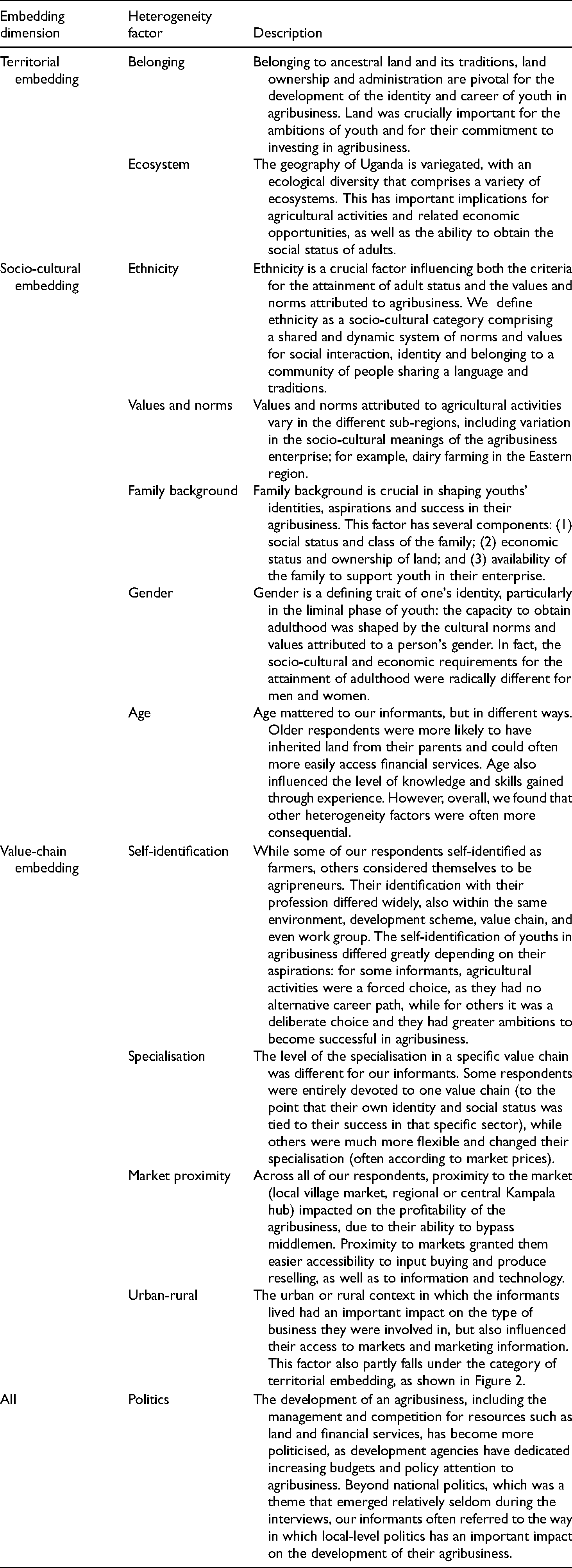
Below we discuss each of these dimensions and factors, arguing that these overlapping heterogeneities can be useful in developing both theory and programing that responds to this important demographic group in a nuanced and multi-dimensional way.
Territorial Embedding and Heterogeneity
“Territorial” refers to the contextual specificities of the different environments across the four regions where we conducted fieldwork. In all four regions, socio-economic status is required to access adulthood – with differences for men and women. However, the term takes on different meanings in different parts of the country. In the Northern and Western Regions, entering and leaving the category of “youth” is a process that is ideally rather short. The concept is, therefore, at odds with programmes that define youth according to a lengthy age range. In the Eastern Region, the social category of youth does not even have a term in the local language, and the English term “youth” is used when referring to this liminal phase. A direct passage from childhood to adulthood is marked by the initiation rites of circumcision (for males) and marriage (for females). Prior to circumcision a boy is referred to as a “ka-boy” or “small boy.” 11 Between being considered a ka-boy and a respected, mature man, a young person is tested on his achievements, economic status, and future planning. This phase of liminality, an in-between phase, does not even warrant its own terminology in the local language and is shunned.
For young agripreneurs in particular, we found that regional disparities in ecosystems and agricultural traditions have strong impacts. First, ecological differences greatly impact agricultural production. The torrid climate in the Northern Region only allows for the production of very resistant agricultural crops, such as grains (wheat, millet) and seeds (sunflower, sesame). In contrast, in the Eastern and Western Region, horticulture is favoured due to the humid and lush environment. The Central Region is least affected by climate conditions, thanks to irrigation technology and greenhouses, which are less available elsewhere.
Inevitably influenced by their ecological environment, the economic opportunities of youth in agribusiness – and, therefore, their ability to obtain the social status of adults – vary across the regions. Underdeveloped infrastructure in the Northern Region, for instance, means that youth there have less access to agribusiness opportunities than youth in the Central Region. Kampala is perceived by many youth to be an island of “modernity” and opportunities. As Dorah, a young woman engaged in a piggery project on the outskirts of Kampala, put it, “If you want to die rich, you have to come to Kampala.” 12
Second, the perception of belonging, ownership and administration of land is very diverse across regions (McAuslan, 2013). Lack of access to land is considered to be one of the main factors pushing youth out of agriculture (Bezu and Holden, 2014). Land is generally inherited by first-born males, automatically leaving female youth in a disadvantaged position. However, even among men, ownership and perception of land differ among youth in different regions. In the Northern Region, for example, land is mostly communal and managed on the household level, while in the Western Region it is individually owned (Leliveld et al., 2013). Geoffrey, a farmer from the Northern Region, explained that, “we don't even count how many people work on the ancestors’ land,” as family members may come and go and still have the right to cultivate a plot on their ancestral land. 13 In the Northern Region, ancestral land cannot be sold. On the contrary, Christine explained that she bought a plot of land in her home in the Western Region, where she was cultivating passion fruit to produce juice. 14 As a result of the perception and ownership of land, the choice of crops to be planted and agribusiness enterprises are also managed differently. Youth in the Northern Region are disadvantaged in comparison to their peers in the Western Region, as the latter are freer to start their own enterprises independent of their family agribusiness plans.
In the Eastern Region, which is very densely populated, we found that Bagishu people are particularly bound to their ancestral land. We even witnessed a small conflict between citizens and the authorities in which a car of the district authorities was ambushed. At a safe distance from the ambush, a group of young men explained how tensions with the authorities had escalated in the past months:
This is our land, our ancestors are buried here—they cannot take it away from us. If they take it from us, it's like taking the food from our mouths. […] If they [the park people] enter people's land it means fighting…we are ready to die with them!
15
On the other hand, the Western Region of the country is perceived to be favoured by the Ugandan President, Yoweri Museveni, who is originally from this region. 16 The infrastructure in this area is noticeably more developed (with the exception of Kampala), and Ugandans from the rest of the country assume that people from the Western Region are better off. Our informants in Kiruhura, however, complained that the benefits do not necessarily trickle down. During a focus group, Isaac, for example, complained that electricity is only going to the President's place, while Alice added, “You think Museveni is coming from Kiruhura, so every Kiruhura person [Bahima] is rich. Museveni could supply money … but we have never seen Museveni with our eyes.” 17
Socio-Cultural Embedding and Heterogeneity
“Socio-cultural” refers to the values and norms that are embedded in different socio-cultural environments. Across the sample, we observed differences in values and norms, which were often, but not always, location dependent. As previously noted, for some youth, particularly in the Northern Region, agricultural activities are tied to the well-being of their extended family and, thus, not understood as an individual enterprise. On the other hand, in the Eastern Region, male Bagishu youth need to obtain economic independence through their business to be considered a man.
As these examples suggest, the most important source of social-cultural heterogeneity is ones’ ethnic group. The clearest example comes from the Western Region, where there is a strong link between the ethnic group, Bahima (historically the same ethnic group as the Tutsi of Rwanda) and the dairy sector. On the other hand, the Bairu (historically the same ethnic group as the Hutu of Rwanda) are more commonly engaged in matooke, coffee and horticultural production. While Bairu have long been owners of land, Bahima were nomadic until the late 1980s, when President Museveni allocated land and enforced a schooling policy (Datzberger, 2018).
Second, family background has a strong impact not only on one's understanding of youth and economic status, but also on youth engagement and success in agribusiness. Irrespective of region and ethnic group, the socio-economic class of one's family has a large influence on young people's ability to engage in agribusiness. Wealthy or prominent families are able to provide their offspring with start-up capital, land, and influential social networks. On the contrary, youth from poorer families have a harder time starting their agribusiness (also see IFAD, 2019).
Third, as already hinted at, a gender component is also visible across our informants. Throughout the country, women are employed in many different value chains, but their economic role is commonly limited to marginal roles. For example, we observed that, generally speaking, women were engaged in both production and market trading, but not in transportation or as the owner or business director of a farm. Gender discrimination tends to be particularly strong in rural areas, and discrimination against women is especially evident in land ownership and agribusiness entrepreneurship. In Uganda, land is mostly inherited patrilineally by male descendants, with young rural women being “only half as likely as young rural men to have sole title to a plot of land” (IFAD, 2019: 35). Most of the female respondents reported that even when they brought in their own income, they were not allowed to administer it. Vanessa, for example, stressed that, “even when you are providing for the family 100 per cent, you’re not supposed to say that you are the breadwinner.” 18 Respondents told us that women who earnt more than their husbands were commonly forced to hand in their profits, leave their job, or even beaten. 19 The few women we encountered who had a prominent and economically-profitable role, reported feeling discriminated against and were unable to find a partner. 20 Given the strong link between economic status and adulthood (and, therefore, manhood), economic success by women is commonly perceived as putting the social status of men at risk.
In the Eastern Region, these gender norms are visible via gender-based rites of passage. Ethnic belonging is not bestowed by birth, but rather a status that has to be earnt and socially recognised. In this region, it can be said that there is no actual category of youth, only a passage from childhood to adulthood. A young Mugishu man, for example, is not recognised as obtaining the ethnic “Mugishu” identity until he is considered mature enough to be circumcised, which – among other factors – means achieving economic independence. This usually happens in one's twenties in a majestic public ceremony that lasts three days and involves the whole community. During this rite of passage young men obtain both adulthood and manhood. On the contrary, for Mugishu women, adulthood is obtained through marriage and pregnancy.
When asked about age as a factor determining adulthood, our interviewees gave conflicting views. On the one hand, in the past, phases of transition (circumcision, inheritance of land, marriage) coincided with age (around eighteen to twenty years of age). According to Cathy, who is from the Eastern Region, “around the age of 17, 18, 20 they stand to be circumcised and turn from childhood to manhood […], there some teachings they are given when they are circumcised, so from there they turn into real men.” 21 However, this is not necessarily the case anymore, given that circumcision is increasingly done in hospitals and at a younger age (or even at birth), rather than in rituals around the traditional age of eighteen. Moreover, we frequently saw evidence of individuals using the label of youth for political and personal reasons. For example, Stephen, a thirty-four-year-old dairy agripreneur, married with children, proudly identified himself as a youth in order to engage in political activism. 22
Value Chain Embedding and Heterogeneity
Finally, we also observed heterogeneity within and across the agricultural networks and value chains (i.e. horticulture, dairy, animal rearing, etc.). Many of the youth we interviewed were engaged in horticultural agribusiness. In the Western Region, however, Bahima youth were mostly engaged in the dairy value chain and, in urban or peri-urban settings, youth were more likely to work in animal rearing than their rural counterparts. In this sense, the regional variety and geographical location of youth had a strong impact on their preference to engage in different sorts of agribusiness. Moreover, geographical location affected the roles of youth in the value chain (production, transport, services, etc.), their proximity to the market, and their self-identification and attitude towards agribusiness.
First, the young agripreneurs we encountered differed in the level of specialisation in a specific value chain: we encountered youth who were strongly rooted in the value chain of their agribusiness, to the point that their own identity and social status were tied to their success in that specific sector. This was particularly true for Bahima people with cattle rearing in the dairy value chain. We also, however, encountered youth who had been working in different sectors and parts of the value chain – from retail to service provision to the production of various agricultural produce. For instance, Alex started helping out on family land in the Eastern Region, before starting his own production, and once he moved to Kampala he had to climb the ladder from “carry boy” to seller – thereby increasing both his status and profits. 23
Second, the urban or rural context in which our respondents lived had an important impact on the type of business that they would become involved in, but also influenced their access to markets (discussed more below), information and technology. Urban contexts were characterised by higher exposure to technological and marketing innovation (e.g. packaging, processing), but also by more difficulty accessing land. On the contrary, rural contexts offered more availability of land and agribusiness enterprises in rural areas were more strongly embedded in the family context (either as a family business or through the inheritance of ancestral land). This was particularly evident in the comparison between youth in and outside of Kampala, but was also apparent in rural contexts, where youth who were living closer to peri-urban or bigger towns had stronger connections in their agribusiness relations throughout the value chain.
Third, in each region, agripreneurs were influenced by their proximity to local and neighbouring markets. Proximity and access to markets not only allows input buying and produce selling, but also enables access to information (on prices, crops etc.) and technology (e.g. irrigation, machinery etc.). The largest difference across regions is the wholesale central market in Kampala, which gives a prominent position to farmers in the Central Region. Kampala and the surrounding peri-urban districts of Wakiso, Mpigi, and Mukono offer more profitable agribusiness perspectives, both because of higher prices and the possibility of accessing the international market. However, access to market is not merely an urban/rural issue. For example, agripreneurs in the Northern Region have trade connections with South Sudan, while in the Eastern Region the proximity with the Kenyan border facilitates a cross-border regional (food)market.
Finally, throughout the four regions where we conducted fieldwork the respondents varied in their self-identification as either a farmer or an entrepreneur. In order to assess whether or not the respondents matched the target group of development programmes, which mainly target young entrepreneurs, we asked each interviewee whether they self-identified as a farmer or entrepreneur. For the majority of respondents, the main criteria distinguishing farmers from entrepreneurs was one's position in the value chain and scale. Those who called themselves “farmers” were still largely engaged in the physical production of agriculture goods. In fact, respondents in this category were often more akin to subsistence farmers (even if they had greater aspirations). These respondents had limited access to markets and often earnt only a small amount of income from cash crops.
On the other hand, entrepreneurs are, according to our respondents, those who engaged in agriculture as a business activity that requires a business plan and accounting. These individuals were often savvier in their understanding of the value chain and were more active in (local) markets. Youth who considered themselves entrepreneurs typically aimed to pursue a career within agribusiness or use the opportunities agribusiness offers to step out of agriculture into another sector. 24 How youth self-identified was, therefore, also related to their agribusiness aspirations – or how committed they were to pursing (and growing) their agribusiness. For some informants, agriculture was a forced choice, as no alternative career path was available; for others, it was a deliberate choice. The latter often had much larger ambitions in agribusiness. Particularly around Kampala, youth were keen on “stepping up” to service provision, trading or processing, which they saw as an improvement in their career. For example, some youth start working at the market as “carry-boys,” transporting customers’ groceries for a small fee, or helping in the loading and unloading of trucks at the wholesale market, before accomplishing the socio-economic position of a respected adult (for instance, owning a market stall or shop).
Concluding Remarks: Youth Beyond Age
Considering the sustained and rapid demographic growth in Africa, there is a pressing theoretical and societal need to understand the identity formation of youth in Africa, particularly in the agribusiness sector, which employs the majority of youth. In this paper, we present evidence on the heterogeneous identities of Ugandan youth working in commercial agriculture, synthesising the results of conversations – both interviews and focus groups – with over 120 youth from all four regions of the country. Using narrative analysis, we identified twelve factors contributing to the heterogeneity of our informants – belonging, ecosystem, ethnicity, values and norms, family background, gender, age, self-identification, specialisation, market proximity, rural-urban nexus, and politics – clustered into three dimensions: territory, socio-cultural, and value chain embeddedness. These factors and categories are intertwined and interact with each other, shaping the different traits that make youth the diverse social category that it is. At the same time, their dynamic interaction means that the agribusiness experience of youth is an ever-evolving process.
Our results provide empirical evidence about the heterogeneity of Uganda's youth population and a basic analytical framework for scholars and practitioners seeking to study African “youth” in a nuanced and multi-dimensional way. These results provide insights into variations across different regions and communities – which would not have been possible if we had conducted a deep-ethnography in only one community – while at the same time recognising the diversity of experiences across this vast group. In this way, we aim to bridge the gap between critical and ethnographic studies of youth that emphasis the contested nature of the term “youth,” and scholarship and policy that focuses on youth as a category that is delineated only by one's age.
Recognising the statistical reality of (and interest in) this growing segment of the population, our hope is that this framework can be used in analysis and policy to account for the complexity and variations among Ugandan youth and can be further developed, tested, and validated in other geographies, cultures, and economic sectors. In particular, we believe that it is crucial to explore whether or not, and how, the heterogeneity factors we identified vary across regions and countries. Interest in African youth will only continue to grow. Our analysis underscores the contested nature of this social category, but also the possibility to target this important group in a more nuanced and multi-dimensional way.
Indeed, as Alex suggested to us at Nakasero market, he is not a youth: not only has he been circumcised, but he accomplished too much to be relegated to that transitional socio-cultural category. In the context of our interview, Alex wanted to be recognised as an adult, because he worked hard for this social status. Yet, at 25, according to the Ugandan Constitution and most development programmes, he still belongs to the youth segment of the population – and indeed Alex himself adopts this ambiguous definition when he sees an opportunity in ascribing to youth. Collectively, our results suggest that while “youth” is an important category demographically, the opportunities and challenges faced by those given this label are often not related to age at all. Therefore, both scholars and practitioners would be well-placed to consider the diversity of experiences grouped under this broad label.
Footnotes
Acknowledgements
The authors are particularly thankful to all the respondents that devoted their time to this research by sharing their experiences, expertise and information, during the interviews we conducted in Uganda. We also thank the research assistants Joyce Atuhaire, Catherine Lakareber, and Timothy Kiboma who facilitated the live translation of the interviews during fieldwork; and Sylivia Kyomugisha and Stephen Onen who completed the transcription of the recorded interviews. We are thankful to the reviewers and journal editors, who significantly contributed to improving this article with their thoughtful feedback. We also thank Kaulane Huisman, for designing Figure 2 in this article, and Susan Sellars for her help editing and polishing the article in the last phase of review. This research was supported by the Belgian Directorate General for Development Cooperation and Humanitarian Aid (DGD) through the Consortium for Improving Agricultural Livelihoods in Central Africa (CIALCA – www.cialca.org). The research forms an integral part of the CGIAR Research Program on Roots, Tubers and Bananas (RTB) which is supported by CGIAR Fund Donors ( ). In addition, the research benefited from a micro-grant from the multidisciplinary research hotspot, Global-Local Divides and Connections (GLOCAL) at Radboud University. The authors declare no conflict of interest with regards to the support they received during this research.
Declaration of Conflicting Interests
The authors declared no potential conflicts of interest with respect to the research, authorship, and/or publication of this article.
Funding
The authors disclosed receipt of the following financial support for the research, authorship, and/or publication of this article: This work was supported by the CIALCA and Radboud University.