




Abstract
Since the turn of the millennium, the African continent has been extremely active in producing African futures. These are part of the multiple non-western modernities existing simultaneously; modernities of revolution, reform, or restitution. This contribution adds to the debate by analysing four recent concepts along four axes: the representation of time and space, the initiators behind those four concepts, and the concepts’ social inclusiveness. The paper first discusses the idea of the “African Renaissance,” which has been proposed as official government policy in South Africa and has given shape to Pan-African political bodies. Second, “Afrotopia” is a term coined by the Senegalese economist Felwine Sarr that emphasises identity politics. Third, “Afropolitanism” proposes an “African-style” modernity as seen in the works of Achille Mbembe and Sarah Nuttall and is also likened to John and Jean Comaroff's writings on “Afromodernity.” Finally, “Afrofuturism” emerged in relation to science fiction literature and digital visual arts and uses the virtual sphere to address an international audience.
Introduction
The Cameroonian intellectual Achille Mbembe opened the African Futures Festival 2015 1 with the words: “[T]he future is anything but determined. The future is open. There was a moment when nobody was talking about the future in relation to Africa. Everybody assumed that we were a hopeless continent destined for chaos and disorder. That is no longer the case.” 2 At this time, the interdisciplinary debate on African futures was already in full swing, a debate falling squarely within decolonial protests, an economic upswing, anthropogenic climate change, and increased critical engagement with African cultural heritage being held in European museums. The media, think tanks, and development agencies began to represent Africa as a continent of hope and emancipation, marking the dawn of a broader Afro-optimist discourse. In the afro-optimist discourse, multiple concepts of African futures sprouted. The social scientific debate on African futures acknowledges the variety of such recent concepts and, at the same time, critically notes that some concepts leave intact dichotomies implied by modernisation theorists from the 1960s onwards that posit a single universal telos. 3 While some propose a new era, others argue with the continuation of an interrupted process of decolonisation.
Earlier critiques of globalisation and modernisation nourished the debate on African futures. Giddens (1995) and Eisenstadt (2000) had argued that multiple non-western modernities exist simultaneously. Refuting the idea that one model of progress, success, and the good life is globally applicable, anthropologists show that globalisation has instead produced a myriad of “glocalised” modernities (Pels, 2015; Piot, 2010; Weiss, 2004). Arjun Appadurai's book The Future as a Cultural Fact (Appadurai, 2013) builds on his earlier works on globalisation theory and emphasises the variety in future productions around the globe alongside each other and still entangled. With this book, Appadurai paved the ground for an anthropology of the future and inspired a scholarly debate on the diversity of alternative, more positive, and hopeful visions. Nonetheless, future(s) have always been a matter of debate in African Studies, even though the future has been taken for granted and has not been a matter of research in its own right (Pels, 2015).
This brings me to the problem statement and the vision for this paper: in current scholarship, there is no shortage of empirical work depicting future making in progress. Many recent examples describe future making in Africa in times of crisis, outlining how, why, and under what conditions people make, imagine and produce futures (Goldstone and Obarrio, 2016; Weiss, 2004). A highly productive period was the 1950s and 1960s when independence was beckoning in many African countries and popular movements imagined radically different times. A more recent one was that around the turn of the millennium, when anthropologists, economists, and scholars of religion proposed imaginations and practices resulting from situations of chronic crisis and uncertainty – the quasi-normal conditions many Africans confront (Mbembe, 2016a). These are crises of social reproduction (Weiss, 2004), volatile environments (Pelican and Heiss, 2014), economic marginalisation (Guyer, 2007), getting stuck in educational trajectories (Stambach and Hall, 2017; Steuer et al., 2017), or political instability (Piot, 2010), the COVID-19 crisis or the global climate crisis (Müller-Mahn and Kioko, 2021) in an era that denies chances of shaping and securing livelihoods. As these authors show, times of crisis, are highly viable times “to unfold desirable futures” (Müller-Mahn and Kioko, 2020: 223). However, few of these empirical contributions conceptualise the future (for an exception, see Hänsch et al., 2017).
This paper aims to discuss the concepts of the future found in four recent works. I compare four of the more prominently debated programmatic contributions to the debate on African futures: African Renaissance, Afrotopia, Afropolitanism, and Afrofuturism, all published around the turn of the millennium or later and showing hallmarks of earlier discussions on decolonial futures, post-colonial futures or modernisation theory. More specifically, the paper compares how they represent time and space, the authors behind the concept, and the concept's social inclusiveness. Wallman (1992) suggests these four criteria for analysis in her book “Contemporary Futures.” Wallman's criteria can serve as an orientation for newer, empirical works on the future: Many authors of recent empirical texts refer to one of the abovementioned concepts without sufficiently considering inherent differences. I shall highlight some of these inherent differences in a table in my synthesis. The section following this introduction presents the terms decolonisation, post-colonisation, modernisation, and modernity. The second section discusses the concept of the “African Renaissance,” which has circulated in South Africa as official government policy since the turn of the millennium. The third discusses “Afrotopia,” a term coined by Senegalese economist Sarr (2019). The next presents “Afropolitanism,” a concept proposing an “African-style” modernity (Mbembe, 2016b; Nuttall and Mbembe, 2007) that is sometimes likened to “Afromodernity” (Comaroff and Comaroff, 2004). In the final section, I will turn to the concept of “Afrofuturism,” which has become a term in literature, music, and visual arts and proposes Black futurity (Eshun, 2003; Nelson, 2002). The paper synthesises and compares the concepts in the concluding section.
Modernity, Modernisation, and Post-Colonial Transformation in Africa
Africanist scholarship roughly went through five phases (cf. Sall, 2002: 55–56): The orature of pre-colonial times. Second, colonial scholarship with its civilisation or modernisation mission (late nineteenth century to 1960s). Third, a phase of decolonial/post-colonial futures as well as the development paradigms (the 1960s–1980s). Fourth, the crisis phase of market orientation and structural adjustment (the 1980s–1990s) and, last, the late 1990s to date produced debates on globalisation and post-colonial reorientation. The works I discuss here fall into the latter phase but borrow ideas from earlier phases.
In sociological theory, the decolonial transformation was a central topic in African studies of the 1970s and a future vision in its own right. This era produced debates on statehood, politics of ethnicity, territoriality, and citizenship. African scholars and politicians also discussed the risk of persisting dependency and racism. Frantz Fanon had argued that racism is internalised and expressed in feelings of alienation and a sense of cultural, social, or economic inferiority. Oppression, as a result of colonisation and structural violence, can only be removed through violent liberation from colonial rule (Fanon, 2021 [1961]: 66). The theme of ongoing racism and suppression make decolonisation debates an insurgent and resurgent theme of civil society movements till today, see f. ex. #Rhodes must fall, engagement with the global #Black Lives Matter and youth protests through music and arts.
While Fanon expects a violent period of decolonisation, post-colonial scholars do not unanimously support a violent revolution to induce change. Postcoloniality refers to long-term processes of transformation after the moment of independence of nation states. The current usage implies a still ongoing incomplete process bridging over from works of DeBois on racism to racism of today. The studies fall into debates on American post-colonial studies (more prominent in Black cultural studies) and European “social studies on developing countries” from the 1960s onwards driven by left-leaning scholars arguing against developmentalism and imperialism. Both later merged under the globalised term of post-colonial studies in the 1980s, criticising power asymmetries in knowledge production in which scholars from the Global South are hardly heard internationally.
The term modernity has a long history from ancient Greece to the Eurocentric accounts during the early modern period. Modernity stems from the European notion and accomplishment of the Enlightenment, including democratisation projects, faith in sciences, and a pursuit of the ration (Osha, 2014: 203). During the “scramble for Africa,” modernity was marked by secularisation, scientisation, commercialisation, industrialisation, and bureaucratic institutionalisation. Modernity carried the belief that “‘modern societies’ were superior to other societies and that modernisation, indeed, was a process leading to normative progress” (Wagner, 2015: 21). As an ideology, modernisation theory is meant to facilitate a fast-track modernity for apparent latecomers. This globalised universal modernity was sceptical about ongoing multi-layered processes of decolonisation and differentiation. Critique held that such processes emerged only due to incomplete, delayed, or distorted modernisation, while the concept itself remained uncontested (Wagner, 2015: 21). More recently, modernity conceives of commitment to individualisation and autonomy leading to “multiple modernities” (Eisenstadt, 2000). This notion includes a vastness of political and social possibilities, socialities, and “imaginary significations” (Wagner, 2015: 22). Multiple modernities that are not the same as Euro-modernity emerged; modernities less focused on institutions but on civil society movements producing (African) futures. The relation between those various modernities is under debate: Some argue for a pluralisation (Comaroff, 2012) with or without a restructuring of centre-periphery relations (Eisenstadt, 2000), others speak of entangled modernities (Luig, 2002: 89).
In Africa, the late 1990s and early 2000s can be marked as a crisis of post-coloniality. It is precisely around that time that African modernities negotiate unresolved contestations of multi-layered representations of indigenous tradition, European-Christian heritage, and Islamic cultures (triple heritage): “African modernities are an invention of postcoloniality and are as such suffused with a profound hybridity (…[Africa]) has not defined its relationship(s) and place within its global project (…), between the universal and the particular” (Osha, 2014: 203). Future-making in Africa borrows from both in diverse ways, as the comparison of concepts aims to show.
Renaissance: “A rediscovery of ourselves”
The term “African Renaissance” stands for a variety of developments after the end of apartheid, which South Africa's president Thabo Mbeki in the late 1990s saw as the last chapter of formal colonialism (Müller, 2007). In his speeches, Mbeki (1996, 1997, 1998, 2000a, 2000b) pointed out endogenous factors as partly responsible for Africa's condition, as well as at Africa's need for self-help by nation states acting together. He advocated for repositioning Africa within the international community, claiming that political unity of African countries, sustainable economic change, and the strengthening of continental organisations would achieve these goals. Mbeki's concept ignited institutional change on the continent that was signalled by the Organisation of African Unity's (OAU) conversion into the African Union (AU) in 2002, an institution equipped with more robust mechanisms to foster self-driven development and based on the “African Charter on Human and Peoples’ Rights.” This atmosphere of change also led to the establishment of the Pan-African Parliament (PAP), the economic body New Partnership for Africa's Development (NEPAD), and the good governance monitor African Peer Review Mechanism (APRM). 4 All these organisations aim at Pan-African problem solving and conflict resolution. As international bodies, these organisations form an integral part of Africa's integration into the international community. This led to an economic improvement in a globalising world after the Cold War (Liebenberg, 1998). Bongmba sees in the concept of the African Renaissance an imperative for a regionally driven post-nationalist agenda (Bongmba, 2004).
Not least, the idea of an African Renaissance is also meaningful to Africanist history, philosophy, and literature. Mbeki borrowed the term from thinkers like Cheikh Anta Diop, Marcus Garvey, Kwame Anthony Appiah, and others (Vale and Maseko, 1998). Diop's essays from 1946 had already propounded an African Renaissance in culture and development, languages, and institutions (Diop and Modum, 1996). Early postcolonialists advocated an era that would incorporate truly African values suppressed, criminalised, or abandoned during the colonial period. Emphasising such lost or occluded values, they proposed revitalising lost knowledge systems and officiating collaboration between traditional and modern institutions. One example of fostering social coherence and identification was the suggestion to make African languages official instead of continuing to use colonial languages. In 1986, Ngũgĩ wa Thiong’o published a collection of essays claiming that keeping native African languages alive would ‘bring about the renaissance in African cultures’ and decolonise the mind (Thiong’o, 2005). This Nobel Prize for Literature nominee and Kenyan independence fighter stressed the role of language in constructing a national identity and the writing of history in a non-Western manner. Thiong’o saw language as the factor that enabled human consciousness and a form of emancipation from colonial continuation in a post-colonial era.
Calls from Pan-African intellectuals 5 for self-driven programmes based on a revitalised African culture fell on the fertile ground towards the end of structural adjustment programmes that dictated neoliberal development plans to economically underperforming states in the 1980s and 1990s. Many African countries experienced little political independence, as well as high levels of debt and poverty. Governments welcomed alternatives to their dependency on Bretton Woods and other institutions, curtailing independent development. African Renaissance served as a tool “from Africans for Africans” addressed to the masses. Mbeki argued that “in today's rapidly globalising world, we are facing the danger of succumbing to the pervasive dominant culture, the ‘Coca-Cola’” culture at the expense of our own cultures, identities, and national heritage. This culture seeks to deny the validity of our own knowledge systems, our morals, and ethics and denies that there are other solutions to our challenges other than those imposed by the dominant cultures’ (Mbeki, 2000b). African Renaissance proposed a truly African model for playing a part in a globalised world (Bongmba, 2004). Part of that was a liberal, privatised economy with a limited role of the state popularised as “power to the people” (Mbeki, 1998). The African Renaissance became a guiding principle in the search for a new post-dependency, post-racist identity and for creating some distance from ongoing dependency on Western-dominated markets and ideologies. Key to this concept were stable democracies following African traditions and the circulation of goods on the continent: thus, African continental economic empowerment (Müller, 2007: 46–50).
On a national level, the African Renaissance had major effects in South Africa, partly owing to two social changes affecting the society towards the end of the twentieth century. As South Africa longed for a new identity as a “rainbow nation,” the country simultaneously and increasingly suffered from a high HIV/AIDS burden. This pandemic, affecting Black people more than the white population, evoked new assumptions of a new racist conspiracy. Biomedical health practitioners and pharmaceutical companies claimed only their “Western” or “white” medicine could effectively treat HIV/AIDS. Sensing a new dependency on Western economies of health and healing raised a call for “African solutions to African problems.” The two major occupational unions of traditional health practitioners started working with (Western) scientific training and research institutions to certify their traditional knowledge and test the efficacy of traditional medication in laboratories. These developments in the health sector became a symbol of the revitalisation of traditional, uniquely African knowledge systems in a pluralistic world (Zenker, 2010). Another example of an African Renaissance movement is the reclamation of a “human dignity-affirming education” as an act of re-membering African knowledge systems (Sesanti, 2019). The “third way” between tradition and modernisation incorporates Africa's diverse indigenous and foreign heritages, Africa's “Triple Heritage” (Mazrui, 2003).
Instead of perceiving this revitalisation as a loss of governmental sovereignty to traditional non-state actors, the concept of the African Renaissance made the status quo official in areas with limited governmentality. Elsewhere, politicians followed this example, introducing (and partly reinventing) pre-colonial values and lost traditions. Particularly in the sectors of health, education, justice and reconciliation, agriculture, and technology, as well as for economic models of sharing instead of monetary exchange, the concept was debated and in some instances, traditional models were made official. Yet, these traditional representatives are not necessarily answerable to governmental (f.ex. legal) institutions, nor do these revived (or formalised) institutions serve a state-bound populace. Thus, actors disclaimed legal responsibility for damage (Kirsch and Grätz, 2010).
Afrotopia: Of Revolution and Restitution
Without a doubt, Africa is in crisis in this neoliberal age. As Janet Roitman rightly notes, Africans “negotiate modern life in a time of austerity” and a state of enduring crisis (Roitman, 1998). Brad Weiss's edited volume shows with case studies from all over the continent that youth unemployment is high, that labour migration affects conjugal life as well as generational contracts, and that radical religious authorities offer only an illusionary order (Weiss, 2004). Radical ideas overcome a disoriented youth stuck in limbo, disadvantaged, and without the networks necessary to enter a meaningful and mature phase of life. Even those who have graduated lack opportunities for getting jobs and earning salaries, not to mention those without educational credentials and support networks behind them.
The Senegalese economist Felwine Sarr problematises African youth's lack of identification with African history. Sarr takes the economy as a starting point for critique as well as for change. Sarr's Afrotopia draws on the works of Frantz Fanon and Dipesh Chakrabarty, arguing that Western pathways to modernisation imply a teleological understanding of the future. Millennium or Sustainable Development Goals force so-called developing countries to lag behind on a prescribed development pathway to modernity. Such “slavish imitation” is, however, without any relation to local realities and nourishes Afropessimist representations of the continent. Two developments on the African continent now provide a forum for critics of modernisation: Africa's economic upswing (curtesy to resource extractivism) in the past few years and the protests of youth stuck in “waithood,” still, ready to “break free” (cf. Stasik et al., 2020).
Being vocal in the political realm has brought Sarr recognition as a political adviser and economic analyst in Senegal. As the title of his manifesto “Afrotopia” already suggests, he goes far beyond an economic programme and stretches his utopia for the future of African youth, proposing a cultural revolution. In “Afrotopia” Sarr elaborates that during colonial times African economic models based on uniquely African strengths were replaced by a market-oriented economy based on exchange, but he argues that homo Africanus is still not homo economicus (Sarr, 2019). In fact, the lion's share of the African economy and the livelihood of many lies in the informal economy 6 rather than the formal sector and relies on social relations and sharing, solidarity, and a communal orientation. As yet, the psychological infrastructure of the homo Africanus lies buried under an imperial philosophy of growth and exploitation. Some of these practices have survived not despite the introduction of the market economy but precisely because of it. These strengths are still visible in the informal economy, the clandestine powerhouse of African economies: a powerhouse degraded to an unregulated black market. But it is not only the economy of the continent that deserves a revitalisation of suppressed strengths. Sarr demands true decolonisation and a new formation of economy, politics, and the social.
Sarr gained international prominence through a co-authored report on “The Restitution of African Cultural Heritage” that called for the restitution of identity and dignity to the future of African youth. Restitution is one way of giving back meaning to youth suffering from a loss of orientation and lacking a sense of African history. Sarr advocates for disoriented African youth by asserting their right to artistic and cultural heritage held captive in European museums. Objects displayed in European museums represent, on the one hand, the entanglement of European and African history during colonialism up to today. On the other, they symbolise the slave trade, colonialism, and the current development discourse that induced massive breaks in the sociality of Africans. The loss of material and immaterial values, such as languages and knowledge systems, has resulted in an inferiority complex and an identity crisis (Sarr, 2019: 89–90). Forced breaks with traditions have hampered Africa's emergence and led to accepting dominating structures. It is noteworthy that Sarr's claim is directed at both European and African populations and the formation of a post-colonial mindset on both sides of the Mediterranean. A claim African youth deliver through music and arts to the former colonial powers of their home countries, a claim they cannot deliver through their political elites who are “befallen by following Western-style modernity.”
Sarr proposes to uncover lost potentialities and achieve “self-apprehension” from the pre-colonial past. This is a dilemma that early post-colonial thinkers like Kwame Nkrumah and Julius Nyerere were already wrestling with and that still holds today. Nyerere argued that pre-colonial values were not lost but had been overshadowed by colonial changes and focused on agricultural, and rural development communities in Tanganyika. He argued for communal land ownership, family-based economies, the revitalisation of pre-colonial modes of production, and the reconstruction of complementary gender roles, self-reliance, and an egalitarian society. But Nyerere's founding myth of a socially egalitarian society without private land ownership invites the criticism that it does not reflect history accurately. Contrasting with Nyerere's opinion, Nkrumah focused on the reform of traditional structures, which had already been altered by the colonial experience. He argued that a return to pre-colonial African society based on egalitarianism, humanism, and communalism was valueless as it would lack authenticity (Martin, 2012). Any ideology for decolonisation had to include the competing ideologies coming with African traditions, Islamic cultures, and Western European infiltrations, Nkrumah argued in his concept of Consciencism (Nkrumah, 2008). Recent debates on the African Renaissance and Afrotopia interpret the past for the sake of ownership of the future. Mbembe and Roitman (1995), in contrast, interpret the immediate present for the future, taking the continuous crises, discontinuities, and contradictions as a routine in African everyday life.
Afropolitanism: Modern, the African Way
In contrast to Felwine Sarr, who frames his work within an incomplete decolonisation project, Achille Mbembe's starting point is an incomplete post-colonisation. Contemporary post-colonial thinkers argue that much of the post-colonial period appears to be continuous with the colonial one (Jesse, 2011). When independence was approaching, post-colonialists enthusiastically promoted their visions of the new era, but many revolutions nevertheless failed. First, some of these visions lacked distance from the colonial experience that the revolutionaries wanted to abolish. Second, in retrospect, some Africans did resist decolonisation – and continue to do so. We can clearly see this continuation in the persistence of educational paradigms on the continent. The post-colonial anthropologist James Ferguson was shocked to hear some African interlocutors advocate Westernisation. His interlocutors had apparently internalised this theoretical approach, and Ferguson found himself confronted with informants making “passionate appeals for salvation from Africa's problems via some imagined ‘return’ of whites who might ‘help us to become like you” (Ferguson, 2006; Piot, 2010). 7 Piot (2010) and Guyer (2007) have shown how Pentecostal churches and macroeconomics perpetuate such thinking in Africa. Attributing such linear narratives of progress and betterment to the Westernised school systems that prevail throughout the African continent, Martin and her colleagues conclude: “We see this in connection with the ideologies that are inscribed into [pupil's] minds and bodies through a Western-type education and discipline” (Martin et al., 2016: 8; cf. Simpson, 2003).
Sharing this view, Achille Mbembe explains that many Africans have internalised a model of Western-style modernity promised during colonial times as well as after and that for them, decolonisation did not result in a break with the colonial model of the future. Thanks to their education, many Africans continue to perceive themselves as part of the global periphery, and migration to Europe can partly be interpreted as an escape from the periphery to the centre of the world (Mbembe, 2016b: 26–27). Migrants (often pejoratively labelled “economic refugees” seeking to escape poverty) aspired to move to the centres of the “real” modernity and to leave behind what they saw as peripheral second-class imitations of a modern state (Ferguson, 2006). Structurally, the colonial project of European dominance in the world has continued in part because of support from forces who defend the Eurocentric economy, scholarship, and politics and who have perpetuated this system. These forces driving narratives of underdevelopment are also perpetuated by elites from the Global South. Most African elites continue to be educated at non-African universities teaching such modernisationist thinking. Some scholars interpret such educational migration as an advantage, arguing that emergent politicians from the Caribbean, Africa, and the United States who studied together at historically Black colleges have historically formed Pan-African networks (Hanchard, 1999). Mbembe rejects this argument and even goes so far as to question intellectuals’ interest in building up true African scholarship (Mbembe, 2016b: 261–263). He sees this lack of African scholarship rather as a challenge in solving African problems. Western-trained African elites have ignored the historical values of Africa and the continuity of the education system from colonial to post-colonial times and even until today. As a result, Africa lacks true democratic thinking and revolutionary vision and is afflicted by increasing senescence among those in power, while large parts of the population are deprived of participation (Mbembe, 2016b).
Futures are made and broken due to disruption, a crisis of tradition, a lack of identity, and a confrontation with globally circulating, competing models of modernity. Very much on the same page with Achille Mbembe, Jean and John Comaroff propose the concept of “Afromodernity,” of which an important aspect is the element of ruptures and crises. Ruptures of colonialism, post-colonial state-building, decolonisation, and liberalisation mark the experience of many Africans. Exclusion, domination, and exploitation have suppressed uniquely African social, economic, and political processes, which have become strongly visible in an era of Afromodernity. Africans feel the brunt of dramatic long-term changes while being excluded from shaping the entangled megaprocesses (Mbembe, 2021: 12), for example, climate change, international terrorism, or the terms of trade. Beyond the political sphere, social reproduction has been continuously disrupted. The effects of long-distance labour migration on generational reproduction and social norms, the HIV/AIDS crisis as the most visceral symptom of disruption, and the chronic unattainability of material independence of young people are visible in African societies. All these interruptions are part of African-style modernity and cannot be ignored as important elements in everyday life. Following Giddens (1995), Comaroff and Comaroff argue with the acceleration of breaks and discontinuities; however, these discontinuities are not all negative. Afromodernity creates informal possibilities and stimulates new forms of cultural production, one of the strengths of African populations used to dealing with new beginnings. Thus, Afromodernity cannot be derivative of the European pathway to modernisation, nor do the authors see any point in “reinventing traditions” since cultures meet, migrate and merge.
The term Afromodernity describes a counterculture to European temporalities but still a culture informed by cultural elements from the Global South as well as the Global North (Hanchard, 1999). Afromodernity is here understood as a historical period or intellectual stance marked by scepticism towards modernisation. The 1980s and 1990s mark a period that criticises the faith in universal development pathways and their replicability. Embedded in post-colonial thinking, Afromodernity appropriates elements from various cultures and forms “a set of dispositions and practices, of aspirations and intentions, distinctly it is own yet also part of a worldwide order” (Comaroff and Comaroff, 2004: 330). The authors support Chakrabarty's proposal for a “provincialisation of Europe,” in which Europe would no longer stand in the middle of so centralised a world, and developing countries would no longer adhere to the idea of a centre of power. Instead, he argues, Africa must define its place in a world where the dominance of the West has begun to decline (Mbembe, 2016b). The imagined community that Mbembe is envisioning is not a nation state. Mbembe's vision is rather one of a global future in which Africa relates to the world, as there is no world without Africa, and there is no part of Africa uninfluenced by the world. As a way forward, Mbembe calls on African intellectuals – many of them in the diaspora – to offer the prospect of a worthwhile future (“rise to humanity”) (Mbembe, 2016b). He claims that through citizenship and true democratisation, African intellectuals will eventually arrive at post-colonial thinking, which he sees as arising in the urban metropoles where a new transnational culture, “Afropolitanism,” is forming (Nuttall and Mbembe, 2007). Based on ideas formulated by the globalisation theorist Arjun Appadurai, “Afropolitanism is a geography of circulation and mobility” (Mbembe and Balakrishnan, 2016) as well as an “ideological condition of cultural production […circulating] only amongst a percentage of the intellectual, creative, artistic and sometimes business and professional sectors of a black metropolitan population that is either exiled, migrant or diasporic” (Ede, 2016). Mbembe puts his hopes in the Afropolitan elites that maintain networks across the globe. As such, Afromodernity and Afropolitanism are formulations of a “planetary future” (Appadurai, 2013; Comaroff and Comaroff, 2004). As an innovative practice, Afromodernity is “caught up in complex relations with, and running in some respects slightly ahead of, northern hemispheric sensibilities, styles, conventions, inventions” (Comaroff and Comaroff, 2004). By this, the scholars mean that many global developments (intended as well as unintended) unfold both more visibly and often much with stronger effects at the fringes of the globalised world – the countries of the Global South.
Afrofuturism and the Digital Future
Like Afrotopia, Afrofuturism breaks with the past. The term marks the beginning of a new, completely different time-space order and a totally different sociality compared to the present (Pels, 2015). As a visionary artists’ political movement, Afrofuturism debates race, class, gender, nation statehood, and discrimination. The goal is to create a dialogue between an aspirational future of Black unity as a utopia of a visionary reunification of Black livelihoods and an emergent presence in a virtual sphere. Shortly put, “Afrofuturism is a strategy for Black community building.” 8 The Afrofuturist movement addresses displacement, home, and belonging, the quest to return to the native land, and loss of cultural identity. In the late 1990s, the Black art and literature scene proposed a united Black community using a virtual forum. 9 The digital boom of the dot.com-era promised a future beyond inequalities, a virtual sphere where internet users could be whatever they wanted to be and leave behind race, class, gender, sex, and real life. The elimination of race and gender distinctions formed the founding myth of the digital age (Nelson, 2002), in which technology would end the burden of social identity. The internet, thus, provided a platform for as inclusive a “radical humanism” as had ever been possible. Afrofuturists started to meet as an online community around 1998 and became known as “African American voices” with “other stories to tell about culture, technology and things to come.” This African American-led movement produced “sci-fi imagery, futurist themes, and technological innovation” (Nelson, 2002), generating a futuristic genre of film and literature, multimedia and visual-art works, pop culture, and Afro-fashion. Afrofuturism as a movement grew globally in the arts and connected Black writers, musicians, and filmmakers across the globe. International artists like Solange, Rihanna, and Beyoncé have started to present themselves as futuristic, non-human, genderless beings in an oppression-free sphere. African artists have joined the chorus. To name only a few, Cyrus Kabiru from Kenya, Lina Iris Viktor from Liberia, the Nigerian-American muralist Shala, and the Kenyan filmmaker Wanuri Kahiu identify with Afrofuturism.
This movement is intended to bridge the digital divide and to include the disadvantaged Black race and economically underprivileged. Authors and artists from the Black diaspora in the movement envision, moreover, a Black writing of history and future. Bolanle Austen Peters, the founder of Terra Kulture – Nigeria's pre-eminent centre for performing arts and culture – explains: “Afrofuturism is a chance to envision a radical and progressive vision of Blackness – one in which justice reigns in superheroes and where Black creativity is mystical and fascinating. In this space, Black life matters. (…) Time is not linear in this genre. An imagined future can impact the present as it unearths a buried African past. Afrofuturism pieces together parts of a history that people were not privy to as their stories had been sidelined for so long” (Peters, 2018). For example, Kodwo Eshun's work attempts to write history from the perspective of African archaeologists through a Black gaze and provide a perspective on Black experience often ignored in Western, “white” history writing (Eshun, 2003). Wanuri's film “Pumzi” (2009) depicts a future state of civilisation (located on the African continent), a place predominantly populated by Black people and alienated from a white-dominated world. Pumzi aligns well with motifs commonly found in Afrofuturism, including but not limited to the presence of barren landscapes and the central role of water, and a world heavily affected by global climate change. It was produced by a South African studio composed of a group of creators who are creating and popularising innovative forms of cultural content from within African nations.
Two countries were pioneers in the usage of digital technology on the African continent for very different reasons. Thanks to broadband internet, Kenya and South Africa provided fertile ground for technological innovation and digital arts. However, these digital innovations were closely linked to civil society protests during the political era of Daniel arap Moi in Kenya and to governmental control during the apartheid era in South Africa, thus generating divergent digital cultures. Digital artists – particularly from those two countries – use the internet, with Jepchumba, one of the Kenyan digital artists and an ambassador of technology in Africa, noting that “Digital Technology is transforming the way the world looks at Africa. Due to increased access to technology, many Africans today have the opportunity to really speak for themselves” (Eternity, 2010). At the same time, Afro-tech displays a pragmatic, down-to-earth approach to everyday life and implicitly challenges Western notions of development and progress. Using open-source code, innovations are easy to adapt and become communal property. In exhibitions like one on “Afro-Tech and the Future of Re-Invention” in Dortmund, Afrofuturism, and Afrotechnology complement each other. However, at closer inspections, they differ in the usage of space, time, inclusiveness, and agency of the actors.
Afrofuturism resonated with the African digital technology scene; however, the relationship between the two remains ambiguous. Afrofuturism embraces a Black community in the digital sphere in an epoch starting with the digital revolution of the 1990s. On the continent, it is predominantly invoked by (South African) feminist and queer activists and has become an external label applied to many African artworks, innovations, and design ideas that use digital media and suggest a future beyond Western normativity. Due to this, some African artists distance themselves from such labelling and criticise the term Afrofuturism for suggesting that there is one global culture of technology in Africa when there are in fact many. Timewise, the African art and maker space scene does not have effects in a virtual space but pragmatically solves everyday problems where electricity is unstable and seasonal humidity affects high-tech solutions. Digital technology as an open-access “workshop” understands itself as a Pan-African-led movement that welcomes imitators from resource-poor settings around the globe. The scene does not merely serve or build a Black community. Afrofuturism, which seems to dominate in Anglophone digital culture, but not in Francophone or Lusophone regions. For one thing, these regions are less penetrated by African American culture; moreover, they are less penetrated by English-speaking web presence and are thus isolated from such discourses.
With regard to the actors involved, the technology scene struggles with external labelling. Smart/digital artists are concerned with how they have been labelled as Afrofuturists in a movement that traces time starting with the Middle Passage; an experience invoked less among Africans than among African-Americans and Afro-Caribbeans. In short, Afrofuturism as a term – as well as an art and communication form – was brought to Africa by an inclusive American art and design world as a way to define and functionally contain work coming out of Africa that explored digitalism and technology. This struggle for representation is not unique to Afrofuturists but also to Afropolitanists: Hanchard (1999) argues that a Black elite has a delineated understanding of making collective advances for the next generation. It understands itself rather as a vanguard than an avant-garde of Black people. Ede (2016) rejects the idea that the Black elite has any interest in the common Black person, asserting that it merely protects Afropolitan or Afropean elite privileges and class boundaries.
Summary and Comparison of the Four Concepts
The continuous attempt to follow modernisation paradigms has ignored the contemporaneity of multiple modernities. The concepts of the future described here relate to modernisation in so far as they reject to accept a European style “modernity with its racist projects” that shaped Africa and demand African concepts instead of universal concepts. However, while some authors frame their work within an incomplete post-colonialisation project, others argue that incomplete decolonisation is at the heart of the problem. Either way, authors of both schools engage with the global circulation of goods, people, information and finance and claim a new positioning of Africa in the world.
It is thanks to the global circulation of information that post-colonial visionaries from Africa presenting alternative futures to Western-style modernisation have found greater receptiveness and popularity among an international scholarship and the wider public. Framed by an ongoing debate, I set out to compare four African futures. I deliberately chose to present those four that seem to be the most popularly debated in Africa as well as in the scholarly Global North. Indeed, plural futures circulate in coeval temporalities beyond those four concepts: my selection includes merely those conveyed in a scientific, internationally accessible format. (This alone may say something about the selectiveness of a Western-driven scientific community – to which I certainly belong.) Moreover, I chose those concepts that emerged around the turn of the millennium, leaving out older concepts of African future-making, for example, Pan-Africanism, Ujamaa, Consciencism, or Modernisation.
An overview of my findings can be summed up with a table comparing the author's driving the concepts and the concepts’ social inclusiveness, the representation of sociality and space, and the concept of time (Table 1).
Comparison of African Renaissance, Afrotopia, Afromodernity, and Afrofuturism.
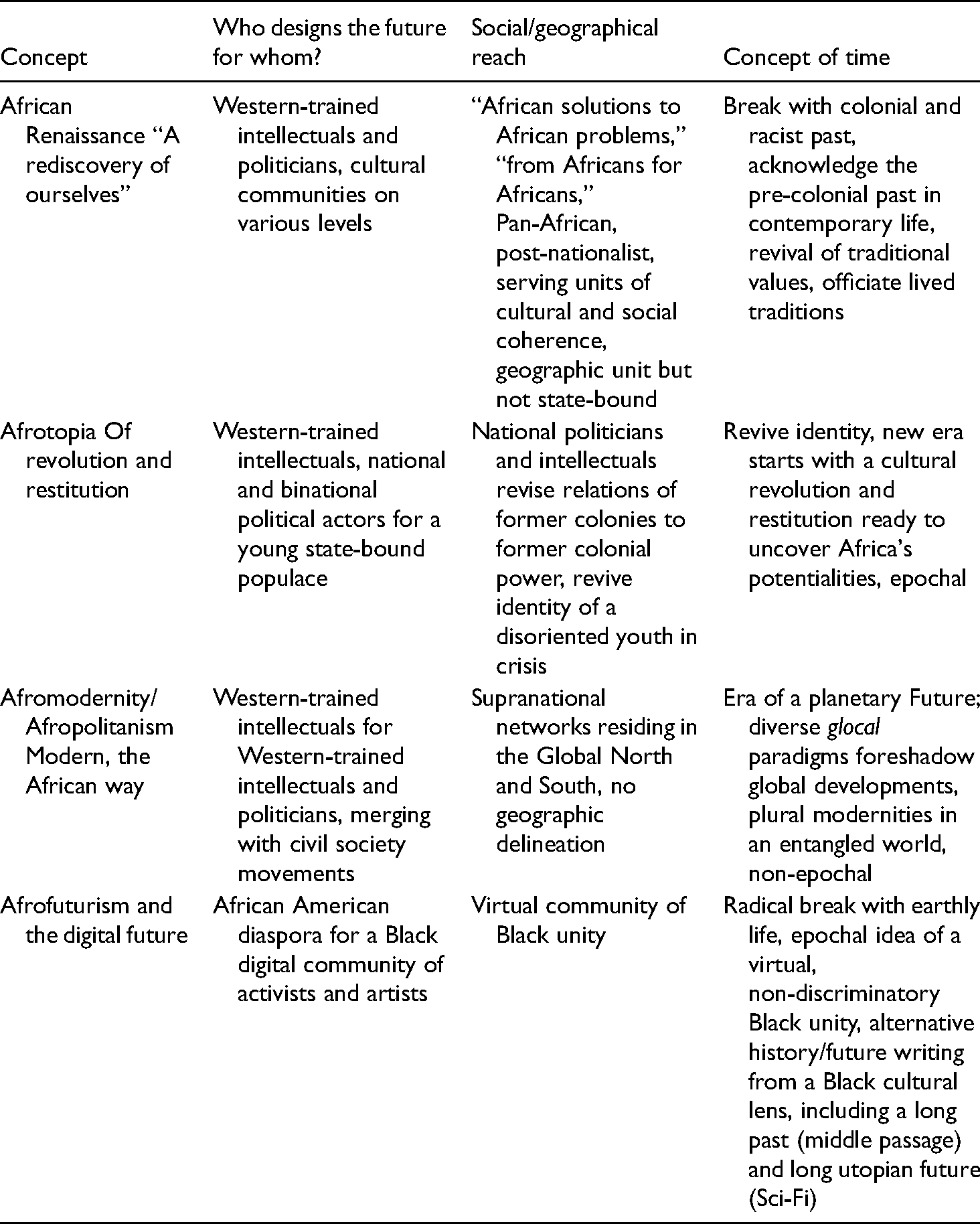
The visions of the future presented here are all formulated by Western-trained intellectuals with a say in international debates, yet, some merge with debates of other actors, like politicians, youth, or civil society actors. Despite this similarity in the second column of the table, the community addressed by the concepts differs. African Renaissance has been translated into concrete political programmes, partly as a reinvention of tradition, serving those sharing cultural identity, including migrant communities living on the continent. Practices translate into national policy and resonate with transnationally organised sub-populations rather than populations of nation states. Afrotopia is somewhat comparable to African Renaissance in seeking to restore lost or overshadowed pre-colonial virtues. Both concepts reject universal pathways of modernisation and revive African values. Afrotopia appeals to marginalised youth, as well as to elder decision-makers in a national discourse, grown tired of ongoing quasi-colonial centralism. Afrotopia longs for decolonisation to restore dignity, national identity and pride. In the third concept, Mbembe, Comaroff and Comaroff advocate against western modernisation and assign a leading role to the new centres found in the Global South. This happens less as a revolutionary break but rather as a continuous change already underway. Afrofuturism is an inclusive project of Black artists. The movement intends to incorporate African digital artists, literary scholars, and activists in a quasi-global, quasi-liberal democratic discourse. Notwithstanding, access is limited to an English-speaking, internet-connected population. While some who do not share these characteristics are excluded, others do wonder how they became labelled as Afrofuturists. Afrofuturism engages with a revolutionary and liberalising break still to come. Mbembe pointedly asks how should we “re-member” the future (Mbembe, 2021: 11)? Who drives imaginations of change?
This brings me to the geographical coverage. The continent shows a vast variety of cultural, political, economic, and historic structures, so what does Afro- in the titles stand for? To what extent can we speak about Afro-topia, African Renaissance, Afro-modernity, or Afro-futurism? Do we take Africa as a geographical unit, as a cultural Sub-Saharan category, as a collection of nation states, or as a geographically dispersed community sharing a racial identity? African Renaissance serves as the political agenda of sovereign nation states (themselves colonial constructs) organised in a political and economic union. Sarr sees Africa as a geographical unit entangled with Europe through colonialism. Framed as a Pan-African project, Afrotopia encourages nation states in Europe and Africa to negotiate their entangled histories. While Sarr takes Africa and Europe as geographical units, Mbembe, Comaroff, and Comaroff point at the global entanglements of Africa in the world and appeal to a “planetary future.” Afrofuturists propose a united Black community in the virtual sphere, uncoupled from space-time paradigms. At the same time, the movement traces time and space, starting with the transatlantic slave trade as a uniting moment in history.
Amid an ongoing climate and health crisis, the outbreak of war in Europe labelled 2022 as a turning point in time. While a crisis is supposedly abrupt and temporary, conditions of crisis are chronic for many African societies (Mbembe, 2016a; Mbembe and Roitman, 1995). How do the concepts relate to the past and the future? African Renaissance is based on ideas formulated in the early independence movements; ideas that have been revived more recently. African Renaissance and Afrotopia reason that traditions in form of material or immaterial heritage are still active but clandestine or that they can be re-introduced. The basic idea of Afrotopia is to inspire a cultural revolution providing a disoriented youth with heritage, identity, self-consciousness, and meaning. Material heritage of colonial provenience was first restituted to Senegal's Museum of Black Civilisations in 2021 in accordance with the African Union’s theme of the year 2021, “Arts, Cultures, and Heritage: Levers for Building the Africa we want.” 10 African Renaissance, instead, acknowledges the continuity of local practices that were criminalised or otherwise suppressed. The last concept, Afrofuturism, marries a long past with a long future aiming at ownership of history and future writing from a Black perspective. Afropolitanism/Afromodernity engage less with the past, which is anyway an amalgamation of cultural networks that are constantly forming and reforming. Such creativity and innovative power suggest that the Global South can be a pioneer in solving global problems. This is the case simply because the consequences of global problems are visible sooner at the periphery than in the centre. African countries need to recognise this head start in dealing with such problems and take a leading role (Comaroff and Comaroff, 2004). Contrasting with African Renaissance, Afrotopia, and Afrofuturism, this concept does not emphasise the past in order to conceptualise the future. Moreover, it conceptualises time as a continuous process rather than as a cultural revolutionary break readjusting relations of colonial powers. Youth movements complete what had not yet been completed.
Ferguson's observation that interlocutors in Africa enthusiastically defend a development paradigm leading to the only modernity seems correct and, at the same time, extremely disturbing. Still, such paradigms are enthusiastically defended by African intellectuals (and policy makers) trained in Europe and the United States. Following such a narrow concept of modernisation is therefore a symptom of the dis-ease with post-colonial thinking. However, the four concepts of African Future are examples of genuinely African scholarship inspiring post-colonial communications between North and South, a process far from being completed. We find some exciting processes of decolonisation of education and future-making underway: South Africa experienced anti-racist and anti-colonial protests in the 1990s, but also in the 2010s. Those at which students demanded the decolonisation of educational spaces (#RhodesMustFall) only marked the beginning of a movement that expanded as they also demanded a new curriculum, as well as decommercialisation of education (#FeesMustFall). The movement merged with the US-based anti-racist Black Lives Matter protests and gained international media coverage. The students engaged actively in future making and took it to the streets as well as into a virtual arena. They claimed nothing less than a better future and, for that matter, a truly post-colonial and Afro-modern educational system.
Footnotes
Declaration of Conflicting Interests
The author declared no potential conflicts of interest with respect to the research, authorship, and/or publication of this article.
Funding
The author disclosed receipt of the following financial support for the research, authorship, and/or publication of this article: This work was supported by the Bundesministerium für Bildung und Forschung.

Notes
Author Biography