



Abstract
This article explores the different ways in which new houses built by migrants from the Mandara Mountains to bigger cities in Cameroon function as an important site for studying their relations within the cities and within their communities of origin. I argue that these new houses constitute both a powerful resource for addressing migrants’ stories about their migratory experiences and a constituent element of these experiences. In many circumstances, the migrants interviewed were unable to speak separately of their migratory experiences and their homes. Thus, the impact of their mobility to cities goes far beyond the mere ownership of the houses; they also manage to change their perceptions of themselves, to restructure their models of social interaction with other migrants, and to change the balance of their relations with the village. The article ends by proposing to connect the two sides of the village/city duality to find out how the local is a product of the global and how the local has reappropriated the global, giving it a meaning.
Introduction
In April 2014 during my fieldwork in Godigong (a village in the northern Mandara Mountains), we were informed of the death of a young man called Matsama 1 at the central prison of Yaoundé. He was the eldest son of one of our informants. We went to present our condolences to his family at their family residence on 17 April 2014, one day after the announcement of his death. Despite his unspeakable sadness, the father of the deceased was able to tell us part of his son's life story: “He had only one dream, which was that of building the most beautiful and biggest house in the village.” 2 To fulfil his dream, Matsama had to take the path of rural exodus in order to gain and save some money. He left the village in May 2007 for the capital city of Yaoundé, but he did not do so without informing his father. He told his dad,
All the names of persons in this work have been replaced by pseudonyms to conform to the dictates of the ethics committee of Université Laval as part of my doctoral thesis (2010–2015). However, dates and locations are accurately noted.
Interview with Mavya, man of 65 years, 17 April 2014, at Slavalada. All quotes were translated into English by the author; unless otherwise noted, quotes were originally in the Podokwo language.
I am going to Yaoundé, and when I return I will become a point of reference, because I will build a new house with a corrugated iron sheet roof which will be the most beautiful and biggest in the village. 3
Interview with Mavya, man of 65 years, 17 April 2014, at Slavalada.
“He no longer wished,” continued the mother of the deceased,
to live in a house of straw, for the young people of his age were constantly laughing at him, telling him that he was no longer in fashion. 4
Interview with Martha, woman of 62 years, 17 April 2014, at Slavalada.
Crying, she concluded, “Instead of having a house, he inherited a grave.” 5
Interview with Martha, woman of 62 years, 17 April 2014, at Slavalada.
Matsama's dream, as revealed by his parents, of having a house roofed with corrugated iron sheeting was not unique; it has been observed by other northern Montagnards. 6 Following their mass movement to the plain from the 1960s (Boutrais 1973), many observers have noted a deep desire for newness among them (Chétima 2015). But in a context where agriculture was the only economic activity, it was virtually impossible for these Montagnards to fulfil their dreams. As such, the only remaining option was to turn towards rural exodus (Iyebi-Mandjek 1993), which led to the reconfiguration of their village. In this respect, rural–urban mobility appeared as a pathway out of poverty. As a result, the Montagnards moved to towns to work and, on their return, invested the greater part of their money in the construction of houses they call “new” or “modern.” 7 These two adjectives resonate with the nationalist discourse of President Ahmadou Ahidjo in the years 1960–1970, emphasising the modernisation of the society, which also involved modifying the appearance and structure of the habitat. In this context, rectangular houses with corrugated iron sheet roofs rapidly became a reference to these changes that transformed towns such as Mora, Mokolo, and Maroua, where some Montagnards went for seasonal employment.
I use this expression to refer to the populations originating from the Mandara Mountains, regardless of whether they live on the plain or the mountain. The reason is that they designate themselves as such.
This work does not take into account a gender dimension for the simple reason that in the three villages studied, I did not meet migrant women who went to the cities on their own account, and who returned to build houses in the villages as did migrant men. This does not mean, however, that women in this area are not mobile or do not have the capacity to act on their own. On the contrary, they have always been the mobile element of society and have shown their agency whenever necessary (see Chétima 2016; Schaafsma and Van Santen 2000; Van Santen 1998).
Based on these empirical observations, this article 8 proposes an integrated approach to two important areas of practice: materiality and migration. Some social sciences, in particular anthropology and postprocessual archaeology, have drawn attention to material culture as a field of meaningful practices for understanding social contexts within both industrialised and non-industrialised societies (e.g. Pellow 2015; Warnier 2007; Tilley et al. 2006; Miller 2001; Appadurai 1997). The importance of object consumption practices in the generation of cultural meanings, in addition to the assertion that, far from being neutral, these objects actively participate in the social process of evaluation and positioning, have gained some centrality in the relevant literature (see Chin 2016; Shove, Trentmann, and Wilk 2009; Miller 2012, 2008; Mihăilescu 2011;). Migration is also the subject of intense debate in the social sciences and is examined in terms of causes, impacts, modalities, trajectories, and intensities (Rosales 2010). The works of Mahir şaul (2017), Aguilar (2009), Vertovec (2007), and Appadurai (2003 [1990]) are references in this context, as they stress the need to think about the consequences of mobility in terms of impacts on personal biographies, identities, and social reproduction. However, although there is much work on migration, there is little literature on its intersections with material culture and consumption practices (Rosales 2010; Basu and Coleman 2008). Yet, all forms of migration, whether rural–urban or transnational migrations, necessarily involve desire and expectation about objects (Betea and Wild 2016; Jacob 2015; Pellow 2015; Moisa 2010; Miller 2008). It is therefore urgent to explore not only the material culture involved in migration processes, but also the material implications of migrations.
I wish to express my gratitude to Paul Lovejoy, Idrissou Alioum, Meredith Terretta, Saibou Issa, Taguem Fah Gilbert and Muriel Gomez-Perez for their assistance with this research and the anonymous reviewers for their insightful comments on the manuscript. I am very grateful to Scott MacEachern for providing the map used in this paper. I have learnt an enormous amount from the local people I interviewed, and am particularly grateful to them.
This article explores the different ways in which new houses built by urban migrants from the Mandara Mountains act as an important site for studying their relations within the cities and within their communities of origin. I argue that these new houses constitute both a powerful resource for addressing migrants’ stories about their migratory experiences and a constituent element of these experiences. In many circumstances, the migrants interviewed were unable to speak separately of their migratory experiences and their homes. Thus, the impact of their mobility to cities goes far beyond the mere ownership of the houses, insofar as they manage to change their perceptions of themselves, to restructure their models of social interaction with other migrants, and to change the balance of their relations with the village. In this light, I postulate that, far from being passives, migrants’ houses constitute cultural goods consumption, as their constructions were guided by the search for all that is new (Appadurai 1997: 84). Along this vein, these houses are the result of a process of cultural consumption (Miller 2007), in which migrants produce and reproduce their living environments as material evidence of a particular social status (Jacob 2015).
In the following paragraphs, I will briefly describe the cultural history of the people that have inhabited the Mandara Mountains since the period of slavery, tracking their movement to the postcolonial era, passing through the colonial period, particularly focusing on aspects of human mobility. The rest of my argument will be to show that the villages of the northern Mandara Mountains have been, for three decades, constituted by the relationship they have with the cities through the rural exodus, and to demonstrate how they were able to maintain their central position in the social world of urban migrants. I propose connecting the two sides of the village/city duality to find out how the local is produced by the global, and how the local has reappropriated the global (Nyamnjoh 2015, 2014; Piot 1999; Appadurai 1997). Before presenting and discussing the results of the study, let us first look at the specificity of the study area and the methodology used to collect the empirical data.
Research Context
This region is presented by many researchers as an extremely complex cultural environment (MacEachern 2012). In fact, located at the intersection between Nigeria and Cameroon, the Mandara Mountains constitute an ethnically diverse cultural mosaic. Authors including Antoinette Hallaire (1991), Christian Seignobos (1982), and Jean Boutrais (1973) count approximately 20 ethnic groups in the northern part alone.
An ethnically diverse region, the Mandara Mountains is also one of the most populated areas of Central Africa, with densities of up to 220 people per square kilometre (Wright, MacEachern, and Lee 2014). The reason for this high population density is to be found in the region's history. From the fifteenth century, the expansion of the Islamic empires of the Borno, Bagirmi, and Wandala pushed the populations to migrate as they fled the slave raids (Chétima and Gaimatakwan 2016; Chétima 2015; David 2014; Van Beek 2012; MacEachern 2011). In this context, the Mandara Mountains represented a place of refuge for over half a millennium for persons who came to inhabit the area. The almost complete occupation of this location seemed to be a means to ensure the people's safety, so they gladly welcomed foreigners to saturate the space (Hallaire 1991). In this context of constant mobility, people have learned to play not only with their ethnic labels, but also with their clan and family belongings (Chétima 2017). Furthermore, researchers such as Scott MacEachern (2012) have argued that contact between the Mandara Mountains and the slave kingdoms of the Chad Basin has led to rearrangements of widespread political and social systems. All in all, mobility rather than stability, displacement rather than rooting, the heterogeneity of the population rather than its homogeneity – in a word, the interweaving of the global with the local – were already what characterised the mountain culture.
Colonial policies further strengthened the culture of mobility as well as the attachment of migrants to their tradition and to the mountains. During the famine period of the 1970s, many young people went to the urban centres of the north (Maroua, Mora, Kousséri, Garoua) and later to the big metropolises of the south (Douala and especially Yaoundé) in search of temporal jobs. The small amount of money saved by migrants during their stay in the cities seemed to have as a main objective the building of a new house: a house of a rectangular shape with a corrugated iron sheet roof.
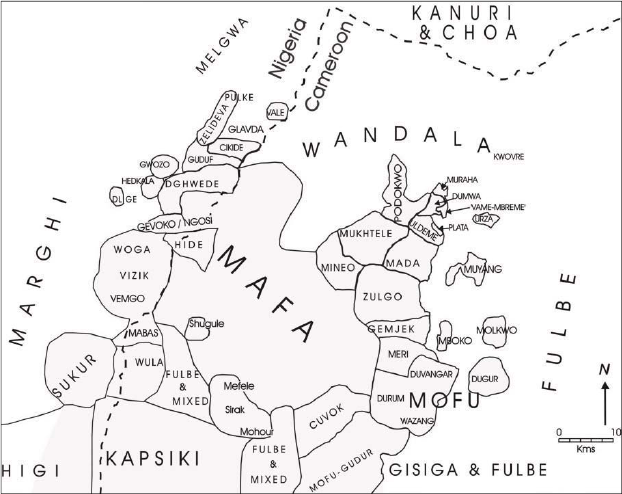
Ethnic Map of the Mandara Mountains and Neighbourhoods
To understand the importance that the Montagnards attached to the rectangular form of houses as a reflection of modernity, we must revisit the colonial period. Colonial administrators had, in many cases, juxtaposed the Wandala against the Montagnards (Chétima 2018; Boutrais 1973: 69), the former being considered more civilised than the latter. The use of rectangular buildings was then a political strategy for Montagnards to blur the visual differences between their own houses and those of the Wandala (Lyons 1996: 364). What made this style of construction more valuable was not just its emulation of Wandala style, but also its emulation of the colonial masters’ style. By assimilating their building style to those of the Wandala, the Montagnards were trying to change their image from that of “primitives” in order to be granted the same esteem as the Wandala. The Montagnards realised that clinging to the round straw hut was detrimental to them, since the colonial administration had always catalogued these huts as the antithesis of modernity. Rectangular houses therefore allowed them to emerge, physically as well as allegorically, from the degrading image of “savages,” and to display a new social identity.
To collect the empirical data on which this study is based, fieldwork was carried out between 2006 and 2016 in three villages – Godigong (in the Podokwo), Tala-Mokolo (in the Muktele), and Mura-Massif (in the Mura) – all of which emerged following the Montagnard migration to the plain starting in 1963 (Boutrais 1973). Since the 1980s, these villages have been strongly marked by the phenomenon of rural exodus. For example, during a Sunday worship at Mura-Massif church on 17 June 2012, there were 113 women and only 18 men present. Interviews with informants reveal that rural exodus is the main reason for this disparity between men and women. From this observation, I made an inventory to establish the number of men present in the village and those living in cities. In June 2012, the inventory indicated 172 men in the cities compared to only 37 men left in the village. As already mentioned, the desire to have a new house appears to be the main objective of migrants. In 2007 there were only 47 corrugated iron sheet houses in Mora-Massif compared to 103 in 2012. In the same vein, the villages of Godigong and Tala-Mokolo represent modernity in local discussions: they have amenities such as electricity, cinema halls, modern houses, in the sense of newness, which earned these villages the nickname of “Petit Paris.” Godigong and Tala-Mokolo are also renowned for their health centres and primary schools, having facilitated the accommodation of the villagers to the new architectural forms.
The central question that guided my research was as follows: How does the rural–urban mobility affect migrants’ relation to the concept of modernisation in terms of housing infrastructure, and how does this process of transformation affect interactions between migrants and non-migrants? To answer this question, I conducted informal and semi-structured interviews, some of which were recorded on camera. I subsequently transcribed the most relevant of them. Conversations lasted from a few minutes to several hours, depending on the participants’ availability. In addition to the interviews, documenting life trajectories emerged as an essential method of collecting data on the daily lives of migrants, both in Yaoundé and in the village. By initially considering different ways of collecting data on migrants and their houses, I realised that the two were associated and interlocked. Indeed, by asking migrants to talk about their stay in Yaoundé, they inevitably talked about their houses. On the other hand, when I asked them to present to me their houses, they ended by mentioning their migratory stays in Yaoundé. Although initially my focus was on new houses, I realised how important rural–urban mobility was in that it influenced the informants to tell the story of their houses, and the stages of their successive transformations. Moreover, when discussing their houses, migrants also talked about their relationships with others, their honour, and their social status, revealed by the nature and size of their houses. In sum, I was able to document the trajectories followed by 11 migrants (four in Mura-Massif, four in Godigong, and three in Tala-Mokolo), with whom I conducted interviews, both in their villages and in Yaoundé. I also observed the morphology of the houses in the migrants’ villages and those in which they live in Yaoundé. In addition, I observed the migrants’ houses in comparison to those of non-migrants in order to better understand the role of rural–urban mobility in the transformation of the rural architectural landscape.
Yaoundé, Place of Accumulation
Où vas-tu, paysan?
Loin de ton beau village […]
Je vais à Yaoundé, Yaoundé la capitale […]
Je vais chercher là-bas une vie meilleure.
(Excerpt from a song by André-Marie Talla, Cameroonian singer, 1970)
André-Marie Talla's song reveals the collective imagination of Yaoundé that spread in Cameroon after independence. It highlights the disarray of a large part of the population living in the hinterland, who had no opportunity to get the cash resources that became necessary to find a place in the market economy. The phenomenon of rural exodus, which started in the early 1960s, was spread beyond Yaoundé to other parts of Cameroon in the 1970s and 1980s (Gubry et al. 1991; Barbier, Courade, and Gubry 1982). Barbier and his colleagues point out that during this period the vast majority of the rural population had only one dream: treading the soil of Yaoundé (Barbier, Courade, and Gubry 1982: 111). It is in this widespread context of rural exodus that the Montagnards embark on the unbridled race to the better life of which André-Marie Talla sings. However, observing their work, their income, and their living conditions in Yaoundé, one discovers a reality that is the antipode of the starting credo. As a matter of fact, most of the Montagnard migrants live in the Bastos-Nylon neighbourhood, one of the marshy environments of Yaoundé. If there is an area where people live below the poverty line, and which can be presented as the emblem of insolvency, it is naturally Bastos-Nylon. Besides, it is named as such to distinguish it from the residential Bastos, which hosts distinguished residential houses and foreign embassies, and to echo the neighbourhood Nylon, known to be the most polluted neighbourhood of Douala.
As shown in Figure 2, the houses in Bastos-Nylon give the impression that they form a single, completely rusted roof. The paths to access the other end of the neighbourhood sometimes lead through private toilets and living rooms. Dirty and polluted water supply the awnings of the dwellings daily. Very small houses are piled up on top of each other and are most often built in carabotte style. To the extent that there is no urban road network, all garbage and household refuse is transferred to the awning of the neighbour's house. As the people here occupy the swampy lowlands, all rainy days are experienced as an ordeal. In an atmosphere of such insalubrity, the crowding of houses poses aeration problems. Anyone unaccustomed to the sector may feel somewhat suffocated, the more so because the stench that the gutters and latrines produce is aggravated by the daily runoff of water evacuated by households (Abega 1989). To the extent that there is no pipeline structure in this zone, this waste stops in front of the houses, forming a layer of mould.
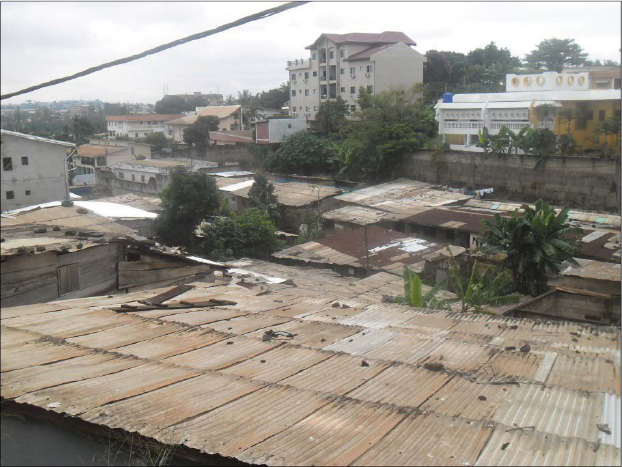
View of Residential Bastos on the Hill and Bastos-Nylon at the Bottom
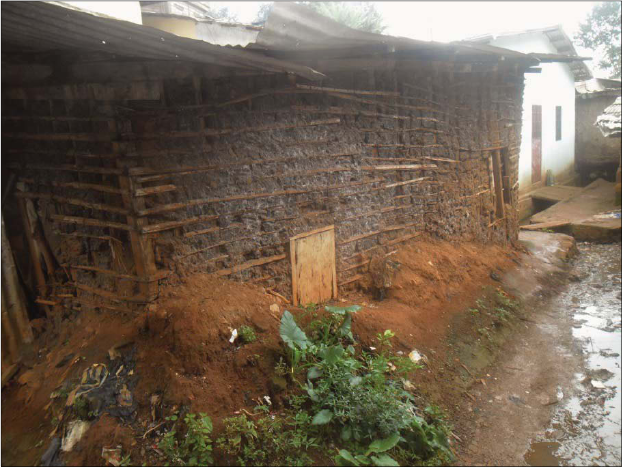
“Grand Salon,” a Carabotte House in the Bastos-Nylon Neighbourhood Housing More Than 30 Podokwo Migrants
It is in this sector of Yaoundé that the great majority of Montagnard migrants live and settle. Most of the time, these migrants gather in groups in small buildings in order to minimise their expenses. In 2012 Podokwo migrants were, for example, grouped together in a building in an advanced state of degradation, but affectionately called it the “Grand Salon.” It was a clay building comprising a bedroom, a living room, and a small courtyard. It did not have any facilities to cook, eat, or rest. Most of the time, migrants slept on the ground in the rain and cold. In this Grand Salon, more than 30 people were sleeping in shifts – those who worked at night used the domestic space during the day, and vice versa. In addition to the Grand Salon, there were other houses known as “Petits Salons,” rented by migrants from the same village, in which they lived according to family relationships. The food was usually prepared by a woman from the village. The living conditions were the same as those observed in the Grand Salon – namely, the smallness of the house in relation to the number of people who occupied it. When a migrant wanted to bring his wife, he left the Grand or Petit Salon to rent a single room for the duration of the wife's stay. Even in the case of an individual lease, minimising expenses was valued. Most rented apartments do not have a kitchen, annex, or living room. To cook, women use an oil stove that they place on a shelf in a corner of the room, separated from the bed by a small curtain. The room therefore serves as a place to sleep, to cook, and to receive friends and relatives.
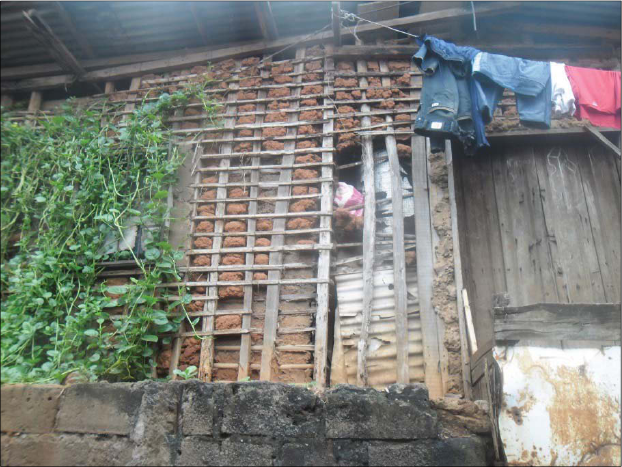
Apartments for Single or Group Rentals
In addition to these extremely difficult housing conditions, migrants’ employment always falls within the second economy (Iyebi-Mandjek 1993). Most of them were employed as night watchmen by businessmen and other diplomats living in residential Bastos for a monthly salary of not more than XAF 50,000 (around USD 90), well below the national average wage. In 2011 more than half of the migrants questioned said they had a salary of less than XAF 25,000 (USD 45). Around 30 per cent reported having a salary staggered between XAF 25,000 and 50,000 (USD 45 to 90). Migrants engaged in all kinds of informal activities, such as street peddling, selling clothes, emptying toilets, and washing cars, which are all activities with the potential for accumulation. The surveys carried out by Foudouop (1991) illustrate the extreme precariousness of the conditions of employment and survival in which Montagnard migrants lived in Yaoundé:
When one closely observes the life of these employees, one thinks of another form of slavery. From the whims of the employer to the unfair dismissals, not to mention the hard work for a low wage. (Foudouop 1991: 16)
In spite of these lousy conditions and the precariousness of their way of life, the migrants’ narratives nevertheless indicate no trace of negativity regarding their austere life in Yaoundé. The former migrants I met remember and nostalgically narrate the way they lodged 20 or 30 at the Grand Salon, often under rain and in the cold. Although they are aware of being marginalised there because of their relative lack of education, the informal nature of their jobs, and the neighbourhood they live in, most of them say they are proud of having overcome the difficulties of urban life and had intended to do so as part of their life project for success. The reason for this is that Yaoundé is not a home for them, but only a source of enrichment, which will be made apparent on their return home. Yaoundé thus has the connotation of a non-place, a space not regulated socially and symbolically (Moisa 2010: 218). The main target of mobility to Yaoundé is certainly the search for a better life, but this better life will not be consumed there, but in the village, 9 hence the fact that they do not complain about how they live and work there. This is also the reason why expenditures throughout the migratory stay are reduced to the bare minimum: “The most important is to save as much money as possible to build a beautiful house in the village.” 10
Interview with Mouche Vaza, man of 50 years, 11 January 2012, at Godigong.
Interview with Sevda Chikoua, man of 44 years, 16 January 2012, at Godigong.
It should also be pointed out that the housing of migrants in Yaoundé is not only precarious, it is even below the comfort of the traditional houses of the Mandara Mountains that they consider to be archaic and outdated. In fact, living in Yaoundé turns out to be only a rite of passage:
You are not a man if you have never been to Yaoundé. It's like the Tupuri: over there, you're not a man unless you have been through the Gonokaye. 11
Interview with Lade Ndawaka, 16 April 2014, at Yaoundé.
Gonokaye among the Tupuri is a ritual that leads the young men to the bush to undergo an initiation that is marked by trials so harsh that some die in the process. Like this initiation, rural–urban mobility is interpreted by the migrants as a path towards accumulation and the acquisition of a new status upon returning to the village. As the departure for the bush already includes the idea of return, the return to the village is already part of the objective of the departure to Yaoundé. In this sense, what the majority of migrants remember is ultimately not the misery experienced in Yaoundé, but the impact of all this once they are back in the village: the construction of new houses. This is also why other migrants compare Yaoundé to a “field of millet to plow.”
It should also be underlined that among the Montagnards, the attitude towards danger, boldness at work, and the ability to perform difficult rural work are the essential criteria for masculinity and honourable rank for an individual within the community. Just as granaries filled with millet testify to one's dedication in farming, building a “modern” house becomes synonymous with hard work exercised elsewhere. This is why new houses, here considered as a result of the difficult conditions endured in the city, are at the heart of the social and cultural stakes of great importance and ensure the individual an honourable place within the society. Under these conditions, migrants willingly accept being marginalised in the city, knowing that once they return to their villages, they will be valued and extolled by their relatives. In other words, the money earned in the city, as well as the new houses built in the village, wipe out the memories of the hardship of working in the city, and at the same time, trigger a fascination among other young villagers who are tempted to go and live the same experience. As a matter of fact, the marginality of urban life gives way to respectability among the people of the village, once the migrant has proved his ability to work elsewhere by building a new house in the village.
The Village, Place of Consumption
If Yaoundé is compared to a “millet field,” the village is compared to a place of consumption 12 where migrants show their migratory success through motorcycles, clothing, and especially corrugated iron sheet–roofed houses. Indeed, one of the peculiarities of the rural–urban mobility is the nostalgia of “return to the village” to consume one's migratory success. Migrants leave the village for Yaoundé knowing that they will be back one day to exhibit and display their achievements. In other words, Yaoundé is not the goal, but merely a means of attaining a nobler goal – that is, the construction of a dreamed house in the village, which has two important elements: a rectangular form and a corrugated iron sheet roof.
Interviews with Mouche Vaza, man of 50 years, 11 January 2012, at Godigong; with Mahama, man of 47 years, 22 May 2012, at Mora-Massif; with Madjokfa, man of 49 years, 17 October 2011, at Tala-Mokolo.
The incorporation of the rectangular form in the buildings of the Montagnard houses was borrowed from public architecture, first by the German and French colonisers, and then by the Islamic state of the Wandala in Mora (Chétima 2015: 205; Lyons 1996: 360; Boutrais 1973: 69). Podokwo informants from Godigong mention that until the early 1980s, all the houses in the village were round and covered with straw. 13 This information is confirmed by the Swiss missionary couple Roby and Eva Bär, whom I met in Sion, Switzerland, in October 2016. The Muktele of Tala-Mokolo also narrated that the first rectangular house appeared only in the 1980s. The same was verified by the Mura of Mora-Massif. The rectangular form was therefore not the norm among Montagnards until the early 1980s. 14 Diane Lyons (1996) also remarks that the oldest rectangular buildings in Mura and Dela only appeared in the 1980s.
Interviews with Mouche Vaza, man of 50 years, 27 January 2012; with Sevda Chikoua, man of 44 years, 18 January 2012, at Godigong.
Interviews with Dawcha, man of 58 years, 17 May 2012, at Mora-Massif; with Amagaouwe, man of 55 years, 17 May 2012, at Mora-Massif; with Nache, woman of 48 years, 18 May 2012, at Mora-Massif; with Mahama, man of 47 years, 22 May 2012, at Mora-Massif.
To better understand the importance of the rectangular form as a sign of modernity, one should consider the context in which it was adopted. In the 1960s, the newly independent Cameroonian state embarked on a process of modernising national institutions, which led to the emergence of new lifestyles and the consumption of modern goods (Pellow 2015), especially clothing, food, houses, and aspects of home comfort (Lyons 1996). In connection with this project of modernising society, the state built rectangular houses and housed civil servants in them. As “modern people,” these officials distinguished themselves from the other villagers by their careful and completely different lifestyle. The fact that they were housed in rectangular houses like the colonial administrators ended up giving the impression that being modern is, among other things, living in rectangular houses, which eventually became proof of social success and openness to the world (see also Prussin 1985). Without having the means, the Montagnards overwhelmingly adopted the rectangular form, making earthen bricks for the walls while using their system of roofing with millet stems. The most important thing was not the comfort, but the rectangular shape, 15 similar to that of the colonial masters and emissaries of the state who were seen as the prototype of the new man. Comparison with them created a sense of modernity and self-fulfillment among the Montagnard migrants.
Interview with Hadjara Gwada, woman of 58 years, 9 February 2012, at Godigong.
The second element by which migrants evoke their status as “modern” via their homes is the roof made of corrugated iron sheeting. I carried out a survey of the first migrants who built such houses in Godigong, Tala-Mokolo, and Mora-Massif. Seventeen people were solicited through the following question: Why did you choose corrugated iron sheeting in the construction of your house? To this question, informants put forward three main reasons: the prettiness and beauty of such houses; the factor of newness and change; and, finally, the material's durability and fire resistance. The first two reasons refer to the aesthetic value and the role of the corrugated sheet to roof houses as it relates to “being modern.” The last reason refers to its functional and practical value. Let us simply consider the first two reasons since they seem to be the most important for the purposes of this study.
The first two reasons are intimately linked and evoke the ideas of beauty and prestige: “However ugly a house, it will become pretty if it is constructed using a corrugated iron sheet for roofing.” 16 In other words, beauty or ugliness is based on the use of a noble material: the corrugated iron sheet. Such a house is regarded as beautiful, whatever form it takes, but especially when it is rectangular in shape. Reciprocally, a straw house embodies ugliness, especially if its owner is young:
Interview with Zabga Valla, man of 62 years, 11 April 2007, at Udjila.
When you are young and build your whole house out of straw, people laugh at you by saying that you live like the grandfathers of the past. 17
Interview with Tobela, man of 25 years, 12 October 2011, at Tala-Mokolo.
Straw indeed seems to refer to another era, more or less stigmatised by the young Montagnards. If straw huts continue to be built by migrants, they are generally used as kitchens or to keep livestock.
For local people, a beautiful house is also a new house, and the importance of the corrugated iron sheet comes from the fact that it makes the houses attractive, new, and modern. 18 In this sense, the mere fact of having built a house with this precious material is a reason for personal fulfillment and satisfaction, even when it is not inhabited. As a matter of fact, in 2007, the vast majority of the houses built with this precious material in the village of Mora-Massif were empty, as the interior was still under construction and not fit for living. Even in this case, their role in the social ascension of the owner is no less important; what matters is not so much the functionality of the house (place to sleep, place to rest, place to cook, and so on), but the message it conveys about the new status of the owner: a message of modernity, fulfillment, and social success. As a material of prestige, corrugated iron is an important element in gauging the importance of an individual. Christian Seignobos (1982) notes that it was always linked to power, and local administrators frequently gave corrugated iron sheets as gifts to traditional authorities of the Montagnards. The local meaning of the roof is intimately linked to masculinity, virility, power, and authority, all associated with a value of representativeness. Visible from afar, the roof attracts attention and onlookers. It does not hide anything, but it reveals the importance of its owner. It is important to note that it is in the village, and not elsewhere, that the promotion of migratory success must take place.
Interview with Dugzum, woman of 40 years, 22 October 2011, at Tala-Mokolo.
Among the migrants of the Mandara Mountains, the houses they inhabit in Yaoundé are clearly seen as secondary residences, and those houses of the village of origin emerge as the main residences, be they inhabited or not. One can go even further and suggest that this house built as a result of migratory exile was not simply the main residence; it achieved that status only because the Montagnards’ stay in Yaoundé was transitory and governed by the logic of passing. Along this vein, a house built in the city, however modern, was seen as an act of waste. One of the informants’ definitions of wastage is particularly striking:
Wastage? It is giving something more than is necessary. If a measure of flour is sufficient to prepare a ball of millet and a woman puts five, it is a waste of flour. If a week is enough to plow a square of land and a man takes two weeks, it is a waste of time. Waste is all that you give that is beyond the value of the thing. 19
Interview with Zabga Pastou, man of 40 years, 17 February 2012, at Godigong.
The definition of waste as specified above provides the people of the village with an arena to criticise the choice of some of the migrants to build houses in the city because “one is never at home when elsewhere.” 20 In other words, to build beautiful houses outside the village is to give them more value than they need, and therefore it is wasteful. On the other hand, a rectangular house roofed with a corrugated iron sheet built in the village will always be a source of honour and respectability for the individual. By absorbing the labour force deployed during migratory exile, the house acts as a sign of identity and power necessary for the social ascension of the individual and the redefinition of his power relations within the village. This concern for honour and respectability consumes the energy of the migrants, so much so that they in some ways compete for the most beautiful and largest house in the village.
Interview with Zabga Pastou, man of 40 years, 17 February 2012, at Godigong.
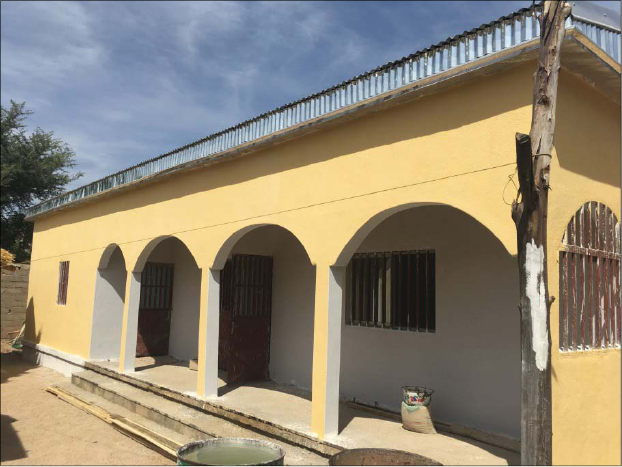
Rectangular and Corrugated Iron Sheet House, Material Representation of Post-Migration Success
Competing for the Most Beautiful and Largest House
When I started my fieldwork in the village of Mora-Massif in 2006, I lived in a single room offered by my host family. The house itself had two bedrooms and a gable roof made of corrugated iron sheeting, with individual entrances overlooking the main courtyard. Opposite were two small, somewhat neglected huts, one of which served as lodging for the children, and the other as a cattle enclosure. When I returned in 2011, I found that one further room and a bathroom with an internal latrine had been added to the main house. The transformation of the house did not require its destruction: the owner just placed the new room next to the previous two and turned the middle one into a living room. From the outside, the wall, which had been cement-coated up to this point, was slightly painted with whitewash to make it look more beautiful. The white colour was obviously another element of newness integrated into the local discourse on prettiness. At the level of the interior equipment, nothing really changed. The owner simply placed in the created living room a padded armchair with a pillow on which a Christian emblem was printed: “Que Dieu bénisse cette maison” (“May God bless this house”). A bunch of artificial flowers was hung on the wall, and a niche for a stereo system placed on a small shelf. The new bathroom was not yet functional, but the new room was inhabited. When I asked my host why he chose to expand the house rather than to renovate it, he explained that it was a response to the transformation of other houses in the village, especially that of his neighbour. By observing some houses in the village, I actually noticed that most houses with two rooms, a dominant model in 2006, had been transformed into houses of three or four rooms, sometimes with an internal bathroom, a dominant model in 2011. To cover the expenses related to the transformation of their houses, most owners had to travel again to Yaoundé for work.
The process of continuous transformation of new houses is not a fact unique to Mora-Massif. It applies to other Mandara Mountain localities, such as Godigong and Tala-Mokolo, where changes can be seen from year to year. The main priorities here also seem to be the colour of the walls, the number of rooms, and the presence of an internal bathroom. If a house of two rooms with a corrugated iron sheet roof satisfied my host in Tala-Mokolo in 2007, it was no longer the mark of distinction in 2011. Unfortunately, my Muktele host was not able to add other new elements because of his advanced age, which prevented him from travelling between the village and the city. His house lost value, since what was now in vogue was a three-bedroom house with an internal shower.
The use of blocks in the buildings becomes another element of prestige. However, in this particular case, the house is no longer plastered and painted, because that would prevent passers-by from determining the building material: the block. In fact, block represents the most important material for attracting admiration and recognition from others. Its use is an act of social presence in the community, “for passers-by will say: here is the house of this or that person!” 21 Once built and even if uninhabited, the cement block house acquires the strength of personification because “speaking of the house is talking about the owner even if he is not present.” The result is the gradual transformation of the original houses to the extent that everybody – men, women, young people, old people – builds, transforms, destroys, and rebuilds, which continually reinvents the image of the village as the years go by. Moreover, the purpose of the rural–urban mobility is not only to construct a house, but also to transform it, the only means of preserving and valuing honour. Without this, the individual risks social isolation.
Interview with Zabga Pastou, man of 40 years, 17 February 2012, at Godigong.
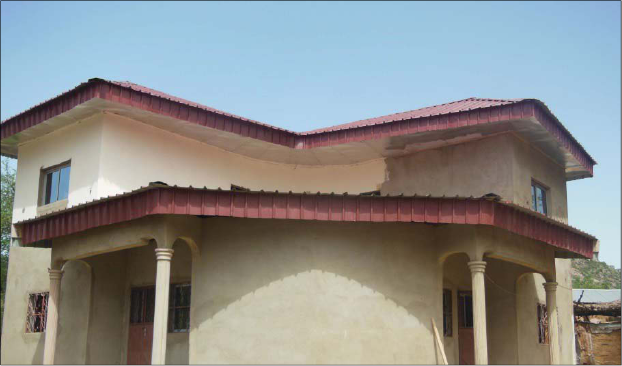
Build, Transform, and Destroy to Stay Competitive
In order to stay in the competition, the villagers prefer to renovate the outside of the house to the detriment of interior finishing:
The house represents you more outside than inside. That is why it is in the outside that people bury all the money earned in Yaoundé. 22
Interview with Madjokfa, man of 49 years, 17 October 2011, at Tala-Mokolo. The quotes were originally in the Matal (Muktele) language.
In other words, it is the exterior, not the interior, that facilitates a visible and prestigious identity through the corrugated iron sheet roof, the rectangular shape, and concrete walls. While the inside is visible only to the family members and relatives, the outside is observable by the residents of the village, who can thus assess the prestige and honourability of the owner. The exterior attracts and encourages visual consumption but also conceals the inside, which may be in a miserable state and is sometimes reserved for storing worthless items. The exterior thus plays the role of packaging, giving a possibly inaccurate overview of the interior (Moisa 2010: 328). As an interstitial space between the owner and the other villagers, the outside attracts all financial and emotional investments in order to perform the role of the house in arresting passers-by who notice the successes of migrants. The whirlwind of competition that grips the villagers explains this unfinished character of the houses. The construction of the “largest and most beautiful house” encourages migrants to transform, adapt, and enlarge their original houses, but without ever finishing them. This desire traps them in an incessant movement between the village and Yaoundé. As buildings that evolve and change, the migrants’ houses accompany in some way the owners’ lives as they take the social elevator. The houses lend themselves to multiple additions: they are wide even if they remain partly uninhabited; they are half-finished and are not the subject of any internal repair. Like a chameleon, a migrant's house undergoes external metamorphoses, constantly taking the colour of fashion. In this way, they are never thought of as finished products as long as their owners are physically able to make new trips to Yaoundé.
The Flipside of the Coin
The success of some urban migrants who built houses in the village masks the failures and the setbacks many of them have experienced. Indeed, urban mobility still does not provide the financial and material resources expected. Conversely, returning to the village without building a new house is perceived as a social disaster. In this context, the other side of the coin is that migrants who have failed to build or transform their houses are stigmatised. For the entourage left in the village, the rural exodus must automatically lead to the construction of a house. What is the purpose of rural–urban mobility if not to allow the social transformation of migrants? Such returnees are regularly labelled as irresponsible and wasteful (see also Åkesson 2011). The failed migrants are thus constantly compared to the young people who died during the initiation rites. In the absence of any transformation of their social status, their entourage mock them by attributing derogatory nicknames to stigmatise them. This situation leads some migrants to go outside the bounds of the law in their quest for their dream house. The profile of a migrant to whom I give the pseudonym of Genda perfectly illustrates this situation.
Like the majority of young people, Genda dropped out of school after nine years without ever completing his primary school. He thought then that school was not for him and that he could not achieve his dream of a house with a corrugated iron sheet roof by continuing in school. He then decided to go to the city to save some money. When he arrived in Yaoundé in 1994, Genda lived in the same room with other migrants in the Bastos-Nylon neighbourhood, as his income did not allow him to rent a single room. He was first employed as a night watchman, until 1997. Unfortunately, his inclination to live a good life did not allow him to accumulate much money to build an acceptable house in the village. This incapacity led him to embrace the career of a bandit by committing petty larceny here and there in the company of his gang. Eventually, Genda was finally jailed for more than three years (2002–2006) in the famous prison of Nkondengui. Once released, he tried to return to normal life by practising some trades in the suburbs of Yaoundé. Building a house in the village now became a real necessity for him. A house would allow him to recover his dignity and tarnished reputation. Not being able to accumulate the desired money despite his hard work, he again turned to delinquency by indulging in acts of robbery. In 2009, he found a domestic job in a French household in which he succeeded in stealing and running away with a huge amount of money. This action finally made available the financial resources he badly needed to invest back at home, an opportunity he never had while in lawful business. Finally, he managed to return to the village the same year and built his “beautiful three-bedroom house.”
Montagnard migrants are ready to risk everything to satisfy the requirement of having a beautiful house in their villages. Caught in the hurricane of architectural competition, they combine legal and illegal activities to acquire money as quickly as possible. The local population admits that today the number of migrants engaging in robbery has grown considerably. They explain the upsurge in theft as a consequence of the marginalisation of unfortunate migrants when they return to the village. Their failure is often the subject of speculation by villagers, who want to know the real reasons. They are considered, for example, to be people with “pierced hands” – that is to say, people who are sure that they will spend whatever level of wealth they have. All in all, migrants’ failure to build “new houses” is a difficult burden to bear. If they are not banned outright, they are at least stigmatised through songs performed during festivals and popular events. 23
Interview with Dawcha, man of 58 years, 17 May 2012, at Mora-Massif. The quotes were originally in the Mura language.
Conclusion
The observation of practices related to the appearance of new houses in the context of this rural–urban migration has shown that the house is not simply a space in which people live. It participates actively in the construction of their social existence, which is maintained and constantly modified as the house changes and transforms (Miller 2001: 119). In some cases, it seems to be emptied of its primary functions by becoming an object of exposure and communication of the success of its owner (Pellow 2015). The migrant no longer needs to live in the village to know what he has achieved, because his house represents him in his absence. In this way, the house acts as a fetish (Miller 2001), insofar as talking about the house comes down to automatically speaking about its owner.
The new houses are “commodified,” as they constitute an important site of cultural consumption, are part of the social fabric of everyday life (Pellow 2015), and represent a new arena through which urban migrants determine their behaviours and identities. New houses therefore confer an honourable identity, since they come to legitimise the labour of their owners, which is realised throughout their migratory stay in cities. Also, to stay in the race, there is a need to embark on a permanent back and forth between the village and Yaoundé, which makes the migrants practically prisoners of their dream of social ascension. In other words, the needle of the pendulum regulating the balance of power between the individual and the house ends up changing direction: man is no longer the head of the house, he suffers Mephistophelian effects because he has to work relentlessly to dispose of the necessary means for the construction and/or transformation of said house. As Daniela Moisa put it so well in the case of the Oseini of Romania, migrants do not realise the almost perverse effects of their own house, which, revealing its agency, does not allow them to profit from their labour (Moisa 2010: 485).
It should be noted, however, that rural exodus has offered migrants the opportunity to enrich their cultural content, not only by acquiring new materials and architectural forms, but also by giving them new meanings according to the code of honour within their communities. As noted by Charles Piot (1999) about the Kabre of northern Togo, things that are appropriated externally are necessarily reconfigured and given local meaning (Nyamnjoy 2014; Brickell and Datta 2011; Knauft 2002). Thus, rectangular forms are deployed and reinterpreted according to the new exigencies and local influences. In the same vein, the corrugated iron sheet roofs of the migrants’ houses build on local stories and values. In any case, it is increasingly difficult in this global context in which the Montagnards now find themselves to consider the adoption of foreign material culture as a passive copy of what is observed elsewhere, particularly in Yaoundé. Rather, it is better to perceive it as a creative appropriation – in other words, as some sort of indigenisation of the cultural inventory copied elsewhere.
Moreover, in addition to the centripetal circulation of architectural forms from global to local, there is another equally important transformation of the local architectural landscape: the centrifugal circulation that unfolds from one village to another and between migrants from the same village. Without minimising the role of imitation in importing new models, what we see today in the villages of the northern Mandara Mountains is not a faithful reflection of what has been observed elsewhere. It is more of an incorporation of one internal experience to another both local and traditional experience (Ingold 2013). Indeed, what is imitated is no longer the house seen elsewhere, but rather that of the parent, neighbour, or other inhabitant of the village. Thus, despite the desire to import to the village the architectural model from elsewhere, the local in the geographical sense (village) and social (community, family) end up imposing their own requirements (Betea and Wild 2016; Moisa 2010). Finally, “travel,” “roots,” “mobility,” and “sedentariness” are no longer exclusive of one another (Clifford 1997: 3), but coexist in what the Montagnards call a “modern house.” Paraphrasing James Clifford (1997), we can conclude by emphasising that “routes” cannot overshadow “roots,” and that modernity is otherwise only a hybrid, incorrigibly plural as well as eternally unfinished (Comaroff and Comaroff 1993: 79).