



Abstract
Previous literature suggests that some African parties employ non-valence positional issues in their party platforms and that this practice is more prevalent in some countries than in others; however, no quantitative research has analysed the electoral effects of non-valenced campaigns. How do African voters perceive parties’ policy positions? Who uses party platforms to choose candidates? Using data from an original survey experiment conducted in Nairobi, we examine voter perceptions of party platforms and their behaviour in the 2017 Kenyan presidential elections. We find that the opposition party’s clearer messaging helps average voters recognise and characterise the party, compared to the incumbent’s moderate policy stance. Moreover, while both parties’ policy positions positively affect voting, non-partisan voters are more likely to support a candidate advocating moderate policies. This implies an incumbency advantage: incumbents’ broad-appeal strategies help maximise their votes, whereas opposition parties have limited strategy options.
Introduction
Some recent studies of electoral strategies in Africa argue that political parties sometimes campaign on non-valence (positional) issues to attract voter support. For instance, Cheeseman and Hinfelaar (2010), Resnick (2012), and Hinfelaar et al. (2020) find that the Patriotic Front (PF), Zambia’s current incumbent party, has mobilised a cross-ethnic support base of the urban poor, informal-sector workers, and the middle class, and established a policy platform ideologically distinctive from opposition parties, to win votes from these groups. Other studies have demonstrated a trend among African parties of taking distinctive policy positions as an electoral strategy (Elischer, 2013; Nugent, 2007; Osei, 2013; Whitfield, 2009). Bleck and Van de Walle (2013) show that 51 per cent, 46 per cent, and 38 per cent of the campaign messages in Kenya, Benin, and Zambia, respectively, emphasise party positions on specific issues.
This study examines voting for parties taking policy positions in relatively new democracies, where political mobilisation often occurs along ethnic lines. When parties campaign on positional issues to gain votes, do African voters correctly understand their policy positions? Who uses parties’ policy platforms to choose candidates? Political parties in Africa may prefer valence strategies to distinctive appeals (Bleck and Van de Walle, 2013) and often rely on ethnic patronage practices and clientelistic networks (van de Walle, 2003; Wantchekon, 2003) when trying to attract typically poorly informed voters with limited resources. Nonetheless, scholars have overlooked how voters evaluate the presented positional policy messages and these messages’ potential influence on voting in Africa’s electoral democracies. If policy platforms lead voters to choose particular parties, they can drive votes and determine election winners amid static ethnic traction.
This empirical article focuses on voting in urban Africa. The electoral behaviour literature attributes the lack of policy voting in Africa to uninformed voters, mostly in rural areas, where people are so poor and widely dispersed that acquiring information from schools and media is prohibitively expensive (Jensen and Justesen, 2014; Vicente and Wantchekon, 2009). Urban voters, by contrast, incur less cost when acquiring information on the electoral process, candidate qualifications, and party positions. Further, ethnicity matters less in cities compared to the countryside (Conroy-Krutz, 2013; Robinson, 2014); thus, opposition parties without sizeable ethnicity-based backing are more successful in urban areas (Harding, 2020; Koter, 2013). The political importance of ethnicity wanes when voters are exposed to alternative cues such as the promise of material goods, security, or future opportunities (Esman, 1994; Nathan, 2016). Moreover, cities provide more access to jobs, education, infrastructure, and information on how to gain individual benefits and on economic development generally. Older modernisation theories suggest that the urban characteristics of individual mobility and competition for “success” encourage political participation focused on individual gains, rather than the traditional preference for kin (Almond and Verba, 1989; Coulter, 1975, Lerner, 1958; Lipset, 1959, 1960). Thus, cities appear to be appropriate settings for evaluating the impact of non-valence issue platforms.
However, urban voters may not attribute policy positions to particular political parties if they cannot interpret the available information. Such attributions may be limited to politically sophisticated voters who possess the cognitive skills and political knowledge to detect differences in parties’ policy stances and who vote accordingly (Healy and Malhotra, 2013; MacKuen et al., 1992). Since African parties do not always use positional issues when making electoral appeals (Bleck and Van de Walle, 2013), voters may require political sophistication to identify differences in party platforms and vote on policy issues. This study examines how party loyalty, education, and income levels affect voters’ ability to detect partisan differences and behaviours.
To test hypotheses regarding voter perceptions of a party’s policy stance vis-à-vis its ethnic support base and electoral effect, this study employs an original survey experiment conducted in Nairobi, Kenya, around the 2017 presidential elections, which featured two major electoral coalitions without an effective third-party presidential candidate running. It examines the presidential candidates’ distinct issue positions in this national contest between coalition parties competing across heterogeneous constituencies. 1 In the experiment, randomly selected respondents were exposed to a campaign message containing one of three kinds of information on a party platform – a market-driven policy, a state-led approach, and an ambiguous view on the economic development strategy – as well as the candidate’s ethnicity. This was done to explore whether a non-valenced strategy sharpens distinctions between parties, and whether this policy information increases electoral support. This test is relevant to African cities, where the workforce is mostly non-agricultural and residents face common challenges such as inequality, unemployment, lack of affordable housing, and crime (Bawumia, 1998).
The data show that Nairobi voters’ perceptions of party brands mirror the parties’ strategic platforms: the left-leaning opposition, National Super Alliance (NASA), has a more distinct policy position, which voters can better detect, compared to the centre-right incumbent Jubilee coalition, while ethnicity is strongly politicised in both coalitions’ campaigns. However, while the Jubilee message attracts non-partisan voters, the NASA policy attracts more partisan voters.
This research advances the literature on political parties and voting in African democracies in two ways. First, it is the first to analyse the effect of African parties’ espousal of policy positions on voters’ understanding of party labels and on electoral choice. Conroy-Krutz et al. (2016) show that partisan cues help politicians and parties mobilise votes in new party systems in Africa. This work extends their argument by investigating the effectiveness of campaigns with positional issues in lower-information environments, and seeks to identify individual-level characteristics that affect voters’ decision-making when both policy considerations and personal traits (i.e. ethnicity) are salient.
Second, the findings suggest a neglected aspect of incumbency advantage in Africa: incumbents succeed because they take policy positions that most appeal to moderate voters (Mayhew, 1974). This contrasts widely accepted explanations for incumbents’ high re-election rates, such as access to resources, high level of legitimacy, and strong state and party institutions (Collier and Vicente, 2012; Jensen and Wantchekon, 2004; Rakner and Van de Walle, 2009), and demonstrates that incumbents strategically mobilise support by expanding their support base to non-co-ethnics attracted by their moderate policy stance.
Context: Political Coalitions and Issues in Kenya
In the run-up to the 2017 presidential elections in Kenya, two electoral coalitions emerged: the Jubilee Alliance, dominated by President Uhuru Kenyatta’s Jubilee Party, and the opposition, NASA, comprising five parties, including those of the presidential candidate Raila Odinga – the Orange Democratic Movement (ODM) – and the deputy presidential candidate Musalia Mudavadi – the Amani National Congress (ANC). While the rivalry between Kikuyu and Luo ethnic leaders has shaped the main coalition-building patterns in Kenya since the 2002 elections, this was the first time a presidential race became a two-coalition competition that presented two straightforward options without a third-party candidate.
The coalitions’ 2017 electoral platforms follow policy positions taken by the 2007 presidential candidates: the then-incumbent candidate, Mwai Kibaki, had emphasised his success in achieving economic growth and the importance of fostering investment, appealing to the middle and upper classes, whereas the opposition candidate, Raila Odinga, took a populist strategy targeting lower-class votes (Kagwanja and Southall, 2009; wa Gĩthĩnji and Holmquist, 2008). Particularly in Nairobi, Odinga, who had been the MP for Africa’s biggest slum, Kibera, for twenty years, maintained political support from the urban poor, tying his party to issues such as inequality, youth unemployment, and poverty (Cheeseman and Larmer, 2015; Gibson and Long, 2009). In his case study of Kibera, de Smedt (2009) contends that Odinga’s popularity there reflects the political salience these issues hold for the constituents, and not ethno-clientelist politics alone.
In their 2017 campaign, the Jubilee politicians praised the completion of the country’s largest infrastructure project, a railway line between Nairobi and the main port in Mombasa, using it to reinforce the party’s image as efficient and modern. This project is part of Kenya Vision 2030, a national development programme launched by the Kibaki administration in November 2006. Linehan (2007) maintains that Vision 2030 is a neoliberal strategy designed to promote exports and foreign direct investment in private business interests and, thus, to build Nairobi as a global hub. Jubilee’s 2017 election platform aligns with Vision 2030: growth-oriented development.
The 2015 Afrobarometer survey results from Kenya reflect how well the voters are aware of the parties’ different issue positions. Most of the respondents (26.87 per cent) report that “the most important difference between the ruling party and opposition parties in Kenya” is “the economic and development policies each party wants to implement.” The Nairobi subset of the data reveals a similar result: 24.19 per cent of the respondents in Nairobi choose the same answer.
Besides development strategy, the two coalitions differ on their stances towards security, devolution of power, urban housing plans, and education. For example, regarding terrorist attacks in Kenya by Al-Shabab, which have been increasing since 2011, Jubilee proposes sending more troops to Somalia to combat Al-Shabab there, while NASA promises to withdraw troops from abroad to fight threats within Kenya (Mutahi, 2017).
Their approach to economic development most clearly distinguishes the two platforms: NASA is a left-leaning party that emphasises economic intervention, while Jubilee is a centre-right party that supports a market economy. 2 Some scholars have suggested that an advantaged candidate or party (usually the incumbent), confident in their personal popularity, moderates their policy position to minimise differences between contenders; meanwhile, a non-advantaged candidate (usually an opposition candidate) shifts to a more extreme position, being forced to distinguish themselves by adopting a relatively radical stance (Berger et al., 2000; Feld and Grofman, 1991). This perspective reflects the centripetal incentive for the governing party, as apparent from the 2017 campaign. We employ this scenario for party position cues in the experiment.
Research Design and Hypotheses
This section presents a simple theoretic framework for understanding voters’ perceptions of political parties and their voting decisions in presidential elections. The goal is a tractable framework incorporating a set of treatments to guide the experimental design and develop theoretical expectations.
In the experiment, each subject listened to a pre-recorded, hypothetical campaign speech randomly assigning the treatment conditions of (a male) presidential candidate’s ethnicity and issue position. For the issue position, all respondents were assigned to one of three policy cues on economic development: ambiguous promise (control condition), market-driven development message (Jubilee platform), or state-led development message (NASA platform). For the ethnicity cue, respondents were randomly assigned to a Kikuyu or Luo candidate surname cue. 3 An ambiguous promise is a statement made by the candidate that they want to increase jobs, without spelling out how. Table 1 shows the script respondents heard in the control and treatment scenarios in the vignette experiment. An ethnicity cue was given in introducing the candidate, while the candidate’s speech delivered a policy cue. The statements, used as positional policy cues, summarise the key messages of the parties’ real manifestos, campaign pledges, and memoranda, particularly on development, enhancing their external validity. 4 Respondents chose between English and Swahili; a male speaker in his fifties recorded the speeches.
Experimental Design for Presidential Campaigns.
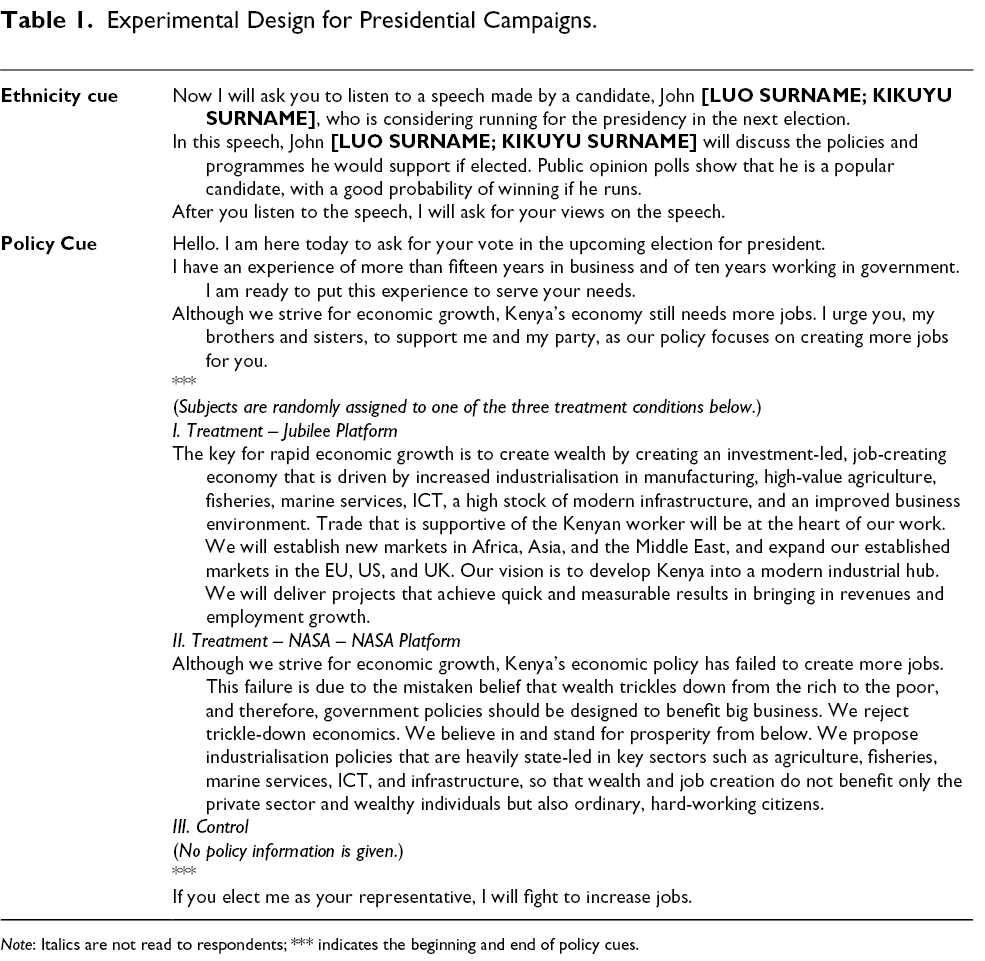
Note: Italics are not read to respondents; *** indicates the beginning and end of policy cues.
Next, the respondents were asked to submit a private ballot indicating whether they supported that candidate. After the voting simulation, the respondents reported their guesses about the candidate’s ethnicity as a manipulation check; the results were relatively consistent with the present treatment frames (see Supplemental Material).
Table 2 summarises the six policy and ethnicity information provision scenarios, with predictions regarding which party the respondents would match the information to. Considering that, when the experiment was conducted in June 2018, Jubilee was led by Uhuru Kenyatta, a Kikuyu, and NASA was headed by Raila Odinga, a Luo; those in the control group with the non-partisan message were expected to attribute a Kikuyu leader to the Jubilee party and a Luo leader to NASA. 5 For those who received a partisan speech, however, the treatments were expected to have different effects on voter perceptions depending on the ethnicity cue: if the market-driven capitalist message was carried by a Kikuyu or the redistributive state-led message by a Luo, it would reinforce the ethnicity effect on party identification; whereas, if the ethnic signals were unexpected – market-driven policy from a Luo leader and state-led policy from a Kikuyu – distinguishing the parties would be difficult. This experimental setup allows testing of whether distinct policy messages increase voters’ ability to detect partisan differences and their interest in supporting the candidate regardless of candidate ethnicity.
The Six Scenarios and Outcome Predictions.
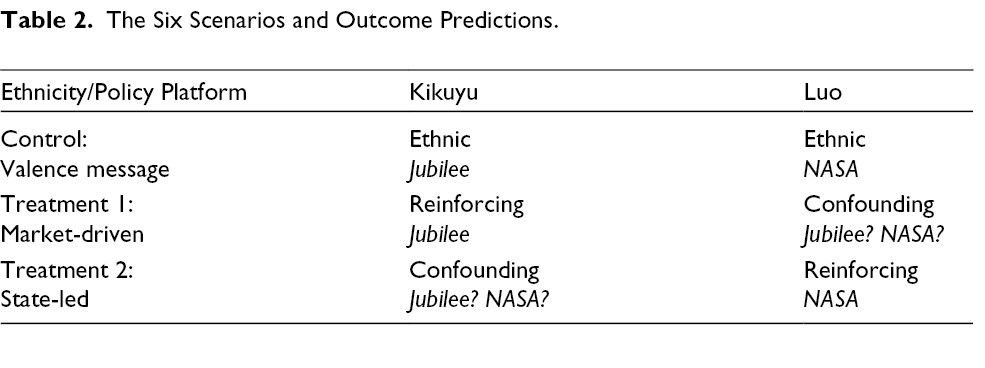
On this basis, the study makes predictions about the effect of non-valence policy on two outcome measures: (1) voters’ perceptions of party brands and (2) vote choice. Regarding the first measure, the study assumes that voters evaluate policy considerations to shape perceptions of party platforms not only when the received information is an accurate description of real-world politics but also when the speech and candidate ethnicity present conflicting information. When the policy platform and candidate ethnicity match expectations, the two cues reinforce the voter’s perception of the candidate’s party. However, when confounding information is presented – when a policy cue is paired with an unexpected ethnic cue – voters’ perception of the candidate’s party should move in the opposite direction from their first party guess, proposed based on the ethnic cue.
This study also examines the electoral effect of presenting a clear policy position relative to that of relying on valence alone. The traditional models of political parties’ behaviour, grounded on the work of Downs (1957), posit that, in a two-party system, electoral competition results in convergent platforms, as both parties choose policies closest to the median voter’s preferred policy, to win more votes. However, many studies, in contrast to this Downsian idea, show that parties are unwilling to compromise their ideological principles to gratify the general population (Carmines and Stimson, 1989; Sundquist, 1983) and that voters prefer candidates who offer them clear, precise policy positions to candidates who are vague (Bartels, 1986; Brady and Ansolabehere, 1989; Brader et al., 2013). This issue is the subject of an ongoing debate, and there is no clear consensus on whether the (im)precision of candidates’ positions helps or hinders victory in elections. Nevertheless, clearer policy messages may indicate greater certainty and competence by the candidate, which helps construct appealing party identities and images (Ezrow et al., 2014). Ambiguity may have a net negative impact on voters’ decisions.
Next, it is important to understand whether politically aware voters can better discern the policy bases of parties via the speech, and use them in voting. Weatherford (1983) holds that, when voters consume relevant information, they gain insights into public policy analysis. This allows them to relate the government’s performance to not only the national, but also their personal economic conditions, and to vote accordingly. However, the obtained information is only useful if voters can correctly comprehend and interpret it in relation to the political context. Abramowitz et al. (1988) contend that education has a powerful effect on voters’ ability to perceive the impact of government policies and economic conditions on their own economic gains. Partisan attachment and political attentiveness also lower the costs of gathering information about government policies and performance, and increase the accuracy of voters’ perceptions of partisan cues in mixed messages from the media (Dalton et al., 1998; Neuman, 1986; Zaller, 1992). Notably, these factors that affect voter sophistication have strong associations with voters’ socioeconomic status. Additionally, becoming informed – that is, becoming more politically sophisticated – reduces the effect of clientelism on voter behaviour (Keefer and Vlaicu, 2008; Weghorst and Lindberg, 2013) and may increase policy-based votes.
However, the links among voter demographics, party loyalty, and voter behaviour are not clear-cut: past studies have offered divergent conclusions about the role of such factors in voting, even on straightforward matters such as whether well-educated and rich voters prefer right-wing parties, or whether partisanship necessarily means issue voting (Clark and Lipset, 2001; Holt and Anderson, 1999; Jansen et al., 2013). Clearly, the relationship between socioeconomic class and voting is no longer self-evident, although the debate on whether class is politically irrelevant is still ongoing. As the focus here is on whether clear policy goals increase support among more politically aware voters, rather than on whether an individual’s socioeconomic status is linked to their party preference, we only consider the behaviour of sophisticated voters regarding their choice between candidates with clear or ambiguous policy positions. For this, we consider three test indicators of voter sophistication: partisanship, education, and income level.
Data and Measures
To test the hypotheses, this study uses original survey experiment data gathered in Nairobi in June 2018. The data comprise a sample of 987 Nairobi residents aged eighteen years or older. A multi-stage, stratified sampling strategy was applied to ensure that the sample was representative of the Nairobi population. In the first stage of sample selection, polling stations acted as sampling points and each parliamentary constituency was a stratum. In each stratum, five to ten sampling points were randomly selected after excluding security risk-laden or non-residential areas. In the second stage, the surveyors selected households based on random-walk rules. In the third stage, once the surveyors reached a selected household, they filled out a household roster to list all household members aged eighteen years or older during the visit. A randomly selected respondent from the household roster was invited to the survey.
The experimental investigation proceeded in two stages. Considering voter perception of party platforms, in the first stage, we asked respondents “Which party do you think this candidate is from?” in the context of the 2017 presidential election. To capture party perception, the survey employed two binary variables, Jubilee and NASA, coded 1 if the voter responded with that party, and 0, otherwise. Responses were Jubilee (30.7 per cent), NASA (28.6 per cent); other responses, not captured by the binary, were “Other” (13.6 per cent), “Don’t know” (25.2 per cent), and “Refuse to answer” (1.9 per cent).
The second stage evaluates voter behaviour to test whether ideological speech content has a stronger electoral impact than an ambiguous statement. To estimate how a respondent will vote, the study employed a binary variable, Vote, which is coded 1 for a Yes vote to express a respondent’s support for the candidate, and 0 for a No vote. Blank or unmarked ballots (4.2 per cent) were considered invalid; Yes votes comprised 56.1 per cent and No votes 39.1 per cent.
In the experiment, a subject was in a treatment group if s/he was randomly assigned to receive a positional issue message. Those within the treatment group were sub-divided via random assignment into two groups: the market-driven policy treatment group and state-led policy treatment group. Subjects in the control group received an ambiguous speech instead of a clear policy promise. All subjects in the treatment and control groups received information about the speaker’s ethnicity, which was randomly selected between Kikuyu and Luo. The treatment rate was 39 per cent for the market-driven message and 29 per cent for the state-led message, while the control rate was 32 per cent.
To measure the influence of socioeconomic variations associated with political sophistication, the study included three binary indicators – partisan, more education, and higher income – based on the pre-treatment survey questions. Partisan voters can better detect partisan differences in mixed messages because they are better informed and more attentive to national politics than are ordinary citizens (e.g. Converse, 1962). Partisan equals 1 if the respondents reported feeling close to any political party. Higher levels of education and income are also indicators that proxy for voter sophistication, as they give voters an advantage in evaluating the policy’s impact on their welfare (Gomez and Wilson, 2001). More education equals 1 if the respondent’s highest level of education is higher than secondary school completion – that is, higher than Form 4 – and higher income equals 1 if the monthly household income is more than the median monthly income in our sample 15,000 Kenyan Shillings (approximately US$150 – higher than the average for the whole country, as incomes are slightly higher in Nairobi), and 0, otherwise.
Results
Pre-Treatment Balance
A difference-in-means test for the socioeconomic and demographic covariates across the assigned treatments tested for randomisation; overall, the randomisation of both ethnic surname and policy position treatment assignments adequately balanced the pre-treatment covariates across different conditions. All pre-treatment covariates are balanced across the ethnic surname treatments except for the variables for NASA partisanship, where the difference is only weakly significant (p < .1). Similarly, there is a balance in most of the pre-treatment covariates across the policy-position conditions. In the Kikuyu and NASA, partisanship variables, the differences are weakly significant (p < .1). For the higher-income variable, the difference is statistically significant (p < .01). Pre-treatment balance statistics are shown in the Supplemental Material (Tables A2 and A3).
Voter Perception
To investigate the first prediction, that a policy message improves voter perceptions of party brand, we use ordinary least squares (OLS) regressions where the outcome variable is Jubilee or NASA. 6 Here, the outcome variable depends on two independent variables (ethnicity and policy cues), their interaction, and constituency fixed effects, including the constant term (to address the different numbers of observations across constituencies; the results are nearly identical even when constituency fixed effects are not controlled). We include an interaction term for ethnicity and policy cues to determine whether a positional statement increases voters’ ability to detect partisan differences compared to an ambiguous speech delivered either by a Kikuyu or Luo candidate. The ethnicity cue provides an empirically realistic setting for voting and determines whether the effects of positional statements on the outcome vary according to the candidate’s ethnicity.
Figure 1 presents the predicted probability of respondents attributing a candidate’s party affiliation to Jubilee or NASA under each of the six scenarios discussed earlier. The predicted probabilities are based on the OLS estimation results provided in Table A4 in the Supplemental Material. Receiving a positional issue message, that is, the state-led (redistributive) message, clearly affects the perception of urban voters. For example, when respondents receive the state-led message from a Kikuyu candidate, the probability of attributing the candidate to Jubilee decreases by approximately 12.7 percentage points compared to when respondents receive an ambiguous message from a Kikuyu candidate (see Model (2) in Table A4 in the Supplemental Material for details). In this confounding scenario, the information on policy position undermines the party brand that voters perceive from the ethnic cue. By contrast, a state-led statement delivered by a Luo speaker reinforces respondents’ perception of the speaker’s party affiliation as NASA. The probability of attributing a Luo candidate to NASA increases by approximately 8.4 percentage points when a respondent receives a state-led statement relative to receiving an ambiguous message, which is statistically significant (p < .10) (see Model (4) in Table A4 in the Supplemental Material).
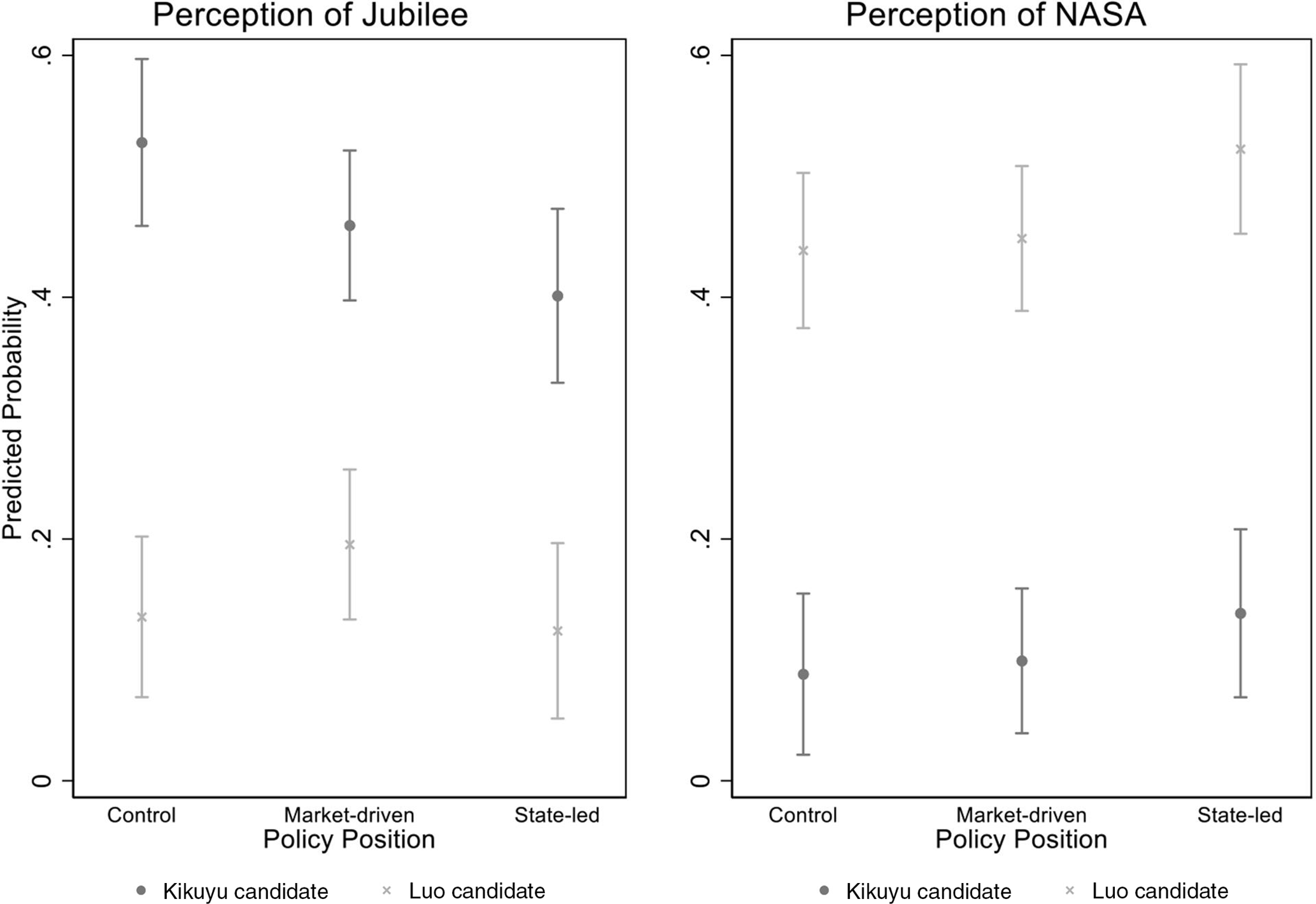
Predicted Probabilities of Understanding Partisanship.
Jubilee’s centre-right position, described in its campaign message, however, does not increase the respondents’ perception of Jubilee’s platform compared to their perception shaped by an ambiguous message given by a Kikuyu candidate. (The regression results remain robust when adding the variables, Male and Kikuyu , which appeared unbalanced in the balance tests; see Model (2) in Table A4 in the Supplemental Material.) When delivered by a Luo, the market-driven message does not help respondents attribute the speaker’s party as not NASA, as the effect of the message on the perception of NASA is almost the same as that of a valence message (see Model (4) in Table A4 in the Supplemental Material).
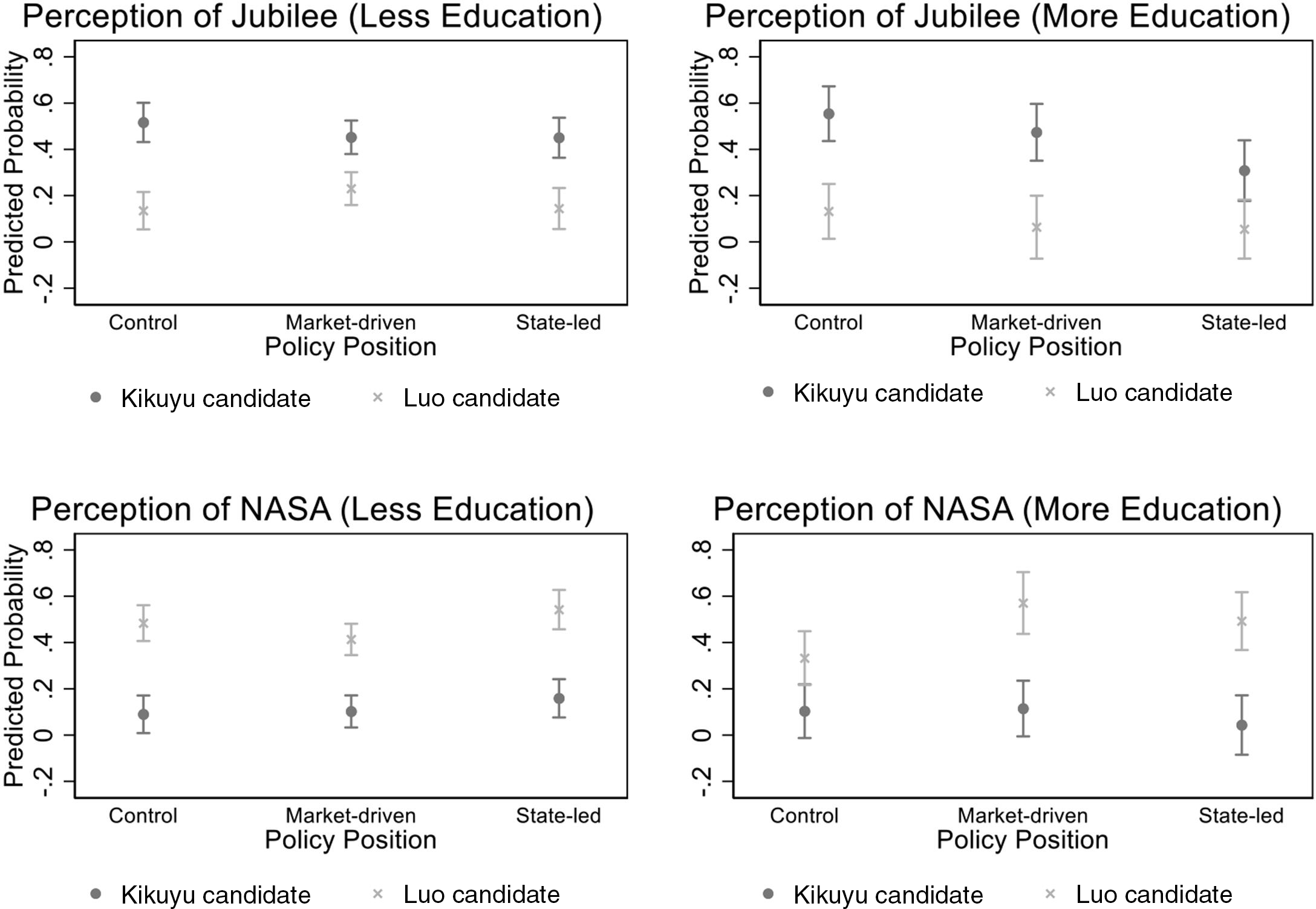
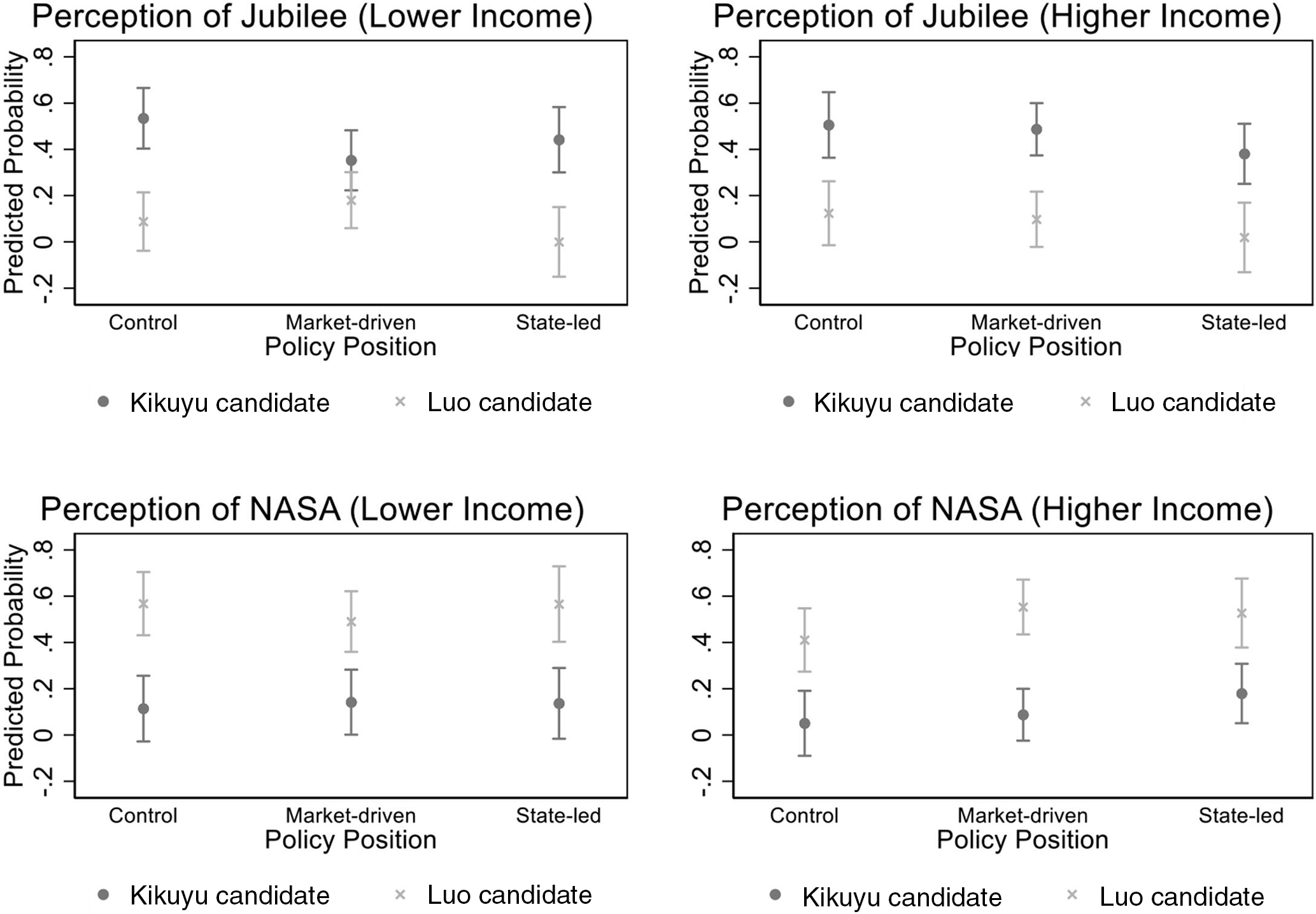
Figures 2 -4 demonstrate whether the attribution of positional issues to parties’ policy positions is conditional on voters’ political sophistication, using different measures, namely, partisanship (Figure 2), education level (Figure 3), and income level (Figure 4), which draw from the OLS regression results accounting for constituency fixed effects (Tables A5–A6 in the Supplemental Material).
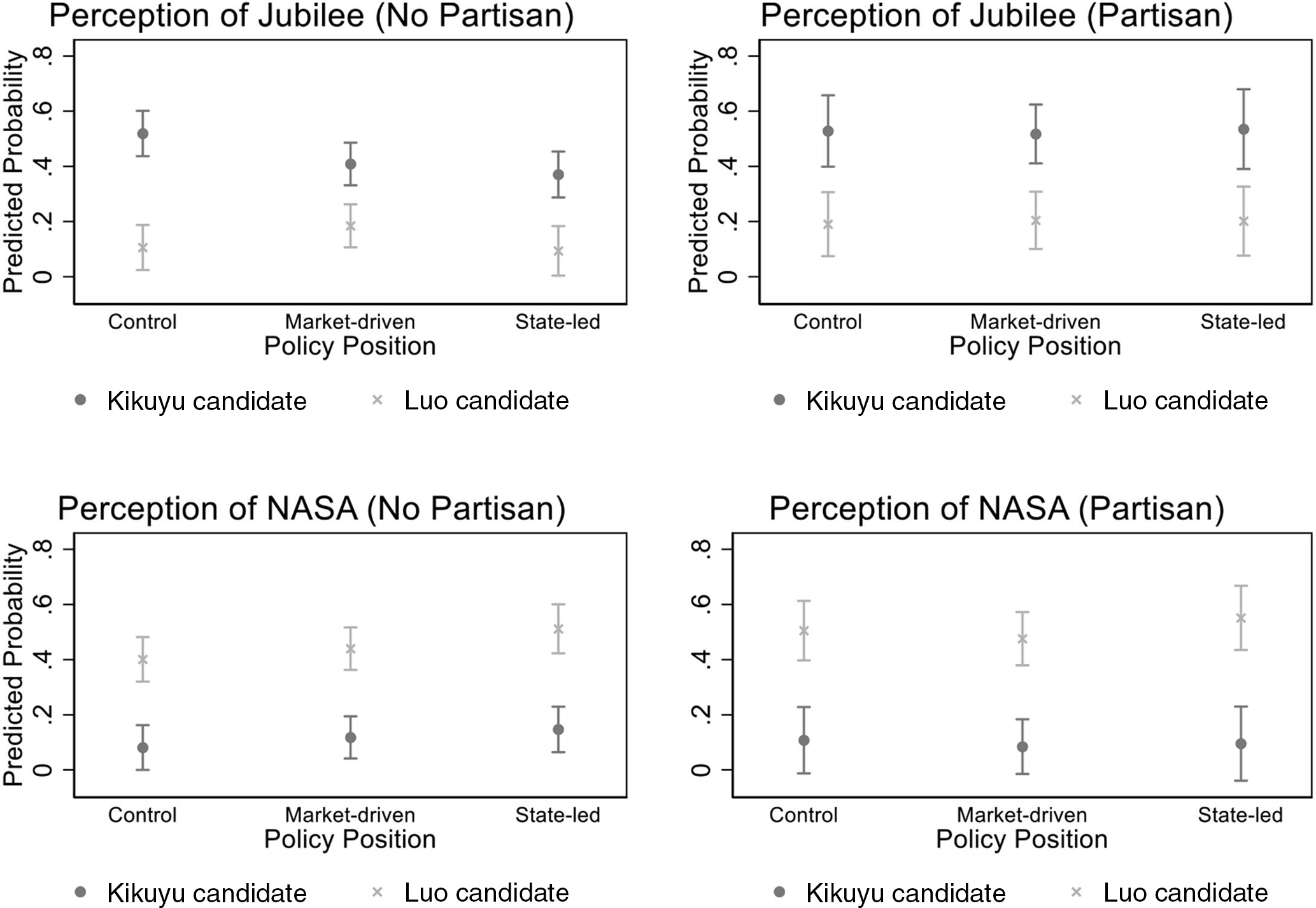
Voter Perception of Party Platform (by Partisanship).
Voter Perception of Party Platform (by Education Level).
Voter Perception of Party Platform (by Income Level).
As shown in Figure 2, partisan voters are no more likely to correctly identify parties’ policy position than are non-partisan voters in most scenarios; the one exception is that partisans are more likely to attribute the market-driven policy given by a Kikuyu candidate to Jubilee than are non-partisans (the difference is 12.4 percentage points, p < .1; Model (1) in Table A5 in the Supplemental Material shows the full regression result). Overall, partisan voters are not sufficiently sophisticated to identify a party’s policy position, indicating that partisanship may be driven by patronage-based attractions like ethnic ties rather than by issue positions. 7
Figure 3 tests whether voters’ sophistication, as measured by their education level, conditions how accurately they attribute parties’ positions. Models (1) and (2) in Table A6 in the Supplemental Material present the full regression results. There is little influence of education on the attribution of parties’ positional issues. Instead, voters with more education are more likely to mistakenly attribute a positional issue to the party with a different issue position. Highly educated voters are approximately 18 percentage points less likely, relative to voters with less education, to attribute a state-led development message to Jubilee when the message is delivered by a Kikuyu speaker (p < .05) and 14.6 percentage points less likely when it is delivered by a Luo speaker (p < .1). Contrary to the prediction, highly educated voters are 17 percentage points more likely to attribute Jubilee’s position on market-driven development to NASA when the speaker is Luo. On this, we speculate that Jubilee’s stance is, perhaps, so commonly adopted by Luo (and likely NASA) politicians at the lower levels of electoral competition across districts that sophisticated voters mistakenly attribute the message to NASA.
Figure 4 reports the estimation results based on income level as a measure of voter sophistication (see the full regression result in Models (3)–(4) in Table A6 in the Supplemental Material). The analysis reveals empirical support for the electoral significance of Jubilee’s policy position for richer voters’ understanding of party platforms. Compared to lower-income voters, higher-income voters are about 15.2 percentage points more likely to identify the Kikuyu candidate with Jubilee when the candidate delivers a market-driven message. As for attributing different policy positions to NASA, however, income level has little influence except when a valence message is delivered by a Luo candidate: higher-income voters are 16.7 percentage points less likely to attribute the valence message from a Luo candidate to NASA than are lower-income voters (p < .1).
Voter Behaviour
The study measures the effects of distinctive issue positions on voting using OLS regression models in which the dependent variable is a vote, meaning that 1 indicates the respondent would vote for the candidate and 0 indicates s/he would not. Model (1) of Table A7 in the Supplemental Material presents the full estimation result from which the predicted probabilities are obtained. Compared to a candidate delivering an ambiguous message, voters are approximately 6–12.5 percentage points more likely to support a candidate delivering either a pro-market or a redistributive policy message. This analysis provides strong support for the argument that clear position-taking improves a presidential candidate’s likelihood of receiving support.
The size of the increase in support following positioning-issue messages is larger for the Luo ethnicity cue. For example, when the Kikuyu cue is given, the market-driven and state-led policy cues increase the likelihood of supporting a candidate by 6.3 and 6.1 percentage points, respectively; neither increase is statistically significant. Conversely, when the Luo-ethnicity cue is given, respondents are 11 and 12 percentage points more likely to vote for the candidate with a market-driven and state-led policy, respectively, as opposed to supporting a candidate with a valence position; both findings are statistically significant (p < .05).
Models (3)–(6) in Table A7 of the Supplemental Material provide tests for the prediction of the effects of political sophistication and issue positions using (sophistication × policy) interaction terms while pooling across the ethnicity cues. As the Model (3) estimates show, among the respondents who reported feeling closer to a particular party, the candidate presenting a state-led policy message attracted more votes (by approximately 20 percentage points) than did the candidate presenting a valence speech (p < .01). Among the non-partisans, the candidate taking a pro-market position receives the most support: approximately 14 percentage points more support than the candidate giving an ambiguous message (p < .01) and 9 percentage points more than the one using a state-led policy (p < .1).
Further, Model (4) reports estimates of the policy-position effect conditional on either incumbent or oppositional partisanship. Whereas the market-driven growth policy does not appear to effectively mobilise Jubilee partisan voters’ support, the state-led redistributive policy increases the likelihood of Jubilee supporters voting for the candidate by roughly 24 percentage points (p < .05). This result seems to contradict the respondents’ report that they support Jubilee. However, considering the results from the voter perception experiment, that partisan voters do not distinguish between different party platforms, it may not be meaningful to interpret the result about the effect of policy position on partisan voters’ choice. Meanwhile, NASA supporters are less likely to support a candidate with a market-driven policy and more likely to support one using a state-led redistribution policy compared to those using a valence policy, but neither effect is statistically significant. Nevertheless, when those who support neither Jubilee nor NASA receive the market-driven growth policy message, the probability of voting for the candidate delivering the message increases by nearly 13 percentage points (p < .01), while they are no more likely to vote for a candidate using a state-led redistribution policy. Considering that close to 70 per cent of the respondents in our sample neither identify themselves as Jubilee nor as NASA partisans, these results show that Jubilee’s market-driven growth policy position is particularly effective in mobilising non-partisan supporters. Therefore, the results show that, while Jubilee’s market-driven growth policy effectively mobilises support among non-partisan unaligned voters, NASA’s state-led redistribution policy effectively persuades Jubilee’s – the opponent party’s – supporters.
As for the conditional effects of the level of education (see Model (5) in Table A7 in the Supplemental Material), a state-led economic policy increases the likelihood of receiving educated voters’ support by 23 percentage points (p < .01), while a pro-market policy shows no statistical significance in its effect on electoral support from respondents, regardless of education level. Surprisingly, the direction of the correlation between respondents’ political orientations and their education level runs counter to the expectation that the better educated will lean, ideologically, towards the right because of their middle-class position. These results are consistent with some recent studies in Western countries and some developing democracies that the better educated tend to be oriented towards the left because of their preferences for quality of life and social responsibility (Dalton, 2010). As for the conditional effects of income level (see Model (6) in Table A7 in the Supplemental Material), both positional messages increase the probability of higher-income earners supporting the candidate to almost the same degree (20–21 percentage point increases). Clear policy positions do not appear to change lower-income voters’ levels of support for the candidate.
Conclusion
This work is the first study, using experimental methods, to test the predictions of voters’ perceptions of parties taking policy positions and the electoral efficacy of such position-taking in an African setting. Although distinctive stances are not common in African electoral politics, when they occur, they do exert some influence on candidate choice, at least in cities. There are voters who understand partisan differences in issue positions, and policy cues are effective in appealing to voters with certain characteristics, thus providing parties with valuable leverage for targeting voters. These results suggest strategic incentives for vote-seeking parties to make their positions clear on nationally important issues, even in new democracies where votes may be based on patronage.
The first part of the analysis estimated models of voter perceptions of parties’ policy positions in Nairobi, Kenya, using four categories of voter traits (partisans, college-educated, higher-income, and all respondents). The results confirm what is generally expected: the more distance a policy stance maintains from mere valence, the more distinguishable it is (Lupu, 2013). For example, NASA’s left-leaning message helps average voters recognise that the party is not Jubilee. However, Jubilee’s centre-right position is not very discernible to general voters. The most obvious benefit is that a given political party receives more recognition than other parties for taking a certain stance, which helps it ensure viability and support from the electorate. This is especially helpful for opposition parties, because it enables voters to distinguish their competence and expertise from the incumbent’s capabilities. Meanwhile, incumbent parties adopt broad-appeal strategies close to the centre (though not at the centre) to maximise their votes.
If individuals with partisan attachment, more education, and higher income are, on average, more knowledgeable about party platforms, such voters should better recognise a candidate’s party affiliation. However, this work shows that partisan voters are not sufficiently sophisticated to discern the policy objectives of parties. This indicates that it is not voters’ ideological motives that shape partisanship in Africa. Further, contrary to prediction, college-educated voters are no better able to identify different policy positions than are those with no college education, whereas higher-income earners better identify different policy positions in specific circumstances, implying that income may determine political sophistication in this context.
The second part of the analysis shows that distinct policy goals have a positive effect on voting, while the campaign promises of both parties are almost equally popular among Nairobi voters. However, the campaign promises of each party appeal to different types of voters: Jubilee’s market-driven policy makes a broad appeal to non-partisan, unaligned voters, while NASA’s state-led redistribution policy persuades partisan voters. An important implication is that even where most electoral contenders appeal to voters on valence issues and a patronage-based strategy, party strategy regarding non-valence issue positions can still play a substantial role in political competition.
This study demonstrates how these promises affect voters in politically sophisticated groups (determined by partisanship, education, and income levels). The results illustrate significant differences in voter preferences between different demographic groups of voters. Non-partisans and higher-income voters are more likely to support a presidential candidate who promotes market-driven growth, while highly educated voters are more likely to vote for a candidate emphasising state-led development policies. Hence, the analysis indicates that parties can use non-valence policy promises to their advantage by stressing the issues that the parties’ targeted voters associate favourably with their own economic or ideological interests.
In retrospect, the Jubilee platform, which better reflected the median voter, was more effective in electoral competition, ultimately winning the election. While NASA’s left-leaning policy mainly affected partisan voters’ support, the Jubilee’s centre-right platform won over unaligned voters. The analysis, thus, suggests that moderating a policy position could be a source of incumbency advantage, which works to the electoral benefit of incumbents and to the detriment of others. Despite NASA’s defeat, however, the non-valence-based campaign strategies serve as a valuable tool to establish a new dimension of party identification and of competition to challenge the incumbent candidate and their party. While this is only an initial study, the approach can be applied in other big cities where political information on parties and policies is more readily available to voters and ethnicity is less likely to be a factor.
Supplemental Material
Online supplementary file 1 - Supplemental material for The Winning Party Platform: Voter Perceptions of Party Positions and Voting in Urban Africa
Supplemental material, Online supplementary file 1, for The Winning Party Platform: Voter Perceptions of Party Positions and Voting in Urban Africa by Eun Kyung Kim and Hye-Sung Kim in Africa Spectrum
Footnotes
Declaration of Conflicting Interests
The author(s) declared no potential conflicts of interest with respect to the research, authorship, and/or publication of this article.
Funding
The author(s) disclosed receipt of the following financial support for the research, authorship, and/or publication of this article: The research is supported by Hankuk University of Foreign Studies Research Fund and Winthrop University Research Council Grant (381809).

Supplemental Material
Supplemental material for this article is available online.
Notes
Author Biographies
Email:
Email: