



Abstract
Applications of Information and Communications Technology (ICT)-driven innovations are profound in the electoral cycle. Among them, biometric technology is currently sweeping across developing countries. It is, however, only poorly adopted among rural voters. Does the use of biometric technology in the conduct of elections reconstruct rural voters’ behaviour, amid prevailing social challenges? The links between these realities and their consequences are currently less understood, and lacking in supporting literature. I argue that the public perception of bio-metric technology, the availability of proper infrastructure, and the distance between polling stations and the dwellings of rural voters all affect the latter's level of adoption of biometric technology. These interactions combine to produce specific modalities that shape voting behaviour and general political culture. I elicit primary data from voters in Nigeria's remote villages, so as to predict the implications and consequences of glossing over the dimensions and magnitude of the biometric technology adaptation challenge by policymakers. I conclude by reflecting on how these interplays and interactions create “spatial differentials” in electoral outcomes/credibility, and proffer possible strategies for institutional intervention.
Introduction
African fledgling democracies have had persistent difficulties in conducting free, fair, credible, and transparent elections. Most are marred by gross irregularities, electoral fraud, violence, and inconclusive ballots (Ayoade 1998). This is why most African states fervently desire to key into modern technological systems in the conduct of elections, namely to strengthen the quality of the electoral process (Diamond 2008). Bio-metric identification systems are currently already in widespread use for voter registration in over 34 of the world's low- and middle-income countries. African states such as Ghana, Mali, Kenya, Cameroon, Sierra Leone, Mozambique, Zambia, Malawi, Rwanda, Senegal, and Mauritania have all enrolled – with varying degrees of success (Gelb and Clark 2013). Golden, Kramon, and Ofosu offer insights to show that
these technological solutions, such as electronic voting machines, polling station webcams, and biometric identification equipment offer the promise of rapid, accurate, and ostensibly tamper-proof innovations that are expected to reduce fraud in the processes of registration, voting, or vote count aggregation. (Golden, Kramon, and Ofosu 2014: 1)
On the same footing, Professor Attahiru Jega, former chairman of the Independent National Electoral Commission (INEC), who oversaw the introduction of biometric voting technology in Nigeria, affirms:
We have made rigging impossible for them (electoral fraudsters) as there is no way the total number of votes cast at the polling unit could exceed the number of accredited persons. Such discrepancy in figures will be immediately spotted. This technology made it impossible for any corrupt electoral officer to connive with any politician to pad-up results. The card reader machines will help us to address all those irregularities, starting from the accreditation of voters at all the polling units. The information stored in both the card readers and the result sheets taken to the ward levels would be retrieved once there is evidence of tampering […]. We believe that this is an added value to our process, it is something that we have not been able to do in the past. (Jega, cited in Nnochiri 2015)
This sheer confidence appears robust and seemingly genuine. Nonetheless, certain fundamental concerns persist and remain challenges. For instance, no attention is drawn to understanding the level of spatial differentiations in rural voters’ behaviour in specific localities during the conducting of elections. This makes it extremely difficult – almost impossible in fact – to feed policymakers with vital judgements concerning the specific localities where voters easily cope with the biometric voting systems and those where they do not. The central questions, then, that underpin and animate this study are: What are the social factors that impinge on the voting behaviour of dwellers in rural communities? How does the use of biometric technology interface with and resolve the adoption challenges of rural voters during the electoral process?
It is important to establish the extent to which such factors combine to redefine or reconstruct rural voters’ encounters with Information and Communications Technology (ICT)-driven biometrics, and consequently determine electoral outcomes. Whereas rural voters originally tend to exhibit a less instinctive drive for electoral participation, their apolitical dispositions are particularly informed by certain fundamental social realities – including negative perceptions and/or increasing apprehension about biometric technology systems, the non-availability of proper infrastructure, and the significant distance between polling stations and their dwellings. These circumstances shed some small light on rural voters’ electoral assertiveness, and their general behaviour during election time.
Most analysts associate the observed malfunctioning of voting smart card readers (SCRs) with technical and manufacturing faults (Election Monitor 2015), while others maintain that such an eventuality is a result of a combination of factors – such as the inability of some voters to read and write (Fujiwara 2015), the unpreparedness of the INEC and its ad hoc staff (National Democratic Institute 2015), and a generally low level of awareness (Dahiru, Abdulkadir, and Baba 2017). There is little agreement, then, among scholars on the causes of rural voters’ behaviour on election day. I add a third perspective here: negative perceptions and divergence in the symbolic attachments to white man-inspired biometric technology. In combination with debilitating social conditions, these together underpin and reinforce political apathy, low and half-hearted electoral participation, voter restraint, self-withdrawal, feelings of unwillingness, a sense of fear, and atypical threat notions among rural voters.
Mutual suspicion and fear, contextual discrimination, and feelings of political intrusion and endangerment over ethnic heritage affect the perception of rural voters when it comes to biometric technology. This is what largely constitutes the poor adaption of rural voters to biometric systems. Since local dwellers are characteristically bonded by strong socio-economic, cultural, and historical facts or myths (Onyima and Iwuoha 2015), for instance, these beliefs tends to define or recreate their specific and peculiar voting behaviours. The electoral views of rural voters are predominantly constructed along negative lines of thinking, and this leads to low voter turnout generally.
While policymakers and public analysts are yet trapped in the fulcrum of policy goals, such as expanding the benefits and reliability of biometric technology and ICT infrastructure generally, specific social dynamics – ones that have been less rigorously identified – continue to interact negatively with the purposes and goals of biometric technology and of other ICT systems drafted in for the better conducting of elections. This study will attempt to predict the implications and consequences of merely glossing over the dimensions and magnitude of these impending challenges. The findings chart a new frontier in knowledge production by defining the dynamics and specificities of these social complexities, and their potency to reshape and recast the nature of rural voters’ encounters with biometric technology. What is implicated in this reality check is a clear picture of the impact of these complex and changing interactions on electoral outcomes in general.
How Voters Perceive the Functionality of Biometric Voting Technology
There has been a remarkable increase in the deployment of ICTs in elections over the last two decades – a trend that is most clearly visible in Africa and Asia. ICTs in the form of digital technologies deployed by electoral commissions include those associated with electronic voter registration, voter verification, and results transmission (Cheeseman, Lynch, and Willis 2018). Technology can reinforce voters’ trust in the electoral process, with perceived reductions in electoral fraud (Gelb and Diofasi 2016). Following Ghana's 2012 voter-registration process, over three-quarters of registered Ghanaians agreed that doing it biometrically represented an improvement over the old system; some 87 per cent believed it to be a useful tool for promoting credible and peaceful elections (Piccolino 2015; Gelb and Diofasi 2016).
The Nigerian experience specifically remains one of daunting challenges, even some years after the introduction of biometric technology to the conducting of elections. McGrath and Maiye (2010a) assert that, despite a number of interventions promoting the innovation, these efforts have failed to institutionalise the electronic voter registration (EVR) system, which was poorly perceived after the elections amid reports of high levels of electoral malpractice. The 2015 elections in Nigeria, for instance, showed how voting technology failure occurred in the middle of an election, making it impossible for SCRs to consistently identify voters’ fingerprints. It was a terrible experience in the interior localities where voters have the lowest propensity for biometric technology adoption, and this prompted manual accreditation – and consequently over-voting.
Harold (1967) focuses on the impact of the cognitive and psychological dispositions of voters in making their choices. The argument is that voters’ electoral conduct is predominantly driven by their specific perceptions of or rigid attributions to voting systems and facilities. Harold's study provides only a vague understanding of whether perceptions of bio-metric technology engender voter apathy among rural voters. Many in the most remote areas have less confidence in themselves, and thus can not summon the courage to subject themselves to the process of voter-verification systems.
In Nigeria, for instance, voter turnout declined to merely 47 per cent in the 2015 general elections, when biometric technology was first introduced. This turnout is significantly less than that of preceding elections in the country. Registered voter turnout on aggregate since 1999 elections has been at an average of 55.13 per cent. The specific level of voter turnout in Nigerian general elections since the end of the last century is as follows: 1999 (52 per cent), 2003 (69 per cent), 2007 and 2011 (54 per cent).
Gelb and Diofasi (2016) posit that the track record of technological solutions is ultimately only mixed. Failures can be technological (inability to read fingerprints) or due to poor implementation and logistics (kits distributed without power or with no time for their charging). They may be unintended, or alternatively result from deliberate actions. It is also possible that biometric technology can perpetuate an atmosphere of suspicion and mistrust, by circumventing the human processes that have to work – and have to be seen to work. This is because the core components of the election are placed in a “black box” that voters cannot observe or evaluate objectively for fairness themselves (Evrensel 2010). Therefore, without an understanding of how the technology works, there is little or no basis for either increased trust among political parties or for greater legitimacy in the eyes of the electorate. There is no guarantee, then, that the use of technology will result in cleaner, less contested, and more democratic elections (Gelb and Diofasi 2016).
Social Factors Relevant in Elections Conducted with Biometric Voting Technology
The study of Evrensel (2010) represents a signpost for other relevant works echoing the issues weaved around the organisational and logistical challenges that the new biometric technology can generate. Evrensel contends that the use of high-level technology in voter-registration processes has raised the issue of moving fragile electronic equipment across treacherous terrain, sometimes resulting in the corruption or even complete loss of the very information that is being sought after. More problematic besides is that these days, especially in Nigeria, it has become difficult to register voters close to their homes. This is mainly because of the limited number of voters that biometric SCRs are programmed to accept in a given polling station. Many voters are therefore registered very far away from their place of residence, and this creates confusion among them when it comes to locating their proper polling station on election day.
Effah and Debrah (2018) focus on the importance of social factors for the success and effectiveness of biometric technology, explaining how and why Ghana's first attempts at using it for voter identification and verification in its 2012 general elections failed. The authors reveal that the effectiveness of biometric technology regarding the provision of reliable identification does not depend solely on its technical qualities, but also on real-time connectivity between registration centres and an electronic national register. Inadequate training of electoral officials on how to operate the machines and a lack of guidance on how to handle situations when breakdowns occur were also implicated as factors that contributed to the failure of the elections in Ghana in their findings.
In a related study, McGrath and Maiye (2010b) draw on Sen's (1999) capability approach (CA) to examine the social arrangements for registration and voting in Nigerian elections, and their influence on citizens’ freedom to participate in the valued activity of electing their leaders. They assessed citizens to benefit from the process in a way that expanded their freedom to choose, but found also that the arrangements made by INEC to enable registration and voting in elections did not ultimately reflect the actual desires or interests of the people themselves. Nigerian citizens do not currently possess the required freedom to exercise their agency in this manner. In other words citizens lacked a number of the basic socio-economic capabilities enabling freedom of political expression, with consequences for the sustainability of the EVR initiative.
Much of the research on developing countries therefore highlights a link between ICTs and development, studied from varying standpoints about the nature of this connection and also the ways in which desired benefits may be achieved (McGrath and Maiye 2010a). Similarly Cheese-man, Lynch, and Willis (2018) concur on the consolidating benefits of digital technology and its implications for African elections. They maintain that the use of biometric technology in elections enhances the polling environment, and makes the electoral commission more robust and efficient. This is achieved by generating greater clarity and transparency regarding election outcomes. However, the authors remain silent on the specific implications of biometric technology within rural environments. Whether the use of biometric technology in the conducting of elections in such geographical areas has enhanced electoral outcomes – especially by increasing voter participation – has therefore remained less understood. This links to Joel Barkan's (2013) argument that new technology in Africa often fails because insufficient attention is paid during the process of rolling it out to the broader management structures that it needs to even function.
Golden, Kramon, and Ofosu (2014) also conducted a study in Ghana during the 2012 national elections, when biometric identification machines were introduced into every polling station in the country as a way to reduce the very high levels of electoral fraud known in particular to affect voter registration. The authors randomly selected a large sample of electoral constituencies and polling stations in four of the ten Ghanaian regions, between them home to half of the country's population, and studied whether the presence of election observers systematically reduces machine malfunction. The main findings included a non-random pattern in machine breakdowns: they were much more likely to malfunction in electorally competitive areas and in polling stations without an election observer present. Two types of election fraud – overvoting and ballot stuffing – were identified and furthermore found to more commonly occur in polling stations affected by the breakdown of the biometric identification machines, especially when an election observer was not present. This means that individuals interfered with the operation of biometric identification machines, and also took advantage of machine breakdowns to commit electoral fraud.
Methodology
This study is based on research data collected during post-election, six-month-long field trips and subsequent return visits to rural communities spread across three of Nigeria's six geopolitical zones – namely, South East (SE), South South (SS), and North Central (NC) – between July 2015 and October 2017. The localities and federal states of the communities engaged in the study are as follows: Zaki-Biam, in Benue; Afikpo, in Ebonyi; and Ogwashi-Ukwu, in Delta. The population size of these towns, from largest to smallest, is as follows: Afikpo: 71,866; Ogwashi-Ukwu: 26,137; Zaki-Biam: 10,470 (World Population Review 2018).
Afikpo is a hilly area that sits at the southern part of Ebonyi State along with neighbouring towns such as Akpha, Unwana, Edda, and Amasiri. It is a transitional area between open grassland and tropical forest. Agriculture is the mainstay of the Afikpo economy, engaging over 75 per cent of locals – though some able-bodied youths in the community have taken to fishing and hunting instead. Afikpo has less than 18 per cent of learned graduates from Nigerian universities (mostly civil servants), who combine their jobs with farming activities – and 10 per cent of whom are trained artisans, shop owners, and cyclists/bike riders. The community market day takes place once every eight days, where farm produce like fresh fish, okra, groundnuts, pepper, and potatoes are sold. With many indigenes engaging in the farming profession, the people of Afikpo are known to contribute significantly to the production of rice and millet across the whole Igboland and Nigeria in general.
Ogwashi-Ukwu is located west of the state capital, Asaba, and is within the Aniocha Local Government Area (LGA). Ogwashi-Ukwu is predominantly an Igbo society, one that is rich in natural resources of different kinds. Generally, even though a sizeable number of people in Ogwashi-Ukwu are located in agricultural production and the farming business, the community maintains diverse sectors within their agrarian economy – ranging from agricultural extraction to call centres, vigilante groups, schoolteachers, trained artisans, commercial taxi drivers, cyclists/ bike riders, and retail businesses.
Zaki-Biam is a small town located in the Sankera axis of Benue State. The town offers a distinct scenic view of the landscapes dotted with thatched roof mud huts and spectacular tribal culture. The vegetation of the town is characterised by forests, which yield trees for timber and provide a suitable habitat for rare animal types and species. The indigenes of Zaki-Biam are predominantly farmers, while a lesser number of people engage in fishing and hunting instead. Zaki-Biam has a very small percentage of learned graduates and trained artisans, teachers, shop owners, cyclists/bike riders, and the like. The people are heavily involved in the production of yam. This makes Zaki-Biam West Africa's largest yam market, and the single-biggest Nigerian market open only to buyers and sellers of yam. The town is said to make an average yearly sale of 1.5 million tubers.
I employed a purposive sampling technique to ensure that the states and communities selected are not the most rich and well-educated ones in Nigeria especially. This is to ensure a fair and true view of the analysis, which is focused on less privileged local communities. The research methods used to gather data were qualitative ones, and based on in-depth formal and semiformal interviews with eligible voters in rural communities. Focus-group discussion was also among the systematic qualitative techniques employed. The qualitative descriptive method of analysis was adopted, so as to make thick descriptions of all observed phenomenon. Three key informant interviews involving elders and community leaders (two males and a female) were conducted across the three selected local communities (i.e. one informant for each community). Meanwhile 42 in-depth interviews (i.e. 14 persons for each community) were conducted across the three communities, involving 18 males and 24 females respectively. The researcher's choice of in-depth interviews was possible only among those eligible voters not occupying elective or appointive positions, so that they could freely divulge relevant information. Women have received adequate coverage in the study. The adoption of the interview method was particularly necessitated by the individuals concerned being less educated, and thus barely able to interpret questionnaires effectively.
Respondents were randomly selected and intersubjectively interviewed. In-depth interviews consisted of open-ended questions. Interviewees worked in diverse sectors within their agrarian economy, ranging from agricultural extraction to call centres, vigilante groups, schoolteachers, trained artisans, commercial taxi drivers, cyclists/bike riders, and retail businesses. The interviewees mostly belonged to the uneducated and semi-educated middle class, with only shallow knowledge about the government and its activities. Key informant interviews involved mainly people considered to be knowledgeable or aware of happenings (18 years old and over) within the community, and who understand how its affairs are managed – such as community heads/leaders among others.
In addition to the recorded interviews, informal conversations and discussions took place throughout the fieldwork with a diverse group of informants; this fundamentally enlightened and influenced the research. This article is, therefore, an account of the perspectives and political behaviours or reactions of local community voters who encountered biometric technology during Nigerian elections. This is complemented with the researcher's own observations and analytic perspectives on the political dimension, and on the interplay of the social factors that shape the political attitudes of these rural voters’ towards biometric technology. Therefore the study explores the patterns of voting responses in local communities after the introduction of biometric technology, and what impact it had on electoral credibility and general outcomes.
I lived with the communities and immersed myself in their daily activities for some weeks within the period of study, which endured beyond the elections. At the end of the fieldwork, I maintained contact with the key informants through phone calls. I adhered to basic human-research ethics, such as seeking informed consent through written and oral channels and ensuring the maintenance of anonymity.
Preparing the Biometric Technology for Election Day
Biometric technology came with a number of related reforms in Nigeria. This was managed by the leadership of the INEC, led by Professor At-tairu Jega. The reforms include: biometric voter registration, the introduction of the Advanced Fingerprints Identification System, the customisation of sensitive electoral materials such as ballot papers and result sheets, the colour coding of the ballot papers so as to render them useless in other constituencies if pilfered or snatched away, the issuance of chip-embedded and machine-readable Permanent Voter Cards (PVCs), as well as the rolling out of the earlier mentioned SCRs. The introduction of these devices was necessitated by the fact that reliable voter registration and identification mechanisms are among the preconditions for free, fair, and credible elections. Biometric machines authenticate the identity of voters using markers, such as fingerprints, that are almost impossible to counterfeit. The technologies are particularly useful in settings where governments have not previously established reliable or completely paper-based identification systems for their populations (Gelb and Decker 2012).
The use of SCR machines, being the pivot of the biometric voting system, functioned as an anti-rigging technological device for the authentication of voter's cards in the 2015 Nigeria general elections (Beetseh and Akpoo 2015). The card reader uses a highly secure and cryptographic technology that is commonly found in devices that need to perform secure transactions, such as pay terminals (Feng, Ng, and Schwiderski-Grosche 2006). It has ultra-low power consumption, with a single core frequency of 1.2 GHz and an Android 4.2.2 operating system (INEC 2015a).
Moreover the INEC produced PVCs for the 68,833,476 persons enrolled in the biometric Register of Voters ahead of the 28 March and 11 April 2015 general elections. The PVC replaced the Temporary Voter Card (TVC) issued during the 2011 voter-registration process. These cards have many components and specialised features (e.g. base substrate, security printing, personalisation, lamination, and chip embedding), and are designed with an average life span of 10 years. The PVC has an embedded chip that contains the biometrics of a legitimate holder (including their fingerprints and facial image). On election day, it would be swiped with a SCR at the polling unit to ensure the authentication and verification of the voter before he/she is allowed to participate. The PVC has security features that are not readily susceptible to counterfeiting (INEC 2015a). The SCR keeps a tally of all cards read, comprising the details of all voters verified as well as those not – and transmits the collected information to a central INEC server via a GSM data service (The Guardian 2015; The Will 2015).
Importantly, the production and distribution of PVCs remained a concern of voters, politicians, and political parties from across the political spectrum in Nigeria alike (Dung 2015). Detailed descriptions of the awarded contracts for the voting technology in Nigeria is contained in Table 1.
Award of Contract for the Supply of Software Development and Support for PVC Radio Frequency Identification (RFID) Readers
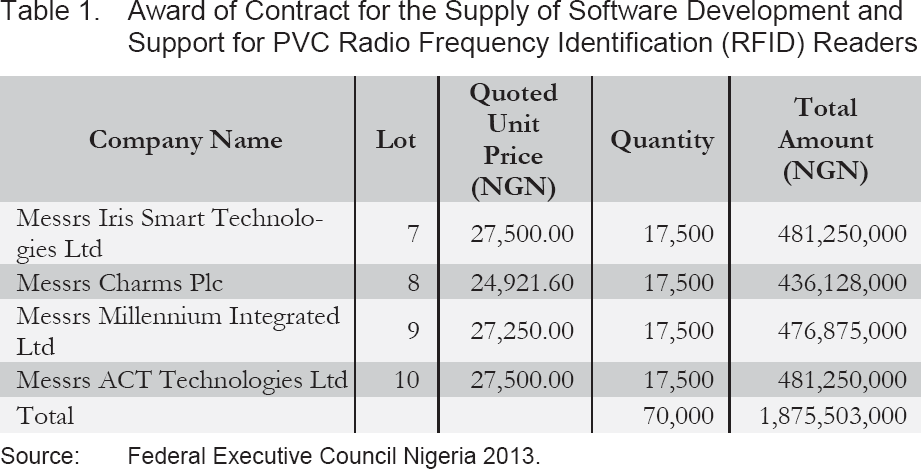
Source: Federal Executive Council Nigeria 2013.
The chairman of the INEC, Professor Attahiru Jega, confirmed that the card reader units have been broadly subjected to quality assurance, integrity, and functionality testing, both locally and in Texas, United States, laboratories by the RFID Research Centre too. They were found to be of the highest quality grade and extremely reliable in terms of ease of use, battery life, and speed of processing (Jega 2015: 2).
The INEC thus had confidence in the card readers, and so procured 152,000 of them along with adequate overstock too – meaning an additional 26,000 units as spares as well as 35,000 surplus batteries. All of these together translated to one spare battery for every five polling units and one spare card reader for every seven. This was a reasonable backup plan. INEC staff were also trained and retrained (INEC 2015d). On Saturday 7 March 2015, the INEC conducted a test-run/public demonstration to ascertain the reliability of the SCRs in 225 out of the total 120,000 polling units and in 358 out of the 155,000 voting centres across 12 Registration Areas (RAs) (i.e. wards) in 12 states of the Federation (i.e. two states for each geopolitical zone). Affected RAs are situated in the following LGAs: Port Harcourt City (Rivers), Abakaliki (Ebonyi), Ado Ekiti (Ekiti), Gassol (Taraba), Kumbotso (Kano), Bunza (Kebbi), Kokona (Nasarawa), Shiroro (Niger), Ikeja (Lagos), Aguata (Anambra), Oshimili South (Delta), and Jama'are (Bauchi) (INEC 2015b).
Overall only 59 per cent of voters who turned out for the test-run of the SCRs (i.e. the public demonstration) had their fingerprints successfully authenticated. This meant a failure rate of 41 per cent (Idowu, cited in INEC 2015b). The Commission, in agreement with registered political parties, therefore provided that where the biometric authentication of a legitimate holder of a genuine PVC became a challenge then the person could be authenticated manually. Along with this, the completion of an Incident Form also took place – both steps to still allow the person to vote (INEC 2015b). This simply means resorting to manual accreditation and voting, which grossly violated the INEC's “Approved Guidelines and Regulations for the Conduct of 2015 General Elections.” Relevant sections of the INEC's “Accreditation And Voting Procedure” that were violated include the following ones:
Accreditation:
8(a) There shall be separate periods for accreditation and voting.
8(b) The accreditation process shall comprise of verification of voters using the Card Reader; Checking of the Register of Voters; and inking of the cuticle of the specified finger. (INEC 2015c)
The guidelines did not make any such provisions in any event for manual accreditation and voting, but the Commission nevertheless went ahead and reverted to processing voters by hand in such cases – thus undermining the essence of biometric technology's introduction and use in the first place.
Rural Voters and Elections: Perceptions, Social Issues, and the Adaptability Challenge
Perceptions of Biometric Technology among Rural Voters
Specific dimensions of rural voters’ perceptions of biometric technology would limit their adaptability to and general acceptance of it. Key informants as well other rural voters from the three local communities investigated laid bare their views during informal interactions occurring in the course of the study. They provided vivid accounts of their roles and levels of political participation in the 2015 general elections in Nigeria, wherein biometric technology was used for voter identification and verification.
A general dimension to the perceptions of the majority of the respondents (85 per cent) during their encounter with biometric technology was that of a feeling that there was a state conspiracy going on, one in which the power elites had adopted coercive and devious means to rig elections for their own selfish interests. 1 The rural voters shared a common historical apprehension of political gladiators being out to achieve inflated demographic statistics under the pretext of holding an election. This aligns with Kaufman's (2006) symbolic-analytical model, which stresses that the critical causes of ethnic grievances are group myths and fears of collective extinction. These hostile superstitions produce emotion-laden symbols that affect the ability of rural dwellers to adapt to or accept new technology. Biometric technology was therefore seen by these locals 2 as part of a secret plot to manipulate and truncate their population numbers to their disfavour, in the same way that political cabals had manipulated census figures in Nigeria ever since 1963. These voters preferred a head count, something that they are traditionally accustomed to, in place of such tiny “magic” (voting) machines. 3 One middle-aged man presented this account:
Personal interviews as well as accounts of group discussions that I had with respondents across Afikpo, Ogwashi-Ukwu, and Zaki-Biam on 22 April 2015.
Personal interview with a group of 11 rural voters in Afikpo community on 25 October 2015.
Personal interview with a group of 11 rural voters in Afikpo community on 25 October 2015.
They [the government] simply don't want us to participate fully in the voting. That is why they brought those machines [SCRs] to deceive everybody. Do you know that those machines had already been configured for rigging the elections? I hope you are aware that the machines did not functioning properly? The thing failed to work when President Jonathan wanted to vote. Forget all these pranks they are playing. In fact, there is no need for even asking us to come out and vote. They had already finished rigging and compiling the votes even before the elections. 4
Personal interview with a 45-year-old petty trader in Afikpo community on 25 October 2015.
The voters in Ogwashi-Ukwu meanwhile were not particularly afraid of the truncation of their population; however, they did insist that biometric technology is a modern strategy and sophisticated modality for committing electoral fraud by political gladiators. 5 One middle-aged farmer claimed that his friend working in the INEC told him in confidence that biometric technology could be manipulated, and thus was not a guaranteed safeguard against electoral malpractice. He added that he himself believed that powerful politicians formatted the technology so that immediately after voting they could automatically reset the machines and input new figures favourable for the ruling party. 6 Therefore, without an understanding of how the technology actually works, 7 there is little or no basis for increased trust among political parties or for greater legitimacy among the electorate (Evrensel 2010) – especially the rural voters in Nigeria's remotest villages here.
Personal interview with a group of nine rural voters in Ogwashi-Ukwu community, led by a 58-year-old farmer on 16 October 2015.
Personal interview with a 41-year-old farmer in Ogwasi-Ukwu on 8 February 2016.
Personal interviews as well as accounts of group discussions with respondents across Afikpo, Ogwashi-Ukwu, and Zaki-Biam on 10 October 2015.
A number of respondents in Zaki-Biam 8 stated that even though technological advancement was in principle good, Nigeria was not yet ripe for it; the country's politicians nevertheless still imported this technology. This was for two reasons: to make money from the awarding of contracts and to coattail on the inadequacies and operate under the disguise of the problems associated with biometric technology, so as to successfully rig elections. Such technology was therefore seen as a desperate move by the ruling class to retain power by all means – “a do or die affair.” These voters recounted their experiences with biometric technology, and how it malfunctioned more than once during the elections. These accounts align with Cheeseman, Lynch, and Willis's (2018) view that ICTs do not make it possible to simply rapidly “leapfrog” to cleaner and more credible elections.
Personal interviews in Zaki-Biam, in the company of six rural voters, with a key informant, a 38-year-old politician, on 24 April 2016.
In many instances, these individuals vowed to sabotage this evil scheme. Many rural voters 9 devised a ploy: namely to press their thumbs against the SCRs as many times as possible, so as to ensure the “magic” machines captured their fingerprints multiple times. This was perceived as a strong tactic and sensible stratagem to counter the tricks of political gladiators, and also to ensure higher population numbers for their communities. This bad voting habit largely accounted for the reason why about 94 per cent of SCRs could not consistently verify fingerprints (see the European Union Election Observation Mission 2015). Attempts at electoral fraud in local communities contributed heavily, despite the use of biometric technology, to random machine breakdowns. In contrast to the scenario in Ghana's 2012 elections where non-random machine breakdowns were attributed to the lack of an election observer present (Golden, Kramon, and Ofosu 2014), in Nigeria's 2015 ones random machine breakdowns occurred even despite some election observers being on-site. It was this key challenge that mainly led to manual voter identification and accreditation. In more than 13 per cent of polling units, SCRs were not always able to read PVCs.
Many respondents across Afikpo, Ogwashi-Ukwu, and Zaki-Biam (68 per cent) confessed in personal interviews that they had tried voting multiple times during the elections (16 October 2015, 25 October 2015, 24 April 2016).
Particularly illustrative was the feeling of some voters 10 that their biometric data – namely photos and fingerprints – being captured and collected by SCRs would expose them to demonic manipulation, and could be used for occult practices by their enemies. This fear depicts rural voters’ symbolic attachments and perceptions being in line with certain core beliefs constituting their traditional worldview – that an enemy could use one's picture to invoke spirits from the spirit world for harm or for other fetish rituals. This practice still remains prevalent and littered among the daily observances of those local villagers who believe in fetish worship. It is therefore very difficult to eradicate such superstitions from the psyche of this group of voters, and to make a clean impression on them generally that biometric technology is truly genuine and not intended to inflict spiritual harm. This is linked to voter behaviour among those people who shrunk from active engagement in the electoral process due to such wrongly held perceptions and evident social limitations.
Personal interviews with a 68-year-old elder, a 42-year-old man, a 48-year-old female, a 37-year-old female, and with a middle-aged teacher from Afikpo community on 14 February 2016.
Social Factors Affecting Biometric Technology Adoption
Rural dwellers generally face larger social infrastructural deficits than their counterparts in urban cities (Iwuoha 2013). Core issues of concern for rural voters include the non-availability of proper infrastructure and a prohibitive geographical distance between polling stations and their dwellings. 11 The lack, for example, of an effective electricity supply impinged on the functioning of the biometric technology and other ICT components deployed during the Nigerian 2015 elections. On the part of rural voters, this poor electricity supply largely limited their exposure to voter education. Informational programmes are mainly transmitted via digital media channels such as television, in order to allow the audiovisual displays that make more effective voters’ education and their adaption to new voting methods.
Personal interviews with key informants: (i) a 43-year-old youth leader in Afi-kpo; (ii) a 51-year-old chief in Ogwashi-Ukwu; and, (iii) a 38-year-old female politician in Zaki-Biam on 14 February 2016.
However most of the voters in rural areas narrated their frustrations over the non-availability of electrical power, which denied them the opportunity to benefit from the chains of voter education and enlightenment programmes rolled out via digital media during the electoral cycle. Most rural voters 12 frowned on the fact that they were totally neglected and virtually isolated from sharing in the pool of electoral information disseminated by the INEC through ICT channels during this period. They strongly believed that this treatment impeded their level of adaptation to the new voting methods. Voters in Afikpo community 13 revealed that there had been virtually no electrical power supply in their community for several months now. Hence they were cut off entirely from connecting to the external environment during the election period, and so were less informed about the modalities and guidelines for proper electoral conduct and behaviour. In Ogwashi-Ukwu, voters 14 complained that often times they experience low electric-power voltages (i.e. low shading), while in Zaki-Biam the supply remained only erratic and highly unstable without any form of remediation offered. 15 These arrays of challenges limited the exposure and opportunities of rural voters to sharing in and benefiting from the pool of available electoral information. An informant in Zaki-Biam reported that:
All the respondents (100 per cent) across Afikpo, Ogwashi-Ukwu, and Zaki-Biam had problems with their electricity supply.
About nine interviewees in Afikpo confirmed that the community currently had no electrical power as a result of a damaged transformer (14 February 2016).
Personal interview with a group of nine rural voters in Ogwashi-Ukwu community, led by a 58-year-old farmer on 16 October 2015.
Personal interviews with two civil servants in Zaki-Biam who work in UkumLGA; conducted in the company of three youths who do menial jobs in the community (20 October 2017).
This is a small town and nothing seems to be working fine here like in the city, where things are somehow better. The electricity people have forgotten us totally. Could you imagine that we hardly see NEPA [electrical power supply] in this community? Even so, whenever they manage to bring the light after many days, it doesn't last. This is a big problem to all of us in this community, I must tell you. Do you know that I did not know what was happening concerning the election until it was over? There was no electricity power supply to even watch television or listen to news and know what INEC was doing. My brother, it is terrible. 16
Personal interview with a 41-year-old trader in the local market on 12 August 2016.
That is why most of the interviewees had no prior knowledge that bio-metric verification machines would be deployed on election day, even though they had been encouraged – indeed almost forced, or at least heavily financially incentivised by urban-based politicians – to participate in biometric voter registration. 17
Usually these politicians are largely disconnected from their own constituencies, but are also directly connected to them by, for example, sharing large “Ghana Must Go” bags of money with the chiefs and community leaders who control the voting attitudes of their own subjects, kinsmen, and blood relatives. It ap pears that in rural communities voting is more a thing of “cash and carry,” “one cap fits all,” or of a “bandwagon effect” than in urban environments – whose voters have more educational opportunities, and therefore decisional and assertive independence over their electoral choices.
Lack of access to Internet services and connectivity in Nigeria's rural communities remains a debilitating issue. Kuboye, Alese, and Imasuen (2012) establish that Internet service providers do not consider such areas economically viable and therefore no attention is given to them. This contrasts with the level of access to Internet connectivity in urban centres. Nigeria's number of active Internet connections, especially found in urban areas, stands at over 90 million, representing 47.44 per cent penetration. As such over 200 communities, between them home to about 40 million Nigerians, have been discovered to still lack access to basic Internet and ICT facilities in the country (Danbatta 2017). Political campaigners generally cash in on this information gap to perpetuate all sorts of threats and “fake news” among rural voters. The spread of disinformation, targeted at undermining opposition parties, has in some cases been accompanied with news of impending dangers – instilling fear and terror among vulnerable voters. In this context, social media platforms (especially Facebook, WhatsApp, and Twitter) served as offshoots of this cycle of electoral disinformation. As most rural voters did not have access to necessary Internet facilities, their opportunities to receive reliable and accurate news from relevant stakeholders responsible for educating voters on the electoral process was severely constrained.
Implications of Long Distances between Polling Stations and Dwellings for Rural Voters’ Electoral Participation
Significant distances between polling stations and voters’ dwellings pose serious challenges in rural communities. This is as a result of the staggered nature of the polling centres’ indiscriminate distribution across the communities. Particularly, the introduction of biometric technology by the INEC compounded the problems of the geographic inaccessibility of polling stations for voters in rural communities.
First, to contend with the limited capabilities of the SCRs in terms of managing large volumes of voter data, the INEC reconfigured the structure of polling stations by introducing the concept of “Voting Points” (VPs). Herein polling stations with large numbers of voters are split into two or more VPs such that each has an average of 500 registered voters (Jega 2014). This did not, however, do away with the problem of overcrowded polling stations – arising from the exponential growth in Nigeria's population that has come with accompanying severe demographic shifts, and that has resulted in new settlements emerging in rural communities without any polling units in them or even within reasonable distance. For example, the present structure of polling stations in Nigeria – which has 120,000 of them across 8,809 wards (RAs) was created in 1996, when the population size was an estimated 110 million people. This structure remained in place for the 1999, 2003, 2007, 2011, and 2015 18 general elections, that despite the country's present population size being estimated at 175 million people – representing a nearly 60 per cent rise on the 1996 figure.
In 2015, the INEC introduced the VPs.
Second, to guarantee the optimum functionality of the biometric technology, the INEC relocated the polling units from “infront of” private houses and other such “unsuitable places,” to inside classrooms, public buildings, or to public open spaces – as well as other such fitting enclosures where tents could be provided (Jega 2014). This restructuring further deepened the issues of the distance and accessibility of polling units for rural voters. Therefore ICTs negatively changed the situational and environmental context of balloting, with the dire consequence of a lack of ease of access to the polling station for many rural communities in Nigeria.
Most rural voters complained 19 of long distances between their abodes and the polling units, which demoralised them and deterred them from participating fully in all facets and segments of the elections. Some voters expressed the utmost disappointment that their poor electoral participation should be blamed on the INEC leadership for not carrying out a proper delineation. 20 An informant 21 in Afikpo community narrated how the issue of significant distance between polling units and voters’ dwellings was complicated by a lack of access roads and poor transportation networks. Election day in Nigeria always comes with a restriction of movement. Hence, no taxis or Okada (motorbikes) were found to transport certain elderly men and women to their respective polling units in the most remote rural locations. This debarred many rural voters, especially the women and elderly ones who could not trek long distances, from taking part in the electoral exercise.
Many respondents across Afikpo, Ogwashi-Ukwu, and Zaki-Biam (88 per cent) complained in personal interviews that they experienced difficulties trekking to their polling units (25 October 2015, 9 February 2016, 24 April 2016).
Personal interviews with a 68-year-old elder, a 42-year-old man, a 48-year-old female, a 37-year-old female, and a middle-aged taxi driver from Afikpo com munity on 14 February 2016.
Personal interview with a 43-year-old youth leader in Afikpo community on 18 July 2017.
The narrative presented by some voters in Ogwashi-Ukwu community was particularly touching. 22 They disclosed that a particular political party (name withheld) distributed monetary amounts ranging from NGN 3,000 to 5,000 on the voting premises, despite the presence of one or two security officials. It was therefore the news of this development that motivated some voters to rush by all available means to their polling centres to benefit from this “unethical largesse.” However, it was further revealed that during the 2015 elections a good number of those who were unable to take on the difficulty and stress of trekking to their faraway polling centres, amid inaccessible roads and flooding, auctioned their voters’ cards to some party agents for a flat rate of NGN 5,000 each. These party agents capitalised on the INEC's resorting to manual accreditation/voting, following the widespread malfunctioning of the biometric SCRs, by assembling mercenaries from neighbouring villages to cast these votes by proxy using “strange” voters’ cards. These shady dealings clearly underpinned the practice of vote buying – an unethical voting behaviour that has become prevalent in local communities as a result of the poor social conditions of dwellers there.
Personal interview with a group of nine rural voters in Ogwashi-Ukwu community, led by a 58-year-old farmer on 16 October 2015.
Therefore, the use of ICTs in the conducting of elections in rural communities actually contributed to the disenfranchisement of rural voters and weakened the integrity of the electoral process. Over 2.3 million of those accredited (7.3 per cent) did not ultimately even cast their ballot (see the European Union Election Observation Mission 2015). Voter turnout declined to a mere 47 per cent in the 2015 general elections, the time when this technology was first introduced. The factors described here suggest that rural voters disproportionately make up these statistics.
Conclusion
This analysis relates biometric technology innovation to public perceptions and powerful social factors, in the context of changing interactions. The majority of voters in elections are found in local communities (Fuji-wara 2015), and their predominant electoral beliefs lead to low or high voter turnout generally. If they are characteristically bonded by strong socio-political facts or myths, for instance, it tends to define or recreate their specific and peculiar voting behaviours/beliefs at all times. These beliefs are usually oriented or patterned along negative and hostile lines. Rural voters seem not to be attuned to the new-found biometric technology in Africa, owing to their own specific traditional perceptions and social challenges.
Thus, in line with McGrath and Maiye's (2010a) analytical position, biometric technology impinged on the constitutive freedom of rural voters. The interface between rural voters and biometric technology presented shades of incompatible values. Rural voters’ behaviours and inclinations for distrust towards biometric technology spurred infractions and disorderliness that undermined the entire electoral process, as it lost most of its essence and credibility. The effect hereof is that rural voters are largely unable to adapt, modify, or align their voting behavioural patterns with the modern innovations and methods employed in the electoral process.
This study has revealed that rural voters in Nigeria's remotest communities generally face social deficits such as the non-availability of proper infrastructure and long distances between polling stations and their dwellings. Generally, the lack of effective electrical power supply and Internet services impinged on the functioning of the biometric technology and other ICT components deployed during the elections; on the part of rural voters, meanwhile, it largely limited their exposure to the digital media channels such as television through which voter education is promoted. Thus there was a tangible lack of vital voting information, poor voter education, and little adaption to new voting methods among the rural population.
The consequences of these realities are manifold. They lead to rural voters’ loss of trust in the INEC, low voter turnout in elections, appalling political behaviours, and declining political participation generally. The best strategy to tackle this problem is building strong measures so as to counter and confront the discussed myths, perceptions, and general belief systems of rural voters, which limit their ability to build lasting confidence in and adapt effectively to biometric technology.
Some possible further measures include factoring social infrastruc-tural development programmes for rural communities into the budget estimates of the INEC in the year prior to the conducting of elections. The INEC should also initiate and build collaborative partnerships with local activists, and ensure that the local security set-up is incorporated into the strategy for policing local areas during elections. In addition, there should be concrete strategies for monitoring social media information/postings during elections to ensure that only genuine and not fake news is disseminated to the public during electioneering campaigns and the voting process. More importantly the INEC could improve the credibility of elections in rural communities by conducting extensive voter education programmes, to build trust and confidence among the rural population on the usefulness of ICT infrastructures for the conducting of elections in Nigeria.