




Abstract
Which party uses violence to influence election outcomes? There are two existing perspectives that have offered responses to this critical question. One is a more popular position indicating that the incumbent party, more than the opposition party, makes use of violence with the aim of rigging elections; the other is a more radical perspective that suggests that electoral violence is more associated with the weakest party than with the incumbent. This paper seeks to contribute to the ongoing debate and to advance the argument suggesting the dominance of the incumbent in the use of violence to rig elections. With evidence sourced from well-trusted reports from independent election monitors, this paper shows with case studies from Nigeria at different electoral periods that, in terms of influencing election outcomes, the incumbent has been more associated with violence during elections than the opposition. It is further argued in the paper that the existing nature of executive power in Nigeria provides a plausible explanation for the incumbent's violence during elections.
The resurgence of democracy in Africa, which began in the 1990s, has been followed by a great number of election-related conflicts and much violence. The African Electoral Violence Database (AEVD) created by Scott Straus and Charlie Taylor shows that approximately 60 per cent of elections held in Africa between 1990 and 2008 exhibited various forms and levels of violence. Given this, the researchers reasonably argued that there is certainly an indication that “this form of political violence is likely to persist – at least in the short term” in many contemporary African states (Straus 2012: 15). Similarly, it has been argued in other scholarly circles that elections have become another major contributing factor to the outbreak of civil wars in modern Africa (Bekoe 2010, Lamin 2011). This has made African states natural case studies for research on electoral violence – its nature, forms, causes and consequences. It is against this backdrop that in 2008 Paul Collier and Pedro Vicente conducted experimental research on electoral violence in the Nigerian 2007 presidential elections whose results seemed to advance a theory that violence is “systematically associated with the weakest party”, employed as an effective means to influence votes in their favour during elections. Hence, they argue that “voter intimidation may be a strategy of the weak analogous to terrorism” (Collier and Vicente 2008: 1).
Until the appearance in the literature of Collier and Vicente's study, the general belief was that committing violence around election periods was a characteristic strategy of incumbents to fraudulently perpetuate their parties’ hold on power (Chaturvedi 2005; Mehler 2007). Therefore, Collier and Vicente's major postulation (the link between the weakest party and electoral violence) has become a source of debate on election-related research forums. For example, at the joint European Commission and United Nations Development Programme workshop called “Elections, Violence and Conflict Prevention” held in Barcelona in June 2011, this theoretical position generated an intense debate among the participants. Many vehemently rejected the idea of associating the weakest party with employing electoral violence as way to rig votes. They instead suggested that the incumbent usually possesses a greater capacity, in terms of resources and motivation, to use violence during the electoral process.
This study is motivated by the above debate regarding who actually perpetrates violence as a means to rig elections. Given that Collier and Vicente's argument is based on findings from the 2007 Nigerian general elections, this study examines the same period of elections with the aim of subjecting their analysis to interrogation. To achieve this, the study adopts a different methodology by systematically analysing reports from very reliable independent election observers who monitored these elections. Following this, the true picture of the incidence of violence during the elections is systematically presented. In addition, the study provides, in qualitative terms, another example of intense violence during a more recent gubernatorial election in Nigeria – the Ekiti rerun election in 2009 – and, based on findings from available reports by trusted election observation teams, describes how violence was instrumentalised by the incumbent party.
Data for this study were drawn from reports of a collection of well-trusted independent election observation teams that monitored the elections under investigation: the European Union Election Observation Mission (EU EOM), the United States National Democratic Institute (NDI), the Institute for Democracy in Africa (IDASA) and the Transition Monitoring Group (TMG). The EU EOM, NDI and IDASA are notable international agencies that have established a good reputation for monitoring elections and that have shown a commitment to the entrenchment of democracy in many states of the world. 1 The TMG is a local non-governmental organisation dedicated to the principles of transparency, accountability and social justice in Nigeria. It is in this spirit that it has participated in election observation in Nigeria, with a heightened level of engagement after the country's return to democracy in 1999. Information was also sourced from other reputable international organisations, primarily Human Rights Watch (HRW), Amnesty International and the International Crisis Group (ICG), who monitored the electoral process in a way consistent with their commitment to civil liberty, democracy and peace.
Polling Results for the 2007 Presidential Elections in Nigeria
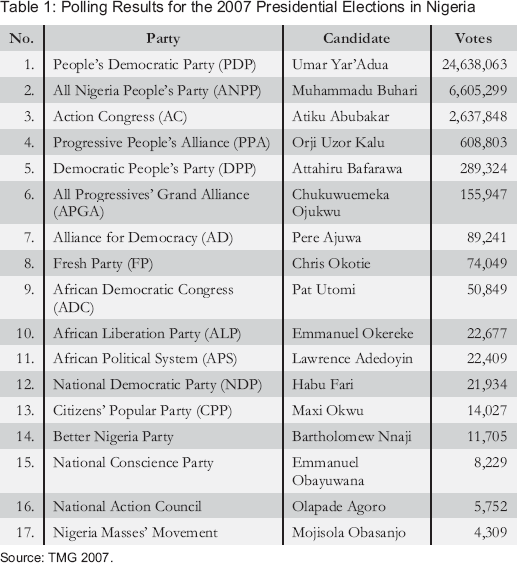
Source: TMG 2007.
It should be noted that IDASA, a South African international non-governmental agency, focused on issues of democracy in Africa before its sudden closure in March 2013 (for financial reasons).
At this point, it should be noted that reports from election-monitoring teams have increasingly come under criticism (for instance, Geisler 1993; Carothers 1997; Dorman 2005; Obi 2008; Kelley 2010). Given discrepancies between their reports on observed elections, it has been argued that the “neutrality” of election-monitoring is indeed a “myth” (Kelley 2010: 168). The argument is mainly informed by the fact that election observation is largely dependent on the extent of autonomy of the monitoring organisation. As argued by Judith Kelley, monitoring agencies “may tread more carefully when dealing with states that are important to their donors” (Kelley 2010: 164). In addition, the strategic importance of the election-holding state to the interests of the monitoring states and agencies can shape the outcome of election observation. The reports by the independent observers are those most suited to examination by this study because a high level of consistency was observed between and among the reports from both the international and domestic observers on the elections being studied here. Aside from that, their reports remain the most, if not the only, objective and reliable sources of information on the elections – in contrast to reports from newspapers, the electoral body and the political parties, which are all partisan. Although some information from news reports has also been gathered and will be referred to below, such reports simply serve to allow for a fuller description of instances of violence during the elections.
This paper is divided into five sections: The first section elucidates how violence represents a fraudulent method of influencing election outcomes. The second section, within the particular framework of the experimental study of Collier and Vicente on the 2007 Nigerian elections, discusses the debates on who has a penchant for using violence as a vote-rigging mechanism – and, indeed, who has effectively used it. The third section gives clear evidence from independent observers’ reports on the phenomenon of electoral violence in the 2007 Nigerian elections. The fourth section provides the example of a gubernatorial election with arguably the highest level of violence of any election in Nigeria ever recorded to date – the Ekiti rerun elections in 2009 – in order to show how the incumbent can use violence to influence election outcomes. The final section answers the question of why the incumbent usually has the capacity to use violence – indeed, brute force – during elections in Nigeria.
Violence as an Instrument of Election-Rigging
Existing studies indicate that electoral violence represents a special form of political violence, different from others in its timing and targets (Höglund and Piyarathne 2009: 289). This is because electoral violence, which comes in the forms of assassination, kidnapping, arson, looting, ballot-stealing and armed attacks on voting and collation centres (Nwolise 2007; Omotola 2010), characteristically occurs during the electoral period and is directly connected to the electoral process. It also especially targets electoral stakeholders (voters, candidates, election observers, electoral officers, media), electoral information (registration data, voting results, campaign materials), electoral facilities (ballot boxes, polling stations) and electoral events (campaign rallies, voter-education exercises, vote-counting exercises) (Fischer 2002: 9).
Contrary to the popular notion that electoral violence is principally aimed at influencing electoral outcomes (Albert 2007; Nwolise 2007; Höglund and Piyarathne 2009; Höglund 2009; Omotola 2010), violence during elections may also serve certain other purposes, depending on its main actors. The principal actors of organised violence during elections may be non-state armed groups or political parties (who may also use the police and military). Studies have shown that non-state armed groups – particularly rebel and terrorist groups – may perpetrate attacks during electoral periods in pursuit of their political objectives or simply to sabotage the electoral process (Höglund 2009; Newman 2013). Nigeria, for example, experienced a series of bomb attacks (which were later linked to the Boko Haram terrorist group) that killed some electoral officers shortly before the commencement of the 2011 elections (ICG 2011: 7). In light of this, Lindsay Newman has empirically demonstrated in her recent study that terrorism comprises a form of electoral violence that has gone largely unnoticed in the research on electoral violence and whose incidence tends to increase at the close of elections (Newman 2013).
When perpetrated by political parties (including transformed rebel political parties), electoral violence's chief motive is to influence the electoral process and its outcome (Bratton 2008; Collier and Vicente 2008; Höglund 2009; Omotola 2010). It is against this backdrop that electoral violence has been conceived of as “an ultimate kind of electoral fraud” (Höglund 2009: 415). In his extensive review of studies on electoral fraud, Fabrice Lehoucq made particular reference to Bensel's study (2002), which revealed how violent intimidation of undecided and opposition voters reigned in the early elections of the United States (Lehoucq 2003). Michael Bratton has shown the prevalence of violence during Nigerian elections used by politicians to reduce the electoral chances of their opponents. Collier and Vicente have also shown in their study that electoral violence is an effective strategy that can keep “those likely to vote for opponents away from the polls” (Collier and Vicente 2008: 24). In addition, Höglund and Piyarathne have argued that voters might be not only discouraged from voting given the atmosphere of fear generated by violence, but also motivated to vote for candidates that seem capable of protecting them from violence (Höglund and Piyarathne 2009: 290). In their own study (2012), Emile Hafner-Burton, Susan Hyde and Ryan Jablonski demonstrate that electoral violence may also compel opposing candidates to boycott elections, thereby improving their competitors’ chances.
As regards the above, electoral violence can be organised into three major stages: the pre-election, election-day and post-election periods. The pre-election violence – disruption of opponents’ campaigns, intimidation of voters and candidates, political assassinations, kidnappings – occurs primarily during voter registration, campaign periods and at other important electoral events such as voter-education exercises. Electoral violence at this stage has been observed to be the most common (Fischer 2002: 8). In their empirical survey of violence in African elections (1990–2007), Straus and Taylor indicate that the pre-election period exhibited the most violence, with 117 of 124 cases of violence recorded during pre-election periods across the continent (Straus and Taylor 2009: 14). Election-day violence is perpetrated on the day of actual voting. This frequently manifests in the form of ballot-snatching, armed attacks on electoral officers and opponents, destruction of electoral facilities and voter intimidation. In the post-election stage, politicians may destroy electoral materials or use force to intimidate people to manipulate final results, particularly in opposition strongholds (Ibrahim 2006: 13). Following this, large-scale violence usually occurs as a form of protest over manipulated elections in their aftermath (Fischer 2002: 10; Mehler 2007: 203).
Who Uses Violence to Influence Election Outcomes?
To start with, it is useful to note that a number of studies are predicated on the perspective, and have empirically demonstrated, that the incumbent party has been the main perpetrator of violence (Chaturvedi 2005; Meyler 2007; Straus and Taylor 2009; Hafner-Burton, Hyde and Jablonski 2012). For example, Mehler (2007: 204) argues in his study that “violent behaviour more frequently emanates from ruling parties”, especially in “multiparty systems which fail to meet minimal democratic standards”. In their study of electoral violence in African elections between 1990 and 2007, Straus and Taylor (2009: 15) write, “Of the 124 cases of any violence, incumbents were the primary perpetrators in 105 of the cases; by contrast, challengers [opposition] were the primary perpetrators in only 18 of those cases.” Similarly, Hafner-Burton, Hyde and Jablonski (2012) show in their study that unpopular incumbents often use violence against their opponents to discourage competition because of the “fear of losing power”.
Collier and Vicente (2008) propound a theoretical model of electoral competition in their experimental study that produces a result radically different from the conclusions all of the above researchers came to. The model introduced three illicit strategies for winning elections: vote-buying, vote-miscounting and voter intimidation. Collier and Vicente propose that the incumbent has more opportunity to make use of the first two strategies: vote-buying and vote-miscounting. In the case of vote-buying, incumbents are argued to have more access to state resources; hence, they could more easily buy the votes of the electorate with state money. In the case of vote-miscounting, incumbents are also clearly more likely to do so given that they have more influence on the electoral body that counts the votes. In this instance, the most feasible option for the opposition to challenge the strategies of the incumbent is to resort to violence. It is against this backdrop that this model suggests that violence is mainly a stratagem of the opposition and weakest parties, though no convincing argument is provided as to why violence is also not a feasible option for the incumbent. As it is, the model does not take enough into account the character of the state. As I argue later in this paper, the coercive nature of the state apparatus and the kind of incumbents such a state produces contributes to explaining the use of violence to influence electoral outcomes by parties during elections.
Collier and Vicente used the 2007 presidential election in Nigeria to test the model. The researchers allied themselves with a non-governmental organisation, ActionAid, which was committed to promoting a violence-free election in the state. The NGO adopted the strategy of campaigning against violence with the slogan “Vote Against Violent Politicians”, aiming to demobilise votes for violent politicians. To test the model and observe which party or parties were really involved with violence, they asked Nigerian voters who they intended to vote for before the anti-violence campaign and then, after the elections, studied how they actually voted. They observed in their survey that the incumbent and the strongest opposition parties (People's Democratic Party [PDP] and All Nigeria's People's Party [ANPP], respectively) greatly benefitted from the anti-violence campaign, while the supposedly weakest party (Action Congress [AC]) dramatically lost support because of the campaign. Based on these findings, it was assumed that “respondents initially intending to vote for a politician perceived as violent may have decided [to] either […] abstain or even switch to other candidates” (Collier and Vicente 2008: 18–19). Therefore, they reported that AC supporters (as the weakest party) were more likely to switch their votes to the PDP in the areas surveyed (Collier and Vicente 2008: 18–19).
Collier and Vicente's study suffers from conceptual problems: The authors were silent on exactly what was taken into consideration to determine the strengths of parties for their classification as either the “strongest” or “weakest”. It is unclear whether this was measured on the basis of the number of members, financial base, popularity of candidates or popularity of the political parties. If those were the factors taken into consideration, it is certain that the party considered as the weakest in the 2007 presidential elections in Nigeria could not have qualified as such given the other parties involved: It should be recalled that 24 parties staged candidates for the presidential elections, and 18 of them gathered less than 100,000 votes from the 54 million registered voters; however, the AC received more than 2.6 million votes (Table 1 below shows the polling results for the presidential election) (NDI 2007: 45). In addition, most of the other parties operated only in a small part of one state, or in just a few states, in the country. They also lacked the financial resources required to politically mobilise and actively participate in the elections. Furthermore, Atiku Abubakar – the candidate for the party considered as the weakest – was the country's incumbent vice-president during the electoral period. He had a tremendous political following and a wide support base across the country, including, of course, enough financial strength to preclude him being labelled the “weakest” among the presidential candidates.
Since the major aim of this study is to argue and demonstrate that incumbent parties use more violence during the electoral process than others, I classify parties on the basis of the incumbent party and the opposition parties during the electoral process. I assume that the incumbent party should be considered as the strong or dominant party given its control of state power and resources, while the opposition parties are in a weaker position because of their disadvantaged situation in the control of state power. In line with this, I draw on the method used earlier by Straus and Taylor (2009). They delineated political parties in the electoral process into the categories of Incumbent and Challenger. The Incumbent is measured by any “state agent, militia, political party member, or hooligan who acts on behalf of the party that controls the executive”, while the Challenger is considered to be any “party member, militia, or hooligan acting on behalf of the political party that does not control the executive” (Straus and Taylor 2009: 9). Using this method, I surveyed the reports of the independent observers on the 2007 elections to empirically show the real perpetrators of violence – whether incumbent or opposition/challenger in the elections under study.
The Incumbent and Violence in the 2007 Nigerian Elections
I aim in this section to provide evidence that the incumbent party was more involved with violence than were “weaker” parties during the 2007 Nigerian elections, in contrast to the position of Collier and Vicente. While it should be noted that the opposition could not be totally absolved from the incidence of violence during the elections, it is incorrect to ascribe violence only to the opposition or weakest party when more cases of violence were connected to the incumbent party during the said elections.
It should first be noted that the elections were truly characterised by intense violence. In one report, TMG observers concluded the following: “The 2007 elections, unfortunately like most electoral contests in Nigeria, assumed the features of warfare rather than open and civil competition for political power” (TMG 2007: 7). Similarly, the team of HRW observers wrote in their report that “the country's widely anticipated 2007 polls proved to be another violent farce. Many seasoned observers stated that the 2007 polls were among the worst they had ever witnessed anywhere in the world” (HRW 2007b: 2). In statistical terms, the NDI observers wrote that over 280 election-related deaths were reported shortly before the elections (NDI 2007: 26). The Nigerian electoral body, the Independent National Electoral Commission (INEC), reported 50 deaths and 1,093 electoral offenders after the first round of the elections on 14 April (Okocha 2007). The TMG also reported over 80 deaths across the country after the general elections (TMG 2007: 86).
Reports by the independent observers clearly show that the elections were delineated by three phases of violence: pre-election, election-day and post-election violence. The pre-election violence was characterised by assassinations and attempted assassinations, intra-party clashes, inter-party clashes, attacks on party offices, attacks on campaign teams, attacks on homes of candidates, gang violence and kidnappings (TMG 2007; ICG 2007; HRW 2007a). In describing this, the HRW and ICG reports were explicit about which party was more connected to the many cases of the pre-election violence in that electoral process: HRW reported that much of the violence “between the end of 2006 and mid-March 2007 saw rival factions of various parties pitted against one another; the vast majority of these cases involved violence within the ruling PDP” (HRW 2007a: 6). In addition, HRW reported that there were approximately seven different cases of attacks on campaign offices which were “related to factional or electoral disputes within the ruling PDP” (HRW 2007a: 7). A further assessment of the cases of violence in the pre-election period compiled from the HRW, TMG, Amnesty International and ICG reports provides a clearer picture.
Table 2 shows that vast majority of reported cases of incidents of violence in the pre-election period were associated with the incumbent party, the PDP. Given the empirical evidence that pre-election violence creates a general atmosphere of fear which significantly undermines voter turnout (Bratton 2008: 625), it is reasonable to argue that the incumbent party had already generated an environment of fear that discouraged voter turnout, which subsequently affected the outcome of the elections. In an earlier study on the correlation between violence and voter turnout in the same 2007 elections, Bratton demonstrated that the threat of violence reduced the intention to vote in the elections by 52 per cent. Similarly, in a pre-election survey of people's voting intentions in these particular elections, HRW stated, “Many would-be voters said that they intended to stay home rather than cast their votes” by stating: ‘I don't want to die'” (HRW 2007a: 20).
Parties and Incidents of Pre-Election Violence during the 2007 Electoral Process in Nigeria
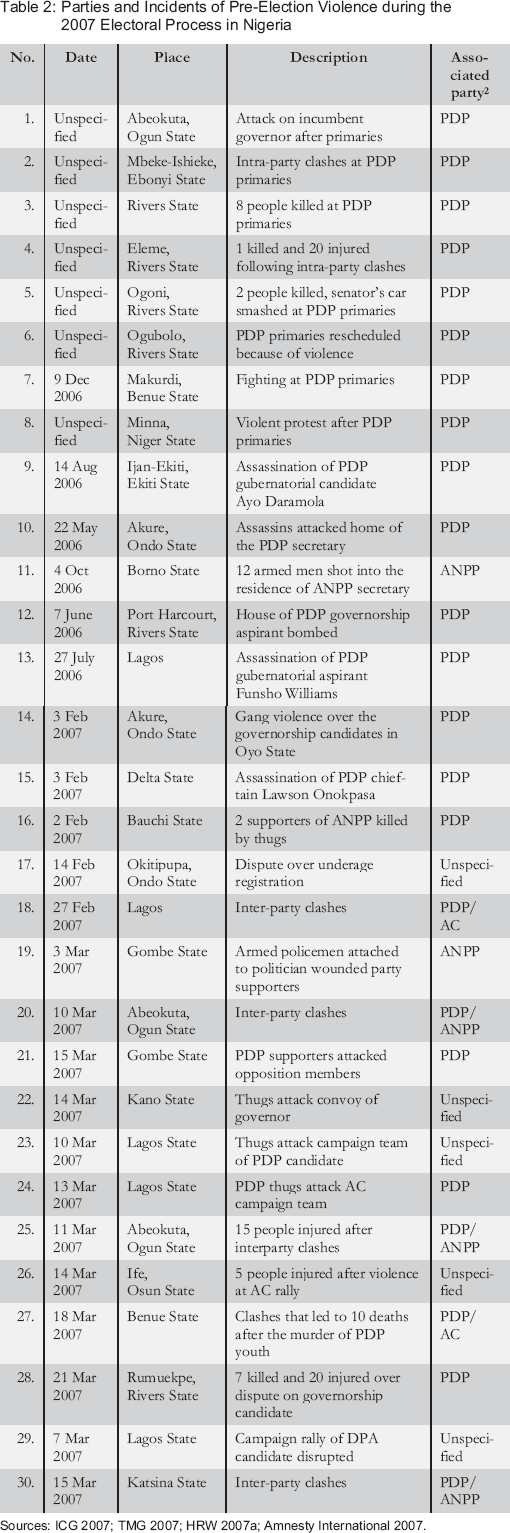
Sources: ICG 2007; TMG 2007; HRW 2007a; Amnesty International 2007.
I associate violence with parties based on the political affiliation of most of the individuals arrested or identified in connection with the various incidents. I also take into consideration the circumstances and nature of the incidents of violence.
The election-day violence shows a different pattern. The observers’ reports show that most of the contending parties engaged in acts of violence. Thus, it was more of an exchange of violence between the incumbent and the opposition parties. However, the predominance on the part of the incumbent to use state security agencies, such as police and soldiers, to best the opposition parties in 2007 provides a reason to argue that the incumbent had the upper hand in violence over the other parties on the day of polling. The TMG listed several instances of violent acts perpetrated by state security agents. It reported a “situation where security agents in many states allowed themselves to be used and manipulated by the ruling party in order to gain an unfair advantage and gave the impression that state institutions like the Nigeria Police Force [were] out to implement the bidding of the party in control of the Federal Government” (TMG 2007: 99). In addition, the EU EOM observers noted that “the role of police between the two election days and in the post-electoral environment remained a concern” because they “received numerous reports of supporters and candidates of opposition parties being arrested and detained between the 14 April and 21 April election days and then [being] released without any charge being brought against them” (EU EOM 2007: 21).
The incidence of post-election violence was more associated with the opposition parties in the reports than with the incumbent. The incidents occurred mostly in the form of protests over perceived fraud by the incumbent party. It assumed the dimensions of rioting and arson attacks on offices of the INEC, party offices and properties owned or used by politicians. The EU, NDI, SDN/IDASA and TMG observers reported the incidents in Osun, Edo, Ondo, Delta, Enugu, Ekiti, Ogun, Anambra, Kogi, Bauchi and Niger States (EU EOM 2007: 63–79). It should be stated that these violent protests were mostly staged after the winners were declared, meaning they could not have influenced the election outcome. There is also no clear evidence to indicate that those protests later influenced the decisions made by the various election tribunals and the Court of Appeal to nullify elections in many of these troubled states.
The Incumbent in the 2009 “Electoral War” in Ekiti State
Ekiti State in southwestern Nigeria gained notoriety in the local and international media following its April 2009 gubernatorial rerun elections that arguably qualify as the most violent in Nigeria's recent electoral history. 3 In February 2009 the Court of Appeal ordered a rerun election in 10 of 16 local government areas (LGAs), after ordering the PDP governor (the supposed winner of the gubernatorial election) to hand over power to the Speaker of the House of Assembly after a long dispute between the incumbent PDP and its main opposition in the region, the AC, over Ekiti State's controversial gubernatorial election in 2007. The PDP was determined to regain and retain its power in the state, as the opposition was increasingly becoming popular in the southwest region. The AC, which believed it had originally won the election in 2007 and was greatly motivated by the ruling of the court, was determined to direct all its resources and energies to challenge the incumbent in the rerun election. The election, therefore, turned out to be a highly contested competition between the two contending parties. For this reason, the campaign period was characterised by messages of violence. Dimeji Bankole, then Speaker of the Federal House of Representatives, boasted on behalf of his incumbent PDP that soldiers would be used to clamp down on the opposition and win the elections (Adegbamigbe 2009). On the other side, the main campaign slogan of the AC was “Rig and Roast” – an indication of its preparedness for the anticipated violence from its opponent (Adepoju 2009).
This assessment considers as one factor the timing of violence. The 2011 post-election violence in the northern part of the country should ordinarily qualify as the worst. However, the Ekiti State rerun election should be categorised as a worst-case scenario given that most cases of violence occurred on the polling day and not in the post-election period.
The election was adequately monitored by local independent observers under the auspices of the Civil Society Monitoring Group (CSMG). The CSMG was basically made up of ActionAid Nigeria, the Justice Development and Peace Commission (JPDC), the Women Advocates Research and Documentation Centre (WARDC), the Centre for Democracy and Development (CDD), the Women's Aid Collective (WACOL), the League for Human Rights, the New Initiative for Social Development (NISD) and the National Council of Women's Societies (NCWS). The monitoring group also collaborated with the TMG and Committee for the Defence of Human Rights (CDHR). Therefore, the CSMG's report on the elections represents a reliable source of information. The report documents large-scale violence in many voting centres across the state. Indeed, the situation was so tense that the resident electoral commissioner (the head officer of the INEC) tendered a resignation letter in the course of the elections and went into hiding after being put under pressure from politicians and receiving threats on her life (Johnson 2009; Alli 2013). In addition, elections were postponed in two voting centres in an LGA (Oye) because of intense violence. One of the monitors in Oye told journalists that it was “a terrible place to conduct [an] election” (Ogundele and Ikuomola 2009).
The high point of the report provided by the independent observers shows the predominance of the PDP in the volley of violence recorded on voting day. This is clearly illustrated in Table 3, which shows the cases of violence in the various LGAs across the state.
Parties and Incidents of Violence During the 2009 Rerun Elections in Ekiti State, Nigeria
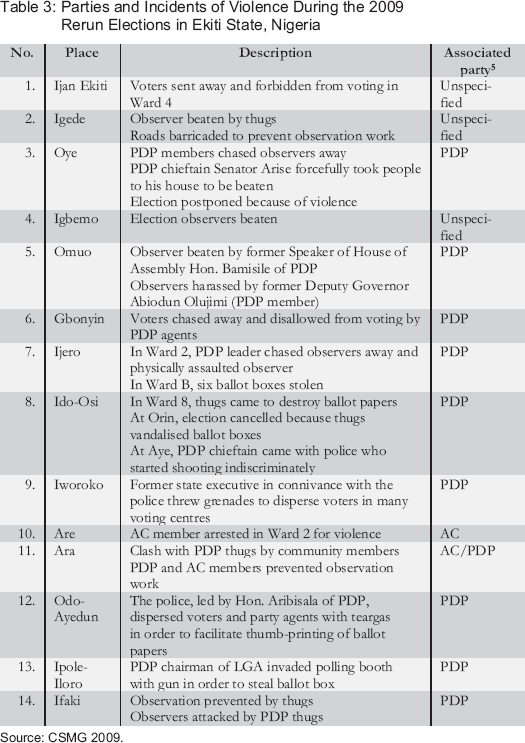
Source: CSMG 2009.
As shown in Table 3, the Ekiti rerun elections also displayed an unusual pattern of electoral violence – attacks on observers and journalists – which has the potential to expand the conception about the possible targets of attack in the literature on electoral violence. This was indeed common in Ekiti's election as a strategy used by the incumbent party to prevent reportage of its fraudulent activities. It is also connected to the belief of the incumbent that the observers and media were working for the opposition party. In addition to the deliberate attacks on election observers and journalists, the police were also used by the incumbent to harass and arrest them. The most-reported case was that of seven CSMG observers at Ifaki – the home-base of the incumbent's candidate. Leader of the observation team in the area, Abubakar Momoh (a university professor of political science), narrated their ordeal thusly:
They (PDP thugs) started asking us, “What is your mission?” We said we were observers, and they retorted that they did not believe in or recognise observers. They said we were sent by Asiwaju Bola Tinubu [an AC leader], that we were all from Lagos. We showed them our INEC registration, our personal identity cards, where we worked and all that, but they wouldn't have any of that. They tore our identity cards, went into their vehicles, harassed us with their weapons – cutlasses, bottles, all sorts of dangerous weapons – and because I was the spokesperson, they beat me up and smashed [a] bottle on my head. And the policemen, about four of them, could not do anything to protect us. (Momoh 2009) 4
This incident was also confirmed in a personal communication with Prof. Momoh on 16 June 2012.
My interpretation of the “associated party” is based on the political affiliation of the individuals involved in the acts as identified by the election observers in their reports.
Another member of the above team, Azeez Olaniyan (a university lecturer of political science), recounted his experience: “They tore our ID cards and tags, which were taken away from us; they used broken bottles on us, and Oyedokun [an officer at the National Human Rights Commission] was stripped naked and was made to walk naked to Ifaki Police State” (Ogunmola 2009). 6 Another observer that suffered the same fate at the hands of the incumbent party lamented, “This is not the first time that we [had monitored] elections. But why we were beaten and almost killed is what I still cannot understand” (Kujenya 2009).
This incident was also confirmed in a personal communication with Azeez Olaniyan on 7 July 2012 at Ado-Ekiti.
In the case of the affected journalists, Segun Bakare of the newspaper The Punch narrated, “They [PDP thugs] poked their fingers in my eyes and started beating me. They collected my camera and crushed my lenses” (Bakare 2009). Another journalist, Gbenro Adesina of Galaxy Television, related, “I was not lucky at Okemesi, where a group of PDP faithful led by a serving councillor identified as Kehinde Faro and his brother, Ayo Faro, mobilised and attacked me on the grounds that my accreditation card was fake. They did not only beat me, they took away my camera” (Adesina 2009).
While reports associate the incumbent with most of the incidents of violence on election day itself, it is clear from (my interpretation of) the reports that the opposition was deeply involved in the post-election violence in Ekiti State. My interpretation takes into consideration the backdrop of the AC-led protests that immediately followed the elections. In this process, the office of the INEC in Ido-Osi was torched. This reiterates my argument that the opposition most likely engages in post-election violence as a form of protest – rather than vote-rigging – against what they perceive as fraudulent practices by the incumbent. However, a great deal of caution should be exercised when coming to conclusions in this regard given that there were further allegations that the INEC office was actually set ablaze by PDP members over fears that the opposition had won the elections in the area. According to a PDP member who confessed at one of the election tribunal sittings on the case,
After the election around 6:00 p.m. when we got to Ido collation centre, there was trouble because we thought AC had won the election going by the result from other local government areas, which we learnt through the telephone. We in the PDP agreed to attack the collation centre and accuse Adeoti Saliu of the AC of doing so. (Sayo 2009)
It is useful to further note that the atmosphere of violence generated by the incumbent party later facilitated its declaration of a false result at the end of the elections. In what was described by observers as a “declaration at gunpoint” (Oladesu 2009: 6), the candidate of the incumbent party was declared the winner in the face of much controversy. Indeed, this necessitated another series of litigations, which lasted for another 18 months. It was only in October 2010 that the court finally declared the opposition AC candidate as the true winner. Clearly, the court's declaration of the opposition as the winner of the election further confirms the argument that the incumbent not only used organised violence to perpetrate fraud during the election, but also benefitted from the phenomenon.
Indeed, the Ekiti State rerun election has further reinforced the argument that the incumbents, rather than the opposition party, more often use violence to influence electoral outcomes in Nigeria. Collier and Vicente, although alluding to the enormous state resources at the disposal of the incumbent that facilitate vote-buying, fail to account for the incumbent's capacity to create and service a network of party thugs with state money. Most importantly, they also fail to consider the nature of executive power in Nigeria, especially regarding the use of force. The incumbent, by virtue of the enormous and unchecked power it possesses over the use of force, does have the capacity to unleash terror on the opposition and others in order to win elections and retain power. The next section, therefore, provides an analysis of the connection between executive power and electoral violence in Nigeria.
Executive Power and the Incumbent's Use of Violence Surrounding Elections
The Office [of the President in Nigeria] is the most powerful in the world because [the president] can literarily unleash all the security agencies on an individual, undermine the National Assembly. This is not in the realm of speculation, it has been happening. I experience[d] it. I had a political face-off with my boss. (Pointblank News 2012)
The above statement was made by former Vice-President Atiku Abubakar alluding to his bitter experience with former President Olusegun Obasanjo (as his superior) – his expulsion from their party and ostracisation within the federal cabinet following a heated power struggle and conflict between himself and Obasanjo. Abubakar's statement graphically illustrates the character of executive power in the current democratic system in Nigeria. Given that the institutional framework that governs the present democratic era is derived from a military system, the president is formed in the fashion of a military head of state with enormous powers far outweighing those of presidents in many other democracies. Power is highly concentrated in the office of the president, which is facilitated by a tremendously powerful federal government laid out by the Constitution. 7 Although Nigeria has a federal system, the constitution outlines a centralised police force which is solely under the authority of the president. Only the president or one of his/her ministers – acting on his/her behalf – has the authority to direct the police in the pursuit of law and order. 8 Given that the country's major sources of revenue are also centralised, the president sits on the country's vast oil-dominated national wealth with a skewed federal allocation ratio: The federal government receives 52.68 per cent of the national revenue, state governments receive 26.72 per cent and local governments receive 20.6 per cent.
The Exclusive Legislative List includes 68 privileges and powers for the federal government in the areas of mining, police, aviation, immigration, etc., while the state government has 30 items in the analogous Concurrent Legislative List.
See 1999 Constitution of the Federal Republic of Nigeria, Section 215(3), online: www.icnl.org/research/library/files/Nigeria/constitution2.pdf (19 May 2012).
It is this institutional framework that is partially responsible for what the literature now terms “imperial presidency” (Prempeh 2008; Isumonah 2012). In the Nigerian context, imperial presidency was experienced to the extreme during the era of President Olusegun Obasanjo (1999–2007), a retired general in the Nigerian army. President Obasanjo became an almighty leader and earned the status of “Father of the Nation” – he was informally referred to as Baba (“Father”) in his role as president. Obasanjo flagrantly and habitually disobeyed rulings from the courts on several occasions. He literally owned the ruling party, appointing and dismissing its chairman at will. Candidature for the party, from the presidential level right down to the local government level, was mainly decided on his desk. There was certainly no respect for the legislature, which he saw as a subordinate institution to the executive. What is more, he unleashed terror at will upon disloyal governors and politicians that stood on his path. When militants dared to murder eight soldiers in Odi, a village in the Niger Delta region, Obasanjo unilaterally declared a massive onslaught of the whole community, an act that resulted in an estimated 2,483 deaths (Environmental Rights Action 2002).
It is in the light of the above that the penchant for the use of violence to win elections by the incumbent in Nigeria can best be understood. The incumbent sees the state as a political empire that must be conquered with coercion. Aside from the normal security forces at his/her beck and call, the president also has the capacity – due to the abundant oil wealth under his/her control – to service a retinue of armed thugs that are used to promote his/her political interests. To the incumbent, the word “opposition” does not really convey co-contestant; rather, it represents an enemy on the war front. This typifies the image of personalised regimes illustrated by Robert Jackson and Carl Rosberg where the electoral game is more of a “fight” than a “contest” (Jackson and Rosberg 1982: 16). In this process, it is the incumbent that has the might to crush the “political enemies” standing in his/her way. For example, a member of the opposition party (during the electoral process) in Ekiti State told me during my field work that what happened in the 2007 elections in that state was a “political conquest” (personal communication, 2012). Also referring to the 2007 electoral process in Ekiti State, whose fall out necessitated the rerun elections, the chairman of the opposition party during the electoral process in Ekiti State, Olajide Awe, said, “Obasanjo's democratic disposition was too strong for a democracy” (personal communication, 2012). It is, therefore, unbelievable that the weakest party could have been able to match, let alone overcome, the incumbent, in the use of violence to influence elections.
Conclusion
Electoral and conflict studies gained a remarkably new perspective on electoral violence with the study by Collier and Vicente. Using the 2007 Nigerian elections as a case study, they showed that the weakest party uses violence to influence election outcomes, while the incumbent uses vote-buying and vote-miscounting. While I agree with the second aspect of the argument that associates the incumbent with vote-buying and vote-mis-counting, I argue in this study that violence is also an effective instrument of manipulation available to the incumbents in a state with strong executives. Against this backdrop, I set out to disprove Collier and Vicente's argument by presenting empirical evidence to demonstrate that the incumbent party was more associated with pre-election and election-day violence, which had the capacity to influence elections, while the opposition led in terms of post-election violence, which could not have influenced election outcomes. I further demonstrated the significance of the incumbent's violence in another violent election in a Nigerian state to strengthen the principal argument of this study. This article shows that the nature of executive power is a significant factor in explaining the predominance of incumbent violence during elections in Nigeria. The weakest party would find it very difficult to match the violence of the incumbent, given its control and access to statecraft. With this in mind, to curtail violence orchestrated by incumbents, the executive powers need to be whittled down, especially at the federal level. Emphasis should also be placed on the functionality and independence of institutions in such a way that incumbents can be subjected to a democratic system of checks and balances.